This is a repository copy of
Analysis of named entity recognition and linking for tweets
.
White Rose Research Online URL for this paper:
http://eprints.whiterose.ac.uk/92764/
Version: Accepted Version
Article:
Derczynski, L., Maynard, D., Rizzo, G. et al. (5 more authors) (2014) Analysis of named
entity recognition and linking for tweets. Information Processing & Management, 51 (2). 32
- 49. ISSN 0306-4573
https://doi.org/10.1016/j.ipm.2014.10.006
Reuse
Unless indicated otherwise, fulltext items are protected by copyright with all rights reserved. The copyright exception in section 29 of the Copyright, Designs and Patents Act 1988 allows the making of a single copy solely for the purpose of non-commercial research or private study within the limits of fair dealing. The publisher or other rights-holder may allow further reproduction and re-use of this version - refer to the White Rose Research Online record for this item. Where records identify the publisher as the copyright holder, users can verify any specific terms of use on the publisher’s website.
Takedown
If you consider content in White Rose Research Online to be in breach of UK law, please notify us by
Analysis of Named Entity Recognition
and Linking for Tweets
Leon Derczynskia, Diana Maynarda, Giuseppe Rizzob,d, Marieke van Erpc,
Genevieve Gorrella, Rapha¨el Troncyb, Johann Petraka, Kalina Bontchevaa
aUniversity of Sheffield, Sheffield, S1 4DP, UK b
EURECOM, 06904 Sophia Antipolis, France
c
VU University Amsterdam, 1081 HV Amsterdam, The Netherlands
d
Universit`a di Torino, 10124 Turin, Italy
Abstract
Applying natural language processing for mining and intelligent information ac-cess to tweets (a form of microblog) is a challenging, emerging research area. Unlike carefully authored news text and other longer content, tweets pose a number of new challenges, due to their short, noisy, context-dependent, and dynamic nature. Information extraction from tweets is typically performed in a pipeline, comprising consecutive stages of language identification, tokenisation, part-of-speech tagging, named entity recognition and entity disambiguation (e.g. with respect to DBpedia). In this work, we describe a new Twitter entity disam-biguation dataset, and conduct an empirical analysis of named entity recognition and disambiguation, investigating how robust a number of state-of-the-art sys-tems are on such noisy texts, what the main sources of error are, and which problems should be further investigated to improve the state of the art.
Keywords: information extraction, named entity recognition, entity disambiguation, microblogs, Twitter
1. Introduction
Information Extraction (IE) [1, 2] is a form of natural language analysis, which takes textual content as input and extracts fixed-type, unambiguous snip-pets as output. The extracted data may be used directly for display to users (e.g. a list of named entities mentioned in a document), for storing in a database for later analysis, or for improving information search and other information access tasks.
Named Entity Recognition (NER) is one of the key information extraction tasks, which is concerned with identifying names of entities such as people, locations, organisations and products. It is typically broken down into two
Email address: [email protected](Leon Derczynski)
1
main phases: entity detection and entity typing (also called classification) [3]. A follow-up step to NER is Named Entity Linking (NEL), which links entity mentions within the same document (also known as entity disambiguation) [4], or in other resources (also known as entity resolution) [5]. Typically, state-of-the-art NER and NEL systems are developed and evaluated on news articles and other carefully written, longer content [6, 5].
In recent years, social media – and microblogging in particular – have es-tablished themselves as high-value, high-volume content, which organisations increasingly wish to analyse automatically. Currently, the leading microblog-ging platform is Twitter, which has around 288 million active users, posting over 500 million tweets a day,2 and has the fastest growing network in terms of
active usage.3
Reliable entity recognition and linking of user-generated content is an en-abler for other information extraction tasks (e.g. relation extraction), as well as opinion mining [7], and summarisation [8]. It is relevant in many appli-cation contexts [9], including knowledge management, competitor intelligence, customer relation management, eBusiness, eScience, eHealth, and eGovernment. Information extraction over microblogs has only recently become an active research topic [10], following early experiments which showed this genre to be extremely challenging for state-of-the-art algorithms [11]. For instance, named entity recognition methods typically have 85-90% accuracy on longer texts, but 30-50% on tweets [12, 13]. First, the shortness of microblogs (maximum 140 characters for tweets) makes them hard to interpret. Consequently, ambiguity is a major problem since semantic annotation methods cannot easily make use of coreference information. Unlike longer news articles, there is a low amount of discourse information per microblog document, and threaded structure is fragmented across multiple documents, flowing in multiple directions. Second, microtexts exhibit much more language variation, tend to be less grammatical than longer posts, contain unorthodox capitalisation, and make frequent use of emoticons, abbreviations and hashtags, which can form an important part of the meaning. To combat these problems, research has focused on microblog-specific information extraction algorithms (e.g. named entity recognition for Twitter using CRFs [12] or hybrid methods [14]). Particular attention is given to microtext normalisation [15], as a way of removing some of the linguistic noise prior to part-of-speech tagging and entity recognition.
In light of the above, this paper aims to answer the following research ques-tions:
RQ1 How robust are state-of-the-art named entity recognition and linking methods on short and noisy microblog texts?
RQ2 What problem areas are there in recognising named entities in microblog posts, and what are the major causes of false negatives and false positives?
2
http://news.cnet.com/8301-1023 3-57541566-93 /report-twitter-hits-half-a-billion-tweets-a-day
3
RQ3 Which problems need to be solved in order to further the state-of-the-art in NER and NEL on this difficult text genre?
Our key contributions in this paper are as follows. We report on the con-struction of a new Twitter NEL dataset that remedies some inconsistencies in prior data. As well as evaluating and analysing modern general-purpose sys-tems, we describe and evaluate two domain specific state-of-the-art NER and NEL systems against data from this genre (NERD-ML and YODIE). Also, we conduct an empirical analysis of named entity recognition and linking over this genre and present the results, to aid principled future investigations in this important area.
The paper is structured as follows.4
Section 2 evaluates the performance of state-of-the-art named entity recog-nition algorithms, comparing versions customised to the microblog genre to conventional, news-trained systems, and provides error analysis.
Section 3 introduces and evaluates named entity linking, comparing conven-tional and recent systems and techniques. Sections 2 and 3 answerRQ1.
Section 4 examines the performance and errors of recognition and linking systems, making overall observations about the nature of the task in this genre. This section addressesRQ2.
Section 5 investigates factors external to NER that may affect entity recog-nition performance. It introduces the microblog normalisation task, compares different methods, and measures the impact normalisation has on the accuracy of information extraction from tweets, and also examines the impact that various NLP pipeline configurations have on entity recognition.
In Section 6, we discuss the limitations of current approaches, and provide directions for future work. This section forms the answer toRQ3.
In this paper, we focus only on microblog posts in English, since few linguistic tools have currently been developed for tweets in other languages.
2. Named Entity Recognition
Named entity recognition (NER) is a critical IE task, as it identifies which snippets in a text are mentions of entities in the real world. It is a pre-requisite for many other IE tasks, including NEL, coreference resolution, and relation extraction. NER is difficult on user-generated content in general, and in the microblog genre specifically, because of the reduced amount of contextual in-formation in short messages and a lack of curation of content by third parties (e.g. that done by editors for newswire). In this section, we examine some state-of-the-art NER methods, compare their performance on microblog data, and analyse the task of entity recognition in this genre.
4
2.1. Existing NER systems
A plethora of named entity recognition techniques and systems is available for general full text (cf. [16, 17, 18]). For Twitter, some approaches have been proposed but they are mostly still in development, and often not freely available. In the remainder of this section, we evaluate and compare a mixture of Twitter-specific and general purpose NER tools. We want to eliminate the possibility that poor NER on tweets is systematic – that is, related to some particular approach, tool, or technology. To this end, we evaluate a wide range of tools and describe their operation. It is also important to establish factors that contribute to making an entity difficult to recognise, and so we use the results of this multilateral comparison in a later analysis
For our analyses of generic NER systems, we chose those that take different approaches and are immediately available as open source. The first system we evaluate is ANNIE from GATE version 8 [19], which uses gazetteer-based lookups and finite state machines to identify and type named entities in newswire text. The second system is the Stanford NER system [20], which uses a machine learning-based method to detect named entities, and is distributed with CRF models for English newswire text.
Of the NER systems available for Twitter, we chose Ritter et al. [12], who take a pipeline approach performing first tokenisation and POS tagging before using topic models to find named entities, reaching 83.6% F1 measure.
In addition to these, we also include a number of commercial and research annotation services, available via Web APIs and a hybrid approach [14], named NERD-ML, tailored for entity recognition of Twitter streams, which unifies the benefits of a crowd entity recognizer through Web entity extractors combined with the linguistic strengths of a machine learning classifier.
The commercial and research tools which we evaluate via their Web APIs are Lupedia,5 DBpedia Spotlight,6 TextRazor,7 and Zemanta.8
DB-pedia Spotlight and Zemanta allow users to customize the annotation task, hence we applied the following settings: i) DBpedia Spotlight={confidence=0, support=0, spotter=CoOccurrenceBasedSelector, version=0.6}; ii) Zemanta ={markup limit:10}. 9 Their evaluation was performed using the NERD
frame-work [21] and the annotation results were harmonized using the NERD ontol-ogy.10 The NERD core ontology provides an easy alignment with the four
classes used for this task. The high-performance system reported by Microsoft Research [13] is not available for evaluation, so we could not reproduce these figures.
5
http://lupedia.ontotext.com
6
http://dbpedia.org/spotlight
7
http://www.textrazor.com
8
http://www.zemanta.com
9
We wanted to include AlchemyAPI, but its terms and conditions prohibit evaluation without permission, and requests for permission were not answered.
10
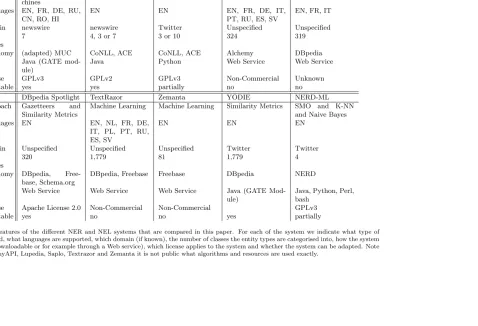
In Table 1, we present the main characteristics of the different NER systems, as well as the NEL systems that will be evaluated in Section 3.
2.2. Comparative Evaluation of Twitter NER
We evaluated the tools described above on three available datasets. The first is the corpus of tweets developed by [12]. This corpus consists of 2,400 tweets (comprising 34K tokens) and was randomly sampled. Tweet IDs are not included in this dataset, making it difficult to determine the nature of the sampling, including the relevant time window. Examining datestamps on image URLs embedded in the corpus suggest that it was collected during September 2010. The second is the gold standard data created through a Twitter annota-tion experiment with crowdsourcing at UMBC [22] (441 tweets comprising 7,037 tokens). The third is the dataset developed for the Making Sense of Microposts 2013 Concept Extraction Challenge [10], consisting of a training and test set. For our evaluations, we use the test set (4,264 tweets comprising 29,089 tokens). These datasets are all anachronistic to some degree, making them susceptible to entity drift, a significant problem in tweet datasets that we touch on in more detail in Section 3.1.1. Strict matching is used to determine scores. Due to the short document lengths, single entity mistakes can lead to large changes in macro-averaged scores, and so we use micro-averaging; that is, scores are cal-culated where each entity has equal weight, instead of weighting at document level.
These datasets use disparate entity classification schemes, which we mapped to person, location, organisation, and miscellaneous using the mappings shown in Table 2. It also needs to be noted that the different Twitter NER approaches that we evaluate and compare are trained and evaluated on small and custom datasets. This complicates carrying out a comparative evaluation and estab-lishing the state-of-the-art in Twitter NER performance.
We exclude Ritter’s T-NER system from the Ritter corpus evaluation, as the released version of the system used this data for training and development.
2.3. Results
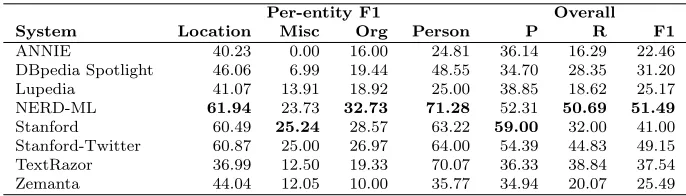
Results on the Ritter dataset are shown in Table 3. We can see that con-ventional tools (i.e., those trained on newswire) perform poorly in this genre, and thus microblog domain adaptation is crucial for good NER. However, when compared to results typically achieved on longer news and blog texts, state-of-the-art in microblog NER is still lacking. Consequently, there is a significant proportion of missed entity mentions and false positives.
A confusion matrix at token-level is also included, in Table 4. This gives an indication of the kinds of errors made by a typical NER system when applied to tweets.
Feature ANNIE Stanford NER Ritter et al. Alchemy API Lupedia Approach Gazetteers and
Finite State Ma-chines
CRF CRF Machine Learning Gazetteers and
rules
Languages EN, FR, DE, RU, CN, RO, HI
EN EN EN, FR, DE, IT,
PT, RU, ES, SV
EN, FR, IT
Domain newswire newswire Twitter Unspecified Unspecified #
Classes
7 4, 3 or 7 3 or 10 324 319
Taxonomy (adapted) MUC CoNLL, ACE CoNLL, ACE Alchemy DBpedia Type Java (GATE
mod-ule)
Java Python Web Service Web Service
License GPLv3 GPLv2 GPLv3 Non-Commercial Unknown
Adaptable yes yes partially no no
DBpedia Spotlight TextRazor Zemanta YODIE NERD-ML Approach Gazetteers and
Similarity Metrics
Machine Learning Machine Learning Similarity Metrics SMO and K-NN and Naive Bayes Languages EN EN, NL, FR, DE,
IT, PL, PT, RU, ES, SV
EN EN EN
Domain Unspecified Unspecified Unspecified Twitter Twitter #
Classes
320 1,779 81 1,779 4
Taxonomy DBpedia, Free-base, Schema.org
DBpedia, Freebase Freebase DBpedia NERD
Type Web Service Web Service Web Service Java (GATE Mod-ule)
Java, Python, Perl, bash
License Apache License 2.0 Non-Commercial Non-Commercial GPLv3
[image:7.612.134.638.131.457.2]Adaptable yes no no yes partially
Table 1: Key features of the different NER and NEL systems that are compared in this paper. For each of the system we indicate what type of approach is used, what languages are supported, which domain (if known), the number of classes the entity types are categorised into, how the system can be used (downloadable or for example through a Web service), which license applies to the system and whether the system can be adapted. Note that for AlchemyAPI, Lupedia, Saplo, Textrazor and Zemanta it is not public what algorithms and resources are used exactly.
Ritter Stanford and ANNIE
company Organisation facility Location geo-loc Location
movie Misc
musicartist Misc
other Misc
person Person
product Misc
sportsteam Organisation
[image:8.612.225.385.151.263.2]tvshow Misc
Table 2: Mappings from Ritter entity types to the Stanford and ANNIE named entity cate-gories. Most “musicartist” annotations referred to either groups or were of indeterminate size, so Misc was chosen for this category instead of Person or Organisation.
Per-entity F1 Overall
System Location Misc Org Person P R F1
ANNIE 40.23 0.00 16.00 24.81 36.14 16.29 22.46
DBpedia Spotlight 46.06 6.99 19.44 48.55 34.70 28.35 31.20 Lupedia 41.07 13.91 18.92 25.00 38.85 18.62 25.17 NERD-ML 61.94 23.73 32.73 71.28 52.31 50.69 51.49
[image:8.612.133.476.361.459.2]Stanford 60.49 25.24 28.57 63.22 59.00 32.00 41.00 Stanford-Twitter 60.87 25.00 26.97 64.00 54.39 44.83 49.15 TextRazor 36.99 12.50 19.33 70.07 36.33 38.84 37.54 Zemanta 44.04 12.05 10.00 35.77 34.94 20.07 25.49
Table 3: Named entity recognition performance over the evaluation partition of the Ritter dataset.
Gold
Tokens Loc. Misc. Org. Person O
Location 65 3 8 5 28
Misc 9 42 14 6 72
Response Organization 5 2 18 2 27
Person 9 6 6 87 34
O 20 25 26 14 8974
[image:8.612.174.439.551.619.2]Per-entity F1 Overall
System Location Org Person P R F1
ANNIE 24.03 10.08 12.00 22.55 13.44 16.84
DBpedia Spotlight 0.00 0.75 0.77 28.57 0.27 0.53 Lupedia 28.70 19.35 14.21 54.10 12.99 20.95 NERD-ML 43.57 21.45 49.05 51.27 31.02 38.65 Ritter T-NER 44.81 14.29 41.04 51.03 26.64 35.00 Stanford 48.58 27.40 43.07 64.22 29.33 40.27
[image:9.612.149.464.123.230.2]Stanford-Twitter 38.93 30.93 29.55 38.46 26.57 31.43 TextRazor 9.49 13.37 20.58 38.64 9.10 14.73 Zemanta 35.87 14.56 11.05 63.73 12.80 21.31
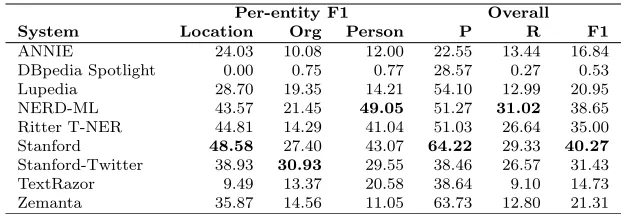
Table 5: Named entity recognition performance over the gold part of the UMBC dataset.
Gold
Tokens Location Organization Person O
Location 68 3 6 152
Response Organization 8 15 10 229
Person 9 7 33 207
O 21 11 21 6150
Table 6: Confusion matrix for Stanford NER performance over the UMBC dataset.
to represent Facility as Location, in some or all cases. Similarly, some systems will consider MusicArtist as a kind of Person, but in our mapping they are Misc, because there are also bands. All this means that, as is common, such a comparison is somewhat imperfect and thus the comparative results are lower than those usually reported in the system-specific evaluations. It should also be noted that this is also a single-annotator corpus, which has implications for bias that make it hard to discern statistically significant differences in results [23].
Performance over the UMBC data is shown in Tables 5 and 6. Scores here are generally lower than those over the Ritter data. Some were particularly
Per-entity F1 Overall
System Location Org Person P R F1
ANNIE 47.83 25.67 72.64 65.98 62.07 63.97
DBpedia Spotlight 35.23 27.39 69.11 59.27 50.42 54.49 Lupedia 33.54 21.30 62.14 65.26 39.11 48.91 NERD-ML 64.08 50.36 86.74 79.52 74.97 77.18
Ritter T-NER 43.66 13.73 83.78 76.25 65.75 70.61 Stanford 61.84 33.94 84.90 81.12 67.23 73.52 Stanford-Twitter 50.28 41.95 80.00 80.20 63.35 70.78 TextRazor 26.13 28.23 78.70 57.82 66.90 62.03
[image:9.612.149.462.541.649.2]Zemanta 46.59 6.62 45.71 29.66 27.28 28.42
Gold
Tokens Location Misc. Organisation Person O
Location 58 3 4 15 53
Misc. 4 40 3 6 167
Response Organisation 12 11 105 20 180
Person 4 4 11 1697 318
O 21 39 40 152 26122
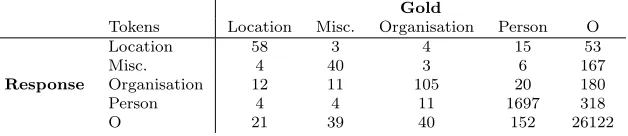
Table 8: Confusion matrix for Stanford NER performance over evaluation part of the MSM2013 dataset.
low; we attribute this to a high frequency of references to very transient entities such as pop music bands in the corpus. As the corpus was designed for use as a gold standard for measuring worker reliability in crowdsourced annotation, some particularly difficult entities may have been deliberately preferred during dataset construction. The custom-trained Stanford model achieved high scores for identifying Organisation entities again, though interestingly, the standard newswire-trained model had the best overall F1 score. The NERD-ML chain achieved the best recall score, though the fact that this value is only 31.02% indicates how difficult the dataset is.
Finally, performance over the MSM2013 dataset is given in Tables 7 and 8. This is also the reason that “MISC” entities are not scored, because no deter-ministic mapping can be made from this entity class to others. The NERD-ML approach had the overall best performance on all three stock entity types, and the Stanford NER system achieved best precision.
This particular annotation scenario, of examining only the text part of indi-vidual tweets, is sub-optimal. Microblog users often rely on sources of context outside the current post, assuming that perhaps there is some shared relation-ship between them and their audience, or temporal context in the form of recent events and recently-mentioned entities. Looking at the text in isolation removes this context, making the entity recognition harder than it would be to the actual intended reader of the message.
2.4. Analysis
[image:10.612.151.465.125.193.2]Figure 1: Sentence context surrounding person entities in a sample of newswire text
about organisations that major in terms of value, power or people (public and private companies and government organisations) while tweets discuss bands, internet companies, and sports clubs. Tweets also have a higher incidence of product mentions than the news genre, occurring in around 5% of messages.
That the entities occurring in tweets are different from those in newswire makes it hard for systems to tag them correctly. Ratinov and Roth [6] point out that given the huge potential variety in named entity expressions, unless one has excellent generalised models of the context in which entities are men-tioned, it becomes very difficult to spot previously unseen entities. This applies to gazetteer-based approaches in particular, but also to statistical approaches. Twitter is well-known as being a noisy genre, making it hard even for systems with perfect models of entity context to recognise unseen NEs correctly. For ex-ample, in newswire, person entities are often mentioned by full name, preceded by a title, constitute the head of a prepositional phrase, or start a sentence, and are always correctly capitalised. They are often followed by a possessive marker or an extended description of the entity (see Figure 1). This kind of linguistic context is well-formed and consistent, possibly having stability bol-stered by journalistic writing guidelines. In contrast, person entities in tweets are apparently stochastically capitalised, short, and occur in a variety of con-texts [25] – including simply as exclamations (see Figure 2). This is a hostile tagging environment, where one will suffer if one expects the cues learned from heavily structured newswire to be present.
Figure 2: Sentence context surrounding person entities in a sample of English tweets
3. Entity Linking
Having determined which expressions in text are mentions of entities, a follow-up information extraction task is entity linking (or entity disambigua-tion). It typically requires annotating a potentially ambiguous entity mention (e.g. Paris) with a link to a canonical identifier describing a unique entity (e.g.
http://dbpedia.org/resource/Paris). Approaches have used different en-tity databases as a disambiguation target (e.g. Wikipedia pages [26, 27, 28]) and Linked Open Data resources (e.g. DBpedia [29], YAGO [30], Freebase [28]). Linking entity mentions to such resources is core to semantic web population and identifying differences among linking tools is crucial to achieving harmo-nious output [31]. Many disambiguation targets have commonalities and links with each other, and it is often possible to map between them [21].
Microblog named entity linking (NEL) is a relatively new, underexplored task. Recent Twitter-focused experiments uncovered problems in using state-of-the-art entity linking in tweets [32, 33, 34], again largely due to lack of sufficient context to aid disambiguation. Others have analysed Twitter hashtags and annotated them with DBpedia entries to assist semantic search over microblog content [35]. Approaches based on knowledge graphs have been proposed, in order to overcome the dearth of context problem, with some success [36].
Research on NEL on microblog content has focused primarily on whole-tweet entity linking, also referred to as an “aboutness” task. The whole-whole-tweet NEL task is defined as determining which topics and entities best capture the meaning of a microtext. However, given the shortness of microtext, correct semantic interpretation is often reliant on subtle contextual clues, and needs to be combined with human knowledge. For example, a tweet mentioning iPad makes Apple a relevant entity, because there is the implicit connection between the two. Consequently, entities relevant to a tweet may only be referred to implicitly, without a mention in the tweet’s text.
From an implementational perspective, the aboutness task involves identify-ing relevant entities at whole-document level, skippidentify-ing the common NER step of determining entity bounds. In cases where the task is to disambiguate only entities which are mentioned explicitly in the tweet text, not only do the entity boundaries need to be identified (e.g. start and end character offsets), but also a target unique entity identifier needs to be assigned to that entity mention. We refer to this NEL task as “word level entity linking”. We start our NEL evaluation with word-level entity linking (Section 3.1), followed by whole tweet linking (Section 3.2).
In our NEL evaluation we compared several systems. The first is YO-DIE [37],11 which links entities to DBpedia URIs using a combination of four
metrics: string similarity, semantic similarity between nearby entities, word level contextual similarity, and URI frequency in Wikipedia articles. This sys-tem uses a Twitter tokeniser, POS tagger, and the ANNIE NER syssys-tem that we
11
described in earlier sections and is thus an end to end evaluation of microblog-adapted components (see Table 1 for details). We also included the generic NER and NEL systems DBpedia Spotlight, Zemanta, and TextRazor presented in Section 2.
3.1. Word-level Entity Linking
Word-level linking aims to disambiguate expressions which are formed by discrete (and typically short) sequences of words. This relies on accurate named entity recognition, so that the expressions to be disambiguated can be identified. Expressions that are not recognised will not be disambiguated, meaning that this stage has a marked effect on overall disambiguation performance.
Research and evaluation of world-level entity linking on microblogs is cur-rently hampered by the lack of a shared corpus of manually disambiguated en-tities. To the best of our knowledge, such resources are currently not available for others to use.12
Consequently, one of the contributions of this work is in the new corpus of world-level linked entities. It is based on Ritter’s named entity annotated dataset (see Section 2), where entity mentions in tweet text are assigned an unambiguous DBpedia URI (Unique Resource Identifier).
3.1.1. Word-level NEL Corpus
To generate the corpus, 177 entity mentions were selected for disambigua-tion. Since paid-for mechanised labour raises issues with “cheating” (intentional input of bad data) and annotation quality [38, 39], instead we recruited 10 vol-unteer NLP experts to annotate them.
Each entity mention was labelled by a random set of three volunteers. The annotation task was performed using Crowdflower [40]. Our interface design was to show each volunteer the text of the tweet, any URL links contained therein, and a set of candidate targets from DBpedia.The volunteers were en-couraged to click on the URL links from the tweet, to gain addition context and thus ensure that the correct DBpedia URI is chosen by them. Candidate entities were shown in random order, using the text from the corresponding DBpedia abstracts (where available) or the actual DBpedia URI otherwise. In addition, the options “none of the above”, “not an entity” and “cannot decide” were added, to allow the volunteers to indicate that this entity mention has no corresponding DBpedia URI (none of the above), the highlighted text is not an entity, or that the tweet text (and any links, if available) did not provide sufficient information to reliably disambiguate the entity mention.
Annotations for which no clear decision was made were adjudicated by a fourth expert who had not previously seen the annotation. As each entity annotation was disambiguated by three annotators, we determined agreement by measuring the proportion of annotations on which all three annotators made the
12
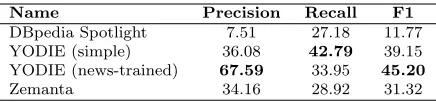
Name Precision Recall F1
DBpedia Spotlight 7.51 27.18 11.77 YODIE (simple) 36.08 42.79 39.15 YODIE (news-trained) 67.59 33.95 45.20
[image:15.612.197.415.123.174.2]Zemanta 34.16 28.92 31.32
Table 9: Tweet-level entity linking performance our entity-disambiguated dataset. YODIE results are for a whole-pipeline approach.
same choice. Out of the resulting 531 judgements, unanimous inter-annotator agreement occurred for 89% of entities. The resulting resource consisted of 182 microblog texts each containing entity mentions and their assigned DBpedia URIs; we make this resource available to the public with this paper. A case study relating this particular crowdsourcing exercise is detailed in [41].
Documents in the corpus were collected over a short period of time. Some-times this can cause problems, as due to entity “drift” [42], the selection of entities prevalent in social media (and other) discourse changes over time. As a result, systems trained on one dataset may perform well over that dataset and other datasets gathered at the time, but not actually generalise well in the long run [43]. In this case, the corpus is only used as evaluation data and not for training, and so this evaluation does not give an artificially drift-free scenario.
3.1.2. Evaluation Results
Evaluation was performed using direct strict matches only: that is, any en-tity extent mistakes or disambiguation errors led to an incorrect mark. Future evaluation measures may be interested in both lenient NER evaluation (with e.g. overlaps being sufficient) as well as lenient entity disambiguation grad-ing, through e.g. allowing entities connected through skos:exactMatch or even owl:sameAs to be credited as correct. However, for this work, we stay with the strictest measure.
Results are given in Table 9. Note that the recall here is not reliable, as we have “downsampled” the set of URIs returned so that all fall within DBpedia, and DBpedia does not contain references to every entity mentioned within the dataset. In addition, due to the specifics of the CrowdFlower NEL interface, annotators could not indicate missed entities for which no candidates have been assigned, even if such exist in DBpedia. Therefore, no result is placed in bold in this dataset. We perform this downsampling so that we may find the simplest possible base for comparison.
3.1.3. Error analysis
Group All capitals All lowercase Sentence case
Mean proportion per tweet 7.9% 74.1% 18.1%
False positives 22.4% 4.7% 65.9%
[image:16.612.149.461.124.164.2]False negatives 9.3% 39.8% 37.3%
Table 10: Proportion of false negatives and false positives from Stanford NER over the Ritter dataset, grouped by word case.
Amongst the systems compared here, YODIE performed best, which should be attributed at least partly to it using Twitter-adapted pre-processing compo-nents.
One major source of mistakes is capitalisation. In general, microblog text tends to be poorly formed and typical entity indicators in English such as mid-sentence capitalisation are often absent or spuriously added to non-entities.
To demonstrate this point, we compare the proportional distribution of lower, upper and sentence-case words in a sentence with the tokens which are subject to false positives or false negatives, in Table 10. It can be seen that the majority of false positives are in sentence case, and the largest part of false neg-atives are in lowercase. Conversely, almost no false positives are in lower case. In both cases, very different proportions are mislabelled from the underlying distributions of case, indicating a non-random effect.
Tweet text is often short, too, and sometimes even human annotators did not have enough context to disambiguate the entities reliably. For example, one candidate tweet mentioned “at Chapel Hill”. While “Chapel Hill” is almost certainly a location, it is a very common location name, and not easy to dis-ambiguate even for a human. Indeed, annotators disagreed enough about this tweet for it to be excluded from the final data.
Further, one may mention a friend’s name, which is correctly tagged as a named entity; however, the friend is almost certainly not listed in the general knowledge resources such as DBpedia, and therefore cannot be disambiguated against this resource (i.e., we have no choice but to assign a “nil” URI, indi-cating that the result could not be disambiguated). In such cases, a FOAF reference [44] would perhaps be more suitable.
Also, many named entities are used in unconventional ways. For example, in the tweet “Branching out from Lincoln park after dark ... Hello “Russian Navy”, it’s like the same thing but with glitter!”, there are no location or organisation entities. Note that Russian Navy is collocated with glitter, which is a little unusual (this could be determined through language modelling). It refers in fact to a nail varnish colour in this context, and is undisambiguable using DBpedia or many other general-purpose linked entity repositories. Lincoln Park After Dark is another colour, and compound proper noun, despite its capitalisation – it does not refer to the location, Lincoln Park.
System Precision Recall F1
DBpedia Spotlight 20.1% 47.5% 28.3%
TextRazor 64.6% 26.9% 38.0%
[image:17.612.201.412.123.164.2]Zemanta 57.7% 31.8% 41.0%
Table 11: Performance of entity linking over the WSDM2012 tweet dataset; note low perfor-mance due to varying levels of specificity in tweet-level annotations.
terse genre. As usual, there is a trade-off between precision and recall. This can be affected by varying the number of candidate URIs, where a large number makes it harder for a system to choose the correct one (i.e. reduces precision), and fewer candidate URIs risks excluding the correct one entirely (i.e. reduces recall).
3.2. “Whole tweet” Entity Linking
The most appropriate dataset to evaluate whole tweet entity linking is the topic-disambiguated dataset detailed in [33]. It contains both tweets and the corresponding Wikipedia articles, which are the topic of these tweets. Since each tweet is topic-annotated, there is no guarantee that the corresponding Wikipedia article is an entity (e.g. topics include “website”, “usability”, and “audience”). Even when the assigned topics are entities, the tweets often contain other entities as well, which are not annotated. These characteristics make measurements using this dataset only a rough indicator of entity linking performance.
3.2.1. Evaluation Results
We evaluated the performance of DBpedia Spotlight, Zemanta and Tex-tRazor on this corpus (see Table 11). These are the systems that are geared to providing whole-tweet accuracy; including others would generate mislead-ing results. Only the top-ranked entities were considered for matchmislead-ing, and we discarded recognised but unlinked entities.
3.2.2. Error analysis
DBpedia Spotlight performed quite poorly in terms of precision, probably due to the nature of the dataset, although it achieved the highest recall. In contrast, Zemanta performed poorly in terms of recall, but reasonably on pre-cision, thus achieving the highest F1 score. TextRazor, although connected to a variety of linking resources, had the worst recall, but the highest precision.
3.3. Discussion
To summarise, named entity linking in tweets is a challenging task, due to the limited surrounding context, as well as the implicit semantics of hashtags and user name mentions.
Furthermore, comparing methods reliably is currently very difficult, due to the limited datasets available in this genre. As a first step towards alleviating this problem, we have created a small-size gold standard of tweets, which are expert annotated with DBpedia URI. We are currently working on expanding this gold standard through paid-for CrowdFlower experiments, where the cur-rent data will be used as gold standard units to help train and monitor the worker’s performance. This is an essential step in the prevention of cheating, where annotators deliberately enter nonsense data in order to save time. We will also require multiple judgements per disambiguated entity, so that low quality annotations can be detected and removed in a reliable manner [39, 45].
In terms of method performance, one of the main sources of errors is unreli-able microblog capitalisation. In news and similar genres, capitalisation is often a reliable indicator of a proper noun, suggesting a named entity. Unfortunately, tweets tend to be inconsistently capitalised and performance suffers as a result. This can in part be attributed to prior named entity recognition problems, in part – to the lack of suitably entity annotated gold standard datasets, and in part – to the short, noisy, and context-dependent nature of tweets. The rest of the paper discusses ways of addressing some of these problems.
4. Analysis
So far, we have demonstrated experimentally that extracting information from microblog text is a challenging task. Problems lie both in named entity recognition and in entity linking, having negative impact on each subsequent task. Some genre-adaptation has been attempted, often successfully, but far from the performance levels found on established text genres, such as news. In this section, we discuss first why processing microblogs is so challenging, and then carry out error analysis. These lead to evidence-based suggestions for future research directions towards improved NER and NEL for microblog text.
4.1. General Microblog Challenges
Microblogs have a number of genre-specific characteristics, which make them particularly challenging for information extraction in general, and NER and NEL in particular. These are as follows:
Noisy content: social media content often has unusual spelling (e.g. 2moro), irregular capitalisation (e.g. all capital or all lowercase letters), emoticons (e.g. :-P), and idiosyncratic abbreviations (e.g. ROFL, ZOMG). Spelling and capitalisation normalisation methods have been developed and will be discussed in Section 5.3.
Social context is crucial for the correct interpretation of social media content. NER and NEL methods need to make use of social context (e.g. what are the names of the poster’s social connections, where is the poster located), in order to disambiguate mentions of person names and locations reliably.
User-generated: since users produce as well as consume social media content, there is a rich source of explicit and implicit information about the user, e.g. demographics (gender, location, age), friendships. The challenge here is how to combine this information with knowledge from external resources, such as DBpedia, in order to achieve the best possible accuracy and coverage of the NER and NEL methods.
Multilingual: Social media content is strongly multilingual. For instance, less than 50% of tweets are in English, with Japanese, Spanish, Portuguese, and German also featuring prominently [46]. Unfortunately, information extraction methods have so far mostly focused on English, while low-overhead adaptation to new languages still remains an open issue. Auto-matic language identification [46, 48] is an important first step, allowing applications to first separate social media in language clusters, which can then be processed using different algorithms.
Next, we turn to an analysis of errors and discuss how these could be ad-dressed.
4.2. Prevalent Errors
The main source of errors lies in the difficult cases, which are specific to this genre and are problematic for all stages of NER and NEL. We examined the datasets to find qualitative explanations for the data. Then, for each of these, we quantify the impact of each explanation.
4.2.1. Capitalisation
The first error source is capitalisation, which causes problems for POS tag-ging, NER and entity linking. In each case, where capitalisation is used in well-formed text to differentiate between common nouns and proper nouns, al-tering this information (e.g. through use of lower caps for convenience or all caps for emphasis) has led to incorrect decisions being made. Correcting cap-italisation is difficult, especially in the cases of polysemous nouns that have named entity senses (e.g. eat an apple vs. Apple Inc., orthe town Little Rock
vs. throw a little rock).
All words Named entities only
Corpus Lower Sentence Caps Lower Sentence Caps
Penn Treebank / WSJ 68.5% 25.5% 5.9% 1.1% 84.5% 14.0%
Ritter 76.1% 15.8% 7.6% 14.3% 71.3% 11.4%
MSM 65.9% 25.5% 8.2% 6.4% 86.0% 6.2%
[image:20.612.137.476.123.184.2]UMBC 73.4% 20.2% 5.7% 17.3% 71.6% 8.8%
Table 12: Capitalisation, in twitter and newswire corpora.
presented in capitals or sentence case. We examine the general capitalisation of words in newswire and twitter text, looking at both all words and just named entities. Table 12 shows that while the corpora in general exhibit similar pro-portions of lower case, sentence case (i.e. with only the first letter capital), and upper case words, entities in the newswire corpus have distinct capitalisation. Notably, they have the lowest likelihood of being in lowercase, a high likelihood of being in sentence case, and the comparatively highest likelihood of being in capitals. Named entities in social media text are more likely to be expressed using lower case. Indeed, the data suggest that the MSM corpus is the clos-est to the clean PTB news text that NER systems are trained on. This goes partly towards explaining the high NER results reported in Table 12, whereas the Ritter and UMBC corpora are much harder for the NER systems.
To investigate the information conveyed by capitalisation, we compared en-tity recognition on a newswire dataset with performance on the same dataset with all tokens lowercased, using the default newswire-trained Stanford NER tool and part of the CoNLL dataset [24]. On the plain dataset, the tool achieves 89.2 precision and 88.5 recall. On the lower case version, it reaches a lower pre-cision of 81.7 and a low recall of 4.1, for an F1 of 7.8. The performance drop is large. This suggests that the capitalisation variations observed in tweets are damaging to named entity recognition performance.
4.2.2. Typographic errors
Secondly, typographic errors confuse many pre-linking stages, specifically tokenisation, POS tagging, and NER. Added, skipped and swapped letters have all been found to cause problems. Although normalisation offers some help, the state-of-the-art does not yet give a good enough balance between ignoring correct out-of-vocabulary (OOV) words and correctly repairing mistyped in-vocabulary (IV) words, demonstrated in the low impact that normalisation has on NER performance (see Section 5.3).
Corpus IV OOV
Penn Treebank / WSJ 86.1% 13.9%
Ritter 70.4% 29.6%
MSM 66.5% 33.5%
[image:21.612.223.388.122.175.2]UMBC 72.9% 27.1%
Table 13: Proportion of in- and out-of-vocabulary words in newswire and twitter corpora.
Corpus NE Recall NE Precision
MSM 53.7% 63.5%
UMBC 37.1% 31.5%
WSJ - unperturbed 89.2% 88.5%
WSJ - perturbed 85.6% 84.3%
Table 14: Statistical NE recognition performance over social media, newswire and perturbed newswire text.
Treebank. The vocabulary used was the iSpell dictionary, having 144K entries.13
Results are given in Table 13. The social media text has an OOV rate 2-2.5 times that of newswire text. Note that the MSM corpus has the highest OOV rate of all microblog corpora, and yet NER results on that are the best of all three.
To determine the impact that these errors have on statistical named entity recognition, we increase the OOV rate in gold-standard named entity annotated newswire text to that found in social media text. This is done by randomly per-turbing IV tokens in newswire text14to make them OOV. Our perturbed corpus
ended up with an IV rate of 58.3%. The entity recognition rate is then compared on newswire, perturbed newswire and social media, using the default newswire-trained Stanford NER tool. Data was taken from the CoNLL dataset and the four-class model used. Results are given in Table 14. It can be seen that per-turbing the newswire dataset’s spellings has a negative impact on named entity recognition performance, though it does not account for all of the performance gap between social media and newswire.
4.2.3. Shortenings
Thirdly, microblog shortness encourages the use of a compressed form of language. This leads to rare, uncommon or incomplete grammatical structures being used, as well as abbreviations, heavy pronoun use and uncommon abbrevi-ations. Typically, one would use linguistic context to unpack these information-dense, peculiarly-structured utterances; however, that is often not available. This creates many problems, and perhaps the best way to overcome it is to create large and more-richly annotated resources.
13
http://www.gnu.org/software/ispell
14
[image:21.612.204.410.202.256.2]Corpus Chars per word Words per sent. Slang shortenings
Newswire (PTB WSJ) 5.1 9.1 0.0059%
Ritter 4.1 14.8 0.85%
MSM 4.3 14.0 0.43%
[image:22.612.134.479.123.175.2]UMBC 4.3 12.5 0.20%
Table 15: Word length, sentence length and slang incidence in twitter and newswire corpora.
We compare word length (in characters) and sentence length (in words) across twitter and newswire corpora. We also measure the occurrence of short-ened words forms in newswire and tweets, using a slang list developed for twitter part-of-speech tagging [49]. Results are given in Table 15. Words are generally shorter in tweets. Sentences appear longer in tweets, which is counter-intuitive. It may be due to the inclusion of hashtags and URLs at the end of tweets, which are often introduced without ending the body sentence with e.g. a full stop. However, although slang is an order of magnitude more frequent, it is still rare in tweets.
4.2.4. Other problems
As discussed in Section 3, the lack of context is a particular problem in the entity linking task. Even the best performing systems reach scores much lower than they would on well-formed text. As with other linguistic disambiguation tasks, context is critical to resolving polysemous words. Methods for increasing the amount of available context are therefore required.
Finally, there is a general need for larger linguistic resources for NEL and NER. Annotated microblog text is particularly rare, and in this difficult genre, very much needed, in order to improve the performance of the supervised learn-ing methods.
5. Reducing Microblog Noise through Pre-Processing
As discussed in Section 4, microblog noise is one of the key sources of NER and NEL errors. Moreover, since NER and NEL approaches tend to rely on shallow, upstream pre-processing components (e.g. language detection, tokeni-sation, part-of-speech tagging), mistakes due to noise tend to cascade down the pipeline.
System Overall English Dutch French German Spanish
TextCat 89.5% 88.4% 90.2% 86.2% 94.6% 88.0%
langid 89.5% 92.5% 89.1% 89.4% 94.3% 83.0%
Cybozu 85.3% 92.0% 79.9% 85.8% 92.0% 77.4%
TextCat (twitter) 97.4% 99.4% 97.6% 95.2% 98.6% 96.2%
[image:23.612.137.477.123.185.2]langid (twitter) 87.7% 88.7% 88.8% 88.0% 92.5% 81.6%
Table 16: Language classification accuracy on the ILPS dataset for systems before and after adaptation to the microblog genre.
5.1. Language Identification
Since microblog content is strongly multilingual (see Section 4), language identificationneeds to be performed prior to other linguistic processing, in order to ensure that the correct NER and NEL component is run. Named entity recognition depends on correct language identification. Not only do names have different spellings in different languages, but critically, the surrounding syntactic and lexical context is heavily language-dependent, being filled with e.g. names of jobs, or prepositions (Figure 1).
TextCat [50] and the Cybozu language detection library [51] rely on n-gram frequency models to discriminate between languages, relying on token sequences that are strong language differentiators. Information gain-based langid.py [48] uses n-grams to learn a multinomial event model, with a feature selection process designed to cope with variations of expression between text domains. Both TextCat and langid.py have been adapted for microblog text, using human-annotated data from Twitter. The former adaptation [46] works on a limited set of languages; the latter [52] on 97 languages.
We evaluated system runs on the ILPS TextCat microblog evaluation dataset.15 Results are given in Table 16, with the Twitter-specific versions
marked “twitter”. Microblog-adapted TextCat performed consistently better than the other systems.
The adapted version of TextCat has a slightly easier task than that for langid.py because it expects only five language choices, whereas the adapted langid.py is choosing labels from a set of 97 languages. The latter assigned a language outside the five available to 6.3% of tweets in the evaluation set. The adapted langid.py performed worse than the generic version. The results are quite close for some languages, and so if an approximate 6% improvement could be made in these cases, the Twitter-adapted version would be better. Although language identification is harder on tweets than on longer texts, its performance is sufficiently high to inform reliable choices in later stages.
15
Approach Accuracy Sentence On unknowns Newswire
Brill 93.9% 28.4%
-Stanford Tagger 97.3% 56.8% 90.5%
Microblog
Brill 70.5% 2.54% 13.1%
Stanford Tagger 73.6% 4.24% 26.6%
Brill (twitter) 78.6% 8.47% 28.5%
Derczynski/Stanford (twitter) 88.7% 20.3% 72.1%
Ritter (twitter) 88.3% -
-Owoputi (twitter) 90.4% 22.0%
-Table 17: POS tagging performance on two corpora: extracts from the Wall Street journal (newswire), and a 25% part of Ritter’s corpus. The latter is tagged with and without in-genre training data. Accuracy is measured at both token and sentence level.
5.2. Part-of-speech Tagging
Part-of-speech (POS) tagging is generally the next stage in a semantic an-notation pipeline following tokenisaton, and is necessary for many tasks such as named entity recognition and linking. Early high-performance tagging ap-proaches include the Brill tagger, which uses transformation-based learning, and has the benefit of being fast [53]. Later, Toutanova et al. [54] introduced the Stanford tagger, trained on newswire texts, and which has sophisticated feature extraction, especially for unknown words, and a highly configurable re-trainable engine. Models using the Penn Treebank (PTB) tagset [55] are available for both these taggers.
However, these are not necessarily suitable for microblogs, and thus specific taggers have been developed to handle these. We concentrate on the PTB tagset, as many existing NLP components expect this labelling schema, and changes in tagset hamper tagger comparison. Ritter et al. [12] trained on PTB-tagged tweets, adding extra tag labels for retweets, URLs, hashtags and user mentions. Their work also included the distribution of a ground truth annotated tweet dataset.
We use the experimental setup detailed in Ritter’s paper, apart from using a fixed train/test split in the Twitter data, where the evaluation portion had 2,242 tokens. Results are given in Table 17, including comparison against sections 22-24 of the Wall Street Journal part of the Penn Treebank [55].
The results for the Stanford and Brill taggers trained on newswire text show poor success rates; it was not possible to re-train the Ritter tagger on newswire data only. Results are also given for the taggers trained on Twitter data – a re-trained, re-tuned Stanford tagger [49], Ritter’s stock tagger,16and the CMU
[image:24.612.154.456.122.233.2]Person Location Organisation
Prec. Recall Prec. Recall Prec. Recall
With Twitter PoS tagging 28 21 71 25 14 7
[image:25.612.146.465.125.165.2]With newswire PoS tagging 26 21 71 25 13 6
Table 18: Impact of domain-specific PoS tagging on NER.
unknown word tagging accuracy.
To measure the impact that domain adaptation of POS tagging has on NER in tweets, we attempted NER using part of speech tags generated by a Twitter-specific and a generic tagger. This was done using GATE ANNIE. The results are shown in Table 18.
A small performance benefit is realised, but recall remains low. It is worth noting that ANNIE is largely gazetteer-based, and so less sensitive to some types of noise, including wrong POS tags. Balancing this advantage is the limited recall of gazetteers when faced with previously unseen items, visible here. However, statistical machine learning-based tools do not reach good levels of recall on tweets either. We did not perform an analysis using the Stanford NER tool and different POS tag sources because this NER tool includes very similar features to those used for POS tagging, and we have already demonstrated the significant impact that in-domain training data has on it (Table 3). For further comment on this issue, see the MSM2013 challenge [10], where it was noted that many of the top-performing systems included custom POS taggers.
Despite the significant error reduction, current microblog-adapted POS tag-ging performance is still not as high as on longer, cleaner content, which impacts NER and NEL performance negatively.
5.3. Normalisation
Normalisation is a commonly proposed solution in cases where it is necessary to overcome or reduce linguistic noise [56]. The task is generally approached in two stages: first, the identification of orthographic errors in an input dis-course, and second, the correction of these errors. Example 1 shows an original microblog message, including a variety of errors, and the post-normalisation text.
(1) Source text: @DORSEY33 lol aw . i thought u was talkin bout another time . nd i dnt see u either !
Normalised text: @DORSEY33 lol aww . I thought you was talking about another time . And I didn’t see you either !
16
As can be seen, not all the errors can be corrected (wasought to bewere, for example) and some genre-specific slang remains – though not in a particularly ambiguous sense or grammatically crucial place. A variety of custom approaches to normalisation has been developed for Twitter. In this section, we present state-of-the-art normalisers; following this, we evaluate the effectiveness of two approaches for improving named entity extraction and linking.
5.3.1. Normalisation Approaches
Normalisation approaches are typically based on a correction list, edit-distance based, cluster-based, or a mixture of these, with hybrid approaches common. Gazetteer-based approaches can be used to repair errors on all kinds of words, not just named entities; for example, Han et al. [57] construct a general-purpose spelling correction dictionary for microblogs. This achieves state-of-the-art performance on both the detection of mis-spelled words and also applying the right correction. It is also possible to use a heuristic to suggest correct spellings, instead of a fixed list of variations.
In the case of microblogs, it has been found that slang accounts for three times as many mis-taggings as orthographic errors [11]. To this end, as well as investigating a heuristic normaliser, we investigate the performance impact that a custom gazetteer-based general-purpose pre-recognition dictionary has on NER.
Our gazetteer approach is constructed from the Ritter dataset’s training split. Creation of the gazetteer is labour-intensive, and the approach is not flexible when taken across domain, across languages or presented with new kinds of slang or nicknames. Our heuristic normalisation approach is taken from Han and Baldwin [15]. It uses a combination of edit distance, phonetic distance (double metaphone), and a small fixed list of slang words.
Normalisation is not a perfect process. We noted three major types of mis-take:
Sentiment change: Some words can be corrected to another word with differing sentiment, that is orthographically close. Tolerating mistakes within a Levenshtein edit distance of 2 – a common limit in this task – allowsin-, im-,
un- and an- prefixes to be stripped, thus reversing the meaning of a word in some cases. For example,unpossible →possible anduntalented →talented.
IV errors: The core vocabulary for discriminating between IV/OOV can be too small, or have too low a weight over other factors. Corrections are made to correctly-spelled words as a result, e.g. roleplay → replay and armwarmers
→armorers.
Entity type No norm Gazetteer norm Heuristic norm
Organisation 28.6% 28.6% 29.6%
Location 60.5% 60.5% 62.6%
Person 63.2% 63.6% 62.8%
[image:27.612.169.439.125.176.2]Overall 49.1% 47.6% 49.3%
Table 19: Impact of gazetteer and machine-learning based normalisation techniques on NER F1 measure when extracting named entities, using Stanford NER with a Twitter-trained model.
5.3.2. Impact of Microblog Normalisation on NER Performance
We measured the performance impact of basic and strong normalisation over a machine-learning based NER system (Stanford CRF NER). Results are given in Table 19.
The Stanford NER system relies on context, and so might be more affected by normalisation, which is reflected in the reported results. In fact, this system only realises NER performance benefits from strong normalisation. While per-category F1 scores are roughly the same (or even slightly improved) with basic normalisation, entities of other types are missed more frequently than without normalisation, leading to an overall decrease in performance. Use of full normal-isation did not cause any more entities to be missed than the no-normalnormal-isation baseline, but did slightly reduce the false positive rate.
This motivates our conclusion that while certainly helpful, normalisation is not sufficient to be the sole method of combatting microblog noise.
6. Conclusion
This paper demonstrated that state-of-the-art NER and NEL approaches do not perform robustly on ill-formed, terse, and linguistically “compressed” microblog texts. Some Twitter-specific methods reach F1 measures of over 80%, but are still far from the state-of-the-art results achieved on newswire.
Next the paper examined the major causes of this poor performance. Poor capitalisation, in particular, causes very significant drops in NER (and thus NEL) recall, not just on microblog content, but also on lowercased newspaper content. Typographic errors and the ubiquitous occurrence of out-of-vocabulary words in microblogs are also detrimental to precision and recall, but the effect is much less prononunced than that of poor capitalisation. We also demonstrated that shortenings and slang are more pronounced in tweets, but again, their effect is not as significant. Moreover, all machine learning NER and NEL methods suffer from the lack of annotated training microblog content, while entity linking methods also suffer from the lack of sufficient context.
NER and NEL performance. While this leads to some improvements, preci-sion and recall still remain low. In ongoing work, we are now experimenting with training a microblog-specific recaser, in order to address the capitalisation problem.
This experiment notwithstanding, we argue that NER and NEL performance will still suffer, due to the very different kinds of entities that are typical in microblogs, as compared against news texts from the training data. Therefore, our conclusion is that microblog-specific NER and NEL algorithms need to be developed, if we are to reach the same level of precision and recall as we now have on news articles.
Moreover, specific to entity linking, the surrounding textual context in mi-croblogs is often not sufficient for disambiguation, even for human annotators. This makes entity linking in microblogs a particularly challenging, open research problem. One approach for combating this problem involves leveraging struc-tured knowledge bases, such as Wikipedia, to improve the semantic annotation of microposts with the hope that injecting more prior knowledge will counter-balance the lack of context. Secondly, additional context could come from other messages belonging to the microblog author. Links posted by the user, and the content of their user profile, also provide additional linguistic context. Thirdly, methods may also bring the author’s friends content as additional context, pos-sibly even linking to other sites, using a multi-layered social network model [58]. Last, but not least, creating more human-annotated training corpora of mi-croblog content will allow better algorithm adaptation and parameter tuning to the specifics of this genre. For example, there are currently fewer than 10,000 tweets annotated with named entity types, which is far from sufficient. One way to address this data challenge is through crowdsourcing such corpora in their entirety [45]. A cheaper approach could be to integrate crowdsourcing within the NER and NEL algorithms themselves [59]. In this way, NE mentions that can be linked automatically and with high confidence to instances in the Linked Open Data cloud, will not need to be shown to the human annotators. The latter will only be consulted on hard-to-solve cases, which will improve result quality while also lowering the annotation costs.
The creation of such new corpora will also aid comparative evaluations, since, as demonstrated in this paper, current corpora suffer from a number of shortcomings. Namely, issues arise from incompatible annotation types used in the various corpora, i.e. some cover only the four basic types (PER, LOC, ORG, MISC), whereas others make much finer-grained distinctions. Another problem is that tweet-level entity linking requires corpora that focus purely on entities, without mixing topics as well. One step in that direction is the corpus from the TAC knowledge base population task17 (TAC-KBP), which
has a NEL task using Wikipedia infoboxes as disambiguation targets. Datasets cover English, Spanish, and Chinese, however, none of these will be microblogs. Only longer textual genres will be covered (newswire, web content, discussion
17
fora), annotated for persons, organisations, and geo-political entities. At the very least, this would be a useful resource for initial training on web and forum content, although microblog-specific data will still be critical.
Acknowledgments
The authors thank Roland Roller and Sean McCorry of the University of Sheffield, and the CrowdFlower workers, for their help in annotating the entity-linked dataset; and the reviewers for their constructive remarks.
This work was partially supported by the UK EPSRC grants Nos. EP/I004327/1 and EP/K017896/1 uComp,18and by the European Union under
grant agreements No. 611233Pheme,19No. 287863 TrendMiner,20No. 287911
LinkedTV,21 and No. 316404 NewsReader.22
References
[1] C. Cardie, Empirical Methods in Information Extraction, AI Magazine 18 (4).
[2] D. E. Appelt, An Introduction to Information Extraction, Artificial Intel-ligence Communications 12 (3) (1999) 161–172.
[3] R. Grishman, B. Sundheim, Message understanding conference - 6: A brief history, in: Proceedings of the 16th
Conference on Computational linguis-tics (COLING’96), Copenhagen, Denmark, 1996.
[4] L. Hirschmann, N. Chinchor, MUC-7 coreference task definition, in: Pro-ceedings of MUC-7, 1997.
[5] D. Rao, P. McNamee, M. Dredze, Entity Linking: Finding Extracted En-tities in a Knowledge Base, in: Multi-source, Multi-lingual Information Extraction and Summarization, 2013.
[6] L. Ratinov, D. Roth, Design challenges and misconceptions in named en-tity recognition, in: Proceedings of the Thirteenth Conference on Compu-tational Natural Language Learning, CoNLL ’09, 2009.
[7] D. Maynard, K. Bontcheva, D. Rout, Challenges in developing opinion mining tools for social media, in: Proceedings of the @NLP can u tag #usergeneratedcontent?! workshop at LREC’12, 2012.
18
http://www.ucomp.eu
19
http://www.pheme.eu
20
http://www.trendminer-project.eu/
21
http://www.linkedtv.eu
22
[8] D. Rout, K. Bontcheva, M. Hepple, Reliably evaluating summaries of twit-ter timelines, in: Proceedings of the AAAI Workshop on Analyzing Micro-text, 2013.
[9] L. Derczynski, B. Yang, C. Jensen, Towards Context-Aware Search and Analysis on Social Media Data, in: Proceedings of the 16th
Conference on Extending Database Technology (EDBT’13), 2013.
[10] A. E. C. Basave, A. Varga, M. Rowe, M. Stankovic, A.-S. Dadzie, Mak-ing Sense of Microposts (#MSM2013) Concept Extraction Challenge, in: Proceedings of the Making Sense of Microposts (#MSM2013) Concept Ex-traction Challenge, 2013.
[11] L. Derczynski, D. Maynard, N. Aswani, K. Bontcheva, Microblog-Genre Noise and Impact on Semantic Annotation Accuracy, in: Proceedings of the ACM Conference on Hypertext and Social Media (HT’13), 2013.
[12] A. Ritter, S. Clark, Mausam, O. Etzioni, Named Entity Recognition in Tweets: An Experimental Study, in: Proceedings of the Conference on Empirical Methods in Natural Language Processing (EMNLP’11), 2011.
[13] X. Liu, M. Zhou, F. Wei, Z. Fu, X. Zhou, Joint inference of named entity recognition and normalization for tweets, in: Proceedings of the Association for Computational Linguistics (ACL’12), 2012, pp. 526–535.
[14] M. van Erp, G. Rizzo, R. Troncy, Learning with the Web: Spotting Named Entities on the intersection of NERD and Machine Learning, in: Proceed-ings of the 3rd
Workshop on Making Sense of Microposts (#MSM2013), 2013.
[15] B. Han, T. Baldwin, Lexical Normalisation of Short Text Messages: Makn Sens a #twitter, in: Proceedings of the 49th
Annual Meeting of the As-sociation for Computational Linguistics: Human Language Technologies (ACL-HLT’11), 2011.
[16] D. Nadeau, S. Sekine, A survey of named entity recognition and classifica-tion, Lingvisticae Investigationes 30 (1) (2007) 3–26.
[17] A. Roberts, R. Gaizauskas, M. Hepple, Y. Guo, Combining terminology re-sources and statistical methods for entity recognition: an evaluation, 2008.
[18] M. Marrero, S. Sanchez-Cuadrado, J. Lara, G. Andreadakis, Evaluation of Named Entity Extraction Systems, Advances in Computational Linguistics, Research in Computing Science 41.
[20] J. Finkel, T. Grenager, C. Manning, Incorporating Non-local Information into Information. Extraction Systems by Gibbs Sampling, in: Proceedings of the 43rd
Annual Meeting on Association for Computational Linguistics (ACL’05), 2005.
[21] G. Rizzo, R. Troncy, NERD: A Framework for Unifying Named Entity Recognition and Disambiguation Extraction Tools, in: Proceedings of the 13th
Conference of the European Chapter of the Association for computa-tional Linguistics (EACL’12), 2012.
[22] T. Finin, W. Murnane, A. Karandikar, N. Keller, J. Martineau, M. Dredze, Annotating Named Entities in Twitter Data with Crowdsourcing, in: Pro-ceedings of the NAACL HLT 2010 Workshop on Creating Speech and Lan-guage Data with Amazon’s Mechanical Turk, 2010.
[23] A. Søgaard, A. Johannsen, B. Plank, D. Hovy, H. Martinez, What’s in a p-value in NLP?, in: Proceedings of the Eighteenth Conference on Com-putational Natural Language Learning (CONLL’14), 2014, pp. 1–10.
[24] E. Tjong Kim Sang, F. De Meulder, Introduction to the CoNLL-2003 shared task: Language-independent named entity recognition, in: Proceed-ings of the 7th
Conference on Natural Language Learning (ACL’03), 2003.
[25] L. Derczynski, K. Bontcheva, Passive-aggressive sequence labeling with dis-criminative post-editing for recognising person entities in tweets, in: Pro-ceedings of the 14th Conference of the European Chapter of the Association for Computational Linguistics (EACL’14), Vol. 2, 2014, pp. 69–73.
[26] S. Cucerzan, Large-Scale Named Entity Disambiguation Based on Wikipedia Data, in: Proceedings of the Conference on Empirical Meth-ods in Natural Language Processing and Computational Natural Language Learning (EMNLP-CoNLL’07), 2007.
[27] A. Burman, A. Jayapal, S. Kannan, M. Kavilikatta, A. Alhelbawy, L. Der-czynski, R. Gaizauskas, USFD at KBP 2011: Entity linking, slot filling and temporal bounding, in: Proceedings of the Text Analysis Conference (TAC’11), 2011.
[28] Z. Zheng, X. Si, F. Li, E. Chang, X. Zhu, Entity Disambiguation with Free-base, in: Proceedings of the Conference on Web Intelligence (WI-IAT’13), 2013.
[29] P. Mendes, M. Jakob, A. Garc´ıa-Silva, C. Bizer, DBpedia Spotlight: Shed-ding Light on the Web of Documents, in: ProceeShed-dings of the 7th
Interna-tional Conference on Semantic Systems (I-SEMANTICS’11), 2011.
[30] W. Shen, J. Wang, P. Luo, M. Wang, LINDEN: Linking Named Entities with Knowledge Base via. Semantic Knowledge, in: Proceedings of the 21st
[31] A. Gangemi, A comparison of knowledge extraction tools for the semantic web, in: The Semantic Web: Semantics and Big Data, Springer, 2013, pp. 351–366.
[32] F. Abel, Q. Gao, G. Houben, K. Tao, Semantic Enrichment of Twitter Posts for User. Profile Construction on the Social Web, in: Proceedings of 8th
Extended Semantic Web Conference (ESWC’11), 2011.
[33] E. Meij, W. Weerkamp, M. de Rijke, Adding Semantics to Microblog Posts, in: Proceedings of the 5th
International Conference on Web Search and Data Mining (WSDM’12), 2012.
[34] M. Greenwood, N. Aswani, K. Bontcheva, Reputation Profiling with GATE, in: CLEF 2012 Labs and Workshop Notebook Papers, 2012.
[35] U. L¨osch, D. M¨uller, Mapping microblog posts to encyclopedia articles., Lecture Notes in Informatics 192 (150).
[36] S. Hakimov, S. A. Oto, E. Dogdu, Named Entity Recognition and Dis-ambiguation using Linked Data and Graph-based Centrality Scoring, in: Proceedings of the 4th
International Workshop on Semantic Web Informa-tion Management, 2012.
[37] D. Damljanovic, K. Bontcheva, Named Entity Disambiguation using Linked Data, in: Proceedings of the 9th
Extended Semantic Web Conference (ESWC’12), 2012.
[38] K. Fort, G. Adda, K. B. Cohen, Amazon mechanical turk: Gold mine or coal mine?, Computational Linguistics 37 (2) (2011) 413 –420.
[39] M. Sabou, K. Bontcheva, A. Scharl, Crowdsourcing research opportunities: Lessons from Natural Language Processing, in: 12th
International Confer-ence on Knowledge Management and Knowledge Technologies (I-KNOW), 2012.
[40] L. Biewald, Massive multiplayer human computation for fun, money, and survival, in: Current Trends in Web Engineering, Springer, 2012, pp. 171– 176.
[41] K. Bontcheva, L. Derczynski, I. Roberts, Crowdsourcing named entity recognition and entity linking corpora, in: N. Ide, J. Pustejovsky (Eds.), The Handbook of Linguistic Annotation (to appear), 2014.
[42] M. M. Masud, Q. Chen, L. Khan, C. Aggarwal, J. Gao, J. Han, B. Thurais-ingham, Addressing concept-evolution in concept-drifting data streams, in: Data Mining (ICDM), 2010 IEEE 10th International Conference on, IEEE, 2010, pp. 929–934.