White Rose Research Online
[email protected]
Universities of Leeds, Sheffield and York
http://eprints.whiterose.ac.uk/
White Rose Research Online URL for this paper:
http://eprints.whiterose.ac.uk/77494/
Working Paper:
1
Exploring changing social structures and health using the Health Survey for England: a
technical note on the creation and analysis of a time-series dataset in SPSS
Abstract
This technical note will discuss the processes involved in creating a time-series dataset for the Health
Survey for England (HSE) from 1998 to 2011. This dataset has been used to explore the changing
structure and composition of England’s society over time, and then to consider what implications this
has for inequalities in health. The HSE, an annual nationwide household survey which is
geographically, socially and demographically representative of the England’s residential population
is an ideal data source for analyses such as this. Despite the richness of the HSE a lack of variable
consistency between survey years hampers analysis of change over time. To successfully explore
change, variables of interest must be either derived or recoded before a new, harmonised dataset can
be created for analysis. This report will outline the methods required to extract variables of interest
and then harmonise inconsistent variables. Some discussion will also be presented on the main
statistical methods used within the final analysis as this influences some of the choices made in data
preparation.
Introduction
This technical note will provide an account of the methods used to create and analyse a time-series
dataset drawn from the Health Survey for England (HSE). Similar to other technical notes reporting
on the creation of a time-series dataset using the HSE, an executive summary will be included which
summarises the steps used (see figure 1). Any prospective user of either the HSE or another similar
source who wishes to create a time-series dataset can then follow these generic steps without
reference to the specific details. Those interested in working with time-series datasets should refer to
other comparable work from Vanessa Higgins and Alan Marshall (2012) who also used the HSE to
create a time-series dataset to analyse trends in obesity. Although this report will provide a linear
account of the main steps taken to create the final dataset, the actual process itself is more iterative
whereby variables may be dropped or further amended to suit the needs of the statistical analysis.
For this research, the dataset created has been used to explore what implications the changing
structure and composition of England’s society has had for population health. Whilst a full discussion
of the analysis will not be presented here, the following section will briefly set out the background to
this research. This should give the reader sufficient information to understand the decisions made
regarding the chosen dataset, variables of interest and statistical methods. Theoretical justifications for
these choices will not, however, be discussed. Having set the context within which this dataset was
created, the HSE itself will be briefly introduced. More extensive reviews of the HSE can be found
2
This will be followed by the executive summary noted above. The remaining sections first discuss in
detail how each variable of interest has been harmonised before briefly discussing some of the
statistical tests used to analyse the data. Tables for each harmonised variable are included clearly
illustrating how the original variable categories have been manipulated to create the final harmonised
version. The final section acts as an illustrative example of the kind of the steps a researcher might
take to analyse trends over time using, in this instance, binary logistic regression. Within the report,
example lines of syntax are presented where required with the full syntax used included in Appendix
A.
Background: why explore change and what implications for health?
The structure and composition of England’s society is dynamic. Whilst England may arguably remain the most ‘class-ridden country under the sun’ this is not to suggest that this class structure has
remained static since Orwell’s damning account (Orwell, 1984: 29). The de-industrialisation of the
workforce which led to an increasing shift from manual to non-manual occupations has altered the
class structure of society. As the labour or class structure of society varies, so too do other
socioeconomic structural features. For example, England’s society may be increasingly educated yet
this is not necessarily equitable across population subgroups defined by anything from class to
geographic location (ONS, 2013). Structural changes to society are also accompanied by
compositional changes: England’s population is increasingly ethnically diverse (ONS, 2012) and also
ageing (Jowit, 2013). Any analysis of structural change should concurrently consider compositional
change as the two are inter-related. For example, an ageing population will inevitably influence the
distribution of the population by economic activity status. Exploring structural and/or compositional
change in society over time may provide insight into a whole range of sociological, economic and
political phenomena. Crucially for this analysis, however, it may also be revealing with respect to
changing inequalities in health.
Inequalities in health are widely observed and there is convincing evidence to suggest that, for some,
these gradients are widening (Norman et al., 2011; Shaw et al., 2004; Thomas et al., 2010). These
socioeconomic and spatial inequalities in health stem from the social and spatial gradients health
follows (Chandola, 2012). It is therefore likely that structural and compositional changes to England’s
society may influence health gradients. Furthermore, as inequalities in health are also found by
ethnicity (Nazroo, 2006), it is important to explore whether different ethnic groups have experienced
different structural changes which may affect health inequalities.
If we assume that societal change does indeed have implications for population health, it is then
important to select a dataset which is rich enough to concurrently explore structural, compositional
and health change in the population over time. Whilst a variety of potential sources exist, the research
3
The Data
Since 1991, the HSE, an annual household nationwide survey, has been collected with the intent of
providing public health professionals and academics with information about the health of the
population and to reveal trends in health-related behaviours. Each year, the survey focusses on
different population subgroups (such as the elderly) or specific morbidities (such as cardiovascular
disease) alongside a set of core questions covering socioeconomic, demographic and general health
variables. Stratified random sampling of individuals from a sample of postcode sectors each year
ensures that the survey sample is representative of the England’s population both in terms of their
socioeconomic composition and geographic distribution. The potential for analysing structural,
composition and health change is clear. However, despite the richness of this particular dataset, any
analysis concerned with change may be hampered by the potential inconsistency of the variables
between survey years. Consequently, before any analysis can be completed, selected variables must
4
1. Download Health Survey for England (HSE) datasets:
1998; 1999; 2000; 2001; 2002; 2003; 2004; 2005; 2006; 2007; 2008; 2009;
2010; 2011
2. Identify variables of interest relating to:
Health; demographics (e.g. age, gender, ethnicity); socioeconomic circumstances (e.g. social class, household tenure, education) [see
table 1 for full variable list]
NB: Each file downloaded contains two datasets, the household and the individual denoted by either ‘ah’ or ‘ai’ within the filename. All variables should be taken from the individual dataset. For 1999 and 2004, the ethnic boost years, three datasets are provided. As one of
the principle interests for this analysis was to explore ethnic inequalities in health, using a boost sample where minority ethnic groups were oversampled may skew the results. Consequently, the boost sample should not be used. 2000 and 2005 were also boost years but for older people and no separate datasets were provided.
These were therefore included within the analysis but necessary caution should be taken when interpreting results from these years.
3. Harmonising and recoding variables:
Variables which are either not consistent over time (either in the
variable name or variable categories), need manipulating to meet the needs of the statistical tests
used or where new variables are derived from existing ones should be
harmonised and recoded according to the syntax described below.
4. Extracting relevant variables into new datasets:
Variables should then be extracted, either in their existing state or as
newly harmonised or derived variables into a series of new datasets. Syntax described below.
5. Creating a time-series dataset and considerations:
Combine all new datasets into a single time-series. Determine whether survey weights should be used and check dataset
for any problems which may arise from variations in sample sizes, e.g. boost years.
6. Analysis:
Analyse the data using various statistical tests including binary logistic regression. To improve the statistical power of analysis
and smooth out random fluctuation, trends should can be explored across pooled rolling three-year averages of groups of
[image:5.842.31.777.71.478.2]5
1. Downloading the data
All data can be accessed and downloaded from the Economic and Social Research Council’s (ESRC)
UK Data Service following registration with the site. Once registered, each survey year of interest can
be downloaded (in a variety of file formats including SPSS). Choice of study period depends on the
availability of variables of interest and the possibility of creating consistent variables for time-series
analysis. For this analysis, whilst the HSE began in 1991 the appropriate time-frame was from 1998 to
2011 owing to the availability or detail provided within key variables such as ethnicity.
2. Identify variables of interest
Variables of interest will differ according to the nature of the study. Furthermore, variables which
may initially be considered important may be subsequently dropped depending on the results of
statistical analysis. Thus, although the broad categories of interest for this analysis were health (the
dependent variables), demographics and socioeconomic status, some variables initially identified
within these themes were not included in the final analysis. For brevity, the following section will
only outline the re-coding, deriving or manipulation of variables which were actually used within the
analysis. However, as discussed in the introduction, once the analysis began further manipulation of
some of the variables was required. Thus, the variable format presented here may not match the
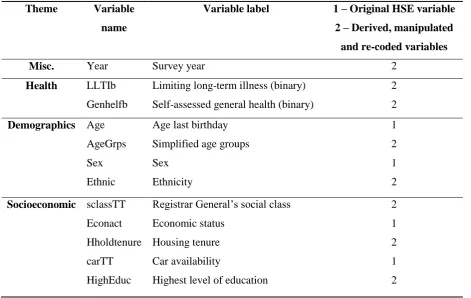
variable format of all the variables used within the final analysis.Table 1 lists these variables
according to their theme, and distinguishes between those which have been manipulated and those
which were used in their original format as supplied in the file.
When identifying variables of interest these should all be taken from the HSE file relating to
individuals (denoted by ‘ai’ in the file name), rather than households (denoted by ‘ah’). For 1999 and
2004, the surveys focussed on the health of minority ethnic groups (MEGs) and therefore provided a
third dataset where MEGs were oversampled. Ethnicity was a key variable for this work and much
may be gleaned from a standalone analysis of either the boost sample for 1999 or 2004. However,
including the oversampled data within the final time-series may bias the results. Consequently, these
boost files were discarded for 1999 and 2004, and the standard individual files used instead.
Although 2000 and 2005 were also boost years with people aged over 65 being oversampled separate
boost files were not provided. As it is assumed that all survey years available within the study
time-frame will be used these should be extracted as normal. The effect of these boosted samples on the
final results can be considered once the time-series dataset has been created and this is discussed
6
GET FILE='F:\Data\HSE\HSE
[image:7.595.65.537.100.398.2]
2011\UKDA-7260-spss\spss\spss14\hse2011ai.sav'.
Table 1: Variables in the dataset
Theme Variable
name
Variable label 1 – Original HSE variable
2 – Derived, manipulated
and re-coded variables
Misc. Year Survey year 2
Health LLTIb
Genhelfb
Limiting long-term illness (binary)
Self-assessed general health (binary)
2
2
Demographics Age
AgeGrps
Sex
Ethnic
Age last birthday
Simplified age groups
Sex
Ethnicity
1
2
1
2
Socioeconomic sclassTT
Econact
Hholdtenure
carTT
HighEduc
Registrar General’s social class
Economic status
Housing tenure
Car availability
Highest level of education
2
1
2
1
2
In SPSS, users are provided with the option of either working with dialogue boxes or using SPSS
syntax to complete tasks. Using SPSS syntax is a much more efficient way of working with large
datasets as syntax can be copied, pasted and re-used quickly without having to work through the
multiple options available in the dialogue boxes. For those unfamiliar with SPSS syntax, a number of
reference books are available (for example see Collier, 2010), as well as a wealth of freely available
information on forums and other internet sites. For clarity, all syntax presented in this document are
enclosed in a text box and, if the file paths and variable labels are correct, can be copied and pasted
for re-use.
Syntax can be used to open each survey year file. The ‘Get file’
command opens up any file on a computer directory so long as the
file path and file name are correct, this can be copied and pasted for
each survey year, amending the name as required.
3. Harmonising and recoding variables
Where required, manipulation of all variables of interest took place within the existing downloaded
dataset. To ensure that variables could be extracted and then combined to create a new time-series
7
Compute ‘Year’ = 2011. either the ‘Recode’ or ‘Compute’ function, depending on the nature of the existing variables. The
following section will be divided into subsections detailing how each manipulated or derived variable
was created. Due to the amount of syntax required for this step of the process, all syntax is provided
(appendix A). Tables illustrating how existing variable categories were either combined or
harmonised to create the new variables: For clarity, the number assigned to each variable category
within the original and newly created formats are listed first in the tables. Newly derived/harmonised
variables are always those in the far right hand column of the table whereas all variables to the left are
those in the original HSE files. Within the original SPSS files, all non-response variables are coded
with a negative number. Preliminary descriptive statistics applied to the extracted and harmonised
variables led to the decision to exclude all non-responses from independent variables and re-code all
non-responses for dependent variables. Consequently, the following section delineating the process of
harmonising each variable will not cover re-coding of non-responses for independent variables
(although relevant syntax can be found in the appendix). Justification for these different exclusions
will be provided in section 5.
a) Year
To explore trends over time it must be possible to cross-tabulate the variables by year in the new
time-series dataset. Consequently a survey year identifier must be created.
This line can be copied and pasted for each dataset, changing the year
as required.
b) Limiting long-term illness (LLTI)
LLTI was re-coded to create a binary outcome whereby respondents either had a LLTI or did not. As
a binary outcome, this variable can be used in binary logistic regression. It was assumed that all
non-responses were respondents without LLTI. The original HSE variable was consistent over time so the
[image:8.595.62.533.602.680.2]syntax to recode LLTI can be repeated for each survey year.
Table 2: Creating the ‘LLTI’ variable
Variable name ‘limitill’ ‘LLTIb’
Variable responses 1 = Limiting LI
2 = Non Limiting LI
3 = No LI
1 = LLTI
8
c) Self-assessed general health
Similar to the LLTI variable, self-assessed general health was simplified into a binary format which is
suitable for binary logistic regression. This variable was also consistent over time so the syntax used
[image:9.595.60.536.191.273.2]can be repeated each year. As with LLTI, non-responses were assumed to be in good health.
Table 3: Creating the ‘genhelfb’ variable
Variable name ‘genhelf2’ ‘genhelfb’
Variable responses 1 = Very good/good
2 = Fair
3 = Bad/very bad
0 = Good/Very good
1 = Less than good
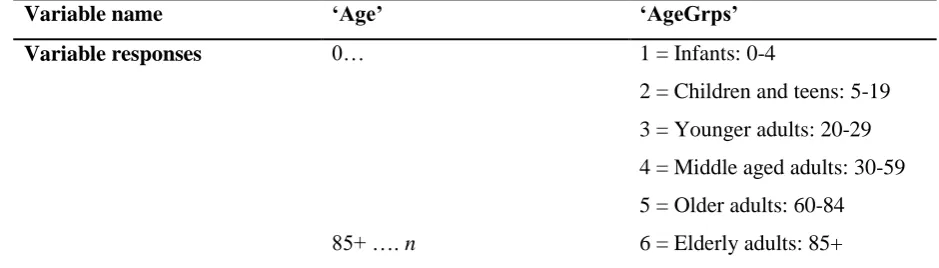
d) Age Groups
A numerical value was listed for each respondent across all survey years. This was simplified into age
groups. Boundaries for the age groups are designed to reflect natural breaks in the life course. While
arbitrary, similar groupings can be found elsewhere and these categories are suitable for the purposes
of this analysis. The syntax used can be repeated for each survey year.
Table 4: Creating Age Groups
Variable name ‘Age’ ‘AgeGrps’
Variable responses 0…
85+ …. n
1 = Infants: 0-4
2 = Children and teens: 5-19
3 = Younger adults: 20-29
4 = Middle aged adults: 30-59
5 = Older adults: 60-84
6 = Elderly adults: 85+
e) Ethnicity
The categorisation of ethnicity varies substantially from year to year with some years explicitly
questioning respondents about their ethnicity whilst other years chose to derive ethnicity from
respondents’ culture. Typically, those survey years which derived ethnicity from a respondent’s
culture created simplistic ethnic categories only distinguishing between White, Mixed, Black or Black
British, Asian or Asian British, and other. This is not detailed enough for the purposes of this analysis
so the original responses to the cultural questions were used to derive more detailed ethnic
[image:9.595.60.530.425.559.2]9
Those survey years which had detailed ethnic classifications, however, also had smaller category
sample sizes which are not always suitable for statistical analysis. These were aggregated to create
larger sample sizes without becoming too heterogeneous. This is particularly important for ethnicity
as typical aggregations, such as Black and Minority Ethnic groups (BME), a commonly used ethnic
classification in health research, masks significant variation between those minority groups which
may be important for any social, economic, political or health-related analysis. Consequently,
re-coding of the ethnicity variables was based on:
a) the need to retain sufficient ethnic detail to return theoretically meaningful results;
b) the statistical necessity of large enough category sample sizes; and finally,
c) the ability to create ethnic groupings which both satisfy a) and b), but also are possible within
the constraints of the varied categorisation of ethnicity over time.
To create a harmonised ethnic variable which met the conditions described above, a number of
compromises were necessary. Firstly, it was not possible to create a ‘White British’ or even ‘White English’ grouping and aggregate all other ‘White’ in ‘Other’. This was because:
d) it was not possible to distinguish between Irish in Northern Ireland and Irish in the Republic
of Ireland even if other possible ‘ethnicity’ variables were used to cross-tabulate against. For
example, this was a problem in 2000 to 2003;
e) some survey years included a response for those who are ‘Other European’ i.e., ‘White
Other’, yet this was not consistent over time; and finally,
f) from 2008 onwards, it was not possible to distinguish between respondents who were either
‘English’, ‘Scottish’, ‘Welsh’ or ‘Northern Irish’, only those who were ‘White British’, ‘White Irish’, or ‘Any other White background’.
Secondly, due to the small numbers involved some ethnicities were combined to increase the
statistical power of the analysis:
g) ‘Black African’ and ‘Black Caribbean’ were combined to create ‘Black’; and,
h) ‘Pakistani’ and ‘Bangladeshi’ were also combined to create ‘Pakistani and Bangladeshi’.
Finally, a large heterogeneous group of ‘Mixed and Other Ethnic group’ was created to catch all of
the remaining ethnicities. These remaining categorisations were too varied year on year to create
anything more meaningful. Non-responses categorisations, as with other variables, varied between
years. Although these were ultimately excluded from the final analysis along with the mixed category,
these were initially collapsed to create two categories of either ‘Refused or don’t know’, or ‘Not
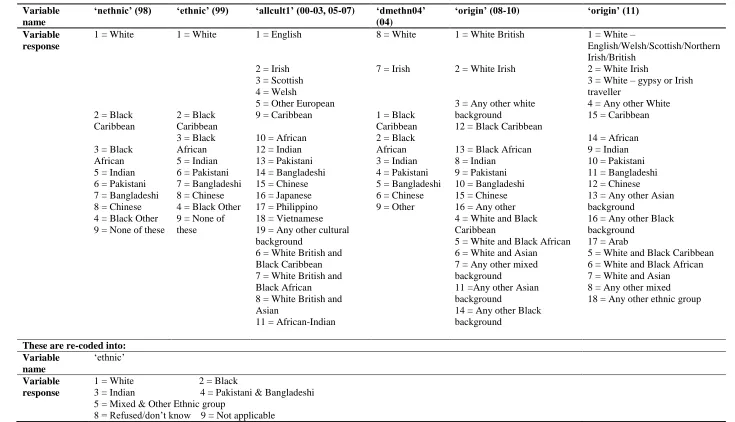
applicable’. Table 5 details the ethnicity variables used from each survey year as well as the newly
10
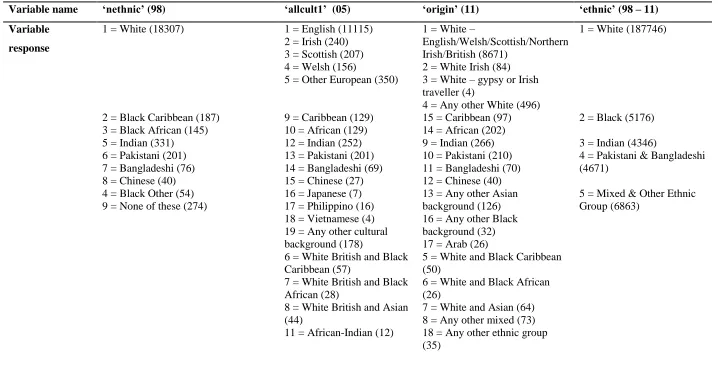
selects a couple of the survey years and illustrates how the categories were aggregated upwards to
give the final harmonised variable. This demonstrates the importance of collapsing some of the
categories due to the small numbers involved. For clarity, table 6 selects two of the survey years and
illustrates how the categories were aggregated to give the final harmonised variable. The final values
for the newly created ethnicity variable reflect the totals for all years and are not the sum of those
11
Table 5: Creating the Ethnicity variable
Variable name
‘nethnic’ (98) ‘ethnic’ (99) ‘allcult1’ (00-03, 05-07) ‘dmethn04’ (04)
‘origin’ (08-10) ‘origin’ (11)
Variable response
1 = White
2 = Black Caribbean
3 = Black African 5 = Indian 6 = Pakistani 7 = Bangladeshi 8 = Chinese 4 = Black Other 9 = None of these
1 = White
2 = Black Caribbean 3 = Black African 5 = Indian 6 = Pakistani 7 = Bangladeshi 8 = Chinese 4 = Black Other 9 = None of these
1 = English
2 = Irish 3 = Scottish 4 = Welsh
5 = Other European 9 = Caribbean
10 = African 12 = Indian 13 = Pakistani 14 = Bangladeshi 15 = Chinese 16 = Japanese 17 = Philippino 18 = Vietnamese 19 = Any other cultural background
6 = White British and Black Caribbean 7 = White British and Black African 8 = White British and Asian
11 = African-Indian
8 = White
7 = Irish
1 = Black Caribbean 2 = Black African 3 = Indian 4 = Pakistani 5 = Bangladeshi 6 = Chinese 9 = Other
1 = White British
2 = White Irish
3 = Any other white background
12 = Black Caribbean
13 = Black African 8 = Indian
9 = Pakistani 10 = Bangladeshi 15 = Chinese 16 = Any other 4 = White and Black Caribbean
5 = White and Black African 6 = White and Asian 7 = Any other mixed background
11 =Any other Asian background
14 = Any other Black background
1 = White –
English/Welsh/Scottish/Northern Irish/British
2 = White Irish
3 = White – gypsy or Irish traveller
4 = Any other White 15 = Caribbean
14 = African 9 = Indian 10 = Pakistani 11 = Bangladeshi 12 = Chinese
13 = Any other Asian background
16 = Any other Black background
17 = Arab
5 = White and Black Caribbean 6 = White and Black African 7 = White and Asian 8 = Any other mixed 18 = Any other ethnic group
These are re-coded into: Variable
name
‘ethnic’
Variable response
1 = White 2 = Black
3 = Indian 4 = Pakistani & Bangladeshi 5 = Mixed & Other Ethnic group
12
Table 6: Aggregating the ethnic variables
Variable name ‘nethnic’ (98) ‘allcult1’ (05) ‘origin’ (11) ‘ethnic’ (98 – 11)
Variable
response
1 = White (18307)
2 = Black Caribbean (187) 3 = Black African (145) 5 = Indian (331)
6 = Pakistani (201) 7 = Bangladeshi (76) 8 = Chinese (40) 4 = Black Other (54) 9 = None of these (274)
1 = English (11115) 2 = Irish (240) 3 = Scottish (207) 4 = Welsh (156)
5 = Other European (350)
9 = Caribbean (129) 10 = African (129) 12 = Indian (252) 13 = Pakistani (201) 14 = Bangladeshi (69) 15 = Chinese (27) 16 = Japanese (7) 17 = Philippino (16) 18 = Vietnamese (4) 19 = Any other cultural background (178)
6 = White British and Black Caribbean (57)
7 = White British and Black African (28)
8 = White British and Asian (44)
11 = African-Indian (12)
1 = White –
English/Welsh/Scottish/Northern Irish/British (8671)
2 = White Irish (84) 3 = White – gypsy or Irish traveller (4)
4 = Any other White (496) 15 = Caribbean (97) 14 = African (202) 9 = Indian (266) 10 = Pakistani (210) 11 = Bangladeshi (70) 12 = Chinese (40) 13 = Any other Asian background (126) 16 = Any other Black background (32) 17 = Arab (26)
5 = White and Black Caribbean (50)
6 = White and Black African (26)
7 = White and Asian (64) 8 = Any other mixed (73) 18 = Any other ethnic group (35)
1 = White (187746)
2 = Black (5176)
3 = Indian (4346)
4 = Pakistani & Bangladeshi (4671)
5 = Mixed & Other Ethnic Group (6863)
Note: Numbers preceding category names are the numerical values for those categories within the SPSS datasets. Numbers in brackets are the total respondents in that
13
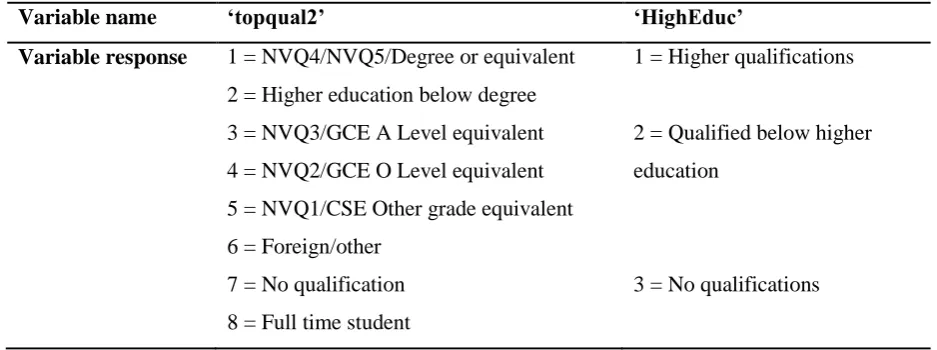
f) Educational attainment
The existing categories within the original variables covering educational attainment were collapsed
to increase the statistical power of the analysis and lead to meaningful results. ‘Foreign/Other’
qualifications are classified as below higher education as it is not possible to determine what level
[image:14.595.63.532.215.390.2]they are equivalent to. The syntax can be repeated for each year.
Table 6: Creating the Education variable
Variable name ‘topqual2’ ‘HighEduc’
Variable response 1 = NVQ4/NVQ5/Degree or equivalent
2 = Higher education below degree
3 = NVQ3/GCE A Level equivalent
4 = NVQ2/GCE O Level equivalent
5 = NVQ1/CSE Other grade equivalent
6 = Foreign/other
7 = No qualification
8 = Full time student
1 = Higher qualifications
2 = Qualified below higher
education
3 = No qualifications
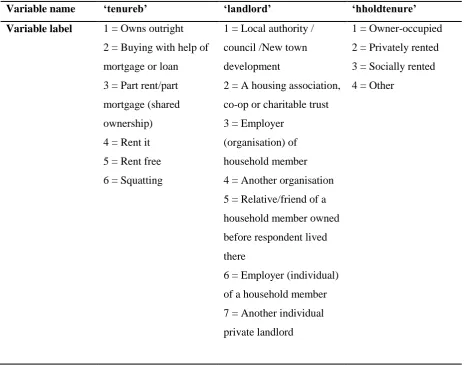
g) Household tenure
Two different variables were used to create a simplified and consistent household tenure variable.
This separately covered the nature of the tenure (tenureb) e.g. whether respondents lived in rented
accommodation, owner-occupied or lived rent free with friends, or for those who rented, who their
landlord was (landlord). The information provided in these two variables was combined to distinguish
between owner-occupied, privately rented and socially rented. To combine two separate variables, the
‘compute’ rather than the ‘recode’ function was used. The same syntax can be repeated for each
14
Table 7: Creating the Household tenure variable (tenureb and landlord are combined)
Variable name ‘tenureb’ ‘landlord’ ‘hholdtenure’
Variable label 1 = Owns outright
2 = Buying with help of
mortgage or loan
3 = Part rent/part
mortgage (shared
ownership)
4 = Rent it
5 = Rent free
6 = Squatting
1 = Local authority /
council /New town
development
2 = A housing association,
co-op or charitable trust
3 = Employer
(organisation) of
household member
4 = Another organisation
5 = Relative/friend of a
household member owned
before respondent lived
there
6 = Employer (individual)
of a household member
7 = Another individual
private landlord
1 = Owner-occupied
2 = Privately rented
3 = Socially rented
4 = Other
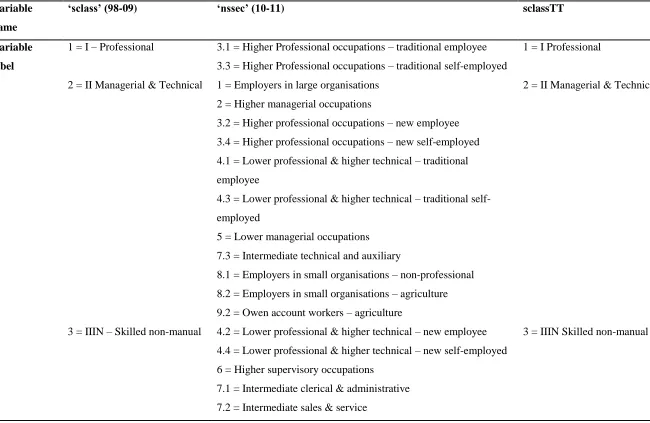
h) Social Class
Prior to 2001, the principle measure of social status or social class was the Registrar General’s Social
Class scheme. However, following calls for improvements to the theory and methods underpinning
this classification, the National Statistics Socio-economic Classification (NS-SEC) was developed.
Whilst each has their relative merits, this analysis used the RGs social class scheme. To convert the
new NS-SEC back to the RGs social class, a look-up table was used (CeLSIUS at University College
London). This was only required from 2010 onwards as up until 2009, the RGs social class was still
provided within the dataset alongside the newly established NS-SEC (which was included from
2001). All respondents who could not be classified within any one of the six social classes was
defined as ‘unclassifiable’; this also included the varying non-response categories. Table 8 details the
original social class variables, the NS-SEC variables from 2010 onwards, and the new harmonised
social class variable for the time-trend dataset. For clarity, NS-SEC categories are ordered according
15
based on the class of the head of household. Two sets of syntax were required depending on whether
16
Table 8: Old and New Social Class variables
Variable
name
‘sclass’ (98-09) ‘nssec’ (10-11) sclassTT
Variable
label
1 = I – Professional
2 = II Managerial & Technical
3 = IIIN – Skilled non-manual
3.1 = Higher Professional occupations – traditional employee
3.3 = Higher Professional occupations – traditional self-employed
1 = Employers in large organisations
2 = Higher managerial occupations
3.2 = Higher professional occupations – new employee
3.4 = Higher professional occupations – new self-employed
4.1 = Lower professional & higher technical – traditional
employee
4.3 = Lower professional & higher technical – traditional
self-employed
5 = Lower managerial occupations
7.3 = Intermediate technical and auxiliary
8.1 = Employers in small organisations – non-professional
8.2 = Employers in small organisations – agriculture
9.2 = Owen account workers – agriculture
4.2 = Lower professional & higher technical – new employee
4.4 = Lower professional & higher technical – new self-employed
6 = Higher supervisory occupations
7.1 = Intermediate clerical & administrative
7.2 = Intermediate sales & service
1 = I Professional
2 = II Managerial & Technical
17 4 = IIIM – Skilled Manual
5 = IV – Semi-skilled Manual
6 = V – Unskilled
7 = Armed Forces
8 = Not fully described
12.1 = Semi-routine sales
12.6 = Semi-routine clerical
7.4 = Intermediate engineering
9.1 = Own account workers – non-professional
10 = Lower supervisory occupations
11.1 = Lower technical craft
12.3 = Semi-routine technical
13.3 = Routine technical
11.2 = Lower technical process operative
12.2 = Semi-routine service
12.4 = Semi-routine operative
12.5 = Semi-routine agricultural
12.7 = Semi-routine childcare
13.1 = Routine sales & service
13.2 = Routine production
13.5 = Routine agricultural
13.4 = Routine operative
14 = Never worked & long-term unemployed
15 = Full time students
16 = Occupations not stated/inadequately described
17 = Not classifiable for other reasons
4 = IIIM Skilled manual
5 = IV Semi-skilled manual
6 = Unskilled
7 = NA/Unclassifiable (includes
armed forces, students, all who have
never worked and other
18
Save outfile =
'F:\Data\HSE\HSE_recode_FD2011. sav'
/Keep= Year age … sclassTT econact hholdtenure topqual2 carTT.
Get file = 'F:\Data\HSE\HSE_time-series.sav'. ADD FILES /FILE=*
/FILE='F:\Data\HSE\HSE_recode_2010.sav'. ADD FILES /FILE=*
/FILE='F:\Data\HSE\HSE_recode_2009.sav'. …
ADD FILES /FILE=*
/FILE='F:\Data\HSE\HSE_recode_1998.sav'. EXECUTE.
4. Extraction
Once the current survey year has been opened and the
relevant syntax to harmonise the original variables within
that year has been run, the newly created variables as well
as any to be used in their original state should be extracted
and saved into a new compressed file. This is done for each
survey year. An example of the syntax required is listed
below, to run for alternative survey years it is just necessary
to amend the output file name.
5. Creating the time-series dataset and considerations
To combine the newly created compressed
datasets, first save the most recent file as
‘HSE_time-series.sav’. Then use both the ‘Get File’ and ‘Add Files’ functions to open and then
append the remaining datasets.
Having created the time-series dataset it is
necessary to establish whether the combined
cross-sectional data are appropriate for use as a time-series. Here, considerations of the influence of
sample size in boost years as well as non-responses and survey weights are important as each may
have different implications for the final results.
a) Boost years
Boost years within the HSE oversample different population subgroups such as minority ethnic
groups or older members of the population. These larger sample sizes can distort or skew the results.
For the minority ethnic group boost years, this is avoided as the boost data is provided in separate
files. However, the boosted elderly groups in 2000 and 2005 are not separated from the main data. In
2000, the boost sample (n = ~ 2500) can be identified by cross-tabulating those living in an institution
by age but this is not possible in 2005. Thus, it is important to establish the extent of the influence of
the increased sample size on the overall results. No notable affect was found for 2000 but a clearly
discernible and consistent spike emerges for 2005 in rates of poor health. This may lead some to
exclude these two survey years, as authors of the obesity study in Manchester chose to (Higgins and
Marshall, 2012). However, as the spike in poor health rates disappears when excluding people aged
65 and over, it can reasonably be attributed to the boosted sample rather than unique socioeconomic
conditions of that year. Consequently, the files are maintained within the time-series dataset and
19
influence on population health rates of an older population is interesting in light of England’s ageing
population.
b) Non-response
Reasons for non-response varied between the survey years ranging from refused to don’t know to not
applicable. For all variables, less than 0.5% of non-responses were categorised as either ‘don’t know’
or ‘refused’. These non-responses have minimal effect on the results of the analysis and are therefore
excluded. Where non-response rates within variables were high, this was due to the inapplicability of
the variable in question. For example, they were high for the social class variable as not all
respondents could be assigned a class. Excluding the non-applicable non-responses is therefore
justified as the research is only interested in the influence of known socioeconomic attributes on
population health.
For the dependent variables, however, non-responses were included but not as non-responses. As the
dataset is based on a health survey it is likely that respondents would be predisposed to affirm if they
suffered poor health. Consequently, it is assumed that any non-response meant that the respondent
was not in poor health. Such assumptions cannot be readily made about the independent variables.
c) Survey weights
When analysing social survey data, operational decisions must be made regarding the use of weights
and choices are generally study dependent. Weights are introduced into survey data to either enhance
the representativeness of a sample (design weights), account for atypical non-respondents which can
bias an otherwise representative sample (non-response weights), or to produce results which mimic
those which would be achieved if the sample size was the same size of the total population (grossing).
Prior to 2003, the only weights within the HSE were design weights used to account for
under-sampled children aged 2 – 15 years. However, from 2003 onwards the HSE introduced non-response
weights to match developments in other large-scale datasets and try and reduce possible non-response
bias (for further information, see the 2003 HSE User Guide available in the documentation folder for
this dataset).
To test whether including weights was advisable, data were extracted and harmonised for the years
2003 and 2011, first with weights and then without. The statistical tests to be used within the
subsequent analysis were then run on each extract. Across each of the datasets, cross-tabulations by
the dependent variables and ethnicity and the remaining independent variables revealed similar
patterns. Weighting the data did not influence the conclusions drawn regarding the associations
between the variables. Similarly, four regression models were run for 2003 and 2011 with the
20 USE ALL.
COMPUTE filter_$=(Year > 1997) AND (Year < 2001).
VARIABLE LABELS filter_$ 'Year = 1996-98 (FILTER)'.
VALUE LABELS filter_$ 0 'Not Selected' 1 'Selected'.
FORMATS filter_$ (f1.0). FILTER BY filter_$. EXECUTE.
LOGISTIC REGRESSION VARIABLES LLTIb /METHOD=ENTER sex AgeGrps ethnic /Contrast (sex) = Indicator(1)
/Contrast (AgeGrps) = Indicator(1) /Contrast (ethnic) = Indicator(1) /PRINT=CI(95)
/CRITERIA=PIN(0.05) POUT(0.10) ITERATE(20) CUT(0.5).
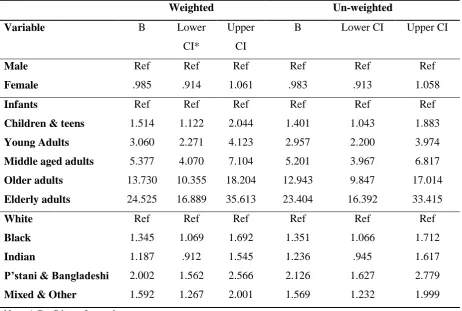
demographic and socioeconomic attributes. The direction and size of the effects across the models are
such that you would make the same conclusions about the variable and the gradients and relationships
between them. This is illustrated in table 9 which shows the beta coefficients and confidence intervals
(CI) for each variable using weighted and un-weighted data using the model for less than good health
[image:21.595.68.531.225.536.2]controlling for demographic attributes in 2003.
Table 9: Binary Logistic Regression Model for 2003, comparing weighted and un-weighted
results.
Weighted Un-weighted
Variable B Lower
CI*
Upper
CI
B Lower CI Upper CI
Male Female Ref .985 Ref .914 Ref 1.061 Ref .983 Ref .913 Ref 1.058 Infants
Children & teens
Young Adults
Middle aged adults
Older adults Elderly adults Ref 1.514 3.060 5.377 13.730 24.525 Ref 1.122 2.271 4.070 10.355 16.889 Ref 2.044 4.123 7.104 18.204 35.613 Ref 1.401 2.957 5.201 12.943 23.404 Ref 1.043 2.200 3.967 9.847 16.392 Ref 1.883 3.974 6.817 17.014 33.415 White Black Indian
P’stani & Bangladeshi
Mixed & Other
Ref 1.345 1.187 2.002 1.592 Ref 1.069 .912 1.562 1.267 Ref 1.692 1.545 2.566 2.001 Ref 1.351 1.236 2.126 1.569 Ref 1.066 .945 1.627 1.232 Ref 1.712 1.617 2.779 1.999
Note: * Confidence Interval.
6. Analysis
The time-series dataset is now ready for
analysis. Trends were explored using
rolling-three year pooled figures. Pooling the data
for each variable across rolling three-yearly
time points increases the sample sizes
involved. Filters applied to the dataset select
the required variables from the appropriate
years before each test is run, whether these
21
distributions (e.g. the count and proportion of respondents in poor health or belonging to different
social classes over time), cross-tabulations (e.g. the proportion of respondents in poor health by social
class over time) and finally, binary logistic regression models to assess how the socioeconomic and
demographic variables differently explain poor health (whether in terms of LLTI or less than good
health) over time. For clarity, this is exemplified below for binary logistic models estimating the
likelihood of LLTI in 1998 to 2000. This model only controls for the demographic variables, i.e.
ethnicity, age and gender.
The ‘Use All’ function clears any existing filters and should be run before any new filter is applied.
Filters are then computed: in the above example the syntax is commanding SPSS to only use data
from years which are greater than 1997 and less than 2001, i.e. the three year period 1998 to 2000.
The second section of the syntax commands SPSS to run a binary logistic regression model whereby
the outcome is the presence of LLTI and the demographic variables are the explanatory variables.
‘Indicator(1)’ informs SPSS that the variables are categorical and that the first category should be
used as the reference. For gender, males are the first category in the sex variable so this is the
reference. Similarly, for ethnicity, White is the first and therefore reference category. Results
presented will therefore always be illustrating what the odds of developing a LLTI in 1998 to 2000 are
for the different demographic groups compared to the relevant reference category, e.g. what are the
odds of females reporting LLTI compared to males? This example of syntax can be amended, altering
either the years, the outcome (e.g. it could be the probability of reporting less than good health), or the
explanatory variables (e.g. different combinations of demographic and/or socioeconomic variables). It
should be noted that if using SPSS to run binary logistic regression models, SPSS can only select
either the first or last variable category as the reference category. If a different category was more
appropriate to use as the reference, the variable would need to be re-coded such that this category
(such as the mode) was either the first or last.
Conclusion
This document can be read in two ways. On the one hand, it is a technical note detailing some of the
key methodological steps taken to create a time-series dataset from the HSE for the analysis of change
in the composition and structure of England’s society. On the other hand, it could be used as a general
technical guide on the steps needed to create a time-series dataset from a repeated annual survey using
SPSS. In both cases, however, the reader should remember a few caveats. Many of the steps taken,
particularly in terms of the harmonising of variables, must be understood within the context of the
research that this dataset was created for. This is important when thinking about variables which differ
substantially year on year or those where the number of variable categories leads to small sample
sizes. Additionally, the types of statistical tests to be run will also have an impact on how variables
22
requiring a binary coded format for the dependent variables, this may not be necessary for alternative
forms of analysis. These caveats hopefully remind the reader that this document is not strictly
prescriptive of what one must do to create a time-series dataset; rather it is illustrative of the kind of
steps which could be undertaken and demonstrates how these steps are carried out in SPSS using
23
Bibliography
CeLSIUS, ‘Mapping NS-SEC to Social Class’ http://celsius.lshtm.ac.uk/modules/socio/se040302.html [Accessed June 2013].
Chandola, T., (2012) ‘Spatial and social determinants of urban health in low-, middle- and high-income countries’, Public Health, 126 (3): 259-261.
Collier, J., (2010) Using SPSS Syntax: A Beginner’s Guide. Sage Publications: London.
Erens, P. and Primatesta, P., (eds) (1999) The Health Survey for England 1998: Cardiovascular Disease 1998. The Stationary Office: London.
Higgins, V. & Marhsall, A., Health Survey for England Time Series Dataset, 1991 – 2009 [computer
file]. Colechester, Essex: UK Data Archive [distributor], July 2020. SN: 7025.
Jowit, J., (2013) ‘Britain’s ageing population: the impact on families and services’ The Guardian:
http://www.theguardian.com/society/2013/feb/24/ageing-population-impact-families-services
[accessed October 2013].
Nazroo, J., (2006) ‘Ethnic Inequalities in Health’, eLS. DOI: 10.1002/9780470015902.a0005858
National Centre for Social Research and University College London. Department of Epidemiology and Public Health, Health Survey for England, 2003 [computer file]. 2nd edition. Colchester, Essex: UK Data Archive [distributor], April 2010. SN: 5098. DOI:10.5255/UKDA-SN-5098-1
Norman, P., Boyle, P., Exeter, D., Feng, Z. & Popham, F., (2011) ‘Rising premature mortality in the UK’s persistently deprived areas: Only a Scottish phenomenon?’, Social Science & Medicine, 73: 1575-1584.
Office for National Statistics, (2012) ‘Ethnicity and National Identify in England and Wales 2011’,
http://www.ons.gov.uk/ons/dcp171776_290558.pdf [accessed January 2013].
Office for National Statistics (2013) ‘Full report – Graduates in the UK Labour market 2013’,
http://www.ons.gov.uk/ons/dcp171776_337841.pdf [accessed November 2013].
Orwell, G., (1984) Why I Write. Penguin Books: London.
Shaw, M., Dorling, D., Gordon, D. & Davey Smith, G. (2004), ‘The widening gap: health inequalities and policy in Britain’, in P Boyle, S Curtis, E Graham & E Moore (Eds), The geography of health inequalities in the developed world (pp. 77-100). Aldershot: Ashgate.
Sproston, K. and Mindell, J., (2006) Health Survey for England 2004: The Health of Minority Ethnic Groups. The Information Centre: London.
24
Appendix A: Syntax
The syntax presented is primarily for the extraction, harmonisation and creation of the new time-series
dataset. It is presented in a linear format and can therefore be copied, pasted and ran if the file names
and pathways used are the same as those shown here. It should be noted that due to the coding of
ethnicity between 2005 and 2007, additional syntax was needed to create the final harmonised
variable - this is documented below. For illustrative purposes, an example of the syntax used to run
one set of binary logistic regression models for the study period is also provided. For clarity, each line
is broken up with a starred comment briefly describing what follows. This can be copied into the
syntax editor as SPSS recognises anything prefixed with a * as a line of comments.
1. Opening dataset, harmonising appropriate variables, extracting all variables of interest to new compacted dataset.
*open file.
GET FILE='F:\Data\HSE\HSE 1998\UKDA-4150-spss\spss\spss12\hse98ai.sav'.
*survey year.
COMPUTE Year = 1998.
VARIABLE LABELS Year 'Survey Year'.
EXECUTE.
*age groups
RECODE age (0 thru 4 = 1) (5 thru 19 = 2) (20 thru 29 = 3) (30 thru 59 = 4) (60 thru 84 = 5) (ELSE = 6) INTO AgeGrps.
VARIABLE LABELS AgeGrps 'simplified '.
add value labels AgeGrps
1 "Infants: 0-4"
2 "Children and teens: 5-19"
3 "Younger adults: 20-29"
4 "Middle aged adults: 30-59"
5 "Older adults: 60-84"
6 "Elderly adults: 85+".
*ethnicity.
RECODE nethnic (1=1) (2 thru 3 = 2) (5=3) (6 thru 7 = 4) (8 thru 9= 5) (4 = 5) (-6 = 9) (-9 thru -7=8) (-6 = 9) (-2 thru -1= 9) INTO ethnic.
VARIABLE LABELS ethnic 'harmonised ethnicity'.
add value labels ethnic
1 "White"
2 "Black"
3 "Indian"
4 "Pakistani and Bangladeshi"
5 "Mixed and Other ethnic group"
8 "Refused dont know"
9 "Not applicable".
*binary LLTI.
RECODE limitill (1=1) (ELSE = 0) INTO LLTIb.
VARIABLE LABELS LLTIb 'harmonised binary LLTI'.
25 1 "LLTI"
0 "no LLTI".
*binary general health.
RECODE genhelf2 (1 = 0) (ELSE = 1) into genhelfb.
VARIABLE LABELS genhelfb 'binary simplified general health'.
add value labels genhelfb
1 "Less than good"
0 "Good / Very good".
*social class.
RECODE sclass (1=1) (2=2) (3=3) (4=4) (5=5) (6=6) (ELSE = 7) into sclassTT.
VARIABLE LABELS sclassTT 'harmonised individual sclass'.
add value labels sclassTT
1 "I Professional"
2 "II Managerial and technical"
3 "IIIN Skilled non-manual"
4 "IIIM Skilled manual"
5 "IV Partly skilled"
6 "V Unskilled"
7 "NA/Unclassifiable".
*household tenure.
COMPUTE hholdtenure = 4.
if (tenureb > 0) and (tenureb < 4) hholdtenure = 1.
if (landlord > 2) and (landlord < 8) hholdtenure = 2.
if (landlord > 0) and (landlord < 3) hholdtenure = 3.
VARIABLE LABELS hholdtenure 'simplified housing tenure'.
add value labels hholdtenure
1 "owner-occupied"
2 "privately rented"
3 "socially rented"
4 "other".
*car.
recode car (1 = 1) (2 = 2) (ELSE = 0) INTO carTT.
VARIABLE LABELS carTT 'harmonised car availability'.
add value labels carTT
1 "yes car available"
2 "not available"
0 “refused dont know”.
*education.
RECODE topqual2 (1 thru 2 = 1) (3 thru 6 = 2) (ELSE = 3) into HighEduc.
VARIABLE LABELS HighEduc 'simplified education: higher or not'.
add value labels HighEduc
1 "Higher qualifications"
2 "Qualified below higher education"
3 "No qualifications".
*extraction.
SAVE OUTFILE =
'F:\Data\HSE\HSE_recode_FD1998.sav'
/Keep=
26 age
AgeGrps
sex
ethnic
LLTIb
limitill
genhelf
genhelfb
sclassTT
econact
hholdtenure
HighEduc
carTT.
*open file.
GET FILE='F:\Data\HSE\HSE 1999\UKDA-4365-spss\spss\spss12\hse99gp3.sav'.
*survey year.
COMPUTE Year = 1999.
VARIABLE LABELS Year 'Survey Year'.
EXECUTE.
*age groups.
RECODE age (0 thru 4 = 1) (5 thru 19 = 2) (20 thru 29 = 3) (30 thru 59 = 4) (60 thru 84 = 5) (ELSE = 6) INTO AgeGrps.
VARIABLE LABELS AgeGrps 'simplified age groups'.
add value labels AgeGrps
1 "Infants: 0-4"
2 "Children and teens: 5-19"
3 "Younger adults: 20-29"
4 "Middle aged adults: 30-59"
5 "Older adults: 60-84"
6 "Elderly adults: 85+".
*ethnic.
RECODE ethnich (1 = 1) (2 thru 3 = 2) (5 = 3) (6 thru 7 = 4) (8 thru 9 = 5) (4 = 5) (-6 = 9) (-9 thru -7=8) (-6 = 9) (-2 thru -1= 9) INTO ethnic.
VARIABLE LABELS ethnic 'harmonised ethnicity'.
add value labels ethnic
1 "White"
2 "Black"
3 "Indian"
4 "Pakistani and Bangladeshi"
5 "Mixed and Other ethnic group"
8 "Refused dont know"
9 "Not applicable".
*binary LLTI.
RECODE limitill (1=1) (ELSE = 0) INTO LLTIb.
VARIABLE LABELS LLTIb 'harmonised binary LLTI'.
add value labels LLTIb
1 "LLTI"
0 "no LLTI".
*binary general health.
27 VARIABLE LABELS genhelfb 'binary
simplified general health'.
add value labels genhelfb
1 "Less than good"
0 "Good / Very good".
*social class.
RECODE sclass (1=1) (2=2) (3=3) (4=4) (5=5) (6=6) (ELSE = 7) into sclassTT.
VARIABLE LABELS sclassTT 'harmonised individual sclass'.
add value labels sclassTT
1 "I Professional"
2 "II Managerial and technical"
3 "IIIN Skilled non-manual"
4 "IIIM Skilled manual"
5 "IV Partly skilled"
6 "V Unskilled"
7 "NA/Unclassifiable".
*tenure.
COMPUTE hholdtenure = 4.
if (tenureb > 0) and (tenureb < 4) hholdtenure = 1.
if (landlord > 2) and (landlord < 8) hholdtenure = 2.
if (landlord > 0) and (landlord < 3) hholdtenure = 3.
VARIABLE LABELS hholdtenure 'simplified housing tenure'.
add value labels hholdtenure
1 "owner-occupied"
2 "privately rented"
3 "socially rented"
4 "other".
*car.
RECODE car (1 = 1) (2 = 2) (ELSE = 0) INTO carTT.
VARIABLE LABELS carTT 'harmonised car availability'.
add value labels carTT
1 "yes car available"
2 "not available"
0 “refused dont know”.
*education.
RECODE topqual2 (1 thru 2 = 1) (3 thru 6 = 2) (ELSE = 3) into HighEduc.
VARIABLE LABELS HighEduc 'simplified education: higher or not'.
add value labels HighEduc
1 "Higher qualifications"
2 "Qualified below higher education"
3 "No qualifications".
*extraction.
SAVE OUTFILE =
'F:\Data\HSE\HSE_recode_FD1999gp3.sav'
/Keep=
Year
age
AgeGrps
sex
ethnic
LLTIb
28 genhelf
genhelfb
sclassTT
econact
hholdtenure
HighEduc
carTT.
*open file.
GET FILE='F:\Data\HSE\HSE 2000\UKDA-4487-spss\spss\spss12\hse00ai.sav'.
*survey year.
COMPUTE Year = 2000.
VARIABLE LABELS Year 'Survey Year'.
EXECUTE.
*age groups.
RECODE age (0 thru 4 = 1) (5 thru 19 = 2) (20 thru 29 = 3) (30 thru 59 = 4) (60 thru 84 = 5) (ELSE = 6) INTO AgeGrps.
VARIABLE LABELS AgeGrps 'simplified age groups'.
add value labels AgeGrps
1 "Infants: 0-4"
2 "Children and teens: 5-19"
3 "Younger adults: 20-29"
4 "Middle aged adults: 30-59"
5 "Older adults: 60-84"
6 "Elderly adults: 85+".
*ethnicity.
RECODE allcult1 (1 thru 5 = 1) (9 thru 10 = 2) (12 = 3) (13 thru 14 = 4) (6 thru 8 = 5) (11 = 5) (15 thru 19 = 5) (-6 = 9) (-9 thru -7 = 8) (-6 = 9) (-2 thru -1 = 9) INTO ethnic.
VARIABLE LABELS ethnic 'harmonised ethnicity'.
add value labels ethnic
1 "White"
2 "Black"
3 "Indian"
4 "Pakistani and Bangladeshi"
5 "Mixed and Other ethnic group"
8 "Refused dont know"
9 "Not applicable".
*binary LLTI.
RECODE limitill (1=1) (ELSE = 0) INTO LLTIb.
VARIABLE LABELS LLTIb 'harmonised binary LLTI'.
add value labels LLTIb
1 "LLTI"
0 "no LLTI".
*binary general health.
RECODE genhelf2 (1 = 0) (ELSE = 1) into genhelfb.
VARIABLE LABELS genhelfb 'binary simplified general health'.
add value labels genhelfb
1 "Less than good"
0 "Good / Very good".
29 RECODE sclass (1 = 1) (2 = 2) (3 = 3) (4 = 4) (5 = 5) (6 = 6) (Else = 7) into sclassTT.
VARIABLE LABELS sclassTT 'harmonised individual sclass'.
add value labels sclassTT
1 "I Professional"
2 "II Managerial and technical"
3 "IIIN Skilled non-manual"
4 "IIIM Skilled manual"
5 "IV Partly skilled"
6 "V Unskilled"
7 "NA/Unclassifiable".
*tenure.
COMPUTE hholdtenure = 4.
if (tenureb > 0) and (tenureb < 4) hholdtenure = 1.
if (landlord > 2) and (landlord < 8) hholdtenure = 2.
if (landlord > 0) and (landlord < 3) hholdtenure = 3.
VARIABLE LABELS hholdtenure 'simplified housing tenure'.
add value labels hholdtenure
1 "owner-occupied"
2 "privately rented"
3 "socially rented"
4 "other".
*car.
RECODE car (1 = 1) (2 = 2) (ELSE = 0) INTO carTT.
VARIABLE LABELS carTT 'harmonised car availability'.
add value labels carTT
1 "yes car available"
2 "not available"
0 “refused dont know”.
*education.
RECODE topqual2 (1 thru 2 = 1) (3 thru 6 = 2) (ELSE = 3) into HighEduc.
VARIABLE LABELS HighEduc 'simplified education: higher or not'.
add value labels HighEduc
1 "Higher qualifications"
2 "Qualified below higher education"
3 "No qualifications".
*extraction.
SAVE OUTFILE =
'F:\Data\HSE\HSE_recode_FD2000.sav'
/Keep=
Year
age
AgeGrps
sex
ethnic
LLTIb
LLTIb
limitill
genhelf
genhelfb
sclassTT
econact
30 HighEduc
carTT.
*open file.
GET FILE='F:\Data\HSE\HSE 2001\UKDA-4628-spss\spss\spss12\hse01ai.sav'.
*survey year.
COMPUTE Year = 2001.
VARIABLE LABELS Year 'Survey Year'.
EXECUTE.
*age groups.
RECODE age (0 thru 4 = 1) (5 thru 19 = 2) (20 thru 29 = 3) (30 thru 59 = 4) (60 thru 84 = 5) (ELSE = 6) INTO AgeGrps.
VARIABLE LABELS AgeGrps 'simplified age groups'.
add value labels AgeGrps
1 "Infants: 0-4"
2 "Children and teens: 5-19"
3 "Younger adults: 20-29"
4 "Middle aged adults: 30-59"
5 "Older adults: 60-84"
6 "Elderly adults: 85+".
*ethnicity.
RECODE allcult1 (1 thru 5 = 1) (9 thru 10 = 2) (12 = 3) (13 thru 14 = 4) (6 thru 8 = 5) (11 = 5) (15 thru 19 = 5) (-6 = 9) (-9 thru -7 = 8) (-6 = 9) (-2 thru -1 = 9) INTO ethnic.
VARIABLE LABELS ethnic 'harmonised ethnicity'.
add value labels ethnic
1 "White"
2 "Black"
3 "Indian"
4 "Pakistani and Bangladeshi"
5 "Mixed and Other ethnic group"
8 "Refused dont know"
9 "Not applicable".
*binary LLTI.
RECODE limitill (1=1) (ELSE = 0) INTO LLTIb.
VARIABLE LABELS LLTIb 'harmonised binary LLTI'.
add value labels LLTIb
1 "LLTI"
0 "no LLTI".
*binary general health.
RECODE genhelf2 (1 = 0) (ELSE = 1) into genhelfb.
VARIABLE LABELS genhelfb 'binary simplified general health'.
add value labels genhelfb
1 "Less than good"
0 "Good / Very good".
*social class.
RECODE sclass (1= 1) (2 = 2) (3 = 3) (4 = 4) (5 = 5) (6 = 6) (ELSE = 7) into sclassTT.
31 add value labels sclassTT
1 "I Professional"
2 "II Managerial and technical"
3 "IIIN Skilled non-manual"
4 "IIIM Skilled manual"
5 "IV Partly skilled"
6 "V Unskilled"
7 "NA/Unclassifiable".
*tenure.
COMPUTE hholdtenure = 4.
if (tenureb > 0) and (tenureb < 4) hholdtenure = 1.
if (landlord > 2) and (landlord < 8) hholdtenure = 2.
if (landlord > 0) and (landlord < 3) hholdtenure = 3.
VARIABLE LABELS hholdtenure 'simplified housing tenure'.
add value labels hholdtenure
1 "owner-occupied"
2 "privately rented"
3 "socially rented"
4 "other".
*car.
RECODE car (1 = 1) (2 = 2) (ELSE = 0) INTO carTT.
VARIABLE LABELS carTT 'harmonised car availability'.
add value labels carTT
1 "yes car available"
2 "not available"
0 “refused dont know”.
*education.
RECODE topqual2 (1 thru 2 = 1) (3 thru 6 = 2) (ELSE = 3) into HighEduc.
VARIABLE LABELS HighEduc 'simplified education: higher or not'.
add value labels HighEduc
1 "Higher qualifications"
2 "Qualified below higher education"
3 "No qualifications".
*extraction.
SAVE OUTFILE =
'F:\Data\HSE\HSE_recode_FD2001.sav'
/Keep=
Year
age
AgeGrps
sex
ethnic
LLTIb
limitill
genhelf
genhelfb
sclassTT
econact
hholdtenure
HighEduc
carTT.
32 GET FILE='F:\Data\HSE\HSE
2002\UKDA-4912-spss\spss\spss12\hse02ai.sav'.
*survey year.
COMPUTE Year = 2002.
VARIABLE LABELS Year 'Survey Year'.
EXECUTE.
*age groups.
RECODE age (0 thru 4 = 1) (5 thru 19 = 2) (20 thru 29 = 3) (30 thru 59 = 4) (60 thru 84 = 5) (ELSE = 6) INTO AgeGrps.
VARIABLE LABELS AgeGrps 'simplified age groups'.
add value labels AgeGrps
1 "Infants: 0-4"
2 "Children and teens: 5-19"
3 "Younger adults: 20-29"
4 "Middle aged adults: 30-59"
5 "Older adults: 60-84"
6 "Elderly adults: 85+".
*ethnicity.
RECODE allcult1 (1 thru 5 = 1) (9 thru 10 = 2) (12 = 3) (13 thru 14 = 4) (6 thru 8 = 5) (11 = 5) (15 thru 19 = 5) (-6 = 9) (-9 thru -7 = 8) (-6 = 9) (-2 thru -1 = 9) INTO ethnic.
VARIABLE LABELS ethnic 'harmonised ethnicity'.
add value labels ethnic
1 "White"
2 "Black"
3 "Indian"
4 "Pakistani and Bangladeshi"
5 "Mixed and Other ethnic group"
8 "Refused dont know"
9 "Not applicable".
*LLTI recode.
RECODE limitill (1=1) (ELSE = 0) INTO LLTIb.
VARIABLE LABELS LLTIb 'harmonised binary LLTI'.
add value labels LLTIb
1 "LLTI"
0 "no LLTI".
*binary general health.
RECODE genhelf2 (1 = 0) (ELSE = 1) into genhelfb.
VARIABLE LABELS genhelfb 'binary simplified general health'.
add value labels genhelfb
1 "Less than good"
0 "Good / Very good".
*social class.
RECODE sclass (1 = 1) (2=2) (3=3) (4=4) (5=5) (6=6) (ELSE = 7) into sclassTT.
VARIABLE LABELS sclassTT 'harmonised individual sclass'.
add value labels sclassTT
1 "I Professional"
2 "II Managerial and technical"
3 "IIIN Skilled non-manual"
4 "IIIM Skilled manual"
33 6 "V Unskilled"
7 "NA/Unclassifiable".
*tenure.
COMPUTE hholdtenure = 4.
if (tenureb > 0) and (tenureb < 4) hholdtenure = 1.
if (landlord > 2) and (landlord < 8) hholdtenure = 2.
if (landlord > 0) and (landlord < 3) hholdtenure = 3.
VARIABLE LABELS hholdtenure 'simplified housing tenure'.
add value labels hholdtenure
1 "owner-occupied"
2 "privately rented"
3 "socially rented"
4 "other".
*car.
RECODE car (1 = 1) (2 = 2) (ELSE = 0) INTO carTT.
VARIABLE LABELS carTT 'harmonised car availability'.
add value labels carTT
1 "yes car available"
2 "not available"
0 “refused dont know”.
*education.
RECODE topqual2 (1 thru 2 = 1) (3 thru 6 = 2) (ELSE = 3) into HighEduc.
VARIABLE LABELS HighEduc 'simplified education: higher or not'.
add value labels HighEduc
1 "Higher qualifications"
2 "Qualified below higher education"
3 "No qualifications".
*extraction.
SAVE OUTFILE =
'F:\Data\HSE\HSE_recode_FD2002.sav'
/Keep=
Year
age
AgeGrps
sex
ethnic
LLTIb
limitill
genhelf
genhelfb
sclassTT
econact
hholdtenure
HighEduc
carTT.
*open file.
GET FILE='F:\Data\HSE\HSE 2003\UKDA-5098-spss\spss\spss12\hse03ai.sav'.
*survey year.
COMPUTE Year = 2003.
VARIABLE LABELS Year 'Survey Year'.
34 *age groups.
RECODE age (0 thru 4 = 1) (5 thru 19 = 2) (20 thru 29 = 3) (30 thru 59 = 4) (60 thru 84 = 5) (ELSE = 6) INTO AgeGrps.
VARIABLE LABELS AgeGrps 'simplified age groups'.
add value labels AgeGrps
1 "Infants: 0-4"
2 "Children and teens: 5-19"
3 "Younger adults: 20-29"
4 "Middle aged adults: 30-59"
5 "Older adults: 60-84"
6 "Elderly adults: 85+".
*ethnicity.
RECODE allcult1 (1 thru 5 = 1) (9 thru 10 = 2) (12 = 3) (13 thru 14 = 4) (6 thru 8 = 5) (11 = 5) (15 thru 19 = 5) (-6 = 9) (-9 thru -7 = 8) (-6 = 9) (-2 thru -1 = 9) INTO ethnic.
VARIABLE LABELS ethnic 'harmonised ethnicity'.
add value labels ethnic
1 "White"
2 "Black"
3 "Indian"
4 "Pakistani and Bangladeshi"
5 "Mixed and Other ethnic group"
8 "Refused dont know"
9 "Not applicable".
*binary LLTI.
RECODE limitill (1=1) (ELSE = 0) INTO LLTIb.
VARIABLE LABELS LLTIb 'harmonised binary LLTI'.
add value labels LLTIb
1 "LLTI"
0 "no LLTI".
*binary general health.
RECODE genhelf2 (1 = 0) (ELSE = 1) into genhelfb.
VARIABLE LABELS genhelfb 'binary simplified general health'.
add value labels genhelfb
1 "Less than good"
0 "Good / Very good".
*social class.
recode sclass (1 = 1) (2 = 2) (3 = 3) (4 = 4) (5 = 5) (6 = 6) (ELSE =7) into sclassTT.
VARIABLE LABELS sclassTT 'harmonised individual sclass'.
add value labels sclassTT
1 "I Professional"
2 "II Managerial and technical"
3 "IIIN Skilled non-manual"
4 "IIIM Skilled manual"
5 "IV Partly skilled"
6 "V Unskilled"
7 "NA/Unclassifiable".
*tenure.
COMPUTE hholdtenure = 4.
35 if (landlord > 2) and (landlord < 8)
hholdtenure = 2.
if (landlord > 0) and (landlord < 3) hholdtenure = 3.
VARIABLE LABELS hholdtenure 'simplified housing tenure'.
add value labels hholdtenure
1 "owner-occupied"
2 "privately rented"
3 "socially rented"
4 "other".
*car.
RECODE car (1 = 1) (2 = 2) (ELSE = 0) INTO carTT.
VARIABLE LABELS carTT 'harmonised car availability'.
add value labels carTT
1 "yes car available"
2 "not available"
0 "refused dont know".
*education.
RECODE topqual2 (1 thru 2 = 1) (3 thru 6 = 2) (ELSE = 3) into HighEduc.
VARIABLE LABELS HighEduc 'simplified education: higher or not'.
add value labels HighEduc
1 "Higher qualifications"
2 "Qualified below higher education"
3 "No qualifications".
*extraction.
SAVE OUTFILE =
'F:\Data\HSE\HSE_recode_FD2003.sav'
/Keep=
Year
age
AgeGrps
sex
ethnic
LLTIb
limitill
genhelf
genhelfb
sclassTT
econact
hholdtenure
HighEduc
carTT.
*open file.
GET FILE='F:\Data\HSE\HSE 2004\UKDA-5439-spss\spss\spss14\hse04gpa.sav'.
*survey year.
COMPUTE Year = 2004.
VARIABLE LABELS Year 'Survey Year'.
EXECUTE.
*age groups.
RECODE age (0 thru 4 = 1) (5 thru 19 = 2) (20 thru 29 = 3) (30 thru 59 = 4) (60 thru 84 = 5) (ELSE = 6) INTO AgeGrps.
VARIABLE LABELS AgeGrps 'simplified age groups'.
add value labels AgeGrps