i
UNIVERSITI TEKNIKAL MALAYSIA MELAKA
Development of Smart Care Application System for Pet by Using
Microcontroller
This report submitted in accordance with requirement of the Universiti Teknikal
Malaysia Melaka (UTeM) for the Bachelor Degree in Electronic Engineering
Technology (Telecommunication) (Hons.)
By
AHLAM AFIQAH BINTI ZAKARIA B 071310443
911215-08-5812
FACULTY OF ENGINEERING TECHNOLOGY
ii
TAJUK: Development of Smart Care Application System for Pet By Using Microcontroller
SESI PENGAJIAN: 2016/17 Semester 1
Saya AHLAM AFIQAH BINTI ZAKARIA
mengaku membenarkan Laporan PSM ini disimpan di Perpustakaan Universiti Teknikal Malaysia Melaka (UTeM) dengan syarat-syarat kegunaan seperti berikut:
1. Laporan PSM adalah hak milik Universiti Teknikal Malaysia Melaka dan penulis.
2. Perpustakaan Universiti Teknikal Malaysia Melaka dibenarkan
membuat salinan untuk tujuan pengajian sahaja dengan izin penulis. 3. Perpustakaan dibenarkan membuat salinan laporan PSM ini sebagai
bahan pertukaran antara institusi pengajian tinggi.
4. **Sila tandakan ( )
UNIVERSITI TEKNIKAL MALAYSIA MELAKA
BORANG PENGESAHAN STATUS LAPORAN PROJEK SARJANA MUDA
SULIT
TERHAD
TERHAD
(Mengandungi maklumat TERHAD yang telah ditentukan oleh organisasi/badan di mana penyelidikan dijalankan)
(Mengandungi maklumat yang berdarjah keselamatan atau kepentingan Malaysia sebagaimana yang termaktub dalam AKTA RAHSIA RASMI 1972)
Alamat Tetap:
341 Lorong 5, Kampung Larut Tin
34000, Taiping Perak.
Tarikh: _9 Dis 2016
Disahkan oleh:
Cop Rasmi
Tarikh:_9 Dis 2016_______________
iii
DECLARATION
I hereby, declared this report entitled ―Development of Smart Care Application System for Pet by Using Microcontroller‖ is the results of my own research
except as cited in references.
Signature :
Author`s Name : Ahlam Afiqah Binti Zakaria
iv
APPROVAL
This report is submitted to the Faculty of Engineering Technology of UTeM as a
partial fulfillment of the requirements for the degree of Bachelor of Electronic
Engineering Technology (Telecommunications) (Hons.). The member of the
supervisory as follow:
………..
(Project Supervisor)
v
ABSTRACT
This project is to build controlling system for cage. The purpose of this project is to
create and develop a system that controlling fan, Liquid Crystal Display (LCD),
Bluetooth and also to display temperature/humidity sensor. Smart Care Application
System for Pet is a control system which able to dry a pet fur after takes a bath. In
this project microcontroller ATmega328 is used as a main component to control
whole system and the Integrated Development Environment (IDE) software was used
for write program. Microcontroller will interface with the components like
temperature/humidity sensor and Bluetooth. Sensors are used to receive and send the
signals to the ATmega328 to control this system. Massachusetts Institute of
Technology Application Invertors 2 (MIT AI2) software was used. Besides that, to
develop a circuit, the Fritzing software was used on this project. In order to realize
this project, extensive background studies have been done on temperature/humidity
sensors, microcontroller ATmega328, and MIT AI2and Fritzing software. The basic
and important methodologies that have been used in this project are literature review,
system development, field testing and build up software. This project can be
vi
ABSTRAK
Projek ini dibina untuk mengawal sistem kawalan sangkar. Tujuan projek ini adalah
untuk mewujudkan dan membangunkan sistem yang mengawal kipas, Liquid Crystal
Display (LCD),Bluetooth dan memaparkan suhu/kelembapan sensor. Sistem
pembagunan penjagaan pintar untuk haiwanialah sistem kawalan yang dapat
mengeringkan bulu haiwan peliharaan selepas mandi. Dalam projek ini
mikropengawal ATmega328 digunakan sebagai komponen utama untuk mengawal
keseluruhan sistem dan perisian Persekitaran Pembangunan Bersepadu (IDE) telah
digunakan untuk program tulis. Mikropengawal akan berinteraksi dengan setiap
komponen seperti suhu sensor / kelembapan dan Bluetooth. Sensor digunakan untuk
menerima dan menghantar isyarat kepada ATmega328 untuk kawalan sistem
ini.Massachusetts Institute of Technology perisian Aplikasi Invertor 2 (MIT AI2)
telah digunakan dan berfungsi sebagai suis hidup / mati dan memaparkan keluaran.
Selain itu, untuk membangunkan litar perisian Fritzing digunakan dalam projek ini.
Bagi merealisasikan projek ini, kajian latar belakang yang luas telah dilakukan pada
suhu / sensor kelembapan, ATmega328 mikropengawal, dan MIT AI2 dan perisian
Fritzing. Metodologi asas dan penting yang telah digunakan dalam projek ini adalah
kajian literatur, pembangunan sistem, ujian lapangan dan membina perisian. Projek
vii
DEDICATION
Alhamdulillah, praise to the Almighty Allah S.W.T
This thesis is dedicated to:
My Parents,
(Mr Zakaria Bin Md Syarif and Mrs Halimah Binti Tamin)
My beloved family,
(Hailzamdan Bin Zakaria, Hazliziana Binti zakaria, Haliza Binti zakaria, Atikah Imar
Binti Zakaria, Muhammad Taufiq Bin Zakaria, Khairunnisa Binti Zakaria,
Muhammad Taqiuddin Bin Zakaria and Syazwani Binti Zakaria).
My Supervisor,
My lecturers
And all my friends
viii
ACKNOWLEDGEMENTS
Alhamdulillah, thank you Allah because of His blessing, I finally complete and finish
my final year project successfully.
During the process to complete my project objective, I do a lot of research
either by using internet, reading past year thesis, reference books and journal. With
the guidance and support from peoples around me, I finally complete the project due
to the time given. Here, I want to give credit to those who helped me to achieve what
I had achieved in my final year project.
First and foremost, I would like to express my sincere acknowledgement to
my supervisor Ahmad Fauzan Bin Kadmin and co-supervisor Mohd Faizal Bin
Zulkifli from the Faculty of Electronic and Computer Technology Engineering
Universiti Teknikal Malaysia Melaka (UTeM) for his guidance, advices, valuable
and constructive suggestions during the planning and development of this project.
Also for his support and encouragement throughout the final year project. Other than
that, I would like to thank my entire friend for help me to succeed this project. I
would like to thank everyone who is involved in this project either directly or
indirectly for their helps and co-operation, and also to my family. Without their
ix
TABLE OF CONTENT
ABSTRACT i
ABSTRAK ii
DEDICATION iii
ACKNOWLEDGEMENTS iv
TABLE OF CONTENTS v
LIST OF FIGURES vi
LIST OF TABLE vii
LIST OF SYMBOLS AND ABBREVIATIONS viii
CHAPTER 1 1
1.1 Background 1
1.2 Problem Statement 2
1.3 Objective 2
1.4 Scope 3
1.5 Project Significance 4
x
CHAPTER 2 5
2.1 Types of Dryers 5
2.1.1 High Pressure Pet Dryers 5
2.1.2 Low Pressure Dryers 7
2.1.3 Handheld Dog Dryers 9
2.2 Types of component 9
2.2.1 Comparison between Bluetooth and ZigBee 9
2.2.2 Comparison between Arduino UNO and Arduino MEGA 11
2.2.3 Comparison between DHT11 & DHT22 12
2.3.4 Types of Fan 13
2.3 Project concept for Smart Care Application System for Pet 14
CHAPTER 3 16
3.1 Project Overview 16
3.2 Project Planning 17
3.3 Method Research 19
3.3.1 Journal 19
3.3.2 Book 20
3.3.3 Website 20
xi
3.5 Description Regarding Component 23
3.5.1 Arduino Uno 24
3.6 Software Development 27
3.6.1 Integrated Development Environment (IDE) 27
3.6.2 MIT Application Inventor Software 28
3.7 Hardware Development (Circuit Building) 30
3.7.1 Sketching the circuit 30
3.7.2 Building the circuit 32
3.8 Project Scope 35
CHAPTER 4 37
4.1 Software 37
4.1.1 Arduino Sketch 38 4.1.2 MIT App Inventor 2 44 4.2 Hardware 47
4.3 Result 48
4.3.1 Results display in serial monitor arduino 49
4.3.2 Results display in android phone 50
4.3.3 Hardware Development Result. 51
xii
4.4.1 Analysis fan Button 52
4.4.2 Analysis for Dry time 55
4.5 Discussion of Result 56
CHAPTER 5 59
5.1 Summary of Project 59
5.2 Achievement of Project Objective 60 5.3 Significant of Project 60 5.4 Problem Faced During the Project 60 5.5 Suggestion Of future Work. 61
REFERENCES 62 APPENDICES 64 Part A: Coding In Arduino 64
Part B: MIT APP Design/Block 70 Part C: Interfacing Component in Fritzing 72
Part D: Type of Cat 74
xiii
LIST OF TABLES
2.1 Comparison between Bluetooth and ZigBee 10
2.2 Comparison of Bluetooth and Zigbee PROTOCOLS 11
2.3 Comparison between Arduino UNO and Arduino MEGA 12 2.4 Comparison between DHT11 and DHT22 13 2.5 Types of fan 14
2.6 Comparison Types of Pet Dryer 15
3.1 Gantt chart for PSM 1 17
3.2 Gantt chart for PSM 2 18
3.3 Summary of Pin 26
4.1 Function button 53
xiv
LIST OF FIGURES
1.1 Project Diagram Smart Care Application System for Pet 3
1.2 Project Flow (connection/Diagram of System) 4
2.1. Flying Simple Grooming Dryer (Forced –Air Dryer) 6
2.2 The B-Air Bear Power Dryer (High Velocity Dryer) 7
2.3 Oster Hi-Velocity Adjustable Table and Cage Dryer (Stand dryers) 8
2.4 The cage dryer room 8
2.5 Comfort Dry Dryers (Handheld dog dryers) 9
2.6 The difference between DHT11 and DHT22 13
2.7 The project diagram of smart care application system for pet 14 3.1 Flowchart of system 22
3.2 Arduino Uno Hardware 24
3.3 Arduino Uno Pinout 25
3.4 Arduino Uno Pinout Label 25
3.5 Coding connection DHT 11 using Arduino IDE 27
3.6 Result connection DHT11 using Arduino IDE display In serial monitor 28
3.7 Smart Care Application System Design Button Using MIT Application inventor software 29
3.8 Smart Care Application System Command/Block Button using MIT Application Inventor Software 29
3.9 Sketching connection 2 DC fan control by button using fritzing. 31
3.10 Sketching connection 2 DC fan control by button using Proteus. 31
3.11 Connection between Bluetooth, DHT 11 and Arduino 33
3.12 Prototype Circuit Smart Care Application System for Pet 34
3.13 Prototype for Fan 1 and Fan 2 34
3.14 Project Diagram Smart Care Application System for Pet. 36
3.15 Smart Care Application systems for pet project flow (Connection/ Diagram of System) 36
4.1 Library Declaration 38
4.2 Pin Declaration 39 4.3 Coding for DHT11 39 4.4 Coding for Fan on 40 4.5 Coding for Fan off (a) 41
Coding for Fan off (b) 41
Coding for Fan off (c) 42
4.6 Coding for Bluetooth 43
4.7 Design for Bluetooth, Fan 1 and Fan 2(Button on) in Mit App 44
xv
4.9 Block for Temperature, Bluetooth, Fan 1 and Fan 2 in MIT App 46 4.10 Circuit for button 47 4.11 Full design smart care application system 47 4.12 Result display in serial monitor for Temperature, Humidity,
Fan 1 and Fan 2 on 49 4.13 Result display in serial monitor for Temperature, Humidity,
Fan 1 and Fan 2 off 49 4.14 Temperature, Humidity, Bluetooth and Button display in Android
Phone before connect 50 4.15 Temperature, Humidity, Bluetooth and Button display in Android
xvi
LIST OF SYMBOLS AND ABBREVIATIONS
LCD = Liquid Crystal Display
MIT = Massachusetts Institute of Technology
OS = Operation System
IDE = Integrated Development Environment
IJESC = International Journal of Engineering science Computing, MIT AI2 = Massachusetts Institute of Technology Application Invertor 2
FYP = Final Year Project
DC = Direct Current
BLE = Bluetooth Low Energy
IEEE = Institute of Electrical and Electronics Engineers
Max. = Maximum
GHz = Gigahertz
MHz = Megahertz
I/O = Input / Output
mA = Mill ampere
USB = Universal Serial Bus
V = Voltage
IOT = Internet of Things
PC = Personal Computer
1
CHAPTER
1
INTRODUCTION
This chapter covers the introduction of the project, background study, the problem
statement, and the project objective, the scope of work, the project significance and
the summary of this project.
1.1 Background
Development of smart care application system for pet is a smart care
application system for a health multifunction cage product for pet. This product
introduces a versatile cage. Not only that, but this products make it easy for user to
dry fur and reduce time. The main function of smart care application system for pet
is to dry fur animals after take a bath.
In smart care application system for pet, microcontroller Arduino UNO
ATmega328 was used to control the system. Microcontroller is a controller that
widely used in controlling process. Microcontroller used to control the devices by
receiving the input signals, processing the input signals and sending the output
signals. Dc fan system, Liquid Crystal Display (LCD) and temperature/humidity
sensor are controlled by microcontroller Arduino UNO board in smart care
2
This project also uses Bluetooth system for data transmission system to a
smart phone. Besides that, Massachusetts Institute of Technology (MIT) application
inventor also used to design application for Android Operating System (OS). This
product can be used at home or at the veterinary.
1.2 Problem Statement
The problem statement of this project is manual pet drying method using hot
air dryer takes a lot of time to complete. Hot blow dryer process traumatized pet
psychology. Current hot blow dryer might burn the fur. No temperature /humidity
display in this system during drying process. The main reason to make smart care
application, because users recently bathed cat without drying and it will impact
healthy to the pet. From research by user, if using a manual dryer, it will take time to
dry the fur.
1.3 Objective
There are few purposes need to be achieve from the completion of this project.
The main purpose of this project is:
I. To develop smart care application for pet.
3
1.4 Scope
Smart care application system for pet is a new product that introduces the
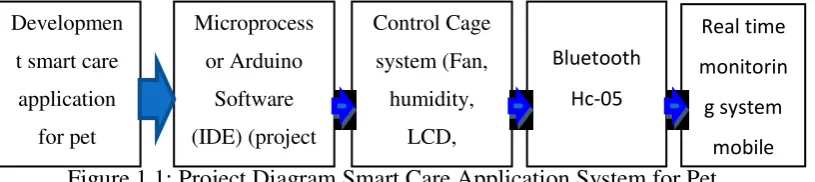
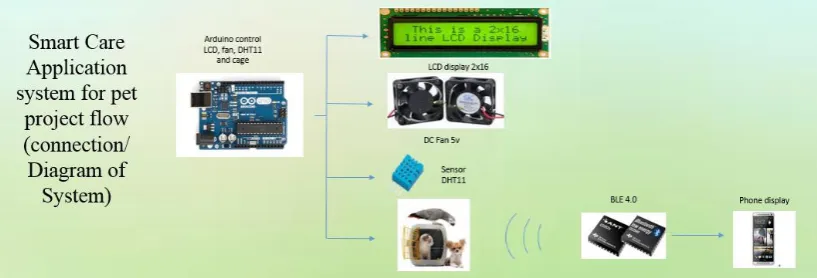
smart cage multifunction. In Figure 1.1 show that the project diagram Smart Care
Application System for Pet and Figure 1.2 show Smart Care Application system for
pet project flow (connection/Diagram of System).
First of all this project we were used microcontroller system because
Microcontroller system is a single chip computer that can be used in control
application. This microcontroller was function as a device that can controller the
equipment. Then, we were design the fan control circuit of smart care application for
pet by using Arduino sketch. This circuit will show how the fan functioning. Other
than that, we also used DHT11 to design the temperature/humidity circuit. Second,
we were using Arduino integrated development environment (IDE) compiler as an
application to make a program. In this section, we will create a system program that
shows how the fan and temperature functions. Besides that, we also program how
much time it takes to dry the fur of pet and by using our smart phone android
application we will displays the value of temperature/humidity of animals fur after
drying in mobile phone.
Third, by using Bluetooth device we make a connection from cage to the
phone. This Bluetooth function as a connection for phone to transmit and receive the
[image:19.595.121.529.638.729.2]data. The data that has been program will transfer to the cage by using Bluetooth.
Figure 1.1: Project Diagram Smart Care Application System for Pet. Control Cage system (Fan, humidity, LCD, Bluetooth Hc-05 Microprocess or Arduino Software (IDE) (project Real time monitorin g system mobile Developmen
t smart care application
4
Figure 1.2: Project Flow (connection/Diagram of System)
1.5 Project Significance
This project will give the most benefit to users in a wide range of industries,
especially to the veterinary company. The veterinary company could develop and
implement this project in order to provide better product performance and convenient
to the users. This project is easy to implement and also low cost.
1.6 Summary
Pet traumatized emotions disturbed due to noise disturbance from the dryer.
Smart care application system for pet by using microcontroller is introduced to
overcome this problem in modern technology life. In this chapter are covered about
the background, the problem statement, the objectives, and the scope of work and the
5
CHAPTER 2
LITERATURE REVIEW
The characteristics and some information of the equipment and materials being used
in the project are discussed in this chapter. This chapter explains literature review
based on current and exist technologies and information has been done in order to
create a specific research about this project. Research hypothesis is been described
clearly. From literature review, there will be an analysis regarding the advantages
and disadvantages for each phase of this project. The research topics that had been
discussed in this chapter are about basic smart care application such as equipment,
software and so on.
2.1 Type of Dryers
2.1.1 High Pressure pet Dryers (Forced-Air Dryers and High velocity dryers)
High pressure Pet dryers for pet are pieces of equipment that operate
with the same concept as hairdryers, except these are designed for pet fur and are quieter than the hair dryers we’re used to. Some pet’s get spooked by loud noises, so these dryers are designed to quietly and thoroughly get our pet dry
and ready for the next step (clipping). While part of the drying process will be
6
rest of the drying process will be most convenient if we have some mechanical
help.
Figure 2.1 show that the Flying Simple Grooming Dryer (Forced –Air
Dryer) makes drying furry friend(s) of all sizes an easy task. The specification
of lightweight, portable, durable dryer features two switches that allow to
comfortably adjusting the speed and heat levels. This dryer can saves
efficiency grooming time by up to 60 percent and very slim. The design of the
120-inch stretchable hose and handle placement, gives the capability to
maneuver it effortlessly while protecting hands from the selected heat option.
By a quick snap on and off clasp, we can customize the dryer with the included
three various size nozzles, which will give a different grooming experience.
Due to removable filters, this dryer is easy for maintaining cleanliness and
keeping pet hair out. With its efficient and powerful function, the dryer is
[image:22.595.259.445.427.542.2]suitable for any pet.
Figure 2.1: Flying Simple Grooming Dryer (Forced –Air Dryer)
Figure 2.2 show that The B-Air Bear Power I Dryer (High Velocity
Dryer) offers powerful drying capability in a light weight and easy to carry
size. Constructed of high-impact ABS plastic for durability, the Bear Power I
weigh in at only 7.8 lbs. The two-speed motor is insulated for quiet operation.
The high RPM on the turbine motor warms the air by approximately 20
degrees Fahrenheit without a heating element. Rubberized feet keep the unit
7
keep the unit free of pet hair and debris. The Bear Power I come with a set of
four nozzles. The slot nozzle is for long coated pets to prevent knotting while
drying. The cone is used for the deepest drying and is great on very thick
coated dogs. The brush nozzle is designed for deseeding the coat. The airflow
nozzle allows more airflow for drying small dogs, cats, and sensitive areas
such as ears and face. This is a compact and light weight with a built-in handle,
the Bear Power I can go anywhere. C-ETL-US Approved. Specifications 2 HP,
115V motor 33,000 FPM 7.4 amps Two speeds 7.8 lbs 6 foot hose 165 CFM
[image:23.595.260.448.280.412.2]10 foot cord. (Joanna Ehlers, 2013).
Figure 2.2: show that The B-Air Bear Power Dryer (High Velocity Dryer)
2.1.2 Low pressure dryers (Stand Dryers, Cage Dryers)
Low pressure dryers also known as carpet dryer, or cage dryer, this
particular type of dog dryer is composed of a large blower that produces a lot
of air flow at a very low pressure. This is a gentle way to dry sensitive dog
coats. Many low pressure dog dryers come with an auxiliary heater to warm
8
Figure 2.3 show The Oster Hi-Velocity Adjustable Table and Cage
Dryer (Stand dryers) is made by a pet-grooming leading manufacturer, Oster,
and offers a sturdy dryer with a heating element that can turn off (perfect!)
and an ideal design to use on your grooming table or as a cage dryer. For
added safety, there is a special overload switch preventing it from
[image:24.595.225.408.221.314.2]overheating. (@lazharichir, 2016)
Figure 2.3: Oster Hi-Velocity Adjustable Table and Cage Dryer (Stand dryers)
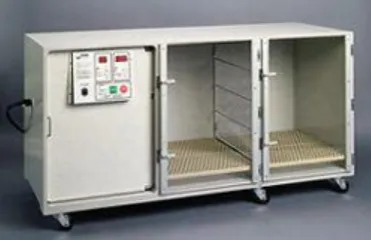
Figure 2.4 show the cage dryer room. The cage dryer concept saves
labor compared to hand drying, and is appropriate for most types of coats and
cuts. Temperature control adds a safety factor far beyond other hands-off
drying setups. The air temperature is regulated and uniform within the
compartment - there are no hot spots. Furthermore, the operator judges what
temperature is appropriate for the animal inside, and sets the exact temperature
[image:24.595.262.448.553.673.2]in degrees Fahrenheit. Setting "fan only" dries without any heat at all.