
Principles in Patterns (PiP): Evaluation
WP7:39 Evaluation of impact on business processes
April 2012
Creator: George Macgregor
Contents
Figures ... 3
Tables ... 4
1. Introduction ... 5
1.1 Evaluation background ... 5
1.2 Previous PiP baselining work ... 5
2. Methodological background and approach ... 7
2.1 Aims ... 7
2.2 Research background and approach ... 7
2.3 Note concerning HaSS data ... 10
3. Analysis and discussion ... 11
3.1 Project radicalness ... 11
3.2 Qualitative benchmarking ... 12
Process bottlenecks: partially resolved ... 13
Poor feedback looping: resolved ... 15
Absence of version control: resolved ... 15
Absence of central repository: resolved... 16
Form size and lack of guidance: partially resolved ... 17
3.3 Pareto analysis: HaSS case study ... 17
3.4 Structural metrics ... 21
Formalising process: an “ideal type” for analysis ... 22
Branching automation factor (BAF) ... 23
Communication automation factor (CAF) ... 23
Activity automation factor (AAF) ... 25
Role integration factor (RIF) ... 25
Process visibility factor (PVF) ... 26
Person dependency factor (PDF) ... 28
Activity parallelism factor (APF) ... 29
Transition delay risk factor (TDRF) ... 29
4. Conclusions ... 30
5. References ... 32
6. Appendix A: HaSS course approval workflow (Faculty level) ... 36
Figures
Creator: George Macgregor
Tables
1. Introduction
1.1 Evaluation background
The innovation and development work conducted under the auspices of the Principles in Patterns (PiP) project [1] is intended to explore and develop new technology-supported approaches to curriculum design, approval and review. An integral component of this innovation is the use of business process analysis and process change techniques - and their instantiation within the C-CAP system (Class and Course Approval Pilot) - in order to improve the efficacy of curriculum approval processes. Improvements to approval process responsiveness and overall process efficacy can assist institutions in better reviewing or updating curriculum designs to enhance pedagogy. Such improvements also assume a greater significance in a globalised HE environment, in which institutions must adapt or create curricula quickly in order to better reflect rapidly changing academic contexts, as well as better responding to the demands of employment marketplaces and the expectations of professional bodies [2], [3]. This is increasingly an issue for disciplines within the sciences and engineering, where new skills or knowledge need to be rapidly embedded in curricula as a response to emerging technological or environmental developments, e.g.[4], [5]. All of the aforementioned must also be achieved while simultaneously maintaining high standards of academic quality, thus adding a further layer of complexity to the way in which HE institutions engage in “responsive curriculum design” and approval [4]. This strand of the PiP evaluation therefore entails an analysis of the business process techniques used by PiP, their efficacy, and the impact of process changes on the curriculum approval process, as instantiated by C-CAP. More generally the evaluation is a contribution towards a wider understanding of technology-supported process improvement initiatives within curriculum approval and their potential to render such processes more transparent, efficient and effective.
Partly owing to limitations in the data required to facilitate comparative analyses, this evaluation adopts a mixed approach, making use of qualitative and quantitative methods as well as theoretical techniques. These approaches combined enable a comparative evaluation of the curriculum approval process under the “new state” (i.e. using C-CAP) and under the “previous state”. This report summarises the methodology used to enable comparative evaluation and presents an analysis and discussion of the results. As the report will explain, the impact of C-CAP and its ability to support improvements in process and document management has resulted in the resolution of numerous process failings. C-CAP has also demonstrated potential for improvements in approval process cycle time, process reliability, process visibility, process automation, process parallelism and a reduction in transition delays within the approval process, thus contributing to considerable process efficiencies; although it is acknowledged that enhancements and redesign may be required to take advantage of C-CAP’s potential. Other aspects pertaining to C-CAP’s impact on process change, improvements to document management and the curation of curriculum designs will also be discussed.
This report represents the third PiP evaluation “strand report”. Reports associated with preceding
strands have already been published [6], [7].
1.2 Previous PiP baselining work
Creator: George Macgregor
iterative interview approach was also used to gather reflective stories from a number of stakeholders, including academics, faculty officers, deans and vice deans, and members of staff involved in governance, management and policy. These stories informed the development of the mapping but also helped to conceptualise the various issues that appeared to be inhibiting process improvement.
The baselining work identified a series of process flow and document workflow issues with the current approval processes. These issues can be summarised as follows:
1. Process bottlenecks: Process bottlenecks are created as a result of the scheduling of committee meetings, particularly those of Senate and Ordinances and Regulations, such that approval decisions are delivered too late for classes and courses to be available to prospective students in any given academic year. Informal arrangements are therefore used by faculties to direct students to local information sources rather than centrally maintained curriculum information. This bottleneck also results in difficulties for a variety of primary stakeholders situated at the process end (e.g. Library, Timetabling, Estates Management, Disability Services, etc.), each of which struggle to discharge their function in the absence of – or late delivery of – curriculum information.
2. Poor feedback looping: Poor feedback looping with inadequate tracking of changes or amendments applied to proposals as they progress through the approval process. This often results in the approval of proposals and curricula that deviate significantly from the initial proposal. Unsatisfactory feedback mechanisms also mean that such changes are not always
communicated to the department delivering the curricula and – in some circumstances - are
not even communicated to the academic staff scheduled to be delivering the teaching.
3. Absence of version control: Poor document versioning and tracking was identified as a serious issue. This is largely a result of the various MS Word templates used by faculties and their progression through the approval process via email and on paper. The situation is complicated by divergent faculty practice, many of which collect additional information beyond
that which is required by central administration. The lack of version control – and the
consequent lack of unique identifiers - ultimately means that considerable effort has to be expended, for example, by administrative staff in order to reconcile versions of proposed classes or courses, significant aspects of which may have changed during the approval process (e.g. change in class or course title, format of study, etc.). The absence of version control is also a particular issue (and coalesces with poor feedback looping) when proposals are resubmitted in response to the conditions set by a committee. It is difficult for committee secretaries and committee members to keep track of feedback or conditions that accompanied previous rejection.
4. Absence of central repository of curriculum information: The absence of any central repository (or “single source of truth”) of approved curriculum proposals and descriptors means that there is no definitive source of approved curriculum information. Not only is this an issue when amended proposals are re-introduced to the approval process, it also means that reviewers have difficulty in understanding how a class contributes to the overall course (programme) it is supposed to form part of. The lack of a central repository of approved descriptors is also an issue when classes and courses are scheduled for periodic review. 5. Daunting size of forms and lack of guidance: The existing curriculum proposal forms were
was highlighted by approval committee members, some of whom encountered forms that were inappropriately or insufficiently completed.
The above noted issues form a useful basis for comparative study, providing five process and document workflow issues against which C-CAP impact can be understood. However, it should be noted that no data gathering was undertaken during the previous baselining work, thus precluding any formal comparative analysis.
2. Methodological background and approach
2.1 Aims
The PiP Evaluation Plan details the wider objectives of the project evaluation [10]. This evaluative strand (WP7:39) is interested in analysing the business process techniques used by PiP, their efficacy, and the impact of process changes on the curriculum approval process. Process changes were implemented via C-CAP. A broad evaluative objective was therefore to capture and evidence improvements in the curriculum design and approval process made by C-CAP and ergo the PiP project. The following broad evaluation objectives influenced the evaluative design:
To what extent have improvements to the curriculum design and approval process – as
instantiated by C-CAP - resulted in efficiencies, i.e. has the process been improved significantly?
To what extent has C-CAP – and the process improvements it facilitates - resolved
acknowledged approval process deficiencies?
An additional exploratory goal was to improve community understanding of the links between technology-supported approaches to curriculum design and the way process improvement initiatives can be embedded, integrated and function as a vehicle for process transparency, efficiency and effectiveness.
2.2 Research background and approach
Although there is growing academic interest in deploying business process change strategies within the public sector [11–16] and even within higher education (HE) [15], [17], very little detailed literature has been published on specific HE implementation strategies, or even how best to evaluate business process change within HE. In a comparative paper Macintosh [15] summarises the business change strategies of several HE institutions and compares them to private sector approaches. Although Macintosh provides useful case studies, evaluation approaches are not discussed and instead the research focuses on the adjustments required for public sector approaches to business change to be successful. More specifically, Jain et al. [17] describe the successful use of business process reengineering (BPR) techniques to redesign curricula, using BPR and benchmarking as a means of identifying improvements to pedagogy within an undergraduate degree class. Jain et al.’s work represents a unique contribution to process thinking within curriculum design; but it is focused on a single class, relies on an analysis of student learning outcomes in order to validate its success, and does not explore a process encompassing numerous actors or sub-processes (e.g. curriculum approval process). The lack of extant literature in this area of study has therefore necessitated a bespoke approach in this instance.
Creator: George Macgregor
useful schematic and a basis for comparative analysis (see section 3.2); however, few performance
indicators were recorded or collected at this time, either because such data did not exist or was difficult to acquire. This evaluative phase therefore has few objective metrics to use in its analysis. Evaluation of the business process improvement (BPI) approach within PiP (and the impact of C-CAP on the process) therefore requires data from a number of disparate sources and the increased use of theoretical and qualitative techniques in order to assess C-CAP’s impact.
In an exhaustive review of business process change methods, techniques and tools, Kettinger et al. [18] propose their Stage-Activity (S-A) Framework. The S-A Framework is designed to assist practitioners in developing and deploying new business change initiatives and has become one of the
most widely recognised [12] and cited approaches [13], [19–22]. Stage 6 (“Evaluate”; S6A1) of
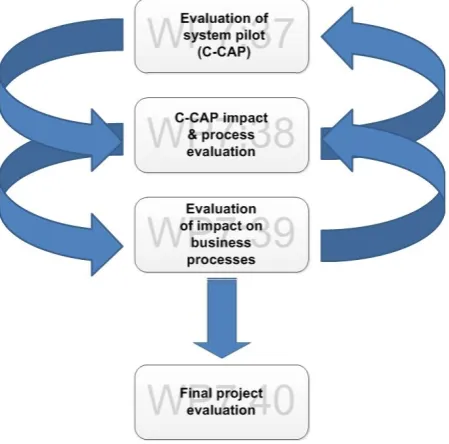
Kettinger et al.’s [18] S-A Framework accommodates evaluation and details a suite of techniques which can be usefully deployed in the evaluation of business process change. Two of the most suitable techniques within the PiP context include: focus groups (group interviews) and employee and team attitude assessments. Given the lack of objective metrics upon which to base comparative analyses, the use of qualitative data sources was considered integral and is considered by Kettinger et al. as important to understanding overall process performance. Similarly, Sarkis and Talluri [23] note the need for qualitative data to feature prominently in any evaluation of business process change. The recursive nature of the evaluation plan [10] is such that qualitative data collected from WP7:38 will feed into the evaluative activities of this present phase (i.e.WP7:39) (See Figure 1). No qualitative data will therefore be collected or reported in this evaluative phase; data to fulfil the group interviews and employee attitude assessment of S6A1 will be collected and reported separately in
WP7:38†. The group interview technique will also be used instead of the focus group approach,
[image:8.595.186.411.402.624.2]owing to its success within organisational research contexts and its directed nature [24].
Figure 1: Overview diagram of the PiP evaluation strands; note the recursive relationship between WP7:38 and 39.
Pareto charting is also cited by Kettinger et al. [18] as an important root-cause evaluation technique. The Pareto principle [25], [26] enjoys wide application across a disparate range of disciplines and states that for many events approximately 80% of the observed effects come from 20% of the causes [25]. The purpose of Pareto charting is to identify the most important factors (within a large set of factors) requiring attention, thus enabling problems to be prioritised and monitored (e.g. most common sources of defects/errors, the highest occurring type of defect/error, etc.) [27–29]. To facilitate Pareto charting, data pertaining to the curriculum approval process in the Faculty of
Humanities and Social Sciences (HaSS) during 2011/2012 was gathered‡. This data covered the curriculum approval period beginning October 2011 up to late March 2012, when HaSS C-CAP piloting began. Data included the number of curriculum proposals for classes and courses that suffered delayed approval or rejection, as well as information on the nature of the problem (“cause”) that resulted in delayed approval or outright rejection. Whilst such data is no substitute for genuine baselining data, its purpose in this instance was – via Pareto analysis - to identify significant problems within the current curriculum approval process and to use this problem data to assist in assessing the potential impact of C-CAP on approval processes.
The evaluation methods summarised above and proposed by Kettinger et al. [18] were supplemented by qualitative benchmarking in order to compensate for limitations in the Pareto data. As noted in
section 1.2, the PiP baselining work identified a series of process and document workflow issues [8]. Whilst no metrics were gathered at this time, the qualitative outcomes of the baselining work provide a
useful basis for qualitative benchmarking. Qualitative benchmarking refers to the “comparison of
processes or practices, instead of numerical outputs” [30] and has been recognised as a useful general management approach [31]. In essence, qualitative benchmarking necessitates the
comparison of a previous situation or “state” with a current situation or new state, or against
established frameworks that define a state of “good practice”. Broderick et al. [32] provide a detailed review of previous work within the area of qualitative benchmarking; suffice to state that such techniques are often applied within IT [33] and have been successfully applied in Knowledge Management (KM) [34] and within business and industrial process contexts [32]. Like the PiP baselining work, qualitative data for such benchmarking is generally gathered using interview approaches, e.g. [30], [32], [34]. The five principal process and document workflow issues identified
by the baselining exercise and summarised in section 1.2 therefore sufficiently characterise the critical
aspects of the previous state (i.e. the current curriculum approval process). Data on this previous state was used in a comparative benchmarking process with the process using C-CAP (i.e. the new
state). An assessment of overall “project radicalness” [18] was also conducted to determine the
suitability of the process change strategy adopted by PiP.
To further quantify the improvements effected by C-CAP in process performance (e.g. in process design, process and document flow issues, etc.), simplified process flow diagrams for the existing
class and course approval processes were generated using ISO 5807:1985 [35] (see Appendices A
and B). These diagrams then formed the basis for theoretical analysis and, where possible, were
subjected to Balasubramanian and Gupta’s “structural metrics” [36]. Balasubramanian and Gupta
[36] provide a formal yet flexible technique to evaluate the implications of process redesign on process performance and propose a list of structural metrics that can be easily deployed to create a formal approach to business process change evaluation. Their metrics synthesise, build upon and extend the work of others, including Nissen [37] and Kueng and Kawalek [38]. Many of Balasubramanian and Gupta’s metrics are applicable to the HE sector and to the curriculum approval process (e.g. Branching Automation Factor (BAF), Communication Automation Factor (CAF), Activity Automation Factor (AAF), etc.) and have been cited in the literature as useful for assessing performance impact [39–41]. Franch [41] also reports on the use Balasubramanian and Gupta’s structural metrics in the development of an information system employing goal-orientated modelling.
To summarise, the following data collection techniques / theoretical approaches were used in this evaluative strand:
1. Group interviews (data to be collected during WP7:38)
2. Employee attitude assessment (data to be collected during WP7:38) 3. Project radicalness assessment
4. Pareto analysis
‡
Creator: George Macgregor
5. Qualitative benchmarking 6. Structural metrics (using [36])
Owing to the nature of the theoretical analysis used to evaluate qualitative benchmarking, Pareto data
and structural metrics, findings have been combined with their discussion in the Analysis and
discussion section.
2.3 Note concerning HaSS data
Note that 3 and 5 used HaSS data and process diagrams respectively. HaSS was used for several reasons:
HaSS was the only faculty to have made some record of curriculum approval process issues.
It is nevertheless surmised that the issues identified by HaSS would feature in all faculties; however, it is acknowledged that this is a clear limitation of the data but one that - owing to the lack of genuine baselining metrics – is necessary to accept.
Of all University of Strathclyde faculties, HaSS has engaged in substantive piloting of C-CAP
3. Analysis and discussion
3.1 Project radicalness
Redesigning aspects of the curriculum approval process was initially a recommendation of the PiP baselining exercise [8]. As a consequence of institutional reorganisation, wholesale redesign of curriculum approval processes was not possible. Institutionally led reviews of curriculum approval remain suspended pending further reorganisation and - until recently, but too late to influence the development of C-CAP - little appetite for process redesign was to be found among management. Reporting undertaken by PiP documents this aspect of the institutional scenario in more detail [42].
PiP - and the curriculum process that C-CAP models – therefore attempts to capture the existing
[image:11.595.67.531.319.636.2]curriculum approval process while streamlining or improving processes, addressing document management and workflow issues, innovating process and improving collaborative potential. An assessment of overall “project radicalness” [18] was therefore conducted to determine the suitability of the process change strategy adopted by PiP.
Table 1: Project radicalness worksheet for PiP, as proposed by Kettinger et al. [18] to inform business process change strategy approach.
Factor Question Process
improvement Process redesign Radical reengineering Strategic centrality
Is the targeted process merely tangential (1) or integral (5) to the organisation’s strategic goals
and objectives?
1
Tangential
2 3 4 5
Integral
Feasibility of IT to change process
Does IT enable only incidental change (1) or fundamental process change (5)?
1
Incidental
2 3 4 5
Fundamental
Process breadth Is the scope of the process intra-functional (1) or
inter-organisational (5)?
1
Intra-functional
2 3 4 5
Inter-organisational
Senior management commitment
Is the senior management visibly removed (1) or actively involved (5) in the BPR efforts?
1
Removed
2 3 4 5
Involved
Performance measure criteria
Are the preferred performance measurement criteria efficiency based (1) or effectiveness
based (5)?
1
Efficiency based
2 3 4 5
Effectiveness based
Process
functionality Is the process functioning marginally (1) or is the process not functioning well at all (5)?
1
Higher functionali
ty
2 3 4 5
Lower functionality
Project resource availability
Are only minimal resources (1) available to support the process change or are resources
abundant (5)?
1
Scarce
2 3 4 5
Abundant
Structural flexibility
Is the organisational structure rigid (1) or is it flexibly conducive (5) to change and learning?
1
Rigid
2 3 4 5
Flexible
Cultural capacity for change
Does the culture support the status quo (1) or actively seek participatory change (5)?
1
Status quo
2 3 4 5
Adaptable
Management’s willingness to impact people
Are only modest impacts on people tolerable (1) or is management willing to deal with the consequences of disruptive impacts (5)?
1
Modest
2 3 4 5
Disruptive
Value chain target
Is the BPR effort targeted at an internal support process (1) or a core process (5)?
1
Support
2 3 4 5
Core Propensity for risk 1 2 3 4 5
Very risk averse
High risk taking
In their empirical review of business process change techniques, Kettinger et al. [18] note the importance of characterising the extent to which an organisation is receptive to process change. They propose a series of 11 contingency factors pertinent to business process change projects (Table 1). A score between 1 and 5 can be assigned to each factor, using the descriptive anchors at the two poles. Factor scores at the lower end suggest that changes should emphasise process improvement,
Creator: George Macgregor
while factor scores at the higher end suggest radical reengineering. Process redesign is cognate with factor scores that are neutral. Each factor is weighted equally and can be used to derive an overall mean score of the 11 factors thus providing an indicator of the process change strategy to be adopted. Using techniques proposed by McFarlan [43] in the area of risk taking, Kettinger et al. [18] also propose an averaging procedure thereby pushing up or down the propensity for risk index which, in this case, yields a risk propensity score of 2. The overall process change strategy (PCS) can then
be calculated using the following formula: PCS = (x + y) / 2; where x represents the mean contingency
factor score (M = 2.18) and y represents the degree of risk propensity. Thus, in this case: PCS = (2.18 + 2) / 2 = 2.09. This suggests that the adopted business process change approach should
emphasise aspects germane to process improvement and should not attempt to redesign or even
reengineer existing processes.
The eventual emphasis on improvement (rather than redesign) is therefore unsurprising in the case of
PiP and is consistent with literature documenting public sector business process change initiatives, many of which demonstrate limited radicalness [13], [44–46]. Sundberg and Sandberg [45] note the peculiarities of public sector organisational structures as an inhibitor of radical process change. Responsibility for processes tends to be shared among numerous stakeholders and often demonstrates labyrinth-like qualities, extending well beyond the boundaries of single departments to encompass entire organisations. This scenario is further reinforced by an organisational culture in which continuity, reliability and egalitarianism are valued and where rigid hierarchical management structures impede change [46]. This generally makes public sector organisations more resistant to redesigns which may result in costly-to-rectify mistakes [47] and instead more conducive to incremental change via process improvement and/or process simplification [15], [45], [48], [46]. The organisational scenario described by Sundberg and Sandberg [45] is replicated within the current curriculum approval process at the University of Strathclyde, which itself incorporates a large number of primary, secondary and key stakeholders, many of which are spread across numerous University departments, faculties and management structures [8]. The decision to model the existing curriculum
approval process while emphasising process improvement or streamlining where possible – and
whilst simultaneously addressing fundamental information management difficulties – has clearly been
validated as the most appropriate process change strategy with which to effect change in this instance. It is nevertheless apposite to note that the initial aspirations of process redesign would probably have been unachievable even if institutional reorganisation had not intervened. This appears to be borne out by extant research (e.g. [13], [44–46]) and the failure of the institutional environment to meet Ahmad et al.’s [49] critical success factors for successful process reengineering in HE.
3.2 Qualitative benchmarking
As noted in section 2.2, the qualitative outcomes of the baselining work provide a useful basis for qualitative benchmarking. Table 2 summarises the five principal process and document workflow
issues identified by the baselining exercise [8] (previous state) and sets out the status of these issues
under the new state (i.e. C-CAP system). Despite the lack of institutional appetite for process
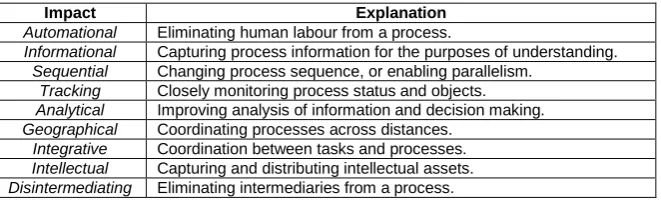
change, the system and process (as instantiated by C-CAP) has managed to address all of the recognised issues from the previous state. Table 2 also sets out the nature of the process innovation achieved in the new state using Davenport’s seminal IT process innovation categories [50]. Definitions of Davenport’s IT process innovation categories are provided in Table 3.
Process bottlenecks: partially resolved
Owing to the institutional scenario outlined in section 3.1 and the modelling of existing processes in
[image:13.595.67.527.240.629.2]C-CAP, PiP has been unable to effect changes to the scheduling of key meeting dates (e.g. academic committee meetings, Senate, Ordinances and Regulations, etc.). With the adoption of a process improvement / streamlining strategy, this particular baselining issue became outside the scope of the project. Effecting such change necessitates a radical redesign of approval procedures in order to coordinate committee meetings across numerous departments and stakeholder groups. It is nevertheless worthwhile noting that faculty piloting of C-CAP and the stakeholder engagement it necessitated has stimulated discussion within the Education Strategy Committee [51] about expediting a review of the current approval procedures.
Table 2: Summary table of qualitative benchmaking. Includes principal baselining findings [8] (previous state) against C-CAP implementation and resolutions (new state) and characterises the process innovation achieved using Davenport’s IT process innovation categories [50].
P r e v i o u s s t a t e N e w s t a t e
# Baselining
issue
Baselining issue summary definition
Status of issue under
C-CAP
C-CAP summary description
Impact: Davenport’s IT process innovation
category
1 Process
bottlenecks
Scheduling of meeting dates of key committees resulting in late decisions; primary stakeholders (e.g. library, timetabling, disability services, etc.) informed too late to sufficiently discharge
function. Partially
resolved
PiP (and ergo C-CAP) unable to change meeting schedules; although C-CAP piloting has facilitated discussion of this by key
stakeholders. Nevertheless, C-CAP enables quicker processing of curriculum proposals prior to crucial decision making milestones and ensures communication of curriculum information to primary stakeholders. ‘Automational’ and ‘disintermediating’ impacts also improve process efficiency. Automational Disintermediating Tracking Intellectual 2 Poor feedback looping
Poor feedback mechanisms throughout process resulting in inadequate change tracking and poor communication of feedback/changes to key stakeholders, including academics.
Resolved
Improved feedback mechanisms throughout the process as facilitated by C-CAP; feedback communicated to key members of academic quality / faculty and members of the writing team. Automational Disintermediating 3 Absence of version control
No version control or unique identifiers in operation resulting in administrative and review issues; lack of standardisation between curriculum design forms.
Resolved
Version control and unique identifiers imposed facilitating ‘tracking’ impact. Curriculum design forms for both
class and course standardised. Tracking
4
Absence of central repository
No central repository of approved curricula to function as “single point of truth”. Creates issues for reviewers / faculty and periodic review.
Resolved
Since C-CAP provides the focus for the entire curriculum design and approval process, it functions as the single point of truth from which the status of proposals can be monitored and approved curricula revisited or amended. Intellectual Tracking Analytical 5 Form size and lack of
guidance
Forms considered “daunting and onerous” and obstacle to pedagogical improvement. Lack of guidance associated with curriculum design process resulting in confusion about approval expectations both at academic and review level.
Partially resolved
Curriculum approval forms have been rationalised and “show and hide” approach to interface design enhances accessibility. Guidance on curriculum design and University policies embedded within C-CAP guidance areas.
N/A
C-CAP has been more successful at addressing other aspects of the process bottleneck issue. Its ability to achieve this is consistent with well understood models of IT’s potential to impact upon process innovation [50]. C-CAP has demonstrated an automational and disintermediating impact [50], [52] on the curriculum approval process, resulting in a variety of process efficiencies.
Creator: George Macgregor
[image:14.595.135.466.222.322.2]begin (Figure 2 - see stages 1 and 2 in rich diagram). Proposal initiation demands the writing team demonstrate the academic rationale and business case for proposing a new degree course. This process is often an iterative one and perhaps a lengthy and cumbersome one if the HoS/HoD insists upon changes to the academic or business rationale. Rather than relying on paper-based processes (occasionally facilitated by the HoS/HoD via email), C-CAP enables immediate and automatic notification to the writing team of whether a new proposal has been accepted by the HoS/HoD or not, and whether modifications are required and the nature of these modifications. Writing teams can action changes as soon as notification is received and revise the proposal accordingly online, minimising further paperwork entering the process.
Table 3: Davenport's [50] categories of potential impact on process innovation of IT and system solutions.
Impact Explanation
Automational Eliminating human labour from a process.
Informational Capturing process information for the purposes of understanding.
Sequential Changing process sequence, or enabling parallelism.
Tracking Closely monitoring process status and objects.
Analytical Improving analysis of information and decision making.
Geographical Coordinating processes across distances.
Integrative Coordination between tasks and processes.
Intellectual Capturing and distributing intellectual assets.
Disintermediating Eliminating intermediaries from a process.
The management of the approval process workflow via the system also speeds up the submission and subsequent dissemination of curriculum proposals to stakeholders within the approval process. This affords writing teams extra time with which to refine curricula prior to final submission and ensures appropriate notification of approval / rejection outcomes, something which was found to be unsatisfactory under the previous state [8].
[image:14.595.73.522.413.726.2]As proposed curricula progress through the approval process, key and primary stakeholders are either notified of actions (i.e. automational) or can access stakeholder specific information (i.e. intellectual). For example, Student Lifecycle [53] is notified of class code requests and the library can access a stakeholder specific view of the reading lists of approved curricula. This stakeholder specific view highlights titles/resources that require procurement by the library, well in advance of the curricula being delivered. Recall that the baselining work found that under the previous state many primary stakeholders were outside the process such that information central to their effective operation was either never communicated to them or was communicated after curricula were already being delivered.
Poor feedback looping: resolved
The previous state of the curriculum approval process was characterised by poor feedback looping. No system or process existed to record the details of changes or amendments that were required to be made to proposals as they progressed through the approval process (e.g. via academic quality, academic committee, etc.), nor could reviewers or key stakeholders view feedback delivered to proposals when they re-entered the approval process. The poor feedback mechanisms and an inability to relate feedback to the changes made often resulted in the approval of proposals and curricula that deviated significantly from the initial proposal. Unsatisfactory feedback mechanisms also meant that changes (particularly those made towards the end of the approval process) were not always communicated by those responsible to key stakeholders. This often included the department delivering the curricula and even members of the writing team and the academic staff scheduled to be delivering the new curricula.
In the new state C-CAP has facilitated improved feedback mechanisms throughout the curriculum approval process, e.g. [54], [55]. Central management of the approval process and its workflow in C-CAP enables reviewers at various stages of the process to deliver feedback. This feedback is specific to each section of the curriculum proposal and is visible to other reviewers. Details of the feedback (e.g. author details, date of feedback delivery, etc.) is recorded and remains visible throughout the process so that subsequent reviewing can verify that previous feedback has been addressed by the writing team. There is no limit to the feedback that can be delivered or a limit to the number of individual comments that can be left by reviewers per proposal section. Since C-CAP provides a central repository for feedback comments - and because the approval process is governed by workflows and is to a certain extent automational [50] - feedback is always communicated to key members of the writing team and members of academic quality / faculty. The use of human intermediaries to relay feedback has also been minimised such that feedback delivered at later stages of the process is visible and delivered directly to those at the beginning of the process thus facilitating a certain level of disintermediation [50].
Absence of version control: resolved
Under the previous state poor document versioning and tracking was identified as a serious issue. This situation had been created as a result of the various MS Word templates used by faculties for curriculum proposals. Problems tracking and identifying proposals were exacerbated by the fact that the process was often facilitated via paper or through email communication. The lack of version control or unique identifiers meant that considerable effort had to be expended by key stakeholders in order to reconcile versions of proposed classes or courses, significant aspects of which may have changed during the approval process (e.g. change in class or course title, format of study, etc.).
Under the new state C-CAP demonstrates ‘tracking’ improvements [50]. C-CAP assigns unique
identifiers to curriculum proposals as soon as they are generated on the system (during “Core
Creator: George Macgregor
arise. Since C-CAP provides central management of the approval process and “a single point of
truth” (see below for more details), only the most up-to-date versions of curricula will be visible to all stakeholders. The status and tracking of proposals is monitored by C-CAP and is made visible to all, thus improving process transparency to stakeholders. Disparate curriculum approval forms have
been conflated into a “super” form which standardises curriculum design across faculties and
incorporates the features best known to improve design and subsequent pedagogy [57], thus
presenting opportunities for an analytical impact on process [50] (see Absence of central repository
for further details).
An additional issue identified under the previous state was the absence of version control when proposals were resubmitted in response to conditions set by committees, making it is difficult for secretaries and committee members to keep track of feedback or the conditions that accompanied
previous proposal rejections. As described in Poor feedback looping, all feedback pertaining to
proposals is captured within C-CAP. The use of identifiers and the automational benefits brought about by workflow management within C-CAP means that proposals re-entering the approval process (e.g. perhaps as a result of previous rejection or major revisions) are never disassociated from previous feedback and remain uniquely identifiable.
Absence of central repository: resolved
The absence of any central repository (or “single source of truth”) of approved curriculum proposals and descriptors was identified as a serious issue under the previous state. Lacking a definitive source of approved curriculum information created problems when curricula were scheduled for periodic review as pulling together the latest versions of all relevant curriculum information was often unachievable. Curriculum information had often been subsequently updated by a number of different actors and updates were not always recorded, tracked or shared among relevant stakeholders. This also had implications for proposals that may have been re-introduced into the approval process as reviewers often encountered difficulties in understanding how, for example, a class contributed to an the overall course (programme) because definitive and up-to-date information on the course was unavailable.
C-CAP provides the focus for the entire curriculum design and approval process in the new state. It functions as the single point of truth for the most up-to-date curriculum information, and from which the status of proposals can be monitored and approved curricula revisited or amended. Central management of the approval process – and the central repository of curriculum information it creates – facilitates version control and proposal tracking. As well as ‘tracking’, the central repository also demonstrates ‘intellectual’ impact and ‘analytical’ potential. Intellectual impact is characterised by capturing intellectual or knowledge assets which can then be distributed more widely to inform the activities of other groups [50]. Curricula are now being captured, managed and distributed by a central system, providing a consistent source of knowledge that can be accessed by anyone with the intellectual desire to do so. The new state also offers considerable analytical potential. Andersen [58] details several examples of IT enabled process innovation in the public sector using Davenport’s framework [50] and notes the reporting and decision support potential of such approaches. This is no exception with C-CAP. Although such analytical tools remain unspecified and have yet to be implemented, only limited technical work is required to provide institution-wide reporting of curriculum issues. For example, the Education Strategy Committee [51] has expressed interest in generating reports on a variety of curriculum design and academic quality issues to assist in monitoring, strategy formulation and decision making, e.g. data on the extent to which students are exposed to a variety of high impact learning activities during specific courses, level of faculty adherence to policies on assessment and feedback [59], assessment methods in use, etc. The Student Experience and Enhancement Services Directorate [60] also view such data as important for effecting operational efficiencies, while faculty staff have expressed interest in generating such data to improve internal quality monitoring and wider portfolio management. These analytical options have only been made
Form size and lack of guidance: partially resolved
The previous state was characterised by curriculum proposal forms that were found to be “daunting and onerous” and reportedly an obstacle to pedagogical improvement or innovation. Those staff designing modules also reported the lack of guidance accompanying the forms as an additional problem contributing to bottlenecks. For example, policy and best practice guidance is scattered across numerous sources and typically concentrates on the bureaucratic and administrative requirements and rarely describes how University policy should be embedded within curriculum designs or how specific aspects of the forms should be completed (e.g. to better meet committee expectations). The reverse of this latter issue was highlighted by approval committee members, some of whom encountered forms that were inappropriately or insufficiently completed.
C-CAP has standardised curriculum design and approval forms and, where possible, has either rationalised the forms or taken advantage of the technical platform (InfoPath) to deliver “show and hide” forms. C-CAP incorporates aspects of logic such that features of the curriculum design process are hidden to members of the writing team unless specific options are selected or their design context demands it (see for example [61]). This logic ensures that those form elements that are rarely used in curriculum design remain hidden to writing teams unless they are explicitly required, thus reducing form length and suppressing irrelevant elements of the form. Improved guidance has been embedded within C-CAP [62], providing additional guidance on University policies (where possible) and recommendations for best practice. Training materials for C-CAP and its operation (including videos) have been created and made available via the University’s Development and Training Gateway [63].
Unlike previous resolutions under the new state, many of which can be verified via theoretical or demonstrable means, verifying that these new forms are “less daunting and onerous” is a qualitative matter. Whilst the forms are theoretically smaller, context sensitive and suppress irrelevant information requirements, this is something that can only be verified after faculty piloting. It is for this reason that this particular baselining issue can only be classified as “partially resolved”.
3.3 Pareto analysis: HaSS case study
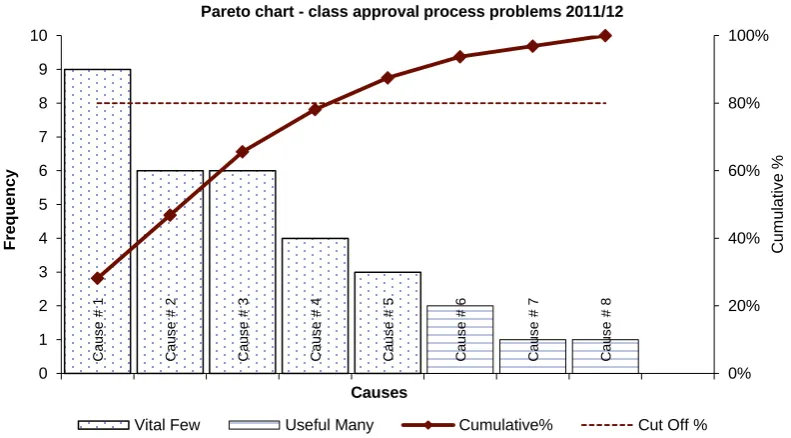
[image:17.595.64.532.593.766.2]A total of 60 class proposals and 6 course proposals were processed by HaSS during the 2011/2012 timeframe. Tables 4 and 5 set out the curriculum approval process problems recorded by HaSS for classes and courses during this period and their frequency. These problems (or “causes”) resulted in the delayed approval of curricula and their re-entry into the approval process or, in some cases, their outright rejection. Pareto representations of this data with a cumulative percentage threshold of 80% are also provided in Figures 3 and 5.
Table 4: HaSS class approval process problems 2011/12: data and cause definitions. Cumulative percentage cut-off set at 80%.
# Cause definitions Frequency Cumulative percentage
1 Cause # 1: Proposer fails to incorporate feedback changes in time for approval through targeted meeting of Faculty Academic Committee.
9 28.1%
2 Cause # 2: Time delay in reviewer providing feedback due to workload constraints.
6 46.9%
3 Cause # 3: Proposers not fully completing the class proposal proforma with requisite information.
6 65.6%
4 Cause # 4: Proposers not completing a class code allocation form which can delay amendments to course regulations.
4 78.1%
5 Cause # 5: Assessment criteria / details flagged up by reviewers as a potential issue, e.g. insufficient detail.
3 87.5%
6 Cause # 6: Resources required to deliver the class not taken into account. 2 93.8%
7 Cause # 7: Competition and duplication of classes run elsewhere in the University not taken into account.
1 96.9%
8 Cause # 8: No contact from proposer after feedback provided. Class approval elapsed.
Creator: George Macgregor
Note that this data does not include those proposals submitted during C-CAP piloting.
[image:18.595.100.496.261.480.2]The causes listed in Table 4 provide a useful insight into actual process issues confronted by faculties during class approval. Table 4 shows members of the writing team failing to incorporate feedback in time for approval to be the most frequently occurring cause. However, the cause frequencies for class approvals (Table 4), although inferring a Pareto effect, are not borne out by the cumulative percentages in which the first two to three categories (the “vital few” [26]) should equate to circa 80% of the effects [27]. Causes #1 - #3 only account for 65.6% of the total effects. As the associated chart illustrates (Figure 3), a gradual decline from left to right is demonstrated and the chart profile does not follow a prototypical Pareto profile, with the 80% cumulative threshold only broken on cause #5. In this instance the “useful many” are actually in the minority. It is nevertheless worth noting that the 80% threshold is an approximation [25], thus 78.1% is reached at cause #4.
Figure 3: Pareto representation of class approval process problems 2011/12.
The data in Table 4 and Figure 3 list a series of process approval issues that were not identified during the original baselining exercise [8]. With the possible exception of cause #3 (“Proposers not fully completing the class proposal proforma with requisite information”), all the causes recorded represent new issues within the approval process requiring attention. Several of the causes exist in areas of the process that CAP either has limited influence over or cannot control. For example, C-CAP is unable to influence the staff workload constraints (cause #2) that may cause approval to be delayed or abandoned, nor can C-CAP control some of the issues surrounding the single biggest cause (cause #1).
Causes that are theoretically eliminated or addressed under the new state - a corollary of addressing
the baselining issues via qualitative benchmarking - are as follows:
Cause #3: Under the new state class proposals cannot be submitted for review if the “core
information” requirements have not been satisfied [56]. Where information is not mandated but considered central for the approval process, system logic is used to either remind the writing team if such an area of the form remains empty, incomplete or incorrect (see for example [64]). Embedded user guidance [62] and additional training materials [63] are also used to ensure writing teams complete proposals to a sufficient approval standard. Resolution of this cause is particularly noteworthy owing to its “vital few” status.
Cau se # 1 Cau se # 2 Cau se # 3 Cau se # 4 Cau se # 5 Cau se # 6 Cau se # 7 Cau se # 8 0% 20% 40% 60% 80% 100% 0 1 2 3 4 5 6 7 8 9 10 C u m u lat iv e % Fre quenc y Causes
Pareto chart - class approval process problems 2011/12
Cause #4: The submission of class code request forms is widely considered an unnecessarily bureaucratic process and one that duplicates information already contained in the class proposal. Under the new state class code request forms are generated automatically. Most of the request form content is extracted automatically from the class proposal by C-CAP, leaving only three minor fields for the writing team to complete. This minimises unnecessary bureaucracy thus removing one of the principal reasons for staff postponing its completion and speeding up the form submission process. Submission of the form is an explicit part of the C-CAP system and writing team members are reminded to submit the form. Student Lifecycle [53] – the body responsible for assigning codes – also has access to the forms prior to submission and are therefore made aware of which request forms are scheduled for submission. Resolution of this cause is particularly noteworthy given its “vital few” status. Cause #6: Under the previous state curriculum design and approval forms across all faculties
failed to address the issue of non-standard resources. Specifying the non-standard resources is now an explicit part of the design process in C-CAP [65]. As part of this process the writing team must provide details of how this resource is to be provided, its availability and estimated cost.
Cause #7: Like cause #6, internal competition and/or duplication is now explicitly addressed by the curriculum design and approval forms served by C-CAP. Writing teams are now required to provide a statement on the distinctiveness of the proposed class and the extent to which it overlaps or competes with any other classes offered elsewhere in the institution. Appendix E of the user acceptance testing report [7] provides screen grabs of this aspect of forms in an earlier version of C-CAP.
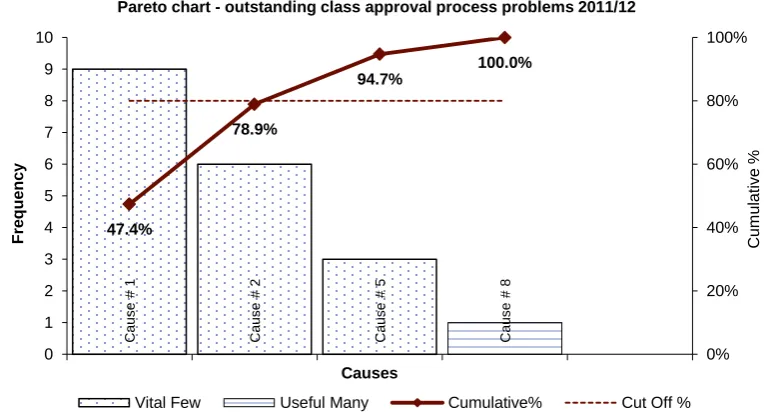
[image:19.595.104.489.459.666.2]A Pareto representation of the outstanding approval problems (causes #1, #2, #5 and #8) is provided in Figure 4. Although the 80% threshold is not broken until cause #5, the cumulative percentage at cause #2 is 78.9%, sufficiently close to 80% to categorise causes #5 and #8 as the “useful many”. Like Figure 3 (above), causes #1 and #2 remain the biggest causes after others have been theoretically eliminated.
Figure 4: Pareto representation of outstanding class approval process problems 2011/12 (theoretically eliminated “causes” removed).
Causes #1 and #5 could nevertheless be reported as partially addressed under the new state:
Cause #1: Although the underlying causes of cause #1 cannot be addressed by C-CAP, the ability for reviewers to deliver targeted feedback on specific aspects of the proposal (i.e. section by section feedback is possible) [54] should assist writing teams in implementing
Cau se # 1 Cau se # 2 Cau se # 5 Cau se # 8 47.4% 78.9% 94.7% 100.0% 0% 20% 40% 60% 80% 100% 0 1 2 3 4 5 6 7 8 9 10 C u m u lat iv e % Fre quenc y Causes
Pareto chart - outstanding class approval process problems 2011/12
Creator: George Macgregor
feedback more expeditiously. However, as noted above, resolving this cause satisfactorily is challenging since C-CAP is unable to influence writing team behaviour outside the system. Cause #5: Under the previous state few curriculum design and approval forms provided an
indication of the expected detail required for assessment activities. This could be one possible explanation as to why some proposals were considered to be defective in this particular dataset. C-CAP is structured to capture specificity in assessment activities [64] and the alignment of assessments with learning objectives (i.e. constructive alignment) [66]. Such specificity is facilitated through a series of drop down menus, auto calculations and system logic. A supplementary description field is available in which the writing team can focus on a description of the assessment activity and its design.
Causes #2 and #8 are not addressed under the new state. Whilst cause #8 is likely to be the result of the writing team deciding to abandon the curriculum approval process, cause #2 is more significant as Figures 3 and 4 attest; yet it is a cause that C-CAP has little ability to influence or prevent.
[image:20.595.68.528.452.610.2]The question of why most of the causes highlighted in Table 4 and Figure 3 were not identified in the baselining exercise requires some reflection. It appears that both exercises (i.e. baselining exercise and Pareto analysis) examined curriculum approval processes from different perspectives (i.e. qualitative and quantitative) and in so doing identified different issues within the same process. Indeed, relying on a single data collection technique is discouraged [67]. Mixing qualitative and quantitative data sources is instead considered essential to better understand process issues and “give meaning” to numeric data [33], [67], [68]. It is also possible that the perceived process issues (as identified by respondents in the baselining exercise) focused on the tacit, holistic and/or fundamental process issues, whilst Pareto analysis exposed important day-to-day issues which would otherwise evade treatment in any holistic discussion of process. The theoretical elimination of causes #3, #4, #6 and #7 and the amelioration of causes #1 and #5 appears - by virtue of addressing the five qualitative benchmarks - to corroborate this analysis.
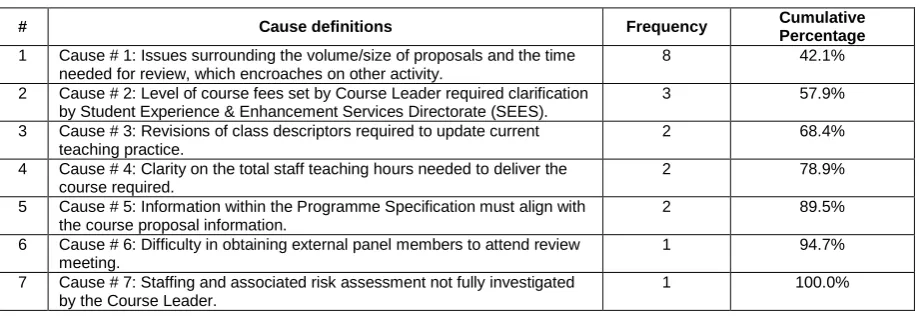
Table 5: HaSS course approval process problems 2011/12: data and cause definitions. Cumulative percentage cut-off set at 80%.
# Cause definitions Frequency Cumulative
Percentage 1 Cause # 1: Issues surrounding the volume/size of proposals and the time
needed for review, which encroaches on other activity.
8 42.1%
2 Cause # 2: Level of course fees set by Course Leader required clarification by Student Experience & Enhancement Services Directorate (SEES).
3 57.9%
3 Cause # 3: Revisions of class descriptors required to update current teaching practice.
2 68.4%
4 Cause # 4: Clarity on the total staff teaching hours needed to deliver the course required.
2 78.9%
5 Cause # 5: Information within the Programme Specification must align with the course proposal information.
2 89.5%
6 Cause # 6: Difficulty in obtaining external panel members to attend review meeting.
1 94.7%
7 Cause # 7: Staffing and associated risk assessment not fully investigated by the Course Leader.
1 100.0%
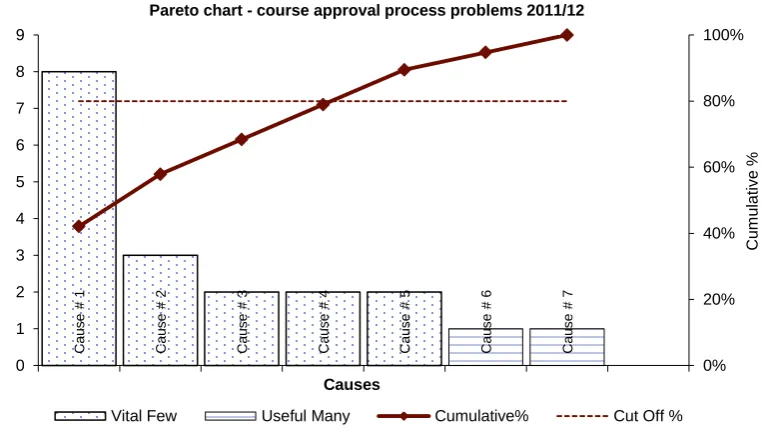
Table 5 sets out the causes for course approval, their frequencies and cumulative percentages. A Pareto representation is provided in Figure 5. Table 5 shows that by far the most frequent cause was the volume of information submitted for review, which was such that academic reviews could not be completed on time. A Pareto effect cannot be observed from Figure 5. With the exception of cause #1, a gradual left to right decline can be observed with the 80% cumulative threshold broken at cause #5; although it should be noted that the cumulative percentage at cause #4 is sufficiently close to at 78.9%.
under the new state. Causes #2, #5, #6 and #7 are not addressed, nor is it clear how they might be addressed or eliminated in a future instantiation of C-CAP. However, causes #1, #3 and #4 are ameliorated:
Cause #1: Cause #1 aligns with aspects of the fifth qualitative benchmark in which curriculum design and approval forms were found to be “daunting and onerous”. As noted in this section, C-CAP has standardised curriculum design and approval forms and, where possible, has either rationalised forms or taken advantage of the technical platform to deliver “show and hide” forms. Forms are therefore shorter. Opportunities for appending additional information, which under the previous state was often collected but performed no purpose or function in the approval process [8], has been removed or discouraged.
Cause #3: Cause #3 aligns with the fourth qualitative benchmark. Under the previous state revisions to extant curriculum designs was difficult and could be time consuming owing to the lack of a central repository and any definitive course of curriculum information [8]. A central repository of definitive curriculum information has ameliorated this by providing an efficient mechanism through which extant curriculum designs can be identified, retrieved, and their intellectual content modified.
Cause #4: The unstructured nature of curriculum design and approval forms associated with the previous state were such that extracting unambiguous data on the total staff teaching hours required to deliver a course was cumbersome and time consuming. C-CAP captures structured information on the percentage time involvement of other departments or external partners [69] (where appropriate) and gathers structured data on the learning activities to be delivered, the number of activities, their nature and duration. Total teaching delivery hours per class are automatically calculated [61]. The analytical potential of the central repository
and standardised curriculum design and approval forms was noted as part of the fourth
[image:21.595.112.497.448.664.2]qualitative benchmark. Further functionality of this type could implemented but at this stage remain unspecified.
Figure 5: Pareto representation of course approval process problems 2011/12.
3.4 Structural metrics
To further quantify the improvements effected in process performance (e.g. in process design, process and document flow issues, etc.), the new state and its process under C-CAP was subjected
Cau se # 1 Cau se # 2 Cau se # 3 Cau se # 4 Cau se # 5 Cau se # 6 Cau se # 7 0% 20% 40% 60% 80% 100% 0 1 2 3 4 5 6 7 8 9 C u m u lat iv e % Fre quenc y Causes
Pareto chart - course approval process problems 2011/12
Creator: George Macgregor
to analysis using Balasubramanian and Gupta’s “structural metrics” [36]. The nature of Balasubramanian and Gupta’s structural metrics and their anticipated impact of process performance is summarised in Table 6 (overleaf). Not all the structural metrics were applicable to the curriculum approval process; explanations are provided in the relevant section.
Formalising process: an “ideal type” for analysis
To facilitate analysis using Balasubramanian and Gupta’s structural metrics [36], the curriculum approval process for courses and classes under the previous state was formalised in Figures 6 and 7 using ISO 5807:1985 compliant symbology [35]. Note that these flow charts model the HaSS approval process, which is typical of other faculties. Larger versions of the figures can be found in Appendices A and B. The flow charts in Figures 6 and 7 were used to inform calculations of the structural metrics; although it is acknowledged that these charts provide an “ideal type”, in a Weberian sense [70], with some sub-processes remaining un-modelled.
The charts form an ideal type because requirements analysis and stakeholder engagement conducted - not just with HaSS but with all faculties throughout the project lifetime - has failed to generate a model of the approval process that all stakeholders can agree upon. The reasons for this are complex but appear to relate to widespread misunderstanding of how the process functions. This situation is further compounded by stakeholder specific perceptions of how the approval process operates, and myths about organisational procedures and a stakeholder’s role within certain procedures, some of which are themselves mythic. For example, it remains not uncommon to encounter stakeholder X, who confidently states than their role in the process is to pass information to stakeholder Y for processing. Stakeholder Y, when questioned, reports that the information stakeholder X communicates is unnecessary and is not required for them to discharge their function; yet stakeholder X remains adamant that it is within their role to behave in this way and by doing so they are adhering to the “process”. Myths are not uncommon in organisational contexts and are often considered necessary in functioning bureaucracies [71–73]. In effect, a variety of myths surrounding the approval process have emerged over many years at the University of Strathclyde. These myths have become pervasiveness and are subscribed to by many actors, thus subverting the process as it currently exists and undermining attempts to formalise or model the true process, let alone effect process change.
Seminal work undertaken by Meyer and Rowan [71] in the area of organisational behaviour explore the formation of myth and ceremony in “institutionalised organisations”. They note the importance of institutional myths in helping employees’ interpretation of organisational culture, or their use in explaining “how things are done around here”. They become, in effect, a factual and highly objective reality in which the myth is constructed to demonstrate why particular practices and procedures are the “only way” an organisation can function effectively [74]. But Meyer and Rowan [71] also note that such myths are frequently contrary to the needs of an organisation which is attempting to grapple with the efficient and effective achievement of its goals or activities. In essence, myths can decrease the coordination and control demanded by genuine organisational activities and instead replaces them with “a logic of confidence and good faith” [71]. Ferris et al. [72] further interprets organisational myth to be a “double-edged sword”: essential to employees’ organisational culture, enabling them to attach meaning and subsequent validity to the disparate activities and processes occurring at the organisation; but also a source of resistance and an impediment to system wide change, because
over time the myth becomes the accepted way of explaining or understanding “organisational
![Table 1: Project radicalness worksheet for PiP, as proposed by Kettinger et al. [18] to inform business process change strategy approach](https://thumb-us.123doks.com/thumbv2/123dok_us/1676761.121105/11.595.67.531.319.636/project-radicalness-worksheet-proposed-kettinger-business-strategy-approach.webp)
![Table 2: Summary table of qualitative benchmaking. Includes principal baselining findings [8] (previous state) against C-CAP implementation and resolutions (new state) and characterises the process innovation achieved using Davenport’s IT process innovati](https://thumb-us.123doks.com/thumbv2/123dok_us/1676761.121105/13.595.67.527.240.629/qualitative-benchmaking-baselining-implementation-resolutions-characterises-innovation-davenport.webp)

![Table 6: Summary table of structural metrics for business process design and evaluation, as proposed by Balasubramanian and Gupta [36]](https://thumb-us.123doks.com/thumbv2/123dok_us/1676761.121105/23.595.67.527.349.607/summary-structural-metrics-business-process-evaluation-proposed-balasubramanian.webp)
