City, University of London Institutional Repository
Citation
:
Baronchelli, A. (2011). Role of feedback and broadcasting in the naming game.
Physical Review E - Statistical, Nonlinear, and Soft Matter Physics, 83(4), doi:
10.1103/PhysRevE.83.046103
This is the unspecified version of the paper.
This version of the publication may differ from the final published
version.
Permanent repository link: http://openaccess.city.ac.uk/2671/
Link to published version
:
http://dx.doi.org/10.1103/PhysRevE.83.046103
Copyright and reuse:
City Research Online aims to make research
outputs of City, University of London available to a wider audience.
Copyright and Moral Rights remain with the author(s) and/or copyright
holders. URLs from City Research Online may be freely distributed and
linked to.
arXiv:1009.4798v2 [physics.soc-ph] 12 Apr 2011
Andrea Baronchelli
Departament de F´ısica i Enginyeria Nuclear, Universitat Polit`ecnica de Catalunya, Campus Nord B4, 08034 Barcelona, Spain
The naming game (NG) describes the agreement dynamics of a population of agents that interact locally in a pairwise fashion, and in recent years statistical physics tools and techniques have greatly contributed to shed light on its rich phenomenology. Here we investigate in details the role played by the way in which the two agents update their states after an interaction. We show that slightly modifying the NG rules in terms of which agent performs the update in given circumstances (i.e. after a success) can either alter dramatically the overall dynamics or leave it qualitatively unchanged. We understand analytically the first case by casting the model in the broader framework of a generalized NG. As for the second case, on the other hand, we note that the modified rule reproducing the main features of the usual NG corresponds in fact to a simplification of it consisting in the elimination of feedback between the agents. This allows us to introduce and study a very natural broadcasting scheme on networks that can be potentially relevant for different applications, such as the design and implementation of autonomous sensor networks, as pointed out in the recent literature.
PACS numbers: 89.75.-k, 05.65.+b, 89.65.-s, 89.75.Hc
I. INTRODUCTION
The naming game (NG) [1, 2] describes a population of agents playing pairwise interactions in order to ne-gotiate conventions. Following Wittengstein’s intuition on language [3], the negotiation is seen as an activity in which one of the individuals (i.e. the “speaker”) tries to draw the attention of the other (i.e. the “hearer”) to-wards an external meaning through the production of a conventional form. For example, the speaker might want to make the hearer identify an object trough the produc-tion of a name. Based on the success or failure of the hearer in pinpointing the proper meaning, both agents reshape their internal meaning-form associations. Since in general at each time step a different pair interacts, the interesting point is to study how the local dynamics affects the population scale behavior, and to investigate the mechanisms leading to the final global consensus.
The model, originally defined to describe artificial in-telligence experiments [1], has been recently brought to the attention of the community of statistical physicists [2] in a formulation that is very close in spirit to that of other opinion dynamics models [4, 5] (for a detailed analysis of this point see [6]). It has been studied in fully con-nected graphs (i.e. in mean-field or homogeneous mixing populations) [1, 2, 7], regular lattices [8, 9], small world networks [9–11], random geometric graphs [9, 12, 13] and static [14–16], dynamic [17] and empirical [18] complex networks. The final state of the system is always consen-sus [19], but stable polarized states can be reached in-troducing a simple confidence/trust parameter [20]. The naming game as defined in [2] has also been modified in several ways [9, 12, 18, 20–29] and it represents the fun-damental brick of more complex models in computational cognitive sciences [30, 31]. From the point of view of the applications, finally, it has been pointed out its relevance in system-design in the context of sensor networks [32], for such problems as autonomous key creation or selec-tion for encrypted communicaselec-tion [9] and, more recently,
as a tool to investigate the community structure of social networks [18, 27].
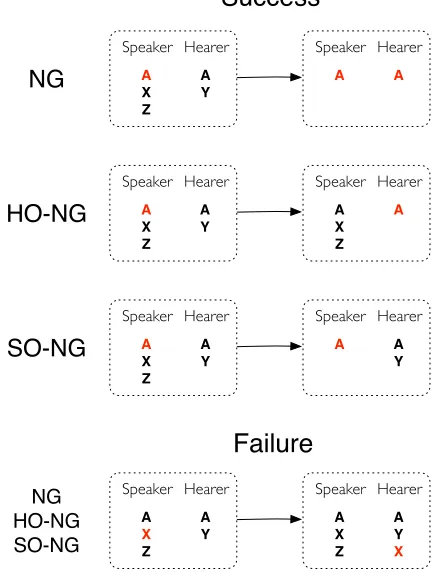
The rules are simple [2]. The game is played by a pop-ulation ofN agents, each of which characterized by an inventory, i.e. a list of words (or “conventions”, “opin-ions”, “forms” or “states”), whose size is not fixed. At every time step two agents are randomly selected and in-teract (see also Figure 1). One of them plays as speaker and the other one as hearer. The speaker picks randomly a word from her inventory and conveys it to the hearer. If the hearer’s inventory contains that word, the game is a success, and both agents delete all the words in their inventories but the one that has just been transmitted. Otherwise it is a failure, and the hearer adds the received word to her inventory. The scheme is completed by spec-ifying that at the beginning of the game all inventories are empty, and that whenever a speaker has an empty inventory she invents a brand new word and transmits it to the hearer [49].
Here we focus on the success rule. The fact that both agents undergo the very same operation (i.e. shrink their inventories to the same unique word), underlies the exis-tence of a feedback between the two. In the original for-mulation the feedback occurrs through an outside world, with the hearer pointing to the object she would asso-ciate with the received word. The speaker would then point on its turn to the right object and both individ-uals would immediately know whether the game was a success or a failure [1]. In the simplified version defined in [2], however, the feedback simply consists in the hearer informing the speaker that she too has the transmitted word. In case of failure, on the other hand, no feedback is needed.
2
Success
A
X Z
A Y Speaker Hearer
A A
Speaker Hearer
A
X Z
A Y Speaker Hearer
A X Z
A
Speaker Hearer
A
X Z
A Y Speaker Hearer
A A
Y Speaker Hearer
NG
HO-NG
SO-NG
A
X
Z A Y Speaker Hearer
Failure
A X Z
A Y
X
Speaker Hearer
NG
HO-NG SO-NG
FIG. 1: (Color online) Interaction rules. The speaker’s inventory contains three words, namely A, X and Z, while the hearer’s one containsAandY. If the speaker randomly selects wordA, the interaction is a success (Top). In the usual NG both agents delete competing synonyms, in the HO-NG only the hearer update her inventory, while in the SO-NG only the speaker does that. When the word transmitted by the speaker is not known by the hearer (as for exampleX), on the other hand, the latter adds it in her inventory and the interaction is classified as a failure (Bottom). In this case, both the HO-NG and the SO-NG behave as the NG.
Speaker-Only NG (SO-NG) respectively (see Figure 1). In particular, we will show that the HO-NG yields a scal-ing of the convergence time with the population size that is the same as the one observed in the usual NG. The SO-NG, on the other hand is significantly slower. We will understand analytically the reason beyond this difference and point out that the SO-NG spontaneously falls in the critical regime of the generalized naming game model in-troduced in [20] (Sec. II). The fact that the HO-NG remains efficient, on the other hand, will allow us to in-troduce a very natural broadcasting scheme that signifi-cantly simplifies previously introduced protocols [9] when the population is embedded in any kind of topology (Sec III).
0 40000 80000
t
0 5000 10000
Nw
(t)
0 40000 80000
t
200 400 600
Nd
(t)
0 100000 200000
t
0 10000 20000
Nw
(t)
NG HO-NG SO-NG
Nwmax
tmax
tconv
FIG. 2: (Color online) Time evolution of the naming game. Top: The total number of wordsNw(t) grows till it reaches a maximum, Nmax
w at time tmax, corresponding to the maximum amount of memory required to the population. Due to an increase in successful interactions, it then start de-creasing till the final state in whichNw(t) =N, meaning that all the agents share the same unique word. The Inset shows that the HO-NG and the SO-NG exhibit the same qualitative behavior observed in the NG. Bottom: the number of differ-ent words presdiffer-ent in the system saturates at Nd(t) = N/2 as soon as the invention process ceases. It then remains al-most constant to fall finally to the consensus valueNd(t) = 1 at the convergence timetconv. Data refer to a population of N= 103
agents and are averaged over 103
realizations.
II. NON-SYMMETRIC UPDATING AND THE
ROLE OF FEEDBACK
Relevant observables in the NG are the total num-ber of words Nw(t), defined as the sum of the
inven-tory sizes of all the agents, and the number of different wordsNd(t), counting, as the name suggests, how many
different words are present in the system at timet [2]. The dynamics proceeds as follows (see Figure 2) [2, 7]: at the beginning both Nw(t) and Nd(t) grow linearly
as the agents invent new words. As invention ceases,
Nd(t) reaches a plateau whose height is on averageN/2
words (since the agents interact in pairs). Nw(t) keeps
on the other hand growing till it reaches a maximum at time tmax, whose height, Nwmax, corresponds to the
highest amount of memory (i.e. size of the inventories) required to the system. The total number of words then decreases and the system reaches the convergence state at timetconv. At convergence all the agents share the same
unique word, so thatNw(tconv) =N andNd(tconv) = 1.
We now focus on the scaling of the memory consump-tion and the convergence time with the system size. In the usual NG it holds tconv ∼ Nω, tmax ∼ Nν and Nmax
w ∼ Nµ, with ω ≃ µ ≃ ν ≃ 1.5 (where the time
is counted in terms of microscopic interactions) [2]. Fig-ure 3 shows that the same scaling is observed also in the SO-NG and the HO-NG as far as the time and height of the peak ofNw(t) are concerned. Looking at the
[image:3.595.324.556.49.205.2] [image:3.595.67.287.62.350.2]100 102 N 104 106 100
106 1012
tconv
NG HO-NG SO-NG
100 102 104 106
N
100 104 108 tmax
100 102 104 106
N
100 104 108
Nw
max
1.5
1.5 1.5
2.0
FIG. 3: (Color online)Scaling with the system size.Top: In the SO-NG the convergence timetconvis much larger than in the NG and the HO-NG. Also the scaling with the popula-tion size is slower than thetconv∼Nω withω≃1.5 (dashed line) exhibited by both the NG and the HO-NG. Bottom pan-els: the time (left) and the height (right) of the total number of words, on the other hand, scale in all cases astmax∼Nν andNmax
w ∼Nµwithν≃µ≃1.5 (dashed lines). Each point represents the average value obtained over 30 simulation runs and is plotted with the correspondent statistical error (often not visible on the scale of the graph).
behaves as the usual NG [50], the SO-NG is remarkably slower, showing a tconv ∼ Nω with ω ≃ 2.0 behavior.
This numerical result is important. Indeed, the fact that that the HO-NG behaves substantially in the same way as the usual NG implies that the hearer’s feedback to the speaker is not crucial, and opens the way to the imple-mentation of straightforward broadcasting protocols, as we will see in the next section [51].
To shed light on the extremely slow convergence of the SO-NG it is convenient to consider the generalized NG scheme defined in [20]. The rules are the same as in the NG, but for the fact that in case of a success-ful interaction the agents update their inventories with probabilityβ (so that the usual rules correspond to the
β = 1 case). Generalizing in the same way the HO-NG and the SO-NG is straightforward: in the first, only the hearer will update her inventory after a success and will do that with a probabilityβ, in the latter it will be only the speaker. The generalized NG exhibits a consensus-polarization transition atβc= 1/3. Forβ > βc the
sys-tem always reaches the final consensus state, while for
β < βc two competing words survive asymptotically (in
the limitN → ∞) and convergence is never reached [52]. The transition can be understood considering that, af-ter the peak of the total number of words, the dynamics proceeds through the progressive elimination of compet-ing words, and just before convergence only two different words, sayAandB, are present in the system [7]. Thus, the population can be divided into three groups formed by all the agents whose inventory stores either only A
or only B or both A and B, whose relative size in the
population we label as nA, nB and nAB. The
[image:4.595.63.291.49.213.2]transi-tion probabilities from different groups are the following [20, 33]:
pA→AB=nB+
1
2nAB, pB→AB=nA+
1
2nAB (1)
pAB→A=
3β
2 nA+βnAB, pAB→B =
3β
2 nB+βnAB(2)
In equation (1), an agent with a single wordA(B) addsB
(A) to its inventory when, playing as hearer, she receives it from the speaker. This may happen either because the speaker stores only B (A), or because the speaker stores both words and selects randomly, with probability 1/2,B(A). In equation (2), on the other hand, an agent reduces her inventory fromABtoA(B) only in case of an update following, with probabilityβ, a success on wordA
(B). The interaction may involve another agent with two words (in this case the factor 1/2 relative to the speaker extraction is balanced by the fact that both agents will have onlyA (B) in their inventory), or an agent storing only A (B). In the latter case, either the AB agent is the speaker and playsA(B) with probability 1/2 or she is the hearer and the success is certain, the sum of these two terms yielding the factor 3/2 (equation (2)).
The above transition probabilities translate into the following mean-field equations for the evolution in time of the fractions of agents in each state [20]:
dnA
dt =−nAnB+βn
2
AB+
3β−1
2 nAnAB (3)
dnB
dt =−nAnB+βn
2
AB+
3β−1
2 nBnAB (4)
and nAB = 1−nA−nB. The fixed points are nA =
1, nB = nAB = 0 and nA = nAB = 0, nB = 1 and nA = b(β), nB = b(β), nAB = 1−2b(β) with b(β) =
1+5β−√1+10β+17β2
4β (andb(0) = 0). Defining the
magne-tization asm=nA−nB, we have
dm dt =
3β−1
2 nABm. (5)
Thus, forβc >1/3, sign(dmdt) =sign(m): |m| →1 and
the system ends up in an absorbing state of consensus in the A or B option. Forβc <1/3,sign(dmdt) =−sign(m)
and|m| →0, implying the stationary coexistence of the three phases, withnA =nB and a finite density of AB
agents.
To describe the SO-NG in the same framework one must modify Eq. (2) to take into account that the hearer never updates her inventory after a success [Eq. (1), concerning the update following a failure, remains un-changed]. The transition probabilities now read
pAB→A=β
nA
2 +
nAB
2
, pAB→B =β
nB
2 +
nAB
2
4
0.2 0.4 0.6 0.8 1
β
103 106 109
tconv
NG HO-NG SO-NG
FIG. 4: (Color online)The generalized NG - Consensus time as a function of β. In the NG the convergence time
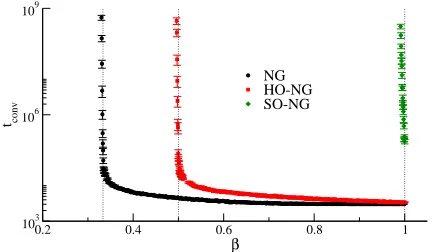
tconv diverges atβc = 1/3. The HO-NG is less robust, and βc= 1/2. For the SO-NG, on the other hand, it holdsβc= 1, so that the final consensus is never a stable solution. Dotted vertical lines represent the theoretical predictions. Data refer to a population of 3×10³
agents and each point represents the average value obtained from 30 simulation runs. Error bars represent the statistical error of the average value.
yielding
dnA
dt =−nAnB+ β
2n 2
AB+ β−1
2 nAnAB (7)
dnB
dt =−nAnB+ β
2n 2
AB+ β−1
2 nBnAB (8)
and therefore
dm dt =
β−1
2 nABm. (9)
Thus, the transition occurs atβc= 1, and the SO-NG is
naturally critical. This explains why the behavior of the SO-NG is qualitatively different from the one observed in the usual NG. The system is not driven to consensus, but rather ends up there only due to large, system size, fluc-tuations of the magnetization. The same analysis can be repeated also for the generalized HO-NG, where one finds that βc = 1/2. Hence, even though for β = 1 the
HO-NG and the HO-NG behave in the same qualitative way, the latter is more robust to perturbations in the generalized setting. Figure 4 shows that numerical simulations are in very good agreement with the theoretical prediction, confirming that focusing on the two words case is indeed a valid assumption to determine the critical values ofβ
(while it can be an oversimplifying starting point to de-scribe more subtle properties of the convergence process in the NG [20]).
III. BROADCASTING ON NETWORKS
Complex networks are the natural environment to in-vestigate the dynamics of models that aim at describing
100 102 N 104 106 100
104 108
tconv
100 102 104 106
N
100 104
Nw
max
100 102 104 106
N
100 104
Nw
max
100 102 N 104 106 100
104 108
tconv
UCM ER
1.4 1.1
1.1 1.1
FIG. 5: (Color online)Broadcasting on networks. Scal-ing of the consensus time (top) and the maximum number of words (bottom) for the broadcasting rule on ER homogeneous (left) and UCM heterogeneous networks (right). Each point is averaged over 30 simulation runs (5 runs on each of 6 network realizations), and error bars are not visible on the scale of the graph. Heterogeneous networks (right panels) are generated with the Uncorrelated Configuration Model (UCM) [34], with minimum degreek= 4 and degree exponent,P(k)∼k−γ, is γ= 2.5. ER networks are generated withhki= 8.
social, techological or biological systems [35–39]. Mo-tivated by the communication protocols employed by sensor nodes, Lu, Korniss and Szymanski introduced a broadcast version of the NG to make it applicable in sen-sor networks [9, 12]. In this framework, the rules are the same as in the usual NG but for the fact that the speaker transmits her word to all her neighbors at the same time, rather than to a randomly selected one. If a hearer has that word in her inventory, she deletes all the compet-ing synonyms but the winncompet-ing one, otherwise she adds the new word to her memory. As for the speaker, she will consider the interaction a success if at least one of the hearers knows it. At least one successful hearer must therefore report to the speaker that she knew the trans-mitted word. In real network this communication could be performed for example through the “lecture hall” al-gorithm [40].
The results discussed above about the HO-NG how-ever show that, at least as far as pairwise interactions are considered, there is no need for the speaker to receive any feedback in order to guarantee an efficient route to convergence. Thus, a very natural broadcasting scheme might simply consist in letting only the hearer update their inventories, following the usual rules in case of fail-ure or success. Figfail-ure 5 shows that such a simple broad-casting scheme guarantees a fast convergence. The scal-ing exponent ω of the consensus time, tconv ∼ Nω, is ω ≃ 1.4 in Erdos-Renyi (ER) homogeneous graphs and
ω≃1.1 in uncorrelated heterogeneous networks [34], the latter being compatible also with a logarithmic behav-iortconv ∼ NlnN. Therefore the broadcasting scheme
[image:5.595.331.546.50.217.2] [image:5.595.69.286.52.178.2]broadcast-ing protocol is adopted, but only in heterogeneous net-works. This is not the case in the usual NG, where it holds ω ∼ 1.4 in both ER and heterogeneous networks [14].
Though faster, however, the broadcasting scheme is not scalable in the thermodynamic limit, since the max-imum memory required to the system scales with an exponent µ ≃ 1.1 (again compatible with a behavior
Nmax
W ∼NlnN), thus implying that single agents should
have an infinite memory as N → ∞. This is not the case for the usual NG, where it holdsµ≃1 [14]. Strictly speaking, therefore, it is not possible to conclude whether the broadcast rule has to be preferred to the usual pair-wise interaction scheme, but rather it would be necessary to decide in a case by case setting, depending also on the topology in which the agents are embedded. In case of heterogeneous networks, broadcasting is certainly the fastest solution when the memory of the system is not a vital parameter, while pairwise interaction offers the best solution if inventory size is a (major) concern. However, the memory consumption is probably not a big issue for all the practical purposes in which a finite population is considered, due to the small value ofµ.
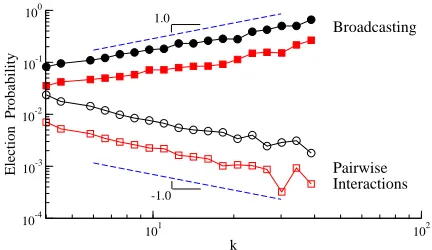
In [9] it is pointed out also that the NG could provide a valuable mechanism forleader election among a group of sensors. The leader is a single node with important responsibilities ranging from routing coordination to key distribution, and the NG would make the identification of the leader hardly predictable from the outside, resulting in enhanced security of the system to possible attacks. To study the effect of broadcasting on the election of the leader, we have run simulations in which at the beginning of the process every node is endowed with a word. All words are different and therefore represent a tag assigned to the agents. Having checked that these initial condi-tions do not alter the scaling properties of the system (data not shown), we look at the statistics of the word upon which consensus is reached, and more in particular on the degree of the node to which it was assigned at the beginning. It has already been observed, even though never quantified, that in the case of pairwise interactions the hubs, playing mostly as hearers, are not good pro-moters for conventions, but rather act as intermediaries between lower degree nodes [14]. In fact, Figure 6 shows that in the NG the probability that a given node of de-greekspreads her identity (i.e., is elected) is linearly sup-pressed by a factork, and the same behavior is observed also for the HO-NG (not shown). Remarkably, the situ-ation is inverted in the broadcasting scheme, where this probability is magnified by the same linearkfactor. Due to the dramatic nonlinearities of the process it is difficult to go beyond the numerical experiment, but this observa-tion can be relevant for the applicaobserva-tions, and at the same time sheds light on the existence of profound differences between the pairwise and the broadcasting schemes at a microscopic level, whose detailed investigation is left for future work.
101 102
k
10-4 10-3 10-2 10-1 100
Election Probability
Broadcasting
Pairwise Interactions
1.0
-1.0
FIG. 6: (Color online) Leader election. The probability that a given agent gets elected increases (almost) linearly with the degree in the broadcasting scheme (full symbols) and it is inversely proportional to the same quantity in the usual NG with pairwise interactions (empty symbols). All curves refer to heterogeneous networks generated with the UCM with minimum degreek= 4 and degree exponentγ= 2.5 (circles) and γ = 3 (squares). Data come from 104
simulation runs and have been logarithmically binned. Curves are vertically shifted for clarity.
IV. DISCUSSION AND CONCLUSIONS
In this paper we have focused on the role of feedback in the NG. We have modified the rule that prescribes the symmetric update of the agents’ inventories after a successful interaction, addressing the two circumstances in which only one of them acts in case of success. We have shown that if the updating agent is the speaker the NG protocol becomes inefficient and the final consensus state is reached in much longer times as compared to the scaling of the usual symmetric rule. Casting this finding in the broader context of a generalized NG scheme, we have shown analytically that preventing the update of the hearer sets the model to a critical point below which con-sensus is not the stable solution, and the system would persist forever (in the thermodynamic limit) in a polar-ized state in which two words survive indefinitely. At the critical point the magnetization is therefore conserved and consensus is reached through large fluctuations in a finite system, thus being slower than in the NG. When the update is performed only by the hearer, on the other hand, the scaling of the main quantities with the system size remains the same as in the usual NG. Thus, feedback is not crucial in the NG as defined in [2], i.e. the scaling of the convergence time and of the memory required to the system does not change if the hearer never informs the speaker of the outcome of the game.
[image:6.595.331.547.51.176.2]6
with some minor drawbacks from the point of view of the memory requirements. Finally, we have discussed how these findings could be relevant also from the point of view of possible applications in the field of sensor net-works [9, 12].
Our work sheds light on the dynamics of the NG, point-ing out that the update of the hearer is a fundamental ingredient of the model contrarily to the feedback pro-vided to the speaker, which turns out to be less crucial. It also opens the way to several lines of investigation. From the theoretical point of view, a systematic study of the broadcasting dynamics on different kinds of networks as well as its generalization, and thorough characteriza-tion, in the probabilisticβframework are potentially very interesting. Furthermore, while in this paper we have concentrated on the study of the system scale behaviors, performing in future a detailed analysis of the micro-scopic aspects of the dynamics, so far addressed only in [15], could provide important insights into the broadcast-ing rule as well as into the difference between the NG, the SO-NG and the HO-NG. It is also worth noting that the result concerning the possibility of neglecting the hearer’s feedback might help in the more ambitious exploration of the connection between the dynamics of the NG and the one of the voter model [46, 47] or of other simple
or-dering dynamics schemes (see also [6] on the challenges concerning this point) .
From the point of view of the applications, finally, the broadcasting scheme is relevant for sensor nodes, as we have already mentioned. Moreover, it could be the best solution also in those cases in which the communicating agents are not embedded in a static network, but on the contrary move in an unknown environment and need to communicate about their exploration [48]. In general, broadcasting is the fundamental communication mecha-nism in different frameworks ranging from scientists com-municating through articles visible to their community to social tagging systems like Delicious [41], from bacte-rial quorum sensing [42] to social networks like Facebook [43] or Twitter [44], and the NG could now constitute an helpful conceptual tool also in these cases (see also [45]).
Acknowledgments. The author is indebted to Alain Barrat, Luca Dall’Asta, Vittorio Loreto, Luc Steels and Romualdo Pastor-Satorras for helpful discussions, and acknowledges support from the Spanish Ministerio de Ciencia e Innovaci´on through the Juan de la Cierva program, as well as from project FIS2010-21781-C02-01 (Fondo Europeo de Desarrollo Regional) and from the Junta de Andaluc´ıa project P09-FQM4682.
[1] L. Steels, Artificial Life2, 319 (1995).
[2] A. Baronchelli, M. Felici, V. Loreto, E. Caglioti, and L. Steels, J. Stat. Mech.P06014(2006).
[3] L. Wittgenstein, Philosophical Investigations. (Trans-lated by Anscombe, G.E.M.) (Basil Blackwell, Oxford, UK, 1953).
[4] F. Fu and L. Wang, Physical Review E78, 16104 (2008). [5] R. Blythe, J. Stat. Mech p. P02059 (2009).
[6] C. Castellano, S. Fortunato, and V. Loreto, Rev. Mod. Phys.81, 591 (2009).
[7] A. Baronchelli, V. Loreto, and L. Steels, Int. J. Mod. Phys. C19, 785 (2008).
[8] A. Baronchelli, L. Dall’Asta, A. Barrat, and V. Loreto, Phys. Rev. E73, 015102 (2005).
[9] Q. Lu, G. Korniss, and B. Szymanski, Physical Review E77, 16111 (2008).
[10] L. Dall’Asta, A. Baronchelli, A. Barrat, and V. Loreto, Europhysics Letters73, 969 (2006).
[11] R. Liu, C. Jia, H. Yang, and B. Wang, Physica A (2009). [12] Q. Lu, G. Korniss, and B. Szymanski, inProceedings of the 2006 American Association for Artificial Intelligence Fall Symposium Series, Interaction and Emergent Phe-nomena in Societies of Agents (AAAI Press, Menlo Park, CA 2006)(2006), pp. 148–155.
[13] H. Jia-Bo, Y. Han-Xin, L. Run-Ran, W. Bing-Hong, and Z. Zhi-Yuan, Chinese Phys. Lett.27(2010).
[14] L. Dall’Asta, A. Baronchelli, A. Barrat, and V. Loreto, Physical Review E74, 036105 (pages 13) (2006). [15] L. Dall’Asta and A. Baronchelli, Journal of Physics A:
Mathematical and General39, 14851 (2006).
[16] H.-X. Yang, W.-X. Wang, and B.-H. Wang, Phys. Rev. E77, 027103 (2008).
[17] C. Nardini, B. Kozma, and A. Barrat, Physical review letters100, 158701 (2008).
[18] Q. Lu, G. Korniss, and B. Szymanski, Journal of Eco-nomic Interaction and Coordination4, 221 (2009). [19] B. De Vylder and K. Tuyls, J. Theor. Bio. 242, 818
(2006).
[20] A. Baronchelli, L. Dall’Asta, A. Barrat, and V. Loreto, Phys. Rev. E76, 051102 (pages 4) (2007).
[21] W. Wang, B. Lin, C. Tang, and G. Chen, Eur. Phys. J. B60, 529 (2007).
[22] E. Brigatti, Physical Review E78, 46108 (2008). [23] A. Lipowski and D. Lipowska, Int. J. of Mod. Phys. C
19, 399 (2008).
[24] A. Lipowski and D. Lipowska, Physical Review E 80, 56107 (2009).
[25] E. Brigatti and I. Roditi, New Journal of Physics 11, 023018 (2009).
[26] C. Lei, T. Wu, L. Wang, and J.-Y. Jia, Physica A389, 4046 (2010).
[27] W. Zhang and C. Lim, Arxiv preprint arXiv:1008.4115 (2010).
[28] Z. Yong, L. Run-Ran, Y. Han-Xin, S. Dong-Mei, and W. Bing-Hong, Chinese Phys. Lett.27(2010).
[29] C. Lei, J. Jia, T. Wu, and L. Wang, Physica A389, 5628 (2010).
[30] A. Puglisi, A. Baronchelli, and V. Loreto, Proc. Natl. Acad. of Sci. USA105, 7936 (2008).
[31] A. Baronchelli, T. Gong, A. Puglisi, and V. Loreto, Proc. Natl. Acad. of Sci. USA107, 2403 (2010).
[33] X. Castell´o, A. Baronchelli, and V. Loreto, Eur. Phys. J. B71, 557 (2009).
[34] M. Catanzaro, M. Bogu˜n´a, and R. Pastor-Satorras, Phys. Rev. E71, 027103 (2005).
[35] G. Caldarelli, Scale-Free Networks: Complex Webs in Nature and Technology (Oxford University Press, Ox-ford, 2007).
[36] A. Barrat, M. Barth´elemy, and A. Vespignani,Dynamical Processes on Complex Networks (Cambridge University Press, Cambridge, 2008).
[37] S. N. Dorogovtsev and J. F. F. Mendes, Evolution of networks: From biological nets to the Internet and WWW
(Oxford University Press, Oxford, 2003).
[38] R. Pastor-Satorras and A. Vespignani, Evolution and structure of the Internet: A statistical physics approach
(Cambridge University Press, Cambridge, 2004). [39] S. Boccaletti, V. Latora, Y. Moreno, M. Chavez, and
D. Hwang, Phys Rep424, 175 (2006).
[40] G. Chen, J. Branche, and B. Szymanski, Proceed-ings of the 19th IEEE International Parallel and Dis-tributed Processing Sympsosium (IPDP’05) - Workshop 12 (IEEE Computer Society, Washington, D.C. (USA), 2005).
[41] URLhttp://www.delicious.com/.
[42] C. M. Waters and B. L. Bassler, Annual Review of Cell and Developmental Biology21, 319 (2005).
[43] URLhttp://www.facebook.com/. [44] URLhttp://twitter.com/.
[45] C. Cattuto, V. Loreto, and L. Pietronero, Proceedings of the National Academy of Sciences104, 1461 (2007). [46] P. Clifford and A. Sudbury, Biometrika60, 581 (1973). [47] R. Holley and T. Liggett, Ann. Probab3, 643 (1975). [48] L. Steels, Trends in cognitive sciences7, 308 (2003). [49] The fact that the invented word is actually new
to the whole population corresponds to discarding homonymy [2].
[50] The curve for the convergence time of the NG for systems of different sizes exhibits small oscillations when plotted in log-log scale [7] and it does not therefore appear as a perfectly straight line.
[51] The fact that the HO-NG and the NG behave in the same way as far as the scaling with the system size of the rel-evant quantities is concerned holds in the framework of the simplified scheme introduced in [2], being a conse-quence of the the fact that homonymy is not taken into account. Feedback remains in fact a fundamental ingre-dient of any language games, as devised by Wittengstein [3].