Business Creativity: An Evolutionary Approach
ABSTRACT
Skype innovated the communication and was acquired by eBay for nearly $4 billion altogether. They did something good and now they also do well. There are companies which reject any kinds of change but also seem to be doing well. How are both possible? In this paper we attempt to answer this question by establishing an evolutionary framework to examine Neo-Darwinian school of evolution and formulate some objections while accepting some ideas, mostly from the Neo rather than from the Darwinian part; thus establishing our own evolutionary framework. Within this framework we discuss the evolution of ideas and the knowledge increase to understand the educational background of new generation decision takers. We also review the changes of the organizational strategy in the e-age; to get a picture of the organizational context of creativity and innovation we discuss the role of the dynamic and static quality in e-age
organizations. Pulling all these together we describe four fitness categories of innovation; we use animal names as metaphors of the categories: the first swallows, the parrots that repeat, the bear awaking form the winter-long hibernation, and the frog that enjoys itself in the changeless swamp. One fitness is not better than another, only your fitness and your habitat (fitness landscape) must be in harmony. That we need for survival.
Keywords:
Creativity; problem solving; knowledge increase
Business Creativity: An Evolutionary Approach
Introduction
Csíkszentmihályi (1997) distinguishes two kinds of creativity, for distinction he writes one of them with capital C: Creativity. The difference between the two is that creativity is needed to arrive at a novum, to create new knowledge but Creativity also includes pitching the new idea (Elsbach, 2003), i.e. transforming it into a new value. So the Creativity is more near to innovation.
As we will discuss it, creating a new value may include doing good and doing right as well. (Gardner, Csikszentmihalyi, & Damon, 2001) in the present paper we shall examine the various possible approaches of organizations to doing good and doing right and also how these relate to doing well. To do this, in the first section we re-examine the idea of applying the conception of evolution to organizations and thus we will establish our framework for the
investigation. This framework will be used to investigate the evolution of ideas in the second and the evolution of innovations in the third section; to finally present our model of four fitness categories of innovation in the fourth section.
organizations and particularly their approach to creativity and innovation. We re-examine the
Baracskai, Z., Dörfler, V., & Velencei, J. (2007).
Business evolution
Ansoff (1965: 5) described strategy as a subset of decision making which is about the “Big Questions”; it is concerned with establishing harmony between the firm and its
environment. This approach is apparently ecological and together with the Carnegie-Mellon behavioral model of the firm it results in evolutionary approach to strategy. (Simon, 1993b)
Darwin‟s model of evolution was by no means the first, e.g. ideas of Jean Baptiste de Lamarck and Herbert Spencer appeared earlier, but is definitely the most recognized one and his two books (Darwin, 1859, 1879) are amongst the most cited books ever. Although the Neo-Darwinism to-day, advocated by authors such as Dennett (1995) and Dawkins, differs from Darwin‟s original ideas so much that he would probably not recognize them, the Now-Darwinists maintain that there are no essential differences. The two probably most remarkable novelties in Neo-Darwinism are developed by Dawkins; the first is the concept of memes (Dawkins, 1989; Blackmore, 2000) and the second is the concept of the extended phenotype (Dawkins, 1999). What remain orthodox in Neo-Darwinism are the two governing principles: The first is the
natural selection, which, in struggle for existence, prefers the fittest – so there is absolute
selfishness and competition. The second is the absence of direction so, as opposed to the human-centered worldview in which the goal is the human being, the evolution progresses from the primitive but towards no goal producing all the changes exclusively by random mutations.
We have some objections against these two principles. Firstly, we can all observe enumerable examples of collaboration and altruism in nature and these are not even specific to humans. Based on previous work of Maynard Smith (e.g. Maynard Smith, 1982; Maynard Smith & Szathmáry, 2000) Dawkins (1989) passionately argues that all collaboration and altruism can be explained as well conceived selfish behavior which fosters competitive advantage. His style is more convincing than his message which is full of holes. The examples of competition can be explained the same way based on collaboration as vice versa; and we do not even have any reason for trying to reduce the number of governing principles – it does not sharpen Occam‟s razor.1 As a contrast, Simon (1993a) e.g. offers a model according to which docility, which enhances the fitness, is accompanied by altruism, which reduces the fitness while also increasing the fitness of the others; these two effects are so balanced that the more docile are also more fit but not so much as if there were no altruism while the whole species is also more fit than without altruism.
Secondly, instead of the absence of direction in evolution we find more feasible the idea outlined by Kuhn (1962: 171 ff), Boulding (1985: 62-65), and Capra (1982), amongst others, that there is a somewhat vague direction in evolution towards greater complexity. Here the concept of the „survival of the fittest‟ should be replaced by the concept of the „survival of the fitting‟, meaning that survive those that can keep in harmony their fitness and their habitat. Both the fitness and the habitat can be changed and the pure chances, i.e. the random mutations, do not appear to be the sole source of change/adaptation rather we can assume underlying creative processes.
The essence of Dawkins‟ approach is that he postulates the genes as replicators on which the evolution works. This means that the struggle for existence neither applies to individuals (as in the original form of Darwinism) nor to species (as in another version of the Neo-Darwinian approach) but to genes; the individuals are merely the survival machines of the genes. It is very
1 William Occam, 13th century philosopher is best known for his maxim: “It is vain to do with more what can be
important that Dawkins recognizes that the genome does not only determine the features of a creature but its reach should be extended to consider the effects of the creature on the
environment as well (for instance a bird eats some worms builds a nest, etc.); this is what Dawkins calls the extended phenotype. The Human Genome Project was accomplished in June 2000, the genetic code is broken; still, we are nowhere near being able to purposefully modify the human DNA. (Fukuyama, 2003: 73) This suggest that not only the phenotype but the genotype should also be extended, so the same genome will produce different creatures in different environments.
The genes are not the only replicators that Dawkins suggested. The genes are the replicators of life and there are also the memes, which would be the replicators of the
knowledge/culture. Mérő (1990) identifies the memes with the cognitive schemata, thus linking the idea of evolution to cognitive psychology. Later, Mérő (2004) goes event further, and introduces an economic replicator, the mone, which he shows to be the money.2 Although the survival machines of the mones are the business organizations, the economic evolution cannot fully be explained by the mones solely as the business organizations are not only economic but also social constructs. Therefore we would need a complex synthesis of at least two evolutions (in our opinion it is actually four as the power and the emotions should also be considered).
This is, however, a scientific problem that we do not attempt solving here. What we want to do in the present paper is to use an evolutionary approach, which is a blend of Dawkins‟ conception of memes, Mérő‟s conception of mones, and Simon‟s conception of docility in the framework of the evolutionary approach to strategy as outlined above, to examine how
organizations approach innovation. Evolution of ideas
The evolution of knowledge can be represented with selective learning, which is determined by the usability of new ideas. After several unsuccessful endeavors the new idea deceases. The weak ideas decease. If a decision rule is used its chances for survival, its fitness, increases if not it reduces. The ideas or decision rules with high fitness form complex ideas and complex rules by merging and mutation, these complex ideas and rules may then form complex ideas and rules of higher level and thus we get a hierarchical structure, as suggested by Simon‟s (2002) near decomposability (ND) approach to natural and social evolution.
Simon‟s (1993a: 157) docility-altruism approach can be interpreted as an interplay of the evolution of life and evolution of knowledge/culture:
“Since docile persons depend heavily on socially provided advice and orders, they often make choices that reduce their own fitness under social advice to do so… Consequently, society can «tax» docile individuals by sometimes persuading them to take altruistic actions that decrease individual fitness.”
There is no need for cloning, people do it themselves. Like a Barbie doll, people dress and think alike. They learn how to behave from others; thus the fitness of their own expectations shrinks. Consider for example the following behavioral pattern that Hammond, Keeney, and Raiffa (1998: 49) classify as a decision trap:
“We all like to believe that we make decisions rationally and objectively. But the fact is, we all carry biases, and those biases influence the choices we make. Decision makers display, for example, a strong bias toward alternatives that perpetuate the status quo.”
The source of the status quo trap is deeply conditioned by the society in our psyche; it expresses our need to protect ourselves from injuries. Departing from the status quo means taking action; if we take action we take responsibility and we risk critique and pity of others and regret on our own. The status quo, in most cases, means certainty; the new is always uncertain. Uncertainty is objectionable. It does not make sense to swap one objectionable to another one. Therefore the status quo has great fitness.
There another memetic example we can observe in the previous quotation: we learn throughout our education that being rational is good, thus the authors of the previous quotation believe that “We all like to believe that we make decisions rationally and objectively.” – well, not all of us. There are a few of us who give more credit to intuitio than to ratio when taking decisions.
We said above that in our view of evolution the survival is determined by the harmony of the fitness and the habitat. The habitat of an idea, the fitness landscape as Simon (2002) called it, is the validity. The master of a discipline can intuitively validate the knowledge (s)he does not know. OK, this statement needs a bit of explanation. The master of a discipline refers to the highest level of knowledge, which Simon (e.g. Prietula & Simon, 1989; Gobet & Simon, 1996) and Dreyfus and Dreyfus (1986: 19-36) call “expert”; here Mérő‟s (1990) terminology is adopted. When assessing new knowledge we cannot expect that the assessor knows more than the creator of the new knowledge. If the master knew what the author investigates the author should not be awarded a PhD or get the paper published as it would not satisfy the expectation of the originality. It is difficult to understand that the master does not know more in the chosen domain than the author but (s)he feels whether the new knowledge is valuable. The fitness and the habitat.
Popper (1961) postulated that due to the work of two gurus, Galileo and Newton, physics left all other sciences far behind. He adds that since Pasteur, the Galileo of biology, biology is almost as successful. We did not have a Galileo of business research yet, and we hope never to have one. If someone could make the business predictable, it would not be the same anymore. Therefore we argue that understanding the business is different from understanding the physics or biology.3
The essence of selective learning as described above is that it also increases the tacit knowledge. A business decision taker does not only rely on measureable decision criteria but also on ideas, feelings, hunches that cannot easily be put into words. The new generation of the business decision takers attended business schools at the turn of the millennium, when the knowledge acquisition was not anymore limited to the 10th+ editions of Kotler, Porter, Brealey-Myers and Maynard. The classes became interactive and there are optional blends of knowledge form well-structured books, case studies, videos, and various other sources. The access to
knowledge has changed. The existing cognitive schemata of the potential businessmen determine what kind of knowledge source they will choose. The existing knowledge of the learners
dominate the search rather than the existing knowledge of the teachers as in the obsolete models of business education. The way of attaching the new knowledge to the existing has changed. The validation has also changed. Due to these changes in approach the business decision takers grew into a habit of assembling the pieces of knowledge in a variety of ways.
There is a waste amount of new knowledge available. We usually have two expectations towards new knowledge: it should be fresh and reliable. In the e-age there is no problem with
3 Actually some recent developments in physics and biology seem to demonstrate more similarity to how we
freshness – we live in a real-time economy. However, the reliability is a different issue. If we waited until the new knowledge is properly verified our competitor would adapt it and we are beaten in the business game; and if we adapt a new knowledge which proves to be false we may loose as well. Our only sources are the trust and the hunch of the master. These were the
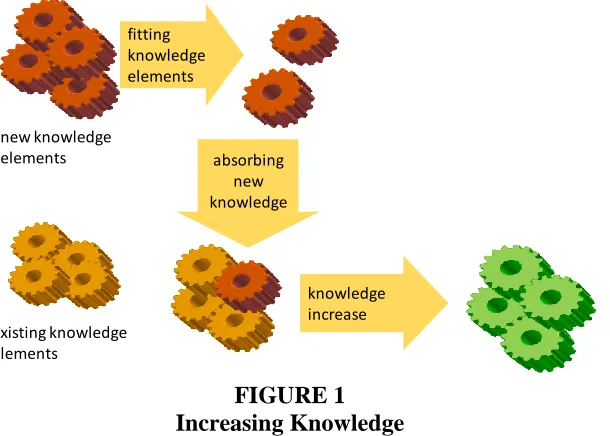
[image:5.612.161.466.201.419.2]traditional expectations but there is a new one: the amount of available knowledge is so vast that we have a chance to make use of only a tiny part – which should it be? In Figure 1 the gearing is chosen to represent drive rather than precision. The changes of knowledge acquisition caused changes in knowledge increase as well.
FIGURE 1 Increasing Knowledge
From the available knowledge there is a fraction only which we can attach to our existing knowledge, i.e. without having to learn all from scratch. The fitting new knowledge will not fit all of our existing knowledge but only some parts of it. When the fitting new knowledge is attached to the existing knowledge the result is a changed knowledge of the individual. And as at higher knowledge levels the knowledge is more complex and thus more interconnected, in the high regions the complete personal knowledge is changed as a piece of new knowledge is absorbed. Those ideas, wiz. bits of new knowledge, that can be incorporated into many different kinds of existing knowledge have a fitness in many habitats – which means enhanced fitness. However, knowledge as regarded here only spreads via education, although this is not limited to classroom type education but to all kinds of learning. Another way of enhancing the fitness of an idea is if we increase its value. To understand this we need to discuss how the organizations deal with the new ideas.
Evolution of innovations
Our colleague, who knew well the military training, told us the following story in bewilderment. Once upon time the rifles were to be filled upfront by gunpowder and a bullet, thus the solder charging the rifle had to stand up and during the process they were „standstill targets‟. It was easy to give commands to destroy this kind of target and most soldiers could easily determine the route of the bullet. The new type of rifle that loaded from the back could be charged without standing up and thus the target disappeared. However, the training remained the
existing knowledge elements
new knowledge elements
fitting knowledge elements
knowledge increase absorbing
same, the soldiers still practice hitting the standstill targets. We had to admit that we are not doing much better in business education. Imagine one (rarely several) target(s) that are standstill for quite some time, calculate the cheapest (most efficient) route to it, and then give the
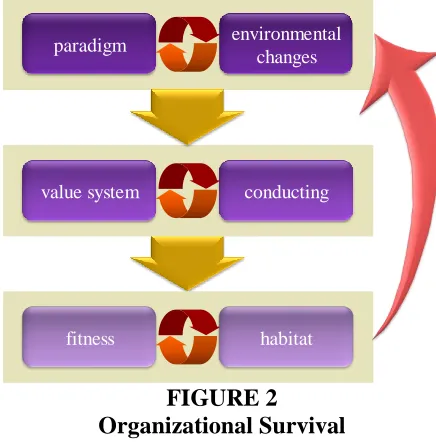
[image:6.612.195.413.211.432.2]command: “Implement the strategy!” We need to replace these obsolete concepts not because we are in innovative mood – although we are nevertheless – but because they do not reflect the reality. Those, who are staggered by the muddled world around, still hang on the old concepts such as balance, clear goals and objectives, optimal strategies, top management, etc., that is, a simple order disregarding the impact of the environment. The world of e-age business can only be described using new concepts, metaphors. (Figure 2)
FIGURE 2
Organizational Survival
If the e-age organization cannot satisfy its expectations (fitness) then and there (in a particular habitat) than it changes its fitness or looks for a new fitness landscape. An organization may have numerous expectations but pays attention only to satisfying the important ones. The paradigm, the current glasses of the decision taker will determine what signs in the environment (s)he will pay attention to, creating symbols from their interpretations. These will determine the interpretation of the egocentric particulars (Russell, 1948: 100), that is, the meaning of “I, this, here, and now”; so the important expectations. The future state of the organization is a set of expectations then and there. The e-age organization constantly seeks the harmony of its fitness and its habitat; it is a rough picture of the potential and desirable future states (status indicators), what does not yet exist, what is not yet achieved. This is about anticipating rather than predicting the future, sensing qualitative changes rather than estimating joint probability distributions (Simon, 1993b: 135):
“Anticipating the future means detecting, preferably prospectively, novel features in the environment that may affect the firm significantly in the future, and determining at what point attention should be focused on them and energy devoted to dealing with them.”
When we chose a habitat we cannot be sure of all the implications of our decision
(performance indicators). The line managers decide about the relevant performance indicators in their particular areas that can be quantified and time horizons assigned. These support the status
fitness habitat
conducting value system
indicators and they affect the paradigm and the changes in the environment via feedback. Maintaining the fitness means an interplay between the dynamic and the static quality.
People are normally prepared for static quality only. (Pirsig, 1992) However, there is a dynamic value, a dynamic „good‟ in each activity that no regulation can bind into a well-structured description but needs to be experienced again and again and is thus assessed
repeatedly as the activity changes. This „good‟ resulting from the intrinsic dynamics we call the dynamic quality, the dynamic value. The dynamic quality emerges unexpectedly, so we cannot predict it and it cannot be repeated. Where the change, that is the dynamic quality, is suppressed and only the static quality is valued, sooner or later boredom appears. Where the static quality is neglected and all support goes to dynamic quality, sooner rather than later anxiety appears. Therefore we must balance between the too, we must maintain a harmony.
The creatives often find themselves in situations which calls for destroying the static quality; following the path of the dynamic quality something new is created. We may call this the de-traditionalization of quality. To the extent to which the activity of the engineer is
determined by the static quality, there is no choice, only tradition. When the creator follows the elusive path of dynamic quality, (s)he is free in doing so. But we also must see that the dynamic quality leads to disarray, unless there is a static system to conserve its results. Latching-like steps are needed during which the dynamic motion gets to a higher level than where the previous static system was and, if the results seem feasible, the latch needs to be put in place to conserve them. This is the only way to improve the fitness otherwise it will slip back to the previous level. It is a great mistake to concentrate exclusively on dynamic quality; attention must be paid to static quality as well.
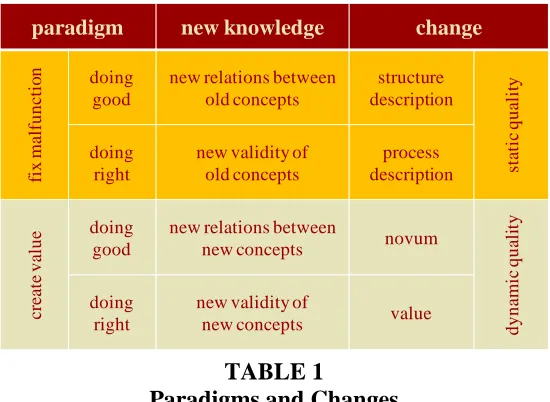
In Table 1 we summarized what kinds of paradigms support what kinds of changes. We described the paradigms with two dimensions: in the first we either want to create a value or to
fix a malfunction; in the second we either want to do good or to do right. Obviously a decision
taker of an e-age organization does not wear the same glasses all the time, although at any moment (s)he can wear only one single pair; (s)he changes her/his paradigm as (s)he sees fit. Within the framework of fixing a malfunction we stay within the boundaries of static quality. Thus the static quality is not entirely static, it aims at providing stability and thus changes, although normally minor ones, may be necessary. The data-masters4 and their teams design well-structured data structures for the business. These can cover various things ranging from a
software operating a compactor to a set of performance evaluation criteria for the knowledge workers. The process-masters5 and their teams offer well-structured process specifications to the data masters; these can also cover various things from the manufacturing technology to business negotiations. The dynamic quality belongs to the approach of value creation. If we want to create a value and do good we shall arrive at a novum, at a creative idea. In this paradigm we do not really care about whether the novum is viable or not. The creatives have a flash of eureka experience, output of which is the ill-structured novum. For those who are described by the above quotation of Hammond, Keeney, and Raiffa, it may be difficult to accept but there are no formal, justified and objective criteria for validation of these ill-structured nova. If we want to create a value and do it right we shall succeed in creating a new value; obviously this will need a novum to be created first, and then we transform it into a value by interpreting it then and there.
This also describes how the decision taker changes her/his glasses. First (s)he supports the creatives in creating the novum, then the focus shifts to the converting the novum into a
4 Those in charge of data, regardless if they are called information managers, system developers or other.
value, then the „production‟ can start and if there is a malfunction we need to fix it by amending the structures or the processes. The table also shows what kind of new knowledge is needed in these particular stages.
TABLE 1
Paradigms and Changes
In the last section we are only concerned with the part of the organizational strategy in which we want to create a value – more precisely we are asking the question do we want to create a value, do we want innovation? The answer to this question characterizes the organization as identity why Simon (1993b: 136) classifies it as meta-strategy.
Four fitness categories of innovations
Skype Technologies SA, the company that launched its Skype VoIP application in August 2003 (the company was founded the same year), was acquired by eBay in October 2005 for approximately $2.5 billion as up-front consideration, plus potential performance-based
consideration around $1.4 billion max. (Skype Ltd, 2005) We have seen similar cases previously, such as IBM acquired Lotus in 1995 of when HP acquired Compaq in 2001. However, the case of Skype is particularly instructive as here we talk of a just above 2 years old company which was never profitable. What was so attractive about it? The creatives at Skype came up with a novum, an excellent quality VoIP software. This was then transformed into a value: “Free Internet telephony that just works.” There is actually a number related to this in the particular case, it is circles in the bottom right corner of Figure 3 – just do not try to use it for calculations.
paradigm new knowledge change
fi x mal fu n ct io n doing good
new relations between old concepts structure description st at ic q u al it y doing right
new validity of old concepts process description creat e v al u e doing good
new relations between
new concepts novum
d y n ami c q u al it y doing right
new validity of
FIGURE 3
Skype: How Many Users Are Online?
In our consultancy work, which is about six projects a year for nearly two decades now, we have seen opposite examples as well. For instance, a company that we do not wish to name here, was more than satisfied with the advices we provided; they were happy about how much they have learnt from us. Yet, before even finishing the project we were sure that nothing would happen, our ideas would never be implemented…
In the previously outlined framework we can classify the organizations‟ approach to innovation, their innovation meta-strategy into four categories, we use animal names as
metaphors for them. (Figure 4) Companies such as Skype are the first swallows, they can also be called valuable companies. They do not attempt making profit, at least this is not their primary concern, they attempt create a value – to do good and to do it right. Can they also do well? Yes, but not necessarily. Skype is a success story but very few value-creating companies are so very successful. In our company Doctus,6 we have created several nova: when we launched version 3.0 of our Doctus Knowledge-Based Expert System in 2002, it was probably the most
sophisticated software of its sort, we created the Doctus Intelligent Portal, the Doctus Knowledge Factory, and the Doctus Knowledge Galaxy is in beta. All superior quality products. Are we doing well? Well, we do not complain but our products do not have much to do with this, at least, not directly. We use them in our consultancy work, we designed applications for several clients but we never had an irresistible offer for the acquisition of Doctus. Probably we were not much concerned with doing right but only with doing good. So the risks are high if you are one of the first swallows but so are the potential rewards. And do not attempt to calculate either of them; as we said previously, there are no rational and objective measures, the feasibility studies do not work in the case of dynamic quality. If a swallow survives, its reputation will usually be that of the great innovator.
FIGURE 4 Fitness of Innovation
The first swallows are followed by the parrots, whose specialty is repeating what others said. The do not attempt to create value by doing good, so the do not attempt to nova. However, they are ready to repeat the novum of a swallow and then attempt to create value by doing right. They do not spend much on creating a novum but they have enormous budgets for advertising. These are the traditionally most successful companies, they make huge profits, thus, if we did not want to use the animal metaphors we would probably call them profitable companies. Their meta-strategy could be briefly summarized by a sentence that Simon (1993b: 136) attributes7 to Trollope:
“Be not the first by whom the new is tried, nor yet the last to lay the old aside.”
The parrots will normally be renown, apart from being very successful, as very customer-focused companies as they bring the new things to the customers as soon as they are verified. That is, they will do this if there are no other speculations in the background; often they will delay the launch of a new product if expecting to gain additional profits from the previous version. Of course, they will not advertize this…
While the parrots are fast movers, the bear wakes up after a long hibernation in the static quality and so it needs a long time to catch up. The bears are late adopters, only if they really feel they have to. The essence of the fitness of bears is the high efficiency (well, they do not eat all the winter) which is primarily achieved by low costs. Therefore they do not have huge spending neither to nova, nor to advertisement, and often not even to their staff. We could as well call them efficient companies. They like to present themselves in the light of reliability at low cost; they are bringing only the well established values to their customers and, as their costs are kept low they can give their customer reasonable pricing. That is, they will do this unless there is another way, e.g. when there are no competitors around or their customers are isolated – of course they will still maintain the myth. At their best, these companies are reliable and so perceived by their customers. The credo bears could be the speech of “Mr President of Big Business Inc.” (quoted from a Public Government Report by Nordström & Ridderstråle, 2002: 22):
“The vast majority of industry and the vast majority of society is not built upon what is known as entrepreneurship. Companies and society are stable, routine operations. They have limited room for fantasy, but a lot of room for competence. We will produce tomorrow what we produce today, hopefully of somewhat better quality and to a somewhat lower cost. We cannot afford rapid shifts in production and we cannot make changes just because someone comes up
7 Various other sources quote the same sentence from Alexander Pope‟s Essay on Criticism. the first
swallows
the parrots repeat
the bear after a long winter-sleep
with a new idea. If we did that our industrial might and our infrastructure would soon collapse. We need a little creativity - not a lot.”
Do you think that bears are against innovation? Wait while you meet the frog. The frogs are the champions of status quo. For the frogs the question of change does not even come up whatever the circumstances. They do not change themselves and they will prevent changes if they can help it – just remember the Easy Riders. Their strength is their position. These are the most bureaucratic organizations spending most of their effort on intriguing with other frogs how to keep up the status quo.
As this section was presented it could be assumed that the swallows are the best and the frogs are the worst. This apparent order is entirely untrue. The reason for the impression is that we like the swallows and thus we write about them with sympathy. However, in different habitats different animals survive. The swallows cannot stay alive in the swamp of the
establishment, which is the best habitat for the frog. Most of the habitats will have a niche for a few swallows and for many parrots and bears. The swamps are mostly populated by frogs, a parrot or a bear may survive if they get out quickly enough, and the rest of the inhabitants are the flies and worms, only these are not included in the present model.
Conclusions
By developing a quite complex and sophisticated evolutionary framework that builds on two replicators, the memes and the mones, examining in this framework the evolution of
knowledge and ideas, organizational strategies, the interplay of the dynamic and static quality, we finally arrived at a model that seem quite simple, and not even surprising: we can classify the organizational approach to innovation into four fitness categories, which we named by the metaphors of the first swallows, the parrots that repeat, the bear awaking form the winter-long hibernation, and the frog enjoying itself in the changeless swamp. Not only that the model is simple but it is also not very surprising. As the model is easy to understand, it can easily be used to classify organizations for purposes of both examination and education.
What we achieved here is not only establishing the four categories of fitness for innovations but, partly driven by the chosen metaphors, we also showed that the survival does not only depend on the fitness but rather on whether we can maintain the harmony of fitness and of habitat (fitness landscape). By doing so we also demonstrated the usability of the framework, which we intend to use not only for addressing the innovation but also the whole organizational strategy – only this is a new problem which we shall address in another research.
REFERENCES
Ansoff, H. I. 1965. Corporate Strategy: An Analytic Approach to Business Policy for Growth and Expansion. New York, NY: McGraw-Hill.
Blackmore, S. 2000. The Meme Machine (paperback ed.). Oxford: Oxford University Press. Boulding, K. E. 1985. The World as a Total System. Beverly Hills, CA: Sage Publications. Capra, F. 1982. The Turning Point: Science, Society, and the Rising Culture. London:
Flamingo.
Darwin, C. 1859. The Origin of Species. Ware: Worldsworth Editions.
Darwin, C. 1879. The Descent of Man, and Selection in Relation to Sex (2nd ed.). London: Penguin Books.
Dawkins, R. 1989. The Selfish Gene (2nd ed.). Oxford: Oxford University Press.
Dawkins, R. 1999. The Extended Phenotype: The Long Reach of the Gene (2nd ed.). Oxford: Oxford University Press.
Dennett, D. C. 1995. Darwin's Dangerous Idea: Evolution and the Meanings of Life. London: Penguin Books.
Dreyfus, H. L., & Dreyfus, S. E. 1986. Mind over Machine. New York, NY: The Free Press. Elsbach, K. D. 2003. How to Pitch a Brilliant Idea. Harvard Business Review, 81(5): 1-7. Fukuyama, F. 2003. Our Posthuman Future: Consequences of the Biotechnology Revolution.
London: Profile Books.
Gardner, H., Csikszentmihalyi, M., & Damon, W. 2001. Good Work: When Excellence and Ethics Meet. New York, NY: Basic Books.
Gobet, F., & Simon, H. A. 1996. Templates in Chess Memory: Mechanism for Re-calling Several Boards. Cognitive Psychology, 31(1): 1-40.
Hammond, J. S., Keeney, R. L., & Raiffa, H. 1998. The Hidden Traps in Decision Making.
Harvard Business Review, September-October: 47-58.
Kuhn, T. S. 1962. The Structure of Scientific Revolutions (3rd ed.). Chicago, IL: The University of Chicago Press.
Maynard Smith, J. 1982. Evolution and the Theory of Games. Cambridge: Cambridge University Press.
Maynard Smith, J., & Szathmáry, E. 2000. The Origins of Life: From the Birth of Life to the Origin of Language (paperback ed.). Oxford: Oxford University Press.
Mérő, L. 1990. Ways of Thinking: The Limits of Rational Thought and Artificial Intelligence. New Jersey, NJ: World Scientific.
Mérő, L. 2004. Az élő pénz(Living Money). Budapest, Hungary. [Published in Hungarian] Nordström, K., & Ridderstråle, J. 2002. Funky Business: Talent Makes Capital Dance (2nd ed.).
London: Prentice Hall.
Pirsig, R. M. 1992. Lila: An Enquiry into Morals. New York, NY: Bantam Books. Popper, K. R. 1961. The Poverty of Historicism. London: Routledge.
Prietula, M. J., & Simon, H. A. 1989. The Experts in Your Midst. Harvard Business Review, January-February: 120-124.
Russell, B. A. 1946. History of Western Philosophy. London: Routledge.
Russell, B. A. 1948. Human Knowledge: Its Scope and Limits. London: Routledge.
Simon, H. A. 1993a. Altruism and Economics. American Economic Review, 83(2): 156-161. Simon, H. A. 1993b. Strategy and Organizational Evolution. Strategic Management Journal,
14(special issue): 131-142.
Simon, H. A. 2002. Near Decomposability and the Speed of Evolution. Industrial and Corporate Change, 11(3): 587-599.
Skype Ltd. 2005. eBay Completes Acquisition of Skype. Retrieved 15/01/2005 from