City, University of London Institutional Repository
Citation
:
Ohadi, A. & Micic, T. (2011). Stochastic process deterioration modelling for adaptive inspections. In: Applications of Statistics and Probability in Civil Engineering. (pp. 322-326). UK: CRC Press. ISBN 9780415669863This is the accepted version of the paper.
This version of the publication may differ from the final published
version.
Permanent repository link:
http://openaccess.city.ac.uk/13493/Link to published version
:
Copyright and reuse:
City Research Online aims to make research
outputs of City, University of London available to a wider audience.
Copyright and Moral Rights remain with the author(s) and/or copyright
holders. URLs from City Research Online may be freely distributed and
linked to.
City Research Online: http://openaccess.city.ac.uk/ [email protected]
INTRODUCTION
In many developed countries management of infrastructure, such as highway bridges, includes a well defined and rather prescriptive routine aiming to ensure reliable service to the public. However, due to intrinsic uniqueness of infrastructure and diversity of processes records that are kept by the owners are substantial but not highly usable. Furthermore, in recent years, modern technology has enabled greater variety of monitoring techniques and therefore availability of data from sensors, video imaging, etc. is rapidly increasing.
Thus, it has become evident that long established infrastructure inspection processes can be reviewed to reconcile quality and diversity of site specific data, physical behaviour models and technology. Once inspection routines take a new shape it will become possible to revise maintenance management and schedule repairs more effectively. This paper will present an approach that would enable an adaptive inspection routines and enhanced usability of inspection outcomes by incorporating information from diverse sources.
Taking the example from UK, for the management of infrastructure, an established inspection routine is followed and it includes Safety, General, Principal and Special inspections that need to be carried out at either fixed time intervals or following specific circumstances or events. For Assessment purposes it is often the case that a separate Assessment Inspection is commissioned.
If we consider the example of the UK, bridge inspections are often strictly prescribed. For example the General inspection is carried out every 2 years and, in broad terms, includes inspection that does not require special access or traffic management arrangements. Principal inspections are taking place every 6 years and include a slightly more sophisticated activity. Many issues can be identified with such approach:
Quality of data that results from inspections is rather poor and difficult to store,
Inspection data can rarely be used for quantitative analysis,
It is difficult to include alternative inspection techniques over the lifecycle,
Quantitative information about the detection performance for different inspection techniques is not available,
Mapping of outcomes of the inspection to optimization of maintenance and repair is, at best, attempted by random variable modelling
There is a very limited scope for structure specific inspection regime that would provide more usable data.
As a result of inspections an extensive records are built up but their format might not be very suitable for decision making due to the nature of data. In particular, if we consider the General Inspection, the outcome of such inspection, for a relatively new infrastructure, is useful. However, once we consider
an ageing structure the ‘snapshot’ information
Stochastic process deterioration modeling for adaptive inspections
A.Ohadi & T. Micic
City University London, United Kingdom
provided by such inspection is very limited as the uncertainty in respect to deterioration of the structure has, inevitably increased but the techniques used, effectively visual ones have not. It is often the case that current inspection techniques are relatively strictly prescribed while their effectiveness is limited. For example following the visual inspection that is defined in great detail distinctive variability in outcomes can be observed as is documented FHWA (2001) in the report on visual inspection effectiveness.
[image:3.595.40.277.465.603.2]It is worth focusing on a sample infrastructure such as bridges. For say, highway bridges inspections are an integral part of Bridge Management System that includes maintenance, repair and replacement procedures. Due to widely acknowledged uncertainties associated with these procedures probabilistic methodology has been used for modelling and optimization. In many applications random variable modelling has been implemented and probability of failure would have been evaluated using standard procedures, Frangopol et al (2004). It is worth acknowledging that failure is often taken as a broad category that could include both serviceability and ultimate limit states. Unfortunately, such approach reveals inconsistencies as random variable modelling is not sophisticated enough to account for fundamental differences in properties over the lifecycle and in specific environmental conditions.
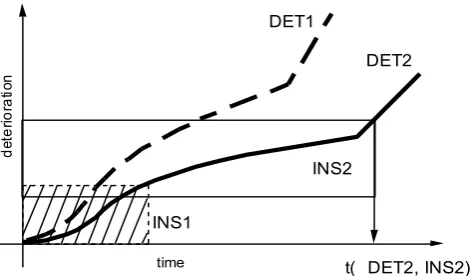
Figure 1 General status for infrastructure subject to inspections and deterioration
For example we can consider Figure 1 where 2 structures are considered with distinct deterioration paths (DET1 and DET2). Different deterioration paths can arise from specific location, service conditions, maintenance and repair procedures, natural disasters, etc. We also identify two inspection techniques (INS1 and INS2) that have distinct deterioration detection domains. We can observe that INS1 technique is suitable in the early years for both deterioration paths, not precisely in respect to time but close enough. However, major differences arise for inspection technique INS2.
While this technique is appropriate initially for both deterioration paths it is clear that it would be of no benefit for DET1 much earlier then for DET2. Several issues can be identified her:
quality of data that we receive from inspections will be highly variable over time,
there will be need to distinguish tolerances from the different inspection techniques
time horizon for implementation of different techniques can be very uncertain, etc.
In this paper we will investigate if the stochastic process representation could improve the status in respect to inspections in order to establish structure/site specific, more streamlined inspection procedures that would account for at least some of the issues raised above.
ADAPTIVE INSPECTION PROCEDURES
In order to improve the efficiency of inspections and usability of inspection data we set out to enable infrastructure owners to define the site/structure specific inspection programme. All infrastructure components are unique be it through the structural type, form of use soil conditions, environmental pollution, etc. Luckily, designers have a very good idea about early years performance so we can rely on them to deliver structures that will last. As it stands the inspection regimes do not acknowledge that, in early years, current inspection techniques have very low deterioration detection likelihood. That is why we consider implementation of stochastic process modelling.
Thus the procedure over the lifecycle would evolve like this:
i. An initial deterioration profile is established on the basis of expert judgement.
ii. For the initial deterioration profile we select the inspection technique and the inspection interval.
iii. Selected inspection is carried out.
iv. On the basis of inspection outcome we update the deterioration profile
v. We select the subsequent inspection technique and the inspection interval. Steps 3-5 are repeated over the lifecycle.
By following such adaptive procedure maintenance decisions can be taken at appropriate time. The preventative maintenance is likely to become an integral part of the decision cycle but all other maintenance activities would become structure specific and scheduled following the inspection outcomes.
time
d
e
te
ri
o
ra
ti
o
n
INS2
INS1
DET1
DET2
DETERIORATION REPRESENTATION
The standard probabilistic approach in recent years has included random variable representation for different forms of deterioration. A good review of issues that random variable modelling is not suited for can be found in Pandey et al. 2009. This modelling is often followed by FORM computation for selected limit states. Random variable representation is very suitable for limit state design where data at failure is needed. Such data is relatively easy to obtain, using often simple experiments, for some standard materials, say yield stress for steel grade is one of such properties. However, when deterioration is modelled using random variable representation the approach has pronounced limitations, Pandey et al.(2009) Namely,
A sample path for component deterioration is set at the start and does not change over its lifecycle so it would be difficult to distinguish between DET1 and DET2 as shown in Figure 1.
COV of deterioration is constant over the time that is clearly not the case in reality.
Deterioration modelling after the first inspection (or prediction) is effectively deterministic. If we consider any structure we can identify that the deterioration is non-negative and continuous function with independent path and variable uncertainty content. Also, the time to failure is very uncertain and certainly structure specific. This is why we implement stochastic process representation as an alternative approach that has been used for modelling deterioration of mechanical components and only in a limited way for structural applications. Recently, it has been identified as an appropriate approach for lifecycle modelling by Frangopol et al. (2004) and VanNoortwijk (2009).
Stochastic process representation
By some standards it is fortunate that there is a lack of failure data for buildings and bridges that is so vital for a reliability approach. However, decisions based on lifetime distribution and/or very low structural failure rates are inconsistent and not very rigorous. For structural engineering applications, time-dependent and highly uncertain properties such as an average rate of deterioration per unit time are frequently considered as random quantities. It is most appropriate choice to use Markov processes as the well defined class of stochastic processes that are well documented. In general a stochastic process with independent increments is a Markov process. However we distinguish between discrete Markov processes i.e. Markov chains and continuous Markov processes, i.e. Brownian motion with drift, Poisson, Levy and Gamma process, etc. (VanNoortwijk, 2009). Due to the nature of
deterioration growth for standard infrastructure applications discrete stochastic process models are inappropriate and we will consider gamma process representation as recommended in Pandey et al, 2009.
VanNoorwijk (2009) has also recommended that gamma process, as a continuous-time stochastic process with independent, non-negative increments having gamma distribution with an identical scale parameter and a time dependent shape function is suitable to model gradually accumulating damage over time in a sequence of small increments. This description refers to standard deterioration processes such as wear, fatigue, creep, cracking, corrosion, etc. An advantage of modelling deterioration using gamma processes is that the required mathematical calculations are relatively straightforward VanNoortwijk(2009).
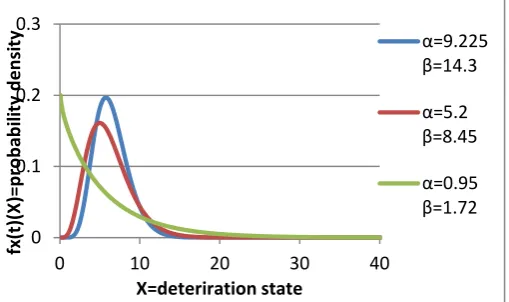
In mathematical terms for the gamma process modelling, we first consider a random variable X that has a gamma distribution with the shape
parameter α>0 and scale parameter >0. Its
probability density function is given by:
where
is the gamma function for α>0.
Figure 2 Gamma random variable representation
Now, we can assume that α(t) is a non-decreasing, right-continuous, real valued function for t≥0, with
α(0)=0. The gamma process with shape function α(t)>0 and scale parameter >0 is a continuous-time
stochastic process {X(t), t≥0} with the following
properties:
has independent increments 0, 1 0 ) 0 ( t for t X t Ga t X X X P
Thus, the probability density function of X(t), where
t refers to time, in accordance with definition of the gamma process, will be given by:
With expectation and variance:
The coefficient of variation is defined by the ratio of the standard deviation and the mean
and decreases as the time increases. On the other hand, the ratio of the variance and the mean does not depend on time only the scale factor.
GAMMA PROCESS MODELLING FOR
DETERIORATION
For a sample deterioration process we first take advantage of the power law formulation
.
This is a standard representation that would have for the expected degradation of concrete due to corrosion of reinforcement linear form ( b=1), for sulphate attack parabolic form( b=2) and for diffusion-controlled aging square root form ( b=0.5) as presented by Ellingwood and Mori (1993). We
therefore consider the deterioration, X(t) that will
denote the deterioration at time t, t≥0. As a result, we are able to define the gamma process with shape function and scale parameter . For simplicity we assume that there is often engineering knowledge available about the shape of the expected deterioration, so b may be constant (VanNoortwijk et al. 2007).
However, c and are unknown and need to be established by using expert judgement or statistics. When adaptive inspection regime is a target as here we will need to There are many statistical methods to estimate such parameters, but the three most common methods are Maximum Likelihood Method, Method of Moments and Bayesian Statistics (VanNoortwijk 2009). For simplicity we have implemented the method of moments. This means that the population parameters are obtained, by equating sample moments with unobservable population moments and then solving the equations for the quantities to be estimated.
According to the expected value and variance of the accumulated deterioration at time t, when the power parameter is known, the non-stationary gamma process can be easily transformed to a stationary gamma process. This is accomplished by performing a monotonic transformation from the time to transformed or operational time,
.
Thus the expected value and variance equation will be:
Similarly, the transformed inspection times would be identified For an inspection interval transformed times between inspections are defined as
and
.
as proposed by (van Noortwijk 2009) The deterioration increments have a gamma distribution with shape factor and scale parameter for all . Following from VanNoortwijk (2009) recommendation the method -of-moments is used for estimates for can be solved from: 0 0.1 0.2 0.3
0 10 20 30 40
Clearly, the method of moments leads to simple formula for parameter estimation which can be easily computed. Estimates by method of moments can be used as the first approximation to the solution of the of the likelihood equations. When we apply this approach to inspection schedule the interval wi
can be the time between inspections but could also represent a longer time horizon. This is of particular interest if we want to ensure that inspection techniques are selected as appropriate for the deterioration path as shown in Figure 1.
[image:6.595.303.568.126.202.2]We consider a simple circular bar element (16mm diameter) that could be a part of bridge deck reinforcement. Our assumption is that this bar is observed over a long time and it is subject to some gradual loss of section due to corrosion. To simplify the approach the corrosion is quantified from empirical studies for corrosion of concrete reinforcement Frangopol et al (2004). The assumed corrosion model is presented in the Table 1 below for somewhat arbitrarily selected times of inspection.
Table 1 Assumed simple deterioration profile Inspection
Time (yr)
Corrosion rate (mm2/yr)
Aprior
(mm2) Apost (mm
2) Acu
(mm2)
0 0 201 201 0
9 3 201 174 27
13 2.3 174 165 36.2
17 2 165 157 44.2
21 1 157 153 48.2
In Table 1 Aprior is the prior section area, Apost is the remaining area after deterioration at inspection time and Acu is the cumulative deteriorated area. The gamma process parameters are estimated by method of moments as described above and presented in Table 2.
Table 2 Derived parameters for Gamma process characterization
Age (yr)
wi
(yr)
xi
(%)
i
(%)
0 - 0 -
9 9 13.4 13.4
13 4 18 5.2
17 4 22 4.8
21 4 24 2.6
In Table 2 the notation is the same as described above and will be used to establish required parameters. In Table 3 we present the Gamma process parameters at different inspection times.
Table 3 Gamma process parameters that are obtained after inspection.
Time α(t)
0 - - -
9
13 14.3 20.5 2.665
17 8.45 11.57 1.966
21 1.72 2.13 0.447
We have to point that here in early years parameters were established on the basis of expert judgement and not the first time inspection. This is to account for the fact that they couldn’t be estimated by the method of moments selected here. Expert judgement is an appropriate method for parameter estimation.
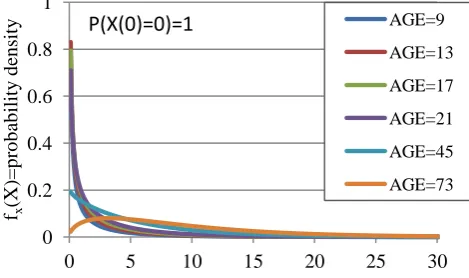
Figure 3 Gamma process representation following the inspection at year 13.
Figure 3 demonstrates the use of Gamma process representation for the loss of section in this example. We note that the curves are positive and skewed to represent expected deterioration. AGE refers to the time horizon from current year (13). The projections for deterioration between time horizons are independent and only functions of current status. This represents major advantage of gamma process modelling in comparison with random variable modelling.
0 0.2 0.4 0.6 0.8 1
0 5 10 15 20 25 30
fx
(X)
=p
ro
b
ab
ilit
y
d
en
sity
X=Cumulative percentage loss of the section
AGE=9
AGE=13
AGE=17
AGE=21
AGE=45
AGE=73
[image:6.595.326.561.371.510.2] [image:6.595.28.300.432.529.2]Figure 4 Gamma process representation following the inspection at year 21
Figure 4 illustrates further benefits of the gamma process modelling. Deterioration paths are again independent between time horizons and reflect increasing deterioration over the lifecycle. So far, this representation is focused on structure that is subject to gradual deterioration. It is easy to observe that, due to the independence between projections effect of major repair or damage for that matter could be included in appropriate way.
INSPECTION TECHNIQUE SELECTION
So far, the stochastic process representation is only limited to modelling of deterioration profiles as an integral part of adaptive inspection programme. We have proposed that the number of inefficient inspections can easily be reduced without undermining the flow of useful information about the structure. Instead we propose that for the specific structure at the specific location inspection techniques should be identified with their associated cost and detection characteristics. Then the owner will be able to decide on the most beneficial sequence of inspections. It might be the case that the owner would find it more beneficial to se a higher cost inspection technique with higher probability of detection at longer time intervals then a low cost frequent inspection. Such flexibility in approach would enable owners to take decision with regard to the age of the structure as well as its specific environment.
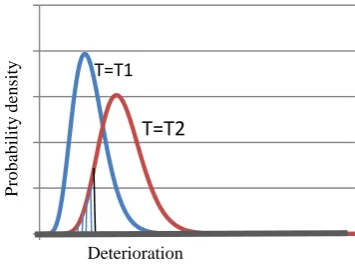
We have already presented the gamma process representation for the deterioration profile however, in order to be able to make decisions, the owner will need to have a quantitative measure for the deterioration growth over specific time. We now extract two density functions, such as those defined in Figure 4 from two time horizons T1 and T2 and present them in Figure 5. These graphs reflect the
progress of deterioration and could be considered at selected time intervals.
Figure 5 Cumulative measure of deterioration following Gamma process modelling
By implementing standard formulations, VanNoortwijk 2009, we can now estimate that the cumulative measure of deterioration as indicated by the shaded are in Figure 5. This estimate can be carried out for a desired interval and used to identify most effective inspection technique as defined in Figure 1. This would effectively mean that crucial decisions on inspection interval and inspection technique would rest with the owner rather then be prescribed. Before such approach is implemented in practice there will need to be selection/ development of appropriate optimization technique as the owner will have to consider diverse components and their impact on a variety of limit states.
Ultimately, at the scale of country wide network of say highway bridges it is expected that the number of inspections carried out would be noticeably reduced and that the new procedures would represent a significant reduction in costs of inspections. At the same time this reduction in inspection costs is envisaged to actually improve the efficiency of maintenance and scheduling of repair.
CONCLUSIONS
In this paper we have considered an option to model deterioration process for infrastructure components using stochastic process representation. In particular, we have identified that Gamma process represents very simple and effective method to establish consistent deterioration models for structures that are subject to inspection. As a result of such approach we see an opportunity to establish adaptive inspection regime that would account much better for:
Structure specific deterioration path,
Site specific environment,
0 0.1 0.2 0.3 0.4 0.5 0.6
0 5 10 15 20 25 30
fx
(X)
=p
ro
b
ab
ilit
y
d
en
sity
X=Cumulative percentage loss of section
AGE=9 AGE=13
AGE=17 AGE=21 AGE=45 AGE=73
P(X(0)=0)=1
0 0.05 0.1 0.15 0.2 0.25
0
P
ro
b
ab
il
it
y
d
en
sity
Deterioration
T=T1
[image:7.595.42.278.61.214.2] [image:7.595.318.496.79.213.2] In service inspection outcomes,
Inspection technique effectiveness,
Planning for the future, etc.
Maintenance planning
Repair schedulling
Much work remains to be done for specific applications as we need to establish methodologies that will enable us to quantify:
Early deterioration profiles
Specific parameter estimation techniques
Characteristics that will define inspection techniques,
Effective optimization techniques for inspection technique selection, etc.
ACKNOWLEDGEMENTS
We gratefully acknowledge that the first author is supported by Islamic Azad University, Oxford
REFERENCES
1- G.Morocoous, Z.Lounis and Yong Cho; An integrated system for bridge management using probabilities and mechanistic deterioration models; KSCE,(2010) Vol. 14(4), pp. 527-537.
2- Dan.M.Frangopol, Maatren-Jan Kallen and Jan.M.van Noortwijk; Probabilistic models for life-cycle performance of deteriorating structures: (Review); Structural Engineering Materials, John Wiley & Sons,(2004); Vol. 6, pp. 197-212.
3- J.M.van Noortwijk; A survey of the application of gamma processes in maintenance, Reliability Engineering and Safety, (2009); Vol. 94, pp. 2-21.
4- M.D.Pandey, X.X.Yuan and J.M.van Noortwijk; The influence of temporal uncertainty of deterioration on life-cycle management of structures, Structure and Infrastructure Engineering, (2009); Vol. 5(2); pp. 145-156. 5- J.M.van Noortwijk, J.A.Mvan Weide, M.J. Kallen, M.D. Pandey. Gamma processes and peaks-over-threshold distributions for time-dependent reliability, Reliability Engineering and System Safety, (2007); 92, pp.1651-1658. 6- M. B. Roberts, C. Atkins, V. Hogg, C. Middleton; A proposed empirical corrosion model for reinforced concrete, Journal of institution Civil Engineering structures & Building;(2000), Vol.140,pp1-11.
7- HE Klatter, A Vrouwenvelder, J.M.van Noortwijk; Societal Aspects of Bridge Management and Safety in The Netherlands, 2006 - Taylor & Francis Group
8- BR. Ellingwood, Y. Mori, Probabilistic methods for condition assessment and life prediction of concrete structures in nuclear power plants, Nuclear Engineering and Design, Volume 142, Issues 2-3, 1993, pp 155-166. 9- FHWA-RD-01-105; Reliability of Visual Inspection for