City, University of London Institutional Repository
Citation
:
Kotti, M., Benetos, E. and Kotropoulos, C. (2008). Computationally Efficient and Robust BIC-Based Speaker Segmentation. IEEE Transactions on Audio, Speech &Language Processing, 16(5), pp. 920-933. doi: 10.1109/TASL.2008.925152
This is the unspecified version of the paper.
This version of the publication may differ from the final published
version.
Permanent repository link:
http://openaccess.city.ac.uk/2045/Link to published version
:
http://dx.doi.org/10.1109/TASL.2008.925152Copyright and reuse:
City Research Online aims to make research
outputs of City, University of London available to a wider audience.
Copyright and Moral Rights remain with the author(s) and/or copyright
holders. URLs from City Research Online may be freely distributed and
linked to.
City Research Online: http://openaccess.city.ac.uk/ [email protected]
1
Computationally efficient and robust BIC-based
speaker segmentation
Margarita Kotti, Emmanouil Benetos, and Constantine Kotropoulos∗, Senior Member, IEEE
Dept. of Informatics, Aristotle University of Thessaloniki, Box 451, Thessaloniki 54124,
Greece, Tel: +30-2310-996361, Fax: +30-2310-998453
{mkotti,empeneto,costas}@aiia.csd.auth.gr
Abstract
An algorithm for automatic speaker segmentation based on the Bayesian Information Criterion (BIC) is presented. BIC tests are not performed for every window shift (e.g. every milliseconds), as previously, but when a speaker change is most probable to occur. This is done by estimating the next probable change point thanks to a model of utterance durations. It is found that the inverse Gaussian fits best the distribution of utterance durations. As a result, less BIC tests are needed, making the proposed system less computationally demanding in time and memory, and considerably more efficient with respect to missed speaker change points. A feature selection algorithm based on branch and bound search strategy is applied in order to identify the most efficient features for speaker segmentation. Furthermore, a new theoretical formulation of BIC is derived by applying centering and simultaneous diagonalization. This formulation is considerably more computationally efficient than the standard BIC, when the covariance matrices are estimated by other estimators than the usual maximum likelihood ones. Two commonly used pairs of figures of merit are employed and their relationship is established. Computational efficiency is achieved through the speaker utterance modeling, whereas robustness is achieved by feature selection and application of BIC tests at appropriately selected time instants. Experimental results indicate that the proposed modifications yield a superior performance compared to existing approaches.
Index Terms
* Corresponding author
copyrighted components of this work in other works.
Automatic speaker segmentation, Bayesian Information Criterion, Speaker utterance duration distri-bution, Inverse Gaussian distridistri-bution, Simultaneous diagonalization, Speech analysis.
I. INTRODUCTION
Nowadays, a vast rise in multimedia archives has occurred, partially due to the increasing number of
broadcast programs, the decreasing cost of mass storage devices, the advances in compression techniques,
and the wide prevalence of personal computers. The functionality of such archives would be in doubt,
unless data management is employed. Data management is necessary for organizing, navigating, and
browsing the multimedia content, as is manifested by the MPEG-7 standard. Here, we focus on speech.
Speaker segmentation is an efficient tool for multimedia archive management. It aims to find the speaker
change points in an audio recording. Speaker segmentation finds numerous applications, since it is
a prerequisite for audio indexing, speaker identification/verification/tracking, automatic transcription,
and dialogue detection in movies. MPEG-7 audio low-level descriptors (e.g. AudioSpectrumProjection,
AudioSpectrumEnvelope) can be used to describe efficiently a speech recording [1]. In addition,
MPEG-7 high-level tools, (e.g. SpokenContent) exploit speakers’ word usage or prosodic features that are also
useful for speaker segmentation. A large number of groups and research centers compete for improved
speaker segmentation. An example is the segmentation task administrated by the National Institute of
Standards and Technology (NIST) [2]. NIST has also been working towards rich transcription evaluation
(NIST/RT). Rich transcription includes speaker segmentation as a part of its diarization task [3].
A. Related Work
Extensive work in speaker segmentation has been carried out for more than two decades. Three major
categories of speaker segmentation algorithms can be found: model-based, metric-based, and hybrid ones.
In model-based segmentation, a set of models is trained for different speaker classes and the incoming
speech recording is classified using the trained models. Various methods have been used in order to create
generic models. Starting from the less complex case, a universal background model (UBM) is utilized to
separate speech from non-speech [4]. The UBM is trained by using a large volume of speech data off-line.
The algorithm can be used in real-time, because the models have been pre-calculated. Second, instead
of using just one generic model, two universal gender models (UGM), that discriminate between male
[5]. This is a predetermined, generic, speaker-independent model, which is progressively adapted into a
specific speaker-dependent one. Alternatively, an anchor model can be utilized, where a speaker utterance
is projected onto a subspace of reference speakers [6]. Finally, more sophisticated models can be created
with the help of hidden Markov models (HMMs) [7], [8], [9] or support vector machines (SVMs) [10].
Metric-based techniques detect the local extrema of a proper distance between neighboring windows
in order to segment an input recording. Various distances have been employed. For example, a weighted
squared Euclidean distance has been used, where the weights are updated by Fisher linear discriminant
analysis [11]. Another criterion is the generalized likelihood ratio (GLR) test [5], [6], [9], [12], [23].
The Kullback-Leibler divergence is also commonly employed. It is used either in conjunction with
the Bayesian Information Criterion (BIC) [12], [13] or independently [14]. Alternatively, second-order
statistics could be used [12]. Another closely related measure is the Hotelling T2 statistic, which is
combined with BIC to achieve a higher accuracy than the standard BIC for turns of short duration [15],
[16]. However, the most popular criterion is BIC [7], [12], [15], [17], [18], [19], [20], [21]. Commonly
used features in speaker segmentation are the mel-cepstrum coefficients (MFCCs), applied in conjunction
with BIC [1], [4], [5], [7], [8], [9], [11], [12], [13], [15], [18], [20], [22]. A milestone variant of
BIC-based algorithms is DISTBIC, that utilizes distance-BIC-based pre-segmentation before applying BIC [12].
Most recently, BIC is compared to agglomerative clustering, minimum description length-based Gaussian
modeling, and exhaustive search. It is found that applying audio classification into speech, noise, and
music prior to speaker segmentation improves speaker segmentation accuracy [22]. An approach to
segmentation and identification of mixed-language speech with BIC has been recently proposed [20].
In particular, BIC is employed to segment an input utterance into a sequence of language-dependent
segments, each of which is used then as processing model for mixed language identification.
Many researchers have experimented with hybrid algorithms, where first metric-based segmentation
creates an initial set of speaker models and model-based techniques refine the segmentation next. In [8],
HMMs are combined with BIC. In [23], another hybrid system is proposed, where the audio stream is
recursively divided into two subsegments and speaker segmentation is applied to both of them separately.
Another interesting hybrid system is described in [9], where two systems are coupled, namely the LIA
system and the CLIPS system. The LIA system is based on HMMs, while the CLIPS system is based on
using different strategies to further improve performance.
B. Proposed Approach
In this paper, an unsupervised, BIC-based system for speaker segmentation is proposed. The first
contribution of the paper is in modeling the distribution of the duration of speaker utterances. More
specifically, the next probable change point is estimated by employing the utterance duration model.
In this way, several advantages are gained, because the search is no longer “blind” and exhaustive, as
is the common case in speaker segmentation algorithms. Consequently, a considerably less demanding
algorithm in time and memory is developed. Several distributions have been tested as hypotheses for the
distribution speaker utterance durations and their parameters have been estimated by maximum likelihood
estimation (MLE). Both the log-likelihood criterion and the Kolmogorov-Smirnov criterion yield the
inverse Gaussian (IG) distribution as the best fit. More specifically, distribution fitting in three datasets
having substantially different nature verifies that IG models more accurately the distribution of speaker
utterance duration. The first dataset, contains recorded speech of concatenated short utterances, the second
dataset contains dialogues between actors that follow specific film grammar rules, while the last dataset
contains spontaneous speech.
The second contribution is in feature selection applied prior to segmentation aiming to determine which
MFCCs are most discriminative for the speaker segmentation task. The branch and bound search strategy
using depth-first search and backtracking is employed, since its performance is near optimal [24]. In the
search strategy, the performance measure resorts to the ratio of the inter-class dispersion over the
intra-class one. That is, the trace of the product of the inverse within-intra-class scatter matrix and the between-intra-class
scatter matrix is employed.
The third contribution is of theoretical nature. An alternative formulation of BIC for multivariate
Gaussians is derived. The new formulation is obtained by applying centering and simultaneous
diagonal-ization. A detailed proof can be found in Appendix I. It is shown that the new formulation is significantly
less computationally demanding than the standard BIC, when covariance matrix estimators other than the
sample dispersion matrices are employed, such as the robust estimators [25], [26] or the regularized MLE
[27]. In particular, simultaneous diagonalization replaces matrix inversions and simplifies the quadratic
forms to be computed. A detailed analysis of the computational cost can be found in Appendix II. The
training recordings
testing recordings
feature selection
modeling speaker utterance duration
BIC with simultaneous diagonalization feature
extraction
feature extraction
best features model
parameters
[image:6.612.192.427.69.203.2]results
Fig. 1. The block diagram of the proposed approach.
Experimental results are reported with respect to the two commonly used sets of figures of merit,
namely: (i) the precision rate (P RC), the recall rate (RCL), and the associatedF1 measure; (ii) the false
alarm rate (F AR) and the miss detection rate (M DR). By utilizing both sets of figures of merit, a
straight-forward comparison with other experimental results reported in related works is enabled. Furthermore,
relationships between the aforementioned figures of merit are derived. The proposed approach yields a
significant improvement in efficiency compared to previous approaches. Experiments were carried out on
two datasets. The first dataset has been created by concatenating speakers from the TIMIT database [28].
This dataset will be referred to as the conTIMIT test dataset. The second dataset has been derived from
RT-03 MDE Training Data Speech [44]. In essence, the HUB-4 1997 English Broadcast News Speech
part has been utilized. The greatest improvement is achieved for missed speaker turn points. Compared
with other approaches, the number of missed speaker change points is smaller as explained in Section V.
This is attributed to the fact that BIC tests take place when a speaker change is most probable to occur.
The remainder of the paper is organized as follows. In Section II, various distributions are tested for
modeling the duration of speaker utterance and the IG distribution is demonstrated to be the best fit.
The feature selection algorithm is sketched in Section III. In Section IV, the standard BIC is presented
and its equivalent transformed BIC is derived. In Section V, the evaluation of the proposed approach is
undertaken. Finally, conclusions are drawn in Section VI. The derivation of the transformed BIC can be
II. MODELING THE DURATION OF SPEAKER UTTERANCES
A. Distribution of speaker utterance durations
The first contribution of this paper is in modeling the distribution of the duration of speaker utterances.
Let us argue why such a modeling is advantageous. By estimating the duration of a speaker’s utterance,
the search is no longer “blind”. After modeling, it is safe to claim that the next speaker change point
most probably occurs after as many seconds dictated by a statistic of speaker utterance durations. In this
context, several distributions have been tested for a goodness-of-fit to the empirical distribution of speaker
utterance durations. A question that arises is why fitting a theoretical distribution of speaker utterance
durations to the empirical one is necessary. The answer is that by doing so, distribution parameters take
into account the structure of the data. Moreover, finding such a theoretical distribution is interesting per
se and this result may find additional applications, e.g. in speech synthesis.
The following distributions have been considered: Birnbaum-Saunders, Exponential, Extreme value,
Gamma, IG, Log-logistic, Logistic, Lognormal, Nakagami, Normal, Rayleigh, Rician, t-location scale,
and Weibull. MLE has been used to calculate the best fitting parameters of each distribution. Here, the
parameters under consideration are the mean and the variance. In order to evaluate the goodness-of-fit,
the log-likelihood and the Kolmogorov-Smirnov criteria have been computed.
The TIMIT database was used first in order to model the duration of speaker utterances. The TIMIT
database includes 6300 sentences uttered by 630 speakers, both male and female ones, who speak various
U.S. English dialects. The recordings are mono-channel, the sampling frequency is 16 KHz, and the audio
PCM samples are quantized in 16 bits [28]. In total, 55 recordings of artificially created dialogues along
with the ground-truth associated with speaker changes comprise the conTIMIT dataset.1 The recordings
have a total duration of about 1 hour. Since a transition between speech and silence is not similar to a
transition between two speakers, the inter-speaker silences have been reduced so that conversations sound
like real [12]. Thus, each segment of a speaker is followed by a segment of another speaker. This is
equivalent to silence removal, which is a common pre-processing step [4], [8], [13], [15]. 935 speaker
change points occur in the conTIMIT dataset. Throughout the conTIMIT dataset, the minimum duration
of an utterance is 1.139 s and the maximum one is 11.751 s, while the mean duration is 3.286 s with
a standard deviation equal to 1.503 s. 10 out of the 55 recordings of the conTIMIT dataset, randomly
1
chosen, were used to create the conTIMIT training-1 dataset, employed in modeling the speaker utterance
duration.
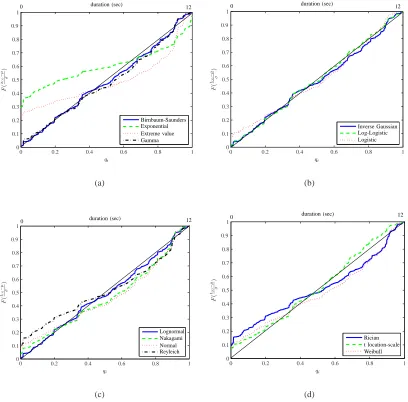
IG distribution has been found to be the best fit with respect to both log-likelihood and
Kolmogorov-Smirnov test. The values of mean utterance duration and standard deviation for the conTIMIT training-1
dataset under the IG model equal 3.286 s and 1.388 s, respectively. An illustration of the best fit for
the aforementioned distributions to the empirical distribution of speaker utterance durations can be seen
in Figure 2 with respect to the probability-probability (P-P) plots. Let us denote the mean and the
standard deviation of durations by µ and σ. Let Fk(·) be the kth normalized theoretical cumulative
density function (cdf) tested. To make a P-P plot, uniform quantiles qi = N+1i , i = 1,2, . . . , N, are
defined in the horizontal axis, where N is the number of the samples whose distribution is estimated.
The vertical axis represents the value admitted by the theoretical cdf at t(i)−µ
σ , i.e.Fk( t(i)−µ
σ ), wheret(i)
is theith order statistic of utterance durations. That is, the durations are arranged in an increasing order
and the ith sorted value is chosen. The better the theoretical cdf approximates the empirical one, the
closer the points (qi, Fk(t( i)−µ
σ )) are to the diagonal [29].
To validate that IG distribution generally fits best the empirical speaker utterance duration distribution,
another dataset has been employed, to be referred to as the movie dataset [30]. In this dataset, 25 audio
recordings are included that have been extracted from six movies of different genres, namely: Analyze
That, Cold Mountain, Jackie Brown, Lord of the Rings I, Platoon, and Secret Window. Indeed, Analyze
That is a comedy, Platoon is an action, and Cold Mountain is a drama. Thus, dialogues of different natures
are included in the movie dataset. Speaker segmentation has been performed by human agents. Having the
ground-truth speaker change points, the distribution of speaker utterance duration for the movie dataset
is modeled by applying the same procedure as for the conTIMIT training-1 dataset. The best fit is found
to be the IG distribution, once again, with respect to both log-likelihood and Kolmogorov-Smirnov test.
This outcome is of great importance, since the dialogues are not recorded in a clean environment. Longer
pauses or overlaps between the actor utterances exist and background music or noise occurs. However, as
expected, different parameters from those estimated in the conTIMIT training-1 dataset are obtained. In
the movie dataset, the mean duration equals 5.333 s, while the standard deviation is 6.189 s. Accordingly,
modeling the duration of speaker utterances by an IG distribution helps to predict the next speaker change
qi
F
(
x(i)
− µ σ ) duration (sec) Birnbaum-Saunders Exponential Extreme value Gamma 12 0
0 0.2 0.4 0.6 0.8 1
0 0.1 0.2 0.3 0.4 0.5 0.6 0.7 0.8 0.9 1 (a) qi F ( t ( i ) − µ σ ) duration (sec) Inverse Gaussian Log-Logistic Logistic 12 0
0 0.2 0.4 0.6 0.8 1
0 0.1 0.2 0.3 0.4 0.5 0.6 0.7 0.8 0.9 1 (b) qi F (
t(i)
− µ σ ) duration (sec) Lognormal Nakagami Normal Reyleich 0 12
0 0.2 0.4 0.6 0.8 1
0 0.1 0.2 0.3 0.4 0.5 0.6 0.7 0.8 0.9 1 (c) qi F ( t ( i ) − µ σ ) duration (sec) Rician t location-scale Weibull 0 12
0 0.2 0.4 0.6 0.8 1
0 0.1 0.2 0.3 0.4 0.5 0.6 0.7 0.8 0.9 1 (d)
Fig. 2. (a) The P-P plots for distributions Birnbaum-Saunders, Exponential, Extreme value, Gamma for the conTIMIT training-1 dataset. (b) The P-P plots for distributions IG, Log-Logistic, Logistic for the conTIMIT training-1 dataset. (c) The P-P plots for distributions Lognormal, Nakagami, Normal, Reyleigh for the conTIMIT training-1 dataset. (d) The P-P plots for distributions Rician,t-location scale, Weibull for the conTIMIT training-1 dataset.
B. Mathematical properties of the IG distribution and its application
Some of the main mathematical properties of the IG distribution are briefly discussed next. The IG
distribution, or Wald distribution, has probability density function (pdf) with parametersµandλIG [31],
[32]:
f(t) = r
λIG 2πt3 exp
−λIG(t−µ)2 2µ2t
[image:9.612.98.506.85.487.2]
where λIG, µ >0. The IG probability density is always positively skewed. Kurtosis is positive as well.
ForN realizations, t1,t2,. . .,tN of an IG random variable the MLEs of σ andµ are: bσ=
r t3
d
λI G
, where
d
λIG= PN N i=1(
1
ti−
1
t)
and t= bµ= N1 PNi=1ti. Obviously, σb does not coincide with the sample dispersion.
One of the most important properties of the IG distribution is its infinite divisibility, which implies that the
IG distribution generates a class of increasing L`evi processes [33]. L`evi processes contain both “small
jumps” and “big jumps”. Such jumps are Poisson point processes that are commonly used to model
the arrival time of an event. In the case under consideration, the arrival time refers to a speaker change
point. This property makes L`evi processes candidates for modeling the speaker utterance duration. “Small
jumps” occur if there are lively exchanges (stichomythia) and “big jumps” occur for monologues.
In conclusion, modeling the speaker utterance duration enables us to perform BIC tests when a speaker
change point is most probable to occur. The simplest approach is to assume that a probable speaker change
point occurs every r seconds, wherer is a submultiple of the expected duration of speaker utterances.r
should be chosen at the same order of magnitude as the sample dispersion. This technical solution does
not exclude other alternatives, such as setting r to a submultiple of the mode of (1) that is given by
b
µ 1 + 9µb2
4λI Gd2 1
2 − 3µb 2λI Gd
[34].
If the total length of the audio recording is La, then ⌊Lar ⌋ BIC tests take place. In straightforward
implementation of BIC-based speaker segmentation,⌊Lau ⌋BIC tests are performed, whereuis the window
shift of several ms. Thus, r−ru% less BIC tests are performed by taking into account the duration of
utterances, when compared to the straightforward implementation of BIC-based speaker segmentation. If
a probable change point is not confirmed through the BIC test, the information contained in the last r
seconds updates the existing speaker model. The use of a submultiple of the expected speaker utterance
duration enables us to reduce the probability of missed speaker change points, as explained in Section V.
Previous experiment demonstrates that under-segmentation, caused by a high number of miss detections,
is more cumbersome to remedy than over-segmentation caused by a high number of false alarms [12],
[13], [15], [16], [23], [40]. For example, over-segmentation could be alleviated by clustering and/or
merging. The use of r within the context of BIC is described in Section IV.
III. FEATUREEXTRACTION ANDSELECTION
Different features yield a varying performance level in speaker segmentation applications [13]. This
contribution of the paper.
MFCCs, sometimes with their first-order (delta) and/or second-order differences (delta-delta) are the
most commonly used features in speaker segmentation. Furthermore, MFCCs were used in various
techniques besides BIC such as HMMs [9] or SVMs [10]. Still, not all the researchers employ the
same MFCC order in BIC-based approaches. For example, 24 MFCCs are employed in [7], while 12
MFCCs and their first differences are utilized in [12] and [20]. 32 MFCCs are used in [11]. In [4], 16
MFCCs are applied, while 12 MFCCs along with their delta and delta-delta coefficients are employed
in [9]. 23 MFCCs are utilized in [1], [8] and 24 MFCCs are applied in [5], [15], [18]. A more detailed
study is presented in [22], where a comparative study between 12 MFCCs, 13 MFCCs and their delta
coefficients, and 13 MFCCs, their delta, and delta-delta coefficients is performed.
A different approach is investigated here. Instead of trying to reveal the MFCC order that yields the
most accurate speaker turn point detection results, an effort is made to find out an MFCC subset that is
more suitable for detecting a speaker change. The MFCCs are calculated every 10 ms with 62.5% overlap
by the algorithm described in [35]. An initial set consisting of 36 MFCCs is formed and the goal is to
derive the subset, which contains the 24 more suitable MFCCs for speaker segmentation, since utilizing
24 coefficients is commonplace in [5], [15], [18].
Let us test the hypothesis there is a speaker change point against the hypothesis there is no speaker
change point. Speakers change once under the first hypothesis, while a monologue is observed under
the second one. For training purposes, an additional dataset of 50 recordings was created from speaker
utterances derived in the TIMIT database, referred to as the conTIMIT training-2 dataset, that is disjoint
to the conTIMIT dataset2. 25 out of the 50 recordings contain a speaker change point and the remaining 25 recordings do not. In this way, two classes are presumed: the first class represents a speaker change
and includes 25 recordings with one speaker change and the second class corresponds to no speaker
changes and includes 25 recordings with monologues. We assume that the mean feature vectors in the
two different classes are different in order to enable discrimination [24]. The goal of feature selection
is to find a feature subset Fi(D) of dimension D. In our case, D= 24. Let J denote the performance
measure. Feature selection finds Fi(D) such that J(Fi(D))≥J(Fj(D)), where j∈ {1, . . . , q(D)} and
2
q(D) is the number of distinguishable subsets containingDelements. If 24 out of the 36 coefficients are
to be selected, thenq(24)=
36 24
is enormous. As a result, a more efficient search strategy than exhaustive
search is required. Such an alternative is branch and bound, which attains an almost optimal performance
[24]. The search process is accomplished systematically by means of a tree structure consisting of
36-24+1=13 levels. A level is composed of a number of nodes and each node corresponds to a coefficient
subset. At the highest level, there is only one node corresponding to the full set of coefficients. At the
lowest level, there are nodes containing 24 coefficients. The search process starts from the highest level
by systematically traversing all levels until the lowest level is reached. The traversing algorithm uses
depth-first search with a backtracking mechanism. This means that if J1 is the best performance found
so far, then branches whose performance is worse than J1 are skipped [24].
The selection criterionJ can be defined in terms of scatter matrices. A scatter matrix gives information
about the dispersion of samples around their mean. The within-class scatter matrix, Sw, describes the
within-class dispersion. The between-class scatter matrix, Sb, describes the dispersion of the
class-dependent sample means around the gross mean. Mathematically, J is defined by
J = tr(S−w1Sb) (2)
wheretr(·)stands for the matrix trace operator. J, as defined in (2), is a monotonically increasing function
of the distance between the mean vectors and a monotonically decreasing function of the scattering around
the mean vectors. Moreover, (2) is invariant to reversible linear transformations. In addition, it is ideal
for Gaussian distributed feature vectors. To a first approximation, MFCCs are assumed to follow the
Gaussian distribution. Under this assumption, (2) guarantees the best performance [24].
From each recording, 36-order MFCCs are extracted. The selected 24 MFCCs for the conTIMIT
training-2 dataset can be seen in Table I. Although the selection of MFCCs, as in Table I, might depend
on the dataset used for feature selection, the aforementioned feature selection can be applied to any
dataset. MFCCs shown in Table I are used in conjunction with their delta and delta-delta coefficients,
in order to capture their temporal evolution that carries additional useful information. In general, the
temporal evolution is found to increase efficiency [9], [15], [20], [22]. However, in [12], it is reported
that using delta and delta-delta coefficients impairs efficiency.
TABLE I
THE SELECTED24 MFCCS FOR THE CONTIMITTRAINING-2DATASET.
# 1 2 3 4 5 6 7 8 9 10 11 12
MFCC 1st 3rd 4th 5th 6th 7th 8th 9th 10th 11th 13th 16th
# 13 14 15 16 17 18 19 20 21 22 23 24
MFCC 22th 23th 24th 25th 26th 27th 28th 29th 31th 33th 35th 36th
wrapper instead of a filter [36], as (2) implies. In such case, the selected MFCCs are: : 1st-18th, 22nd,
23rd, 27th, 28th, 31st, and 35th. The computation time required by (2) is less by 187.06% than that
required by BIC, when a PC with a 3 GHz Athlon processor and 1 GB of RAM is used. In Section V,
we comment on the accuracy of the latter feature selection method.
IV. BIC-BASEDSPEAKERSEGMENTATION
In this section, the BIC criterion is detailed and an equivalent BIC criterion is derived, that is
consid-erably less computationally demanding. It is also explained how the contributions of Sections II and III
are utilized in conjunction with BIC.
BIC is a maximum likelihood, asymptotically optimal, Bayesian model selection criterion penalized
by the model complexity. For speaker turn detection, two different models are employed. Assume that
there are two neighboring chunks X and Y around time tj. The problem is to decide whether or not
a speaker change point exists at tj. Let Z = X∪Y and NX, NY, NZ be the numbers of samples in
chunks X, Y, and Z, respectively. Obviously, NY = NZ −NX. The problem is formulated as a two
hypothesis testing problem.
Under H0 there is no speaker change point at time tj. MLE is used to compute the parameters of
a Gaussian distribution that models the data samples in Z. Let us denote by θZ the parameters of the
Gaussian distribution, i.e. the mean vectorµZ and the full covariance matrix ΣZ. The log-likelihood L0
under H0 is
L0 = NX X
i=1
lnp(zi|θZ) + NZ X
i=NX+1
lnp(zi|θZ) (3)
where zi ∈ Rd, i = 1,2, . . . , NZ which are assumed to be independent. zi consists of the 24 selected
MFCCs with their delta and delta-delta coefficients, i.e. d = 72. Under H1 there is a speaker change
parameters are denoted by θX andθY, respectively. Their definition is similar to θZ. The log-likelihood
L1 under H1 is given by:
L1= NX X
i=1
lnp(zi|θX) + NZ X
i=NX+1
lnp(zi|θY). (4)
The BIC is defined as
δ =L1−L0−
λ 2
d+d(d+ 1) 2
| {z }
lnNZ≷0 (5)
model parameters
whereλis a data-dependent penalty factor (ideally 1.0). Ifδ >0, then timetjis considered to be a speaker
change point. Otherwise, there is no speaker change point at time tj. The standard BIC formulation for
multivariate Gaussian densities p(zi|θX), p(zi|θY), p(zi|θZ) can be analytically written as
−
NZ X
i=1
(zi−µZ)TΣZ−1(zi−µZ)+ NX X
i=1
(zi−µX)TΣX−1(zi−µX)+ NZ X
i=NX+1
(zi−µY)TΣY−1(zi−µY)≷γBIC,
(6)
where γBIC is defined as
γBIC =NZln|ΣZ| −NXln|ΣX| −NY ln|ΣY|+λ
d+d(d+ 1) 2
lnNZ. (7)
In the light of the discussion made in Section II, BIC tests are performed every r seconds, where
r is a submultiple of the expected duration of speaker utterances. The window size is also set equal
to r taking into consideration as many data as possible. When more data are available, more accurate
Gaussian models are built, since BIC behaves better for large windows, whereas short changes are not
easily detectable by BIC [12], [16]. Moreover, it was shown in [22], that the bigger the window size, the
better the performance.
Next, a novel formulation of the BIC is theoretically derived. It is assumed thatΣX,ΣY, andΣZ are
full covariance matrices. Moreover, the covariance matrix estimators are not limited to sample dispersion
matrices for which BIC defined in (6)-(7) obtains the simplified form (21), as explained in Appendix I. For
example, one may employ the robust estimators of covariance matrices [25], [26] or the regularized MLEs
[27]. To obtain the novel formulation, we apply first centering and then simultaneous diagonalization for
transformation iszei =zi−µZ. Next, simultaneous diagonalization of ΣX and ΣZ is applied. Let ΛZ
be the diagonal matrix of the eigenvalues ofΣZ andΦbe the corresponding modal matrix. Let us define
K=Λ− 1 2
Z ΦTΣXΦΛ
−1 2
Z =ΨΛKΨT, where ΛK is the diagonal matrix of eigenvalues of Kand Ψ is
the corresponding modal matrix. The simultaneous diagonalization transformation yields for zi ∈ Z ∩
X =X
e
wi=ΨTΛ
−1 2
Z ΦTezi. (8)
Let H = ΛZ−12ΦTΣYΦΛZ− 1
2 and H = ΞΛHΞT. Following the same strategy, we obtain for zi ∈
Z∩Y = Y
e
vi=ΞTΛ
−1 2
Z ΦTezi. (9)
In Appendix I, it is shown that (6) is equivalently rewritten as
NX X
i=1
e
wTi (ΛK−1−I)wei+ NZ X
i=NX+1
e
vTi (ΛH−1−I)vei ≷γ′ (10)
where γ′ is an appropriate threshold derived analytically in (26).
Concerning the computational cost, simultaneous diagonalization replaces matrix inversions and
simpli-fies the quadratic forms to be computed. This leads to a substantially less computational costly transformed
BIC, as opposed to the standard BIC. As it is detailed in Appendix II, the computational cost of the
standard BIC in flops, excluding the cost of γBIC, is
3d3+ 6NZd2+ (8NZ+ 3)d+ 2, (11)
whereas the computational cost of the transformed BIC, excluding the cost of γBIC, equals
30d3+ (4NZ+ 4)d2+ (7NZ+ 9)d+ 5. (12)
Sinced≪NZ, by comparing (11) and (12), it can be seen that the standard BIC is more computationally
costly than its transformed alternative.
To sum up, the algorithm can be roughly sketched as follows:
1) Initialize the interval [a, b]to [0,2r]and let v= a+2b.
2) Until the audio recording end, use BIC with the selected MFCCs to evaluate if there is a change
3) If there is no speaker change point in [a, b], then b=b+r. Go to step 2).
4) If there is a speaker change point in [a, b], then a=v, b=v+r. Go to step 2).
It is reminded thatr is a submultiple of the mean utterance duration, which is obtained by the analysis in
Section II and the term selected MFCCs refers to the MFCCs chosen by the feature selection algorithm,
described in Section III.
V. EXPERIMENTALRESULTS ANDDISCUSSION
A. Figures of Merit
To judge the efficiency of speaker turn point detection algorithms, two sets of figures of merit are
commonly used. On the one hand, one may use the false alarm rate (F AR) and the miss detection rate
(M DR) defined as
F AR= F A
GT+ F A, M DR= M D
GT (13)
where F A denotes the number of false alarms, M D the number of miss detections, andGT stands for
the number of actual speaker turns, i.e. the ground truth. A false alarm occurs when a speaker turn is
detected although it does not exist, while a miss detection occurs, when the process does not detect an
existing speaker turn [12], [23]. On the other hand, one may employ the precision (P RC), recall (RCL)
andF1 rates given by
P RC = CF C DET =
CF C
CF C+F A, RCL= CF C
GT =
CF C
CF C+M D, F1 = 2
P RC RCL
P RC+RCL (14)
where CF C denotes the number of correctly found changes and DET = CF C +F A is the number
of detected speaker changes. F1 admits a value between 0 and 1. The higher its value is, the better
performance is obtained [8], [18]. Between the pairs (F AR, M DR) and (P RC, RCL), the following
relationships hold:
M DR= 1−RCL, F AR= DET P RCRCL F A+RCL F A. (15)
In order to facilitate a comparative assessment of our results with others reported in the literature, the
B. Evaluation
1) Comparative performance evaluation on the conTIMIT test dataset: The total number of recordings
in the conTIMIT dataset is 55. The evaluation is performed upon 49 randomly selected recordings of
the conTIMIT dataset, forming the conTIMIT test dataset. The remaining 6 were used to determine the
value of the BIC penalty-factorλand to create the conTIMIT training-3 dataset. Although the conTIMIT
dataset is an artificially created dataset and includes no real conversations, performance assessment over
the conTIMIT test dataset is still informative. It is also reminded that 10 randomly chosen recordings out
of the 55 ones of the conTIMIT dataset, are employed to model the speaker utterance duration (conTIMIT
training-1 dataset). Consequently, there is a partial overlap between the conTIMIT test dataset and the
conTIMIT training-1 dataset. It has been reported that BIC performance is likely to reach a limit [20].
There are 4 reasons for that: (a) estimates of the BIC model parameters are used, (b) the penalty-factor
λ may not be tuned properly, (c) the data are assumed to be jointly normal, but this is an assumption,
frequently not validated, for example when voiced speech is embedded into noise [37], and (d) researchers
have found that BIC faces problems for small sample sets [37], [38]. Researchers tend to agree that BIC
performance deteriorates when a speaker utterance does not have sufficient duration, which should be
more than about 2 s. For the conTIMIT test dataset, the tolerance equals 1 s. That is, 0.5 s before and
after the actual speaker change point.
For evaluation purposes, 4 systems are assessed, namely: (a) The BIC system without speaker utterance
duration estimation and feature selection. This is the baseline system (system 1). (b) The BIC system with
speaker utterance duration estimation (system 2). (c) The BIC system with feature selection (system 3).
(d) The proposed system, that is the BIC system with speaker utterance duration estimation and feature
selection (system 4). The window shiftris set equal to the half of the average speaker utterance duration
for systems 2 and 4, whereas r is equal to 0.2 s for systems 1 and 3.
BIC performance on the conTIMIT test dataset without modeling the speaker utterance duration and
feature selection is depicted in Table II. The performance of BIC with modeling the distribution of the
speaker utterance is exhibited in Table III, while its performance when feature selection is applied only
is summarized in Table IV. The overall performance of the proposed system (system 4) is summarized
in Table V. For all systems, the figures of merit are computed for each audio recording and then their
TABLE II
PERFORMANCE OFBICON THE CONTIMITTEST DATASET
WITHOUT MODELING THE SPEAKER UTTERANCE DURATION NOR APPLYING FEATURE SELECTION.
P RC RCL F1 F AR M DR
mean 0.446 0.647 0.516 0.352 0.353
standard deviation 0.094 0.137 0.081 0.157 0.137
TABLE III
PERFORMANCE OFBICON THE CONTIMITTEST DATASET
WITH MODELING THE SPEAKER UTTERANCE DURATION.
P RC RCL F1 F AR M DR
mean 0.613 0.895 0.723 0.311 0.105
standard deviation 0.079 0.116 0.077 0.114 0.116
TABLE IV
PERFORMANCE OFBICON THE CONTIMITTEST DATASET
WITH FEATURE SELECTION.
P RC RCL F1 F AR M DR
mean 0.527 0.654 0.567 0.295 0.335
standard deviation 0.159 0.137 0.110 0.177 0.150
TABLE V
PERFORMANCE OF THE PROPOSED SYSTEM ON THE
CONTIMITTEST DATASET SYSTEM(WITH MODELING THE
SPEAKER UTTERANCE DURATION AND FEATURE SELECTION).
P RC RCL F1 F AR M DR
mean 0.670 0.949 0.777 0.289 0.051
standard deviation 0.106 0.056 0.069 0.139 0.056
by BIC, it is found thatP RC=0.685,RCL= 0.951,F1=0.974,F AR= 0.303, andM DR=0.049. However,
it is reminded that the improvement is achieved at the cost of constraining the generalization ability.
Our aim is to validate that each system differentiates significantly from the others concerning their
mean figures of merit. First, one-way analysis of variance (one-way ANOVA) is applied. The null
hypothesis tested is that the 4 system mean figures of merit are equal. The alternative hypothesis states
that the differences among the figures of merit are not due to random errors, but due to variation among
unequal mean figures of merit. That is, the null hypothesis declares that the systems do not differentiate
significantly from one another, while the alternative hypothesis suggests that at least one of the systems
differs from the remaining. The F-statistic value and its p-value for all five efficiency measures are
indicated in Table VI. From Table VI, it is evident that the 4 systems are statistically different, with
TABLE VI
F-STATISTIC VALUES AND P-VALUES FORP RC,RCL,F1,F AR,ANDM DROF THE4SYSTEMS TESTED ON THE CONTIMITTEST DATASET.
P RC RCL F1 F AR M DR
F-statistic 36.322 90.295 103.931 1.794 81.576
p-value 1.945 10−6 2.743 10−8 1.009 10−9 0.150 9.324 10−7
respect to P RC, RCL, F1, and M DR, whereas there appears to be no significant difference with
TABLE VII
95%CONFIDENCE INTERVALS FOR ALL PAIRWISE
COMPARISONS OF THE4SYSTEMS FORP RC.
systems compared 95% confidence interval
1st-2nd [-0.224,-0.107] 1st-3rd [-0.140,-0.022] 1st-4th [-0.282,-0.164] 2nd-3rd [0.027,0.145] 2nd-4th [-0.116,-0.002] 3rd-4th [-0.201,-0.083]
TABLE VIII
95%CONFIDENCE INTERVALS FOR ALL PAIRWISE
COMPARISONS OF THE4SYSTEMS FORRCL.
systems compared 95% confidence interval
1st-2nd [-0.309,-0.188] 1st-3rd [-0.067,-0.054] 1st-4th [-0.363,-0.241] 2nd-3rd [0.181,0.302] 2nd-4th [-0.114,-0.007] 3rd-4th [-0.356,-0.235]
One-way ANOVA assures us that at least one system is different from the others. However no
information is provided about the pairs of systems that differentiate. Tukey’s method or honestly significant
difference method is applied to find the pairs of systems that differentiate [39]. Tukey’s method is designed
to make all pairwise comparisons of means, while maintaining the confidence level at a pre-defined level.
Moreover, it is optimal for balanced one-way ANOVA, which is our scenario. For k systems, there are
k
k−1 2
possible combinations (e.g. 6 possible combinations are examined for k= 4). Tukey’s method
for the same number of measurements is applied, i.e. 49. The critical test statistic is obtained from the
Studentized range statistic.
Since one-way ANOVA has validated that F AR differences are not significant, Tukey’s method is
applied to the remaining figures of merit i.e. P RC,RCL, F1, and M DR for the same confidence level
95%. The corresponding confidence intervals for all pairwise comparisons among the 4 systems for the
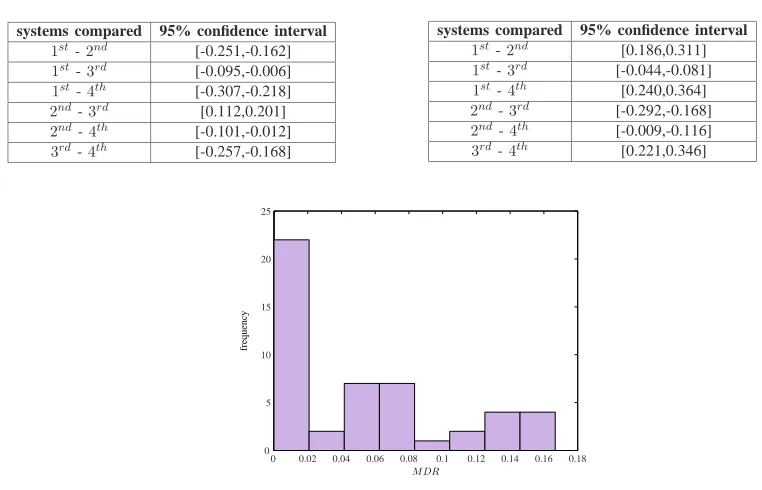
aforementioned figures of merit can be seen in Tables VII - X, respectively. If the confidence interval
includes zero, the difference is not significant. It is clear from Tables VII - X that zero is not included in
any interval. Thus, for any pairwise system comparison and any figure of merit from P CR, RCL, F1,
andM DR the difference is significant.
Accordingly, there is statistical evidence that both speaker utterance modeling and feature selection
improve performance significantly either individually or combined forP RC, RCL,F1 andM DR. This
is not the case forF AR.
2) MDR histogram of the conTIMIT test dataset: We focus on the results of the proposed system for
the conTIMIT test dataset depicted in Table V. TheM DRhistogram is plotted in Figure 3. A clear peak
exists near to 0, which is the ideal case. The latter is a direct outcome of the fact that two-hypothesis
TABLE IX
95%CONFIDENCE INTERVALS FOR ALL PAIRWISE
COMPARISONS OF THE4SYSTEMS FORF1.
systems compared 95% confidence interval
1st-2nd [-0.251,-0.162] 1st-3rd [-0.095,-0.006] 1st-4th [-0.307,-0.218] 2nd-3rd [0.112,0.201] 2nd-4th [-0.101,-0.012] 3rd-4th [-0.257,-0.168]
TABLE X
95%CONFIDENCE INTERVALS FOR ALL PAIRWISE
COMPARISONS OF THE4SYSTEMS FORM DR.
systems compared 95% confidence interval
1st-2nd [0.186,0.311] 1st-3rd [-0.044,-0.081] 1st-4th [0.240,0.364] 2nd-3rd [-0.292,-0.168] 2nd-4th [-0.009,-0.116] 3rd-4th [0.221,0.346]
M DR
fr
eq
u
en
cy
0 0.02 0.04 0.06 0.08 0.1 0.12 0.14 0.16 0.18 0
5 10 15 20 25
Fig. 3. The histogram ofM DRin the conTIMIT test dataset.
3) Correlation among figures of merit on the conTIMIT test dataset: The correlation coefficient
between the figures of merit for the conTIMIT test dataset can be seen in Table XI. The correlation
coefficient between RCL andM DR is -1, as a consequence of (15). The pairs: (i) (P RC, RCL) and
(P RC, M DR) (ii) (F1, RCL) and (F1, M DR) (iii) (F AR, RCL) and (F AR, M DR) have opposite
signs. That is, when the first quantity increases, the second decreases and vice versa. The degree of linear
dependence is indicated by the absolute value of the correlation index. It is seen that (P RC,F1) and
(P RC,F AR) exhibit the strongest correlation.
TABLE XI
THE CORRELATION COEFFICIENT BETWEEN THE PAIRS OF FIGURES OF MERIT FOR THE CONTIMITTEST DATASET.
P RC RCL F1 F AR M DR
P RC 1 -0.344 0.939 -0.945 0.344
RCL 1 -0.014 0.628 -1
F1 1 -0.778 0.014
F AR 1 -0.628
[image:20.612.99.480.109.354.2]4) Performance evaluation on the HUB-4 1997 English Broadcast News Speech dataset: Aiming
to verify the efficiency of the proposed contributions, i.e. modeling the speaker utterance duration and
feature selection on real data, RT-03 MDE Training Data Speech is utilized [44]. To facilitate performance
comparisons between the proposed system and other systems, we confine ourselves to broadcast news
audio recordings, that is the HUB-4 1997 English Broadcast News Speech dataset [41]. The recordings
are mono-channel, the sampling frequency is 16 KHz, and the audio PCM samples are quantized in 16
bits. The selected audio recordings have a duration of approximately 1 hour.
20% of the selected audio recordings are used for estimating the speaker utterance duration distribution.
For the third time, IG distribution is verified to be the best fit for modeling speaker utterance duration
by both the log-likelihood and the Kolmogorov-Smirnov criteria. In this case, the mean duration equals
23.541 s and the standard deviation equals 24.210 s. Since the standard deviation value is considerably
large,r is set equal to one eighth of the mean speaker utterance duration. This rather small submultiple
aims to reduce the probability of missing a speaker change for the reasons explained in Section II-B.
To assess the robustness of the MFCCs shown in Table I, the same coefficients along with their
corresponding delta and delta-delta coefficients have been used in the HUB-4 1997 English Broadcast
News Speech dataset. The proposed algorithm is tested on the remaining 80% of the selected audio
recordings. For the HUB-4 1997 English Broadcast News Speech dataset, since the dialogues are real,
the tolerance should be greater, as is explained in [12]. Motivated by [23], that also employs broadcasts,
the tolerance is equal to 2 s. The achieved figures of merit are:P RC = 0.634,RCL= 0.922,F1= 0.738,
F AR= 0.309, andM DR= 0.078.
5) Performance discussion: Before discussing the performance of the proposed system with respect to
other systems, let us argue why it is generally a good choice to minimize M D even ifF Ais high [12].
F A can be more easily removed [13], [15], [16], [40], for example through clustering.P RC andF AR
are associated withF A, whileRCLand M DR depend on M D. This means that P RC andF AR are
less cumbersome to remedy than RCLand M DR.
The proposed system is evaluated on the conTIMIT test dataset first. It outperforms three other systems
tested on a similar dataset, created by concatenating speakers from the TIMIT database, as described
in [21]. Although the dataset in [21] is substantially smaller than the conTIMIT test dataset, the nature
by the previous approaches is summarized in Table XII. Missing entries are due to the fact that not all
researchers use the same set of figures of merit, which creates further implications in direct comparisons.
P RC andF ARof the proposed system on the conTIMIT test dataset are slightly deteriorated than those
obtained by the multiple pass system with a fusion scheme when speakers are modeled by quasi-GMMs
system. However, RCL and M DR are substantially improved. RCL and M DR are also improved
with respect to the two remaining systems. Finally, the superiority of the proposed system against the
three systems developed in [21] is demonstrated by the fact that its F1 value is relatively improved
by 7.917%, 6.438%, and 28.007%, respectively. In [12], the used dataset was created by concatenating
TABLE XII
AVERAGE FIGURES OF MERIT IN[12]AND[21]ON A SIMILAR DATASET CREATED BY CONCATENATING SPEAKERS FROM
THETIMITDATABASE.
system Database used P RC RCL F1 F AR M DR
Proposed system concatenated utterances from speakers of the TIMIT database (not the same concatenation as in [12])
0.670 0.949 0.777 0.289 0.051
Multiple pass system with a fusion scheme [21]
concatenated utterances from speakers of the TIMIT database
0.780 0.700 0.720 0.218 0.305
Speakers modeled by quasi-GMMs system [21]
concatenated utterances from speakers of the TIMIT database
0.680 0.800 0.730 0.280 0.200
Auxiliary second-order andT2Hotelling statistic system [21]
concatenated utterances from speakers of the TIMIT database
0.490 0.812 0.607 0.455 0.188
Delacourt and Wellekens [12]
concatenated utterances from speakers of the TIMIT database
0.282 0.156
speaker utterances from the TIMIT database, too. However, this concatenation is not the same to the one
employed here. AlthoughF AR is slightly better that ours, the reported M DR for the proposed system
is considerably lower. The relative M DR improvement equals 67.308%.
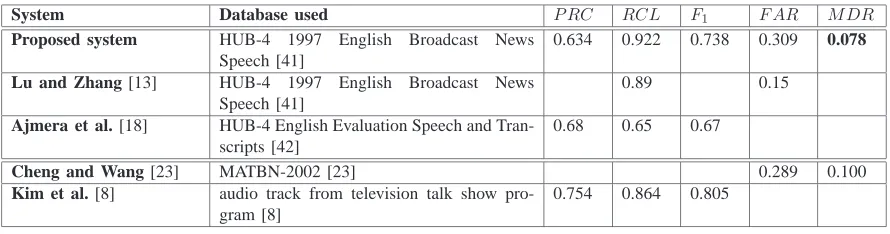
The proposed system is also assessed on the HUB-4 1997 English Broadcast News Speech dataset.
As is demonstrated in Table XIII, the same dataset is utilized in [13]. The system presented in [13] is a
two-step system. The first step is a ”coarse to refine” step, whereas the second step is a refinement one
that aims at reducing F AR. Both our algorithm and the one in [13] apply incremental speaker model
updating to deal with the problem of insufficient data in estimating the speaker model. However, the
updating strategy is not the same. In [13], quasi-GMMs are utilized. Both algorithms considerF As less
background noise level detection algorithm is applied. This is not required here. Another interesting point
is that the tolerance in our approach is 2 s, whereas in [13] the tolerance is 3 s. ImprovedF AR in [13]
may be partially attributed to the increased tolerance. In summary, the proposed system, when compared
to that in [13], yields a relatively improvedRCLby 3.600% at the expense of doublingF AR. The latter
is more easily manageable than RCL.
A dataset of the same nature with the HUB-4 1997 English Broadcast News Speech is employed in
[18]. The greatest P RC relative improvement of the system proposed in [18] when compared to the
[image:23.612.84.529.303.420.2]proposed system is 7.256%. The corresponding relativeRCL deterioration is29.501%.
TABLE XIII
THE EFFICIENCY AND THE DATASET USED BY THE PROPOSED SYSTEM AND OTHER BENCHMARK SYSTEMS.
System Database used P RC RCL F1 F AR M DR
Proposed system HUB-4 1997 English Broadcast News Speech [41]
0.634 0.922 0.738 0.309 0.078
Lu and Zhang [13] HUB-4 1997 English Broadcast News Speech [41]
0.89 0.15
Ajmera et al. [18] HUB-4 English Evaluation Speech and Tran-scripts [42]
0.68 0.65 0.67
Cheng and Wang [23] MATBN-2002 [23] 0.289 0.100
Kim et al. [8] audio track from television talk show pro-gram [8]
0.754 0.864 0.805
It should be noted that the efficiency of a speaker segmentation algorithm depends highly on the nature
of the data it is designed for. There are experimental results available for different datasets, such as the
MATBN-2002 database. However, a direct comparison is not feasible. For the remaining of the section,
a rough discussion between systems tested on different datasets is attempted.
Concerning the performance of the proposed system on 2 different datasets, namely the conTIMIT
dataset and the subset of the HUB-4 1997 English Broadcast News Speech dataset, all five figures
of merit are slightly deteriorated for the HUB-4 1997 English Broadcast News Speech dataset, when
compared to those measured on the conTIMIT. This is expected, due to the nature of the conTIMIT.
Metric-SEQDAC is another approach introduced by Cheng and Wang [23]. The dataset employed is
the MATBN-2002 Mandarin Chinese broadcast news corpus. A ROC-diagram is provided in [23] to
demonstrate the efficiency of metric-SEQDAC algorithm. From the diagram it can be deducted that for
M DR is roughly equal to 0.100. Once again, a great relative M DR improvement equal to 28.205% is
achieved at the expense of a 6.472% relativeF AR deterioration.
Kim et al. [8] presented a hybrid speaker-based segmentation, which combines metric-based and
model-based techniques. Audio track from a television talk show program is used to evaluate the performance.
Comparing the proposed system to the one in [8], P RC is relatively deteriorated by 15.915%, while
RCLis relatively improved by 6.713%.
To sum up, the proposed system demonstrates a very low M DRcompared to state-of-the-art systems.
VI. CONCLUSIONS
A novel efficient and robust approach for automatic BIC-based speaker segmentation is proposed.
Computational efficiency is achieved through the speaker utterance modeling and the transformed BIC
for-mulation, whereas robustness is attained by feature selection and application of BIC tests at appropriately
selected time stamps. The first contribution of the paper is in modeling the duration of speaker utterances.
As a result, computational needs are reduced in terms of time and memory. The IG distribution is found
to be the best fit for the empirical distribution of speaker utterance duration. The second contribution
of the paper is in MFCC selection. The third contribution is in the new theoretical formulation of BIC
after centering and simultaneous diagonalization, whose computational complexity is less than that of the
standard BIC, when covariance matrix estimators other than the sample dispersion matrices are used.
In order to attest that speaker utterance duration modeling and feature selection yield more robust
systems, 4 systems are tested on the conTIMIT test dataset: the first utilizes the standard BIC approach,
the second applies speaker utterance duration estimation, the third employs feature selection, and the fourth
is the proposed system that combines all proposals made in this paper. One-way ANOVA and a posteriori
Tukey’s method confirm that the 4 systems, when compared pairwise, are significantly different from one
another for P RC, RCL, F1, and M DR. Accordingly, the proposed contributions either individually
or in combination improve performance. Moreover, to overcome the restrictions posed by the artificial
dialogues in the conTIMIT dataset, first experimental results on the HUB-4 1997 English Broadcast News
ACKNOWLEDGEMENT
M. Kotti was supported by the “Propondis” Public Welfare Foundation and E. Benetos by the
“Alexan-der S. Onassis” Public Benefit Foundation through scholarships.
APPENDIXI
A detailed proof of the new formulation of BIC follows. Assuming that the chunks X, Y, and Z are
modeled by Gaussian density functions, we define
A,−NX( d
2ln(2π) + 1
2ln|ΣZ|)− 1 2
NX X
i=1
(zi−µZ)TΣZ−1(zi−µZ)
+NX(d
2ln(2π) + 1
2ln|ΣX|) + 1 2
NX X
i=1
(zi−µX)TΣX−1(zi−µX),
(16)
B ,−NY( d
2ln(2π) + 1
2ln|ΣZ|)− 1 2
NZ X
i=NX+1
(zi−µZ)TΣZ−1(zi−µZ)
+NY( d
2ln(2π) + 1
2ln|ΣY|) + 1 2
NZ X
i=NX+1
(zi−µY)TΣY−1(zi−µY).
(17)
Under these assumptions, (5) equals to
δ=A+B− λ
2
d+d(d+ 1) 2
lnNZ≷0. (18)
If ΣX, ΣY, and ΣZ are estimated by sample dispersion matrices, it is true that
NX X
i=1
(zi−µZ)TΣ−Z1(zi−µZ) = tr{Σ−Z1 NX X
i=1
(zi−µZ)(zi−µZ)T}, (19)
NX X
i=1
(zi−µX)TΣ−X1(zi−µX) = tr{Σ−X1 NX X
i=1
(zi−µX)(zi−µX)T}=dNX. (20)
So, (16) can be written as: A = −NX(d2ln(2π) + 12ln|ΣZ|)− 1 2tr{Σ
−1
Z PNX
i=1(zi−µZ)(zi−µZ)T}
+NX(d2ln(2π) +12ln|ΣX|) +d2NX. Applying the same estimation for B allows us to rewrite (18) as
−NZ
2 ln|ΣZ|+ NX
2 ln|ΣX|+ NY
2 ln|ΣY| − λ 2
d+d(d+ 1) 2
lnNZ≷0, (21)
If we apply simultaneous diagonalization toΣX andΣZ, thenΣZ =ΦΛZΦT, whereΛZ andΦare
the diagonal matrix of eigenvalues and modal matrix ofΣZ, respectively. Moreover, letK=ΛZ−12 ΦTΣX
ΦΛZ−12.ΛK is the diagonal matrix of eigenvalues of Kand Ψis the corresponding modal matrix, i.e.
ΛK =ΨTKΨ. W is defined as W , ΦΛZ−12Ψ. It is straightforward to prove that WTΣZW = I
and WTΣXW = ΛK. The same procedure for simultaneous diagonalization of ΣY and ΣZ takes
place. Let H = ΛZ−12ΦTΣYΦΛZ− 1
2. Additionally, ΛH is the diagonal matrix of eigenvalues of H
and Ξ is the corresponding modal matrix i.e. ΛH = ΞTHΞ. If Ω is defined as Ω, ΦΛZ−12Ξ, it is
straightforward to prove thatΩTΣZΩ=IandΩTΣYΩ=ΛH. The transformed (21) is NX 2 ln
|WΛKW T
| |WWT|
+NY2 ln|ΩΛHΩT|
|ΩΩT
|
-λ
2
d+d(d2+1)
lnNZ ≷0 or equivalently,
NX 2
d X
i=1
lnλi(ΛK) +NY
2 d X
i=1
lnλi(ΛH)−λ
2
d+d(d+ 1) 2
lnNZ≷0, (22)
where λi(ΛK) stands for the ith eigenvalue of ΛK andλi(ΛH) stands for theith eigenvalue of ΛH.
However, sample dispersion matrices are not the only estimators for ΣX, ΣY, and ΣZ. Besides
the sample dispersion matrix, there exist other estimators of the covariance matrix, such as the robust
estimators [25], [26] or the regularized MLEs [27]. For that reason, in the remaining of Appendix I, (19)
and (20) are not required. Accordingly, the transformation holds for any covariance matrix estimators.
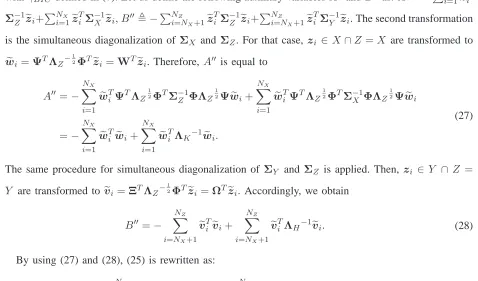
In the general case, the first transformation that takes place is centering for zi ∈ X∩Z =X
e
zi=zi−µZ, µ′X = NX1 PNX
i=1zi−µZ = NX1 PNX
i=1zei, (23)
the centeredAis re-written asA′= -NX2 ln|ΣZ|
|ΣX|
-1 2
PNX i=1ez
T
i Σ−Z1zei+12
PNX i=1ze
T
i Σ−X1ezi− NX
2 µ′
T
XΣ−X1µ′X.
B is transformed toB′ by an exactly similar procedure. Forzi ∈ Y ∩Z =Y, it holds
e
zi =zi−µZ, µ′Y = NY1 PNZ
i=NX+1zi−µZ= 1
NY PNZ
i=NX+1zei. (24)
By doing so (6) can be written as:
−
NX X
i=1
e
zTi Σ−1
Z ezi+ NX X
i=1
e
zTi Σ−1
X ezi− NZ X
i=NX+1
e
zTiΣ−1
Z ezi+ NZ X
i=NX+1
e
zTiΣ−1
Y ezi≷γ′ (25)
where
γ′ =γBIC+NXµ′T
XΣ−X1µ′X +NYµ′ T
withγBIC defined in (7). Let us define the following auxiliary variablesA′′ andB′′as: A′′,-PNXi=1ze
T i
Σ−1
Z ezi+ PNX
i=1zeTi Σ−X1zei, B′′,− PNZ
i=NX+1ez T
i Σ−Z1ezi+ PNZ
i=NX+1ze T
i Σ−Y1ezi.The second transformation
is the simultaneous diagonalization of ΣX and ΣZ. For that case, zi ∈X∩Z =X are transformed to
e
wi =ΨTΛZ−
1
2ΦTezi =WTezi. Therefore,A′′ is equal to
A′′=−
NX X
i=1
e
wTiΨTΛZ12ΦTΣ−1
Z ΦΛZ
1
2Ψwei+
NX X
i=1
e
wTi ΨTΛZ12ΦTΣ−1
X ΦΛZ
1 2Ψwei
=−
NX X
i=1
e
wTiwei+ NX X
i=1
e
wTi ΛK−1wei.
(27)
The same procedure for simultaneous diagonalization of ΣY and ΣZ is applied. Then, zi ∈ Y ∩ Z =
Y are transformed tovei =ΞTΛZ−
1
2ΦTezi=ΩTezi.Accordingly, we obtain
B′′=−
NZ X
i=NX+1
e
vTi evi+ NZ X
i=NX+1
e
vTi ΛH−1evi. (28)
By using (27) and (28), (25) is rewritten as:
NX X
i=1
e
wTi (ΛK−1−I)wei+
NZ X
i=NX+1
e
vTi (ΛH−1−I)vei ≷γ′ (29)
whose left side is a weighted sum of squares.
APPENDIXII
The computational cost of the left part of standard BIC, as appears in (6), is calculated here
approx-imately. By flop we denote a single floating point operation, i.e. a floating point addition or a floating
point multiplication [45]. This is a crude method for estimating the computational cost. Robust statistics
[25], [26] are assumed for the computation of ΣX, ΣY, ΣZ. The standard BIC left part computational
cost is detailed in Table XIV.
[image:27.612.67.545.85.366.2]Adding all the above computational costs plus 2 flops for the additions among the terms (13)-(15) of
Table XIV, the final cost is
3d3+ 6NZd2+ (8NZ+ 3)d+ 2. (30)
For the left part of the transformed BIC, the calculation is summarized in Table XV. It includes the
cost for all the transformations, as described in Appendix I, and for the computation of the left part of
TABLE XIV
STANDARDBICLEFT PART COMPUTATIONAL
COST.
Term Index Evaluated Term Computational Cost
1 ΣX NXd2
2 ΣY NYd2
3 ΣZ NZd2
4 µZ NZd+d
5 µX NXd+d
6 µY NYd+d
7 zi−µZ,i= 1, . . . , NZ NZd
8 zi−µX,i= 1, . . . , NX NXd
9 zi−µY,i= 1, . . . , NY NYd
10 ΣZ−1 d3
11 ΣX−1 d3
12 ΣY−1 d3
13 PNZ
i=1(ezi−µZ)TΣZ−1(ezi−µZ) NZ(2d2+ 2d)
14 PNX
i=1(ezi−µX)TΣX−1(ezi−µX) NX(2d2+ 2d)
15 PNZ
i=NX+1(ezi−µY) TΣY−1(ez
i−µY) NY(2d2+ 2d)
TABLE XV
TRANSFORMEDBICLEFT PART
COMPUTATIONAL COST.
Term Index Evaluated Term Computational Cost
1 ΣX NXd2
2 ΣY NYd2
3 ΣZ NZd2
4 µZ NZd+d
5 zi−µZ, forX∩Zin (23) NXd
6 µ′
Xin (23) NXd+d
7 zi−µZ, forY∩Zin (24) NYd
8 µ′
Y in (24) NYd+d
9 W 14d3[45]
10 Ω 14d3[45]
11 wei=WTezi, forwei∈X 2NXd2
12 vei=ΩTezi, forvei∈Y 2NYd2
13 Λ−1
K d
14 Λ−1
H d
15 PNX
i=1weTi(ΛK−1−I)ewi 4NXd
16 PNZ
i=NX+1vei(
ΛH−1−I)evi 4NYd
of W that simultaneously diagonalizes ΣZ, and ΣX, such that WTΣZW =I and WTΣXW = ΛK
is included [45, pp. 463-464]. This is also true for matrix Ω that simultaneously diagonalizesΣZ, and
ΣY. The total cost of the transformations and the left part of the transformed BIC equals the sum of
the terms that appear in Table XV plus 1 for the addition between the terms (15) and (16). This cost is
28d3+ 4NZd2+ (7NZ + 5)d+ 1. Moreover, as can be seen in (26), there is an additional differential
cost with respect to BIC for the right part of the transformed BIC. This cost is analyzed in Table XVI.
The total differential cost for the right part of the transformed BIC, is the sum of the terms (1)-(4) that
TABLE XVI
DIFFERENTIAL COMPUTATIONAL COST FOR THE RIGHT PART OF THE TRANSFORMEDBIC.
Term Index Evaluated Term Computational Cost
1 Σ−X1 d3
2 Σ−1
Y d3
3 µ′T
XΣ−X1µ′X 2d2+ 2d
4 µ′T
YΣ−Y1µ′Y 2d2+ 2d
appear in Table XVI, plus 2 multiplications and 2 additions, i.e. 2d3+ 4d2+ 4d+ 4. Accordingly, the
total computational cost for the transformed BIC, excluding the cost of γBIC is
30d3+ (4NZ+ 4)d2+ (7NZ+ 9)d+ 5. (31)
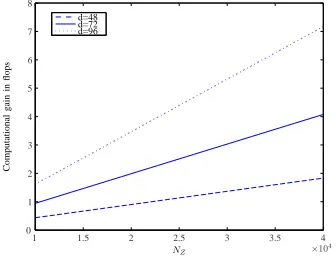
Since NZ ≫d, it is obvious that NZ bears the main computational cost. In particular, typical values
significantly reduced computational cost. The computational gain in flops is defined as the subtraction of
the standard BIC computational cost minus the transformed BIC computational cost. The aforementioned
computational gain, with respect to various NZ and d values, can be seen in Figure 4. The total
NZ
C
o
m
p
u
ta
ti
o
n
al
g
ai
n
in
flo
p
s
d=48 d=72 d=96
1 1.5 2 2.5 3 3.5 4
×104 0
[image:29.612.215.383.158.288.2]1 2 3 4 5 6 7 8
Fig. 4. The computational gain in flops for severalNZ anddvalues.
computational cost gain if the speaker utterance duration estimation is used in conjunction with the
transformed BIC rather than the standard BIC with no speaker utterance duration estimation, equals
1−ur30d33d+(43+6NZNZd+4)2+(8d2+(7NZNZ+3)+9)d+2d+5%.
REFERENCES
[1] H. G. Kim and T. Sikora “Comparison of MPEG-7 audio spectrum projection features and MFCC applied to speaker
recognition, sound classification and audio segmentation”, in Proc. 2004 IEEE Int. Conf. Acoustics, Speech, and Signal
Processing, vol. 5, pp. 925-928, Montreal, Canada, May 2004.
[2] The Segmentation Task: Find the Story Boundaries, http://www.nist.gov/speech/tests/tdt/tdt99/presentations/NIST
segmentation/index.htm
[3] NIST Rich Transcription Evaluation, http://www.nist.gov/speech/tests/rt/
[4] T. Wu, L. Lu, K. Chen, and H. Zhang, “UBM-based real-time speaker segmentation for broadcasting news”, in Proc. 2003
IEEE Int. Conf. Acoustics, Speech, and Signal Processing, vol. 2, pp. 193-196, Hong Kong, April, 2003.
[5] S. Know and S. Narayanan, “Unsupervised speaker indexing using generic models”, IEEE Trans. Audio, Speech, and
Language Processing, vol. 13, no. 5, pp. 1004-1013, September 2005.
[6] M. Collet, D. Charlet, and F. Bimbot, “A correlation metric for speaker tracking using anchor models”, in Proc. 2005 IEEE
Int. Conf. Acoustics, Speech, and Signal Processing, vol. 1, pp. 713-716, Philadelphia, USA, March 2005.
[7] A. Tritschler and R. Gopinath, “Improved speaker segmentation and segments clustering using the Bayesian information
criterion”, in Proc. 6th European Conf. Speech Communication and Techology, pp. 679-682, Budapest, Hungary, September