Development of an advanced on-line position-specific
stable carbon isotope system and application to methyl
tert
-butyl ether
Caroline Gauchotte
1,4*, Gwen O’Sullivan
2, Simon Davis
3and Robert M. Kalin
1 1Department of Civil Engineering, University of Strathclyde, John Anderson Building, Glasgow G4 0NG, UK 2
Trium Environmental Solutions Inc., Cochrane, Alberta, T4C 0A4, Canada 3
Compact Science Systems, Lymedale Business Centre, Newcastle-under-Lyme ST5 9FQ, UK 4
School of Planning, Architecture and Civil Engineering, Queen’s University Belfast, David Keir Building, Belfast BT9 5AG, UK
Received 14 May 2009; Revised 21 July 2009; Accepted 22 July 2009
We present an advanced system for on-line position-specific carbon isotope analysis. The main limitation of on-line intramolecular isotope ratio measurements has been that optimal pyrolytic fragments are obtained mostly at temperatures where the analyte has not completely reacted. As a result of undetermined isotopic fractionation, the isotopic signatures of the pyrolysis products are not strictly equal to these of the equivalent moieties in the parent molecule. We designed a pyrolytic unit in which both temperature and reaction time are variable parameters, enabling determination of the enrichment factor of the pyrolysis at optimal temperature by construction of a Rayleigh plot. In the case of methyl tert-butyl ether (MTBE) presented here, a ‘pre-pyrolysis’ fractionation of MTBE leading to a depletion of 0.9%was discovered and the enrichment factor of the optimal pyrolysis reaction was determined at1.7%. Absoluted13C values of two functional groups of MTBE – the methoxy group and the 2-methylpropane group – could be determined with 95% confidence intervals of 0.4%and 0.5%, respectively. Copyright#2009 John Wiley & Sons, Ltd.
The introduction of continuous flow isotope ratio mass spec-trometry (CF-IRMS) during the last decade has enabled the development of a new technique, which couples gas chroma-tography and isotope ratio mass spectrometry (GC-c-IRMS)1–5 for on-line measurements of intermolecular isotopic variations at very low levels (nanomolar quantities). Compound-specific stable isotope analysis (CSIA) has become a routine technique in many areas including geochemistry,6 pharmacology,7 medicine8and forensic science.9
In Environmental Forensics, CSIA is fast becoming a major tool for the investigation of the origin and fate of environmental pollutants.10,11Because isotopic fractionation occurs during most (bio)chemical and physical processes, the stable isotopic signatures of an organic contaminant contain information about its history from synthesis to degradation. Synthesis pathway (natural and anthropogenic) conditions have been found to have a significant influence on the iso-topic composition.12–14Studies of the environmental fate of contaminants have demonstrated that while non-degradative processes, such as volatilisation14–19and sorption,20,21have no significant effect on stable isotopic signatures, some microbial degradations may generate substantial isotopic fractionation. CSIA has, therefore, successfully been used for source allocation but it has also emerged as a method of
choice for the detection, monitoring and quantification of environmental biodegradation22–36 independently of mass losses due to weathering processes. Methods using the carbon and hydrogen CSIA data of contaminants have also been developed for the investigation of biodegradation pathways.37–42The combination of the carbon and hydrogen Rayleigh enrichment factors of biodegradations enables distinction between degradation mechanisms.38–40 An alternative and potentially more powerful approach to the elucidation or the differentiation of degradation pathways is via the measurements ofintramolecular isotopic variations. Position-Specific Isotope Analysis (PSIA) determines the isotope ratios of different moieties in a molecule. PSIA can be carried out using either nuclear magnetic resonance (NMR) or IRMS techniques. NMR has been used for PSIA to estimate both deuterium and carbon 13 isotope shifts. Accurate measurements require very large sample sizes, which are often incompatible with environmental samples, particularly for carbon stable isotopes. Carbon PSIA using CF-IRMS works by breaking down a molecule into relevant fragments, giving access to the isotope signatures of various moieties in the molecule. Historically, PSIA was carried out by chemolysis, using carefully selected chemical reactions.43– 45
Off-line chemolysis presents disadvantages for field samples, such as possible uncontrolled isotopic fractiona-tions due to the multiplication of sample preparation stages. Moreover, as for NMR, it requires sample sizes larger than those routinely available.
Rapid Commun. Mass Spectrom.2009;23: 3183–3193
Published online in Wiley InterScience (www.interscience.wiley.com) DOI: 10.1002/rcm.4222
*Correspondence to: C. Gauchotte, Department of Civil Engineer-ing, University of Strathclyde, John Anderson BuildEngineer-ing, Glas-gow G4 0NG, UK.
A system coupling on-line pyrolysis and classic GC-c-IRMS (py-GC-c-GC-c-IRMS) for intramolecular isotope analysis was first designed in 1997 by Corso and Brenna for applications in biology and biomedicine.46With this initial design, molecular cracking occurs by non-catalysed pyrol-ysis and as such the system is flexible and readily adaptable for a wide variety of volatile and semi-volatile compounds compatible with gas chromatography. The range of its applications has so far included alkanes,47toluene,47 fatty acid methyl esters,48lactic acid,49and four amino acids.50,51 Low molecular weight organic acids have also been inves-tigated through similar systems for applications in environ-mental52 and geoscience.53 In most cases, the pyrolysis reaction is not quantitative.
Because isotopic fractionation may occur during non-quantitative reactions, the isotopic signatures of the pyrolysis products may not be equal to the isotopic signatures of the equivalent moieties in the parent molecule. Previous PSIA studies did not determine absolute intramolecular isotope ratios and the values were reported only as relative isotope ratios by comparison with chemically identical standards.49–51
The lack of absoluteintramolecular isotope ratios limits the application of PSIA for Environmental Forensics because there is no means for interlaboratory comparisons of results. Brenna and co-workers49proposed a theoretical method to calculate intramolecular fractionation to overcome this problem. We report here, for the first time, the development of an on-line PSIA system equipped with an improved pyrolysis furnace that allows for adjustable temperatures and residence times to facilitate experimental evaluation and calculation of the pyrolysis isotopic fractionation.
This new method has been applied to methyl tert-butyl ether (MTBE), a synthetic compound which is globally added to gasoline to improve fuel performance and combustion efficiency. The increased production and use of MTBE have led to its detection in the environment; it has become a contaminant of concern due to its highly soluble nature and poor adsorption to soil. Understanding the origin and fate of MTBE is a topical issue in Environmental Forensics. Stable isotope analysis of MTBE has been applied to establish the occurrence of different biodegrada-tion pathways of MTBE in the environment and the calculation of kinetic isotope rates has led to hypotheses on their mechanisms.25,26,32,33,35,36,39 Two sites of attack have been hypothesised for the first stage of MTBE biodegradation depending on the microbial conditions: the central carbon atom of the 2-methylpropane group and the carbon atom of the methoxy group. Using off-line quantitative nucleophilic substitution, the hetero-geneous carbon isotopic distribution between the two groups was recently reported.39,41The methoxy group was found to be highly depleted (around35%) relative to the tert-butyl group (25%). MTBE samples originating from different manufacturers but with the same overall d13C showed distinguishable d13C values for these two functional groups.41
MTBE is mainly produced by the reaction of methanol with isobutylene over a catalyst bed. The carbon atoms of the 2-methylpropane side of MTBE originate from the
isobutylene while methanol is the carbon source for the methoxy group. Methanol is a commercially available compound that is produced either from natural gas, coal, the distillation of wood or the degradation of biomass. Isobutylene can be sourced from the mixed C4 streams, known as raffinate-1, generated as by-products in either steam cracking or fluid catalytic cracking of petroleum but also from the dehydrogenation of isobutane (2-methylpropane) or from the dehydration of tert-butyl alcohol.56 The various potential origins of the raw materials mean that their carbon isotopic values may vary greatly.
The stable isotopic values of the different carbon atoms are also determined by the isotopic fractionation occurring during the production process; this fractionation will affect most the site of reaction, i.e. the central carbon atom of isobutylene. Parameters of the production process such as the catalysts used, reaction phases, pressures and tempera-tures vary from one production plant to another and may also vary from one batch to the next, rendering unique the associated isotopic fractionation. Position-specific isotope analysis has therefore the potential to link MTBE samples to the raw materials used for their production and their synthesis, and also to identify the sites of microbial attack.
We report here a method for the on-line PSIA of MTBE with direct quantification of the isotope effect to test the applicability of our hybrid, GC-pyrolysis (Py)-GC-time-of-flight mass spectrometry (TOFMS)/c-IRMS system for routine PSIA in Environmental Forensics. Accurate quanti-fication of the pyrolysis isotopic fractionation was achieved by (i) assessment of isotopic fractionation internal to the system and not related to the pyrolysis, (ii) investigation of the pyrolysis temperature for optimal fragmentation, and (iii) calculation of the fractionation factor of the pyrolysis using the Rayleigh equation.
EXPERIMENTAL
Chemicals
MTBE (99.8% HPLC grade; Sigma Aldrich, St. Louis, MO, USA) and benzene (99.7% analytical grade; BDH, Poole, UK) were used without further purification.
Preparation of the standard solutions
Because benzene does not readily pyrolyse below 8008C, it was chosen as an internal standard. We prepared a MTBE/ benzene (3:1, v/v) solution for the experiments.
For the calibration curve of MTBE vs. benzene for the IRMS studies, six solutions with a range of volumetric ratios between 3:1 and 1:4 were prepared.
Design of the GC-Py-GC-TOFMS/c-IRMS
system
A schematic diagram of the GC-Py-GC-TOFMS/c-IRMS instrumentation is shown in Fig. 1. A description of the function and operation of the individual components of the system is given below.
Initial GC system
An initial gas chromatograph was used for the vaporisation and purification of MTBE. This unit was a CE 8000 Top equipped with a split/splitless injector (Thermoquest, Milan, Italy). For the analysis of MTBE, it was fitted with a 30 m forte BPX-vol capillary column (SGE, Ringwood, Victoria, Australia). The inlet pressure of the carrier gas helium was kept constant at 150 kPa while the temperature was maintained isothermal at 608C. This ensured a constant flow rate. The injector was operated at 2508C in split mode with a 75:1 split ratio and a constant injection volume of 0.4mL. The eluent of the initial gas chromatograph column passed to the pyrolysis unit.
Pyrolysis unit
In the pyrolysis unit described below the compound of interest was thermolysed without a catalyst in the gaseous phase.
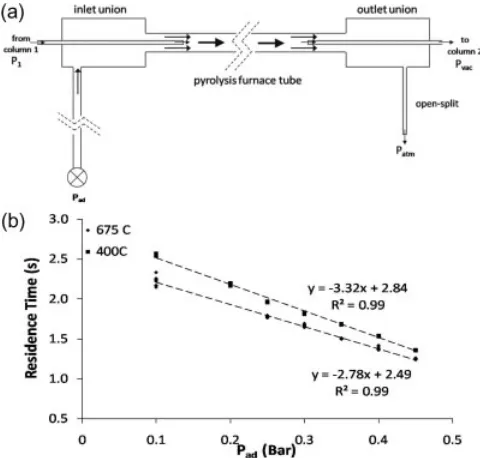
The pyrolysis reactor was constructed of a quartz tube embedded in a temperature-controlled furnace. Five centi-metres of the end of the capillary columns were threaded into the inlet of the quartz tube through a tee union. A secondary helium supply was connected to the third branch of the tee union (detailed in Fig. 2).
In previously reported on-line PSIA systems, the pyrolysis of the target compounds was optimised for pyrolysis temperature alone. We designed a pyrolysis unit that enabled us to also vary the pyrolysis reaction time by adding a controlled pressure of helium to the flow at the inlet of the furnace. To avoid the risk of backflushing, we placed an open-split at the outlet of the furnace. The residence time
[image:3.595.107.516.49.228.2]of the sample in the furnace depends on the dimension of the furnace and on the flow rate, which is controlled by the pressures and temperatures in the system. The head-pressure of the first gas chromatograph was kept constant while the open-split vented to atmospheric pressure. The pressures in both mass spectrometers were within the molecular flow range (¼<1103mbar). All other Figure 1. Schematic diagram of the GC-Py-GC-TOFMS/c-IRMS system. MTBE is pyrolysed at the outlet
of the first gas chromatograph. It is cryo-focused with its pyrolysates before being injected into the second capillary column. A two-way valve directs the flow either to the time-of-flight mass spectrometer for structural analysis of the pyrolysates or to the isotope ratio mass spectrometer via the combustion furnace and a water trap (Nafion membrane) for carbon isotopic analysis.
Figure 2. (a) Detail of the pyrolysis furnace. The inlet pres-sure in the first column is kept constant atP1, the open-split
opens to atmospheric pressure (Patm), and the pressure in
both mass spectrometers is within the molecular flow range (¼<1103mbar) (P
vac). The pressure Pad of the added
[image:3.595.319.559.411.640.2]parameters (temperatures of the gas chromatograph ovens and dimensions of columns and capillaries) remained constant. The added helium pressure (Pad) thus controlled the residence time.
To calculate the residence times, we measured the flow rate at the open-split for various values ofPad(ranging from 0.1 to 0.4 bar). This was repeated with oven temperatures set at 400 and 6758C. Figure 2(b) is a plot of the residence times calculated from the measured flow rate using the Hagen-Poiseuille equation vs. the added helium pressure. The residence times were calculated using approximations for the dimensions of the fused-silica capillaries and capillary columns because the exact measurements were unknown. The residence time was found to be linearly related to the added helium pressure at both temperatures.
The flow rate at the open-split was not measured in further experiments. The linearity of the relationship of the added helium pressure against residence time was assumed, and the added helium pressure was utilised as a relative measurement of the residence time.
Cryo-focusing unit
The pyrolysis tube was connected to a custom-built cryo-focusing system which in turn was linked to the second gas chromatograph. The compound of interest and its pyroly-sates were trapped and focused by the cryo-focusing system prior to injection into the second gas chromatograph.
The cyro-focusing unit was composed of a continuous piece of 250mm i.d. capillary fed first through an 18 cm loop of nickel casing. This casing was layered with heating tape. Subsequently, the silica was passed through an 80 cm straight stainless steel tube sheathed in isolating tape. For the analysis of MTBE and its pyrolysates, the nickel loop was rapidly immersed into liquid nitrogen for a period of 11 min 30 s. This was carried out 6 min 30s before injection of the sample and for an additional 5 min after injection. Upon removal of the loop from the liquid nitrogen heat was applied via the heating tape to vaporise the trapped compounds.
Secondary GC system
In the second gas chromatograph, the products of the pyrolysis (pyrolysates) and the remaining reactant were separated.
The second chromatographic unit was a HP5890 (Hewlett Packard, Palo Alto, CA, USA). The injector was by-passed and the capillary from the pyrolysis unit was directly connected to the capillary column via a zero dead volume union. The inlet pressure was governed by the added helium pressure at the time of the vaporisation of the sample and its pyrolysates.
For the analysis of MTBE and its pyrolysates, the gas chromatograph was fitted with a 30 m Solgel-wax capillary column (SGE). The temperature was held at 558C until the sample had been vaporised and then it was ramped to 1858C at a rate of 158C/min. The added helium pressure was always set to 0.8 bar at the time of vaporisation of the sample, in order to keep constant the inlet pressure of the sample in the second gas chromatograph.
A two-position valve at the outlet of the column allowed the eluent to be directed to two different mass spectrometers: (1) a time-of-flight mass spectrometer for structural analysis of the pyrolysates or (2) through a combustion furnace and into an isotope ratio mass spectrometer.
An independent supply of helium was fitted to the fourth port of the valve to provide constant carrier gas supply to the mass spectrometer that was disconnected from the second gas chromatograph flow.
TOFMS analysis
Identification of the pyrolysates and study of the kinetics of the pyrolysis were conducted using a bespoke TOF mass spectrometer (IsoTOF, Mass Spec Solutions, Manchester, UK). The spectra of the pyrolysates were matched using the NIST library (NIST, Gaithersburg, MD, USA).
IRMS analysis
Carbon stable isotopic ratios were analysed using an IRMS instrument (Isoprime, Micromass, Manchester, UK) as the detector. For isotopic analysis, the pyrolysates were oxidised at 8508C in a combustion furnace packed with copper oxide (CuO) granules. The combustion products were then passed through a Nafion1membrane to remove water from the gas stream prior to entering the mass spectrometer.
Isotope ratios were calibrated against a CO2 reference purchased from Air Products (Allentown, PA, USA) with a known value relative to the international isotopic reference carbonate, NBS 18. The ratios are presented using the delta notation (Eqn. (1)):
d13CVPDB¼
RsampleRVPDB
RVPDB
103 (1)
where R¼[13C]/[12C] and VPDB refers to the international standard Vienna PeeDee Belemnite.
Design
Evaluation of fractionation effects associated with
components of the GC-Py-GC-TOFMS/c-IRMS system
It was necessary to first investigate whether the system presented mass discriminatory stages that might imply internal isotopic fractionation of the sample. The mass discriminatory processes of GC-C-IRMS and their effects have been identified and studied.54,55 The GC-Py-GC-TOFMS/c-IRMS system, however, presents additional stages not evaluated in previous work.The pyrolysis unit described previously presents an open-split. The split ratio created at the outlet of the furnace is flow rate dependent and is therefore a possible source of differential fractionation. Another possible source of isotopic fractionation is the distortion of the chromatographic peaks because of the increased length of the capillary. To reduce this effect, the bespoke cryo-focusing system was used to re-focus the MTBE and its pyrolysates after pyrolysis. This allowed a constant flow rate in the second GC column. Cryo-focusing is also potentially mass discriminatory. The system was tested for possible internal isotopic fractionation associated with the configuration of the system. The d13C of MTBE was analysed under the following three configurations, with a furnace temperature of 4008C which does not pyrolyse MTBE:
added helium pressure was kept constant throughout the run at 0.8 bar.
Configuration 2: Cryo-focusing and a constant added helium pressure. The sample was cryo-focused after pyrol-ysis and vaporised. The added helium pressure was kept constant throughout the run at 0.8 bar.
Configuration 3: Cryo-focusing with variable added helium pressure. The sample was cryo-focused after pyrol-ysis and vaporised. The added helium pressure was set at 0.3 bar during pyrolysis but increased to 0.8 bar during vaporisation.
Analyses were carried out five times for each configur-ation. The results of these experiments were statistically analysed using the Minitab 15 statistical package (Minitab Inc., State College, PA, USA).
Optimisation of the pyrolysis temperature
The kinetics of the pyrolysis reaction was studied for a range of temperatures between 500 and 7508C. Pyrolysis was carried out with different reaction times. Four added helium pressures between 0.1 and 0.4 bar were used to obtain a range of reaction times. Each analysis was carried out in triplicate with the TOFMS instrument as the analyser, and the uncertainty determined.
Investigation of the kinetic isotope effect associated
with pyrolysis
Once the optimal pyrolysis temperature had been estab-lished, the effect of pyrolysis on the isotopic signatures of MTBE and its pyrolysates was investigated. The added helium pressure was varied between 0.2 and 0.45 bar in 0.05 bar increments to change the reaction time of the pyrolysis, and the d13C values of MTBE and the pyrolysates were measured in the IRMS instrument. Each analysis was carried out in triplicate and the error calculated.
The IRMS results were quantified using benzene as an internal standard. The major ion response in the IRMS instrument is proportional to the number of moles of CO2 entering the ion source which in turn is related to the number of carbon atoms in the parent molecule and it may be normalised using Eqn. (2):
PAðX1Þ
x1nx1
¼PAðX2Þ x2nx2
(2)
where PA(X) is the peak area of the major ion,nxthe number of moles andxthe number of carbon atoms. A calibration
curve was constructed using benzene as an internal standard. Various molar ratios of MTBE and benzene were analysed in triplicate using the system in configuration 3.
RESULTS AND DISCUSSION
Evaluation of fractionation effects associated
with components of the GC-Py-GC-TOFMS/
c-IRMS system
To investigate the fractionation effect associated with the components of the system, thed13C values of MTBE and benzene under configurations 1, 2 and 3 of the systems were measured. They are presented in Table 1. The results were compared for the two compounds using Student’s unpaired two-tailed t-test analysis with a significant difference at p¼0.05. The results of the t-tests are shown in Table 2.
In all three configurations, there was no significant difference between the isotopic values of MTBE and benzene. The difference in split ratio in configurations 2 and 3 did not have a significant influence on the carbon isotopic values, nor did the introduction of cryo-focusing between configurations 1 and 2. The standard deviations of MTBE and benzene d13C values were poor in configuration 1 (1.5 and 0.8%, respectively) but decreased to generally acceptable values for continuous flow stable isotope analysis (0.3 and 0.2%. respectively), demonstrating that cryo-focusing improves the precision of the system.
Table 1 also presents the d13CVPDB values of MTBE calculated with benzene as an internal reference using Eqn. (3):57
d13CðMTBEÞVPDB¼d13CðbenzeneÞVPDBþd13CðMTBEÞbenzene þd13CðbenzeneÞVPDBd13CðMTBEÞbenzene
(3)
While the external CO2reference pulses compensate only for isotopic fractionation occurring in the IRMS instrument, benzene undergoes all the mass discriminative stages in the system. Results using benzene as a reference proved to be more precise and were adopted for this work.
Optimisation of the pyrolysis temperature
[image:5.595.54.561.664.755.2]The criteria for the selection of the pyrolysis conditions for on-line PSIA follow the notion of ‘isotopic fidelity’ intro-duced by Brenna and co-workers.49–51 Isotopic fidelity describes the degree of correlation between the isotope ratio
Table 1. d13C values of MTBE and benzene in configurations 1, 2 and 3 of the system. Added helium pressure 1 (P1) is the added
helium pressure during pyrolysis and added helium pressure 2 (P2) is the added helium pressure after vaporisation.d13C(MTBE)a
is the value calculated with the CO2reference gas pulses,d13C(MTBE)bis the value calculated with benzene as internal isotopic
standard following Eqn. (3) (n¼number of samples, SD: standard deviation)
Configurations
n d13C(MTBE) (%) SD (%) d13C(benzene)a(%) SD (%) d13C(MTBE)b(%) SD (%) Number Cryo-focusing
P1 P2
(bar)
1 No 0.8 0.8 6 26.9 1.5 25.8 0.8 27.1 0.3
2 Yes 0.8 0.8 6 27.6 0.3 25.8 0.2 27.3 0.1
of a fragment and that of a specific moiety in the original compound.49 An ideal fragment has a fidelity of 100%, meaning that it originates entirely from a unique position or moiety.
Preliminary work showed that MTBE pyrolysed at temperatures above 5008C and that, at temperatures above 7508C, MTBE had quantitatively reacted but showed
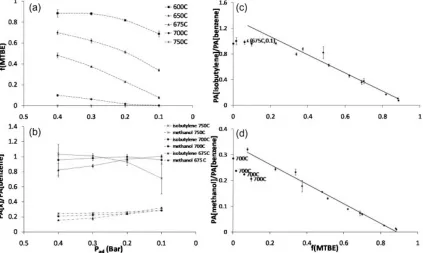
evidence of polymerisation. Secondary reactions of the pyrolysates and polymerisation affect the fidelity. Optimis-ation of the pyrolysis was therefore investigated between 600 and 7508C. The progress curves of MTBE at various temperatures are presented in Fig. 3(a). The remaining fraction of MTBE (f) was calculated using Eqn. (4):
f¼ C C0
¼
PA½MTBE
PA½benzene
PA½MTBE0
PA½benzene0
(4)
where PA[X] is the peak area of the compound X after pyrolysis and PA[X]0the peak area of the compound X when the pyrolysis furnace is set at 5008C. We used the peak areas of benzene to normalise the data to compensate for the variations of the split ratio of the pyrolysis furnace.
[image:6.595.35.276.138.314.2]MTBE broke down into methanol and isobutylene. Other pyrolysis products such as dimers or polymers could be detected but at negligible levels. Daly and Wentrup58 demonstrated that the pyrolysis of MTBE at low tempera-tures might proceed through theintramolecular elimination depicted in Fig. 4. The methanol fragment originates from the methoxy group while the isobutylene originates from the 2-methylpropane group. At 7508C, MTBE had completely reacted and polymers could be detected only in trace amounts; however, the quantity of isobutylene detected through the TOFMS system decreased with increased residence time (Fig. 3(b)), indicating secondary pyrolysis reactions. These reactions are likely to lead to isotopic fractionation and, because the extent of this fractionation may not be known and cannot be calculated, 7508C may not be the optimal temperature for PSIA of MTBE.
Table 2. Two-sample Student’s t-test values comparing results from analysis using configurations 1, 2 and 3 of the system. 1vs2 means configuration 1 tested against configur-ation 2. MTBEat-value was calculated withd13C(MTBE)aand MTBEbt-value with d13C(MTBE)b. The p-value is the prob-ability for the two means to be equal; the hypothesis is rejected ifp0.05. df is the degree of freedom calculated for samples with unequal variances
df t-value P-value
1vs2
MTBEa 4 1 0.372
Benzene 4 0.08 0.942
MTBEb 5 1.92 0.113
1vs3
MTBEa 4 1.12 0.326
Benzene 4 0.45 0.675
MTBEb 6 1.17 0.285
2vs3
MTBEa 6 0.36 0.729
Benzene 7 1.24 0.254
MTBEb 4 0.90 0.421
Figure 3. (a) Plot of the remaining fraction of MTBE vs. the added helium pressure (Pad) at various
temperatures. (b) Plot of the quantity of the pyrolysates vs.Padat 6758C, 7008C and 7508C. (For plots (a)
and (b) thePadvalues are in reverse order to simulate a residence time scale.) (c) Quantity of isobutylene vs.
[image:6.595.80.503.435.688.2]For temperatures up to and including 6758C, the formation of isobutylene and methanol followed the kinetics of the consumption of MTBE (Figs. 3(b), 3(c) and 3(d)) but, at 7008C, the concentration of the pyrolysates was lower than that of the MTBE reacted, indicating that secondary pyrolysis reactions had started. A temperature of 6758C was thus chosen as the optimal pyrolysis temperature for the PSIA of MTBE because, at this temperature, for all added helium pressures studied, the yield of the reaction is high (franges from 0.40 to 0.07), the fidelity of both pyrolysates is 100% and the pyrolysates are not involved in secondary reactions.
Investigation of the kinetic isotope effect
associated with pyrolysis
The Rayleigh equation
We established that there was no fractionation associated with the inherent process of the system; however, because the reaction is not quantitative at the chosen pyrolysis temperature, 6758C, it is likely that isotopic fractionation will occur during pyrolysis. In effect, the pyrolysis of MTBE within this system is believed to occur through a molecular elimination reaction during which a CO bond is broken. Heavier isotopes of an atom form more stable chemical bonds than lighter isotopes of the same atom; hence a13CO bond will require more energy to break than a12CO bond. As pyrolysis reactions involve the cleavage of bonds, they are therefore likely to be sensitive to the atomic mass resulting in a kinetic isotope effect. The remaining MTBE will be enriched in13C while the weighted average ratios of the products of pyrolysis will be depleted compared with that of the original MTBE. The enrichment undergone by the MTBE during the pyrolysis may be quantified using the following version of the Rayleigh equation as developed by Mariottiet al.:59
lnðd13CðMTBEÞremþ1000Þ ¼ "R
1000lnfþlnðd
13C
0þ1000Þ (5)
where d13C0 and d13C(MTBE)rem are the carbon isotopic signatures of MTBE before and after pyrolysis, respectively,f the remaining fraction of MTBE after pyrolyis and eR the enrichment factor.
Determination of the remaining fraction of MTBE
To construct the Rayleigh plot, quantification of the remaining fraction of MTBE in the IRMS instrument is required. A calibration curve was produced using benzene as an internal standard. Figure 5 presents a plot of the ratio of the major ion peak areas of MTBE and benzene vs. the molar ratio of the injected solutions. According to Eqn. (2), the theoretical equation of this curve isy¼56x. The experimental
curve presented a linear fit and the value of its slope was
close to 5/6. The good fit showed that, for the range of concentrations studied, the major ion response was linear and that it could be used for quantification by means of Eqn. (2). The linear fit was demonstrated only for the relationship between MTBE and benzene, but the assump-tion was made that Eqn. (2) may also be used for quantification of isobutylene and methanol.
The pre-pyrolysis fractionation
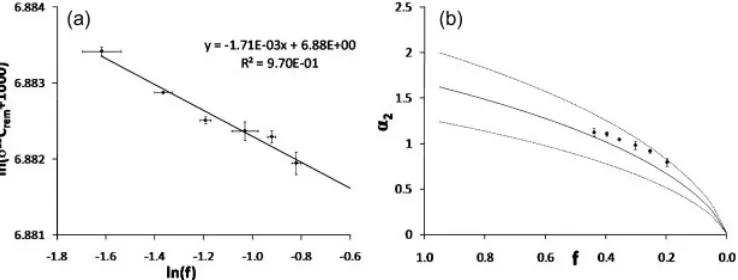
Figure 6(a) presents the Rayleigh plot for the pyrolysis of MTBE at 6758C constructed with the quantifiedfvalues and thed13CVPDB(MTBE) values obtained for the various added helium pressures. By linear regression, the enrichment factor was found to be1.71 and the d13C0, calculated using the origin ordinate, was26.4%with a 95% confidence interval of 0.4%. This value ford13C0, the carbon isotopic signature of MTBE before pyrolysis, is different from the d13C(MTBE) determined analytically at 5008C (27.3%). To verify whether this difference in the calculated and analytical values for d13C(MTBE) is a real isotopic shift or a mathematical artefact a total mass balance of carbon atoms was calculated for each added helium pressure according to Eqn. (6):
d13CðtotÞ ¼ ðxMTBEd13CðMTBEÞremÞ þ ðxmethanold13CðmethanolÞÞ þ ðxisobutylened13CðisobutyleneÞÞ
(6)
with xx¼PA
ðXÞ P
PA; d
13
[image:7.595.140.474.41.110.2]C(tot), the total mass balance of the d13C values; and d13C(methanol) andd13C(isobutylene), the measured d13CVPDB values of methanol and isobutylene, respectively, using benzene as internal standard.
Figure 4. Mechanism of the pyrolysis of MTBE.
[image:7.595.320.559.158.301.2]The results for the d13C(tot) and their 95% confidence intervals at the various added helium pressures are presented in Table 3. These values (between 26.3 and 26.7%) are similar to the d13C0 value obtained from the Rayleigh plot regression but are significantly different from the d13C(MTBE) value determined at 5008C. Matter con-servation dictates thatd13C(tot) is equal to thed13C value of MTBE before the start of the pyrolysis reaction. These results therefore indicate that the difference between the values of d13C(MTBE) andd13C0is not a mathematical artefact but does in fact represent a carbon isotopic shift of MTBE between the moment it enters the system and the beginning of pyrolysis. Moreover, the d13C(tot) values do not appear to vary significantly for the various added helium pressures, suggesting that the isotopic fractionation undergone by MTBE prior to pyrolysis does not depend on the residence time of MTBE in the pyrolysis furnace. We named this ‘pre-pyrolysis’ fractionation a1, where a1¼d13C(MTBE) d13C0¼ 0.9%.
Kinetic isotopic fractionation of the pyrolysates
The Rayleigh plot demonstrated that the pyrolysis reaction is a mass-selective process. When the reaction is not complete, the isotopic signature of the reaction products is representa-tive only of the reacted MTBE. Mariottiet al.59proposed an equation for the calculation of the average accumulated
products isotopic ratio in a non-quantitative chemical reaction (Eqn. (7)):
d13C
pyroþ1000
d13C0þ1000
¼ 1
ð1fÞ ½1f
1þ"R
1000 (7)
where d13Cpyro is the weighted average d13C of the accumulated products. Therefore, for the pyrolysis of MTBE:
d13Cpyro¼4
5d
13
CðisobutyleneÞ þ1 5d
13
CðmethanolÞ (8)
Equation (7) may be rearranged to calculate the total fractionation,a2, of the pyrolysates:
a2¼d13C0d13Cpyro
¼ f
1f ðf
1þ"R
10001Þ ðd13C0þ1000Þ (9)
Figure 6(b) presents the theoretical curve ofa2calculated from the right-hand term of Eqn. (9) using d13C0 and eR obtained from the Rayleigh plot regression. To test the model vs. the experimental data, an experimental value of a2was obtained, for each analysis, by determiningd13Cpyro and substituting d13C0 by d13C(tot). The experimental a2 values are also presented in Fig. 6(b) for comparison; they all fall within the 95% confidence interval of the theoretical curve.
[image:8.595.105.474.41.181.2]The Rayleigh plot has therefore enabled us to determine the existence of a pre-pyrolysis depletion and to calculate the Table 3. Results for the total mass balance (d13C(tot)),a1,a2and the absoluted13C values of the two functional groups of MTBE at
various added helium pressures (CI: confidence interval)
Pad(bar) f
d13C(tot) (%)
CI (95%)
a1 (%)
CI (95%)
a2 (%)
CI (95%)
d13C(methoxy) (%)
CI (95%)
d13C(2-methylpropane) (%)
CI (95%)
0.45 0.44 26.4 0.1 0.9 0.4 1.1 0.3 35.4 0.4 25.3 0.5
0.40 0.40 26.3 0.2 0.9 0.4 1.0 0.3 35.4 0.4 25.3 0.5
0.35 0.36 26.4 0.1 0.9 0.4 1.0 0.3 35.2 0.4 25.4 0.5
0.30 0.30 26.6 0.1 0.9 0.4 0.9 0.2 35.3 0.4 25.7 0.5
0.25 0.26 26.6 0.1 0.9 0.4 0.8 0.2 35.3 0.4 25.7 0.5
0.20 0.20 26.7 0.1 0.9 0.4 0.7 0.2 35.2 0.4 25.8 0.5
Figure 6. (a) Rayleigh plot of the pyrolysis of MTBE at 6758C. (b) Curve of the calculated enrichmenta2of the accumulated products of the pyrolysis vs. the remaining fraction of MTBE.
[image:8.595.36.540.307.401.2]total isotopic shift between the fragments and the parent molecule. The ‘pre-pyrolysis’ enrichment can be evaluated experimentally by comparing thed13C(tot) resulting from the mass balance and the d13C value of the parent MTBE determined either by compound-specific analysis or using the PSIA system with a non-pyrolysing temperature for the pyrolysis furnace. The second enrichment,a2, is due to the pyrolysis reaction and can be evaluated from Eqn. (9) using the parameters from the Rayleigh plot regression.
Determination of the correction factors linking
pyrolysates and their parent moieties
The total correction,a1þa2, linksd13C(MTBE) andd13Cpyro. We aim, however, to access the individual carbon isotopic signature of the two functional groups of MTBE. This is possible by making the two following assumptions: (1) the ‘pre-pyrolysis’ fractionation is homogeneous, thus a1 is equally distributed for the five MTBE carbon atoms. The assumption was made on the premise that the isotopically selective process that MTBE appears to undergo before pyrolysis was physical rather than chemical and therefore would not occur on a particular moiety in the molecule. (2) As described previously, and presented in Fig. 4, the mechanism of the pyrolysis of MTBE is a molecular elimination, occurring with the breaking of the CO ether bond on the 2-methylpropane side of the molecule. For carbon kinetic isotopic fractionation in chemical reactions, the secondary isotopic effects (effects on the carbon atoms that are not involved in the chemical reactions) are usually negligible and isotopic fractionation is noticeable only on the carbon atoms undergoing the reaction. Thus, because the primary fractionation occurs only on the carbon atoms of the 2-methylpropane group, the carbon isotopic signature of the methoxy group should not be affected by the pyrolysis. This assumption ideally should have been verified by the evolution of the d13C values of methanol and isobutylene during pyrolysis. Theoretically, the methanol values should have remained constant and the isobutylene values should have changed as a function of the progress of the reaction. In the range of progress of the reaction obtained here (fvalues between 0.20 and 0.44), however, the difference between lowest and highest values ofa2is only 0.4%, which is only slightly above the system precision and no significant differences could be observed for the d13C values of isobutylene at the various stages of the reaction.
Following the two preceding assumptions,d13C(methoxy) and d13C(2-methylpropane) were calculated according to Eqns. (10) and (11), respectively. In Eqn. (10), the factor 5/4 was introduced before a2 to compensate for the dilution effect in the calculation ofd13Cpyro.
d13CðmethyoxyÞ ¼d13CðmethanolÞ þa1 (10)
d13CðtertbutylÞ ¼d13CðisobutyleneÞ þa1þ5
4a2 (11) The values ford13C(methoxy) andd13C(2-methylpropane) are presented in Table 3 for the various added helium pressures. These values are absolute and can be presented against the international standard VPDB.
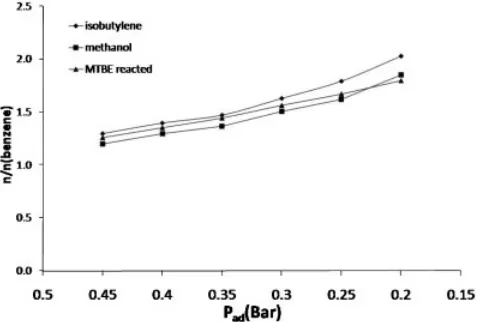
The results for d13C(methoxy) do not show significant differences for the various residence times; the results for d13C(2-methylpropane), however, appear slightly depleted for the lowest added helium pressures (Table 3). Figure 7 shows the change in concentration of the two pyrolysates and reacted MTBE with residence time. For the shortest residence times, the concentrations of methanol, isobuty-lene and reacted MTBE were very similar. For longer residence times, however, the apparent concentration of isobutylene became much higher than that of the reacted MTBE. When the sample resides for a long time in the furnace at high temperature prior to being cryo-focused, it is possible that impurities accumulate. Isobutylene was the first eluted compound from the second gas chromatograph; unretained impurities might co-elute with it, creating the appearance of a higher concentration and influencing the carbon isotope signature. The routine operational settings, however, can be established to exclude these minor effects by choosing an optimal added helium pressure, higher than 0.3 bar.
Robustness of the system
[image:9.595.321.561.41.202.2]Finally, the progress of the reaction is a sole function of the residence time, which in turn depends on the flow rate and the volume of the pyrolysis furnace. The characteristics of the pyrolysis furnace that dictate the flow rate are the added helium pressure and the dimension of the outlet split; the volume is determined by the length and diameter of the quartz tube and the length of fused-silica capillaries inserted into the furnace on both sides. When no changes are made to these parameters andf, the remaining fraction of MTBE in the optimal pysolysis conditions, is known,a2can be calculated for each analysis using Eqn. (9). In a case where changes were made, it would be necessary to recalculatefin the optimal pyrolysis conditions, prior to the determination of a2, according to Eqn. (4) and using benzene as the internal standard.
CONCLUSIONS
We successfully designed an advanced system for the routine analytical determination of intramolecular isotope signatures. Variable pyrolysis reaction times and use of an internal reference provided us with the tools for a greater understanding of the real fractionations associated with the inherent nature of the process. We first were able to rule out any fractionation associated with the additional features of the system, i.e. the additional open-split and the cryo-focusing. For MTBE, we identified two types of fractionations undergone by the compound of interest during pyrolysis; a pre-pyrolysis depletion and the kinetic isotope effect of the pyrolysis reaction. This enabled us to produce absolute values for thed13C of individual moieties in the molecule that can be presented against the international standard VPDB. Interlaboratory comparisons have therefore become theor-etically possible for the on-line PSIA of MTBE. MTBE was a straightforward case for the development of an on-line position-specific isotope analysis system because the mech-anism of the pyrolysis of MTBE at temperatures below 7008C follows a unique route of molecular elimination and both pyrolysates have an isotopic fidelity of 100%. On-line PSIA of molecules of interest with several simultaneous pyrolysis mechanisms and isotopic fidelities different from 100% might involve more complex calculations for the isotopic correction factors.
The method will provide a useful tool for source tracking of MTBE and many other contaminants of concern in the environment, and potentially to uniquely identify discrete microbial utilisation pathways. For instance, in the case of MTBE, both functional groups are possible sites of attack during biodegradation; monitoring the changes in their d13C values should give insight into the first steps of the degradation mechanisms.
Acknowledgements
The authors would like to thank Neil Wallace for invaluable technical support and advice. Mass Spec Solutions (Manche-ster, UK) is acknowledged for constant assistance to the project. The work was financially supported by the EPSRC grant EP/D013739/1 (PhD studentship for CG), the Queen’s University of Belfast and the University of Strathclyde, Glasgow.
REFERENCES
1. Sano M, Yotsui Y, Abe H, Sasaki S.Biomed. Mass Spectrom.
1973;3: 1.
2. Matthews DE, Hayes JM.Anal. Chem.1978;50: 1465. 3. Barrie A, Bricout J, Koziet J.Biol. Mass Spectrom.1984;11:
583.
4. Hall JA, Barth JAC, Kalin RM.Rapid Commun. Mass Spectrom.
1999;13: 1231.
5. Meier-Augenstein W.J. Chromatogr. A1999;842: 351. 6. Hayes JM, Freeman KH, Popp BN, Hoham CH.Org.
Geo-chem.1990;16: 1115.
7. Jasper JP, Westenberger BJ, Spencer JA, Buhse LF, Nasr M.
JPBA2004;35: 21.
8. Morrison DJ, Cooper K, Waldron S, Slater S, Weaver LT, Preston T.Rapid Commun. Mass Spectrom.2004;18: 2593. 9. Benson S, Lennard C, Maynard P, Roux C.Forensic Sci. Int.
2006;157: 1.
10. Slater GF.Environ. Forensics2003;4: 13.
11. Jeffrey AWA. Application of stable isotope ratios in spilled oil identification. InOil Spill Environmental Forensics – Fingerprinting and Source Identification, Wang Z, Stout SA (eds). Academic Press: New York, 2007; 207.
12. Dempster HS, Sherwood Lollar B, Feenstra S.Environ. Sci. Technol.1997;31: 3193.
13. Smallwood BJ, Philp RP, Burgoyne TW, Allen JD. Environ-mental Forensics2001;2: 215.
14. O’Sullivan G, Kalin RM.Environ. Forensics2008;9: 166. 15. Poulson SR, Drever JI. Environ. Sci. Technol. 1999; 33:
3689.
16. Harrington RR, Poulson SR, Drever JI, Colberg PJS, Kelly EF.
Org. Geochem.1999;30: 765.
17. Huang L, Sturchio NC, Abrajano T, Heraty LJ, Holt BD.Org. Geochem.1999;30: 777.
18. Wang Y, Huang Y.Org. Geochem.2001;32: 991.
19. Slater GF, Dempster HS, Sherwood Lollar B, Ahad J.Environ. Sci. Technol.1999;33: 190.
20. Slater GF, Ahad JME, Sherwood Lollar B, Allen-King R, Sleep B.Anal. Chem.2000;72: 5669.
21. Schu¨th C, Taubald H, Bolan˜o N, Maciejczyk K.
J. Contaminant Hydrol.2003;64: 269.
22. Gray JR, Lacrampe-Couloume G, Gandhi D, Scow KM, Wilson RD, Mackay DM, Sherwood Lollar B.Environ. Sci. Technol.2002;36: 1931.
23. Hall JA, Kalin RM, Larkin MJ, Allen CCR, Harper DB.Org. Geochem.1999;30: 801.
24. Hirschorn SK, Dinglasan MJ, Elsner M, Mancini SA, Lacrampe-Couloume G, Edwards EA, SherwoodLollar B.
Environ. Sci. Technol.2004;38: 4775.
25. Hunkeler D, Butler BJ, Aravena R, Barker JF.Environ. Sci. Technol.2001;35: 676.
26. Kolhatkar R, Kuder T, Philp P, Allen J, Wilson JT.Environ. Sci. Technol.2002;36: 5139.
27. Kuder T, Wilson JT, Kaiser P, Kolhatkar R, Philp P, Allen J.
Environ. Sci. Technol.2005;39: 213.
28. Mancini SA, Lacrampe-Couloume G, Jonker H, van Breu-kelen BM, Groen J, Volkering F, Sherwood Lollar B.Environ. Sci. Technol.2002;36: 2464.
29. Meckenstock RU, Morasch B, Griebler C, Richnow HH.
J. Contaminant Hydrol.2004;75: 215.
30. Miller LG, Kalin RM, McCauley SE, Hamilton JTG, Harper DB, Millet DB, Oremland RS, Goldstein AH.Proc. Natl. Acad. Ssi.2001;98: 5833.
31. Richnow HH, Annweiler E, Michaelis W, Meckenstock RU.
J. Contaminant Hydrol.2003;65: 101.
32. Rosell M, Barcelo D, Rohwerder T, Breuer U, Gehre M, Richnow HH.Environ. Sci. Technol.2007;41: 2036.
33. Schmidt TC.TrAC Trends Anal. Chem.2003;22: 776. 34. Schmidt TC, Schirmer M, Weiß H, Haderlein SB.
J. Contaminant Hydrol.2004;70: 173.
35. Somsamak P, Richnow HH, Haggblom MM. Environ. Sci. Technol.2005;39: 103.
36. Somsamak P, Richnow HH, Haggblom MM.Appl. Environ. Microbiol.2006;72: 1157.
37. Barth JAC, Slater G, Schuth C, Bill M, Downey A, Larkin M, Kalin RM.Appl. Environ. Microbiol.2002;68: 1728.
38. Elsner M, Zwank L, Hunkeler D, Schwarzenbach RP.
Environ. Sci. Technol.2005;39: 6896.
40. Fischer A, Herklotz I, Herrmann S, Thullner M, Weelink SAB, Stams AJM, Schlo¨mann M, Richnow H, Vogt C.
Environ. Sci. Technol.2008;42: 4356.
41. O’Sullivan G.PhD thesis, Queen’s University Belfast, 2004. 42. Elsner M, McKelvie J, Lacrampe Couloume, Sherwood
Lollar B.Environ. Sci. Technol.2007;41: 5693.
43. Abelson PH, Hoering TC.Proc. Natl. Acad. Sci.1961;47: 623. 44. Vogler EA, Hayes JM.J. Org. Chem.1979;44: 3682. 45. Monson KD, Hayes JM.Geochim. Cosmochim. Acta1982;46:
139.
46. Corso TN, Brenna JT.Proc. Natl. Acad. Sci.1997;94: 1049. 47. Corso TN, Brenna JT.Anal. Chim. Acta1999;397: 217. 48. Corso TN, Lewis BA, Brenna JT. Anal. Chem. 1998; 70:
3752.
49. Wolyniak CJ, Sacks GL, Metzger SK, Brenna JT.Anal. Chem.
2006;78: 2752.
50. Wolyniak CJ, Sacks GL, Pan BS, Brenna JT.Anal. Chem.2005; 77: 1746.
51. Sacks GL, Brenna JT.Anal. Chem.2003;75: 5495.
52. Yamada K, Tanaka M, Nagawa F, Yoshida N.Rapid Commun. Mass Spectrom.2002;16: 1059.
53. Dias RF, Freeman KH, Franks SG.Org. Geochem.2002;33: 161. 54. Merritt DA, Brand WA, Hayes JM.Org. Geochem.1994;21:
573.
55. Meier-Augenstein W. GC and IRMS technology for 13C and 15N analysis on organic compounds and related gases. In
Handbook of Stable Isotope Analytical Techniques, de Groot PA (ed). Elsevier: Amsterdam, 2004; 171.
56. Nesbitt ER, Robinson C, Cantrell RL, Foresco CB, Lahey K, Tortorice J. Methyl tertiary-Butyl Ether (MTBE): Conditions Affecting the Domestic Industry, US International Trade Com-mission, Washington DC 20436, 1999.
57. Coplen TB.Pure Appl. Chem.1994;66: 273. 58. Daly NJ, Wentrup C.Aust. J. Chem.1968;21: 2711. 59. Mariotti A, Germon J, Hubert P, Kaiser P, Letolle R, Tardieux