INTERNATIONAL DESIGN CONFERENCE - DESIGN 2008 Dubrovnik - Croatia, May 19 - 22, 2008.
THE INTEGRATION OF SYNCHRONOUS AND
ASYNCHRONOUS DESIGN ACTIVITY RECORDS
M D Giess 1, A P Conway 2, C A McMahon1, W J Ion2
1 University of Bath (UK), 2 University of Strathclyde (UK)
Keywords: design activity, information, knowledge capture
Abstract
With many engineering companies changing their focus from product delivery towards through-life service support, the realisation is that much of the information and knowledge being generated throughout each stage of the design process can aid in both product lifecycle support and also the development of new products. To support these activities, information and knowledge capture systems and models are required, which allow the information to be stored and used thirty years or more into the future. The issue many companies are finding in their quest to retain this valuable data is how and when to perform the capture activities. Design activities are untaken in a variety of modes, many of which are dichotomous, and each of which may require separate documentary mechanisms to capture information in an efficient manner. For example, we can identify the modes of learning and transaction to describe whether an activity is aimed at increasing a level of understanding or whether it involves manipulating information to achieve a tangible task. The dichotomy of interest in this paper is that of synchronous and asynchronous working, where engineers may work as part of a group or as individuals and where different forms of record are necessary to adequately capture the processes and rationale employed in each mode. This paper looks at each mode of working in turn and proposes complimentary approaches to information and knowledge capture. The combination of information and knowledge capture performed during both asynchronous and synchronous activities has the potential to create a significantly enhanced overall design process model and record enhancing not only the through-life support of the product but also subsequent projects.
1. Introduction
2. Synchronous and Asynchronous Modes of Working
Engineering design is a collaborative process which involves communication, decision making, negotiation and team learning. In general terms, the majority of communication within the design process is of an asynchronous nature with information being relayed between design partners in a sequential manner. For certain forms of design communications this means of operation is not satisfactory and direct interaction between design participants, in synchronous mode, is necessary [Wodehouse, et al. 2005]. To clarify this further in terms of modes of working, Fruchter [Fruchter 1999], made the following observations on conventional design team communication methods:
• Information in the form of text, calculations, graphics and drawings are captured in paper or computer based forms. Unfortunately, much of the design intent in a design dialogue is lost because it is partially documented. The final decision tends to be recorded but much of the interaction and developmental thinking of a design discussion is not;
• The process of identifying shared interests within a design team is ad-hoc and based on
participants’ imperfect memories and retrieval of available documents. This is erroneous and time consuming and can lead to inconsistencies and conflicts;
• Meetings are usually the forum in which inconsistencies are detected and resolved before a
project can progress. Telephone conversations are also used to resolve conflict and inconsistencies within the design decision-making process as and when they occur. Discussion of graphical or numerical information by telephone, email etc. is difficult and leads to misunderstandings/misinterpretations and eventually increased product cost;
• Time delays in asynchronous based communication between design team members can cause
significant delays in project timescales. Additionally, these communication methods tend not to develop a team ethos or a common sense of ownership of design decisions.
When undertaking a large collaborative and possibly even global engineering design project, the effective use and understanding of both synchronous and asynchronous modes of working becomes critical to the success of the project. To achieve the best results, the most efficient communication channels must be utilised and the documentation of activities and decisions key. This is also true of smaller, co-located projects for during these projects both modes of working will also be utilised.
2.1 Synchronous modes of working
In engineering design, working synchronously involves individual designers and/or team members working on the same activity at the same time. Activities such as design related meetings are prime examples of social and collaborative instances where valuable information and knowledge can be communicated through channels such as speech, body language and even gesturing, which can be extremely difficult to both recognise and record. In many cases subsequent decisions can be linked to this sometimes tacit or implicit knowledge and information, therefore much of the rationale behind these decisions are lost.
2.1.1 The Capture of Information within Social and Collaborative Situations
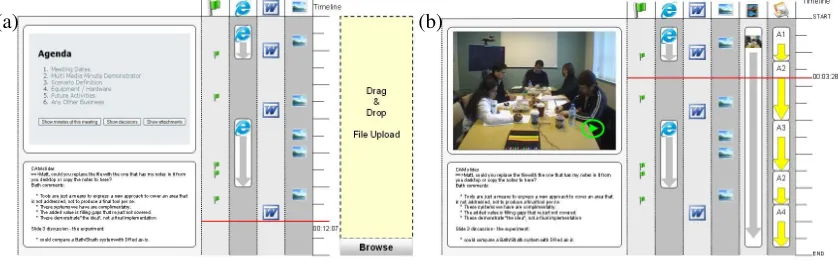
Enhanced Minuting System (MEMS), a prototype software system to be used as an effective meeting capture and review tool. MEMS possesses the ability to quickly and unobtrusively create richer representations of meetings by displaying and organising multi-media generated during the meeting. Using pre-defined meeting structure templates and drag and drop file upload facilities, the user has the ability to record not only the decisions and actions specified during meetings, but also document the rationale and exploration activities which in effect led to the decisions and actions being taken. The MEMS tool itself is web-based software linked to a repository, allowing the user to easily and rapidly create a record of the meeting at the time as opposed to creating digital or paper-based minutes retrospectively. MEMS possesses the ability to display the data objects in individual “data streams” customisable to the specific user’s requirements. During the meeting, MEMS displays the agenda and metadata for the meeting (time, date, attendees) and shows a “live view” of the meeting against the timeline, highlighting in the various streams, the data objects and notes recorded during the meeting (figure 1(a)). Post-meeting, media streams such as video and audio are incorporated into the system and synchronised using the meeting timeline. These additional data streams, which are also displayed against the agenda points, are accessible and allow the user to revisit any part of the meeting record and view the data objects corresponding to a specific instance or occurrence during the meeting (figure 1(b)).
[image:3.612.98.518.287.420.2]
Figure 1: Conceptual MEMS Display (“live” and “post” meeting)
MEMS differs from previous work as it tries to bridge the gap between current live capture and post processing systems by utilising a combination of both principles. The users have the ability to see what is being utilised in the meeting and the use of timelines allow an easily recognisable structure to the meeting, drawing from the principle of IBIS and the work done by Conklin [Conklin 2006] and Bracewell et al. [Bracewell, et al. 2004] to name but a few. The ability to view all media associated with the meeting at a later date enhances the overall record of the meeting and draws on the principle employed by systems such as Informedia [Hauptmann, et al. 2001] and Ferret Browser [Lalanne, et al.
2005] whose key selling point is that a complete and accurate record of the meeting can be captured using video and audio, although these systems also utilise voice recognition and automate transcription technologies. The key goal of the MEMS development is to enhance the record of activities and decisions made collaboratively and in social situations to allow them to be revisited at latter stages in the design process.
2.2 Asynchronous Modes of Working
The ability to comprehend the activities undertaken by an individual engineer is also of key importance if such work is to be interpreted and reused at a later date, for example when renovating a product or performing a redesign. It is possible to distinguish two separate forms of activity within asynchronous working, the learning and transactional, and these terms are routinely used by an industrial collaborator. A transactional activity is one where manipulation of information takes place according to an established process and further information is created. A learning activity is that in which an engineer consults and manipulates information resources in order to further his or her
understanding of some domain. The process is not prescribed and if repeated the learning may be augmented. There may be a documentary record of what is learned, but in some cases the process it is predominantly cognitive with no documentable outcome as it remains non-explicit. This work focuses entirely upon records of transactional activities, and the information processing and dependencies that these describe. Records of asynchronous learning activities will be described in a later paper.
Alongside the established design reports, which have been identified as suboptimal, efforts have been made to express processes in models such as Petri-net based approaches [McMahon, et al. 1996] and through information flows such as IDEF [IEEE, 1998]. The approach taken in this work is to capture detailed information manipulations and to indicate how these manipulations are linked by considering their information interdependencies. The IDEF0 format has been identified as suitable for this
purpose, as it indicates the information flow between activities and also the methods by which the information was manipulated and how the activity was guided or controlled.
A client-based tool has been developed which produces an XML representation of a transactional activity. An engineer may use this tool to define an activity to be undertaken along with all information required to conduct the activity. The data model has elements of input, output, control and mechanism, all of which are computer-addressable, for example a item of product geometry held in a CAD system [which may be marked up, McMahon, et al. 2005], an algorithm applied in a computational environment, a specific clause in a specification etc. In this manner, the data model describes a map of how these computational information instances are combined. By referencing each instance it is possible to consistently refer to them throughout the complete design activity, thus a mapping of information flow may be produced. It is possible to generate these activity models as design activities are carried out, as discussed in the following section, and as the underlying data model is XML-based it is also possible to generate automated reports of these activities for purposes of communication and human assimilation. This will be discussed in section 2.2.2.
2.2.1 The Capture and Automated Documentation of Transactional Work
It is intended that design transaction records be generated directly from the computational environment in which an engineer is working. Many engineering environments support the use of objects (distinct entities of information typed according to the nature of the information or task), allowing the input, manipulation and flow of information within an activity to be depicted. This aspect has been explored within an engineering company, where all structural analysis has been transferred to a CAE environment supported by a PDM-based data and information repository. The use of objects within the analysis environment allows the PDM system to organise data types which correspond to objects, and as the objects are loaded into the working environment it is possible to save a workspace to indicate how these objects are utilised within a given analysis. As such, there is little overhead to this method of capture. This work is to be built upon by considering how higher-level reporting documents, as held in a separate information system, may be generated from the interlinked object records contained in the PDM system.
2.2.2 Aggregation, Organisation and Visualisation of Process Flows
The capture of a single activity can be made comprehensible and reusable if its place in a wider context of an asynchronous episode may be indicated. As such, effort has been expended upon providing means of both reporting chains of transactional activity and of browsing and visualising such chains.
representation in this manner, and hence this approach can be applied within any given reporting mechanism.
3. Co-ordinating the Representations
The retrieval of information exclusively within the two modes allows for some degree of reuse of transactional work and for some degree of comprehension of the reasons behind decisions made in synchronous working. However, individually they do not provide a complete depiction of the processes across the modes of working, for example why a transactional activity was undertaken or upon what basis a decision could be made within a synchronous mode of working. To enable this it is essential that records from the two modes be co-ordinated such that dependencies across the two modes can be traced. The means by which this will be accomplished is still an open area of research, and this section will discuss the avenues currently under consideration.
It is suggested that capturing the transition between synchronous and asynchronous working will provide a mechanism for the transactional work to be grouped into a single task, as by capturing the instigation and completion of a task, at the points at which it interfaces with the synchronous modes, a natural partition is created. Transactional activities are captured and organised as a continuous chain of information flow, and as this flow continues across different asynchronous episodes it may be difficult to identify specific groups of transactional activity. By identifying the synchronous modes of working that lead into and flow from these transactions it becomes possible to identify consistent groups of transactions. The identification and description of these groups will be discussed in the following sections.
In our observations of design activities we see transactional activities leading to synchronous meetings, and vice versa – e.g. meetings called to address conflicts or issues raised within transactional working or transactional activities are instigated to address issues raised in synchronous working. Both modes of co-ordination may be pertinent, depending upon which direction of transfer is significant at a given point in the design process.
3.1 Information Dependency capture
It has been argued that by tracing the information flow within asynchronous activities it is possible to revisit such episodes. Extending the information dependency trail into the synchronous mode it is possible to capture how asynchronous activities impact upon decisions made within the synchronous environment. Two key related issues are faced, one of granularity and one of identification of key information pertinent to decision-making. Transactional records capture information flows at a lower level than within synchronous modes, where the emphasis is more upon aggregated information which is used in the identification and resolution of issues and in the support of decision-making. In many cases the aggregated information may comprise reports, presentations or other devices intended for purely communicative purposes, which is based upon the underpinning information utilised and developed within the transactional activities but not expressly linked to it. These boundary or intermediary objects are key to information exchange in such situations, and by utilising XSLT transformations it is possible to express transactional records in such a manner as to support decision-making in synchronous situations. Different stakeholders within synchronous activities may have different viewpoints and thus need different transformations; however as the transformations are rigorously linked to the underpinning transactional record it is possible to comprehend the flow of information from transaction into synchronous modes of work. The MEMS system also makes reference to documents used in the support of discourse; hence it is possible to link synchronous events to the underpinning documentary resource.
3.2 The Specification of Agenda
subsequent transaction activities. For example, if a part or component within a subassembly was found to be suboptimal then this part would have to be withdrawn or altered. The decision to undertake this redesign exercise would commonly be taken in collaborative situations such as design reviews or design change meetings and therefore fall under the synchronous modes of working. However, the actual directive or action for the activity to be undertaken would in effect provide a structure or plan for the individual engineer and therefore the dependencies become visible. The key decisions and actions documented during the synchronous activities have the potential to be utilised as directives within process maps, informing the project stakeholders of the need to undertake certain activities. The representation of the activities may be mapped using for example IDEF models, showing the dependencies and the resources required during the synchronous activities.
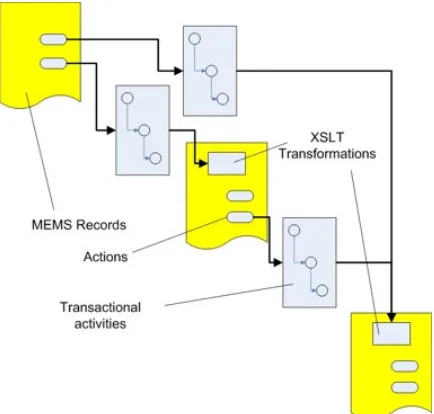
Figure 2: Co-ordination between MEMS and Transactional record
Figure 2 illustrates the means by which the two different forms of record may be co-ordinated, with actions from MEMS records setting the agenda for transactional activities, and XSLT views of transactional activities being referenced and utilised in synchronous activities.
4 Organising and Browsing the Representations
There are two syntaxes for Topic Maps. ISO 13250 is based on SGML [British Standards, 2000] and XTM upon XML [TopicMaps.Org 2001]. The data model for the transaction records is XML; hence the XTM syntax has been deployed as this eases the manipulation of such information. A script for translating the XML transaction representation into XTM has been written in JavaScript, allowing a single activity to be automatically represented as a distinct Topic Map. A key feature of Topic Maps is the ability to automatically merge separate maps based upon shared topics. If two maps both refer to the same tangible resource and certain naming conventions are met, then it is possible to automatically join the maps through this topic. For example, if a topic represented a component diameter that was an output from an activity in one map and an input to another, the two maps would be merged such that this topic was the intermediary between these two activities.
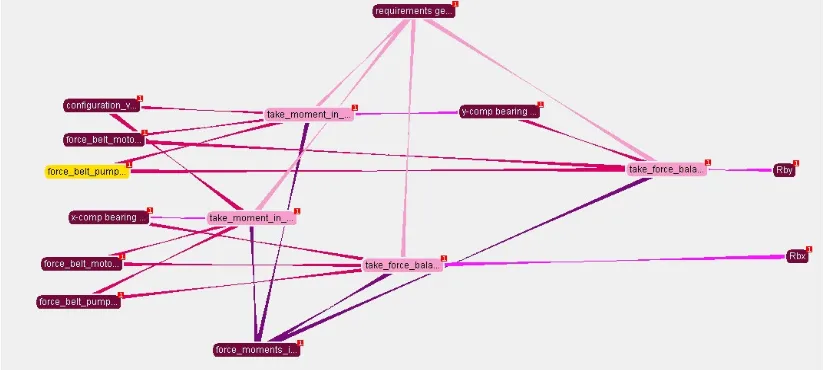
Figure 3: Sample Topic Map of Transactional Episode
Although not intrinsically visual, Topic Maps lend themselves to visual display and browsing as the topics and associations form directed graph structures which may be traversed from topic to topic by following associations of interest. Figure 3 shows a map of a simple transactional design episode, where three activities are undertaken in order to compute bearing reaction forces. This activity was part of a simple design exercise undertaken to demonstrate a number of the proposed approaches [Giess, et al. 2007]. The darker nodes (including a single yellow node, highlighted as an active node) represent instances of information and the lighter nodes represent the activities to which these information instances act as input, output, control and resource. Each form of association is indicated by differently-coloured arcs within the map. The map may be browsed and expanded to show further related topics, and each node may be activated and drilled into to reveal further detail such as where it occurs within the actual design record and what other associations it is involved in.
The application of Topic Maps focuses upon the transactional records, however it is possible to extend this approach to the MEMS representations. Distinct information resources are utilised within the MEMS record, each of which may be referenced by a Topic Map and whose associations may be inferred from the MEMS record itself. The specific mechanism by which this could be achieved is an area currently under investigation.
Conclusions
MEMS captures the discursive aspects of synchronous design activities, and identifies information resources utilised within such design situations. Transactional records are utilised in capturing the information manipulations in asynchronous working, and allow various transformations to be applied to present the information dependencies within these activities in a variety of different forms according to user need. These two forms of documentation may then be co-ordinated by considering how the use of transactional record transforms within synchronous modes may be captured, and how actions from synchronous events may act as an ‘agenda’ for transactional activities in the asynchronous mode.
Acknowledgements
This research is funded by EPSRC under grants EP/C534220/1 and EP/E00184X/1
References
British Standards, BS ISO/IEC 13250:2000, "Information technology - SGML applications - topic maps", 2000 Bracewell, R. H., Ahmed, S. and Wallace, K. M., "DRed and design folders: a way of capturing, storing and passing on knowledge generated during design projects", ASME International Design Engineering Technical Conferences & Computers and Information in Engineering Conference, Salt Lake City, Utah, USA,, 2004 Clark, J., "XSL Transformations (XSLT) Version 1.0", W3C, 1999, http://www.w3.org/TR/xslt (Accessed 1 December 2007)
Conklin, J., "Dialogue Mapping: Building Shared Understanding of Wicked Problems", John Wiley & Sons, Ltd, 2006
Ding, L., Giess, M. D., Goh, Y. M. and McMahon, C., "Component-based Model: a Process Model for Designers", (In Preparation),
Fruchter, R., "A/E/C Teamwork: A Collaborative Design and Learning Space", Journal of Computing in Civil Engineering, Vol.13, No.4, 1999, pp261-269
Giess, M. D., Goh, Y. M., Ding, L. and McMahon, C. A., "Improved Product, Process And Rationale Representation And Information Organisation To Support Design Learning", International Conference On Engineering Design, ICED07, Paris, France, 2007,
Hauptmann, A., S.Thornton, Qi, Y., Papernick, N., Ng, T. D., Jin, R. and Houghton, R., "Video Retrieval with the Informedia Digital Video Library System", Text Retrieval Conference (TREC'01), Gaithersburg, Maryland, 2001, Lalanne, D., Lisowska, A., Bruno, E., Flynn, M., Georgescul, M., Guillemot, M., Janvier, B., Marchand-Maillet, S., Melichar, M., Moenne-Loccoz, N., Popescu-Belis, A., Rajman, M., Rigamonti, M., Rotz, D. v. and Wellner, P., "The IM2 Multimodal Meeting Browser Family", 2005
McMahon, C. and Meng, X., "A Network Appraoch to Parametric Design Integration", Research in engineering Design, Vol.8, 1996, pp14-32
McMahon, C. A. and Davies, D., "The use of markup in documents and in computer aided design: a comparison", International Workshop on Annotation for Collaboration Methods Tools and Practices, Boujut, J.-F., 2005, Pepper, S., "The TAO of Topic Maps", Ontopia, 2002, http://www.ontopia.net/topicmaps/materials/tao.html (Accessed 1 August 2006)
IEEE, IEEE Std 1320.1-1998, "IEEE Standard for Functional Modeling Language - Syntax and Semantics for IDEF0", 1998
TopicMaps.Org, "XML Topic Maps (XTM) 1.0", TopicMaps.Org, 2001, http://www.topicmaps.org/xtm/ (Accessed 1 April 2006)
Wodehouse, A., Grierson, H., Ion, W., Juster, N. and McGill, L., "Enhancing design learning using a digital repository." International Conference on Engineering Design (ICED), Melbourne, Australia, 2005,
Correponding Author: Dr Matt Giess
Innovative Design and Manufacturing Research Centre University of Bath, Bath UK