Satisfiability-Based Algorithms for Pseudo-Boolean
Optimization Using Gomory Cuts and Search Restarts
Vasco M. Manquinho and Jo˜ao Marques-Silva
IST/INESC-ID, Technical University of Lisbon, Portugal
{
vmm,jpms
}
@sat.inesc-id.pt
Abstract
Cutting planes are a well-known, widely used, and very effective technique for Integer Linear Programming (ILP). In contrast, the utilization of cutting planes in Pseudo-Boolean Optimization (PBO) is recent and results still pre-liminary. This paper addresses the utilization of cutting planes, namely Gomory mixed-integer cuts, in Satisfiability-based algorithms for PBO, and shows how these cuts can be used for computing lower bounds and for learning new constraints. A side result of learning new constraints is that the utilization of cutting planes enables non-chronological backtracking. Besides cutting planes, the paper also pro-poses the utilization of search restarts in PBO. We show that search restarts can be effective in practice, allowing the computation of more aggressive lower bounds each time the search restarts. Experimental results show that the inte-gration of cutting planes and search restarts in a SAT-based algorithm for PBO yields a very efficient and robust new solution for PBO.
1. Introduction
Recent algorithms for Pseudo-Boolean (PB) Solving (PBS) and Optimization (PBO) have been the subject of sig-nificant improvements [2, 6, 9]. The most effective Boolean Satisfiability (SAT) techniques, including clause learning, lazy data structures and conflict-driven branching heuris-tics, have been extended to PBO. From this work resulted a generation of PB solvers significantly more effective than previous ones [4]. In addition to the significant amount of work on extending SAT techniques to PBS, there has also been work specific to PBO, which entails techniques spe-cific for optimizing the cost function associated with PBO formulations [15, 17, 18].
This paper proposes to apply the identification of cut-ting planes to SAT-based algorithms for PBO. The objec-tive is to use cutting planes for computing more accurate
lower bounds, and consequently obtaining additional prun-ing ability. Moreover, the paper shows how to exploit the computation of cutting planes for creating new con-straints, which enable non-chronological backtracking from lower bounding information. In contrast with the work of [15], which uses cutting planes solely for computing lower bounds, we propose the use of cutting planes for con-straint learning, and for backtracking non-chronologically from conflicts involving those constraints. Besides the uti-lization of cutting planes in SAT-based PBO algorithms, this paper also proposes the utilization of search restarts [10]. Since cutting planes are used for generating new con-straints, it is reasonable to assume that search restarts may yield tighter lower bounds each time the search restarts. In practice, we observed that this can indeed be the case.
The paper is organized as follows. The following two sections address, respectively, definitions and a survey of PBO algorithms. Afterwards, Section 4 presents Gomory cutting planes and outlines its integration in SAT-based PBO algorithms. Section 5 addresses the utilization of search restarts and experimental results on representative problem instances are discussed in Section 6. Finally, the paper concludes in Section 7.
2. Preliminaries
In a propositional formula, a literallj denotes either a variablexj or its complementx¯j. A literal is said to be a positive literal if it denotes a variablexj. If a literal denotes ¯
xj is said to be a negative literal. If a literallj =xj and
xj is assigned value 1 orlj = ¯xjandxjis assigned value 0, then the literal is said to be true. Otherwise, the literal is said to be false. An instance P of the Pseudo-Boolean
Optimization (PBO) problem can be defined as follows:
minimize Pn j=1
cj·xj
subject to Pn j=1
aijlj ≥bi,
xj∈ {0,1}, aij, bi∈ +0, i∈ {1..m},
wherecjis a non-negative integer cost associated with vari-ablexj, j∈Nandaijdenote the coefficients of the literals
ljin the set ofmlinear constraints. Every pseudo-boolean formulation can be rewritten such that all coefficients aij and right-hand sidebibe non-negative.
In a given constraint, if allaijcoefficients have the same value k, then it is called a cardinality constraint, since it
only requires thatdbi/keliterals be true. A pseudo-boolean constraint where any literal set to true is enough to satisfy the constraint, can be interpreted as a propositional clause. This occurs when the value of allaijcoefficients are greater than or equal tobi. If every constraint can be interpreted as a propositional clause then P is an instance of thebinate covering problem(BCP). When all literals of the proposi-tional clauses are positive thenPis an instance of theunate covering problem(UCP). Covering formulations have been the subject of thorough research work [8, 16, 17].
Observe that a linear pseudo-boolean optimization prob-lem can also be viewed as a special case of linear integer programming problem. The linear integer programming formulation for the constraints can be obtained if we replace literalsx¯jby1−xj.
Throughout the paper we refer extensively to backtrack search algorithms. In addition, the PB inference techniques of [6, 9] are assumed.
3. Pseudo-Boolean Optimization Algorithms
Given that PBO is a restriction of generic ILP, all algo-rithms proposed in the past for ILP can also be used for PBO. Among these, complete approaches include branch-and-bound with linear programming relaxations [22], cut-ting planes [11] and branch-and-cut [20]. Besides algo-rithms for generic ILP, algoalgo-rithms specific to PBO have also been proposed. These include SAT-based algorithms [4], branch-and-bound algorithms [8] and SAT-based algo-rithms with lower bounding [17, 18].
This section addresses algorithms for PBO that are rel-evant to the work described in the paper. We briefly overview branch-and-bound algorithms for the Binate Cov-ering Problem (BCP), representing a well-known restriction of PBO [8], and address SAT-based algorithms for PBO. Moreover, we describe the utilization of linear program-ming relaxations, an extremely effective technique in PBO algorithms that utilize lower bounding.
3.1. SAT-Based Algorithms
The first SAT-based approach for PBO was proposed by P. Barth [4]. This algorithm is based on the DLL procedure augmented with conditions on the value of the cost func-tion. The algorithm performs a linear search on the pos-sible values of the cost function, starting from the highest
value, and at each step requiring the next computed solu-tion to have a cost lower than the previous one. If the re-sulting instance is not satisfiable, then the solution is given by the last recorded solution. The generalization of recent advances in SAT to PB constraints resulted in new effective algorithms [2, 6, 9] for several classes of PB instances. The most relevant techniques include non-chronological back-tracking in the search tree, conflict-based constraint learn-ing mechanisms and lazy data structures. Observe that most SAT-based approaches focus primarily on finding solutions to the PB constraints. As a result, for highly constrained problem instances, these techniques can be very effective. However, these algorithms are less effective at handling the information provided by the cost function [18].
3.2. Branch-and-Bound Algorithms
Unlike SAT-based algorithms, branch-and-bound algo-rithms [8, 16] have proved to be very effective for instances that are not highly constrained. In general, these algorithms are able to prune the search tree earlier by using estimates on the value of the cost function. In branch-and-bound al-gorithms upper bounds on the value of the cost function are identified for each solution to the constraints, andlower boundson the value of the cost function are estimated con-sidering the current variable assignments. For a given in-stanceP of pseudo-boolean optimization, letP.upper de-note the upper bound on the value of the cost function. The search is pruned whenever the lower bound estimation is larger than or equal toP.upper. In this case it is guaranteed that a better solution cannot be found with the current vari-able assignments and therefore the search can be pruned. The algorithms described in [8, 16, 17] for the binate cov-ering problem follow this approach.
For several classes of instances, the tightness of the lower bounding procedure is crucial for the algorithm’s ef-ficiency, because with higher estimates of the lower bound, the search can be pruned earlier. Several procedures can be used for lower bound estimation, namely the approximation of a maximum independent set of constraints [8] or linear-programming relaxations [16], among others.
In the remainder of the paper, we refer tolower bound conflicts to denote the situations when the search process backtracks because the lower bound estimate is greater than or equal to a previously computed upper bound on the value of the cost function.
3.3. Linear Programming Relaxations
suc-cess [16, 18]. It is also often the case that the LPR bound is tighter than the one obtained with the MIS approach.
The general formulation of the LPR for a pseudo-boolean problem instance is obtained from (1) as follows:
minimize zlpr = n P j=1
cj·xj
subject to Pn j=1
aijxj≥bi
0≤xj≤1, aij, bi∈
(2)
The solution of (1) is referred to asz∗
pbo, whereas the solution of (2) is referred to asz∗
lpr. It is well-known that the solutionz∗
lprof (2) is a lower bound on the solutionz
∗
pbo of (1) [22]. Basically, any solution of (1) is also a feasible solution of (2), but the converse is not true. Moreover, for a given solution of (2) wherex ∈ {0,1}n, we necessarily havez∗
pbo=z
∗
lpr. Hence, the result follows.
4. Cutting Planes
Linear Programming Relaxations are extensively used in Integer Linear Programming (ILP) algorithms for estimat-ing lower bounds on the value of the cost function and also for the identification of cutting planes.
The work on cutting planes can be traced to Go-mory [11]. GoGo-mory introduced a cutting plane technique that derives new linear inequalities in order to exclude some non-integer solutions from (2). However, the new linear in-equalities are valid for the original integer linear program and so can be safely added to the original problem. More-over, solving (2) with the added inequalities may yield a tighter lower bound estimate.
Since Gomory’s original work, a large number of cutting plane techniques have been proposed [5, 7, 22]. This sec-tion addresses Gomory mixed-integer cuts and its integra-tion in a SAT-based PBO solver. Moreover, we also estab-lish conditions in order to backtrack non-chronologically in the search tree when a conflict arises involving learned cut-ting planes.
4.1. Gomory Mixed-Integer Cuts
Section 3.3 describes the utilization of linear program-ming relaxation (LPR) for estimating lower bounds in Pseudo-Boolean Optimization (PBO). In simplex-based so-lutions for solving the LPR from (2), the simplex method adds a setSof slack variables (one for each constraint) such
that
minimize zlpr= n P j=1
cj·xj
subject to Pn j=1
aijxj−si=bi
0≤xj≤1, si≥0, aij, bi∈
(3)
This formulation is called the slack formulation and it is used to create the original simplex tableau [22].
If the solutionx∗of the LPR is integral, then
x∗provides
the optimal solution to the original problem. Otherwise, choose a basic1variablex
j such that its value on the LPR solution is not integral. Sincexjis a basic variable, after the pivot operations performed by the simplex algorithm on (3), there is a row in the simplex tableau of the form,
xj+ X
i∈P
αixi+ X
i∈Q
βisi=x∗j (4)
whereP andQare the sets of indexes of non-basic vari-ables (problem varivari-ables and slack varivari-ables, respectively). In [11], Gomory proves that the inequality,
P i∈P
f(αi)xi+ P i∈Q
f(βi)si≥f(x∗j)
wheref(y) =y− byc, y∈
(5)
is violated by the solution of the LPR, but satisfied by all non-negative integer solutions to (4). Hence, it is also sat-isfied by all solutions to the original problem as formulated in (1) and can be added to the LPR. Solving the LPR with the new restriction will yield a tighter lower bound estimate on the value of the PBO instance.
Several methods for strengthening the original Gomory cuts have been proposed [3, 12, 14]. In [12], Gomory proves that the cut
P i∈P
g(αi)xi+ P i∈Q
g(βi)si ≥1
whereg(y) =
f(y)
f(x∗
j) : f(y)≤f(x
∗
j)
1−f(y) 1−f(x∗
j) : f(y)> f(x
∗
j)
(6)
is stronger than (5) and satisfied by all solutions of (3). Notice that from (3) each slack variable depends only from the original problem variables and can be replaced in (6) by,
si= n X
j=1
aijxj−bi (7)
Afterwards, if we apply the rounding operation on the non integer coefficients we obtain a new pseudo-boolean con-straint valid for the original PBO instance (1), since the rounding operation will only weaken the constraint.
One should note that in a modern SAT-based algorithm, a conflict analysis procedure is carried out whenever a con-flict arises [19, 21]. Therefore, if the generated cutting plane is involved in the conflict analysis process, it must be able to determine its logical dependencies in order to backtrack to a valid node of the search tree. In the next section we propose conditions for associating dependencies with com-puted cutting planes, thus enabling constraint learning and non-chronological backtracking from constraints inferred with cutting plane techniques.
4.2. Learning from Gomory Mixed-Integer Cuts
The most straightforward solution, for safely determin-ing a set of dependencies for the Gomory mixed-integer cuts generated during the search process, is to declare that these cuts depend on all decision assignments made from the root node to the current node. This solution associates with each cutting plane all decisions in the search tree, thus forcing chronological backtracking and ensuring complete-ness. The main idea is that if one of the decision assign-ments were to be different, then the generated cut could not be applied. In this case, we can determine a set of literals
ωcutthat defines the set of dependencies for the generated cut. When one literal in ωcut is set to 1, the cut will no longer be active (i.e. the associated constraint will be sat-isfied). Therefore, the generated cut would depend on all decision assignments and, for all decision variablesxj as-signed from the root node to the current node, we would have,
¯
xj ∈ωcutifxj = 1
xj ∈ωcutifxj = 0 (8)
In order for the generated cut to be safely added to the set of pseudo-boolean constraints, we must add all literalslj ∈
ωcutto the cut. The coefficient of each added literalljmust be large enough to satisfy the constraint wheneverlj= 1.
With this approach, we can safely add any new cuts to our set of pseudo-boolean constraints, guaranteeing the completeness of the algorithm. However, since the cuts de-pend on all decision assignments made in the search tree from the root node to the current nodeNwhere the cut was generated, the constraint will not be used other than at the subtree with root at the nodeN. Moreover, if a conflict occurs involving the generated cuts at nodeN, the search
cannot backtrack to a node higher thanNin the search tree.
The second technique for associating dependencies with cuts follows the ideas proposed in [18] for LPR. Since each cut is derived from the outcome of solving the LPR formu-lation, then we can associate with each cut the same de-pendencies we associate with lower bound conflicts. Given the solution to the LPR formulation, the dependencies are identified as all 0-valued literals in all clauses for which the value of the slack variable is 0 [18]. Albeit this technique is more accurate than the first one, it is possible to achieve in-creased accuracy, by analyzing the process associated with the identification of Gomory mixed-integer cuts.
For describing the third technique, one should note that the tableau constraint (4), from which the Gomory mixed-integer cut is inferred, depends on the pivot operations per-formed while solving the LPR. As a result, the tableau con-straint (4) contains the slack variables assigned value 0 from the constraints from which it depends.
LetS be the set of constraints with slack variables as-signed value 0 in the tableau constraint (4). If the literals
assigned value 0 in these constraints were to have a differ-ent value, the tableau constraint might not be inferred in the LPR. Therefore, we can consider the assignments to those literals as the responsible for inferring the cut and we can defineωcutas:
ωcut={l:l= 0∧l∈ωi∧ωi∈S} (9) Notice that the generated cut might not depend on all decision assignments. Hence, if a conflict occurs involving generated cuts at nodeN with its dependences determined
as in (9), it is possible to backtrack to a node higher thanN
in the search tree, i.e. a non-chronological backtrack step. Moreover, the generated cuts can also be used in different parts of the search tree, in addition to the subtree with root at the nodeN.
5. Search Restarts
Search restarts have been proposed by Gomes [10] and have been successfully applied to SAT [21]. However, de-spite its success in SAT, search restarts have seldom been used in PBO. Our motivation to use search restarts is that our algorithm not only learns new propositional clauses when conflicts arise, but also learns new constraints by us-ing cuttus-ing plane techniques. Hence, each time the search restarts, the lower bound at the root node can be higher than in the previous restart. Moreover, since the decision assign-ment procedure is based on the information provided by the LPR solution, by restarting the search, it is also possible that the new decision assignments might drive the search to-wards new areas of the search space where the new learned constraints are more effective at pruning the search.
There are several methods to guarantee completeness of backtrack search algorithms with search restarts. One of the approaches is to keep a set of learned constraints (possibly all learned constraints) in order to avoid exploring areas of the search space already explored. However, in our algo-rithm, we simply increase the cutoff point after each search restart [21]. For each run of the algorithm there is a conflict counter that counts the number of conflicts in that run. In the first run, the algorithm restarts when the counter equals a given numberkthat defines the initial cutoff. Each time a new restart occurs, the cutoff limit is increased byk. If during a given run of the algorithm, a new solution is found that improves the upper bound value, we reset the conflict counter of that run since the algorithm is being able to im-prove on its previous solution.
6. Experimental Results
ran it on PBO instances from logic synthesis [24] and satis-fiable instances of the DIMACS benchmark set [13], using the model described in [23].
The bsolo solver also incorporates SAT-based tech-niques, namely unit propagation, non-chronological back-tracking in the search tree and conflict-based learning mech-anisms [17, 18]. The results presented in the paper were ob-tained by configuringbsoloto use the constraint strength-ening technique described in [9]. Besides bsolo, we also ranPBS[2],Galena[6] and the commercial MILP solver
CPLEX(version 7.5) [1].2
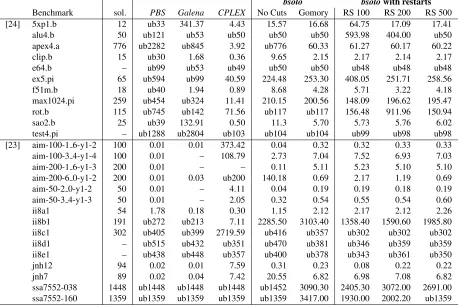
The experimental results are shown in Table 1. After the column with the instance name, there is the indication of the optimum value of the cost function. Notice that there are some instances for which no solver was able to prove optimality3. Forbsolowe present results for different
con-figurations: without using cutting planes, using strength-ened Gomory mixed-integer cuts during the search and us-ing both Gomory cuts and restarts with different initial cut-offs (100, 200 and 500). For allbsoloconfigurations, the lower bound estimates were obtained using LPR.
The CPU times presented are from a AMD Athlon pro-cessor at 1.9 GHz with 1 GB of physical memory. The time limit for each instance was set to one hour. If the time limit is reached, we provide an indication of which was the best upper bound value found when the search was stopped.
Experimental results show that pure SAT-based algo-rithms (PBSandGalena) are not suitable to deal with these logic synthesis instances due to their lack of lower bound es-timation procedures. These algorithms can easily find a so-lution to the constraints, but are unable to identify the opti-mum value of the cost function. On the other hand,CPLEX
andbsoloare able to prove optimality for most of these in-stances. Moreover, by using search restarts,bsolois able to prove optimality for instancealu4.band find a better solu-tion thanCPLEXfore64.bandtest4.pi. One should note that CPLEXis faster than bsolofor some instances since
CPLEXis a commercial tool, with highly optimized code. SAT-based algorithms perform better than CPLEX for instances of the minimum-size prime implicant problem, since finding a solution to the problem constraints is harder. Nevertheless,bsolois the most robust algorithm. Not only isbsoloable to solve allaiminstances, essentially exploit-ing its SAT-based techniques, but is also able to solve the
ssainstances when using Gomory mixed-integer cuts. Re-sults also show that the use of search restarts allowbsoloto perform better for theii8instances, being able to find better solutions thanCPLEXfor several instances.
2TheEclipsetool [15] is not yet available for benchmarking purposes. 3Entries with – denote instances for which a given solver was unable to provide either an upper bound or the optimum value.
7. Conclusions
This paper describes the integration of Gomory mixed-integer cuts in SAT-based algorithms for PBO. In addi-tion, the paper outlines conditions for performing constraint learning and non-chronological backtracking based on pre-viously inferred cutting planes. These conditions provide novel mechanisms for extending the most effective SAT techniques to PBO, including the ability for backtracking non-chronologically from lower bound conflicts. In clear contrast with the work of [15], our approach uses cut-ting planes for learning new constraints, and consequently for performing non-chronological backtracking from lower bound conflicts.
Besides the integration of cutting planes in SAT-based algorithms, the paper also proposes the utilization of search restarts, and shows that the constraints learned from iden-tified cutting planes can be useful for accurating the com-puted lower bounds. Hence, the constraints inferred from identified cutting planes motivate the use of search restarts. The experimental results show that the utilization of cut-ting planes can be extremely effective. In fact,bsolousing Gomory cuts and search restarts is able to solve problem in-stances thatnoother PBO solver is able to solve (including the commercial ILP solverCPLEX). Moreover, the results give further evidence that the use of lower bounding tech-niques is essential for developing effective PBO algorithms.
References
[1] CPLEX MILP solver. http://www.ilog.com/products/cplex/. [2] F. Aloul, A. Ramani, I. Markov, and K. Sakallah. Generic ILP versus specialized 0-1 ILP: An update. In Proc. In-ternational Conference on Computer Aided Design, pages 450–457, November 2002.
[3] E. Balas, S. Ceria, G. Cornu´ejols, and N. Natraj. Gomory cuts revisited.Operations Research Letters, 19:1–9, 1996. [4] P. Barth. A Davis-Putnam Enumeration Algorithm for
Lin-ear Pseudo-Boolean Optimization. Technical Report MPI-I-95-2-003, Max Plank Institute for Computer Science, 1995. [5] R. E. Bixby. Progress in linear programming.ORSA Journal
on computing, 6(1):15–22, 1994.
[6] D. Chai and A. Kuehlmann. A Fast Pseudo-Boolean Con-straint Solver. In Proc. Design Automation Conference, pages 830–835, 2003.
[7] V. Chv´atal. Edmonds polytopes and a hierarchy of combi-natorial problems.Discrete Mathematics, 4:305–337, 1973. [8] O. Coudert. On Solving Covering Problems. InProc. Design
Automation Conference, pages 197–202, June 1996. [9] H. Dixon and M. Ginsberg. Inference Methods for a
Pseudo-Boolean Satisfiability Solver. InProc. National Conference on Artificial Intelligence, pages 635–640, 2002.
Table 1. Results for logic synthesis and minimum-size prime implicant
bsolo bsolowith restarts
Benchmark sol. PBS Galena CPLEX No Cuts Gomory RS 100 RS 200 RS 500
[24] 5xp1.b 12 ub33 341.37 4.43 15.57 16.68 64.75 17.09 17.41
alu4.b 50 ub121 ub53 ub50 ub50 ub50 593.98 404.00 ub50
apex4.a 776 ub2282 ub845 3.92 ub776 60.33 61.27 60.17 60.22
clip.b 15 ub30 1.68 0.36 9.65 2.15 2.17 2.14 2.17
e64.b – ub99 ub53 ub49 ub50 ub50 ub48 ub48 ub48
ex5.pi 65 ub594 ub99 40.59 224.48 253.30 408.05 251.71 258.56
f51m.b 18 ub40 1.94 0.89 8.68 4.28 5.71 3.22 4.18
max1024.pi 259 ub454 ub324 11.41 210.15 200.56 148.09 196.62 195.47
rot.b 115 ub745 ub142 71.56 ub117 ub117 156.48 911.96 150.94
sao2.b 25 ub39 132.91 0.50 11.3 5.70 5.73 5.76 6.02
test4.pi – ub1288 ub2804 ub103 ub104 ub104 ub99 ub98 ub98
[23] aim-100-1 6-y1-2 100 0.01 0.01 373.42 0.04 0.32 0.32 0.33 0.33
aim-100-3 4-y1-4 100 0.01 – 108.79 2.73 7.04 7.52 6.93 7.03
aim-200-1 6-y1-3 200 0.01 – – 0.11 5.11 5.23 5.10 5.10
aim-200-6 0-y1-2 200 0.01 0.03 ub200 140.18 0.69 2.17 1.19 0.69
aim-50-2 0-y1-2 50 0.01 – 4.11 0.04 0.19 0.19 0.18 0.19
aim-50-3 4-y1-3 50 0.01 – 2.05 0.32 0.54 0.55 0.54 0.60
ii8a1 54 1.78 0.18 0.30 1.15 2.12 2.17 2.12 2.26
ii8b1 191 ub272 ub213 7.11 2285.50 3103.40 1358.40 1590.60 1985.80
ii8c1 302 ub405 ub399 2719.59 ub416 ub357 ub302 ub302 ub302
ii8d1 – ub515 ub432 ub351 ub470 ub381 ub346 ub359 ub359
ii8e1 – ub438 ub448 ub357 ub400 ub378 ub343 ub361 ub350
jnh12 94 0.02 0.01 7.59 0.31 0.23 0.08 0.22 0.22
jnh7 89 0.02 0.04 7.42 20.55 6.82 6.98 7.08 6.82
ssa7552-038 1448 ub1448 ub1448 ub1448 ub1452 3090.30 2405.30 3072.00 2691.00
ssa7552-160 1359 ub1359 ub1359 ub1359 ub1359 3417.00 1930.00 2002.20 ub1359
[11] R. Gomory. Outline of an algorithm for integer solutions to linear programs. Bulletin of the American Mathematical Society, 64:275–278, 1958.
[12] R. Gomory. An algorithm for the mixed-integer problem. Technical Report RM-2597, Rand Corporation, 1960. [13] D. S. Johnson and M. A. Trick. Second DIMACS
Implemen-tation Challenge. DIMACS Series in Discrete Mathematics and Theoretical Computer Science, 1994.
[14] A. Letchford and A. Lodi. Strengthening chvatal-gomory cuts and gomory fractional cuts. Operations Research Let-ters, 30(2):74–82, 2002.
[15] X.-Y. Li, M. Stallmann, and F. Brglez. Effective Bounding Techniques for Solving Unate and Binate Covering Prob-lems. InProc. Design Automation Conference, June 2005. [16] S. Liao and S. Devadas. Solving Covering Problems
Us-ing LPR-Based Lower Bounds. InProc. Design Automation Conference, pages 117–120, June 1997.
[17] V. Manquinho and J. Marques-Silva. Search pruning tech-niques in SAT-based branch-and-bound algorithms for the binate covering problem. IEEE Transactions on Computer-Aided Design, 21(5):505–516, May 2002.
[18] V. Manquinho and J. P. Marques-Silva. Effective lower bounding techniques for pseudo-boolean optimization. In Proc. Design, Automation and Test in Europe Conference, March 2005.
[19] J. P. Marques-Silva and K. A. Sakallah. GRASP: A new search algorithm for satisfiability. InProc. International Conference on Computer-Aided Design, pages 220–227, November 1996.
[20] J. Mitchell. Branch-and-cut algorithms for combinatorial optimization problems. InHandbook of Applied Optimiza-tion, pages 65–77. Oxford University Press, 2002.
[21] M. Moskewicz, C. Madigan, Y. Zhao, L. Zhang, and S. Ma-lik. Engineering an efficient SAT solver. InProc. Design Automation Conference, pages 530–535, June 2001. [22] G. L. Nemhauser and L. A. Wolsey. Integer and
Combina-torial Optimization. John Wiley & Sons, 1988.
[23] C. Pizzuti. Computing Prime Implicants by Integer Pro-gramming. InProc. International Conference on Tools with Artificial Intelligence, pages 332–336, November 1996. [24] S. Yang. Logic Synthesis and Optimization Benchmarks