i
“I hereby declare that I have read through this report entitle “Analysis of Performance for Cart
Gantry Crane System using Scheduling Algorithm via Controller Area Network (CAN)” and
found that it has comply the partial fulfillment for awarding the degree of Bachelor of
Electrical Engineering (Control, Instrumentation and Automation)”
Signature : ...
Supervisor’s Name : En. Hazriq Izzuan Bin Jaafar
ii
ANALYSIS OF PERFORMANCE FOR CART GANTRY CRANE SYSTEM
USING SCHEDULING ALGORITHM VIA CONTROLLER
AREA NETWORK (CAN)
MOHAMAD ROSZULFADLI BIN MOHAMAD @ MUDA
This Report Is Submitted In Partial Fullfillment Of Requirements For The Bachelor Of
Electrical Engineering (Control, Instrumentation, and Automation)
Fakulti of Electrical Engineering
UNIVERSTI TEKNIKAL MALAYSIA MELAKA
iii
I declare that this report entitle “Analysis of Performance for Cart Gantry Crane System using
Scheduling Algorithm via Controller Area Network (CAN)” is the result of my own research
except as cited in the references. The report has not been accepted for any degree and is not
concurrently submitted in candidature of any other degree.
Signature : ...
Name : Mohamad Roszulfadli Bin Mohamad @ Muda
Date : 23th June 2016
iv
ACKNOWLEDGEMENT
Firstly, I would like to express my gratitude and appreciation to all those who gave me
the possibility to complete this report. Deepest thanks to my supervisor, Mr. Hazriq Izzuan Bin
Jaafar for his invaluable guidance, stimulating suggestions and encouragement to complete
this project. During under his supervision, lot of valuable information is obtained in order to
coordinate and complete this project and thesis in the time given.
Special thanks and higher appreciation to my parents, family and special mate of mine
for their cooperation, constructive suggestion and also supports from the beginning until the
ends during the period of the project. Also thanks to all my friends and others, that has been
contributed by supporting and helps myself during the final year project progress till it is fully
completed.
Last but not least, greater appreciation to BEKC classmates and Electrical Engineering
Faculty UTeM for great commitment and cooperation during my Final Year Project. Besides, I
would like to appreciate the guidance given by the panels especially in our project presentation
v
ABSTRACT
Gantry Crane System (GCS) is one of the huge machinery that carrying a heavy load from one
place to another. If the load could not handle properly, it can be effected to the workers at the
working area. In order to prevent this issue, the Deadline Monotonic Priority Assignment
(DMPA) and the Earliest Deadline First (EDF) are implemented for this GCS. In addition, the
presence of Controller Area Network (CAN) is also implemented for the model for Multi-Cart
GCS analysis. The analysis is based on the Settling Time (Ts) and Overshoot (%OS). PID
Controller is used to the implementation of this project that serves as a basic requirement of
control system. All conducive to the implementation of the simulation results and the impact
of input-output is the same environment that will be implemented in MATLAB. Based on the
results, the implementation of DMPA and EDF scheduling algorithm via CAN is successfully
analyzed whereby the execution time could not exceed to the period time to make ensure the
vi
ABSTRAK
Sistem Gantri Kren (SGK) adalah salah satu daripada jentera besar yang membawa beban
berat dari satu tempat ke tempat lain. Jika beban tidak dapat dikendalikan dengan baik, ia
boleh menjadi kesan kepada pekerja di kawasan kerja. Untuk mengelakkan masalah ini,
Deadline Monotonic Priority Assignment (DMPA) dan Earliest Deadline First (EDF)
dilaksanakan untuk SGK ini. Di samping itu, kehadiran Controller Area Network (CAN) juga
dilaksanakan untuk model. Analisis ini adalah berdasarkan kepada Masa Penyelesaian dan
Masa Lonjakan. PID Controller digunakan untuk pelaksanaan projek ini yang berfungsi
sebagai keperluan asas sistem kawalan. Semua kondusif untuk pelaksanaan keputusan simulasi
dan kesan masukkan-keluaran adalah persekitaran yang sama yang akan dilaksanakan dalam
MATLAB. Berdasarkan keputusan, pelaksanaan DMPA dan EDF algoritma penjadualan
melalui CAN berjaya dianalisis di mana masa pelaksanaan tidak boleh melebihi tempoh sistem
vii
TABLE OF CONTENT
CHAPTER TITLE PAGE
PROJECT TITLE
ACKNOWLEDGEMENT
ii
iv
ABSTRACT v
ABSTRAK vi
TABLE OF CONTENT vii
LIST OF TABLE x
LIST OF FIGURE xi
LIST OF ABBREVIATIONS xiv
LIST OF APPENDIXES ix
1 INTRODUCTION 1
1.1 Gantry Crane System (GCS) 1
1.2 Objectives 2
1.3 Motivation 3
1.4 Problems statement 3
1.5 Scopes 4
1.6 Report outline 4
2 LITERITURE REVIEW 6
2.1 Introduction 6
2.2 Control System of GCS 6
2.3
2.4
Deadline Monotonic Priority Assignment (DMPA)
Earliest Dead First (EDF)
7
viii
2.5
2.6
Controller Area Network (CAN)
Conclusion
10
11
3 METHODOLOGY 12
3.1 Project Planning 12
3.2 Gantry Crane System Model 15
3.3 Mathematical Modeling 16
3.4 Simulation of Single Trolley GCS 17
3.5 Analysis of Multi-Cart GCS Based on DMPA and EDF
Algorithm
19
3.6
3.7
Scheduling Algorithm Via Controller Area Network (CAN)
3.6.1 Analysis of GCS Based on DMPA and EDF
Algorithm via CAN
Conclusions
20
21
23
4 RESULTS AND DISCUSSIONS 24
4.1 Result of Simulation for a Single-Cart GCS 24
4.2 Result of Simulation for a Multi-Cart GCS 30
4.3
4.4
4.2.1 Analysis of DMPA Algorithm
4.2.2 Analysis of EDF Algorithm
Result of GCS on DMPA and EDF Algorithm via CAN
4.3.1 Analysis DMPA and EDF Algorithm via CAN for
CASE 1
4.3.2 Analysis DMPA and EDF Algorithm via CAN for
CASE 2
4.3.3 Analysis DMPA and EDF Algorithm via CAN for
CASE 3
Discussion
4.4.1 Single-Chart GCS Analysis Discussion (DMPA and
ix
4.5
4.4.2 Multi-Chart GCS Analysis Discussion (DMPA and
EDF)
4.4.3 Analysis Discussion DMPA and EDF Algorithm via
CAN
Conclusion
44
46
48
5 CONCLUSIONS 49
5.1 Conclusions 49
5.2 Future Work 50
REFERENCES 51
x
LIST OF TABLES
TABLE TITLE PAGE
3.1 System Parameter Value 16
4.1 CASE 1 - Period and Execute Time for Network Node 35
4.2 CASE 2 - Period and Execute Time for Network Node 38
4.3
4.4
4.5
4.6
4.7
4.8
CASE 3 - Period and Execute Time for Network Node
Effect of Control Performances
Effect of Control Performances
Effect of Control Performances
Effect of Control Performances
Effect of Control Performances
41
44
45
46
47
48
xi
LIST OF FIGURES
NO. TITLE PAGE
1.1 Gantry crane 2
3.1 Flowchart o Project 13
3.2 K-Chart 14
3.3 Schematic Diagram of gantry crane 15
3.4 Single Gantry Crane System (GCS) 17
3.5 Block Diagram inside the Main Block of GCS 18
3.6 Initialize True Time Kernel and Task Attributes 18
3.7 Initialize True Time Kernel and Task Attributes for Execution
Time
18
3.8 DMPA Initialize True Time Kernal and Task Attributes 19
3.9
3.10
EDF Initialize True Time Kernal and Task Attributes
Three Gantry Crane System (GCS)
19
20
3.11 Implement DMPA and EDF via CAN 20
3.12 Simulink Block Diagram GCS with CAN 21
3.13
3.14
TRUETIME Network Parameter Configuration
Selection of Scheduling Mode
22
23
4.1 DMPA execution time case 1 25
4.2 DMPA case 1- Reference Input (r), Trolley Displacement (y) and
Control Signal (u)
25
4.3 EDF execution time case 1 25
4.4 EDF case 1- Reference Input (r), Trolley Displacement (y) and
Control Signal (u)
xii
4.5 DMPA Execution time case 2 26
4.6 DMPA case 2- Reference Input (r), Trolley Displacement (y) and
Control Signal (u)
26
4.7 EDF Execution time case 2 26
4.8 EDF case 2- Reference Input (r), Trolley Displacement (y) and
Control Signal (u)
27
4.9 DMPA Execution time case 3 27
4.10 DMPA case 3- Reference Input (r), Trolley Displacement (y) and
Control Signal (u)
28
4.11 EDF execution time case 3 28
4.12 EDF case 3- Reference Input (r), Trolley Displacement (y) and
Control Signal (u)
28
4.13 DMPA execution time case 4 29
4.14 DMPA case 4- Reference Input (r), Trolley Displacement (y) and
Control Signal (u)
29
4.15 EDF execution time case 4 29
4.16 4.17 4.18 4.19 4.20 4.21 4.22 4.23 4.24 4.25 4.26
EDF case 4- Reference Input (r), Trolley Displacement (y) and
Control Signal (u)
Task Parameter Declaration for EDF
Control performance for DMPA analysis
Computer schedule for DMPA analysis
Control performance for EDF analysis
Computer schedule for EDF analysis
DMPA and EDF Schedule Analysis of Gantry Crane System with
CAN
DMPA and EDF Analysis of Gantry Crane System with CAN
DMPA and EDF Schedule Analysis of Gantry Crane System with
CAN
DMPA and EDF Analysis of Gantry Crane System with CAN
DMPA and EDF Schedule Analysis of Gantry Crane System with
xiii
xiv
LIST OF ABRREVIOTIONS
GCS - Gantry Crane System
DMPA - Deadline Monotonic Priority Assignment
PID
EDF
-
-
Proportional, Integrator and Derivative
Earliest Deadline First
1
CHAPTER 1
INTRODUCTION
This chapter will explain descriptions of Gantry Crane System (GCS) that will be
discussed to provide knowledge about the project. The objectives, statements of issues, scope
and project outlines for the project as a whole is clearly stated in this chapter.
1.1 Gantry Crane System
Gantry Crane is a vehicle that is also known as cart. The cart used to carry loads from
one place to another place in time. Gantry Crane Systems (GCS) need a good control system
because GCS heavily involved in the work environment and must be controlled precisely to
avoid any unwanted accidents in [1]. The GCS is the most popular in the form of container
gantry cranes. It is used for loading containers used to load and transport hub in the outer
container ships. It can be categorized as huge gantry crane "full", capable of carrying the
heaviest in the world. The small gantry crane normally carries out the work of lifting loads
less severe as the engine to be removed or inserted into the vehicle.
The main purpose of this study was to perform a good system of gantry crane, where it
2
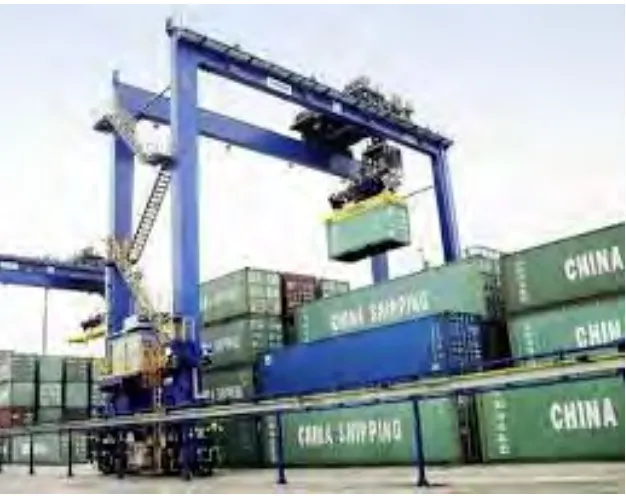
aims to put some gantry crane on a common platform. Figure 1.1 shows one example of a
[image:16.612.166.479.151.399.2]gantry crane used in the industry in Malaysia.
Figure 1.1 : Example of a Gantry Crane System
1.2 Objectives
This study embarks on the following objectives :
i. To design TRUETIME simulation environment for analyzing Single Cart
Gantry Crane System (GCS) via Deadline Monotonic Priority Assignment
(DMPA) and Earliest Deadline First (EDF) scheduling techniques.
ii. To analyze the DMPA and EDF for three model of Cart GCS running
3
iii. To evaluate the DMPA and EDF scheduling techniques by using Controller
Area Network (CAN) on the global schedule performances.
1.3 Motivation
In the work done by the GCS is primarily concerned with safety. This is because the
work performed by GCS very dangerous to the environment and can kill workers who were
around. Operating conducted by GCS is associated with heavy materials and may have
dangerous substances like explosives or other. The main objective of this project is to give
attention to the position of the cart at GCS. In addition, this project will to the favorable
impact on the speed of GCS without much effect on load swing.
1.4 Problem Statement
Gantry crane is a system for carrying loads from one place to another. Gantry cranes
facilitate the work carrying heavy loads. Gantry cranes have to pay for the speed of its tasks to
save time without giving too much power to the load swing. One had accidents is human error,
which operates in the state of GCS manual. Furthermore, the percentage of accidents is high if
the load is bigger and heavier. Ranking trolley must immediately follow the requirements of
the system to stop the trolley in the current move. Scheduling methods are very important for
GCS to control the position and speed of the trolley is good and in accordance with the
4
1.5 Scopes
The scope on this project, state as below:
I. Analyze the system of Deadline Monotonic Priority Assignment (DMPA) and
Earliest Deadline First (EDF) in Single Trolley Gantry Crane System (GCS).
II. The scheduling algorithm and simulation purpose via MATLAB environment.
III. Implement the Controller Area Network (CAN) into the system to analyze the
DMPA and EDF scheduling algorithm.
1.6 Report outlines
There are report outlines, as below:
Chapter 1 is the introduction to the project. The objectively, problem statement and scope
of the project is obviously in this report.
Chapter 2 is the study of GCS through some paper work that has been done by the
researchers of this wipeout, scheduling algorithms, and network control method.
Chapter 3 is about the methodology of the entire project, which will tell you the steps
from the beginning of the project until the end of the project. Additionally, it will tell you the
materials used during this project, such as Matlab Software will be used to perform
simulations on the project.
Chapter 4 is showing the results of the implementation of the project. As a result of the
implementation of this project divides into three parts, of which the first part is a result of the
Single Trolley GCS to implement scheduling algorithms. Part two is the Multi-Cart GCS and
the top three were Cart GCS with scheduling algorithms in the Controller Area Network
5
Chapter 5 is the end of the evaluation and discussion of the overall project for future
6
CHAPTER 2
LITERATURE REVIEW
2.1 Introduction
In this chapter, it discusses previously associated in this research. The method used in
this research scheduling algorithm through the Control Area Network (CAN) and some other
methods used in the implementation of GCS. The main purpose of this chapter is to
understand and delve more deeply into the methods used.
2.2 Control System of GCS
In 2012, researchers have used genetic Fuzzy System to control the gantry crane [2].
This method is a form of gain scheduling control system. This technique is appropriate and
broad based multi-parameter controller by exogenous variables. In addition, this technique is
aimed at finding the minimum linear scheduled set by the fuzzy controller interpolation
schema. But the researchers are just focusing sheets y axis on which anti-swing crane. The
7
In 2011, a researcher has focused on the effects of heavy load on the system response
GCS. In his research [3], he uses feedback control schemes for GCS. To achieve this result
were evaluated with different weights in algorithm. Three different control strategies used by
researchers, namely LQR, PD controller for DFS and simulation exercises in Matlab, and the
results were compared with the uncontrolled system. Many researchers have used the term
open loop optimal strategy as discussed in [4,5]. However, they come out with results that are
not good for open-loop strategy because it is sensitive to parameters (eg rope long) and cannot
recompense for wind noise. Singhose [6] introduced the importance of open-loop strategy is
the input form. However input form the method is still open loop approach. But others with
feedback control, it is less sensitive to noise and parameter variation [7] is also used to control
the GCS.
2.3 Deadline Monotonic Priority Assignment (DMPA)
DMPA is the inverse of the deadline and it is similar in concept to rate monotonic
priority. Where priority is given to the process is inversely proportional to the length of the
deadline. Short deadlines or quickly given the highest priority and due date of the oldest of the
lowest priority. The patient is the priority order when the next rate monotonic order to match
the deadline (period = the deadline). DMPA is a static priority scheme optimal for fast sharing
of critical process. This was stated as Theorem 2.4 in [8] “Reverse-deadline optimum priority
assignment for the processors”. In [9] states that any set of processes whose characteristics
appropriate time to rate monotonic analysis will also be accepted by virtue of static theory that
justifies the deadline and within different processes.
Generally, where a deadline-monotonic scheme who are not working due to lack of
sufficient schedulability test. The rate-monotonic scheduling schedulability test can be used to
reduce the length of the individual so that the same process with deadlines. This situation
obviously test it will not be optimal because the workload on the processor will exceed the
8
to their deadline, the task with a short deadline given the highest priority. Optimal assignment
policy priorities for a set of tasks on a regular or occasional strictly compliant system model
like, all tasks have deadlines of less than or equal to the minimum their time between the
arrival (or periods) and all tasks have the worst-case execution times (WCET) of less than or
equal to their end date. All tasks are independent and so do not prevent their implementation.
This is because there is a duty voluntarily suspends itself. There is a point in time, the
so-called critical instant, where all tasks to be ready to execute simultaneously and when
scheduling overhead is zero. Over scheduling is intended to switch from one task to another.
All tasks have zero emissions jitter (time of assignment arrived for it to be ready to
implement).
Besides that, for the example in [10] if the restriction is lifted 7, then "deadline less
jitter" monotonic priority assignment is optimal. If the restrictions lifted to allow the deadline
to be greater than the last, then Audsley optimum priority assignment algorithm can be used to
find the optimum priority assignment.
2.4 Earliest Deadline First (EDF)
The Earliest Deadline First (EDF) is a dynamic scheduling algorithm used in real-time
operating system to put a process in the priority queue. The priority queue is an abstract data
type as a stack data is unusual, but in which every element has an additional "priority"
associated with it. In the priority queue, an element with priority served before the element
with low priority. If two elements have the same priority, they are served according to their
order in the queue. Although priority queue are often implemented with a stack, they are
conceptually different from the stack.
The priority queue is an abstract concept such as “list” or “map”. It is only as a list can
be implemented with a linked list or array. In addition, the priority queue can be implemented
9
such as a completed task scheduling, the line will be searched for the closest to the deadline.
This process is next scheduled for execution. EDF is an optimal scheduling algorithm in
uniprocessors advance. It means, if the collection of independent and each has features that
moment arrived, the implementation requirements and deadlines, it can be scheduled with any
algorithm in a way that ensures all work completed by their deadlines. EDF will schedule the
collection so that they all complete the work according to their deadline. EDF can guarantee
all the deadlines met provided that the total CPU usage is more than 100%. EDF can ensure
that all deadlines in the system of higher loading compared with fixed priority scheduling
techniques such as scheduling classes monotonic [11].
In [12], the researchers have used the EDF for automotive applications. Generally,
automotive applications are cyber ordinary physical systems, where it performs real-time
processing of continuous data using a variety of sensors and communication on board from
outside the vehicle. However, transmission of data outside-the-vehicles often has problems
when introducing data rate fluctuations are large, where the arrival time can vary or not be
guaranteed. The researchers have determined the flow and have been using EDF Scheduling.
These techniques can be used not only EDF-PStream, but also for general data processing
flow-based EDF. EDF-Tstream is a method that uses rescheduling by EDF preemtable data
stream. The design method preemptable data flow task by their characteristics, and the
researchers confirmed the effectiveness of this method is based on analysis and experiments
[12]. It showed improved efficacy in a real-time implementation constraints, reduction of
vehicle accidents, and vehicle positional accuracy, compared to the scheduling method based
on data flow. existing real-time scheduling cannot handle the data flow out of order queuing,
and search out-of-order queue by EDF performance degrades as frequently accessing queues.
Weighted Fair Queueing (WFQ) [13] and the earliest Deadline First (EDF) [14] have been
extensively studied in recent years. WFQ and EDF using dynamic priority mechanisms in the
packet and both can provide end-to-end delay limits for regulated traffic flow. In a packet
network, the scheduling is an important mechanism for realizing the Quality-of-Service (QoS)
as it directly controls the packet delay. WFQ has good properties for the protection of traffic,
while EDF is known to be the optimum delay in providing limits on single node [15]. If in the
10
2.5 Control Area Network (CAN)
A Controller Area Network (CAN) is a vehicle bus standard designed to allow
microcontrollers. CAN is also for the tools to communicate with each other in the application
without a host computer. It is a message-based protocol, originally designed for a multiplex
electrical wiring in cars, but also used in many other contexts. Car accidents or vehicle on the
road is often the case. One of the reasons is because drivers are often sleepy when driving.
Therefore, in [17] the researchers have been using CAN as control Advanced RISC Machines
(ARM). The system is safe for drivers who often sleepy when driving. Both ARM controller,
Master and Slave are connected to the CAN bus protocol for exchanging information and for
commu-nication. The CAN be used for faster and reliable Communi-cations.
In a study [18], a system developed using ARM controller as the main control unit and
CAN bus in a car. ARM is used to get high performance. CAN makes use of high-speed
communication in control networks. Besides, it also helps the sharing of data between all
nodes resulting increase their collaborative work. Vehicle reliability is largely influenced by
the complexity of the circuits used in control systems [19, 20] in an increasing number of
electronic controllers and instruments in the modern automotive industry. Maintenance is
difficult to carry out and from the point of view of the layout, electrical systems using
point-topoint traditional single communication approach, which inevitably will lead to the big
problem of cable pets. Thus, CAN is used as a high quality vehicle for the bus system to
connect all the controllers in the system to achieve unified management [21]. The CAN lead to
easier data sharing and interoperability between different control systems. Due to the
complexity of the vehicle, for example, the entire vehicle with a sensor assigned to various
standard and automotive systems is the data in various formats such as complex data,
heterogeneous data etc. [22].
Vehicle systems need information to the maintainer and driver. It is necessary to
design an efficient, reliable gateway and data processing systems. The gap between different
systems is difficult to meet is a concoction. This problem can be solved by the entrance bridge