Texture classification via conditional histograms
Eugenia Montiel
a,*, Alberto S. Aguado
a, Mark S. Nixon
ba
Electronic and Electrical Engineering, University of Surrey, Guildford, Surrey GU2 5XH, United Kingdom b
Electronics and Computer Science, University of Southampton, Southampton SO17 1BJ, United Kingdom
Received 21 September 2003; received in revised form 1 October 2004 Available online 29 April 2005
Communicated by E. Backer
Abstract
This paper presents a non-parametric discrimination strategy based on texture features characterised by one-dimen-sional conditional histograms. Our characterisation extends previous co-occurrence matrix encoding schemes by con-sidering a mixture of colour and contextual information obtained from binary images. We compute joint distributions that define regions that represent pixels with similar intensity or colour properties. The main motivation is to obtain a compact characterisation suitable for applications requiring on-line training. Experimental results show that our approach can provide accurate discrimination. We use the classification to implement a segmentation application based on a hierarchical subdivision. The segmentation handles mixture problems at the boundary of regions by considering windows of different sizes. Examples show that the segmentation can accurately delineate image regions.
2005 Elsevier B.V. All rights reserved.
Keywords: Texture classification; Co-occurrence features; Image analysis; Image segmentation; Region detection; Non-linear image analysis
1. Introduction
Previous works have shown that histograms can be used as powerful descriptions for non-para-metric classification (Unser, 1986a; Valkealahti
and Oja, 1998; Ojala et al., 1996, 2000; Hofmann et al., 1998; Puzicha et al., 1999). In contrast to parametric features (Haralick, 1979), histograms contain all the information of distributions avoid-ing the problem of feature selection. In general, the development of a method for automatic feature selection is not trivial since optimal performance requires a careful selection of features according to particular types of textures (Ohanian and Dubes, 1992; Jain and Zongker, 1997; Sullis,
0167-8655/$ - see front matter 2005 Elsevier B.V. All rights reserved. doi:10.1016/j.patrec.2005.02.004
*
Corresponding author. Tel.: +44 1483 68 6044; fax: +44 1483 68 6031.
E-mail addresses:[email protected](E. Montiel), [email protected](M.S. Nixon).
1990; Ng et al., 1998). However, histograms can-not be directly used as texture descriptors; the computation and dimensionality impose prohibi-tive computational resources for applications (Rosenfeld et al., 1982; Augusteijn et al., 1995). The computation of histograms of low-dimension-ality is considered as an open problem (Unser, 1986a; Valkealahti and Oja, 1998; Rosenfeld et al., 1982; Ojala et al., 2001).
In addition to make texture descriptors useful for applications, the reduction of histogramÕs dimensionality has two important implications. First, it avoids sparse histograms due to insuffi-cient training data. Secondly, if histograms are compact, it is possible to consider more complex pixels interdependencies increasing the discrimina-tion power. It is important to notice that if the his-togram reduction is effective, we should expect good discrimination with similar features than the ones used to codify the high dimension descrip-tion. As such, it is important to distinguish be-tween the effectiveness of the reduced process and the additional power obtained by including more complex pixel interdependencies.
A powerful approach to histogram reduction is to perform a quantisation to adapt the histogram bins according to the distribution (Puzicha et al., 1999). In (Valkealahti and Oja, 1998; Ojala et al., 2001) the adaptation is defined by using techniques of vector quantisation (Gersho and Gray, 1992). Results on texture discrimination have shown that this is a very powerful technique to reduce multi-plex (i.e., >2) co-occurrences. However, although a tree structure can be used to handle the complex-ity required by the encoder, yet the encoder re-quires a significant number of operations and sample data. The search uses more memory that a full search vector quantisation and the process can lead to sub-optimal solutions (Gersho and Gray, 1992).
In this paper, we simplify histograms by con-sidering combinations of the random variables defining the joint probability function (i.e., grey tone or colour dependence) (Unser, 1986a; Rosen-feld et al., 1982; Ojala et al., 2001). In (Rosenfeld et al., 1982), and later (Unser, 1986a), histograms define the probability of the differences of grey levels for pixel pairs. The motivation is that these
operations define the principal axes of the second order joint probability function (Unser, 1986a). However, they have had an unpredictable success in applications (Schulerud and Carstensen, 1995; Chetverikov, 1994). The main caveat of this repre-sentation is that, in general, random variables in a texture do not define Gaussian independent distri-butions. Additionally, although the average error of the difference is well approximated by the factorised probability (Ojala et al., 2001), the difference operation loses spatial information and histograms can become bad approximations of joint probability functions. In order to maintain spatial information, we propose to encode the tex-tureÕs random structure by computing joint proba-bilities defining the dependence between pixels forming regions sharing intensity or colour prop-erties. To reduce dimensionality, statistical distri-butions are computed for binary images. We combine joint distributions of binary values and the probability of intensity values to define a collection of histograms. These histograms are normalised, thus they can be used for non-para-metric texture discrimination independently of the size of the sampled region (Puzicha et al., 1999).
in (Chen and Pavlidis, 1979), but it divides an image using non-parametric classification.
2. Statistical characterisation of textures
The interdependence of pixels in a texture can be defined by the joint probabilities computed for random variables associated to pixel intensi-ties. Given n discrete random variables c(x1),
c(x2),. . .,c(xn) at positions x1,x2,. . .,xn, the n
th-order density function defines the probability that the variables take the values c1,c2,. . .,cn,
respec-tively (Papoulis, 1991). That is, f(c1,. . .,cn;x1,. . .,
xn) =P{c(x1) =c1,. . .,c(xn) =cn}. Here, c takes
values within the range of possible grey levels or colours. Since textures are stationary processes, then distributions can be expressed independently of their position. Thus, f(c1,. . .,cn;x1,. . .,xn)
de-pends on the distance between x1 and any other
variable xi. That is, f(c1,. . .,cn;s2,. . .,sn) for si= jxix1j. This function represents the probability
of obtaining the grey level values c1,c2,. . .,cn at distancess1,s2,. . .,snmeasured fromx1. The
gen-eral form can be limited to different orders to de-fine alternative texture descriptors. For example, co-occurrence matrices (Haralick et al., 1973a; Kovalev and Petrou, 1996; Strand and Taxt, 1994) are defined by considering only two points. That is,
fðc1;c2;sÞ for s¼ jx2x1j ð1Þ
for values ofsdefining neighbourhoods of 3·3 or 4·4 pixels. These descriptors have powerful dis-crimination properties. However, the computation of the probability for each combinationc1andc2
requires a large number of samples and computa-tions. Previous works have considered simplifica-tions obtained by replacing the dependence on the valuesc1andc2for arithmetical combinations
(Unser, 1986a; Rosenfeld et al., 1982; Ojala et al., 2001). For example difference histograms (Ojala et al., 2001) are defined as
fðc1;c2c1;sÞ ð2Þ
This equation characterises the same information as Eq. (1), but the changes in intensities are given relative to the value atx1. This can be simplified by
considering that all the possible values ofc1have
the same probability of occurrence and that the probabilities of P{c(x1) =c1} and P{c1c2=a}
are independent. In this case
fðc1;c1c2;sÞ ffifða;sÞ fora¼c1c2 ð3Þ
This description can be extended to large neigh-bourhoods or to differences of higher order. The main advantage is that it is simpler than Eq.(1), thus it can make the classification faster and it re-quires less training data. The main drawback is that many combinations of valuesc1,c2map into
the same value ofa, thus information about per-mutations is lost. Additionally, dependence on intensity information is lost making classification on small regions difficult. In the next section we present a characterisation that simplifies Eq. (1)
keeping dependence in intensity information. Pre-vious works have shown the importance of inten-sity values for classification (Dubuisson-Jolly and Gupta, 2000).
3. Conditional histograms
We can describe the interdependence of pixels in a texture by considering ideas of binary feature selection. Previous works have shown that binari-sation can be very effective to characterise the spa-tial dependence of pixels in images (Wang and He, 1990; Chen et al., 1995; Hepplewhite and Stonham, 1997; Ojala and Pietika¨inen, 1999). As suggested in (Ojala et al., 2000), we use the joint distribution of binary patterns. However, in order to be able to locate a texture embedded in different images, we use a global threshold strategy (Chen et al., 1995). A global threshold divides an image into re-gions with similar intensity properties. Thus, we can expect that the joint probabilities computed in a binary image to contain much of the informa-tion about the spatial structure of the texture.
Ifc1andc2represent binary features atx1and
x2, then the structural information given by the
permutations in two locations can be written as
fðc1jc1;c2;sÞ fors¼ jx2x1j ð4Þ
neighbouring pixels. Since we consider binary fea-tures, the second-order spatial and intensity inter-dependencies of neighbouring pixels are defined by the four histograms
f1ðc1;sÞ ¼fðc1j0;0;sÞ
f2ðc1;sÞ ¼fðc1j0;1;sÞ
f3ðc1;sÞ ¼fðc1j1;0;sÞ
f4ðc1;sÞ ¼fðc1j1;1;sÞ
ð5Þ
This description can be extended to large neigh-bourhoods orn-order interdependencies. That is,
fðc1jc1;c2;. . .;cn;s2;. . .;snÞ for si¼ jxix1j
ð6Þ
Thus a texture is characterised by 2n one-dimen-sional histograms per binary feature. For colour or multispectral images, we can maintain a low dimensionality by considering each colour compo-nent separately. Thus, for an image with m chro-matic components, we have m2n histograms. Although it is possible to consider directly the colour components in the definition of the histograms, in general, it is better to perform a pre-processing such that each component has a higher discriminatory ability. For example, if c1,R,c1,Gandc1,Bare the red, blue and green
val-ues of an image (i.e.,m= 3) then the description in Eq.(6) can be extended to
fðc1jjc1;c2;. . .;cn;s2;. . .;snÞ ð7Þ
for
c1;1¼ ðc1;Rþc1;Gþc1;BÞ=3
c1;2¼c1;Rc1;B
c1;3¼ ð2c1;Gc1;Rc1;BÞ=3
ð8Þ
These definitions can obtain a set of components with discriminatory ability as good as that ob-tained by the Karhunen Loeve transformation (Ohta et al., 1980).
4. Classification
In general, the classification performance de-pends on the discrimination approach. Numerous discrimination approaches are possible (Devijver
or region tracking applications, it is important to minimise the number of times the user selects sam-ples to delineate a region of interest. Additionally, in these applications, training cannot be performed off-line, thus we have to minimise the time spent in computing features and in creating the texture database.
In non-parametric classification techniques, there are alternative ways to define the dissimilar-ity between histograms. Valuable experimental work has evaluated the performance of alternative dissimilarity measures for k-NN classifiers (Ojala et al., 1996; Puzicha et al., 1999). The results sug-gest that the performance depends on several fac-tors such as the size of the training data, type of features, type of images and particular applica-tions. In general, when histograms are not sparse (e.g., by using marginal distributions or by consid-ering many training samples (Puzicha et al., 1999)), the difference in performance is not signi-ficant for most measures. For small sample data, it is better to use measures based on statistics or aggregate measures less sensitive to sample noise. Since we are using only one set of histograms per class, thus we expect (and in fact this is part of the motivation to reduce dimensionality) to have histograms with a significant number of entries per bin. Thus, we choose to use theL1norm that
provides a good classification with a small compu-tational load. In the case of windows with few pixels, the performance can be maintained if the number of bins is reduced. This can be achieved by adaptive binning, but this is computationally expensive (Ojala et al., 1996). In a simpler strategy, we constrain the similarity measure to bins that have a significant number of entries.
By considering Eq. (6), a test sample S is as-signed to the class of the modelMjthat minimises the absolute difference between corresponding bins in each histogram.
DðS;MjÞ ¼
Xm2n
h
X
i
jfShðcijc1;c2;. . .;cn;s2;. . .;snÞ
fMj;hðcijc1;c2;. . .;cn;s2;. . .;snÞj ð9Þ
The fist summation indicates all the histograms whilst the second summation iterates for each bin. The sub-indexhis used to index the histogram
of the sample and the model. This definition mea-sures whether the pixels in two textures have simi-lar intensities with simisimi-lar spatial organisation. That is, the value of D(S,M) will be small if the intensity values of the two textures are similar and they are grouped into regions of similar contrast.
5. Segmentation
We used the classification to implement a seg-mentation application based on a top-down hier-archical subdivision. This approach searches for an optimum partition by dividing the image in a quad-tree homogenous decomposition. This com-prises three steps. First, a region is classified. Sec-ondly, it is partitioned and each partition is classified. Finally, it is necessary to measure the homogeneity of the partition. If the region is homogenous, then the whole region is assigned to the same class and the subdivision is stopped. If the region is not homogenous, the region is subdivided. The subdivision is repeated until the image region is equal to one pixel.
measure the variance of the sub-blocks, but the confidence that we have in the result.
We consider the uncertainty in classification as the ratio between the similarity values of the two textures in the database that are most similar to the distribution computed from a region. We denote as j the element that minimises D(S,Mj)
and we denote as DðS;MjÞ the corresponding
minimum value. We denote as j+ the class that minimisesD(S,Mj) when the elementjis not con-sidered. Thus,DðS;MjþÞdenotes the distance value
for the classj+. The uncertainty of classifyingSis defined as
UðS;jÞ ¼DðS;MjþÞ
DðS;MjÞ ð
10Þ
This measure will be close to one if the classifica-tion is vague. The uncertainty in the classificaclassifica-tion decreases when the difference between classifica-tion distances increases. Thus, the subdivision must minimise the uncertainty in the entire image. We perform the subdivision based on the compar-ison between the uncertainty of the region and the uncertainty of the new regions. However, this comparison cannot be based on the uncertainty between different levels in the quad-tree. Since each level of the quad-tree has regions of smaller size, then the uncertainty in lower levels is always higher.
In order to evaluate the subdivision, we con-sider the uncertainty when regions are classified by considering the class in the upper level and the new classification in the low level. If S1, S2,
S3 and S4 are the regions in a subdivision, then
the change in uncertainty due to a splitting opera-tion can be measured as
UðS1;jÞ þUðS2;jÞ þUðS3;jÞ þUðS4;jÞ
ðUðS1;j1Þ þUðS2;j2Þ þUðS3;j3Þ þUðS4;j4ÞÞ
ð11Þ
where j minimises in the upper level and, j 1;
j
2;j3 andj4 minimise each one of the new
sub-re-gions. The sub-division is performed if the abso-lute difference in Eq. (11) is lower than a fixed threshold. The basic idea is to subdivide the region only if it is composed of several textures. In this case, the classification obtained by smaller regions
composing a mixture has less uncertainty than when we consider a single class for the whole region.
Although uncertainty is capable of giving a use-ful measure of homogeneity, still it is extremely difficult to classify small blocks in an image. If the window is to small, then it probably does not contain sufficient information to characterise the region, thus increasing the probability of misclassification (Ojala et al., 2000). In order to obtain an accurate delineation of texture regions, we reduce the number of potential classes. When the subdivision is due to a boundary and the win-dow size is smaller than a fixed threshold, the clas-sification is made by considering only the texture classes of current and neighbour regions. That is, we assume that there are not new regions smal-ler than the fixed threshold, thus the segmentation can be stopped and the subdivision can only be used to delineate the existing coarse regions. The threshold size determines the minimum data necessary to obtain a good classification and it is strongly dependent on the number of texture categories. As more classes are included, the probability of misclassification of small data in-creases. Thus, the threshold should be increased such that, the classification of regions is made by including enough information. The threshold should be set to the minimum window size for which the classification obtains reliable results. This value is an input parameter of the classifica-tion applicaclassifica-tion.
6. Experimental results and examples
6.1. Experimental data
For the 32-category problem, texture samples are obtained from a 256·256 image with 256 grey levels. Each image is subdivided into 16 blocks of 64·64 pixels and each block is transformed into three new blocks by 90 rotation, scale from the 45·45 pixels in the middle and by combining rotation and scaling. This produces 2048 blocks. Half of the data is selected by randomly choosing 8 blocks and the corresponding transformed blocks. This data is used to define class histograms and the remaining blocks to evaluate the classifica-tion process.
The 16-category problem uses four types of images containing four distinct textures. Two types of textures are generated from fractal and Gaussian Markov random field models. The other two types were obtained from leather and painted surfaces. Images are divided into 256 non-overlapping regions of 32·32 pixels. Only 200 regions of each image are selected to obtain 3200 samples. Performance is measured by con-sidering the leave-one-out error. Thus, 3184 samples are used for training and 16 to assess the discrimination.
6.2. Computation of features
In contrast to (Valkealahti and Oja, 1998) where feature histograms are computed for each texture block separately by considering a 4·4 neighbourhood, we obtain histograms for each texture category by considering only a 2·2 neigh-bourhood. Thus, the 32 training blocks of each class are used to compute 4·4 conditional histo-grams. The first collection of four represents the class without any geometric transformation; the second collection is used for the scale, and the last two for rotation and combination of scale and rotation. To obtain binary features, we use three fixed thresholds with values of 128, 64 and 32. Thus, each class is represented by 4·4·3 histo-grams.
[image:7.544.285.501.121.461.2]6.3. Classification results
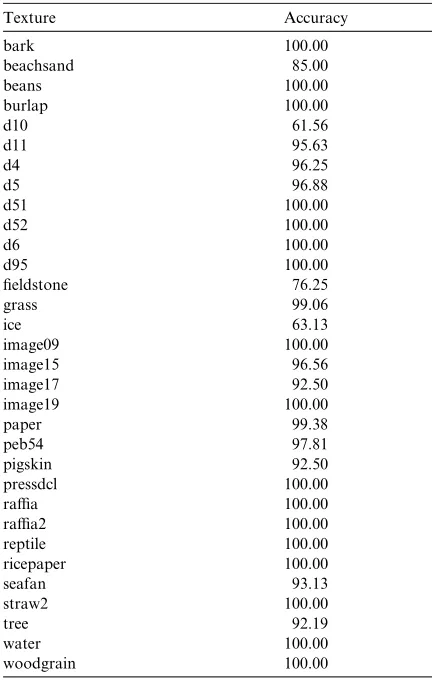
Table 1shows the average classification results obtained for 10 random selected test sets for the first test. The table shows the average for each class.
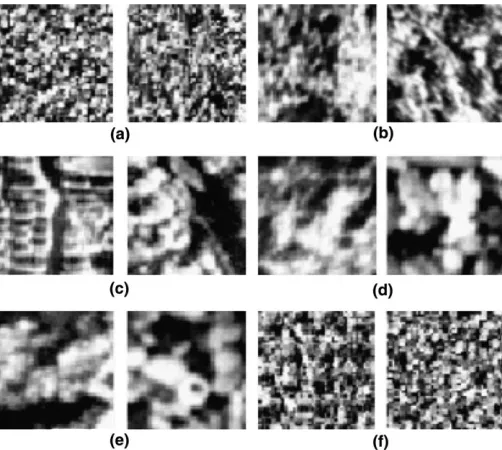
In general, the classification performance is very good with exception of the classes: beachsand, D10, ice and fieldstone. A detailed observation of the results showed that most misclassifications for these classes are for blocks obtained by the scale transformation.Fig. 1shows six examples of these misclassifications.Fig. 1(a) shows a block of beach-sand that was misclassified as the class grass. The second texture inFig. 1(a) shows an example of this class. Fig. 1(b)–(f) shows other misclassifications obtained for the scaling classes. The remarkable similarity between the textures inFig. 1can explain the misclassifications. Additionally, since scaling is obtained from digital images, there is some lost in resolution and as consequence aliasing produces Table 1
Average classification accuracies (%) over 10 experiments for 32 texture categories
Texture Accuracy
bark 100.00
beachsand 85.00
beans 100.00
burlap 100.00
d10 61.56
d11 95.63
d4 96.25
d5 96.88
d51 100.00
d52 100.00
d6 100.00
d95 100.00
fieldstone 76.25
grass 99.06
ice 63.13
image09 100.00
image15 96.56
image17 92.50
image19 100.00
paper 99.38
peb54 97.81
pigskin 92.50
pressdcl 100.00
raffia 100.00
raffia2 100.00
reptile 100.00
ricepaper 100.00
seafan 93.13
straw2 100.00
tree 92.19
water 100.00
new blocks with very similar values for neighbour-ing pixels. Thus, spatial information obtained by considering neighbouring pixels is not so good as the original blocks.
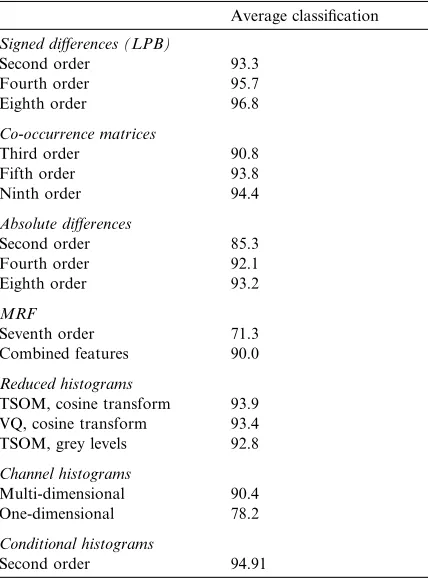
Table 2 shows the global performance of the classification. The table includes the results pre-sented in (Valkealahti and Oja, 1998; Ojala et al., 2001) for signed differences (Valkealahti and Oja, 1998), co-occurrences (Haralick et al., 1973b), absolute differences (Ojala and Pietika¨inen, 1996), Gaussian random field model (Van Gool et al., 1985), reduced histograms (Ojala et al., 2001) and channel histograms (Unser, 1986b). In general, the accuracy of the proposed features compares to the most successful techniques. How-ever, it is important to notice that quantisation and signed grey level distributions required 16th and 9th order probabilities. We have used second order joint probabilities in a 2·2 neighbourhood. This makes the complexity adequate for applica-tions requiring online training.
Table 3 shows the result for the second test. The table includes the results presented in (Ojala et al., 1996; Ohanian and Dubes, 1992) for local
binary patterns (Wang and He, 1990), co-occur-rences (Haralick et al., 1973b), grey level differ-ences (Unser, 1986a) and classification based on a combination of three different texture features (Ohanian and Dubes, 1992). For the leave-one-out classification, the classification accuracy for conditional histograms was of 100%. In order to highlight the advantage of conditional histograms, we perform the same test by reducing the training data. In our results good performance can be maintained with only 10% to 5% of the data.
[image:8.544.144.395.91.316.2]Table 4 shows the classification results for only 20 training samples and windows of 32·32 and 16·16. For the 32·32 case this represents the 10% of training data. When the window is reduced to 16·16 only 2.5% of the original data is used. Classification performance is maintained with less training data because, as explained in Section 4, histograms are computed by using data incremen-tally. Thus, when we reduce training data, we are not reducing the number of features, but the accu-racy of the features. But since histograms are just one dimensional, then they can be populated with few data.
6.4. Segmentation
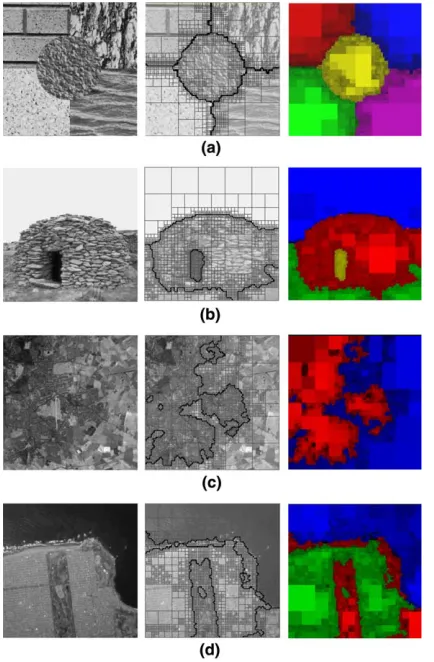
Figs. 2 and 3show selected examples of the seg-mentation application for grey level and colour images. In these examples, training data was ob-tained by considering two windows of 32·32 for each class. For each example, we show the segmen-tation regions, the borders between classes and the uncertainty in the classification. Uncertainty is shown as a colour image whose change in bright-ness represents the confidence of the classification of each pixel. Brighter colours represent a high degree of confidence, whilst darker colours show areas whose classification is more uncertain. We can see that in general large areas of uniform tex-ture are classified in regions of large size with low uncertainty, whilst high detailed areas are divided into small regions with high uncertainty.
[image:9.544.48.262.112.404.2]The examples show that texture features can be used in applications to obtain well-delineated bor-ders. Notice that as boundaries are refined, regions reduce the confidence in the classification. Figs. 2(a) and3(a) show two examples of segmentation for synthetic images composed of grey level and colour textures, respectively. Each image has a res-olution of 256·256 pixels. We can observe that the refinement of regions provides an analysis capable of producing accurate segmentation re-sults. In these examples, the colour information Table 2
Global performance for 16 texture categories
Average classification
Signed differences (LPB)
Second order 93.3
Fourth order 95.7
Eighth order 96.8
Co-occurrence matrices
Third order 90.8
Fifth order 93.8
Ninth order 94.4
Absolute differences
Second order 85.3
Fourth order 92.1
Eighth order 93.2
MRF
Seventh order 71.3
Combined features 90.0
Reduced histograms
TSOM, cosine transform 93.9 VQ, cosine transform 93.4 TSOM, grey levels 92.8
Channel histograms
Multi-dimensional 90.4 One-dimensional 78.2
Conditional histograms
Second order 94.91
Table 3
Global performance for 16 texture categories
Local binary patterns
LBP 81.40
LPB and contrast 87.62
LBP and covariance 185.03
Co-occurrence features
4 Features 188.25
9 Features 90.69
Grey level difference
DIFFX and DIFFY 96.56
Combined features MRF, Gabor, Fractal
4 Features 191.07
9 Features 195.41
Conditional histogram
[image:9.544.285.502.112.290.2]32·32 (199 samples per class) 100.00 32·32 (20 samples per class) 1100.00 16·16 (20 samples per class) 195.69
Table 4
Average classification accuracy (%) for 16 texture categories
Texture 32·32 16·16
Fractal1 100.00 100.00
Fractal2 100.00 81.11
Fractal3 100.00 100.00
Fractal4 100.00 100.00
mrf1 100.00 100.00
mrf2 100.00 92.78
mrf3 100.00 100.00
mrf4 100.00 94.44
Leather1 100.00 100.00
Leather2 100.00 100.00
Leather3 100.00 100.00
Leather4 100.00 84.44
paint1 100.00 100.00
paint2 100.00 100.00
paint3 100.00 78.33
paint4 100.00 100.00
produces a clearer delineation of regions since small regions are more accurately classified. The detailed evaluation of the segmentation results shown that 98.7% and 99.2% of pixels in the grey level and colour images, were correctly classified. Although the difference between the results of the final classification is very small, we can observe a clear distinction in the uncertainty maps. We can observe that whilst for the colour image a high confidence in the classification results is main-tained for regions of reduced size, grey level infor-mation tends to produce less contrasted and darker regions. Thus, when regions are small, the lack of information increases the probability of erroneous classification for grey level textures.
However, since the increase in probability is only significant for small regions, then the error of the whole segmentation process is small.
[image:10.544.280.496.90.424.2]The example in Fig. 2(b) contains a grey level image with four types of regions. Two types of re-gions have a rather regular appearance with white and black intensities, respectively. In spite of the lack of texture, the intensity component in the characterisation produces a successful classifica-tion. Fig. 2(c) corresponds to the infrared band in a multispectral LANDSAT image. A training set was defined by selecting two regions as repre-sentative members of urban and agricultural land covers. In this example, we can see that the model of texture developed can be used to accurately Fig. 2. Examples of texture images. (a) Synthetic image
composed of five grey level textures, (b) image containing grey level natural textures, (c) infrared band of a satellite image and (d) intensity image.
[image:10.544.44.261.92.423.2]delineate textured regions. The uncertainty map provides useful information for classification. For example, although the top left region was classified as urban area, the low confidence value shows that it probably contains a different type of land cover. In the same manner, small black regions in the red areas indicate possible fields inside an urban area. The results inFig. 2(d) show an accurate segmen-tation capable of discriminating between regions of constant intensity and regions with textured patterns.
Fig. 3(b) shows a similar example to Fig. 2(d). In this case, the uncertainty is reduced due to col-our data. We can observe an accurate segmenta-tion even for small regions. Fig. 3(c) and (d) show two examples of colour texture landscapes. InFig. 3(d), the green tones in two texture classes produce a considerable similarity between some re-gions. Accordingly, the segmentation process sub-divides several times the regions that contain green areas. Although small green regions have a large uncertainty with respect to larger areas, the classi-fication results lead to accurately delineated bor-ders. The segmentation of the image in Fig. 3(c) has a more clear distinction of classes. Thus, larger regions with low uncertainty are obtained. We can notice that in regions where rock and grass merge, the uncertainty increases and the subdivision be-comes finer in order to identify pure classes.
7. Conclusions and further work
We have proposed a characterisation of tex-tures based on a mixture of colour and contextual information obtained from binary features. The characterisation defines one-dimensional histo-grams that represent the conditional probability of intensity values given the joint probabilities of pixels in image regions. Experimental results show that a non-parametric classification based on conditional histograms produces a compact and powerful set of features. High classification per-formance is obtained by considering only second order distributions. The compactness of the repre-sentation has three main interests. First, com-pactness is important to make texture analysis practical. This is particularly relevant for
applica-tions requiring on-line database construction. Sec-ondly, it avoids sparse histograms that can reduce the classification performance. Finally, since the number of bins is reduced, compactness minimises the data required during the training step. We rein-force this last point by considering training data incrementally.
We have included examples that show the appli-cation of the classifiappli-cation to region delineation by means of a hierarchical subdivision. Examples show that the classification is useful to obtain well-delineated borders. The dependence of the representation on intensity data is suitable to clas-sify regions of small sizes. Our current work is con-sidering the potential implications of incremental training. We think that distributions can be used to determine when training can be stopped and to detect when training data agree with a single distribution. If data do not agree with a single distribution, then several classes should be used to represent a texture. Additionally, we consider extending the approach to applications on non-supervised segmentation. There are recent studies where efficient unsupervised segmentation is per-formed using feature distributions (Ojala et al., 2000).
References
Augusteijn, M.F., Clemens, L.E., Shaw, K.A., 1995. Perfor-mance evaluation of texture measures for ground cover identification in satellite images by means of a neural network classifier. IEEE Trans. Geosci. Remote Sensing 33 (3), 616–626.
Briggs, J.M., Nellis, M.D., 1991. Seasonal variation of hetero-geneity in the tallgrassprairie: A quantitative measure using remote sensing. Photogramm. Eng. Remote Sensing 57 (4), 407–411.
Chen, P.C., Pavlidis, T., 1979. Segmentation by texture using a co-occurrence matrix and a split and merge algorithm. Comput. Vision Graphics Image Process. 10, 172–182. Chen, Y.Q., Nixon, M.S., Thomas, D.W., 1995. Statistical
geometric features for texture classification. Pattern Recog-nition 28, 537–552.
Chetverikov, D., 1994. GLDH based analysis of texture anisotropy and symmetry: An experimental study. Proc. Internat. Conf. on Pattern Recognition I, 444–448. Devijver, P.A., Kittler, J., 1982. Pattern Recognition, a
Dubuisson-Jolly, M.-P., Gupta, A., 2000. Color and texture fusion: Application to aerial image segmentation and GIS updating. Image Vision Comput. 18 (10), 823–832. Dutra, L.V., Mascarenhas, N.D.A., 1984. Some experiments
with spatial feature extraction methods in multispectral classification. Int. J. Remote Sensing 5 (2), 303–313. Gersho, A., Gray, R.M., 1992. Vector Quantization and Signal
Compression. Kluwer Academic Publishers, Dordrecht, Netherlands.
Haralick, R., 1979. Statistical and structural approaches to texture. Proc. IEEE 67, 786–804.
Haralick, R., Shanmugam, K., Distein, I., 1973a. Textural features for image classification. IEEE Trans. Systems Man Cybernet. 3, 610–621.
Haralick, R., Shanmugam, K., Dinstein, I., 1973b. Textural features for image classification. IEEE Trans. Systems Man Cybernet. SMC-3, 610–621.
Hepplewhite, L., Stonham, T.J., 1997. N-tuple texture recog-nition and the zero crossing sketch. Electron. Lett. 33 (1), 45–46.
Hofmann, T., Puzicha, J., Buhmann, J., 1998. Unsupervised texture segmentation in a deterministic annealing frame-work. IEEE Trans. Pattern Anal. Mach. Intell. 20 (8), 803– 818.
Horowitz, S.L., Pavlidis, T., 1976. Picture segmentation by a tree traversal algorithm. J. ACM 23 (2), 368–388. Hsu, S., 1978. Texture-tone analysis for automated land-use
mapping. Photogramm. Eng. Remote Sensing 44 (11), 1393–1404.
Jain, A., Zongker, D., 1997. Feature selection: Evaluation, application and small sample performance. IEEE Trans. Pattern Anal. Mach. Intell. 19 (2), 153–158.
Kovalev, V., Petrou, M., 1996. Multidimensional co-occurrence matrices for object recognition and matching. Graph. Models Image Process. 58 (3), 187–197.
Lee, J.W., 1998. Joint optimization of block size and quanti-zation for quadtree based motion estimation. Image Pro-cess. 7 (6), 909–912.
Ma, W., Manjunath, B., 1997. Edge flow: A framework of boundary detection and image segmentation, Proc. IEEE Conf. on Computer Vision and Pattern Recognition, pp. 744–749.
Marceau, D.J., Howarth, P.J., Dubois, J.M., Grattton, D.J., 1990. Evaluation of the grey-level co-occurrence matrix method for land-cover classification using SPOT imagery. IEEE Trans. Geosci. Remote Sensing 28 (4), 513–519. Ng, L.S., Nixon, M.S., Carter, J.N., 1998. Combining feature
sets for texture extraction. Proc. IEEE Southwest Sympo-sium on Image Analysis and Interpretation, Texas, pp. 103– 108.
Ohanian, P.P., Dubes, R.C., 1992. Performance evaluation for four classes of textural features. Pattern Recognition 25 (8), 819–833.
Ohta, Y.-I., Kanade, T., Sakai, T., 1980. Color information for region segmentation. Comput. Graph. Image Process. 13, 222–241.
Ojala, T., Pietika¨inen, M., 1996. A comparative study of texture measures with classification based on feature distributions. Pattern Recognition 29 (1), 51–59.
Ojala, T., Pietika¨inen, M., 1999. Unsupervised texture segmen-tation using feature distributions. Pattern Recognition 32, 477–486.
Ojala, T., Pietika¨inen, M., Harwood, D., 1996. A comparative study of texture measures with classification based on feature distributions. Pattern Recognition 29, 51–59. Ojala, T., Pietika¨inen, M., Ma¨enpa¨a¨, T., 2000. Gray scale and
rotation invariant texture classification with local binary patterns, Proc. Sixth European Conf. on Computer Vision, Dublin, Ireland, vol. 1, pp. 404–420.
Ojala, T., Valkealahti, K., Oja, E., Pietika¨inen, M., 2001. Texture discrimination with multidimensional distributions of signed gray level differences. Pattern Recognition 34 (3), 727–739.
Papoulis, A., 1991. Probability, Random Variables, and Stochastic Processes. McGraw–Hill.
Puzicha, J., Rubner, Y., Tomasi, C., Buhmann, J.M., 1999. Empirical evaluation of dissimilarity measures for color and texture. Proc. IEEE Internat. Conf. on Computer Vision (ICCVÕ99), pp. 1165–1173.
Rosenfeld, A., Wang, C.Y., Wu, A.Y., 1982. Multispectral texture. IEEE Trans. Systems Man Cybernet. 12 (1), 79– 84.
Schalkoff, R., 1992. Pattern Recognition. Statistical, Structural and Neural Approaches. Wiley.
Schulerud, H., Carstensen, J., 1995. Multiresolution texture analysis of four classes of mice liver cells using different cell cluster representations. Proc. 9th Scandinavian Conf. on Image Analysis, Uppsala, Sweden, pp. 121–129.
Strand, J., Taxt, T., 1994. Local frequency features for texture classification. Pattern Recognition 27 (10), 1397– 1406.
Sullis, J.R., 1990. Distributed learning of texture classification. Lect. Notes Comput. Sci. 427, 349–358.
Szeliski, R., Shum, H.-Y., 1996. Motion estimation with quadtree splines. IEEE Trans. Pattern Anal. Mach. Intell. 18 (12), 1199–1210.
Unser, M., 1986a. Sum and difference histograms for texture classification. IEEE Trans. Pattern Anal. Mach. Intell. 8, 118–125.
Unser, M., 1986b. Local linear transforms for texture measure-ments. Signal Process. 11 (1), 61–79.
Valkealahti, K., Oja, E., 1998. Reduced multi-dimensional co-occurrence histograms in texture classification. IEEE Trans. Pattern Anal. Mach. Intell. 20 (1), 90–94.
Van Gool, L., Dewaele, P., Oosterlinck, A., 1985. Texture analysis anno 1983. Comput. Vision Graphics Image Process. 29, 336–357.
Wang, L., He, D.C., 1990. Texture classification using texture spectrum. Pattern Recognition 23 (8), 905–910.