Predicting Concrete Durability
from its Absorption
by R.K. Dhir, M.R. Jones,
E.A. Byars, and I.G. Shaaban
Synopsis : This paper discusses the current approach for specifying the durability of concrete in structures. The shortcomings of the use of bulk parameters such as strength, water/binder ratio and binder content to specify durability are discussed. Studies carried out over the last 10 years at Dundee University, using simple permeation tests, which are sensitive to curing, cement type and grade of concrete, have shown close association between permeation properties and the durability of concrete.
This paper deals with the measurement of concrete durability by the Dundee-modified Initial Surface Absorption Test (ISAT). A wide range of concrete mixes made with ordinary portland cement and blends with pulverized-fuel ash (PFA) and ground-granulated blastfurnace slag were designed. The duration of moist curing was varied from 0 to 28 days, and the maximum aggregate size from 5 to 40mm. All mixes were tested for absorptivity and aspects of durability including freeze/thaw resistance, carbonation, chloride ingress and mechanical wear.
The results show that the absorptivity of concrete, measured with the ISAT, could be used as an accurate specification for concrete durability, irrespective of curing, grade or mix constituents.
A tentative surface absorptivity classification for durability has been proposed.
Keywords: Abrasion; absorption; carbonation; chlorides; curing; diffusion; durability; freeze thaw durability; permeability; structural design; tests
Professor Ravindra K. Dhir BSc PhD CEng MIMM FGS, Director of the Concrete Technology Unit, University of Dundee, has published extensively on the use of PFA in concrete, as well as the curing, permeation properties, durability and protection of concrete. He has served on several technical committees, is a member of the Editorial Advisory Board of the Magazine of Concrete Research, and a past chairman of the Concrete Society, Scotland.
Dr M. Roderick Jones BSc PhD CEng MICE MIM FGS is a Lecturer in Concrete Technology in the University of Dundee. His research interests are concerned with the use of pozzolanic binders in concrete with particular reference to the improvement of durability.
Dr Ewan A. Byars BSc, PhD is a Lecturer in Concrete Technology in the University of Dundee. His research interests include the measurement of durability of concrete in-situ by indicator testing and the effects of curing, pozzolanic materials and age on concrete durability.
Dr Ibrahim G. Shaaban BSc, MSc, PhD is a lecturer in the Civil Engineering Department at Zagazig University, Egypt. His research interests include the development of tests for in-situ permeation and durability of concrete.
INTRODUCTION
Concrete technology and construction. barring a few notable innovations such as reinforced concrete in 1917(1) and prestressed concrete in 1933(2), have evolved rather slowly. For a long time, concrete has been considered as a bulk material that can be specified satisfactorily in terms of workability and strength alone and, unfortunately, this remains the typical position today. Any attempt to change this perception of concrete is resisted strongly on the grounds that strength relates broadly with all other properties and is an adequate measure of durability.
Fortunately for concrete construction, economic constraints worldwide are making designers more accountable for costing structures in terms whole-life performance. There is already a move in this direction(4), and it is of note that some national government authorities are now considering the whole-life costs of concrete structures as an essential part of the design process. This, and the lessons learnt from the rising costs of repair and maintenance of concrete structures(5), are making engineers move towards directly designing concrete for durability. Whilst this is clearly the way forward, the question of how best to realise this in practise remains to be resolved and is giving rise to some serious debate.
SPECIFYING FOR DURABLE CONCRETE
Conventional Specifications
It could be argued that even in present times, engineers are designing durable structures through passive specifications which imply, rather than directly specify, concrete durability. Moreover, engineers often don't know how long their designed structures will last. Most specifications for concrete can be divided into two separate but closely related phases. Firstly, a set of construction and structural requirements, namely the necessary workability and strength. Secondly, the designer will turn his attention to durability and is immediately faced with two major unanswered questions,
(i) No serviceable life is stated by the client.
(ii) Little detail is known about effects of the exposure environment on service life.
The dilemma then faced is to provide a satisfactory structure whilst fulfilling only vague requirements for durability. The designer will inevitably turn to his experience and the recommendations of Codes of Practice. It is not possible to provide any answer to the first of these problems but it seems likely that lifespans in excess of 100 years may be required for structures in the most aggressive environments such as highway and marine sites. The recommendations of Codes of Practice internationally are remarkably similar in their approach, even if some details differ. Typically specified parameters are,
e
Binder type, minimum binder content and maximum water/binder ratioe
Minimum strength grade, cover depth and degree of compactione
'Adequate' curing for a fixed period of timedeterioration as the good concreting practice of the CEB(6) illustrates. It is quite clear that concrete has to be designed and produced correctly to achieve a required durable life(7), and in an ideal world no further action would be necessary. However, such an approach is not a panacea for excellence(5), as the UK's annual £20 billion repair and maintenance costs for concrete structures(8) shows, and there must be some method of quality control testing to ensure that an acceptable standard is met.
Active Specification for Durability
Deliberate and additional specification strategies are, therefore, necessary for concrete to be designed for durability. Recognition must be made that the relative performance of commonly used binders such as the various portland cements, pulverized-fuel ash (PFA) and ground granulated blastfurnace slag (GGBS) varies with different exposure environments, and that specification by the 'conventional' criteria alone is not adequate. For example, PFA concrete can be as much as 5 times more resistant to the ingress of chlorides than equal design strength OPC concrete(9).
A 'complete' concrete specification would need to provide a balanced set of concrete characteristics which takes into account all the requirements for construction (such as workability), structural capacity (strength and dead load) and durability (cover to steel, permeation properties and chemical resistance), as illustrated in Figure 1.
To specify durability by performance characteristics there are three requirements:
(i) A suitable durability measure for specification and compliance purposes.
(ii) A simple and reliable test.
(iii) A test method that is suitable for site use.
CONCRETE QUALITY FROM PERMEATION
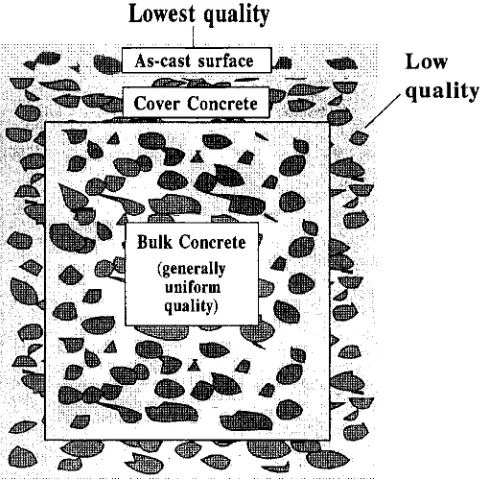
Variations in the make up of concrete arise not only from the inhomogeneity of constituent materials, but also result from bleeding and segregation in the vertical plane. There is an increase in quality with depth from surfaces exposed to the atmosphere(12), Figure 2, as a result of the differential rate of moisture loss, which becomes acute on site if proper attention is not paid to curing. The result of these combined effects is a layering effect, which has three basic elements,
(i) A surface 'skin', a few millimetres deep, composed mainly of weak mortar.
(ii) An intermediate layer over which the concrete quality improves to a maximum.
(iii) A bulk region, of relatively constant quality.
The relative depths of these layers can vary with curing and concrete grade(3), but the significance of this layering effect is that the cover region, which protects the reinforcing steel from the ingress of aggressive environmental agents, such as chlorides and carbon dioxide, is of lower quality than that of the bulk.
Whilst there are many in situ test methods, such as Schmidt hammer, pull-out test and ultrasonic pulse velocity, these tend to be strength-related and are more sensitive to overall bulk concrete quality than to the condition of the cover concrete.
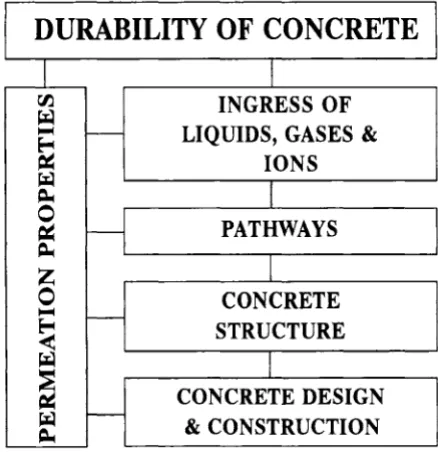
The relationships between the durability aspects of concrete and its resistance to the ingress of aggressive gases and fluids(9), give rise to a serious possibility for both checking compliance with performance specification in-situ, and estimation of the expected life of concrete in different exposure environments ..
Depending upon the prevailing conditions, the movement of aggressive fluids and ions may be driven by one, or a combination of up to three basic mechanisms. These are,
Figure 3. This can only improve the specification of concrete for durability. Furthermore, the variation in concrete durability arising from materials, w/c, type of element, workmanship, curing, cover, and exposure can be measured in situ, using permeation tests, which give a single-parameter assessment of concrete quality (Figure 4).
This study has correlated the results of accelerated durability tests with those of the Initial Surface Absorption Test (ISAT). The test is practically suited for in-situ work, being portable, cheap and sensitive to small changes in mixture constituents, concrete grade, and curing(l4), and also has a UK National Standard( IS). The ISAT measures the absorptivity of the surface and near-surface layers of concrete, which are generally of the poorest quality, thus giving a worst-case assessment of concrete durability.
INITIAL SURFACE ABSORPTION TEST (ISAT)
The ISA T apparatus (Figure 5) whilst adopting the general principles of the British Standards(l5,16), was modified to make it more accurate and easier to use(ll). A cap of known area is clamped to the test surface, with one vertical branch acting as a reservoir, which can be isolated by a tap. Another branch is connected to a calibrated capillary tube, which measures the rate of absorption of water into the concrete below the cap on closure of the tap.
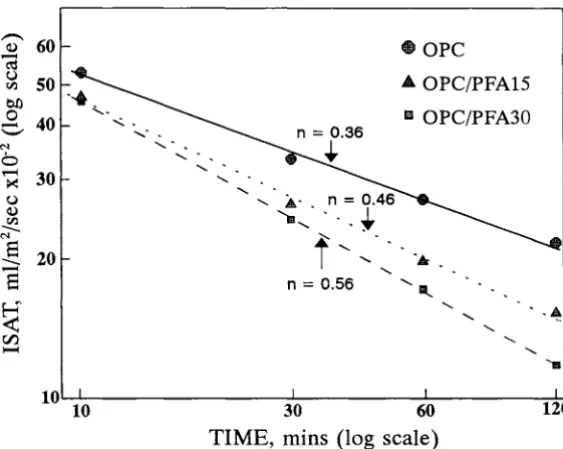
It is recommended that ISA T measurements should be taken at 10, 30, 60 and 120 minutes after the initiation of the test. The theoretical derivation of the relationship between these values, and another parameter, the n value, are described by the Poisseulle equation, expressed as,
where, v
a,n =
dv = at-•
dt (1)
water-filled pore volume, mL time, in seconds
constants
Equation (1) can be used to define the decay in absorption rate with time. The slope of the Log(ISAT) versus Log(time) graph, Figure 6, gives then value, which can be used with the ISAT -10 (ISA T measurement taken at 10 minutes) to provide a meaningful summary of the complete set of results(l4). However, at this early stage of the work only the 10 minute values have been considered.
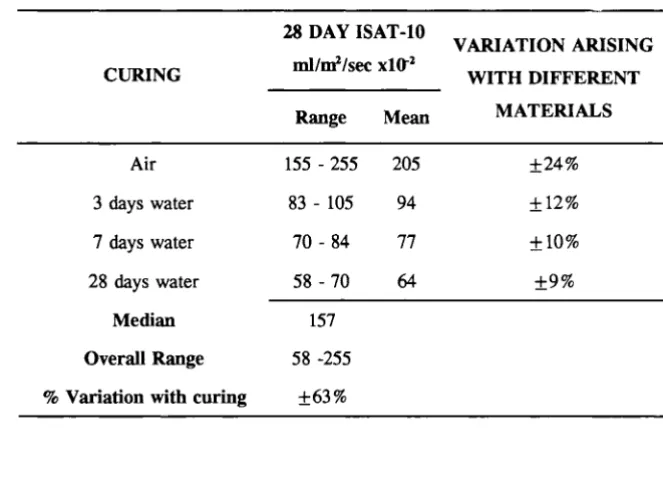
affecting the absorptivity of concrete is curing. Varying curing for the same concrete mixture can produce absorptivity values of ±63% about a mean value, but even for the same curing, material differences can cause variations of up to ±24% of the mean value. Site concrete has several other factors which cause the concrete quality to vary, such as workmanship, control over material quantities, degree of compaction, and temperature.
MEASUREMENT OF DURABILITY
Freezine and Thawine Deterioration
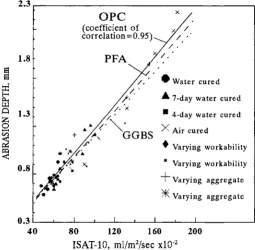
The durability of a number of concrete mixes to alternate freezing and thawing, carbonation, chloride ingress and abrasion were measured and are plotted against ISAT-10 in Figures 7-10. The mixtures, curing regimes and workability reflect the concrete commonly used in construction, and form the basis of a major research programme at Dundee University(11,13,17). Details of the range of variables tested can be obtained from Figures 7-10.
It is not be normal practice to use non-air-entrained concrete for frost resistance, but in order to establish the potential of the ISA T test to measure frost resistance non-air-entrained concrete was used in this study. The total number of freezing and thawing cycles, to ASTM C666 (Part A)(18), to cause failure of non-air-entrained concrete in terms of length change, are plotted against corresponding ISAT-10 in Figure 7. This shows all the OPC concrete results, together with general relationships for PFA and GGBS concrete.
The relationship between absorption and frost resistance for OPC concrete is excellent, and has a coefficient of correlation of 0.95. The magnitude of the internal stresses induced by the expansion of water in concrete is affected by the ease with which these stresses can be relieved by movement of water through the pore system, and on the ultimate tensile strength of the concrete. Air-entrained concrete however, which is specified for frost resistance, has discrete spherical cavities which allow the flow of water away from areas of stress. This suggests that the interconnectivity of a pore system would be the controlling factor of frost resistance. The results obtained here show that for non-air-entrained concrete this is not the case, and that an inverse relationship between ISA T and frost resistance exists (ie. high absorptivity, low frost resistance).
Carbonation
Atmospheric C02 penetrates concrete structures, causing a reduction in pore fluid alkalinity, thereby reducing its protection against corrosion of steel reinforcement.
An accelerated carbonation system(21) was used to produce a depth of carbonation over periods equivalent to up to 30 years. The 20-year equivalent carbonation results are shown plotted against the ISAT-10 in Figure 8. Whilst the coefficient of correlation, r, between the parameters across all OPC mixes tested was 0.86, analysis of the individual series would suggest that better correlation exists for specific concrete types. The process of carbonation is affected by both pore structure of hydrated cement paste and its initial pH. These two parameters are altered by the use of pozzolanic materials, which produce a less permeable matrix, but also consume Ca(OH)z in the process, which reduces the pH. This accounts for the change in the ISAT-carbonation depth relationship when PFA or GGBS is used. It should be noted, however, that both materials caused a reduction in the absorptivity. This means that for equal strength grade concrete, the carbonation resistance of PF A or GGBS concrete would be closer to that of portland cement concrete than judgement on the basis of equal ISAT-10 would suggest.
Chloride Diffusion
The effects of replacing OPC with PFA at 15 and 30% levels by mass, on an equal 28-day strength basis, were studied. The relationship between ISAT -10 and the coefficient of chloride diffusion (D) is shown plotted in Figure 9 for water-cured concrete. Whilst there is no general relationship between the ISAT -10 and chloride diffusion, unique relationships do exist when different binders are considered individually.
The resistance of concrete to the ingress of chlorides is determined by two parameters. Firstly, there is a physical effect, which is controlled by the number of available paths through the pore system of the cover concrete. Secondly, different binders can react with chloride ions to varying degrees(22), and can fix them chemically, and thus retard further ingress. It has been shown(23) that PFA, irrespective of quality, has a higher chloride binding capacity than OPC, and that this chemical response causes the change in the chloride diffusion/ISAT -10 relationship shown in Figure 9.
Abrasion
Although the abrasion resistance of concrete can be readily measured in the laboratory(24,25) it is difficult to measure in-situ. Thus, a simple method which could routinely be applied non-destructively to assess abrasion resistance is highly attractive.
A good correlation (r = 0.95) was found between ISAT -10 and abrasion depth (25) for the OPC, PFA and GGBS concretes.
It is not surprising that the ISA T, which is sensitive to the degree of hydration and the physical characteristics of the surface layers, would give a good measure of the resistance to mechanical attrition.
PERFORMANCE-BASED CLASSIFICATION FOR DURABILITY
A tentative durability classification, based the ISAT-10, is given in Table 2. It is recognised that over the service life of concrete its absorption properties will be affected to a varying degree by microcracking caused by factors such as cyclic heating and cooling, freezing and thawing, loading and unloading and the differences between the coefficient of thermal expansion and E value of the cement paste and aggregate. However, this classification is intended to show the potential of the ISAT for quality control purposes, usually carried out at no later than 28 days. At this relatively early age, the w/c and cement chemistry are likely to be more important than ongoing environmental factors. Furthermore, since the mixtures tested in this study form only a part of a larger research programme, the values chosen are conservative. As future results become available, it will be possible to be more accurate in the classification.
It should also be noted that material differences will require additional considerations to be taken into account as indicated in Table 2, particularly in environments where there are chemically-dominated durability problems, such as chloride ingress and carbonation.
IN-SITU CONDITIONING
Little guidance(16) is available for in-situ testing other than "not within two days of rain". This is clearly inadequate. There are two possible methods to overcome this problem. One approach is to attempt to measure in-situ moisture content(26), then back-calculate the absorptivity at a standard moisture content. A more practical approach would be to standardise the moisture content of the test region prior to test.
A vacuum drying system has been developed at Dundee University(27). The system operates by removing moisture by the use of hard vacuum from the surface of the concrete and defines the standard moisture condition for testing by the use of a humidity indicator salt. This has advantages in that it can be used either in the laboratory or in-situ, and initial results are encouraging. This suggests that the proposed classification for durability can indeed be developed for in-situ applications.
CONCLUSIONS
1. The Initial Surface Absorption Test can be used as a performance-based classification for specifying concrete durability. Close relationships exist between the ISAT -10 results and different aspects of durability for a selection of concrete mixes, with varying grade, cement type, maximum aggregate size and curing environment.
2. Excellent correlation with durability aspects was found where the physical nature of the concrete was the dominating factor for resisting deterioration, such as with freeze/thaw and abrasion resistance. Where chemical processes have an effect on durability, such as is the case carbonation and chloride diffusion, the correlation between absorption and durability is less strong, but unique relationships do exist for individual binder types.
3. A tentative durability classification for concrete, based on the I SAT-10, has been proposed. Although much work remains to be done in this area, such a classification has the potential to overcome many of the present limitations of conventional specifications. This could be further developed to allow active design for durability, with a measurable quality-control parameter which could be checked against a performance-based specification.
ACKNOWLEDGEMENTS
REFERENCES
1. Final Report of Special Committee on Standard Specifications for Concrete and Reinforced Concrete. Transactions of the American Society of Civil Engineers, Vol 81, 1917, pp 1101- 1205.
2. Hawkins, NM. Impact of research on prestressed concrete specifications. Significant developments in Engineering Practice. ACI SP-72, 1981, pp163-176.
3. Kreijger, PC. The skin of concrete, composition and properties. Materials and Structures, Vol 17, No 100, July/August 1984, pp275-283.
4. Geiker, MR, Henriksen, C and Thaulow, N. Design for durability : a case story. Concrete 2000, Proceedings of the International Conference on Economic and Durable Construction through Excellence, University of Dundee, September, 1993, pp63-70.
5. Wallbank, EJ. The performance of concrete in bridges a survey of 200 highway bridges. HMSO, London, 1989, 96pp.
6. Durable Concrete Structures - Design Guide. Comite Euro-International Du Beton. Thomas Telford Services Ltd, 1992, 112pp.
7. Mather, B. How soon is soon enough? Proceedings of the First International Conference on Ready-Mixed Concrete., University of Dundee, September, 1975, pp331-336.
8. Long, AE. Introduction to a series of technical notes on in-situ non-destructive testing techniques. Structures and Buildings, Proceedings of the Institution of Civil Engineers, Vol 99, February, 1993, p63.
9. Dhir, RK and Byars, EA. PFA concrete: Chloride Diffusion Rates. Magazine of Concrete Research, Vol 45, No 162, March, 1993, pp1-9.
10. Mather, K. Relation of Absorption and Sulfate Test Results on Concrete Sands. ASTM Bulletin, No. 144, January, 1947, pp 26-31.
11. Dhir, RK, Hewlett, PC and Chan, YN. Near-surface characteristics of concrete: assessment and development of in-situ test methods. Magazine of Concrete Research, Vol 39, No 141, December 1987, pp183-195.
12. Dewar, JD. Concrete durability : Specifying more simply and surely by strength. Concrete, Vol 15, No 2, February, 1982, pp19-21.
14. Dhir, RK and Byars, EA. PFA concrete: near surface absorption properties. Magazine of Concrete Research, Vol43, No 157, December 1991, pp219-232.
15. British Standards Institution. BS 1881, Part 122, 1983. Test for determining the initial surface absorption.
16. British Standards Institution. BS 1881 Part 5 1970. Testing hardened concrete for other than strength.
17. Dhir, RK, Jones, MR, and Ahmed. HEH. Concrete Durability : estimation of chloride concentration during design life. Magazine of Concrete Research, Vol 43, No 154, 1991, March, pp37-44.
18. American Society for Testing and Materials. ASTM C666-84. Standard Test Method for Resistance of Concrete to Rapid Frost.
19. Berry, EE and Malhotra, VM. Fly ash for use in concrete- A Critical Review. ACI Journal, March-April 1980, pp59-73.
20. Dhir, RK. PFA Concrete - Freeze-thaw resistance. Internal Report, Department of Civil Engineering, University of Dundee, February, 1992.
21. Dhir, RK, Jones MR and Munday, JGL. A practical approach to studying carbonation of concrete. Concrete, Vol 19, No 10, October 1985, pp75-87.
22. Page, CL, Short NR, and Holden, WR. Influence of different cements on chloride-induced corrosion of reinforcing steel. Cement and Concrete Research, Vol 16, No 1, 1986, pp79-86.
23. Dhir, RK, Jones, MR and Seneviratne, AGM. Diffusion of chlorides into concrete: Influence of PFA quality. Cement and Concrete Research, Vol 21, 1991, pp1092-1102.
24. American Society for Testing and Materials. ASTM C418-89. Standard Test Method for Abrasion Resistance of Concrete by Sandblasting.
25. American Society for Testing and Materials. ASTM C779-87. Standard Test Method for Abrasion Resistance of Horizontal Concrete Surfaces.
26. Parrot, LJ. Moisture profiles in drying concrete. Advances in Cement Research, Vol 1, No 3, July, 1988, pp164-170.
TABLE 1 - EFFECT OF CURING AND MATERIAL VARIATION ON THE ISAT OF
GRADE 35 N/mm2 CONCRETE
28 DAY ISAT-10
VARIATION ARISING
CURING ml/nr/sec
xto-
1 WITH DIFFERENTRange Mean MATERIALS
Air 155- 255 205 ±24%
3 days water 83- 105 94 ±12%
7 days water 70- 84 77 ±10%
28 days water 58-70 64 ±9%
Median 157
Overall Range 58 -255
%Variation with curing ±63%
TABLE 2 - TENTATIVE CLASSIFICATION FOR CONCRETE DURABILITY BASED ON THE ISAT
DURABILITY
ISAT-10, ADDITIONAL
CLASSIFICATION
ml/m1/sec x I0-2 CONSIDERATIONS
RANKING
<50 Chloride Diffusion With PFA or GOBS, increase
2 51-70 ranking by 2 divisions
Carbonation
3 71-90 With PFA or GOBS, decrease
ranking by 1 division
4 91-110
Frost Resistance
[image:13.516.73.405.86.329.2] [image:13.516.78.401.363.530.2]'CONVENTIONAL' SPECIFICATION
CONSTRUCTION REQUIREMENTS • Workability
• Heat of Hydration
STRUCTURAL CAPACI1Y • Grade • Dead Load
Due to Cover
DURABILITY • Cover
• Water/Binder Ratio
• Exposure Class
ADDITIONAL CHARACTERISTICS NECESSARY TO SPECIFY DURABILITY
• Permeation Properties
• Environmental Effects
• Chemistry of Binder
Fig. 1-Specilication requirements lor durable concrete
Lowest quality
I
Low
quality
[image:14.515.115.424.74.254.2] [image:14.515.153.395.311.554.2]DURABILITY OF CONCRETE
I
I
rJ".J
INGRESS OF
~~ r - -
LIQUIDS, GASES
&~
IONS
~
I
=--0
H
PATHWAYS
~
~
z
l
0
CONCRETE
~
-~
STRUCTURE
~
I
~
CONCRETE DESIGN
~
~
-
&CONSTRUCTION
=--Fig. 3-Relationship between permeation properties, concrete structure, and durability
MAIN PARAMETERS RESPONSffiLE • CONSTITUENT MATERIALS • WATER/CEMENT RATIO • STRUCTURAL ELEMENT • WORKMANSHIP • CURING • COVER
• EXPOSURE, NATURFJSEVERI1Y • PERMEATION NATURE
STRENGTH_.
STRENGTH. CEMENT CONTENT. WATER/CEMENT RATIO. COVER.
PERFORMANCE SPECIFICATION FOR DURABILITY
DEVELOPMENT WORK IN PROGRESS PRACTICAL SOLUTION ?
[image:15.516.136.355.62.288.2] [image:15.516.94.395.347.539.2]Tap Inlet
Graduated capillary
'\
Air out Water in Screw clamp..._
~----~-J
Sloping roofFig. 5-Generol layout of the ISAT equipment and detail of the sloping-roof cop
"""'
<1)-
C':lu til
bl)
0
-N
0
""""
~ u<1)
til
-N
s
-
-
s
H'
<t:
Cl'.l
-60 tiiOPC
50 A OPC/PFA15
'-· m OPC/PFA30
40 ....:..
.... .-
...
..
...
....
30
....
....
... :A·. n
=
0.46...
•
•••
f' ....
20
....
••
n
=
0.56....
..._....
• .t.....
.... ....
....
'a10~10---3~0~---~6~0---,1~20
TIME, mins (log scale)
[image:16.516.120.424.71.234.2] [image:16.516.133.415.313.537.2]800 400 200 100 50 20 10 \
OPC (coefficient of
\ '•. • correlation = -0.95)
't ·T~
\
.
'·~··
GGBS• Water cured
A. 7-day water cured
---""
,...PFA
-r· •·
• 4-day water cured\
".
\\
\ x,
X
Air cured+
Varying workability • Varying workability+Varying aggregate
\ , • *Varying aggregate
\
2 L _ _ _ _ _ L _ _ _ _ L _ _ _ _ _ _ L _ _ _ ~---~
40 60 80 120 160
ISAT-10, ml/m2/sec xl0-2 (log scale)
Fig. ]-Relationship between number of freeze-thaw cycles to failure and ISAT-10
35
OPC
~ 30 correlation= 0.86) (coefficient of
z
0
~
z
0 ~ p::::
C)
....
0~
~ ~ Ci 25 2015
..
• Water cured
..;.. 7-day water cured
• 4-day water cured
><Air cured
+
Varying workability • Varying workability+Varying aggregate
*Varying aggregate
s
40 60 80 100 120 140 160ISAT-10, ml/m2/sec xl0-2
[image:17.514.92.389.67.287.2] [image:17.514.105.380.340.561.2]50,---~
OPC
..._PFA and GGBS
35 45 55 65 75 85
ISAT-10, ml/m
2/sec xl0·
2Fig. 9-Effect of PFA and GGBS on the I SAT -10 versus chloride diffusion coefficient relationship
~
::d
...
t:>-.
j:.I.l
Cl
z
0
~
I=Q
<
2.3r---~
1.8
1.3
0.8
OPC
(coefficient of correlation= 0. 95)
PFA
/ .
/ '
/·' / • X
/.'
..
,.
( '""'"
+ :.-,
GGBS
~·
X
/ / "
/ ·
• Water cured
... 7-day water cured
• 4-day water cured
X Air cured
+
Varying workability • Varying workability+Varying aggregate
*Varying aggregate
0.3~~---L--~--~~---L--~--~---~
40 80 120 160 200
![Fig. ]-Relationship between number of freeze-thaw cycles to failure and ISAT-10](https://thumb-us.123doks.com/thumbv2/123dok_us/8064612.226496/17.514.105.380.340.561/fig-relationship-number-freeze-thaw-cycles-failure-isat.webp)