Dr. B. Ramakrishnan
Associate Professor, Department of Computer Science and Research Centre,
S.T.Hindu College, Nagercoil, Tamilnadu, India.
[email protected]
Abstract - Underwater acoustic sensor network is used to monitorthe ocean areas with the help of Autonomous Underwater Vehicles, wireless data access points like tools. A number of problems like environmental changes, predicting disaster informations, exploration of mines can be addressed by applying this process in the sea. In this paper, we apply the routing protocol Vector Based Forwarding in two different architecture like static nodes and moving nodes in an underwater architecture. The comparison between the architecture is based on the simulation results, from the comparison the Energy Efficiency, Throughput, PDR are analyzed. Seeing the various graph results, we can conclude that the VBF protocol is significantly beneficial for the underwater architecture with moving nodes than static nodes.
Index Terms- UWSN, Routing, Vector Based Forwarding, Aqua-sim, PDR.
1. INTRODUCTION
The communication using the sensor nodes in underwater environment is now a days needed for monitoring environment in Deep Ocean. Underwater communication use acoustic waves, which is slower than the radio frequency. Acoustic waves signal encounters problems like propagation delay and slow data delivery, so there is in need of analysis for best protocol to overcome these problems [1-3]. A good communication system and also an effective routing protocol is needed to ensure maximum efficiency.
Recently, many routing algorithm have been proposed for UWSNs to overcome these problems [4-6]. There are two types of algorithms, based algorithm and localization-free algorithm. Normally, the localization-based algorithm formulate realistic sense of balance of their performance for various parameters [8-10]. In this paper, we analyze the localized protocol VBF in two ways which are, first the nodes are static in various location in Deep Ocean, and second the nodes are moving for collecting information from the environment. Here, the VBF form a vector pipe from source node to destination node to find the nearest possible node to transfer the data. When receiver receives it, then it finds the next forwarder in the same procedure using the vector pipe and
transmit the data. This process repeated until the data is transmitted to the target node [11-13].
2. RELATED WORK
Many research work has been done in last few years for routing protocol, which discussed many challenges in detail [1-3]. Many different protocols are analyzed for their various performance and parameters [6-8].The localization algorithms are specifically analyzed for their route findings and delivery of data [9-11].In some research work, the terrestrial architecture is formed with the help of clusters. In which the cluster-head in each cluster used to communicate with the other nodes in each group [12, 14]. This cluster concept is implemented in our underwater sensor network architecture and the protocol performance are analyzed [15, 16]. From the above list of analysis, we can say that the various challenges are in UWSN, so further analysis can be done using some specific protocols like VBF. In this paper, we analyze the architecture for the protocol.
3. SYSTEM MODEL 3.1. Architecture
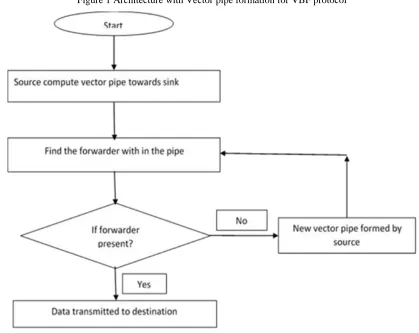
The Figure 1 describes UWSN Architecture with Vector pipe formation for VBF protocol. In this architecture the ships act as sink with the help of floating buoy and various nodes are deployed under the sea. Here we assume the two architecture first the nodes are moving for gathering data, and second they are fixed using anchors to gather data.
3.2. VBF Protocol
RESEARCH ARTICLE
Figure 1 Architecture with Vector pipe formation for VBF protocol
V – propagation speed
d- distance between close nodes R – Transmission range
Here the small desirable factor α, can be calculated using the vector projection, angle between source and forwarder, transmission range and distance. The distance can be calculated by the source and forwarder position (x, y, z) values in the architecture [10].
In this time period Tadaptation, when the node receive the duplicate packet, it neglect the packet by checking its desirable factor with the existing packets desirable factor.
3.3. VBF algorithm
Location(N(i))=Rand(x),Rand(y) //initialize the system with nodes position
Destination(D)=Rand(sink)
Source(S)=Rand(N(i)) //Randomly choose the source
For I = 1 to N(i)
vectorpipe(S,D)
For J = 1 to N(i)
Find forwarder(F)
If F found then
F.data=S.data
end if
End for
If D reached then
D.data=S.data
End if
//next transaction begins
End for
The above algorithm is implemented in the simulation program to send the data packet form source to destination. When the nodes are moving the vector will quickly find the forwarder and send the packet to the destination. On the other hand when the
4. EXPERIMENTAL ANALYSIS
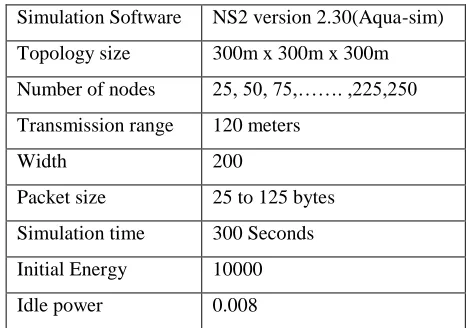
The experiment is implemented using the NS2 Aqua-sim which is a packet level simulator. In Aqua-sim we implement the above with nodes and sinks. In this architecture the protocol VBF is analyzed in underwater sensor network up to 250 nodes. Here we place the nodes uniformly in a scenario of cubic 300m area. The transmission range is 120 meters and the data pocket size ranges from 25 to 125 bytes. As a result, it produces the trace file. The trace file contains the information about the communication in a record format as text file. Using the AWK language, which accept text file as input and process a sequence of record information, we can get the EC, PDR and Throughput etc. The following table represents the simulation parameter.
Simulation Software NS2 version 2.30(Aqua-sim) Topology size 300m x 300m x 300m Number of nodes 25, 50, 75,……. ,225,250 Transmission range 120 meters
Width 200
Packet size 25 to 125 bytes Simulation time 300 Seconds Initial Energy 10000 Idle power 0.008
Table 1 Simulation Parameters 4.1. NS2 Aqua-Sim Overview
Aqua-Sim simulator is specialized for UWSNs, Which is developed on the basis of NS-2. Aqua-Sim can effectively simulate acoustic signal attenuation and packet level in underwater sensor networks. Moreover, in Aqua-Sim the three-dimensional deployment can be done. It can easily be integrated with the existing codes in NS-2. It is in parallel with the CMU wireless simulation package. The Aqua-Sim can evolve independently. It is a powerful recreation tool, with high fidelity and flexibility, for underwater networking in research [22-23].
RESEARCH ARTICLE
Figure 3 Structure of Aqua-sim in Ns2.
change made in the wireless package in NS2. On the other hand, any change to Aqua-Sim is also restricted to it and does not have any impact on other packages in NS-2. Aqua-Sim stands on 3D networks and mobile network. Here the underwater sound channel are have high loyalty. It carries a complete protocol stack from physical layer to application layer [24].
4.2. AWK Programming
The NS2 text files can be processed using AWK language. The AWK program is a sequence of pattern-action statements, in which each statement is a record. Each record is broken up into a sequence of fields. So we can consider the first word in a line as the first field, the second word as the second field, and so on. In actual fact, AWK is a stylish and simple language. AWK is an extremely flexible programming language for working on files. It is an excellent tool for processing these rows and columns, and AWK is easier to use than most conventional programming languages. And it reads a line at a time as Input and computes the process and gives the Output. Due to string manipulation functions, in AWK programming, it can search for particular strings and modify the output. AWK Programming can also perform on UNIX utilities to generate rows and columns of information [25].
5. ENERGY CONSUMPTION
Since the nodes in UWSN is big in size it need more energy for its process, so analyzing this parameter is very useful in each communication. This will represent the transmitting, receiving and ideal energy consumption of a node [17-18].
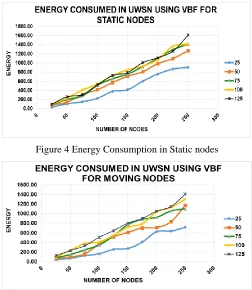
Energy consumption for static nodes (Figure 4) and Moving Nodes (Figure 5) is shown below. The nodes deployed in the area ranges from 25 to 250. The pocket size is from 25 bytes to 125 bytes which is shown in different colors. In each point, we get the data for energy consumption for a group of nodes at a particular packet size.
Figure 4 Energy Consumption in Static nodes
Figure 5 Energy Consumption in Moving nodes When we analyze for a fixed packet size (100 bytes), the following Figure 6 shows that the VBF is suitable for moving nodes rather than static nodes, because when nodes are moving, the vector will find the forwarder node very fast and transfer the data to it, so the energy consumption is less in moving nodes.
Figure 6 Comparing the EC for packet sixe 100 6. THROUGHPUT
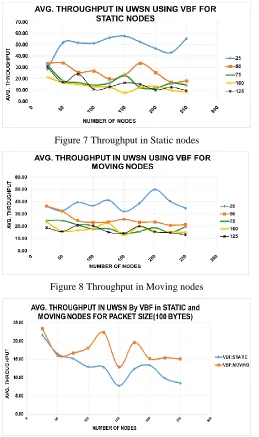
Figure 7 Throughput in Static nodes
Figure 8 Throughput in Moving nodes
Figure 9 Comparing the Avg. throughput for packet size 100 The above Figure 9 represent the average throughput for packet size 100 bytes in our architecture. From that we can clearly describe that the VBF protocol is suitable for moving nodes because the throughput is higher than the static nodes architecture.
7. PDR
Packet Delivery Ratio (PDR) define the successful transmission of packets from source to destination. Like throughput, we can calculate the PDR by using number of the packets sent and received. That is total-packet-received / total-
Figure 10 Avg. Delivery ratio in Static Nodes
Figure 11 Avg. Delivery ratio in Moving nodes
Figure 12 Comparing the PDR for packet size 100 From the Figure 12, we can say that the delivery ratio is higher in moving nodes than the static nodes for mostly all group of nodes and also for all packet size.
8. PACKET DROP
RESEARCH ARTICLE
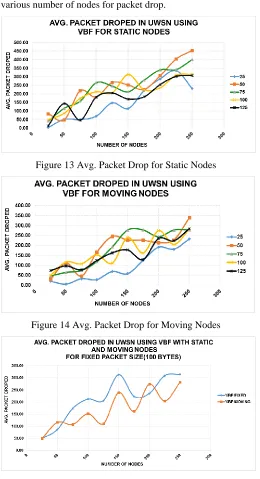
demonstrate the comparison between the architecture with various number of nodes for packet drop.
Figure 13 Avg. Packet Drop for Static Nodes
Figure 14 Avg. Packet Drop for Moving Nodes
Figure 15 Comparing the Packet Drop for packet size 100 From the Figure 15 we can say that the Packet Drop is less for the Moving nodes while using the VBF protocol for environment with various number of nodes.
9. CONCLUSION
In underwater sensor network architecture, when we analyze the VBF protocols performance, the above results represent that the VBF is mostly and highly recommended protocol for the moving node architecture, which will consume low energy,
high throughput, high packet delivery ratio and low packet drop than the static node architecture.
REFERENCES
[1] J Heidemann, W Ye, J Wills, A Syed, Y Li, Research challenges and applications for underwater sensor networking. Proceedings of the IEEE Wireless Communications and Networking Conference (WCNC '06), Las Vegas, Nev, USA 1, April 2006, pp.228–235.
[2] J-H Cui, J Kong, M Gerla, S Zhou, The challenges of building scalable mobile underwater wireless sensor networks for aquatic applications. IEEE Network 20(3), 2006, pp.12–18.
[3] JG Proakis, JA Rice, EM Sozer, M Stojanovic, Shallow water acoustic networks. IEEE Communications Magazine 39(11), 2001, pp.114–119. [4] Abdul Wahid, Kim Dongkyun- Analyzing Routing Protocols for
Underwater Wireless Sensor Networks -International Journal of Communication Networks and Information Security (IJCNIS)- Vol. 2, No. 3, December 2010.
[5] B.Ramakrishnan, RS.Rajesh, RS. Shaji, Analysis of routing protocols for highway model without using roadside unit and cluster, IJSER, Vol 2 issue 1,2011,pp. 1-9.
[6] A Goel, AG Kannan, I Katz, R Bartos, Improving efficiency of a flooding-based routing protocol for underwater networks. Proceedings of the 3rd ACM International Workshop on Underwater Networks, San Francisco, Calif, USA, pp.91–94, September 2008.
[7] S. Ahmed, I. U. Khan, M. B. Rasheed, M. Ilahi, R. D. Khaz, S. H. Bouk, N. Javaid “Comparative Analysis of Routing Protocols for Under Water Wireless Sensor Networks”-COMSATS Institute of Information Technology, Islamabad, Pakistan.
[8] John Heidemann, Milica Stojanovic, Michele Zorzi –“Underwater Sensor Networks: Applications, Advances, and Challenges”, Philosophical Transactions of the Royal Society A, August 2011. [9] J Kong, J-H Cui, D Wu, M Gerla, Building underwater adhoc networks
for large scale real-time aquatic applications. Proceedings of the IEEE Military Communication Conference (MILCOM '05), 2005.
[10] Peng Xie and Jun-Hong Cui and Li Lao-“VBF: Vector-Based Forwarding Protocol for Underwater Sensor Networks” – IFIP Networking, pp.1216-1221, Springer-2006.
[11] Y Zhang, L Cheng, A distributed protocol for multi-hop underwater robot positioning. Proceedings of the IEEE International Conference on Robotics and Biomimetics, August 2004.
[12] E. A. Carlson, P. P. Beaujean, “Location aware routing protocol for underwater acoustic networks,” Oceans 2006.
[13] NH Kussat, CD Chadwell, R Zimmerman, Absolute positioning of an autonomous underwater vehicle using GPS and acoustic measurements. IEEE Journal of Oceanic Engineering 30(1), pp. 153–164, 2005. [14] Z Zhou, J-H Cui, A Bagtzoglou, Scalable localization with mobility
prediction for underwater sensor networks. UCONN CSE Report, July 2007.
[15] B.Ramakrishnan, RS.Rajesh, RS. Shaji, CBVNET: A cluster based vehicular adhoc network model for simple highway communication, IJANA vol 2, issue 4, pp. 755-761, 2011.
[16] B.Ramakrishnan, MM.Jeo, RB. Nishanth, Modeling and simulation of efficient cluster based Manhattan Mobility model for Vehicular communication, IJANA vol 6, issue 2, pp.253-261, 2014.
[17] A.Anumba Merlyn, A.Anuja Merlyn, “Energy Efficient Routing (EER) For Reducing Congestion and Time Delay in Wireless Sensor Network”, Internatonal Journal of Computer Networks and Applications (IJCNA), Volume - 1, Issue - , Page. No : 1-10, November – December (2014). [18] Mari Carmen Domingo, Rui Prior, Energy analysis or routing protocols
for underwater wireless sensor networks, Elsevier Computer communication 2008, pp.1227-1237.
Mr. C. Namesh is currently working as Assistant Professor in Computer Science in S.T. Hindu College, Nagercoil, Kanyakumari District. He received his MCA degree from Manonmaniam Sundaranar University, Tirunelveli and received M.Phil. in Computer Science from Manonmaniam Sundaranar University. He got more than 10 years of P.G. teaching experience. Now He is research scholar in Manonmaniam Sundaranar University, Tirunelveli, India. His research interests are Mobile Networks and Ad-hoc Networks.