
A GEANT4 Simulation of the SAGE
Spectrometer and its First Application to
255
Lr
Thesis submitted in accordance with the requirements of the University of Liverpool for the degree of Doctor in Philosophy
by
Daniel Martin Cox
Abstract
A two-part experiment studying 255Lr was performed in the University of Jyv¨askly¨a, Finland. The nucleus was created in the fusion-evaporation re-action 209Bi(48Ca,2n)255Lr. The first part was performed using RITU and
GREAT, and was run at a high intensity to study the decay properties of
255Lr. The second part combined RITU, GREAT, and SAGE, and was run
at a lower intensity to study excited states in 255Lr.
In parallel a comprehensive GEANT4 simulation has for the SAGE spec-trometer has been developed. With the goals of better characterising the experimental setup, and allowing the simulation of complex level schemes such as those seen in255Lr for the purposes of testing proposed level schemes by direct comparison to experimental data.
“A university is very much like a coral reef. It provides calm waters and food particles for delicate yet marvellously constructed organisms that could not possibly survive in the pounding surf of reality, where people ask questions like ‘Is what you do of any use?’ and other nonsense.”
Science of Discworld
Acknowledgements
First and foremost I would like to thank my supervisor Prof. Rodi Herzberg for all his guidance and support during my PhD.
I am incredibly grateful to Philippos for the endless advice and patience over the last four years.
A big thank you to everyone at the University of Jyv¨askyl¨a for all their help and support over the years and to all the people that brightened up my time there on experiments, far too many to name them all here, but especially all the past and present members of Team Herzberg, Philippos, Andy, Andrew, Fuad, and Eddie.
Thanks to all the students and postdocs in the Department for all the good times over the years, the conferences, the summer school, the beers, the incredibly varied and often surreal lunchtime conversations. It was never dull. Thanks must go to Pete, Joe, and Pete, for always patiently listening to my demented GEANT4 based ravings over the years. Special mention goes to my year mates, Mark, Joe, Pete, Anthony, and Baha for being there through it all, the highs and the lows.
My sincere gratitude goes to, again, Dr Philippos Papadakis and Dr Gemma Wilson for their skills as proof readers of this work. Without them, it wouldn’t make much sense.
I would also like to acknowledge the STFC, for providing the necessary financial support for this research project.
Contents
1 Introduction 1
2 Theoretical Framework 7
2.1 Liquid Drop Model . . . 7
2.1.1 Binding Energy . . . 7
2.1.2 Semi-Empirical Mass Formula . . . 9
2.2 Spherical Shell Model . . . 12
2.3 Nilsson Model . . . 13
2.4 Nuclear Rotation . . . 14
2.5 Isomerism . . . 16
2.6 Alpha Decay . . . 18
2.6.1 Fine Structure . . . 20
2.7 Electromagnetic Decay . . . 20
2.7.1 Weisskopf Estimates . . . 22
2.7.2 Internal Conversion . . . 24
3 Experimental Methods 28 3.1 SAGE Spectrometer . . . 28
3.1.1 JUROGAM II array . . . 28
3.1.2 SAGE silicon Detector . . . 30
3.1.3 SAGE Solenoidal Magnet and High Voltage Barrier . . 30
3.2 RITU Gas-filled Recoil Separator . . . 31
3.3 GREAT Focal Plane Array . . . 32
3.3.1 Multi-wire proportional counter . . . 32
3.3.2 Double-sided Silicon Strip detectors . . . 33
3.3.3 Planar detector . . . 34
3.3.4 Silicon PIN photodiode detectors . . . 34
3.3.5 Clover detectors . . . 34
4.3 Analysis of Simulation Data . . . 41
4.4 Tuning electromagnetic fields . . . 42
4.5 Detection Efficiency . . . 45
4.5.1 Efficiency Losses . . . 50
4.6 Sensitivity to delayed electron emission . . . 52
4.7 Emission angle of electrons . . . 54
4.8 New data format for simulation of experiments . . . 55
4.8.1 Test nucleus simulation . . . 57
4.9 Expansions to the current simulation . . . 64
5 Analysis Techniques 66 5.1 Calibration . . . 66
5.1.1 Internal calibration of DSSD . . . 67
5.1.2 Calibration of silicon & germanium detectors . . . 67
5.1.3 Doppler Correction . . . 69
5.2 Data Acquisition . . . 71
5.2.1 Total data readout . . . 71
5.2.2 GRAIN analysis system . . . 71
5.2.3 Use of TUPLES for sorting data . . . 72
6 255Lr Analysis Results and Discussion 74 6.1 Previous Work . . . 75
6.2 Decay Spectroscopy . . . 78
6.2.1 Alpha Spectroscopy . . . 78
6.2.2 Half-life measurement . . . 81
6.2.3 Isomeric decay . . . 83
6.3 Discussion of Decay spectroscopy . . . 87
6.4 In-beam spectroscopy . . . 89
6.4.1 Gamma-ray spectroscopy . . . 89
6.4.2 Conversion-electron spectroscopy . . . 91
6.5 Discussion of Recoil-Gated in-beam spectroscopy . . . 98
6.5.1 Spin assignment of 1/2- [521] band . . . 98
6.5.2 Spin assignment of 7/2- [514] band . . . 100
6.5.3 Expansion upon known levels . . . 102
6.6 Comparison to simulated data . . . 105
7 Summary 118 7.1 Summary . . . 118
7.2 Outlook . . . 119
List of Figures
1.1 Self-consistent mean-field calculations for shell correction
ener-gies, in MeV,for the Z∼50 region, and the super heavy nuclei[Ben01]. 3 2.1 A plot of binding energy per nucleon as a function of mass
number [Cas01]. . . 8 2.2 Chart of nuclides overlaid with the predicted binding energy
per nucleon according to the liquid drop model, also line for various values ofZ2/A tracking the fissility [Sch13]. . . . 11
2.3 Schematic representation of angular momentum coupling of a prolate nucleus with a single particle orbiting. . . 14 2.4 Illustration of different types of isomers taken from [Wal99]. . 17 2.5 A section of Segr´e chart, showing the longest lived isomers
Z≥82 [Her11]. . . 18 2.6 Internal conversion coefficients αk and αtot, as a function of
energy for E2 and M1 transitions in lawrencium. . . 27
3.1 Schematic Diagram of the setup at Jyv¨askyl¨a, showing JU-ROGAM II and the SAGE silicon detector along with RITU and GREAT [Pap09]. . . 29 3.2 The JUROGAM II array, purple dewars indicate Clover
detec-tors, the golden dewars, Phase I’s. At the front the hexagonal gap can be seen where the 5 Phase I detectors have been re-moved to make space for the solenoidal magnet. . . 29 3.3 Schematic drawing of the SAGE silicon detector showing the
arrangement of the pixels. . . 30 3.4 Schematic of the RITU gas filled separator. . . 31 3.5 Schematic of the GREAT Focal Plane Array [Pag03]. . . 33 3.6 Efficiency curve for various components in the GREAT focal
plane array - obtained from [GJ08]. . . 35
4.2 Cross section view of two Clover(centre, right) and one Phase I (left) Ge detectors. . . 39 4.3 Comparison of simulated and real Si detectors. . . 39 4.4 Comparison of simulated and real high voltage barriers, note
the horseshoe is not shown in real image. . . 40 4.5 Schematic view of the magnetic coils and shielding within SAGE. 43 4.6 Comparison of electron distribution for original detector
po-sition (left) and detector moved by 10 mm towards the beam axis (right). . . 43 4.7 Simulated electrons in the SAGE silicon detector with an
ini-tial energy of 100 keV. . . 46 4.8 Simulated efficiency curve for the SAGE silicon detector
com-pared to measured values for peaks in 133Ba and 207Bi. . . . . 47
4.9 Simulated SAGE silicon detector efficiency as a function of high-voltage barrier setting. . . 48 4.10 Comparison of measured and simulated SAGE silicon detector
efficiency for a high voltage barrier setting of -30kV. . . 49 4.11 Simulated efficiency of the Jurogam II array also shown in blue
is a calculated efficiency curve. . . 50 4.12 Simulation detailing the geometry near to the target position
in SAGE, visible are the carbon foil unit, target wheel, target, and the detector chamber. . . 51 4.13 Detection efficiency as a function of distance downstream of
the target position for emission of electrons of energy 100 keV. 53 4.14 Electrons detected as a function of emission angle. . . 54 4.15 An example rotational band to be simulated. . . 58 4.16 Upper:γ-ray spectrum, lower:electron spectrum produced by
simulation of 1 million decays of level structure shown in Fig-ure 4.15. . . 59 4.17 An example strongly coupled rotational band to be simulated. 60 4.18 Upper γ-ray spectrum, lower electron spectrum produced by
simulation of 1 million decays of level structure shown in Fig-ure 4.17 with low intensity M1 transitions. . . 61 4.19 Upper γ-ray spectrum, lower electron spectrum produced by
simulation of 1 million decays of level structure shown in Fig-ure 4.17 with high intensity M1 transitions. . . 61
5.1 Relative efficiency curve for the SAGE silicon detector as a function of electron energy. . . 68 5.2 Absolute efficiency curve for the JUROGAM II array as a
6.1 Level scheme taken from [Jep09]. . . 76 6.2 Alpha decay scheme taken from Chatillonet al. [Cha06] . . . 77 6.3 γ-ray spectra taken from Ketelhut et al. [Ket09], (a) Singles
spectrum in delayed coincidence with recoil implantation (b)
γ −γ projection in coincidence with the sum of the gates of the transitions marked by dotted lines (c) same as (b) but for transitions marked with dashed lines. . . 77 6.4 An α spectrum of 255Lr, vetoed with the MWPC, visible are
two peaks from255Lr, along with the αdecay daughter,251Md and contamination from 255No. . . . . 79
6.5 A recoil-decay correlatedα-decay spectrum of255Lr, requiring
the detection of a recoil nucleus in the 100 s prior to the α
detection. Peaks from the daughter nucleus 251Md and
con-taminant 255No are also seen. . . . . 79
6.6 Upper, recoil-αcorrelated spectrum of255Lr with a correlation time of 100 s, lower recoil-α-αcorrelated spectrum showing the daughter 251Md with a correlation time of 900 s. . . . 80
6.7 Two recoil-α−α correlated spectra inset with gating condi-tions on the α energy from the mother nucleus. . . 80 6.8 Decay curve for correlatedαdecays in 31 s half-life peak. Inset
shows the gating conditions with respect to α-particle energy. 82 6.9 Decay curve for correlatedα decays in 2.5 s peak. Inset shows
the gating conditions with respect toα-particle energy. . . 83 6.10 Decay curve for correlated isomeric decays, the short half-life
component is due to contamination from 206Pb. . . . 84
6.11 Recoil-electron tagged γ-ray spectrum from the focal plane Clover detectors. . . 85 6.12 Recoil-electron tagged γ-ray spectrum from the focal plane
planar detector, peaks marked with an * are known lawren-cium X-rays. . . 86 6.13 αdecay curve for correlatedαdecay in longer lived peak, inset
shows gating conditions. . . 88 6.14 Recoil-gated γ-ray spectrum from the JUROGAM II array.
Black labels indicate transitions in rotational band, red and blue indicate the two signature partner bands in the strongly coupled band. . . 90 6.15 Recoil-gatedγγcoincidence spectra, gating on a) knownγrays
6.16 Recoil-gated conversion electron spectrum from the SAGE sil-icon detector, a number of prominent peaks are labelled, en-ergies are uncorrected for binding energy. . . 92 6.17 Recoil-α-gated conversion electron spectrum from the SAGE
silicon detector, a number of prominent peaks are labelled, energies are uncorrected for binding energy. . . 93 6.18 Recoil-gatedγ-electron coincidence spectra, gating on a) known
γ rays in the rotational band b) knownγ rays in first signature partner band c) knownγ rays in second signature partner band. 94 6.19 Recoil-gated γ-ray spectrum gating on electrons at (upper)
50 keV, (middle) 64 keV, and (lower) 112 keV transitions. Shown in black, blue, and red, are the transitions in the rotational band, first signature partner and second signature partner bands, respectively. . . 95 6.20 Recoil-gated γ-ray spectrum gating on electrons at (upper)
76 keV, (middle) 104 keV, and (lower) 138 keV transitions Shown in black, blue, and red, are the transitions in the rotational band, first signature partner and second signature partner bands, respectively. . . 96 6.21 Recoil-gated γ-ray spectrum gating on electrons at (upper)
156 keV, and (lower) 188 keV transitions Shown in black, blue, and red, are the transitions in the rotational band, first signa-ture partner and second signasigna-ture partner bands, respectively. 97 6.22 Previously known bands from [Ket09]. . . 99 6.23 Kinematic moment of inertia for different values of spin of
lowest known level in 1/2− band. . . 100 6.24 Comparison of kinematic moment of inertia for different values
of spin of the lowest known level in the 1/2−band of255Lr with 179Os and181Pt. . . 101
6.25 Comparison of the kinematic and dynamic moments of inertia for 255Lr and179Os for excited states built upon the 1/2− state.102
6.26 Kinematic moment of inertia for different values of spin of lowest known level in the 7/2−band, also shown is the dynamic moment of inertia for comparison purposes. . . 103 6.27 Comparison of the kinematic and dynamic moments of inertia
for 255Lr and181Pt for excited states built upon the 7/2− state. 104 6.28 Proposed additional transitions based upon in-beam data and
6.29 Proposed level scheme for 255Lr broken down in the separate
sections to be simulated. . . 106 6.30 Level scheme of 255Lr to be simulated in GEANT4, including
all energies of M1 transitions, energies are in keV. . . 107 6.31 Possible structures built on various states in251Md[Cha07]. . . 111 6.32 1 million event simulation of rotational band built upon the
1/2− configuration from 255Lr. . . 112
6.33 1 million event simulation of coupled band from 255Lr taking M1/E2 ratios for 7/2− configuration. . . 113 6.34 1 million event simulation of coupled band from 255Lr taking
M1/E2 ratios for 7/2+ configuration. . . 114 6.35 Combined simulated spectra for decay of 255Lr. . . 115
6.36 Comparison of simulated and measured 255Lr-tagged electron
spectra for 255Lr Left axis shows experimental values, right simulated. . . 116 6.37 Comparison of simulated and measured electron spectra for
255Lr Left axis shows experimental values, right simulated. . . 117
List of Tables
2.1 Transition probabilities T (s−1) for Weisskopf single particle
estimates expressed asB(EL) andB(ML). The energiesE are measured in MeV [Rin04] . . . 24 2.2 Table of atomic electron binding energies for the innermost
transitions in lawrencium [Fir99] . . . 25
4.1 Number of electrons from one million generated at 100 keV interacting with different parts of the geometry, rounded to the nearest thousand. For the detector, only full energy deposits are considered, for all other volumes any energy deposit is counted. Note that an electron can deposit energy in multiple elements. . . 52 4.2 Example of level scheme file used for generation of radioactive
decays. L and G denote whether an entry is for a level or a γ
ray, respectively. . . 62 4.3 Example of one transition in an ICC file used for generation
of radioactive decays (E=40 keV, Z=103) . . . 63 4.4 Example of Intensity file used for generation of radioactive
decays. . . 63
5.1 Coefficients used for the fitting of the efficiency curve shown in Equation 5.1.2. Parameter denoted by * was held constant . 69
6.1 Experiment details. . . 75 6.2 Comparison of experimental details between Jeppesen et al.
Chapter 1
Introduction
One of the major questions in nuclear physics has always been what is the
limit of nuclear binding and to that end what is the heaviest nuclei that can
exist. The study of superheavy nuclei, those at the higher extremes of mass
and proton number, is at the forefront of this research as it is an excellent
testing ground for nuclear models. The nucleus is made up of positively
charged protons and uncharged neutrons held together by the strong force.
As the number of protons increases, so does the Coulomb repulsion that they experience. According to the liquid drop model (LDM) [Boh37] Coulomb
repulsion should become large enough to tear the nucleus apart for more
than 104 protons [Kru00], clearly this is not the case however. Elements
with Z up to 118 have been produced with relatively long half-lives [Oga07].
There must be other factors contributing to the binding of the nucleus.
The LDM was the first model to accurately describe nuclear properties
of protons and neutrons. From this came the idea that the nucleons had
specific arrangements in the nucleus, much like atomic electrons, and from
this arose the shell model.
There is a vast amount of experimental evidence for the existence of magic
numbers at 2, 8, 20, 28, 50, 82, for protons and neutrons, and also 126 for only neutrons [Cas01]. Furthermore, the next magic number, its value and its
very existence are greatly debated. Comparison of experimental observations
with theoretical models is vital to answering questions such as where is the
next island of stability? What is the heaviest bound nucleus that can exist?
According to theoretical predictions it is expected that a doubly magic
superheavy nucleus will have enhanced stability [Nil68, Nil69, ´Cwi05]. This
should lead to a so-called ”island of stability” [Sto06, Oga00] though the
limits of this are unknown.
The upper panel of Figure 1.1 shows theoretical shell closures for Z=50
nuclei. There is little variation within the models shown, and they all strongly
agree on Z=50 and N=82 being the most strongly bound. In the lower half
of this plot, however, there appears to be no definite closed shell but more
an area of increased stability centred between Z=114 and Z=126 depending
on the model.
Theoretical models can be split into two categories, microscopic-macroscopic models and self-consistent mean-field models. The former consist of a smoothly
varying component described by the LDM, and an oscillatory component
described by the shell model. The latter are formed by an iterative
proce-dure where an initial guess of the wavefunction is chosen to calculate the
un-Figure 1.1: Self-consistent mean-field calculations for shell correction ener-gies, in MeV,for the Z∼50 region, and the super heavy nuclei[Ben01]. til self-consistent convergance is achieved, and entirely shell model based.
Microscopic-macroscopic models generally predict the next doubly magic
nu-cleus to have Z=114 and N=184 [Nil68, Nil69, Par05, Par04, M¨ol94, M¨ol92]. Self-consistent models, however, generally disagree with the
microscopic-macroscopic predictions. Comparisons of the mean-field calculations [Kru00,
Ben01] indicate that non-relativistic models [ ´Cwi96, Ben99] give Z=124-126
and N=184. Relativistic models [Afa03, Ben03, Lal96, Ben99] predict a
higher Z=120 and a lower N=172. A detailed review of experimental studies
relevant to these calculations can be found in [Her11].
[image:15.595.163.438.131.396.2]cross section for production of these elements is so low, that one event may
be detected in a day, a week, or even longer. With the heaviest studied so
far being 294
176118 [Oga06]. Here only 3 decay chains were detected in over
45 days of experiment. These extremely low production cross sections for
superheavy nuclei, <1 pb for element 118 [Arm03] mean that is not possible to get spectroscopic information. The heaviest nucleus to have any
spectro-scopic information measured is288115 [Rud13]. As can be seen in Figure A.1,
some states that are involved in the closed shell at Z=114, drop in energy
with increasing deformation. Owing to this, these states are accessible in
excitations of lighter deformed nuclei in the Z∼102 region. These nuclei are relatively easy to produce in fusion evaporation reactions with cross sections
in the microbarn to nanobarn region. This allows for detailed spectroscopic
analysis, which can then be used to inform the theory of heavier spherical nuclei.
In-beam spectroscopic studies in γ-rays and conversion-electrons being
studied independently have lead to important insight into information such
as rotational structure, deformation and stability against fission. Even-even
nuclei such as 254No [Her02, Her06] and 250Fm [Gre08, Ros09, Bas06] have
been separately studied in both γ-ray and conversion-electron detection
ex-periments. Odd-mass nuclei do provide a more sensitive probe into single-particle structure at the cost of increased complexity, especially when studied
independently with γ-rays or conversion-electrons. Odd-mass nuclei 253No
[Rei04, Rei05, Moo07], 251Md [Cha07], 255Lr [Ket09] have been studied in γ-ray, with 253No also being studied in conversion electrons [Her02, Her09].
transitions has been established. The M1 transitions were not observed in
the early γ-ray experiments [Rei05, Rei04] owing to their low energy and
high conversion coefficients but were observed in the following conversion
electron study [Her02, Her09]. Later, in higher intensity γ-ray studies, some
of these M1 transitions were seen, but lower energy transitions still remain undetected. This case is similar to that of 255Lr, where alongside the ground
state rotational band, a strongly coupled rotational band band has been
detected [Ket09]. The statistics were not high enough here to measure any
M1 transitions.
In this case a combinedγ-ray and conversion electron study of 255Lr has
a higher sensitivity to these highly converted low-energy transitions whilst
retaining the ability to observe the higher energy known transitions, though
the cross section to produce 255Lr is very close to the current experimental limit with the lowest cross section studied in-beam being 60 nb for 256Rf
[Rub13]. With that in mind it was decided that to meaningfully interpret
the results it was required to better understand the experimental response.
To that end a comprehensive GEANT4 simulation has been developed with
the aim of reproducing experimental data for purposes of testing proposed
level schemes and comparing to experimental data.
In this study, after an overview of the relevant theoretical framework, an experiment with the aim of studying excited states in255Lr will be presented.
The experiment was performed at the University of Jyv¨askyl¨a using the
re-action209Bi(48Ca,2n)255Lr in two parts with a high intensity decay study at a
Alongside this a comprehensive simulation package has been developed using
the GEANT4 toolkit [Ago03]. This simulation has been designed to include
all relevant geometries for the emission, tracking and subsequent detection
of γ-rays and conversion-electrons within the SAGE spectrometer. Within
this simulation there is the ability to enter possible structures and decays and reproduce the experimental response for that decay, which can then be
directly compared to the experimentally acquired data. Finally results of
Chapter 2
Theoretical Framework
2.1
Liquid Drop Model
The LDM was one of the first models proposed to explain the properties of the nucleus [Boh37]. The LDM treats the nucleus as an incompressible liquid
drop. This model successfully describes bulk properties of the nucleus, such
as fission, fusion, and α decay. However it fails to explain the experimental
observations of systematic deviations in properties such as binding energy,
nuclear charge radii, and the energy of the first excited state. It also fails to
explain to stability of superheavy nuclei since according to the liquid drop
model, nuclei with Z≥104 would be unbound. This led to the development of the shell model [GM49].
2.1.1
Binding Energy
The binding energy, B, of a nucleus is defined as the energy required to
nucleus is lower than the mass of its constituent particles byB/c2 which then
follows that
B(Z, A) = Zmp+N mn−M(Z, A)
c2, (2.1)
from [Boh98], where mp and mn are the masses of the proton and neutron,
[image:20.595.156.445.255.495.2]and M(Z,A) is the observed mass in the ground state.
Figure 2.1: A plot of binding energy per nucleon as a function of mass number [Cas01].
Binding energy is most often described in the form of binding energy per
nucleon, as shown in Figure 2.1, where binding energy per nucleon is plotted
as a function of mass number. There are a number of interesting conclusions
that can be drawn from this plot. The binding energy per nucleon increases
quickly untilA∼10, then there is a slower increase to A∼60, above thisB/A
attractive force experienced by each nucleon in the nucleus, B would increase proportionally with A2. This is not the case however, as B/A saturates at
a maximum of just over 8 MeV. This indicates that each nucleon only feels
an attractive force from its nearest neighbours. From this it follows that
the nuclear force is a short range force. The fluctuations at low A show the discrepancies of the LDM, which will be discussed in more detail in later
sections.
2.1.2
Semi-Empirical Mass Formula
Weizs¨acker [Wei35] derived an empirically refined formulation of the LDM to
describe the relatively smooth variation in the binding energy with respect
to mass number. The formula is written as:
M(Z, A) =ZmH +N mn−
1
c2B(Z, A), (2.2)
from [Boh98], where the binding energy is given as
B(Z, A) = avA−asA2/3+acZ(Z−1)A−1/3−asym
(A−2Z)2
A +δ. (2.3)
The first three terms in the Equation 2.3 can be explained by considering
the terms in the LDM:
• The volume term, avA, where av is constant. This arises due to all
nucleons having the same number of neighbours.
lower number of neighbouring nucleons.
• The Coloumb term, acZ(Z−1)A−1/3, where ac is constant. This term
accounts for the repulsion between protons within the nucleus and
be-comes more significant in heavier nuclei.
The first three terms of Equation 2.3 fail to describe the curve shown in Figure 2.1, especially for large A. This is where the LDM breaks down and shell effects become important. The fourth term accounts for the fact that in
light nuclei, binding energy is maximal for Z=N. For larger nuclei, this is no longer the case due to the tendency for the neutron-proton interactions being
stronger than for like particles owing to the Pauli exclusion principle. This
symmetry term is of the form −asym(A−2Z)2/A, where asym is constant.
The final term, δ, is the pairing term, and accounts for alike nucleons forming pairs, increasing stability in even nuclei. This term is positive for even-even
nuclei, negative for odd-odd nuclei and zero for even-odd nuclei. These five
terms combined give a relatively accurate description of the trend of nuclear
Figure 2.2: Chart of nuclides overlaid with the predicted binding energy per nucleon according to the liquid drop model, also line for various values of Z2/A tracking the fissility [Sch13].
Figure 2.2 shows the binding energy per nucleon overlaid onto the chart of
nuclides. Although the liquid drop binding energy cannot describe the limits
of nuclear stability, it does track remarkably well. Also overlaid are the
facilities for fission and it can be seen thatZ2/A= 40 tracks the upper limit
of known nuclei to a neutron number of around 150 and a proton number of
2.2
Spherical Shell Model
The LDM can describe a number of the bulk properties of nuclei, but it fails
at describing the quantal effects. The clearest of which is the existence of
anomalously stable nuclei at certain configurations of nuclei, namely nuclei
with nucleon numbers 2, 8, 20, 28, 50, 82, and also 126 for neutrons. The
magic numbers form the strongest experimental motivation for the
formula-tion of the shell model. Further to this are the discontinuities in the binding energy as a function of mass for these magic-number nuclei. The first excited
2+ states in these magic-number nuclei are also significantly higher than in
neighbouring nuclei [Cas01].
The spherical shell model makes the assumption that each nucleon moves
independently within the nucleus. The nucleons move within a uniform
po-tential resulting from the averaged interactions of all the nucleons.
The system can be described by the nuclear Hamiltonian H, defined as
H =
A X
i=1
−¯h
2
2m5 2
i +
A X
ij
V(rij), (2.4)
where the first term is the sum of the individual kinetic energies, and the
second term describes the potential acting on all nucleons. This can be
rewritten in the form
H =
A X
i=1
− ¯h
2
2m 5 2
i +V(Ri)
+ X ij
v(rij)− X
i
Vi(ri)
, (2.5)
simpli-fied to
H =
A X
i=1
hi+Vres, (2.6)
where Vres is a small perturbation on the Hamiltonian for a system of nearly
independent nucleons orbiting in a common mean field potential.
The shell model assumes that this residual interaction is significantly
smaller than the central interaction [Cas01].
2.3
Nilsson Model
The Nilsson model was first proposed by Nilsson [Nil55] in 1955. Nilsson pro-posed that a deformed nuclear potential could be described by an anisotropic
harmonic-oscillator potential. The model considers a single valence particle
undergoing rapid orbital motion around a relatively stationary axially
sym-metric deformed core. The core has angular momentum R, and the single particle has angular momentum J. Thus to total angular momentum I can be written,
I =R+J. (2.7)
The projection ofIonto the symmetry axis (z) is K as shown in Figure 2.3. When there are two single particles, their projections of j1 and j2 onto the
symmetry axis are equal to Ω1 and Ω2, which sum to K. A single-particle
orbiting a deformed core can be completely described by the Nilsson quantum
numbers
x
z I
J
K
R
Figure 2.3: Schematic representation of angular momentum coupling of a prolate nucleus with a single particle orbiting.
where N is the principal quantum number, denoting the major shell, nz is
the number of oscillator quanta along the symmetry axis, Λ is the projection
of the orbital angular momentum (l) onto the symmetry axis, and Ω is the projection of the total angular momentum j. Parity,π is (-1)N.
The labels are used to identify single-particle states in the Nilsson diagram
showing single-particle energy plotted against deformation. The Nilsson
di-agrams for proton (Z≥82) and neutrons (N≥126) are shown in Appendix A.
2.4
Nuclear Rotation
By considering the energy possessed by a rigid rotating body the energy levels of a rotational band are given,
E(I) = ¯h
2
This equation defines the static moment of inertia, J0. This assumes that
the nucleus behaves like a rigid body under rotation, which is not the case
as the moment of inertia changes with increasing rotation. To quantify this,
the rotational frequency, ω, must be defined. It is classically defined as
¯
hω = dE
dIx
, (2.10)
where Ix is the projection of the total angular momentum onto the rotation
axis, given by Ix = p
I(I+ 1)−K2. Quantum mechanically ω becomes,
¯
hω = dE(I)
dpI(I+ 1)−K2. (2.11)
Note that in the even-even case, as J=0 and I=R, thus K=0 and equation 2.11 simplifies to
¯
hω ∼ Eγ
2 , (2.12)
where Eγ is the γ ray energy given byE(I)−E(I−2).
The kinematic and dynamic moments of inertia J1 and J2 are the first
and second order derivatives of Equation 2.9 and provide a useful perspective
from which to examine rotational bands. Thus, in the case where I∼Ix, the
kinematic moment of inertia is defined as
J1 = 2
¯
h2
dE(I)
dI !−1
= ¯hI
and the dynamic moment of inertia is defined as
J2 = 1
¯
h2
d2E(I) dI2
!−1
= ¯hdI
dω. (2.14)
When examining a rotational band, these quantities are related to the
tran-sition energies such that J1 becomes
J1 = ¯h
2
(2J −1)
Eγ(J→J−2)
, (2.15)
and J2 becomes
J2 = 4¯h
2
Eγ(J+2→J)−Eγ(J→J−2)
, (2.16)
for a state with angular momentum I. The kinematic and dynamic moments of inertia are related via the expression
J2 =J1 +ωdJ1
dω. (2.17)
2.5
Isomerism
There is no solid definition of what an isomer is, but it is generally considered to be a meta-stable excited state with a lifetime of greater than 1 ns [Wal99].
Shown in Figure 2.4, are three types of isomer: shape, spin trap, and
K-trap. Shape isomerism occurs when there is a secondary energy minimum
at large deformation of the nucleus; the primary energy corresponds to the
ground-state. Spin trap isomerism is more common and depends on the
large change in nuclear spin. This means that an emission of radiation with
high multipolarity is needed; these high multipolarity transitions are greatly
hindered and so electromagnetic decay can take a long time to occur. K
isomerism occurs in much the same way as shape isomerism though in this
case it is a secondary minimum for the potential energy at a value of K, the spin projection. In Figure 2.4 the three described isomers are shown,
on the left a nucleus is shown to have two local minima in the potential
energy plot as a function of shape elongation. In the centre, a nucleus has
a secondary minimum as a function of spin. Finally on the right, a nucleus
has a secondary minimum as a function of spin projection.
>1000s
>1s
>1ms
>1µs
[image:30.595.106.497.132.325.2]>1ns
Figure 2.5: A section of Segr´e chart, showing the longest lived isomers Z≥82 [Her11].
Figure 2.5 details the currently known longest lived isomeric states above
the closed shell atZ=82. It can be seen that there is a wealth of information on isomeric states with nuclei in the Z∼95 region. Fewer isomeric states are known for higher-mass nuclei. However those that are known generally have
half-lives in excess of 1 ms. These isomeric states are often caused by very
pure single-particle states and can provide a great testing ground for nuclear theories.
2.6
Alpha Decay
Alpha decay is one of the main modes of decay for superheavy nuclei. This can be understood by looking at how the involved forces scale with the size of
the stabilisation of the nuclear binding force only scales with A. Alpha decay (emission of a 4He nucleus) can be written in the form
A
ZXN →A−Z−42 X
0
N−2+α, (2.18)
where X0 is the nucleus after α emission. Applying conservation of
momen-tum and energy to the α emission process, the energy emitted, the Q value,
is given by
Q=MX −MX0 −Mα =TX0 +Tα, (2.19)
whereMX,MX0, andMα are the nuclear masses of the mother, daughter and α particle, respectively. TX0 and Tα are the kinetic energies of the daughter
nucleus the α particle, respectively. From equation 2.19, it can be seen
that Q is equal to the total kinetic energy of the fragments. It is also clear
that α decay can only happen spontaneously should the Q value is positive.
Although it should be noted that α decay does not become prominent until
Q reaches the order of several MeV.
Due to its composition theαparticle has spin and parity of 0+meaning it
can only take orbital angular momentum lα within the range|Ii−If|< lα<
Ii+If. The angular momenta of the initial and final states of the mother and
daughter nuclei are given by Ii and If respectively. The parity change after
α emission is given by (−1)lα. Additionally if the angular momentum of the
emitted α particle is non-zero, the decay will be hindered by a centrifugal
The probability of α decay is given by
Pα decay =Ppref ormation×Ptunnel (2.20)
where Ppref ormation is the probability that an α particle will form in the
nu-cleus and Ptunnel is the probability that this α particle will then tunnel out
of the nucleus.
2.6.1
Fine Structure
Fine structure occurs when a nucleus emits α particles of more than one
energy, possibly from more than one state, thus populating excited states in
the daughter nucleus. In even-even nuclei, ground state to ground state decay
is generally the most frequent. This is not necessarily true for odd nuclei. In odd nuclei, ground state to excited state, excited state to excited state
and excited state to ground state can occur. The resulting fine structure
can provide important information about both mother and daughter nuclei,
such as information about single-particle structure when a populated state
subsequently decays.
2.7
Electromagnetic Decay
When an excited state, with a spin Ii, decays to another state, with spin
If, electromagnetic radiation in the form of a γ ray can be emitted. The
energy of the γ ray, Eγ, is directly related to the energy of the initial and
γ rays is quantised, taking only certain values. This makes detecting and
studying the γ-rays emitted incredibly useful in understanding the structure
of nuclear matter. It should also be noted that the kinetic energy of the
recoiling nucleus can be ignored in this case as this energy small compared
to that of the γ rays of interest.
Gamma rays can be classified according to their electromagnetic character
and multipolarity, L. Due to conservation of angular momentum and parity,
π, selection rules arise, which determine whether the emitted radiation is
electric (EL) or magnetic (ML) in nature, where L denotes the order of the multipole.
The emitted γ ray can carry away L units of angular momentum, mea-sured in units of ¯h, which is limited by the selection rule
|Ii−If| ≤L≤Ifi+If;
L6= 0.
(2.21)
The nature of the emitted γ ray is defined by conservation of parity rules,
πiπf =πL, (2.22)
where πi is the parity of the initial state, πf is the parity of the final state,
and πL is the parity of the emitted photon, where
∆πEL = (−1)L, (2.23)
For transitions between states πi and πf, ∆π= +1 corresponds to no parity
change, whereas ∆π = −1 corresponds to a parity change. It can be seen that E1, M2, E3, and M4 transitions will induce a change in parity, whereas
M1, E2, M3, and E4 transitions will not.
If the γ ray carries away the maximum amount of angular momentum, it is said to be a stretched transition. If a non-maximal amount of angular
momentum is carried away, the transition is referred to as folded. Transitions
can be formed of an admixture of different multipoles, though an electric
transition will always dominate a magnetic transition of the same multipole
value. M1 and E2 admixtures are reasonably common. When a transition is
formed by the mixing of two components, the mixing ratio is denoted as δ,
given by,
δE22/M1 =
T(E2, I →I−1)
T(M1, I →I−1). (2.25)
2.7.1
Weisskopf Estimates
The total transition probability from a state with spin Ii to a state with spin
If can be written as [Boh98]
Tf i =
8π(L+ 1) ¯
hL[(2L+ 1)!!]2( Eγ
¯
hc)
2L+1B(σL;I
i →If), (2.26)
where B(σL) is the reduced transition probability given by
B(EL, Ii →If) =
1 2Ii + 1
for the electric case, and
B(M L, Ii →If) =
1 2Ii+ 1
|< fkMˆki >|2, (2.28) for the magnetic case. Here ˆQand ˆM are the electric and magnetic multipole
operators, respectively.
To ease calculation of these terms, Weisskopf [Wei51] made a number of
simplifying assumptions about the nucleus. Firstly a transition is assumed
to be due to a single proton changing from one spherical single-particle state
to another. Secondly, the radial part of the nuclear wavefunction is replaced with a constant within the nuclear interior, and assumed to be zero outside of
the nuclear volume. Finally angular momentum coupling is neglected. From
these assumptions the following can be obtained:
B(EL) = (1.2)
2L
4π (
3
L+ 3)
2
A2L3 [e2(f m)2L] (2.29)
for the electric transitions and
B(M L) = 10
π (
3
L+ 3)
2A2L−23 [µ2
N(f m)2
L−2] (2.30)
for the magnetic transitions, where A is the atomic number.
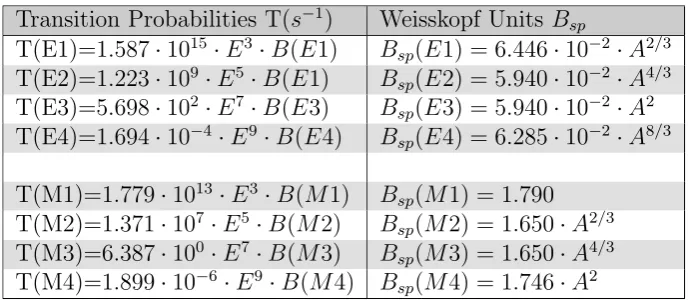
Table 2.1 shows expressions for the single-particle estimates for transition
Transition Probabilities T(s−1) Weisskopf Units B
sp
T(E1)=1.587·1015·E3·B(E1) B
sp(E1) = 6.446·10−2·A2/3
T(E2)=1.223·109·E5·B(E1) B
sp(E2) = 5.940·10−2·A4/3
T(E3)=5.698·102·E7·B(E3) B
sp(E3) = 5.940·10−2·A2
T(E4)=1.694·10−4·E9·B(E4) B
sp(E4) = 6.285·10−2·A8/3
T(M1)=1.779·1013·E3·B(M1) B
sp(M1) = 1.790
T(M2)=1.371·107 ·E5·B(M2) B
sp(M2) = 1.650·A2/3
T(M3)=6.387·100 ·E7·B(M3) B
sp(M3) = 1.650·A4/3
T(M4)=1.899·10−6·E9 ·B(M4) B
[image:36.595.125.471.126.276.2]sp(M4) = 1.746·A2
Table 2.1: Transition probabilities T (s−1) for Weisskopf single particle
esti-mates expressed asB(EL) andB(ML). The energiesE are measured in MeV [Rin04]
2.7.2
Internal Conversion
An excited nucleus can decay to a lower energy state by the emission of a
γ ray. There are other processes that compete with γ-ray emission, one of
which is the emission of a conversion electron. Conversion-electron emission
is a process whereby the nucleus interacts with a bound atomic electron,
causing this electron to be ejected from the atom. This process is completely
separate from β decay, in which an electron is emitted from the nucleus
via the decay of a neutron into a proton, an electron, and an electron
anti-neutrino.
As this process is the result of a two-body interaction with a transition
between two well defined states, the energy imparted on the electron will be
well defined. This is not the case inβdecay, where the emitted electron has a
range of allowed energies owing to the three bodied nature of the interaction.
Atomic electrons are in bound states; the strength of this binding depends
Electron Shell B (keV) K 152.970 L1 30.038 L2 29.103 L3 22.359 M1 7.930 M2 7.474 M3 5.860 M4 5.176 M5 4.876
Table 2.2: Table of atomic electron binding energies for the innermost tran-sitions in lawrencium [Fir99]
of the electron will not be the same as the γ ray resulting from the same transition. The kinetic energy of the emitted electron, Te, can be described
by
Te = ∆E−B. (2.31)
The binding energy B, will depend on the shell from which the electron is ejected, i.e. the K, L, M, . . . shells. Table 2.2 shows the binding energies
for the innermost transitions in lawrencium. The difference in strength
be-tween the competing γ-ray emission and conversion-electron emission can
vary dramatically; one process may dominate or they can be much closer in strength. The probability of each decay mode occurring, for a given
transi-tion, is described by the internal conversion coefficient, α, which is defined as
the relative probabity of the decay occuring via conversion-electron emission
versus γ-ray emission.
α= Ne
Nγ
= λe
λγ
where λ denotes the decay probability of the respective decay mode. From,
this the total electromagnetic decay rate can be written as
λt =λγ(1 +α) =λγ(1 +αK+αL1+αL2+. . .). (2.33)
Internal conversion coefficients for a point nucleus can be defined as
α(EL)∼= Z
3
n3 L L+ 1
e
2
4π0hc¯
4 2mec 2
E
L+5/2
, (2.34)
for electric multipoles and
α(EL)∼= Z
3
n3 e2
4π0¯hc
4 2mec 2
E
L+3/2
, (2.35)
for magnetic multipoles [Kra87].
Some general trends of internal conversion coefficients can be drawn from
Equations 2.34 and 2.35.
• Internal conversion increases rapidly with nuclear charge (atomic num-ber Z).
• Internal conversion decreases with increasing transition energy (E).
• The probability for internal conversion increases for higher L transitions (L).
• The probability for internal conversion decreases for higher atomic shells (n).
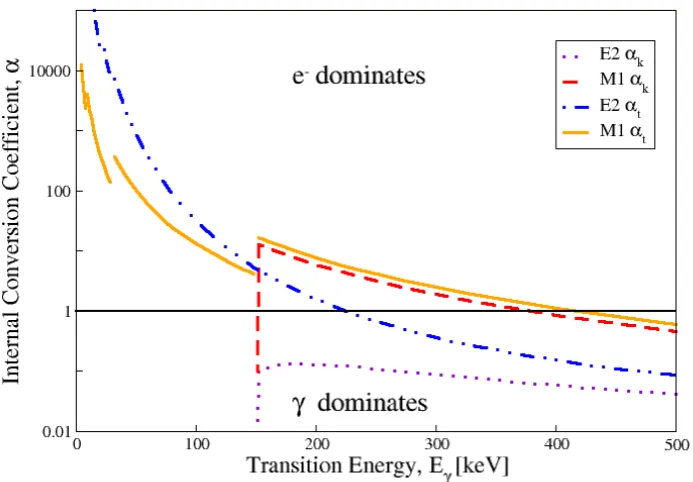
Figure 2.6: Internal conversion coefficientsαkandαtot, as a function of energy
for E2 and M1 transitions in lawrencium.
transitions could be completely unseen in γ-ray spectroscopy but strong in
electron spectroscopy.
Figure 2.6 details the conversion coefficients as a function of energy for
M1 and E2 transitions, for both K and total conversion. It is interesting to note that K conversion cannot occur below the K binding energy of the
given nucleus, in this case lawrencium. It is also clear how strongly low
Chapter 3
Experimental Methods
3.1
SAGE Spectrometer
The SAGE spectrometer [Pap10] consists of the JUROGAM II germanium detector array coupled to a solenoidal magnet which transports conversion
electrons to the SAGE silicon detector.
3.1.1
JUROGAM II array
The JUROGAM II array [Bea96] consists of 24 fourfold segmented Clover
dectors [She99], and 15 EUROGAM Phase I type Compton-suppressed
ger-manium detectors [Nol94, Bea92], though to accommodate the solenoidal
magnet of SAGE, 5 of these Phase I detectors need to be removed leaving 10
Figure 3.1: Schematic Diagram of the setup at Jyv¨askyl¨a, showing JU-ROGAM II and the SAGE silicon detector along with RITU and GREAT [Pap09].
Figure 3.3: Schematic drawing of the SAGE silicon detector showing the arrangement of the pixels.
3.1.2
SAGE silicon Detector
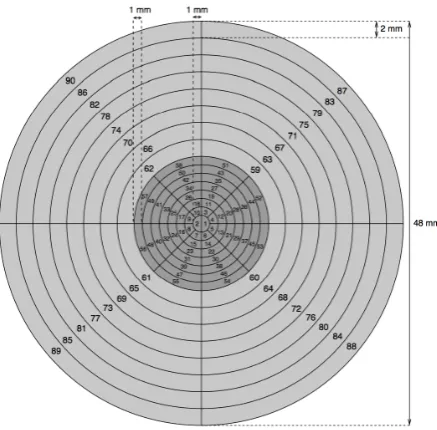
The SAGE silicon detector is a highly segmented detector made up of 90
pixels. The detector is 48 mm in diameter with a thickness of 1 mm. Fig-ure 3.3 shows the arrangement of the pixels along with dimensions and the
numbering scheme used.
3.1.3
SAGE Solenoidal Magnet and High Voltage
Bar-rier
The SAGE solenoidal magnet consists of three separate solenoids, two
up-stream of the target position and a third downup-stream. The upup-stream solenoids
Figure 3.4: Schematic of the RITU gas filled separator.
Doppler broadening of the electron peaks, along with reducing the amount of delta electrons incident of the detector, which are emitted with a heavy
forward focus. The solenoid magnets transport electrons from the target
po-sition to the detector, which is popo-sitioned upstream just off beam axis and at
a distance of ∼95 cm. Further to the solenoidal magnet, there is a high volt-age barrier in position between the target and the detector. When a negative
voltage is applied to this, it has the effect of suppressing the transmission of
low energy electrons, further reducing the background from delta electrons.
3.2
RITU Gas-filled Recoil Separator
RITU is a gas-filled recoil separator [Lei95], consisting of three quadrupole
ure 3.4 shows a schematic plan of the RITU gas filled separator, showing the
target chamber, the four magnets, and the GREAT focal plane array.
3.3
GREAT Focal Plane Array
The GREAT Focal Plane Array [Pag03], is a combination of silicon,
germa-nium, and gas detectors, for detecting the arrival and subsequent decay of
reaction products. It is sensitive to α particles, β particles, γ rays, X-rays,
as well as electrons from processes such as internal conversion and β
de-cay. GREAT consists of a number of separate detector systems that will be expanded upon in the following subsections. At the entrance to GREAT is
the multi-wire proportional counter (MWPC), next are the dual-sided silicon
strip detectors (DSSDs), 11.4 mm behind this is the planar detector. In a
box configuration around the DSSDs are the PIN diodes. Originally behind,
but now above this, is the GREAT Clover detector, further to this another
two fourfold segmented Clover detectors are placed either side. Figure 3.5
shows a schematic view of the GREAT focal plane spectrometer. Visible are the DSSD, PIN diodes, planar and the GREAT clover. Not shown are the
MWPC and the additional two Clover detectors.
3.3.1
Multi-wire proportional counter
The MWPC, is positioned at the entrance of GREAT. All products passing
through RITU to the focal plane, pass through it, allowing for identification
based on energy loss in the gas along with time of flight in conjunction with
Figure 3.5: Schematic of the GREAT Focal Plane Array [Pag03].
wide strut in the centre to support the thin mylar foils, used as the anode,
with the wires acting as the cathode. The MWPC is filled with isobutane
gas, this facilitates a small amount of energy loss by particles passing through
it. Particles can then be differentiated depending on their energy loss. This
ability to identify recoils passing through the MWPC allows for distinction between these and their subsequent radioactive decays.
3.3.2
Double-sided Silicon Strip detectors
The DSSDs, are the implantation detectors, each DSSD is 60 × 40 mm in size with a thickness of 300µm, with a strip width of 1 mm. Two of these
on one side and 40 horizontal strips on the other, giving a total of 4800 pixels.
The two DSSDs are mounted 4 mm apart on a hollow block through which
coolant is circulated, cooling the DSSDs to -20◦C. The detection efficiency for
recoils is∼85%. Further to detecting recoils with a high efficiency the DSSDs can detect α particles with an efficiency of ∼50% and conversion-electrons depending on the gain settings used.
3.3.3
Planar detector
The planar detector is a double-sided germanium strip detector, for measur-ing low energy γ-rays and X-rays. The detector has an active area of 120
× 60 mm and a thickness of 15 mm. The width of the strips on both sides is 5 mm. The efficiency of the Planar detector, along with the Clover
detec-tors is shown in Figure 3.6. These efficiencies are based on the GEANT4
simulation from Andreyev et al. [And04].
3.3.4
Silicon PIN photodiode detectors
An array of 28 silicon PIN photodiode detectors are mounted in a box
ar-rangement around the DSSDs, in the backwards direction relative to the
beam direction. Each of these PINs has an area of 28 ×28 mm and a thick-ness of 500µm. This arrangement has an efficiency of ∼20% [And04].
3.3.5
Clover detectors
Figure 3.6: Efficiency curve for various components in the GREAT focal plane array - obtained from [GJ08].
also tapered by an angle of 15◦ on the outside surface. Each crystal has
a further four fold segmentation. There is also a suppression shield of
bis-muth germanate crystals surrounding the detector to improve peak-to-total ratio. Further than the GREAT clover detector there are two more four fold
Chapter 4
Simulation of the SAGE
spectrometer in GEANT4
4.1
Justification of Simulation
As with any new detector setup, understanding its behaviour is a large part
in analysing any experiment performed with it. A comprehensive simulation not only allows better understanding of the performance of the setup, but can
be used as a tool to help in the tuning of such things as the electromagnetic
fields with the aim of increasing electron transmission efficiency.
During the design and construction phase of the SAGE spectrometer,
simulations were carried out using the SOLENOID code [But96]. These
simulations were limited to two dimensions with cylindrical symmetry and
focussed only on electron transport. The SOLENOID code did have the ability to specify an angle between the beam axis and the field axis, but not
symmetric field.
GEANT4 [Ago03] is a toolkit for the simulation of the passage of particles
through matter. It has a large range of functionality including reproduction
of complex geometry and materials alongside detailed physics models for
the interactions of particles with matter over a wide range of energies. The toolkit is implemented in the object-oriented programming language C++
and has been used in a wide range of applications in fields such as high energy
physics, nuclear physics, space engineering and medical physics.
A GEANT4 simulation overcomes the restrictions of the previous
simu-lation by being fully three dimensional and can also be expanded to include
the JUROGAM II array. This allows for a more realistic simulation and a
more detailed view of electron motion within SAGE and the volumes where
electrons are being lost [Pap12, Cox13].
4.2
Construction of the Geometry
The accuracy to which the geometry is reproduced is of great importance for the usefulness of the simulation. Figure 4.1 shows the simulated geometry.
The Phase I and Clover Ge detectors have been reproduced from design
specifications, including the bore hole, Li contacts, Ge crystals, BGO crystals,
Heavymet collimators, and supports. Figure 4.2 shows a cross section view
through two Clover and one Phase I Ge detectors.
Figure 4.3 shows the comparison between the simulated Si detector and
Figure 4.1: Complete Simulation of SAGE spectrometer, with the SAGE silicon detector to the left and JUROGAM II array to the right.
strips. This leads to a total inactive area of around 4%. For more in depth
discussion on the SAGE silicon detector see [Pap10].
Figure 4.4 shows a comparison between the simulated high voltage barrier
and the real one. The real high voltage barrier did not have the horseshoe connector, which is used to charge the high voltage barrier, fitted in this
Figure 4.2: Cross section view of two Clover(centre, right) and one Phase I (left) Ge detectors.
4.3
Analysis of Simulation Data
The ROOT data analysis framework [Bru97] has been used for the extraction
and analysis of data from the simulation. Within the simulation a ROOT tree
is built containing relevant details about each event. These details are mainly focussed on the values that are measurable in the real setup, namely the
energy deposition within detectors, but also include quantities that cannot
be measured such as,
• initial energies of particles
• initial momentum vector, for analysis of angular emission
• energy deposition in non-detector volumes, e.g. target wheel. This allows for in depth analysis of where efficiency losses occur, see section
4.5
• information of particles generation, i.e. primary particle, secondary particle generated from some physical process such as pair-production.
Once this ROOT tree has been generated all subsequent analysis can be
performed afterwards with the use of ROOT codes much faster than running the simulation. This is done as the tracking of several million electrons in
electromagnetic fields can take many hours, whereas generating a histogram
filled with the electrons detected in a certain volume, such as a single pixel
techniques such as Compton suppression and add-back can be implemented
also.
4.4
Tuning electromagnetic fields
GEANT4 has a number of models to describe charged-particle motion in an
electromagnetic field depending on the kind of motion, the accuracy of
sim-ulation needed and the type of field in question. Further to this there are a
number of parameters used to describe the required accuracy of the particle
motion in a given field. Here there is a trade-off between the accuracy of the simulation and the speed at which it can be performed. The initial
simu-lation and generation of the electromagnetic field map was performed using
the OPERA simulation package [Fie07]. This simulation was performed to
an accuracy of 1 cm in a 3D grid setup. The field map used covered an area
of 30 cm × 30 cm × 150 cm containing all volumes that electrons could be located within. More details on the field simulations can be found in [Pap10].
This meant that the field did not extend for the full simulation, rather only where the electrons of interest are likely to be affected by it. Further to
this, outside of the vacuum, where the Ge detectors are located, necessarily
had to be a low field region as the Ge detectors are highly sensitive to
elec-tromagnetic fields. To this end, a large number of shielding configurations
were tested, in simulations before construction, with the final setup, and
fi-nally in GEANT4. Figure 4.5 shows a schematic view of the final shielding
Shields
Shields
Solenoid axis
Beam axis
0 10cm
Figure 4.5: Schematic view of the magnetic coils and shielding within SAGE.
Figure 4.6: Comparison of electron distribution for original detector position (left) and detector moved by 10 mm towards the beam axis (right).
Initially the effect of the 3.2◦ angle between the upstream and downstream
coils, as can bee seen in Figure 4.5, was underestimated. This caused the
focus of the electrons to be off centre on the detector. This was reproduced
in GEANT4, as can be seen in Figure 4.6 where the initial distribution and
the final distribution of electrons can be seen.
intensity. To this end, the size and arrangement of the pixels within SAGE
was chosen with the aim of giving an even count-rate across the whole
detec-tor, with central, smaller pixels experiencing a higher intensity than outer,
larger pixels, which in turn detect more electrons due to their size.
The smallest aperture that electrons pass through in the SAGE spec-trometer is the carbon foil unit, which is necessary for separating the high
vacuum needed for operation of the high voltage barrier from the He gas
used in RITU, which has an inner diameter of 31 mm. The field map has
been interpolated from a 1 cm3 grid. From this scale it can be seen that
us-ing greater than millimetre accuracy would not give a gain in accuracy and
would only increase the time taken for the simulation considerably.
In GEANT4 the motion of a charged particle in an electromagnetic field
is tracked by integration of it’s equation of motion. This is done using a Runge-Kutta method, there are other methods for specific types of fields
depending on their level of uniformity and whether they are wholly magnetic
in nature. The integration method is described by the stepper in GEANT4.
1
A number of parameters are used to describe how accurately the path of
a particle is tracked in GEANT4. A curved path of motion is broken down
into a series of linear chord segments, of length set by the user, that closely approximate the curved path. The distance of closest approach between a
volume boundary and a linear chord segment is known as the miss distance
or chord distance. If this chord distance is below a certain value, again set by
1The 4CashKarpRKF45 stepper was chosen for the best balance between reproduction
the user, the path of motion will be recalculated with shorter steps, limited in
size by another parameter, to see if the particle will cross the boundary. At
which point if the particle is found to cross the boundary the interaction will
be calculated. These various parameters were all set to a value of 1 mm due to
the accuracy of geometry and field values, anything greater than this would increase significantly the computational time required without meaningful
change to accuracy.
4.5
Detection Efficiency
The most important aspect of the simulation is the accuracy with which
it reproduces the real experimental efficiency. For the real detector 133Ba
and 209Bi are used for calibration as these give a spread of electron energies
up to ∼1 MeV, see Section 5.1 for more on calibration of the SAGE silicon detector. With the simulation, it is a simple task to generate a given number
of electrons with a definite energy. For a detailed analysis of the detection
efficiency electrons are generated with energy divisions of 10 keV from 10 to 1000 keV. Through the use of ROOT, electrons with a given initial energy
can then be selected. As can be seen from Figure 4.7 electrons with initially
identical energies will lose varying amounts whilst being transported to the
detector. This can be caused by energy loss in the carbon foils for instance.
Figure 4.7 shows all electrons detected for an initial energy of 100 keV.
Of these a significant fraction have lost a large amount of their initial energy.
re-Figure 4.7: Simulated electrons in the SAGE silicon detector with an initial energy of 100 keV.
produced. This consists of a thin mylar window on the face pointing towards
the detector and a thicker acrylic backing pointing away. Electrons emitted
towards the detector lose a small amount of energy exiting the source and are
found in the main peak, electrons emitted at a backwards angle which are
reflected by the magnetic field lose a larger amount of energy and make up
the second lower energy peak. If only the number of electrons detected was taken as a measure of the efficiency, it would be a great overestimation, and
in a realistic case where there would be more than one energy peak and it
would not be possible. Ideally all the electrons in the peak would be counted
and those that would be considered background if it were real data would
be discounted. To achieve this a fitting algorithm was developed
combin-ing a Crystal Ball Function [Gai82] to fit the peak with a combination of a
quadratic and a step function to fit the background. It can be seen that the
line shows the combined step function and the quadratic. This is close to
what would be expected for fitting a real peak with this kind of background.
The need for this background subtraction diminishes as the energy of
the emitted electron increases, and is required even less for γ rays, but for
[image:59.595.148.437.282.489.2]consistency purposes all fits are done using the same algorithm.
Figure 4.8: Simulated efficiency curve for the SAGE silicon detector com-pared to measured values for peaks in 133Ba and 207Bi.
Figure 4.8 shows a simulated efficiency curve for electrons of energies from
0 to 1000 keV. It can be seen that for energies below 200 keV this simulation
underestimates the electron efficiency, but for higher energies there is a good
agreement. The source of this discrepancy is not yet understood and it may
Figure 4.9: Simulated SAGE silicon detector efficiency as a function of high-voltage barrier setting.
ting. It can be seen that the efficiency below 200 keV is affected by the high-voltage barrier settings. The effect of the high-voltage barrier is
pre-dictable and proportionate to the barrier setting.
Figure 4.10 shows a comparison of simulated and measured efficiency for
a barrier setting of -30kV. Here it can be seen that there is a good
agree-ment with measured efficiency for energies above 200 keV, below this there is
still some difference between simulation and measured values, though from
50 keV downwards there is once again good agreement between simulation of measurement.
Alongside the detection efficiency of electrons with the SAGE silicon
Figure 4.10: Comparison of measured and simulated SAGE silicon detector efficiency for a high voltage barrier setting of -30kV.
important part of this simulation. Figure 4.11 shows a comparison of simu-lated and measured efficiency for the JUROGAM II array. It can be seen that
there is a very good agreement in shape between simulation and measured
efficiency, though in the simulation the efficiency is between 1-2 % higher at
all points. The reason for this is likely to do with a combination of
geom-etry not yet included in the simulation, namely the aluminium holder the
target wheel sits in, the motor used to rotate the wheel and tin and copper
absorber foils on the faces of the Phase I and Clover detectors, and inaccu-racies in crystal size and position. Though the effect seems too pronounced
fur-Figure 4.11: Simulated efficiency of the Jurogam II array also shown in blue is a calculated efficiency curve.
that has not been taken into account is the effect of low energy noise. For real detectors a threshold signal limit has to be set to stop excessively high
count rates. The effect this has on low energy efficiency could account for
the discrepancies seen here.
4.5.1
Efficiency Losses
The SAGE spectrometer has a number of apertures between the target
po-sition and the silicon detector, through which electrons must pass. This is
illustrated in Figure 4.12. Table 4.1 details the volumes that electrons deposit
energy in.
[image:62.595.148.437.163.370.2]Figure 4.12: Simulation detailing the geometry near to the target position in SAGE, visible are the carbon foil unit, target wheel, target, and the detector chamber.
the target wheel, shown in Figure 4.12, that are the main volumes for
ab-sorbing electrons. The target also shows a very high number of interactions,
though it should be noted that these are generally of a very small energy and most electrons that interact here will go on to deposit most of their energy
in either the target wheel, carbon foil unit, or detector. Inversely, the target
chamber, detector chamber, and high-voltage barrier all account for a very
![Figure 1.1: Self-consistent mean-field calculations for shell correction ener-gies, in MeV,for the Z∼50 region, and the super heavy nuclei[Ben01].](https://thumb-us.123doks.com/thumbv2/123dok_us/8062367.226195/15.595.163.438.131.396/figure-consistent-eld-calculations-shell-correction-region-nuclei.webp)
![Figure 2.1:A plot of binding energy per nucleon as a function of massnumber [Cas01].](https://thumb-us.123doks.com/thumbv2/123dok_us/8062367.226195/20.595.156.445.255.495/figure-plot-binding-energy-nucleon-function-massnumber-cas.webp)
![Figure 2.2:Chart of nuclides overlaid with the predicted binding energyper nucleon according to the liquid drop model, also line for various valuesof Z2/A tracking the fissility [Sch13].](https://thumb-us.123doks.com/thumbv2/123dok_us/8062367.226195/23.595.108.485.153.416/nuclides-overlaid-predicted-energyper-according-valuesof-tracking-ssility.webp)
![Figure 2.5: A section of Segr´e chart, showing the longest lived isomers Z≥82[Her11].](https://thumb-us.123doks.com/thumbv2/123dok_us/8062367.226195/30.595.106.497.132.325/figure-section-segr-chart-showing-longest-lived-isomers.webp)
![Table 2.2: Table of atomic electron binding energies for the innermost tran-sitions in lawrencium [Fir99]](https://thumb-us.123doks.com/thumbv2/123dok_us/8062367.226195/37.595.229.367.127.275/table-table-electron-binding-energies-innermost-sitions-lawrencium.webp)
![Figure 3.1:Schematic Diagram of the setup at Jyv¨askyl¨a, showing JU-ROGAM II and the SAGE silicon detector along with RITU and GREAT[Pap09].](https://thumb-us.123doks.com/thumbv2/123dok_us/8062367.226195/41.595.195.413.398.621/figure-schematic-diagram-showing-rogam-silicon-detector-great.webp)
![Figure 3.6: Efficiency curve for various components in the GREAT focalplane array - obtained from [GJ08].](https://thumb-us.123doks.com/thumbv2/123dok_us/8062367.226195/47.595.132.486.130.395/figure-eciency-curve-various-components-great-focalplane-obtained.webp)
