Foreword
The Handbook of Evolutionary Computation represents a major milestone for the field of evolutionary computation (EC). As is the case with any new field, there are a number of distinct stages of growth and maturation. The field began in the late 1950s and early 1960s as the availability of digital computing permitted scientists and engineers to build and experiment with various models of evolutionary processes. This early work produced a number of important EC paradigms, including evolutionary programming (EP), evolution strategies (ESs), and genetic algorithms (GAs), which served as the basis for much of the work done in the 1970s, a period of intense exploration and refinement of these ideas. The result was a variety of robust algorithms with significant potential for addressing difficult scientific and engineering problems. By the late 1980s and early 1990s the level of activity had grown to the point that each of the subgroups associated with the primary EC paradigms (GAs, ESs, and EP) was involved in planning and holding its own regularly scheduled conferences.
However, within the field there was a growing sense of the need for more interaction and cohesion among the various subgroups. If the field as a whole were to mature, it needed a name, it needed to have an articulated cohesive structure, and it needed a reservoir for archival literature. The 1990s reflect this maturation with the choice of evolutionary computation as the name of the field, the establishment of two journals for the field, and the commitment to produce this handbook as the first clear and cohesive description of the field.
With the publication of this handbook there is now a sense of unity and maturity to the field. The handbook represents a momentous accomplishment for which we owe the editors and the many contributors a great deal of thanks. More importantly, it is designed to be an evolving description of the field and will continue to serve as a foundational reference for the future.
Kenneth De Jong, George Mason University
Lawrence Fogel, Natural Selection Inc.
A1.1
Introduction
David B Fogel
Abstract
A rationale for simulating evolution is offered in this section. Efforts in evolutionary computation commonly derive from one of four different motivations: improving optimization, robust adaptation, machine intelligence, and facilitating a greater understanding of biology. A brief overview for each of these avenues is offered here.
A1.1.1 Introductory remarks
As a recognized field, evolutionary computation is quite young. The term itself was invented as recently as 1991, and it represents an effort to bring together researchers who have been following different approaches
to simulating various aspects of evolution. These techniques of genetic algorithms, evolution strategies, B1.2,B1.3 and evolutionary programming have one fundamental commonality: they each involve the reproduction, B1.4 random variation, competition, and selection of contending individuals in a population. These form the essential essence of evolution, and once these four processes are in place, whether in nature or in a computer, evolution is the inevitable outcome (Atmar 1994). The impetus to simulate evolution on a computer comes from at least four directions.
A1.1.2 Optimization
Evolution is an optimization process (Mayr 1988, p 104). Darwin (1859, ch 6) was struck with the ‘organs of extreme perfection’ that have been evolved, one such example being the image-forming eye (Atmar, 1976). Optimization does not imply perfection, yet evolution can discover highly precise functional solutions to particular problems posed by an organism’s environment, and even though the mechanisms that are evolved are often overly elaborate from an engineering perspective, function is the sole quality that is exposed to natural selection, and functionality is what is optimized by iterative selection and mutation. It is quite natural, therefore, to seek to describe evolution in terms of an algorithm that can be used to solve difficult engineering optimization problems. The classic techniques of gradient descent, deterministic hill climbing, and purely random search (with no heredity) have been generally unsatisfactory when applied to nonlinear optimization problems, especially those with stochastic, temporal, or chaotic components. But these are the problems that nature has seemingly solved so very well. Evolution provides inspiration for computing the solutions to problems that have previously appeared intractable. This was a key foundation for the efforts in evolution strategies (Rechenberg 1965, 1994, Schwefel 1965, 1995).
A1.1.3 Robust adaptation
Introduction
A1.1.4 Machine intelligence
Intelligence may be defined as the capability of a system to adapt its behavior to meet desired goals in a range of environments (Fogel 1995, p xiii). Intelligent behavior then requires prediction, for adaptation to future circumstances requires predicting those circumstances and taking appropriate action. Evolution has created creatures of increasing intelligence over time. Rather than seek to generate machine intelligence by replicating humans, either in the rules they may follow or in their neural connections, an alternative approach to generating machine intelligence is to simulate evolution on a class of predictive algorithms. This was the foundation for the evolutionary programming research of Fogel (1962, Fogel et al 1966). A1.1.5 Biology
Rather than attempt to use evolution as a tool to solve a particular engineering problem, there is a desire to capture the essence of evolution in a computer simulation and use the simulation to gain new insight into the physics of natural evolutionary processes (Ray 1991). Success raises the possibility of studying A2.1 alternative biological systems that are merely plausible images of what life might be like in some way. It also raises the question of what properties such imagined systems might have in common with life as evolved on Earth (Langton 1987). Although every model is incomplete, and assessing what life might be like in other instantiations lies in the realm of pure speculation, computer simulations under the rubric of artificial life have generated some patterns that appear to correspond with naturally occurring phenomena.
A1.1.6 Discussion
The ultimate answer to the question ‘why simulate evolution?’ lies in the lack of good alternatives. We cannot easily germinate another planet, wait several millions of years, and assess how life might develop elsewhere. We cannot easily use classic optimization methods to find global minima in functions when they are surrounded by local minima. We find that expert systems and other attempts to mimic human intelligence are often brittle: they are not robust to changes in the domain of application and are incapable of correctly predicting future circumstances so as to take appropriate action. In contrast, by successfully exploiting the use of randomness, or in others words the useful use of uncertainty, ‘all possible pathways are open’ for evolutionary computation (Hofstadter 1995, p 115). Our challenge is, at least in some important respects, to not allow our own biases to constrain the potential for evolutionary computation to discover new solutions to new problems in fascinating and unpredictable ways. However, as always, the ultimate advancement of the field will come from the careful abstraction and interpretation of the natural processes that inspire it.
References
Atmar J W 1976 Speculation on the Evolution of Intelligence and its Possible Realization in Machine Form Doctoral Dissertation, New Mexico State University
Atmar W 1994 Notes on the simulation of evolution IEEE Trans. Neural Networks NN-5 130–47
Darwin C R 1859 On the Origin of Species by Means of Natural Selection or the Preservation of Favoured Races in
the Struggle for Life (London: Murray)
Fogel D B 1995 Evolutionary Computation: Toward a New Philosophy of Machine Intelligence (Piscataway, NJ: IEEE) Fogel L J 1962 Autonomous automata Industr. Res. 4 14–9
Fogel L J, Owens A J and Walsh M J 1966 Artificial Intelligence through Simulated Evolution (New York: Wiley) Hofstadter D 1995 Fluid Concepts and Creative Analogies: Computer Models of the Fundamental Mechanisms of
Thought (New York: Basic Books)
Holland J H 1975 Adaptation in Natural and Artificial Systems (Ann Arbor, MI: University of Michigan Press) Langton C G 1987 Artificial life Artificial Life ed C G Langton (Reading, MA: Addison-Wesley) pp 1–47 Mayr E 1988 Toward a New Philosophy of Biology: Observations of an Evolutionist (Cambridge, MA: Belknap) Ray T 1991 An approach to the synthesis of life Artificial Life II ed C G Langton, C Taylor, J D Farmer and
S Rasmussen (Reading, MA: Addison-Wesley) pp 371–408
Rechenberg I 1965 Cybernetic Solution Path of an Experimental Problem Royal Aircraft Establishment Library Translation 1122, Farnborough, UK
——1994 Evolutionsstrategies ’94 (Stuttgart: Frommann-Holzboog)
Schwefel H-P 1965 Kybernetische Evolution als Strategie der Experimentellen Forschung in der Str¨omungstechnik Diploma Thesis, Technical University of Berlin
A1.2
Possible applications of evolutionary computation
David Beasley
Abstract
This section describes some of the applications to which evolutionary computation has been applied. Applications are divided into the areas of planning, design, simulation and identification, control, and classification.
A1.2.1 Introduction
Applications of evolutionary computation (EC) fall into a wide continuum of areas. For convenience, in this section they have been split into five broad categories:
• planning • design
• simulation and identification • control
• classification.
These categories are by no means meant to be absolute or definitive. They all overlap to some extent, and many applications could rightly appear in more than one of the categories.
These categories correspond to the sections found in Part F roughly as follows: planning is
covered by F1.5 (scheduling) and F1.7 (packing); simulation and identification are covered by F1.4 F1.5,F1.7,F1.4 (identification), F1.8 (simulation models) and F1.10 (simulated evolution); control is covered by F1.8,F1.10 F1.3 (control); classification is covered by F1.6 (pattern recognition). Design is not covered by a specific F1.3,F1.6 section in Part F.
Some of the applications mentioned here are described more fully in other parts of this book as indicated by marginal cross-references. The final part of this section lists a number of bibliographies where more extensive information on EC applications can be found.
A1.2.2 Applications in planning A1.2.2.1 Routing
Perhaps one of the best known combinatorial optimization problems is the traveling salesman problem G1.3,G9.5 or TSP (Goldberg and Lingle 1985, Grefenstette 1987, Fogel 1988, Oliver et al 1987, M¨uhlenbein 1989,
Whitley et al 1989, Fogel 1993a, Homaifar et al 1993). A salesman must visit a number of cities, and then return home. In which order should the cities be visited to minimize the distance traveled? Optimizing the tradeoff between speed and accuracy of solution has been one aim (Verhoeven et al 1992).
A generalization of the TSP occurs when there is more than one salesman (Fogel 1990). The vehicle routing problem is similar. There is a fleet of vehicles, all based at the same depot. A set of customers must each receive one delivery. Which route should each vehicle take for minimum cost? There are constraints, for example, on vehicle capacity and delivery times (Blanton and Wainwright 1993, Thangia et al 1993).
Possible applications of evolutionary computation
to a number of customers from a number of depots. Each customer may receive deliveries from one or more depots. What is the minimum-cost solution? (Michalewicz 1992, 1993).
Planning the path which a robot should take is another route planning problem. The path must be feasible and safe (i.e. it must be achievable within the operational constraints of the robot) and there must be no collisions. Examples include determining the joint motions required to move the gripper of a robot arm between locations (Parker et al 1989, Davidor 1991, McDonnell et al 1992), and autonomous vehicle routing (Jakob et al 1992, Page et al 1992). In unknown areas or nonstatic environments, on-line planning/navigating is required, in which the robot revises its plans as it travels. G3.6
A1.2.2.2 Scheduling
Scheduling involves devising a plan to carry out a number of activities over a period of time, where the activities require resources which are limited, there are various constraints and there are one or more objectives to be optimized.
Job shop scheduling is a widely studied NP-complete problem (Davis 1985, Biegel and Davern 1990, G1.2.3 Syswerda 1991, Yamada and Nakano 1992). The scenario is a manufacturing plant, with machines of different types. There are a number of jobs to be completed, each comprising a set of tasks. Each task requires a particular type of machine for a particular length of time, and the tasks for each job must be completed in a given order. What schedule allows all tasks to be completed with minimum cost? Husbands (1993) has used the additional biological metaphor of an ecosystem. His method optimizes the sequence G9.3 of tasks in each job at the same time as it builds the schedule. In real job shops the requirements may change while the jobs are being carried out, requiring that the schedule be replanned (Fang et al 1993). In the limit, the manufacturing process runs continuously, so all scheduling must be carried out on-line, as in a chemical flowshop (Cartwright and Tuson 1994).
Another scheduling problem is to devise a timetable for a set of examinations (Corne et al 1994), university lectures (Ling 1992), a staff rota (Easton and Mansour 1993) or suchlike. G9.4
In computing, scheduling problems include efficiently allocating tasks to processors in a multiprocessor system (Van Driessche and Piessens 1992, Kidwell 1993, Fogel and Fogel 1996), and devising memory cache replacement policies (Altman et al 1993).
A1.2.2.3 Packing
Evolutionary algorithms (EAs) have been applied to many packing problems, the simplest of which is the one-dimensional zero–one knapsack problem. Given a knapsack of a certain capacity, and a set of G9.7 items, each with a particular size and value, find the set of items with maximum value which can be accommodated in the knapsack. Various real-world problems are of this type: for example, the allocation of communication channels to customers who are charged at different rates.
There are various examples of two-dimensional packing problems. When manufacturing items are cut from sheet materials (e.g. metal or cloth), it is desirable to find the most compact arrangement of pieces, so as to minimize the amount of scrap (Smith 1985, Fujita et al 1993). A similar problem arises in the design of layouts for integrated circuits—how should the subcircuits be arranged to minimize the total chip area required (Fourman 1985, Cohoon and Paris 1987, Chan et al 1991)?
In three dimensions, there are obvious applications in which the best way of packing objects into a restricted space is required. Juliff (1993) has considered the problem of packing goods into a truck for
delivery. (See also Section F1.7 of this handbook.) F1.7
A1.2.3 Applications in design
a two-dimensional arrangement of ‘departments’ such that the distance which information has to travel between departments is minimized.
EC techniques have been widely applied to artificial neural networks, both in the design of network topologies and in the search for optimum sets of weights (Miller et al 1989, Fogel et al 1990, Harp and Samad 1991, Baba 1992, Hancock 1992, Feldman 1993, Gruau 1993, Polani and Uthmann 1993, Romaniuk 1993, Spittle and Horrocks 1993, Zhang and M¨uhlenbein 1993, Porto et al 1995). They have also been applied to Kohonen feature map design (Polani and Uthmann 1992). Other types of network design problems have also been approached (see Section G1.3 of this handbook), for example, in G1.3 telecommunications (Cox et al 1991, Davis and Cox 1993).
There have been many engineering applications of EC: structure design, both two-dimensional, such G3 as a plane truss (Lohmann 1992, Watabe and Okino 1993), and three-dimensional, such as aircraft design (Bramlette and Bouchard 1991), actuator placement on space structures (Furuya and Haftka 1993), linear accelerator design, gearbox design, and chemical reactor design (Powell and Skolnick 1993). In relation G4.2 to high-energy physics, the design of Monte Carlo generators has been tackled. G4.1
In order to perform parallel computations requiring global coordination, EC has been used to design
cellular automata with appropriate communication mechanisms. G1.6
There have also been applications in testing and fault diagnosis. For example, an EA can be used to search for challenging fault scenarios for an autonomous vehicle controller. G3.4
A1.2.4 Applications in simulation and identification
Simulation involves taking a design or model for a system, and determining how the system will behave. In some cases this is done because we are unsure about the behavior (e.g. when designing a new aircraft). In other cases, the behavior is known, but we wish to test the accuracy of the model (e.g. see Section
F1.8 of this handbook). F1.8
EC has been applied to difficult problems in chemistry and biology. Roosen and Meyer (1992) used G5,G6 an evolution strategy to determine the equilibrium of chemically reactive systems, by determining the minimum free enthalpy of the compounds involved. The determination of the three-dimensional structure of a protein, given its amino acid sequence, has been tackled (Lucasius et al 1991). Lucasius and Kateman (1992) approached this as a sequenced subset selection problem, using two-dimensional nuclear magnetic resonance spectrum data as a starting point. Others have searched for energetically favorable protein conformations (Schulze-Kremer 1992, Unger and Moult 1993), and used EC to assist with drug design (Gehlhaar et al 1995). EC has been used to simulate how the nervous system learns in order to test an existing theory (see Section G8.4 of this handbook). Similarly, EC has been used in order to help develop G8.4
models of biological evolution (see Section F1.10 of this handbook). F1.10
In the field of economics, EC has been used to model economic interaction of competing firms in a G7.1 market.
Identification is the inverse of simulation. It involves determining the design of a system given its F1.4 behavior.
Many systems can be represented by a model which produces a single-valued output in response to one or more input signals. Given a number of observations of input and output values, system identification G1.4 is the task of deducing the details of the model. Flockton and White (1993) concern themselves with determining the poles and zeros of the system.
One reason for wanting to identify systems is so that we can predict the output in response to a given set of inputs. In Section G4.3 of this handbook EC is employed to fit equations to noisy, chaotic medical G4.3 data, in order to predict future values. Janikow and Cai (1992) similarly used EC to estimate statistical functions for survival analysis in clinical trials. In a similar area, Manela et al (1993) used EC to fit spline functions to noisy pharmaceutical fermentation process data.
In Section G5.1 of this handbook, EC is used to identify the sources of airborne pollution, given data G5.1 from a number of monitoring points in an urban area—the source apportionment problem.
In electromagnetics, Tanaka et al (1993) have applied EC to determining the two-dimensional current distribution in a conductor, given its external magnetic field.
Possible applications of evolutionary computation
A1.2.5 Applications in control
There are two distinct approaches to the use of EC in control: off-line and on-line. The off-line approach uses an EA to design a controller, which is then used to control the system. The on-line approach uses an EA as an active part of the control process. Therefore, with the off-line approach there is nothing evolutionary about the control process itself, only about the design of the controller.
Some researchers (Fogel et al 1966, DeJong 1980) have sought to use the adaptive qualities of EAs in order to build on-line controllers for dynamic systems. The advantage of an evolutionary controller is that it can adapt to cope with systems whose characteristics change over time, whether the change is gradual or sudden. Most researchers, however, have taken the off-line approach to the control of relatively unchanging systems.
Fonseca and Fleming (1993) used an EA to design a controller for a gas turbine engine, to optimize its step response. A control system to optimize combustion in multiple-burner furnaces and boiler plants is discussed in Section G3.2. EC has also been applied to the control of guidance and navigation systems G3.2 (Krishnakumar and Goldberg 1990, 1992).
Hunt (1992b) has tackled the problem of synthesizing LQG (linear–quadratic–Gaussian) and H∞
(H-infinity) optimal controllers. He has also considered the frequency domain optimization of controllers with fixed structures (Hunt 1992a).
Two control problems which have been well studied are balancing a pole on a movable cart (Fogel 1995), and backing up a trailer truck to a loading bay from an arbitrary starting point (Abu Zitar and Hassoun 1993). In robotics, EAs have been developed which can evolve control systems for visually guided behaviors (see Section G3.7). They can also learn how to control mobile robots (Kim and Shim G3.7 1995), for example, controlling the legs of a six-legged ‘insect’ to make it crawl or walk (Spencer 1993). Alm´assy and Verschure (1992) modeled the interaction between natural selection and the adaptation of individuals during their lifetimes to develop an agent with a distributed adaptive control framework which learns to avoid obstacles and locate food sources.
A1.2.6 Applications in classification
A significant amount of EC research has concerned the theory and practice of classifier systems (CFS) B1.5.2 (Booker 1985, Holland 1985, 1987, Holland et al 1987, Robertson 1987, Wilson 1987, Fogarty 1994). Classifier systems are at the heart of many other types of system. For example, many control systems rely on being able to classify the characteristics of their environment before an appropriate control decision can be made. This is true in many robotics applications of EC, for example, learning to control robot arm motion (Patel and Dorigo 1994) and learning to solve mazes (Pipe and Carse 1994).
An important aspect of a classifier system, especially in a control application, is how the state space is partitioned. Many applications take for granted a particular partitioning of the state space, while in others, the appropriate partitioning of the state space is itself part of the problem (Melhuish and Fogarty 1994). In Section G2.3, EC was used to determine optimal symbolic descriptions for concepts. G2.3
Game playing is another application for which classification plays a key role. Although EC is often applied to rather simple games (e.g. the prisoner’s dilemma (Axelrod 1987, Fogel 1993b)), this is sometimes motivated by more serious applications, such as military ones (e.g. the two-tanks game (Fairley and Yates
1994) and air combat maneuvering. G3.3
EC has been hybridized with feature partitioning and applied to a range of tasks (G¨uvenir and ¸Sirin 1993), including classification of iris flowers, prediction of survival for heart attack victims from echocardiogram data, diagnosis of heart disease, and classification of glass samples. In linguistics, EC has been applied to the classification of Swedish words.
In economics, Oliver (1993) has found rules to reflect the way in which consumers choose one brand rather than another, when there are multiple criteria on which to judge a product. A fuzzy hybrid system has been used for financial decision making, with applications to credit evaluation, risk assessment, and G7.2 insurance underwriting.
In image processing, there have been further military applications, classifying features in images as targets (Bala and Wechsler 1993, Tackett 1993), and also non-military applications, such as optical
character recognition. G8.1
Of increasing importance is the efficient storage and retrieval of information. Section G2.2 is G2.2 concerned with generating equifrequency distributions of material, to improve the efficiency of information storage and its subsequent retrieval. EC has also been employed to assist with the representation and storage of chemical structures, and the retrieval from databases of molecules containing certain substructures (Jones et al 1993). The retrieval of documents which match certain characteristics is becoming increasingly important as more and more information is held on-line. Tools to retrieve documents which contain specified words have been available for many years, but they have the limitation that constructing an appropriate search query can be difficult. Researchers are now using EAs to help with query construction G2.1 (Yang and Korfhage 1993).
A1.2.7 Summary
EC has been applied in a vast number of application areas. In some cases it has advantages over existing computerized techniques. More interestingly, perhaps, it is being applied to an increasing number of areas in which computers have not been used before. We can expect to see the number of applications grow considerably in the future. Comprehensive bibliographies in many different application areas are listed in the further reading section of this article.
References
Abu Zitar R A and Hassoun M H 1993 Regulator control via genetic search and assisted reinforcement Proc. 5th
Int. Conf. on Genetic Algorithms (Urbana-Champaign, IL, July 1993) ed S Forrest (San Mateo, CA: Morgan
Kaufmann) pp 254–62
Alm´assy N and Verschure P 1992 Optimizing self-organising control architectures with genetic algorithms: the interaction between natural selection and ontogenesis Parallel Problem Solving from Nature, 2 (Proc. 2nd Int.
Conf. on Parallel Problem Solving from Nature, Brussels, 1992) ed R M¨anner and B Manderick (Amsterdam:
Elsevier) pp 451–60
Altman E R, Agarwal V K and Gao G R 1993 A novel methodology using genetic algorithms for the design of caches and cache replacement policy Proc. 5th Int. Conf. on Genetic Algorithms (Urbana-Champaign, IL, July 1993) ed S Forrest (San Mateo, CA: Morgan Kaufmann) pp 392–9
Axelrod R 1987 The evolution of strategies in the iterated prisoner’s dilemma Genetic Algorithms and Simulated
Annealing ed L Davis (Boston, MA: Pitman) ch 3, pp 32–41
Baba N 1992 Utilization of stochastic automata and genetic algorithms for neural network learning Parallel Problem
Solving from Nature, 2 (Proc. 2nd Int. Conf. on Parallel Problem Solving from Nature, Brussels, 1992) ed R
M¨anner and B Manderick (Amsterdam: Elsevier) pp 431–40
Bagchi S, Uckun S, Miyabe Y and Kawamura K 1991 Exploring problem-specific recombination operators for job shop scheduling Proc. 4th Int. Conf. on Genetic Algorithms (San Diego, CA, July 1991) ed R Belew and L Booker (San Mateo, CA: Morgan Kaufmann) pp 10–7
Bala J W and Wechsler H 1993 Learning to detect targets using scale-space and genetic search Proc. 5th Int. Conf.
on Genetic Algorithms (Urbana-Champaign, IL, July 1993) ed S Forrest (San Mateo, CA: Morgan Kaufmann)
pp 516–22
Biegel J E and Davern J J 1990 Genetic algorithms and job shop scheduling Comput. Indust. Eng. 19 81–91 Blanton J L and Wainwright R L 1993 Multiple vehicle routing with time and capacity constraints Proc. 5th Int. Conf.
on Genetic Algorithms (Urbana-Champaign, IL, July 1993) ed S Forrest (San Mateo, CA: Morgan Kaufmann)
pp 452–9
Booker L 1985 Improving the performance of genetic algorithms in classifier systems Proc. 1st Int. Conf. on Genetic
Algorithms (Pittsburgh, PA, July 1985) ed J J Grefenstette (Hillsdale, NJ: Lawrence Erlbaum Associates) pp 80–92
Bramlette M F and Bouchard E E 1991 Genetic algorithms in parametric design of aircraft Handbook of Genetic
Algorithms ed L Davis (New York: Van Nostrand Reinhold) ch 10, pp 109–23
Cartwright H M and Tuson A L 1994 Genetic algorithms and flowshop scheduling: towards the development of a real-time process control system Evolutionary Computing (AISB Workshop, Leeds, 1994, Selected Papers) (Lecture
Notes in Computer Science 865) ed T C Fogarty (Berlin: Springer) pp 277–90
Chan H, Mazumder P and Shahookar K 1991 Macro-cell and module placement by genetic adaptive search with bitmap-represented chromosome Integration VLSI J. 12 49–77
Possible applications of evolutionary computation
Corne D, Ross P and Fang H-L 1994 Fast practical evolutionary timetabling Evolutionary Computing (AISB Workshop,
Leeds, 1994, Selected Papers) (Lecture Notes in Computer Science 865) ed T C Fogarty (Berlin: Springer) pp 250–
63
Cox L A, Davis L and Qiu Y 1991 Dynamic anticipatory routing in circuit-switched telecommunications networks
Handbook of Genetic Algorithms ed L Davis (New York: Van Nostrand Reinhold) ch 11, pp 124–43
Davidor Y 1991 A genetic algorithm applied to robot trajectory generation Handbook of Genetic Algorithms ed L Davis (New York: Van Nostrand Reinhold) ch 12, pp 144–65
Davis L 1985 Job shop scheduling with genetic algorithms Proc. 1st Int. Conf. on Genetic Algorithms (Pittsburgh, PA,
July 1985) ed J J Grefenstette (Hillsdale, NJ: Lawrence Erlbaum Associates) pp 136–40
Davis L and Cox A 1993 A genetic algorithm for survivable network design Proc. 5th Int. Conf. on Genetic Algorithms
(Urbana-Champaign, IL, July 1993) ed S Forrest (San Mateo, CA: Morgan Kaufmann) pp 408–15
DeJong K 1980 Adaptive system design: a genetic approach IEEE Trans. Systems, Man Cybern. SMC-10 566–74 Easton F F and Mansour N 1993 A distributed genetic algorithm for employee staffing and scheduling problems Proc.
5th Int. Conf. on Genetic Algorithms (Urbana-Champaign, IL, July 1993) ed S Forrest (San Mateo, CA: Morgan
Kaufmann) pp 360–67
Etter D M, Hicks M J and Cho K H 1982 Recursive adaptive filter design using an adaptive genetic algorithm IEEE
Int. Conf. on Acoutics, Speech and Signal Processing (Piscataway, NJ: IEEE) pp 635–8
Fairley A and Yates D F 1994 Inductive operators and rule repair in a hybrid genetic learning system: some initial results Evolutionary Computing (AISB Workshop, Leeds, 1994, Selected Papers) (Lecture Notes in Computer
Science 865) ed T C Fogarty (Berlin: Springer) pp 166–79
Fang H-L, Ross P and Corne D 1993 A promising genetic algorithm approach to job-shop scheduling, rescheduling and open-shop scheduling problems Proc. 5th Int. Conf. on Genetic Algorithms (Urbana-Champaign, IL, July
1993) ed S Forrest (San Mateo, CA: Morgan Kaufmann) pp 375–82
Feldman D S 1993 Fuzzy network synthesis with genetic algorithms Proc. 5th Int. Conf. on Genetic Algorithms
(Urbana-Champaign, IL, July 1993) ed S Forrest (San Mateo, CA: Morgan Kaufmann) pp 312–7
Flockton S J and White M 1993 Pole-zero system identification using genetic algorithms Proc. 5th Int. Conf. on Genetic
Algorithms (Urbana-Champaign, IL, July 1993) ed S Forrest (San Mateo, CA: Morgan Kaufmann) pp 531–5
Fogarty T C 1994 Co-evolving co-operative populations of rules in learning control systems Evolutionary Computing
(AISB Workshop, Leeds, 1994, Selected Papers) (Lecture Notes in Computer Science 865) ed T C Fogarty (Berlin:
Springer) pp 195–209
Fogel D B 1988 An evolutionary approach to the traveling salesman problem Biol. Cybernet. 6 139–44
——1990 A parallel processing approach to a multiple traveling salesman problem using evolutionary programming
Proc. 4th Ann. Symp. on Parallel Processing (Piscataway, NJ: IEEE) pp 318–26
——1991 System Identification through Simulated Evolution (Needham, MA: Ginn)
——1993a Applying evolutionary programming to selected traveling salesman problems Cybernet. Syst. 24 27–36 ——1993b Evolving behaviors in the iterated prisoner’s dilemma Evolut. Comput. 1 77–97
——1995 Evolutionary Computation: Toward a New Philosophy of Machine Intelligence (Piscataway, NJ: IEEE) Fogel D B and Fogel L J 1996 Using evolutionary programming to schedule tasks on a suite of heterogeneous
computers Comput. Operat. Res. 23 527–34
Fogel D B, Fogel L J and Porto V W 1990 Evolving neural networks Biol. Cybern. 63 487–93
Fogel L J, Owens A J and Walsh M J 1966 Artificial intelligence Through Simulated Evolution (New York: Wiley) Fonseca C M and Fleming P J 1993 Genetic algorithms for multiobjective optimization: formulation, discussion and
generalization Proc. 5th Int. Conf. on Genetic Algorithms (Urbana-Champaign, IL, July 1993) ed S Forrest (San Mateo, CA: Morgan Kaufmann) pp 416–23
Fonseca C M, Mendes E M, Fleming P J and Billings S A 1993 Non-linear model term selection with genetic algorithms Natural Algorithms in Signal Processing (Workshop, Chelmsford, UK, November 1993) vol 2 (London: IEE) pp 27/1–27/8
Fourman M P 1985 Compaction of symbolic layout using genetic algorithms Proc. 1st Int. Conf. on Genetic Algorithms
(Pittsburgh, PA, July 1985) ed J J Grefenstette (Hillsdale, NJ: Lawrence Erlbaum Associates) pp 141–53
Fujita K, Akagi S and Hirokawa N 1993 Hybrid approach for optimal nesting using genetic algorithm and a local minimization algorithm Advances in Design Automation vol 1, DE-65–1 (ASME) pp 477–84
Furuya H and Haftka R T 1993 Genetic algorithms for placing actuators on space structures Proc. 5th Int. Conf.
on Genetic Algorithms (Urbana-Champaign, IL, July 1993) ed S Forrest (San Mateo, CA: Morgan Kaufmann)
pp 536–42
Gehlhaar D K, Verkhivker G M, Rejto P A, Sherman C J, Fogel D B, Fogel L J and Freer S T 1995 Molecular recognition of the inhibitor AG-1343 by HIV-1 protease: conformationally flexible docking by evolutionary programming Chem. Biol. 2 317–24
Goldberg D E and Lingle R 1985 Alleles, loci and the travelling salesman problem Proc. 1st Int. Conf. on Genetic
Algorithms (Pittsburgh, PA, July 1985) ed J J Grefenstette (Hillsdale, NJ: Lawrence Erlbaum Associates) pp 154–9
Grefenstette J J 1987 Incorporating problem specific knowledge into genetic algorithms Genetic Algorithms and
Gruau F 1993 Genetic synthesis of modular neural networks Proc. 5th Int. Conf. on Genetic Algorithms
(Urbana-Champaign, IL, July 1993) ed S Forrest (San Mateo, CA: Morgan Kaufmann) pp 318–25
G¨uvenir H A and ¸Sirin I 1993 A genetic algorithm for classification by feature recognition Proc. 5th Int. Conf.
on Genetic Algorithms (Urbana-Champaign, IL, July 1993) ed S Forrest (San Mateo, CA: Morgan Kaufmann)
pp 543–8
Hancock P 1992 Recombination operators for the design of neural nets by genetic algorithm Parallel Problem Solving
from Nature, 2 (Proc. 2nd Int. Conf. on Parallel Problem Solving from Nature, Brussels, 1992) ed R M¨anner and
B Manderick (Amsterdam: Elsevier) pp 441–50
Handley S 1993 Automated learning of a detector forα-helices in protein sequences via genetic programming Proc.
5th Int. Conf. on Genetic Algorithms (Urbana-Champaign, IL, July 1993) ed S Forrest (San Mateo, CA: Morgan
Kaufmann) pp 271–8
Harp S A and Samad T 1991 Genetic synthesis of neural network architecture Handbook of Genetic Algorithms ed L Davis (New York: Van Nostrand Reinhold) ch 15, pp 202–21
Holland J H 1985 Properties of the bucket-brigade algorithm Proc. 1st Int. Conf. on Genetic Algorithms (Pittsburgh,
PA, July 1985) ed J J Grefenstette (Hillsdale, NJ: Lawrence Erlbaum Associates) pp 1–7
——1987 Genetic algorithms and classifier systems: foundations and future directions Proc. 2nd Int. Conf. on Genetic
Algorithms (Pittsburgh, PA, July 1985) ed J J Grefenstette (Hillsdale, NJ: Lawrence Erlbaum Associates) pp 82–9
Holland J H, Holyoak K J, Nisbett R E and Thagard P R 1987 Classifier systems,Q-morphisms and induction Genetic
Algorithms and Simulated Annealing ed L Davis (Boston, MA: Pitman) ch 9, pp 116–28
Homaifar, A., Guan S and Liepins G 1993 A new approach to the travelling salesman problem by genetic algorithms
Proc. 5th Int. Conf. on Genetic Algorithms (Urbana-Champaign, IL, July 1993) ed S Forrest (San Mateo, CA:
Morgan Kaufmann) pp 460–6
Hunt K J 1992a Optimal control system synthesis with genetic algorithms Parallel Problem Solving from Nature, 2
(Proc. 2nd Int. Conf. on Parallel Problem Solving from Nature, Brussels, 1992) ed R M¨anner and B Manderick
(Amsterdam: Elsevier) pp 381–9
——1992b Polynomial LQG andH∞controller synthesis: a genetic algorithm solution Proc. IEEE Conf. on Decision
and Control (Tuscon, AZ) (Picataway, NJ: IEEE)
Husbands P 1993 An ecosystems model for integrated production planning Int. J. Comput. Integrated Manufacturing
6 74–86
Ifeachor E C and Harris S P 1993 A new approach to frequency sampling filter design using genetic algorithms Natural
Algorithms in Signal Processing (Workshop, Chelmsford, UK, November 1993) vol 1 (London: IEE) pp 5/1–5/8
Jakob W, Gorges-Schleuter M and Blume C 1992 Application of genetic algorithms to task planning and learning
Parallel Problem Solving from Nature, 2 (Proc. 2nd Int. Conf. on Parallel Problem Solving from Nature, Brussels, 1992) ed R M¨anner and B Manderick (Amsterdam: Elsevier) pp 291–300
Janikow C Z and Cai H 1992 A genetic algorithm application in nonparametric functional estimation Parallel Problem
Solving from Nature, 2 (Proc. 2nd Int. Conf. on Parallel Problem Solving from Nature, Brussels, 1992) ed R
M¨anner and B Manderick (Amsterdam: Elsevier) pp 249–58
Jones G, Brown R D, Clark D E, Willett P and Glen R C 1993 Searching databases of two-dimensional and three dimensional chemical structures using genetic algorithms Proc. 5th Int. Conf. on Genetic Algorithms
(Urbana-Champaign, IL, July 1993) ed S Forrest (San Mateo, CA: Morgan Kaufmann) pp 597–602
Juliff K 1993 A multi-chromosome genetic algorithm for pallet loading Proc. 5th Int. Conf. on Genetic Algorithms
(Urbana-Champaign, IL, July 1993) ed S Forrest (San Mateo, CA: Morgan Kaufmann) pp 467–73
Kidwell M D 1993 Using genetic algorithms to schedule distributed tasks on a bus-based system Proc. 5th Int. Conf.
on Genetic Algorithms (Urbana-Champaign, IL, July 1993) ed S Forrest (San Mateo, CA: Morgan Kaufmann)
pp 368–74
Kim J-H and Shim H-S 1995 Evolutionary programming-based optimal robust locomotion control of autonomous mobile robots Proc. 4th Ann. Conf. on Evolutionary Programming ed J R McDonnell, R G Reynolds and D B Fogel (Cambridge, MA: MIT Press) pp 631–44
Krishnakumar K and Goldberg D E 1990 Genetic algorithms in control system optimization. Proc. AIAA Guidance,
Navigation, and Control Conf. (Portland, OR) pp 1568–77
——1992 Control system optimization using genetic algorithms J. Guidance Control Dynam. 15 735–40
Ling S-E 1992 Integrating genetic algorithms with a prolog assignment program as a hybrid solution for a polytechnic timetable problem Parallel Problem Solving from Nature, 2 (Proc. 2nd Int. Conf. on Parallel Problem Solving
from Nature, Brussels, 1992) ed R M¨anner and B Manderick (Amsterdam: Elsevier) pp 321–9
Lohmann R 1992 Structure evolution and incomplete induction Parallel Problem Solving from Nature, 2 (Proc. 2nd
Int. Conf. on Parallel Problem Solving from Nature, Brussels, 1992) ed R M¨anner and B Manderick (Amsterdam:
Elsevier) pp 175–85
Louis S J and Rawlins G J E 1991 Designer genetic algorithms: genetic algorithms in structure design Proc. 4th Int.
Conf. on Genetic Algorithms (San Diego, CA, July 1991) ed R Belew and L Booker (San Mateo, CA: Morgan
Possible applications of evolutionary computation
Lucasius C B, Blommers M J, Buydens L M and Kateman G 1991 A genetic algorithm for conformational analysis of DNA Handbook of Genetic Algorithms ed L Davis (New York: Van Nostrand Reinhold) ch 18, pp 251–81 Lucasius C B and Kateman G 1992 Towards solving subset selection problems with the aid of the genetic algorithm
Parallel Problem Solving from Nature, 2 (Proc. 2nd Int. Conf. on Parallel Problem Solving from Nature, Brussels, 1992) ed R M¨anner and B Manderick (Amsterdam: Elsevier) pp 239–47
Manela, M., Thornhill N and Campbell J A 1993 Fitting spline functions to noisy data using a genetic algorithm Proc.
5th Int. Conf. on Genetic Algorithms (Urbana-Champaign, IL, July 1993) ed S Forrest (San Mateo, CA: Morgan
Kaufmann) pp 549–56
McDonnell J R, Andersen B L, Page W C and Pin F G 1992 Mobile manipulator configuration optimization using evolutionary programming Proc. 1st Ann. Conf. on Evolutionary Programming ed D B Fogel and W Atmar (La Jolla, CA: Evolutionary Programming Society) pp 52–62
Melhuish C and Fogarty T C 1994 Applying a restricted mating policy to determine state space niches using immediate and delayed reinforcement Evolutionary Computing (AISB Workshop, Leeds, 1994, Selected Papers) (Lecture
Notes in Computer Science 865) ed T C Fogarty (Berlin: Springer) pp 224–37
Michalewicz Z 1992 Genetic Algorithms + Data Structures = Evolution Programs (Berlin: Springer) ——1993 A hierarchy of evolution programs: an experimental study Evolut. Comput. 1 51–76
Miller G F, Todd P M and Hegde S U 1989 Designing neural networks using genetic algorithms. Proc. 3rd Int. Conf.
on Genetic Algorithms (Fairfax, VA, June 1989) ed J D Schaffer (San Mateo, CA: Morgan Kaufmann) pp 379–84
M¨uhlenbein H 1989 Parallel genetic algorithms, population genetics and combinatorial optimization Proc. 3rd Int.
Conf. on Genetic Algorithms (Fairfax, VA, June 1989) ed J D Schaffer (San Mateo, CA: Morgan Kaufmann)
pp 416–21
Namibar R and Mars P 1993 Adaptive IIR filtering using natural algorithms Natural Algorithms in Signal Processing
(Workshop, Chelmsford, UK, November 1993) vol 2 (London: IEE) pp 20/1–20/10
Oliver J R 1993 Discovering individual decision rules: an application of genetic algorithms Proc. 5th Int. Conf.
on Genetic Algorithms (Urbana-Champaign, IL, July 1993) ed S Forrest (San Mateo, CA: Morgan Kaufmann)
pp 216–22
Oliver I M, Smith D J and Holland J R C 1987 A study of permutation crossover operators on the travelling salesman problem Proc. 2nd Int. Conf. on Genetic Algorithms (Cambridge, MA, 1987) ed J J Grefenstette (Hillsdale, NJ: Erlbaum) pp 224–30
Page W C, McDonnell J R and Anderson B 1992 An evolutionary programming approach to multi-dimensional path planning Proc. 1st Ann. Conf. on Evolutionary Programming ed D B Fogel and W Atmar (La Jolla, CA: Evolutionary Programming Society) pp 63–70
Parker J K, Goldberg D E and Khoogar A R 1989 Inverse kinematics of redundant robots using genetic algorithms
Proc. Int. Conf. on Robotics and Automation (Scottsdale, AZ, 1989) vol 1 (Los Alamitos: IEEE Computer Society
Press) pp 271–6
Patel M J and Dorigo M 1994 Adaptive learning of a robot arm Evolutionary Computing (AISB Workshop, Leeds,
1994, Selected Papers) (Lecture Notes in Computer Science 865) ed T C Fogarty (Berlin: Springer) pp 180–94
Pipe A G and Carse B 1994 A comparison between two architectures for searching and learning in maze problems
Evolutionary Computing (AISB Workshop, Leeds, 1994, Selected Papers) (Lecture Notes in Computer Science 865) ed T C Fogarty (Berlin: Springer) pp 238–49
Polani D and Uthmann T 1992 Adaptation of Kohonen feature map topologies by genetic algorithms Parallel Problem
Solving from Nature, 2 (Proc. 2nd Int. Conf. on Parallel Problem Solving from Nature, Brussels, 1992) ed R
M¨anner and B Manderick (Amsterdam: Elsevier) pp 421–9
——1993 Training Kohonen feature maps in different topologies: an analysis using genetic algorithms Proc. 5th
Int. Conf. on Genetic Algorithms (Urbana-Champaign, IL, July 1993) ed S Forrest (San Mateo, CA: Morgan
Kaufmann) pp 326–33
Porto V W, Fogel D B and Fogel L J 1995 Alternative neural network training methods IEEE Expert 10 16–22 Powell D and Skolnick M M 1993 Using genetic algorithms in engineering design optimization with non-linear
constraints Proc. 5th Int. Conf. on Genetic Algorithms (Urbana-Champaign, IL, July 1993) ed S Forrest (San Mateo, CA: Morgan Kaufmann) pp 424–31
Punch W F, Goodman E D, Pei, M, Chia-Shun L, Hovland P and Enbody R 1993 Further research on feature selection and classification using genetic algorithms Proc. 5th Int. Conf. on Genetic Algorithms (Urbana-Champaign, IL,
July 1993) ed S Forrest (San Mateo, CA: Morgan Kaufmann) pp 557–64
Rahmani A T and Ono N 1993 A genetic algorithm for channel routing problem Proc. 5th Int. Conf. on Genetic
Algorithms (Urbana-Champaign, IL, July 1993) ed S Forrest (San Mateo, CA: Morgan Kaufmann) pp 494–8
Roberts A and Wade G 1993 A structured GA for FIR filter design Natural Algorithms in Signal Processing (Workshop,
Chelmsford, UK, November 1993) vol 1 (London: IEE) pp 16/1–16/8
Robertson G 1987 Parallel implementation of genetic algorithms in a classifier system Genetic Algorithms and
Simulated Annealing ed L Davis (Boston, MA: Pitman) ch 10, pp 129–40
Romaniuk S G 1993 Evolutionary growth perceptrons Proc. 5th Int. Conf. on Genetic Algorithms (Urbana-Champaign,
Roosen P and Meyer F 1992 Determination of chemical equilibria by means of an evolution strategy Parallel Problem
Solving from Nature, 2 (Proc. 2nd Int. Conf. on Parallel Problem Solving from Nature, Brussels, 1992) ed R
M¨anner and B Manderick (Amsterdam: Elsevier) pp 411–20
San Martin R and Knight J P 1993 Genetic algorithms for optimization of integrated circuit synthesis Proc. 5th
Int. Conf. on Genetic Algorithms (Urbana-Champaign, IL, July 1993) ed S Forrest (San Mateo, CA: Morgan
Kaufmann) pp 432–8
Schaffer J D and Eshelman L J 1993 Designing multiplierless digital filters using genetic algorithms Proc. 5th Int. Conf.
on Genetic Algorithms (Urbana-Champaign, IL, July 1993) ed S Forrest (San Mateo, CA: Morgan Kaufmann)
pp 439–44
Schulze-Kremer S 1992 Genetic algorithms for protein tertiary structure prediction Parallel Problem Solving from
Nature, 2 (Proc. 2nd Int. Conf. on Parallel Problem Solving from Nature, Brussels, 1992) ed R M¨anner and B
Manderick (Amsterdam: Elsevier) pp 391–400
Smith A E and Tate D M 1993 Genetic optimization using a penalty function Proc. 5th Int. Conf. on Genetic Algorithms
(Urbana-Champaign, IL, July 1993) ed S Forrest (San Mateo, CA: Morgan Kaufmann) pp 499–505
Smith D 1985 Bin packing with adaptive search Proc. 1st Int. Conf. on Genetic Algorithms (Pittsburgh, PA, July 1985) ed J J Grefenstette (Hillsdale, NJ: Lawrence Erlbaum Associates)
Spencer G F 1993 Automatic generation of programs for crawling and walking Proc. 5th Int. Conf. on Genetic
Algorithms (Urbana-Champaign, IL, July 1993) ed S Forrest (San Mateo, CA: Morgan Kaufmann) p 654
Spittle M C and Horrocks D H 1993 Genetic algorithms and reduced complexity artificial neural networks Natural
Algorithms in Signal Processing (Workshop, Chelmsford, UK, November 1993) vol 1 (London: IEE) pp 8/1–8/9
Suckley D 1991 Genetic algorithm in the design of FIR filters IEE Proc. G 138 234–8
Syswerda G 1991 Schedule optimization using genetic algorithms Handbook of Genetic Algorithms ed L Davis(New York: Van Nostrand Reinhold) ch 21, pp 332–49
Tackett W A 1993 Genetic programming for feature discovery and image discrimination Proc. 5th Int. Conf. on Genetic
Algorithms (Urbana-Champaign, IL, July 1993) ed S Forrest (San Mateo, CA: Morgan Kaufmann) pp 303–9
Tanaka, Y., Ishiguro A and Uchikawa Y 1993 A genetic algorithms application to inverse problems in electromagnetics
Proc. 5th Int. Conf. on Genetic Algorithms (Urbana-Champaign, IL, July 1993) ed S Forrest (San Mateo, CA:
Morgan Kaufmann) p 656
Thangia S R, Vinayagamoorthy R and Gubbi A V 1993 Vehicle routing with time deadlines using genetic and local algorithms Proc. 5th Int. Conf. on Genetic Algorithms (Urbana-Champaign, IL, July 1993) ed S Forrest (San Mateo, CA: Morgan Kaufmann) pp 506–13
Unger R and Moult J 1993 A genetic algorithm for 3D protein folding simulations Proc. 5th Int. Conf. on Genetic
Algorithms (Urbana-Champaign, IL, July 1993) ed S Forrest (San Mateo, CA: Morgan Kaufmann) pp 581–8
Van Driessche R and Piessens R 1992 Load balancing with genetic algorithms Parallel Problem Solving from Nature,
2 (Proc. 2nd Int. Conf. on Parallel Problem Solving from Nature, Brussels, 1992) ed R M¨anner and B Manderick
(Amsterdam: Elsevier) pp 341–50
Verhoeven M G A, Aarts E H L, van de Sluis E and Vaessens R J M 1992 Parallel local search and the travelling salesman problem Parallel Problem Solving from Nature, 2 (Proc. 2nd Int. Conf. on Parallel Problem Solving
from Nature, Brussels, 1992) ed R M¨anner and B Manderick (Amsterdam: Elsevier) pp 543–52
Watabe H and Okino N 1993 A study on genetic shape design Proc. 5th Int. Conf. on Genetic Algorithms
(Urbana-Champaign, IL, July 1993) ed S Forrest (San Mateo, CA: Morgan Kaufmann) pp 445–50
White M and Flockton S 1993 A comparative study of natural algorithms for adaptive IIR filtering Natural Algorithms
in Signal Processing (Workshop, Chelmsford, UK, November 1993) vol 2 (London: IEE) pp 22/1–22/8
Whitley D, Starkweather T and Fuquay D 1989 Scheduling problems and travelling salesmen: the genetic edge recombination operator Proc. 3rd Int. Conf. on Genetic Algorithms (Fairfax, VA, June 1989) ed J D Schaffer (San Mateo, CA: Morgan Kaufmann) pp 133–40
Wicks T and Lawson S 1993 Genetic algorithm design of wave digital filters with a restricted coefficient set Natural
Algorithms in Signal Processing (Workshop, Chelmsford, UK, November 1993) vol 1 (London: IEE) pp 17/1–17/7
Wilson P B and Macleod M D 1993 Low implementation cost IIR digital filter design using genetic algorithms Natural
Algorithms in Signal Processing (Workshop, Chelmsford, UK, November 1993) vol 1 (London: IEE) pp 4/1–4/8
Wilson S W 1987 Hierarchical credit allocation in a classifier system Genetic Algorithms and Simulated Annealing ed L Davis (Boston, MA: Pitman) ch 8, pp 104–15
Yamada T and Nakano R 1992 A genetic algorithm applicable to large-scale job-shop problems Parallel Problem
Solving from Nature, 2 (Proc. 2nd Int. Conf. on Parallel Problem Solving from Nature, Brussels, 1992) ed R
M¨anner and B Manderick (Amsterdam: Elsevier) pp 281–90
Yang J-J and Korfhage R R 1993 Query optimization in information retrieval using genetic algorithms Proc. 5th
Int. Conf. on Genetic Algorithms (Urbana-Champaign, IL, July 1993) ed S Forrest (San Mateo, CA: Morgan
Kaufmann) pp 603–11
Zhang B-T and M¨uhlenbein H 1993 Genetic programming of minimal neural nets using Occam’s razor Proc. 5th
Int. Conf. on Genetic Algorithms (Urbana-Champaign, IL, July 1993) ed S Forrest (San Mateo, CA: Morgan
Possible applications of evolutionary computation
Further reading
This article has provided only a glimpse into the range of applications for evolutionary computing. A series of comprehensive bibliographies has been produced by J T Alander of the Department of Information Technology and Production Economics, University of Vaasa, as listed below.
1. Art and Music: Indexed Bibliography of Genetic Algorithms in Art and Music Report 94-1-ART
(ftp.uwasa.fi/cs/report94-1/gaARTbib.ps.Z)
2. Chemistry and Physics: Indexed Bibliography of Genetic Algorithms in Chemistry and Physics Report 94-1-CHEMPHYS (ftp.uwasa.fi/cs/report94-1/ga94-1-CHEMPHYSbib.ps.Z)
3. Control: Indexed Bibliography of Genetic Algorithms in Control. Report 94-1-CONTROL (ftp.uwasa.fi/cs/report94-1/gaCONTROLbib.ps.Z)
4. Computer Aided Design: Indexed Bibliography of Genetic Algorithms in Computer Aided Design Report 94-1-CAD (ftp.uwasa.fi/cs/report94-1/ga94-1-CADbib.ps.Z)
5. Computer Science: Indexed Bibliography of Genetic Algorithms in Computer Science Report 94-1-CS
(ftp.uwasa.fi/cs/report94-1/gaCSbib.ps.Z)
6. Economics: Indexed Bibliography of Genetic Algorithms in Economics Report 94-1-ECO (ftp.uwasa.fi/cs/report94-1/gaECObib.ps.Z)
7. Electronics and VLSI Design and Testing: Indexed Bibliography of Genetic Algorithms in Electronics and VLSI
Design and Testing Report 94-1-VLSI (ftp.uwasa.fi/cs/report94-1/gaVLSIbib.ps.Z)
8. Engineering: Indexed Bibliography of Genetic Algorithms in Engineering Report 94-1-ENG (ftp.uwasa.fi/cs/report94-1/gaENGbib.ps.Z)
9. Fuzzy Systems: Indexed Bibliography of Genetic Algorithms and Fuzzy Systems Report 94-1-FUZZY
(ftp.uwasa.fi/cs/report94-1/gaFUZZYbib.ps.Z)
10. Logistics: Indexed Bibliography of Genetic Algorithms in Logistics Report 94-1-LOGISTICS (ftp.uwasa.fi/cs/report94-1/gaLOGISTICSbib.ps.Z)
11. Manufacturing: Indexed Bibliography of Genetic Algorithms in Manufacturing Report 94-1-MANU
(ftp.uwasa.fi/cs/report94-1/gaMANUbib.ps.Z)
12. Neural Networks: Indexed Bibliography of Genetic Algorithms and Neural Networks Report 94-1-NN
(ftp.uwasa.fi/cs/report94-1/gaNNbib.ps.Z)
13. Optimization: Indexed Bibliography of Genetic Algorithms and Optimization Report 94-1-OPTIMI
(ftp.uwasa.fi/cs/report94-1/gaOPTIMIbib.ps.Z)
14. Operations Research: Indexed Bibliography of Genetic Algorithms in Operations Research Report 94-1-OR (ftp.uwasa.fi/cs/report94-1/gaORbib.ps.Z)
15. Power Engineering: Indexed Bibliography of Genetic Algorithms in Power Engineering Report 94-1-POWER (ftp.uwasa.fi/cs/report94-1/gaPOWERbib.ps.Z)
16. Robotics: Indexed Bibliography of Genetic Algorithms in Robotics Report 94-1-ROBO (ftp.uwasa.fi/cs/report94-1/gaROBObib.ps.Z)
A1.3
Advantages (and disadvantages) of evolutionary
computation over other approaches
Hans-Paul Schwefel
Abstract
The attractiveness of evolutionary algorithms is obvious from the many successful applications already and the huge number of publications in the field of evolutionary computation. Trying to offer hard facts about comparative advantages in general, however, turns out to be difficult—if not impossible. One reason for this is the so-called no-free-lunch (NFL) theorem.
A1.3.1 No-free-lunch theorem
Since, according to the no-free-lunch (NFL) theorem (Wolpert and Macready 1996), there cannot exist any algorithm for solving all (e.g. optimization) problems that is generally (on average) superior to any competitor, the question of whether evolutionary algorithms (EAs) are inferior/superior to any alternative approach is senseless. What could be claimed solely is that EAs behave better than other methods with respect to solving a specific class of problems—with the consequence that they behave worse for other problem classes.
The NFL theorem can be corroborated in the case of EAs versus many classical optimization methods insofar as the latter are more efficient in solving linear, quadratic, strongly convex, unimodal, separable, and many other special problems. On the other hand, EAs do not give up so early when discontinuous, nondifferentiable, multimodal, noisy, and otherwise unconventional response surfaces are involved. Their effectiveness (or robustness) thus extends to a broader field of applications, of course with a corresponding loss in efficiency when applied to the classes of simple problems classical procedures have been specifically devised for.
Looking into the historical record of procedures devised to solve optimization problems, especially around the 1960s (see the book by Schwefel (1995)), when a couple of direct optimum-seeking algorithms were published, for example, in the Computer Journal, a certain pattern of development emerges. Author A publishes a procedure and demonstrates its suitability by means of tests using some test functions. Next, author B comes along with a counterexample showing weak performance of A’s algorithm in the case of a certain test problem. Of course, he also presents a new or modified technique that outperforms the older one(s) with respect to the additional test problem. This game could in principle be played ad infinitum.
A better means of clarifying the scene ought to result from theory. This should clearly define the domain of applicability of each algorithm by presenting convergence proofs and efficiency results. Unfortunately, however, it is possible to prove abilities of algorithms only by simplifying them as well as the situations to which they are confronted. The huge remainder of questions must be answered by means of (always limited) test series, and even that cannot tell much about an actual real-world problem-solving situation with yet unanalyzed features, that is, the normal case in applications.
Advantages (and disadvantages) of evolutionary computation over other approaches
A1.3.2 Conclusions
Finally, what are the truths and consequences? First, there will always remain a dichotomy between efficiency and general applicability, between reliability and effort of problem-solving, especially optimum-seeking, algorithms. Any specific knowledge about the situation at hand may be used to specify an adequate specific solution algorithm, the optimal situation being that one knows the solution in advance. On the other hand, there cannot exist one method that solves all problems effectively as well as efficiently. These goals are contradictory.
If there is already a traditional method that solves a given problem, EAs should not be used. They cannot do it better or with less computational effort. In particular, they do not offer an escape from the curse of dimensionality—the often quadratic, cubic, or otherwise polynomial increase in instructions used as the number of decision variables is increased, arising, for example, from matrix manipulation.
To develop a new solution method suitable for a problem at hand may be a nice challenge to a theoretician, who will afterwards get some merit for his effort, but from the application point of view the time for developing the new technique has to be added to the computer time invested. In that respect, a nonspecialized, robust procedure (and EAs belong to this class) may be, and often proves to be, worthwhile. A warning should be given about a common practice—the linearization or other decomplexification of the situation in order to make a traditional method applicable. Even a guaranteed globally optimal solution for the simplified task may be a long way off and thus largely inferior to an approximate solution to the real problem.
The best one can say about EAs, therefore, is that they present a methodological framework that is easy to understand and handle, and is either usable as a black-box method or open to the incorporation of new or old recipes for further sophistication, specialization or hybridization. They are applicable even in dynamic situations where the goal or constraints are moving over time or changing, either exogenously or self-induced, where parameter adjustments and fitness measurements are disturbed, and where the landscape is rough, discontinuous, multimodal, even fractal or cannot otherwise be handled by traditional methods, especially those that need global prediction from local surface analysis.
There exist EA versions for multiple criteria decision making (MCDM) and many different parallel C4.5,F1.9 computing architectures. Almost forgotten today is their applicability in experimental (non-computing)
situations.
Sometimes striking is the fact that even obviously wrong parameter settings do not prevent fairly E1 good results: this certainly can be described as robustness. Not yet well understood, but nevertheless very successful are those EAs which self-adapt some of their internal parameters, a feature that can be described as collective learning of the environmental conditions. Nevertheless, even self-adaptation does not circumvent the NFL theorem.
In this sense, and only in this sense, EAs always present an intermediate compromise; the enthusiasm of its inventors is not yet taken into account here, nor the insights available from the analysis of the algorithms for natural evolutionary processes which they try to mimic.
References
Schwefel H-P 1995 Evolution and Optimum Seeking (New York: Wiley)
A2.1
Principles of evolutionary processes
David B Fogel
Abstract
The principles of evolution are considered. Evolution is seen to be the inevitable outcome of the interaction of four essential processes: reproduction, competition, mutation, and selection. Consideration is given to the duality of natural organisms in terms of their genotypes and phenotypes, as well as to characterizing evolution in terms of adaptive landscapes.
A2.1.1 Overview
The most widely accepted collection of evolutionary theories is the neo-Darwinian paradigm. These arguments assert that the vast majority of the history of life can be fully accounted for by physical processes operating on and within populations and species (Hoffman 1989, p 39). These processes are reproduction, mutation, competition, and selection. Reproduction is an obvious property of extant species. Further, species have such great reproductive potential that their population size would increase at an exponential rate if all individuals of the species were to reproduce successfully (Malthus 1826, Mayr 1982, p. 479). Reproduction is accomplished through the transfer of an individual’s genetic program (either asexually or sexually) to progeny. Mutation, in a positively entropic system, is guaranteed, in that replication errors during information transfer will necessarily occur. Competition is a consequence of expanding populations in a finite resource space. Selection is the inevitable result of competitive replication as species fill the available space. Evolution becomes the inescapable result of interacting basic physical statistical processes (Huxley 1963, Wooldridge 1968, Atmar 1979).
Individuals and species can be viewed as a duality of their genetic program, the genotype, and A2.2.2 their expressed behavioral traits, the phenotype. The genotype provides a mechanism for the storage of experiential evidence, of historically acquired information. Unfortunately, the results of genetic variations are generally unpredictable due to the universal effects of pleiotropy and polygeny (figure A2.1.1) (Mayr 1959, 1963, 1982, 1988, Wright 1931, 1960, Simpson 1949, p 224, Dobzhansky 1970, Stanley 1975, Dawkins 1986). Pleiotropy is the effect that a single gene may simultaneously affect several phenotypic traits. Polygeny is the effect that a single phenotypic characteristic may be determined by the simultaneous interaction of many genes. There are no one-gene, one-trait relationships in naturally evolved systems. The phenotype varies as a complex, nonlinear function of the interaction between underlying genetic structures and current environmental conditions. Very different genetic structures may code for equivalent behaviors, just as diverse computer programs can generate similar functions.
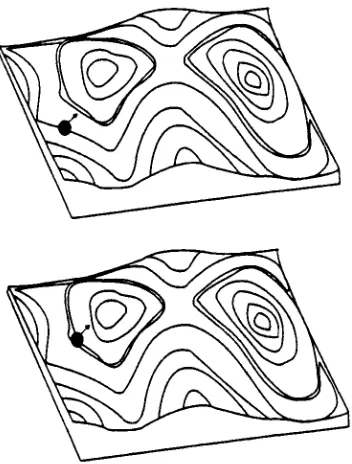
Selection directly acts only on the expressed behaviors of individuals and species (Mayr 1988, pp 477–8). Wright (1932) offered the concept of adaptive topography to describe the fitness of individuals and species (minimally, isolated reproductive populations termed demes). A population of genotypes maps to respective phenotypes (sensu Lewontin 1974), which are in turn mapped onto the adaptive topography (figure A2.1.2). Each peak corresponds to an optimized collection of phenotypes, and thus to one of more sets of optimized genotypes. Evolution probabilistically proceeds up the slopes of the topography toward peaks as selection culls inappropriate phenotypic variants.
Principles of evolutionary processes
a
b
c
d
e
f
g
h
i
j 1
2
3
4
5
6
7
8
9
10
[image:17.612.205.414.55.315.2] [image:17.612.226.402.410.642.2]GENE GENE PRODUCT CHARACTER
Figure A2.1.1. Pleiotropy is the effect that a single gene may simultaneously affect several phenotypic
traits. Polygeny is the effect that a single phenotypic characteristic may be determined by the simultaneous interaction of many genes. These one-to-many and many-to-one mappings are pervasive in natural systems. As a result, even small changes to a single gene may induce a raft of behavioral changes in the individual (after Mayr 1963).
Figure A2.1.2. Wright’s adaptive topography, inverted. An adaptive topography, or adaptive landscape, is
error entropy wells’ (Atmar 1979). Searching for peaks depicts evolution as a slowly advancing, tedious, uncertain process. Moreover, there appears to be a certain fragility to an evolving phyletic line; an optimized population might be expected to quickly fall of the peak under slight perturbations. The inverted topography leaves an altogether different impression. Populations advance rapidly down the walls of the error troughs until their cohesive set of interrelated behaviors is optimized, at which point stagnation occurs. If the topography is generally static, rapid descents will be followed by long periods of stasis. If, however, the topography is in continual flux, stagnation may never set in.
Viewed in this manner, evolution is an obvious optimizing problem-solving process (not to be confused with a process that leads to perfection). Selection drives phenotypes as close to the optimum as possible, given initial conditions and environment constraints. However the environment is continually changing. Species lag behind, constantly evolving toward a new optimum. No organism should be viewed as being perfectly adapted to its environment. The suboptimality of behavior is to be expected in any dynamic environment that mandates tradeoffs between behavioral requirements. However selection never ceases to operate, regardless of the population’s position on the topography.
Mayr (1988, p 532) has summarized some of the more salient characteristics of the neo-Darwinian paradigm. These include:
(i) The individual is the primary target of selection.
(ii) Genetic variation is largely a chance phenomenon. Stochastic processes play a significant role in evolution.
(iii) Genotypic variation is largely a product of recombination and ‘only ultimately of mutation’. (iv) ‘Gradual’ evolution may incorporate phenotypic discontinuities.
(v) Not all phenotypic changes are necessarily consequences of ad hoc natural selection. (vi) Evolution is a change in adaptation and diversity, not merely a change in gene frequencies. (vii) Selection is probabilistic, not deterministic.
These characteristics form a framework for evolutionary computation.
References
Atmar W 1979 The inevitability of evolutionary invention, unpublished manuscript Dawkins R 1986 The Blind Watchmaker (Oxford: Clarendon)
Dobzhansky T 1970 Genetics of the Evolutionary Processes (New York: Columbia University Press)
Hoffman A 1989 Arguments on Evolution: a Paleontologist’s Perspective (New York: Oxford University Press) Huxley J 1963 The evolutionary process Evolution as a Process ed J Huxley, A C Hardy and E B Ford (New York:
Collier) pp 9–33
Lewontin R C 1974 The Genetic Basis of Evolutionary Change (New York: Columbia University Press)
Malthus T R 1826 An Essay on the Principle of Population, as it Affects the Future Improvement of Society 6th edn (London: Murray)
Mayr E 1959 Where are we? Cold Spring Harbor Symp. Quant. Biol. 24 409–40 ——1963 Animal Species and Evolution (Cambridge, MA: Belknap)
——1982 The Growth of Biological Thought: Diversity, Evolution and Inheritance (Cambridge, MA: Belknap) ——1988 Toward a New Philosophy of Biology: Observations of an Evolutionist (Cambridge, MA: Belknap) Raven P H and Johnson G B 1986 Biology (St Louis, MO: Times Mirror)
Simpson G G 1949 The Meaning of Evolution: a Study of the History of Life and its Significance for Man (New Haven, CT: Yale University Press)
Stanley S M 1975 A theory of evolution above the species level Proc. Natl Acad. Sci. USA 72 646–50 Wooldridge D E 1968 The Mechanical Man: the Physical Basis of Intelligent Life (New York: McGraw-Hill) Wright S 1931 Evolution in Mendelian populations Genetics 16 97–159
——1932 The roles of mutation, inbreeding, crossbreeding, and selection in evolution Proc. 6th Int. Congr. on Genetics
(Ithaca, NY) vol 1, pp 356–66
Evolutionary Computation: The Background
A2.2
Principles of genetics
Raymond C Paton
Abstract
The purpose of this section is to provide the reader with a general overview of the biological background to evolutionary computing. This is not a central issue to understanding how evolutionary algorithms work or how they can be applied. However, many biological terms have been reapplied in evolutionary computing and many researchers seek to introduce new ideas from biological sources. It is hoped to provide valuable background for such readers.
A2.2.1 Introduction
The material covers a number of key areas which are necessary to understanding the nature of the evolutionary process. We begin by looking at some basic ideas of heredity and how variation occurs in interbreeding populations. From here we look at the gene in more detail and then consider how it can undergo change. The next section looks at aspects of population thinking needed to appreciate selection. This is crucial to an appreciation of Darwinian mechanisms of evolution. The article concludes with selected references to further information. In order to keep this contribution within its size limits, the material is primarily about the biology of higher plants and animals.
A2.2.2 Some fundamental concepts in genetics
Many plants and animals are produced through sexual means by which the nucleus of a male sperm cell fuses with a female egg cell (ovum). Sperm and ovum nuclei each contain a single complement of nuclear material arranged as ribbon-like structures called chromosomes. When a sperm fuses with an egg the resulting cell, called a zygote, has a double complement of chromosomes together with the cytoplasm of the ovum. We say that a single complement of chromosomes constitutes a haploid set (abbreviated as n)