promoting access to White Rose research papers
White Rose Research Online
Universities of Leeds, Sheffield and York
http://eprints.whiterose.ac.uk/
This is an author produced version of a paper published
in International
Journal of Performance Art and Digital Media.
White Rose Research Online URL for this paper:
http://eprints.whiterose.ac.uk/76895/
Paper:
Creating Common Ground: Dialogues between performance and digital
technologies
(Article published in the
International Journal for Performance Arts and Digital
Media, April 2005)
Authors: Sita Popat & Scott Palmer
Institutional affiliation: School of Performance & Cultural Industries, University of Leeds
________________________________________________________
Abstract:
This article addresses the challenge of collaborative research between performers and technologists, seeking a model by which a common language can be developed between the collaborators. It draws upon the authors’ experiences of projects where creative laboratory situations were used to support open-ended processes of exploration. The Performance Robotics project demonstrates how a cycle of iterative knowledge exchange between performance academics and robotics designers and engineers was achieved through an embodiment exercise that developed unexpectedly. The Projecting Performance Project resulted in computer operators ‘performing’ via the control of animated sprites that were projected on stage alongside dancers. Playful interaction in these projects enabled artists and technologists to find common ground on which to establish a rich dialogue for further research.
________________________________________________________
Introduction
with a particular emphasis on digital technologies. Funding programmes such as Wellcome's
Sci-Art programme have encouraged such collaborations. Yet this approach has been criticised for promoting an underlying principle of commonality that can be difficult to achieve:
The idea that science and art can somehow meet on common ground - that scientists can speak the same language as artists and vice versa - often entails compromise and more often than not it is the art that gets compromised. (Swain 2004: 63)
Is this a fundamental problem that cannot be overcome? Do the performing arts always suffer in their relationships with science and/or new technologies? Support for this gloomy hypothesis can be found in Peter Hall's statement that 'Advances in technology have allowed for greater scope, potential and excitement but have also created potential problems in the cohesiveness of making theatre’ (1998). This proposition has been echoed by many practitioners within theatre and dance who view the use of new technology as somehow at odds with the nature of making performance work. Technology is seen by some as anti-artistic, and those who use it can appear more concerned with the mechanics than its creative contribution to performance. Are artists and scientists doomed to work separately due to an inability to communicate? As performing arts academics engaged in collaborative research with digital technologists, the search for common ground is a key issue for the authors of this article.
forgotten and yet it is the one place where performers and technologists can explore the points of intersection between their disciplines on which to base creative dialogue for long-term development. This article investigates potential models for creating such common ground between the performing arts and new technologies, drawing upon research projects where cycles of iterative knowledge exchange were sought and places were found for performer/researchers and commercial sector technologists to play together as equals.
Invisible technologies?
Back in 1997, Janet Murray proposed that the experience of narrative need not be affected by the medium of delivery:
Eventually all successful story-telling technologies become “transparent”: we lose consciousness of the medium and see neither print nor film but only the power of the story itself. If digital art reaches the same level of expressiveness as these older media, we will no longer concern ourselves with how we are receiving the information. We will only think about what truth it has told us about our lives. (1997:26)
This statement negates the influence of both new technologies and artistic media with fine abandon. Yet it could be argued that the invisibility of the medium is due more to our ability to ignore it through familiarity, than to the medium itself being ‘expressive’. We speak the language, so we can disregard it on a conscious level if we do not wish to observe such technicalities. Yet perhaps we enjoy the medium in which the story is portrayed. Perhaps we revel in the elegant and poetic use of vocabulary and syntax, and the truth that it tells us is a secondary factor. The technical aspects of the artistic medium can be inspiring in themselves, where the medium is fundamental to the appreciation. But what if we do not share a common language with the storyteller? Then we do not understand the story at all, or we are only able to decipher parts of it.
the stage, but as an extension of its formal possibilities and an addition to its repertoire of expressive devices' (Packer 1998). In Monsters of Grace, Wilson chose to use three-dimensional projected holograms, yet the quality of the images of virtual worlds sat uncomfortably alongside the live aspects of the performance. It seemed to be an interesting experiment with the technology rather than an integrated, scenographic solution. The roughness of the renderings, the computerised aesthetic of the worlds portrayed, coupled with the need for audience members to put on and take off 3D glasses to see the images had a profound effect in lessening the theatricality of the event. The overt visibility of the technological aspects formed an unresolved tension with the 'live' elements.
Packer suggests that we should not be seeking a form of technology that can infiltrate theatre invisibly, but instead searching for methods by which the technology can extend the possibilities of performance. There is a type of ‘invisibility’ that can occur which is not about making the digital medium ignorable, but instead is concerned with the integration of the elements to achieve a cohesive product. Richard Povall, a dance artist who works with new media, goes so far as to state that if the technology ‘is not almost entirely transparent, or at least entirely seamless and integrated into a performance, the work has failed’ (Povall 2001, p.457). He qualifies this statement by adding that ‘The audience should be absorbed in the performance, not in the technology or the tricks, or the geewhiz effects’. The seamless integration that Povall describes demonstrates a maturity that allows the performance to focus on aesthetic rather than functional aspects, hence the apparent transparency of the technology. Whether the technology is foregrounded or not, the sophistry of the technological and artistic combination allows the audience’s eye to see the aesthetic ‘whole’. Subtlety comes from maturity and experience built up within the field. We would argue that if the technology is integrated into the performance (and vice versa) then the two will be simultaneously readable through their creative synthesis, rather than through the transparency (or negation) of the technology. Yet how can this synthesis be achieved if artists and scientists cannot find a common ground on which to play with the possibilities and develop maturity in their collaboration, as proposed earlier in this article? Further research in this area leads us to believe that perhaps the forecast is not so gloomy as it seems at first glance.
Playing (in) the Field
exploration of the medium. Swanick (1982:25), in his paper on music education, states the need for ‘imaginative play’ in the creative learning process, where the primary motivation is the discovery of the potential inherent in the medium rather than the production of a polished outcome. This is an essential part of exploring possibilities and from the experience of playing, the maturity of understanding arises. Playful interaction between the technological and the artistic should, in theory, lead to understanding and synthesis in the creative product, provided that the technical skills and qualities of both spheres are recognised and valued so that the widest points of intersection between the two can be explored.
Common ground has been established to varying degrees by collaborators with a willingness to play. One of the most prolific instigators of such collaborations over the past fifty years was scientist, Billy Klüver (1927-2004). Having a strong personal interest in the arts, he began collaborating with a series of artists in the 1960s, initially being a co-organiser of the seminal work 9 Evenings: Theatre and Engineering (1966). His collaborators over the years have included such illustrious individuals as Robert Rauschenberg, John Cage and Andy Warhol. In 1966 he explained ‘All of the art projects that I have worked on have at least one thing in common; from an engineer's point of view they are ridiculous.’ (Klüver cited in Miller 1998) They were ridiculous because they appeared to serve no obvious purpose in the ‘real’ world. Why would a scientist be interested in making a tennis racket boom with sound when it hits a ball, or in making snowflakes fly upwards? Yet Klüver and his colleagues in ‘Experiments in Art & Technology’ (E.A.T.) have maintained and developed science/art collaborations, because they recognised the value of this challenge to work in unfamiliar environments. Klüver originally had specific ideas about the relationship between artist and scientist:
Once I gave a talk […] and made the point that an engineer should just be another tool for the artist. But Bob [Rauschenberg] very specifically said, “No! It has to be a collaboration.” I immediately understood what Bob was saying. The one-to-one collaboration between two people from different fields always holds the possibility of producing something new and different that neither of them could have done alone. (Klüver cited in Miller 1998)
Collaboration was most effective if it was not limited by the idea that one group ‘serviced’ the other. Together the collaborators could extend the possibilities beyond the boundaries apparently inherent in each medium alone.
body through motion capture and digital technologies. In Ghostcatching the body of Bill T. Jones is removed and only his captured movement remains to animate the hand-sketched digital representations of the male human body.1 Technological invisibility or visibility is not
relevant because the piece exists as a digital movie and cannot be seen without the technology, yet nor does it leave the viewer stunned into artistic numbness by the ‘gee-whiz effects’ (Povall 2001), because the focus of the work is on the aesthetic. Kaiser feels that his work with dancers has enabled him to see the world through ‘dance eyes’, although he also says that earlier he was ‘finding the same beauty with film eyes, shooting a Manhattan intersection in Super-8 for my film Colourblind etc (1977)’ (Kaiser 2003:112). Is this interest in the art of film-making prior to his collaboration with dancers a key to the success of the collaboration? We will return to this point later.
There are many examples of art/science/technology collaborations today, and it seems that some collaborators at least are able to transcend the practicalities and technicalities that Swain suggests can often lead to negative compromise (2004), and that Peter Hall blames for creating problems with ‘cohesiveness of making theatre’ (1998). Journals such as the one in which this article is published and MIT’s Leonardo, and conferences such as ISEA’s
International Symposium on Electronic Art, the International Conference for Digital Technologies and Performance Arts, and CAIIA-STAR’s Consciousness Reframed bring together artists, scientists and technologists to share their findings and their practice. Yet in the documentation of all these projects, one question still often remains for the authors of this article: How was the common ground for those collaborations attained? While collaborators often talk at length about the products that they have created, they seldom seem to focus on the route by which they achieved their successful collaboration, and even less so on the pitfalls or problems that arose. This article will now discuss two collaborative projects in which the authors were directly involved, and try to establish what made these engagements effective in establishing common ground between artists and technologists.
Performance Robotics
The Performance Robotics Research Group’s (PRRG) week-long experimental laboratory at the University of Leeds in December 2003 provided a research context that supported a valuable playful interaction between participants. The PRRG consists of academics in performance, drama, puppetry and dance from the University of Leeds, Loughborough
1 For more information on Ghostcatching, see
University and University of Kent, working with Shadow Robots Ltd, London.2 One of the
aims of the research was to seek a methodology for mutual knowledge exchange between disciplines, building on an iterative cycle of research, that involved performance academics and robotics designers and engineers at all points (Popat et al, 2004). One of our aims was to develop a human-robot relationship that differed from existing research. We were seeking ways for human and robot to function together, rather than trying to fuse one with the other in the cyborgian tradition practised by performance artist Stelarc in, for example, his work
Exoskeleton.3 Stelarc focuses primarily on how the body ‘meshes… with its machines in
ever-increasing complexity and interactiveness’ (Stelarc 2000:572). He sees the body ‘not as a subject but as an object’ (p.562). The PRRG’s research was founded instead upon principles of phenomenology and the experience of ‘being there together’. Consequently our aims were twofold in terms of collaboration. On one level we put performance academic and robotics specialist in the same laboratory, and on another level we put dancer and robot in the same studio, and then we observed the relationships that arose. On both levels, this resulted in some unique experiences for the participants.
This was an open laboratory, with no specific aims other than trying to find a common language in order to develop ideas further. The participants were seeking to explore the spaces that their collaboration opened up between performance and robotics, which was a vague and uncertain place to start. At the beginning of the week we felt worryingly unprepared because the brief was so open. However we also felt that this was an important aspect of the collaboration. We did not want to be tied by plans and expectations, but there was always the risk that nothing would be achieved because of this lack of focus, and so a wide range of materials as assembled to provide maximum flexibility. The Shadow Robots team brought three ‘ready-made’ robots and copious amounts of equipment, and set up a temporary workroom in a studio, with two larger studios available for practical workshops. Two dance students and two performance design students joined the team for the week, and all groups purposely tried to preserve open minds in order to see where our experiments would take us. Performers constructed bits of robots, and engineers took part in movement and drama workshops, in an effort to come to understand each other’s disciplines and research imperatives.
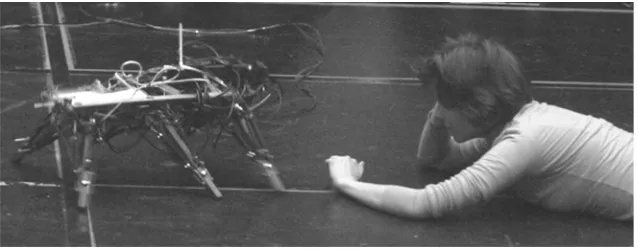
A number of activities took place over that week, but one of the most interesting was the emergence of a relationship between Liz (a student dancer) and Zephyrus (a prototype robot)
2 Dr Gordon Ramsay, Dr Melissa Trimingham, Professor Mick Wallis and Dr Sita Popat are the
(see Fig. 1). Zephyrus had a rectangular body and six legs, with limited movement on the forwards/backwards plane and no knee-joints. This meant that in order to gain any forward motion it had to move its legs repeatedly over short distances, giving all its movement an impression of great effort and struggle. It was powered by air-muscle technology with compressed air, so it made regular and insistent hissing noises and clicks. This gave it a strong ‘character’, leading to much anthropomorphism during the course of the week. The relationship between Liz and Zephyrus developed throughout the laboratory, and demonstrated clearly the ways in which performance and robotics could achieve a synthesis that allowed knowledge to pass between the disciplines and a common ground to develop that could benefit both.
Figure 1: Zephyrus (robot) and Elizabeth Collier (dancer)
On the first day of the laboratory, an embodiment exercise was set up, and Liz chose to embody Zephyrus. Embodiment is beyond the act of ‘copying’ the movement, and requires the performer to gain a feel for the essence of the entity that they are embodying so that they can come to ‘experience’ what it is to ‘be’ that entity. Liz watched Zephyrus closely, trying to gain a feel for it, and to translate that experience into her own body. She took on the movement qualities and restrictions of the robot and experimented with the extremely limited possibilities. Her emerging embodiment was a demanding and intrusive character, with much action for little forward motion. At that stage the performance researchers were more engaged in watching Liz’s work than the engineers, as the full import of her actions had yet to dawn upon us.
more complex, but still fairly closely within the robot’s own constraints. Zephyrus itself was used in different workshop contexts, and in one of these it was discovered that the robot could balance on its back legs in a ‘sitting’ position and wave its ‘arms’, which then provided Liz with more alternatives for her movement vocabulary. Gradually it became apparent that her growing familiarity with the restrictions, but also with the possibilities, was leading her to develop movements that were currently beyond Zephyrus, but these movements could potentially become realised through changes in the robot’s design. One of the engineers was astonished to recognise that Zephyrus might be made capable of jumping. The prospect had not occurred to him previously because there were no knee joints to bend. However Liz discovered that, although her limbs were straight, if she pulled them together sharply when she was standing on her hands and feet then she was able to make small jumping movements. The engineer began to recognise the new design potentials in what was happening, and he started watching Liz and Zephyrus closely and making notes on what Liz was doing and how that could relate to robotic design principles.
On the final day of the laboratory, the same engineer asked tentatively if Liz could find a way to embody Zephyrus standing on its hind legs. He acknowledged that this was well beyond the design possibilities currently, but he wanted to see it anyway. Liz improvised for fifteen minutes, and she eventually used Zephyrus’ insistent rhythmical sound to find a way to stand by working the rhythm through her hands and feet first on the floor and then up her body. The struggle that was evident in Zephyrus’ movement at all times was particularly pronounced as she tried to achieve the task whilst staying within the movement parameters as far as possible. As she worked at this challenge, the engineers were sitting around the studio sketching and quietly discussing possibilities, looking at her movement from the point of view of mechanical joints, air-muscles and programming. Then finally there was silence in the room as the suspense and concentration became palpable, until Liz finally managed to achieve a standing position. As she ended the improvisation there was a spontaneous round of applause from performers and engineers alike. This was an unplanned moment of performance, which had also generated pages of robotic design notes.
the field of experimentation considerably. The engineers described how watching Liz embodying Zephyrus enabled them to have an overview of the potential within the whole of the robot. It allowed them to see possibilities towards which they could then design.
Equally, the embodiment of the independently moving, idiosyncratic robot extended both Liz’s dance techniques and choreographic skills. The robot’s limited scope for movement placed her in a position where she had few options, and she had to investigate in great depth those movements that were available to her. She moved well beyond her standard personal movement style and found a range of movement that she would not normally have explored. The robot had strong ‘character’ qualities that were completely attributable to its motion, since it had no definable expression in its simple, mechanical appearance. Its independence, moving as it did through internal programming, gave it a sense of being a conscious entity that made its actions seem purposeful, and yet its quirky style was an interesting task for human embodiment. The movement that was thereby produced on Liz was highly expressive but articulated the body in unusual ways, providing a vocabulary that stretched all those dancers present both choreographically and performatively. The purpose and expression inherent in the movement kept it from replicating choreographer Merce Cunningham’s machinistic treatment of the human body, and yet it was disjointed and challenging to perform. The performers suggested that robots could be used to aid dance students and even professional dancers and choreographers in seeking diverse movement vocabularies either for specific works or for training purposes.
The experience of Liz working with Zephyrus opened up new options for our research and enabled us to see clearly how our research imperatives might intersect through the investigation of the human/robot relationship interface. At the same time we found that the robotics specialist/performance academic interface could be the basis for exchanges that were profitable for all concerned. Although there was a performative outcome on the final day, this project was not particularly aimed at performance exploration. Instead we were concerned with how knowledge could be transferred between the disciplines, and how this transference could become an iterative cycle of knowledge exchange that built up common ground between us. We were trying to find some focus that would not feel ‘ridiculous’ to the technologists in the way that Klüver described, but would still remain relevant to the performers. Above all we wished to avoid one discipline ‘servicing’ the other.
string) in the early stages of designing and realising their robots, they were not averse to the idea of discarding or adapting items under construction. This gave their work a sense of improvisation and play at some levels that complemented the work of the performers. We did not know when Liz undertook the embodiment exercise that this would be the point from which the iterative knowledge exchange would become established, but the free-play situation allowed us to experiment and see where the moment of intersection arose. The Shadow Robots team was patient enough and flexible enough to watch and see when it became relevant to them. This open play environment has in the past often been difficult to support through funding schemes, although current changes in emphasis are becoming evident.4 In this case, the funding for the week had come from an internal university source that was aimed at promoting new research enterprises, and did not require a specific return other than seeing if the project was viable. This, coupled with the attitude of the individuals and their willingness to enter into experimentation that might not lead to anything more than defining what interested us (or even what did not interest us), was central in finding intersections between our disciplines through which to keep communicating and continue working. It must also be explained that there were many other activities in the week’s laboratory which were not so successful in identifying common interests for all concerned, and this was equally important to us. At the end of the week’s laboratory we had a far stronger basis for communication, and we spent the final afternoon discussing what we had done and establishing the research questions that we are now using as the basis for applications for project funding. These questions were firmly founded upon the common ground that had matured out of our period of ‘play’.
Projecting Performance
Following the success of the Performance Robotics Research Group’s laboratory, the authors attempted to instigate the same methodology in their collaboration with KMA Creative Technology Ltd5 in June 2004. The Projecting Performance Project brought together software and graphics programmers from KMA and staff and students in dance and performance design at the University of Leeds. KMA are involved in a diverse range of creative work within the digital domain. One of their more high-profile activities has consisted of the design and manipulation of a series of vibrant scenic projections for large-scale popular music events. Another key activity has been the design of interactive abstract digital forms for use on web sites. Through initial discussions, it emerged that there might be some interesting
4 Examples of more flexible grants include the Arts & Humanities Research Board’s new Route for
Speculative Research, and the National Endowment for Science, Technology and the Arts’ Dream Time fellowship. Such grants do not require predefined outcomes. They allow for playful exploration and, importantly, failure.
possibilities in combining these two products with a live performance setting. Ultimately the project was realised because of this desire to explore synergies in the work that both parties were already undertaking, and the clear performative focus set it apart from the Performance Robotics project. The objective of Projecting Performance was to investigate the performance potential inherent in the combination of digital media and human dancers, and the stage picture maintained a primacy in this collaboration. KMA were specifically interested in working with dance researchers as they had recently begun a commercial project with Phoenix Dance Theatre, requiring a sufficiently robust technical set-up to tour with the company without direct support from KMA. This pressure limited the possibilities for experimental work, as reliability and replication were a primary requirement. Projecting Performance was therefore viewed as a research and development opportunity, allowing space and time to play with the technology without a fixed outcome in mind. We began by expecting to deal with ‘mock-up’ situations, where the human operator mimicked what would later be programmed for computerised control. However, as the project continued we realised that in our automatic assumption that a fully computerised system was preferable, we were overlooking an issue that engaged us far more in terms of the technical operator’s relationship to the performance.
Similarly to the Performance Robotics project, a team of individuals was assembled with skills that seemed to be appropriate to the artistic and technological aspects of the project. Potential ways of investigating the interactivity between the digital space and the performance space were suggested but these ideas were registered only as possible starting points, not fixed outcomes. It was important that the project provided space for open-ended creative interaction and it was refreshing to observe that all members of the team were able to commit to working in such a divergent way. The main processes that we discussed were based on improvisation and devised dance performance. Kit Monkman, company director of KMA, admitted afterwards that he had had a few reservations, and he was initially concerned ‘that it might be embarrassing (very English). That we might waste each other's time, that our working practices might prove to be fundamentally incompatible.’6 The performance
the way that KMA worked. Monkman describes their usual working techniques as ‘experimentation and serendipitous discovery’ – a process remarkably akin to devising and creating performance work.
The University of Leeds provided a studio space to act as a performance laboratory for the project. The studio was equipped with a full lighting grid, sound and projection facilities and a good blackout, with other theatrical equipment available for the duration of the project for exploration purposes. An important feature of the space, which contributed directly to the quality of research, was that it was flexible and allowed for the rapid testing of ideas. Experimentation with the technology could therefore take place without the typical lengthy delays of re-rigging equipment that is usually associated with technical production work in similar environments.
The first day of the residency was reserved for KMA to set up their digital equipment and for the performance designers to prepare the space theatrically. A gauze (scrim) was rigged across the space to provide a semi-transparent wall as a surface for projection. Whilst this plane bisected the stage space, dancers were still visible behind it. Theatrical lighting was prepared to allow for a variety of options in lighting both the space and the performers. The computers which were to generate the projections were set up and linked to a data projector which was then focused on the gauze. Initial software programming was then undertaken in preparation for the arrival of the dancers. This preparation of the space was important to ensure that the technical aspects of theatrical production work did not interfere with the momentum of creative discoveries. Ideas could be tried out quickly and then either discarded, recorded for future exploration, or developed further. Ultimately this potential for rapid experimentation contributed significantly to the range of discoveries that were made during the two further days of intensive work.
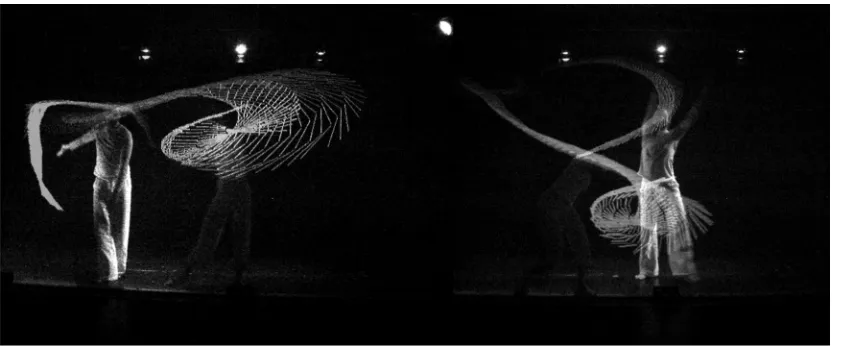
more complex interactions to take place. Each sprite was controlled by an operator, working initially with a computer mouse. The operator used the mouse to draw the path of the sprite, leading it around the screen/gauze. The dancers could see the images on the gauze in front of them, and they were able to respond to the sprites, improvising movement with them in the performance space.
Figure 2: Elizabeth Collier and Paul Clark (dance students) interacting with yellow and blue sprites projected on the gauze in front of them. (Note: Some of the vibrancy in the images is lost in the transition to greyscale.)
Figure 3: Tom Wexler (KMA) and Lisette Wright (design student) using WACOM tablets to operate the sprites.
[image:15.595.90.407.531.723.2]
Key discoveries were made through allowing the dancers and operators to improvise freely within both the digital domain and the physical stage space, exploring how they could relate to each other through the performance medium. The experiments began with simple improvised movement from the dancer, which the operator of the sprite attempted to follow on stage. This tracking process provided an almost instant mediatisedecho of the movement content that was manifested in the space with the dancer via the gauze. At first, the dancers found the inter-relationship with the sprite a strange but exciting one, with one dancer commenting; ‘I'm not used to dancing with a light’.7 This tendency at first to think of the sprite as being merely a scenographic element was gradually overcome to reveal a richer relationship between dancer and sprite as Tom, the programmer and operator from KMA, became more familiar with the dancers’ movement. His confidence increased as he came to ‘trust’ the dancers to move with him, and they to trust him to respond to them.
Gradually the relationship changed, and the operator discovered that he could lead the movement of the dancer, with the dancer responding to the speed, direction and qualities of the projected image’s movement. The dancers reported that they felt increasingly as if they were dancing with another person, rather than a computerised image. The way that the sprite reacted to them and improvised with them was more akin to a human partner than a computerised interaction, as it had potential for the unexpected, the humorous, and the quirky. This realisation coincided with the operators removing their computer monitors altogether and working entirely by watching the sprites on the stage gauze in the performance space. This was a major breakthrough for the research, as it marked the point at which the operator moved from being the ‘technologist’ to being a performer, albeit by a proxy arrangement. It is in marked contrast to industry practice, where it is common for technical operation to occur away from the place of performance, removed physically from the stage space itself and distanced by glass screens and layers of technology. This practice has been criticised, (Hunt 2001, White1999:10) since the operator often experiences little engagement with the creative act of performance and may simply be pushing buttons. In this project, however, the operators were engaging in dynamic creative expression, with a direct relationship between their embodied movements of mouse control through the sprites’ movements. The dancers also explained that their awareness of the dancing partner slipped between the image and the operator, so that sometimes they felt that they were dancing with the sprite and sometimes with Tom. At this point we ceased to think so much about how the movement would be simulated by a computer program, and focused our attention onto the relationship between
performer-dancer and performer-operator.
This shift in focus led to the suggestion to replace the mouse-driven input device with a WACOM graphics tablet and pen (see Fig. 3). This allowed for more expressive movement as the pen was more intuitive and precise to use than the mouse, engaging the operator in an free-flowing action based on drawing or sketching. The sprite became gradually more infused with the operator’s own movement style, which was not entirely clear until Lisette, a performance design student, joined Tom and started operating a second sprite. It was apparent which person was operating which sprite as their styles were subtly different in quality and use of space. Other members of the team took turns to operate, resulting in some interesting observations about the performance skills of individuals from different disciplines. One of the dancers tried working with the pen, but his use of the space was clearly coloured by the experience of dancing. He found it difficult to use the whole of the screen, and his sprite seemed to be bound by a non-existent gravity that led him to use the lower section of the screen for most of the movement. His general awareness of the stage space was primarily as performer, and while performers are used to feeling the sensation of embodying movement in space, they are not necessarily used to visually engaging with the whole stage ‘picture’. By contrast, the scenographers on the team were more able to construct a visual image that comprised of the two sprites and the dancers in the performance space, using the full range of spatial availability. However the most aesthetically interesting and sensitive performance was created by the KMA operator, Tom, who was also the designer and programmer of the sprites and therefore the most familiar with the technology and its possibilities. His use of space, quality of movement and sensitivity to the dancers was highly developed, despite his lack of dance or performance experience. Both Tom and scenographer Scott Palmer reacted strongly to the experience of ‘dancing’ via their sprites with the performers on stage. Afterwards, they described the fluid interface that the pen provided allowing them to feel their movement embodied in the sprite. They were still sitting amongst the technical paraphernalia, but their experiences transcended that situation and they felt ‘drawn in’ to the image of the sprite on the stage. They were aware of the technicalities of what they were doing in one sense, but the differentiation between the performance and the technology had been erased in the moment, so that they considered themselves to be performers and experienced an intensity that they felt was akin to stage performance. The choreography that we created through the second day included both dancers and operators as choreographed performers.
of the sprite were suggested by all participants, in a spirit of open collaboration. Changes were undertaken through speedy programming and ideas were tested and modified further. Audience members from outside the research team were invited into the space to share examples of the work and to comment. This fed far more ideas into the process than we could use in the short period of the laboratory, but it aided us in establishing common ground on which to build. Our shift in focus to address the performer/operator relationship became a fundamental basis of our research, and proved to be more directly relevant to all disciplines (dance, scenography and technology) than had been apparent in the early stages of planning.
Despite the difficulties and necessary uncertainties in working in this way, the range and quality of the discoveries suggests that it has greater validity than a more prescriptive approach. Monkman described the process as ‘an extraordinary valuable way of collaborating on projects’. He explained how much KMA valued the experience: ‘Sadly, the creative freedom that we all had […] to play (with so much resource and support) without expectation is rarely possible in the commercial world.’ However, the collaborative approach is not necessarily straightforward, nor easy to achieve within the rehearsal room, and much depends on the nature of the individuals involved. A level of honesty and trust is required between team members to enable truly exploratory work to develop and this openness of approach is difficult to attain, especially amongst individuals who are not familiar with the art form and language of dance or of this method of working. A longer time-scale is also usually required for members of the team to build up a relationship and to appreciate individual's skills and ways of working. Importantly for the outcome of this project, the technologists from KMA were both happy and, more fundamentally, able to work in this collaborative way.
idea AND a strong working relationship. Both of which we'd like to pursue.’ As this article goes to press, Projecting Performance is continuing with the support of a grant from the Arts and Humanities Research Council.
Conclusions
The Performance Robotics project and Projecting Performance both demonstrate models of effective working practice for collaboration between performers and scientists/technologists. Despite the reservations of some, as Svoboda (1993:17) wrote, ‘This union of art and science is essential and vitally necessary for our time. It provides art with a rational basis and helps us to carry our investigations further’. Each discipline has so much to offer to the development of the other. There are many examples of individuals and groups from different disciplines working together and finding common ground. However it takes time and willingness to participate in dialogue and play. Too often individual agendas can intervene in the creative process, which can prevent collaboration and recognition of the value of all participating disciplines. This can particularly be the case where limited time and expensive resources are involved.
How, then, does the connection happen? We explained earlier in the article how new media specialist Paul Kaiser (2003:112) felt that his collaborations with dancers enabled him to look at the world through ‘dance eyes’, but it seems that he is actually looking from an aesthetic perspective. For performers, if the technologists can begin to look from an aesthetic viewpoint then we have found our common ground. Yet Kaiser reported that he was already interested in the ‘beauty’ of imagery through making his own films (2003:112). Klüver had an interest in the arts prior to his work collaborating with artists. The team members from KMA had interests in philosophy and music, and the Shadow Robots team had interests in photography and philosophy. Even if they were not practising artists, they had an understanding of art in some form. We suspect that this is a major factor in the success of the collaborations, as some basis for common ground was already in existence. Without an interest in the artistic aspects, the scientist or technologist is likely to default to the ‘service provider’ role, which severely limits the possibility for creative synthesis between disciplines.
embodiment of Zephyrus the performance academics were primarily considering the dance performance and the roboticists were looking at the technical design implications. We were watching the same phenomenon, but drawing different information from it according to our own disciplines. Was there really a common ground to our collaboration, then? There was, because the knowledge that we each developed was based upon the events that arose from the intersection of our disciplines. Our ongoing research questions are based on the reciprocal questions of how the robot influences the dancers’ movement, and how dance movement can inform the programming of the robot. This is a different kind of common ground from
Projecting Performance, but it is nevertheless a valuable point of departure for all of us. In both projects we have developed understandings not necessarily of each other’s disciplines (which might be too much to expect in a week’s laboratory) but of the points at which they intersect and the questions that arise for us at those points. We suggest that recognition of our inability to know everything but our willingness to bring our knowledge to the table and think flexibly and creatively is the key element of these collaborations.
the same language as artists and vice versa’. We do not yet speak the same language as our robotic or technology counterparts in these projects, but we do have sufficient words in common to communicate and learn more.
Bibliography
Abbs, Peter (1989), 'The Pattern of Art-Making', in P. Abbs (ed), The Symbolic Order: A Contemporary Reader on the Arts Debate, London: Falmer Press, pp.198-210
Ascott, Roy (ed) (1999) Reframing Consciousness, Bristol: Intellect
Barker, Martin (2003), ‘Crash, Theatre Audiences, and the Idea of ‘Liveness’’, Studies in Theatre & Performance, 23(1), pp.21-39
Drefus, Hubert (2001), 'Telepistemology: Descartes's Last Stand', in Ken Goldberg (ed), The Robot in the Garden: Telerobotics and Telepistemology in the Age of the Internet, Mass: MIT Press, pp.48-63
Hall, Peter (1998), Keynote speech, Theatre in Britain and Europe - A Visual Dialogue? Conference, Royal Haymarket Theatre, London, UK, 8th May 1998
Hunt, Nick (2001), ‘A Play of Light’, Showlight 2001: International Colloquium on Entertainment Lighting, Edinburgh Festival Theatre, Edinburgh, Scotland, 21-23 May 2001 Izzo, Gary (1997), The Art of Play: The new genre of interactive theatre, Portsmouth, NH: Heinemann
Kaiser, Paul (2003), ‘Frequently Pondered Questions’, in Judy Mitoma (ed) Envisioning Dance on Film and Video, New York & London: Routledge, pp.108-112
Miller, Paul (1998), ‘The Engineer as Catalyst: Billy Klüver on Working With Artists’, IEEE Spectrum, July 1998, available online at http://www.spectrum.ieee.org/select/0798/kluv.html Murray, Janet H. (1997), Hamlet on the Holodeck: The Future of Narrative in Cyberspace, Cambridge, Mass: MIT Press
Packer, Randall (1998), Monsters of Immersion
http://www.cyberstage.org/archive/newstuff/monsters.html May 1998
Popat, S., G, Ramsay, M. Trimingham & M. Wallis (2004), 'Robotics and Performance: A Phenomenological Dialogue', in the proceedings for Pixelraiders 2 Conference, Sheffield Hallam University, UK, CD-ROM publication
Povall, Richard (2001), ‘A Little Technology is a Dangerous Thing’, in Anne Dils & Ann Cooper Albright (eds) Moving History/Dancing Cultures: A Dance History Reader, Connecticut: Wesleyan University Press, pp.455-458
Swain, Miria (2004), ‘Just Sugaring the Pill?’, Mute 27 (Winter/Spring 2004), pp.56-63 Swanick, Keith (1982), The Arts in Education: Dreaming or Wide Awake?, University of London: Institute of Education Special Professorial Lecture, 4 November 1982
White, Christine (1999) ‘The Changing Scenographic Aesthetic’, Scenography International,
Issue 1, New Departures, 7 October 1999, available online at
http://www.lboro.ac.uk/research/scenography/
Acknowledgements