Rochester Institute of Technology
RIT Scholar Works
Theses Thesis/Dissertation Collections
5-1-2008
Hardware study on the H.264/AVC video stream
parser
Michelle M. Brown
Follow this and additional works at:http://scholarworks.rit.edu/theses
This Thesis is brought to you for free and open access by the Thesis/Dissertation Collections at RIT Scholar Works. It has been accepted for inclusion in Theses by an authorized administrator of RIT Scholar Works. For more information, please [email protected].
Recommended Citation
Hardware Study on the H.264/AVC Video Stream Parser
by
Michelle M. Brown
A Thesis Submitted in Partial Fulfillment of the Requirements for the Degree of Master of Science in Computer Engineering
Supervised by
Dr. Kenneth Hsu,
Professor, RIT Department of Computer Engineering Department of Computer Engineering
Kate Gleason College of Engineering Rochester Institute of Technology
Rochester, New York May 2008
Approved By:
Dr. Kenneth Hsu
Professor, RIT Department of Computer Engineering Primary Adviser
Dr. Andreas Savakis
Professor, RIT Department of Computer Engineering
Dr. Dhireesha Kudithipudi
Dedication
I dedicate this thesis to my supportive family, who have always been there for me through
the good, the bad, and when I needed them the most. I would especially like to dedicate
this thesis to my mom, who provided me with the strength, courage, and determination to
always strive for my goals, and my dad, who encouraged me to pursue a college degree and
Acknowledgments
I would like to thank my advisors for proving their guidance, knowledge, and time during
Abstract
The video standard H.264/AVC is the latest standard jointly developed in 2003 by the
ITU-T Video Coding Experts Group (VCEG) and the ISO/IEC Moving Picture Experts Group
(MPEG). It is an improvement over previous standards, such as MPEG-1 and MPEG-2,
as it aims to be efficient for a wide range of applications and resolutions, including high
definition broadcast television and video for mobile devices. Due to the standardization of
the formatted bit stream and video decoder many more applications can take advantage of
the abstraction this standard provides by implementing a desired video encoder and simply
adhering to the bit stream constraints. The increase in application flexibility and variable
resolution support results in the need for more sophisticated decoder implementations and
hardware designs become a necessity.
It is desirable to consider architectures that focus on the first stage of the video
decod-ing process, where all data and parameter information are recovered, to understand how
influential the initial step is to the decoding process and how influential various targeting
platforms can be. The focus of this thesis is to study the differences between targeting
an original video stream parser architecture for a 65nm ASIC (Application Specific
In-tegrated Circuit), as well as an FPGA (Field Programmable Gate Array). Previous works
have concentrated on designing parts of the parser and using numerous platforms; however,
the comparison of a single architecture targeting different platforms could lead to further
insight into the video stream parser.
Overall, the ASIC implementations showed higher performance and lower area than the
FPGA, with a 60% increase in performance and 6x decrease in area. The results also show
Contents
Dedication. . . ii
Acknowledgments . . . iii
Abstract . . . iv
1 Introduction. . . 1
1.1 Background . . . 1
1.2 Thesis Objective . . . 2
1.3 Thesis Overview . . . 3
2 Video Compression . . . 4
2.1 Compression Techniques . . . 4
2.2 H.264/AVC Encoder and Decoder . . . 5
2.2.1 Encoding . . . 5
2.2.2 Decoding . . . 8
2.3 Existing Hardware Implementations . . . 10
3 H.264/AVC Video Stream Parser . . . 14
3.1 Reading NAL Units . . . 15
3.2 Parsing NAL Units . . . 17
3.2.1 Basic Coding . . . 18
3.2.2 Exponential-Golomb Coding . . . 18
4 Design and VHDL models . . . 21
4.1 Reading NAL units . . . 22
4.2 Parsing NAL units . . . 22
4.2.1 Basic Decoding . . . 23
4.2.2 Exponential-Golomb Decoding . . . 25
4.2.3 Context-Adaptive Variable Length Coding (CAVLC) . . . 27
5 Implementations and Testing . . . 42
5.1 ASIC Implementation . . . 43
5.1.1 Sub-Design Comparisons . . . 45
5.2 FPGA Implementation . . . 49
5.2.1 Sub-Design Comparisons . . . 50
5.3 Synthesis Simulations . . . 52
5.4 ASIC and FPGA Comparisons . . . 52
5.5 Comparisons with Existing Works . . . 54
6 Future Work . . . 56
7 Conclusion . . . 58
List of Figures
1.1 Structure of the H.264/AVC Video Stream Parser . . . 3
2.1 H.264 and MPEG-2 Comparison [3] . . . 6
2.2 Structure of an H.264/AVC encoder [8] . . . 6
2.3 Multi-Frame Motion Compensation [11] . . . 7
2.4 Integer Transform Matrix used in H.264/AVC [17] . . . 7
2.5 CAVLC Decoder [18] . . . 10
2.6 Low Power CAVLC Decoder Design [8] . . . 11
2.7 Low Cost High Performance CAVLC Decoder Design [6] . . . 12
2.8 Exp-Golomb Decoder [19] . . . 13
3.1 Video Stream Parser . . . 14
3.2 NAL Types [9] . . . 16
3.3 Example of CAVLC Decoding Reverse Zig Zag Scan . . . 20
4.1 Architecture of the Video Stream Parser . . . 22
4.2 NAL Unit Format . . . 23
4.3 NAL Unit Parser State Machine . . . 24
4.4 Hardware Design of the Exp-Golomb Decoder . . . 25
4.5 Hardware Design of the First One Detector used by the Exp-Golomb Decoder 26 4.6 Architecture of CAVLC Decoder . . . 27
4.7 Architecture for parse coeff token . . . 28
4.8 Neighboring Macroblocks of the Current Macroblock in Frame Mode . . . 28
4.10 State Machine Used By All Components Utilizing the Integer Division
Function . . . 30
4.11 Neighboring Macroblocks of the Current Macroblock in Field Mode . . . . 31
4.12 mbAddrN Specification with MbaffFrameFlag equal to One [17] . . . 33
4.13 Architecture of find luma neighbors . . . 34
4.14 State Machine for find luma neighbors . . . 35
4.15 State Machine Modeling the VLC look-up Tables . . . 36
4.16 Architecture of trailing1s level wrapper . . . 37
4.17 Architecture of totalZeros runBefore wrapper . . . 39
4.18 State Machine Modeling the totalZeros runBefore wrapper design . . . 40
4.19 Hardware Architecture for the Cofficients’ Array Indices . . . 41
5.1 16x16 Luma Block (left) and 8x8 Cb or Cr Block (right) . . . 42
5.2 The ASIC and FPGA Implementations’ Performance for Various Resolutions 44 5.3 Basic Decoding ASIC . . . 45
5.4 Exponential Golomb Decoding ASIC . . . 46
5.5 CAVLC Decoder ASIC . . . 46
5.6 Power, Area, and Performance Comparison of CAVLC Sub-Designs . . . . 47
5.7 parse coeff token ASIC . . . 48
5.8 trailing1s level wrapper ASIC . . . 48
5.9 totalZeros runBefore wrapper ASIC . . . 49
5.10 FPGA Resource Usage of Top Level Designs . . . 50
5.11 FPGA and ASIC Gate Count Comparison . . . 53
List of Tables
3.1 NAL Unit Format . . . 16
3.2 Entropy Decoder Algorithms . . . 17
3.3 Mapping of Exp-Golomb codeNums and Codewords . . . 18
3.4 CAVLC Decoder Syntax Elements [8] . . . 20
4.1 Neighboring Macroblock Address Calculations for Frame and Field Modes 31 4.2 mbAddrN Specification with MbaffFrameFlag equal to Zero [17] . . . 32
1. Introduction
1.1
Background
Video compression is the procedure through which the amount of data representing a video
sequence is significantly reduced to allow for a decrease in transmission time and an
in-crease in data storage by removing redundancies within the video. The need for video
compression arose with the development of technology and can be traced back to 1964
when AT&T introduced the first Picturephone at the World’s Fair in New York [10].
How-ever, a strong need came with the development of digital technology, such as
standard-definition television (SDTV), which was first introduced in 1996. Compared to analog
systems, SDTV offers more channels and produces better picture quality. SDTV displays
at a resolution of 704 X 480 pixels at 30 frames per second, which requires uncompressed
data to be transmitted at 121.7 Mbps. The MPEG-2 video compression standard is
com-monly used to handle the large amounts of video data the SDTV technology requires to be
sent by compressing the bit rate to 3 Mbps. One of the major advancements in television
af-ter SDTV is high-definition television (HDTV), which allows viewers to watch television
at even greater resolution. However, this implies more data to be transmitted during the
same amount of time. HDTV can be viewed at a resolution of 1920 X 1080 pixels, which
requires 746.5 Mbps of uncompressed data to be transmitted and about six times more data
to be sent than SDTV. The MPEG-2 standard is only able to compress the HDTV bit rate to
32 Mbps for HDTV [4]. As a result, a more advanced algorithm, such as the one specified
by the H.264/AVC standard, is desired to achieve an increase in transmission efficiency.
With the many techniques the H.264/AVC standard specifies, transmitting the same image
1.2
Thesis Objective
The objective of this thesis is to explore the design of the decoder’s first step, the video
stream parser, with a focus on providing an architecture to be targeted for two ASICs and an
FPGA. While existing implementations have shown to be valuable, the results of targeting
these designs for different platforms has yet to be studied. As a result of the thesis work
presented here, when an H.264/AVC video parser design is targeted for two ASIC process
technologies and an FPGA, insight is gained into the impact this decoder component has
across various process technologies and platforms. Since the video parser is composed of
numerous algorithms, the resulting architecture consists of original and leveraged designs,
where many designs were implemented as a Finite State Machine (FSM) and another used
different hardware components than seen in other published works.
The implementation satisfies the Basic H.264/AVC Profile, which can handle tasks such
as entropy decoding, macroblock adaptation of frame and field modes, and parsing
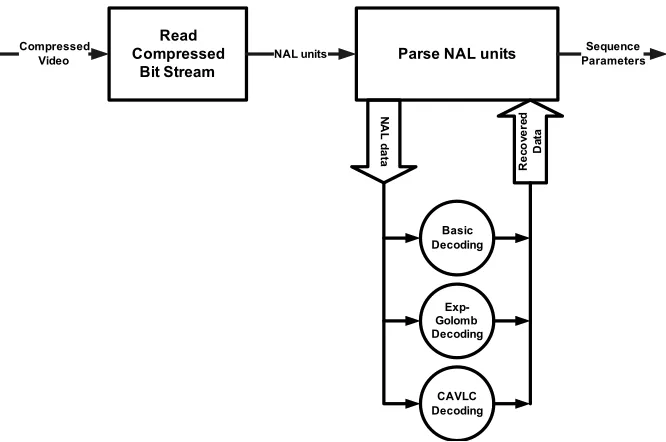
differ-ent slice types. The overall design is shown in Figure 1.1, where the first step is to read
the compressed video stream and parse the Network Abstraction Layer (NAL) units. The
NAL units, which are used to provide a layer of abstraction over the video data, are parsed
individually and various decoding algorithms are invoked, including Basic,
Exponential-Golomb (Exp-Exponential-Golomb), and Context-Adaptive Variable-Length Coding (CAVLC)
decod-ing, to recover all video data.
The VHDL hardware description language was used to describe an implementation of
the video stream parser. An existing behavioral model of the H.264/AVC decoder assisted
with the creation and validation of the synthesizable VHDL description. Implementing the
design allowed for the analysis of the parser with respect to the timing and hardware
com-plexities. The Xilinx ISE application was used to synthesize the FPGA model, while
Syn-opsys’ Design Compiler performed the synthesis of the lower power ASIC model.
Mod-elSim 6.1a SE was used to test the FPGA implementation, with the presumption that both
Read Compressed
Bit Stream NAL units Parse NAL units
Basic Decoding
Exp-Golomb Decoding
NA
L d
ata
R
ec
ov
er
ed
D
at
a
CAVLC Decoding
Sequence Parameters Compressed
[image:13.612.143.476.87.308.2]Video
Figure 1.1: Structure of the H.264/AVC Video Stream Parser
1.3
Thesis Overview
An overview of video compression is given in Chapter 2, where various video compression
techniques, and an overview of the H.264/AVC standard are explored. The details of the
H.264/AVC video stream parser are presented in Chapter 3 and the design of the parser,
which includes how the NAL units are created and parsed, is presented in Chapter 4. The
three parsing methods, Basic, Exp-Golomb, and CAVLC decoding, are also explained in
this chapter. The testing strategies and statistics on the two implementations are given in
Chapter 5. Finally, the document is completed with a conclusion and future work
2. Video Compression
Video compression standards date back to the 1980s, when the first video codec
(en-coder/decoder) was standardized as the H.120 standard by the ITU-T. A decade later,
the MPEG group made vast improvements on video and audio compression and created
the MPEG-1 standard, which also defined the MP3 audio format and was used in Video
CD. Two years later, in 1991, MPEG expanded on their previous standard by creating the
MPEG-2, which specified the format of broadcast digital signals and stored digital video,
and is currently used in DVD standards and SDTV systems. The MPEG-2 was a vast
im-provement on the MPEG-1 because of its expansion of format specification and support
of interlaced video, which allows for the same video to be seen using half the bandwidth.
Later, in 1998, MPEG created the MPEG-4 standard, which aimed at the compression of
audio and video digital data and is currently used in many areas including web video, video
telephone, and broadcast television. There are several standards defined by the MPEG-4,
one of which is termed the ISO/IEC MPEG-4 Part 10 standard, or the ITU-T H.264
stan-dard, which is a digital video codec that is an improvement over previous standards by
flexibly providing high quality video data at various bit rates and has been around since
2003.
2.1
Compression Techniques
Different video compression techniques are available and can be classified into the
fol-lowing categories based on each technique’s goals: lossless, lossy, interframe, intraframe,
object, and transform based.
information and lossy compression discards some information to achieve a higher
com-pression ratio. Interframe comcom-pression takes advantage of temporal redundancies by using
the similarities between successive frames to reduce the amount of data required to
rep-resent the video sequence, while intraframe compresses each frame based solely on the
current one. The object-based technique compresses data based on the detection of
par-ticular objects between frames. Finally, transform based compression transforms the video
data from the spatial to frequency domain to exploit the human eye’s low sensitivity to high
frequency change. This is different from object-based because the entire image is divided
into blocks and the data is compressed independent of any objects within those blocks.
Parts of the 4 standard utilizes the object based compression, while the
MPEG-1, MPEG-2, and H.264/AVC standards use the transform based. The 2-D discrete cosine
transform (DCT), discrete wavelet transform (DWT), and the integer transform are some
methods used within transform based compression.
2.2
H.264/AVC Encoder and Decoder
The main goal of the H.264/AVC standard is to be efficient for a wide range of applications
and resolutions, while achieving lower bit rates than previous standards (see Figure 2.1).
The increase in application flexibility and compression ratio is enabled by the introduction
of many new features, such as context-adaptive variable length coding (CAVLC), weighted
prediction, multiple reference picture motion compensation, and an in-the-loop deblocking
filter.
2.2.1
Encoding
The H.264/AVC standard can be further explored by analyzing the encoding process
pre-sented in Fig. 2.2. The process encompasses four steps (motion estimation, transform,
quantization, and entropy coding), where each works on a 16x16 macroblock of video
Figure 2.1: H.264 and MPEG-2 Comparison [3]
- EstimationMotion Transform Quantization Entropy Coding
Inverse Quantization Inverse
Transform Uncompressed
[image:16.612.128.491.83.326.2]Video CompressedVideo
Figure 2.2: Structure of an H.264/AVC encoder [8]
Motion Estimation
Motion estimation uses reference frames to detect change, or motion, between frames to
allow for only the residual data to be encoded. The video frames are classified into three
types: I, P, and B. An I-frame is encoded using intra-frame prediction, where macroblocks
within the frame are referenced, and can be used as a reference picture for subsequent
frames. A P-frame uses inter-prediction, where a previous frame is referenced to produce a
prediction signal for each block within the frame. The B-frame also uses inter-prediction,
but is able to reference two previous frames and take a weighted average of the two
predic-tion signal values [17]. The accuracy of the mopredic-tion representapredic-tion has been improved to
in-clude quarter-samples, compared to half-sample accuracy in previous standards. Also, the
allowance of motion vectors to breech picture boundaries has been added to the H.264/AVC
specification. The inclusion of using previously decoded pictures as reference for motion
Figure 2.3: Multi-Frame Motion Compensation [11]
Transform and Quantization
The H.264/AVC standard uses an integer transform algorithm on a 4x4 block, instead of
using a 4x4 DCT as in previous standards (see Fig. 2.4). The transformed coefficients are
then quantized, which is a lossy compression technique that divides the values and rounds
them to the nearest integer. This allows for greater compression efficiency because most of
the high frequency coefficients become zero [17].
Figure 2.4: Integer Transform Matrix used in H.264/AVC [17]
Entropy Coding
The output of the motion estimation, transformation, and quantization stages is sent through
a decoding feedback loop, where the difference between the incoming uncompressed video
and the processed data is recursively used in the encoding flow. The video data and settings
lengths by utilizing Exp-Golomb codes for all syntax elements, except for the quantized
transform coefficients, where CAVLC is used. The Exp-Golomb encoding scheme allows
for the use of only one look-up table, instead of having a table for each syntax element. The
CAVLC encoder is highly efficient and complicated; therefore, it is only used to encode the
quantized transform coefficients. There are multiple look-up tables used to encode the
various syntax elements associated with this scheme. More detailed information about the
Exp-Golomb and CAVLC schemes can be found in Chapter 3 - H.264/AVC Video Stream
Parser.
Video Coding Layer and Network Abstraction Layer
In the last stage, the Video Coding Layer (VCL) encoder provides a customizable
represen-tation of the video data and the Network Abstraction Layer (NAL) encoder adds headers
and organizes the data into NAL units. Having an abstraction layer, consisting of the VCL
and NAL layers, provides immense freedom for the application, while also adhering to the
standard.
2.2.2
Decoding
The process of decompression can be viewed as undoing the actions performed during
the compression process where similar techniques are used to recover the original video
data. Within a video sequence, each picture is divided into macroblocks, which represent
a fixed sized area of the picture. The fixed sizes of the macroblocks are 16x16 samples for
the luma component and 8x8 samples for the two chroma components. The H.264/AVC
standard separates the color representation of video into three components: Y,Cb,Cr, where
Y (or luma) refers to the brightness, and the Cb and Cr (or chroma) components refer to the
picture color with respect to blue and red. Since the human eye is more sensitive to change
in brightness than color, the luma component is represented with four times the amount
of samples than the chroma components. Equation 2.1 is used to calcuate the Y, Cb, Cr
(2.1)
A picture can also be represented as a frame, which embodies two interleaved fields.
The top field is made up of all even rows in the frame and the bottom field contains the odd
rows. Since moving objects often cause adjacent rows to be independent, compressing them
separately can provide greater coding efficiency. Conversely, non-moving objects should
be compressed in frame mode, since a dependency is likely to exist between adjacent rows.
The H.264/AVC standard supports adaptive field/frame encoding on a pair of macroblocks,
which allows for greater efficiency when a frame contains both moving and non-moving
areas [17].
The decoding process begins by parsing the incoming compressed stream and is
per-formed by the video stream parser. The decoder receives the data in NAL units, which are
packets that contain the encoded data, and are classified by the type of data they contain.
These units are parsed by the entropy decoder and depending on the type of NAL unit, a
specified entropy decoding algorithm is invoked. The three types of algorithms are based on
basic coding, Exponential-Golomb coding, and context-adaptive coding. After the stream
parser recovers all the parameter information and residual data, the inverse quantization
and transform stages reconstruct the residual data. Then, based on the type of prediction
used during encoding, the residual data is used to recreate the original frames. A side effect
of operating on blocks within each frame is visually noticeable block edges throughout the
frames. To smooth the edges of the blocking effect, H.264/AVC incorporates an in-loop
deblocking filter, which adapts its filter strength based on previous syntax elements and
2.3
Existing Hardware Implementations
High performance architectures of the H.264/AVC standard have been a focus of research
within many universities and in industry, but there has yet to be published studies focused
on a single architecture targeting different platforms. An industry example is one that
was a joint effort between Xilinx, Inc. and 4i2i Communication Ltd and is a main/high
profile decoder IP core for an FGPA. None of the implementation details have been
pro-vided, which prevents others from learning how they accomplished the design; however,
high level information has been given, such as the IP core targeting HD applications, the
fully pipelined design with multiple configuration options, and an external SRAM memory
needed to support the HD video [15].
There has also been some research performed on specific H.264/AVC decoder
compo-nents, namely the Context-Adaptive Variable-Length Coding (CAVLC) and Exp-Golomb
decoders. A proposed architecture, which focused on a generic VLSI architecture of the
CAVLC decoder, can be viewed in Figure 2.5.
R1 R0
32 bit Barrel Shifter 8 bit Accumulator Input
Level VLC
Decoder Controller
Coeff_token VLC Decoder
(VLD) Track_zeros
VLC Decoder Run_Before
VLC Decoder
# non-zero neighbor coeffs Coeff_token VLD done level VLD done
# zeros preceding non-zero coeffs
Total_coeff & T1 T1's sign & non-zero level # zeros before last level Length of consumed bits
Run
[image:20.612.118.504.414.655.2]stack Level stack
The proposed CAVLC design is a pipelined architecture, which is suitable for
appli-cations requiring high throughput decoding due to the one cycle recovery time of a single
syntax element. The design consists of six components: the controller, input buffer,
co-eff token Variable Length Code (VLC) decoder, level VLC decoder, total zeros VLC
de-coder, and the run before VLC decoder. Since the end of each VLC is not known until the
previous VLC has been decoded, all actions occur sequentially. The input buffer aligns the
input stream so it is possible to decode the next code word, and the coeff token and level
VLC decoders determine which VLC table to use based on neighboring block information.
The total zeros VLC decoder determines the number of zeros preceding the last non-zero
level and the run before VLC decoder determines the number of zeros preceding the last
non-zero coefficient [18].
Another CAVLC decoder design is proposed for low power consumption and is targeted
as an ASIC using the 0.18um CMOS standard cell-based library (see Fig. 2.6).
Coeff_Token
TrailingOne
Level
Run_Before TotalZeros
Controller Output Array Adder
Barrel Shifter R1
R2 Load
Codelength
maxNumCoeff reset vlctype
Code
Enable
Figure 2.6: Low Power CAVLC Decoder Design [8]
The design achieves its lower power consumption by employing various power saving
techniques, which include prefix predecoding and table partitioning within most of the
components. Another low power technique, which is used in the CAVLC design presented
Wishbone Interface Parameter Data Prediction Data R/W module Memory Coeff_Token Decoder TotalZero Decoder shifter T1 Decoder Level Decoder R E G IDS Controller acc Run_Before Decoder IQ
Figure 2.7: Low Cost High Performance CAVLC Decoder Design [6]
tables throughout the design. [8].
A low cost and high performance CAVLC decoder was proposed in [6], where various
techniques were used to achieve the real-time processing requirement of 1080 HD video
decoding (see Fig. 2.7).
To reach the high performance, this architecture contains a many more components
as the previous two designs, which include a Flush-unit, parameter interface, prediction
data R/W module, and Interleave Double Stacks (IDS). The Flush-unit flushes the previous
codeword into the bit stream and aligns the next one. The controller assists in
decreas-ing the computation time and lowerdecreas-ing the power consumption by implementdecreas-ing the Zero
Codeword Skip (ZCS), which does not decode zero codewords in 4x4 and 2x2 blocks that
only contain zeros. Also, placing an enable signal on each component allows for power to
be saved by disabling those which are not being used. Within the coeff token component,
hierarchical logic for look-up tables are used, which partitions the tables by frequency of
appearance and helps the design achieve its high performance goal. The IDS component
handles communication between the the CAVLC decoder and the inverse quantization [6].
A generic VLSI architecture for a Exp-Golomb decoder was proposed in [19] and a
modified version is presented in this thesis work. The proposed architecture can be viewed
R1 R0
32 bit Shifter 0 5 bit Accumulator
<<1 + 1 First 1 detector
Shifter1 32 – code_len
Postprocessing Module
input
carry
code_len M
[image:23.612.212.408.90.291.2]Syntax element
Figure 2.8: Exp-Golomb Decoder [19]
The barrel shifter, ”Shifter0,” is used to align the input bit stream for the next decoding
cycle and the ”First 1 Detector” counts the number of leading zeros. The other barrel shifter,
”Shifter1,” is used to determine CodeNum + 1, which is used to determine the value of the
recovered syntax element. This architecture only requires 3210 gates with a critical path
3. H.264/AVC Video Stream Parser
A VHDL model of the video stream parsing process has been designed and successfully
implemented on two different platforms, a low cost FPGA and a low power ASIC. The
design was focused on the use of Finite State Machines and on the use of different
hard-ware components than seen in other published works. Also, low power techniques were
implemented to decrease the overall power consumption. Pipelining was not incorporated
into the design because of the inherent sequential bit reading of the incoming stream.
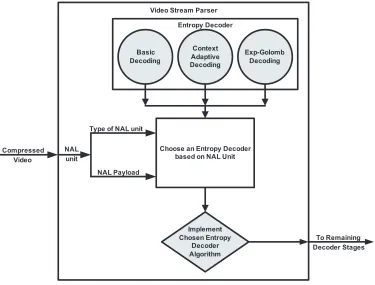
There are two main steps in achieving the functionality of the video stream parser:
reading NAL units and decoding the NAL units (see Fig. 3.1).
Video Stream Parser Entropy Decoder
Basic Decoding
Context Adaptive Decoding
Exp-Golomb Decoding
Implement Chosen Entropy
Decoder Algorithm Choose an Entropy Decoder
based on NAL Unit Compressed
Video
NAL unit
Type of NAL unit
NAL Payload
[image:24.612.124.499.386.671.2]To Remaining Decoder Stages
The video parsing process consists of reading the compressed bit stream, creating the
NAL units, and parsing the NAL units to recover picture information. The parsing process
involves the use of three decoding components: Basic, Exp-Golomb, and CAVLC. The
Basic and Exp-Golomb decoders are used through out the video parsing scheme and return
a single syntax element, which could represent many slice header, sequence parameter, or
picture parameter values. The CAVLC decoder is a much more complex scheme and is
used to parse the residual, zig-zag ordered blocks of transform coefficients of each frame
to take advantage of the following quantized blocks’ characteristics:
1. Most non-zero coefficients tend to be toward the low frequency end of the zig-zag
or-dered list. As a result, VLC look-up tables are used to encode the level (magnitude).
2. Most of the values following the non-zero coefficients are (+/-) one; therefore, the
amount and sign of the trailing ones are encoded.
3. Each string of zero is encoded using run-level encoding since most of the quantized
blocks contain many zeros.
The top-level design consists of reading the data stream, iteratively parsing each unit,
and storing the recovered information. Most of the received units contain sampled values
of the video picture, while the units received at the start of the stream contain information
that could be applied to multiple units. Once all of them have been parsed and the video
parser completes, all the recovered data is sent to the next stage of the decoder.
3.1
Reading NAL Units
The creation of NAL units is the first step of the video stream parser. The compressed
video stream is read and based on the sequence of bits received, NAL units are created.
of data each one contains (see Fig. 3.2). The importance of the NAL is noticeable in its
[image:26.612.144.475.137.485.2]ability to be efficiently customizable for various transport systems.
Figure 3.2: NAL Types [9]
Header Byte Payload
Forbidden zero bit Raw Bit Sequence Payload (RBSP) NAL reference ID
NAL unit type
Table 3.1: NAL Unit Format
The start of each unit is signified by a header byte, which holds various information,
as seen in Table 3.1. Following the header byte are payload bytes of the type specified in
the header. For systems that require the delivery of units in a byte-stream format, a start
code prefix is required to denote the beginning of each unit. Other systems, such as IP/RTP,
which is a protocol for delivering audio and video over the Internet, require the delivery of
them in packets; therefore, for these systems the use of the start code prefix is not necessary.
The payload can contain Video Coding Layer (VCL) or non-VCL data. The VCL NAL
contain parameter set information, which can be applied to multiple units and are values
that are not expected to change frequently. These parameter sets can be classified into
sequence parameter sets, which apply to a sequence of coded video pictures, or picture
parameter sets, which apply to separate coded video pictures.
A sequence of units that define a coded picture is called an access unit. There can also
be special NAL units that signify the beginning of an access unit, called an access unit
delimiter, and the end of an access unit, called an end of sequence or end of stream NAL
unit.
3.2
Parsing NAL Units
The task of the NAL parser is to analyze the incoming units to recover the video data,
header, and parameters. Based on the type of unit received, certain decoding algorithms are
invoked to recover the necessary syntax elements. The types of payloads that are encoded
can be categorized into Basic, Exp-Golomb, and context-adaptive syntax elements (see
Table 3.2).
Coding Algorithm Payload Type
Basic Byte
Basic Fixed-pattern n-bit string
Basic Signed n-bit integer
Basic Unsigned n-bit integer
Exp-Golomb Mapped Exp-Golomb-coded syntax element Exp-Golomb Truncated Exp-Golomb-coded syntax element Exp-Golomb Signed integer Exp-Golomb-coded syntax element Exp-Golomb Unsigned integer Exp-Golomb-coded syntax element Context-Adaptive Context-adaptive arithmetic entropy-coded syntax elements Context-Adaptive Context-adaptive variable-length entropy-coded syntax element
3.2.1
Basic Coding
The Basic decoding technique involves direct interpretation of each syntax element as the
type of element it was encoded as. For example, if an element was encoded as an unsigned
integer, then it is decoded as an unsigned integer. This technique handles the interpretation
of signed and unsigned integers, bytes, and fixed-pattern strings (see Table 3.2).
3.2.2
Exponential-Golomb Coding
The Exp-Golomb decoding algorithm is slightly more complex and uses a single
code-word look-up table (VLC table). Variable length coding uses smaller code code-word lengths
for frequently occurring data and larger codeword lengths for less frequently occurrences.
As a result, the average codeword length is reduced and higher compression is achieved.
Within the Exp-Golomb algorithm, the variable length codewords are defined as: [M
ze-ros][1][INFO], where M denotes the number of leading zeros and INFO denotes an M-bit
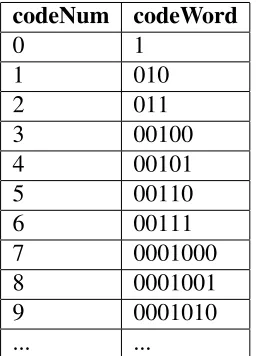
field of information. A codeNum value would have been mapped to its corresponding
codeword during the encoding stage.
codeNum codeWord
0 1
1 010
2 011
3 00100
4 00101
5 00110
6 00111
7 0001000
8 0001001
9 0001010
[image:28.612.247.375.438.616.2]... ...
Table 3.3: Mapping of Exp-Golomb codeNums and Codewords
algorithms might be used (see Table 3.2). Each decoding algorithm determines the
code-Num value by using the equation codecode-Num = codeWord - 1. Then, based on the codecode-Num
calculated and decoding algorithm used, a corresponding element value is provided. These
element values are used to define certain video parameters and are passed to the remainder
of the decoder for further processing.
3.2.3
Context-Adaptive Variable Length Coding (CAVLC)
Context-Adaptive Variable Length Coding (CAVLC) decoding is a type of run length
de-coding, where the number of zeros to be transmitted is reduced. As a result of the
al-gorithm’s increased complexity and efficiency, it is only used when quantized transform
coefficients are transmitted. During video compression, many video coefficients become
zero after the quantization step occurs, which is termed a run of zeros. Instead of encoding
each zero into the video compression stream, run length compression is used, where the
run length of the zeros is encoded to increase the overall compression efficiency. CAVLC
decoding also uses the probability of occurring symbols to further increase the compression
ratio.
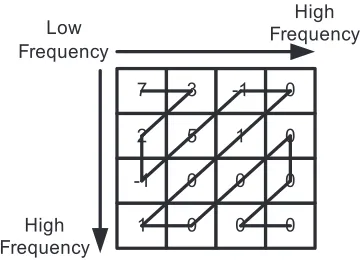
The CAVLC decoding algorithm receives the quantized coefficients within a
mac-roblock in zig-zag order, starting at the top left of the block (see Fig. 3.3). The low
fre-quency values are located in the top left and tend to have larger values than those at higher
frequencies. These values become less dense as the bottom right corner of the block is
approached.
The next step requires the decoding of five syntax elements from the received
coef-ficients: coeff token, sign of trailing ones (T1s), level, total zeros, and run before (see
Table 3.4).
The sign of the T1s and the level can be arithmetically decoded, while the other syntax
elements need to be decoded using look-up tables. There are two types of VLC tables
used: (1) for the number of non-zero coefficients and (2) for the level of the non-zero
7 3 -1 0
2 5 1 0
-1 0 0 0
1 0 0 0
Low Frequency
High Frequency
High Frequency
[image:30.612.220.400.92.222.2]Scanned Coefficients: 7 3 2 -1 5 -1 0 1 0 1 0 0 0 0 0 0
Figure 3.3: Example of CAVLC Decoding Reverse Zig Zag Scan
Syntax Elements Description
coeff token the number of all non-zero coefficients (total coeff) and the number of trailing ones (T1s) are encoded by this syntax element
Sign of T1s the sign bit of each T1 is reverse zig-zag scan order is encoded by this syntax element
Level The value of each non-zero coefficient (except for T1s) is encoded by this syntax element
total zeros The total number of zero coefficients preceding the last non-zero coefficients in zig-zag order is encoded by this syntax element run before The number of successive zero coefficients following the non-zero
coefficients in reverse zig-zag order.
Table 3.4: CAVLC Decoder Syntax Elements [8]
choice is based on the values obtained from these blocks. Once a compressed bit stream
has been decoded, the pixel values of a 4x4 block can be recovered. When the final list
of coefficients have been compiled, they are passed onto the transform unit for further
4. Design and VHDL models
The video stream parser consists of three main functionalities: reading NAL units, parsing
NAL units, and a memory component (see Fig. 4.1). During the reading process, test
data is compiled into numerous NAL units and later parsed after all have been formed.
The recovery of all the picture parameter and data information occurs within the parsing
component, where the Basic, Golomb, and CAVLC decoders are utilized. The
Exp-Golomb and Basic decoding models are used by many other components because of their
ability to recover single syntax elements, which could represent the slice header, sequence,
or picture data, and are used as parameters by the remainder of the H.264/AVC decoder.
The majority of the video stream parser effort is located in recovering the slice data, which
represents the actual picture information, and where the CAVLC decoder is utilized. The
memory component is accessed to store and read the recovered data throughout the parsing
process. Also, the remaining stages of the H.264/AVC decoder will be able to read all of
the desired elements from this component.
The stream parser is modeled as a finite state machine to control the flow of data (see
Fig. 4.2). Reading of the NAL units begins when the stream parser is enabled and after
all units are read, the iterative parsing of each one commences. As each NAL is parsed
the recovered data is stored in a global memory component and the updated information is
available to all subsequent NAL units. After all parsing completes and the information is
saved, the design returns to its default state. By the end of this design, all appropriate data
Read in NAL units from test data
Parse NAL units NAL units
Recover Slice Header
Data NAL type = 1 or 5
Recover Sequence Parameters NAL type = 7
Recover Picture Parameters NAL type = 9
Recover Slice Data Main Memory Unit
(recovered data) Read/Write
Read MB Read MB Prediction Values
Recover Luma or Chroma MB from Residual Data
(CAVLC)
Exp Golomb
[image:32.612.96.546.92.343.2]Decoding DecodingBasic Video Stream Parser
Figure 4.1: Architecture of the Video Stream Parser
4.1
Reading NAL units
Reading in the NAL units is accomplished by recursively reading a line from a hexadecimal
file until the end of the file is reached. Each line represents a byte of data, which is added
to the input buffer. The end of NAL units are detected by a delimiter, which is defined as
three consecutive bytes of zero followed by a fourth byte equal to one. When a delimiter
is detected, it is discarded and the NAL unit is created. At the end of this design, all NAL
units have been read in and are ready to be parsed.
4.2
Parsing NAL units
The goal of this design is to recover all necessary data from the NAL units. As each parser
algorithm is invoked, more information is found and could represent the slice header, data,
or parameter information. The design consists of much control logic for utilization of the
IDLE READ NAL PARSENAL
CONTINUE PARSING PARSER
DONE
enable = 1 done = 1 parse
r_done = 1
coun t <= N
AL_count
parser_do ne = 1
count > NAL_c
ount
-Save NAL output
-Save NAL output -Assign next NAL
input -assign NAL unit
-enable parser -increment NAL_count -enable reader
reset_n = 0
Figure 4.2: NAL Unit Format
is used to manage the flow of the design and is a vital part in the organization and control
of data. There are a total of eighty-six states within this design and a simplified version can
be viewed in Figure 4.3.
It can be noticed that the Basic and Exp-Golomb parsers are used by every state, which
signifies their importance in recovering single syntax elements throughout the video parsing
process. Even though the CAVLC parser is only used by one state, it constitutes the most
computational complexity and time consumption than the other two parsers. Its complexity
derives from the intensive algorithms it must endure to produce multiple coefficient values.
4.2.1
Basic Decoding
While the H.264/AVC standard specifies the Basic decoding scheme to decode signed and
unsigned integers, bytes, and strings, this design only has the capability to decode unsigned
integers and bytes. Since the CABAC decoding algorithm was not supported in this
im-plementation, the other two data types were not required to be decoded. As a result of the
algorithm’s simplicity, hardware was not required to be used; however, it was implemented
in this design to remain consistent with the rest of the video parser implementation. The
design of the basic decoding scheme takes in as input the current NAL payload and the size
of the desired syntax element, which could range from 1-bit to 8-bits. Since the range is
SEQUENCE
PARAMETERS PARAMETERSPICTURE SLICE
HEADER SLICE DATA
PARSE
NAL unit ty
pe = 1 or 5 NAL unit type = 8 NAL unit type = 7
Basic
Exp-Golomb Basic
Exp-Golomb Basic Golomb
Exp-READ MACROBLO
CKS
MB PREDICTION
SUB-MB PREDICTION
Basic
Exp-Golomb
Basic
[image:34.612.107.514.92.401.2]Exp-Golomb CAVLC
Figure 4.3: NAL Unit Parser State Machine
element. Within the branches representing sizes 1 through 7 lies another case statement,
which provides all the bit configurations of the NAL payload for the particular syntax
el-ement size. Choosing this configuration allows for simple hardware representation by the
use of multiplexers to model the case statements. The 8-bit case is implemented using
the ”CONV INTEGER” function provided in the IEEE library since this function is more
efficient than using a 256-branched case statement for the 256 possibilities. The decoded
element is the integer equivalent to the bit configuration within the matched case statement
4.2.2
Exponential-Golomb Decoding
A structural approach is taken with the Exp-Golomb design and a modified version of [19]
is implemented, where a 32-bit accumulator and a 32-bit shift register are removed. The
re-moval of the unnecessary components provides an increase in performance due to the
Exp-Golomb decoding mechanism performing only one syntax element recovery at a time. As
a result, both an accumulator to track what bits of the input buffer have been consumed and
a register to shift the data in preparation for subsequent parsing are not needed. The
result-ing implementation has a decrease in complexity and power consumption. The hardware
design can be viewed in Figure 4.4 and consists of five components: first-one detector, two
bit shifters, an adder, and a post-processing module.
First 1 Detector R0
<< 1 M
32 - codeLength
2M
32-bit Shift right 16 bits 32 bits
Post-Processing Module codeNum + 1
32 – (2M + 1) = 31 – 2M
[image:35.612.183.437.324.574.2]Syntax Element Input Data [0:31]
Figure 4.4: Hardware Design of the Exp-Golomb Decoder
An Exp-Golomb encoded codeword is formatted as [M zeros][1][M-bits of
informa-tion]. Given the maximum codeword length is 32-bits and the format of an Exp-Golomb
encoded codeword, it is a guarantee that the first 15 bits of data will contain a one.
MUX
Input (0:3) Input (4:7) Input (8:11) Input (12:15)
Encoder 1 Encoder 2
/4
+
/2 /4
[image:36.612.164.452.87.378.2]M
Figure 4.5: Hardware Design of the First One Detector used by the Exp-Golomb Decoder
after the M-bits of zero. The 16-bit input is divided into four sections, each of which
determines if it contains a bit value of one. The four sections of bits are also sent to a
multiplexer where the selection is based on where the first detected one is located. The
output of the multiplexer is sent to an encoder, which produces a 2-bit value representing
the position of the one within the chosen section. The second encoder provides a 4-bit
value representing which of the four sections contained the first one. The output of both
encoders are added to produce the final output of this component, which is a 4-bit vector
specifying the bit location of the first detected one, denoted as M, within the given 16-bit
value.
The output of the first-one detector is sent to a shifter and adder to produce the code
length, which is defined as 2*M + 1. A modified version of this value (32 - code length) is
used by a 32-bit shifter to shift the input and produce (codeNum + 1), which is used by the
parser is controlled using a multiplexer that chooses the type of parsing to perform. If an
unsigned syntax element needs to be recovered, then the output is simply codeNum, and
when a mapped element is parsed a look-up is performed. When a signed or truncated
element is desired Eq. 4.1 or Eq. 4.2 are used, respectively.
syntaxelement= (−1)(codeN um+1)∗((codeN um+ 1)÷2) (4.1)
syntaxelement= (codeN um+ 1)%2 (4.2)
4.2.3
Context-Adaptive Variable Length Coding (CAVLC)
Coeff Token
Decoder TrailingOnes and Level VLC Decoder TotalZeros and RunBefore VLC Decoder Controller
Levels Memory
Accumulator 64-bit Shifter
64-bit Data Register Input Data
(32 bits)
Nonzero levels Nonzero levels
# TotalCoeffs & # T1s # TotalCoeffs
# TotalCoeffs & # T1s
Coefficient array
[image:37.612.113.511.324.572.2]T1 signs
Figure 4.6: Architecture of CAVLC Decoder
Out of three decoding algorithms implemented, the CAVLC is the most complex. This
design consists of thirteen hardware components, where the highest level is designed using
a large state machine to manage the data flow. There are three main components, which
1. parse the coeff token value to recover the amount of trailing ones and total
coeffi-cients (parse coeff token)
2. parse the number of trailing ones and level values for all non-zero coefficients
(trail-ing1s level wrapper)
3. parse the total amount of zeros and the location of each zero within the coefficient
array (totalZeros runBefore wrapper)
parse coeff token
Find Luma/Chroma Neighbor Information (find_luma_neighbors)
Determine which VLC table to use
Perform VLC table look-up
TotalCoeffs
T1s table ID
mbAddrA; blkIdxA
mbAddrB; blkIdxB block
index
Figure 4.7: Architecture for parse coeff token
This component is an original FSM-based (Finite State Machine) design to handle the
computational complexity and provide data flow management. The goal of this component
is to parse the coeff token codeword, which results in the production of two values: the
number of non-zero coefficients and trailing ones. These values are found via a VLC
look-up table, where the choice of table is dependent on the previously decoded macroblocks.
Figure 4.8 shows the naming conventions for neighboring macroblocks, where each ones
address and index in the macroblock array are found to help determine which look-up table
to use.
mbAddrD mbAddrB mbAddrC
[image:38.612.238.382.568.663.2]mbAddrA CurrMbAddr
As a result of the computational complexity inherent in the parsing of the codeword,
FSM-based designs are used throughout the process to help control the massive amount
of data flow and use of many utility components. Figure 4.9 displays the components that
make up parse coeff token in a hierarchical organization. When the CAVLC component
is enabled, the 64-bit input buffer is filled from the incoming data stream to allow for
faster data access throughout this parsing procedure. The purpose of gathering the neighbor
information is to assist in determining which VLC table to use to find the total number of
coefficients and number of trailing ones.
parse_coeff_token
find_luma_neighbors
get_neighbor_location get_4x4_luma_scan
get_neighbor _mb_address getMacroblockIndex
mb_is_available divider
Figure 4.9: Hierarchical Organization of parse coeff token
• Division is used throughout the CAVLC decoding process. Even though division
by two can be executed as performing a bitwise shift right, there are many cases
where a divisor of two is not used. As a result, it is necessary to implement a integer
division design that can be used in the CAVLC process. The hardware components
and organization are derived from [13] and consists of four basic components: a
multiplexer, register, down-counter, and right-to-left shift register.
The usage of the division function is controlled by a state machine, shown in
Fig-ure 4.10, and is a part of all components that need to perform integer division.
Once the division is enabled, the numerator and denominator are assigned values,
these values are held at the input for two clock cycles to ensure proper signal
assign-ment within the block. When the division completes, the necessary output signals are
assigned to internal signals and during the final state they are latched into registers.
IDLE
Divider Enable
Divider Done
Compute Output
enable = 1 state_twice = 1
divider_
done = 1
Latch divider outputs into registers
Assign divider output to internal signals *Assign divider input values
[image:40.612.102.516.163.380.2]*set “state_twice” signal reset_n = 0
Figure 4.10: State Machine Used By All Components Utilizing the Integer Division Func-tion
• mb is available determines if a macroblock is available and is accomplished by a
simple comparison with its address, the value of zero, and the current macroblock’s
address. The macroblock is available if it has a valid address, it is greater than zero,
and it is greater than the current one’s address, which would imply it has not been
analyzed.
• getMacroblockIndex determines a macroblock’s index in the macroblock array, which
is performed using a simple look-up into the array using the known address.
• get neighbor mb address finds all four neighboring macroblocks and returns their
addresses, if they exist. It supports macroblocks that are encoded in frame or field
mode, which could have been done independently on vertical pairs of luma
set denotes that the pair of macroblocks are coded in frame mode, otherwise they
are coded in field mode (see Figure 4.11). Table 4.1 shows how each neighboring
address is calculated depending on the value of MbaffFrameFlag, if they exist.
mbAddrD mbAddrB mbAddrC
mbAddrA CurrMbAddr or
CurrMbAddr
Figure 4.11: Neighboring Macroblocks of the Current Macroblock in Field Mode
Neighbor
Address Frame Mode Field Mode
mbAddrA CurrMbAddr - 1 2 * (CurrMbAddr/2 - 1)
[image:41.612.230.388.162.270.2]mbAddrB CurrMbAddr - PicWidthInMbs 2 * (CurrMbAddr/2 - PicWidthInMbs) mbAddrC CurrMbAddr - PicWidthInMbs+1 2 * (CurrMbAddr/2 - PicWidthInMbs+1) mbAddrD CurrMbAddr - PicWidthInMbs-1 2 * (CurrMbAddr/2 - PicWidthInMbs-1)
Table 4.1: Neighboring Macroblock Address Calculations for Frame and Field Modes
• get 4x4 luma scan returns a block index when given a luma or chroma location
(xW,yW) by using Eq. 4.3. The division function previously discussed is
instanti-ated four times to handle the use of division used within this equation.
luma4x4BlkIdx = 4*(xW / 8) + 8*(yW / 8) +
1∗((xW%8)/4) + 2∗((yW%8)/4) (4.3)
• get neighbor location performs the functionality of finding a neighbor’s location
rel-ative to the upper left corner of the returned address. A neighboring macroblock
could contain luma or chroma type coefficients, where the size is expressed in terms
or chroma location, type of block, the MbaffFrameFlag signal, and the current
mac-roblock address, this component is able to produce a macmac-roblock address where the
given location resides as well as a new location expressed relative to the upper left
corner of the found address. This entity is implemented using six processes, where
the first one, depending on the value of MbaffFrameFlag, finds the macroblock
ad-dress, mbAddrN, or sets necessary flags for future use. Table 4.2 and Figure 4.12
show how the signal mbAddrN is assigned when given the luma or chroma location
(xN, yN). When the address is found, the location of the neighboring luma
loca-tion (xW, yW) is calculated relative to the upper left corner of mbAddrN using the
following equations:
xW = (xN +maxW H)÷maxW H (4.4)
yW = (yN +maxW H)÷maxW H (4.5)
xN yN mbAddrN
less than 0 less than 0 mbAddrD
less than 0 0 ... maxWH-1 mbAddrA
0 ... maxWH-1 less than 0 mbAddrB
0 ... maxWH-1 0 ... maxWH-1 CurMbAddr
less than maxWH-1 less than 0 mbAddrC
less than maxWH-1 0 ... maxWH-1 not available any value less than maxWH-1 not available
Table 4.2: mbAddrN Specification with MbaffFrameFlag equal to Zero [17]
• find luma neighbors finds the neighboring luma or chroma addresses and indices, if
they exist. Since the AVC Standard specifies the same algorithm for finding
neigh-bors of luma and chroma macroblocks, this component has the ability to find either
type of neighbor.
The data flow of the find luma neighbors component is shown in Figure 4.13. The
first step is to find the (x,y) location of the upper-left luma sample for the given 4x4
xN yN cu rr M bF ra m eF la g m bI sT op M bF la g m bA dd rX Ad di tio na l co nd iti on m bA dd rN yM yN yN (yN + maxWH) >> 1
2*yN yN yN yN yN >> 1 yN >> 1
yN yN yN yN yN yN na (yN + maxWH) >> 1
(yN + maxWH) >> 1 yN << 1 (yN << 1) - maxWH
(yN << 1) + 1 (yN << 1) + 1
-maxWH yN yN yN 2*yN 2*yN yN yN na na mbAddrD + 1
mbAddrA mbAddrA + 1 mbAddrD + 1 mbAddrD mbAddrD + 1
mbAdrrA mbAddrA mbAddrA + 1 mbAddrA + 1
mbAddrA
mbAddrB mbAddrB + 1
CurrmbAddr mbAddrC + 1
na mbAddrA mbAddrA + 1
mbAddrA mbAddrA + 1
mbAddrA mbAddrA + 1 mbAddrA + 1 mbAddrB + 1
CurrMbAddr - 1
mbAddrB + 1
mbAddrC + 1 mbAddrC mbAddrC + 1
na na
yN % 2 = = 0 yN % 2 ! = 0
yN % 2 = = 0 yN % 2 ! = 0
yN < ( maxWH / 2 ) yN >= ( maxWH / 2 ) yN < ( maxWH / 2 ) yN >= ( maxWH / 2 )
mbAddrD mbAddrA mbAddrA mbAddrB CurrMbAddr mbAddrC na mbAddrB CurrMbAddr mbAddrB mbAddrC mbAddrC na na 1 0 1 0 1 0 0 1 0 1 0 1 0 1 1 0 1 0 1 1 0 1 0 0 < 0 0 .. maxWH -1
0 .. maxWH - 1
< 0
< 0
0 .. maxWH - 1
> maxWH - 1
< 0
< 0
0 .. maxWH - 1
>
maxWH - 1
0 ..
maxWH - 1
> maxWH - 1
[image:43.612.130.493.124.635.2]mbAddrD mbAddrD m bA dd rX Fr am eF la g 1 0 1 0 0 0 1 1 0 1 1 0 1 0 1 0 mbAddrA mbAddrA mbAddrA
Controller get_neighbor _location
(x,y) block location
mbAddrN (xN, yN) get_4x4_luma_scan
(xN,yN)
blkIdxN
block index
Current MB’s neighboring addresses and block
indexes (mbAddrA, blkIdxA;
mbAddrB, blkIdxB) MB Addresses
(from memory unit)
Figure 4.13: Architecture of find luma neighbors
x = InverseRasterScan( luma4x4BlkIdx / 4,8,8,16,0 )
+InverseRasterScan(luma4x4BlkIdxmod4,4,4,8,0) (4.6)
x = InverseRasterScan( luma4x4BlkIdx / 4,8,8,16,1 )
+InverseRasterScan(luma4x4BlkIdxmod4,4,4,8,1) (4.7)
Once a location is calculated, it is modified slightly so it would be possible to
cal-culate the location of the neighbors to the left and above the current macroblock.
The corresponding neighbor’s macroblock addresses and locations, relative to the
upper left corner of their containing macroblock, are then found by utilizing the
get neighbor location component previously discussed. Once the neighbor’s
ad-dresses (mbAddrA, mbAddrB) and corresponding locations ((xA,yA), (xB,yB)) are
found, the 4x4 luma or 4x4 chroma block index relative to the upper left corner of
the found macroblock is calculated using the get 4x4 luma scan component. The
This entity is designed as a ten-state state machine (see Fig. 4.14), where two
com-ponents previously described, get neighbor location and get 4x4 luma scan, are
en-abled and disen-abled as needed. The division function is also used to perform the
necessary division and modulation calculation to find the (x,y) location. If any of
the neighbors do not exist, their index is not attempted to be found. The found
in-dex(es) are saved to local signals and the state transitions to done state, where the
final outputs are latched.
Idle dividers_en dividers_done
compute_output
save_output
compute_vars
lumaScan_en find_neighbor_loc
find_blkIdx done_state
enable = ‘1’ state_twice = ‘1’
state_twice <= ‘1’
Both neighbors found Luma scans
completed reset_n = ‘0’
Calculate inputs to get_neighbor_location
component Latch division
outputs
Enable get_neighbor_location components and latch
their outputs Enable
get_4x4_luma_scan component(s) Latch final outputs
Latch appropriate get_4x4_luma_scan
[image:45.612.103.516.256.518.2]outputs
Figure 4.14: State Machine for find luma neighbors
• coeff array models the coeff token VLC look-up tables and is implemented as a state
machine to manage the data flow (see Fig. 4.15). When this component is enabled,
the table to be used is determined based on an identification number passed in. The
parsing begins in the parse entry 0 state with a comparison between the first entry in
IDLE Find table Parse entry 0 End entry
reached
enable = 1
Latch outputs based on current table_entry value
reset_n = 0 Parse entry
1
No LUT entry match LUT entry
match
Increment index value
*Increment table entry value *Reset index value
LUT(table_entry)(0 to index) !=
data(0 to index)
LUT(table_entry)(0 to index) ==
data(0 to index) LUT(table_entry)(index) == “X”
OR index = 16
OR table_entry = 62
Figure 4.15: State Machine Modeling the VLC look-up Tables
current table entry has been reached, if a full match has been found, if more
com-parisons are necessary, or if the end of the table has been reached. The comparison
between the current table entry and the input data is performed one bit at a time,
where an index value is used to determine where in the entry the comparison is
oc-curring. When the table entry and input data no longer match (NO LUT entry match),
the table entry value is incremented and the index value is reset to allow for the next
table entry to be examined for a match. Otherwise, if the table entry and input data
does match up to the current index value (LUT entry match), then the index is simply
incremented to continue the comparison between the two values. The end of a table
table entry size is reached. A successful full match is found when either of these
con-ditions are encountered during a comparison. Even though it is expected to always
find a match, the search would end if the table entry value exceeded 62 since there
are only 62 entries in the table.
trailing1s level wrapper
After the number of total coefficients (TotalCoeff) and amount of trailing ones
(Trailin-gOnes) are found using parse coeff token, the signs of the TrailingOnes and values of the
coefficients are calculated (see Fig. 4.16). This design is also original, where it consists of
three processes:
1. control the use of the level parser, latch the recovered level value, calculate the suffix
length based on that value
2. shift the data buffer after each level parser completion to allow for the next level
parser to retrieve data from the first data index
3. compile the final level values, which are based on the values of the TotalCoeff and
TrailingOnes signals, into an array
Recover T1 (+/-) signs
Recover non-zero coefficients (parse_level) 64-bit shifter
Amt consumed NAL payload data
Compile final array of coefficients (including T 1s) Amt consumed
Array of non-zero coefficients
The desired number of data bits is read from the input buffer to determine the sign of all
TrailingOne bits; this number is equivalent to TrailingOnes. The sign of the one is negative
when the data bit is zero and positive otherwise. Next, the values of the coefficients are
found by finding the level prefix and suffix values and respective lengths. With these values
the following equations are used to find the levels:
levelCode= (levelP ref ix∗(2suf f ixLength)) +levelSuf f ix (4.8)
For even-valued levelCode:
level= (levelCode+ 2)÷2 (4.9)
For odd-valued levelCode:
level = (−1? levelCode−1)÷2 (4.10)
Once the levels are compiled, they are serially written out to a memory element that
holds the recovered values and are used by the next design, totalZeros runBefore wrapper.
totalZeros runBefore wrapper
The final stage in performing the CAVLC decoding scheme involves two steps: (1)
recov-ering the total amount of zeros in the coefficient array and (2) determining the runs of zeros
between the already found level values. This original design encapsulates both algorithms
and controls their utilization with a state machine, whose diagram is shown in Figure 4.18.
The number of zeros are found by enabling parse total zeros and the runs of zeros are
found by enabling parse run before for each desired run value. Once all the necessary runs
are recovered, the final run value is assigned the remaining amount zeros. Based on the
runs of zeros found, the locations of the coefficients within an array are calculated with the
use of fifteen adders and multiplexers. The modeled architecture can be seen in Figure 4.19
Controller parse_total_zeros
TotalCoeff
total_zeros parse_run_before
run_before Shifter
NAL payload data
assign_coeffLevels
zero runs zeros_left Level Array
[image:49.612.140.481.90.297.2]Coefficient Array
Figure 4.17: Architecture of totalZeros runBefore wrapper
dependent on the previous. Even though the range of TotalCoeff is fixed, the architecture
accounts for its dynamic value and is achieved by placing the multiplexers before the input
of one adder operand, where the previous coefficient location value could be used, if it
existed. The level values recovered by the trailing1s level wrapper component are then
placed where appropriate within the final coefficient array.
• parse total zeros and parse run before: Determining how many coefficients are
ze-ros and the location of the runs of zeze-ros consists of enabling a look-up table and
registering the results upon completion. A control signal is used to determine which
type of table to use: (1) finding the total amount of zeros for luma or chroma type
of neighbors, or (2) finding the runs of zeros. The total number of coefficients
(To-talCoeff) is used to choose a specific table to use. The actual table look-up process
is controlled using a state machine (see Fig. 4.11), where each table entry is read
and compared per bit to the data stream. Once a complete match is found, the
Idle
Enable
parse_total_zeros parse_total_zerosDone
Enable parse_run_before
parse_run_before Done Hold for data
stream Shifting enable = ‘1’
and totalCoeff > 0
zeros_done = ‘1’
totalCoeff > 1
run_done = ‘1’
Runs performed = (totalCoeff – 1) enable = ‘0’
reset_n = ‘0’
totalCoeff = 1
Runs performed < (totalCoeff – 1)
Assign Last Run Value Assign
coefficient array values
![Figure 2.2: Structure of an H.264/AVC encoder [8]](https://thumb-us.123doks.com/thumbv2/123dok_us/116234.11218/16.612.128.491.83.326/figure-structure-of-an-h-avc-encoder.webp)
![Figure 2.3: Multi-Frame Motion Compensation [11]](https://thumb-us.123doks.com/thumbv2/123dok_us/116234.11218/17.612.229.395.458.525/figure-multi-frame-motion-compensation.webp)
![Figure 2.5: CAVLC Decoder [18]](https://thumb-us.123doks.com/thumbv2/123dok_us/116234.11218/20.612.118.504.414.655/figure-cavlc-decoder.webp)
![Figure 2.8: Exp-Golomb Decoder [19]](https://thumb-us.123doks.com/thumbv2/123dok_us/116234.11218/23.612.212.408.90.291/figure-exp-golomb-decoder.webp)
![Figure 3.2: NAL Types [9]](https://thumb-us.123doks.com/thumbv2/123dok_us/116234.11218/26.612.144.475.137.485/figure-nal-types.webp)