Volume 2006, Article ID 83563, Pages1–15 DOI 10.1155/ASP/2006/83563
Efficient Video Transcoding from H.263 to H.264/AVC
Standard with Enhanced Rate Control
Viet-Anh Nguyen and Yap-Peng Tan
School of Electrical & Electronic Engineering, Nanyang Technological University, 50 Nanyang Avenue, Singapore 639798
Received 11 August 2005; Revised 25 December 2005; Accepted 18 February 2006
A new video coding standard H.264/AVC has been recently developed and standardized. The standard represents a number of advances in video coding technology in terms of both coding efficiency and flexibility and is expected to replace the existing standards such as H.263 and MPEG-1/2/4 in many possible applications. In this paper we investigate and present efficient syntax transcoding and downsizing transcoding methods from H.263 to H.264/AVC standard. Specifically, we propose an efficient motion vector reestimation scheme using vector median filtering and a fast intraprediction mode selection scheme based on coarse edge information obtained from integer-transform coefficients. Furthermore, an enhanced rate control method based on a quadratic model is proposed for selecting quantization parameters at the sequence and frame levels together with a new frame-layer bit allocation scheme based on the side information in the precoded video. Extensive experiments have been conducted and the results show the efficiency and effectiveness of the proposed methods.
Copyright © 2006 Hindawi Publishing Corporation. All rights reserved.
1. INTRODUCTION
The presence of various efficient video coding standards has
resulted in a large number of videos produced and stored
in different compressed forms [1]. These coding standards
compress videos to meet closely the constraints of their tar-get applications, such as available transmission bandwidth, desired spatial or temporal resolution, error resilience, and so forth. Consequently, videos compressed for one applica-tion may not be well suited for other applicaapplica-tions subject to a set of more restricted constraints, for example, a lower channel capacity or a smaller display screen. To a certain ex-tent, this mismatch in application constraints has hindered
efficient sharing of compressed videos among today’s
hetero-geneous networks and devices.
To address such inefficiency, video transcoding has been
proposed to convert an existing compressed video to a new
compressed video in a different format or syntax [2, 3].
Video transcoding techniques can be broadly classified into homogenous and heterogenous transcodings. Homogeneous transcoding is generally used to reduce the bitrate, frame rate, and/or spatial resolution (downsizing transcoding) so that the processed video can suit better the new applica-tion constraints (e.g., small display screen, limited process-ing resource, or scarce transmission capacity). On the other
hand, heterogenous transcoding is used to change the syn-tax of a compressed video (synsyn-tax transcoding) for decoders
compliant to a different compression standard, such as the
conversion between MPEG-2 and H.263 standards [4]. To
meet the requirements of many potential real-time appli-cations, existing video transcoding techniques mostly focus on a few computationally intensive encoding functions (e.g., motion estimation or discrete cosine transform) to speed up the transcoding process. Many also exploit the information
extracted from the precoded video [5–7].
Meanwhile, in response to the need of a more efficient
video coding technique for diversified networks and applica-tions, H.264/AVC video coding standard has been recently developed and standardized collaboratively by the ITU-T
VCEG and the ISO/IEC MPEG standard committees [8].
The standard achieves high coding efficiency by
employ-ing a number of new technologies, includemploy-ing multiple ref-erence frames, variable block sizes for motion estimation
and compensation, intraprediction coding, 4 × 4 integer
devices compliant to the H.264/AVC standard will soon be-come popular. Hence, there is a need for transcoding pre-coded videos to H.264/AVC format.
However, due to its new coding features, H.264/AVC is
much more different and complex than other existing
stan-dards. For example, multiple reference frames and variable block sizes make the motion estimation in H.264/AVC much more complex than that of other standards. Besides mo-tion estimamo-tion, intrapredicmo-tion and coding mode decision in a rate-distortion optimized fashion also increase the cod-ing complexity substantially. Besides, these new features also
make accurate rate control more difficult and challenging
for both coding and transcoding in H.264/AVC standard
[9]. Due to these differences, direct application of existing
transcoding techniques may not be efficient and suitable for
this new standard.
In this paper, we investigate and propose efficient
meth-ods for transcoding H.263 video to H.264/AVC standard by exploiting the new coding features. Specifically, the pro-posed methods aim to reduce the computational complex-ity while maintaining acceptable video qualcomplex-ity for syntax transcoding and 2 : 1 downsizing transcoding from H.263 to H.264/AVC standard. In a nutshell, the proposed methods include three components, namely fast intraprediction mode selection, motion vector reestimation and intermode selec-tion, and enhanced rate control for H.264/AVC transcoding. The first two components focus on the most computation-ally intensive parts of the H.264/AVC standard to speed up the transcoding process, while the third component aims to achieve a better video quality by enhancing the rate control with the side information extracted from the precoded video. The experimental results show that the proposed methods
can reduce the total encoding time by a factor of 6 and suffer
only about 0.35 dB loss in peak-signal-to-noise ratio (PSNR).
The remainder of the paper is organized as follows.
Section 2briefly describes the new H.264/AVC coding
fea-tures exploited in this paper. Section 3 presents the
pro-posed fast methods for syntax transcoding and downsizing transcoding from H.263 to H.264/AVC standard as well as the enhanced rate control method. The experimental results
are shown inSection 4. InSection 5, we conclude the paper
by summarizing the main contributions. A preliminary
ver-sion of this work has been presented in [10].
2. BRIEF OVERVIEW OF H.264/AVC STANDARD
The H.264/AVC standard incorporates a set of new coding
features to achieve its high coding efficiency at the cost of
substantial increase in complexity. In this section, we sum-marize the key features, which contribute to the encoder complexity and should be considered in video transcoding to improve the performances in terms of both processing speed
and video quality. Interested readers are referred to [11] for a
more comprehensive overview of H.264/AVC.
2.1. Coding features
The H.264/AVC standard employs a hybrid coding approach
similar to many existing standards but different substantially
in terms of the actual coding tools used.Figure 1shows the
block diagram of a typical H.264/AVC encoder.
Like other existing standards, H.264/AVC also employs a block-based motion estimation and compensation scheme to reduce the temporal redundancy in a video bit stream. However, it enhances the performance of motion estima-tion by supporting multiple reference frames and variable
block sizes. Each 16×16 macroblock can be partitioned into
16×16, 16×8, 8×16, and 8×8 samples, and when
neces-sary, each 8×8 block of samples can be further partitioned
into 8×4, 4×8, and 4×4 samples, resulting in a
combina-tion of seven mocombina-tion-compensated prediccombina-tion (MCP) modes (seeFigure 2). To attain more precise motion compensation in areas of fine or complex motion, the motion vectors are specified in quarter-pixel accuracy. Furthermore, up to five previously coded frames can be used as references for inter-frame macroblock prediction. These features make motion estimation in H.264/AVC much more complex compared to that of other existing standards.
In addition, in contrast to previous standards where in-traprediction is conducted in the transform domain, the intraprediction in H.264/AVC is formed in the spatial do-main based on previously encoded and reconstructed blocks. There are a total of nine possible prediction modes for each
4×4 luma block, four modes for a 16×16 luma block, and
four modes for a chroma block, respectively. The number of the intraprediction modes are intrinsically complex and
re-quire much computation time [11].
Besides motion estimation and intraprediction, coding mode decision is another main process that increases the computational complexity of a typical H.264/AVC encoder.
To attain a high coding efficiency, the H.264/AVC standard
software exhaustively examines all coding modes (intra, in-ter, or skipped) for each macroblock in a rate-distortion (RD) optimized fashion, minimizing a Lagrangian cost func-tion in the form of
J=D+λR, (1)
whereDdenotes some distortion measure between the
orig-inal and the coded macroblock partitions predicted from the
reference frames, Rrepresents the number of bits required
to code the macroblock difference, and λ is the Lagrange
multiplier imposing a suitable rate constraint. To obtain the best coding mode, the encoder in fact performs a real cod-ing process, includcod-ing prediction and compensation, trans-formation, quantization, and entropy coding for all inter and intramodes, resulting in a heavy computational load.
2.2. H.264/AVC rate control
The advanced features in H.264/AVC make it difficult and
in-efficient to employ the existing rate control schemes of other
standards. The rate control adopted by the H.264/AVC stan-dard uses an adaptive frame-layer rate control scheme based
on a linear prediction model [12].
In the frame-layer rate control, the target buffer bits
Tbuf allocated for thejth frame are determined according to
Input video
Intraframe prediction Motion compensation
Motion estimation
Memory Deblocking
filter Inverse transform
Inverse quantization Transform Quantization
Quantized
coefficients Entropy coding
Intra/inter +
+
M
o
tion
infor
m
ation
Figure1: Block diagram of a typical H.264/AVC encoder.
Mode 1 (16×16) Mode 2 (16×8) Mode 3 (8×16) Mode 8×8
Mode 4 (8×8)
Mode 5 (8×4)
Mode 6 (4×8)
Mode 7 (4×4) Figure2: Possible modes for motion-compensated prediction in H.264/AVC.
Bc(nj), the available channel bandwidthu(nj), and the frame
rateFras follows:
Tbuf=
unj
Fr +γ
TBLnj−Bcnj, (2)
whereγis a constant and its typical value is 0.75. In addition,
the remaining bits are equally allocated to all not-yet-coded frames and the number of bits allocated for each frame is given by
Tr=NRr
r, (3)
whereRris the number of remaining bits andNris the
to-tal number of not-yet-coded frames. Then, the target bit is a
weighted combination ofTrandTbuf,
T=β×Tr+ (1−β)×Tbuf, (4)
whereβis a weighting factor.
A quadratic RD model is used to calculate the corre-sponding quantization parameter (QP), which is then used
for the RD optimization for each macroblock in the cur-rent frame. Note that the RD model requires the
mean-of-absolute difference (MAD) of the residue error to estimate
the QP, which is only available after RD optimized process, thus resulting in a chicken-and-egg problem.
To solve this dilemma, the MAD in the RD model is dicted by a linear model using the actual MAD of the
pre-vious frames (refer to [12] for details). However, the linear
model assumes the frame complexity varies gradually. If a scene change occurs, the prediction based on the informa-tion collected from the previous frames may not be accu-rate, and in turn it may fail to obtain a suitable QP. Con-sequently, the number of coding bits for the current frame may not meet the target allocation bits, resulting in quality degradation.
In addition, it should be noted that the first I andP
frames in the current group of pictures (GOP) are coded by using the QP given at the GOP layer, in which the starting QP of the first GOP is predefined and the starting QPs of other GOPs are computed based on the QPs of the previ-ous GOP. Thus, an inappropriately predefined starting QP
can affect the actual achievable bitrate and video quality. Too
small a starting QP would allocate more bits to the first few frames; hence there would not be enough bits for coding other frames to closely meet the target bitrate and inconsis-tent video quality would result. On the other hand, too large a starting QP would result in a low quality for the first
ref-erence frame, which in turn affects the quality of the
subse-quent frames.
In summary, the advanced coding features in H.264/AVC
can provide a better coding efficiency at the cost of
in-creasing complexity. As many potential applications of video transcoding require the video to be transcoded in real time or as fast as possible (e.g., video streaming over heteroge-nous networks), it is therefore necessary to minimize the complexity of video transcoding without sacrificing much
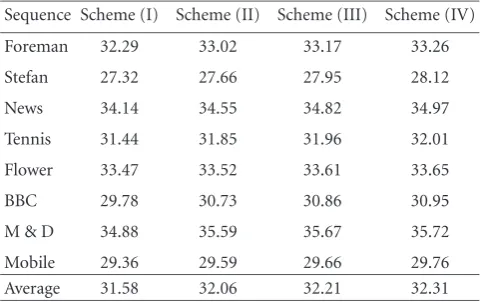
Table1: PSNR results (in dB) obtained by the cascaded H.264/AVC recoding approach using four schemes with different combinations of MCP modes and reference frames.
Sequence Scheme (I) Scheme (II) Scheme (III) Scheme (IV)
Foreman 32.29 33.02 33.17 33.26
Stefan 27.32 27.66 27.95 28.12
News 34.14 34.55 34.82 34.97
Tennis 31.44 31.85 31.96 32.01
Flower 33.47 33.52 33.61 33.65
BBC 29.78 30.73 30.86 30.95
M & D 34.88 35.59 35.67 35.72
Mobile 29.36 29.59 29.66 29.76
Average 31.58 32.06 32.21 32.31
computationally intensive parts of H.264/AVC coding, in-cluding intramode prediction, motion estimation, and cod-ing mode decision, to speed up the transcodcod-ing process. Fur-thermore, by using the information available in the precoded video, we further enhance the H.264/AVC rate control to achieve a better quality for the transcoded video.
2.3. Efficient options and modes for transcoding
Before discussing in detail the proposed transcoding meth-ods, it should be noted that a large number and combina-tion of MCP modes and prediccombina-tion reference frames for each macroblock are possible. Searching over all possible com-binations of modes and reference frame options to maxi-mize the overall RD performance is computationally inten-sive. Moreover, performance analysis conducted by Joch et
al. [13] on fourteen common test sequences has shown that
more than 80% bit savings gained by exploiting all possible macroblock partitions can be obtained using partitions not
smaller than 8×8. Furthermore, when multiple frame
pre-diction is employed, the average bit savings for twelve test se-quences are less than 5% and around 20% for the remaining two.
To examine whether the coding performance remains the same for video transcoding using H.264/AVC, we transcoded eight precoded H.263 sequences at 30 frames/s without
us-ing B frames (as shown inTable 1) to H.264/AVC at reduced
bitrates using the cascaded recoding approach (i.e., the pre-coded videos were fully depre-coded and then reenpre-coded using the H.264/AVC standard software). Four schemes using dif-ferent combinations of MCP modes and reference frames were considered: (I) one mode (mode 1) and one reference frame, (II) four modes (modes 1–4) and one reference frame, (III) all seven modes and one reference frame, and (IV) all seven modes and five reference frames.
The results show that compared with scheme (I), scheme
(II) can obtain an average 0.5 dB PSNR improvement.
How-ever, the performance gain by using scheme (IV) compared
with that of using scheme (II) is only 0.25 dB on average. In
addition, by exploiting all partitions smaller than 8×8 with
one reference frame, scheme (III) can obtain only an
aver-age 0.15 dB PSNR gain compared with scheme (II). In our
view, the much higher computation and memory cost re-quired by exploiting all the possible coding modes and ref-erence frame options cannot justify the small incremental performance gain for video transcoding. Hence, we will limit our proposed H.264/AVC transcoding methods to mainly us-ing four MCP modes (modes 1–4) and one reference frame to minimize the transcoding time.
3. PROPOSED H.263 TO H.264/AVC TRANSCODING METHODS
Figure 3 shows the architecture of the proposed video transcoder. It consists of a typical H.263 decoder followed by a H.264/AVC video encoder. The precoded H.263 video is first decoded by the H.263 decoder and then reen-coded by the H.264/AVC video encoder. For downsizing transcoding, the decoded video will be down-sampled be-fore it is transcoded to a H.264/AVC video. In what fol-lows, we present the three key components of our proposed H.264/AVC video transcoding methods: (1) fast intrapredic-tion mode selecintrapredic-tion, (2) mointrapredic-tion vector reestimaintrapredic-tion and in-termode selection, and (3) enhanced rate control.
3.1. Fast intraprediction mode selection
4×4luma prediction
In intraprediction, the H.264/AVC encoder selects the mode
that minimizes the sum-of-absolution difference (SAD) of
4 ×4 integer-transform coefficients of the difference
be-tween the prediction and the block to be coded. Although full search can obtain the optimal prediction mode, it is
compu-tationally expensive. Pan et al. [14] propose a fast
intrapre-diction mode selection scheme based on edge direction his-togram; however the computation of edge direction intro-duces additional complexity. Inspired by a key observation that the best prediction mode of a block is most likely in the direction of the dominant edge within that block, we propose a fast intraprediction mode selection scheme based on the coarse edge information obtained from the
integer-transform coefficients.
Note that in the DC prediction mode, the residue is
com-puted by offsetting all pixel values of the block to be coded
by the same value. Thus, the AC coefficients of the 4×4
in-teger transform of the residue in the DC prediction mode
are the same as the transform coefficients of the block to be
coded. Similar to discrete cosine transform (DCT) [15], these
integer-transform coefficients can be used to extract some
low-level feature information.
Figure 4shows pictorially the representations for some
AC coefficients of the 4×4 integer transform. It can be
seen that the value of AC coefficientF01essentially depends
upon intensity difference in the horizontal direction between
H.263 input stream Entropy decoding
Inverse quantization
Inverse transform
Motion
compensation memoryFrame
H.263 decoder
+
Motion vector from precoded video Motion vector reestimation
Spatial downsampling Intra/inter
Motion compensation
Fast intra-prediction Memory
Deblocking filter
Inverse transform
Inverse quantization
Quantized coefficients Entropy
coding Buffer
H.264/AVC encoder
M
o
tion
infor
m
ation
Quantization Transform
Enhanced rate control
Do
w
n
sizing
tr
ansc
oding
Sy
n
ta
x
tr
ansc
oding
+ +
Figure3: Block diagram of the proposed video transcoder.
+ −
F01
+ − F10
+ − − + F02
+ − − + F20
Figure4: Pictorial representation of some 4×4 integer-transform coefficients of the difference between the prediction and the block to be coded in the DC prediction mode.
orientation, can be extracted using these AC measurements
in a way similar to that shown in [15] for DCT coefficients.
Extending the results obtained in [15], we propose in this
pa-per to estimate the dominant edge orientation by
θ=tan−1
3
j=1F0j
3
i=1Fi0
, (5)
whereθ is the angle of the dominant edge with respect to
the horizontal axis andFij’s are the integer-transform coeffi
-cients of a 4×4 block.
Given the angleθof the dominant edge, we propose to
se-lect additional two out of nine intraprediction modes, which
have closest orientations to the edge angle θ, for a 4 ×4
luma prediction. Note that the edge directions of the nine
possible prediction modes are shown inFigure 5. Hence, if
the angleθof the dominant edge is between−26.6◦and 0◦,
Mode 7 (63.4◦)
Mode 3 (45◦) Mode 8 (26.6◦)
Mode 1 (0◦)
Mode 6 (−26.6◦) Mode 4 (−45◦) Mode 5 (−63.4◦) Mode 0 (−90◦)
Figure5: Directions of nine possible intraprediction modes for a 4×4 block.
modes 1 and 6 will be selected. Therefore, together with the DC mode, we only need to perform the prediction for three
modes instead of nine for a 4×4 block. As the DC mode is
always included in 4×4 luma prediction, we can compute
(5) using the AC coefficients of 4×4 integer transform of
the residue in the DC prediction mode, which are available during the computation of its cost function in
Table2: Average and cumulative percentages of the optimal MV distribution measured at different absolute distances from the new search center in eight test sequences.
Total percentage at different absolute vertical/horizontal distances from the new search center Vertical/horizontal
distance 0 1 2 3 4 5 6 7
0 64.8920 7.7059 0.6248 0.4464 0.2391 0.1733 0.1875 0.2691
1 9.3550 5.1418 0.5633 0.2701 0.1336 0.0715 0.0735 0.0884
2 0.7161 0.9548 0.3081 0.1211 0.0586 0.0376 0.0305 0.0267
3 0.4097 0.4086 0.1631 0.1704 0.0685 0.0327 0.0295 0.0277
4 0.2227 0.1856 0.0923 0.0932 0.0828 0.0404 0.0265 0.0236
5 0.1289 0.0908 0.0735 0.0361 0.0564 0.0508 0.0319 0.0227
6 0.1399 0.0852 0.0403 0.0337 0.0235 0.0421 0.0388 0.0269
7 0.1966 0.0821 0.0394 0.0420 0.0217 0.0201 0.0427 0.0459
Average percentage and cumulative percentage of optimal MV distribution at different absolute distances
Average percentage 64.8920 22.203 3.1671 1.9893 1.1764 0.7919 0.7829 0.9755
Cumulative percentage 64.8920 87.095 90.262 92.251 93.427 94.219 95.002 95.978
Hence, the computational complexity for 4×4 luma
predic-tion can be reduced by a factor of 3 compared with the full search of the best intraprediction mode.
16×16luma prediction
Similarly, we can obtain the edge orientations of four 8×8
blocks in a macroblock from the DCT coefficients
avail-able in the precoded video. Taking the average of these edge orientations gives us the dominant edge orientation in the macroblock. Hence, in addition to the DC prediction mode which is common in homogeneous scenes, we propose to se-lect another one out of three other possible modes based on
the dominant edge orientation for a 16×16 macroblock. In
this way, we can reduce the complexity of 16×16 luma
pre-diction by a factor of 2.
Note that the fast intraprediction of the proposed tran-scoder is still conducted in spatial domain. It only makes use
of 4×4 integer-transform coefficients and 8×8 DCT
coef-ficients available during transcoding process for estimating the dominant edge direction to reduce the complexity of in-tramode prediction.
3.2. Motion vector reestimation and intermode selection
To reduce the complexity of video transcoding, many existing methods propose to estimate the new motion vectors (MVs) required for the transcoded video directly from the MVs ex-isting in the precoded video. In this paper, we use the vector median filter, which has been shown to be able to achieve
generally the best performance [6], to resample the MVs in
the precoded video. The operation of the vector median filter
over a set ofKcorresponding MVsV = {mv1,mv2,. . .,mvK}
is given by
mvVM=arg min
mvj∈V K
i=1
mvj−mviγ,
mv=S×mv
VM,
(6)
wheremvVM denotes the vector median, · γ theγ-norm
for measuring the distance between two MVs,mvthe new
MV required, andSa 2×2 diagonal matrix downscaling the
vector median mvVM to suit the reduced frame size in the
2 : 1 downsizing transcoding. Note that in this paper the
Eu-clidean norm (γ=2) is adopted for measuring the distance
between two MVs.
During the encoding process, the H.264/AVC encoder needs to examine all modes and find the MV of each par-tition. However, a small number of available MVs for each macroblock in the H.263 precoded video makes it hard to es-timate the required MVs accurately. Note that in H.264/AVC standard, the predicted MV from the neighboring mac-roblocks is used as the MV of the skipped mode. Thus, to enhance the transcoding performance, this predicted MV is also taken into account for estimating the new MVs.
Before we describe our proposed method, let us examine the distribution of the optimal MVs obtained by perform-ing exhaustive search around the precoded and predicted MVs in transcoding eight well-known test sequences (listed inTable 1) consisting of different spatial details and motion
contents.Table 2shows the average and cumulative
percent-ages of the optimal MV distribution around either the pre-coded or the predicted MV, that is, the one that achieves the smaller SAD is selected as the new search center. For
visu-alization, Figure 6also shows the distribution of the
15 10
5 0
15 10
5 0
0 5 10 15 ×103
Figure6: Distribution of the MVs obtained by exhaustive search around the precoded MV or the predicted MV from the neighbor-ing macroblocks.
the optimal MVs are enclosed in a 3×3 window area
cen-tered around either the precoded or the predicted MV. Based on this empirical study, we propose a scheme for reestimat-ing the new MVs required as follows.
Syntax transcoding
The MV required for each partition of each mode is sim-ply selected from the MV in the precoded video and the predicted MV; the one that achieves the smaller SAD is se-lected as the new MV.
Downsizing transcoding
The median MV (mvVM) is first obtained from the precoded
MVs for each partition of different modes as follows.
Mode 1. ThemvVMis the downscaled median MV obtained
from the four corresponding MVs in the precoded
video (see (6)).
Mode 2. ThemvVMof the upper partition is estimated from
the downscaled MVs of the two upper corresponding macroblocks; the one that achieves a smaller SAD is se-lected as the new MV for the upper partition. Similarly,
themvVMfor the lower partition is estimated from the
downscaled MVs of the two lower corresponding mac-roblocks.
Mode 3. Similar to mode 2, themvVM’s of the left and right
partition are estimated from the downscaled MVs of the two left and right corresponding macroblocks, re-spectively.
Mode 8×8. The mvVM for each subpartition in an 8×8
block is simply estimated as the downscaled MV from the corresponding macroblock in the precoded video.
The new MV required for each partition of each mode is
then estimated from themvVMand the MV predicted from
neighboring blocks; the one that achieves a smaller SAD will be selected. Note that if a macroblock is intracoded in the
precoded video, the zero MV will be used to reestimate the MVs required.
Since the MVs obtained by exhaustive search are mostly centered within a small window around the reestimated MVs obtained using the above steps, we also propose to refine the reestimated MVs by searching a small diamond pattern
cen-tered at the reestimated MVs [16]. To further improve the
performance, the refined MVs in integer resolution can be further refined using the default quarter-pixel accuracy in H.264/AVC. To reduce the complexity, we propose to first choose the optimal intermode based on the smallest SAD value obtained by the refined MVs in integer resolution for each mode. Thus, the MVs of only one mode need to perform the quarter-pixel refinement. Furthermore, no RD optimized process is required to choose the best intermode, which can reduce the computational load significantly.
By using MV reestimation, we can reduce the computa-tional complexity for video transcoding. However, during the RD optimized process, the transcoder still needs to make a decision between intra and intermode for each macroblock. It should be noted that the mode decision process of in-tramode is computationally intensive and may cost five times
of that for intermode [17]. Based on our empirical study,
we propose to adopt the MV reestimation without using
in-tramode prediction for coding macroblocks inPframes. The
reason is that we can reduce the complexity notably with-out introducing much degradation given that the only infor-mation available to the transcoder is the compressed video which is already lossy compressed.
3.3. Enhanced rate control for H.264/AVC transcoding
Rate-quantization ratio model
Both the H.263 and H.264/AVC reference models approxi-mate the relation between the rate and distortion through a quadratic model, in which the number of coding bits is a quadratic function of the quantization step size. Thus, there may be a computable relation between the total number of coding bits in the precoded and transcoded videos.
To confirm, we transcoded the Foreman sequence, which was precoded by H.263 using a constant QP, to H.264/AVC
using another fixed QP.Figure 7shows the relation between
the total number of coding bits per frame in the precoded
and transcoded videos at different QPs. The figures show that
it is likely to have a linear relation between the number of coding bits for each frame in the precoded and transcoded
videos. Note that each curve in Figure 7contains two
lin-ear segments, in which the top-right segment representing a
greater number of coding bits corresponds toIframes; while
the bottom-left segment denoting a smaller number of
cod-ing bits corresponds toPframes. It can be seen that the slopes
of the two segments are not the same and vary for different
QPs, thus suggesting the linear relation could be different for
IandPframes and depends on the quantization step sizes of
the precoded and transcoded videos.
To justify the above argument, we transcoded five
pre-coded H.263 test sequences to H.264/AVC using diff
0 1 2 3 4 5 6 ×10⁴
No. of coding bits per frame in the precoded video 0 1 2 3 4 5 ×10⁴
N o .o f tr ansc o ded b its p er fr ame
QP=20
(a)
0 1 2 3 4 5 6
×104
No. of coding bits per frame in the precoded video 0
1 2 3 4 ×10⁴
N o .o f tr ansc o ded b its p er fr ame
QP=24
(b)
0 1 2 3 4 5 6
×104
No. of coding bits per frame in the precoded video 0
0.5 1 1.5 2 2.5
×104
N o .o f tr ansc o ded b its p er fr ame
QP=28
(c)
0 1 2 3 4 5 6
×104
No. of coding bits per frame in the precoded video 0
4 8 12 16
×104
N o .o f tr ansc o ded b its p er fr ame
QP=32
(d)
Figure7: Relation between the number of coding bits in precoded and transcoded videos by transcoding using a fixed QP.
0 1 2 3 4 5 6 7 8
Quantization step size ratio 0.1
0.3 0.5 0.7 0.9 1.1
Ratio o f n umber o f coding bits Foreman News Silent Stefan Tennis (a)Iframe
0 1 2 3 4 5 6 7 8
Quantization step size ratio 0
0.2 0.4 0.6 0.8 1 1.2 1.4
Ratio o f n umber o f coding bits Foreman News Silent Stefan Tennis (b)Pframe
average ratio of total number of coding bits and the quanti-zation step size ratio between the precoded and transcoded
videos for I andP frames. The results show that the ratio
of total number of coding bits between the precoded and transcoded videos most likely depends on the quantization
step size ratio and could be nearly constant for different video
contents.
In this paper we propose to use a quadratic model to ap-proximate these relations, which basically follow the trend of the actual curves. Mathematically, the proposed
rate-quantization ratio (Rr-Qr) model is given by
RI t RI p = XI 1
Qt/Qp2
+ X2I
Qt/Qp+X I
3,
RP t
RPp = X P
1
Qt/Qp2
+ X
P
2
Qt/Qp+X P
3,
(7)
whereRIp,PandRtI,Pare the total numbers of coding bits,QIp,P
andQIt,Pare the quantization step sizes forIandPframes in
the precoded and transcoded videos, respectively, andX1I,P,
XI,P
2 , and XI
,P
3 are the model parameters. The model
pa-rameters are empirically obtained by simulation with a large number of video sequences, in which the linear least square method is used to fit the actual curves. Note that the parame-ters of the model are adaptively updated by using actual data points obtained during the transcoding process to make a better fit for the current video sequence.
Proposed rate control method
(1) Selection of starting QP. In what follows, we propose to determine the good enough starting QP of the sequence or current GOP in order to meet closely the target bitrate. As
the quality fluctuation has a negative effect on the subjective
video quality, it is desirable to produce a constant quality for the transcoded video. Many experiments have indicated that using constant QP for the entire video sequence typically re-sults in good performance, in terms of both average PSNR
and consistent quality [18]. Hence, we will choose the value
of the constant QP, which can obtain the transcoded bitrate as close to the target bitrate as possible, as starting QP.
LetQt be the quantization step size for transcoding the
remaining video in order to have the number of transcoded
bits close to the number of remaining bits Rt. By using
the proposed model, we can express the total number of
transcoded bits with the use of a constantQtas
Rt= N
k=j
X1
Qt/Qkp2
+ X2
Qt/Qkp+X3
×Rk
p, (8)
whereQkp andRkpare the quantization step size and the
to-tal number of coding bits of thekth frame in the precoded
video, j is the frame number of the first frame in the
cur-rent GOP,Nis the total number of frames, andX1,X2, and
X3 are the corresponding model parameters depending on
the type (I orP frame) of thekth frame. Hence,Qt can be
obtained by solving the above quadratic equation. The start-ing QP of the sequence or current GOP is determined as the
nearest integer in the quantization table that corresponds to
the quantization step sizeQt.
(2) Allocation of frame bits. As mentioned earlier, H.264/AVC rate control computes the target number of bits per frame by allocating the number of remaining bits to all not-yet-coded frames equally. However, in order to achieve consistently good video quality over the entire sequence, a bit allocation scheme should take into consideration the frame complexity. The basic idea is to allocate fewer bits to less complex frames in order to save more bits for more complex frames. In this paper, we use the number of coding bits and quantization step size in the precoded video to measure the
complexitySkof thekth frame as
Sk=Rkp×Qkp. (9)
Hence, instead of allocating bits equally as (3), we propose to
allocate the number of remaining bits to all not-yet-coded frames proportionally according to the frame complexity.
Thus, the number of bits allocated for thekth frameTrkcan
be computed as
Tk
r =Rr×NSk i=kSi.
(10)
The final target bitrate is then computed using (4).
(3) Determination of frame QP. After target bit alloca-tion, it is important to determine the corresponding QP to meet exactly the target bit budget. However, the RD model in the existing rate control scheme may fail to determine the correct QP due to inaccurate prediction of MAD in the event of abrupt change in frame complexity. In this paper, we
pro-pose to use theRr-Qr model to determine the QP at frame
level.
Similar to (8), the quantization step sizeQkt for thekth
frame can be easily determined by solving
Tk t = X1 Qk t/Qkp2
+ X2
Qk
t/Qkp +X3
×Rk
p, (11)
whereTtkis the target number of bits for thekth frame
ob-tained from (4).
4. EXPERIMENTAL RESULTS
To evaluate the performance of the proposed transcoding methods, our test sequences include eight popular CIF
res-olution sequences, as shown inTable 3, which were precoded
by using the test model 8 (TMN8) H.263 encoder [19]. In
our simulation, the proposed transcoding methods were
im-plemented on the reference software H.264/AVC JM 7.4 [20].
For each test sequence, we set the frame rate to 30 frames/s and selected the appropriate bitrate so that there was no skipped frame in the precoded and transcoded videos. For performance comparison, we kept the bitrate constant when
Table3: PSNR results and encoding times obtained by transcoding H.263 sequences using the cascaded H.264/AVC recoding (RC) method, the MV reestimation method proposed inSection 3.2, with or without quarter-pixel refinement (refn.).
(a) PSNR (dB)
Sequence Transcoded Scheme (I) Scheme (II) H.264/AVC RC
frame size No refn. Refn. No refn. Refn. Refn.
Foreman 352×288 34.94 36.43 34.42 36.12 36.67
176×144 31.57 32.74 31.35 32.61 33.08
M & D 352×288 39.83 40.60 39.67 40.51 40.66
176×144 37.17 38.05 37.13 38.01 38.12
News 352×288 38.64 39.33 38.33 39.17 39.50
176×144 34.27 35.10 34.20 35.04 35.32
Silent 352×288 35.08 35.36 34.90 35.26 35.43
176×144 33.67 34.09 33.55 34.02 34.22
Stefan 352×288 28.28 31.55 27.48 31.05 31.86
176×144 26.80 28.83 26.46 28.66 29.36
Tennis 352×288 31.12 31.47 30.82 31.33 31.63
176×144 35.02 35.38 34.88 35.31 35.66
Mobile 352×288 25.97 27.88 25.66 27.83 28.16
176×144 34.33 35.41 34.31 35.41 35.60
Flower 352×288 29.05 29.81 29.00 29.80 29.90
176×144 30.84 31.44 30.84 31.45 31.48
(b) Total encoding time (s)
Sequence Transcoded Scheme (I) Scheme (II) H.264/AVC RC
frame size No refn. Refn. No refn. Refn. Refn.
Foreman 352×288 955 1144 220 341 1924
176×144 217 270 54 82 462
M & D 352×288 949 1092 210 319 1805
176×144 228 277 57 77 449
News 352×288 997 1130 215 326 1866
176×144 231 285 55 79 452
Silent 352×288 1082 1214 227 339 1944
176×144 243 288 60 85 483
Stefan 352×288 948 1134 224 343 1904
176×144 240 285 62 86 488
Tennis 352×288 1341 1416 271 432 2577
176×144 269 298 64 85 496
Mobile 352×288 1416 1588 353 488 2551
176×144 400 451 97 117 642
Flower 352×288 1158 1291 239 342 2402
176×144 278 306 60 82 475
GOP of each precoded and transcoded sequence consisted
of oneI frame followed by 14P frames. During
downsiz-ing transcoddownsiz-ing, each precoded frame was reconstructed and downsized in spatial domain using bicubic interpolation. To
video with downscaling (for downsizing transcoding) or without downscaling (for syntax transcoding) to the same frame size.
In the first set of experiments, eight test sequences pre-coded in H.263 were transpre-coded to H.264/AVC using only
the MV reestimation method proposed in Section 3.2with
four MCP modes (modes 1–4) and one reference frame to compare with the cascaded recoding (RC) approach using seven MCP modes and one reference frame. For
compari-son, two schemes of different mode options for coding
mac-roblocks inP frames were considered: (I) using both intra
and intermodes and (II) using only intermode.Table 3shows
the PSNR and complexity results in terms of total encoding time based on our implementation. The results show that in-curring much lower computational costs, both schemes can perform comparably to the H.264/AVC RC scheme. Specif-ically, the average PSNR results obtained by the proposed
schemes are only about 0.35 dB inferior to that obtained by
the H.264/AVC RC scheme both with and without downscal-ing, while the total encoding time of scheme (II) is reduced by a factor of about 6 compared with that of the H.264/AVC RC scheme. It should be noted that by using quarter-pixel
refinement, we can achieve about 0.9 dB and 1.3 dB
im-provement in PSNR both with and without downscaling, re-spectively, in both schemes. In addition, without using
in-tramode inP frames, scheme (II) can reduce the
computa-tional cost substantially while the performance is only a little worse than that of scheme (I). Furthermore, compared with scheme (I) (without quarter-pixel refinement), scheme (II) (with quarter-pixel refinement) not only is much less com-putationally expensive, it can also obtain an average of more than 1 dB performance gain in PSNR.
In another set of experiments, we repeated the first ex-periment by using both transcoding methods proposed in
Sections3.1 and3.2. Similar to the first experiment, both
schemes with and without using intramode inPframes were
considered, and denoted as scheme (I’) and scheme (II’).
Note that the only difference between these schemes and
those inTable 3 is that the proposed intraprediction mode
selection scheme (IPMS) was used to find the best mode in
intraprediction instead of the full search IPMS.Table 4shows
the average PSNR results and total encoding times. Observ-ably, using the proposed IPMS with fewer intraprediction modes for transcoding (scheme (I’) and scheme (I”)) can re-duce the encoding complexity significantly compared with the full search IPMS (scheme (I) and scheme (II)) while
in-troducing only about 0.1 dB loss in PSNR.
Figure 9shows the frame-to-frame PSNR results of the News sequence obtained by using scheme (I’) and scheme (II’) in comparison with the H.264/AVC RC scheme. It should be noted that the proposed method can perform modestly inferior compared to the cascaded H.264/AVC RC
scheme and the differences are uniformly distributed over
the entire sequence. For visual comparison,Figure 10shows
sample frames of the Foreman sequence obtained by the pro-posed method. The figures show that the propro-posed method can achieve a good perceived video quality, in terms of sharpness and blocking artifacts, compared with cascaded
recoding method, and perform visually about the same as the cascaded recoding scheme.
To evaluate the performance of the proposed rate con-trol method when used together with the proposed fast transcoding methods, the Foreman sequence was transcoded
to H.264/AVC using the proposedRr-Qrmodel to determine
the starting QP at different target bitrates that were
gener-ated by transcoding with different constant QPs. The
simu-lation shows that the proposed model is able to choose the constant QP, which was used to generate each target bitrate,
as the starting QP.Figure 11shows the PSNR results and the
difference between the target and achieved bitrates for
vari-ous starting QPs. Obvivari-ously, the starting QPs in the
bottom-right area are preferred, where the differences between the
target and achieved bitrates are close to zero and the PSNRs are high enough. The results show that by using the pro-posed method, the transcoder can determine a reasonably good starting QP (star marker) in order to meet closely the given target bitrates and achieve good video quality. Fur-thermore, the proposed method can provide more consistent video quality in terms of low PSNR fluctuation (measured
by the standard deviation (σ) of the PSNR results over each
entire sequence) as shown inTable 5. Note thatTable 5
tabu-lates the numerical results of using several QP values around
the selected one (bottom-right area inFigure 11); these QPs
generally result in too large a difference between target and
achieved bitrates or too low PSNR.
In the last set of experiments, we transcoded six test sequences at QCIF resolution and 15 frames/s by the cas-caded H.264/AVC RC approach using seven MCP modes and one reference frame and the fast transcoding methods
pro-posed in Sections3.1and3.2with both existing H.264/AVC
and proposed rate control methods using four MCP modes
(modes 1–4) and one reference frame. The results inTable 6
show that the standard deviation of the PSNR performance obtained using the H.264/AVC RC method is slightly bet-ter than that achieved by using the proposed fast transcod-ing methods with existtranscod-ing H.264/AVC rate control. However, by using the proposed rate control method for transcoding, the quality of transcoded video can be further enhanced. Specifically, compared with the H.264/AVC RC method, the transcoded video obtained by using the proposed rate con-trol method can meet the target bitrate more accurately; fur-thermore, the standard deviation of the PSNR performance is lower than that obtained by the H.264/AVC RC method, which implies a more consistent video quality over the entire sequence.
Figure 12shows the frame-to-frame PSNR results of the Foreman sequence obtained by the H.264/AVC RC method and the proposed fast transcoding methods together with the enhanced rate control. Not surprisingly, the fluctuation of PSNR obtained by transcoding with the proposed rate con-trol method is less than that of the H.264/AVC RC method. This can be explained by the fact that our method allocates bits per frame based on the frame complexity. In addition, we
used the proposedRr-Qrmodel to determine more accurate
QP for each frame rather than using MAD prediction that
Table4: PSNR results and encoding times obtained by transcoding H.263 sequences using the cascaded H.264/AVC recoding (RC) method and the proposed H.264/AVC transcoding methods in Sections3.1and3.2, with or without quarter-pixel refinement (refn.).
(a) PSNR (dB)
Sequence Transcoded Scheme (I’) Scheme (II’) H.264/AVC RC
frame size No refn. Refn. No refn. Refn. Refn.
Foreman 352×288 34.82 36.35 34.39 36.08 36.67
176×144 31.46 32.65 31.25 32.52 33.08
M & D 352×288 39.78 40.57 39.63 40.49 40.66
176×144 37.10 37.97 37.06 37.92 38.12
News 352×288 38.52 39.24 38.28 39.09 39.50
176×144 34.10 34.90 34.06 34.88 35.32
Silent 352×288 35.02 35.32 34.87 35.24 35.43
176×144 33.55 33.96 33.46 33.91 34.22
Stefan 352×288 28.10 31.47 27.42 30.98 31.86
176×144 26.68 28.76 26.36 28.60 29.36
Tennis 352×288 31.06 31.43 30.79 31.30 31.63
176×144 34.97 35.35 34.83 35.26 35.66
Mobile 352×288 25.87 27.83 25.63 27.80 28.16
176×144 34.29 35.38 34.28 35.38 35.60
Flower 352×288 28.99 29.75 28.96 29.75 29.90
176×144 30.72 31.30 30.71 31.32 31.48
(b) Total encoding time (s)
Sequence Transcoded Scheme (I’) Scheme (II’) H.264/AVC RC
frame size No refn. Refn. No refn. Refn. Refn.
Foreman 352×288 597 752 193 314 1924
176×144 138 162 44 72 462
M & D 352×288 584 707 185 292 1805
176×144 135 166 43 73 449
News 352×288 611 749 185 295 1866
176×144 135 166 42 67 452
Silent 352×288 656 773 192 306 1944
176×144 146 178 43 75 483
Stefan 352×288 586 745 200 303 1904
176×144 146 178 49 77 488
Tennis 352×288 641 767 194 303 2577
176×144 160 188 49 77 496
Mobile 352×288 726 874 236 359 2551
176×144 278 259 74 102 642
Flower 352×288 692 788 199 302 2402
176×144 157 198 48 72 475
plots the number of bits allocated per frame and the actual coding bits obtained using the QPs, which were determined
by existing H.264/AVC model and proposedRr-Qrmodel. As
can be seen, the proposed model can obtain the number of actual coding bits very close to the number of allocation bits.
5. CONCLUSION
We have proposed in this paper an efficient method for H.263
0 50 100 150 200 250 300 News
Frame 31
32 33 34 35 36 37 38
PSNR
(dB)
Scheme I’ Scheme II’ H.264/AVC RC
Figure9: Frame-to-frame PSNR results of the News sequence ob-tained by the proposed H.264/AVC transcoding methods and the H.264/AVC recoding (RC) method.
Original precoded frame (37.59 dB) (a)
Scheme I’(36.48 dB) (b)
Scheme II’(36.27 dB) (c)
H.264/AVC RC (36.72 dB) (d)
Figure10: Sample frames from the Foreman sequence transcoded from the precoded H.263 video by the proposed syntax transcod-ing methods with quarter-pixel refinement and the cascaded H.264/AVC recoding (RC) method.
a fast intraprediction mode selection scheme based on the coarse edge information obtained from integer-transform
coefficients. In addition, an enhanced rate control method
is proposed to improve the transcoded video quality. The proposed rate control method uses a quadratic model for se-lecting quantization parameters at the sequence and frame
32.5 33 33.5 34 34.5 35
PSNR (dB) −1
0 1 2 3 4 5 6 7 8 9 ×10⁴
T
arget
and
ac
h
ie
ve
d
b
it
ra
te
di
ff
er
enc
e
Different starting QPs Selected starting QP
Figure11: PSNR results (in dB) and the differences between the target and achieved bitrates obtained by transcoding the Foreman sequence using various starting QPs at a given target bitrate.
Table5: PSNR, standard deviations of the PSNR results (σ), and achieved bitrate for the Foreman sequence using different starting QPs at a given target bitrate. Note that the starting QP obtained by the proposed model is 28.
Starting Target bitrate Achieved bitrate PSNR σ
QP (kbps) (kbps) (dB)
16 84.83 86.36 32.90 3.51
20 84.83 85.55 34.44 1.56
24 84.83 84.67 34.74 0.95
28 84.83 84.70 34.72 0.88
32 84.83 84.62 34.65 0.86
36 84.83 84.18 34.38 1.21
levels together with a new frame-layer bit allocation scheme based on the side information from the precoded video. The experimental results show the accuracy of the model
and the effectiveness of the proposed methods. In particular,
the PSNR obtained by the proposed methods is only about
0.35 dB inferior to that obtained by the cascaded H.264/AVC
Table6: PSNR results (in dB), standard deviations of the PSNR results (σ), and actual bitrates obtained by H.264/AVC recoding (RC) method, the proposed fast transcoding methods in conjunction with the existing, and the proposed H.264/AVC rate control methods.
Target Proposed fast transcoding methods H.264/AVC cascaded
bitrate Existing rate control Proposed rate control recoding
(kbps) Actual bitrate PSNR σ Actual bitrate PSNR σ Actual bitrate PSNR σ
Sequence (kbps) (dB) (kbps) (dB) (kbps) (dB)
Foreman 65.17 64.87 33.81 1.015 65.15 33.83 0.652 64.58 34.22 0.923 111.05 111.80 35.52 0.792 111.17 35.57 0.543 111.72 35.95 0.712
News 31.89 32.81 32.92 1.167 31.92 32.95 0.915 32.75 33.27 1.095 55.46 56.38 35.67 1.093 55.53 35.60 0.835 56.41 36.06 0.964
Silent 60.38 60.74 34.58 0.787 60.36 34.64 0.493 60.59 34.79 0.792 109.59 110.60 36.51 0.597 109.64 36.56 0.326 108.62 36.78 0.543
Stefan 140.28 140.73 29.03 1.433 140.34 29.11 0.875 140.84 29.75 1.355 292.04 292.98 32.34 1.281 292.19 32.30 0.613 292.76 33.13 1.153
Tennis 73.49 74.11 30.55 2.191 73.62 30.57 1.593 72.89 30.84 2.018 136.60 136.92 32.81 1.712 136.58 32.87 1.033 136.89 33.14 1.582
Mobile 194.44 195.54 28.47 1.132 194.66 28.54 0.847 195.32 28.66 1.087 388.00 388.54 31.03 0.984 388.13 31.17 0.652 388.61 31.25 0.941
0 20 40 60 80 100
Frame number 31
32 33 34 35 36 37
Foreman
PSNR
(dB)
H.264/AVC RC Proposed methods
Figure12: PSNR performance (in dB) of the Foreman sequence ob-tained by the H.264/AVC recoding (RC) method and the proposed fast transcoding methods together with the enhanced rate control.
ACKNOWLEDGMENT
The work of V.-A. Nguyen was supported in part by a post-graduate scholarship from Singapore Millennium Founda-tion.
0 10 20 30 40 50 60 70 80 90
Frame number 0
1 2 3 4 5 6 7 ×10³
Nu
m
b
er
o
f
b
it
s
Allocation bits
Coded bits by H.264/AVC Coded bits by proposed rate control
Figure13: Number of bits allocated per frame and actual coding bits obtained using the QP determined by H.264/AVC method and the proposedRr-Qrmodel.
REFERENCES
[1] B. Haskell, P. G. Howard, Y. LeCun, et al., “Image and video coding - emerging standards and beyond,”IEEE Transactions
on Circuits and Systems for Video Technology, vol. 8, no. 7, pp.
[2] A. Vetro, C. Christopoulos, and H. Sun, “Video transcoding architectures and techniques: an overview,”IEEE Signal
Pro-cessing Magazine, vol. 20, no. 2, pp. 18–29, 2003.
[3] N. Bjork and C. Christopoulos, “Transcoder architecture for video coding,” IEEE Transactions on Consumer Electronics, vol. 44, no. 1, pp. 88–98, 1998.
[4] T. Shanableh and M. Ghanbari, “Transcoding of video into different encoding formats,” inIEEE International Conference
on Acoustics, Speech, and Signal Processing (ICASSP ’00), pp.
1927–1930, Istanbul, Turkey, June 2000.
[5] B. Shen, I. K. Sethi, and B. Vasudev, “Adaptive motion-vector resampling for compressed video downscaling,”IEEE
Transac-tions on Circuits and Systems for Video Technology, vol. 9, no. 6,
pp. 929–936, June 1999.
[6] Y.-P. Tan, H. Sun, and Y. Liang, “On the methods and applica-tions of arbitrary downsizing video transcoding,” inIEEE
In-ternational Conference on Multimedia and Expo, pp. 609–612,
Lausanne, Switzerland, August 2002.
[7] T. Shanableh and M. Ghanbari, “Heterogeneous video transcoding to lower spatio-temporal resolutions and differ-ent encoding formats,”IEEE Transaction on Multimedia, vol. 2, no. 2, pp. 101–110, 2000.
[8] T. Wiegand and G. Sullivan, “Draft ITU-T Recommendation and Final Draft International Standard of Joint Video Specifi-cation (ITU-T Rec. H.264 — ISO/IEC 14496-10 AVC),” March 2003.
[9] J. Ostermann, J. Bormans, P. List, et al., “Video coding with H.264/AVC: tools, performance, and complexity,”IEEE
Cir-cuits and Systems Magazine, vol. 4, no. 1, pp. 7–28, 2004.
[10] V.-A. Nguyen and Y.-P. Tan, “Efficient H.263 to H.264/AVC video transcoding using enhanced rate control,” inIEEE
In-ternational Conference on Image Processing (ICIP ’05), Genoa,
Italy, September 2005.
[11] T. Wiegand, G. J. Sullivan, G. Bjontegaard, and A. Luthra, “Overview of the H.264/AVC video coding standard,”IEEE
Transactions on Circuits and Systems for Video Technology,
vol. 13, pp. 560–576, 2003.
[12] Z. G. Li, F. Pan, K. P. Lim, G. N. Feng, X. Lin, and S. Rahardja, “Adaptive basic unit layer rate control for JVT, JVT-G012-r1,”
in7th Meeting, Pattaya II, Bangkok, Thailand, March 2003.
[13] A. Joch, F. Kossentini, and P. Nasiopoulos, “A performance analysis of the ITU-T draft H.26L video coding standard,”
in12th International Packet Video Workshop, Pittsburgh, Pa,
USA, April 2002.
[14] F. Pan, X. Lin, and R. Susanto, “Fast intra mode decision al-gorithm for H.264/AVC video coding,” inIEEE International
Conference on Image Processing (ICIP ’04), Singapore, October
2004.
[15] B. Shen and I. K. Shethi, “Direct feature extraction from com-pressed images,” inStorage and Retrieval for Image and Video
Databases IV, vol. 2670 ofProceedings of SPIE, pp. 404–414,
San Jose, Calif, USA, February 1996.
[16] S. Zhu and K. K. Ma, “A new diamond search algorithm for fast blockmatching motion estimation,”IEEE Transaction on
Image Processing, vol. 9, pp. 287–290, 2000.
[17] B. Jeon and J. Lee, “Fast mode decision for H.264,” ITU-T VCEG (Q.6/16), July 2003.
[18] B. Xie and W. Zeng, “Sequence-based rate control for con-stant quality video,” inIEEE International Conference on Image
Processing (ICIP ’02), vol. 1, pp. 77–80, Rochester, NY, USA,
September 2002.
[19] ITU-T/SG15, “Video Codec Test Model TMN-8,” Portland, June 1997.
[20] JM Reference Software Version 7.4, http://iphome.hhi.de/
suehring/tml/download.
Viet-Anh Nguyen was born in Vietnam
in 1980. He received the B.S. degree in electrical and electronic engineering from Nanyang Technological University (NTU), Singapore, in 2004, where he is currently working toward the Ph.D. degree. His cur-rent research interests include image and video processing, pattern recognition, com-puter vision, and color imaging. He received the First Prize in the National Informatics
Olympiad in Vietnam in 1998. In 2004, he was awarded the Sin-gapore Millennium Foundation scholarship for his postgraduate study.
Yap-Peng Tanreceived the B.S. degree from
National Taiwan University, Taipei, Taiwan, in 1993, and the M.A. and Ph.D. degrees from Princeton University, Princeton, NJ, in 1995 and 1997, respectively, all in electri-cal engineering. He was the recipient of an IBM Graduate Fellowship from IBM T. J. Watson Research Center, Yorktown Heights, NY, from 1995 to 1997 and was with Intel and Sharp Labs of America from 1997 to