City, University of London Institutional Repository
Citation:
McDowell, C. A. (2013). ‘Climate Change Adaptation and Mitigation: Implications for land acquisition and population relocation’. Development Policy Review, 31(6), pp. 677-695. doi: 10.1111/dpr.12030This is the accepted version of the paper.
This version of the publication may differ from the final published
version.
Permanent repository link:
http://openaccess.city.ac.uk/4869/Link to published version:
http://dx.doi.org/10.1111/dpr.12030Copyright and reuse: City Research Online aims to make research
outputs of City, University of London available to a wider audience.
Copyright and Moral Rights remain with the author(s) and/or copyright
holders. URLs from City Research Online may be freely distributed and
linked to.
City Research Online: http://openaccess.city.ac.uk/ [email protected]
This article was published in Development Policy Review, 2012, 30 (1): 29-48
Climate change Adaptation and Mitigation: Implications for Land
Acquisition and Population Relocation
In response to the challenge of climate change developing country governments are evolving adaptation and mitigation programmes for which they are seeking international financing. This article presents the findings of a review of national action programmes and other interventions to assess their likely societal impacts with an emphasis on land-use change, future land acquisitions, population displacement and resettlement. Evidence presented suggests there is likely to be additional and large scale resettlement related to adaptation and mitigation investments in the coming decades. It describes such climate change related projects as infrastructure development projects and the population displacement they may generate as a form of development-created involuntary resettlement. The article considers the policy and development challenges such involuntary resettlement will pose and assesses the robustness of currentgovernance arrangements to manage that resettlement. It is argued that the UNFCCC process presents opportunities for improving the national and international management of land acquisition and resettlement particularly in LDCs and Small Island States but cautions that at present the financing arrangements do not prioritise the legal protection of affected populations.
Key words: climate change, adaptation, displacement, involuntary resettlement
1. Introduction
This article reviews national action plans submitted by less developed and developing
countries as part of the UN Framework Convention on Climate Change (UNFCCC) process
to secure financing for adaptation and mitigation projects. The aim of the review is to assess
the likely societal impact with a particular emphasis on implications for land-use change
requiring land acquisition and population resettlement. It is argued that the types of projects
proposed envisage mainly infrastructure and biodiversity protection involving what is defined
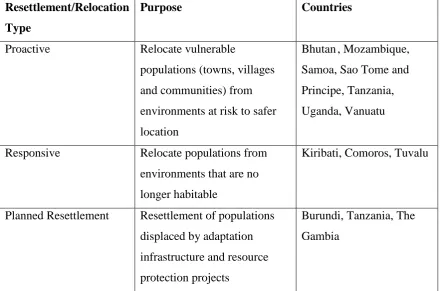
by the author as ‘proactive relocation’ (where the purpose is to relocate exposed populations from environments at risk to safer locations), ‘responsive relocation’ (of populations from environments that are deemed no longer habitable) and ‘planned population resettlement’
(where communities are displaced and resettled as a result of the construction of adaptation
infrastructure and resource protection projects). Having reviewed the types of interventions
outlined in countries’ programmes of action the article locates such land acquisition and
investments, and further considers the strengths and weaknesses of the current governance of
development-created resettlement at the national and international levels. The article concurs
with Adger et al.,(2009) and de Sherebinin et al. (2011) that the proposed adaptation and
mitigation plans and programmes of action, in addition to increasing the number of people
relocated from areas at risk (Barnett and O’Neill, 2012), will require large scale land-use
conversions resulting in population resettlement that has the potential to add considerably to
the estimated 15 million people displaced annually in the developing world by infrastructure
projects. However, insufficient information has yet been provided by governments on the
location and likely scale of societal impacts. There is little evidence available to suggest that
states have considered the magnitude of the additional resettlement challenge that such
actions will entail, the sufficiency of national laws and policies to manage resettlement, or the
necessary preparations to ensure that resettlement conforms with the best available
international standards. It further considers opportunities that are presented by the new
arrangements for climate change funding for reinvigorating stalled initiatives (by multilateral
development banks, the United Nations, the African Union, and non-state actors) to improve
the managment of land acquisition and resettlement and enhance the protection of those
displaced. Steps towards improvement would include greater transparency in the land
acquisition and involuntary resettlement process, and the strengthening of the legal rights of
individuals and communities who lose land and other assets in the development process,
including the securing of the consent of affected populations to their resettlement. New legal
instruments ideally would seek to better protect traditional land tenure systems, avoid
arbitrary displacement, guarantee citizens rights to replacement land, and ensure the payment
of full and fair compensation based on realistic asset valuation, with fullconsultation taking
place throughout the land acquisition and resettlement process.
2. Financing Adaptation and Mitigation
The following analysis of the resettlement outcomes of countries’ adaptation and mitigation
investments is based on a review of key planning and strategy documents produced by
governments from within the UNFCCC and specifically Copenhagen Accord processes. The
programmes were subsequently tabled at the COP16 at Cancun, and are now being
considered as part of the negotiations’ track activities on climate financing agreed at the
COP17 at Durban . The aim of this review is to gather evidence on the implications of
resettlement, to quantify those impacts, and to assess the policy and legal contexts within
which such actions will be undertaken in the near future. The review is principally concerned
with official adaptation1[1] and mitigation plans prepared by developing country governments.
The World Bank (2009) estimates that hundreds of billions of dollars will be required each
year for several years to enable states to mitigate against and adapt to global climate change.
There is a complex and ever evolving web of financial support mechanisms to assist
developing and transition countries in their adaptation and mitigation activities principally
under the umbrella of the Framework Convention, and including climate specific funds made
available by international agencies, and numerous bi- and multilateral assistance channels for
public sector flows, as well as philanthropic undertakings and a multitude of additional
private sector financial and investment sources. The most significant of these funding
mechanisms, working both alongside and in partnership with the Global Environment Facility
(GEF) and the Climate Investment Fund (CIF) is the Adaptation Fund (AF) which was
established under the Kyoto Protocol to finance concrete adaptation projects and programmes
in vulnerable developing countries. Other mechanisms include those agreed as part of the
Cancun Agreement (and further endorsed at Durban) such as the Green Climate Fund (GCF),
the Least Developed Countries Fund (LDCF), the Special Climate Change Fund (SCCF) 2[2],
and the ongoing Fast Start financing provisions.3[3] This range of financial support presents
major challenges for coherence and monitoring (Corfee-Merlot et al 2009), and also in
guaranteeing the implementation of the Copenhagen Accord and subsequent decisions and
agreements (such as the Bali Action Plan) on adaptation.. At the COP17 in Durban the new
negotiating track (the Ad Hoc Working Group on the Durban Platform for Enhanced Action
(ADP)) was added to the UNFCCC process. The ADP is expected to develop by 2015 a new
legal instrument on emissions ‘with legal force’4[4] and taking effect from 2020, to secure
agreement on the operationalising of the GCF, and to manage a work programme to bring
coherence to the diverse financing arrangements outlined above.
1[1]
Adaptation refers to planned adaptations that may be either reactive or anticipatory, over various timescales, and which are generally undertaken by governments on behalf of society to reduce the vulnerability of society to changes in the climate system (Huq et al, 2003:19) .
2[2] Both the SCCF and the LCDF which was used to fund the preparation of the NAMAs and NAPAs, are
administered through the GEF.
3[3] See www.faststartfinance.org; although India and China are recipients of climate they have confirmed that
they will not access Fast Start financing.
As the IIED (Parry et al 2009) has pointed out, progress on climate financing has been slow
from the outset of the Convention, and it took seven years from the launch of the Adaptation
Fund in Marrakech in 2001 for an acceptable legal framework for Fund disbursement to be
agreed. It was during the period of the establishment of the Fund, and in the two years
immediately before and following the COP15 in Copenhagen, that developing and transition
states identified in a general, and sometimes in more concrete terms, projects that addressed
adaptation and mitigation needs within their borders5[5] .
It is these plans that give some guidance on the likely direct and indirect societal impacts of
adaptation and mitigation programmes particularly in relation to the concerns of this article –
land-use change and the subsequent involuntary resettlement or relocation of populations as a
result of policies pursued under the umbrella of adaptation and mitigation.
2.1 National Adaptation Programmes of Action (NAPAs)
The clearest public presentation of countries’ climate change adaptation planning can be
found in the National Adaptation Programmes (or Plans) of Action (NAPAs) which were
produced by more than forty Least Developed Countries (LDCs)6[6] between 2005 and 2009.
It is relevant to note that the NAPA process was designed to assist governments in the
development of strategies to enable adaptation projects to be funded and launched. As such
there was a dual focus among the LDC Expert Group advising governments both on capacity
building within states, as well as on urgent and immediate adaptation needs, reflecting
concerns that adaptation to climate change had not yet become a major policy issue or
priority within developing countries and the ‘mainstreaming’ of adaptation into development
planning needed to take place alongside improved National Communications (NatComs)7[7]
on governments’ Convention activities.
5[5] Transborder thinking on adaptation has been largely at the margins of climate change response planning.
6[6] Least Developed Countries (LDCs) are a group of 49 countries considered to be
theworld’s poorest countries with a per capita Gross Domestic Product (GDP) under
$900 and with very low levels of capital, human and technological development.
7[7] NatComs are periodiod reports to the Conference of Parties (COP) on progress achieved, or activities
In the preparation of the national adaptation plans governments were unclear about the
mechanisms for financing, and how any new arrangements may have an impact on existing
international development finance, including for ongoing projects. It is therefore unsurprising
that the projects outlined in the NAPAs are generally modest in scale, underdeveloped in
policy terms, and cautious in the sense that rather than setting a radical new agenda they seek
build on pre-existing programmes of necessary modernisation and renovation – for example
the protection of coasts, through the development of new agricultural systems (to adapt to
salination or water shortage), and restoration and rehabilitation through the replanting of
coastal forests, mangroves and estuarine marsh, or the preservation of sand dunes. The plans
contain also frequent references to the extension of insurance cover improved management
and governance of key sectors, disaster response mechanisms, and also propose projects that
address the need for improved early warning systems. The NAPAs were more conservative
than the general press coverage on risks and threats. For example, the governments of those
countries deemed most at risk of flooding as a result of sea-level rises, and for whom
large-scale displacement and resettlement has been widely discussed in the media, did not prioritise
the large-scale relocation of populations as an adaptation response. For example, neither
Bhola Island (in the case of Bangladesh which is popularly regarded as the first large-scale
example of climate change displacement8[8]) nor international resettlement (in the case of The
Maldives9[9]) were identified as priorities in the respective NAPA submissions (or indeed in
the case of The Maldives in follow on national strategies).
Countries Contemplating Land-Use Changes
Forty NAPAs10[10] were surveyed and it was found that they contained statements of intent
rather than detailed project proposals and as such it is difficult to assess with accuracy the
8[8]
See Al Jazeera English, ‘Bangladeshis flee disappearing islands’, 17 December 2009.
http://www.youtube.com/watch?v=KF6gEBzJeF8. Accessed on 4 October 2012
9[9] See Sydney Morning Herald, ‘Climate change castaways consider move to Australia’, 4 October 2012.
http://www.smh.com.au/environment/climate-change/climate-change-castaways-consider-move-to-australia-20120106-1pobf.html. Accessed 4 October 2012
10[10]
location, scale and societal implications of adaptation plans in terms of land-use change.
There are however some exceptions. The Government of Eritrea stated its intention to build a
multi-purpose large-scale water development project in Genale-Dawa Basin, while
neighbouring Ethiopia proposed a series of named hydropower projects as did Sao Taome
and Principal with the construction of hydro-power stations in Claudino Faro and Bernardo
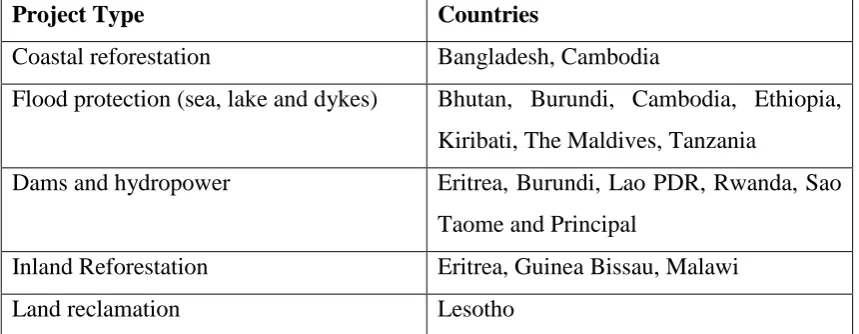
Faro. The minority of NAPAs (18 out of 40) however, as Table 1 below shows, declared an
unspecified commitment to adaptation projects that involved land-use change with only
minimal information provided on the area of land or the numbers of people who may be
[image:7.595.66.496.321.488.2]affected by such projects.
Table 1 NAPA Projects Involving Land-Use Change
Project Type Countries
Coastal reforestation Bangladesh, Cambodia
Flood protection (sea, lake and dykes) Bhutan, Burundi, Cambodia, Ethiopia,
Kiribati, The Maldives, Tanzania
Dams and hydropower Eritrea, Burundi, Lao PDR, Rwanda, Sao
Taome and Principal
Inland Reforestation Eritrea, Guinea Bissau, Malawi
Land reclamation Lesotho
Source: NAPAs
Countries Contemplating Resettlement
Evidence gathered from NAPAs broadly suggest that LDCs when faced with environmental
and climate change sought adaptation solutions that allowedpopulations to remain in situ
wherever possible. Environmental projects that predated the NAPAs and which involved
some elements of resettlement, for example, the policy of ‘economic reintstallation’ against
desertification in Mongolia including pastoral sedentarisation, and the shifting of populations
away from the banks of the Mekong river in Vietnam (Warner et al., 2009), were absent from
those countries NAPAs. The plans suggest that states analysed their immediate situation in
terms of numerous interconnected problems: population growth, lack of development, poor
infrastructure, vulnerability to natural disasters and the damage they cause, poverty,
overcrowding and loss of natural resources and biodiversity; and concluded that solutions
[image:8.595.67.508.259.550.2]would require a comprehensive plan of action within which adaptation could be integrated.
Table 2 Proactive, Responsive and Planned Relocation
Resettlement/Relocation
Type
Purpose Countries
Proactive Relocate vulnerable
populations (towns, villages
and communities) from
environments at risk to safer
location
Bhutan , Mozambique,
Samoa, Sao Tome and
Principe, Tanzania,
Uganda, Vanuatu
Responsive Relocate populations from
environments that are no
longer habitable
Kiribati, Comoros, Tuvalu
Planned Resettlement Resettlement of populations
displaced by adaptation
infrastructure and resource
protection projects
Burundi, Tanzania, The
Gambia
Source: NAPAs
As can be seen from the above Table some low lying islands, sub-Sarahan African states and
Bhutan identified the likely need to resettle populations as part of the adaptation solutions
either in extremis where land can no longer sustain a population, in response to identified
risks of flooding and salination, and as a consequence of adaptation projects such as natural
resource protection and the establishment of wildlife corridors11[11].
11[11] A strategy that Geisler and de Sousa (2000) refer to as ‘protected area greenlining’ which involves the
In most national plans specific details about the precise locations from which people are
likely to be relocated, to where they may be moved, or the numbers of people involved, were
not provided. One exception was Bhutan which proposed moving the town of Chamkhar to
Dekiling, and the Comoros Government which estimated that 10 per cent of its population
(approximately 60,000 people) would require moving as a result of saline intrusion into the
groundwater and land. Kiribati recognised that some relocation may take place spontaneously
in the event of sudden erosion, and The Gambia cited the planned upgrading of the Kotu
Stream as requiring land acquisition resulting in resettlement.
Resettlement Planning and Policy
As noted above, the Guidelines for the preparation of the NAPAs did not require LDCs to
provide information on the policy and legal frameworks within which adaptation projects
would be undertaken. There is no detail for example on legal requirements and policy
procedures guiding land acquisition or voluntary/involuntary resettlement. Across the 40
NAPAs reviewed there were only two references to the process of resettlement. The
Government of Burundi warned that resistance to relocation should be expected, and ‘strong
legislation (would be) required’. While the Government of The Gambia stated that “resettlement and compensation will have to be considered”. The Government of Rwanda
linked future adaptation actions to its Imidigudu national human settlement policy for
returned displaced people following the violent conflicts in the 1990s. Against the backdrop
of concerns voiced about coercion, lack of popular participation, poor design, and small plot
size the Government of Rwanda stated a committed to this form of concentrated villagisation
for future ‘environmental resettlement’.The lack of detail and policy consideration in those
sections of the NAPAs raising the likelihood of relocation and resettlement suggests that
proper consideration was not given to the land acquisition and the resettlement challenge, and
associated human rights issues, that will arise were governments to pursue resettlement either
in a proactive manner (to remove people from areas of risk), in a reactive manner (following
an emergency or disaster), or as a result of land use changes or the construction of physical
infrastructure to aid adaptation.
A further dataset useful in assessing the likelihood of population relocation and resettlement
in states’ responses to climate change and in their formulation of funding requests are the
Nationally Appropriate Mitigation Actions (NAMAs) submitted by Non-Annex 1 Parties to
the UNFCCC as called for following the Copenhagen Accord. It is generally viewed that the
process at Copenhagen failed to precisely define what NAMAs should prioritise or how they
should be included in the international financial architecture for climate change. Similar to
NAPAs, the NAMAs were mostly generalised and did not set out concrete implementation
plans, and mitigation was broadly defined. For the purposes of this analysis, however, the
NAMAs are an important resource because they provide some indication of non-LDC states’
thinking and forwardplanning on future actions that have implications for land-use,
resettlement and migration. Perhaps most significant is the commitment to large-scale
[image:10.595.69.495.382.551.2]afforestation (creating new forests) and reafforestation (replanting depleted forests).
Table 3 Afforestation and Reafforestation (Non-Annex 1 Parties, UNFCCC)
Country Commitment
Togo increase forest cover from present 7% to
30% by 2050
Mauritania increase forest cover from present 3.2%
to 9% by 2050
China increase forest production by 40 million
hectares and forest stock by 1.3 billion
cubic metres by 2020 from 2005 levels
Source: NAMAs
Armenia, Botswana and Jordan each gave a general commitment to reafforestation, while
Indonesia signalled a policy of carbon sequestration and Benin a programme of carbon
storage through new plantations. The governments of Ethiopia and Brazil included biofuel
development and the increased use of biofuels as key mitigation strategies in their 2010
NAMAs with a focus on liquid biofuels (ethanol and biodiesel).
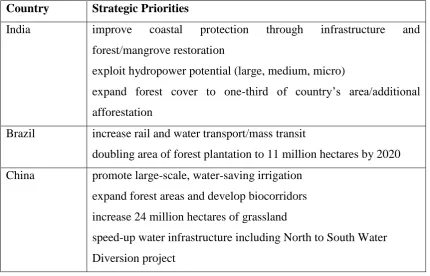
In parallel with the UNFCCC NAPA and NAMA process, fast industrialising states (Brazil,
South Africa, India and China (referred to using the acronym BASIC)) published national
climate change strategies in 2007 and 2008 which included plans of action, partially cited in
earlier NAMAs, which also identify and in some cases attempted to quantify new priority
projects and strategic commitments. As Fransen et al (2009) conclude, these plans articulated
the potential effects of climate change impacts on livelihood economies, and natural systems,
but stopped short of providing concrete procedures and strategies for meeting adaptation
needs. The proposals reflect preliminary adaptation planning efforts but nonetheless provide
additional important information on likely land conversion, land acquisition and resettlement
outcomes.
Table 4 BASIC Proposed Adaptation and Mitigation Interventions with Likely
Resettlement Impacts
Country Strategic Priorities
India improve coastal protection through infrastructure and
forest/mangrove restoration
exploit hydropower potential (large, medium, micro)
expand forest cover to one-third of country’s area/additional
afforestation
Brazil increase rail and water transport/mass transit
doubling area of forest plantation to 11 million hectares by 2020
China promote large-scale, water-saving irrigation
expand forest areas and develop biocorridors
increase 24 million hectares of grassland
speed-up water infrastructure including North to South Water
Diversion project
Source: India (July 2008) National Action Plan on Climate Change; Brazil (December 2008)
[image:11.595.66.497.382.658.2]In climate negotiations, India and China have consistently stressed the need to avoid
compromising national economic growth or state sovereignty in addressing the challenge of
climate change. This is evident in the Chinese Government’s 11th
Five Year Plan in which it
sets out a twin strategy to balance conservation with exploitation, and development with
low-carbon growth. China’s adaptation and mitigation measures, as set out in the plan, have the
potential to create resettlement on a considerable scale. Most notably in the Priority
Programmes for Ecological Conservation (Chapter 6, Five Year Plan, April 2010) which
include:
the conversion of cultivated land back to grassland or forest
the conversion of grazing land back to grassland
wetland restoration
and the construction of wildlife and natural reserves
UN Reducing Emissions from Deforestation and Forest Degradation (REDD+) Programme
The UN REDD/REDD+ adaptation involves projects that are part of a range of programmes
in the broad category of Payment for Ecosystem Services (PES)12[12],providing finance to
mainly forest basin countries to develop low-carbon growth and to help those countries
access financial and technical support to address deforestation and forest degradation. They
include also methods and tools for measuring and monitoring greenhouse gas emissions and
forest carbon flows. The UN recognises that REDD and REDD+ Programme activities may
impact detrimentally upon the rights and livelihoods of Indigenous Peoples or other forest
dependent communities. For example, , the REDD+ Vietnam Benefit Distribution Study
includes resettlement as a possible operation linked to an ‘interventions that might address drivers of forest change’ (UN REDD, 2010:156). In recognition of the likelihood of
resettlement, the UNDP (2009) has produced Guidance providing background and context on
the inclusion of Indigenous Peoples in UN programmes and activities, identifying guiding
principles inorder to respect and support the rights of Indigenous Peoples and other forest
dependent communities, and outlining the operational guidelines for the design and
implementation of UN‐REDD Programme activities at the global and national scale. While
there is no direct reference to resettlement or denial of access to forest land in these
12[12]
guidelines, it is however likely that interventions and activities implemented to avoid
deforestation and/or forest degradation may include the resettlement of communities from
those forests, or the denial of access to such resources. It is further recognised that the
guidelines are insufficient to manage land acquisition and resettlement with the expectation
that national laws and policies will apply.
3. Displacement, Involuntary Resettlement and Impoverishment
The preceding overview of countries’ climate change adaptation and mitigation plans and
their participation in other internationally publically funded, nongovernmental or private
climate change response initiatives, presents evidence that in the coming decades as a result
of:
significant new infrastructure projects (in pursuit of hydropower and water diversion
and storage, the construction of sea and river defences);
biodiversity enlargement and protection (the creation of new forests, grassland and
wildlife reserves);
increased biofuel production;
and through the proactive and responsive relocation of communities from land under
threat of flooding or salination
there is likely to be additional large scale displacement and resettlement of populations in the
developing world taking place alongside other types of state-managed, spontaneous and
emergency population movements not directly related to climate change adaptation and
mitigation. Such movements will occur as a result of natural disasters, conflict, state-planned
resettlement as part of natural resource management or land-use change programmes, and
resulting from compulsory land acquisition for infrastructure development projects,
industrialisation and economic growth. Additional land acquisition and displacement will
arise as a result of the rapid increase in commercial international land acquisitions for food
and/or energy production, particularly in Africa (see for example HRW, 2012). Furthermore,
such involuntary displacement and resettlement will unfold in societies where migration, both
significant feature of economic, social and political transformations both spontaneous and
state-directed, influenced by patterns of national and international investment13[13].
Resettlement that is likely to take place as a consequence of climate change responses
outlined in adapation and mitigation plans will be managed within the existing normative and
national and international policy and legal frameworks that shape land acquisition and
resettlement policy and practice in both the public and the private spheres. Adaptation and
mitigation interventions, as the review has shown, are likely to take the form of large-scale
development infrastructure projects and it is therefore instructive, as Ferris (2012) has noted,
to look again at the literature and research evidence on development-created population
displacement and resettlement to consider the strengths and weaknesses of current
governance and resettlement policies, and to further consider whether new climate change
legislation and the gradual evolution of an international climate change regime, presents an
opportunity to improve land acquisition andresettlement governance and practice.
3.1 Resettlement in the context of fractured governance
The development-created displacement and involuntary resettlement literature, supported by
operational evaluations of emergency and longer-term responses by states, international
organisations and NGOs, points to a strong correlation between the processes of land and
resource alienation, involuntary resettlement, and the impoverishment and political
marginalisation of those affected both immediately and over generations (Colson, 1971;
Scudder, 1991, 1993; McDowell, 1996; Cernea, 2000; Kälin, 2005; Ferris, 2008, 2012;
McDowell and Morrell, 2010; McDowell and Bennett, 2012; Xi, J. et al 2012 ) . In studies
that have compared the outcomes of displacement and resettlement across and between the
displacement domains (where the proximate cause of displacement was either conflict,
natural disaster, development, or the result of state-mandated relocation schemes) the creation
of new forms of impoverishment or the deepening of existing impoverishment, and the
distancing of displaced and resettled people from full participation in society, was a marked
feature of resettlement undertakings (Ferris, 2008; McDowell and Cernea, 2000). The largest
and most comprehensive body of evidence of this relationship has emerged out of studies on
development-created forced displacement and resettlement over the past forty years.
13[13] It is estimated that by 2030 there will be 68 Indian cities with populations above 1 million – 18 more than
It has been estimated that 280-30014[14] million people over the past twenty years (15 million
people annually15 [15]) have been displaced and involuntarily resettled as a result of the
construction of both public and private sector infrastructure development projects (Cernea,
2008:20). The majority of such displacement and resettlement has taken place in the fast
industrialising countries of China and India, principally as a result of infrastructure projects in
the hydropower and transport sector (ADB, 2007).. Without the additional land-use
conversions generated by climate change responses, the numbers of people displaced by
infrastructure development projects is set to grow in the coming decades as rates of
industrialisation inthe South accelerate steeply, population numbers climb, urbanisation
increases and larger projects consume greater areas of land for power, transport, water,
commercial agriculture, urban upgrading and industrial zones.
Over recent decades, academic researchers, civil society organisations representing the
interests of those affected by development, and indeed the development banks who lend
money for projects that generate development gains, but in so doing create displacement,
acknowledge the negative impacts of land acquisition, asset loss and involuntary
resettlement. Specifically, research across Asia, Africa and Latin America has catalogued the
multiple impoverishment risks generated by failures in involuntary resettlement and the
weaknesses in the legal and policy frameworks to protect affected populations against both
legal and illegal displacement and resettlement (Cernea, 1996, 2008). Loss of livelihoods and
access to lands strip rural populations of a secure means of subsistence, affecting family well
being, and social cohesion. When dams impact on downstream river habitats, millions suffer
the loss of access to aquatic resources, and important sources of nutrition and subsistence not
only disappear but the costs of substituting such losses in non-monetised or subsistence
economies can become prohibitive (Scudder, 2006). Such losses typically affect several
thousand people more than are initially displaced by a reservoir’s construction. Strip
developments such as new or upgraded highways displace often the poorest people living on
marginal lands, denying them access to market and customers, and with uncertain title to their
land, they receive little or no legal protection in the resettlement and compensation process
(Pearce, 1999).
14[14] Due to under-reporting and hidden displacement this number is likely to be a significant under-estimation. 15[15] Marking an increase of 5 million people displaced each year when compared to World Bank estimates
While economic losses are significant in resettlement, community disarticulation is arguably
the most complex impoverishment risk in the displacement and reconstruction process. The
term is used to refer to the tearing apart of social structures, interpersonal ties, and the
enveloping social fabric as a result of forced resettlement. Cernea and McDowell (2000) have
described the main elements of community disarticulation as the scattering of kinship groups
and informal networks of mutual help. The unravelling of spatially and culturally based
patterns of self-organisation, social interaction and reciprocity represents loss of valuable
social capital that compounds the loss of both natural and man-made capital (Downing 1996;
McDowell and Bennett, 2012). While these components of impoverishment were identified
in relation to involuntary resettlement induced by planned development processes, the same
risks – though in different combinations, and with different intensities – will be critical in
other domains of forced displacement including the infrastructure and biodiversity protection
projects proposed in the NAPAs and NAMAs.
The UN Guiding Principles on Internal Displacement call for ‘large-scale’ development-induced displacement only to be undertaken if there is a ‘compelling’ and overriding public
interest, when all other options have been exhausted, and where those affected have given
their consent to acquisition and resettlement. However, as governments are faced with limited
public funds to meet the demands of infrastructure development the line between public
interest and ‘for profit’ private development is increasingly blurred. Purchase by the private
sector is risky to land based rural farmers who, once divested of their land-based livelihoods,
have few skills with which to turn cash compensation into sustainable livelihoods. The extent
of private engagement in adaptation and mitigationis not yet clear, but states are likely to
follow the dominant development financing model to include large-scale public-private
arrangements with market mechanisms.16[16]
New forms of particularly pernicious impoverishment occurring as a result of involuntary
resettlement have been identified where political disempowerment coupled with
marginalisation - both within displaced communities and between the displaced and the wider
society and the state – is creating new vulnerabilities leading to social unrest (McDowell and
Bennett, 2012). Pieke has described how ‘land acquisition is the most important source of
discontent and exploitation in rural China (personal correspondence) (see also Amnesty
16[16] Such mechanisms have been widely discussed by the UN Secretary General’s Advisory Group on Climate
International, 2012).17[17] In India, increasing social unrest or the fear of unrest prompted the
Government of India to approve for the first time a Resettlement and Rehabilitation Policy in
2007, focusing on both public and private sector investments. The adoption of the policy was
an indication of the importance of this issue to one of the world’s major economies. Given
such unrest, governments undertaking additional land acquisition involving population
resettlement as part of their adaptation response face a considerable challenge in persuading
populations that the proposed actions and the societal and political costs they entail are
justified by the threat of climate change; without public support the risks of unrest will
multiply.
Evidence shows that tribal and indigenous populations, and those urban dwellers unable to
prove ownership of the lands they occupy or depend upon for subsistence are particularly
vulnerable to marginalisation and impoverishment in land and resource alienation, and
historically such populations have been at greater risk of summary eviction in the
development process (McDowell and Bennett, 2012). Adaptation and mitigation projects will
add to the growing and immediate challenge of managing the development process while
protecting the rights of citizens in situations of displacement and land acquisition. A
challenge currently exacerbated by five main drivers:
inadequate available unoccupied public land for development purposes;
increased forced acquisition of both private lands and public lands occupied by the
landless;
the non-availability of alternative land for replacement to ensure those who lose their
lands todevelopment are able to regain sustainable livelihoods;
increasing private sector investments with minimal regulatory oversight by the state;
and finally, a rise in public private investments with state involvement in
expropriation but where investments are profit-oriented rather than in the public
interest.
The protection afforded to those who are most vulnerable to such pressures on development
remain weak, in large part because the land tenure rights of individuals and communities are
17[17] The absence of a land market in China coupled with the absence of legal provision to limit expropriation
themselves far weaker than eminent domain laws. Important efforts have been made at the
international level, led by the UN Declaration on the Rights of Indigenous Peoples to respect
and strengthen land tenure systems, and these have been further endorsed by the UNDP
Initiative on Legal Empowerment of the Poor (LEAP), and noted in successive World
Development Reports. In addition the World Bank has increased its investments in
land-tenure related projects, and NGOs have published numerous policy statements urging the
strengthening of land tenure. However, as pressure on land grows, the rules, norms and
institutions that govern access to and control over traditional lands are being placed under
immense strain, not least when eminent domain rights are employed to expropriate land.
Further policy developments over the past decade have sought to improve the response to
development-forced displacement and to provide more effective safeguards for those most
negatively affected. In addition to the Government of India, other countries such as Vietnam
China, Sri Lanka, Lao PDR have adopted national resettlement policies and laws since 2005,
and in acknowledging past damage (as the Chinese have recently done in paying reparations
to some of the 23 million people displaced by dams in that country since 1949), governments
more so today than in the past are prepared to accept that development and economic
progress cannot easily be achieved by disenfranchising and leaving behind populations who
by happenstance live in the path of ‘progress’.
Within the main lenders, most notably the World Bank and the Asian Development Bank
(ADB), there were strong pressures from staff within those institutions, and also from NGOs
on the outside, to strengthen their safeguard policies to ensure that development funded in
part or whole by Bank loans did not have the perverse counter development impacts of
increased impoverishment, marginalisation of indigenous population and women, and
accelerated damage to the environment. Consequently, throughout the 1990s there was
encouraging dialogue between the development banks and lender governments on new policy
and legislative frameworks within which land acquisition and involuntary resettlement would
be conducted.18[18] There was encouragement also that the banks’ oversight role was being
strengthened.19[19] However, in recent years, and reflecting a weakening of the development
18[18] The ADB in particular used its resources to fund technical assistance programmes designed to bring polices
and laws in line with the best international standards.
19[19] For example, the Mumbai Urban Transportation Project (MUTP) funded by the World Bank and which
banks’ safeguards regime generally, the development banks would appear to have
backtracked from this commitment to international standard setting and the momentum
gained towards improving legislative frameworks for resettlement has been lost. However,
accountability mechanisms, such as the World Bank’s Inspection Panel, continue to play an
important scrutiny role in response to complaints from ordinary citizens who feel they have
been adversely affected by development bank investments in projects that generate
resettlement.
Soft law instruments such as the UN Guiding Principles on Internal Displacement in
recognising arbitrary displacement in the development process as a potential source of human
rights violations, set out the responsibilities of states in avoiding displacement where
‘large-scale’ projects could not be shown to be in the national interest, and in providing assistance
and protection to displaced people eventually enabling their return. While the Principles will
not be accepted as new binding international law, elements of the Principles have been
incorporated into the domestic legislation of some developing countries, and they influenced
the drafting and adoption of the Africa Union Convention on the Protection and Assistance of
Internally Displaced People in Africa (Kampala Convention) in October 2009, which also
seeks the enhanced protection of development-displacees on the African continent.
Despite these normative and legal gains, and additional technical improvements in calculating
and making reparations for assets lost as a result of land acquisition, impoverishment remains
the dominant outcome for the majority displaced from their lands and communities as a result
of development investments. There are a range of new uncertainties in the coming decades
that present even greater challenges for policy makers, civil society, academic researchers
and the affected populations. These include:
the fast evolving shift towards commercial development for example in highways and
energy development, in the construction of dams for power generation;
with conflict related internal displacement on the increase (see IDMC 2011 Global
Report) it is more commonly the case that development-forced displacement is
inter-meshing with conflict population displacement - this dynamic has clear protection
implications;
similarly, disaster-related displacement is on the rise (ICRC World Disasters Report
2011) and again there is a dangerous intersection of types of displacement thatraise
complex response and protection challenges;
and the rise of new investors, such as China in Africa and the Mekong Region, raises
potential social risks that are only now being documented (HRW, 2012).
Development displacees in unstable and particularly undemocratic countries in conflict are
particularly susceptible to human rights violations and multiple displacement in this new
development context.
4 Resettlement performance and convention reporting
Complex negotiations in an attempt to secure political agreement on the continuation of the
Kyoto Protocol (so called KP II)20[20], on Monitoring, Reporting and Verification (MRV)
requirements, and towards resolving disagreements on the issue of a globally binding rather
than domestically binding targets on C02 emissions are currently underway in the transition
period between COP17 in Durban and 2020 (by when the new regime including a binding
agreement to reduce emissions is scheduled to be in place). While significant funding pledges
have previously been made to support NAPA and NAMA projects, it is unclear how many of
the projects identified by governments are likely to go ahead while negotiations continue and
while political will for an agreement remains weak. However, Fast Start concessional loans
and grants distributed through multilateral channels such as the GEF under the Trusteeship of
the World Bank, and the CIF managed by a group of multilateral development banks, remain
the most immediate and accessible source of financing for NAMA and NAPA projects. While
initial pledges of $30 billion between 2010-2012 have not been realised21[21], and there is
limited transparency on the commitment and disbursement of monies from many donors,
Europe, the US and Japan continue to push for financing through this mechanism to enable
LDC and Small Island States (SIS) to begin work on their NAMA and NAPA projects.
Fast Start financing is important to certain western governments as a means of rebuilding
confidence and trust between developed and developing countries in the continuing absence
20[20] Following Canada’s decision to withdraw from the Kyoto Protocol in 2012 it is likely that a second
commitment period for the Kyoto Protocol will include only EU member states.
of any clear consensus on a more general framework for climate financing. Despite the
flagging momentum behind Fast Start it presents both opportunities and risks for any
ambition to use climate change adaptation and mitigation processes as leverage to tackle the
weaknesses in national and international frameworks for managing land acquisition and
population resettlement in the development context. Fast Start financing, by its nature, carries
the risk that projects may proceed without the full and necessary scrutiny of legal and policy
measures to fully protect against land acquisition and resettlement that is poorly managed,
underfunded or purely speculative. The channelling of Fast Start funds through the World
Bank administered GEF provides both a risk and an opportunity. On the one hand, there is
concern that the World Bank’s Country Systems Approach, in which the implementation of
bank-financed projects increasingly relies on borrower governments’ institutions, laws and
policies rather than on the Bank’s own environmental and social safeguard policies to ensure
that people and the environment are not harmed in the development process , marks a further
retreat on the part of the Bank towards setting and upholding international standards on
resettlement and protecting the most vulnerable. Balasundaram and Dobinger acknowledge
that the adoption of country systems by the institutional members of the GEF has important
implications for the projects it funds and ultimately ‘might affect the effectiveness of such
safeguards’ (2006:12). On the other hand, the high-level ministerial engagement in the Fast Start and GEF, which includes the UN Secretary General’s Advisory Group on Climate
Finance and numerous bilateral talks, represents an opportunity to position the social impacts
of any decisions taken on climate financing to be at the centre of those discussions. For some
years, western governments and UN agencies (including UNHCR and UNDP) have shown a
reluctance to engage with developing country governments at any senior political level on
involuntary resettlement, however, the current political momentum and the broad nature of
the discussions around energy policy, urbanisation, and biodiversity protection offer an
opportunity for such engagement to take place on a constructive basis where adaptation and
mitigation projects are not stand alone but are rather fully integrated into national
development planning and international cooperation.
It was agreed at Cancun that Parties would report annually on the delivery of their
commitments to Fast Start and formal reporting to the UNFCC therefore is continuing
through National Communications (NatComs) with states establishing new institutions for
this purpose. The main objective of reporting is to track progress made by governments on
transparency in the use of funds, and ultimately to add credibility to the UNFCC process
itself. Overall the reporting regime is not particularly strong. NatComs are sporadic, not
subject to expert review, and their quality varies greatly depending on the sufficiency of data
and the resources and capacity within governments to undertake complex evaluations.
However, it is argued here that within NatComs, and eventually through domestic MRV,
there are opportunities to build in the requirement that states in receipt of international
financing for projects that involve land acquisition and resettlement provide full and
comprehensive reporting on resettlement’s legal basis, detailing the policies that guide
consultation and compensation, and provide evidence of how any resettlement is to be
undertaken and its predicted impact on those affected made clear.
5. Conclusion
This article has argued that in any analysis of green adaptation and mitigation that involves
land-use change and resettlement it is important to understand such processes within the
international and national complex of population movements including historical internal
displacement and resettlement. Climate change related resettlement will not occur in a
vacuum but rather will be shaped by other types of conflict and non-conflict related
movement within a country and across borders. The complexity of such movements of people
presents protection challenges of equal complexity that will need to be addressed by states
and their funders contemplating any new land acquisitions or land-use change that demands
population relocation.
It has been further argued that such resettlement will take place against the backdrop of what
has been described above as the fractured governance of population displacement and
resettlement, and poor performance in the public and private development process.
Information advanced by governments on their national actions plans to tackle climate
change, as we have seen, provide insufficient information on the location and likely scale of
these societal impacts. Many states do not have land acquisition or resettlement legislation
that is adequate to guarantee the protection of the displaced or to ensure their rehabilitation in
a new location. Little evidence has been advanced to suggest that either donors or the
recipient states of climate financing have considered the magnitude of the additional
guidelines and policies to manage resettlement in a manner that conforms with the best
available international standards.
The past three decade has seen what Weiss and Korn (2006) have described as ‘bottom up’,
soft law and normative attempts (i.e. World Bank’s safeguard policies, UN Guiding
Principles, voluntary business codes on social protection) at formulating a regime that
strengthens the legal and policy frameworks within which land acquisition and involuntary
resettlement take place. The UN’s humanitarian reform process which began in 2005 and was
designed to identify and fill gaps in humanitarian protection, involved serious discussions
among UN agencies and NGOs about the status of development displaced persons as
potentially a ‘people in need’ of humanitarian protection and warranting a humanitarian
response. While the UNHCR has stretched its mandate to include the responsibility to protect
not only international refugees but also those who have not crossed a border but who
nonetheless are in a refugee like situation, the refugee agency along with other humanitarian
actors has repeatedly balked at expanding the definition of displacement to include those
people who lose their homes and their assets in the development process. Martin (2004, 2010)
believes there are arguments in favour of formalising this process and that
development-induced population displacement can be considered a form of forced migration and as such
could arguably fall under the remit of a newly constituted UN agency (a High Commission
for Forced Migration) charged with enforcing a new binding convention on the rights of all
displaced persons (internal and international, conflict and non-conflict) to include those
displaced and relocated as a consequence of climate change. To date, however, it would seem
that land acquisition and involuntary resettlement, unless those displaced people find
themselves mixed with more traditional refugees fleeing conflict and whose rights are clearly
being violated, will not be considered as warrantinghumanitarian protection.
This position is understandable because the humanitarian world faces a significant challenge
dealing with the world’s conflict and natural disaster displaced, often struggling to finance
their operations and with an ever present concern that states in both the developed and
developing world are questioning the relevance of the 1951 Refugee Convention and may
seek revisions which would reduce their legal obligations to protection and asylum. There is a
danger that the sheer number of development displacees would eclipse the number of
cross-border refugees and IDPs in situations of conflict and divert resources, and the inclusion of
of the globally displaced would further broaden the definition of displacement, confuse
public understanding and ultimately reduce public sympathy for conflict refugees.
It is therefore unlikely that the humanitarian agencies, headed by the UNHCR, will, as Martin
has urged, take a leading protection role in displacement where climate change and climate
variability are the most immediate causes. However, the attention drawn to the human
consequences of climate change, including displacement and resettlement that is either
planned or spontaneous, through the arguments and case studies presented by UNHCR (see
Ferris, 2012), discussed at high level humanitarian fora, and argued in civil society advocacy
campaigns, has ensured that protection is an issue of concern to the international politics of
climate change, and this is raising the potential for persuasion to change perceptions and
behaviour among governments who are responsible for managing adaptation.
As Betts (2009) has argued, for persuasion of this kind to work, there needs to be a structural
and institutional basis and context within which ideas and evidence can inform behaviour.
The negotiations track established at Durban, alongside Fast Start financing discussions, and
further detailed negotiations on MRVs and the form of reporting required from NatComs
involves a dense array of meetings among the Convention parties that presents opportunities
for governments, international organisations or nonstate actors to influence policy decisions.
Persuasion, as Betts notes, is more likely to be successful in achieving its objectives where
there is an interconnection between issue areas allowing for cross-issue persuasion
(2009:188-189) and where decisions taken can be seen to advance the interests of developing
states. This article tentatively suggests that Convention negotiations have the potential to
influence states understanding of resettlement, specifically in arguing that well-managed
resettlement that respects human rights and involves proper investments in livelihood
rebuilding has the potential to reduce the likelihood of opposition and unrest to large projects,
which in turn could limit future irregular migration, and buttress public support for climate
References
Adger, Neil, Lorenzoni, Irene and O’Brien, Karen (2009) ‘Adaptation Now’, in Adger, Neil, Lorenzoni, Irene and O’Brien, Karen (eds) Adapting to Climate Change: Thresholds, Values and Governance. Cambridge: Cambridge University Press, pp.1-22
Amnesty International (2012) Standing their Ground: Thousands face violent eviction in China. ASA 17/001/2012, London, October, pp.85
Asian Development Bank (2007) Capacity Building for Resettlement Risk Management: People’s Republic of China Country Report. November, Manila.
Balasundaram, Rema and Dobinger, Johannes (2006) Joint Evaluation - The GEF Activity Cycle and Modalities; Evaluation Component Three - Review of Related Activites. October, UNIDO, New York
Barnett, Jon and Webber, Michael (2009) Accommodating Migration to Promote Adaptation to Climate Change. Report prepared for the Commission on Climate Change and
Development.
http://www.ccdcommission.org/Filer/documents/Accommodating%20Migration.pdf
Barnett,Jon and O’Neill, Saffron (2012) ‘Islands, resettlement and adaptation’, in Nature Climate Change 2: 8-10.
Betts, Alexander (2009) Protection by Persuasion: International Cooperation in the Refugee Regime. Ithaca and London: Cornell University Press
Cernea, Michael (1996) ‘Understanding and Preventing Impoverishment from Displacement – Reflections of the State of Knowledge’, in McDowell, Christopher (ed.) (1996)
Understanding Impoverishment: The Consequences of Development-Induced Displacement, Oxford: Berghahn, pp.12-32
Cernea, Michael (2008) ‘Compensation and investment in resettlement: theory, practice, pitfalls, and needed policy’, in Cernea, Michael and Mathur, Hari Mohan (eds) (2008) Can Compensation Prevent Impoverishment?. Delhi: Oxford University Press.
Cernea, Michael and McDowell, Christopher (eds) 2000 Risks and Reconstruction: Experiences of Resettlers and Refugees. Washington D.C.: The World Bank
Colson, Elizabeth (1971) The Social Consequences of Resettlement: The Impact of the Kariba Resettlement on the Gwembe Tonga. Manchester: Manchester University Press.
Corfee-Morlot, Jan, Guay, Bruno and Larsen, Kate (2009) Financing Climate Change: Toward a Framework for Measurement, Reporting and Verification of Mitigation. OECD-IEA
Graeme; B. Pandey; Shi, Guo (2011) ‘Preparing for Resettlement Associated with Climate Change’, Science 334: 456-457.
Downing, Theodore (1996) ‘Mitigating SocialImpoverishment when People are Involuntarily Displaced’, in McDowell, C. (1996) (ed.) Understanding Impoverishment: the consequences of development-induced displacement. Oxford: Berghahn Books, pp.33-48
Ferris, Elizabeth (2008) Natural Disaster and Conflict Induced Displacement: Similarities, Differences and Interconnections. Address given at the Brookings Institute, Washington, D.C. March 27.
Ferris, Elizabeth (2012) Protection and Planned Relocations in the Context of Climate Change. Legal and Protection Policy Research Series, UNHCR, Geneva, pp.33
Fransen, T, Nakhooda, S. Chu, E. and McGray, H. (2009) ‘Comparative Analysis of national Climate Change Strategies in Developing Countries’, Working Paper, World Resources Institute, Washington, DC
Geisler, C. and de Sousa, R. (2000) From Refuge to Refugee: The Africa Case’, Working Paper No.3. Land Tenure Centre, University of Wisconsin, Madison, pp19
Huq, Saleemul; Rahman, Atiq; Konate, Mama; Sokona, Youba; Reid, Hannah (2003)
Mainstreaming adaptation to climate change in Least Developed Countries. London: IIED.
Human Rights Watch (2012) “What Will Happen if Hunger Comes?” Abuses against the
Indigenous Peoples of Ethiopia’s Lower Omo Valley. London, pp.73.
International Committee of the Red Cross (ICRC) (2011) World Disasters Report 2011. Geneva
Internal Displacement Monitoring Centre (IDMC) 2011 Global Report. Geneva
Martin, S. (2004) ‘Making the UN Work: Forced Migration and Institutional Reform’,
Journal of Refugee Studies 17(3): 301-318
Martin, S. (2010) ‘Forced Migration, the Refugee Regime and the Responsibility to Protect’ in Global Responsibility to Protect 2: 38–59.
McDowell, Christopher (1996) (ed.) Understanding Impoverishment: the consequences of development-induced displacement. Oxford: Berghahn Books.
McDowell, Christopher and Morrell, Gareth (2010) Non-Conflict Displacement: Challenges for the 21st Century. Oxford: Berghahn.
McDowell, Christopher and Bennett, Olivia (2012) Displaced: The Human Cost of Development and Resettlement. New York: Palgrave.
McKinsey Global Institute (2010) India’s urban awakening: Building inclusive cities,
Nakhooda, Smita, Caravani, Alice, Bird, Neil, and Schalatek, Liane (2011) Climate Finance Fundamentals: Adaptation Finance. Heinrich Boll Stiftung/ODI, London, November, pp.6.
Parry, M. et.al. (2009) Assessing the costs of adaptation to climate change: A review of UNFCCC and other recent estimates. London: IIED.
Pearce, David (1999) ‘Methodologicalissues in the economic analysis for involuntary
resettlement operations’, in Cernea, Michael (ed.) The Economics of Involuntary
Resettlement: Questions and Challenges. Washington, DC: World Bank Publications, pp. 50-82.
Scudder, Thayer (1991) ‘A Sociological Framework for the Analysis of New Land
Settlement’, in Cernea, Michael (ed.) Putting People First: Sociological Variables in Rural Development. New York: Oxford University Press.
Scudder, Thayer (1993) ‘Development-Induced Relocation and Refugee Studies: 37 Years of Continuity and Change among Zambia’s Gwembe Tong’, Journal of Refugee Studies 6 (3): 123-152.
Scudder, Thayer (2006) The Future of Large Dams: Dealing with Social, Environmental, Institutional and Political Costs. London: Earthscan.
UNDP (2009) UN REDD Programme Operational Guidance: Engagement of Indigenous Peoples and Other Forest Dependent Communities. March, New York.
UNESCO-UNEP (2009) Biofuels and Environmental Impacts, Policy Brief No.9, June. Paris.
UN REDD (2010) Design of a REDD Compliant Benefit Distribution System for Viet Nam, January, Hanoi.
UN OCHA (1998) Guiding Principles on Internal Displacement. Geneva.
Von Braun, J. and Meinzen Dick, R. (2009) ‘Land Grabbing’ by Foreign Investors in
Developing Countries, International Food Policy Research Institute (IFPRI) Policy Brief 13, April, London
Warner, K., Ehrhart, C., de Sherbinin, A., Adamo, S. and Chai-Onn, T. (2009) ‘In search of
shelter: mapping the effects of climate change on human migration and displacement’, CARE
International, London pp. 26 pp.
Warner, K. (2011) ‘Migration and displacement in the context of adaptation to climate change: developments in the UNFCCC climate negotiations and potential for future action’, Policy Development Review 23, Foresight Programme, UK Government, London, October
Weiss, T. and Korn, D. (2006) Internal Displacement: Conceptualisation and its consequences, London: Routledge
World Bank (2009) ‘Monitoring and Reporting on Financial Flows Related to Climate Change’, Washington, D.C.
World Bank (2010) Development Report 2010: ‘Changing the climate for development’, Washington DC