High-Efficiency NPC Multilevel Converter
Using Super-Junction MOSFETs
Neville McNeill, Xibo Yuan,
Member, IEEE
, and Philip Anthony
Abstract—Super-junction MOSFETs exhibit low on-state resistances and low switching losses. However, the reverse recovery behavior of their intrinsic diodes and their out-put capacitance characteristics make their deployment in freewheeling locations challenging. In this paper, a new snubber circuit arrangement has been proposed for a three-level converter to minimize the effect of the output capacitance. This is used in conjunction with diode deac-tivation circuitry to address the diode recovery behavior. Results are given for a three-phase three-level neutral point clamped converter running from an input voltage of 720 V and supplying a 3-kVA load. The converter operates with no forced cooling and efficiency is estimated at 99.3%. Apart from lower energy consumption, an advantage of high efficiency is a reduced converter mass due to reduced cooling requirements.
Index Terms—Efficiency, MOSFET, multilevel, neutral point clamped, super-junction (SJ).
I. INTRODUCTION
I
NSULATED-GATE bipolar transistors (IGBTs) and fast-recovery diodes are typically the preferred power devices for use in voltage source converter (VSC) topologies at voltages above approximately 200 V to 300 V. However, super-junction (SJ) technology [1] has made the MOSFET of potential interest here as lowRDS(on) ratings are attainable at these voltages.Advantages are low forward conduction losses, low switching losses and the possibility of implementing synchronous rec-tification to reduce freewheel diode conduction losses. How-ever, challenges are encountered when deploying SJ devices in VSCs.
• Their intrinsic diodes tend to exhibit adverse behavior and draw a very high reverse recovery charge(Qrr).
• Even with the diode behavior addressed, the output ca-pacitance,Coss, still presents a difficulty. Coss is highly
nonlinear [1], increasing with reducing drain-source volt-age. This non-linearity is beneficial in single-ended appli-cations [2] as self-discharge losses are low. However, it
Manuscript received March 10, 2015; revised June 24, 2015; accepted July 11, 2015. Date of publication August 11, 2015; date of current version December 9, 2015. This work was supported by the UK EPSRC National Centre for Power Electronics under Grant EP/K035096/1 and Grant EP/K035304/1.
The authors are with the Electrical Energy Management Group, De-partment of Electrical and Electronic Engineering, University of Bristol, Bristol, BS8 1UB, U.K. (e-mail: [email protected]; xibo.yuan@ bristol.ac.uk; [email protected]).
Color versions of one or more of the figures in this paper are available online at http://ieeexplore.ieee.org.
Digital Object Identifier 10.1109/TIE.2015.2466553
is problematic in a voltage-sourced bridge-leg at turn-on of the complementary device. For example, as the low-side device begins to turns on, the voltage across it is still high and consequently, the voltage across the other high-side device is low and itsCossis high. The low-side
device therefore simultaneously supports a high voltage and sources a large current to supply the charge,Qoss,
drawn by theCossof the high-side device, leading to high
switching losses and EMI. Because of these drawbacks, SJ devices cannot readily be used as direct replacements for IGBTs in locations where they have to provide a freewheeling function as well as operating as a forward switch.
Silicon carbide (SiC) MOSFETs draw little reverse recov-ery charge and have a low Coss [3]. However,
commercially-available devices are costlier than silicon counterparts and they exhibit technical challenges when driving their gates due to their lower trans-conductances and lower absolute maximum gate-source voltage limits.
Instead of the VSC, SJ devices can be deployed in a current source converter (CSC) [4]. MOSFETs do not have to freewheel in a CSC and the problems associated with their intrinsic diodes are thus obviated. The CSC has desirable properties, partic-ularly in machine drives, such as reduced winding insulation stresses. However, because of the need to provide a current source instead of a voltage source and the need for output capacitors capable of supporting bipolar voltages, the VSC is normally preferred.
High efficiency ac to dc converters can be realized by de-ploying SJ MOSFETs with SiC diodes such that the MOSFETs only operate as forward switches and do not freewheel [5]–[7]. Topologically, this becomes more complex in dc to ac convert-ers where the converter has to provide a low-frequency steering function. Combined buck converters can be used here [8], [9] but choke utilization is poor and the technique is not readily suited to machine drives where the machine’s series inductance acts as a choke.
Difficulties due to intrinsic diode effects andCoss charging
can be addressed with synchronous conducting mode (SCM) [10] operation (also referred to as the triangular conduction mode (TCM) in [11]). With SCM operation the choke current in a converter changes direction twice per switching cycle and soft switching of the MOSFETs at turn-on can be realized. How-ever, RMS currents are higher than when in the continuous con-duction mode (CCM) and the converter’s switching frequency varies with load and supply voltage conditions. Furthermore, a difficulty is encountered with SCM operation in machine drive
for efficient Coss charging and intrinsic diode deactivation.
Again, additional drive signals are required.
Snubber circuitry and the diode deactivation circuitry in [16] was used to address the difficulties presented by the adverse intrinsic diode behavior and Coss in [17] where 600-V SJ
MOSFETs were deployed in a two-level converter. However, many applications require a nominal voltage-supporting ca-pability greater than 600 V. SJ MOSFETs are available with 900-V ratings and lowRDS(on)values, but a 1200-V rating is
often needed. An alternative is to use lower-rated power devices in a multilevel converter. Apart from giving a higher-voltage capability, another advantage of multilevel converters is a more beneficial output voltage harmonic spectrum [18]. This paper presents a three-level VSC with 600-V SJ devices. A novel snubber configuration addresses the effect of the device’s output capacitances. This is used in conjunction with circuitry that de-activates the device’s intrinsic diodes. The design process used to inform the numbers and locations of the snubber elements and diode deactivation circuits is given. A prototype circuit is presented and experimental results are given.
II. MULTILEVEL CONVERTER TOPOLOGY
SELECTION ANDOPERATION
Various multilevel topologies are available [19], [20], in-cluding the neutral point clamped (NPC), flying capacitor-clamped and cascaded H-bridge circuits. A diode-capacitor-clamped NPC three-level converter is investigated here. Active NPC (ANPC) multilevel converters [21]–[23], have advantages including the ability to balance losses between power devices. However, they have greater complexity, requiring six switches per phase for a three-level converter and the diode-clamped variant is therefore considered in this paper. On the other hand, the focus of this paper is to devise a relatively generalized method to determine how many snubber circuits are required and how to design them in a three-level converter. Therefore, we take a simpler structure, i.e., the conventional NPC converter, as an example as a starting point given the popularity of the NPC struc-ture in various applications. Nevertheless, the devised method can also be applied to the ANPC structure with adjustment.
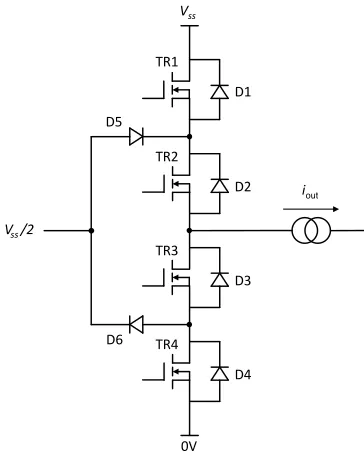
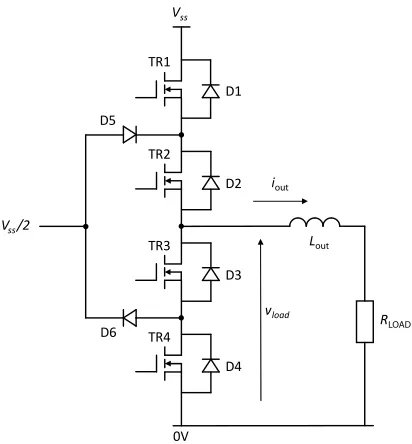
Fig. 1shows the NPC circuit with SJ MOSFETs (TR1-TR4) and fast-recovery diodes (D5 and D6). D1-4 are the MOSFETs’ intrinsic diodes.Tables IandIIsummarize operation with the output current (iout in Fig. 1), flowing out of, and into the
bridge-leg, respectively. The output voltage levels referred to as H, M and L correspond, respectively to Vss, Vss/2 and
[image:2.594.338.520.67.296.2]0 V inFig. 1. InTables IandIIsequential voltage excursions from H to M, from M to L, from L to M and from M to H are described, arbitrarily starting at H with both TR1 and TR2
Fig. 1. Three-level NPC converter phase-leg based around MOSFETs.
signaled on. Operation in all four quadrants is thus considered. Simple drive signals with under-lapping are applied in each case. Transient stages during under-lap intervals are shown in grey. Some observations are made with respect toTables IandII.
1) D5 and D6 are taken as being purpose-designed fast-recovery pn silicon or SiC Schottky diodes. The reverse recovery charge drawn by them is therefore treated as being negligible or much smaller than the Qrr or Qoss
drawn by the MOSFETs. The effects of D5 and D6 are therefore neglected in the far right-hand columns in
Tables IandII.
2) With the switching sequences given, the intrinsic diodes in either TR1 or TR4 have to recover in reverse during a cycle and deactivating them is desirable.
3) Even if the intrinsic diodes in TR1 and TR4 are deacti-vated, their output capacitances are still problematic as they draw substantial charging currents.
While the currents in TR2 and TR3 are zero when they are turned off, a voltage change ofVss/2is applied across one of
them during each switching cycle. This results in them drawing
Coss charging currents to supply Qoss. As described in [1],
SJ MOSFETs have a highly nonlinearCoss. In [17], a simple
working rectangular characteristic, Fig. 2, was assumed and this is applied again in this paper. Ideally,Qossis drawn from a
lossless source such as a voltage,v, in series with an inductance,
L. The area under the QV curve represents the capacitive co-energy and this is much higher than the capacitive stored electric field energy for low-RDS(on) high-voltage MOSFETs.
The straight-line approximation inFig. 2yields an overestimate of the co-energy and thus a factor of safety.
TABLE I
OPERATION OFPOWERDEVICESWITHCURRENTFLOWINGOUT OFBRIDGE-LEG
TABLE II
OPERATION OFPOWERDEVICESWITHCURRENTFLOWINGINTOBRIDGE-LEG
Fig. 2. Rectangular approximation ofQV characteristic of output ca-pacitance of super-junction MOSFET.
In low-voltage conversion, a technique for MOSFET intrinsic diode deactivation is to connect a silicon Schottky diode in anti-parallel [24]. However, silicon Schottky diodes do not have sufficient voltage ratings for use at off-line voltages. Those diodes that do, such as the fast recovery silicon P-N diode or the SiC Schottky diode, have a higher forward voltage drop, being comparable to, or greater than, that of the MOSFET’s intrinsic diode. The effect of this is that when the MOSFET’s channel is
turned off, there is insufficient voltage to force current into an external diode.
III. PROPOSEDARRANGEMENT
An objective is to identify the minimum ancillary cir-cuit requirements based on the switching actions listed in
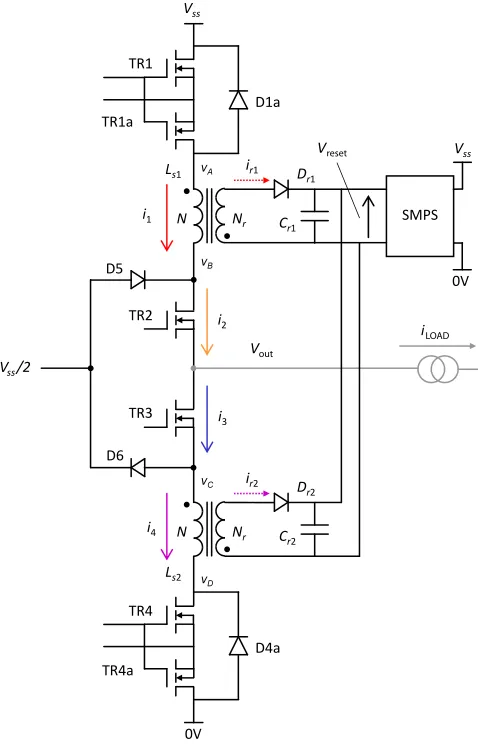
Tables I and II, where linear inductors are used to control charging ofCoss.Fig. 3shows the proposed arrangement [25].
As TR1 and TR4 are subjected to intrinsic diode recovery effects, the local intrinsic diode deactivation circuits in [16] are included. By inspecting the far right-hand columns in
Tables IandIIit is seen that both TR2 and TR3 lie in all the charging current routes. Locating one snubber inductor directly in series with either TR2 or TR3 should therefore suffice to control theCosscharging currents into all four MOSFETs.
However, a difficulty arises with inductor reset. Consider, for example, where the transition from Stage 6 to Stage 7 in
Table I is made. TR4 effectively turns off when it has drawn most of itsQossand itsCossthen falls rapidly.
Fig. 3. Proposed phase-leg arrangement.
resetting. For this reason, the circuit with two inductors in
Fig. 3 is used as either TR1 or TR4 lie in all the charging routes. Inductor reset is implemented by a secondary winding,
Nr, on each inductor that transfers energy into a voltage sink,
Vreset, via a diode,Dr. This energy is returned to the power
rails by a switched-mode power supply (SMPS). One SMPS can suffice for recovering the energy from all the inductors in a converter [17].Cris a local decoupling capacitor. According
to the rectangularQV approximation inFig. 2, energy,Eoss,
given by
Eoss =QossVin (1)
is stored in Lsin the process of chargingCoss. If fsw is the
switching frequency, then the power,Ws, transferred through
Lsdue to charging any oneCossis given by
WS =fswQossVin. (2)
From (2) it is seen thatWsis independent of the load
cur-rent(iLOAD).Nrperforms another function once during each
switching cycle (assuming transitions are only made between two voltage levels each cycle) apart from allowing the recovery of stored energy associated with the inductor’s snubbering
Fig. 4. Waveforms when sourcing current.Ls2controls the current into
Coss(TR4) during the L to M transition.Ls1 controls the current into
Coss(TR3) during the M to H transition.
action when chargingCoss. Depending on the transitions being
made (between H and M or between M and L), and the direction ofiLOAD, it either provides a reflected path for current when
current is forced intoN or allows commutation of the current inNwithout the applied mmf undergoing a step change. When current is initially forced intoN, ifNrwere not present, the
inductor would present a high impedance and a large over-voltage would appear across the applicable power device turn-ing off. WithNrpresent,Lsacts as a voltage transformer until
the magnetizing current reaches iLOAD. Neglecting leakage
inductance effects, the over-voltage across the device is limited to the reflected reset voltage. Similarly, when current inN is commutated,Nr provides a reflected path in parallel withLs.
The power throughput,W2, due to either a current being forced
intoNor a current in it being commutated is given by
W2=
fswILOAD2 LS
2 . (3)
It is assumed here thatN=Nrand the time,t1, taken for either
of these actions is given by
T1=
LSILOAD Vreset
. (4)
Figs. 4and5show idealized waveforms when the converter leg is sourcing current and sinking current, respectively.ir1 and ir2are the currents in the secondary windings ofLs1andLs2,
respectively. The grey areas representQossonly, asQrris now,
ideally, eliminated. The peak current,Ipk, due to the charging
ofCossthat flows inLsis given by
Ipk=
2V Qoss LS
(5)
[image:4.594.45.284.68.444.2]Fig. 5. Waveforms when sinking current.Ls1controls the current into
Coss(TR1) during the H to M transition.Ls2 controls the current into
Coss(TR2) during the M to L transition.
diode deactivation circuitry, the transient currents drawn by TR1 and TR4 when they become reverse-biased are now (given ideal deactivation) solelyCoss charging currents. The charges
drawn by them are therefore independent of iLOAD prior to
commutation and are the same as those drawn by TR2 and TR3 upon becoming reverse-biased.
However, the peak current in Ls is partially dependent on
iLOAD if the current supplyingQoss is superimposed onto it.
The energy,Esec, transferred out ofNr intoVreset during the
reset interval,Treset, is independent ofiLOADand is given by
Esec = 1 2I
2
pkLs. (6)
However, the total energy,ΔE, transferred out ofLs during
Tresetmust be
ΔE= 1 2
(ILOAD+Ipk)2−ILOAD2
LS. (7)
The difference betweenΔE andEsec is accounted for by the
primary winding,N, also sourcing energy, Epri, during the
reset period,Treset. SubtractingEsecfromΔEgivesEpri
Epri=ΔE−Esec. (8)
Putting the results from (6) and (7) into (8) yields
Epri=ILOADVresettreset. (9) Tresetis given by
Treset= LSIpk
Vreset
. (10)
Putting the result from (5) into (10) yields
Treset= √
2V QossLS
Vreset
[image:5.594.323.529.67.211.2]. (11)
Fig. 6. Experimental hardware. The main MOSFETs are visible on the front surfaces of the heatsinks and the main diodes are located on the rear surfaces.
The flux density change,BQ, incurred in the core ofLswhen
sourcingQossis given by
BQ =
N Ipk SAe
(12)
whereS is the core’s reluctance. Substituting the result from (5) into (12) yields
BQ =
2μ0μrVRAILQoss leAe
. (13)
Duringt1andTreset, a reflected over-voltage appears across
one of the power devices. Use of an SMPS to recover energy into the dc link has the advantage that the reflected voltage can be small while using a snubber inductor withN =Nr, an
arrangement with low leakage inductance. An SMPS can attain a high voltage gain without operating at extreme duty cycles and poor efficiency by using an isolated-output topology such as the flyback circuit in [17].
The circuit proposed here uses six fully-rated power devices and four auxiliary devices per phase-leg. An alternative circuit is proposed in [26] where a hybrid arrangement of IGBTs, MOSFETs and diodes is used.
IV. EXPERIMENTALHARDWAREDESIGN
A. Main Power Devices and Decoupling Capacitors
The circuit in Fig. 6 was constructed around three of the phase-legs inFig. 3.VRAIL was 720 V and the output power
was 3 kVA at 400 V.fsw was 20 kHz. SJ devices can switch
at high frequencies in SMPSs with the consequent benefits of allowing smaller passive components to be used [2]. However, an intended application for the circuitry here is in machine drives where this is not generally advantageous. A frequency of 20 kHz was selected as being suitable for a drive. The devices were: TR1-TR4 = TK40J60U [27], TR1a, TR4a =
IPD031N03L G, D1a, D4a =IDD03SG60C [28], D5, D6=
DHG20I600HA [29]. The main devices (TR1-4, D5 and D6) are mounted on the heatsinks shown. TR1a and TR4a only require a low voltage rating and theirRDS(on)for a given area
Fig. 7. Test rig. No forced cooling is applied.
power dissipation in D1a and D4a is low due to their operation at low duty cycles, and they are similarly mounted. Three 1-μF, 630-V polypropylene capacitors connected in parallel across each voltage cell provide local supply rail decoupling. The mass of the converter as shown was measured at 0.634 kg. The PCB on which it was built measures 207 mm by 93 mm. The converter was run on the horizontal surface inFig. 7with no forced cooling.
B. PWM Generation Circuitry
The three-phase 12-channel PWM signals are generated us-ing a Texas Instrument DSP TMS320F2812. The PWM signals between TR1 and TR3 are generated in a complementary fashion, as are those for TR2 and TR4. The dead-time is 690 ns and the modulation index,M, is 0.9.
C. Snubber Inductor Design and Reset Circuitry
The design of Ls was identical to that in [17]. It was
con-structed with a Micrometals T80-8/90 toroidal core [30].Qoss
for the TK40J60U device has been measured at 300 nC [17]. Substituting this and data from [30] (μr= 35,le= 51.4mm,
Ae= 23.1mm2) into (13) givesBQ= 94mT.Nwas set at 16.
Using the manufacturer’s quoted inductance factor this gives an inductance of 4.61μH. The inductance of one inductor was measured at 4.89μH in [17].Nrhas the same number of turns
asN and each winding was evenly distributed around the core to minimize leakage inductances.N andNrwere as follows:
• N: 22 strands of 0.2-mm diameter copper wire; • Nr: one strand of 0.315-mm diameter copper wire.
N was formed with stranded wire to mitigate skin-effect losses and ease construction. The flux density, BLOAD,
at-tributable toiLOADflowing inNis given by
BLOAD=
N μ0μrILOAD le
. (14)
At 3 kVA and 400 V, the peakiLOADis 6.15 A. Putting data
into (14) yieldsBLOAD= 84mT. AddingBLOADtoBQgives
a total flux density excursion of 176 mT. Dividing this by two
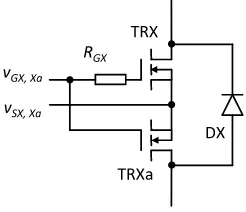
Fig. 8. Local gate driver arrangement with resistor,RGX, to slow the fall in gate-source voltage of TRX relative to that of TRXa.
gives a peak ac flux density change of 88 mT. The worst-case flux density excursion from zero occurs when an inductor is carrying aCoss charging current of a MOSFET superimposed
onto the incomingiLOAD when the latter is at its peak value.
This occurs, for example, when the converter is sourcing current (Fig. 4) and TR1 turns on andLs1controls the charging current
into TR3.
From the measurements in [17], the resistance,Rw, ofNwas
taken as 10.4 mΩ, when at 60◦C.Rwis small compared to the
totalRDS(on)value of the MOSFET combination in series with
it and the latter dominates.Vresetwas set at a nominal value of
25 V.Drwas an IDD03SG60C SiC diode andCrwas a 1.5-μF,
50-V polyester type for local decoupling.
D. Gate Driver Circuits
Gate drivers with optical isolation were used between the DSP board and converter. The on-state and off-state gate-source voltages were 12 V and −3 V, respectively. To avoid turning off TR1 and TR4 in Fig. 3with reverse current in them and activating their intrinsic diodes, the circuitry inFig. 8was used.
RGX slows the fall in gate-source voltage of TRX relative
to that of TRXa. At the penalty of losses in RGX and extra
switching losses in TRX, this causes TRXa to turn off and route current out of TRX and into DX before TRX turns off.RGX
was 10-Ω.
E. Predicted Losses
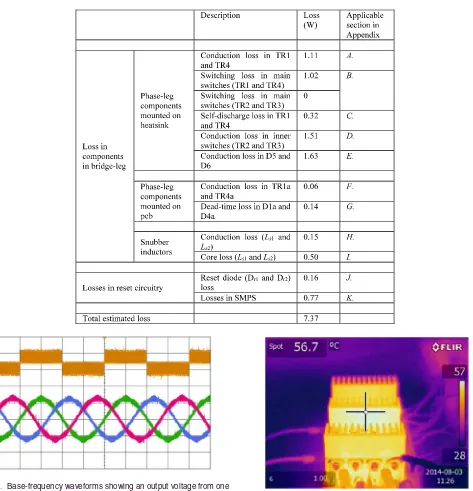
Table IIIshows predicted losses for a phase-leg supplying 1 kVA at unity power factor. Calculations are given in the Appendix. Losses for each row are the total for both compo-nents in the description. The following points are noted.
• Switching losses in TR1a and TR4a are neglected. • Total losses in the components mounted on the heatsink
are estimated at 5.59 W.
• The switching-frequency ripple content in iLOAD is
neglected.
V. EXPERIMENTALRESULTS
A. Base Frequency Waveforms
[image:6.594.369.492.71.177.2]TABLE III
[image:7.594.59.532.89.580.2]PREDICTEDLOSSESFROMONEPHASE-LEG
Fig. 9. Base-frequency waveforms showing an output voltage from one phase and the three output currents. The top trace is the voltage. Scales:
vout= 500V/div,iLOAD= 5A/div. Time scale= 5ms/div.
The load was formed with three star-connected series-RL cir-cuits. The inductors were 2-mH laminated steel components. The base frequency was 50 Hz.
B. Power Transferred Into Reset Voltage Sink
The power transferred intoVresetis the sum ofWsandW2,
given by (2) and (3), respectively. This is calculated at 3.09 W per phase-leg in the Appendix, giving a total of 9.27 W for all three phases. Instead of commissioning an SMPS, a dump load was used for experimentation. Its resistance (72Ω) was set so thatVresetwas close to the nominal value of 25 V. The
Fig. 10. Thermal photograph of the circuit in Figs. 6 and 7 when supplying 3 kVA into a unity power factor load and in the hard thermal steady-state.
power dissipation was measured at 8.3 W. This is lower than the 9.27 W predicted, and is expected due to losses inLsandDr.
C. Thermal Measurements
Fig. 11. Switching-frequency waveforms showing complete switching cycles. Scales:iLOAD,i1= 5A/div,vA,vB= 200V/div. Time scale= 20μs/div.
voltage developed was measured. The thermal resistance was estimated at 4.74◦C/W by recording the heatsink’s temperature rise above ambient. The total loss of the components mounted on the heatsinks was estimated at 17.3 W from the average temperature rises of the heatsinks. Due to the proximity of the heatsinks to each other, and the heating effect of losses incurred from circuitry not mounted on the heatsinks, this is expected to be an overestimate. Although the central heatsink is at a higher temperature than the other two, this is only by approximately 2◦C and is expected given its physical location.
[image:8.594.309.554.260.402.2] [image:8.594.308.553.450.590.2]D. Exemplifying Switching-Frequency Waveforms With Current out of Converter and Positive Output Voltage
Fig. 11shows switching-frequency waveforms from a phase-leg running under steady-state dc conditions and switching between the “H” and “M” voltage levels so that it outputs a positive voltage. The duty cycle was set so that the average output voltage,vout, is 230 V. An RL load is connected between voutandVss/2. For this test an inductor of 3.9 mH based around
ferrite cores was used. iLOAD is 4.35 A. This corresponds to
those instances in the ac cycle inFig. 9whereωt= 0.785rads and 2.356 rads. The quantities shown are:iLOAD, the current (i1)in the primary winding ofLs1, the drain voltage of TR1a (vA)and the drain voltage of TR2(vB). For practical purposes
vA is very close to the source voltage of TR1. An overshoot
voltage (circle “A”) is seen atvAwhen current is forced out of
Ls1at TR1 turn-off. An overshoot voltage (circle “B”) is seen
atvBatLs1reset.iLOADwas measured with a high-bandwidth
dc current probe. i1 was measured with a sensor based on a
Rogowski coil as this introduces less physical disruption and consequent stray inductance in series with N. The resistance of the dump load substituted for the SMPS was set to give a Vreset value close to 25 V. 227 Ω gave Vreset= 25.6 V.
The power transferred into the resistance was thus calculated at 2.89 W. Figs. 12 and13show waveforms at TR1 turn-on. Although no intrinsic diode recovery action is taking place, a
Coss charging current is sourced into TR3. It is seen,Fig. 12,
that the duration ofTresetis in good agreement with the value
of 1.30 μs calculated with (10).Fig. 14shows waveforms at
Fig. 12. Waveforms at TR1 turn-on. Scales:iLOAD,i1= 5A/div,vA,
vB= 200V/div. Time scale= 500ns/div.
Fig. 13. Expanded view of waveforms at TR1 turn-on. Scales:iLOAD,
i1= 5A/div,vA,vB= 200V/div. Time scale= 200ns/div.
Fig. 14. Waveforms at TR1 turn-off. Scales:iLOAD,i1= 5A/div,vA,
vB= 200V/div. Time scale= 500ns/div.
TR1 turn off where it is also seen thatt1is in good agreement
with the value of 0.85μs calculated with (4).
E. Exemplifying Switching-Frequency Waveforms With Current out of Converter and Negative Output Voltage
For these tests the RL load was connected between thevout
Fig. 15. Connection arrangement with positive output current and neg-ative output voltage (when referenced to mid-point,Vss/2). The ancillary circuitry is not shown for clarity.
Fig. 16. Switching-frequency waveforms showing complete switching cycles. Scales:iLOAD,i4= 5A/div,vC,vD= 200V/div. Time scale= 20μs/div.
case with ac to dc (rectifier) operation. In this case the behavior of its intrinsic diode has to be addressed in conjunction with the charging of itsCoss, as is the case with the L to M and H
to M transitions inTables IandII, respectively. The switching stresses are thus those encountered with operation as an ac to dc converter. The switching duty factor was set so that the load voltage (not output voltage) is 230 V with an averageiLOAD
[image:9.594.40.287.345.488.2]of 4.35 A.
Fig. 16shows exemplifying switching-frequency waveforms from one of the phase-legs. As in Section D, the phase-leg is running under steady-state dc conditions. In this case it transitions between the “M” and “L” voltage levels to output a negative voltage. Four quantities are shown:iLOAD, the current (i4)in the primary winding ofLs2, the source voltage of TR3 (vC)and the drain voltage of TR4 (vD). iLOAD was, again,
measured using a high-bandwidth dc current probe. As with
i1,i4 was measured using a sensor based around a Rogowski
coil.Vresetwas measured at 24.52 V. Given the dump resistance
Fig. 17. Waveforms at TR2 turn-on. Scales:iLOAD,i4= 5A/div,vC,
[image:9.594.305.549.450.589.2]vD= 200V/div. Time scale= 500ns/div.
Fig. 18. Expanded view of waveforms at TR2 turn-on. Scales:iLOAD,
i4= 5A/div,vC,vD= 200V/div. Time scale= 200ns/div.
Fig. 19. Waveforms at TR2 turn-off. Scales:iLOAD,i4= 5A/div,vC,
vD= 200V/div. Time scale= 500ns/div.
value of 227 Ω used here, the power transferred into the resistance was calculated at 2.65 W.
Figs. 17 and 18 show waveforms at TR2 turn-on.
Fig. 19 shows waveforms at TR2 turn-off. The power trans-ferred intoVresetis similar for the two situations where firstly
a capacitance has to be charged (2.89 W) and secondly both a Coss has to be charged and an intrinsic diode has to be
deactivated (2.65 W). Also, the observedQossis approximately
300 nC in both cases. Qoss is taken from the current-time
This gives a headroom voltage of only 35 V at the peak output voltage with simple PWM control. However, harmonic injection can be used in a three-phase inverter control scheme to increase the effective headroom voltage, or space vector modulation with a cell-balancing capability may be used [33].
Although the converter is based around silicon SJ devices, some SiC components are used. These are D1a, D4a,Dr1and Dr2. However, these are not active switches and the use of SiC
MOSFETs or JFETs is avoided. Also, none of these diodes has to be rated for a high steady-state current and their cost is consequently low. D5 and D6 are fast-recovery silicon diodes. The converter has been configured for operation at any power factor. However, during unity power factor operation as a dc to ac converter it only operates in the two quadrants where
iLOAD and vout are of the same sign. FromTables I and II
it is seen that none of the MOSFET’s intrinsic diodes is ac-tivated under this condition. At high power factors, operation with diode recovery only occurs wheniLOADis small, thereby
reducing the necessity for the deactivation networks around TR1 and TR4. However, in, for example, vehicle charging or V2G applications [37], operation is always or frequently as an ac to dc converter with consequent intrinsic diode recovery.
IfLsis low, this has the advantage that the power transfer
given by (3) tends to zero, with a consequent reduction in losses in the inductor energy recovery circuitry. However, a larger peak current(Ipk)appears inNat the instant when most
ofQoss has been supplied andCoss then rapidly falls.
Disad-vantages include higher peak voltages across power devices and increased EMI. The snubber inductors introduce leakage inductances into paths that undergo rapid current changes. Although not included here, in [17] the resulting over-voltages across the power devices were effectively clamped using simple low-loss RCD circuits.
The inferred power dissipation of the devices on the heatsinks shows good agreement with the calculated value, although losses in the individual devices have not been experi-mentally apportioned. Dividing the total loss of devices on the heatsinks (17.3 W) by three gives a loss of 5.77 W, close to the predicted loss of 5.59 W. Individual losses in the inductor cores, windings and reset diodes are not experimentally apportioned. However, aggregate losses are inferred at 0.97 W from the shortfall in the measured power dissipation in the dump resistor when compared to the expected energy transferred through the inductors. We have assumed a modest 75% efficiency for the SMPS stage. Adding the measured losses from the devices on the heatsinks of 17.3 W, the inferred aggregate loss in the inductor cores, windings and reset diodes of 0.97 W, and the expected SMPS loss of 0.77 W yields a total loss of 19.04 W. An efficiency of 99.3% is therefore estimated. However, losses
IGBTs and ancillary circuitry is required in a VSC application, several system-level benefits result. The lifetime cost in lost energy is reduced. Where forced cooling is dispensed with, the cost of fans or pumps is avoided. Furthermore, the parasitic power consumption of these items is eliminated, as is the need to provide them with a low-voltage power supply. The reliability and servicing costs of forced cooling systems are avoided. In applications where forced cooling is undesirable or impermissible, smaller heatsinks may be used with a con-sequent reduced overall mass and bulk. This is particularly advantageous in aerospace power systems. High efficiencies are also attainable with SiC devices, but these are costlier than SJ devices and, in the case of SiC MOSFETs, there are concerns over gate oxide behavior [39].
VII. CONCLUSION
Silicon super-junction MOSFETs can be readily deployed in a three-level neutral point clamped converter provided the be-havior of the intrinsic diodes in the outer devices and charging of the output capacitances of all the MOSFETs is addressed. 99.3% efficiency has been estimated in a naturally-cooled con-verter operating from a 720-V dc rail, switching at 20 kHz, and supplying 3 kVA. Target applications are where forced cooling is undesirable or not possible, and low losses are consequently essential to reduce cooling requirements.
APPENDIX
Loss formulas for one phase-leg are given in this Appendix. Values are calculated for a 1-kVA unity power factor load.
A. Conduction Loss in Main Outer Switches (TR1 and TR4)
AsiLOAD is 4.35 A, its peak value,Ip, is 6.15 A.vout is
230 V (phase) and its peak phase value,Vp, is 325 V. The
effec-tive input voltage for calculating duty cycles is half of 720 V, at 360 V. The total on-state loss in TR1 and TR4 is given by
w(t) =i2LOAD(t)RDS(on)δ(t). (A1)
iLOAD(t)is given by
iLOAD(t) =Ipsin(ωt−ϕ) (A2)
whereϕis the phase angle ofiLOAD.δ(t)is given by
δ(t) =vout(t) Vin
= Vp Vin
The modulation depth,M, is defined as
M = Vp Vin
. (A4)
Hence,δ(t)may be expressed as
δ(t) =Msinωt. (A5)
The results from (A2) and (A5) are put into (A1) andWaveis
then derived as
Wave=
RDS(on)I2
pM
12π ×[12 + 4 cos 2ϕ]. (A6)
RDS(on)for TR1-4 is taken as 80 mΩ. This was estimated from
[26] as being the approximate value at a junction temperature of 60◦C. Putting values into (A6) gives a loss of 1.11 W.
B. Switching Loss in Main Switches (TR1-4)
Each switching cycle a power device is switching iLOAD
on and off. Which device switches depends on the direction ofiLOADand whether the transitions are between H and M or
between M and L. The total loss is independent ofϕ and is given by
Wave=
(tr+tf)fswVinIp
π (A7)
where tr is the rise time and tf is the fall time. The total
switching loss in TR1 and TR4 is given by
Wave=
(tr+tf)fswVinIp
2π ×(1 + cosϕ). (A8)
The total switching loss in TR2 and TR3 is given by
Wave=
(tr+tf)fswVinIp
2π ×(1−cosϕ). (A9)
tf andtrare each estimated at approximately 40 ns by
obser-vation. Putting the values into (A8) and (A9) gives 1.02 W and 0 W, respectively. Due to the self-snubbering action of Coss,
turn-off losses may be over-estimated.
C. Self-Discharge Loss in TR1 and TR4
The data in [27] gives Coss forvDS between 0.1 V and
100 V. We have derived aQV curve from this data and linearly extrapolated the curve to 360 V at the gradient (capacitance) observed at 100 V. The stored energy is estimated at 16.1μJ. Multiplying this by the switching frequency of 20 kHz yields a power dissipation due to self-discharge of 322 mW.
D. Conduction Loss in TR2 and TR3
This is calculated from
Wave=i2LOADRDS(on). (A10)
Putting values into (A10)(RDS(on)= 80mΩ)yields 1.51 W.
E. Conduction Loss in D5 and D6
This is calculated from
w(t) =VfiLOAD(t) (1−δ(t)). (A11)
Putting the results from (A2) and (A5) into (A11) yields
w(t) =VfIpsin(ωt−ϕ)×(1−Msinωt). (A12)
The average value derived from (A12) is
Wave= Vf2Ip
π +
VfIpM
4π [(4ϕ−2π) cosϕ−4 sinϕ]. (A13)
The diode forward voltage drop,Vf, is estimated at 1.3 V from
[29]. Putting this and other values into (A13) yields 1.63 W.
F. Conduction Loss in Auxiliary Switches (TR1a and TR4a)
This was calculated from (A6), but with theRDS(on)value
for the auxiliary MOSFETs entered. This was estimated at 4 mΩ at a junction temperature of 60 ◦C from the data in [28]. Putting the values at unity power factor into (A6) yields 0.06 W.
G. Dead-Time Loss in D1a and D4a
This is calculated from
w(t) = 2VfiLOAD(t)Tdeadfsw (A14)
whereTdeadis the dead-time. Averaging the integral of (A14)
between the appropriate limits yields
Wave
4VfTdeadfswIp
π . (A15)
PuttingTdead= 690ns andVf= 1.3V into (A15) gives 0.14 W.
H. Conduction Loss (Ls1andLs2)
This is given by (A6), but withRwsubstituted forRDS(on) Wave=
RwIp2M
12π ×[12 + 4 cos 2ϕ]. (A16)
Putting the values into (A16)(Rw= 10.4mΩ)yields 0.15 W.
I. Core Loss (Ls1andLs2)
The loss density for the -8 material was estimated at 416 mW/cm3 from the curve-fit formula in [30]. This was then multiplied by the effective volume of the T80-8/90 core (1.19 cm3) to yield a loss of 495 mW. The peak ac flux density excursion entered was 88 mT, that is, the value wheniLOADis
ave
2π 0
Putting the data into (A17) gives 925 mW. Adding the results from (2) and (A17) gives 3.09 W. If this is transferred into
Vreset, then the average current throughDr into a 25-V reset
voltage is 124 mA. If Dr’s forward voltage drop is taken as
1.3 V, this gives a loss of 161 mW. Losses inLsare neglected
in estimating the power transferred throughDr.
K. Losses in SMPS
A modest 75% efficiency is assumed for the SMPS. This gives a loss of 773 mW with an input power of 3.09 W. Losses inLsandDrare neglected in estimating the power transferred
into the SMPS.
REFERENCES
[1] J.-S. Laiet al., “Characteristics and utilization of a new class of low on-resistance MOS-gated power device,” IEEE Trans. Ind. Appl., vol. 37, no. 5, pp. 1282–1289, Sep./Oct. 2001.
[2] L. Lorenz, G. Deboy, and I. Zverev, “Matched pair of CoolMOS transistor with SiC-Schottky diode—Advantages in application,”IEEE Trans. Ind. Appl., vol. 40, no. 5, pp. 1265–1272, Sep./Oct. 2004.
[3] R. A. Wood and T. E. Salem, “Evaluation of a 1200-V, 800-A all-SiC dual module,”IEEE Trans. Power Electron., vol. 26, no. 9, pp. 2504–2511, Sep. 2011.
[4] M. M. Farag, S. M. Gadoue, A. L. Mohamadein, A. M. Massoud, and S. Ahmed, “Elimination of reverse recovery effects associated with Coolmos devices employing current source inverter topology,” inProc. IET 6th Power Electron., Mach. Drives Conf., Bristol, U.K., Mar. 2012, pp. 1–6.
[5] J. Biela, J. W. Kolar, and G. Deboy, “Optimal design of a compact 99.3% efficient single-phase PFC rectifier,” inProc. 25th Annu. IEEE Appl. Power Electron. Conf. Expo., Palm Springs, CA, USA, Feb. 2010, pp. 1397–1404.
[6] J. W. Kolar and T. Friedli, “The essence of three-phase PFC recti-fier systems—Part I,” IEEE Trans. Power Electron., vol. 28, no. 1, pp. 176–198, Jan. 2013.
[7] T. Friedli, M. Hartmann, and J. W. Kolar, “The essence of three-phase PFC rectifier systems—Part II,”IEEE Trans. Power Electron., vol. 29, no. 2, pp. 543–560, Feb. 2014.
[8] S. V. Araújo, P. Zacharias, and R. Mallwitz, “Highly efficient single-phase transformerless inverters for grid-connected photovoltaic systems,”IEEE Trans. Ind. Electron., vol. 57, no. 9, pp. 3118–3128, Sep. 2010. [9] P. Sun, C. Liu, J.-S. Lai, C.-L. Chen, and N. Kees, “Three-phase
dual-buck inverter with unified pulsewidth modulation”,IEEE Trans. Power Electron., vol. 27, no. 3, pp. 1159–1167, Mar. 2012.
[10] W. Yu, H. Qian, and J.-S. Lai, “Design of high-efficiency bidirectional DC-DC converter and high-precision efficiency measurement,” inProc. 34th Annu. IEEE Ind. Electron. Soc. Conf., Orlando, FL, USA, Nov. 2008, pp. 685–690.
[11] C. Marxgut, F. Krismer, D. Bortis, and J. W. Kolar, “Ultraflat interleaved triangular current mode (TCM) single-phase PFC rectifier,”IEEE Trans. Power Electron., vol. 29, no. 2, pp. 873–882, Feb. 2014.
[12] J. Zhang and J.-S. Lai, “A synchronous rectification featured soft-switching inverter using CoolMOS,” in Proc. 21st Annu. IEEE Appl. Power Electron. Conf. Expo., Dallas, TX, USA, Mar. 2006, pp. 810–815.
chine drive inverter using super-junction MOSFETs,” inProc. 7th IET Power Electron., Mach. Drives Conf., Manchester, U.K., Apr. 2014, pp. 1–6.
[18] G. Grandi, J. Loncarski, and O. Dordevic, “Analysis and comparison of peak-to-peak current ripple in two-level and multilevel PWM in-verters,” IEEE Trans. Ind. Electron., vol. 62, no. 5, pp. 2721–2730, May 2015.
[19] J. Rodríguez, J.-S. Lai, and F. Z. Peng, “Multilevel inverters: A survey of topologies, controls, and applications,” IEEE Trans. Ind. Electron., vol. 49, no. 4, pp. 724–738, Aug. 2002.
[20] S. Kouroet al., “Recent advances and industrial applications of multilevel converters,”IEEE Trans. Ind. Electron., vol. 57, no. 8, pp. 2553–2580, Aug. 2010.
[21] T. Brückner and S. Bernet, “Loss balancing in three-level voltage source inverters applying active NPC switches,” in Proc. 32nd Annu. IEEE Power Electron. Spec. Conf., Vancouver, BC, Canada, Jun. 2001, vol. 2, pp. 1135–1140.
[22] T. Brückner, S. Bernet, and H. Güldner, “The active NPC inverter and its loss-balancing control,”IEEE Trans. Ind. Electron., vol. 54, no. 6, pp. 855–868, Jun. 2005.
[23] J. Li, A. Q. Huang, Z. Liang, and S. Bhattacharya, “Analysis and design of Active NPC (ANPC) inverters for fault-tolerant operation of high-power electrical drives,”IEEE Trans. Power Electron., vol. 27, no. 2, pp. 519–533, Feb. 2012.
[24] N. Yamashita, N. Murakami, and T. Yachi, “Conduction power loss in MOSFET synchronous rectifier with parallel-connected Schottky bar-rier diode,”IEEE Trans. Power Electron., vol. 13, no. 4, pp. 667–673, Jul. 1998.
[25] N. McNeill, X. Yuan, and P. Anthony, “High-efficiency multilevel con-verter technology for electric vehicle applications using super-junction MOSFETs,” inProc. 5th IET Hybrid Elect. Veh. Conf., London, U.K., Nov. 2014, pp. 1–7.
[26] Y. Wang and R. Li, “Novel high-efficiency three-level stacked-neutral-point-clamped grid-tied inverter,” IEEE Trans. Ind. Electron., vol. 60, no. 9, pp. 3766–3774, Sep. 2013.
[27] TK40J60U datasheet. Accessed Mar. 2013. [Online]. Available: www. toshiba-components.com
[28] IPD031N03L G and IDD03SG60C datasheets. Accessed Mar. 2013. [Online]. Available: www.infineon.com
[29] DHG20I600HA datasheet. Accessed Mar. 2013. [Online]. Available: www.ixys.com
[30] T80-8/90 and -8 Material datasheets. Accessed Apr. 2013. [Online]. Available: www.micrometals.com
[31] P. Zanchetta, D. B. Gerry, V. G. Monopoli, J. C. Clare, and P. W. Wheeler, “Predictive current control for multilevel active rectifiers with reduced switching frequency,” IEEE Trans. Ind. Electron., vol. 55, no. 1, pp. 163–172, Jan. 2008.
[32] F. H. Khan, L. M. Tolbert, and W. E. Webb, “Hybrid electric vehicle power management solutions based on isolated and nonisolated configurations of multilevel modular capacitor-clamped converter,” IEEE Trans. Ind. Electron., vol. 56, no. 8, pp. 3079–3095, Aug. 2009.
[33] C. Xia, H. Shao, Y. Zhang, and X. He, “Adjustable proportional hybrid SVPWM strategy for neutral-point-clamped three-level inverters,”IEEE Trans. Ind. Electron., vol. 60, no. 10, pp. 4234–4242, Oct. 2013. [34] J. I. Leonet al., “Three-dimensional feedforward space vector
modula-tion applied to multilevel diode-clamped converters,”IEEE Trans. Ind. Electron., vol. 56, no. 1, pp. 101–109, Jan. 2009.
[35] R. Davoodnezhad, D. G. Holmes, and B. P. McGrath, “A novel three-level hysteresis current regulation strategy for three-phase three-three-level in-verters,”IEEE Trans. Power Electron., vol. 29, no. 11, pp. 6100–6109, Nov. 2014.
[37] M. Kesler, M. C. Kisacikoglu, and L. M. Tolbert, “Vehicle-to-grid reac-tive power operation using plug-in electric vehicle bidirectional offboard charger,”IEEE Trans. Ind. Electron., vol. 61, no. 12, pp. 6778–6784, Dec. 2014.
[38] M. Schweizer and J. W. Kolar, “Design and implementation of a highly efficient three-level T-type converter,” IEEE Trans. Power Electron., vol. 28, no. 2, pp. 899–907, Feb. 2013.
[39] R. Ouaidaet al., “Gate oxide degradation of SiC MOSFET in switching conditions,”IEEE Electron Device Lett., vol. 35, no. 12, pp. 1284–1286, Dec. 2014.
Neville McNeillreceived the M.Phil. and Ph.D. degrees in power electronics from Napier Uni-versity, Edinburgh, U.K. in 2003 and 2008, respectively.
His career has included periods working for electric vehicle and renewable energy compa-nies. In 2004, he became a Pesearch Engineer in the Electrical Energy Management Group (EEMG), Department of Electrical and Elec-tronic Engineering, University of Bristol, Bristol, U.K., where he became a Lecturer in 2009 and is currently a Senior Lecturer in Power Electronics. His present research interests are in the area of high-efficiency multi-kilowatt power elec-tronic conversion for aerospace, renewable energy, and electric vehicle applications.
Dr. McNeill is a member of the Institution of Engineering and Tech-nology, U.K., a Chartered Engineer with the Engineering Council of the U.K., and a Fellow of the Higher Education Academy.
Xibo Yuan (M’11) received the B.S. degree from China University of Mining and Technol-ogy, Xuzhou, China, and the Ph.D. degree from Tsinghua University, Beijing, China, in 2005 and 2010, respectively, both in electrical engineering.
He is currently a Senior Lecturer in the Electrical Energy Management Group (EEMG), Department of Electrical and Electronic En-gineering, University of Bristol, Bristol, U.K., where he was a Lecturer from 2011 to July 2015. From 2007 to 2008, he was a Visiting Scholar with the Center for Power Electronics Systems (CPES), Virginia Polytechnic Institute and State University, Blacksburg, VA, USA. In early 2013, he was a Visiting Scholar with the Institute of Energy Technology, Aalborg University, Aalborg, Denmark. During 2010 and 2011, he was a Postdoctoral Research Associate with the Electrical Machines and Drives (EMD) Research Group, Department of Electronic and Electrical Engineering, The University of Sheffield, Sheffield, U.K. His research area include power electronics, wind power generation, multilevel con-verters, sensorless drives of induction motors and permanent-magnet motors, drive train design for electric vehicles, and more electric aircraft technologies.
Dr. Yuan is an Associate Editor of IET Power Electronics and an International Scientific Committee Member of the European Power Electronics and Drives Association.