City, University of London Institutional Repository
Citation
:
MacLaren, J. (2014). Developing Assessment at City: A Review of Learning Development Associate Projects 2010-12. Learning at City Journal, 4(1), pp. 14-26.This is the unspecified version of the paper.
This version of the publication may differ from the final published
version.
Permanent repository link:
http://openaccess.city.ac.uk/3247/Link to published version
:
Copyright and reuse:
City Research Online aims to make research
outputs of City, University of London available to a wider audience.
Copyright and Moral Rights remain with the author(s) and/or copyright
holders. URLs from City Research Online may be freely distributed and
linked to.
Developing Assessment at City: A Review of Learning Development Associate Projects 2010-12
Dr Julie MacLaren
Senior Lecturer in Educational Development and Workplace Learning, School of Health Sciences, City University London
Abstract
City University London has a strong tradition of encouraging pedagogic practitioner-research through the sponsorship of workplace and inter-departmental project working under the auspices of the Learning Development Centre (LDC). Reflecting sector-wide issues, the University’s focus on assessment and feedback as a priority area for academic development has resulted in several studies which have shaped the university’s understanding and practices in this area. In this article I review a selection of recent projects which have a bearing on this area of academic practice. The scope of projects is wide, focusing on many different facets of assessment and feedback, but with an emphasis on improving student experience of this in both classroom and workplace settings. This review starts with a discussion of some of the concerns surrounding assessment and feedback within the University, before exploring how recent studies by staff and Learning Development Associates have explored this agenda and set about changing practice.
Key words: Learning, Assessment, Student Experience, Feedback, Failure, Curriculum Design
Assessment in Context
Assessment and feedback are core functions of the higher education system and as such generate a range of sector-wide concerns and issues. These are linked firmly with issues of learning, quality and student experience. International trends such as the continued massification of higher education have led to perspectives of assessment as becoming mechanised, fuelled by increasing class sizes, reduced resources and the potential for dumbing down of academic standards (Gibbs 2013). The Higher Education Academy (2012) accepts that assessment practices in higher education have not kept pace with innovations and change occurring in other areas of teaching and learning. Issues such as constructive alignment and curriculum design for learning continue to challenge educators to strive for excellence, yet perceptions may lag behind. Students may be increasingly looked on as consumers of their learning, yet Behrens (2013) reports the trend in national student surveys for scores in the ‘assessment and feedback’ category to trail behind those for overall student experience satisfaction levels.
choice of University via the league tables that contribute to the external reputation of an organisation.
Simplistic arguments regarding improving student perceptions of what constitutes feedback tend to focus on the need to inform students when they are receiving feedback, as if to reinforce that they indeed are receiving it. We do need to understand what is happening for our students, going beyond the basic stance of lecturers’ ‘labelling’ or qualifying interactions by ‘telling them its feedback’. If it is supposed that the quality of feedback is in the perception
of the student, who are we to deny their experience, through the simplistic act of ‘badging’ activities thus? Within the University there is a growing recognition that students’ perceptions and experiences of ‘quality feedback’ could help to improve academic practice, and student outcomes. Encouraging dialogue in assessment and feedback may provide one way of including the student in the assessment process and encouraging self-assessment, and offers hope for engaging the student in the learning process (Sutton 2009).
Learning Development Associate Projects
The Learning Development Centre at City University London promotes practitioner research through encouraging academic staff to develop a project in one of several key work strands relating to the core foci of the City University Strategy (2012). A range of awards are offered which provide either funding or day release from normal duties to undertake research of benefit to the wider university. Topic areas may also change, however the Assessment and Feedback strand has not changed, indicating its significance to the work of the university. Each award recipient is expected to present and publish their findings. As part of my own Learning Development Associate role I have undertaken a review of recent projects within this work strand.
Projects
Student Experiences of Feedback
Abbott et al (2012) explored several dimensions of students’ experiences of feedback in an exploration of how students in the School of Health Sciences (SHS) would prefer to be assessed. In particular their remit was to understand what, about assessments was enjoyable or anxiety-provoking, and what was considered fair or rigorous in their assessments. The most significant outcome of this small interview study was considered to be the ability and willingness of the third year students interviewed to contribute to a constructive dialogue about assessment design. Wiley (2011) argues that in general students may not feel prepared to play a more active role in assessment design and that timeframes for school ratification to assessment changes might be prohibitive in the short term. However, Wiley (2011) also reports the suggestion of one of his focus group participants, that further student involvement in assessment design would give students’ more ownership of the assessment and feedback process, supporting the claims of Abbott et al (2012). As is common in practitioner research, Abbott et al (2012) recruited a smaller sample group than anticipated, with only six students agreeing to be interviewed. Whilst the authors state that this is a limitation of their study and that findings cannot be taken as representative, some ‘unique and universal understandings’ (Simons 1996: 225) of the student experience are evident. These include a belief amongst students that a mixture of assessment methods is the fairest way to assess a programme, to account for the diverse preferences and abilities of students. Some recognition that assessments could be enjoyable (coursework, viva and essays) was tempered by an agreement that exams, presentations and objective structured clinical examinations were sources of stress to students. However issues of fairness in terms of being assessed on concepts not considered by them as being part of the curriculum they studied; unequal workloads; consistent applications of assessment criteria and access to lecturers’ time were also raised. Additionally, interviewees identified power inequalities between student and supervisor which appeared to override criterion based assessment. Much time and effort was spent pandering to the wishes and instructions of their workplace supervisors in order to get through (pass) an assessment. Meanwhile seemingly conflicting feedback between academic tutors and clinical practice supervisors was provided in some cases.
Secondly, checks on ensuring that course content is adequate preparation for assessment were recommended as interviewees felt that assessments sometimes contained materials not covered in class. Finally, consistent adherence by markers to the marking criteria was felt to be an issue with some markers and workplace supervisors being seen as ‘easier’ than others in their assessment practices (Abbott et al 2012). This study did not explicitly consider the timing of feedback although one instance of an appreciative student recognising that there was now a four week turnaround of marks and feedback is provided within the report.
Timing of Feedback
Timing of feedback on assessments is the focus of Reimers and Freeman’s (2012) project. They explored satisfaction with the timing of student feedback after assignment submission and perceptions of this in relation to other universities. In a survey of 204 social science students their results showed that the median expectation for return of feedback was 19 days. Significantly this is below the 21 day turnaround time expected by the university. There was no significant difference in estimation of feedback turnaround time between those who were satisfied, and those dissatisfied with the speed at which they received feedback. These two groups were fairly well matched in terms of numbers, although a breakdown of these is not provided in the advance report. Those who were dissatisfied with the promptness of feedback, tended to have perceptions that other institutions had quicker marking and moderation processes, although NUS/HSBC findings (2008) show that this is not necessarily the case.
In what he describes as a ‘modest’ study within the University, Wiley (2012) explores student understanding and engagement with feedback on assessments and formative work. Collecting data from a range of sources, and culminating with student focus groups, Wiley shows that students recognise that feedback contains both qualitative and quantitative components. The majority agreed that both component types were essential to them understanding their own performance, although some acknowledged that the grade was a more important part of their feedback. Further, some students never collect marked work, viewing only their mark on the University’s Strategic Learning Environment (Moodle). Within programme handbooks there was some confusion about who, and what, feedback was for. Wiley (2012) suggests that handbooks offer two competing notions of feedback. Firstly feedback on assessed work to the student, and secondly feedback from the student on their programme experience. For example, feedback within the student programme handbook was predominantly discussed as students giving feedback to inform University programming and provision (through student committees such as Student Staff Liaison Committee).
good quality feedback was more important to their learning than ‘imperfect’ feedback that a quick and dirty process would allow. A lack of consistency between feedback on formative drafts and summative assignments was also noted although students appeared to be well aware of where to solicit further clarification and study skills support.
Clarity and Format of Feedback
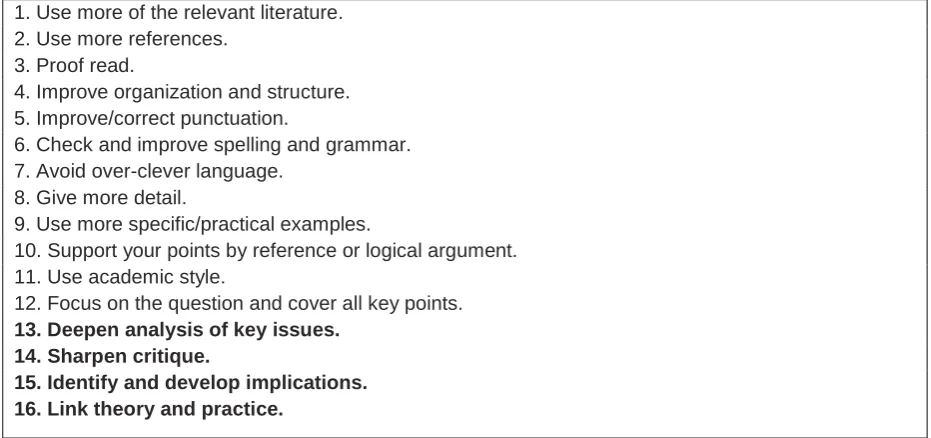
Previous studies examining the clarity of feedback to students have focused on claims that feedback provided can be cryptic, vague, negatively worded and lacking appropriate developmental advice (Weaver 2006, Carless 2007). Also, students do not always interpret it in the way it was intended by the marker (Orsmond and Merry 2011). Wiley’s (2012) participants discussed a lack of clarity in explaining how the student might address issues raised in their feedback. An example was given where a student had been asked to add more content to an assignment with a tight word limit, but was given no advice on how to accommodate this within his available word count. Similar observations were made by Duncan (2007) who commented that some areas of feedback were not easy for assessors to make clear. He identified sixteen issues, synthesised from tutor feedback in over 150 tutor feedback sheets to students undertaking a second year module (level 2) at his university. Duncan notes that of the list provided in table one below, the first twelve items were fairly easy to address in feedback in terms of providing instructional feedback. However items 13-16 proved a challenge for tutors who found analysis (rather than description) a hard skill to teach, unless their students spontaneously ‘got it’. Even when an intervention to improve feedback giving was implemented, its impact proved difficult to assess.
1. Use more of the relevant literature. 2. Use more references.
3. Proof read.
4. Improve organization and structure. 5. Improve/correct punctuation.
6. Check and improve spelling and grammar. 7. Avoid over-clever language.
8. Give more detail.
9. Use more specific/practical examples.
10. Support your points by reference or logical argument. 11. Use academic style.
12. Focus on the question and cover all key points. 13. Deepen analysis of key issues.
14. Sharpen critique.
[image:6.595.65.531.407.626.2]15. Identify and develop implications. 16. Link theory and practice.
In a series of focus groups (n=50) Wiley (2012) explored students’ favoured mode of receiving feedback. Of five options, students favoured dialogic (conversational) feedback over other measures (50%), whilst written report (33%) and screen-cast (17%) also featured as favourites. The other options of podcast and telephone feedback garnered no support. The National Union of Students Feedback Charter (NUS 2008) guides that students should have the option of different feedback methods, however the project undertaken by Attenborough (2011) identifies that students may prefer different methods in combination rather than an either/or approach to feedback, and that podcasted feedback might have a place in a toolkit of feedback strategies.
Mode of Feedback
Attenborough et al (2012) explored the use of audio feedback recorded as individual podcasts to students and uploaded to the Strategic Learning Environment alongside written feedback. Students undertaking a stand-alone continuing professional development module in the School of Health were provided feedback on their formative work in two forms – audio podcast and written feedback. This study built upon the findings of Merry and Orsmond (2008) that students prefer audio to written feedback. It was guided by the perceived advantage that audio feedback has for dyslexic students and students whose first language is not English. Survey and interview approaches were made to students receiving audio and written feedback as well as those lecturers responsible for providing it. In all 100 questionnaires were distributed to students who had opted in to receiving audio feedback. The return of 49 of these represented a good return rate for this type of study. Of the 49 responses, 45 had submitted their work via the SLE and had received audio feedback via this medium whilst four had not.
Of the 45 students receiving audio feedback, 31 had listened to the feedback provided for them (69%) although data glitches accounted for some missed data. Further, two of this group also volunteered to be interviewed about their experiences. The findings of this study highlight that audio feedback was perceived positively by students with one of the interviewees noting that for them: “The more feedback the better really”. However Attenborough et al (ibid) note that audio feedback was not seen by students as an alternative form of feedback. Instead 89% of survey respondents preferred both types of feedback together as a complementary system rather than an ‘either/or’ provision. 80% of respondents expressed a preference for audio and written feedback together for any further assignments, in comparison to a smaller group of 16% who preferred written only feedback on assignments.
the focus group also identified relationships as the ideal building block for giving feedback. One lecturer commented that they felt more obligated to be positive in recording audio feedback, whilst for others the contrasts between personal ‘deficit’ models of marking were raised.
The team posited that the positive nature of audio feedback may be why the students liked this method. However, the lecturer focus group did identify that providing written and audio feedback was burdensome and necessitated duplication of efforts. Justification for the effort required in providing formative feedback (of any type) against the benefits to students was questioned by this group. As summative module outcomes were not evaluated in the light of this study, it remains inconclusive as to whether this form of feedback had any influence on student academic performance. However, this may provide further scope for research and analysis. This is a useful study in understanding student preferences in receiving feedback. However generalisations to a wider student population may be limited. The students surveyed are part-time, seconded from clinical practice, and Attenborough et al (2012) identify that they may have other motivations, as undertaking this module is seen as near compulsory for their practice.
Experiences of Failure
The effects of assessment can be far-reaching and are seldom neutral (Falchikov and Boud 2007).A study I undertook in 2010 explored why students on a clinically focused mentorship module within the School of Health Sciences failed or underachieved in that module (MacLaren 2010). The module is the same one later utilised as a sample by Attenborough et al (2012) albeit with a different student group. The impetus for this study was a review of module assessment results over a three year period, which indicated that the pass rate for students re-taking their assignment was poor, despite provision of significant tutor feedback on formative and summative assignments and ready availability of tutorial support. This small-scale case study was undertaken as part of doctoral study funded by the university. Whilst it is not an LDC funded study, its discussion of student outcomes of assessment and my current Learning Development Associate role merits its inclusion here.
Issues with the format of the final assessment were noted. One key issue arising from the review of course documents was the lack of structure to the supervisor’s report on mentorship achievements (needed to gain a professional award in mentorship). This did not allow supervising mentors to capture sufficient evidence of the mentorship student’s competency in practice in relation to regulatory standards of mentorship in the nursing and midwifery professions. (NMC 2008) Lack of guidance on what the supervisor’s role should be meant that high expectations within the role could not be communicated (c.f. Chickering and Gamson 1991) leading to potentially invalid and inaccurate assessment and reports of practice. The study contributed to alterations in the assessment strategy from a 3000 word assignment to a short answer paper (1600 words), and the implementation of a professional body-approved portfolio of mentorship practice. It gave a renewed focus on assessment in both classroom and workplace for this module which have led to improvements in pass marks at first and second attempt. However, an important factor arising from the interviews was that psychological factors were often at the root of underachievement in the module, and were not always acknowledged or addressed by lecturers. Students who failed or underachieved in their mentorship module displayed different orientations to learning which affected their onward learning. These orientations appeared to be indicative of how both mentorship and underachievement was framed for the individual.
Two representative cases were discussed whose responses showed similarity to the entity-theorist and incremental –entity-theorist orientations to learning identified by Dweck and associates (Dweck and Sorich 1999, Dweck 2000, Nussbaum and Dweck 2008). Students with incremental-theorist orientations appeared to thrive in the face of learning challenges. The concepts of commitment, perceived personal control and challenge are significant components in promoting positive outcomes and coping with stressful situations such as their negative assignment outcomes (Maddi 2004). Incremental-theorists demonstrate high self-efficacy and problem solving approaches to new challenges in learning (Nussbaum and Dweck 2008). Meanwhile, entity-theorist orientations to learning, regard learning potential as fixed and unresponsive to effort, with the locus of control situated outside the individual, making them to susceptible to learned helplessness (Seligman 1975), as they doubt their intelligence, ability and personal capacity to reach learning outcomes.
This lack of reciprocity and cooperation only served to undermine confidence in practitioners’ learning capabilities, especially in workplace components of the module assessment, and had the potential to further jeopardise workplace assessment of competency. Workplace learning and assessment are vital parts of the assessment schemes for many programmes at City University London, and as educators we have an obligation to ensure that practice-based colleagues are adequately prepared and supported to enable and promote valid and reliable assessment. Similarly approaches to assessment and feedback must build upon the previous experiences of students in order to provide tailored feedback approaches and encourage students to gain confidence and competence in practice and academic study. Although I made no explicit recommendations for how this might be achieved due to the small sample group interviewed, the assessment protocol for the module was subsequently reviewed, to consider assessment for learning as well as assessing for outcomes.
Feedback as Part of a Holistic Approach to Learning
Brown (2012) considers the overall concept of assessment for learning in her Learning Development Project report, based in the Cass Business School. She gives an account of success of an approach to assessment and feedback consisting of wholesale changes to module design along constructivist lines to encourage student engagement with module content and facilitate deep learning. This focus on engagement for assessment is unique in the context of projects sponsored by the LDC. Previous innovations within the Business Studies degree pathway had included the implementation of Moodle and the introduction of invigilated and online tests, although a traditional lecturer mode of delivery persisted. However, the development of the double credit bearing module Management Practice and Skills (MPS) implemented further student centred activity in the form of six interlinked pieces of coursework (some individual, some team-based) within a curriculum incorporating shorter lectures and smaller group seminar tutorials. Using a high tech/high touch approach, students and tutors got to know and feed back to each other in person whilst the learning analytics functions of Moodle served to both track student engagement and allow ‘action support’ and intervention in students’ learning.
Brown (2012) recognises that whilst the aim of her project was to review and assess the role of student coursework and feedback on assessments, this became only a part of a “tightly interwoven course design”. What was demonstrated was that the new module fulfilled the four principles outlined by Gibbs (2010) as essential for high quality education (class size, student effort and engagement, choice of teachers, quality and quantity of feedback to students). The module was generally well received by those students enrolled on it, although some teething problems in articulating how lectures, seminars and coursework activities were linked, were noted by students.
Key Themes
findings of recent LDC sponsored work when applied in their broadest sense. Table 2 demonstrates how his suggestions are broadly represented across the studies reviewed.
Feedback Element:
Feedback should be...
MacLaren (2010)
Attenborough et al (2011)
Abbott et al (2012)
Brown (2012)
Wiley (2012)
Reimers and Freeman (2012)
Understandable √ √ √ √ Selective √
Specific √ √ √ √
Timely √ √ √ √
Contextualised √ √ √ √ √ Non-judgemental X √ √
Balanced √ √
Forward-looking √ √ Transferable √ √
[image:11.595.69.532.114.323.2]Personal √ √
Table 2: Coverage of Nicol’s suggestions for improved dialogic feedback across the six studies reviewed. Negative associations are shown as an X. The table shows that over the past few years all
elements of these suggestions have been addressed. Adapted from Nicol D (2010)
Marking and the provision of written feedback are not the only mechanisms affecting assessment outcome. Instead what arises from the studies presented is a need for clarity (Wiley, 2012): of process, of communication, of expectations, of marking processes, of assessment criteria and of feedback itself. Developing ways to become more explicit in student feedback should be a consideration for all teaching staff. Interventions such as peer review of feedback (currently in use in my own school), offer opportunities for tutors to discuss the ‘hard skills’ of analysis and synthesis identified by Duncan (2007), although do not appear widespread across the university. Further, consideration of the mode of feedback may also yield advances in student learning. The NUS charter on assessment and feedback identifies that students should have access to feedback in different formats (NUS 2008), however the studies presented here indicate that whilst useful, participation rates in trials of innovative forms of feedback are low amongst the student body.
Further data on student’s experience of assessment and feedback is required to explore attitudes toward feedback and assessment of a wider group of students across the university. Reimers and Freeman (2011) identified that perceptions do not always meet with the realities of feedback timing. This might be achieved through the implementation of validated questionnaire surveys such as the Assessment Experience Questionnaire (Gibbs and Simpson 2004) at an early stage of students’ university feedback career. The scaling up and prioritisation of practitioner research across the organisation needs to be given consideration by the Central University, along with regular synthesis of assessment and feedback projects so that lacunae might be identified and addressed, and good practice disseminated. Using Simons’ (1996) concept of situated generalisation, projects within different schools can demonstrate significance to a wider academic population within the University and connect teams of students and researchers from different schools to offer a wider horizon to researching such complex issues in academic practice.
Conclusions
The tradition of practitioner research across City University London is one that encourages teachers and lecturers to stand back and explore their own practice in small scale projects. Whilst the intention may be individual or school-level practice improvement, this review has yielded a wealth of insights into the assessment and feedback process across different schools which highlight similarities of experience and approach. Despite the relatively small numbers of students engaged within each of the projects, taken together they demonstrate the commitment of staff to make a difference to teaching and learning within the University; each study adding a different dimension to a multi-faceted view of assessment and feedback activity.
References
Abbott, S., A. Robinson and J. Attenborough (2012). How would students prefer to be assessed? Report for Learning Development Centre. London, City University London.
Attenborough, J., S. Gulati and S. Abbott (2012). "Audio feedback on student assignments: boon or burden?" Learning at City Journal 2(2): [Available online at
openaccess.city.ac.uk/1638/ last accessed 1608/1605/1613].
Brown, A. (2012). The Success of Innovative Assessment and Feedback at Cass. An Assessment of a New Module Design for the Learning Development Centre. London, City University London.
Chickering, A. W. and Z. F. Gamson (1991). Applying the Seven Principles to Good Practice in Undergraduate Education. San Francisco, Jossey Bass.
Duncan, N. (2007). "‘Feed-forward’: Improving students’ use of Tutors’ comments " Higher Education, Assessment and Evaluation in Higher Education 32(3): 271-283.
Dweck, C. S. (2000). Self-Theories: Their Role in Motivation, Personality, and Development. Philadelphia, Brunner/Mazel.
Dweck, C. S. and L. A. Sorich (1999). Mastery-oriented thinking. Coping: The Psychology of What Works. C. R. Snyder. New York, Oxford University Press.
Evison, R. (2006). Changing to learning cultures that foster lifelong learners. Lifelong Learning: Concepts and Contexts. P. Sutherland and J. Crowther. Abingdon, Routledge.
Falchikov, N. and D. Boud (2007). Assessment and emotion: the impact of being assessed. Rethinking Assessment in Higher Education: Learning for the Long Term. D. Boud and N. Falchikov. Abingdon, Routledge: 144-155.
Gibbs, G. (2010). Dimensions of Quality. York, The Higher Education Academy, [Available online at
http://www.heacademy.ac.uk/assets/documents/evidence_informed_practice/Dimensions_of _Quality.pdf Last Accessed 08/05/13].
Gibbs, G. and C. Simpson (2004). "Conditions under which assessment supports students' learning." Learning and Teaching in Higher Education 1: 3-21.
Higgins, R., P. Hartley and A. Skelton (2001). "Getting the message across: the problem of communicating assessment feedback." Teaching in Higher Education 6(2): 269-274.
Kluger, A. N. and P. Van Dijk (2010). "Feedback, the various tasks of the doctor and the feedforward alternative." Medical Education 44(12): 1166-1174.
MacLaren, J. (2010). Underachievement in Nursing Continuing Professional Development: Experiences and Influences on Learning Outcomes in a Mentorship Module. London, Unpublished Institutional Focused Study, Institute of Education.
Maddi, S. (2004). "Hardiness: an operationalization of existential courage." Journal of Humanistic Psychology 44(3): 279-298.
Merry, S. and P. Orsmond (2008). "Students' attitudes to and usage of academic feedback provided by audio files." Bioscience Education e-Journal 11(3): [Available online at
Naisbitt, J. (1999). High Tech, High Touch: Technology and our Search for Meaning. New York, Broadway Books.
Nicol, D. (2010). "From Monologue to dialogue: improving written feedback processes in mass higher education." Assessment and Evaluation in Higher Education 35: 501-507.
NMC (2008). Standards to Support Learning and Assessment in Practice, second edition. London, Nursing and Midwifery Council.
NUS (2008). NUS Feedback Charter. London, National Union of Students.
NUS/HSBC (2008). NUS Student Experience Report. London, National Union of Students.
Nussbaum, A. D. and C. S. Dweck (2008). "Defensiveness vs remediation: self theories and modes of self-esteem maintenance." Personality and Social Psychology 34(5): 599-612.
Orsmond, P. and S. Merry (2011). "Feedback alignment: effective and ineffective links between tutors' and students' understanding of coursework feedback." Assessment and Evaluation in Higher Education 36(2): 125-136.
Reimers, S. and E. Freeman (2012). Project Report: Satisfaction with Assessmnet and Feedback. London, Learning Development Centre, City University London.
Seligman, M. (1975). Helplessness: On Depression, Development and Death. San Francisco, Freeman.
Simons, H. (1996). "The paradox of case study." Cambridge Journal of Education 26(2): 225-240.
Simons, H., S. Kushner, K. Jones and D. James (2003). "From evidence-based practice to practice-based evidence: the idea of situated generalisation." Research Papers in Education 18(4): 347-364.
Stake, R. E. (1995). The Art of Case Study Research. Thousand Oaks, Sage.
Sutton, P. (2009). "Towards dialogic feedback." Critical and Reflective Practice in Education 1(1): 1-10.
Weaver, M. (2006). "Do students value feedback? Student perceptions of tutors' written responses." Assessment and Evaluation in Higher Education 31(3): 379-394.