Published online in Wiley Online Library (wileyonlinelibrary.com). DOI: 10.1002/we.2095
RESEARCH ARTICLE
A spatial and temporal correlation analysis of
aggregate wind power in an ideally interconnected
Europe
A. Malvaldi1 , S. Weiss1 , D. Infield1, J. Browell1, P. Leahy2and A. M. Foley3 1Department of Electronic and Electrical Engineering, University of Strathclyde, Glasgow, UK
2School of Engineering, University College Cork, Cork, Ireland
3School of Mechanical and Aerospace Engineering, Queen’s University Belfast, Belfast, UK
ABSTRACT
Studies have shown that a large geographic spread of installed capacity can reduce wind power variability and smooth pro-duction. This could be achieved by using electricity interconnections and storage systems. However, interconnections and storage are not totally flexible, so it is essential to understand the wind power correlation in order to address power system constraints in systems with large and growing wind power penetrations. In this study, the spatial and temporal correlation of wind power generation across several European Union countries was examined to understand how wind ‘travels’ across Europe. Three years of historical hourly wind power generation data from 10 countries were analysed. The results of the analysis were then compared with two other studies focused on the Nordic region and the USA. The findings show that similar general correlation characteristics do exist between European country pairs. This is of particular importance when planning and operating interconnector flows, storage optimization and cross-border power trading. Copyright © 2017 The Authors Wind Energy Published by John Wiley & Sons Ltd
KEYWORDS
wind power generation; wind energy; interconnection; geographic diversity; correlation
Correspondence
A. Malvaldi, Department of Electronic and Electrical Engineering, University of Strathclyde, Glasgow, UK. E-mail: [email protected]
This is an open access article under the terms of the Creative Commons Attribution License, which permits use, distribution and reproduction in any medium, provided the original work is properly cited.
Received 1 June 2016; Revised 8 December 2016; Accepted 30 January 2017
1. INTRODUCTION
Installed wind power capacity in Europe grew strongly in the decade to 2015, from 48 GW, at the end of 2005, to almost 142 GW by the end of 2015.1As the penetration of wind generation in power systems continues to increase, the uncertainty and variability associated with wind power bring challenges for power system operators. Many previous studies have addressed the problem of integrating variable wind power in existing power systems.2–5 These works emphasized the impact of geographic diversity of wind farms on power system operations. A large geographic spread of wind capacity greatly reduces the aggregate wind power variability, as wind speeds experienced in different areas are not 100% correlated over time. As the geographic spread increases, the distribution of aggregate wind power approaches a normal distribution according to the central limit theorem.6As a result, the number of high-power or low-power output events in the aggregate wind power time series is decreased, and this reduction in variability is referred as the ‘smoothing effect’.
power output between wind farms is influenced not only by separation distance but also by time scales. High-frequency variations of wind power from different locations are random and uncorrelated, whereas correlation is high for longer term fluctuations (several hours or more).6, 8, 10, 16Moreover, the degree of correlation between wind farm outputs is also influenced by diurnal weather variations and the movement of synoptic weather systems. Therefore, the correlation of wind power output between different locations can exhibit a wide range of values from 1 day to another. Two locations can have a very high correlation 1 day and little or negative correlation the next.6, 10, 17
Many other factors may impact on the level of correlation between the power outputs of different wind farms. One of these is the direction of separation between wind farms. There may be a greater similarity between outputs of wind farms separated in one direction than in others, as shown in Tastu et al.18and Osborn et al.19
In general, increased geographic diversity of wind power capacity and increased numbers of turbines may deliver several benefits to power system operators. For example, the number of ramp events tends to decrease as the geographic diversity of installed wind power capacity increases.6, 11, 16, 20, 21The relative requirement for ancillary services may also be reduced because of the smoothing effect on aggregate wind power outputs, as shown in the analysis carried out by Ernst et al.
using data from the German ‘250-MW measurement program’.8Furthermore, geographic diversity and larger numbers of turbines both lead to a lower temporal variability of aggregate power output, with decreased durations of high-power and low-power events, and smaller wind forecast errors. However, high penetration of wind power also brings some issues and challenges for transmission system operators (TSOs). Frequency control and system security are highly influenced by wind power fluctuations in systems with very weak interconnection.22–24For example, on the island of Ireland, there is 10.26 GW of dispatchable generation capacity, including 3.02 GW23dispatchable wind plant and 950 MW of intercon-nection capacity to Great Britain (GB). The TSOs in Ireland EirGrid and System Operator Northern Ireland (SONI) have increased interconnection to the UK and between Northern Ireland and the Republic of Ireland with further plans to extend to France to ensure security of supply and grid stability.25 EirGrid and SONI25 identified and examined the technical operational issues with increasing wind penetration.
It is therefore desirable to encourage greater geographic diversity of wind power capacity. Several studies have examined the opportunity to ‘smooth’ wind generation over time and to integrate it more efficiently and have suggested a common balancing area for adjacent systems.4–6, 26 As a result, interconnection capacity between different countries and market regions within the European Union (EU) and the USA has been increasing over the last number of years. For example, within the EU, more than 20 GW of electricity interconnections have been built during the last decades and more than 50 GW are under construction or planned to be built, according to the projects of common interests (PCI).27
A few studies have analysed the correlation between wind farms using actual wind power production data. Among them, Holttinen11used real power production data from the Nordic countries of Denmark, Finland, Sweden and Norway to perform a statistical analysis. However, in this study, the time series from Finland, Sweden and Norway had to be upscaled more than 10-fold to create large-scale wind power production time series. This study found that increased geographical spread of wind power capacity reduces the overall variability, and in particular, the number of periods of very high and very low outputs decreases. A more recent study conducted by Louie6carried out extensive correlation analysis using historical data from four North American system operators (i.e. BPA, ERCOT, MISO and PJM). In the study, a hypothetical interconnection of the normalized wind power values for four North American systems is modelled. Louie6highlighted three main conclusions. First, all correlations between systems or wind farms present similar characteristics such that correlation increases with the averaging period and decreases exponentially with separation distance. Second, despite the smoothing of wind generation over time by spatial aggregation, clear diurnal and seasonal patterns were still evident in the aggregated wind generation time series. Third, the increase in installed wind power capacity did not affect the correlation and statistical results of the study.
Foley et al.26analysed meteorological wind data from a number of Met Éireann and UK Meteorological Office recording stations in the UK and the Republic of Ireland in order to examine wind variability across the British Isles. The situation in the British Isles regarding interconnected power systems is somewhat similar, albeit at a smaller scale, to the North American case.
2. DATASET
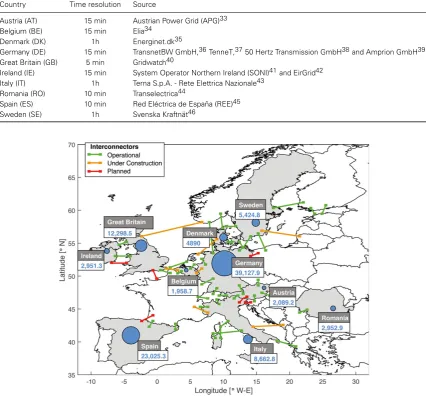
This study used historical data of wind power generation from 10 European countries (i.e. Austria, Belgium, Denmark, Germany, Great Britain, Ireland, Italy, Romania, Spain and Sweden). The analysis considered a 3 year period starting on 1 January 2012 and ending on 31 December 2014. Table I lists the time resolution and data source for each country selected. The datasets collected have different time resolutions, ranging from 5 min up to 1 h. Thus, the original time series were aggregated hourly, temporally synchronized and referenced to Greenwich Mean Time. Figure 1 presents a map of Europe with the 10 countries, which are the focus of the analysis, highlighted in grey. The installed wind power capacity (MW) for each of the 10 countries and the position ofweighted centroid(i.e. blue circle) together with operational, under construction and planned PCI high-voltage direct current interconnectors27are also shown.
The 10 countries were selected not only because of the availability of datasets but also because of the following: (i) geographic diversity (i.e. terrain, size and location) on a north–south axis; (ii) the different installed wind power capacity values; and (iii) the existence of inter-country PCI high-voltage direct current interconnections.27 In addition, the
geo-Table I. Time resolution and source of wind power data for the 10 EU countries selected for this study.
Country Time resolution Source
Austria (AT) 15 min Austrian Power Grid (APG)33 Belgium (BE) 15 min Elia34
Denmark (DK) 1h Energinet.dk35
Germany (DE) 15 min TransnetBW GmbH,36TenneT,3750 Hertz Transmission GmbH38and Amprion GmbH39* Great Britain (GB) 5 min Gridwatch40
Ireland (IE) 15 min System Operator Northern Ireland (SONI)41and EirGrid42 Italy (IT) 1h Terna S.p.A. - Rete Elettrica Nazionale43
Romania (RO) 10 min Transelectrica44
Spain (ES) 10 min Red Eléctrica de España (REE)45 Sweden (SE) 1h Svenska Kraftnät46
Figure 1. Map of Europe showing the 10 selected countries for this study, their installed wind power capacity (MW) and position of weighted centroid (blue circle), together with the main electricity interconnectors from the PCI.27[Colour figure can be viewed at
wileyonlinelibrary.com]
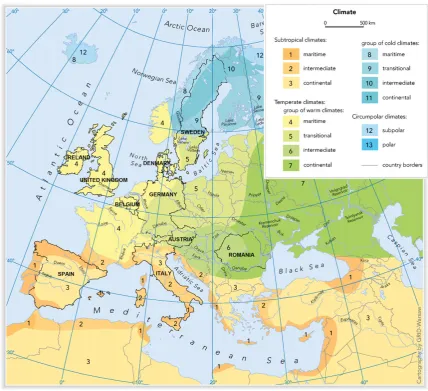
[image:3.595.83.510.241.639.2]Figure 2. Map showing the main climates of Europe29; the 10 countries considered in this study are labelled by their names. [Colour figure can be viewed at wileyonlinelibrary.com]
graphic diversity allows for very different weather systems and climates among the selected EU countries. The climatic conditions range from subtropical climates, temperate climates and cold climates28, 29as shown in Figure 2.
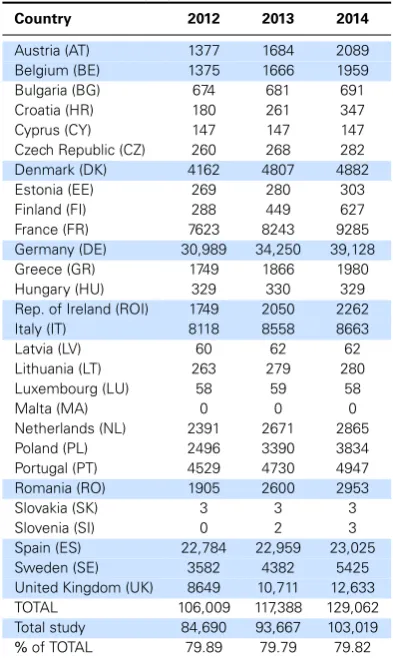
Table II. Wind power installed (MW) in Europe (EU-28) by end of year.1, 30–32 The 10 selected countries are
highlighted in blue.
Country 2012 2013 2014
Austria (AT) 1377 1684 2089
Belgium (BE) 1375 1666 1959
Bulgaria (BG) 674 681 691
Croatia (HR) 180 261 347
Cyprus (CY) 147 147 147
Czech Republic (CZ) 260 268 282
Denmark (DK) 4162 4807 4882
Estonia (EE) 269 280 303
Finland (FI) 288 449 627
France (FR) 7623 8243 9285
Germany (DE) 30,989 34,250 39,128
Greece (GR) 1749 1866 1980
Hungary (HU) 329 330 329
Rep. of Ireland (ROI) 1749 2050 2262
Italy (IT) 8118 8558 8663
Latvia (LV) 60 62 62
Lithuania (LT) 263 279 280
Luxembourg (LU) 58 59 58
Malta (MA) 0 0 0
Netherlands (NL) 2391 2671 2865
Poland (PL) 2496 3390 3834
Portugal (PT) 4529 4730 4947
Romania (RO) 1905 2600 2953
Slovakia (SK) 3 3 3
Slovenia (SI) 0 2 3
Spain (ES) 22,784 22,959 23,025
Sweden (SE) 3582 4382 5425
United Kingdom (UK) 8649 10,711 12,633
TOTAL 106,009 117,388 129,062
Total study 84,690 93,667 103,019
%of TOTAL 79.89 79.79 79.82
The Energy Roadmap 2050 ‘sets out four main routes to a more sustainable, competitive and secure energy system in 2050: energy efficiency, renewable energy, nuclear energy, carbon capture and storage. It combined these routes in different ways to create and analyse seven possible scenarios for 2050’.48The aim of the 195 energy projects identified on the latest PCI list is to enable the single EU Energy Market and support the ‘EUs energy policy objectives of affordable, secure and sustainable energy’.49Thus, it is important to establish any wind power correlation characteristics in an ‘ideally interconnected Europe’ to inform technical and policy decisions by key stakeholders. It has to be noted that this study does not model power system flows in the EU. In fact, no limits on power transport are imposed on this ideally interconnected power system. However, as the selected countries cover nearly 80% of the total installed capacity in Europe, the datasets used for this study can be considered quite representative of an ideally interconnected Europe.
3. METHODOLOGY
3.1. Normalized wind power
The wind power was normalized by installed capacity by comparing the datasets. Therefore, for each country, the normalized power was defined as
PnD pn CI
, (1)
installed capacity of the available wind farms only. The available installed wind power capacity datasets come from annual reports of the European Wind Energy Agency and are therefore yearly values. However, the installed wind power capacity varies during the year, and to take this into account, the datasets from December 2011,502012,31201330and 20141have been interpolated to obtain quarterly values.
3.2. Cross-correlation calculation
Cross-correlation sequences were calculated for different time lags,m, in order to analyse the relationships between wind power generation of the EU country pairs. If each variable hasNscalar observations, then the cross-correlation function is defined as
i,j.m/D 1
N1 N
X
tD0
Pi.t/i
i
!
Pj.tm/j
j
!
, (2)
whereiandiare the mean and standard deviation (SD) of the normalized powerPirespectively, andi,jD1,: : :, 10 are the indices for each country. It should be noted that the number of scalar observations,N, can vary from one time series to another as only the valid datasets were taken into account. Hence, the non-valid datasets were not counted in the calculation of the correlation. The analysis carried out in this study also used cross-correlation coefficients, which were obtained from (2) formD0. This calculation was made using the 3 years of datasets and also for each selected year separately. In addition to this, cross-correlation functions were calculated for time lagsjmj 120 h.
3.3. Statistical analysis
The statistical analysis was carried out by considering the hourly time series of each country. The mean, median and standard deviation values have been calculated together with the total number of hours in which instantaneous wind power is lower than 10% or higher than 75% of installed capacity for each country to characterize each data set. In addition to this, duration curves were created by counting the number of hours in each year that the wind power production exceeds a certain value of power (given as a percentage of the installed capacity). Wind power distributions for each country were also analysed. Finally, hour-to-hour variations were calculated by using normalized hourly wind power time series and computing the difference between each hour for each country.
3.4. Distance calculation
For each country, a weighted centroid has been defined to locate the ‘centre’ of all the installed wind power capacity of the country. The coordinates (XC,YC) of the weighted centroid have been calculated considering the position of wind turbine aggregates in each country51and weighted by the number of wind turbines in that area and thus by the installed capacity. Therefore,
XC D
P
ixiNi
P
iNi
, (3)
YC D
P
iyiNi
P
iNi
, (4)
whereXC andYC are the longitude and latitude of the weighted centroidC, xi andyiare the longitude and latitude of aggregated wind farms with total number of wind turbinesNifor that point.
Finally, the distances between each country were calculated using the coordinates of the weighted centroid. In the analysis, the wind power generation of each country was represented by a single time series associated to a single point in space, the weighted centroid. This weighted centroid approach represents the broad dependencies between each country, but the exact relationship will also be influenced by the size of the country. Note that although the correlation patterns will be affected by this aggregation, the patterns still provide useful information.
4. RESULTS AND ANALYSIS
4.1. Cross-correlation coefficients
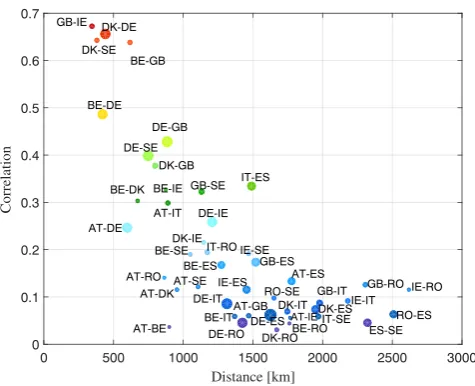
Figure 3. Correlation coefficients for country pairs as a function of the distance between them. The size of markers is proportional to the installed wind power capacity of each country pair. [Colour figure can be viewed at wileyonlinelibrary.com]
Table III. Correlation coefficients for country pairs calculated using all 3 years of data.
AT BE DK DE GB IE IT RO ES SE
AT 1 0.04 0.11 0.25 0.06 0.06 0.30 0.14 0.13 0.12 BE 0.04 1 0.30 0.49 0.64 0.33 0.06 0.04 0.17 0.19 DK 0.11 0.31 1 0.66 0.38 0.21 0.07 0.03 0.07 0.64 DE 0.25 0.49 0.65 1 0.43 0.26 0.08 0.04 0.06 0.40 GB 0.06 0.64 0.38 0.43 1 0.67 0.09 0.13 0.17 0.32 IE 0.06 0.31 0.21 0.26 0.66 1 0.09 0.12 0.12 0.19 IT 0.30 0.06 0.07 0.08 0.09 0.09 1 0.19 0.33 0.06 RO 0.14 0.04 0.03 0.04 0.12 0.11 0.19 1 0.06 0.10 ES 0.13 0.17 0.08 0.06 0.17 0.11 0.33 0.06 1 0.04 SE 0.12 0.19 0.64 0.40 0.32 0.18 0.06 0.10 0.04 1
data. The highest correlation of 0.67 as expected, because of their proximity, is between GB and Ireland. Denmark is highly correlated with Germany and Sweden with 0.65 and 0.64, respectively. In Figure 3, the size of the circle is proportional to the installed wind power capacity of the particular country pair.
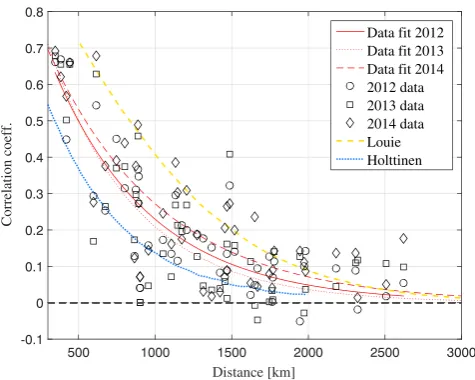
This analysis was undertaken separately for each year to investigate changes in correlation from one year to another. Figure 4 shows a plot of the cross-correlation coefficients as a function of the distance between the country pairs with a best-fit curve. Three best-fit curves were plotted in order to better analyse changes from one year to another. The first curve (i.e. solid red line) considers only data from 2012, the second curve (i.e. dotted red line) considers only data from 2013 and the third curve (i.e. dashed red line) considers only data from 2014. The general model for the approximated curves is the exponential
f.x/Daebx, (5)
whereaandbare curve fitting parameters andxis the distance between countries in kilometres. The coefficients have been estimated using a least square approach, where aD1.17, 1.36 and 1.05, and bD0.0017, 0.0020 and 0.0014 for the datasets for 2012, 2013 and 2014, respectively. The results of the least squares approach in Figure 4 are compared with the results from Louie6using datasets from four North American TSOs (i.e. dashed yellow line) and Holttinen et al.11
Figure 4. Correlation coefficients of country pairs versus distance with best-fit for 2012 data (solid red line), best-fit curve for 2013 data (dotted red line) and for 2014 data (dashed red line). The results are compared with the empirical relationship found in Louie6
(dashed yellow line) and Holttinen et al.11(dotted blue line). [Colour figure can be viewed at wileyonlinelibrary.com]
power outputs are mainly affected by macro-scale conditions that tend to have higher correlation over longer distances than local effects that influence single wind farms.
Figure 4 also shows that cross-correlation coefficients change from year to year for each country pair. Considering the coefficients for each year, the highest correlation is between Ireland and GB ranging from 0.67 in 2012 to 0.69 in 2014. There are a few cases of negative correlation values for annual averages only, which are likely a result of small sample sets and low coefficient values. Several EU country-pairs exhibited near-zero correlation, in particular Italy–Sweden and Denmark–Romania. The value of the cross-correlation coefficients is influenced by many different factors. For example, the yearly changes shown in Figure 4 could be due to different weather conditions in each country, i.e. a year can be more windy than another in some places but not everywhere. Moreover, the correlation between two countries could vary because of changes in their installed wind power capacity. In addition to this, it is important to consider that the information on curtailment of wind farms was not available. Consequently, this affects the results, and it is not possible to distinguish if a change is due to curtailment or real variation in wind power production of a country.
4.2. Cross-correlation sequences
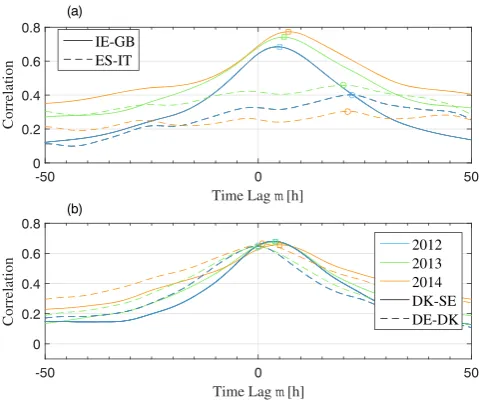
Cross-correlation sequences have been estimated according to (2) for lags jmj < 120 h (5 days). Figure 5 shows some examples of cross-correlation for three country pairs with high correlation (i.e. Ireland–GB, Denmark–Sweden and Germany–Denmark). The lag for maximum correlation is influenced by the direction of separation. For this reason, the graphs in Figure 5 were divided on a west–east axis and north–south axis considering the position of the weighted centroids for each country.
For the west–east axis, the position of the lag reflects the distance between the countries. For example, the weighted centroids for Ireland’s and GB’s are 347 km apart in the west–east direction, and the peak in correlation is between 5 and 8 h. This is due to weather fronts travelling from west to east. The time lag corresponding to the peak cross-correlation also changes slightly from one year to another. For example, in 2012, the time lag between Ireland and GB was roughly 5 h, whereas in 2014, it was 8 h. This increase in lag and the shift further east in the location of the weighted centroid could be due to the addition of wind power generation from large offshore wind farms in the North Sea in 2013 and 2014. In the case of the correlation function between Spain and Italy, a diurnal variation is evident with peaks at regular 24 h intervals. The main peak occurs at aroundmD24 h, which could be due to the large distance of 1487 km between the weighted centroids and that a weather system hitting Spain could affect Italy the following day.
Figure 5. Cross-correlation functions with time shift applied to the second system listed in each pair, i.e. GB, IT, SE and DK time shifted respect to IE, ES, DK and DE, respectively. In (a) country pairs have a west–east direction of separation and north–south in (b).
[Colour figure can be viewed at wileyonlinelibrary.com]
Figure 6. Duration curves for normalized wind power production in 2014 for four selected countries in the EU compared with the ideally interconnected Europe (solid red line) and an uncorrelated system simulation in Louie6(dashed black line). [Colour figure can
be viewed at wileyonlinelibrary.com]
4.3. Aggregate wind power characteristics
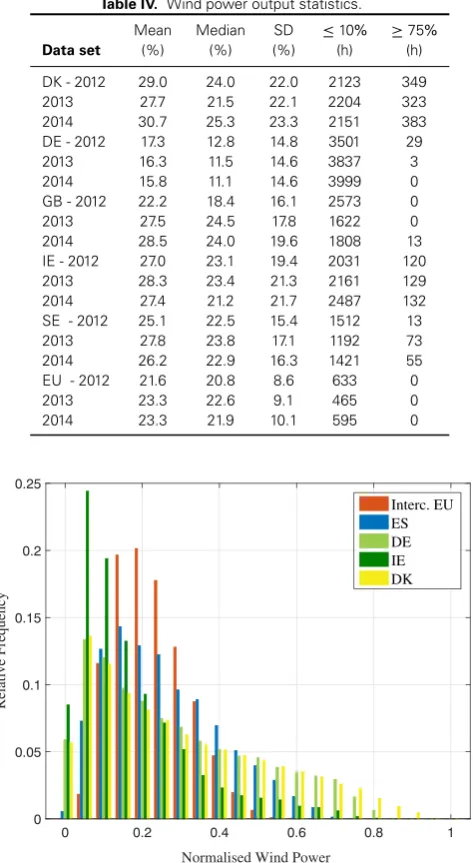
[image:9.595.178.414.336.530.2]The duration curves for the single countries are quite different from one another and reflect the different characteristics of each system. For example, the yearly duration curve for Denmark appears very asymmetric. It exhibits a larger number of high-production hours (i.e.>75%) compared with the other countries. This is evident by analyzing the results reported in Table IV. Germany has quite a significant number of low-production hours and very few hours of high-production hours as shown in Table IV. In fact, the duration curve for Germany starts with a sharp decrease as the number of hours of high power is smaller compared with the other countries. The curve then declines more slowly because of the high number of low-power production hours.
[image:10.595.181.418.239.671.2]The shape of the yearly duration curve for the ideally interconnected European system is similar to the uncorrelated reference system, but the two curves do not coincide as the ideally interconnected European power system is shifted because of the different system characteristics. The mean is estimated to be around 21.5% of installed wind capacity, and the standard deviation is around 9%, whereas the uncorrelated system simulated by Louie6has a higher mean of 30% and a slightly lower standard deviation of 7.7%. In Table IV, it is shown that the number of wind power production hours below 10% of installed capacity in the ideally interconnected Europe is reduced by a factor of 2 compared with Sweden and up to a factor of 5.5 compared with Germany.
Table IV. Wind power output statistics.
Mean Median SD 10% 75%
Data set (%) (%) (%) (h) (h)
DK - 2012 29.0 24.0 22.0 2123 349
2013 27.7 21.5 22.1 2204 323
2014 30.7 25.3 23.3 2151 383
DE - 2012 17.3 12.8 14.8 3501 29
2013 16.3 11.5 14.6 3837 3
2014 15.8 11.1 14.6 3999 0
GB - 2012 22.2 18.4 16.1 2573 0
2013 27.5 24.5 17.8 1622 0
2014 28.5 24.0 19.6 1808 13
IE - 2012 27.0 23.1 19.4 2031 120
2013 28.3 23.4 21.3 2161 129
2014 27.4 21.2 21.7 2487 132
SE - 2012 25.1 22.5 15.4 1512 13
2013 27.8 23.8 17.1 1192 73
2014 26.2 22.9 16.3 1421 55
EU - 2012 21.6 20.8 8.6 633 0
2013 23.3 22.6 9.1 465 0
2014 23.3 21.9 10.1 595 0
In this analysis, the duration of high and low wind power production has also been considered. The longest duration of low wind power production (i.e.< 10%) is 54 h for Romania, followed by 23 h for Germany, 17 h for Spain, 13 h for Belgium and 10 h for GB. The longest duration of peak wind power production (i.e.> 75%) is 41 h for Romania, closely followed by 40 h for Denmark and by 18, 16, 14 and 12 h for Sweden, Ireland, Austria and Germany, respectively. These results are important for power system operations and planning in an idealized interconnected Europe with regard to power flow, system stability, intermarket trading, storage and ancillary services as the countries with more advantageous correlation characteristics are highlighted.
[image:11.595.177.416.217.413.2]The distribution of wind power production from each country has also been analysed. Figure 7 shows the distribution for Denmark, Ireland, Germany and Spain compared with the ideally interconnected Europe. It is evident that in general, the wind power distributions of these EU countries are spread over a wide range of values. However, wind power production in Spain has a distribution that is the closest to that of the ideally interconnected Europe with a wind power production that has a more concentrated distribution (i.e. a shorter tail).
Figure 8. Histogram showing hourly variations of wind power outputs (normalized) from each country and the ideal interconnected European system. [Colour figure can be viewed at wileyonlinelibrary.com]
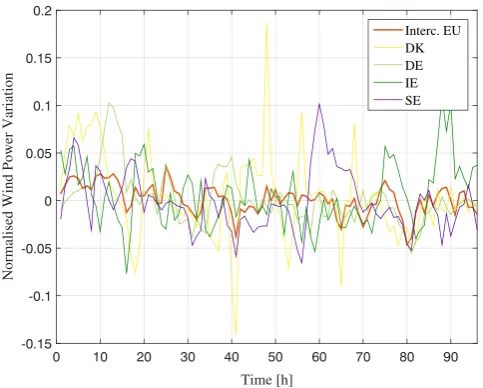
Figure 9. Hourly wind power variations as a fraction of installed wind capacity for the ideal interconnected European system (thick red line), Denmark (yellow), Germany (light green), Ireland (dark green) and Sweden (purple). [Colour figure can be viewed at
[image:11.595.177.419.469.663.2]4.4. Inter-temporal variations
The inter-temporal variations of the wind power production from each country were examined to determine the frequency of occurrence of hourly variations. Hourly variations were calculated as an hour is the highest time resolution of the datasets. Figure 8 shows the frequency of occurrence of hourly power output variations for each country and the ideally interconnected Europe. The results of the analysis demonstrate that the ideally interconnected Europe has almost all hourly variations very close to zero, whereas the other countries exhibit larger hourly variations. Therefore, it can be inferred that the wind power production in the ideally interconnected Europe would have smaller hourly variations and a smoother wind power output. An example is reported in Figure 9 where 4 days (i.e. 96 h from 24 to 28 October 2013) of wind power production have been considered for Denmark, Germany, Ireland, Sweden and the interconnected Europe. During these dates, Denmark experienced a sharp increase in wind power production of almost 20% of installed wind power capacity (with a normalized wind power variation of 0.2) as can be seen by the spikes in the graph. However, at the same time, the wind power production in the ideally interconnected system increased by only 1.5% of the total EU installed wind power capacity. This indicates that there is opportunity for balancing in the ideally interconnected Europe. Overall, the maximum variation in wind power production in the ideally interconnected Europe was 3.6% of the total installed wind power capacity. Thus, in the ideally interconnected Europe, the inter-temporal variations are reduced and the resultant wind power output is smoother compared with that of the single countries. It is important to highlight that the benefits of large-scale smoothing effects are only possible if power exchange can be realized across countries.
5. CONCLUSION
This study analysed real wind power production data from 10 countries in Europe representing almost 80% of the total installed wind power capacity of the EU. The work focused on the following: (i) the correlation between the 10 coun-tries related to distance; (ii) wind power production characteristics; and (iii) the inter-temporal variations in wind power production.
The analysis showed that the correlation between EU countries decreases exponentially with separation distance. This result is consistent with other studies.6, 11 This indicates that the PCI interconnectors between EU countries with low correlation should be prioritized in order to fully optimize wind power production and smooth wind power variability.52 Moreover, the cross-correlation analysis found that the location of the peak in the cross-correlation function depends on both the separation and relative position of the country pairs with direction playing a key role. Peak correlation was observed at non-zero lag on a west–east axis, while the peak correlation was observed at close to zero lag along a north–south axis. This time lag could also be used for improving wind power forecasting (i.e. data from a particular country could be used to reduce prediction errors for another system taking into account their degree of correlation and especially the time lag between them) and thus mitigates the cost of wind power integration for TSOs. For example, this could be applied to develop a large-scale very-short-term wind power forecast model for all of Europe at the regional or even wind farm level using techniques like the sparse vector autoregressive model introduced by Cavalcante et al.53In addition, this time shift is important in many different aspects of power system operation and planning. The characteristics of the wind power pro-duction correlation between each country should be taken into account when planning and scheduling interconnector flows and grid operations because storage optimization and intermarket power trading and ancillary services will be influenced by the wind power correlation relationship of the two countries involved. Furthermore, another interesting finding often over-looked is that time lag can decrease and increase between countries depending on the geographic dispersion. For example, the lag increased by 3 hours and moved further east between Ireland and GB over 2012 to 2014. The change is perhaps due to wind power generation from large offshore wind farms in the North Sea over the same time period. This suggests that the lag value for maximum correlation and the location of the weighted centroid are altered as a function of the dispersion of wind farms in each country. This also has the potential to be critical in terms of PCI interconnector planning and operation. The highest correlation is between Ireland and GB (e.g. 0.67 in 2012 and 0.69 in 2014).
Furthermore, the analysis of the characteristics of wind power production showed that some countries have wind power production distributions with a large probability for low values and longer tails towards higher values. An ideally intercon-nected European system has been modelled to show that interconnections help to create a narrower and more symmetric distribution of wind power production, thus reducing periods of both very low and very high wind power generation. For example, in Table IV, it was shown that the number of wind power production hours below 10% of installed capacity in the ideally interconnected Europe is reduced by a factor of 2 compared with Sweden and up to a factor of 5.5 compared with Germany. This suggests that increased interconnection results in an overall ‘smoother’ system with a more concentrated distribution with characteristics similar to an uncorrelated system.
example, it was also determined that the maximum variation in the wind power production for the ideally interconnected system was 3.6% of the total installed wind power capacity.
It is important to understand large-scale wind power production characteristics in an idealized interconnected Europe with the prospect of a single European energy target market in a future scenario with more and more renewable energy sources providing electricity and more interconnectors being built between EU Member States. The findings of this study indicate that an ideally interconnected Europe could mitigate the effects of increasing wind power and wind power vari-ability. This in turn would result in more efficient power system operations because of increased grid stability, security and potentially less fluctuation in prices and improved predictability, thus reducing costs, emissions and primary energy consumption.
Finally, the analysis of wind power generation in 10 European countries has highlighted some important correlation characteristics that need further investigation, in particular, the lags in correlation between country pairs. These are espe-cially relevant for power system operations, storage optimization and intermarket trading. This will form the basis of future research.
ACKNOWLEDGEMENTS
This publication is supported by multiple datasets, which are openly available at locations cited in the reference section. The authors gratefully acknowledge the Austrian Power Grid, Elia, Energinet.dk, TransnetBW, TenneT, 50Hertz, Amprion, Gridwatch and BM Reports, SONI, EirGrid, Terna, Transelectrica, Red Eléctrica de España and Svenska Kraftnät for wind power datasets. The authors also thank the European Environment Agency (EEA) for Figure 2. This research is funded by the Engineering Physical Sciences Research Council (EPSRC) via the University of Strathclyde’s Wind Energy Systems Centre for Doctoral Training, grant number EP/G037728/1.
REFERENCES
1. European Wind Energy Association. Wind in Power 2015: European Statistics, Technical Report, WindEurope, Brussels, Belgium, 2016.
2. Sustainable Energy Ireland (SEI). Operating Reserve Requirements as Wind Power Penetration Increases in the Irish Electricity System, 2004.
3. Smith J, Milligan M, DeMeo E, Parsons B. Utility wind integration and operating impact state of the art.IEEE Transactions on Power Systems2007;22: 900–908.
4. Holttinen H, Meibom P, Orths A, van Hulle F, Lange B, O’Malley M, Pierik J, Ummels B, Tande JO, Estanqueiro A.
et al.Design and operation of power systems with large amounts of wind power,Final Report of IEA Task 25, VTT Research Notes, 2009.
5. Energy GE, Western Wind and Solar Integration Study,Technical Report, The National Renewable Energy Laboratory (NREL), Golden, CO (US), 2010.
6. Louie H. Correlation and statistical characteristics of aggregate wind power in large transcontinental systems.Wind Energy2014;17: 793–810.
7. Giebel G. On the benefits of distributed generation of wind energy in Europe,PhD Thesis, Carl von Ossietzky Universit˙at, Institute of Physics, Oldenburg, 2001.
8. Ernst B, Wan Y-H, Kirby B, Short-term Power Fluctuation of Wind Turbines: Analyzing Data from the German 250 MW Measurement Program from the Ancillary Services Viewpoint,Technical Report, The National Renewable Energy Laboratory (NREL), Golden, CO (US), 1999.
9. Archer CL, Jacobson MZ. Corrections to “Spatial and Temporal Distributions of U.S. Winds and Wind Power at 80m Derived from Measurements”.Journal of Geophysical Research: Atmospheres2003;109.
10. Wan Y-H, Milligan M, Parsons B. Output power correlation between adjacent wind power plants.Journal of Solar Energy Engineering2003;125: 551–555.
11. Holttinen H. Hourly wind power variations in the Nordic countries.Wind Energy2005;8: 173–195. 12. Hasche B. General statistics of geographically dispersed wind power.Wind Energy2010;13: 773–784.
13. Fertig E, Apt J, Jaramillo P, Katzenstein W. The Effect of Long-distance Interconnection on Wind Power Variability.
Environmental Research Letters2012;7(3): 034017.
14. Kempton W, Pimenta FM, Veron DE, Colle BA. Electric power from offshore wind via synoptic-scale interconnection.
15. St. Martin CM, Lundquist JK, Handschy MA. Variability of Interconnected Wind Plants: Correlation Length and its Dependence on Variability Time Scale.Environmental Research Letters2015;10: 044004.
16. Krich A, Milligan M, The Impact of Wind Energy on Hourly Load Following Requirements: An Hourly and Seasonal Analysis,Technical Report. The National Renewable Energy Laboratory (NREL), Golden, CO (US), 2005.
17. Nanahara T, Asari M, Maejima T, Sato T, Yamaguchi K, Shibata M. Smoothing effects of distributed wind turbines. Part 2. Coherence among power output of distant wind turbines.Wind Energy2004;7: 75–85.
18. Tastu J, Pinson P, Kotwa E, Madsen H, Nielsen HA. Spatio-temporal analysis and modeling of short-term wind power forecast errors.Wind Energy2011;14: 43–60.
19. Osborn D, Henderson M, Nickell B, Lasher W, Liebold C, Adams J, Caspary J. Driving forces behind wind.IEEE Power and Energy Magazine2011;9: 60–74.
20. Parsons BK, Wan Y, Kirby B, Wind Farm Power Fluctuations, Ancillary Services, and System Operating Impact Anal-ysis Activities in the United States,Technical Report. The National Renewable Energy Laboratory (NREL), Golden, CO (US), 2001.
21. Wan Y. Analysis of Wind Power Ramping Behaviour in ERCOT,Technical Report. The National Renewable Energy Laboratory (NREL), Golden, CO (US), 2011.
22. Holttinen H, Meibom P, Orths A, Lange B, O’Malley M, Tande JO, Estanqueiro A, Gomez E, Söder L, Strbac G, Smith JC, van Hulle F. Impacts of large amounts of wind power on design and operation of power systems, results of IEA collaboration.Wind Energy2011;14: 179–192.
23. Eirgrid and SONI. All-Island Generation Capacity Statement 2016-2025,Technical ReportEirgrid, Dublin, Ireland, and SONI, Belfast, Northern Ireland, 2016.
24. DeMarco CL, Baone CA, Han Y, Lesieutre B. Primary and secondary control for high penetration renewables,Future Grid Initiative White Paper, June 2012.
25. Eirgrid and SONI, All Island TSO Facilitation of Renewables Studies,Technical ReportEirgrid, Dublin, Ireland, and SONI, Belfast, Northern Ireland, 2010.
26. Foley A, Leahy P, McKeogh E. Wind energy integration and the Ireland-Wales interconnector. IEEE PES/IAS Conference on Sustainable Alternative Energy (SAE), Valencia, Spain, 2009; 1–6.
27. European Commission. Projects of Common Interest. Available at: https://ec.europa.eu/energy/en/topics/infrastructure/ projects-common-interest (Accessed March 2016) [Online].
28. Peel MC, Finlayson BL, McMahon TA. Updated world map of the Köppen–Geiger climate classification.Hydrology and Earth System Sciences2007;11: 1633–1644.
29. European Environment Agency. Available at: http://www.eea.europa.eu/data-and-maps/figures/climate (Accessed August 2016) [Online].
30. European Wind Energy Association, Wind in Power 2014: European Statistics, Technical Report, WindEurope, Brussels, Belgium, Febuary 2015.
31. European Wind Energy Association, Wind in Power 2013: European Statistics, Technical Report, WindEurope, Brussels, Belgium, February 2014.
32. UK Government, Regional Statistics 2003-2014: Installed Capacity. Available at: https://www.gov.uk/government/ statistics/regional-renewable-statistics (Accessed March 2016) [Online].
33. Austrian Power Grid (APG). Market Information, Generation, Wind Energy. Available at: https://www.apg.at/en/ market/generation/wind-energy (Accessed March 2016) [Online].
34. Elia, Transmission System Operator in Belgium, Grid Data, Power Generation, Wind-power generation data. Available at: http://www.elia.be/en/grid-data/power-generation/wind-power (Accessed March 2016) [Online].
35. Energinet.dk. Electricity and Gas Transmission System Operator in Denmark Electricity, The wholesale market, Down-load of market data. Available: http://www.energinet.dk/en/el/engrosmarked/udtraek-af-markedsdata/Sider/default. aspx (Accessed March 2016) [Online].
36. Transnet BW. Transmission Grid Operator in Baden-Württemberg Key Figures, Wind Infeed. Available at: https:// www.transnetbw.com/en/key-figures/renewable-energies/wind-infeed (Accessed March 2016) [Online].
37. TenneT, Transmission System Operator in several counties in Germany Transparency, Publications, Network figures, Actual and forecast wind energy feed-in. Available at: http://www.tennettso.de/site/en/Transparency/publications/ network-figures/actual-and-forecast-wind-energy-feed-in (Accessed March 2016) [Online].
39. Amprion, Transmission System Operator in Germany from Lower Saxony down to the Alps System usage, Grid data, Wind power infeed. Available at: http://www.amprion.net/en/wind-feed-in (Accessed March 2016) [Online]. 40. Gridwatch data courtesy of BM Reports. Available at: http://www.gridwatch.templar.co.uk (Accessed March 2016)
[Online].
41. SONI. Transmission System Operator in Northern Ireland.
42. EirGrid Group. Transmission System Operator in the Republic of Ireland.
43. Terna SpA - Rete Elettrica Nazionale, Transmission System Operator in Italy. Available at: http://www.terna. it/it-it/sistemaelettrico/transparencyreport/generation/expostdataontheactualgeneration.aspx (Accessed March 2016) [Online].
44. Transelectrica, Transmission System Operator in Romania, Generation and Consumption. Available at: http:// transelectrica.ro/widget/web/tel/sen-grafic/-/SENGrafic_WAR_SENGraficportlet (Accessed March 2016) [Online]. 45. Red Eléctrica de España. Transmission System Operator in Spain. Available at: http://www.ree.es (Accessed March
2016) [Online].
46. Svenska Kraftnät, Transmission System Operator in Sweden. Available at: http://www.svk.se/en/ (Accessed March 2016) [Online].
47. ELEXON Limited, BM Reports. Available at: http://www.bmreports.com/ (Accessed March 2016) [Online].
48. European Commission. 2050 Energy strategy. Available at: https://ec.europa.eu/energy/en/topics/energy-strategy/ 2050-energy-strategy (Accessed March 2016) [Online].
49. European Commission. Commission Delegated Regulation (EU) 2016/89 of 18 November 2015 amending Regulation (EU) No 347/2013 of the European Parliament and of the Council as regards the Union list of projects of common interest. Available at: http://data.europa.eu/eli/reg_del/2016/89/oj (Accessed May 2016) [Online].
50. European Wind Energy Association, Wind in Power 2012: European Statistics, Technical Report WindEurope, Brussels, Belgium, February 2013.
51. The Wind Power, Wind Energy Market Intelligence. Available at: http://www.thewindpower.net/ (Accessed March 2016) [Online].
52. De Decker J, Kreutzkamp P. Offshore Electricity Grid Infrastructure in Europe. 3E (coordinator), dena, EWEA, ForWind, IEO, NTUA, Senergy, SINTEF, 2011.