Complexity of the Winner Determination Problem in
Judgment Aggregation: Kemeny, Slater, Tideman, Young
Ulle Endriss
ILLC, University of Amsterdam
[email protected]
Ronald de Haan
Technische Universität Wien[email protected]
ABSTRACT
Judgment aggregation is a collective decision making frame-work where the opinions of a group of agents is combined into a collective opinion. This can be done using many differ-ent judgmdiffer-ent aggregation procedures. We study the com-putational complexity of computing the group opinion for several of the most prominent judgment aggregation proce-dures. In particular, we show that the complexity of this winner determination problem for analogues of the Kemeny rule, the Slater rule and the Young rule lies at the Θp2-level of the Polynomial Hierarchy (PH). Moreover, we show that the problem has a complexity at the ∆p2-level of the PH for the
analogue of Tideman’s procedure with a fixed tie-breaking rule, and at the Σp2-level of the PH for the analogue of
Tide-man’s procedure without a fixed tie-breaking rule.
Categories and Subject Descriptors
F.2 [Analysis of Algorithms and Problem Complex-ity]: General
General Terms
TheoryKeywords
Judgment Aggregation; Winner Determination; Complexity Theory; Bounded Query Complexity
1.
INTRODUCTION
Collective decision making is central in the area of multia-gent systems [6]. Judgment aggregation is a collective deci-sion making framework that can be used for many applica-tions [12, 17, 23]. In judgment aggregation, the goal is to combine the opinions of a group of individuals (or agents) on a set of propositions into a collective opinion reflecting the views of the group as a whole. As such, judgment ag-gregation generalizes the setting of preference agag-gregation, where the opinions are restricted to preferences over a given domain of alternatives [9]. There are many ways (or pro-cedures) to combine the individual opinions, and choosing between such procedures involves deciding between various
Appears in:Proceedings of the 14th International Conference on Autonomous Agents and Multiagent Systems (AAMAS 2015), Bordini, Elkind, Weiss, Yolum (eds.), May 4–8, 2015, Istanbul, Turkey.
Copyrightc 2015, International Foundation for Autonomous Agents and Multiagent Systems (www.ifaamas.org). All rights reserved.
desirable properties that such procedures can have. Some of the most salient desiderata for these procedures are that they are consistent (that is, the resulting group opinion is a tenable position) and complete (that is, for each proposition, the resulting group opinion takes a clear position).
Another important property of judgment aggregation pro-cedures concerns their computational complexity, i.e., the amount of time it takes to compute the group opinion. In this paper, expanding on previous work [13, 21], we study the computational complexity of the winner determination problem for several of the most prominent judgment ag-gregation procedures that are complete and consistent. In particular, we study the judgment aggregation analogues of the Kemeny rule, the Slater rule and the Young rule, as well as two variants of Tideman’s Ranked-Pairs rule (whose judgment aggregation analogue we call the Ranked-Agenda rule), all familiar from voting theory and preference aggre-gation [5].
Concretely, we study two different computational prob-lems for the various procedures, one decision problem and one search problem. We consider the problem of deciding whether there exists an outcome that is deemed acceptable by the judgment aggregation procedure and that satisfies a number of additional requirements. In addition, we consider the computational task of producing one such acceptable outcome, if it exists. We argue that this latter formalization of the problem more adequately models the relevant compu-tational properties of the various procedures. We show that the complexity (of both the decision and the search problem) for the Kemeny, Slater and Young rules lies at the Θp2-level of the Polynomial Hierarchy (PH). Interestingly, these rules have exactly the same complexity in the setting of prefer-ence aggregation. In addition, we show that the complexity of Tideman’s Ranked-Agenda procedure lies at the ∆p2-level
of the PH, in case of a fixed tie-breaking rule, and lies at the Σp2-level of the PH in case ties can be broken in arbitrary ways. It is interesting that both variants of the Ranked-Agenda rule are of higher computational complexity than the other three rules we consider in the setting of judgment aggregation, whereas in the case of preference aggregation both variants are of lower complexity than these rules. An overview of the complexity results that we obtain in this paper can be found in Table 1.
autonomous agents, or more generally, independent sources of information. Determining the exact location of these problems in the PH is very useful for determining what algo-rithmic approaches are best-suited to solve the problems in practice. For problems at the Θp2-level and at the ∆p2-level, for instance, the method of iterative SAT solving could be used, which is generally more efficient than solving methods for problems at the Σp2-level.
Related Work.
The computational complexity of the winner determination problem has been studied before, by Endriss et al. [13] for several procedures including the Kemeny rule, and by Lang and Slavkovik [21] for several procedures, including the Slater rule, the Kemeny rule and the variant of the Ranked-Agenda procedure without a fixed tie-breaking rule. However, those previous works consider different formalizations of the com-putational task of winner determination. First, they study only decision problems (and no search problems) [13, 21]. Second, the problems studied by Lang and Slavkovik in-volve checking whether all outcomes satisfy a certain prop-erty, rather than some outcome [21]. The computational complexity of various other computational tasks in judg-ment aggregation has also been studied, including problems related to manipulation, bribery and control [1, 3, 4, 8, 13].
Structure of the Paper.
We begin, in Section 2, with reviewing notions from logic, judgment aggregation and complexity theory. Then, in Sec-tion 3, we formally define the computaSec-tional problems that we use to capture the task of winner determination, and we analyze their computational complexity for the various judgment aggregation procedures. Finally, in Section 4, we conclude, and suggest directions for further research.
2.
PRELIMINARIES
In this section we review relevant material on logic, judg-ment aggregation and complexity theory.
2.1
Propositional Logic
A literal is a propositional variable x or a negated vari-able¬x. For literals l∈ {x,¬x}, we let Var(l) =xdenote the variable occurring in l. A clause is a finite set of lit-erals, not containing a complementary pair x, ¬x, and is interpreted as the disjunction of these literals. We let ⊥
denote the empty clause. A formula inconjunctive normal form (CNF)is a finite set of clauses, interpreted as the con-junction of these clauses. We define thesize||ϕ||of a CNF formulaϕto beP
c∈ϕ|c|; the number of clauses ofϕis de-noted by|ϕ|. For a CNF formulaϕ, the set Var(ϕ) denotes the set of all variables xsuch that some clause of ϕ con-tainsxor¬x. We use the standard notion of(truth) assign-ments α: Var(ϕ) → {0,1}for Boolean formulas andtruth
of a formula under such an assignment. We letSATdenote the problem of deciding whether a given propositional for-mula is satisfiable. For every propositional forfor-mula ϕ, we let ∼ϕ denote thecomplement ofϕ, i.e., ∼ϕ=¬ϕ if ϕis not of the form¬ψ, and∼ϕ=ψifϕis of the form¬ψ.
2.2
Judgment Aggregation
Anagenda is a finite nonempty set Φ of propositional for-mulas that does not contain any doubly-negated
formu-las and that is closed under complementation. Moreover, if Φ = {ϕ1, . . . , ϕm,¬ϕ1, . . . ,¬ϕm}is an agenda, then we let [Φ] ={ϕ1, . . . , ϕm}denote thepreagendaassociated with the agenda Φ. Ajudgment setJ for an agenda Φ is a sub-setJ⊆Φ. We call a judgment setJcompleteif eitherϕ∈J
or ∼ϕ∈J, for allϕ∈Φ; we call itcomplement-free if for allϕ∈ Φ it is not the case that bothϕand ∼ϕare in J; and we call itconsistent if there exists a truth assignment that makes all formulas inJ true.
In addition, we associate with each agenda Φ an integrity constraint Γ, that can be used to explicitly represent logical dependencies between agenda issues. Integrity constraints for agendas have been considered in previous literature [10, 21], and the notion bears resemblance to the framework of binary aggregation with integrity constraints [15, 16]. Such an integrity constraint Γ consists of a single propositional formula. In the remainder of the paper, if no integrity con-straint is specified, we implicitly assume that Γ = >. We say that a judgment set J is Γ-consistent if there exists a truth assignment that simultaneously makes all formulas inJ and Γ true. LetJ(Φ,Γ) denote the set of all complete and Γ-consistent subsets of Φ.
LetN be a finite set ofindividuals (oragents). A judg-ment aggregation procedure (or rule) for the agenda Φ and the setN of individuals is a functionF that takes as input a profileJ∈ J(Φ,Γ)n, consisting of a sequence (J1, . . . , Jn)
of n =|N | complete and Γ-consistent judgment sets, and that produces a non-empty set of non-empty judgment sets, i.e., it produces an element in P(P(Φ)\{∅})\{∅}. We call a judgment aggregation procedure F resolute if for any profile J it returns a singleton, i.e., |F(J)| = 1; other-wise, we call F irresolute. An example of a resolute judg-ment aggregation procedure is thestrict majority ruleFmaj,
whereϕ∈Fmaj(J) if and only ifϕoccurs in the strict
ma-jority of judgment sets in J, for all ϕ ∈ Φ. We call F
complete, complement-free and (Γ-)consistent, ifJ is com-plete, complement-free and (Γ-)consistent, respectively, for everyJ∈ J(Φ,Γ)nand everyJ∈F(J).
As an example, consider the following profile for a judg-ment aggregation problem with preagenda [Φ] ={p, q, p∨q}, integrity constraint Γ =¬(p∧q), and three individuals:
p q p∨q
individual 1 no yes yes individual 2 yes no yes individual 3 no no no majority no no yes
Thus, respecting majorities leads to an inconsistent outcome for this profile. This is an instance of the well-known dis-cursive dilemma [22]. In this paper, we will consider several judgment aggregation procedures that resolve this dilemma by always picking from the set of all consistent judgment sets. There currently is no consistent naming convention for these aggregation procedures in the literature. Here, to iden-tify the procedures that we consider, we use names from well-known voting rules that most closely resemble them [5]. The procedures that we consider have been studied as judgment aggregation procedures before. We consider procedures that resemble the Kemeny rule [24, 25], the Slater rule [24], the Young rule [20], and the Ranked-Agenda rule [20, 26].
The former three aggregation procedures are based on a notion of score. For F ∈ {Kemeny,Slater,Young}, we define ScoreF as follows. Here J denotes a single
F WinDet(F) FWinDet(F) location in the PH
Kemeny PNP[log]-complete FPNP[log,wit]-complete Θp 2-level
Slater PNP[log]-complete FPNP[log,wit]-complete Θp2-level Young PNP[log]-complete FPNP[log,wit]-complete Θp2-level
Tideman (fixed tie-breaking) PNP-complete FPNP-complete ∆p2-level
Tideman Σp2-complete FΣ
p
2-complete Σ
p 2-level
Table 1: Overview of complexity results.
a profile, and d(J, J0) denotes the Hamming distance be-tween two consistent and complete judgment setsJ, J0. We let ScoreKemeny(J,J) = P1≤i≤nd(J, Ji). Moreover, we let ScoreSlater(J,J) = d(J, Fmaj(J)), where Fmaj(J)
de-notes the (possibly inconsistent) majority outcome of a pro-file J. Finally, we let ScoreYoung(J,J) = min{k : there
exists a subprofileJ0 of J containingn−k judgment sets such thatJ=Fmaj(J0
)}. Using these scores, we can define the aggregation procedures WinnerF,Φ,Γ, for F∈ {Kemeny,
Slater,Young}, as follows. We say that a Γ-consistent and complete judgment setJ∗is in WinnerF,Φ,Γ(J) if and only
if there is no Γ-consistent and complete judgment setJsuch that ScoreF(J,J)<ScoreF(J∗,J).
Intuitively, the Kemeny rule selects those complete and consistent judgment sets that minimize the cumulative Ham-ming distance to the judgment sets in the profile. TheSlater
rule selects those complete and consistent judgment sets that minimize the Hamming distance to the majority outcome. TheYoungrule selects those complete and consistent judg-ment sets that are the majority outcome of a subprofile of maximal size with a consistent majority outcome.
Next, we consider theRanked-Agenda aggregation proce-dure. Given a profile J = (J1, . . . , Jn) ∈ J(Φ,Γ)n and a
formulaϕ∈Φ, we let themajority strengthms(J, ϕ) be the number ofi’s such thatϕ∈Ji, i.e., ms(J, ϕ) =|{1≤i≤
n:ϕ ∈Ji}|. We define the partial order≤J ⊆Φ×Φ as
follows. Letϕ, ϕ0∈Φ be formulas. If ms(J, ϕ)<ms(J, ϕ0), we letϕ≤J ϕ0; and if ms(J, ϕ) = ms(J, ϕ0), we letϕ6≤Jϕ0.
We say that a total order <J is a Ranked-Agenda order
(for J) if it extends ≤J. Given a Ranked-Agenda
or-der<J, we define the judgment set RA(<J,Φ,Γ) as follows.
Let Φ ={ϕ1, . . . , ϕm}and assume thatϕ1>J · · ·>Jϕ2m.
We letJ0=∅. For each 1≤i≤2m, we letJi=Ji−1∪ {ϕi} ifJi−1∪ {ϕi}is Γ-consistent; otherwise, we let Ji =Ji−1.
By definition, eachJi is Γ-consistent. (Note that we could equivalently let Ji = Ji−1∪ {¬ϕi} if Ji−1 ∪ {ϕi} is not Γ-consistent.) We then let RA(<J,Φ,Γ) = J2m. Given
any total order <A ⊆ Φ×Φ, and a partial order ≤
J,
we define the Ranked-Agenda order <AJ to be the unique
total order such that: (1) ϕ <AJ ϕ
0
whenever ϕ ≤J ϕ0
and ϕ0 6≤J ϕ; and (2) ϕ <AJ ϕ
0
if and only if ϕ <A ϕ0
, wheneverϕ=Jϕ0. We now say that a Γ-consistent and
com-plete judgment setJ∗∈ J(Φ,Γ) is aRanked-Agenda winner, denoted J∗ ∈ WinnerRA,Φ,Γ(J) if there is some
Ranked-Agenda order<J forJ such that J∗ = RA(<J,Φ,Γ). We
say that a tie-breaking rule A is defined by a total or-der<A ⊆Φ×Φ for each agenda Φ. Moreover, we say that a Γ-consistent and complete judgment setJ∗ ∈ J(Φ,Γ) is a Ranked-Agenda winner for the fixed tie-breaking rule A, denotedJ∗∈WinnerRAA,Φ,Γ(J) if J
∗
= RA(<A
J,Φ,Γ). In
voting, it is pairs (of alternatives) rather than propositions that are being ranked, which is why the corresponding vot-ing rule is called the Ranked-Pairs rule.
2.3
Complexity Theory
Readers familiar with seach problems and bounded query complexity may skip this section.
Search Problems.
In this paper, we will assume knowledge of to the well-known complexity classes P and NP, consisting of decision problems. In addition, we will consider search problems. Let Σ be an alphabet. A search problem is a binary rela-tion R over strings in Σ∗. For any input string x ∈ Σ∗, we let R(x) = {y ∈ Σ∗ : (x, y) ∈ R} denote the set of
solutions forx. We say that a Turing machineT solves R
if on input x ∈ Σ∗ the following holds: if there exists at least oneysuch that (x, y)∈R, then T acceptsxand out-puts some y such that (x, y) ∈ R; otherwise, T rejects x. With any search problem R we associate a decision prob-lem SR, defined by SR ={x∈Σ∗ : there exists somey ∈ Σ∗such that (x, y)∈R}. We will use the following notion of reductions for search problems. Apolynomial-time Levin reduction from one search problem R1 to another search
problem R2 is a pair of polynomial-time computable
func-tions (g1, g2) such that (1) the function g1 is a many-one
reduction from SR1 to SR2, i.e., for every x∈ Σ
∗
it holds that x∈SR1 if and only ifg1(x) ∈SR2; and (2) for every string x ∈ SR1 and every solution y ∈ R2(g1(x)) it holds that (x, g2(x, y))∈R1. For more details, we refer to
text-books on the topic [14].
Complexity Classes.
The complexity class FP consists of those search problems that can be computed by a polynomial-time deterministic Turing machine, and the class FNP consists of those search problems that can be computed by a polynomial-time non-deterministic Turing machine.
Moreover, we will use complexity classes that are based on Turing machines that have access to an oracle. Let C
be a complexity class with decision problems. A Turing ma-chineTwith access to ayes-noCoracleis a Turing machine with a dedicatedoracle tapeand dedicated statesqoracle,qyes
andqno. WheneverT is in the stateqoracle, it does not
pro-ceed according to the transition relation, but instead it tran-sitions into the stateqyesif the oracle tape contains a stringx
that is a yes-instance for the problemC, i.e., ifx∈C, and it transitions into the stateqnoifx6∈C. LetC be a
complex-ity class with search problems. Similarly, a Turing machine with access to awitnessCoraclehas a dedicated oracle tape and dedicated statesqoracle,qyesandqno. Also, wheneverT
is in the state qoracle it transitions into the stateqyes if the
oracle tape contains a stringxsuch that there exists somey
such thatC(x, y), and in addition the contents of the oracle tape are replaced by (the encoding of) such any; it transi-tions into the stateqnoif there exists noysuch thatC(x, y).
We point out that the notion of algorithms that have ac-cess to witness FNP oracles accurately models algorithms that can call a SAT solver (modulo the running time of the SAT solver), as SAT solvers also return a satisfying assign-ment if it exists.
In this paper, we will consider the following complexity classes that are based on oracle machines. The class PNP[log]
consists of all decision problems that can be decided by a de-terministic polynomial-time Turing machine that has access to a yes-no NP oracle, and on any input of lengthnqueries the oracle at mostO(logn) many times. This class coincides with the class PNP|| , and is also known as Θ
p 2.
The class FPNP[log,wit] consists of all search problems that can be solved by a deterministic polynomial-time Tur-ing machine that has access to a witness FNP oracle, and on any input of lengthnqueries the oracle at mostO(logn) many times. In a sense, it is the search variant of PNP[log].
The class FΣp2 consists of all search problems that can be computed by a nondeterministic polynomial-time Turing machine that has access to a witness FNP oracle. In a sense, it is the search variant of Σp2.
We say that a decision problemP is complete for a com-plexity class C containing decision problems if any prob-lem Q∈C is polynomial-time (many-one) reducible to P. Similarly, we say that a search problem R is complete for a complexity classC containing search problems if for any problemR0∈Cthere exists a polynomial-time Levin reduc-tion fromR0 toR.
Complete Problems.
Next, we consider a number of search and decision problems that are complete for the various complexity classes that we consider in this paper. The decision problem SAT is NP-complete. This problem consists of deciding whether a given propositional formula ϕhas a satisfying assignment. The corresponding search problem, FSAT, consisting of all pairs (ϕ, α), where α is a satisfying assignment for ϕ, is FNP-complete. Next, consider the following problems.
X-Max-Model
Input: a formulaϕand a subsetX ⊆Var(ϕ) of vari-ables ofϕ.
Output: a modelM ofϕthat sets a maximum number of variables inX to true, if such a model exists.
X-Max-Model-Parity
Instance: a formula ϕ, a subsetX ⊆Var(ϕ) of vari-ables ofϕ, and a variablex0∈X.
Question: is there a modelM ofϕsuch thatX -Max-Model(ϕ, M) andM setsx0to true?
The search problem X-Max-Model is complete for FPNP[log,wit] [7]. Moreover, the decision problemX -Max-Model-Parityis complete for PNP[log]. This follows from the fact that all predicates in FPNP[log,wit] are computable
in PNP[log] [18, Corollary 6.3.5].
FLex-Max-Model
Input: a formulaϕwith Var(ϕ) ={x1, . . . , xn}.
Output: a lexicographically maximal model M of ϕ, if such a model exists. (Here, the variables are or-deredx1<· · ·< xn.)
Lex-Max-Model
Instance: a formulaϕand a variablex0∈Var(ϕ).
Question: is there a modelM ofϕ such that FLex-Max-Model(ϕ, M) andM setsx0 to true?
The search problem FLex-Max-Model is complete for FPNP, and the decision problemLex-Max-Model is com-plete for PNP[19].
FQSat2
Input: a quantified Boolean formula ϕ = ∃X.∀Y.ψ, whereψis quantifier-free.
Output: an assignmentαto the variables inX, such that∀Y.ψ[α] is true, if it exists.
The decision problemQSat2 associated toFQSat2 is
well-known to be Σp2-complete. The search problemFQSat2 is complete for FΣp2. This can be shown straightforwardly by
modifying the proof of Σp2-completeness forQSat2[27, 28],
which can also be found in many textbooks (e.g., [2]).
3.
COMPLEXITY RESULTS
For the various judgment aggregation proceduresF, we will consider the following decision problem.
WinDet(F)
Instance: an agenda Φ with an integrity constraint Γ, a profile J ∈ J(Φ,Γ)n and a number of sub-setsL0, . . . , Lu⊆Φ of the agenda, withu≥0.
Question: is there a judgment set J∗ ∈
WinnerF,Φ,Γ(J) such that L0 ⊆J∗ andLi 6⊆J∗ for each 1≤i≤u?
In addition, we will consider the following search problem.
FWinDet(F)
Input: an agenda Φ with an integrity constraint Γ, a profile J ∈ J(Φ,Γ)n and a number of sub-setsL0, . . . , Lu⊆Φ of the agenda, withu≥0.
Output: a judgment set J∗ ∈ WinnerF,Φ,Γ(J) such
that L0 ⊆J∗ and Li 6⊆J∗ for each 1≤i≤ u, if it exists.
In these problems, the set L0 allows us to specify
judg-ments that the outcome must contain. Moreover, using the sets L1, . . . , Lu, we can specify a list of forbidden
(combi-nations of) judgments that the outcome may not contain. This allows us, for instance, to enumerate several outcomes by using previously found outcomes as the setsL1, . . . , Lu.
NP oracle that are needed. In fact, we show that producing an outcome can be done in deterministic polynomial time with only a logarithmic number of calls to an oracle that produces witnesses for NP problems. Formalizing the task as a search problem in the first place circumvents this issue. Secondly, these computational problems involve the ques-tion whether there exists an outcome that satisfies certain properties, rather than the question whether all outcomes satisfy certain properties (as studied by Lang and Slavkovik [21]). We think the former question is the more natural of these two, as computing outcomes for judgment aggregation procedures is arguably the most central computational task in judgment aggregation.
The third observation concerns the condition that the sub-setsL1, . . . , Lu, given as part of the input to the problems,
are not subsets of the judgment setJ∗ ∈WinnerF,Φ,Γ(J).
As can be seen in the proofs in the remainder of this sec-tion, this condition does not have an effect on the complexity analysis of the problem. However, it does allow us to use this formalization of the problem to devise an algorithm to enu-merate outcomes of judgment aggregation procedures. In order to enumerate outcomes, one could use an algorithm that solves FWinDet(F) repeatedly, and rule out previ-ously found outcomes by providing them as the subsetsLi (withi >0).
We obtain the following complexity results for these two computational problems (summarized in Table 1).
Theorem 1. For eachF∈ {Kemeny,Slater,Young}:
a) WinDet(F)isPNP[log]-complete; and
b) FWinDet(F)isFPNP[log,wit]-complete.
Theorem 2. For any tie-breaking rule A, it holds that WinDet(RAA) is in PNP and FWinDet(RAA) is in FPNP. Moreover, there is some tie-breaking rule A such thatWinDet(RAA)isPNP-complete andFWinDet(RAA)
isFPNP-complete.
Theorem 3. WinDet(RA) is Σp2-complete and
FWinDet(RA)isFΣp2-complete.
We would like to point out that the complexity result for WinDet(Kemeny) has been shown before [13]. We give an alternative proof of hardness for this problem. We prove hardness by giving a reduction directly from a canon-ical complete problem for PNP[log], which allows us to ex-tend this hardness result to the case of the search prob-lemFWinDet(Kemeny), which would not have been at all straightforward with the known PNP[log]-hardness proof for WinDet(Kemeny)from the literature.
We begin by proving Theorem 1 in Sections 3.1–3.3 (Propositions 5–9 and Corollaries 6–10). Then, we prove Theorems 2 and 3 in Section 3.4 (Propositions 11–12 and Corollaries 13–14, and Propositions 15–16 and Corollary 17, respectively).
3.1
Membership for Kemeny, Slater, Young
We will show FPNP[log,wit]-membership of the problemFWinDet(F), for each F ∈ {Kemeny,Slater,Young} by giving a polynomial-time algorithm that uses an FNP wit-ness oracle at most O(logn) many times. Since PNP[log]
coincides with PNP[log,wit], this algorithm can then easily be adapted to show PNP[log]-membership of WinDet(F).
The approach that we use to show these membership re-sults is similar to the approach taken in the known PNP [log]-membership proof ofWinDet(Kemeny)[13].
For each F ∈ {Kemeny,Slater,Young}, we will consider the following auxiliary problem.
FSetScore(F)
Input: an agenda Φ with an integrity constraint Γ, a profileJ∈ J(Φ,Γ), a number of subsetsL0, . . . , Lu⊆ Φ, withu≥0, and a positive integerm(in unary).
Output: a consistent and complete judgment set J
such that L0 ⊆ J, Li 6⊆ J for each 1 ≤ i ≤ u, and ScoreF(J,J)≤m, if it exists.
Lemma 4. For each F ∈ {Kemeny,Slater,Young}, it
holds thatFSetScore(F)∈FNP.
Proof (sketch). We describe a guess-and-check algo-rithm for FSetScore(F). The algorithm gets as input an agenda Φ with an integrity constraint Γ, a profile J ∈ J(Φ,Γ), a number of subsetsL0, . . . , Lu⊆Φ of the agenda, with u ≥ 0, and a positive integer m in unary. The al-gorithm guesses a complete judgment setJ, and an inter-pretation M that witnesses that J is Γ-consistent. Ad-ditionally, if F = Young, the algorithm guesses ` ≤ m
many judgment sets Ji1, . . . , Ji` in J to remove from J.
Then, the algorithm verifies (1) whetherM satisfies bothJ
and Γ, (2) whether ScoreF(J,J)≤m, (3) whetherL0 ⊆J,
and (4) whether Li 6⊆ J for each 1 ≤ i ≤ u. If F = Young, the verification of (2) uses the guessed judgment sets Ji1, . . . , Ji`. It is straightforward to verify that these
checks can be done in polynomial time. IfJsatisfies condi-tions (1)–(4), the algorithm accepts and outputs J; other-wise, the algorithm rejects.
Proposition 5. For each F∈ {Kemeny,Slater,Young}, FWinDet(F)∈FPNP[log,wit].
Proof (sketch). We describe a polynomial-time algo-rithm that computes FWinDet(F) by using an FSet -Score(F)oracle. The algorithm firstly computes the min-imal number m∗ such that there is some Γ-consistent and complete judgment setJsuch that ScoreF(J,J)≤m∗. For
each F ∈ {Kemeny,Slater,Young}, we know that m∗ is polynomially bounded by the size of (the encoding of) J. Therefore, we can employ a binary search strategy to com-pute m∗ by asking O(log|J|) many oracle queries of the form (Φ,Γ,J,∅, m). Then, the algorithm returns the an-swer to the oracle query (Φ,Γ,J, L0, . . . , Lu, m∗).
Corollary 6. For each F ∈ {Kemeny,Slater,Young}, WinDet(F)∈PNP[log].
3.2
Hardness for Kemeny and Slater
Proposition 7. The problemsFWinDet(Kemeny)and
FWinDet(Slater) are FPNP[log,wit]-hard, even with the
restriction thatΓ =>, andu= 0.
Proof (sketch). We give a polynomial-time Levin re-duction from X-Max-Model. The same reduction works for both FWinDet(Kemeny) and FWinDet(Slater). Let (ϕ, X) be an input to X-Max-Model with X =
{x1, . . . , xv} ⊆ Var(ϕ). We construct an agenda Φ, an in-tegrity constraint Γ =>, an integeru= 0, a subsetL0⊆Φ,
such that w > v2, e.g., w = 2v2. For each 1 ≤ i ≤ v
and 1≤ j ≤ w, we introduce a fresh variable zj,i. More-over, we introduce a fresh variabey. Then, we construct a propositional formulaϕ0that is true if and only if one of the following conditions holds: either (i) for some 1≤i≤v,xi is set to false,y is set to false, and all zj,i for 1≤ j ≤w are set to true, or (ii) all zj,i are set to false, y is set to true, and the assignment to the variablesxi satisfies ϕ. It is straightforward to construct in polynomial time some for-mulaϕ0 that satisfies this property. Then we introduce w
many syntactic copiesϕ0jofϕ
0
. We now define the agenda Φ by letting [Φ] = {y} ∪ {x1, . . . , xv} ∪ {zj,i : 1 ≤ j ≤
w,1≤i≤n} ∪ {ϕ01, . . . , ϕ
0
w}. Next, we construct the pro-fileJ = (J1, . . . , Jv) as shown in Figure 1. Moreover, we
letL0={y}.
J J1 J2 . . . Jv−1 Jv m(J)
y 0 0 0 . . . 0 0
x1 0 1 1 . . . 1 1
x2 1 0 1 . . . 1 1
. .
. ... . .. ... ...
xv−1 1 . . . 1 0 1 1
xv 1 . . . 1 1 0 1
z1,1 1 0 0 . . . 0 0
z1,2 0 1 0 . . . 0 0
. .
. ... . .. ... ...
z1,v−1 0 . . . 0 1 0 0
z1,v 0 . . . 0 0 1 0 .
.
. ... ...
zw,1 1 0 0 . . . 0 0
zw,2 0 1 0 . . . 0 0
. .
. ... . .. ... ...
zw,v−1 0 . . . 0 1 0 0
zw,v 0 . . . 0 0 1 0
ϕ01 1 1 . . . 1 1
ϕ02 1 1 . . . 1 1
. .
. ... . .. ... ...
ϕ0w−1 1 . . . 1 1 1
[image:6.612.78.269.223.511.2]ϕ0w 1 . . . 1 1 1
Figure 1: construction of the profile in the proof of Proposition 7.
What remains is to specify a polynomial-time com-putable function g that takes some J∗ ∈ WinnerF,Φ,Γ(J)
withL0⊆J∗, if it exists, and that produces a modelMsuch
that X-Max-Model(ϕ, X, M). Let J∗ ∈ WinnerF,Φ,Γ(J)
such that L0 ∈ J∗. Then the function g outputs J∗∩ {x1, . . . , xv}.
The intuition behind this reduction is the following. The agenda and the profile are constructed in such a way that it is ‘cheaper’ to agree with the overall profile (respectively, with the majority outcome) on the formulasϕ0iand the for-mulaszj,i, if possible. Ifϕis satisfiable, the cheapest way to agree with the overall profile (respectively, with the majority outcome) on the above formulas (in a consistent judgment set) is to set the variables xi to a maximal assignmentα to the variables inX that is extendable to a satisfying as-signment to ϕ, and to set y to true. If ϕ is unsatisfiable,
all consistent judgment sets that disagree with the majority outcome on a minimal number of formulas (e.g., settingzj,i to true for some 1 ≤ i ≤ v and all 1 ≤ j ≤ w) do not containy(and thus are not a superset ofL0).
Corollary 8. The problems WinDet(Kemeny) and
WinDet(Slater) arePNP[log]-hard, even with the restric-tion thatΓ =>, andu= 0.
Proof (sketch). The reduction in the proof of Propo-sition 7 can be adapted to a many-one reduction from WinDet(Kemeny) (respectively, fromWinDet(Slater)) to X-Max-Model-Parity, by letting L0 = {y, x0},
where x0 is given in the original input for the problem
X-Max-Model-Parity.
3.3
Hardness for Young
Proposition 9. FWinDet(Young) is FPNP[log,wit]
-hard, even with the restriction thatΓ =>, andu= 0.
Proof (sketch). We give a polynomial-time Levin re-duction from X-Max-Model. Let ϕ be an input to X-Max-Model with Var(ϕ) = {x1, . . . , xv}. We may assume that any satisfying assignment (if there exists any) sets at least one variable inX to true, and that setting all variables inX to true does not satisfyϕ. We construct an agenda Φ, an integrity constraint Γ =>, an integeru= 0, a subset L0 ⊆ Φ, and a profileJ ∈ J(Φ,Γ)n as follows.
We letw= 2v+ 1. Then, we construct a propositional for-mulaϕ0 that is satisfiable if and only if one of the following conditions holds: either (i) for some 1≤j≤w,yj is set to true, or (ii) allyjare set to false and the assignment to the variablesxireducesϕto a satisfiable formula. It is straight-forward to construct in polynomial time some formula ϕ0
that satisfies this property. We now define the agenda Φ by letting [Φ] = {x1, . . . , xv} ∪ {yj : 1≤ j ≤ w} ∪ {ϕ0}. Next, we construct the profileJ= (J1, . . . , Jw) as shown in
Figure 2. Moreover, we letL0={¬y1, . . . ,¬yw}.
What remains is to specify a polynomial-time computable function g that takes some J∗ ∈ WinnerYoung,Φ,Γ(J)
withL0⊆J∗, if it exists, and that produces a modelMsuch
thatX-Max-Model(ϕ, M). LetJ∗∈WinnerYoung,Φ,Γ(J).
Then the functiongoutputsJ∗∩ {x1, . . . , xv}.
The intuition behind this reduction is the following. Since the profile is unanimous onϕ0, any winner must includeϕ0. Satisfyingϕ0 can be done by either setting someyi to true, or by satisfying the original formulaϕ. In the case that ϕ
is satisfiable, a maximal assignmentαto the variables inX
that is extendable to a satisfying assignment for ϕ corre-sponds to the minimum number of judgment sets that need to be removed from the profile to get a consistent majority outcome (namely, remove exactly thoseJifor whichαsetsxi to false, and remove an equal number of judgment setsJj forv+ 1≤j≤w). In the case thatϕis unsatisfiable, the only subprofiles that have a consistent majority outcome are subprofiles consisting of a single judgment setJ, for which all holds thatL06⊆J.
Corollary 10. WinDet(Young) is PNP[log]-hard,
even with the restriction thatΓ =>, andu= 0.
Proof (sketch). The reduction in the proof of Propo-sition 9 can be adapted to a many-one reduction from WinDet(Young) to X-Max-Model-Parity, by let-tingL0 ={x0, x1}, wherex0 is given in the original input
J J1 J2 J3 . . . Jv Jv+1 Jv+2 . . . Jw
ϕ0 1 1 1 . . . 1 1 1 . . . 1
x1 1 0 0 . . . 0 1 1 . . . 1
x2 0 1 0 . . . 0 1 1 . . . 1
. .
. ... . .. ... ... ... . .. ...
xv−1 0 . . . 0 1 0 1 1 . . . 1
xv 0 . . . 0 0 1 1 1 . . . 1
y1 1 0 . . . 0 0
y2 0 1 . . . 0 0
. .
. ... . .. ...
yw−1 0 0 . . . 1 0
[image:7.612.180.430.52.198.2]yw 0 0 . . . 0 1
Figure 2: construction of the profile in the proof of Proposition 9.
3.4
Completeness for Tideman
Proposition 11. Let <A be some tie-breaking rule.
ThenFWinDet(RAA)is inFPNP.
Proof (sketch). We describe a deterministic polynomial-time algorithm with access to a (yes-no) SAT oracle that solves FWinDet(RAA). The algorithm takes as input an agenda Φ, an integrity constraint Γ, a profileJ ∈ J(Φ,Γ)n, and a number of subsets L0, . . . , Lu of the agenda with u ≥ 0. In polynomial time, the algorithm computes ≤J, and computes the
Ranked-Agenda order <A
J, using the tie-breaking rule <A.
Let Φ = {ϕ1, . . . , ϕ2m}, where ϕ1 >AJ · · · >
A
J ϕ2m. We
compute RA(<AJ,Φ,Γ) =J2mby iteratively computingJi, for all 0≤i≤2m. LetJ0=∅. GivenJi, we computeJi+1
as follows, by querying the SAT oracle. We query the SAT solver whetherψi+1=Vϕ∈Jiϕ∧ϕi+1 is Γ-consistent.
Ifψi+1is Γ-consistent, we letJi+1=Ji∪ {ϕi+1}; otherwise, we letJi+1=Ji. Clearly, this requires 2m=|Φ|calls to the
SAT oracle. Then, letJ∗=J2m= RA(<AJ,Φ,Γ). Finally,
the algorithm verifies whether L0 ⊆ J∗ and Li 6⊆ J∗ for all 1≤i≤u. If these checks do not succeed, the algorithm rejects the input; otherwise, it returnsJ∗.
Proposition 12. FWinDet(RAA) is FPNP-hard for
some (fixed) tie-breaking rule A, even with the restriction thatΓ =>, andu= 0.
Proof (sketch). We give a polynomial-time Levin re-duction from FLex-Max-Model. Let ϕ be an input for FLex-Max-Model, with Var(ϕ) = {x1, . . . , xv}. We con-struct an agenda Φ, an integrity constraint Γ =>, an inte-geru= 0, a linear order<A⊆Φ×Φ, a profileJ∈ J(Φ,Γ)n, and a subset L0 ⊆ Φ, as follows. We pick some even w
such that w > v, e.g., w = 2v. We introduce auxiliary variables y1, . . . , yw. Then, we construct a propositional
formula ϕ0 that is true if and only if one of the follow-ing conditions holds: either (i) for some 1 ≤ j ≤ w, yj is set to true, or (ii) the assignment to the variables xi satisfies ϕ. We define the agenda Φ by letting [Φ] =
{ϕ0} ∪ {y1, . . . , yw} ∪ {x1, . . . , xv}. Then, we define the total order<A by lettingϕ0 >A ¬y1 >A · · ·>A ¬yw >A x1 >A ¬x1 >A · · ·>A xv >A ¬xv>A y1 >A · · · >A yw >A ¬ϕ0. Next, we construct the profileJ= (J1, . . . , Jw) as shown in
Figure 3. Note that the Ranked-Agenda order<AJ coindices
with the order<A. Finally, we letL0={¬yw}.
J J1 J2 J3 J4 . . . Jw−1 Jw
ϕ0 1 1 1 1 . . . 1 1
x1 1 0 1 0 . . . 1 0
x2 1 0 1 0 . . . 1 0
. .
. ... ... ... ... . .. ... ...
xv−1 1 0 1 0 . . . 1 0
xv 1 0 1 0 . . . 1 0
y1 1 0 0 . . . 0
y2 0 1 0 . . . 0
. .
. ... . .. ...
yw−1 0 . . . 0 1 0
[image:7.612.338.536.227.375.2]yw 0 . . . 0 0 1 Figure 3: construction of the profile in the proof of Proposition 12.
What remains is to specify a polynomial-time com-putable functiongthat takes someJ∗∈WinnerRAA,Φ,Γ(J)
with L0 ⊆ J∗, and that produces a model M such
that FLex-Max-Model(ϕ, M). The function g out-putsJ∗∩ {x1, . . . , xv}.
Note that for each instanceϕofFLex-Max-Model, this reduction produces a different agenda Φ. Therefore, there is a single tie-breaking ruleAthat produces the correct or-der<Afor each agenda Φ that is generated by this reduction (and moreover, this order<Aclearly is computable in poly-nomial time, givenϕ).
The intuition behind this reduction is the following. Ifϕis satisfiable, the Ranked-Agenda winner (for the tie-breaking ruleA) will containϕ0 and¬y1, . . . ,¬yw, because these are
consistent (and are the first formulas in the order>AJ, and
if ϕ is unsatisfiable, the winner will not contain ¬yw, be-cause ϕ0 and ¬y1, . . . ,¬yw−1 are not consistent with¬yw.
Moreover, ifϕis satisfiable, the Ranked-Agenda order >A
J
forces the winner to contain the lexicographically maximal model ofϕ.
Corollary 13. Let<A be some tie-breaking rule. Then
WinDet(RAA)is inPNP.
Corollary 14. WinDet(RAA) is PNP-hard for some (fixed) tie-breaking ruleA, even with the restriction thatΓ =
>, andu= 0.
WinDet(RAA) to Lex-Max-Model, by letting L0 = {¬yw, x0}, where x0 is given in the original input for the
problemLex-Max-Model.
Because the winner determination problem is hard for the ∆p2-level of the PH for some tie-breaking rule, we know that one cannot obtain lower complexity results without ex-ploiting the structure of tie-breaking rules. In other words, any lower complexity results cannot hold for all tie-breaking rules, and their proofs will have to take into account some specific properties of any tie-breaking rules for which the results hold.
Proposition 15. FWinDet(RA)is inFΣp2.
Proof (sketch). We describe a nondeterministic polynomial-time algorithm with access to a (yes-no) SAT oracle that solves FWinDet(RA). The algorithm takes as input an agenda Φ, an integrity constraint Γ, a pro-fileJ∈ J(Φ,Γ)n, and a number of subsetsL
0, . . . , Lu⊆Φ of the agenda. It is straightforward to compute ≤J in
polynomial time. Then, the algorithm guesses some total order<A
J⊆Φ×Φ. It is straightforward to verify in
poly-nomial time that<AJ extends the partial order ≤J. (If<AJ
does not extend ≤J, the algorithm rejects.) Then, the
algorithm proceeds similarly to the algorithm described in the proof of Proposition 11 to computeJ∗= RA(<AJ,Φ,Γ).
Also, the algorithm verifies whetherL0 ⊆J∗ andLi6⊆J∗ for all 1 ≤ i ≤ u. If these checks do not succeed, the algorithm rejects; otherwise, it returnsJ∗.
Proposition 16. FWinDet(RA) is FΣp2-hard, even
with the restriction thatΓ =>, andu= 0.
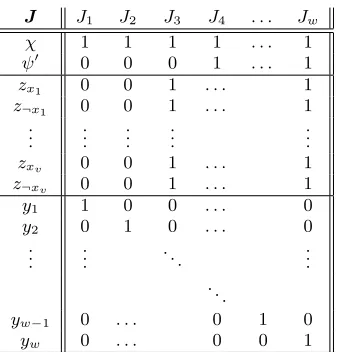
Proof (sketch). We give a polynomial-time Levin re-duction fromFQSat2. Letϕ=∃X.∀Y.ψbe an instance of
FQSat2, whereX={x1, . . . , xv}. We may assume without loss of generality thatψis not a tautology. We construct an agenda Φ, an integrity constraint Γ =>, an integeru= 0, a profileJ∈ J(Φ,Γ)n, and a subsetL
0⊆Φ of the agenda, as
follows. We pick somewsuch thatw > v, e.g.,w= 2v. We introduce auxiliary variablesy1, . . . , yw. Also, we introduce
auxiliary variableszl for each l ∈ {xi,¬xi : 1 ≤i ≤ v}. Then we construct a propositional formulaχthat is true if and only if one of the following two conditions holds: ei-ther (i) someyi is true, or (ii) for each l ∈ {xi,¬xi : 1 ≤
i ≤ v} it holds that l is true if and only if zl is true. Moreover, we construct a propositional formula ψ0 that is true if and only if both of the following two conditions holds: both (i) noyi with 1 ≤ i ≤ 3 is true, and (ii) ei-ther (ii.a) someyi is true, or (ii.b) the formula¬ψ is sat-isfiable. It is straightforward to construct these formulasχ
andψ0in polynomial time. We now define the agenda Φ by letting [Φ] ={χ, ψ0} ∪ {zxi, z¬xi: 1≤i≤v} ∪ {y1, . . . , yw}.
Next, we construct the profile J = (J1, . . . , Jw) as shown
in Figure 4. Note thatm(J, χ) = w; m(J, ψ0) = w−3; for each 1≤ i ≤v,m(J, zxi) = m(J, z¬xi) = w−2; for
each 1 ≤ j ≤ w, m(J,¬yj) = w−1. Therefore {χ} ≤J { ¬yj : 1 ≤j ≤w} ≤J {zxi, z¬xi : 1 ≤i≤ v} ≤J {ψ
0
}. Moreover, we letL0={¬ψ0}.
What remains is to specify a polynomial-time com-putable functiongthat takes some J∗∈WinnerRA,Φ,Γ(J)
with L0 ⊆ J∗, and that produces a model M such
thatFQSat2(ϕ, M). LetJ
∗∈
WinnerRA,Φ,Γ(J). The
func-tiongoutputs{xi: 1≤i≤v, zxi ∈J
∗}
.
J J1 J2 J3 J4 . . . Jw
χ 1 1 1 1 . . . 1
ψ0 0 0 0 1 . . . 1
zx1 0 0 1 . . . 1
z¬x1 0 0 1 . . . 1 .
.
. ... ... ... ...
zxv 0 0 1 . . . 1
z¬xv 0 0 1 . . . 1
y1 1 0 0 . . . 0
y2 0 1 0 . . . 0
. .
. ... . .. ... . ..
yw−1 0 . . . 0 1 0
[image:8.612.353.522.50.226.2]yw 0 . . . 0 0 1
Figure 4: construction of the profile in the proof of Proposition 16.
The intuition behind this reduction is the following. The profile is constructed in such a way that every Ranked-Agenda winner contains χ. If there is an assignment α to the variables {x1, . . . , xv} such that ∀Y.ψ[α] is true, then there exists a winner containing all literals ¬yj, the vari-ables zl for those literalsl that are satisfied byα, and the formula¬ψ0, because any set containingχ, the literals¬yj, and those variableszlwould be inconsistent with ψ0, since such a set implies ψ (and thus forces ¬ψ to be unsatisfi-able). Moreover, any winner containing ¬ψ0 is of such a form, and thus corresponds to an assignment α with the property that∀Y.ψ[α] is true.
Corollary 17. WinDet(RA) is Σp2-complete.
Hard-ness holds even with the restriction thatΓ =>, andu= 0.
4.
CONCLUSION
We studied the computational complexity of the winner determination problem for (the judgment aggregation ana-logues of) the Kemeny rule, the Slater rule and the Young rule, as well as two variants of the Ranked-Agenda rule. These computational tasks we formalized in the form of a search problem and a decision problem. We showed that the complexity for the Kemeny, Slater and Young rules lies at the Θp2-level of the PH, and we showed that the complexity
of the Ranked-Agenda rule, lies at the ∆p2-level of the PH, in case of a fixed tie-breaking rule, and lies at the Σp2-level
of the PH in case ties can be broken in arbitrary ways. Future research should include investigating the computa-tional complexity of the winner determination problem for other complete and consistent judgment aggregation pro-cedures. One example of such a procedure is one based on the distance measure introduced by Duddy and Piggins [11]. Another direction for further research is to investigate the contribution of various aspects of the problem to its com-putational complexity, by analyzing the problems using the framework of parameterized complexity theory.
Acknowledgments
REFERENCES
[1] N. Alon, D. Falik, R. Meir, and M. Tennenholtz. Bundling attacks in judgment aggregation. In
Proceedings of the Twenty-Seventh AAAI Conference on Artificial Intelligence (AAAI 2013). AAAI Press, 2013.
[2] S. Arora and B. Barak.Computational Complexity – A Modern Approach. Cambridge University Press, 2009. [3] D. Baumeister, G. Erd´elyi, O. J. Erd´elyi, and
J. Rothe. Computational aspects of manipulation and control in judgment aggregation. In P. Perny,
M. Pirlot, and A. Tsouki`as, editors,Proceedings of the Third International Conference on Algorithmic Decision Theory (ADT 2013), Brussels, Belgium, November 13–15, 2013, volume 8176 ofLecture Notes in Computer Science, pages 71–85. Springer Verlag, 2013.
[4] D. Baumeister, G. Erd´elyi, and J. Rothe. How hard is it to bribe the judges? A study of the complexity of bribery in judgment aggregation. InProceedings of the Second International Conference on Algorithmic Decision Theory (ADT 2011), Piscataway, NJ, USA, October 26–28, 2011, volume 6992 ofLecture Notes in Computer Science, pages 1–15. Springer Verlag, 2011. [5] S. J. Brams and P. C. Fishburn. Voting procedures. In
K. J. Arrow, A. K. Sen, and K. Suzumura, editors,
Handbook of Social Choice and Welfare, volume 1, chapter 4, pages 173–236. Elsevier Science Publishers, North-Holland, 2002.
[6] F. Brandt, V. Conitzer, and U. Endriss.
Computational social choice. In G. Weiss, editor,
Multiagent Systems, pages 213–283. MIT Press, 2013. [7] Z.-Z. Chen and S. Toda. The complexity of selecting
maximal solutions.Information and Computation, 119:231–239, June 1995.
[8] V. Conitzer, J. Lang, and L. Xia. How hard is it to control sequential elections via the agenda? In C. Boutilier, editor,IJCAI 2009, Proceedings of the 21st International Joint Conference on Artificial Intelligence, Pasadena, California, USA, July 11-17, 2009, pages 103–108, 2009.
[9] F. Dietrich and C. List. Arrow’s Theorem in judgment aggregation.Social Choice and Welfare, 29(1):19–33, 2007.
[10] F. Dietrich and C. List. Judgment aggregation under constraints. In T. Boylan and R. Gekker, editors,
Economics, Rational Choice and Normative
Philosophy, Routledge Frontiers of Political Economy. Taylor & Francis, 2008.
[11] C. Duddy and A. Piggins. A measure of distance between judgment sets.Social Choice and Welfare, 39(4):855–867, 2012.
[12] U. Endriss. Judgment aggregation. In F. Brandt, V. Conitzer, U. Endriss, J. Lang, and A. D. Procaccia, editors,Handbook of Computational Social Choice. Cambridge University Press, 2015. Forthcoming.
[13] U. Endriss, U. Grandi, and D. Porello. Complexity of judgment aggregation.J. Artif. Intell. Res.,
45:481–514, 2012.
[14] O. Goldreich.P, NP, and NP-Completeness: The Basics of Complexity Theory. Cambridge University Press, 2010.
[15] U. Grandi.Binary Aggregation with Integrity Constraints. PhD thesis, University of Amsterdam, 2012.
[16] U. Grandi and U. Endriss. Lifting integrity constraints in binary aggregation.Artificial Intelligence,
199–200:45–66, 2013.
[17] D. Grossi and G. Pigozzi.Judgment Aggregation: A Primer. Synthesis Lectures on Artificial Intelligence and Machine Learning. Morgan & Claypool, 2014. [18] J. Krajicek.Bounded arithmetic, propositional logic
and complexity theory. Cambridge University Press, 1995.
[19] M. W. Krentel. Generalizations of OptP to the Polynomial Hierarchy.Theoretical Computer Science, 97(2):183–198, 1992.
[20] J. Lang, G. Pigozzi, M. Slavkovik, and L. van der Torre. Judgment aggregation rules based on minimization. InProceedings of the 13th Conference on Theoretical Aspects of Rationality and Knowledge (TARK-2011), 2011.
[21] J. Lang and M. Slavkovik. How hard is it to compute majority-preserving judgment aggregation rules? In
21st European Conference on Artificial Intelligence (ECAI 2014). IOS Press, 2014.
[22] C. List and P. Pettit. Aggregating sets of judgments: An impossibility result.Economics and Philosophy, 18(1):89–110, 2002.
[23] C. List and C. Puppe. Judgment aggregation: A survey. In P. Anand, P. Pattanaik, and C. Puppe, editors,Handbook of Rational and Social Choice. Oxford University Press, 2009.
[24] M. K. Miller and D. Osherson. Methods for distance-based judgment aggregation.Social Choice and Welfare, 32(4):575–601, 2009.
[25] G. Pigozzi. Belief merging and the discursive dilemma: An argument-based account of paradoxes of judgment aggregation.Synthese, 152(2):285–298, 2006.
[26] D. Porello and U. Endriss. Ontology merging as social choice. InProceedings of the 12th International Workshop on Computational Logic in Multiagent Systems (CLIMA-2011), volume 6814 ofLecture Notes in Artificial Intelligence, pages 157–170. Springer Verlag, July 2011.
[27] L. J. Stockmeyer. The polynomial-time hierarchy.
Theoretical Computer Science, 3(1):1–22, 1976. [28] C. Wrathall. Complete sets and the polynomial-time