R E S E A R C H A R T I C L E
Open Access
What is the potential for bisexual men in China
to act as a bridge of HIV transmission to the
female population? Behavioural evidence from a
systematic review and meta-analysis
Eric PF Chow
1, David P Wilson
1and Lei Zhang
1,2*Abstract
Background:HIV prevalence among men who have sex with men (MSM) in China has rapidly increased in recent
years. It is suggested that MSM could be a potential bridge of HIV transmission to the general female population. We investigated the bisexual behaviour of MSM in China through systematic review and meta-analysis.
Methods:We conducted a systematic review and meta-analyses on published peer-reviewed Chinese and English literature during 2001-2010 according to the PRISMA guidelines. Marital status and sexual behavioural indicators of MSM were presented graphically using forest plots. The pooled effect rates with 95% confidence intervals were also calculated. Meta-regression analyses were performed to examine the factors associated with high
heterogeneities across the studies.
Results:Forty-three eligible articles (11 in English and 32 in Chinese) were identified. Our results showed that 17.0% (95% CI: 15.1-19.1%) of MSM in China are currently married to a woman and 26.3% (95% CI: 23.6-29.1%) of MSM had female sexual partners in the last six months. The pooled estimates for condom use rate between MSM and female sex partners was 41.4% (95% CI: 35.5-47.5%) at the last sex act; and 25.6% (95% CI: 23.0-28.4%) in the last six months. The consistent condom use rates with regular, non-commercial, casual and commercial female sex partners in the last six months were 23.3% (95% CI: 11.25-42.1%), 39.0% (95% CI: 28.8-50.3%) and 55.8% (95% CI: 41.4-69.4%), respectively.
Conclusions:A substantial proportion of Chinese MSM is currently married or had sexual relations with a female in the past six months. In addition, low condom usage was common between married MSM and their wives, hence posing a higher risk of transmitting HIV. Harm-reduction programs targeting married MSM and their female partners are necessary to curb the further spread of HIV infection to the general female population.
Keywords:Men who have sex with men (MSM), meta-analysis, bisexual behaviour, condom use
Background
Although blood transfusions and injecting drug use had historically been the dominant risk factors associated with HIV infection in China, sexual transmission has become the main route of HIV transmission in recent years. Among the 48,000 (41,000-55,000) Chinese people newly diagnosed with HIV in 2009 [1], 42.2% and 32.5%
were due to heterosexual and homosexual transmission respectively [1,2]. Notably, HIV prevalence among men who have sex with men (MSM) in China had increased rapidly from 1.4% to 5.3% between 2001-2009 [3] and this increasing trend is likely to continue in coming years.
The rapid increase in HIV prevalence among Chinese MSM was probably due to many factors including the increasing numbers of men who engage in homosexual sex; multiple male partners; and high levels of unpro-tected anal intercourse. A recent systematic review and * Correspondence: [email protected]
1
The Kirby Institute for infection and immunity in society, University of New South Wales, Sydney, Australia
Full list of author information is available at the end of the article Chowet al.BMC Infectious Diseases2011,11:242
http://www.biomedcentral.com/1471-2334/11/242
meta-analysis study showed that just over one-third of MSM report consistent condom use with their male sex partners in the last six months and only 20% consis-tently used condoms with their regular male partners [4]. It has also been reported that sexually active Chi-nese MSM report having an average of six to seven male sexual partners in the last six months and 18% of them had participated in group sex in the past 12 months [5].
Due to traditional cultural and family values, Chinese MSM often marry to conceal their homosexuality from family and friends. It was estimated that approximately 50-70% of MSM have had sex with females in their life-time [6-10] and 70-90% will eventually marry [11,12]. This suggests that bisexual behaviours among Chinese MSM are common. As they are often the only son in their families, as a direct result of China’s one-child pol-icy, they also face their parents’expectation to have chil-dren to continue the family line.
Chinese MSM tend to have low rates of condom use with their female partners [13]. Given the rapid increase in HIV prevalence among Chinese MSM, their bisexual behaviours could potentially act as a bridge of HIV trans-mission to the general population [5,9,14-16]. In this study we conducted a systematic review of studies on bisexual behaviours among Chinese MSM in both Chinese and English literature to examine the extent to which bisexual behaviour is common among Chinese MSM.
Our review, coupled with meta-analyses for specific questions, summarised evidence of bisexual behaviours of Chinese MSM. These included the age of MSM who are currently married; the percentage of Chinese MSM who had female sexual partners in last six months; the percentage of MSM who are currently married; and the condom usage rate among MSM with their female sexual partners at the last sex act or in the last six months. Dif-ferent types of partnerships, including regular, non-com-mercial casual or comnon-com-mercial, were also distinguished in our review and analysis. In comparison with a recent published systematic review on behavioural studies among Chinese MSM [17], this study employed a meta-analysis approach with a strong focus on the condom use with different types of female partners. In addition, this study substantially extended the previous analysis to include both English and Chinese literature. Our study provides more detail insights and quantifiable results on the bisexual behaviours among MSM in China.
Method
Searching strategy
Two investigators (EPFC, LZ) performed a systematic lit-erature search for peer-reviewed studies from the follow-ing electronic databases: PubMed, Wanfang Data, China National Knowledge Infrastructure (CNKI) and Chinese
Scientific Journals Fulltext Database (CQVIP), published between 2001 and 2010. The keywords searched in the databases were ("unprotected sex”OR“condom use”OR “risk behaviour”)OR ("KABP [knowledge, attitudes, beliefs and practices]” OR“behaviour”)OR("Married” OR“Unmarried”)OR("female sexual partners”)AND ("homosexual”OR“MSM”OR“men who have sex with men”OR“gay”)AND“China”. The references in the rele-vant articles were searched manually. We limited our search to articles published in Chinese and English only. We followed the PRISMA (Preferred Reporting Items for Systematic Reviews and Meta-Analyses) guidelines issued in 2009 for conducting and reporting this systematic review and meta-analysis [18].
Study selection
Studies were included if they (1) reported the percentage of condom use (at the last sex act and/or consistent condom use in the last six months)OR (2) reported the percentage of MSM who had female sexual partners in last six months, through a peer-reviewed publication of cohort or cross-sectional study. We excluded studies in which the target study population was specifically money boys or MSM drug users only. Review papers, non-peer reviewed theses, local reports, conference abstract and presentations were excluded from this study. The two duration types of condom use in “last sex act” and“in last six months”were the most frequent and standardised reported indicators in most Chinese and English literature. Therefore consistent condom use rates within other durations (e.g. past one, three, twelve months or others) were also excluded. Studies which did not report study location, time periods and sample size were also excluded. If the study was duplicated in the databases, studies published in Chinese or published lat-est were excluded from this review.
Quality assessment
The quality of studies was assessed using a validated quality assessment tool for cross-sectional studies [19]. The following seven items were assessed to calculate a total quality score: (1) clear definition of the target population; (2) representativity of probability sampling; (3) sample characteristics matching the overall popula-tion; (4) adequate response rate; (5) standardised data collection methods; (6) reliable and valid survey mea-sures/instruments; (7) appropriate statistical methods. Answers were scored 0 and 1 for ‘No’and‘Yes’, respec-tively. The total quality score varied between 0 and 7 (see Table 1).
Data abstraction
For all identified studies, we also extracted information about the study: first author and year of publication, Chowet al.BMC Infectious Diseases2011,11:242
http://www.biomedcentral.com/1471-2334/11/242
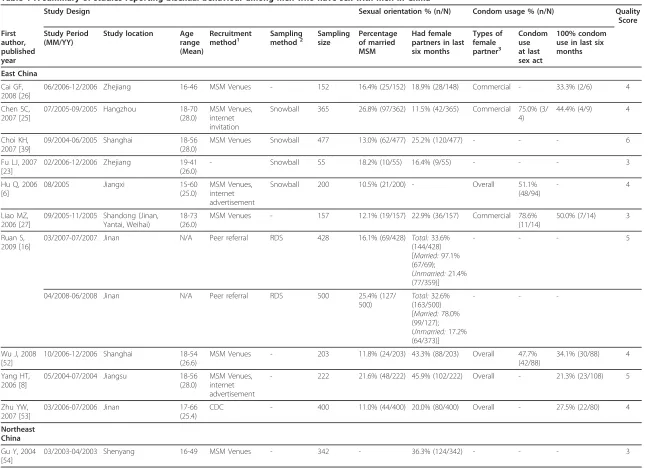
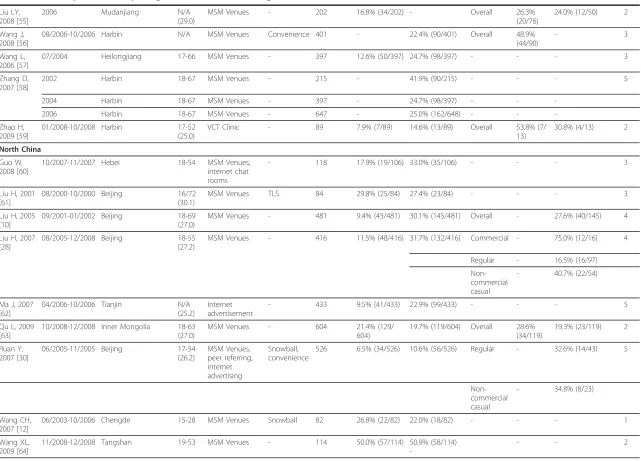
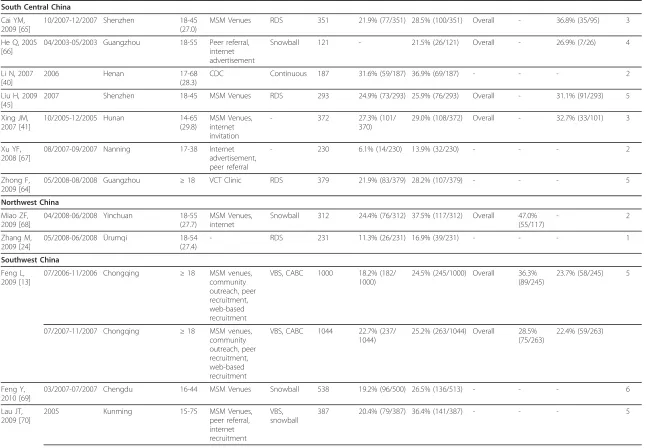
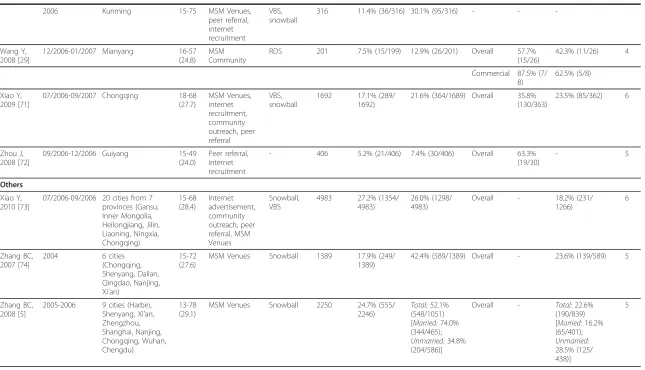
Table 1 A summary of studies reporting bisexual behaviour among men who have sex with men in China
Study Design Sexual orientation % (n/N) Condom usage % (n/N) Quality
Score First author, published year Study Period (MM/YY)
Study location Age range (Mean) Recruitment method1 Sampling method2 Sampling size Percentage of married MSM Had female partners in last six months Types of female partner3 Condom use at last sex act 100% condom use in last six months
East China
Cai GF, 2008 [26]
06/2006-12/2006 Zhejiang 16-46 MSM Venues - 152 16.4% (25/152) 18.9% (28/148) Commercial - 33.3% (2/6) 4
Chen SC, 2007 [25]
07/2005-09/2005 Hangzhou 18-70 (28.0)
MSM Venues, internet invitation
Snowball 365 26.8% (97/362) 11.5% (42/365) Commercial 75.0% (3/ 4)
44.4% (4/9) 4
Choi KH, 2007 [39]
09/2004-06/2005 Shanghai 18-56 (28.0)
MSM Venues Snowball 477 13.0% (62/477) 25.2% (120/477) - - - 6
Fu LJ, 2007 [23]
02/2006-12/2006 Zhejiang 19-41 (26.0)
- Snowball 55 18.2% (10/55) 16.4% (9/55) - - - 3
Hu Q, 2006 [6]
08/2005 Jiangxi 15-60
(25.0)
MSM Venues, internet advertisement
Snowball 200 10.5% (21/200) - Overall 51.1%
(48/94)
- 4
Liao MZ, 2006 [27]
09/2005-11/2005 Shandong (Jinan, Yantai, Weihai)
18-73 (26.0)
MSM Venues - 157 12.1% (19/157) 22.9% (36/157) Commercial 78.6%
(11/14)
50.0% (7/14) 3
Ruan S, 2009 [16]
03/2007-07/2007 Jinan N/A Peer referral RDS 428 16.1% (69/428) Total:33.6%
(144/428) [Married:97.1% (67/69);
Unmarried:21.4% (77/359)]
- - - 5
04/2008-06/2008 Jinan N/A Peer referral RDS 500 25.4% (127/
500)
Total:32.6% (163/500) [Married:78.0% (99/127);
Unmarried:17.2% (64/373)]
- -
-Wu J, 2008 [52]
10/2006-12/2006 Shanghai 18-54 (26.6)
MSM Venues - 203 11.8% (24/203) 43.3% (88/203) Overall 47.7%
(42/88)
34.1% (30/88) 4
Yang HT, 2006 [8]
05/2004-07/2004 Jiangsu 18-56
(28.0)
MSM Venues, internet advertisement
- 222 21.6% (48/222) 45.9% (102/222) Overall - 21.3% (23/108) 5
Zhu YW, 2007 [53]
03/2006-07/2006 Jinan 17-66
(25.4)
CDC - 400 11.0% (44/400) 20.0% (80/400) Overall - 27.5% (22/80) 4
Northeast China
Gu Y, 2004 [54]
03/2003-04/2003 Shenyang 16-49 MSM Venues - 342 - 36.3% (124/342) - - - 3
Table 1 A summary of studies reporting bisexual behaviour among men who have sex with men in China(Continued)
Liu LY, 2008 [55]
2006 Mudanjiang N/A
(29.0)
MSM Venues - 202 16.8% (34/202) - Overall 26.3%
(20/76)
24.0% (12/50) 2
Wang J, 2008 [56]
08/2006-10/2006 Harbin N/A MSM Venues Convenience 401 - 22.4% (90/401) Overall 48.9%
(44/90)
- 3
Wang L, 2006 [57]
07/2004 Heilongjiang 17-66 MSM Venues - 397 12.6% (50/397) 24.7% (98/397) - - - 3
Zhang D, 2007 [58]
2002 Harbin 18-67 MSM Venues - 215 - 41.9% (90/215) - - - 5
2004 Harbin 18-67 MSM Venues - 397 - 24.7% (98/397) - -
-2006 Harbin 18-67 MSM Venues - 647 - 25.0% (162/648) - -
-Zhao H, 2009 [59]
01/2008-10/2008 Harbin 17-52
(25.0)
VCT Clinic - 89 7.9% (7/89) 14.6% (13/89) Overall 53.8% (7/
13)
30.8% (4/13) 2
North China
Guo W, 2008 [60]
10/2007-11/2007 Hebei 18-54 MSM Venues,
internet chat rooms
- 118 17.9% (19/106) 33.0% (35/106) - - - 3
Liu H, 2001 [61]
08/2000-10/2000 Beijing 16/72
(30.1)
MSM Venues TLS 84 29.8% (25/84) 27.4% (23/84) - - - 3
Liu H, 2005 [10]
09/2001-01/2002 Beijing 18-69
(27.0)
MSM Venues - 481 9.4% (45/481) 30.1% (145/481) Overall - 27.6% (40/145) 4
Liu H, 2007 [28]
08/2005-12/2008 Beijing 18-55
(27.2)
MSM Venues - 416 11.5% (48/416) 31.7% (132/416) Commercial - 75.0% (12/16) 4
Regular - 16.5% (16/97)
Non-commercial casual
- 40.7% (22/54)
Ma J, 2007 [62]
04/2006-10/2006 Tianjin N/A
(25.2)
Internet advertisement
- 433 9.5% (41/433) 22.9% (99/433) - - - 5
Qu L, 2009 [63]
10/2008-12/2008 Inner Mongolia 18-63 (27.0)
MSM Venues - 604 21.4% (129/
604)
19.7% (119/604) Overall 28.6% (34/119)
19.3% (23/119) 2
Ruan Y, 2007 [30]
06/2005-11/2005 Beijing 17-54
(26.2)
MSM Venues, peer referring, internet advertising
Snowball, convenience
526 6.5% (34/526) 10.6% (56/526) Regular - 32.6% (14/43) 5
Non-commercial casual
- 34.8% (8/23)
Wang CH, 2007 [12]
06/2003-10/2006 Chengde 15-28 MSM Venues Snowball 82 26.8% (22/82) 22.0% (18/82) - - - 1
Wang XL, 2009 [64]
11/2008-12/2008 Tangshan 19-53 MSM Venues - 114 50.0% (57/114) 50.9% (58/114)
-- - 2
Chow
et
al
.
BMC
Infectious
Diseases
2011,
11
:242
http://ww
w.biomedcen
tral.com/1471
-2334/11/242
Page
4
o
f
1
Table 1 A summary of studies reporting bisexual behaviour among men who have sex with men in China(Continued)
South Central China
Cai YM, 2009 [65]
10/2007-12/2007 Shenzhen 18-45 (27.0)
MSM Venues RDS 351 21.9% (77/351) 28.5% (100/351) Overall - 36.8% (35/95) 3
He Q, 2005 [66]
04/2003-05/2003 Guangzhou 18-55 Peer referral, internet advertisement
Snowball 121 - 21.5% (26/121) Overall - 26.9% (7/26) 4
Li N, 2007 [40]
2006 Henan 17-68
(28.3)
CDC Continuous 187 31.6% (59/187) 36.9% (69/187) - - - 2
Liu H, 2009 [45]
2007 Shenzhen 18-45 MSM Venues RDS 293 24.9% (73/293) 25.9% (76/293) Overall - 31.1% (91/293) 5
Xing JM, 2007 [41]
10/2005-12/2005 Hunan 14-65
(29.8)
MSM Venues, internet invitation
- 372 27.3% (101/
370)
29.0% (108/372) Overall - 32.7% (33/101) 3
Xu YF, 2008 [67]
08/2007-09/2007 Nanning 17-38 Internet advertisement, peer referral
- 230 6.1% (14/230) 13.9% (32/230) - - - 2
Zhong F, 2009 [64]
05/2008-08/2008 Guangzhou ≥18 VCT Clinic RDS 379 21.9% (83/379) 28.2% (107/379) - - - 5
Northwest China
Miao ZF, 2009 [68]
04/2008-06/2008 Yinchuan 18-55 (27.7)
MSM Venues, internet
Snowball 312 24.4% (76/312) 37.5% (117/312) Overall 47.0% (55/117)
- 2
Zhang M, 2009 [24]
05/2008-06/2008 Ürumqi 18-54
(27.4)
- RDS 231 11.3% (26/231) 16.9% (39/231) - - - 1
Southwest China
Feng L, 2009 [13]
07/2006-11/2006 Chongqing ≥18 MSM venues, community outreach, peer recruitment, web-based recruitment
VBS, CABC 1000 18.2% (182/ 1000)
24.5% (245/1000) Overall 36.3% (89/245)
23.7% (58/245) 5
07/2007-11/2007 Chongqing ≥18 MSM venues, community outreach, peer recruitment, web-based recruitment
VBS, CABC 1044 22.7% (237/ 1044)
25.2% (263/1044) Overall 28.5% (75/263)
22.4% (59/263)
Feng Y, 2010 [69]
03/2007-07/2007 Chengdu 16-44 MSM Venues Snowball 538 19.2% (96/500) 26.5% (136/513) - - - 6
Lau JT, 2009 [70]
2005 Kunming 15-75 MSM Venues,
peer referral, internet recruitment
VBS, snowball
387 20.4% (79/387) 36.4% (141/387) - - - 5
Chow
et
al
.
BMC
Infectious
Diseases
2011,
11
:242
http://ww
w.biomedcen
tral.com/1471
-2334/11/242
Page
5
o
f
1
Table 1 A summary of studies reporting bisexual behaviour among men who have sex with men in China(Continued)
2006 Kunming 15-75 MSM Venues,
peer referral, internet recruitment
VBS, snowball
316 11.4% (36/316) 30.1% (95/316) - -
-Wang Y, 2008 [29]
12/2006-01/2007 Mianyang 16-57 (24.8)
MSM Community
RDS 201 7.5% (15/199) 12.9% (26/201) Overall 57.7%
(15/26)
42.3% (11/26) 4
Commercial 87.5% (7/ 8)
62.5% (5/8)
Xiao Y, 2009 [71]
07/2006-09/2007 Chongqing 18-68 (27.7) MSM Venues, internet recruitment, community outreach, peer referral VBS, snowball
1692 17.1% (289/ 1692)
21.6% (364/1689) Overall 35.8% (130/363)
23.5% (85/362) 6
Zhou J, 2008 [72]
09/2006-12/2006 Guiyang 15-49
(24.0)
Peer referral, internet recruitment
- 406 5.2% (21/406) 7.4% (30/406) Overall 63.3%
(19/30)
- 5
Others
Xiao Y, 2010 [73]
07/2006-09/2006 20 cities from 7 provinces (Gansu, Inner Mongolia, Heilongjiang, Jilin, Liaoning, Ningxia, Chongqing) 15-68 (28.4) Internet advertisement, community outreach, peer referral, MSM Venues Snowball, VBS
4983 27.2% (1354/ 4983)
26.0% (1298/ 4983)
Overall - 18.2% (231/
1266)
6
Zhang BC, 2007 [74]
2004 6 cities
(Chongqing, Shenyang, Dalian, Qingdao, Nanjing, Xi’an)
15-72 (27.6)
MSM Venues Snowball 1389 17.9% (249/
1389)
42.4% (589/1389) Overall - 23.6% (139/589) 5
Zhang BC, 2008 [5]
2005-2006 9 cities (Harbin, Shenyang, Xi’an, Zhengzhou, Shanghai, Nanjing, Chongqing, Wuhan, Chengdu) 13-78 (29.1)
MSM Venues Snowball 2250 24.7% (555/
2246)
Total:52.1% (548/1051) [Married:74.0% (344/465);
Unmarried:34.8% (204/586)]
Overall - Total:22.6%
(190/839) [Married:16.2% (65/401); Unmarried: 28.5% (125/ 438)] 5 1
MSM Venues: including gay bars, parks, sauna, bathroom, dance clubs; VCT Clinic: HIV voluntary counseling and testing clinic 2
RDS: Respondent-Driven Sampling; TLS: time-location sampling; VBS: Venue-based sampling, CABC: Cruising area-based convenience sampling 3
Overall partnerships represent the combination of regular, non-commercial casual and commercial female partnerships.
study period, study location, age of MSM, study base, sampling method, sample size, marital status (percentage of currently married MSM), and types of female sexual partners (regular, non-commercial casual, commercial or overall). We divided the studies into six traditional administrative regions (East China, Northeast China, North China, South Central China, Northwest China and Southwest China). See Table 1 for a description of included studies and extracted data.
Quantitative data synthesis
The data were analysed in the Comprehensive Meta-Ana-lysis software (V2.0, Biostat, Englewood, New Jersey). For every stratified analysis, we tested the significance of het-erogeneity by the Cochran’sQstatistics (p< 0.10 indicates significant heterogeneity) and the level of heterogeneity was assessed by theI2statistic [20]. The value of theI2 sta-tistic indicates low (25%), moderate (50%) and high (75%) heterogeneity between studies. Due to the presence of het-erogeneity in different stratified analyses, random effect models were used to compute the pooled effect rates (i.e. percentage of married MSM, percentage of MSM who had female sexual partners in the last six months and the con-dom use rates), 95% confidence intervals (CI) and relative weights of studies. Results were graphically presented in forest plots. Publication bias was tested by the Begg and Mazumdar rank correlation (p< 0.05 on the Kendall’s tau indicates significant publication bias) where three or more studies contributed to a stratified analysis [21].
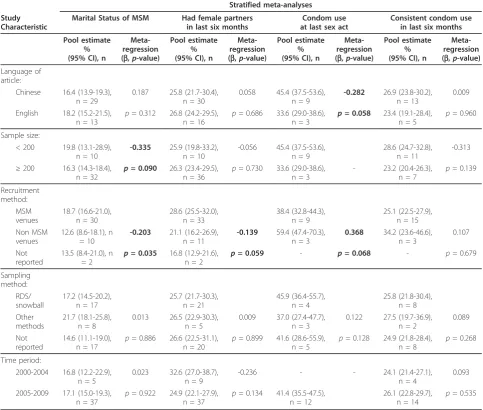
Heterogeneity in meta-analysis is a test of the varia-tion between studies. A high level of heterogeneity (I2 ≥ 75.00,p <0.10) may be due to the factors of the size of study, sampling methods and study base [20]. We inves-tigated factors related to heterogeneity among studies by using meta-regression [22]. Due to insufficient number of studies, we could only perform meta-regression for the meta-analysis on: (1) MSM marriage rate; (2) MSM who had female sexual partners in the last six months; (3) condom use between MSM and female partners at last act; and (4) consistent condom use between MSM and female partners in the last six months. Potential study characteristics associated with high heterogeneity were examined in a multiple variables model. The multi-ple variables used in this study were the language of publication (Chinese versus English), size of study (< 200 versus ≥ 200), recruitment method (MSM venues versus non-MSM venues versus not reported), sampling method (not reported method versus other methods versus RDS (respondent driven sampling) or snowball method), and study time period (early 2000s (2000-2004) versus late 2000s (2005-2009)). The regression coefficient and pvalues (pvalue < 0.10 indicates that the factor is significantly associated with heterogeneity) for each study characteristic on meta-analysis were
calculated by the STATA statistical software package (version 10). Results of meta-regression and subgroup meta-analyses based on the potential study characteris-tics were summarised in Table 2.
We also performed further analyses on the correlation between age and percentage of married MSM by the Spearman correlation coefficient (r).
Results
Trial Flow/Flow of included studies
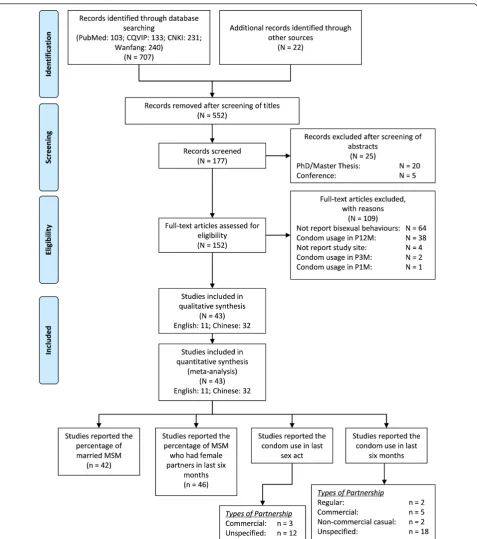
We identified 707 articles from four electronic databases (103 in PubMed, 133 in CQVIP, 231 in CNKI and 240 in Wanfang); we also identified 22 articles from an internet search and reference lists of published articles. Due to duplication of articles and unrelated topics, we excluded 552 articles after screening the titles. We screened the abstracts of the remaining 177 articles, fol-lowing which 25 articles were excluded because 20 were non peer-reviewed theses and five were conference pre-sentations or abstracts. The remaining 152 articles were eligible for full-text screening; we further excluded 109 articles (64 did not report bisexual behaviour; 38 reported condom use with female partners in last twelve months; four did not report the study site; two reported condom use in last three months and one reported con-dom use in the last one month only). Finally, we included 43 articles (11 in English and 32 in Chinese) in a qualitative and quantitative synthesis (Figure 1).
Study characteristics
The sample size of identified studies ranged from 55 to 4983 (median: 365; IQR: 201-480). Among 43 studies, two did not identify the study base [23,24] and approxi-mately 73% (30/41) of studies recruited MSM partici-pants from MSM venues. Five studies [25-29] reported the condom use rate between MSM and female sex workers. Two studies [28,30] reported the condom use rate between MSM and regular/non-commercial casual female sexual partners. Only two studies [5,16] reported the percentage of married and unmarried MSM who had sex with female in the last six months. The majority of studies recruited MSM participants from MSM venues such as gay bars, sauna and bathrooms (Table 1).
Quantitative data synthesis Marital status
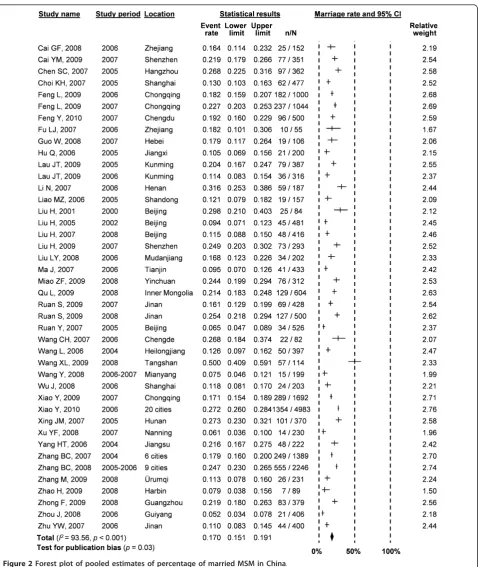
It was estimated that 17.0% (95% CI: 15.1-19.1%) of MSM in China are currently married (Figure 2). High and significant heterogeneity (I2 = 93.56, p< 0.001) existed and the publication bias was marginally signifi-cant (p = 0.03). Meta-regression analysis showed that heterogeneity was explained by the size of study (b = -0.335,p= 0.090) and recruitment method (b= -0.203, p= 0.035) (Table 2). Studies with a small sample size Chowet al.BMC Infectious Diseases2011,11:242
http://www.biomedcentral.com/1471-2334/11/242
(< 200) and participants recruited from MSM venues were more likely to report a higher marriage rate than large studies conducted in non-MSM venues. In addi-tion, a significant association (r = 0.816,p < 0.0001) between the mean age of the sampled MSM cohorts and the current marital status (Figure 3) was observed, which indicates that older MSM are more likely to be married compared to younger MSM.
Bisexual behaviour of MSM
The random effects model revealed that approximately 26.3% (95% CI: 23.6-29.1%) of MSM had female sexual partners in the last six months (Figure 4a); no signifi-cant publication bias existed (p= 0.353). High and sig-nificant heterogeneity between studies existed (I2 =
95.27, p< 0.001) in the meta-analysis. Only one study factor (recruitment method) was significantly asso-ciated with this heterogeneity (b = -0.139, p= 0.059) (Table 2). Studies which recruited participants from gay venues were more likely to have female sexual partners in the last six months than MSM recruited from non-gay venues.
[image:8.595.56.540.102.512.2]A comparison of the bisexual behaviours between married and unmarried MSM showed that married MSM (83.9%, 95% CI: 71.1-91.8%) were more likely to have female sexual partners than unmarried MSM (23.9%, 95% CI: 14.7-36.5%) in last six months (Figure 4b) (c2 = 490.4,p< 0.001). No significant publication bias was observed (p= 0.851).
Table 2 Result of individual variable meta-regression models for each stratified meta-analysis
Stratified meta-analyses
Study Characteristic
Marital Status of MSM Had female partners in last six months
Condom use at last sex act
Consistent condom use in last six months
Pool estimate % (95% CI), n
Meta-regression (b,p-value)
Pool estimate % (95% CI), n
Meta-regression (b,p-value)
Pool estimate % (95% CI), n
Meta-regression (b,p-value)
Pool estimate % (95% CI), n
Meta-regression (b,p-value)
Language of article:
Chinese 16.4 (13.9-19.3), n = 29
0.187 25.8 (21.7-30.4), n = 30
0.058 45.4 (37.5-53.6), n = 9
-0.282 26.9 (23.8-30.2), n = 13
0.009
English 18.2 (15.2-21.5), n = 13
p= 0.312 26.8 (24.2-29.5), n = 16
p= 0.686 33.6 (29.0-38.6), n = 3
p= 0.058 23.4 (19.1-28.4), n = 5
p= 0.960
Sample size:
< 200 19.8 (13.1-28.9), n = 10
-0.335 25.9 (19.8-33.2), n = 10
-0.056 45.4 (37.5-53.6), n = 9
28.6 (24.7-32.8), n = 11
-0.313
≥200 16.3 (14.3-18.4),
n = 32 p
= 0.090 26.3 (23.4-29.5), n = 36
p= 0.730 33.6 (29.0-38.6), n = 3
- 23.2 (20.4-26.3), n = 7
p= 0.139
Recruitment method:
MSM venues
18.7 (16.6-21.0), n = 30
28.6 (25.5-32.0), n = 33
38.4 (32.8-44.3), n = 9
25.1 (22.5-27.9), n = 15 Non MSM
venues
12.6 (8.6-18.1), n = 10
-0.203 21.1 (16.2-26.9), n = 11
-0.139 59.4 (47.4-70.3), n = 3
0.368 34.2 (23.6-46.6), n = 3
0.107
Not reported
13.5 (8.4-21.0), n
= 2 p
= 0.035 16.8 (12.9-21.6),
n = 2 p
= 0.059 - p= 0.068 - p= 0.679
Sampling method:
RDS/ snowball
17.2 (14.5-20.2), n = 17
25.7 (21.7-30.3), n = 21
45.9 (36.4-55.7), n = 4
25.8 (21.8-30.4), n = 8 Other
methods
21.7 (18.1-25.8), n = 8
0.013 26.5 (22.9-30.3), n = 5
0.009 37.0 (27.4-47.7), n = 3
0.122 27.5 (19.7-36.9), n = 2
0.089
Not reported
14.6 (11.1-19.0), n = 17
p= 0.886 26.6 (22.5-31.1), n = 20
p= 0.899 41.6 (28.6-55.9), n = 5
p= 0.128 24.9 (21.8-28.4), n = 8
p= 0.268
Time period:
2000-2004 16.8 (12.2-22.9), n = 5
0.023 32.6 (27.0-38.7), n = 9
-0.236 - - 24.1 (21.4-27.1),
n = 4
0.093
2005-2009 17.1 (15.0-19.3), n = 37
p= 0.922 24.9 (22.1-27.9), n = 37
p= 0.134 41.4 (35.5-47.5), n = 12
26.1 (22.8-29.7), n = 14
p= 0.535
Table showing the pool estimate (%), 95% confidence interval (CI), number of studies (n), meta-regression coefficient (b) and significance ofb(p-value).p-values
in bold print represent significant associations (p< 0.10).
Chowet al.BMC Infectious Diseases2011,11:242 http://www.biomedcentral.com/1471-2334/11/242
Condom use with female partners
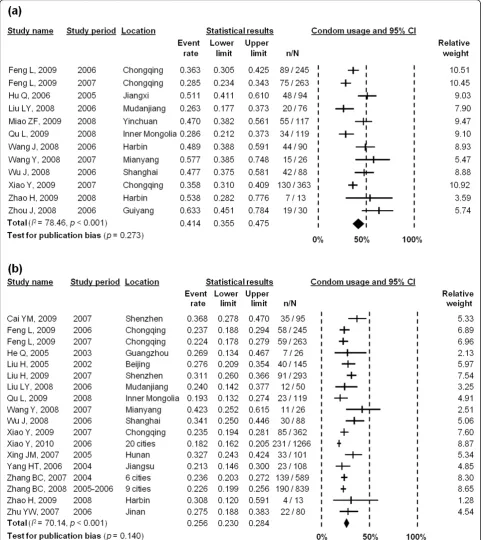
The pooled estimate of levels of condom use between MSM and their female partners during 2005-2008 was 41.4% (95% CI: 35.5-47.5%) at last sex act (Figure 5a) with significant heterogeneity (I2 = 78.46,p < 0.001) throughout these studies. Meta-regression analysis
[image:9.595.60.538.86.626.2]showed that two study characteristics, language of arti-cles (b = -0.282,p= 0.058) and recruitment method (b = 0.368,p= 0.068), significantly contributed to this rela-tively high heterogeneity (Table 2). Since the sample size and time period were collinear with other study factors in the meta-regression model, these two study
Figure 1Flow chart for selection of studies with number of articles (N) and number of estimates (n). Chowet al.BMC Infectious Diseases2011,11:242
http://www.biomedcentral.com/1471-2334/11/242
characteristics were both excluded by the meta-regres-sion model. There was no significant publication bias in this meta-analysis (p= 0.273).
Consistent condom use with female sexual partners in last six months was 25.6% (95% CI: 23.0-28.4%) during the
[image:10.595.60.539.85.653.2]period of 2002-2008 (Figure 5b). Moderate heterogeneity was observed between studies (I2= 70.14,p< 0.001), but we found that none of the study characteristics was signifi-cantly associated with this heterogeneity (Table 2). There was no significant publication bias observed (p= 0.140).
Figure 2Forest plot of pooled estimates of percentage of married MSM in China. Chowet al.BMC Infectious Diseases2011,11:242
http://www.biomedcentral.com/1471-2334/11/242
Condom use among MSM with commercial female partners was also analysed according to identified stu-dies (three reported condom use at last act [25,27,29], and five reported rates of consistent use in the last six months [25-29]). The pooled estimates of condom use in commercial partnerships were 80.3% (95% CI: 60.4-91.6%) (I2 = 0.00,p = 0.602) at last sex act and 55.8% (95% CI: 41.4-69.4%) (I2 = 4.50,p= 0.327) in the last six months (Figure 6). No significant publication bias was observed in either of the stratified analyses (p= 0.602 and 0.327 for last sex act and last six months, respec-tively). Since heterogeneities were low and not signifi-cant in both stratified meta-analyses, meta-regression analysis was not performed.
Two studies reported the consistent condom use with regular and non-commercial causal female partners in the last six months [28,30]. In comparison with commercial partnerships, condom usage rates in regular and non-com-mercial casual partnerships were much lower, estimated to be 23.3% (95% CI: 11.25-42.1%) (I2= 77.37,p= 0.036) and 39.0% (95% CI: 28.8-50.3%) (I2= 0.00,p= 0.240), respec-tively (Figure 7). Publication bias could not be assessed due to lack of studies in both stratified meta-analyses.
Discussion
Our meta-analysis showed that approximately 17.0% of MSM are currently married to a female in China, which is consistent with another recent review which reported an average of 17.5% [17]. In contrast, the percentage of MSM who are married in most Western developed countries is much lower. Only 1.5-3.0% of MSM are currently married to a woman in the United States [31-33] and 7.9% in Australia [34]; however, higher rates of marriage among MSM were observed in some other developing countries (for example, 35-42% in India [35,36]). There is generally greater acceptance and legiti-macy of gay identity, gay marriage or cohabitation
relationships and less social stigma, discrimination and family pressure in developed countries. Previous studies showed that only 11-17% of Chinese MSM disclosed their homosexual sexual orientation to their wives [37,38] and 1% of them disclosed to their children [37]. Due to the high prevalence of bisexual behaviours among MSM in China, this group is very likely to facili-tate HIV transmission to the female population to a much greater extent than occurs in most countries where HIV predominantly affects MSM. Our review provides a timely synthesis of current evidence of bisex-ual behaviours among MSM in China, which could inform the implementation of effective intervention programs.
Previous available studies indicated that Chinese MSM had an average of 1-5 female sexual partners in the last six months [7,8,39,40]. Additionally, we estimated that a higher proportion (83.9%) of married MSM have had female sexual partners than unmarried MSM (23.9%). However, only 16.2% and 28.5% of married and unmar-ried MSM have had consistent condom use with their female partners in the past six months, respectively [5]. Fifty-eight percent of married MSM had concurrent male and female sexual partners in last six months, hence putting their wives at a greater risk of HIV infec-tion [41].
Partnership type had strong influences on condom use of MSM. In general, condom usage at last sex act between MSM and overall female sexual partners was estimated to be 41.4% (95% CI: 35.5-47.5%); but only 25.6% (95% CI: 23.0-28.4%) of MSM used condoms con-sistently in the last six months. A study in 2004 found that 31.8% of MSM had regular female sex partners, 6.0% had non-commercial casual female sex partners and 4.5% had commercial female sex partners [14]. Among three specific partnership types, consistent con-dom use was estimated to be the greatest in commercial partnerships (55.8%, 95% CI: 41.4-69.4%), followed by non-commercial casual partnerships (39.0%, 95% CI: 28.8-50.3%) and regular partnerships (23.3%, 95% CI: 11.2-42.1%). In general, reasons of low condom use with partners mainly included: emotional and physical sensa-tion, availability of condoms, and loyalty and trust [5,25]. In addition, sexual abuse was common in China. It was reported that 30% of wives were abused by their homosexual or bisexual husbands to relieve their mental pressure from social stigma and discrimination [42]. This indicated that regular sexual partners of Chinese MSM were often not empowered to negotiate for pro-tected sexual intercourse with their male partners.
[image:11.595.56.291.89.240.2]Several limitations of our study must be noted. First, the selected studies in this review recruited MSM parti-cipants predominantly from major urban Chinese cities. Bisexual behaviour such as MSM who have female
Figure 3Correlation between mean age of MSM in China and the percentage of MSM who are currently married.
Chowet al.BMC Infectious Diseases2011,11:242 http://www.biomedcentral.com/1471-2334/11/242
sexual partners and condom usage may be significantly different between urban and rural regions. Second, based on our search criteria, we could not identify any studies on condom use at the last sex act in the South
[image:12.595.60.537.94.629.2]Central region or consistent condom use in the last six months in the Northwest region. Our pooled estimates of condom usage may not be representative for the entire MSM population in China. Third, very few
Figure 4Forest plot of pooled estimates of percentage of (a) MSM; and (b) married and unmarried MSM who had female partners in last six months.
Chowet al.BMC Infectious Diseases2011,11:242 http://www.biomedcentral.com/1471-2334/11/242
studies reported bisexual behaviours stratified according to their marital status and partnership types. This sub-stantially limited the strength of meta-analysis in these cases. Fourth, due to insufficient description of some
[image:13.595.57.541.90.631.2]studies, we were unable to classify whether the sexual contacts between MSM and female was penile-vaginal intercourse, penile-anal intercourse or oral sex. Male-to-female anal contacts often had a higher risk of HIV
Figure 5Forest plot of (a) condom use with overall female partners in the last sex act; and (b) reported consistent condom use with overall female partners in last six months.
Chowet al.BMC Infectious Diseases2011,11:242 http://www.biomedcentral.com/1471-2334/11/242
Figure 6Forest plot of (a) condom use with commercial female partners in the last sex act; and (b) reported consistent condom use with commercial female partners in last six months.
Figure 7Forest plot of condom use with (a) regular female partners; and (b) non-commercial casual female partners in last six months.
Chowet al.BMC Infectious Diseases2011,11:242 http://www.biomedcentral.com/1471-2334/11/242
[image:14.595.65.542.406.709.2]transmission than vaginal contact [43]. Due to reproduc-tive reasons, MSM might not use condoms during vagi-nal sex but they may use condoms in avagi-nal sex. Since vaginal intercourse was more common than anal inter-course in male-female partnership, we assumed all con-dom usage estimates were associated with vaginal sexual intercourse. Fifth, due to limited number of studies available, we were unable to investigate the associations between the age of MSM and consistent condom use in different geographical locations and with different types of partnerships. For the same reason, the contribution of age to the heterogeneity of the studies could not be investigated. Sixth, our study only addressed the overall MSM population; specific populations such as male sex workers (’money boys’) were not included in this study. In China,‘money boys’ have become one of the emer-ging high-risk sub-populations in gay communities in recent years [44]. However, very few epidemiological and socio-behavioural studies have focused on this population to date. Limited studies indicated that Chi-nese‘money boys’are usually younger than the overall MSM population and unmarried [38,45-47]. An esti-mated 71% of Chinese money boys had 1-3 male clients and 11% had more than 10 clients per week [38]. Approximately 27% of money boys had female clients in last six months [48]. Unprotected sex with both male and female clients was very common (59.4% and 55.6%, respectively) [38]. A survey in 2007 found that 43% of the money boys had female sexual partners but only 36% reported consistent condom use in the last six months [45]. Money boys were more likely to move between major cities to earn extra income from the commercial sex industry and hence they may be a parti-cularly important population for transmitting HIV in different geographical locations [49]. These characteris-tics may result in the population of money boys becom-ing the core group for HIV transmission among MSM and the general population [44,45]. Further investiga-tions are necessary to understand the behaviours of this sub-population in China.
Moderate to high heterogeneities were observed in the conducted meta-analyses. Given the limited details of study information, we only investigated five potential study characteristics associated with the heterogeneity in the meta-regression model. Recruitment method was found to be the major study characteristic associated with high heterogeneity in the stratified meta-analyses (associated with marital status, percent of MSM who had female sex partners and condom use at last sex act). Furthermore, we postulate that several other factors, including geographical Chinese regions, age of MSM and migrant status, may also be associated with the het-erogeneity observed, although these factors could not be assessed by meta-regression due to limited data. Other
study variables such as the quality of interviewers, ques-tionnaire or marital status of MSM were not reported in the collated studies but may also contribute to the het-erogeneities across studies.
MSM is a population highly susceptible to the emerging HIV epidemic in China [9,50,51]. Further studies on speci-fic sub-populations of MSM, such as money boys, trans-gender MSM, MSM who inject drugs and bisexual MSM, are necessary to understand their sexual behaviours and contribution to the HIV transmission within and beyond the MSM population. Currently, there are no specific pub-lic health interventions targeting bisexual MSM in China. Our results indicate that MSM recruited at MSM venues were more likely to be currently married, had sex with females in last six months, and had unprotected sex with females. Harm-reduction interventions such as distribu-tion of condoms and lubricants to bisexual MSM may be implemented at MSM venues and further expanded to the wider communities. Given the low condom usage between MSM and their regular female partners, public health intervention strategies should particularly target married MSM and their regular female partners. Sexual behaviour and condom use rates with different partnerships should be clearly identified in the future social-behavioural sur-veys in order to understand the bisexua behaviour among MSM and to curb the spread of HIV transmission from MSM to the overall female population.
Conclusion
Men who have sex with men are a population that is highly susceptible to the rapid spreading HIV infection in recent years. Our study shows that a substantial propor-tion of MSM is currently married or has had sex with a female in the past six months. Consistent condom use rates are low among partnerships with regular females. Our findings imply that the general female population, as regular partners of MSM, has a high risk of contracting HIV infection that are bridged from their bisexual male partners. Scale-up of the harm-reduction interventions and health educations for bisexual MSM and their female partners are necessary to halt the further spread of HIV into the general female population.
Acknowledgements
This study was funded from the following sources: the Australian
Government Department of Health and Ageing; the University of New South Wales; the World Bank Global HIV/AIDS Program; and grant no FT0991990 from the Australian Research Council. The views expressed in this publication do not necessarily represent the position of the Australian Government. The Kirby Institute is affiliated with the Faculty of Medicine, University of New South Wales.
Author details
1
The Kirby Institute for infection and immunity in society, University of New South Wales, Sydney, Australia.2CFI Building, Corner of West and Boundary Streets, Darlinghurst, Sydney NSW 2010, Australia.
Chowet al.BMC Infectious Diseases2011,11:242 http://www.biomedcentral.com/1471-2334/11/242
Authors’contributions
All authors were involved in the study design, including setting up the keywords search and the project protocol. EPFC and LZ performed the literature search, quality assessment and data extraction. EPFC performed data analysis. LZ and DPW assisted with data analysis and interpretation. DPW was responsible for the supervision of the project. All authors contributed in writing and editing the manuscript. All authors read and approved the final version of the manuscript.
Competing interests
The authors declare that they have no competing interests.
Received: 19 April 2011 Accepted: 15 September 2011 Published: 15 September 2011
References
1. Ministry of Health of the People’s Republic of China:China 2010 UNGASS
Country Progress Report.Beijing, China: Ministry of Health; 2010.
2. Ministry of Health People’s Republic of China, Joint United Nations Programme on HIV/AIDS, World Health Organization:2009 Estimates for
the HIV/AIDS Epidemic in China.Beijing, China; 2010.
3. Chow EPF, Wilson DP, Zhang J, Jing J, Zhang L:Human Immunodeficiency Virus Prevalence Is Increasing Among Men Who Have Sex With Men in
China: Findings From a Review and Meta-Analysis.Sexually Transmitted
Diseases2011.
4. Chow EP, Wilson DP, Zhang L:Patterns of condom use among men who have sex with men in China: a systematic review and meta-analysis.
AIDS and Behavior2011.
5. Zhang B, Li X, Chu Q, Wang n, Wang Z, Zhou S, Tong C, Zhang J, Guan W, Cui Z,et al:[A survey of HIV/AIDS related behaviors among 2250 MSM in
nine major cities of China].Chinese Journal of AIDS & STD2008,
14(6):541-547.
6. Hu Q, Lu FB, Gong JP, Li YC, Li GB, Liu JH, Chen H, Liao QH:[Knowledge, attitudes, and practice about STD/AIDS among the men who have sex
with men in Nanchang City, Jiangxi Province].Chinese Journal of Health
Education2006,22(9):647-649.
7. Qu SQ, Zhang DP, Wu YH, Zhu H, Cui Y, Zhao DH, Zhang J:[A Survey of Knowledge, Attitude and Practice Related to HIV/AIDS among Men Who
Have Sex with Men in a Northeast City of China].Chin J STD/AIDS Prev
Cont2002,8(6):338-340, 370.
8. Yang HT, Ding JP, Chen GH, Li XF, Zhang BC, Guan WH:[Behavioral
features of Men Who Have Sex with Men in Jiangsu].Jiangsu Prev Med
2006,17(1):1-4.
9. Choi KH, Gibson DR, Han L, Guo Y:High levels of unprotected sex with men and women among men who have sex with men: a potential
bridge of HIV transmission in Beijing, China.AIDS Educ Prev2004,
16(1):19-30.
10. Liu H, Liu Y, Xiao Y, Zhang Q, Shao Y, Zhen L, Li JH, Choi KH:[A survey of the knowledge, attitude, and behaviors on STD/AIDS in men who have
sex with men in Beijing].Chinese Journal of AIDS & STD2005,
11(4):268-270.
11. Zhang B, Li X, Hu T, Liu D, Shi T:[HIV/AIDS interventions targeting men
who have sex with men (MSM): theory and practice].Chin J STD/AIDS
Prev Cont2000,6(3):155-157.
12. Wang CH, Yang YH, Lu GJ, Yang XX, Ge LR, Zhao HR, Zhang YQ:[Intervent male male sexual contact AIDS high dangerous behavior and evaluate
effection of intervention].Chinese Journal of Health Laboratory Technology
2007,17(12):2291-2292.
13. Feng L, Ding X, Lu R, Liu J, Sy A, Ouyang L, Pan C, Yi H, Liu H, Xu J,et al: High HIV prevalence detected in 2006 and 2007 among men who have
sex with men in China’s largest municipality: an alarming epidemic in
Chongqing, China.J Acquir Immune Defic Syndr2009,52(1):79-85.
14. He Q, Wang Y, Lin P, Liu Y, Yang F, Fu X, Li Y, Sun B, Li J, Zhao X,et al: Potential bridges for HIV infection to men who have sex with men in
Guangzhou, China.AIDS Behav2006,10(4 Suppl):S17-23.
15. Guo H, Wu ZY:[Review of study on marital status and sex behavior
features of men who have sex with men].Disease Surveillance2010,
25(8):651-654.
16. Ruan S, Yang H, Zhu Y, Wang M, Ma Y, Zhao J, McFarland W, Raymond HF: Rising HIV prevalence among married and unmarried among men who
have sex with men: Jinan, China.AIDS Behav2009,13(4):671-676.
17. Guo Y, Li X, Stanton B:HIV-Related Behavioral Studies of Men Who Have Sex with Men in China: A Systematic Review and Recommendations for
Future Research.AIDS Behav2010.
18. Moher D, Liberati A, Tetzlaff J, Altman DG, Grp P:Preferred Reporting Items for Systematic Reviews and Meta-Analyses: The PRISMA
Statement.Plos Medicine2009,6(7).
19. Boyle MH:Guidelines for evaluating prevalence studies.Evidence-Based Mental Health1998,1(2):37-39.
20. Higgins JPT, Thompson SG, Deeks JJ, Altman DG:Measuring inconsistency
in meta-analyses.Brit Med J2003,327(7414):557-560.
21. Begg CB, Mazumdar M:Operating characteristics of a rank correlation
test for publication bias.Biometrics1994,50(4):1088-1101.
22. Thompson SG, Sharp SJ:Explaining heterogeneity in meta-analysis: A
comparison of methods.Statistics in Medicine1999,18(20):2693-2708.
23. Fu LJ, Fang YR, Guo TY:[Investigation of the sexual behaviors among the
MSM in Shaoxing City of Zhejiang Province].Disease Surveillance2007,
22(12):818-819.
24. Zhang M, Wang XD, Yang Y:[Prevalence oh HIV, anti-HCV, syphilis infection and AIDS knowledge among men who have sex with men
(MSM) in Urumqi].Chin J Public Health2009,25(9):1075-1076.
25. Chen SC, Luo Y, Cheng J, Ding JM, Dai YZ, Xu K, Chen KK, Chen WY, Shi SF:
[Analysis on results of MSM behavioral surveillance on HIV/AIDS].Disease
Surveillance2007,22(3):175-177.
26. Cai GF, Ma QQ, Pan XH, Fu LJ, Xu WX, Shan XR, Yang Q:[HIV/AIDS Related Knowledge, Attitude, Practice and HIV/STD Infection among MSM in
Two Cities of Zhejiang Province].China Preventive Medicine2008,
9(6):482-485.
27. Liao MZ, Liu XZ, Fu JH, Qian YS, Zhang XF:[Analysis of data of behavioral surveillance in men who have sex with men(MSM) in Shandong
Province].Chinese Journal of AIDS & STD2006,12(6):530-532.
28. Liu H, Wang N, Zhang Q, Shao Y, Wu T, Liu Y, Jiang HB, Song Y, Zhang L, Yin WY,et al:[Study of HIV and syphilis infection situation and sexual
behavioral characteristics among 416 MSM].Chinese Journal of AIDS &
STD2007,13(3):230-232, 234.
29. Wang Y, Zhang HB, Gui ZG, Yang HW, Fan J, Zheng YJ, Liu L:[Analysis of behavior of MSM population and the biological monitoring result in
Mianyang city].Modern Preventive Medicine2008,35(19):3780-3783, 3789.
30. Ruan Y, Li D, Li X, Qian HZ, Shi W, Zhang X, Yang Z, Wang C, Liu Y, Yu M,
et al:Relationship between syphilis and HIV infections among men who
have sex with men in Beijing, China.Sex Transm Dis2007,34(8):592-597.
31. Catania JA, Osmond D, Stall RD, Pollack L, Paul JP, Blower S, Binson D, Canchola JA, Mills TC, Fisher L,et al:The continuing HIV epidemic among
men who have sex with men.American Journal of Public Health2001,
91(6):907-914.
32. Jeffries WL:Sociodemographic, Sexual, and HIV and Other Sexually Transmitted Disease Risk Profiles of Nonhomosexual-Identified Men Who
Have Sex With Men.American Journal of Public Health2009,
99(6):1042-1045.
33. Weinhardt LS, Kelly JA, Brondino MJ, Rotheram-Borus MJ, Kirshenbaum SB, Chesney MA, Remien RH, Morin SF, Lightfoot M, Ehrhardt AA,et al:HIV transmission risk behavior among men and women living with HIV in 4
cities in the United States.Jaids-J Acq Imm Def2004,36(5):1057-1066.
34. Prestage G, Hudson J, Bradley J, Down I, Sutherland R, Corrigan N, Gray B, Chalmers B, Batrouney C, Martin P,et al:Three or More Study (TOMS). Sydney: National Centre in HIV Epidemiology and Clinical Research, The University of New South Wales; 2008.
35. Solomon SS, Srikrishnan AK, Sifakis F, Mehta SH, Vasudevan CK, Balakrishnan P, Mayer KH, Solomon S, Celentano DD:The Emerging HIV Epidemic among Men Who have Sex with Men in Tamil Nadu, India:
Geographic Diffusion and Bisexual Concurrency.AIDS and Behavior2010,
14(5):1001-1010.
36. Dandona L, Dandona R, Gutierrez JP, Kumar GA, McPherson S, Bertozzi SM, Team AFS:Sex behaviour of men who have sex with men and risk of
HIV in Andhra Pradesh, India.AIDS2005,19(6):611-619.
37. Zhang B, Li X, Chu Q, Wang N, Wang Z, Zhou S, Tong C, Zhang J, Guan wh, Cui Z,et al:[Correlation between AIDS and homosexuals: A
study of 2046 male homosexuals in nine major cities of China].The
Chinese Journal of Human Sexuality2008,17(8):6-10.
38. Cai YM, Liu H, Pan P, Hong FC, Zhou H:[Survey of KABP on STD/AIDS
among male sexual workers in Shenzhen City].China Tropical Medicine
2007,7(11):2131-2133. Chowet al.BMC Infectious Diseases2011,11:242
http://www.biomedcentral.com/1471-2334/11/242
39. Choi KH, Ning Z, Gregorich SE, Pan QC:The influence of social and sexual networks in the spread of HIV and syphilis among men who have sex
with men in Shanghai, China.J Acquir Immune Defic Syndr2007,
45(1):77-84.
40. Li N, Wang Z, Sun GQ, Sun DY:[Analysis of HIV/AIDS sentinel surveillance
among high risk population in Henan province in 2006].Chinese Journal
of AIDS & STD2007,13(5):427-429.
41. Xing JM, Zhang KL, Chen X, Zheng J:[Investigation on HIV/AIDS knowledge and sexual behaviors among men who have sex with men
in Hunan province].Chin J Prev Med2007,41(6):511-513.
42. Wives of Homosexual Men in China-A Disadvantaged Group.[http://
www.chinadecoded.com/2010/12/02/wives-of-homosexual-men-in-china-a-disadvantaged-group/].
43. Varghese B, Maher JE, Peterman TA, Branson BM, Steketee RW:Reducing the risk of sexual HIV transmission-Quantifying the per-act risk for HIV
on the basis of choice of partner, sex act, and condom use.Sexually
Transmitted Diseases2002,29(1):38-43.
44. Jing J, Worth H:HIV in China: Understanding the Social Aspects of the
Epidemic.Sydney: University of New South Wales Press; 2010.
45. Liu H, Cai Y, Rhodes AG, Hong F:Money boys, HIV risks, and the associations between norms and safer sex: a respondent-driven
sampling study in Shenzhen, China.AIDS Behav2009,13(4):652-662.
46. Xi SJ, He YF, Zhou XH:[Analysis of influencing factors of risk behaviors associated with AIDS among money boys in Hangzhou, Zhejiang].
Disease Surveillance2009,24(11):839-842.
47. He N, Wong FY, Huang ZJ, Ding YY, Fu CW, Smith BD, Young D, Jiang QW: HIV risks among two types of male migrants in Shanghai, China: money
boys vs. general male migrants.Aids2007,21:S73-S79.
48. Cao NX, Jiang J, Ge FQ:[Study on sexual safety among MSM sex
workers].Chinese Journal of AIDS/STD2009,15(6):583-585.
49. Hu LX, Chen YY, Li J, Du J, Zhao BL, Wang LT:[Effect evaluation of health education on prevention of HIV/AIDS among the migrant population].
Chinese Journal of Health Education2007,23(6):431-433.
50. Choi KH, Liu H, Guo Y, Han L, Mandel JS, Rutherford GW:Emerging HIV-1
epidemic in China in men who have sex with men.Lancet2003,
361(9375):2125-2126.
51. Choi KH, Lui H, Guo Y, Han L, Mandel JS:Lack of HIV testing and awareness of HIV infection among men who have sex with men, Beijing,
China.AIDS Educ Prev2006,18(1):33-43.
52. Wu J, Chen L, Fan HL, Ruan Y:[A survey on the prevalence of HIV-1 and syphilis infection and characteristics of sexual behaviors in MSM (men
who have sex with men) living in Shanghai].J Diagn Concepts Pract2008,
7(3):296-299.
53. Zhu YW, Ruan SM, Yang H, Wang MH, Zhang CQ, Jia Z, Shi ZL, Zhang MY: [Investigation on AIDS Related Knowledge Risk Behavior and HIV
Infection in MSM in Ji’nan City].Preventive Medicine Tribune2007,
13(6):490-492.
54. Gu Y, Qu P, Xu L, Luo M, Wang X, Gu J, Zhao L, Lu Y-h, Zhou B:[Survey of knowledge, attitude, behavior and practice related to STI/HIV among
male homosexuality in Shenyang].Chin J Public Health2004,
20(5):573-574.
55. Liu LY:[Investigation on HIV/AIDS sexual behavior among men who
have sex with men in 2006 in city of Mudanjiang].Med Ani Prev2008,
24(7):534-535.
56. Wang J, Luo C, Wen YC:[HIV infection and related risk behaviors among
MSM in Harbin].Chinese Journal of AIDS & STD2008,14(1):75.
57. Wang L, Jie Z, Liu F, Zhan Y, Wu YH:[A survey on general conditions and high risk behaviors among men who have sex with men in a city of
Heilongjiang province].Chinese Journal of AIDS & STD2006,12(4):339-340.
58. Zhang D, Bi P, Lv F, Zhang J, Hiller JE:Changes in HIV prevalence and sexual behavior among men who have sex with men in a northern
Chinese city: 2002-2006.Journal of Infectection2007,55(5):456-463.
59. Zhao H, Wang G, Liu H:[The Investigation Report of Male-to-male Contact During the Voluntary Consulation in Daolin District of Harebin].
Guide of China Medicine2009,7(10):181-183.
60. Guo W, Song AJ, Meng HD, Pang L, Rou KM, Wu ZY:[Survey on AIDS/STD risk behaviors and prevalence among men who have sex with men in
Langfang, Hebei].Chinese Journal of Epidemiology2008,29(6):545-547.
61. Liu H, Liu Y, Xiao Y:[A Survey on Knowledge, Attitude, Belief and
Practice related to HIV/AIDS among MSM].Chin J STD/AIDS Prev Cont
2001,7(5):289-291.
62. Ma J, Guo J:[Internet survey of high risk sexual behaviors and sexually
transmitted diseases among male homosexuals in Tianjin].Modern
Preventive Medicine2007,34(20):3928-3931.
63. Qu L, Yang JY, Zhang XG, Yang YR, Bao ZQ:[Study on HIV and syphilis infections among men who have sex with men in selected cities of
Inner Mongolia].Chin J Epidemiol2009,30(10):1089-1090.
64. Zhong F, Lin P, Xu H, Wang Y, Wang M, He Q, Fan L, Li Y, Wen F, Liang Y,
et al:Possible Increase in HIV and Syphilis Prevalence Among Men Who Have Sex with Men in Guangzhou, China: Results from a
Respondent-Driven Sampling Survey.AIDS Behav2009.
65. Cai YM, Liu H, Pan P, Hong FC, Feng TJ:[Survey of HIV/AIDS related knowledge and high risk behavior among men who have sex with men
in Shenzhen using respondent-driven sampling].South China J Prev Med
2009,35(1):4-7.
66. He Q, Wang Y, Lin P, Zhang Z-b, Zhao X-x, Xu H-f:[KAP study on AIDS among men who have sex with men in Guangzhou, Guangdong
province].Chinese Journal of Disease Control & Prevention2005,9(2):106-108.
67. Xu YF, Zhou J, Chen SH, Zhou FH, Mo JC, Zhu JJ:[Investigation of HIV Knowledge and High-risk Behavior Among Men Who Have Sex With
Men in Nanning].Journal of Preventive Medicine Information2008,
24(10):753-755.
68. Miao ZF, Li J, Lei LM, Han X, Zhang XP:[Survey of AIDS-related
Knowledge and Behavior in 312 MSM].Journal of Ningxia Medical
University2009,31(6):761-762.
69. Feng Y, Wu Z, Detels R, Qin G, Liu L, Wang X, Wang J, Zhang L:HIV/STD prevalence among men who have sex with men in Chengdu, China and
associated risk factors for HIV infection.J Acquir Immune Defic Syndr2010,
53(Suppl 1):S74-80.
70. Lau JT, Wang M, Tse YK, Gu J, Tsui HY, Zhang Y, Wang N, Cheng F: HIV-related behaviors among men who have sex with men in China:
2005-2006.AIDS Educ Prev2009,21(4):325-339.
71. Xiao Y, Ding X, Li C, Liu J, Sun J, Jia Y:Prevalence and correlates of HIV and syphilis infections among men who have sex with men in
Chongqing Municipality, China.Sex Transm Dis2009,36(10):647-656.
72. Zhou J, Zhu JJ, Bin H, Zhang L, Yao M, Zhang W, Zhang W, Zhong JY, You QY, Gao L:[A survey of HIV/STD, HBV and HCV infections and risk
behaviors among MSM in two central districts of Guiyang city].Chinese
Journal of AIDS & STD2008,14(1):47-48, 51.
73. Xiao Y, Sun J, Li C, Lu F, Allen KL, Vermund SH, Jia Y:Prevalence and correlates of HIV and syphilis infections among men who have sex with
men in seven provinces in China with historically low HIV prevalence.J
Acquir Immune Defic Syndr2010,53(Suppl 1):S66-73.
74. Zhang BC, Zeng Y, Xu H, Li XF, Zhou SJ, Li H, Liao LM, Zhang XM:[Study on 1389 men who have sex with men regarding their HIV high-risk
behaviors and associated factors in mainland China in 2004].Zhonghua
Liu Xing Bing Xue Za Zhi2007,28(1):32-36.
Pre-publication history
The pre-publication history for this paper can be accessed here: http://www.biomedcentral.com/1471-2334/11/242/prepub
doi:10.1186/1471-2334-11-242
Cite this article as:Chowet al.:What is the potential for bisexual men in China to act as a bridge of HIV transmission to the female population? Behavioural evidence from a systematic review and
meta-analysis.BMC Infectious Diseases201111:242.
Chowet al.BMC Infectious Diseases2011,11:242 http://www.biomedcentral.com/1471-2334/11/242