AN EVALUATION STUDY
BY • ?a,„4 t
CAROL P. D'SOUZA B.A., T.Dip.A., F.A.Dip.
A DISSERTATION SUBMITTED IN PART FULFILMENT OF THE REQUIREMENT FOR THE DEGREE OF MASTER. OF EDUCATION (COURSEWORK),
CENTRE FOR EDUCATION, UNIVERSITY OF TASMANIA:
TL
IA.)ft
Eel
I wish to express my appreciation for the assistance, co-operation, and academic guidance of my Master's Degree supervisor, Dr. Brian Caldwell, of the Centre for Education, University of Tasmania.
Thanks also to those participants of the Tasmanian
Parents as Partners Project who made available their time, project documentation and the valuable accounts of their experiences.
Not least, I wish to acknowledge the longstanding support and encouragement of my family, in particular my parents, Stuart and Peggy Lewis.
ABSTRACT
During the 1970's the Australian Schools Commission identified many of the changing needs within Australian society and expressed them as objectives to be achieved through education. It fostered educational change and innovation through field-based experimentation, particularly at the school and community level. The Parents as Partners Project, a state-wide education project in Tasmania, was one such funded project. The aim of the project was to promote the importance of parent participation in
children's learning.
After four years of activity, the Parents as Partners Project closed in 1981. Project staff agreed to have the project documented and reviewed. The purpose of the evaluation study was to critically reflect on the project's aims, activities and outcomes within a broader educational context. It was hoped that a number of questions raised by the project participants could be examined in the light of the evaluation, and that the evaluation study would provide one source of material for future develop-ments in parental participation in education.
used, including the selection of a model, collection and
analysis of data and selection of evaluation criteria. The study contains a list of findings and discusses a number of issues, including the importance of educational evaluation. Not least, it concludes with a number of recommendations for future
TABLE OF CONTENTS
CHAPTER 1: THE PARENTS AS PARTNERS PROJECT 1 Australian Developments in Parental Involvement
in Education 2
The Structure of the Parents as Partners Project 10 The Purposes of the Evaluation Study 12 Scheme of the Evaluation Study 14
CHAPTER 2: PARENT INVOLVEMENT IN EDUCATION 17 The Influence of the Family 18 Review of Research in the Field 23
CHAPTER 3: SELECTION OF A MODEL FOR EVALUATION 33 The Meaning and Purposes of Evaluation 34 Which Approach to Suit Evaluation Purposes? 38 The Stake Model of Evaluation 48 The CIPP Model of Evaluation 58 Reasons for Choosing the Stake Model 63
CHAPTER 4: EVALUATION METHODOLOGY 66
The Purpose of the Evaluation Study 66 Gathering and Organising Information 67 Selection of Project Features and Criteria
for Evaluation 72
Analysing the Data and Making Judgements 74
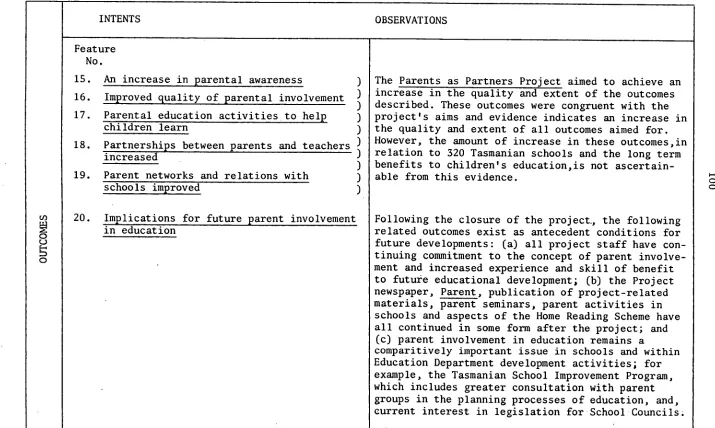
WITHIN THE STAKE MODEL 93 Selection of the Project Features 93 The Descriptive Matrix 94
The Judgement Matrix 101
CHAPTER 7: CONCLUSIONS AND RECOMMENDATIONS 109 Gaining an Understanding of the Parents
as Partners Project 109
Addressing the Questions 114 The Role of Evaluation in Educational Planning 123
Recommendations 0 125
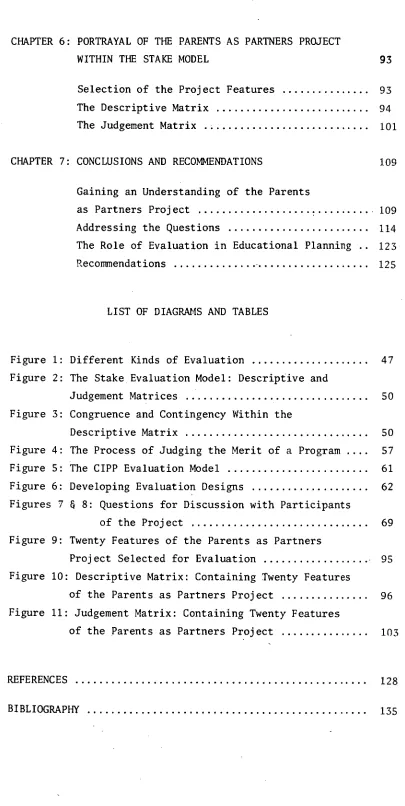
[image:7.548.71.476.27.833.2]LIST OF DIAGRAMS AND TABLES
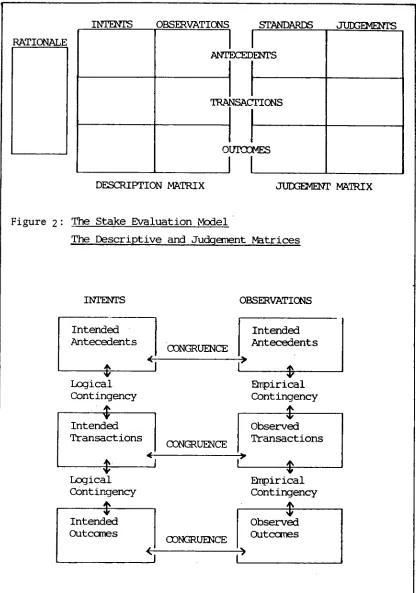
Figure 1: Different Kinds of Evaluation 47 Figure 2: The Stake Evaluation Model: Descriptive and
Judgement Matrices 50
Figure 3: Congruence and Contingency Within the
Descriptive Matrix 50
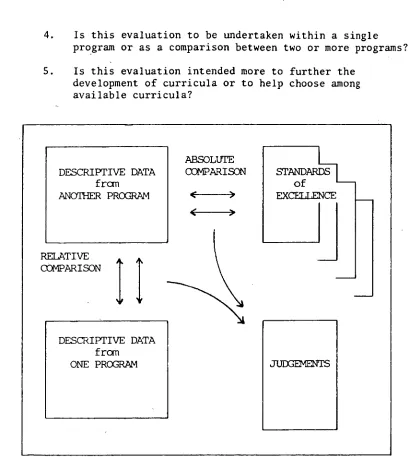
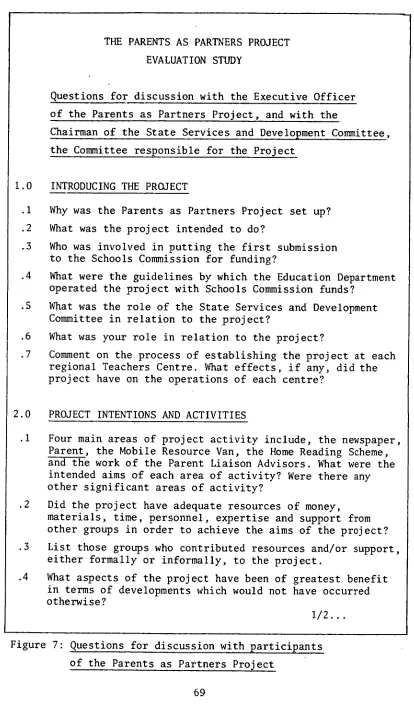
Figure 4: The Process of Judging the Merit of a Program 57 Figure 5: The CIPP Evaluation Model 61 Figure 6: Developing Evaluation Designs 62 Figures 7 & 8: Questions for Discussion with Participants
of the Project 69
Figure 9: Twenty Features of the Parents as Partners
Project Selected for Evaluation 95 Figure 10: Descriptive Matrix: Containing Twenty Features
of the Parents as Partners Project 96 Figure 11: Judgement Matrix: Containing Twenty Features
of the Parents as Partners Project 103
REFERENCES 128
CHAPTER ONE
THE PARENTS AS PARTNERS PROJECT
In Australian education the changes of the 1970s were marked by the setting up of the Australian Schools Commission in
1973. The Schools Commission identified many of the changing needs within Australian society and expressed them as objectives to be achieved through change and innovation in education.
Throughout the decade the Schools Commission sought to foster change by funding field-based experimentation in education, particularly at the school and community level. The Parents as Partners Project, a statewide education project in Tasmania, was one such project that was funded by the Schools Commission. Its aim was to promote the importance of parent participation in children's learning.
The purpose of this evaluation study is to provide a basis for a summative evaluation of the Tasmanian Parents as Partners Project.
This chapter provides a brief overview of Australian developments in this area of education during the 1970s. It
indicates the educational milieu from which the Parents as Partners emerged. The chapter also outlines the structure of the project, states the purposes of evaluation and presents an outline of the six stages of the evaluation study that are described more fully in the chapters that follow.
Australian Developments in Parental Involvement in Education
Material was gathered through a literature search of Australian developments in community involvement in education
from 1973 to 1980 in order to gain an initial overview. Sources included: Australian Schools Commission reports, State and Commonwealth education reports, descriptions and reports of specific projects, subject-related bibliographies and reference to the work of exponents in the field. A comprehensive listing of sources is provided in the bibliography of this evaluation study.
Fantini (1982) 1 distinguishes three categories of parental involvement in schools. These are:
(i) parents as decisionmakers, directly involved in the governance and policy making decisions of schools;
(ii) parents as educational producers, involved in teaching, either inside or outside the school; and,
(iii) parents as clients receiving the educational services of professional personnel in schools.
Whichever category, two of the main underlying intentions of parental involvement in schools are to improve the learning environment and increase student achievement. Collectively, the literature surveyed provides a clear indication of the trends of increased interest in all three categories of parental involvement in Australia.
decentralisation of the (South Australian) Education Department and wider community participation in policymaking.
In 1973 the Australian Schools Commission held the
following view about the existing process of change in Australian education:
(Change is) characterised by the imposition of new policies from above on schools across the board. Pupils, parents, teachers, employers and the community at large - those with a major interest in schooling - have generally minor roles in the process. Emphasis has been placed on the substance of change and on the conditioning of the participants to accept its consequences rather than on enhancing and exploiting the capacities of committed people to generate their own improvements. 3
At the time, the Schools Commission held only general views about community involvement. It did not intend to be prescriptive. It did not specify how to explain education to the community or how to create greater interaction between school and community.
By 1975 "devolution of responsibility" and "community
involvement" were two of the basic assumptions upon which it based its recommendations. A study group was established on the issue of "the school and the community" to examine problems and review trends in Australia and overseas. The Schools Commission was now directing ten percent of its development funds towards activities involving parents. It became an opportune time for innovation in Australian education as far as funding and national educational policy was concerned.
Of particular significance, the Schools Commission report 4
(a) The first model is the traditional or "fortress" model which limits the learning processes to the teachers and students, and, ignores the educational influence of the parents' role in the home.
(b) The second model concentrates on promoting communication between parents and teachers with a view to improving the learning experience of the child. It works on the basis that parents are interested in their children's learning and influence their achievement. The school attempts to provide opportunities to explain its educational aims to parents.
(c) In the third model opportunities exist for various participants, including teachers. parents and students, to reach agreement on educational values.
(d) The fourth model provides for initiatives which may change the nature of the school itself, in order to involve the school in the process of social change. Teachers, parents and students become involved in the process of learning.
The Schools Commission stated that the majority of schools in Australia fell into the first two models; that some administrators, teacher and parent organisations and individuals pressed strongly for development of the third model, while a few schools pioneered model four.
5 met with mixed success.
Notably, several small community groups set up alternative schools in which parents participated in governance, curriculum planning and teaching. However, the majority of Schools Commission funded projects were executed through the existing structures of the States' education systems with the attendant implications for the management of change through bureaucratic structures. It was the Tasmanian Education Department structure that provided the setting in which the Parents as Partners Project attempted to foster innovation and change in parent participation.
Did these aspirations for parent involvement correlate with parents' attitudes towards education and their expectations of
5.
education for their children? Fitzgerald (1976) gives evidence of the views held by many parents:
The views of parents are influenced by their own
previous experience at school. Many evince a lingering sense of failure with regard to formal study. At the same time parents want their children to succeed. They tend to link academic success with good careers and the material advantages that follow. So long as schooling is seen mainly as academic, the notion of matching ideas on curricula and related
procedures must seem a daunting one to parents. Most believe they lack both the time and the knowledge to contribute usefully. By and large parents perceive their role to be supportive of teachers in the task of inculcating knowledge and skills.
In this belief parents continue to hand over much of the socialisation of their children to public officials consider-ed to be experts. ....They expect that the school will equip their children to obtain a job, that teachers will transmit the traditional elements of the Australian way of life, and that deviations of a political, or of a moral nature will be checked
' 6
in Tasmania prior to the commencement of the project in 1977:
In Tasmania we remained largely apart from developments that related specifically to the involvement of teachers, parents and the community in the formal management of school affairs.
At this time we found it difficult to find ways in which ten per cent of our funds could be spent on parents.
We had no parents on our committees. Parents were not used to coming to our seminars about educational matters unless the situation was something sensationalised by the media. They were not used to working with teachers in a seminar situation.
They were not asking us for anything - even, for example, to tell them much about what was going on in schools.
What was the existing position of community involvement and the impact of the early Schools Commission funded initiatives on the existing educational scene?
Hunt's analysis (1981) 8 of community participation through-out the seventies describes attempts at provision for parental involvement at the formal level. This was the introduction of
school councils and legislation for the provision of wider decision making powers for school councils. Legislation was passed in four of the states, but these options were not taken up by large numbers in the community. Those school councils which did exist tended to have little direct say. Hunt does speak highly of the Catholic and other private schools in Australia, in particular the parent
7
With Schools Commission funding, experimentation with varying forms of parent involvement began to emerge in all states. Moves were made to open up schools, to involve and inform the community.
Some projects focused on opening up schools to the community with the assistance of school-based liaison officers. For example, in Tasmania in 1976, the Bridgewater Primary School commenced a Parent Support Program in association with the local high school. Generally, the intentions of the program were: to make school less forbidding to parents and more of a community facility; to increase positive
contact with teachers and create opportunities for the school to explain its program; and, ,to gain greater support and involvement
from parents. The Bridgewater program was closely followed by programs at Acton Primary and schools in the Huon Valley.
In this instance, the Parents as Partners Project also supported Tasmanian schools' efforts to open their doors to the community. The project made three regionally-based Parent Liaison Advisors (PLAs) available to assist any Tasmanian school or parent group. The Parent Liaison Advisors were also supported by the project's Mobile Resource Van which brought displays and materials to schools and their local communities promOting parent involvement.
Other projects around Australia set out to involve parents in home or school-based reading or tutoring programs with children. Generally, these operated under the guidance of school staff who managed the programs and selected the appropriate resource materials. Again referring to examples in Tasmania, two home reading schemes that had considerable impact were the Huon Valley Language Project
schools at some time throughout the period of 1977 to 1981.
Other projects were concerned with communication and public relations - informing the public about schools and education. At national level the publication School and Community News set out to inform parents and teachers about current issues and developments in education. The Parents as Partners' newspaper Parent represented a state level publication that was distributed to all schools and their Parents and Friends Associations. Not least, at the local level, many schools across Australia commenced the practice of sending home newsletters, over and above the usual official notices to parents.
Parental involvement in discussion and decision making
concerning educational and school issues received some encouragement with increased interest in participative planning and
decision-making techniques that were being developed as one form of organis-ational management. For example, in 1976 Rosny Community College in Hobart consulted with students, teachers and the community,utilising participative planning techniques as part of the consultative
process for developing its College program. A later example is the series of planning seminars for teachers and parents held by the Acton Primary School in 1981. Educational priorities were identified for the school and then activities were undertaken by parents and teachers to make the subsequent changes.
9
attendance by parents at seminars held at regional Teachers Centres in Tasmania. Statistics for 1980 (State Services and Development
11
Committee) indicate that a total of 2,392 parents attended at least one course from among 585 courses offered to Tasmanian
teachers and parents by the State and Regional Development Committee.
In summary
In summary, it is clear from the literature there emerged an increased interest in finding ways to involve the community in the processes of providing education to children. In 1971 a
significant step was the Karmel Report's recommendation for wider community participation in policy making. By 1975 the Australian Schools Commission had described four models of school involvement with parents and community, and, advocated those models in which teachers, parents and students reach agreement about educational values and become involved in the process of learning that assists schools to become important instruments of social change.
Most comprehensive reports on Australian education from State and Commonwealth levels now included statements about the broadening role for parents and the community. By the end of the decade there was a renewed interest by many states in the notion of increased participation through school councils. Most recently, this interest in parent and community involvement can be identified as a substantial component of the national School Improvement
Program, an initiative of which the Tasmanian School Improvement Program is an early example.
Australian Schools Commission funding provided an
educational change. Many field studies and innovative education projects evolved as a direct consequence. Amongst them the Parents as Partners Project took its place within the wider Australian context, reflecting the educational interests of the time and contributing to the development of parental involvement with ideas and activities that were innovative to both the local and state setting.
The Structure of the Parents as Partners Project
The Tasmanian Parents as Partners Project commenced in the wake of the influence of the British Plowden Report (Plowden,1967) 12 and the Haringey Reading Project (Keynes,1981) 13. It also bears the influence of the American Coleman Report (Coleman et al.,1966) 14 and the national Head Start, Home Start and Follow Through programs.
Set up in late 1977, the project's aims were:
• to increase parent awareness of educational issues;
to promote parent education activities that enhance student learning;
• to improve generally the quality of parent involvement in education; and,
* to have all such activities assist in developing partnerships between parents and teachers. 15
11
support from the State Professional Development Committee, and, in
particular, from its Chairman, Deputy Director of Services, Martyn
Cove. Cove's interest in the field of parent involvement in
child-ren's learning, his overseas study tour to gather evidence of
developments in this field, and his experience within the Education
Department were utilised to advantage when Schools Commission funds
became available. These appear to be instrumental factors
contribut-ing to the settcontribut-ing up of the Project.
The State Development Committee was a central committee,
based at the Development Branch of the Education Department. Its
membership included representatives from Catholic Education, the
Association of Heads of Independent Schools, the Tasmanian Teachers
Federation, Tasmanian Council of State Schools Parents and Friends
Association, and the Australian Schools Commission. The Committee
also included the Regional Development Officers based at each
regional Teachers Centre. The three Teachers Centres, of the South,
North, and North West regions, also supported the project with
administrative and seminar facilities and access to information
and services of personnel.
The personnel of the Parents as Partners Project included
the Executive Officer, the State Co-ordinator who was also Editor
of the newspaper, Parent, and three Parent Liaison Advisors. The
Executive Officer was a full-time salaried employee of the Education
Department. All other personnel were employed half-time and paid
through Schools Commission funds.
The project operated a wide range of activities in each
region and across the State. They include:
and teachers;
* a Mobile Resource Van stocked with relevant literature,
material's and displays for parents and teachers;
* Parent Liaison Advisors' visits to schools and parent groups
to organise discussions, seminars and activities relevant to
the aims of the project; and,
• a statewide newspaper, Parent, for parents and teachers, with
parents on the editorial staff.
The Purpose of the Evaluation Study
The Parents as Partners Project ceased after four years, in
December 1981, even though Schools Commission funds remained
avail-able. There was little direct intervention by parent groups or schools
to oppose its closure, although numerous letters of protest were
16
written to Parent. The School Improvement Program became the new
direction to develop within the State education system, and
certain-ly built upon some of the Parents as Partners experience in further
developing parent participation as one strand of its program.
Despite its termination, Parents as Partners personnel remained
convinced of the worth of the project's aims and objectives.
In October 1981, prior to the closure of the project, a
group of participants,who had implemented or supported the
oper-ations of the project, considered the worth of having the project
documented and reviewed.
Participants of the project determined that the purpose of
an evaluation study would be to examine the nature, extent,
13
of operation from late 1977 to 1981. They hoped that such a study
would provide:
(i) a critical analysis of the project's aims, activities
and outcomes;
(ii) the project to be set in a broader educational context,
in order to examine a number of issues raised by the
participants; and,
(ii) documentation and interpretation of project data for future
developments in parental involvement in education.
In particular, three questions emerged from the issues to
be explored as part of the evaluation process. The questions were:
(a) Who should assist parents in the task of building their
confidence for participation in children's education?
(b) How is it determined whether the project was good value
as a resource user in the face of competing priorities?
(c) How can the impact of the project be measured?
The present evaluation study of the Parents as Partners
Project was undertaken within the scope of a dissertation for the
Degree of Master of Education (Coursework). Hence, there were
constraints on funding, extensive information compiling, and on
measurement procedures that would be required to analyse the wider
impact of the project both on the community and on broader
develop-ments in education. The evaluation study narrowed its perspectives
to the specific interests of the main participants of the project.
It provides a modest foundation of data set in an educational
Scheme of the Evaluation Study
The evaluation study was organised into six stages:
Stage 1: Literature Review
The intention of the literature review was to put the topic of parental involvement in education into its current educational context. The review examines educational developments in Australia as they pertain to community involvement, particularly since the inception of the Australian Schools Commission which was the funding sponsor of the Parents as Partners Project. The present chapter has delineated a summary of this review drawing a number of examples from the Tasmanian field of education in order to provide a contextual setting in which to describe and assess the Parents as Partners Project.
A further aspect of the literature review was to look at the underlying assumptions of parental involvement lifting levels of achievement in children's learning. This was done with particular reference to the influence of research developments in America and the United Kingdom. This aspect of the review is not exhaustive, thus indicating the paucity of theoretical and research literature that can provide valid evidence of the extent and nature of
parental influence within the range of complex variables that influence children's learning. Chapter Two contains a summary of the literature reviewed.
Stage 2: Selection of a Model for Evaluation
15
in relation to the purposes they are expected to serve. It describes a range of avaluation approaches that were examined before the
Stake Model of Evaluation was selected. The Stake Model is described in some detail as is the Context, Input, Product and Process (CIPP) Model of evaluation for comparative purposes. Chapter Three contains a description of these models for evalu-ation, with reasons for the adoption of the Stake Model.
Stage 3: Evaluation Methodology
Chapter Four consists of a description of the evaluation process; that is, how project information was gathered, how judgement criteria were decided upon and how variables were
selected for observation and measurement within the constraints of the evaluation study. It also illustrates the analysis and
judgement process that one feature of the project undergoes in order to exemplify the underlying evaluation processes that yielded the outcomes and judgements of the Matrices in Chapter Six.
Stage 4: Review of Project Documents ,
A review of the Parents as Partners documents, primary source materials and brief excerpts from interviews with project staff give some indication of the nature of the project and its transactions, as well as one source of criteria for evaluating the project. The review of project documentation is contained in
Chapter Five.
Stage 5: Portrayal of the Project Within the Stake Model
the Parents as Partners Project were described and analysed within two data matrices - the Descriptive Matrix and the Judgement Matrix. The analysis took into account Stake's five basic characteristics of evaluation activity. These characteristics are:
(a) the evaluation acts of description and judgement;
(b) collection of data forming three bodies of information: antecedent, transactional and outcome data;
(c) consideration of congruencies and contingencies; (d) determination of standards to be used as criteria for
judgement; and,
(e) the uses of evaluation.
In Chapter Six the main features of the project that have been selected for analysis and evaluation are listed. The standards held by relevant groups are made explicit as part of the evaluation process. A summary of the analysis is given in table form.
Stage 6: Project Conclusions and Implications
This stage was concerned with the conclusions about the project, and it followed up the issues and questions originally raised by the project participants. Chapter Seven gives a summary of the implications of the project for future planning and
CHAPTER TWO
PARENT INVOLVEMENT IN EDUCATION
This chapter discusses the literature concerned with parent involvement in children's learning. It is intended to provide an understanding of the theoretical basis of parental
involvement and a view of the state of current research in this area. It is particularly indicative of some of the antecedent influences from American and British research studies from which the Parents as Partners Project drew its own rationale.
The first section considers a role for parents in their children's learning. It looks at the pervasive influence of the family, as described by the educational theorists and researchers, and notes the difficulty of measuring this influence on children's educational achievement. The second section looks at the multi-plicity of variables that influence children's learning. This provides the major difficulty for researchers who have tried to establish direct links between parent involvement and levels of achievement. The research results of a number of British and American projects are outlined, and despite the difficulties, conclusions that have been drawn from research findings are also described.
A comprehensive listing of sources for this chapter is provided in the bibliography, including those primary sources which influenced the directions of the Parents as Partners Project.
The Influence of the Family
The general trend of parent involvement in education has
broadened considerably in Australia in the past decade. It
continued to develop based on American and British research and
project work, and extensive fieldwork that took place in Australia,
particularly since the inception of the Australian Schools
Commission in 1973. This paved the way for significant changes in
attitudes about the role of parents in school-based education.
In particular, the concern of the evaluation study lay with
what may be described as the "awareness raising" stage of the
present interest in parent and community participation in education;
a stage when attempts were made to find evidence to support the
assumption that parents do influence their children's learning
achievement.
To what extent does the influence of home and parents affect
children's levels of achievement at school; how can educators turn
this influence to positive account in the child's schooling and
developmental interests; and, to what extent are the educational
processes that are required to develop parental interest and
involvement the responsibility of Education Departments, schools
and teachers?
Attempts to explore such questions requires an understanding
of the nature of the child's relationship (a) to its family, and,
(b) to the complex range of external variables that also influence
development, socialisation and education.
Bronfenbrenner (1979) subscribes to the view that the family
19
ment. He argues that the family is the most powerful structure known for nurturing the capacity of human beings to develop and work effectively in all areas of human activity; that it is
critical to the capacity of the child to develop physiologically, mentally, emotionally, motivationally, socially and morally. Within the family, the psychological development of the child is brought about through his or her,
continuing involvement in progressively more complex
patterns of reciprocal activity with persons with whom the child develops a strong and enduring emotional attachment.
....(The reciprocal activity) generates an emotional bond, enhanced motivation, and cognitive and manipulative skills that are mutually reinforcing to both participants. They are then reflected in the child's enhanced capacity to comprehend, cope with and even create the environment in which he or she lives
1
Bernstein (1977) 2 concurs with the case for the family being a major influence, but indicates that the family is strongly influenced by the social class to which it belongs, and that the language code a social class uses is the basis of its socialization process. Further, that this language code can be at odds with the language code that operates within a school thus creating a
cultural discontinuity which raises one problem of educability for children who are not sensitive to the communication system of the school.
Bernstein's theory of restricted and elaborated codes of communication is based on the powerful relationship between language and socialization. Socialization refers "to the process whereby a child acquires a specific cultural identity, and to his
3
a complex process of control, whereby a particular moral, cognitive and affective awareness is evoked in the child and given specific form and context. Socialization sensitizes the child to the various orderings of society as these are made substantive in the various roles he is expected to play. It is through the basic agencies of family, peer group, school and work, and in particular through their relationship with each other, that the various orderings of society are made manifest.
For example, Bernstein notes that a communication code of the lower working class will emphasize verbally the communal
rather than the individual, the concrete rather than the abstract, substance rather than the elaboration of processes, the here and now rather than exploration of motives and intentions, and
positional rather than personalised forms of social control. As the child learns his speech or the specific codes which regulate his verbal acts, he learns the requirements of his social
structure.
Bernstein terms this communication code a restricted code. He explains that this restricted code directs the child to orders of learning and relevance that may in themselves be valid,
21
between the school and community of the working class child there may exist a cultural discontinuity based upon two radically
different systems of communication. The source of the problem of educability lies not so much in the genetic code but in the culturally determined communication code.
4
Kifer (1977) contributes further to the analysis of variables in the home setting that influence children's learning, and the criteria by which learning achievement is measured. His intention was to identify and measure processes which operate effectively across homes to produce educational advantages for children. Notably the most effective processes, as identified by Kifer, line up with Bernstein's elaborated code of communication and its associated social values.
Kifer views three process variables as facets of three main dimensions of the home environment. The first process variable is the verbal dimension, that is, use of language, reading,
encouraging children to express themselves precisely in both speech and writing. He states:
An explanation for the power of the verbal environment resides in the notion that success in the typical classroom is, in part, a function of the child's ability to penetrate the verbal curtain which surrounds the instructional
process. Those children with verbal facility tend, there-fore, to be more successful in academic tasks. .... In those homes where precise communication is encouraged and emphasized, children develop abilities which give them increased power to comprehend what is expected of them in the classroom setting.
5
The second dimension is an effective home environment which includes activities congruent with the expectations of the school. For example, finding a time and place for homework,
and taking an interest in what the child is doing at school. There are positive correlations between parental behaviours and willingness of students to devote efforts to their school studies.
The third dimension of the home environment is its
general cultural level. Homes which emphasize reading, discussing, attending cultural activites, and visiting museums and zoos,
provide a milieu in which children develop both competencies and attitudes which increase the probability that they will be success-ful in school. Further, where there is congruence between what home expects and what school expects and rewards, achievement and positive personal growth result; incongruence leads to less
achievement and less positive personal growth.
In summary
In summary, Bronfenbrenner 'indicates the critical importance of the family in nurturing the capacity of children to develop. Bernstein's theory, in turn,shows how the family is powerfully influenced by social class and the language codes of that class which are used in the socialization process of children. Not least,
23 Review of Research in the Field
This section shifts from the variables of home environment and family and community background to the research evidence for the impact of parent involvement in school-based activities. The
difficulties of measuring student achievement and establishing the causal links between parent involvement and student achievement are discussed. A number of research projects and their findings are briefly delineated in order to indicate the nature of the research work that has been undertaken, despite the difficulties of assessing the outcomes. The section sums up the generally held conclusions from the research findings which continue to support the development of parent participation in education.
Stearns and Peterson (1973) 6 assert that there is a serious lack of data on the effects of increased parental involvement in schools. Although many studies in this area have been undertaken throughout the 1960's and 1970's, there is little direct
evidence to confirm or reject the basic assumptions about the impact of parental involvement and its influence on students' achievement. Although the advantages are claimed to be numerous, the causal links between increase in involvement and the subsequent benefits are not often clearly stated. This view is also held by
7
Filiczak, Lordeman and Friedman (1977), Clasby and Stanton (1982) 8 and Fantini (1982). 9
Further, Clasby and Stanton (1982) 10 state that despite the apparent value of establishing a causal link between community participation and student performance, the norm-referenced
about programs for community participation in schools. They also hold reservations about large-scale statistical studies and
narrowly focused case studies providing adequate grounds for policy and practice in community involvement.
On the one hand, the case studies avoid the dangers of "context stripping" which results with large-scale statistical studies. They do provide a more in-depth look at programs and tend to place behaviours in a meaningful context, illuminating
complexities and variations. However, Clasby and Stanton claim that it is extraordinarily difficult to accumulate knowledge that can be generalised from such individual case studies which may also lack consistency in perspective and rigour in analysis.
Despite these shortcomings, research studies and
opportunities for practice in the field are valuable sources of evidence that can be used to refine the theoretical bases and
assumptions which underlie the rationale of much of our educational activity. From research and practice,educators can learn more about the variables that are associated with effective schools and
teaching, and can gain a clearer understanding of causality. As early as 1966, in the U.S.A., the Federal Government commenced a nationwide effort to create educational opportunity through its Head Start, Home Start and Follow Through programs, which involved parents in children's learning. The programs were based on the following assumptions:
parents are the primary educators of their children and schools must recognise this;
25
and, the child's self-concept affects learning.
The programs were directed at mainly pre-school age
children and their parents, but assisted children up to grade
three level where funds would allow. The broad educational goals
included interest in educational achievement and mandatory parent
involvement as well as interest in health and social welfare. The
Follow Through programs were for students of all abilities,
especially for those of low-income families, and were designed to
sustain gains that children had made in previous programs. 11 & 12
An example of the extensiveness of these programs can be
seen by the activities that were developed by the Philadelphia
Parent-Child Centre, Philadelphia, PA. It commenced its Head Start
Program in 1968 and spread its activities to include: a Learning
Centre Program (1968), Home Visitor Program (1970), Family Day
Care Program (1974), Centre Based Program (1974), and Home Based
Program (1977). This particular Head Start program was also further
supplemented when its children were given opportunities to continue
Follow Through programs up to grades three and four. Further, Brady
13
(1976) states that some Head Start continuation projects also
trained parents as Head Start Assistant teachers to move with
children into public schools to assist in maintaining the gains
that pre-school children had made.
What results did programs like these yield? Bronfenbrenner
supports his arguments with evidence from research results of many
of the American studies. From twelve studies of pre-school
inter-vention and home-based tutoring programs, Bronfenbrenner reports
• cognitively structured curricula produced greater gains
than play-oriented programs;
• by the first or second year after completion of the program
children began to show a progressive decline, the sharpest
occurring after the child's entry into regular school; but
preliminary data from the Follow Through Program suggests
that this decline may be offset by the continuation of
intervention programs, including strong parent involvement
into the early grades; and,
• children who profited least and showed earliest and rapid
decline were from the most deprived social and economic
backgrounds. 14
Similarly, Levenstein (1978) 15 investigates research into
child-parent interaction and its influence on education. She
reports the research findings of a Mother-Child Home Program which
took place from 1972 to 1974. The program was looking for:
(±) positive relationships at age four between what parents
did and how children acted; and,
(ii) whether the ratings of children's competence by teachers
in crass two years later correlate with mother's parenting
behaviour when the child was four.
The program sought forty five low-income mothers with
children age four. The children were assessed by home visitors at
half hour play sessions twice a week for seven months and then
27
The measuring instruments used were the "Child's Behaviour Traits" (CBT) and "Parent and Child Together" (PACT), both
composed of Likert-type scales yielding item and summative scores. Empirical testing supported the view that there is mutual influence on child and parent; that parents influence a child's later socio-emotional coping skills in school; and, in particular, that verbal interaction behaviours of mothers are significantly linked to competencies of the child age four at home and of enduring influence to the child age six. Similarly, Berlin and Berlin's (1973) 16 nationwide study of Head Start programs supported these findings.
On the American scene from the mid-1960's onwards, the 17
Coleman Report (1966) represented the most significant piece of research documentation. It provided data for interpretation and
18
reassessment (Jencks, 1972) for the next decade and a half. Many of the early studies on parent involvement were related to examining the effects of compensatory education programs in the United States. These studies found that the direct participation of parents in instructional activities had positive effects on student achievement, and that parental involvement in school governance increased the self-concept of children in schools
(Jencks,1972, 19 Wagenaar,1977, 20 Baker,1971, 21 Berlin and Berlin,1973 22).
the relationship between school life and the factors of parental occupation, "ability", size of family and type of school attended. Studies by Douglas (1964) 24 and Moore (1968) 25 dealt with
children's learning, achievement and emotional development being more related to the indices of family environment than to socio-economic status.
One of the most comprehensive British studies was the Plowden Report, Children and Their Primary Schools (Central
Advisory Council for Education, 1967). 26 The Plowden Report argued that educational policy should recognise the influence of the environment on the school and of the school on the environment. The triangle of parent, child and teacher should be completed and a more direct relationship established between teachers and parents. "They should be partners in more than name; their responsibility become joint instead of several"1 27
In 1964 the Plowden Committee commenced a national survey, the aim of which was to relate what could be learned about home and school to the attainment of children. The survey included three thousand children from one hundred and seventy three junior, junior-infant and infant schools. Information was collected from the head teachers about their schools and the children in the sample. Attainments of the children were assessed by reading comprehension tests, and a picture intelligence test was also given to top infants. The report also included a survey of
interviews with mothers (and occasionally fathers) of the Plowden children.
29
their children; did they visit their children's school; how much time did they spend with their children, help with homework, read at home; what amenities were part of the home; what was father's occupation and income; what was the size of the family; and, what was the level of education of both parents?
The Plowden Report stressed the importance of parental attitudes in the educational system. It revealed that parents were greedy for information about their children at school, the school itself and how children learn. The report assessed that eighty one per cent of all parents interviewed were positively interested. Based on this evidence, the report urged that instead of relying on voluntary membership of parent-teacher associations, schools, local education authorities and the Department of
Education and Science should positively encourage parents to become far more actively involved in their children's education.
28
Jackson (1978) even argues for the establishment of part-time courses for parents, explaining that some schools affect parental attitudes by helping parents to understand the education process by working with them rather than compensating for them.
In brief, the Haringey Project asked parents to hear their children read several times a week from appropriate material sent home from the school. The six schools which took part in the two year experiment had the same multi-ethnic, inner city
background, with reading standards well below the national average. At the end of the Haringey Project, it was reported that children with parent help were well ahead of comparable children who did not receive help. More than one half of the
parent-assisted children were reading at or above their age level, a slightly better performance than the national average. The control group had only one third of its number reach a reading performance appropriate to their ages. A year later, further assessment showed that the parent-assisted children had maintained their lead over
.30 the control groups in reading performance. Spencer (1979), Armor and Associates (1976) 31 and Guttentag (1972) 32 also provide data from the American educational scene that supports the significant relationship that exists between family involvement and reading achievement.
33
In conclusion, Cove (1980) summarises much of the recent American and British evidence and provides a summary of eight
inter-related factors that affect levels of achievement. These factors are:
1. standards of literacy and numeracy correlate closely with socio-economic status and the self-concepts of
students and their parents;
2. parental attitudes are strong determinants of success; 3. the extent of physical impairment (visual and auditory),
31
4. there is an inverse relationship between the age of the child and the likelihood that intervention will be successful;
5. well organised and planned programs of teaching are correlated closely with improvement in standards of achievement;
6. improvement will not occur without diagnosis and skilled, unremitting follow-up;
7. the effectiveness of schools depends on staff commitment and skill, and system support; and, 8. student motivation and will to learn is of special
importance. 34 35
Fantini's (1982) summing up expresses the generally held views derived from the findings of the research literature.
The pattern of involvement that focuses directly on the educational process, with the parent participating as an educator, does show a relationship to school
achievement in reading and mathematics as well as self-concept... .Some of the literature acknowledges parental participation as a valuable end in itself. ....Research suggests that only those forms of participation directly involved in instruction have a positive measurable impact on achievement and self-concept. 36
In view of all the findings related to parent involve-ment and student achieveinvolve-ment, it is reasonable to assume that any consideration of the effectiveness of schools should take the factors related to this involvement into account. Educators can attempt to reach children both directly and indirectly with the assistance of parents, if schools and Education Departments are prepared to make policy and implement education programs that encourage parent involvement in the school and in children's learning. For example, the formation of processes for more
the learning environment and increased performance on the part of students. To many, however, these processes involve parent education as well.
In summary
The evidence that emerged from studies undertaken in America and Britain supported the widely-held assumption that parental involvement in education does enhance children's levels of achievement. Much of the evidence concluded that
schools and Departments of Education should find ways to involve parents and increase collaboration between parents and teachers
in the interests of school children.
CHAPTER THREE
SELECTION OF A MODEL FOR EVALUATION
This chapter is about the meaning and purpose of
evaluation in relation to education projects and programs. Two
models are described which have been designed to assist the
process of evaluation in education. They are referred to as
the Stake Model of Evaluation and the Context, Input, Process
and Product (CIPP) Model of Evaluation. In particular, this
evaluation study has applied the Stake Model as a framework for
portraying, analysing and evaluating the Parents as Partners Project, a project which cannot be evaluated solely by measur-ing children's levels of learnmeasur-ing achievement. The CIPP Model
provides a framework for comparison of evaluation models.
Educators and project planners who are interested to
monitor and evaluate the impact of work done in education, or
who require data in preparation for planning future developments
in education, embark upon a task which can become complicated
and often frustrating. There are many variables, some measurable
and others not, that influence the processes of educating
children and the degree of educational achievement that can be
attained. For example, such variables include, amongst others,
the socio-economic background of school children, the
avail-ability of adequate resources for education, the choice of
curriculum and the methods of teaching used in the school's
curriculum.
Apart from the variables that constitute the influences
on learning, the process of evaluation carries with it
influences of its own which also affect the interpretation of
the outcomes of an education project. For example, these include
the constraints of time and resources of those participating in
the evaluation, the choice of methods used to gather and analyse
information in relation to the purpose of the evaluation, and
the values and interests of the evaluators and those
partici-pants directly involved with the project. Despite the
complexi-ties, educators and project planners must continue to make
decisions about priorities in education, about the selection of
the best alternatives for program implementation and deployment
of resources. Good decision making is assisted by accurate and
useful information that helps to increase understanding.
The meaning and purposes of evaluation
In the context of this evaluation study, the concept of
1 evaluation as derived from Stufflebeam (et al., 1971), and
utilized by Davis (1981), 2 is appropriate. Davis states that
evaluation is,
35
An evaluation is concerned with a specific situation.
Its value lies partly in the understanding gained of the
specific situation by the evaluators - preferably including the
main project participants because of their work leading up to
the report - and partly in a variety of benefits to others,
such as teachers, parents, education administrators and project
planners.
From the late 1960's onwards there has been much
development in the designing of approaches to evaluation to
meet the widening range of evaluation purposes. For example,
education projects, such as the Parents as Partners Project,
that set out to involve the community in a diverse range of
activities related to their children's education are a recent
phenomenon. They require a different form of evaluation to the
traditional forms that consisted of measuring children's levels
of achievement or evaluating curricula or evaluating the
variables of home background and school setting in 'relation to
children's learning, even though they contribute to the same
implicit goals. The difficulty here was how to evaluate a
program intended to increase parental understanding of education,
confidence in their own educating capacities, and skill and
knowledge required to collaborate with teachers in the educating
processes.
4
Both Davis and Kemmis (1980) give useful descriptions
of the evolution of educational evaluation from the early Tyler
behavioural objectives. Other significant evaluation approaches
include: organisational development models, such as the CIPP
model, which address wider institutional arrangements as part of
an evaluation; responsive and illuminative models, by Stake and
Parlett and Hamilton, which arose in response to previous
mechanistic and rationalistic approaches; current action-research
and participative models of evaluation which incorporate the
experiences and critical reflections of program participants to
a much greater extent in an ongoing evaluation process which is
an integral part of program implementation.
In particular, there are two main kinds of evaluation
5
which Scriven (Davis, 1981) distinguishes as 'formative'
evaluation and 'summative' evaluation. Formative evaluation is
investigatory and is intended to provide information that
in-creases an understanding of an education program's problems and
possibilities. Educators are involved in formative evaluation
when they critically examine what they do (for example, their
teaching, the materials they use or the learning environments
they create) with a view to improvement.
Summative evaluation, such as this evaluation study of
the Parents as Partners Project, reports relative levels of
success and failure according to specified criteria, standards
or values. As it is not primarily intended to provide
inform-ation for subsequent modificinform-ation and development, a developed
process, end event or finished product is assumed. Summative
evaluation usually follows formative evaluation (but often
37
Further, Stake distinguishes the formal and informal
sides of educational evaluation methodologies. Informal
evalu-ation is recognised by its dependence on casual observevalu-ation,
implicit goals, intuitive norms and subjective judgement.
Formal evaluation is recognised by its dependence on checklists,
the structured visitation of peers, controlled comparisons and
standardised testing of students.
Henderson (1978) 6 sums up with a number of useful
characteristics that distinguish an evaluation study.
(a) In evaluation the context of the study almost completely defines the issue for investigation.
(b) Precise hypotheses can rarely be generated, and the task more usually becomes that of testing generalis-ations derived from previous knowledge and experience.
(c) Every evaluation study is unique.
(d) Evaluations have to be conducted in the presence of a multitude of variables which could have relevance in the interpretation of results, with randomisation generally impossible or impractical to accomplish.
(e) In evaluation, the data to be collected are heavily influenced, if not determined, by feasibility.
Which Approach to Evaluation Will Suit the Evaluation Purposes?
Kemmis (1980) 7 in his argument against the "technologisation of reason" outlines five models of educational evaluation that have evolved from the early Engineering Model that was first articulated by Tyler to the Critical Refection Model that Kemmis advocates. These five classes of evaluation approaches are the engineering, organisational, ecological, illuminative/responsive, democratic and evaluation as self-reflection approaches. They are outlined briefly here to indicate the process of selection that took place in
searching out an evaluation model suitable for the Parents as Partners Project.
(a) Engineering Model
The Engineering Model concentrates upon developers'
instructional objectives and related student learning outcomes. It entails the following stages:
(i) secure agreement on the aims of the curriculum and/or course of study;
(ii) express these aims as'objectives' (i.e. explicitly stated student behaviours that the curriculum is intended to produce);
(iii) devise and provide experience that seems likely to enable learners to behave in the desired way;
(iv) assess the congruence of student performance and objectives; and,
(v) vary the 'treatment' until behaviour matches objectives.
This model, which integrates the evaluation and development processes, draws several main criticisms under the problems of
39
It is evident that on its own this model is not sufficient for the purposes of the present evaluation study.
(b) Organisational Model
The Organisational Model is based on the image of the program as an organisation. The aim is essentially bureaucratic: to serve program managers (decision makers) with the range of information relevant for keeping their programs or institutions on the right track. It is a model of rational management, its image supported by cultural values of scientific rationality, economic efficiency and consensus about an institutional mission.
The main dimensions of this model include:
(i) determining institution purposes, goals and educational objectives;
(ii) measuring educational and other outcomes;
(iii) evaluating learning experiences in terms of the desired outcomes;
(iv) evaluating the adequacy and utilisation of resources in terms of desired outcomes;
(v) evaluating the planning and decision making processes in terms of the desired outcomes; and, (vi) interpreting objectives, means of attainment, and
evidence of attainment to new faculty, to students and to the public.
Kemmis notes that experience with this model in Australian schools indicates that it tends to disaffect staffs, involve them in extensive data-gathering exercises and yield little in terms of actual change.
lengths to control this complexity. It is so comprehensive as to defy genuine application. It subjugates the critical perspective of participants to the perspective of the institution as a corporate entity in its own right, and, being goal-based, is open to some of the same criticisms of the Engineering Model.
Its positive features are that it can accommodate the
participants in a program in its evaluation, and it can suggest the enormous variety of places where something can go wrong with an organisation. However, Kemmis states, it may deaden critical aware-ness in the slow grind of its progress rather than heighten self-criticism in convivial debate.
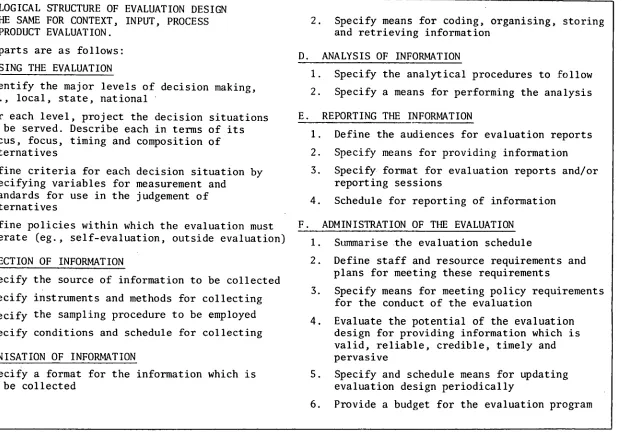
The Context, Input, Process and Product (CIPP) Model of Evaluation is a particularly representative example of the
Organisational Model which continues to be used today in many program evaluations concerning general institutional arrangements. The CIPP Model was selected for comparative purposes with the Stake Model of Evaluation for three reasons. It does provide one possible evaluation approach that could be modified to suit the evaluation purposes. It represents an approach that continues to have extensive influence in evaluation. Not least, the Illuminative/Responsive approaches,
including the Stake Model, evolved out of dissatisfaction for these rationalistic approaches. By outlining the CIPP model it can be
indicated just where the Stake Model has come from in the development of approaches to educational evaluation and why it has acquired the characteristic features that it possesses.
(c) Ecological Model
41
to understand our social life not just as a set of interacting variables, but as organic, structured and functioning. It sees a program as "alive" and part of a "living" context.
This approach falls prey to the dangers of positivism and the problem of complexity cited in relation to previous models. The kind of complexity these models deal in is hostile to understanding
because it fragments our view of the program along the lines of its own analysis, not according to the problems perceived and experienced by those who inhabit the programs.
Like the engineering and organisational models, this model
reveals an "objectivist" epistemology. The evaluator attempts to study the program "objectively", is interested in value-neutrality with respect to the program, and displays a "technical"
knowledge-constitutive interest.
Kemmis concludes that all three models manifest the technologis-ation of reason, making critical self-understanding subordinate to program goals, bureaucratic organisational imperatives, or the "life" of the program as understood from a non-participatory (non-empathetic) perspective.
(d) Illuminative/Responsive Model
Parlett and Hamilton's "illuminative" approach and Stake's "responsive" approach are two relatively recent models for evaluation.
Stake's approach attempts to address issues raised by program participants rather than impart the questions of the evaluator into the program setting. These issues guide the quest for data and the writing of reports. The evaluator is likely to choose to make
The aim is to convey something of the life of the program and the concerns of its inhabitants. Similarly, Parlett and Hamilton's illuminative evaluation discards the analytical role in favour of an interpretive one.
Problems of these approaches include the problems of credi-bility, the length of time required for descriptive methodologies and the criterion of authenticity.
Reports are not always regarded as credible, which is a
fundamental problem for an approach which is built on the notion that evaluation should speak to the concerns of the participants and in their own preferred languages.
Descriptive methodologies take time. However, the process of writing up at least part of a program, even if imperfectly, may help to make wiser judgements of it.
The notions of "responsiveness" to participant and audience concerns, of "progressively focussing" on issues which compel those in and around the program and of "participant confirmation" as
guarantees of authenticity are challenged by the notion that it is not the participants themselves but professional evaluators who shape the accounts. The outside observer understanding and reporting on the program is doing something fundamentally different from the insider-participant who must live with the consequences of the evaluation, with the meanings reclaimed from its life and the reputations the evaluation establishes or diminishes.
(e) Democratic Model
43
in evaluating them. The shift from the illuminative/responsive approach to the democratic approach parallels the shift from the engineering model to the organisational model.
Kemmis refers to "Evaluation and the Control Education" (MacDonald, 1976) for the distinctions between bureaucratic, autocratic and democratic approaches to evaluation of programs.
Democratic evaluation is an information service to the community about the characteristics of an educational program. It recognises value-pluralism and seeks to represent a range of interests in its issue-formulation. The basic value is an informed citizenry, and the evaluator acts as a broker in exchanges of information between differing groups. His techniques of data-gathering and presentation must be accessible to non-specialist audiences. His main activity is the collection of definitions of, and reactions to, the program. He offers confidentiality to informants and gives them control over his use of information. The report is
non-recommendatory, and the evaluator has no concept of misuse of information. The evaluator engages in periodic negotiation of his relationships with sponsors and program participants. The criterion of success is the range of audiences served. The report aspires to "bestseller" status. The key concepts of democratic evaluation are 'confidentiality', 'negotiation' and
'accessability'. The key justificatory concept is 'the right to know' 8
Kemmis describes the image of the democratic evaluator as one of the investigative journalist, or open-minded concerned
observer who attempts to see that reason wins over political muscle as different views of a program are shared among participants and with program audiences.
to the image of evaluation achieving both conviviality and critical capacity.
(f) Evaluation as Self-reflection in a Critical Community 9
Jevons (1979) has remarked that the strategic aim of a tertiary institution is that it become "a learning learning system", that is, a learning system capable of learning from its own experience.
Kemmis states that we must create the means to engage the community of participants (administrators, teachers, students, parents and others) in our programs in the critical debate about them. This self-reflective approach is in some senses the most familiar notion of program evaluation. It is evident whenever program participants discuss the life of the program with a view to understanding it in general and to understanding it within the constraints of its context, or with a view to modifying program practice.
The evaluative dimension of all human activity is present in a range of individual and public judgement processes which exist whether or not an evaluation is formally commissioned or expected of a program's participants. Evaluations then should approximate
(and focus and sharpen) these informal critical processes, not ignore or supplant them.
45
and an evaluator. Evaluation forms a natural part of the critical thinking that guides the development process. This is not to say that formal evaluations can lack vigour, discipline and honesty, but rather their critical edge should be tempered with humane values rather than narrowly technocratic or bureaucratic concerns. Thus,the definition of evaluation which informs Kemmis' principle is this:
Evaluation is the process of marshalling information and arguments which enable interested individuals and groups to participate in the critical debate about a specific program.
11
The Democratic Model and the Critical Reflection Model represent current interests and developments in educational evaluation. Both are sensitive to the politics and social
consequences of evaluation activities, and the latter particularly values the capacities of program participants to evaluate in . both a critical and convivial manner as part of ongoing program development. Aspects of both models were kept in mind while undertaking this evaluation study.
In conclusion, a last reference is made to Davis' (1981) 12 13 .