ANALYSE OF PROCESS PARAMETER VARIATION IN GRAPHENE FIELD-EFFECT TRANSISTOR (GFET) DEVICE USING L9 OA TAGUCHI METHOD
NURIN IRWANIE BINTI RUSLI
i
ANALYSE OF PROCESS PARAMETER VARIATION IN GRRAPHENE FIELD-
EFFECT TRANSISTOR (GFET) DEVICE USING L9 OA TAGUCHI METHOD
NURIN IRWANIE BINTI RUSLI
This Report Is Submitted In Partial Fulfillment Of Requirements For The Bachelor Degree Of Electronic Engineering (Computer Engineering)
Fakulti Kejuruteraan Elektronik dan Kejuruteraan Komputer
Universiti Teknikal Malaysia Melaka
v
vi
ACKNOWLEGEMENT
In the name of Allah, Most Merciful, Most Compassionate. Alhamdulillah, I was able to complete this project within the time given. I would like to give my sincere gratitude to my supervisor of this project; Dr. Fauziyah Binti Salehudin who gave me such a huge opportunity to gain a knowledge on semiconductor technology. I would like to thanks my supervisor so much on her vision, technical guidance, patience and willingness throughout the entire project.
I also would like to thank to Mr. Khairil Ezwan Bin Kaharudin, Mr. Muhammad Nazirul Ifwat Bin Abd Aziz for their advice and information at resolving my difficulty to finish this project. Apart from that, I would like to send my special thanks to my cousin Norhaida Binti Sahak who helps me to lend her laptop and can make me install and using software tools that I used to complete this project.
vii
ABSTRACT
viii
ABSTRAK
Projek ini adalah mengenai analisis variasi proses parameter di dalam Graphene Field-Effect Transistor (GFET) peranti menggunakan L9 OA Kaedah Taguchi. Proses simulasi
dilakukan dengan menggunakan alat SILVACO TCAD dan pemodelan statistik
menggunakan L9 OA kaedah Taguchi. Dalam kertas ini, terdapat empat proses
parameter yang dikaji iaitu halo implant dos, halo implant tenaga, S/D implant dos dan S/D implant tenaga. L9 OA kaedah Taguchi digunakan untuk menganalisis proses
parameter untuk mengenal pasti nilai optimum ambang voltan (VTH),drive current (ION) dan current-state ratio (ION/IOFF). Matlamat projek ini adalah untuk mereka bentuk peranti GFET dengan menggunakan modul ATHENA, menganalisis ciri-ciri elektrik
dengan menggunakan modul ATLAS dan mengoptimumkan proses parameter dengan
menggunakan kaedah Taguchi. Nilai VTH, ION dan nisbah ION/IOFF dibandingkan dengan sebulam dan selepas proses pengoptimum. Di samping itu, nilai nisbah ION/IOFF dibandingkan dengan kajian penyelidikan yang lepas. Kajian ini membuktikan bahawa nilai selepas pengoptimum adalah lebih baik daripada sebelum pengoptimum dan nisbah
ix
TABLE OF CONTENT
CHAPTER TITLE PAGE
PROJECT TITLE i
REPORT STATUS FORM ii
DECLARATION iii
SUPERVISOR VERIFICATION iv
DEDICATION v
ACKNOWLEDGEMENT vi
ABSTRACT vii
ABSTRAK viii
TABLE OF CONTENT ix-xii LIST OF TABLES xiii-xiv LIST OF FIGURES xv-xvi LIST OF ABBREVIATIONS xvii
LIST OF SYMBOLS xviii
I INTRODUCTION 1.1 BACKGROUND 1-3 1.2 OBJECTIVES OF THIS PROJECT 3
1.3 PROBLEM STATEMENT 3-4 1.4 SCOPE OF PROJECT 4
x
II LITERATURE REVIEW
2.1 INTRODUCTION 6
2.2 INTRODUCTION TO CMOS 6-7
2.3 INTRODUCTION TO GRAPHENE 7-9
2.3.1 Operating Principle of Graphene Device 10 2.4 GRAPHENE FIELD EFFECT TRANSISTOR (GFET) 10 2.4.1 Basic Operation Principles 10 2.4.2 GFET Circuits Model and Characterization 11 2.4.3 Mobility Analysis GFETs 11 2.4.4 Current-Voltage Characteristics of GFETs 11-13 2.4.5 Hybrid Radiation Detector Based on Charge 13
Sensing GFET
2.5 APPLICATION OF GRAPHENE 14-15
2.6 TAGUCHI METHOD 16
2.7 L9 ORTHOGONAL ARRAY METHOD 16-17 2.8 TAGUCHI OPTIMIZED SYNTHESIS OF GRAPHENE 17-19
III METHODOLOGY
3.1 INTRODUCTION 20
3.2 SIMULATION USING SILVACO TCAD TOOLS 20-21 SOFTWARE
3.3 BASIC FLOWCHART OF MOSFET-LIKE GFET 22 TRANSISTOR
3.3.1 Mesh and Substrate Material Establishment 23
3.3.2 Well Oxidation 23-24
3.3.3 Gate Oxide Growth 24
xi
3.3.6 Halo Implantation 27
3.3.7 Sidewall Spacer 27-28
3.3.8 Source/Drain Implantation 28 3.3.9 PECVD and BPSG Oxide Deposition 29 3.3.10 Pattern Source/Drain Contact 29-30 3.3.11 Aluminium Metallization 30-31 3.3.12 Mirror MOSFET-like GFET Structure 31 3.4 DEVICE SIMULATION USING ATLAS 32 3.5 TAGUCHI METHOD FOR OPTIMIZATION 33-34
APPROACH
3.5.1 Identification of Process Parameters 35 3.5.2 Selection of Orthogonal Array (OA) 35-36 3.5.3 Analysis of Variance 36 3.5.4 Confirmation Experiment 37
IV RESULT AND ANALYSIS
4.1 INTRODUCTION 38
4.2 MOSFET-like GFET 38-41
4.3 STATISTICAL MODELING OF PROCESS
PARAMETER VARIATIONS BY USING L9 OA 42 OF TAGUCHI METHOD
4.3.1 Selection of The Process Parameter and Orthogonal 42-43 Array of Taguchi Method
4.3.2 VTH, ION and ION/IOFF Ratio Value Acquisition 44-46 4.3.3 Signal to Noise Analysis 46-49 4.3.4 Prediction of S/N Ratio 49-53 4.3.5 Analysis of Variance (ANOVA) 53-55
4.3.6 Confirmation Test 55-57
xii
CHARACTERISTICS
V CONCLUSION
5.1 CONCLUSION 60-61
5.2 RECOMMENDATION AND FUTURE 61
DEVELOPMENT
xiii
LIST OF TABLES
NO TITLE PAGES
2.1 Electronic applications of graphene 15 2.2 Photonic applications of graphene 15 2.3 Experimental layout using L9 orthogonal array 17
3.1 Process parameter selected 35
xiv
after optimization
4.19 Comparison of the optimal ION Value between before and 58 after optimization
xv
LIST OF FIGURES
NO TITLE PAGES
1.1 Moore’s Law in evolution of a billion transistor in recent years 1 2.1 sp2 and p orbital of carbon atoms in graphene 8
2.2 Graphene form in years 8
2.3 Lattice structure of graphene 9
2.4 The electronic dispersion in graphene 9
2.5 Schematic of dual-gate GFET 12
2.6 Ideal drain current versus gate voltage using equation 12 2.7 Ideal drain current against source-drain voltage for different 13
gate biases
2.8 Hybrid GFET detector schematic and operating principle 13
2.9 Response graph of I2D/IG 18
2.10 Response graph of ID/IG 19
3.1 Simulation flowchart using SILVACO TCAD Tools 21 3.2 Flowchart of MOSFET-like GFET Design 22 3.3 P-type substrate doping concentration 23
3.4 Oxide deposition 24
3.5 Gate oxide growth 24
3.6 Adding of Bilayer Graphene on top of SiO2 25 3.7 Deposited high-k material of HfO2 26
3.8 Deposited metal gate of WSiX 26
3.9 Halo Implantation process 27
3.10 Depositing and etching Si3N4 28
xvi
3.12 PECVD and BPSG oxide deposition process 29 3.13 MOSFET-like GFET structure after pattern source/drain contact 30
Process
3.14 Aluminium metallization process 30
3.15 Aluminium etching 31
3.16 Mirroring Process 31
3.17 Flowchart of device simulation using ATLAS module 32 3.18 Flowchart of Taguchi Method Approach 34
4.1 MOSFET-like GFET 39
xvii
LIST OF ABBREVIATIONS
CMOS - Complementary Metal Oxide Semiconductor MOSFET - Metal Oxide Semiconductor Field Effect Transistor
Si MOSFET - Silicon Metal Oxide Semiconductor Field Effect Transistor GFET - Graphene Field Effect Transistor
TCAD - Technology Computer Aided Design OA - Orthogonal Array
CVD - Chemical Vapor Deposition FET - Field Effect Transistor S/N - Signal-to-noise ratio
ITRS - International Technology Roadmap for Semiconductors Bi-graphene - Bilayer Grapheme
I-V - Device Current-Voltage Characteristics MOS - Metal-Oxide Semiconductor
xviii
LIST OF SYMBOLS
˚C - Celsius
2D - 2-Dimensional
eV - Electron-volt
ID - Drain Current
IOFF - Off-state Current or Leakage Current ION - On-state Current or Drive Current k - Boltzmann constant
Lg - Gate Length
n - Free electron concentration
Ni - Nickel
Nm - Nano-meter
s - Second
Si - Silicon
SiC - Silicon Carbide SiO2 - Silicon Dioxide VD - Drain Voltage
VDS - Drain to Source Voltage VG - Gate Voltage
1
CHAPTER 1
INTRODUCTION
1.1 Background
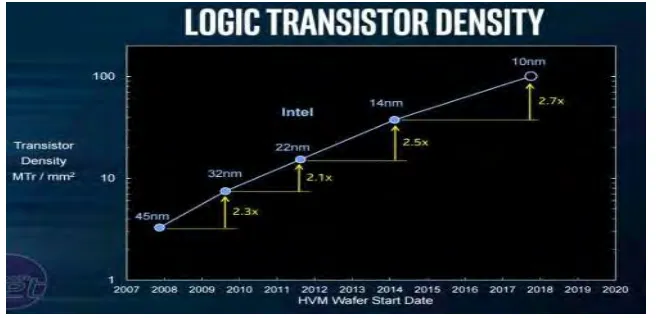
[image:20.612.164.492.525.684.2]In the past recent years, the microelectronic industry has decreased the transistor feature size scaling which 10µm to approximately 30nm. Apart from that, silicon(Si) bipolar also changed to p-channel metal oxidesemiconductor (MOS) and then evaluate to n-channel MOS and stop to complementary MOS (CMOS) planar transistor. Unfortunately, the industry also had faced challenges in scaling the transistor size into 10nm. However, this challenges need to be overcome by identifying other material that suitable to replace Si transistor in the future [1]. Another limitation that come across is the physical limits of the transistor [2]. The development of CMOS scaling in recent years is defined as Moore’s Law. Figure 1.1 shown evolution of transistor according to Moore’s Law [3].
2
Scaling theory is based on the simple rules of the transistor design which need in increase of circuit speed and density. Therefore, with the improvement on circuit performance and density, a complicated functionallity can be construct into a single chip. This can give benefit in reducing cost of fabrication [3]. Moore’s Law state that the component density and performance of integrated circuits will be double in every two years. The integrated circuits and scaling based on Moore’s Law is said as “the cheap way to do electronics”. The rate of improvement to overcome the limitation of CMOS will be change again and that means that Moore’s Law is still have more further. The limitations of the scaling are parasitic resistance and capacitance. This limitation is assumed as negligible by scaling theory. This limitation was accepted in the past 40 years but are not valid anymore for futher implementation in the next years. Moore’s law is not a physical law but it is a law about economics [1].
Therefore, to overcome the limitation there are a research regarding to identify a new device structure and alternative material. A few nanoelectronics device have been choosen to replace MOSFET device. For example silicon nanowire (SiNW), carbon nanotubes (CNT), III-V compound materials such as gallium arsenide (GaAs) and germanium (Ge) and last but not least is graphene. As this reseacrh continued, the graphene had final be choose as the most suitable material that can replace Si MOSFET [4]. Graphene is type of material that produce as high quality material with simple procedure and has cheap cost. Graphene has a large number of its material parameters such as mechanical stiffness, strength and elasticity, very high electrical and thermal conductivity [5]. A further explanation regarding to this material will be explain further in literature review part of this report.
3
graphene is used in MOSFET-like GFET device due to its potential in one of the solution to open the band gap in graphene material. Taguchi method is utilize to optimize the process parameter on threshold voltage (Vth), drive current (ION) and current state ratio (ION/IOFF) of the device. Analysis by using Taguchi method is done to identify which the process parameter that give the most impact on device performance. L9 Orthogonal Array (OA) of Taguchi Method is use for the statistical approach. The comparison is made up with previous research, before and after optimization.
1.2 Objectives of This Project
The main goal of this research is to analyse of process of parameter variation in Graphene field-effect transistor (GFET) device using L9 Orthogonal Array (OA) Taguchi method. The objectives are specific:
(i) To design MOSFET-like Graphene Field-Effect Transistor (GFET) by using ATHENA module in SILVACO TCAD tool.
(ii) To analyze the electrical characteristics of GFET by using ATLAS module.
(iii) To optimize the process parameter variation of MOSFET-like GFET using Taguchi method.
1.3 Problem Statement
4
parasitic resistance and capacitance which are generally assumed negligible [1]. A new device structure and alternative material is needed to overcome this limitation. Hence, among the new material that been choose, graphene appeared as the most suitable material that can replaced Si MOSFET [5].
1.4 Scope of Project
This project execution is based on simulation and program development. Simulation of Graphene field-effect transistor (GFET) device will be conducted by using a ATHENA module in SILVACO’s TCAD tool. Meanwhile, the simulation of electrical characteristics will be implemented by using an ATLAS module in SILVACO’s TCAD simulation tool. This tool will be used to simulate and design device structures. Other than that, this project is focused on the application of Taguchi method to obtain the optimum solution for GFET device in order to verify the predicted optimal design.
1.5 Report Structure
This thesis consist of five chapters which contain of the introduction, literature review, methodology, result and discussion and for the last chapter is conclusion and recomendation of the project. Chapter 1 is about the introduction of the project. In this chapter, the background and specific intruction regarding to this project is explained. Apart from that, in this Chapter 1 the objectives of the project are state with the problem statement and also the scope of the project.
5
MOSFET-like GFET structure is explain further. Apart from that, the method that be used to analyse the parameter of the MOSFET-like GFET also is included in this chapter.