Multiple Representations in Instructional Material:
An Issue of Literacy
Michael Sankey
University of Southern Queensland Toowoomba, Queensland 4350 Australia
E-mail: [email protected]
This paper will report on a current research project being conducted at the University of Southern Queensland (USQ), involving the development of a multimedia version of an existing print based course. Specifically, it will investigate relevant instructional design (ID) issues and reflect on the research that has informed this project. These issues include, firstly, the concepts involved in catering for a multiliterate clientele and how the use of multiple representations may enhance learning opportunities for students. Secondly it will investigate the cognitive constraints experienced in displaying and representing information in multiple ways and whether providing users with a level of interactive choice is beneficial to their cognition. Finally, in the light of this investigation an appropriate instructional design response will be suggested and demonstrated, limited only by the print medium of this paper.
Introduction
A team of academic staff from the Faculty of Business (F of B) and the Distance Education Centre (DEC) at the University of Southern Queensland (USQ) recently developed a multimedia version of a Project Management course run by USQ. Although not the first production of multimedia learning materials at USQ, this particular development is interesting as it is being further utilised as part of a funded research project to ascertain student/user response to such an interactive learning episode. This paper will outline the pedagogical constructs and assumptions that have been foundational in the development of this project, and will be further complimented by a display of the learning episode involved in the research project. Specifically, this paper will investigate the areas of instructional design (ID); the multiple representation of a concept and cognitive imperatives and constraints relating to effective learning strategies, particularly when catering for students whose learning modality may differ from the ‘traditional’ style. It will further demonstrate that catering for multiliterate learners in the design of interactive multimedia learning materials is a viable and appropriate option, and one that can assist in the learning of a wide variety of concepts. Lastly, it will be shown that when learners are given a certain level of choice in how they access their learning materials, they may be further empowered and stimulated in the acquisition of knowledge.
Rationale of the Learning Episode and the Research Project
Typically, the first on campus face-to-face lecturer for this course Dr Nooriafshar would elaborate the introductory concepts of; Project Management Techniques; Work Breakdown Structures; Network Diagrams and Gantt Charts. This is achieved by using sequential illustrations on a white board, while talking the students through these concepts. External students on the other hand received only static drawings and textual elaboration with limited scope to demonstrate the dynamic relationship that exists between the two. It was seen that creating an animated version of these concepts might serve as an appropriate solution to the perceived inequity experienced by students who, for many reasons, chose to study off campus and therefore not attend lectures.
To address this perceived inequity a project team was established with appropriately qualified staff from the FoB and DEC. Considerable time, resources and thinking would need to be committed to this project. It was considered appropriate to investigate whether the time and effort expended would ultimately benefit external students. Funding was sought and granted from the F of B and in-kind support was also offered by the DEC, for the design and construction of this material.
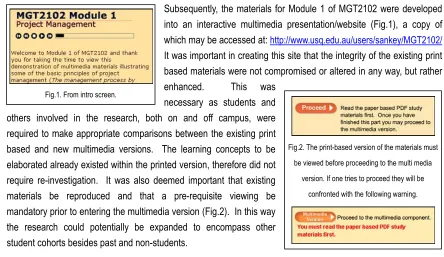
Subsequently, the materials for Module 1 of MGT2102 were developed into an interactive multimedia presentation/website (Fig.1), a copy of which may be accessed at: http://www.usq.edu.au/users/sankey/MGT2102/
It was important in creating this site that the integrity of the existing print based materials were not compromised or altered in any way, but rather enhanced. This was
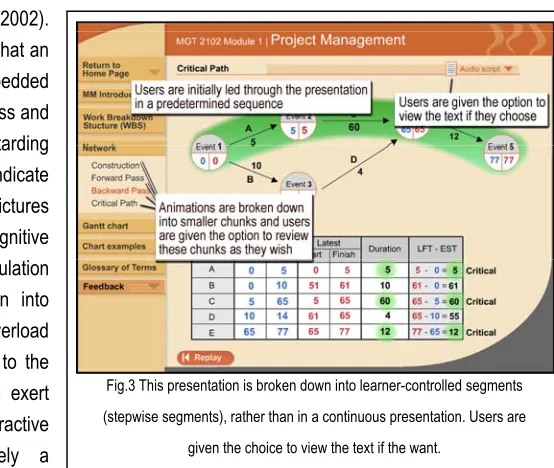
[image:2.595.61.505.297.554.2]necessary as students and others involved in the research, both on and off campus, were required to make appropriate comparisons between the existing print based and new multimedia versions. The learning concepts to be elaborated already existed within the printed version, therefore did not require re-investigation. It was also deemed important that existing materials be reproduced and that a pre-requisite viewing be mandatory prior to entering the multimedia version (Fig.2). In this way the research could potentially be expanded to encompass other student cohorts besides past and non-students.
Fig.1. From intro screen.
Fig.2. The print-based version of the materials must
be viewed before proceeding to the multi media version. If one tries to proceed they will be
confronted with the following warning.
This site is currently being utilised with student response data being continually collected. This process will continue for the next eighteen months. The initial results of this research, which are reported later in this paper, cover the first six months of this testing period. It should be noted that it was anticipated that students would receive this material favourably and that further modules from this course would need to be developed along these same lines.
Certain theoretical assumptions, concerning student learning modality and cognition were made in designing the learning episode. These will be discussed prior to any consideration of research findings that, over the longer term, may or may not validate the assumptions made during the projects’ design and implementation.
Different Learning Styles
acknowledge the significant effect that learning styles have on the learning process, they are unable to form a consensus regarding the establishment of a single set of accepted principles (Vincent & Ross 2001). For instance, a recent study conducted by Liu and Ginther (1999) found that approximately 20 - 30% of American students were auditory learners; about 40% visual; while the remaining 30 - 40% either tactual/kinesthetic, visual/tactual, or some combinations of the above. Another study found that approximately 50% were auditory, followed by 33% visual and 17% kinesthetic (Vincent & Ross 2001). Although these figures vary, it is clear that people learn in very different ways. This being the case, it is imperative that ‘instructional materials, as well as teaching styles, should be matched with cognitive styles for greatest learner benefits’ (Stokes 2002, p. 12), and this imperative becomes a matter of priority.
Research also indicates that many instructional events only target genetic cognitive styles. This is unsatisfactory, particularly for learners with styles inappropriately matched with the learning task (McKay 1999). It is also known that learning is more effective when multiple sensory channels are involved (Kearnsley 2000). On the other hand however, ‘when there is a mismatch between cognitive style and the mode of presentation, it is argued that performance is deemed to be reduced’ (McKay 1999, p. 324). Fortunately, recent research would suggest that there is a growing awareness amongst instructional designers (ID’s) of individual differences in cognitive style (McKay 1999). Conversely, one of the more basic problems as
DePorter (1992) suggests, lies in the fact that ‘many people don’t even realise they are favouring one way or the other, because nothing external tells them they’re any different from anyone else’ (p. 114). Consequently, many students struggle with the text based learning materials provided in a variety of learning situations. Therefore, the fundamental areas of sensory preference should be given credibility by ID’s. Instructional design must address the complex inter-relationships between learning task, learner’s cognitive processes and media attributes (Gunawardena 1992). Consequently, teaching requires a
variety of presentation techniques that will help students interact with materials and to satisfy their different learning needs (Chanlin 1997). To further illustrate this, some learners have difficulty reading, but may be careful listeners who remember what they have been told, while other learners may have great difficulty interpreting and understanding verbal instructions, especially when they are lengthy and complex, and may respond better to what they see (Flattley 1998).
Many students today struggle with text based learning materials.
Visualisation in Representation
Aristotle once stated that, ‘without image, thinking is impossible’ (cited in Stokes 2002). Interestingly, Stokes notes that much of the recent research reported in educational literature today would support this, asserting that using visuals strategies in teaching results in a greater degree of learning. Unfortunately, in most university classes very little visual information is presented. Students mainly listen to lectures and read material written on whiteboards and in textbooks and handouts (Flood & Lapp 1997). Or, in the case of distance education, interact with study books or computer screens that contain very few visual references. Felder and Soloman (2001) suggest that most people are visual learners, and that if sufficient visual content were included in learning materials students would retain more information. Fortunately, many educational researchers are calling for increased attention to the use of graphical inscriptions in education (Roth 2002).
many elite academics who are horrified by these thoughts, seeing any addition of pictures to learning materials as 'dumbing down' academic content. It is hoped however, that as more visual elements are incorporated to achieve an optimal balance between verbal and visual cues in education, interdependence between these two modes of thought will be fostered (Stokes 2002, p. 11). The ability to transmit and display both realistic images and graphical representations of information will provide an impetus for educators to come to a deeper understanding of the role of visualization in learning (Flattley 1998). For, as we will see, ‘educators need to foster a variety of new types of literacies to make education relevant to the demands of a new millennium’ (Kellner 2000, p. 245).
Muffoletto (2001) believes that, by understanding the process by which images become images, images that will in turn represent or refer to the creation of meaning, may be deemed as useless ‘if teachers do not incorporate the notion of multiple perspectives into their daily pedagogy’ (p. 7). DePorter (1992) states that, ‘when you’re aware of how you and others perceive and process information, you can make learning and communication easier’ (p. 110). This suggests that an effective instructional format would facilitate a combination of cognitive styles, necessitating the introduction of primarily visual texts (McKay 1999). This would then become almost mandatory if, as is being suggested, visual communication is capable of disseminating knowledge more effectively than almost any other vehicle of communication (Flattley 1998). There is therefore, a real ‘need to know how to communicate using this language, which includes being alert to visual messages and critically reading or viewing images as the language of the messages’ (Stokes 2002, p. 12). This however is not limited simply to visual literacy. Education today needs to foster a variety of literacies to empower students and to make education relevant to the demands of the present and future (Kellner 1998). In a very real sense our technology rich, postmodern condition, requires us to be multiliterate.
Multiple Literacy
Kellner (2000) believes that literacies are socially constructed by educational and cultural practices and that they evolve and shift in response to social and cultural change, he writes:
“…one could argue that in an era of technological revolution and new technologies we need to develop new forms of media literacy, computer literacy, and multimedia literacies that I and others call by the covering concept of “multiliteracies” or “multiple literacies”. New technologies and cultural forms require new skills and competencies and if education is to be relevant to the problems and challenges of contemporary life it must expand the concept of literacy and develop new curricula and pedagogies” (p. 249).
This being the case, multiple literacies are required if we are to meet the challenges of today's society. These literacies include ‘…print literacy, visual literacy, aural literacy, media literacy, computer literacy, cultural literacy, social literacy, and eco literacy’ (Stokes 2002, p. 11). If we are to extract maximum benefit from information and communication technologies as Kellner (2000) suggests, both in terms of engagement and learning, a futures oriented approach that prepares students to ‘read’ the world and communicate through multiple modes of communication will be necessary in preparation for functioning in an increasingly technological society (O’Rourke 2002).
way of education in the future, there is a real need to theorise the literacies necessary to interact with these new multimedia environments and to gain the necessary skills to enable individuals to learn, work, and create in these emergent cultural spaces and domains (Kellner 2000). Being multiliterate in a society that recognises a full range of multiple learning styles will therefore require the development of theories and strategies for the multiple representations of concepts for instruction, if for no other reason than to be totally democratic.
If students are to be prepared to operate in a multiliterate manner then, ‘we must provide them with opportunities to both express themselves and make sense of the world through multiple modes of communication (linguistic/textual, visual/graphical, musical/audio, spatial, gestural) sometimes all operating simultaneously’ (O’Rourke 2002, p. 57). It would seem that the way forward in this regard is to conceptualise and demonstrate the use of multiple representations, utilising the latest multimedia techniques and technologies. Multimedia does not hold all the answers, but it does offer certain opportunities that have not previously existed.
Multiple Representation and Multimedia
The use of multiple representations, particularly in computer-based learning environments, offers a wonderful variety of possibilities to the instructional designer. For instance, Bodemer and Ploetzner (2002) inform us that, ‘multiple representations can complement each other, resulting in a more complete representation of an application domain than a single source of information does’ (p. 2).
Ainsworth and Van Labeke (2002) state that, ‘Learning with multiple representations has been recognized as a potentially powerful way of facilitating understanding for many years.’ They also state that, ‘early research concentrated on the ways that presenting pictures alongside text could improve readers’ memory and comprehension of text. In the last two decades, the debate has widened to include an extensive variety of representational formats including animations, sound, video and dynamic simulations’ (p. 1). An example of this can be seen when writing about the impact of an atomic blast. ‘When the atomic bomb explodes a huge mushroom cloud is formed that stretches way up into the sky’. This written explanation may mean very little to somebody who has never seen a huge mushroom cloud or atomic blast. However, if an image of an atomic blast were placed with the test the reader would have an instant reference point. Simply put, ‘students learn better from words and pictures than from words alone’ (Doolittle 2002, p. 1). Both language and image are important means of symbolic representation, therefore when language fails, visual communication can be relied upon (Flattley 1998).
The words ‘atomic blast’ by themselves
may mean very little, but the inclusion of an image dramatically increases meaning.
Source:http://www.rockingham.k12.va.us/ EMS/WWII/WWII.html
For computer-based multimedia, visual literacy therefore takes on increased importance. Computer screens are clearly more graphic, visual, and interactive than traditional media, leading users to scan visual fields, perceive and interact with icons and graphics, and use devices, such as a mouse to interact with desired material and fields (Kellner 2000). Animation, which falls within both the visual and auditory fields, plays a pivotal role in this new medium. Computer-generated animation potentially helps the learner build mental representations for comprehension. This is because ‘animated pictures can present different states of a subject matter, they provide more information to a learner and require more processing than static pictures’ (Lai 2001). Animated pictures appear to have an enabling function that allows the user to perform a higher degree of cognitive processing than with static pictures (Schnotz 2002). This important feature, if not handled correctly, may in fact prove detrimental to the learning process. This is primarily due to the fact that to process multiple representations on the screen may place additional, and quite often unnecessary, cognitive demands on a learner. For example, learners may have to direct their attention simultaneously to different representations, especially if multiple representations are combined with other dynamic components. This therefore requires the learner to process large amounts of information. Very often these demands overburden student cognitive capabilities, resulting in the user learning very little (Bodemer & Ploetzner 2002).
Cognitive Constraints and Benefits
Two specific theories should be taken into account when designing instructional multimedia events. These theories are Dual Coding Theory and Cognitive Load Theory. Both theories focus, to different degrees, on the use of short-term memory when text and pictures are processed simultaneously. These theories seem at first to give contradictory predictions about the influence of instruction on learning when text and pictures are combined (Gellevij et al. 2002). However, common ground can be found when considering these theories, ground that the author believes can be very effective in the design of multimedia learning materials.
Cognitive Load Theory
Cognitive Load Theory suggests that when large amounts of information are presented at one time the learner can experience cognitive overload, the learner will become overwhelmed with what is being presented, resulting in a loss of direction and focus (Chanlin 1997). Further, it has been found that students learn more effectively when extraneous words, pictures, and sounds are excluded from materials. It is therefore essential that multimedia presentations focus on clear and concise presentations rather than on all the ‘bells and whistles’ or unnecessary information that will potentially impede student learning (Doolittle 2002). In other words, if one form of instruction is intelligible and adequate, for example a simple animation, providing the same information in a different form will impose an extraneous cognitive load on the learner (Sweller 2002). In a multimedia context, the main factors influencing cognitive load seem to be screen designs displaying text, graphics and animation (Lai 2001).
learners work in multiple modes (McLoughlin 1997), as long as reasonable constraints are provided.
Dual Coding Theory
Dual Coding Theory suggests that working memory consists of two distinct systems or parts, a verbal and a non-verbal system. The non-verbal system processes narrative (spoken) information, while visual information, both image and text, are processed by the non-verbal system. This means that narrative and pictures are being processed at the same time, but in two distinctly different areas of the working memory. This theory differs from Cognitive Load Theory that builds on the idea that there is only one working memory, with only a limited capacity (Gellevij et al. 2002).
The key concept for information visualization therefore, is to make use of the visual system to efficiently process information that otherwise may require more cognitive effort. Zhang et al. (2002) believe that the human visual system is powerful enough to process information in parallel, automatically and unconsciously. In so doing it bypasses the bottleneck of human working memory that is limited in capacity. This is primarily due to the fact that illustrations reduce memory load, for they are spatial, and in a sense, non-temporal. ‘They can store all the relations discussed in the text simultaneously. Text, by contrast, is read in temporal sequence and requires memory to keep all the parts in place’ (Kirsh 2002, p. 4).
The use of Illustrations and animation therefore allows for the possibility of increasing working memory capacity. This is achieved by using dual, rather than single modality representations. For example, Sweller (2002) informs us that, ‘under split-attention conditions, rather than presenting a diagram and written text that should be physically integrated, it may be possible to present a diagram and spoken text. Because the diagram uses a visual modality while speech uses the auditory modality, total available working memory capacity should be increased resulting in enhanced learning’ (p. 1506). This means that students may gain a better understand of an explanation when corresponding words (verbal) and pictures are presented at the same time than when separated in time (Mayer & Moreno 1999). Mayer and co-authors have repeatedly shown that users greatly benefit from this multimodal approach, with the most common form being a mixture of words and pictures (Gellevij et al. 2002). Simply put, students learn better from animation and narrative rather than from animation, narration, and on-screen text (Doolittle 2002).
Let the User Choose
When utilising traditional teaching media’s, such as textbooks and printed study materials, it makes the consideration of individual learning styles very difficult. Instead, the notion of a ‘model user’ is relied upon. Inevitably this ‘model user’ would be a read/write learner, who is equipped with a set of common or average cognitive characteristics. This is where interactive media can play an important facilitating role, for it is in the use of multiple representation that the preferred modality of the user, over that of an arbitrary generic construct, can aid in the construction of meaning. If this can be the case it allows the learner to adapt a presentation to his/her individual cognitive needs, by actively deciding about the ‘what’ and the ‘how’ of a given presentation of information (Schwan 2002). This suggests that, if the learner is presented with a choice of representation, the one that best suits their needs can be selected. There is evidence, in recent research, that this can strategy will significantly improve learning (Ainsworth & Van Labeke 2002).
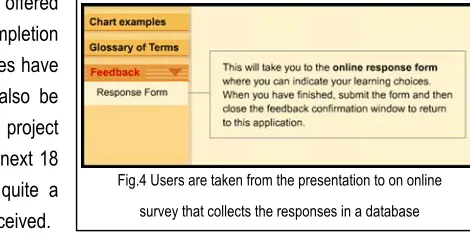
number of different concepts (Schnotz 2002). On the other hand, it is also suggested that an animation that has too many imbedded controls may even curtail the effectiveness and efficiency of the learning event, retarding assimilation (Lai 2001). These findings indicate that using continuous simulation pictures and/or too many controls may cause cognitive overload, whereas stepwise simulation pictures (breaking the animation down into shorter sections) will avoid cognitive overload by giving more control of presentation to the learner (Schnotz 2002). This ability to exert control over actions, within the interactive multimedia environment, is ultimately a
[image:8.595.223.500.78.312.2]pleasing experience for the learner. However, as has been noted, allowing too much control of the process may have the opposite effect and direct learners’ attention toward the operation of the program, rather than the content itself. Due to the limited capacity of working memory, students cannot simultaneously focus on the content area and control the learning process (Lai 2001). It is therefore recommended that only limited program control be allowed, giving learners the opportunity to concentrate on the task at hand.
Fig.3 This presentation is broken down into learner-controlled segments (stepwise segments), rather than in a continuous presentation. Users are
given the choice to view the text if the want.
An Instructional Design Response
The practical challenge for instructional designers therefore, is to use the power of computer graphics in empirically justifiable ways (Lih-Juan 1998). The new technologies and cultural spaces discussed require a rethink of education in its entirety, ranging from the role of the teacher, teacher-student relations, classroom instruction, distance and online education, grading and testing, the value and limitations of books, multimedia, and other teaching material, and the goals of education itself (Kellner 2000). Visual and other alternative forms of literacy, it should be emphasised, are not promoted here to supplant linguistic literacy, but rather support and enhance it. ‘As educators we must literally get back to the drawing board - or the computer or television screen - to develop visual materials for instruction’ (Flattley 1998). McKay (1999) believes that if we are able to move beyond individual instruction to individualised instruction, we may start to design instruction that caters for a range of cognitive/learning styles. The next few years, for the author at least, will be a time of challenge and a time for experimentation. It is a time, as Kellner (2000) informs us, to ‘put existing pedagogies, practices, and educational philosophies in question and to construct new ones. It is a time for new pedagogical experiments to see what works and what doesn’t work in the new millennium. It is a time to reflect on our goals and to discern what we want to achieve with education and how we can achieve it’ (p. 259).
Initial Findings
The learning materials developed for this project, as described at the beginning of this paper, have taken into consideration the theoretical elements discussed in this paper. These learning materials may be viewed at:
Applications II’. The opportunity to participate was offered to all the 45 students doing this course at the completion of semester two in 2002. Since then 39 responses have been received. Opportunity to participate will also be given to student doing this and other project management courses within the F of B over the next 18 months. It is anticipated that over this time, quite a significant number of responses will have been received.
Fig.4 Users are taken from the presentation to on online survey that collects the responses in a database
From the responses received to date some very clear trends are already beginning to emerge. Firstly, over 85 percent of respondents found the multimedia version of the materials less time consuming to work through than the printed version. The same percentage found the project management concepts presented easier to understand in the multimedia version. There was also an extremely high acceptance rating of the materials, with 95 percent of respondents reporting that they felt the presentation of the project management concepts were either ‘good’ or ‘very good’. Interestingly when asked if they would prefer to receive all their learning materials in this way only 29 percent responded positively with 54 percent preferring to receive a combination of both online and print based materials. Only one respondent preferred to receive solely print based material. It was seen from this and from further comments received that respondents would still like to retain access to print based materials, not necessarily as the primary source of instruction, but as an optional extra.
Conclusions
References
Ainsworth, S. 1999, ‘The Functions of Multiple Representations’. Computers & Education, vol. 33, no. 2-3, Sep-Nov, pp. 131-52.
Ainsworth, S. & Van Labeke, N. 2002, ‘Using a Multi-Representational Design Framework to Develop and Evaluate a Dynamic Simulation Environment’, Proceedings of theInternational Workshop on Dynamic Visualizations and Learning. Tübingen. ed. R. Ploetzner.
Bodemer, D. & Ploetzner, R. 2002, ‘Encouraging the Active Integration of Information During Learning with Multiple and Interactive Representations’, Proceedings of theInternational Workshop on Dynamic Visualizations and Learning. Tübingen. ed. R. Ploetzner.
Chanlin, L. 1997, ‘The effects of verbal elaboration and visual elaboration on student learning’, International Journal of Instructional Media, vol. 24, no. 4.
DePorter, B. 1992, ‘Quantum Learning: Unleashing the Genius in You’, Dell Publishing, New York.
Doolittle, P.E. 2002 ‘Multimedia Learning: Empirical Results and Practical Applications’, The proceedings of the Irish Educational Technology Users' Conference, Carlow, Ireland. May, 2002.
Felder, R.M. & Soloman, B.A. ‘Learning Styles and Strategies’ [Online], Available from: URL http://www2.ncsu.edu/unity/f/felder/public/ILSdir/styles.htm [Accessed 14 March 2001].
Flattley, R. 1998, ‘Visual Literacy’ [Online], Available through the Psychology Department at the Prima Community Collage Tucson Arizona at: URL http://dtc.pima.edu/psychology/Visual_Literacy.html [Accessed 5 August 2002]
Flood, J. & Lapp, D. 1997, ‘Broadening Conceptualisations of Literacy: the visual and communicative arts’, Reading Teacher, vol. 51, no. 4, Dec97/Jan98, pp. 342-5.
Gellevij, M., van der Meij, H., Jong, T. & Pieters, J. 2002, ‘Visuals in Instruction: Functions of Screen Captures in Software Manuals’, Proceedings of theInternational Workshop on Dynamic Visualizations and Learning. Tübingen. ed. R. Ploetzner.
Gunawardena, C.N. 1992, ‘Changing faculty roles and audiographics and online teaching’, The American Journal of Distance Education, vol. 6, no. 3, pp. 58-71.
Kearnsley, G. 2000, ‘Learning and teaching in cyberspace’ [Online], available from: URL
http://www.usqonline.com.au/courses/81_Content/readings/kearsley_g/chapts.html [Accessed 3 February 2001].
Kellner, D. 1998, Multiple Literacies and Critical Pedagogy in a Multicultural Society, Educational Theory, vol. 48, no. 1, Winter, pp. 108-28.
Kellner, D. 2000, ‘New Technologies/New Literacies: reconstructing education for the new millennium’, Teaching Education,vol: 11, no. 3, pp. 245-65.
Kirsh, D. 2002, ‘Why Illustrations aid understanding’ Proceedings of theInternational Workshop on Dynamic Visualizations and Learning. Tübingen. ed. R. Ploetzner.
Kress, G. & van Leeuwen, T. 1996, ‘Reading Images: The Grammar of Visual Design’, Routledge, London.
Lih-Juan, C. 1998, ‘Animation to Teach Students of Different Knowledge Levels’, Journal of Instructional Psychology, vol. 25, no. 3, Sep.
Liu, Y. & Ginther, D. 1999, ‘Cognitive Styles and Distance Education’ Online Journal of Distance Learning Administration, [Online] vol 2, no. 3, Fall. Available from: URL http://www.westga.edu/~distance/liu23.html [Accesses 5 August 2002].
Mayer, R.E. & Moreno, R. 1999, ‘Instructional Technology’ in, Handbook of Applied Cognition, ed. F Durso, Wiley, New York.
McKay, E. 1999, ‘An investigation of text-based instructional materials enhanced with graphics’, Educational Psychology, vol. 19, no. 3, September, pp. 323 – 35.
McLoughlin, C. 1997, ‘Visual Thinking and Telepedagogy’, [Online], Conference proceedings ASCILITE 97, Curtain University, Perth, Western Australia. Available at: URL
http://www.ascilite.org.au/conferences/perth97/papers/Mcloughlin/Mcloughlin.html [Accessed 25 January 2002].
Muffoletto, R. 2001, ‘An inquiry into the nature of Uncle Joe’s representation and meaning’, [Online]. Reading Online, 4(8). Available at: URL http://www.readingonline.org/newliteracies/muffoletto/index.html [Accessed 6 March 2001].
O’Rourke, M. 2002, ‘Engaging Students Through ITCs: A Multiliteracies Approach’, [Online], TechKnowLogia, April – June. Knowledge Enterprise, Inc. Available from: URL www.TechKnowLogia.org.
Rogalin, R.R. 1997, ‘The Changing Face of Literacy: a publishers perspective’, Reading Teacher, vol. 51, no. 4 Dec97/Jan98, p. 865.
Roth, W. 2002, ‘Reading graphs: contributions to an integrative concept of literacy’. Journal of Curriculum Studies, vol. 34, no. 1, Jan, pp.1-24.
Schnotz, W. 2002, ‘Enabling, Facilitating, and Inhibiting Effects in Learning from Animated Pictures’ Proceedings of theInternational Workshop on Dynamic Visualizations and Learning. Tübingen. ed. R. Ploetzner.
Schwan, S. 2002, ‘Do it yourself? Interactive Visualizations as Cognitive Tools’, Proceedings of theInternational Workshop on Dynamic Visualizations and Learning. Tübingen. ed. R. Ploetzner.
Spender, D. 2000, ‘Ferny Grove’ from USQ Online materials unit 81531 Semester 1 2000
Stokes, S. 2002, ‘Visual Literacy in Teaching and Learning: A Literature Perspective’, [Online], Electronic Journal for the Integration of Technology in Education, vol 1, no. 1, Spring, available from: URL
http://ejite.isu.edu/Volume1No1/Stokes.html. [Accessed 1 August 2002]
Sweller, J. 2002, ‘Visualisation and Instructional Design’, Proceedings of theInternational Workshop on Dynamic Visualizations and Learning. Tübingen. ed. R. Ploetzner.
Vincent, A. & Ross, D. 2001, Learning Style Awareness: A Basis For Developing Teaching and Learning Strategies Journal of Research on Technology in Education, vol. 33 no. 5 Summer. Also available online at:
http://www.iste.org/jrte/33/5/vincent.cfm.
Zhang, J., Johnson, K. A., Malin, J.T. & Smith, J.W. 2002, ‘Human-Centered Information Visualization’