PH
ARE
DOCUMENTATION
•
COMMISSION
z
w t N0'-...
"'
...
..0
... H
PHARE
0
INDEX
Page
A.
Administmtive Part
11. Notice of our new address 3
2. List of Documentation available at
the PHARE Advisory Unit 5
3. Document Request Form
7
4.
Glossary 9B.
Backrround Information
155.
Background Brief 176. First Annual Report to the Council 37
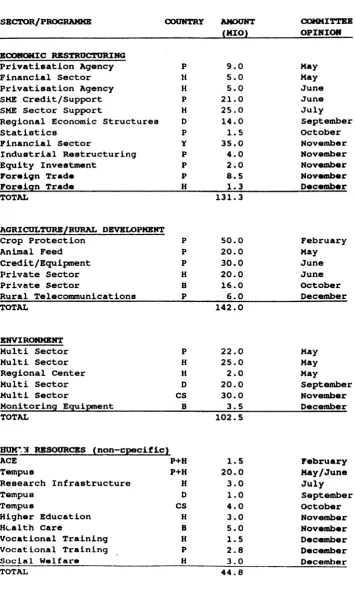
7. Financial Commitments 1990- 1991 71
8.
Overview of Operational Procedures77
c.
Programme Information
799. List of Approved Projects (selected by country) 81
10. Indicative Programmes 1992 105
11.
Compendium 1992 11912. Privatisation 165
13. Investment Promotion 175
14. JOPP 185
15. Selected Documentation 223
16. SME 255
17. Social Dimension 263
D.
Addresses
27116. List of Addresses 273
E.
Re,gister Fonn
293A.1
***
:a:
*
I::
*
***
The PHARE Advisory Unit has moved.
We can be found at
rue Be/liard 68, 2nd floor, offices 26, 40, 42
B-1040 Brussels
Postal Address:
Commission of the European Communities
B 68 2140
B-1049 Brussels
l'clea•honc:
(32-2)
299.13.56
299.14.00
299.15.00
299.16.00
Fax:
299.17.77
**a***
*
*
*
*
***
DOCUMENTATION AVAILABLE
at the
PHARE ADVISORY UNIT
LisTED BELOW AI'..E SO."dE OF TIIH DOCUMENTS AVAll...ABLE FROM TilE Pl-f..ARE ADVISORY
UNIT. lF YOU WOULD LIKE ANY OF TIIESE DOCUMENTS PLEASE FU.L Ol!T THE REQUEST FORM
ATfACHED AND SEND IT TO THE ADVISORY UNIT AT 200 RUE DE LA Lol, (n6& 2/U) B-1049
BRUXELLES.
1. PHARE OPERATIONAL GUIDE {ENOL!SII, FRAN~AIS, 0El1TSCH)
2. PHARE
PR.oJEcr
SUMMARIES Nos 8 & 9 (1992).Nos
1-7 ARE COPITAL~ED IN mE PHARECoMPENDIUM 1990-1992. UPDATES ARE MADE FOLLOWING TUE PHARE MANAGE'MENT
COMMITfEES {ENGLISH)
3. PHARE COMPENDIUM 1990 & 1991 PROGRAMME SUMMARIES BY SECTOR (ENGUSH).
4. PHARE PROJECTS LISTED BY COUN"rnY DETAILING THE NAME OF THE PROSECT AND ITS
BUDGET (ENGLISH)
5.
EC JOINT VENTURE SUPPORT SCHEME -JOPP (ENGLISH, FRANCAIS, DEUfSCH)6. PRN ATISATION AND RESTRUCTURING IN CENTRAL AND EASTERN EUROPE (ENGLISH, FRAN~AIS)
7. INvEsTMENT PROMOTION IN CENrP...AL & EASTERN EUROPE (ENGLISH)
8. FIRST ANNUAL REPoRT FROM THE COMMISSION TO TilE CoUNCIL AND THE EUROPEAN
P ARLIAl..tENT ON THE IMPLEMENTATION OF EcoNOMIC AID TO THE CoUNTRIES OF EAST AND
CENTRAL EUROPE AS OF 31 DECFMBER 1990 (ENGLISH, FR.AN~AlS, DEtrrSCH)
9. PHARE FINANCIAL CoMMITMENTS 1990 & 1991 (ENGLISH)
10. PHARE REGULATIONS-To BE FOUND AT THE B~CK OF THE PHA.R.E OPERATIONAL GUIDE.
(ENGLISH, FRANCAlS, DEUTSCH).
11.
nm
PHARE ADDRESS BooK: (ENGLISH)12.
•nm
COMidUNITY AT THE CENTRE OF AID TO THE COUNTRIF..S OF CENTRAL AND EASTERNEUROPE {ENGLISH, FRANCAIS, DEUTSCH)
13. ECHO'S DF t.'EUROPF.- DO~Sir:R SPf:.CIAJ. PIIAP.E (FRANCAIS)
14. CONSULTANT'S REGISTRATION FOP..M (ENGLISH)
15. 1)fE 1992 PHARE INDICATIVE PROGRAMMES SUMMARY (ENGLISH)
A.7
DOCUMENT REQUEST
FORM
NAME:
...
~ ... .ADDRESS:
···
···
TELEPHONE: •••••••.•.•••••..••••••••••••••••••••••••••••••...•...••.•..•
FAX:
PLEASE SEND TO TilE ABOVE ADDRESS:
No. OF Doc. LANGUAGE DocUMENT NAME COPIES #
(MAX 3)
COMMISSION OF THE EUROPEAN COMMUNITIES
PROGRAMME OF ASSISTANCE FOR ECONOMIC RESTRUCTURING
IN THE COUNTRIES OF CENTRAL AND EASTERN EUROPE
The
·PHARE
A.9
of commonly used terms & acronyms
Written by the PilAR£ Advisory Unit
A.10
2
GLOSSARY
PilAR£
PHARE is the European Community Programme wh.ich channels Economic and Technical Assistance to the countries of Central and Eastern Europe. Starting with Poland and Hungary in 1989 (hence the PHARE acronym: Poland Hungary Assistance for the Reconstruction of the Economy). the programme today covers the following countries: Albania, Bulgaria, Czechoslovakia, Estonia, Latvia, Lithuania, Poland, Romania and Slovenia. PHARE will in due course be extended to the other Republics of the fonner Yugoslavia as and when they meet the conditions of elegibility.
LEGAL BASIS
Regulation 3906189:
(OJEC Nr. L 37511 /)
Regulation 2698/90:
(OJEC Nr. L 25711)
Regulatio11 3800/9 I:
(OJEC Nr. L 357110) Regulation 2334192:
(0./EC Nr. L 227/1)
Basic Council Regulation for PHARE. Constitutes legal basis
for decision making procedures. Provides mechanism for management committee and tendering procedures broadly similar to other fonns of EC external Aid.
Amendment to Regulation 3906/89 which extends
Community assistance to Bulgaria, Czechoslovakia, the GDR. Romania and Yugoslavia. Humanitarian aid permitted.
Extension of assistance to Lithuania, Latvia,
Estonia and Albania. Deletion of the GDR from PHARE.
Extension of assistance to Slovenia.
PHARE OPERATIONAL SERVICE (referred to as PHOS)
Brussels based Directorate set up by the European Commission within the Directorate General I
(External Relations) in early 1990 to initiate, prepare and supervise the implementation of PHARE assistance programmes. PHOS consists of the following units:
P/IOS I:
PHOS 2:
PHOS
3:
1'1/0S 4:
PHAR£ Advisory &
/11[ormation Unit
Agriculture, Environment, Nuclear Safety, Infrastructure (Transpon, Energy and Telecommunications). Food aid.
Banking and Financial Sector, Small and Medium Sized Enterprises. Enterprise Restructuring, Privatisation.
Social & Employment, Health sectors, Public Infrastructure & Administration, Humanitarian Aid, Programming and Country Co-ordination.
lntemal Resource management (finance, admamstrattOn, contracts. personne I).
3
J•JIARE
I>ROCEDURES
PIIARE Budget: Allocated each year as a global envelope from the EC Budget. It has grown by 368% to I billion ECU since 1989. The total allocated over the last three years is now 2.28 billion ECU.
Financial Regulation: Council Regulation governing the execution of the Community budget. Of
particular interest is Chapter IX on external aid, providing the basic rules & procedures for implementing PHARE Programmes and awarding contracts.
Natio11al Co-orditrator : A person, usually of ministerial rank, who has been designated by the
beneficiary govenunent to co-ordinate PH ARE assistance on beha If of his/her government. The National Co-ordinator is responsible inter alia for liaising
with internal ministries in order to prepare the PHARE narional (indicative) programme and select the priorities for regional co-operation.
PHARE Ma11agenrent Committee:
Defined by Article 9 of Regulation 3609/89. Consists of representatives of the EC Member States who meet 6-8 times a year to give their opinion on the proposed PHARE measures (financing proposals), before the Commission takes a financing decision.
lndicati••e Programme: A working document agreed on an annual or multiannual basis bee ween the
National Co-ordinator on behalf of his/her government and PHOS on behalf of the Commission. It sets out key priorities, objectives and the sectoral breakdown for PHARE-financed acrivities and serves as a guideline for subsequent detailed identification and appraisal of sectoral programmang.
Sectoral ProJ!ramme: PHARE progranune outlining actions lo be taken and funds committed to provide assistance in rhe priority secrors defined hy the Indicative J>rogrammc.
Regional Programmes: A Programme involving three or more beneficiary countries which pursue
common goals by joint action. They may also aim to achieve economies of scale, greater flexibility and are conducive to exchanges of information between the countries concerned. In particular, they may facilitate the establislunent of administrative information-processing systems (customs, statistics etc.) compatible with those in use in other parts of Europe.
Fitra11c:i11K Propo.,.al: Document containing any one proposed (sectoral) programme Wntten by PHOS in co-operation with the respective government. Presented to the PH ARE Management Committee for opinion, and then to the Commission for decision. The envisaged measures are described and explained in their context, along with their estimated budget.
Financing Memora11dum :
PIU, PSU, PMU :
Signed by the representatives of the Commission and the beneficiary country after the Commission's formal adoption of the Financing Proposal. Necessary before any project may be implemented, it is the legal basis for the commitment of resources to achieve specific obJectives
Project Implementation/Support/Management Unit. Established by and in a national Ministry or Agency of the beneficiary country in order to manage the PHARE Programme in situ. The unil is usually staffed by the Ministry
and supported by PHARE-funded Technical Assistants (External Experts)
A.12
4
Projects Authorising Officer (PAO):
Responsible for project implementation and financial management. Invested with contractual powers.
Teclurical Assista11ce (rA) or Tee/mica/ Co-operation:
CEC Delegatio11s :
Technical Assistance is defined as the provision of services with the primary purpose of transferring lcnowledge, skills, technical know-how or productive aptitudes. The aim is usually to increase the stock of human intellectual capital or to maximise the capacity for the most effective use of existing factor endowment and lcnow-how transfer (as distinct from transfers intended to increase the stock of physical capital).
Representations of the Commission, with ambassadorial status. accredited to third country governments. (currently in Belgrade. Budapest, Prague and Warsaw. A Delegation is to be accredited in Sofia).
CONTRACTUAL ARRANGEMENTS
Public Supply Cmrtracts:
Direct Agreeme11ts :
Open Ttmder:
Restricted Te11der:
Prequalificatio~r :
Letter of /11terest :
Contracts for pecuniary interest concluded in writing involving the purchase of products between a supplier (a natural or legal person) and one of the contracting authorities.
Contracts entered into by the EC or PIU directly with the consultant or supplier without prior tendering. Usually of sums less than 50.000 ECU. Public tendering procedure whereby all interested suppliers may present an offer. Used principally for supply contracts. Published locally and, for major contracts, in the E.C. Official Journal. Part C. SupplementS.
Procedure whereby only those suppliers invited by the contracting authorities may submit tenders. Usual procedure used for Technical Assistance I
Services contracts.
Preselection of firms mainJy for Technical Assistance or Service contracts Effected by responding to a formal invitation to state interest appearing in the Official Journal, part C, supplement S. Results in a "long list" of qualified firms. from which "short lists" are drawn whenever a restricted tender is organised.
Informal expression of interest and capability which should be sent to the relevant P.I.U. and/or Co-ordinators office and/or Commission PHOS with a request to be considered for contracts.
Consultant's Register: A list of consulting firms which have expressed an interest in being
considered for PHARE contracts. May be consulted by PHOS when organising a restricted tender. An expression of interest and capability should be made to the competent PHARE office in Brussels by means of a proforma application (Fax 32-2-235.53.87).
4
Short List :
5
Selected list of firms invited to submit offers for a specific T.A. or SeiViccs tender. Drawn from the Long List (see above), the suggestions of tendering authorities, the Consultant's Register, other Commission seiVices' lists (e.g. DGs for Energy or Environment), Letters of Interest and data banks of other international financing institutions.
Multidisciplinary fund: Enabling device, consistent with general management procedures in external aid, to give a general authorisation to finance (within given parameters) small operations such as feasibility studies, technical assistance and micro projects outside of and supplementary to sectoral programmes. It is managed from Brussels. Specific memoranda and Management Committee opinion are not required for each grant. Grants up to I MECU.
GTAF (Ge11era/ Technical Assistance Facility):
Hunranitaria11 Aid:
Fund set up enabling the implementation unit to prepare preliminary steps in a number of sectors in one country. Managed in the beneficiary country by a Project Implementation Unit for the GT AF.
PHARE funds set aside for hwnanitarian aid destined to cover emergency measures, short or medium term needs (e.g. medical supplies, aid to orphanages). Not to be confused with Food Aid and Emergency Aid (which is run by DG VIII). May be up to 10% ofPHARE's budget.
PHAREPROG~EACRONYMS PHARE: TACIS: GTAF SIGMA: ACE: TEMPUS: COST: JOPP: STRI/J>l:.R: EXPROM: TOURIN: APRICOT: LIS: SUPEC: SIERRA: MOVE: TESSA: LAMBDA: SCITEC/1:
Poland Hungary Aid for Restructuring the Economy
Technical Assistance to the Commonwealth of Independent States (applies to the CIS & Georgia)
General Technical Assistance Facility
Support for Improvement m Governance and Management (Regional) Aid for Co-operation in Economics (Regional)
Trans-European Mobility Programme for University Studies (Regional)
Co-operation in Science & Technology (Regional)
Joint Ventures in PHARE programmes managed by DG XVIII. J. Magnette -(352) 4301 6262 (Luxemb()urg)
Stntctural Ot>vt>loprn~nt 111 '.<""lerted Re~~inns (Pola1H1)
Expon promotion (Poland)
development of the tounst mdustry (Poland)
Agriculture: privatisation and co-operatives (Poland)
Land Information System (Poland)
Support to economic strategy and the creat1on of the Ministry of the Economy (Poland)
Support for the implementation of the Europe Agreement (Poland)
Modernisation of Vocational Education (Poland)
Teaching & EducatiOn tn Strategically Significant Areas (Poland) Local Administration Management Building and Development (Poland)
Support for Science and Technology (Poland)
A.14
OAIEGA: CORIN£: CEEC/PECO:
CIS:
SMF./PME: FEOGA: ECHO: IF/ I IFO: EIBIBEI:
EBRDIBERD:
6
Public Administration Reform (Poland)
Co-ordination of Information on Environment (DG XI)
Central and East European Countries. Pays de !'Europe Centrale et Orientale: Albania, Bulgaria, the CSFR. Estonia, Hungary, Latvia, Lithuania, Poland, Romania, Yugoslavia.
Commonwealth of Independent States (ex-USSR. minus Georgia and the Baltic States)
Small and Medium Sized Enterprises I Petites et Moyennes Entreprises
Fonds Europeen d'Orientation des Garanties Agricoles
Eurpean Commission Humanitarian aid Office (DG VIII)
International Financing Institution I Organization
European Investment Bank (of the E.C.) Banque Europeene d'lnvestissements (des C.E.). Principally investment financing)
European Bank for Reconstruction and Development I Banque Europeenne pour Ia reconstruction et le developpement. Principally investment financing. Opened in London in April 1991. EC is a major shareholder.
/BRD/8/RD ("World Bank/Ba11que Mm•dia/e'') :
NGO:
OECD: IMFIFMI: WANO:
International Bank for Reconstruction and Development I Banque lnternationale de Ia reconstruction et du developpement.
"Non Govememental Organisations" is a broad appelation understood by PHARE to refer to non profit making voluntary organisations. social movements and grassroot initiatives. regardless of their formal or legal status.
Organisation for Economic Co-operation and Development.
International Monetary Fund I Fonds Monetaire International
8.15
COMMISSION
OF THE EUROPEAN COMMUNITIES
Olr.c:torot....c.nerol
AudloYieual. lnfonnatlon. Camunleotlon. CUlture
External lnfonnat lon 1.8.4
BACKGROUND BRIEF. JUNE 1992
BB/12
EC- EAST EUROPE
Fe
I at. i
ens
wIth
O:ntra
I
a-d
Eastern 8..rq:E
erd the Qmn::ruea
I
th
of
11
li::4:£t
d:i
1lt
states
I. OVERY E l
1. Agreements
a. The Joint EEC/COUECON* Declaration of 25 June 1988 marked the
start of a new· era In trade and political relations with the
countries of Central and Eastern Europe. Diplomatic relations were
established and permanent missions were sent from each of these
countries to the COmmunity.
Negotiations for bilateral treaties
were also Initiated.
b. Trade and cooper at I on agreements were cone luded between October
1988 and March 1991 with all the Central and East European
countries. They ·are to last ten years except In the case of Poland
where It Is flve.years.
(More
Information on the trade and cooperation agreements
In
annex 1).
c. Pr lor to the trade and cooper at I on agreements, sector a I · trade
arrangements had been signed between the former COMECON countries
and the Community concerning textiles, steel and beef.
d.
In November 1991 Europe or Assoclat lon agreements between the EC
ancr Poland, Hungary and CSFR** were finalised, and signed In
December. They have to be approved by the European Parliament and
the national parliaments of the Twelve and of Poland, Hungary and
CSFR, before entering Into force on January 1, 1993.
Interim agreemenis covering the trade and related questions of the
Association agreements have also been signed; these do not require
ratification by' the Twelve parliaments and
therefore became
effective on
Mar~h1, 1992.
(More Information on the Europe agreements In annex 2).
Negotiations for similar Europe Agreements with Bulgaria and
Romania started In spring 1992.
*·council for Mutual Economic Assistance, dissolved early 1991
** Czech and Slovak Federal Republic
P'oetot Actdr"e: flUe de lo Lol 200 &-1049 Bru.eele - S.lglun
[[l-"/ec-1el. 92
Vle"o" Addr-•: flUe de Tr.,.. 120 &-1049 Brueeele - S.lgllll'
Tel: direct line 299 •... ••~ 299.11.11- Telex co.E:\1 8 21877- Tei~•CC!hlc oddr"e ~ Bru•••'•- Telefox 299 ... .
t./{p
IJ.
17
-&.+&
- 2
-2. Assistance
a.
In order to Improve market access. the Community decided In
1989to
grant GSP (genenallzed system of trade preferences) treatment to
Imports from Po·land and Hungary; and to eliminate or suspend
quantitative trade restrictions as of 1 January 1990.
In all
Member States ex.cept In Spain and Portugal. These measures were
later extended
to
Imports from Czechoslovakia.
Bulgaria and
Romania; Albanla.and the Baltic States began to benefit from this
scheme In 1992.
b. The COmmunity's PHARE programme Is aimed at supporting the process
of economic restructuring and encouraging the changes necessary to
build a market-oriented economy and to promote private enterprise.
The support Is mainly In the form of technical assistance and
skills transfer.
In addition
hwnan~tarlanemergency aid has been
made
available to some countries. The high priority sectors
Include
agriculture.
Industry,
energy,
financial
services.
prIvatI sat ton. Investment promot ton, envtrorvnent protect lon. and
training. The
Commission's PHARE
budget was
500 UECU(1)
In
1990; 785 UECU In 1991 and 1000 UECU for 1992. All Community PHARE
funding
Is
In
the
form
of non-reimbursable grants
to
the
beneficiary gove'rnments. PHARE assistance was Initially Intended
for only Poland and Hungary but has since been extended to Include
the CSFR, Bulgaria, Romania and former Yugoslavla(2). Albania and
the Baltic States became eligible for PHARE assistance In January
1992, which brings the total number of beneficiaries to 10.
c. Convnun I ty loans .targeted at he I pIng the countr les of Centra I and
Eastern Europe "overcome their balance of payment difficulties
amount to 2090 t.tECU.
The COmmunity contribution Is roughly equal
to the sum of' the contributions from the' remaining G-24(3)
contributors. (see point g. below)
d.
The Community's European lnvestiR8nt Bank (EIB) has extended Its
Investment
activities to Poland,
Hungary,
CSFR.
Romania
and
Bulgaria. The Community guarantees these loans. For the period
ending December 1992, ·the E
18has ear•arked a tota I amount of 1. 700
UECU for loans to these five countries.
e. The European Coal and Steel Community (ECSC) Is contributing to the
restructuring
o~the steel and coal Industries In Central and
Eastern Europe v't a trade and cooper at ton agreements and by way of
loans.
It has earmarked a total of 200 UECU for loans to support
the restructuring of the coal and steel sectors In Central and
Eastern European·countrles.
f. The European Bank for Reconstruction and Development (EBRD), under
G-24 aegis, officially opened ·on 15th April 1991. The Community
contributes to the capital of the EBRD, and holds a 51X share.
It
started Its activities In September 1991.
End
1991,
It had
approved projects for a tot a I amount of 427 UECU and comm
1t ted
13UECU In the framework of the technical assistance.
(1) UECU: one million ECU
(2) See chapter "Yugoslavia" page
13-
.) .g. The Commission coordinates the assistance offered to the countries
of Contra I and Eastorn Europe by all 24 lndustr lallsod market
economy
countrl~s,the
G-24.Working groups have boon sot up
amongst tho
G-24
represontatlves to doal with the coordination of
financial and technical assistance In specific sectors.
3.
lU.W1
a. Both Imports frbm and oxports to tho flvo Contral and Eastorn
European countries (Poland, CSFR,
Hungary,
Romania,
Bulgaria}
lncroased considerably during the first nino months of
1991:
23and
52% respectively. Thoy represent
4,11of EC exports and 3,3X of EC
Imports. The trado balance which usod to be In favour of the
Contral
and
Eastorn
European
countries
Is
turning
to
the
Communlty•s advantago (about
1
billion ECU for the period
January-September
1991).
This marked change Is mainly due to the doubling
of Community exports to Poland.
b. The COmmunlty•s main Imports from East European countries consisted
In
1990
of: agrl.cultural products Including processed agricultural
products:
17%=.baso meta Is and art lc les of base meta Is:
15Xtextiles and tex\11e products:
141;
and mineral products:
11%.
c. The Communlty•s principal exports to East Europe In
1990
were
machinery and eloctrlcal equipment:
321;chemical products:
121;textiles and textile products:
111;and agricultural products,
Including
proces~edproducts: lOX. More than half of these textile
exports are
relmported
Into
the Community
after
undergoing
processing In
Ce~traland East European Countries.
I I . S TUAT O'J BY COUNTRY
POLAND
1 •
Agroemen t s
.
a. A flye-year trade and ecoogmle e00poratlon agreement was signed on
19
September
1989.
It entered Into force on
1
December
1989.
This
non-preferential agreement which Includes the clause of reciprocal
MFN
(Most
Favoured
Nation}
treatment,
foreseos
the
gradual
liberalization
b~1994
of quantitative restrictions applied by tho
Conlnunl ty on Imports or lglnat log from Poland.
However,
In the
framework of
PHA~E.tho COmmunity decided to spoed up the process
and agreed to suspond non-specific and
IIberato all specific
quantitativa restrictions as of
1January
1990In all Member States
except SpaIn and Por tuga I . Moreover. the agreement prov 1 dos for
cooperation aimed at
tho development
and
diversification of
EC/Pollsh two-way trado.
19
8.+8
- 4
-b. The eurooo Agreement between the Community and Poland was slgn6d ._,;. 16 December 1991 and Is In the process of ratification. In the' meant I me. the trade aspects have entered Into force on March i . 1992. by way of an Inter lm Agreement. The Europe Agreement w I I I replace tho trade and economic cooperation agreement of 1989.
c. A Delegat lon from the CommUnity was opened In Warsaw on
21 September 1990. The Head of Delegation Is Mr Dljckmeester.
2. Assistance
a·. In the two years 1990 and 1991, some 27 projects represent log· a
total amount of about 380 MECU from the Commission's PHARE
programme was ap_proved In favour of Poland. These projects which are mainly In sOpport of the economic restructuring benefit I.a.
the environment.: agriculture. Industrial, financial. social and
health sectors. as well as the development of small and medium
sized enterprises and human resources. On 3 June 1992, the
Indicative Programme for European COmmunity Assistance to the
Republic of Poland for 1992 {PHARE 1992), Involving 200 million ECU
{1 ECU- appr. 17.000 Zlotys) In grants, was signed In Warsaw.
Whereas In 1990 the priority sector was rapid assistance to
agriculture {by supplying plant protection chemicals and animal feed), In 1991 prlvatlsatlon and economic reform were the central areas. Economic reform Is also a key area for at tent lon In the 1992 programme, with special attention for the structural
development In selected, less-developed regions. Environment has
been a priority ~rea In all three Indicative Programmes signed so far, having received approximately 13X of the resources which wera
available over the last three years. Poland also benefits from
PHARE programmes destined for several Central European countries.
b. So far, Poland r.ecelved five EIB loans for a total value of 240
MECU. The beneficiary sectors Include railways, telecommunications, energy and smal I and medium sized enterprises.
c. In 1991, Poland -benefited from EBRD loans for a total amount of 113 MECU. In June 1992, the EBRD launched an equity subscr lpt lon of 40 MECU In the Polish Pr lvate Equl ty Fund, a company to be
estab II shed to Invest In sma II and medIum sIzed prIvate
enterprises.
d. Poland Is entitled to ECSC loans In support of restructuring Its
coal and steel Industries. So far It has received a 25 MECU loan.
a. Trade between the Community and Poland has Increased substantially
over the last two years. Total Imports Into the Community from
Poland have lncr~ased by 53% since 1988 to just over 5.1 billion ECU In 1990. Exports from the Community to Poland Increased by 59% between 1988 and 1990 to 4.4 billion ECU. The 1990 balance of 763
UECU was In favour of Poland. In 1991 the Community became
Poland's most Important trade partner, buying about half of
Poland's exports and supplying over one third of Its Imports. As a
result, the 1,662 MECU trade balance turned In favour of the
- 5 .
b.
In the period January-September 1991, the community Imported
fromPoland mainly base metals and articles thereof:
18X;agricultural
products, Including processed agricultural products: 16%; textiles
and textile articles: 14%; and mineral products: 11%.
The largest exports from the COmmunity to Poland were machinery and
electrical eQuipment: 24%; transport eQuipment: 15%; agricultural
products
Including processed agricultural
products:
14%;
and
chemical products: 10%.
HUNGARY
1. Agreements
a. A teo-year trade: and economic cooPeration agreement was signed on
26September 1988.
It entered Into force on 1 December 1988.
This
non-prefereotlal~agreement
also Included the clause of reciprocal
UFN (Uost Favoured Nation) treatment and foresees the gradual
liberalization by 1994 of quantitative restrictions applied by the
Community on
Imports originating from Hungary.
The agreement
provides
for
-cooperation
aimed
at
the
development
and
diversification of EC/Hungarlan
two-way
trade. The
agreement
Includes an ECSC protocol relating to trade and cooperation In coal
and steel products which was signed In October 1991.
b. The Europe Agreement between the Community and Hungary was signed
on
16December
1991and Is In the process of ratification.
In the
meantime, the trade aspects have entered Into force on 1 Uarch 1992
by way of an Interim Agreement. The Europe Agreement wll I replace
the trade and economic cooperation agreement of 1988.
c. The COnlnunlty opened a Delegation In Budapest In November 1990.
The Head of Delegation Is Ur. Beck.
2. Assistance
a. Hungary has benefited from the COnlnunlty's PHABE programme which
was launched In 1989. Up to end 1991 PHARE projects for a total
amount of 240 UECU were approved In support of actions In the areas
of
agriculture,
environment,
economic
restructuring,
human
resources as we I_ I as soc I a I and f I nanc I a I sectors and sma I I and
med lum sIzed enterprIse dove lopment. The 1992 programme has an
lndlcat lve budget of 100 UECU. In add It lon ttungnry benet I tn from
the PHARE
projec~sdestined for several Central European countries.
b.
In order
to Welp
Hungary overcome
Its balance of payments
difficulties, the Community has granted In 1990 and 1991 two loans
with a total value of 1,050 UECU.
~I
B.~
- 6
-d.
In
1991.Hungary benefited from EBRD
Interventions (loans
o··equities) for a total amount of
98UECU.
e. Hungary has acce$s to ECSC loans In support of restructuring Its
coal and steel sectors. An amount of
55UECU has been earmarked to
be shared between Hungary and Poland.
a. Total
Imports
Into the Community from Hungary have
Increased
annually by
12%since
1986to just over
2.9billion ECU In
1990.Exports from the Community to Hungary have Increased annually by
4~since
1986to just under 2.9 billion ECU In
1990.However EC
exports to Hungary were decreasing In
1990 (-4%).The balance of
trade at the end of
1990was
59t.tECU In favour of Hungary.
The
Community became. Hungary's 180St Important trade partner In
1991,buying almost half of Hungary's exports and supplying over one
third of Its Imports. End
1991.the balance of trade was
140UECU
In favour of Hungary.
b. The Community's main Imports from Hungary In the period
January-September
19911conslsted of agricultural
products,
Including
processed goods:
'24X;textiles and textile articles:
16%;machinery
and electrical equipment:
15X.The largest exports from the Community to Hungary were mach lnery
and electrical equipment: 28X; chemical products:
13X;and textiles
and textile articles:
13X.Almost
60%of these textile exports wl I I
be relmported following processing In Hungary.
CZECH
AND
SLQ'IAIC FEDERAL REPUBLIC (~)1.
Agreements
,,
a. An agreeraent between the CSFR and the Community on the trade of
Industrial products was signed on
19December
1988.·:
b. A ten-year trade. and economic coooerat ton agreement was s lgned on
c.
7 May
1990.It .. came Into effect on
1November
1990.ThIs
non-preferential
agr~ementalso Included the clause of reciprocal UFN
(most
favoured
nat I on)
treatment.
1t
foresees
the
gradua I
ll~arallzatlon
by
1994of quantitative restrictions applied by the
Community on Imports originating from the CSFR.
The agreement
provides
for
cooperation
aimed
at
the
development
and
diversification of EC/CSFR two-way trade.
It covers Industrial and
agricultural goods.
Trade In coal and steel products Is governed
by a ECSC protocol signed In February
1992.The Europe Agreement with the CSFR was
and Is In the process of ratification.
aspects have
en~eredInto force on
1Interim Agreement.
The Europe Agreement
economic cooperation agreement of
1990.signed on
16December
1991In the meantime. the trade
March
1992by way of an
will replace the trade and
2. Assistance
a. From September
:1990,
when the CSFR became eligible for
PHARE
funding
bythe Community, up to November 1991, some
10PHARE
projects for a total value of
133
MECU wore approved for the CSFR.
Priority
areas
Include
envlrorvnent,
training,
energy,
restructur lng and tho pr I vat lsat lon of state owned propert les and
dove lopment of SUEs as we II as human resources development.
In
addition, Czechoslovakia benefits from the PHARE projects destined
for several Central European countries. For
1992,
the
I lkely
financial requirements total 96 UECU.
b. The Community extended In Uay
1991
a
375
UECU medium term loan In
order to help support the CSFR's balance of payments.
c. The eommun I ty has agreed to extend Its guarantee of E IB loans In
Central and Eastern Europe to the CSFR, Bulgaria and Romania.
The credit line for these three countries Is
700
UECU over a
2
year period
(1991-1992).
d.
In
1991,
the CSFR benefited from EBRD Interventions (equities) for
a total amount of
31
UECU.
e. Czechoslovakia Is also eligible for ECSC loans In support of Its
coal and steel Industries.
a. Total Imports Into the Community from the CSFR have Increased by
22X
since
1988
to almost
2.7
billion ECU In
1990.
Total exports
from the Community to the CSFR have Increased by
17%
since
1988
to
just slightly over
2.6
billion ECU In
1990.
The balance of trade
at the end of
1990
was
81
UECU In favour of Czechoslovakia. The
Community became Czechoslovakia's most Important trade partner,
with In
1991,
buying over
~OXof Its exports and supplying about
one third of
Its Imports. The 245 UECU balance remains
In
Czechoslovakla's:favour.
b. The Community's most Important Imports from the CSFR In the period
January-September
1991were base metals and articles of base
metals:
15%;
textiles and textile articles:
12%;
machinery and
electrical equipment:
11X;
and transport equipment:
lOX.
The largest exports from the Community to tho CSFR were machinery
and electrical equipment:
37X;transport equipment:
11X:and
chemical products: lOX.
13
B.H
- 8
-B U L G A 8 A
1. Aareements
a. The too-year trade and economic CQQporatlon agreement between the
Community and Bulgaria was signed on 24 September 1990 and came
Into force on
1November 1990. The f lrst meet log of the Joint
committee was held In Sofia on 30 November 1990.
A ECSC protocol on trade and cooperation In coal and steel products
Is In
preparatlo~.b. Since 1 January
:1991,the Community extended Its GSP (Generalised
System of
trade Preferences)
to Imports from
Bulgaria,
and
eliminated or suspended the quantitative restrictions It applied on
Imports from Bulgaria.
c. Negotiations with Bulgaria with a view to concluding a Europe
Agreement started on 14 Uay 1992.
d. A Commission Delegation was opened In Sofia In June 1992. The Head
of Delegation Is Mr. O'Sullivan.
2. Assistance
a.
In September
1990,the Community's PHARE programme was extended to
Bulgaria. Up to November 1991 some 11 PHARE projects for a total
amount of
100
MECU were approved In agriculture. environment.
health,
energy;:.· economic
restructuring.
and
human
resources
development. Total allocations of PHARE funds to Bulgaria In 1992
Indicative Programme
Is foreseen to be 90 MECU.
In addition
Bu I gar I a benefIts from the PHARE projects destIned for sever a I
Central European countries. Bulgaria also received together with
Romania part of
100
MECU humanitarian aid programme In the form of
emergency food and medical ald.
b. The COmmunity de·clded In June
1991
to extend a 290 MECU loan to
Bulgaria In support of Its balance of payments, as part of a
coordinated effort within the G-24. A first Instalment of
150
MECU
was disbursed In July
1991;
a second Instalment Is expected to be
paid soon. On 5 June 1992 the Commission proposed to the Councl I a
decision on additional financial assistance for Bulgaria
(110
UECU
medium-term loan).
c. The Community has extended Its guarantee of EIB loans In Central
and Eastern Europe to Include Bulgaria. The credit
I lne for
Bulgaria, Romania and czechoslovakia together Is 700 MECU over the
two years 1991-1992.
3. ~
a. Total Imports lr1to the Community from BulgarIa have Increased by
26Xsince 1988
to
almost 0.6 billion ECU In 1990.
Tota
1exports
from the COmmunity to Bulgaria have decreased by JSX since 1988 to
0.9 billion
ECUIn 1990. The balance of trade at the end of 1990
was 317 UECU
In favour of the EC.
In 1991. EC
Imports from
Bulgaria Increased significantly by 29%, while our exports grew
15%. thus
furthe~diminishing the EC trade surplus to 281 UECU.
b. The largest Imports Into the Community from Bulgaria In the period
January-September 1991 were: agricultural products Including those
already processed 25X; textiles and textile articles: 15%; and base
metals and products of base metals: 13%.
The largest exports from the Community to Bulgaria were machinery
and electrical equipment:
26X;
transport equipment:
17X;and
agricultural products. Including those already processed: 16%.
c. The Council authorised the European Commission In early October to
negotiate with
~ulgarlathe amending of the textile agreements In
force. The EC
ls~wllllngto Increase up to 8X the quota allotted to
t:
Bulgaria, for
pr~ductscovered by the Multlflbre Arrangement.
BOMAN A
1.
Agreements
a. Since 1974 Romania has benefited from GSP treatment and In 1980 an
agreement was signed concerning trade of Industrial products. This
1980 agreement was to have been replaced by an agreement of greater
scope. However negotiations on this were suspended In April 1989.
b. COmmunity
relations with Romania were
reactivated after
the
revolution of December 1990 and a trade and economic c
00
oeratlon
agreement was concluded on 5 Uarch 1991. and entered Into force on
1 May 1991.
An
ECSC
protoco~i
relating to trade and cooperation In coal and
steel products was Initialled In December 1991.
c. NegotIatIons wl th RomanIa wl th a view to cone ludlng a Europe
Agreement started In spring 1992.
d. The Council authorized the European Commission In October 1991 to
negotiate with Romania the amending of the textIle agreements
already In force. offering an Increase In the Import quota for
products covered by the Multlflbre Arrangement.
2. Assistance
a. The Communlty•s
PHARE
programme was extended to Romania
In
September 1990 but was suspended until January 1991 for political
21f
;2.5
8.24
- 10
-reasons. Until November 1991, 6 PHARE projects for a total amount
of 100 UECU were approved, providing assistance In the area of
genera I techn I ca.l ass I stance and human resources as we II as some
sectoral programmes concerning
Imports and healthcare. On
31
January
1992a
1992Indicative Programme of 130 UECU for PHARE
assistance to Romania was signed. Romania also benefits from the
PHARE projects destined for several Central European countries.
b. Before Its full Inclusion In the PHARE programme, Romania received
60 MECU worth of humanitarian and emergency aid In 1990. Of this,
11 UECU was for medical aid, 41 MECU for agriculture and 7 MECU for
orphanages and Romanian children.
The European COunc I I of 14 and 15 December 1990 decIded on new
emergency aId equa I I I ng 100 UECU to be shared by Roman I a and
Bulgaria.
80 MECU of thts Is allocated to food aid and
20UECU
supplied by PHARE to medical ald.
c.
In order
to help Romania overcome
Its balance of payments
difficulties the Community and Romania signed In November
1991an
agreement for a ·375 UECU loan. A first Instalment of
190t.tECU has
been disbursed. ·on 5 June
1992the Commission proposed the Council
to decide on an additional
financial assistance for Romania
(medium-term loan of 80 t.tECU).
d. The Community has extended Its guarantee of EIB loans In Central
and Eastern Europe to Romania. So far a loan of 25 t.tECU has been
approved In favour of the electricity company.
e.
In
1991,Romania' benefited from EBRD loans for a total amount of
165 MECU.
.
f.
Ra.anla can also·obtaln ECSC loans In support of Its coal and steel
sector a.
a. Total Imports Into the Coamunlty from Ra.anla have decreased by
29%since 1988 to
1.4
billion ECU In 1991.
Exports from the Community
to Romania have·· almost doubled to 1.3 billion ECU In
1991.The
trade balance
In~1991 was 137 t.tECU In favour of Romania.
b. The largest Imports Into the Community from Romania In the period
January-September. 1991 were: text lies and text lie art lcles: 25%;
,
mineral products: 19X; base metals and articles of base metals: 9%.
.
'ALBAN A
1. Agreements
a.
In February 1991.. the COmmission received official requests from
Albania
for
the
establishment of
diplomatic
relations.
the
negotiation of a trade and cooperation agreement, and for food ald.
b. Multiparty elections took place for the first time In Albania on
March 31 1991 with some EC Member States sending observers. This
led to official relations being established between the EC and
Albania; the Albanian Deputy Prime Minister on June 24 visited the
Commission.
c. On 20 June 1991, Albania was welcomed as the 35th member of the
CSCE (Conference for Security and Cooperation In Europe).
d.
In October the COuncil authorized the Conlnlsslon to negotiate a
trade and c00oeratlon agreement with Albania, which was signed on
11 .5.1992.
2. Assistance
a. EC emergency aid to Albania In 1991 totaled 19 MECU comprising
humanitarian and medical assistance (1.5 MECU), food aid (15 MECU),
emergency rellef-(1 MECU), and aid to refugees In Greece and Italy
(1.5 MECU). In June 1992 the Council decided on additional food aid
for 45 MECU.
b. The
G-24
countries
decided
In
September
to
extend
their
coordination assistance to Albania, which from January 1992 Is also
eligible for PHARE ald. From the 1991 PHARE budget It received
already 24 UECU.
c. On October 29 Albania became a member of the EBRD (European Bank
for Reconstruct fbn and Development). Unt II end 1991. It a
1ready
benefIted
from··i EBRD's
lntervent I on
In
bank
restructur log
techniques.
a.
In 1990 the Coiinunlty Imported 80.7 MECU worth of goods from
Albania and total exports to that country amounted to 117.8 MECU.
In 1991 these figures were 35 MECU (Imports) and 78 UECU (exports).
b. On March 11, 1991 the Commission approved the llberallzat lon of
several Albanian Imports from Italy, (chemicals, leather and fur,
glass products .•
~)with Immediate effect.
c. 1 January 1992 the EC removed all quotas on Imports from Albania,
except for textiles and some agricultural goods.
d. The
COUncil
decided on 3.2.1992 to
Include Albania
In
the
generalized systqm of preferences.
i.CP
27
8.'!6
12
-e. The largest Imports Into the Conwnunlty from Albania In 1990
werechrome. nickel. medicinal plants and ref I ned ol I.
The pr Inc lpa I
community export products to Albania were food products. ol Is (such
as sunflower), tobacco, thin Iron sheets and carded cotton.
I H E 8 A L I
C S I A I E S
1. Agreements
a.
In September 1991 the European Community announced Its Intention to
negotiate trade and cooperation agreements with Estonia, Latvia and
Lithuania.
b.
Directives were for trade and coooeratlon agreements between the EC
and each of the BaIt I c States approved by the EC Counc I I of
Ministers In November 1991.
The three agreements were signed In
Brussels on 11 Uay 1992. They are regarded as "first generatlonM
agreements, given the present situation In the Baltic States. but
with
the
possibility of
replacing them
later
with
European
(assocI at I on) agreements.
The agreement wIth LIthuanIa (the on I y
Baltic State with nuclear facilities) also covers relations with
EURATOM.
During a visit by EP members In early November 1991, Lithuanian
President Landsberg Is stated he considered a form of assoclat lon
with the EC to be the logical course to Industrial reorganisation
and diversification of trade.
c. The Community's !delegation In Stockholm was also accredited to
Estonia and Latvia at end April and will be accredited to Lithuania
In due course.
2. Assistance
a. The Council decided In early October that the three Baltic States
would remain beneficiaries of the Programme of technical assistance
to the USSR until end 1991, with 15 UECU reserved for them.
Latvia. Estonia and Lithuania have become beneficiaries of the
PHARE programme from January 1992.
PHARE assistance for
these
countries amounts to 45 MECU In 1992.
b.
Po~slbllltlesof balance of payment assistance will be examined In
connection with International financial Institutions.
The EC Is
already supporting membership of the three Baltic States In the IMF
and the World Bank In the near future.
I
c. Food aid to the value of 45 UECU commenced on 4 February 1992 with
several del lverles to Estonia.
3. ~
a.
Since
January
1992,
the
Baltic
republics
are
among
the
beneficiaries of the Community generalised system of preferences.
-- I._,
b.
In mid-October 1991, six weeks after Independence, Llthu3nla,
Latvia and Estonia declared their Intent ton to create a BaIt
lcStates common Mar.ket at the earliest opportunity. They have agreed
on the creation of a free trade zone with no customs duties. the
eventual objective being no controls on goods at their frontiers.
The three countries Intend to establish their own currencies and
Estonia expects to do so very shortly.
c. The Baltic
State~.which are seeking a certain division of labour
among them, also signed In October a •charter of Development
Strategy•.
A more specific division will be difficult due to the
transition from a centralized economy to a market economy.
At
present, the Battles export over 60X of their net production to the
C.I.S. republics and depend on the former USSR for energy supplies,
raw materials and spare parts.
YUGOSLAV A
1. Agreements- Recognition of lndeoendent reoubllcs
Official EC relations with Yugoslavia began with the signature of a
non-preferential
agreement
In
1970,
followed
by
an
updated
agreement In
1973,
later completed by an additional clause covering
progressive cooperation In the development field.
Following this
strengthening of· ties, a cooperation agreement was concluded In
1980
for
an
rndeflnlte period. This agreement
which grants
preferential treatment for trade, Includes dotal led clauses on
economic,
technical,
financial
and
social
cooperation. A
Commission Delegat lon was opened In Belgrade at the end of
1980.
The Head of
Dele~atlonIs Mr. Janssens.
- 14
-The Convnunlty now applies full economic sanctIons against
Serb!~and Uontenegro In line with the UN Security Councl I Resolution 757.
2.
Assistance
EC loan finance has been made available under a protocol to the
cooperation agreement, and Yugoslavia became eligible for economic
assistance In autumn
1991.
receiving PHARE grants total ling
35
UECU
that year to support the restructuring of enterprises and the
financial sector;.
In
1991
political developments have made
It
Impossible to continue cooperation under the PHARE progranvne, no
grants have therefore been made since then. Between September
1991
and June
1992,
the EC has granted the republics of
former
Yugoslavia
(with the exception of Serbia and Montenegro)
an
emergency aid of
.49
UECU, of which
29
UECU have already been spent.
our lng the last
5years, EC-Yugoslavla trade has been expanding
continuously. EC Imports rose from
4.9
billion ECU In
1986
to
7. 7
billion
In
1990
(+57%),
of
which
manufactured
goods
represented
57X.
machinery
and
transportation equipment
21%,
foodstuffs and tobacco
6X.
EC exports Increased from
5.8
billion
ECU In
1986
to
8.5
billion In
1990
(+45%),
of which manufactured
goods represented
39X,
machinery and transportation equipment
35%
and chemical products
13X.
For the first
9
months of
1991,
Imports
reached
5.8
bllrlon ECU
(+1.5X
as compared to the first
9
months
of
1990),
and exports amounted to
5.3
billion ECU
<-
12X).
SLOVENIA
Slovenia was recognized on January
15, 1992.
Early Uarch
1992
the
Commission
started
talks on
an
agreement,
similar
to
the
cooperation agreement EC/Yugoslavla of
1981,
with a possible clause
to come to an Europe Agreement. as Slovenia asked for.
At the end
of Uay negotiation directives were proposed to the Council.
If the
Commission
receives
a
mandate
negotIatIons
could
lead
to
In It
I
a Ill ng an agreement before August
92.
That agreement cou
1
d
come Into force by 1.1.1993.
CROATIA
CroatIa was recognized as an Independent republic on January
15,
8 0 S N I A -
H E R Z E G 0
V
I N A
Bosn 1 a-Herzegov Ina was recognIzed on 7. 4.
1992.Pres I dent Del or s
has written to Bosnian President lzetbegovlc about the Commission's
willingness to .strengthen relations, and
Invited a government
representat lve
to
discuss
the
establishment
of
contractua I
relations.
MACEDONIA
The recognition of Macedonia Is still under discussion. The EC has
accepted the principle of recognizing the republ lc. but first wants
to solve the denomination problem.
1.
Agreements
CXMtQNWEALIH OF I NDEPENDENJ STATES
(former USSR)
A ton-year trado
1and economic c000eratlon agreement was signed In
December
1989.Economic cooperation aimed at strengthening and
diversifying economic ties between the two sides and encouraging
economic operators, promoting Investment and encouraging joint
ventures,
licensing agreements and other forms of
Industrial
cooperation. The areas of economic cooperation Included mining.
agriculture, environmental protection, energy and
the service
lndustr los (banking, Insurance, transport, etc.). EURATOU was a
party to this agreement, given the EC's close Interest In matters
relating to nuclear research and safety In the USSR.
At the end of
1990the EC and the USSR had planned to renegotiate
and broaden the
~greement,but these talks could not begin due to
the events In
1991,which resulted In the disintegration of the
USSR
as such, =·and
Its replacement
In
December
1991by
a
Commonwealth of Independent States (C.I.S), formed by eleven former
Republics of the Union, with the exception of Georgia. This wholly
new situation has Incited the Commission to envisage a new typo of
agreement, somew.here In between the normal
trade and economic
cooperatIon agreoment and the Associ at I on or Europe agreements
signed with Poland, Hungary and CSFR.
The Commission p;lans to submit to the Council In July directives
with a view to negotiating new agreements with the
12states. The
COUncil should decide In the autumn so that negotiations can begin
soon afterwards.
2. Assistance
The EC agreed In principle In late
1990to provide assistance to
the USSR, although at various stages during
1991part of this was
blocked as a consequence of political uncertainties thoro.
30
31
B.a&
- 16
-Food
aid to a value of
250UECU was approved In March
1991.Deliveries began In June and have been largely completed; the food
Is for the most deprived sectors of the Soviet population. and
Internal
distribution Is mainly
In hands of non-governmental
organisations.
Afurther
200UECU of food aid was decided
InDecember
1991by
the Uaastrlcht European Council
for
urgent
delivery to Moscow and St. Petersburg. But food aid should not
become a systematic feature of the Community's support for the
Independent states. It should be replaced, to the greatest extent
possible, by commercial operations to reestablish trade flows and
to strengthen the market mechanism. In addition the EC has provided
a guarantee of a loan of 500 UECU taken by a Soviet bank from a
consortium of EC banks, and approved an EC loan of
1,250UECU.
The
money made available will be used to buy food supplies and medical
products from the Community and the countries of Central and
Eastern Europe, -·Including the Battles. The total amounts thus to
2,000
UECU, as the EC contribution to a total food and medical aid
package of around
6,000UECU from the
G-7group of Industrialised
countries.
The Community also provided
400UECU for technical assistance under
the 1991 EC Technical Assistance Programme, mainly In the fields of
training,
transport,
food
distribution, energy
and
financial
servIces. A techn
Ica I ass I stance budget of
450UECU Is provIded
for 1992.
Building on the five priority areas Identified under the
1991 programme, the Commission alms to provide assistance under the
1992
programme
In
several
additional
fields,
namely
food
production,
tel~communlcatlonsand the conversion of
defence-related Industries.
During 1991, the USSR benefited from EBRD Interventions for a total
amount of 20,7 UECU, of which
14UECU In loans and 6,7 UECU In the
framework of technical assistance. The EBRD approved on 27 Uay 1992
: ':!