International Journal of Innovative Technology and Exploring Engineering (IJITEE) ISSN: 2278-3075, Volume-8 Issue-9, July 2019
Retrieval Number:I8420078919/19©BEIESP
Abstract- The implementation of load balancing is challenging task for correct system functioning. Load balancing is the process of distributing the load among all the available nodes in a proper way. We present the concept of split point where underloaded node is not absorb all the load of overloaded node, rather it will be distributed among several underloaded nodes. In a distributed system, the directory is maintained at all the information of all the nodes. Another term defined in this algorithm is threshold. Threshold limit defines the capacity of each node. Ideally load is not above the define threshold limit, if overloaded condition arise then load will be migrated from one node to another. In this paper we implement the formal specification of split point load balancing algorithm under Rodin platform on event B. Formal methods are mathematically based tools for the verification of software system and hardware system. Event B is formal method for modeling and mathematical reasoning about the system that may consist of physical components and software modeling.
Keywords—Load Balancing, Threshold, Event B, Formal Specification, Formal Methods, Formal Verification
I. INTRODUCTION
Load balancing [1] is one of the important concept in distributed system. Our system is the collection of nodes where all the nodes defined by some load. Load balancing improves the resources utility, maximize the throughput, minimize response time and minimize the overhead in entire system [2][3][4][5][6]. Split point is one of the best load balancing algorithm [2], where load will be transferred to several underloaded nodes. In this paper we prove the algorithm using formal methods and verification process.
Defining the system model, if any new request is processed in node then we increase the load value and according the load value we define node status under these categories:
A) Underloaded node B) Overloaded node
If load of the node is greater than threshold value then we define the node is overloaded. If load value less than threshold value then we can say that node is underloaded. After defining the type of node if load is overloaded then we transfer the load from overloaded node to underloaded node. In this structure we maintain a directory of each node with corresponding load. To overcome the load of overloaded nodes, we broadcast the message from overloaded nodes to
Revised Manuscript Received on July 05, 2019..
Shantanu Shukla, Computer Science Depatement, Pranveer Singh Institute of Technology, Kanpur, India.
Raghuraj Singh Suryavanshi, Computer Science Departement, Pranveer Singh Institute of Technology, Kanpur, India.
.Divakar Yadav, Computer Science department, Institute of Engineering and technology, Lucknow, India.
underloaded nodes. After broadcasting the request message, underloaded nodes deliver the request and reply with load value and node information. Overloaded nodes receive the information with corresponding load and save the information in own directory. After saving the nodes and corresponding load information, overloaded node search the suitable node for sending the load. One important point is there load will not be transferred to that node which has recently received the load from other node.
If any overloaded node which is not suitable to transfer the load because of load value of overloaded node is excess and none of the underloaded nodes are taking the load in one node so we shall split the load in overloaded node according to the information of directory. Means we select the least load of underloaded nodes and according the underloaded load value we split the load in overloaded node. In their one important point is this none of the node' load value greater than threshold limit.
After selection of nodes, we define node movement mechanism. In this mechanism a node is overloaded due to many reasons. First reason is a node gets overloaded due to high popularity of more than one of its node. Second, a node gets overloaded because of high amount of loads put on it while none of them is highly popular, In this condition we select a node and transfer the load from overloaded to under loaded node. During the transfer of the load, the load value of overloaded node is decrease and load value of underloaded node is increase according to corresponding threshold value.
In this paper, we present a formal model of verification and validation of a distributed load balancing (how can we balance the load and transfer the load in appropriate node). According the algorithm we convert the each condition into set theory which have defined under the eclipse based RODIN platform to the extension of Event B [7] language. We define every single module and satisfy the assumption of proof obligation (PO) methods in the formal based approach. Rodin tool is generated the proof tree and statistics of context and machine. It also generate the proof information of every event and invariants. The Event B formalism is a part of the B method [7][8]. It is a state based formal approach to promote the construct of correct paradigm of algorithm and formal verification by proving the theorem [9].
The remainder of this paper is organized as follows: Section 2 briefly outline about the Event B and Rodin platform, Section 3 describes system model and informal description about events, Section 4 presents Event−B Model of Load balancing for distributed system. Section 5 defines the result analysis of proposed model
and Section 6 concludes the paper.
Split Point Load Balancing Algorithm Based on
Event B
II. EVENT B AND RODIN PLATFORM
Event B is a modeling language to provide a transition methods of any algorithm. Event B has been simplified the general notation into discrete mathematical expression. A general notation called event. Every event represents a different modules under the where clause and according to where clause, act module is implemented. Additionally, we read some modeling structure that are important to understand the concept of Rodin platform and provide the verification of any algorithm. Event B model [7] [8] [9] [10][11] is divided into two components - Context and Machine.
A) Context: Context specify the static part of model. It contains sets, constant, axioms and theorems. Sets may be enumerated or carrier sets. The properties of constant and sets describe under the axioms section. Axiom is set of constant identifier and these identifier describe the properties under the axioms section. The context may be seen by the machine directly or indirectly.
B) Machine: Machine represents the dynamic part of model which have contained the behavior model. Machine contains refine, sees, variables, invariants, variants and events. Under the machine, we create a local variables and define the operations in event section which start with when and begin keyword. Under the guard section we write a condition, if all the guards is true then act module will be implemented. In guard all the conditions are define according to our model. If one of the guard is false then act module will not be correctly implemented.
Invariant term defines under the machine model, which is definition of the variable. Variable contain three modules like variable keyword, invariant and initialization part. Variables are constrained by invariants and these invariants are to be safe whereas change the value of variables. All the module should be clearly define. A machine can refines by the other machine, but each machine refines only one machine.
For making the consistent model, invariants should be formally prove. Machine sees the context part, if we do not define the context variables in machine model then we cannot conclude static part in model. The guard states the essential condition under an event and action (act) describe on behalf of the guard when the successfully events occur.
Event B is a process refinement, state based model. Refinement is a technique of changing some values of model using different state model that proofs the correctness of model. For a correct state of refinement, every possible execution of refined machines correspond to execution step of its abstract machine. Verification of a model as well as correctness of refinement steps should be discharging by proof obligation. The Rodin platform [8] is support of event B that provides the environment of automatically generated proofs and manages an automated proves that is automatic discharging the goal of the model. The level of automation should be high to make a realistic model.
There is some B notation frequently used in our model. Let P and Q be two sets, then the relational constructor ↔ defines the set between P and Q.
P ↔ Q = Power (A*B)
Where * is Cartesian product of P and Q. These relation written as p ↦ q where p ∈ P and q ∈ Q
Another symbols in B notation as follows: ⇸ Partial function
↔ Relation function → Total function P power set
P1 Non empty power set dom (R) domain of relation R ran (R) range of relation R ⊂ Strict subset ⊆ Subset
III. SYSTEM MODEL AND INFORMAL DESCRIPTION OF EVENTS
In this section, we shall consider an informal approach about the split point load balancing under distributed environment. They have a set of nodes where every node maintain a dictionary. In dictionary they contain the information about requesting node and their respective load. Request queue also contain the message of overloaded node with respective load. In a load balancing system, every node maintains a status of node. Node status defines in two categories like overloaded node and under loaded node. Assume one of the node's load is overloaded then their respective dictionary search the under loaded nodes. During the searching process overloaded node broadcast the message and received by the every node except sending node. The node whose load value is less than threshold, send reply to sender node. Overloaded node selects one of the best nodes in underloaded nodes and transfer their respective load. Each time when a message is send by any node their respective dictionaries will be updated. During the load transfer if one receiver is not able to received whole value of sender load then the load will be divided and transferred to two or more underloaded node. The main objective is that load value of receiver should also not exceed the threshold limit.
The informal description of events are as follows:
A) Load submission: When a load is submitted to node, its load value is increased by one. After increasing the load value, we compare the load value with threshold value. If the load value is greater than threshold value then we set the node status is overloaded and if the load value is less than threshold value then we set the status of node is underloaded. Overloaded nodes search the underloaded node for achieving to balance the load in the system.
International Journal of Innovative Technology and Exploring Engineering (IJITEE) ISSN: 2278-3075, Volume-8 Issue-9, July 2019
Retrieval Number:I8420078919/19©BEIESP
On the basis of different load values in overloaded node, the node selects the most appropriate node for transferring the load.
E) Split point sender and decrement the load: Whenever underloaded node does not capacity to receive whole load of sender (which is overloaded node), the overloaded node splits the load and choose two or more underloaded nodes to transfer the load. Split the load in sender node corresponding the load value of underloaded node. After splitting the load value node can transfer the load in various underloaded nodes and decrease the value from overloaded node.
F) Split point receiver and increment the load: After receiving the load from overloaded node, value of nodes increase the load in underloaded nodes. After all the overloaded node turn into normal node, load transfer is complete.
We have read many algorithms which are implemented under the Event B model for verification and provide the proof obligation [11][12][13][14][15].
IV. EVENT B MODEL OF LOAD BALANCING IN DISTRIBUTED SYSYTEM
Event B model contains a context and a machine. Machine contains various invariants and events. In context we declare the sets of MESSAGE & NODE as carrier set. The other term is set status, capacity, and type, which are define as enumerated set. In the set status we have declared the two type of load like under load & overload. The set status define the status of node. The set type contain a constant like value_under load, value_overload, threshold, val_threshold, request, reply, inprogress and completed. The message type defines the type of message whenever it is request or reply. Invariant defined as “sender" variable is a partial function from MESSAGE to NODE. A mapping (mm→nn) ∈ sender indicates that message mm is send by node nn. Define another variable is loadmessage. Loadmessage manages a load by natural number (N). Invariant defines by (loadmessage ∈MESSAGE → N) means message contain the load which have natural number. The variable reqnodes is subset of NODE set and it contains only those nodes which are overloaded.
The variables, initialization and invariants terms of machine are defines as follows:
Variables: sender, loadmessage, deliver, nodestatus, loadvalue, replymsgsend, replymsgrcd, msgsend, dir, messagenodevalue, messagetype, replynode, trans, transferload
Initialization: We declare all the initial values according to the modeling. Most of them declare with ∅ value. But some values can't be ∅. The initial value of node status is under loaded and initial value of load value is 0 which is a natural number.
Fig 2: Invariants of load balancing model
Fig 1: Invariants of load balancing algorithm
All those invariants (see figure 1) described below:
a) The variable sender send the message from one node to another (inv1). The invariant inv(2) is defined as follows :
deliver ∈ NODE↔MESSAGE
The variable deliver represents delivery of message at a node. A mapping of form (nn ↦mm) ∈ deliver represents that a node nn has delivered the message mm to participating nodes.
b) The variable nodestatus defines the status of node, either load is overloaded or underloaded. (Inv3)
c) The invariant inv(4) represents the variable of loadvalue. It defines the value of load in a node. Load value represent by a natural number.
d) The Invariant inv (5) represents replymsgsend as follows:
replymsgsend ∈ (MESSAGE↔MESSAGE)⇸NODE
The invariant of replymsgsend defines the sending of message from participant node (underloaded node) to corresponding node (overloaded node).
A mapping of form {({mm↦m})↦n} ∈ replymsgsend represents that an underloaded node n send the reply message m for corresponding request message mm.
e) The variable replymsgrcd represents the receiving of message from participating nodes (receiver) to corresponding node (sender). (Inv 6)
replymsgrcd ∈ NODE↔ (MESSAGE↔MESSAGE)
A mapping of the form is as follows:
{nn ↦ ({mm ↦ m})} ∈ replymsgrcd INVARIANTS
inv1 : sender∈ MESSAGE⇸NODE inv2 : deliver∈ NODE↔MESSAGE inv3 : nodestatus ∈ NODE → status inv4 : loadvalue ∈ NODE→ℕ inv5 : replymsgsend ∈ (MESSAGE ↔MESSAGE)⇸NODE inv6 : replymsgrcd ∈ NODE↔ (MESSAGE↔MESSAGE) inv7 : msgsend ⊆ MESSAGE inv8 : dir ∈ NODE↔(MESSAGE⇸ℕ) inv9 : messagetype ∈ msgsend→type inv10 : messagenodevalue ∈ MESSAGE↔ℕ inv11 : replynode ∈ NODE↔ (MESSAGE⇸ℕ ) inv12 : trans ⊆ NODE
An overloaded node nn has received the reply message m from corresponding request message mm.
f) The invariant Inv (7) msgsend specifies set of send and receive messages.
g) The variable dir represents the directory structure. It store the information of load value of node. Directory exchange the load information between the overloaded node and underloaded node. (Inv 8)
h) The variable messagetype specify the type of message. Message type is either request or reply. (Inv 9)
i) The variable messagenodevalue carry the information of load value of node. (Inv 10)
j) The variable replynode represent only those nodes which have accept the load from the underloaded nodes and reply to overloaded node. (Inv 11)
k) The invariant (inv 12) represents the trans variable, which is belong to NODE set. The invariant (inv 13) of transferload represent under the axioms in context section. The transfer load is either completed or inprogress.
l) The variable loadmessage represent only these messages which are reply to overloaded nodes. (Inv 14)
4.1 Events
In last section we define variable and invariants of load balancing machine. Now we discuss the events in load balancing process. Events are also called the operation or transitions. Event has no parameter, user is define as own event according to machine requirement. There is no access to state variable. At most one event is seen by system at a time. Different guard in each event makes different operation perform by machine and generate a proof obligation. Any invariant I (v) where v is variable, which is initialized with initial condition and which is safe by events or transitions in the list of events.
There are some events in load balancing process to provide the correctness and efficiency our model.
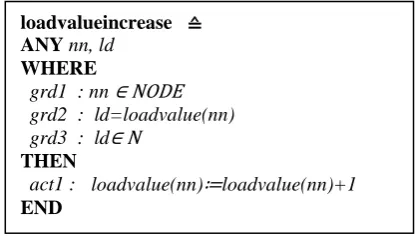
A) Increase the load value: If any fresh node is processed in the system then we have increased the load value by one. (See figure 2)
[image:4.595.317.533.156.287.2]
Fig 2: Event of Load value increase
The guard grd1 ensures that node nn is node and guard grd2 defines its loadvalue ld of the node nn. If the guard is true then action act 1 increases the value by one.
B) Identify the under loaded node: To identification of the node as under loaded, we compare the value of threshold. If the load value of node is less than threshold then we define the status of node is under loaded. (See figure 3)
[image:4.595.314.530.431.570.2]
Fig 3: Event of under loaded node
System compare the load value of node nn with the value of threshold in guard grd2. If the guard is true then the action is perform and status of node is set to the undeloaded (act1).
B) Identify the overloaded node: The event of overload node shows in figure 4. To identify the node status whether it is underloaded or overloaded, we compare the value of threshold. If the value of threshold is greater than load of the node, then the node is overloaded.
Fig 4: Event of overloaded node
Event of overloaded node defines the load value of node nn is greater than or equal to threshold value in guard grd2. Load value of node nn is natural number (grd 3). We set the status of node nn is overloaded in action act1.
C) Broadcast the message: After identify the status of nodes if any node is overloaded then we broadcast the request and send the message to every participating nodes. All the participating nodes receive the request message. Figure 5 defines the event of broadcast.
loadvalueincrease ≙ ANY nn, ld
WHERE
grd1 : nn ∈ NODE grd2 : ld=loadvalue(nn) grd3 : ld∈ N THEN
act1 : loadvalue(nn)≔loadvalue(nn)+1 END
overload ≙ ANY nn WHERE
grd1 : nn ∈NODE
grd2 : loadvalue(nn) ≥ value_threshold grd3: loadvalue(nn) ∈ ℕ
THEN
act1 : nodestatus(nn) ≔ overloaded END
underload ≙
ANY nn WHERE
grd1 : nn∈NODE
grd2 : loadvalue(nn)<value_threshold THEN
[image:4.595.59.267.609.727.2]International Journal of Innovative Technology and Exploring Engineering (IJITEE) ISSN: 2278-3075, Volume-8 Issue-9, July 2019
Retrieval Number:I8420078919/19©BEIESP
Fig 5: Broadcast of message
In broadcast event we define the variable nn and mm where nn is belong to node and mm is belong to sending message (grd 1, 2). We set the status of node is overloaded (grd 4). We send the newly message that not occurring in domain of sender list (grd 3) in receiving node. We perform the action clause where message mm is broadcast to all the system send by node nn updated in action act1. Message mm is reflect in msgsend list represent in action act 2. Type of message mm is request (act3).
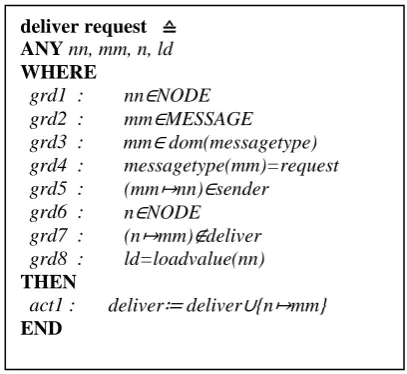
[image:5.595.61.272.57.211.2]E) Delivery of request message: When the overloaded node send a request to underloaded node then all nodes receive the request. Message must be fresh in the receiving node. Delivery event is shown in figure 6.
Fig 6: Event B model of request delivery
In request deliver event model, the delivery of request message at participating node. The guard grd5 ensures that message mm is send by node nn and message is in the sender list. The guard grd7 defines, delivery of message mm in node n does not exist. We deliver the message mm in node n successfully in action act1.
Fig 7: Reply of request message
F) Reply of request message: After receiving the delivery message by participating nodes, underloaded nodes send a reply message to coordinator node (overloaded node). Coordinator node receive a reply message from underloaded nodes and update the directory with nodes and respective load information. (See figure 7)
In replymsgsend event shows that message mm is in the domain of sender list in guard grd 4 and type of message is request define in guard grd7. Message m is a fresh message and not deliver yet (grd 9 and 10). Message m is not in domain of sender (grd11). Reply message does not send in domain of sender (grd 12) and directory of node n does not update with load value ld by sending message m (grd 14). Nodes send the reply message, the load value of nodes are less than threshold limit (grd15). If all the guard is true, then we perform the action, the new message m is in message send list (act1). Type of the message m is reply message (act 2). The sender node is updated with reply message m (act 3). Reply message is contain the new message m which was send by node n correspond to request message mm in action act4. We snatch the load value of node n from the message m shown in action act 5.
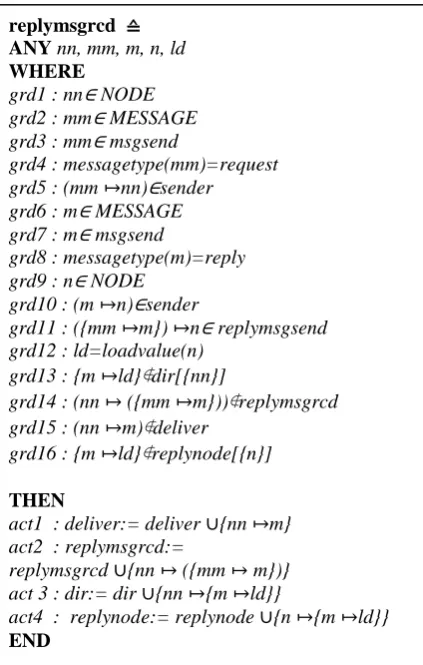
G) Delivery of reply message at coordinator node: After sending the reply message from participating nodes, coordinator node (overloaded node) receive the reply message. (See figure 8
)
deliver request ≙ ANY nn, mm, n, ld WHERE
grd1 : nn∈NODE grd2 : mm∈MESSAGE grd3 : mm∈ dom(messagetype) grd4 : messagetype(mm)=request grd5 : (mm↦nn)∈sender
grd6 : n∈NODE grd7 : (n↦mm)∉deliver grd8 : ld=loadvalue(nn) THEN
act1 : deliver≔ deliver∪{n↦mm} END
broadcast ≙ ANY nn, mm WHERE
grd1 : nn∈NODE grd2 : mm∈MESSAGE grd3 : mm∉ dom(sender)
grd4 : nodestatus(nn)=overloaded THEN
act1 : sender≔sender∪{mm↦nn} act2 : msgsend≔msgsend∪{mm} act3 : messagetype(mm)≔request END
replymsgsend ≙ ANY n, mm, m, ld, nn
WHERE
grd1 : n∈ NODE grd2 : mm∈ MESSAGE grd3 : mm∈ msgsend grd4 : mm∈dom(sender) grd5 : (n↦ mm)∈deliver grd6 : ld=loadvalue(n)
grd7 : messagetype(mm)=request grd8 : (mm↦ nn)∈sender grd9 : m∈ MESSAGE grd10 : m∉ msgsend grd11 : m∉ dom(sender)
grd12 : {mm↦m}∉ dom(replymsgsend) grd13 : nn∈ NODE
grd14 : {m↦ld}∉dir[{nn}]
grd15 : loadvalue(n)≤ value_threshold THEN
act1 : msgsend≔ msgsend∪{m} act2 : messagetype(m)≔reply act3 : sender≔ sender∪{m↦n} act4 :
replymsgsend≔ replymsgsend∪ {({mm↦m})↦n}
[image:5.595.66.270.439.626.2]
Fig 8: Delivery of reply message
In guard grd 4 shown that message type of mm is request and type of message m is reply message in guard grd 4 and 8 respectively. The guard grd 5 shows request message mm successfully deliver in node nn and grd 10 ensures that message m is in sender list of node n. The guard grd 11 shows that reply message send in coordinator node. After that node nn is not received the reply message in guard grd 14. Node n which are send the message m with load (ld) is not shown in directory of node nn in guard grd 16. Message m is send by node n is not deliver in node nn shown in guard grd 15. The action act1 represents the message m is successfully delivered in node nn. Action act 2 shows that reply message received by node nn that is send by message m to corresponding request message mm. Action act 3 ensures that load value of receiver node n is successfully shows in directory of sender node nn. Action act 4 ensures that load value ld of message m send by reply node n.
H) Split load and decrease the load value: After successfully receiving of reply message of node nn, system chooses the overloaded node to transfer the load. We compare the value of node with threshold value. If the load value is less than threshold then select the node and transfer the load into it. Any overloaded node search the directory to send the load in under loaded nodes and node can't migrate the load due to unavailability of sufficient load in underloaded nodes. We split the load in overloaded node and transfer the load in two or more underloaded nodes.
(See fig 9)
Fig 9: Split point at sender node and decrease the load Guard grd 2 & 5 ensures that node status of node n is underloaded and node nn is overloaded. Loadvalue of n & nn is natural number ensures in guard grd 3 & 6. Variable ld belong to load and define by the natural number shows in guard grd 9. Message m is deliver at node nn ensure guard grd 10. Load value of node n continues with message m and update the directory of node nn in guard grd11. Reply message receives by node nn ensures at the guard grd 12. Guard grd 13 & 14 describe the load value of node nn is greater than threshold while loadvalue of n is less than threshold. Load ll is variable, belong to natural number ensures in guard grd 15. Reply nodes are those nodes whose value is less than threshold in node n ensure in guard grd 16 and load ll belong to split load whose value is greater than load value of node nn ensure in guard grd 17. Guard grd 18 ensures that adding the loadvalue of n and load ll does not exceed the threshold value. Guard grd 19 & 20 ensures that node nn belong to the domain of transfer load and progress of node is not complete.
Action act1 ensures that transferload is inprogress. Loadvalue of sender node nn is subtract the load ll and decrease the loadvalue of overloaded node shows in action act 2.
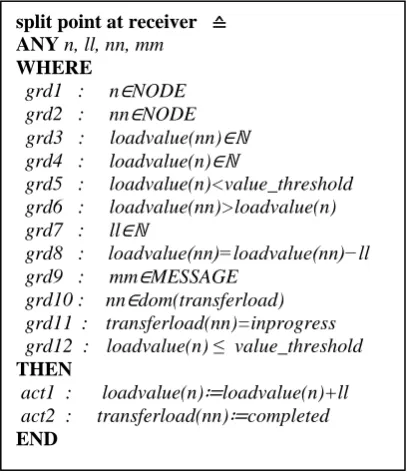
I) Split point at receiver: After Sending the split load from sender (overloaded) node to receiver node (underloaded node), we decrease the load in overloaded node and increase the load in underloaded node. Formal description is describe below:
replymsgrcd ≙ ANY nn, mm, m, n, ld WHERE
grd1 : nn∈ NODE grd2 : mm∈ MESSAGE grd3 : mm∈ msgsend
grd4 : messagetype(mm)=request grd5 : (mm ↦nn)∈sender grd6 : m∈ MESSAGE grd7 : m∈ msgsend
grd8 : messagetype(m)=reply grd9 : n∈ NODE
grd10 : (m ↦n)∈sender
grd11 : ({mm ↦m}) ↦n∈ replymsgsend grd12 : ld=loadvalue(n)
grd13 : {m ↦ld}∉dir[{nn}]
grd14 : (nn ↦ ({mm ↦m}))∉replymsgrcd grd15 : (nn ↦m)∉deliver
grd16 : {m ↦ld}∉replynode[{n}]
THEN
act1 : deliver:= deliver ∪{nn ↦m}
act2 : replymsgrcd:= replymsgrcd ∪{nn ↦ ({mm ↦ m})}
act 3 : dir:= dir ∪{nn ↦{m ↦ld}}
act4 : replynode:= replynode ∪{n ↦{m ↦ld}} END
splitpoint at sender ≙ ANY nn, n, ld, m, mm, ll WHERE
grd1 : n∈NODE
grd2 : nodestatus(n)=underloaded grd3 : loadvalue(n)∈ℕ
grd4 : nn∈NODE
grd5 : nodestatus(nn)=overloaded grd6 : loadvalue(nn) ∈ℕ
grd7 : m∈ MESSAGE grd8 : mm∈MESSAGE grd9 : ld∈ ℕ
grd10 : (nn↦ m)∈deliver grd11 : (nn↦{m↦ld})∈dir
grd12 : nn↦({mm↦m})∈replymsgrcd grd13 : loadvalue(nn) > value_threshold grd14 : loadvalue(n) ≤ value_threshold grd15 : ll∈ℕ
grd16 : (n↦{m↦ld})∈ replynode grd17 : ll<loadvalue(nn)
grd18 : loadvalue(n)+ll < value_threshold grd19 : nn∈dom(transferload)
grd 20 : transferload(nn)≠inprogress THEN
act1 : transferload(nn) ≔inprogress act2 : loadvalue(nn)≔loadvalue(nn)−ll END
[image:6.595.295.534.59.391.2]International Journal of Innovative Technology and Exploring Engineering (IJITEE) ISSN: 2278-3075, Volume-8 Issue-9, July 2019
[image:7.595.65.269.54.292.2]Retrieval Number:I8420078919/19©BEIESP
Fig 10: Split point at receiver node
In figure 10 guard grd 5 ensures that load value of n is less than threshold value. Guard grd 6 shows that load value of nn is always greater than load value of node n. Load ll belongs to natural number (grd 7). We extract the load from overloaded node in guard grd 8. Guard grd 11 ensures that transferload is inprogress and loadvalue of node n is less than value of threshold ensure by guard grd 12. To perform the action we add the load in various underloaded nodes shown in action act1 and load transfer of node nn is completed in action act2.
V. RESULT ANALYSIS OF PROPOSED MODEL
In distributed load balancing we have balanced the load from overloaded nodes to under loaded nodes. All the activities in the system is verified and validated with Event B model. Event B is mathematical model which contain the set and logic operations. We convert all the load balancing steps into events and invariants for generating a proof obligation methods. Proof obligation methods are manually or automatically discharged. Rodin tool generates a total 80 proof obligations and all of them are discharge automatically. Here is a statistics of the proof table:
Element name
Total P.O.
Automatic P.O.
Manual
P.O. Reviewed Undischarged
Load
context 0 0 0 0 0
Load balance Machine
80 80 0 0 0
VI. CONCLUSION
To balance the load in each node is main objective of this paper and it is ensure by the formal verification. In this paper, we focus on split point load balancing technique. We have developed the model of load balancing through send and receive of messages in global environment and formalization of the model in B language on RODIN platform. In the refinement, we shows how to transfer the load from sender to
receiver. Load balancing is a key role in distributed network, without it we cannot imagine to implement the system. Our model implements correctly and all the events and invariants are successfully discharge. We proof the correctness of a model using Event B. In this model, there is not any invariant violation to implement the model and all those properties must be maintained.
ACKNOWLEDGEMENT
This work is done under the DLSR project (Distributed load balancing and system recovery) governed by Uttar Pradesh Council of Science and Technology (UPCST) and supported by PSIT College Kanpur.
REFERENCES
1. Mukesh Singhal and Nirjan G. Shivratri " Advanced concept in operating System- Distributed, Database and multiprocessor operating
system " Tata Mcgraw Hill 2001
2. Narjes Soltani and Mohsen Sharifi : "A load balancing algorithm based on replication and Movement of Data items for dynamic structured P2P system" International Journal of Peer to Peer Networks (IJP2P) Vol.5, No.3, August 2014
3. Neeraj Rathore & Inderveer Chana “Load balancing and job Migration Techniques in Grid-A Survey of Recent Trends" In wireless Personal communication ISSN 0929-6212
4. A. Rao, K. Lakshminarayanan, S. Surana, R. Karp, and I. Stoica, "Load Balancing in Structured P2P Systems," in Second Int’l Workshop Peer-to-Peer Systems (IPTPS ’02), USA, pp. 68-79, 2003
5. Ion Stoica, Robert Morris, David Karger, M. Frans Kaashoek, Hari Balakrishnan " Chord: A Scalable Peer to peer Lookup Service for Internet" MIT Laboratory for Computer Science
6. Jea-cheol Ryou Johnny ,S. K. Wong, " A Task Migration Algorithm for Load Balancing in a Distributed System" Computer Science Department Iowa State University Ames, Iowa 50011
7. J R Abrial. The B Book : Assigning Programs to Meaning, Cambridge University Press,1996.
8. J R Abrial. Extending B without changing it. (For Distributed System).Proc. of 1st Conf. on B Method, pp 169-191, 1996.
9. Butler M. and Walden, M.: Distributed System Development in B. In: Proc. of Ist Conf. in B Method, Nantes, pp. 155-168, (1996).
10. M.Butler " Concise summary of Event B mathematical toolkit" 11. Divakar Yadav and Michael Butler "Rigorous Design of Fault - Tolerant Transactions for Replicated Database Systems Using Event B"
School of Electronics and Computer Science ,University of Southampton 12. Arun Kumar Singh1 and Divakar Yadav" Formal Specification and Verification of total order broadcast through destination agreement using event B" International Journal of Computer Science & Information Technology (IJCSIT) Vol 7, No 5, October 2015
13. Raghuraj Suryavanshi1 and Divakar Yadav " Modeling Of Distributed Mutual Exclusion System using Event B"
14. Girish Chandra1, Raghuraj Suryavanshi2 and Divakar Yadav" Formal Verification Of Distributed Checkpoint Using Event-B
15. Alexei Iliasov1, Linas Laibinis2, Elena Troubitsyna2, and Alexander Romanovsky " Formal Derivation of a Distributed System"
AUTHORS
Shantanu Shukla is a research assistant in Department of Computer Science and Engineering at PSIT college, Kanpur. He has received M.Tech degree from AKTU University, Lucknow. He has presented several research paper in international journal. His current research area is in distributed system and formal methods. split point at receiver ≙
ANY n, ll, nn, mm WHERE
grd1 : n∈NODE grd2 : nn∈NODE grd3 : loadvalue(nn)∈ℕ grd4 : loadvalue(n)∈ℕ
grd5 : loadvalue(n)<value_threshold grd6 : loadvalue(nn)>loadvalue(n) grd7 : ll∈ℕ
grd8 : loadvalue(nn)=loadvalue(nn)−ll grd9 : mm∈MESSAGE
grd10 : nn∈dom(transferload) grd11 : transferload(nn)=inprogress grd12 : loadvalue(n) ≤ value_threshold THEN
Raghuraj Suryavanshi is working as Associate Professor in Department of Computer Science and Engineering at Pranveer Singh Institute of Engineering & Technology Kanpur. He has completed Ph.D. from Uttar Pradesh Technical University, Lucknow. He has received Teacher Fellowship award from Uttar Pradesh Technical University. His research interests are formal verification and validation of critical properties of distributed database systems.