835
AN APPROACH BASED ON HETEROGENEOUS
MULTI-AGENT SYSTEM FOR STOCK MARKET SPECULATION
1YOUNES CHIHAB , 2ZINEB BOUSBAA, 2HANA JAMALI, 3OMAR BENCHAREF
1MSISM FP Safi, Cadi Ayyad University, Department of Physics, Marrakesh, Morocco
2SAEDD EST ESSAOUIRA. Cadi Ayyad University, Department of Computer Sciences, Essaouira,
Morocco
3FSTG Marrakesh, Cadi Ayyad University, Department of Computer Sciences, Marrakesh, Morocco
E-mail: 1[email protected], 2[email protected], 2[email protected], 3[email protected],
ABSTRACT
Foreign Exchange market (FOREX) is the global and most liquid market interested in buying, selling and exchanging currencies. The price of these currencies changes rapidly. However, we need to have a good trading strategy to take advantage of these variations.
As Forex is a dynamic market, it becomes more difficult to control trading behavior and it becomes very complex to predict the events that can occur. Due to the chaotic, noisy, and non-stationary nature of the data, many algorithmic approaches were adopted in the aim to help traders and make FOREX speculation successful. Algorithmic trading offers the ability to have a strategy in advance. It helps traders to take the final decision. When the decision is so wide and complex, that one algorithm cannot possess all rules to take it. It becomes necessary to call upon several agents, who must work together in pursuing a common objective. These agents co-operate with one another to solve these decision problems. Coordinating between agents in a multi-agent system gives more flexibility and performance to problem solving. Each agent simultaneous results are combined by using a super-agent who helps to make the final decision.
In our paper, we propose a theoretical Multi Agent System for stock market Speculation. We use four agents working in one system. The first one is a Metaheuristic Algorithm agent, the second one is based on technical indicators, the third one is a Text Mining agent, and the fourth one is a Fundamental Factor agent. The final decision should be made based on the combination of the four agents results. We think that working with Metaheuristics can improve speculation results compared to the use of classical algorithms. In perspective work, we test our system on a multi-agent systems platform.
Keywords: Stock Market, Speculation, Text Mining, Smart Agent, Technical Indicators, Fundamental
Factor, Metaheuristic, Particle Swarm Optimization, Multi Agent System.
1. INTRODUCTION
Foreign Exchange Market is a decentralized global financial exchange market which determines the relative values of different world wide currencies through buying, selling and exchanging currencies, with different participants coming from all over the world. Its importance is reflected in the volume of transactions made daily, [1].The main goal of Forex is to help international trade and investors to make their financial transactions more flexible through the exchange of one currency to
another [2]. Foreign exchange markets are made up of banks, commercial companies, central banks, investment management firms, hedge funds, and retail Forex brokers and investors. The major traded currencies are USD (U.S. Dollar), EUR (Euro), GBP (British Pound), YEN (Japanese Yen) and CHF (Swiss Franc).These currencies are traded (exchanged) in pair between each other.
836 one of the least volatile financial markets around. Therefore, many currency speculators rely on the availability of enormous leverage to increase the value of potential movements. These make Forex market one of the most defying financial markets in term of prevision.
As Forex is a global market, it is open 24h/24, five days a week, investing in this market remains difficult for multiple reasons: Forex trading is a real business that requires some skills and a hard work. In this market, every trader wants to win money through buying and selling a currency pair without thinking about the risk of his investment. However, he risks losing an important sum of his capital in less time due to the lack of information, to emotional dimension or to changing market conditions. To succeed or maximize the chances in Forex speculation, investors must absolutely be aware of technical analysis and fundamental analysis in order to make an intelligent and a logical decision. In addition, traders can be victims of their emotions when they trade in this market. This can be a result of fear, hope or greed. These Overflowing Emotions cause overtrading, opening positions too important, cutting winning traders or maintaining a losing position.
There are many reasons to explain the difficulties that one encounters in Forex. Sometimes the problem is not based on the trader psychology, but on the changing conditions of the Foreign Exchange Market. We can have a good trading strategic approach working well for one day but failing the next day. In this case, losses can quickly become insurmountable. In fact, a trader must have a solid trading plan. In other words, he must consider his gains but also his losses. A trader must have certain expectations regarding his potential profits and define a market exit strategy allowing him to take profits.
Nowadays, there is not a permanently winning strategy. However, several approaches have been applied to predict the evolution of this market. For that, many approaches were adopted in the aim to success FOREX speculation. These approaches introduce one or more techniques which aims at helping traders and investors to make the best decision. Among these techniques we find Smart Agents, which work together in a multi-agent system. When the decision is so wide and complex that one algorithm cannot possess all the rules to take it. It becomes necessary to call upon several agents, which must work together in pursuing a common objective. These agents co-operate with one another to solve this decision problem.
The rest of the paper is organized as follows: Section 2 deals with multi agent systems, their different possible architectures that are available in literature and the motivation behind the using them. Our proposed system architecture is developed, and each agent is explained separately in Section 3. Finally, the conclusion of the paper is drawn in Section 4.
2. MULTI AGENT SYSTEMS OVERVIEW
Multi agent systems are distributed computing systems, composed of interacting computational entities; they are unlike classical distributed systems intelligent. A multi-agent system is a loosely coupled network of problem-solving entities (agents) that work together to find answers to problems that are beyond the individual capabilities or knowledge of each entity (agent).
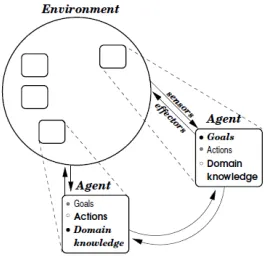
837 indicated by the arrows between the agents [[10],[12]].
Figure 1: The Fully General Multi-agent Scenario.
There are several possible reasons to use Multi Agents Systems: Having multiple agents could speed up a system’s operation by providing a method for parallel computation. Another benefit of multi-agent systems is their scalability. Since they are inherently modular, it should be easier to add new agents to a multi-agent system than it is to add new capabilities to a monolithic system. From a programmer’s perspective, the modularity of multi-agent systems can lead to simpler programming, rather than tackling the whole task with a centralized agent. Programmers can identify subtasks and assign control of those subtasks to different agents.
There are several types of Multi-Agent Systems. We can mention:
Homogeneous non-communicating Multi-Agent Systems. In this Multi-Multi-Agent Systems there are several different agents with identical structure. All individual agents have the same goals, domain knowledge, and possible actions.
Homogeneous communicating Multi-Agent Systems, where individual agents can communicate with each other directly. With the aid of communication, agents can coordinate more effectively.
Heterogeneous non-communicating Multi-Agent Systems, Individual agents within a it might be heterogeneous in a number of ways: from having different goals to having different domain knowledge and actions.
Heterogeneous communicating Multi-Agent Systems: inherits the issues of communicating from homogeneous communicating Multi-Agent Systems, but heterogeneity brings additional issues to the communication.
Software agents: can be as simple as subroutines, but typically, they are larger entities with some sort of persistent control.
In addition to the organizational paradigms considered in previous paragraph, several other paradigms emerged for Multi-Agent Systems are mentioned in Figure 2 [11].
In literature, a number of different methods have been applied in order to predict stock market returns. Despite these studies, the definition and the implementation of a stock market strategy remains a difficult problem to resolve. Jerzy Korczak et all [13] have presented a trading strategy that is based on a multi-agent system in the aim to help investors to make decisions in stock market. The main component, the supervisor agent, uses a consensus method as a strategy to reduce the level of investment risk. Their method has allowed the agents work coordination, and on the basis of the provided agents decisions a trading advice is presented to the investor. The strategy was tested on FOREX quotes, namely on the major pair EUR/USD.
In work [14], J. Korczak et all have presented an issue related to developing methods for fundamental analysis used to expand capabilities of their multi-agent trading system, to better predict the financial market behavior. They have used fundamental analysis indicators as a confirmation of decisions generated by other strategies of the system. They have examined the statistical analysis of correlations of the different time series indicators and algorithms of fundamental analysis agents.
838
Figure 2:Some other Organizational Paradigms of Agents
[image:4.612.71.567.338.638.2]839 consists of three types of agents that are classified based on their functionality: Interface, resource and retrieval agents. They have used the IBM Aglet SDK to implement their system.
[16], Yu N-P et al have proposed an integrative and flexible method that uses agent-based modeling for assessment of market designs. Agents are facilitated by Q-learning. Compared with the competitive benchmark. They can exploit market flaws to make higher profits.
In the paper [17], Lina Ponta et all have presented an artificial stock market characterized by heterogeneous and informed agents. The agents trade risky assets, they are characterized by sentiments, amount of cash and stocks owned. In [17] agents share information and sentiments by means of interactions determined by graphs. They have studied the statistical properties of the univariate and multivariate process of prices and returns. Their approach allows to endogenously reproducing the multivariate stylized facts.
3. PROPOSED SYSTEM
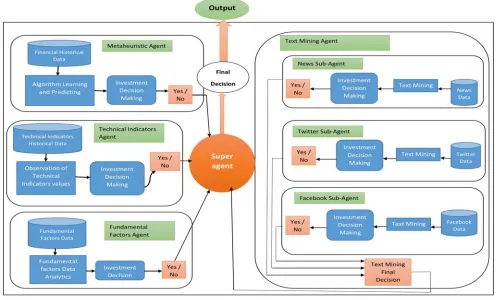
Agent technology has currently played an important role in complex software development. The underlying paradigm offers a large repertoire of original concepts, architectures, interaction protocols, and methodologies for the analysis and the specification of complex systems [3]. There are several types of agents; we focus on data-mining agents that use several sources to find trends and patterns in information. Smart agents are often described schematically as an abstract functional system like a computer program, also closely related to software agents that represent an autonomous computer program that carries out tasks on behalf of users. A smart agent executes tasks by using learning modules which store information necessary to execute the tasks [4]. In this section, the proposed multi-agents architecture is explained and modeled in Fig. 3, and each agent is described in details.
3.1 Our Architecture
The agents in our architecture are developed independently of each other; so these components can be member agents in new Multi-Agent systems. Figure 3 shows our proposed system architecture, that belongs to Heterogeneous non-communicating Multi-Agent Systems category, because each agent had its own decision making process. At the end the system makes a final decisions based on its agents outputs:
3.2 Metaheuristic Agent
The first agent we used is a Metaheuristic; Metaheuristics are performance optimization methods of other algorithms, in order to resolve problems that are considered difficult, where a precise solution is not possible. Metaheuristic is formally defined as an iterative generation process which guides a subordinate heuristic by combining intelligently different concepts for exploring and exploiting the search space, learning strategies are used to structure information in order to find efficiently near-optimal solutions[5].
Metaheuristics are typically high-level strategies, which guide an underlying local search algorithm toward more promising regions of search space that contain a high quality solutions. The main goal is to avoid the disadvantages of iterative improvement and, in particular, multiple descent by allowing the local search to escape from local optima. This is achieved by either allowing worsening moves or generating new starting solutions for the local search in a more “intelligent” way than just providing random initial solutions. Many of the methods can be interpreted as introducing a bias such that high quality solutions are produced quickly. This bias can be of various forms and can be cast as descent bias (based on the objective function), memory bias (based on previously made decisions) or experience bias (based on prior performance). Many of the metaheuristic approaches rely on probabilistic decisions made during the search. But the main difference to pure random search is that in metaheuristic algorithms randomness is not used blindly but in an intelligent, biased form [6].
Particle Swarm Optimization -PSO- is a very good example of Metaheuristics. It is based on the concept of cooperation between multiple particles that are seen as animals with limited power, but information exchange between them allow them to resolve difficult problems. The problem to resolve is often represented with a cost function that has parameters we aim to optimize: whether to maximize or to minimize depending on our case of study.
840 We take as an example [6], it worked on forecasting exchange rate of Euro currency in American Dollar, and tried to optimize Multiple Linear Regression results using Particle Swarm Optimization Metaheuristic, by minimizing the cost function that is the mean square difference between predicted and real values:
After determining the research space and determining the search space, [7] used 100 particles, and in every iteration each particle changes its position on research space depending on its best performance and other swarm particles best performance. At the end of the process, they obtained good results that are way better than Simple Linear Regression without optimization. The results of our model validation showed that exchange rate varieties the same way in 71% of the cases, which shows the model performance improved significantly after integrating Particle Swarm Optimization into the Simple Multiple Regression algorithm.
Another example of Metaheuristics used in on financial data is [2], They improved a Regression model using Simulated Annealing Metaheuristic for Stock Market Speculation, and their experiments showed a good performance for predicting the daily exchange rates of the USD/EUR pair.
3.3 Technical indicators Agent
Technical Indicator is a series of points used to analyze stock market securities, in order to predict the price movements. The indicator is a mathematical formula that uses the price and / or volume of a security over a given period (the input data for the formula is historical currency data) to highlight and exploit market situations.
They are a fundamental part of the technical analysis and are usually represented in the form of a diagram to try to predict the market trend. The indicators are generally overlaid on the price chart data to indicate where the price is going, or if the price is in an "overbought" or an "oversold" condition.
Technical indicators measure the speed and quality of price movement and serve to identify situations of excessive upward and downward levels of overbought or oversold, to find the current trend is running out of steam thanks to divergences, to retrieve Market dynamics through trend tracking indicators, to enter into an established trend, to find support and resistance levels and as a consequence set objectives.
They are also used in artificial intelligence for learning algorithms and building powerful models; they can be used as features for learning a regression algorithm, or in a classification problem using majority voting technique using classification algorithms like decision trees and genetic algorithms [7].
Technical indicators are numerous: Moving Average Convergence / Divergence (MACD), Average True Range (ATR), Bollinger Band, Commodity Channel Index (CCI), Moving Average, Relative Strength Index (RSI), Momentum, Rate of Change (ROC) , Standard Deviation and Stochastic indicator. These indicators are classified according to their objective. A trader needs a combination of several indicators to open a trade. It is difficult to find an indicator that will be useful for all traders. In this article, we use suggest the MACD technical indicator and a classification algorithm.
3.3.1 Moving Average Convergence / Divergence (MACD).
Developed by Gerald Appel in the late seventies, MACD is one of the simplest and most effective indicators of dynamism available, it is a trend-following momentum indicator that shows the relationship between two moving averages of prices. It consists of two lines: The signal line, and the MACD line. It is calculated by subtracting the 26-day exponential moving average (EMA) from the 12-day EMA. A nine-day EMA of the MACD, called the "signal line", is then plotted on top of the MACD, functioning as a trigger for buy and sell signals (see Fig.1).
841 Moving average is one of the most often used technical indicators used by Forex traders. It is a lagging indicator which is extremely important to confirm that a pattern is occurring or about to occur.
3.3.2 Our algorithm
In this work, an agent will be used in the aim to apply our algorithm to execute a set of rules. Our agent is trained by historical data price. The goal of this agent is to obtain price dynamics similar to those observed in training. Thereafter, our agent analyzes the information flow from outside the market and sends a buy / sell message in the goal to help traders to make their decisions. The message is modeled by a digital signal St .The threshold is equal to the purchase value of the currency Our agent analyzes the flow in real time t and decides to buy or sell the currency according to the following rule:
Counter _purchase = 0; Counter_sell =0; For j=0 to closure
For i =0 to 4 do
If (St > Ti) do Counter_purchase = counter_purchase +1
Else if St < Ti) do
Counter_sell = counter_sell +1 Else
St = Ti End for
If ( Counter_purchase >4) do The agent sends a buy signal. End if
If ( Counter_sell <2) do The agent sends a sell signal. End if
End for End.
At each time-step, the agent compares the threshold value with the actual currency value. If the agent finds that the actual value is superior than to that of the threshold during four time-steps, the agent confirms that it is upward trend. In this moment, the agent sends a buy signal. In the other case, if he finds that the actual value is inferior than to that of the threshold during two time steps, for
842 reasons of precaution, the agent confirms that it is a downward trend. However, the agent sends a sales signal. In the case when the real value is equal to the threshold value, the agent keeps the threshold value.
3.4 Text Mining Agent
Machine Learning methods have proved remarkably their success on texts without understanding specific properties such as the concepts of grammar or the meaning of words. Strictly low-level frequency information is used, such as the number of times a word appears in a document. One of the main themes supporting text mining is the transformation of text into numerical data. Therefore, although the initial presentation is different, at some intermediate stage, the data moves into a classical data-mining encoding, the unstructured data become structured. Text Mining is used for several reasons: Document Classification; Information Retrieval, by measuring similarity which is a comparison between two documents; Clustering and Organizing Documents, it is equivalent to assigning the labels needed for text categorization; Information Extraction, its objective is to take an unstructured document and automatically fill in the values of a spreadsheet; Prediction and Evaluation where the learning program studies documents and finds some generalized rules that will give correct answers on new examples [9].
Social networks are rich in various kinds of contents such as text and multimedia. They require Text Mining algorithms for a wide variety of applications such as keyword search, classification, and clustering. Much of the work in the area uses either purely the text content or purely the linkage structure. In many cases, it turns out that the use of a combination of linkage and content information provides much more effective results than a system which is based purely on either of the two. The paper[] provides a survey of such algorithms, and the advantages observed by using such algorithms in different scenarios. A number of challenges remain for Text Mining on social media. These challenges are as follows: Many of the techniques are not designed to be scalable for massive datasets. The techniques need to be designed for dynamic data sets. It is important to be able to quickly re-adjust the models in order to take into account the changing characteristics of the underlying data. Many of the networks are inherently heterogeneous, in which the nodes may be of different types.
Our Text Mining agent is divided into three sub-agents, where each one uses different source of data: Facebook, Twitter and News. Each agent will work with different tools, algorithms and approaches that fit to the nature of its data source [8].
The data source of our agent is Internet. However, this source contains a big heterogonous amount of information (Language, media, etc.), that are as well instable, redundant, non-persistent and under different formats: Text, video, graph, sound and image. In the works [18][19][20], authors have studied problems that are information retrieving related. In our system, the information retrieval is done passively and actively. In the first case, the trader receives the information from third parties that share the same areas of interest. And in the second case, the trader retrieves the information that he desires himself.
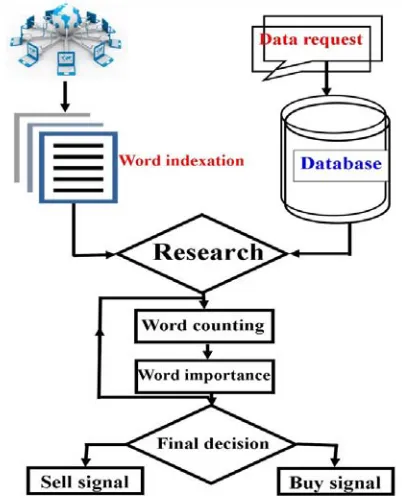
There are three principle information retrieval models: Boolean models, probabilistic models and vector models. In our case, we opt for vector model, which belongs to statistic models category. It is based on vector spaces mathematics. Figure 5 shows our model.
The aim of the model (Fig. 5) is to measure the relevance degree of each information.
In order to ensure this, we proposed a statistical approach that, the purpose of which is to characterize the target information.
In the vector model, a document is represented as a vector of words, each word in the vector is associated to a weight (« word frequency weighting »). We consider:
dj = (w1,j , w2,j , w3,j , ….., wn,j )
Where wi,j are the terms weights for the document d, and n is the total sum of terms in the index.
843 been recalculated on the basis that a term is important to a given document if it appears a certain number of times in that document. In this work, we propose the weighting method of the paper [21]. The weighting is measured using the formula Tf*Idf.
Tf means ‘term frequency’. it designates a proportional measure of the term frequency in the document.
Idf means ‘inverted document frequency’. This factor measures the importance of a term in the whole collection.
[image:9.612.85.286.298.548.2]Finally, the agent sends a decision signal according to the weighting value that is already established.
Figure 5: Our Information Retrieval Model.
3.5 Fundamental Factors Agent
Fundamental analytics implies analyzing economic conditions that are affecting money valuation. Fundamental traders wait for the beneficial state to be produced, for example when they put a long position, once the price rises the suspended position is automatically activated. Similarly, when the price decreases, suspended short positions are automatically activated, and traders will get the benefits in both cases. These
factors can be categorized into four categories: The first one is Financial Factors category, like Monetary policy of governments, central banks news and reports. Fundamental traders wait for favorable condition to occur, for example, when they put a buy order in the system, as soon as prices go upward, a buy order in pending order is activated automatically. Similarly, when prices go down, a sell order in pending order will execute transaction automatically, and traders will earn profit in both ways. The second category is Political and Social Events, those have a significant impact on countries. If deteriorating political situation prevails, this causes high fluctuation in currency demand around the world, and political news like presidential election would make a big effect regarding the future government plans. And good statistics news like higher rate of job opportunities would send a good signal to traders. And finally the fourth category is Crisis; it makes market move so fast in a few moment like natural catastrophes. In these cases, traders have to manage their open positions to avoid great potential losses [7].
Our approach consists of choosing a fundamental factor, and assign to it the role of being one of our multi-agent system agents. The system considers its contribution in its final decision, since it has proved its success and performance in trading.
3.6 Supervisor-agent
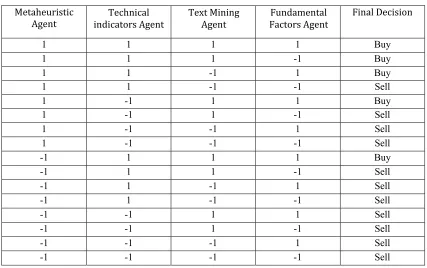
Although the multi-agent systems has been in existence for a long time. There is no fully satisfactory strategy to predict forex evolution. The objective of our study is to help traders to have a good dynamic strategy which enable them to follow Forex variation. For this, the supervisor-agent offers the possibility to have this strategy. It is based on the decision signals coming from four agents employed in the system. Supervisor-agent decision is made according to the cases presented in Table 1. Agent signals are numerically represented: 1 for a buy signal and -1 for a sell signal.
844
4. CONCLUSION
Each of the mentioned approaches above has shown its strong forecasting ability. We conclude that the implementation of a Multi Agent System will ensure building a model used as a better strategy for trading than each agent itself, because the combination will exploit each agent strengths and exclude its weaknesses. Future work will include a comparative study and the concrete results of our system.
In this paper, we have proposed a theoretical Multi Agent System for stock market Speculation. We used four agents: A Metaheuristic algorithm agent, a Technical indicator agent, a Text Mining agent and a fundamental factor agent all working in one system. The final decision should be made based on the combination of the four agents results. We think that working with Metaheuristics can improve speculation results compared to the use of classical algorithms.
It should be said that the goal of our theoretical multi-agent system can help traders not only to take the financial decision in the goal to maximize the rate of return on investment, but also to limit the risk level associated with this investment. We have chosen a multi agent system characterized by heterogeneous and interacting
agents, where agents are characterized by autonomy, self-adaptation and decision making. In perspective work, we hope to test our system on a multi-agent systems platform.
REFERENCES
[1] Mańdziuk, J., Rajkiewicz, P.: “Neuro-evolutionary system for FOREX trading. In:
IEEE Congress on Evolutionary Computation
(CEC). IEEE, 2016.
[2] Jamali, Hana, et al. “Improving Regression Models Using Simulated Annealing for Stock Market Speculation." World Conference on
Information Systems and Technologies.
Springer, Cham, 2018.
[3] Bordini, R.H., Dastani, M., Dix, J. and Seghrouchni, A.E.F “Multi-Agent Programming", Springer,2014.
[4] Slotznick, B., Slotznick and Benjamin, 1999. “Intelligent agent for executing delegated tasks", U.S. Patent 5, 1999, 983,200.
[5] Osman, Ibrahim H., and Gilbert Laporte. “Metaheuristics: A bibliography." 1996, pp: 511-623.
Metaheuristic
Agent indicators Agent Technical Text Mining Agent Factors Agent Fundamental
Final Decision
1 1 1 1 Buy
1 1 1 -1 Buy
1 1 -1 1 Buy
1 1 -1 -1 Sell
1 -1 1 1 Buy
1 -1 1 -1 Sell
1 -1 -1 1 Sell
1 -1 -1 -1 Sell
-1 1 1 1 Buy
-1 1 1 -1 Sell
-1 1 -1 1 Sell
-1 1 -1 -1 Sell
-1 -1 1 1 Sell
-1 -1 1 -1 Sell
-1 -1 -1 1 Sell
[image:10.612.75.502.111.379.2]-1 -1 -1 -1 Sell
845 [6] Stützle, Thomas, “Local search algorithms for
combinatorial problems-analysis, algorithms and new applications”, DISKI-Dissertationen
zur Künstlichen Intelligenz, Infix, Sankt
Augustin, Germany, 1999.
[7] Zineb BOUSBAA, Omar BENCHAREF ,Abdellah NABAJI, “Stock Market Speculation System Development based on Technico Temporal indicators and Data Mining Tools”,
The third International Conference on Modeling and Scientific Computing in Mathematical
Engineering (MOCASIM2018).
[8] Aggarwal, Charu C., and Haixun Wang. “Text mining in social networks”, Social network data
analytics. Springer, Boston, MA, 2011.
353-378.
[9] Weiss, Sholom M., Nitin Indurkhya, and Tong Zhang. “Overview of text mining”,
Fundamentals of Predictive Text Mining,
Springer London, 2010, pp: 1-12.
[10] Singh, Munindar P. “Multi-agent systems”,
Springer Berlin Heidelberg, 1994.
[11] Stone, Peter, and Manuela Veloso. “Multiagent systems: A survey from a machine learning perspective”, Autonomous Robots 8.3, 2000 ,pp
: 345-383.
[12] Glavic, Mevludin. “Agents and multi-agent systems: a short introduction for power engineers” , 2006.
[13] Jerzy Korczak et all . “Risk avoiding strategy in multi-agent trading system”, Proceedings of the 2013 Federated Conference on Computer
Science and Information Systems, pp. 1119–
1126.
[14] J. Korczak, M. Hernes and M. Bac, “Fundamental analysis in the multi-agent trading system”, Federated Conference on Computer Science and Information Systems
(FedCSIS), Gdansk, 2016, pp. 1169-1174.
[15] ELHADI SHAKSHUKI and SAAD ABU-DRAZ. “Multi-agent system architecture to trading systems”, Journal of Interconnection
Networks, Vol. 06, No. 03, 2005, pp. 283-302 .
[16] Yu N-P, Liu C-C, “Price J. Evaluation of market rules using a multi-agent system method”, IEEE Trans Power Syst. 2010
Feb;25(1), pp: 470–479.
[17] Lina Ponta et all. “Information-based multi-assets artificial stock market with heterogeneous agents”, Nonlinear Analysis: Real World
Applications, Volume 12, Issue 2, April 2011,
pp: 1235-1242.
[18] Boughanem.M., Savoy.J. (2008). “Introduction à la recherche d’information. Recherche d’information: état des lieux et perspectives”,
Edition Hermes Science Lavoisier, Chap. 1, pp
19-44.
[19] Chevalier.M. “Interface adaptative pour l’aide a la recherche d’information sur le web”. Thèse
de doctorat de l’Université de Toulouse III,
2002.
[20] Lerman.K., Galstyan.A. (2003). “Agent memory and adaptation in multi-agent systems”. Int. Conf. on Autonomous Agents and Multi-Agent Systems (AAMAS’03),
Melbourne, Australia, 2003.
[21] Picard.G, Bernon.C., Gleizes.M.P. (2004). “Cooperative agent model within ADELFE framework: an application to a timetabling problem,” In AAMAS'04, New York, USA,