
Abstract: The images captured by SAR and sonar are blurred and corrupted more by speckle noise and also other types of noise like Gaussian noise and salt & pepper noise. Denoising all types of noises to get perfect image is a vital challenge, earlier works on the same mode addressed with one filter for one noise, there is no one common or unified filter which can denoise all types of noise. Therefore in this paper, we have designed a filter which not only removes speckle noise, but also combination of other noises. Here IUNR (Intelligent Unified Noise Reduction) algorithm is proposed which is based on neural network called adaptive radial basis function acts as a unified filter for Denoising. Proposed method needs a single noisy image to train the adaptive radial basis function neural network to learn the correction of the noisy image. The Gaussian kernel function is applied to reconstruct the local disturbance appeared because of the noise. The proposed adaptive radial basis function network is compared with the fixed form which has fixed spread and the center value of kernel function. This method can correct the image suffered from different varieties of noises like speckle noise, salt & pepper noise and Gaussian noise separately or combination of noise. Various standard test images are considered for test purpose with different levels of noise density and performance of proposed algorithm is compared with adaptive wiener filter.
Index Terms: Adaptive radial basis function, adaptive wiener filter, Gaussian noise and speckle noise.
I. INTRODUCTION
Underwater images have poor quality due to low contrast, inhomogeneous lighting, blur and color diminishing. Designing a noise model for underwater images has become a challenging area of research. In the literature, there are several filters designed to remove noise from the underwater images. One filter works well for one type of noise but worst for another type of noise. Practically in most of the applications, the environment consists of the mixture of noise, so there is a need of a unified noise correction model which has ‘knowledge’ to remove the noise rather than correcting the pixels as according to statistical change appeared because of noise in the local region. For example in SAR images, along with speckle noise, there exists Gaussian noise as well as salt & pepper noise. In this regard, the artificial neural network can be considered as one of the best choices. In the earlier neural network models, denoising is done on different types of noise.
This paper proposed a unified approach for Denoising by not only removing speckle noise and Gaussian noise but also the mixed noise. Among the various possibilities under the artificial neural network, the radial basis function model is
Revised Manuscript Received on July 05, 2019
Azra Jeelani, Department of Electronics & Communication Engineering, Research Scholar, BMSCE, Bangalore, India
Veena M B, Department of Electronics & Communication Engineering, Associate Professor, BMSCE, Bangalore, India.
preferred because of its universal approximation capability with a simplified model of architecture. The adaptive approach is applied in defining the center as well as spreads of kernel function to make the learning better and faster.
II. RELATEDWORK
In 1988, Broomhead[1], introduced the nonlinear network models like feedforward network models with the concepts of generalization and interpolation. It maps the n dimensional inputs to m dimensional outputs. This introduces a network model based on the curve fitting based on radial basis functions (RBF). In this approach a subset of weights are to be considered for optimization. This has an advantage of few hidden units. [2] Proposed a distinguished learning method for neural network using the orthogonal least square method.This algorithm constructs an adequate network by choosing RBF centers one by one randomly. This algorithm has been applied to two different signal processing applications. [3] Proposed CRBFN (complex radial basis function neural network) for low order digital channel equalization with an extra parameter to reduce nonlinear distortion. [4] Presented the concept of adaptive RBF which gives improved performance for less number of centers. [5] proposed the supervised learning based on the gradient descent training.[6] Presented an approach of radial basis function for nonlinear mapping from Rn to R by using conditional clustering or fuzzy clustering. [7] Proposed a reformulated radial basis function is used gradient descent training with supervised learning. [8] Presented the new learning strategy involving not only local optimization of variances of activation function but also global optimization called as interactive gradient learning method. [9] Developed a stochastic search learning algorithm which proved to be better algorithm than back propagation error learning for the recurring artificial neural network.[10] Proposed conditional c-means learning algorithm which gives a better performance than the unconditional C-means algorithm. [11] Proposed an improvement of the conjugate learning algorithm in terms of speed of convergence.[12] Here the performance of MLP (Multi Layer Perceptron) is compared with the other denoising methods like BM3D(Block matching 3D filtering), median filter and JPEG image compression algorithm. Hence MLP gave excellent results in comparison to other methods in denoising of salt & pepper noise, stripe noise and JPEG quantization artifacts. [13] Proposed the concept of clustering and gave the comparative analysis of different kernel function implemented on a different c-means algorithm like fuzzy, rough
and intuitionistic fuzzy algorithms.[14] Proposed a
Unified Noise Reduction using Adaptive Radial
Basis Function
method of removing the speckle noise from SAR images with better performance by modifying the window size of Lee filter and then compressing by using wavelet transform. [15] Proposed an algorithm to restore noisy images which are corrupted by salt & pepper noise. This is done by estimating the intensity values of noisy pixels with their non-noisy pixels. By doing this the window size is reduced which removes impulsive salt & pepper noise and also preserves edges. This algorithm cannot be applied to speckle noise and Gaussian noise. [16] Proposed a new speckle reduction method SAR imagery based on CNN. [17] Proposed two models the stacked denoising auto encoder (SDAE) models and deep belief network (DBN) model to recognize the underwater target radiated noises. The models used the comparison algorithms like support vector machine (SVM), probabilistic neural network (PNN) and general regression neural network (GRNN). [18] Describes the canonical and weighted kNN classification algorithms. Proposed the Ada-kNN2 and Ada-kNN classifier using a heuristic learning algorithm for point-specific k selection. [19] Proposed a non-local switching filter-convolutional neural network denoising algorithm (NLSF-CNN), to remove salt and pepper noise. NLSF-CNN consists of two steps, i.e., a NLSF processing step and a CNN training step. Pre-processing of noisy images is done by using NLSF using non-local information and then these images are divided into patches that are then given to CNN for training, and hence CNN denoising model is used for future noisy images. [20] Introduced a speckle noise reduction method for a digital holographic imaging system which uses multi-scale CNN model. The resulted noisy image consists of additive and multiplicative noise of various levels. This leads to good quantitative and qualitative performance in speckle noise reduction. [21] Presented a deep Convolutional Neural Network for Denoising as well as preserve image edges using Canny method. MLP architecture has high computation cost compared to radial basis function architecture. Radial basis function uses adaptive form of Gaussian basis function which supports the local correlation of pixels for learning. But MLP uses sigmoid function which has less sensitivity in understanding the local correlation. As in the earlier neural network models, denoising is done on various types of noise. Hence, the proposed method is used to remove not only Gaussian noise and speckle noise but also the mixture of noise. In this algorithm adaptive radial Basis Function (ARBF) is used. Here ARBF is compared with Adaptive wiener filter (AWF).The working principle of proposed solution is based on "approximation through learning" where knowledge is acquired to remove the noise. AWF apply the concept of exploiting the surrounding local pixels to estimate the possible value for noisy pixels. In AWF, as the noise density increases, due to more destruction of noise, Denoising is not proper. But in the proposed method, as the noise density is increased, denoising is better.
An intelligent approach is applied to reduce the level of noise without estimation of existing noise model in the image through the use of radial basis function. The unified solution is presented to resolve the level of different types of noise and their mixture form. The proposed intelligent unified noise reduction. (IUNR) algorithm is applied an adaptive form of learning in RBF to correct the noise information by taking the noisy pixels input and keeping the target as the normal pixels. There is a requirement of less number of iterations to train the RBF with the proposed adaptive form of learning and also it
has delivered the consistent performance over different trials. The proposed method is applied to recorrect the different forms of noise and comparatively drive the superior result with respect to Adaptive Weiner filter.
III. RESEARCHMETHOD:RADIALBASIS
FUNCTIONNEURALNETWORK(RBF-NN)
RBF network performs Non-Linear Transformation over an input vector and then fed for classification. By using such transformation; it is possible to converge linear non-separable problem to a linear separable problem. This RBF network model is similar to a K-nearest neighbor models. The main basic concept of this model is that a predicted target value of an item seems to be same as other items that have close values of the predictor variables. RBF neurons are positioned in space by the predictor variables. These predictor variables have the same dimensions as space. Then Euclidian distance is calculated from the evaluated point to the center of each neuron and RBF (kernel function)is applied to the distance. This will calculate the weights (influence) for each neuron. Further, a neuron is from a point being evaluated the less influence it has. The radial function is so named since the radial distance is the function argument. The detailed structure of RBF neural network has an input layer, an output layer and hidden layer between the two. Input layer carries input and has the equal number of neurons as inputs.. A hidden layer has one or more neurons each having a kernel function, for example, output of this hidden layer and Gaussian function will become weighted input to output layer neurons. The final output appeared as a sum of the inputs from the output layer neurons. The Gaussian function characteristics defined through two parameters the center ‘c’ and spread ‘r’. So, in the proposed form of architecture, there are three parameters which get the change in the learning process, the weights ‘w’ which is between the hidden nodes and output nodes, the center ‘C’ and spread ‘r’ of the kernel function.
A. Training and Need of Adaptiveness
In practice, the neural network considers supervised training method. Though a learning algorithm is defined, the network weights are so adjusted that the error between the actual and desired response is minimized with respect to some optimization criteria. After training, the interpolation is performed by the network in the output vector space. Hence the network achieves a non-linear mapping between the input and the output vector spaces. The architecture of the RBF NN consists of three layers: an input layer, an output layer and a hybrid layer between the two.
The output of RBFNN is calculated according to Eq(1).
2
1 1
, k k
N
k ik k
k N
k ik i
i f x W xc W x c
y
, (1)
i=1,2,…N
Where
x
n1 is defined as an input vector,
k
. is afunction from to , 2
.
indicates the Euclideanindicates the number of neurons in the hidden layer. For each neuron, the Euclidean distance between associated centers and the input to the network is computed. The neuron in a hidden layer gives output which is a nonlinear function of the distance. The weighted sum of these hidden layer outputs are calculated as the output of the network. The function is Gaussian and is given by Equation. 2
exp
2
2
x
x
(2)Where parameter is called as spread parameter which controls the “width” of RBF. The centers are the subset of input data which forms the input data subset .This data subset performs the sampling. In this Gaussian RBF, the spread parameter is set as follows.
k dmax
(3)
The total number of centers is maximum Euclidean distance between the centers and k. Using Equation.2..The RBF of a neuron in the middle layer which is denoted as the hidden layer is given by
2 2 max exp, k x ck
d k c
x
(4)
In conventional methods the centers are randomly sampled and measures standard deviation from the available Euclidean distance. Hence for a highly concentrated dataset with little variation, this approach is appropriate. The optimal values of centers and the corresponding standard deviations are provided to improve the performance. The important task is to train the parameters by updating each parameter depending on the error in the output. This updation is done by using the gradient mechanism for each iteration.
B. Adaptive RBF NN
In the fixed RBF NN or static RBF, only one parameter is adjustable i.e weight of the output layer. This approach is simple, in orders to perform adequate sampling of the input but has a large number of centers from the input data set which in turn will generate a relatively very large network.In the proposed adaptive method, we can adjust all the three parameters weight, position of centers and width of RBF. Hence supervised training is not only done by the weights in the output layer but also done by the position of the centers and the spread parameter in the hidden layer for every processing units. Therefore defining the error cost function is the primary step as given in equation (5).
2 1 2 , 2 1 2 1
N k k kd n w n xn c n y n e n J (5) With the RBF chosen as Gaussian, Equation.5 becomes
2 1 2 2 2 exp 2 1
N k k k k d n n c n x n w n y n J (6)
The updated equations for the weight, centers and spread are given by Equation.7, equation.8 and Equation.9
c J
n w w nw n
w n
w
1
(7)
c c nk c k
k n c n c J n k k
c
1
(8)
nk k k
k n
n
c J n k k
1 (9)C. Algorithm: Adaptive RBFNN
Following are the steps for Adaptive RBFNN
1. The centers of RBF functions are selected from the set of input vectors.
2. The initial value of spread parameter for the RBF function is calculated.
3. Initialize Weights in the output layer to some small random values.
4. From the input vector , the network output is computed. according to equation.10
N k k k k xn c w n y 1 , , (10)
5. Update the network parameter according to equation(11)
n
wn e
n nw 1
c
(11)
x
n c n
xn c
n
n n w n e n c n
c k k k
k k c k
k
, ( ),
1
2 (12)
23 , ,
1 xn c n xn c n
n n w n e n
n k k k
k k k
k
(13)
D. Functional Block Diagram
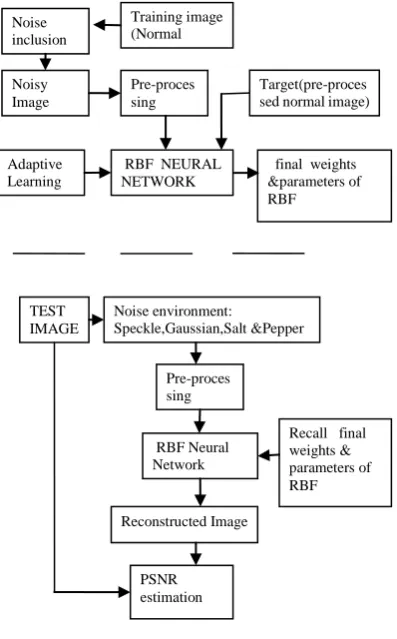
The proposed method has two phases, training phase and test phase as shown in functional block diagram Fig.1 In the phase of training, a noise-free image, and here SAR(Synthetic Aperture Radar) image is taken.
The steps involved in adaptive RBF based Denoising are: 1. Image Acquisition
2. Noise Insertion 3. Pre-Processing 4. Static RBF 5. Adaptive RBF
6. Performance comparison 7. Denoise image by ARBF
8. Performance comparison of ARBF and Adaptive Wiener Filter
First the underwater image is taken. It is made noisy by adding the salt & pepper noise to make the noisy image for the training purpose. In pre-processing, image pixel matrix is first normalized in the range of [0 1] by dividing each pixel value by the maximum value of pixel then, transform the normalized matrix into the number of blocks. Each block matrix is transformed into the vector which will appear as the input to the ARBF. The target for an input vector has taken the vector which forms corresponding spatial information in the noise-free image. An adaptive form of learning is applied as discussed in section 3 to acquire the knowledge in order to recorrect the noise. Once learning is completed, the RBF
parameters, weights,
the time of the test. At the time of the test, any normal image or noisy image has considered for preprocessing and then applied for the input to the RBF which is known to carry the trained parameters. Because this trained network has the knowledge to recorrect the input, disturbance available in the input side is recorrected without estimating the type of disturbance. For the training purpose, salt & pepper is considered so that there could be the maximum level of variation in the pixels information and RBF could learn under this extreme condition.
Figure 1: Functional Block Diagram
IV. RESULTS &DISCUSSIONS
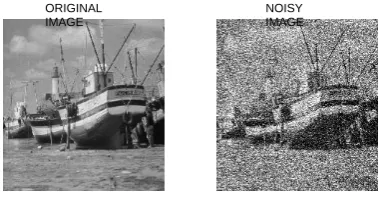
To get the benefits with the developed method, SAR image (fish image) is taken. In order to compare the static RBF and the Adaptive RBF , first the image is made noisy by adding speckle noise with noise density of 0.2. as shown in Fig.3 . This image is trained for 5 iterations for training purpose. Both the, fixed RBF and Adaptive RBF are applied independently for 5 iterations. To get the information about consistency in the performance, experiment is repeated for 5 independent trials. Performance analysis is done based on mean square error. The experiment is performed on different grayscale images of size 512*512 pixels. Preprocessing is applied to each image in a normalized form and each image is divided as a block of 3*3 pixel.RBF neural network architecture contains 9 input nodes, 2 hidden nodes, and 9 output nodes. Weights have initialized as the random number by a uniform distribution in the range of [-0.5 0.5]. The mean error in learning of SRBF and ARBF is shown in Fig.3 while their convergence characteristics for all trials have shown in Fig.4. It is clear that there is a very high error in learning is observed with SRBF as compared to ARBF.
A. Simulation results of SRBF vs ARBF.
To understand the benefits of proposed adaptiveness in the RBF in comparison to static RBF, learning the behavior of both networks with a noisy image have been considered for 5 different trials. SAR image with and without noise has been considered for training purpose. Noisy image after preprocessing is applied as the input and corresponding spatial information in the normal image is considered as the target. Observed mean square error (MSE) under different trials is shown in Table1. It is observed that there is no proper learning with SRBF because, there were only output weights, which were changing to acquire the knowledge, hence it was difficult to minimize the error as the spatial information getting changed from one location to another. The variation of obtained final MSE with the same number of iterations is very large. This is because of change in the selection of centers and spread parameters value from one trial to another. Because of high error and high variation in the trial, SRBF is not an appropriate method for denoising. When the proposed form of adaptiveness is applied in the ARBF, the obtained performance under different trails as shown in the Table1 is appealing (mean error: 0.3114). Under all trials, the learning convergence characteristics for SRBF and ARBF are as shown in Fig.4. It is observed that there is very less change in the error for SRBF even after providing the number of iterations. While with ARBF there is a sharp decline in error value observed with iterations because of the change in the centers and spreads.
Figure 2a: Original image Figure 2b. Noisy image
Table.1: Mean Square Error in learning of image with Static RBF and Adaptive RBF
Trial SRBF ARBF
1 1.6779 0.3114
2 1.5770 0.2670
3 0.9411 0.3114
4 1.1663 0.3162
5 1.3049 0.3114
Mean 1.3049 0.3114
ORIGINAL IMAGE NOISY IMAGE
1 2
0 0.2 0.4 0.6 0.8 1 1.2 1.4
[1]SRBF , [2]ARBF
F
IN
A
L
M
E
A
N
E
R
R
O
R
Noisy Image
Pre-proces sing
RBF NEURAL NETWORK Adaptive
Learning
TEST IMAGE
Noise environment:
Speckle,Gaussian,Salt &Pepper
RBF Neural Network
Reconstructed Image
Recall final weights & parameters of RBF
PSNR estimation Training image (Normal image) Noise
inclusion
Target(pre-proces sed normal image)
Pre-proces sing
[image:4.595.319.538.386.456.2] [image:4.595.316.547.497.838.2]Figure 3: Comparison of static RBF and Adaptive RBF with respect to mean square error
Figure 4:Learning convergence under different trials in static and adaptive RBF
[image:5.595.317.542.231.286.2]The comparison of static and adaptive RBF in the Fig.4 indicates that the convergence rate is faster in adaptive RBF than static RBF. The comparative performance of the proposed model of noise reduction using ARBF against Adaptive Weiner filter is shown in Table 3. It is observed that under various noise reduction measuring parameters, the proposed method has delivered the better performance. The direct quality measure through the PSNR, it is observed that there is more than 4db improvement using proposed method which is very significant value. To get the more clear picture of comparison in Fig.5 bar plot of PSNR is given between the noisy image, de-noised image by AWF and IUNR. To get the visual perception about the quality of noise reduction through the proposed IUNR, Fig.6 shows the simulated result of de-noised image.
Table.2: Performance analysis of Adaptive wiener filter and proposed IUNR
Noise Characteristics
Adaptive Wiener filter
IUNR
Mean Noise Reduction
50.4727 46.9392
Mean in Unnoised Information
4.3925 4.4049
Std Dev in Unnoised Information
11.2783 8.3384
Signal to Noise Ratio 11.3300 11.4774
Peak Signal to Noise Ratio
22.2118 23.1313
From the above Table.2, PSNR of image by Adaptive Wiener Filter is 22.21 whereas by proposed filter PSNR is improved to 23.13.
Figure 5: Performance of noisy image, adaptive wiener filter and IUNR with respect to PSNR
Figure 6:Simulation result of original, noisy image and IUNR denoised image.
Table 3 The results of proposed method for different noise models with noise density=0.05
Noise Type
PSNR for noisy Image
PSNR for AWF
PSNR for ADRBF
Salt & Pepper Noise
18.42 21.08 24.46
Gaussian Noise
13.66 20.94 21.05
Speckle Noise
18.83 24.93 25.23
B. Simulation results of mixed noise model (speckle & gaussian noise)
Practically there is no environment filled with single characteristics of noise but it is a mixture of different types of noise. Hence appropriate modeling of existing noise is very difficult to make. In such case application of the dedicated filter for a particular noise, model degrades the performance further. The proposed IUNR method has the capability to reconstruct the image even it suffered from different types of noise. In Fig.7, boat image is shown with a mixture of noise with Gaussian and Speckle noise. It can be observed that available noise has destroyed the valuable information of the original image. When the noisy image corrected with AWF and IUNR the obtained performance has shown in Table 4.It is observed that as in the case single noise model, with the mixed noise model, IUNR performance is superior in comparison to AWF. In Fig.8 the learning characteristics of ADRF has shown for 5 iterations. The denoised image has shown in Fig.9 and observed that that information which was nearly impossible to visualize in a noisy image, after denoising it is easy to find out.
1 1.5 2 2.5 3 3.5 4 4.5 5
0.8 1 1.2 1.4 1.6 1.8
Iteration No.
M
E
A
N
E
R
R
O
R
LEARNING CONVERGENCE UNDER DIFFERNT TRIALS IN STATIC RBF
1 1.5 2 2.5 3 3.5 4 4.5 5
0.26 0.28 0.3 0.32 0.34 0.36
Iteration No.
M
E
A
N
E
R
R
O
R
LEARNING CONVERGENCE UNDER DIFFERNT TRIALS IN ADAPTIVE RBF
1 2 3
0 5 10 15 20 25
[1]NI [2]WD [3]RD
P
S
N
R
[image:5.595.51.288.491.637.2]Figure 7: Original image and noisy image(mix of Gaussian and speckle noise)
Table.4: Performance analysis of Adaptive wiener filter and proposed adaptive RBF for mixed noise model
Noise Characteristics Adaptive Wiener Filter
Proposed Adaptive
RBF
Mean Noise Reduction 57.3831 60.6994
Mean in Unnoised Information
15.3673 11.9365
Std Dev in Unnoised Information
18.2839 14.4999
Signal to Noise Ratio 14.3378 14.4844
Peak Signal to Noise ratio
19.2813 20.5827
From the above table 4. PSNR of noisy image is 12.78 , PSNR of image by Adaptive Wiener Filter is 19.78 and that of proposed ARBF is 20.58. It is observed that the PSNR of proposed algorithm is improved in comparison with adaptive wiener filter.
Figure 8: Convergence characteristics for ARBF
Figure 9: Simulation result of original, noisy image and ARBF denoised image
V. CONCLUSION
In this paper, a unified approach is used to reduce the level of different types of noise. To reduce the level of noise, the adaptive radial basis function neural network is proposed. Spreads and center positions are adapted by using the gradient method. It is also observed that the proposed adaptiveness has reduced the error in very less iterations in the learning process. Adaptive RBF is used in training to reconstruct the noisy image and learned approximation knowledge applied to recorrect the other varieties of noise in images suffered from the homogeneous and heterogeneous types of noise. Proposed method is compared with adaptive Weiner filter and hence from the above results, adaptive RBF gives better reduction in the different levels of noise.
REFERENCES
1. D. S. Broomhead and D. Lowe, “Multivariable functional interpolation and adaptive networks”, Complex Syst., vol. 2,1988, pp. 321-355. 2. S . Chen , C. F. N. Cowan, and P. M. Grant, “Orthogonal Least Squares
Learning Algorithm for Radial Basis Function Networks”, Department of Electrical Engineering, University of Edinburgh, Mayfield Road, Edinburgh EH9 3JL, Scotland, U.K, IEEE TRANSACTIONS ON NEURAL NETWORKS, VOL. 2, NO. 2, MARCH 1991
3. Inhyok Cha, Student Member, IEEE, and Saleem A. Kassam, “Channel Equalization Using Adaptive Complex Radial Basis Function Networks”, Fellow, IEEE, IEEE JOURNAL ON SELECTED AREAS IN COMMUNICATIONS, VOL. 13, NO. 1, JANUARY 1995. 4. Andrew R. Webb and Simon Shannon, “Adaptive Radial Basis
Functions”, Defence Research Agency, St Andrews Road, Malvern, Worcestershire WR14 3PS, 1996 British Crown Copyright Proceedings of ICPR ’96 [5]
5. Nicolaos B. Karayiannis, “ Gradient Descent Learning of Radial Basis Neural Networks”,1997, Department of Electrical & Computer Engineering University of Houston,Houston, Texas, IEEE.
6. Witold Pedrycz, “Conditional Fuzzy Clustering in the Design of Radial Basis Function Neural Networks”, Senior Member, IEEE 1998, IEEE TRANSACTIONS ON NEURAL NETWORKS, VOL. 9, NO. 4, JULY 1998
7. Nicolaos B. Karayiannis, “Reformulated Radial Basis Neural Networks Trained by Gradient Descent”, IEEE TRANSACTIONS ON NEURAL NETWORKS, VOL. 10, NO. 3, MAY 1999 657.
8. Li Jianyul., Luo Siwei, Qi Yingjian and Huang Yaping, “ Interactive Gradient Algorithm for Radial Basis Function Networks”, Computer Science Dept., Northern Jinotang Ilniv, Beijing China 100014,School of lnformation and Engineering. Bcijing Broadcasting Institute. Beijing China, ICSPO2 Proceedings.
9. Konstantin P. Nikolic and Ivan B. Scepanovic, , “Stochastic Search-Based Neural Networks Learning Algorithms”, Department of Informatics, Faculty of Management, Novi Sad, university of Belgrade, Republic of Serbia,9th symposium on neural network application in electrical engineering. Sep-25-27 2008
10. Kanishka Tyagi, Xun Cai and Michael T. Manry, “Fuzzy C-Means Clustering Based Construction And Training For Second Order RBF Network”, Department of Electrical Engineering, The University of Texas at Arlington, Arlington, USA, School of Computer Science and Technology, Shandong University Jinan, Shandong, P.R.China, Department of Electrical Engineering, The University of Texas at Arlington Arlington, TX, USA, 2011 IEEE International Conference on Fuzzy Systems June 27-30, 2011, Taipei, Taiwan.
11. Long Zhang and Kang Li , Shujuan Wang, “An Improved Conjugate Gradient Algorithm for Radial Basis Function (RBF) Networks Modelling”, School of Electronics, Electrical Engineering and Computer Science, Queen's University Belfast, UK, School of Electrical Engineering and Automation, Harbin Institute of Technology, China, UKACC, International Conference on Control 2012, Cardiff, UK, 3-5 September 2012.
12. Harmeling, S., Schuler, C. J., Burger, H. C,2012, Image denoising: Can plain neural networks compete with BM3D?.: IEEE Conference on Computer Vision and Pattern Recognition 2012, vol.157, pp.2392-2399. IEEE Computer Society (2012).
13. Dishant Mittal, B. K. Tripathy,2015, Efficiency
1 1.5 2 2.5 3 3.5 4 4.5 5
0.345 0.35 0.355 0.36 0.365 0.37 0.375 0.38 0.385 0.39
Iteration No.
M
S
E
ORIGINAL IMAGE NOISY IMAGE DENOISED IMAGE
IMAGE
ORIGINAL IMAGE
[image:6.595.64.272.442.584.2] [image:6.595.55.281.613.707.2]or-1 Photo
Analysis of Kernel Functions In Uncertainty Based C-Means Algorithms, School of Computing Science and Engineering VIT University Vellore, India. 2015 International Conference on Advances in Computing, Communications and Informatics (ICACCI).
14. Rongke Liu , Spencer Ojogba Onuh and Ani Cosmas , 2015, SAR Image Despeckling and Compression Using K Nearest Neighbor Based Lee Filter and Wavelet, Aiyeola Sikiru Yommy1*, Ikechukwu ,Beihang University, Beijing, 100191, P.R. China , National Space Research and Development Agency, Abuja, Nigeria , University of Nigeria Nsukka, Nigeria, 2015 8th International Congress on Image and Signal Processing (CISP 2015).
15. Fariborz Taherkhani, Mansour Jamzad, 2017, Restoring highly corrupted images by impulse noise using radial basis functions interpolation, Department of Computer Engineering, Sharif University of Technology, Tehran, Iran, ISSN 1751-9659, 17th November 2017. 16. Puyang Wang, He Zhang, and Vishal M. Patel,2017,SAR Image
Despeckling Using a Convolutional Neural Network, IEEE Signal Processing Letters , Vol- 24 , Issue- 12 , Dec. 2017 , pages:1763 – 1767. 17. Yuechao Chen, Xiaonan Xu, 2017, “The research of underwater target recognition method based on deep learning”,2017 IEEE International Conference on Signal Processing, Communications and Computing (ICSPCC), Xiamen, China.
18. Sankha Subhra Mullick, Shounak Datta, and Swagatam Das, 2018 , Adaptive Learning-Based k-Nearest Neighbor Classifiers With Resilience to Class Imbalance, Senior Member, IEEE, IEEE Transactions On Neural Networks And Learning Systems.
19. Bo Fu, Xiao-Yang Zhao, Yi Li, Xiang-Hai Wang and Yong-Gong Ren,2018 ,A Convolutional Neural Networks Denoising Approach for Salt and Pepper Noise, School of Computer and Information Technology, Liaoning Normal University, China, Multimedia Tools and Applications,2018,Pages-1-25.
20. Wonseok Jeon, Wooyoung Jeong, Kyungchan Son, and Hyunseok Yang, 2018, Speckle noise reduction for digital holographic images using multi-scale convolutional neural networks”, Optics Letters, Vol. 43, Issue 17, pp. 4240-4243 (2018).
21. Hamid Reza Shahdoosti,Zahra Rahemi, “Edge-preserving image denoising using a deep convolutional neural
AUTHORSPROFILE
Azra Jeelani BE, M.Tech, Pursuing Ph.D,in VTU, Having Experience of 16 Years in Teaching, Presently working as Associate Professor in ECE Department, M S Engineering College, Bangalore, India, Published 10 papers in national and international journals. Interested in the fields of Image processing, VLSI and Communication.

![[18F]-Fluorodeoxyglucose Uptake in Lymphoid Tissue Serves as a Predictor of Disease Outcome in the Nonhuman Primate Model of Monkeypox Virus Infection](data:image/gif;base64,R0lGODlhAQABAIAAAP///wAAACH5BAEAAAAALAAAAAABAAEAAAICRAEAOw==)