Abstract: The aim of current research effort is to evaluate the performance of much less utilized Argemone Mexicana seed oil methyl ester in single cylinder, water-cooled, 4-S diesel engine. The Argemone Mexicana is an agricultural weed, a plant of wasteland; its use led to the resource conservation. The methyl ester or biodiesel obtained by Argemone Mexicana seed oil is produced by the course of transesterification process. This process consists of pretreatment of vegetable oil with acid catalyst due to high FFA content followed by base catalyzed transesterification. The essential properties of transesterified Argemone Mexicana seed oil are tested and compared with natural diesel. The biodiesel blends with diesel in the combination of B10, B20, B30, B40 and B50 are utilized in a compression-ignition engine, its performance parameters are examined and compared with natural diesel. The lower blends of biodiesel exhibits similar characteristics to diesel without any modification in the design of engine. This experimental work testified that the blending of diesel with biodiesel obtained from Argemone Mexicana oil in diesel engine is a feasible alternative for depletion of petroleum diesel.
Keywords : Argemone Mexicana, Biodiesel, Brake thermal efficiency, Performance evaluation, Specific fuel consumption, Transesterification.
I. INTRODUCTION
Present society is dependent on technology competent of using diverse type of the power to give consumers extra comfort for present life which comprises transportation, electricity and heating [1]. The diminishing stocks of the fossil fuel and continuously rising environmental interest have resulted renewable energy an extremely smart alternate energy source of the future [2]. Nowadays, so many nations of the world are exchanging their existing energy sources by more promising, sustainable and renewable ones [3]. Various reports show that nation like India will increase their fuel consumption up to two fold by 2030 and biodiesel appears a promising source of energy [4]. It is one of the alternatives which can be utilized in any diesel engine as blend or pure biodiesel without any change in the engine [5]. Direct application of vegetable oil as a fuel in the diesel engines leads to durability as well as operational problems also
Revised Manuscript Received on September 07, 2019
* Correspondence Author
Syed Shahbaz Anjum*, Department of Mechanical Engineering, NIT Patna, India.
Dr. Om Prakash, Department of Mechanical Engineering, NIT Patna, India.
Dr. Amit Pal, Department of Mechanical Engineering, DTU Delhi, India.
because of high viscosity and low volatility. Many research works are available discussing production as well as performance of biodiesel in a diesel engine. Vijayaraj et al. 2016 investigated the making and utilization of biodiesel by mango seed oil into a diesel engine [6]. They produced biodiesel from mango seed oil through transesterification process and used as blends with natural diesel and found lower brake thermal efficiency, smoke density and unburned hydrocarbon from diesel while higher BSFC and NOx for
various blends. While Maniniyan et al., 2012 had discussed the performance characteristics of biodiesel made from mahua on a diesel engine [7]. However they found B20 blend
having the improved performance and emission
characteristics than the other blends. Oxidation stability or induction period of biodiesel was investigated by blending with low stability biodiesel and biodiesel having higher stability. Soybean biodiesel was observed to have higher oxidation stability and used as blender for low oxidation stability like cottonseed, residual cooking oil, and sunflower biodiesel [8]. Nair et al. 2017 reported that B10 blend were having lower emissions and better performance than most of the other blends of biodiesel produced from neem oil as well as natural diesel [9]. They found higher brake thermal efficiency and lesser CO, HC and NOx emissions than that of
diesel. Dawody et al. 2014 conducted tests on diesel engine at constant 1500 rpm and various loads for performance and the emission characteristics of biodiesel extracted from soybean (20%, 40%, 100%) [10]. The bsfc (brake sp. fuel cons.) was reported less than diesel for all blends. The performances of loofah ester as a blend of 5-20% with petroleum diesel in diesel engine were similar to the performance of petroleum diesel [11]. The other parameters like exhaust temperature, torque, fuel consumption rate and speed showed non-significant variation in performance of pure diesel and loofah biodiesel blend in diesel engine. The viscosities of Jatropha biodiesel blend (B10 and B20) were found very close to diesel while the oxidation consistency of these blends met the European specifications (EN 590) [12]. Engine
performances and emission characteristics for
Jatropha-biodiesel were compared and found marginally lower with diesel. The feasibility of soapnut biodiesel was investigated and its properties along with its blending properties were compared with diesel. The various properties of soapnut biodiesel were reported as, cetane number 58, flash point 177 °C,
Performance Evaluation and Analysis of
Underutilized Argemone Mexicana seed oil
Biodiesel in Single Cylinder 4-S Diesel Engine
filter-plugging point 6 °C, iodine value 83.6 g/100 g and kinematic viscosity 4.88 mm2/sec at 40 °C along with satisfactory oxidation constancy [13]. Atabani et al. 2014 had investigated that the blendings of the diesel along with the biodiesel result in betterment of kinematic-viscosity, oxidation stability, density and calorific value however decrease in flash point with increase in biodiesel blend was observed [14]. A number of research papers were available for various non-edible-vegetable-oils biodiesel for instance karanja seed oil, polanga seeds oil, mahua seed oil, rubber seed oil, jojoba seeds oil, cotton seeds oil, tobacco seed oil, neem seeds oil, linseed oil, jatropha seed oil, castor oil, rice bran oil, soapnut oil, see mango oil, yellow oleander oil etc [15-16]. Apart from above mentioned non-edible oils, Argemone Mexicana seed oils were underutilized as a prospective feedstock in support of biodiesel making [17].
The purposeful goal of this research work is to investigate the viability in Argemone Mexicana as a prospective feedstock meant for biodiesel. It belongs to the family of papaveraceae and the whole species comes under poppy. In India it is popular with the name as Satyanashi, Bhrahmadanthi and shialakanta. The underutilized Argemone Mexicana is found everywhere along roadsides, in dry and poor waste land. It basically prefers sandy light soils. However it is a common weed in agricultural field. It is an annual herb. Its seed as well as oil look like mustard and mustard oil in respect of specific gravity, colour and odour [18]. The entire plants of Argemone Mexicana, including the seeds are having medicinal characteristics however it contains toxic alkaloids [19-20]. The oil of Argemone Mexicana seed might be a better source for the biodiesel production provided all toxic alkaloids are removed [21].
II. MATERIALSANDMETHODS
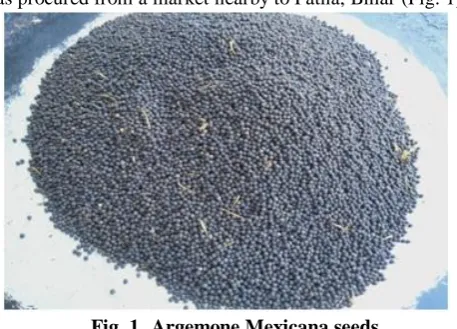
[image:2.595.56.285.531.695.2]The seed oil of Argemone Mexicana has been used for the production of biodiesel in present research study. The seed was procured from a market nearby to Patna, Bihar (Fig. 1).
Fig. 1. Argemone Mexicana seeds
The procured seeds were dried in the sunlight. Then the oil from the seed was extracted mechanically in local oil mills. It was found very hard to process the seeds in screw press because of seeds physical properties. Several cycles for oil extractions were required. During the process of oil extraction, belt and other accessories of mill were adjusted several times. Finally 30% by weight, oil extraction was
achieved. Anhydrous methanol (99.8% minimum),
potassium hydroxide (85% minimum) and sulphuric acid (99% minimum) were procured locally from chemical shops. Petroleum diesel was procured from local petrol pump. Various titration processes were carried out in chemical labs of the institute.
A. Biodiesel Production
a. Refining of Argemone Mexicana oil
Because of soaring free fatty acid (FFA) contents (i.e. nearly 6%), two steps transesterifications were recommended after removal of the alkaloid and the gum [22]. 100 ml crude Argemone oil was treated or homogenized by 25 ml methanolic H3PO4 solutions (12%, vol/vol) and then left for
overnight. The next day, oil and methanol were separated, and then it was filtered through 60-120 mesh silica gel under suction. For the degumming, filtrate was recycled three times. After the degumming, oil was left overnight with the 0.1% aqueous NaOH solutions. The next morning, oil was separated with aqueous portion and then it was water washed to remove alkali. Then oils were heated in the boiling water up to 1 hour and then to remove the moisture contents, it was passed through anhydrous Na2SO3 (warmed at 105 °C). The
resultant oils were stored as refined Argemone Mexicana oils (RAMO).
b. Two-steps Transesterification Process
For transesterification methanol was selected because of higher reactivity than the ethoxide-radicals of ethanol. In first step, esterification was carried out with alcohols (i.e. methanol), acid (i.e. H2SO4) and RAMO. All constituents
were properly mixed and stirred continuously at constant temperature of 60 °C for 3-4 hours on hot plate magnetic stirrer. Thereafter excess alcohols and glycerin were separated with oil and followed by neutralization of oil. The neutralized oil was subsequently mixed with methanol and alkali catalyst for second step. This mixture was continuously well stirred and heated at 60 °C for few hours. These second steps were called transesterification. After the transesterification reaction, mixture was poured in separating flask, subsequently oil was separated and water washed twice for removing the impurities. After that the water washed oil was heated gently up to a temperature 110 °C for 10 minutes so as to get evaporated water contents inside oil which followed by filtration. This filtered oil is known as transesterified oil (TEO) and stored for further investigation.
B. Preparation of biodiesel samples for engine tests
The petroleum diesel (PD) was used as reference fuel, TEO and PD were blended at 10-50% with 10% increment of TEO by volume to obtain five biodiesel samples in the subsequent proportions:
and 90% PD
B20 = 20% Argemone Mexicana oil biodiesel (TEO) and 80% PD
B30 = 30% Argemone Mexicana oil biodiesel (TEO) and 70% PD
B40 = 40% Argemone Mexicana oil biodiesel (TEO) and 60% PD
B50 = 50% Argemone Mexicana oil biodiesel (TEO) and 50% PD
C. Experimental setup
[image:3.595.78.260.286.440.2]The experiment in this study was carried out in a four stroke, single cylinder diesel engine attached to the eddy-current-type-dynamometer for load applications as shown in Fig. 2. The complete stipulations of the diesel engine and the eddy current dynamometer have been given in the table I and II, respectively.
Table- I: Specifications of Test engine
Items Specification
Engine Make Sonalika
Type of Fuel Diesel.
Air Inhalation Naturally-aspirated
Cooling system Water-cooled
Numbers of cylinder 1
Rated Output 5 HP at 1500 rpm
Bore-diameter 95mm
[image:3.595.47.282.466.752.2]Stroke-Length 110mm
Table- II: Specifications of Dynamometer (Eddy Current type)
Items Specification
Torque 4.7 - 549 Nm
RPM Maximum 3500 rpm
Coil Voltage 0–80 volt DC (standard)
Overload Maximum 250% short-time
Class “F” insulation Standard
Fig. 2. Diesel engine test rig
D. Test Procedure
Firstly, the engine had to run without load with only diesel-fuel for some time. After warm up and achieving stability of the engine which were determined by the exhaust gas temperature stability, the experimental investigations were carried out for standard diesel fuel and blends for instance B 10, B 20, B 30, B 40, B 50 with diesel again. However varying load (3-15 kg) was applied through the eddy current dynamometer. However the experiment was performed at steady engine speed (1500 rpm) with constant compression ratio. A cubical air tank with orifice was attached to the engine for air supply. For each and every load conditions, the engine had to run at least for 3 minutes, after that data were recorded. Then the engine was shutdown. Different performance parameters for engine were measured and results obtained were plotted by the aid of Origin Pro software.
III. RESULTSANDDISCUSSIONS
A. Biodiesel Production results
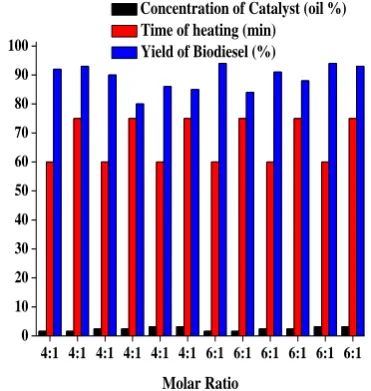
During the transesterification process, two different molar ratios (4:1 and 6:1), two different heating times (60 and 75 minutes) and three different catalyst concentrations (0.4, 0.6 and 0.8%) were considered. Finally a graph was plotted for best yield percentage combination of different parameters. From the chart represented in Figure 3, the best yield percentage was obtained to be 94% for molar ratio 6:1 along with heating time 60 minutes. The maximum yield was achieved for two different catalyst concentrations i.e. 0.4% and 0.8%. The lesser use catalyst might be considered eco-friendly.
4:1 4:1 4:1 4:1 4:1 4:1 6:1 6:1 6:1 6:1 6:1 6:1 0
10 20 30 40 50 60 70 80 90 100
Concentration of Catalyst (oil %) Time of heating (min)
Yield of Biodiesel (%)
Molar Ratio
Fig. 3. Comparisons of biodiesel yield from RAMO for various combinations of catalyst concentration and
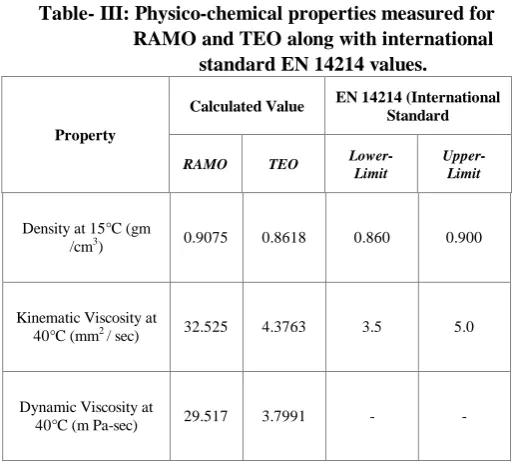
[image:3.595.330.516.478.674.2]The physicochemical properties of RAMO and TEO were measured as per the standard methods and average values were presented in table III.
C. Engine performances
a. Brake - specific - fuel consumption versus engine load
Figure 4 shows the deviation of brake - specific fuel consumptions versus engine-load for TEO biodiesel blend B 10, B 20, B 30, B 40, B 50 and diesel. From the graph it is observed that for blend as well as for diesel, brake specific fuel consumptions are decreasing with engine load. The explanation behind this could be warmed up situation for engine at low load condition and as for increasing load, higher percentage of energy produced from combustion might be converted into brake power. Brake specific fuel consumption for B20 blend was found marginally lower as other blends and pure diesel were almost same. Similar results are reported by previous researchers [23].
2 4 6 8 10 12 14 16
0.2 0.4 0.6 0.8 1.0 1.2 1.4 1.6
B
r
a
k
e
S
p
e
c
if
ic
F
u
e
l
C
o
n
s
u
m
p
ti
o
n
(
k
g
/k
W
-h
r
)
Load (kg)
[image:4.595.75.264.324.504.2]Diesel B10 B20 B30 B40 B50
[image:4.595.337.530.326.494.2]Fig. 4. Variations of brake sp. fuel consumption with engine load.
Table- III: Physico-chemical properties measured for RAMO and TEO along with international
standard EN 14214 values.
Property
Calculated Value EN 14214 (International Standard
RAMO TEO Lower-
Limit
Upper- Limit
Density at 15°C (gm
/cm3) 0.9075 0.8618 0.860 0.900
Kinematic Viscosity at
40°C (mm2 / sec) 32.525 4.3763 3.5 5.0
Dynamic Viscosity at
40°C (m Pa-sec) 29.517 3.7991 - -
b. Brake thermal efficiency versus engine load
The variations of brake – thermal - efficiency in percentage by engine load are presented in figure 5. The brake thermal efficiency of internal combustion engine is ratio of the power produced by engine to rate of energy produced by combustion of fuel. However energy produced by combustion is product of heating value of fuel with its mass flow rate. Here trend for brake thermal efficiencies is increasing with engine load for all biodiesel blends as well as for pure diesel. It was caused due to continuous reduction in the heat loss for higher loads. For few blends in some of the load conditions, break thermal efficiencies were lower than pure diesel because of lesser calorific values of blends. On the other hand, some blends like B20 exhibits higher brake thermal efficiency than pure diesel due to availability of oxygen within biodiesel chemical structure and their greater lubricity. This resulted in improved burning and lesser friction losses [24].
2 4 6 8 10 12 14 16
4 6 8 10 12 14 16 18 20 22
B
r
a
k
e
T
h
e
r
m
a
l
E
ff
ic
ie
n
c
y
(
%
)
Load (kg)
[image:4.595.40.300.549.782.2]Diesel B10 B20 B30 B40 B50
Fig. 5. Variations of brake-thermal-efficiencies with respect to engine load.
c. Exhaust gas temperature versus engine load
2 4 6 8 10 12 14 16
100 105 110 115 120 125 130 135
E
x
h
a
u
st
G
a
s
T
e
m
p
e
r
a
tu
r
e
(
°C
)
Load (kg)
Diesel B10 B20 B30 B40 B50
Fig. 6. Variations of exhaust – gas - temperature along with engine load.
[image:4.595.332.535.572.723.2]are presented through Figure 6. The exhaust emission gas temperatures were observed lowest for diesel and lower for blends up to B20. This was revealed that effective combustion was taking place and there was savings in the exhaust emission gas energy losses. The brake-specific fuel consumptions and the brake-thermal efficiency graphs reflected the same facts. The exhaust emission gas temperature rises for all blends along with diesel with increase in engine load.
d.Brake Specific Fuel Consumption versus Biodiesel Blend
It was honored from figure 7 that for every load conditions, pure diesel had the least specific fuel consumption, however it was increasing with enhance in biodiesel within blends. This trend occurred due to less energy content (low heating value) for higher biodiesel blends and it resulted in higher brake specific fuel consumption. In present experimental work the brake specific fuel consumption amplified in the range 4.9% to 20% for different biodiesel blends than that of pure diesel.
Diesel B10 B20 B30 B40 B50
0.0 0.1 0.2 0.3 0.4 0.5 0.6 0.7 0.8 0.9 1.0 1.1 1.2 1.3 1.4 1.5 1.6 1.7 1.8 1.9 2.0
B
r
a
k
e
S
p
e
c
if
ic
F
u
e
l
C
o
n
s
u
m
p
tio
n
(
k
g
/k
W
-h
r
)
Biodiesel Blend
[image:5.595.332.513.206.370.2]3 kg 6 kg 9 kg 12 kg 15 kg
Fig. 7. Variations of brake-specific-fuel consumptions along with biodiesel blend.
e. Brake Thermal Efficiency versus Biodiesel Blend
Diesel B10 B20 B30 B40 B50
0 5 10 15 20 25 30
B
ra
k
e
T
h
er
m
al
E
ff
ic
ie
n
cy
(
%
)
Biodiesel Blends
3 kg 6 kg 9 kg 12 kg 15 kg
Fig. 8. Variations of brake-thermal-efficiency with biodiesel blend.
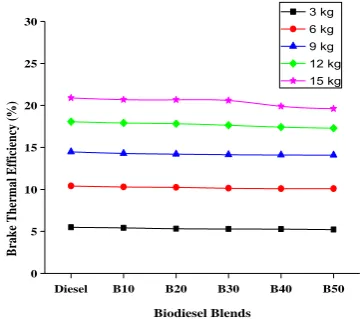
The variations of brake thermal efficiencies with respect to percentage blends of biodiesel are represented in figure 8. The decreasing trend in brake thermal efficiency for all loads
is observed with raise in biodiesel blendings. The brake-thermal-efficiency variation ranges from 2.6% to 6.2% for different biodiesel blends than that for pure diesel for various loading conditions.
f. Exhaust Gas Temperature versus Biodiesel Blend
The effect of blends on exhaust emission gas temperature is represented in figure 9. The result inferred so as to exhaust-gas-temperature rises with the rise in blend for the entire loads. This is due to the poor combustion characteristics because of its greater viscosity.
Diesel B10 B20 B30 B40 B50
60 70 80 90 100 110 120 130 140 150 160
E
x
h
a
u
st
G
a
s
T
em
p
er
a
tu
re
(
°C
)
Biodiesel Blend
3 kg
6 kg
9 kg
12 kg
[image:5.595.74.285.313.490.2]15 kg
Fig. 9. Variations of exhaust-gas-temperature along with biodiesel blend.
IV. CONCLUSION
The biodiesel was produced from raw Argemone Mexicana seed oil using transesterification process. The measured property of biodiesel reflects close harmony with the natural diesel. Therefore diesel engines can satisfactorily operate on biodiesel produced from Argemone Mexicana seed oil without any change or modification in the diesel engine. From this experimental investigation on biodiesel produced from Argemone Mexicana seed oil to evaluate and appraise the production, performance and combustion of its blends inside the single cylinder water-cooled diesel engine, the subsequent conclusions could be drawn.
1) The best yield achieved was 94%. The maximum yield percentage achieved was obtained for the molar ratio 6:1 with heating time 60 minutes and catalyst-concentration of 0.4% (by weight of oil).
2) The brake-specific-fuel consumption for various blend and pure diesel are almost same however B20 blend is found marginally lower.
3) The brake-thermal-efficiency meant for B 20 blend is somewhat greater than natural diesel.
4) The exhaust emission gas temperature, which reflects effective combustion, is found very close to natural diesel for up to B20 blends.
[image:5.595.76.258.554.713.2]6) The brake-thermal-efficiency variation for different biodiesel blend is observed from 2.6 to 6.2 percent with respect to natural diesel.
7) The increasing trend is observed in exhaust emission gas temperature for biodiesel blend because of greater viscosity of blends.
From the subsequent results, this can be inferred that Argemone Mexicana seed oil is a viable source of biodiesel production. B20 blend of biodiesel is exhibiting almost equal results as that of pure diesel without any change in the existing engine. Thereby it results in saving of 20% of the valuable efficient petroleum diesel fuel.
REFERENCES
1. Alexandre E. C. F., Silveira E. V., Castro C. F. S., Sales J. F., de Oliveira L. C. S., Viana L. H., and Barbosa L. C. A., “Synthesis, characterization and study of the thermal behavior of methylic and ethylic biodiesel produced from tucuma (Astrocaryum huaimi Mart.) seed oil”, Fuel, Vol. 161, 2015, pp. 233-238.
2. Atabani A. E., Silitonga A. S., Ong H. C.,Mahlia T. M. I., Masjuki H. H., Badruddin I. A., and Fayaz H., “Non-edible vegetable oils: A critical evaluation of oil extraction, fatty acid compositions, biodiesel production, characteristics, engine performance and emission production”, Renewable and Sustainable Energy Reviews, Vol. 18, 2013, pp. 211-245. 3. Karabektas M., and Hosoz M. “Performance and emission characteristics of diesel engine using isobutanol-diesel fuel blends”, Renewable Energy, Vol. 34, 2009, pp. 1554-1559.
4. Yadav A. K., Khan M. E., Dubey A. M., and Amit Pal, “Performance and emission characteristics of a transportation diesel engine operated with non-edible vegetable oils biodiesel”, Case Studies in Thermal Engineering, Vol. 8, 2016, pp. 236-244.
5. Ng J. H., Ng H. K., and Gan S., “Characterization of engine-output response from a light duty diesel engine fuelled palm methyl ester (PME)”, Applied Energy, Vol. 90, 2012, pp. 58-67.
6. Vijayaraj K., and Sathiyagnanam A. P., “Experimental investigation of a diesel engine with methyl ester of mango seed oil and diesel blends” Alexandria Engineering Journal, Vol. 55, 2016, pp. 215-221.
7. Maniniyan V., and Sivaprakasam S., “Performance, combustion and emission evaluation in DI diesel engine using diesel and biodiesel”, Elixir Mech. Engg. Vol. 52, 2012, pp. 11305-11308.
8. Serqueira D. S., Fernandes D. M., Cunha R. R., Squissato A. L., Santos D. Q., Richter E. M., and Munoz R. A. A., “Influence of blending soybean, sunflower, colza, corn,cottonseed, and residual cooking oil methyl biodiesels on the oxidation stability”, Fuel, Vol. 118, 2014, pp. 16-20.
9. Nair J. N., Kaviti A. K., and Daram A. K., “Analysis of performance and emission on compression ignition engine fuelled with blends of Neem biodiesel”, Egyptian Journal of Petroleum, Vol. 26, 2017, pp. 927-931. 10. Dawody M. F. A., and Bhatti S. K., “Experimental and computational
investigations for combustion, performance and emission parameters of a diesel engine fuelled with soybean biodiesel-diesel blends”, Energy Procedia, Vol. 52, 2014, pp. 421-430.
11. Oniya O. O., and Bamgboye A. I., “Performance of a stationary diesel engine using loofah (Luffa cylindrical L.) biodiesel”, Int. Jour. of Sustainable Energy, 2014, dx.doi.org/10.1080/14786451.2014.922973. 12. Mofijur M., Masjuki H. H., Kalam M. A., and Atabani A. E., “Evaluation of biodiesel blending, engine performance and emissions characteristics of Jatropha curcas methyl ester: Malaysian perspective”, Energy, Vol. 55, 2013, pp. 879-887.
13. Chen Y. H., Chiang T. H., and Chen J. H., “Properties of soapnut (Sapindus mukorossi) oil biodiesel and its blends with diesel”, Biomass and Bioenergy, Vol. 52, 2013, pp. 15-21.
14. Atabani A. E., Mofijur M., Masjuki H. H., Badruddin I. A., Kalam M. A., and Chong W. T., “Effect of Croton megalocarpus, Calophyllum inophyllum, Moringa oleifera, palm and coconut biodiesel-diesel blending on their physic-chemical properties”, Industrial Crops and Products, Vol. 60, 2014, pp. 130-137.
15. Ashraful A. M., Masjuki H. H., Kalam M. A., Rizwanul Fatah I. M., Imtenan S., Shahir S. A., and Mobarak H. M., “Production and comparison of fuel properties, engine performance, and emission characteristics of biodiesel from various nonedible vegetable oils: A
review”, Energy Conversion and Management, Vol. 80, 2014, pp. 202-228.
16. Atabani A. E., Silitonga A. S., Ong H. C., Mahlia T. M. I., Masjuki H. H., Badruddin I. A., and Fayaz H., “Non-edible vegetable oils: A critical evaluation of oil extraction, fatty acid compositions, biodiesel production, characteristics, engine performance and emissions production”, Renewable and Sustainable Energy Reviews, Vol. 18, 2013, pp. 211-245. 17. Anjum S. S., Prakash O., and Pal A., “Conversion of non-edible Argemone Mexicana seed oil into biodiesel through the transesterification process”, Energy Source Part A: Recovery, Utilization, and
environmental Effects, 2018,
doi.org/10.1080/15567036.2018.1563244.
18. Shukla A. K., Johar S. S., and Singh R. P., “Identification of Argemone oil and its simple qualitative detection in mustard oil”, Brassica, Vol. 5, 2003, pp. 75-76.
19. Kumar A., and Sharma S., “Potential non-edible oil resources as biodiesel feedstock: An Indian perspective”, Renewable and Sustainable Energy Reviews, Vol. 15, 2011, pp. 1791-1800.
20. Garcia V. P., Valdes F., Martin R., Luis J. C., Afonso A. M., and Ayala J. H., “Biosynthesis of antitumoral bactericidal sanguinarine”, Journal of Biomedicine and Biotechnology, 2006, doi 10.1155/JBB/2006/63518. 21. Pramanik P., Das P., and Kim P. J., “Preparation of biofuel from
Argemone Mexicana seed oil by an alternative cost-effective technique”, Fuel, Vol. 91, 2012, pp. 81-86.
22. Fadhil A. B., Al-Tikrity E. T. B., and Khalaf A. M., 2018. “Transesterification of non-edible oils over potassium acetate impregnated CaO solid base catalyst”, Fuel, Vol. 234, 2018, pp. 81-93. 23. Ramadhas A. S., Muraleedharan C., and Jayaraj S., “Performance and
emission evaluation of a diesel engine fueled with methyl esters of rubber seed oil” Renewable Energy, Vol. 30, 2005, pp. 1789-1800.
24. Bora D. K. “Performance of single cylinder diesel engine with karabi seed biodiesel”, J. Sci. & Industrial Research, Vol. 68, 2009, pp. 960-63.
AUTHORSPROFILE
Syed Shahbaz Anjum, Research Scholar in Mechanical Engineering Department, N I T Patna, M Sc Engineering from P U Patna, B Sc Engineering from A M U Aligarh, Research Interest in Biofuels and Thermal Engineering, Journals-2, International Conference-2, Presently working as Assistant Professor in Maulana Azad College of Engineering and Technology Patna, Life Member of ISTE, BSPC Patna.
.
Dr. Om Prakash, Professor in Mechanical Engineering Department, N I T Patna, Ph.D. from I I T Delhi, ME from N I T Tiruchirappalli, Journals- 31, International Conference- 09, National Conference- 14, Project- 01, Books-02, Membership- SAE India, ISHRAE, ISTE, SEEM, Burse India.