Abstract: Background/Objective: Mobile frameworks for automobiles, trains, airplanes, and buses that use roaming networks as a unit are based on internet transparency. For implementation of the framework, the Network Mobility Basic Support (NEMO BS) protocol was proposed and developed by the Internet Engineering Task Force. Although NEMO BS performs continuous, optimized, and safe communications for all nodes, it has a handoff delay and packet transmission delay a tan increasing nested level. Method/Statistical Analysis: To solve the problems, this study makes use of a hierarchical structure in an advanced binding update list, and proposes a new route optimization method for nested mobile networks. Findings: The proposed method is aimed at solving the problem of pinball routing and at making handoffs smooth. The method proposed in this study minimizes transmission delay, handoff delay, and packet overhead, and solves the problems of NEMO BS for optimized routing in nested mobile networks. The proposed method shows performance three times higher than NEMO BS, and 88% higher than the ROTIO. This study’s results prove that the proposed method offers more improved performance than NEMO BS and ROTIO with a rise in nesting level. Improvements/Applications: According to the performance evaluation, the proposed method reduces packet overhead, handoff delay, and packet transmission delay, and performs optimal routing.
Keywords: NEMO BS, binding update list, mobile networks, ROTIO, protocol, mobile framework
I.INTRODUCTION
In the wireless mobile networking environment, users are able to access VoIP(voice over internet protocol) services like video conference and web browsing with their mobile devices at any time and any place. In this case, multicast is very useful in MHs(mobile hosts), as was shown in [1]. This method makes it possible for MHs to freely keep connections as long as networking keeps leading to the development of mobile networks. With the expectation that internet access will be universalized further, the demands for mobility are not simply limited to individual devices. Support for network mobility, such as mobility with one device, is the clear requirement of internet access in mobile platforms like buses, trains, and airplanes. Network mobility is implemented in the NEMO BS(Network Mobility Basic Support) protocol, which was developed by the IETF(Internet Engineering Task Force)
Revised Manuscript Received on January 03, 2019.
ChulHo Park, Department of Smart IT, Doowon Technical University, KyungGi Do, PajuSiPajuEup, Jurawi Gil 159, 10838, South Korea
SangYeob Oh, Corresponding author, Department of Computer Engineering, Gachon University, KyungGi Do, SeongNamSi, SuJeong GU, SeongNamDaeRo 1342, 13120, South Korea
[2–4]. NEMO BS is based on mobile IPv6(Internet Protocol version 6) and works in the IP layer. One or more MRs(mobile routers) can include a mobile network in order to provide internet access [5].Additional features of all mobile networks depend on MR performance. Unlike MIPv6(mobile IPv6), NEMO MR can access the internet via different MRs. The NEMO BS protocol has some problems, such as a non-optimized routing path in packet transmissions and a high delay time due to tunneling-based HAs(home agents) and overhead from headers [6, 7]. These problems can be even greater, depending on each level of nested mobile networks. Actually, transmitted data need to visit the HAs of all MRs on the way to their destinations, and consequently, high handoff delay times, packet loss, and disconnections can occur. To solve these problems, this study proposes a hierarchical structure-based method with an advanced binding update list BUL to support efficient NEMO with optimal routing for a new path and seamless handoffs, and it presents solutions for multi-homes, path optimization, packet overhead, handoff delay times, and security [8, 9, 10]. Also, it addresses packet delay times for dynamically increased NEMO with a rise in nesting level. In the proposed structure, the optimized path with a shortened packet delay time is applied, whereas in NEMO, a packet can appear in a long path from a CN(correspondent node) to MNN( mobile network node) [11–13]. Unlike the proposed method using level 1 only, ROTIO provides optimization with two-step encapsulation. Therefore, the proposed method clearly has a shorter delay time than ROTIO
This paper comprises the following.Section2 presents relevant studies on a method of providing multicasting for mobile hosts. Section3 describes details and the advantages of the proposed method. Section4 analyzes the optimized performance evaluation results of the proposed method in terms of handoff delay times and packet transmission times. Section5 presents the conclusion tothis study.
II.RELATEDWORKS
Regarding conventional end-host multicast protocols, there are differences in the target applications of end-host multicast protocols and routing algorithms. The targets of an end system multicast and an ALMI application-level multicast infrastructure) are cooperative applications as small group members. A number of varied methods have been proposed to reduce registration phase
delay time. If these methods are used to reduce delay
Multicasting Optimization Using an Improved
Binding Update List in Mobile Hosts for Nested
Mobile Networks
1
time, it is possible to minimize the influence of handoff delay time in nested mobile networks. They are aimed at reducing the number of channeled MR-HAs(mobile router HAs)in one two-way tunnel between the MR and the HA of a visiting mobile node [1, 14–17].
Mobile IP is the IETF standard for supporting mobility on the internet. By adding an interface level to a routing architecture, the protocol can transparently support host mobility. In order to upgrade the home address of a mobile host on the basis of an EID(endpoint identifier) as an interface identifier, mobile IP guarantees physical features of independent hosts added to the internet in consideration of the CoA(care-of address) and the packets of mobile hosts with a home address. To meet these conditions, mobile IP creates a routing tunnel between the home network of a mobile host and the CoA. The routing tunnel causes advertising of a wide-area routing table that has low routing expansion in an explicit host path [18, 19]. Therefore, its implementation requires care. To solve the problems arising in the mobile network, and to propose a more stable and efficient NEMO protocol, a lot of research and development has been made.
HCoP-B(Hierarchical care-of prefix with BUT), a hierarchical CoP with an update tree structure, was proposed to solve the problems of path optimization storm and pinball routing in nested mobile networks [20–23]. In the HCoP-B environment, MNNs in nested mobile networks provide a short buffering time and a short break time for continuous real-time applications. As a result, the packets redirected to the MNNs from a new position after handoff are saved into a smaller buffer space. In this structure, packet loss occurs during a long handoff delay and the handoff itself. To solve the problem and improve the structure, predictive fast HCoP-B[24–26] and reactive FHCoP-B[9, 27–29] were proposed.
Although the proposed methods have short handoff delay times and reduced packet loss, they failed to solve the problem of the large caching size of a TLMR(top-level mobile router) to process bottlenecks in all mobile networks.
III.PROPOSEDMETHOD
The proposed method has the structure of NEMO BS in the TLMR and the MRs of mobile networks, and can use CNs or HAs without change. In order to locally process the signalized message for handoff in nested mobile networks and to optimize routing, the MAP(mobility anchor point) was proposed, as shown in Hierarchical MIPv6[24–26] and used in a hierarchical approach. The TLMR in nested mobile networks was proposed to work just as a MAP in HMIPv6 so that all nested MEMOs[17,30–33] become a local MAP domain. The MAP records binding information on all MRs and MNNs and provides an optimized path from CNs to MNNs in nested mobile networks [31, 34–39, 41].
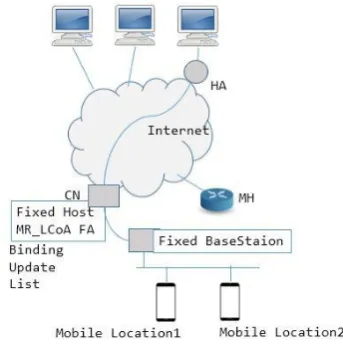
In the proposed structure, it is assumed that an MR sends a packet to a relevant HA on an optimized path, encapsulates a packet, and has binding caching for nodes. As illustrated in Figure 1, the novel advanced binding update list of the proposed structure was introduced and created in each MR of nested NEMO in order to record information on all child MRs and MNNs located under each MR.
Figure 1. Design of an improved decision tree algorithm for educational data mining
This information includes addresses of CNs, HAs of MRs, and binding of HAs for MNNs. The pseudo-code below represents the method of making an optimized advanced BUL for each MR in nested mobile networks.
Proposed algorithm Start of Algorithm If Stack is empty; Finish Work = False;
If the result of the search for node in BUL+ with node addresses is equal to prefix of NEMO;
If (node is not found){ Finish Work = True; Use normal path process; }
Else If {
Push HoA_MR to Stack;
Repeat until work comes to an end { Push LCoA of Node to Stack; Get LCoA prefix;
Search for Node in BUL+ with LCoA prefix and prefix.
If (node is not found) { Finish Work = True; }
}
Count = 1; (Initialize the count of MR & MNN in mobile network to ‘1’.)
Repeat (if work does not come to an end) { /* Record child node information in BUL+ as node of MR. */
[image:2.595.331.503.60.234.2]Child has one value among non-visited nodes. Get prefix of child node; Push LCoA of child node to Stack; Push HoA of child node to Stack; Increase count by one;
} Else If {
Work End = True;
/* There is no node that has non-visited child nodes; */ }
/* Repeat until all child nodes are recorded. */
}
End of Algorithm
IV. ANALYTICEVALUATION
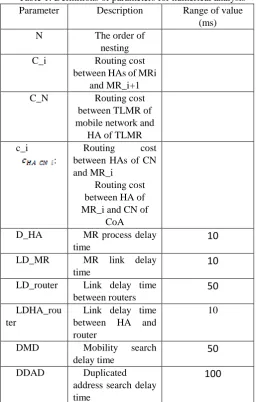
[image:3.595.42.291.53.227.2]The performance of the proposed structure was evaluated with an analytic evaluation method. Based on the result, packet transmission delay times and handoff delay times between NEMO BS and ROTIO were compared. For this performance evaluation, two methods were applied. The first is to compare packet transmission delay times, handoff delay times, and routing costs. The formula for this analysis model uses the parameters as shown in Table 1.
Table 1: Definitions of parameters for numerical analysis
Parameter Description Range of value
(ms)
N The order of
nesting
C_i Routing cost
between HAs of MRi and MR_i+1
C_N Routing cost
between TLMR of mobile network and
HA of TLMR c_i
:
Routing cost between HAs of CN and MR_i
Routing cost between HA of MR_i and CN of
CoA
D_HA MR process delay
time
10
LD_MR MR link delay
time
10
LD_router Link delay time
between routers
50
LDHA_rou ter
Link delay time between HA and router
10
DMD Mobility search
delay time
50
DDAD Duplicated
address search delay time
100
4.1. Evaluations of packet transmission delay times In NEMO BS, all packets need to have two-way tunneling between the MR and HA [41]. Therefore, this study does not consider path optimization. The total packet delay time from CNs to MNNs in NEMO can be calculated with Equation (1):
PD(Pack Delay)_in_NEMO = (LD_CN_router +
LD_HA_router)+2 + +
+ + + )+
(1)
Unlike NEMO, ROTIO supports path optimization in Level 2 encapsulation. The total packet delay time underROTIO can be calculated with Equation (2). (In this case under ROTIO, level: a = 2):
PD_in_ROTIO = (LD_CN_router + LD_HA_router) +
2 + + +
+ + ) + (2) The method proposed in this study not only processes Level 1 encapsulation, but it supports path optimization. The total packet delay time of the proposed method can be calculated with Equation (3):
PD_in_proposed = (LD_CN_router + LD_HA_router) +
+ + +
+ + ) + (3) On the basis of the results calculated from equations (1), (2), and (3) [41, 42,43] and the numbers in Table 1, NEMO BS, ROTIO, and the proposed method were compared in terms of packet transmission delay times. Figure 2 illustrates the comparison results. As shown in the figure, the packet transmission delay time under NEMO increases in proportion to a rise in nesting level, and is higher than that of ROTIO and the proposed method. That is because NEMO packets follow a long path from CN to MNN, whereas packets of the proposed method follow an optimized path. As presented in Figure2, NEMO BS has a higher packet transmission delay time than the proposed method and ROTIO. The proposed method improved packet transmission delay time is improved 10.26% more than ROTIO, and 75.5% more than NEMO BS.
Figure 2. Packet transmission delay times at different Nesting Levels
4.2. Handoff delay time
[image:3.595.41.300.374.777.2]MR does not perform DDAD at an intra-NEMO handoff. The proposed method has a low handoff delay time.
Figure 3. Handoff delay times of NEMO BS, ROTIO, and the proposed method
As shown in Figure 3, the proposed method has a lower handoff delay time than ROTIO and NEMO BS. That is because MR handoff occurs in the MAP domain where CoAs are locally organized. In other words, the proposed method improved handoff delay time 75.4% more than ROTIO and 120.4% more than NEMO BS.
4.3. Measurement pf routing performance
Since HAs can be distributed over a wide area, a long routing distance can cause high routing costs, which lead to link delay.
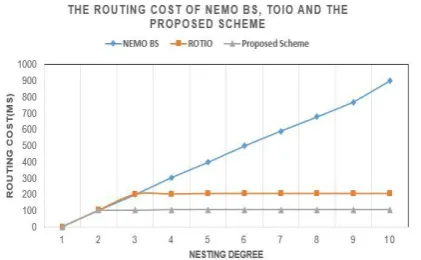
Figure 4. Comparison of routing costs among NEMO BS, ROTIO, and the proposed method
As illustrated in Figure4, the routing cost of NEMO BS rapidly increases with a rise in nesting level. In ROTIO, its routing cost remains the same after 186 ms. In other words, after nesting, the routing cost remains constant. To calculate the routing cost of the proposed method, of NEMO BS, and of ROTIO, the routing cost measurement method in NEMO BS is shown in Equation (4):
= + (4) The routing cost measurement method under ROTIO is presented in Equation (5):
= + C1 + (5) The routing cost measurement method for the proposed structure is shown in Equation (6):
= + (6) If a nesting level is large in equations (4), (5), and (6), the routing cost for two-way tunneling linearly increases, as presented in Figure4. The proposed method and ROTIO keep Step 1 tunneling, regardless of the order of nesting.
V.CONCLUSION
In the analytic evaluation described in Section 4, it was found that the hop count, including data communications between CN and MNN, played a significant role in mobile network performance. Accordingly, the proposed method always has one-level tunneling, regardless of the degree of the nested mobile network, so that its cost is constant. The proposed method showed three times higher performance than NEMO BS and 88% higher performance than ROTIO. This study’s results proved that the proposed method has more improved performance than NEMO BS and ROTIO with a rise in nesting level. This study proposed a new optimized routing structure based on a hierarchical structure with an advanced binding update list: BUL+. The proposed method aims to solve the problem of pinball routing and to provide smooth handoffs. The method proposed in this study minimizes transmission delays, handoff delays, and packet overhead, and solves the problems with NEMO BS for optimized routing in nested mobile networks. In a comparative performance evaluation, the proposed structure, compared to NEMO BS and ROTIO protocols, minimizes packet transmission delay and handoff delay.
ACKNOWLEDGMENT
This research was supported by the MSIT (Ministry of Science and ICT), Korea, under the National Program for Excellence in SW (2015-0-00932) supervised by the IITP (Institute of Information & Communications Technology Planning & Evaluation) (2015-0-00932).
REFERENCES
1. M.Sabeur, B.Jouaber, D.Zeghalche, “Seamless Handoff Solution for Nested Mobile Networks,”, Journal of netwokrs, vol. 1, no.4, August 2006.
2. S. Shakkottai, and T.S. Rappaport, "Research challenges in wireless networks: a technical overview,"Proc of the Fifth International Symposium on Wireless Personal Multimedia Communications, Honolulu, HI, Oct. 2002. pp. 12-18.
3. W. Kellerer, Lai-U Choi, and E., Steinbach, "Cross layer adaptation for optimized B3G service provisioning," Proc. 6th International Symposium on Wireless Personal Multimedia Communications (WPMC), Special Session on Applications and Service in Wireless Networks, Yokosuka, Kanagawa, Japan, October, 2003. pp. 19-22. 4. S. Shakkottai, T. S. Rappaport, and P. C. Karlsson, "Cross-layer design
for wireless networks," IEEE Communications magazine, October, 2003. pp. 74-80.
5. P. Francis. “Yoid: your won Internet distribution,” http://www.isi.edu/div7/yoid, March, 2001.
6. Q. Zhang, W. Zhu, and Y-Q. Zhang, "A cross-layer QoS-supporting framework for multimedia delivery over wireless internet," International Packetvideo Workshop 2002. pp. 1-9.
7. Y. Chu, S. G. Rao, and H. Zhang. “A case for end system multicast,” In Proc. of ACM SIGMETRICS, June, 2000. pp 1-12.
8. D. Pendarakis, S. Shi, D. Verma, and M. Waldvogel. “ALMI: an application level multicast infrastructure,” In Proceedings of 3rd Usenix Symposium on Internet Technologies and Systems (USITS 2001), March 2001. pp.1-21.
9. B. Girod, M. Kalman, Y. Liang, and R. Zhang, "Advances in channel-adaptive video streaming," Wireless Communications and Mobile computing, no. 2, 2002. pp. 549-552
[image:4.595.70.281.376.506.2]http://www.cs.berkeley.edu/~yatin/papers/scattercast.ps.
11. Paul Francis, “Yoid: Extending the Internet Multicast Architecture,”ACIRI, April 2, 2000.
12. R. Droms. “Dynamic host configuration protocol,” RFC 1541, Network Working Group (Novemeber, 1993).
13. Y. Hsan and A. Zakhor, "Cross-layer techniques for adaptive video streaming over wireless networks,"in Proceedings of the International Conference Multimedia and Expo, Vo. 1, 2002. pp. 277-280. 14. G. Ding, H. Ghafoor, and B. Bhargava, "Error resilient video
transmission over wireless networks," in Proceedings of the 6th International Symposium Object-Oriented Real-Time Distributed Computing, 2003.
15. H. Jiang, W. Zhuang, and X. Shen, "Cross-Layer Design for Resource Allocation in 3G Wireless Networks and Beyond," IEEE Communications Magazine, December, 2005. pp. 120-126.
16. AnargyrosGaryfalos and Kevin C. Almeroth, “A Flexible Overlay Architecture for Mobile IPv6 Multicast,” IEEE Journal on Selected areas in Communications, vol. 23, no. 11, November, 2005, pp. 2194-2205. 17. V. Kawadia and P. Kumar, "A Cautionary Perspective on Cross Layer
Design," IEEE Wireless Communications, vol. 12. no. 1, Feb. 2005, pp. 3-11
18. S. J. Baek, J. S. Han, K. Y. Chung, "Dynamic Reconfiguration based on Goal-Scenario by Adaptation Strategy", Wireless Personal Communications, 2013. Doi: 10.1007/s11277-013-1239-0
19. K. Y. Chung, J. Yoo, K. J. Kim, "Recent Trends on Mobile Computing and Future Networks", Personal and Ubiquitous Computing, 2013. DOI: 10.1007/s00779-013-0682-y.
20. J. W. Ko, K. Y. Chung, J. S. Han, "Model Transformation Verification using Similarity and Graph Comparison Algorithm", Multimedia Tools and Applications, 2013. Doi: 10.1007/s11042-013-1581-y.
21. C. W. Song, D. Lee, K. Y. Chung, K. W. Rim, J. H. Lee, "Interactive Middleware Architecture for Lifelog based Context Awareness",
Multimedia Tools and Applications, 2013. DOI
10.1007/s11042-013-1362-7
22. S. Shakkottai, and T.S. Rappaport, "Research challenges in wireless networks: a technical overview,"Proc of the Fifth International Symposium on Wireless Personal Multimedia Communications, Honolulu, HI, Oct. 2002. pp. 12-18.
23. W. Kellerer, Lai-U Choi, and E., Steinbach, "Cross layer adaptation for optimized B3G service provisioning," Proc. 6th International Symposium on Wireless Personal Multimedia Communications (WPMC), Special Session on Applications and Service in Wireless Networks, Yokosuka, Kanagawa, Japan, October, 2003. pp. 19-22. 24. S. Shakkottai, T. S. Rappaport, and P. C. Karlsson, "Cross-layer design
for wireless networks," IEEE Communications magazine, October, 2003. pp. 74-80.
25. Q. Zhang, W. Zhu, and Y-Q. Zhang, "A cross-layer QoS-supporting framework for multimedia delivery over wireless internet," International Packetvideo Workshop 2002. pp. 1-9.
26. B. Girod, M. Kalman, Y. Liang, and R. Zhang, "Advances in channel-adaptive video streaming," Wireless Communications and Mobile computing, no. 2, 2002. pp. 549-552.
27. Y. Hsan and A. Zakhor, "Cross-layer techniques for adaptive video streaming over wireless networks,"in Proceedings of the International Conference Multimedia and Expo, Vo. 1, 2002. pp. 277-280. 28. G. Ding, H. Ghafoor, and B. Bhargava, "Error resilient video
transmission over wireless networks," in Proceedings of the 6th International Symposium Object-Oriented Real-Time Distributed Computing, 2003.
29. H. Jiang, W. Zhuang, and X. Shen, "Cross-Layer Design for Resource Allocation in 3G Wireless Networks and Beyond," IEEE Communications Magazine, December, 2005. pp. 120-126.
30. V. Kawadia and P. Kumar, "A Cautionary Perspective on Cross Layer Design," IEEE Wireless Communications, vol. 12. no. 1, Feb. 2005, pp. 3-11
31. H. Lim and C. Kim, “Multicast tree construction and flooding in wireless adhoc networks,” Proceedings of the ACM International Workshop on Modeling, Analysis and Simulation of Wireless and Mobile System (MSWIM), 2000
32. J. Bound and C. Perkins. “Dynamic Host Configuration Protocol for IPv6 (DHCPv6),” Internet-Draft draft-ietfdhc-dhcpv6-14.txt, Internet Engineering Task Force (IETF), February, 1999.
33. Charles E. Perkins, “Mobile IP and the IETF,”
http://www.sigmobile.org/MC2R/articles/ mobileip_v3n1.pdf, Mobile
computing and Communications Review, vol. 3, no. 1.
34. ZhiJunGu, Dongmin Yang, Cheeha Kim, “Mobile IPv6 Extensions to support Nested Mobile Networks,” Proceedings of the 18th International
Conference on Advanced Information Networking and Application (AINA’04), IEEE Computer Society, 2004.
35. Ming-Chin Chuang, Jeng-Farn Lee, “ DRO:domain-based route optimization scheme for nested mobile networks”, EURASIP Journal on Wireless Communications and Networking 2011, vol.2011:70 36. VineetChikarmane, Carey L. Williamson, Richard B. Bunt and Wayne
L. Mackrell,” Multicast support for mobile hosts using Mobile IP: Design issues and proposed architecture,” Mobile Networks and Applications 3, pp365-379, 1998.
37. S.Deering, “Multicast routing in a datagram internetwork,” Ph.D. Thesis, Department of Computer Sicence, Stanford University, 1991 38. Kuang-Hwei Chi, Chien-Chao tseng, Tign-Lu Huang, “IP Multicast
Support in Mobile Internetworks,” Invited to appear in Journal of Computers
39. V. Devarapalli, A. Petrescu, R. Walikawa and P. Thubert, “Network Mobility (MEMO) Basic Support Protocol, “LETF, RFC 3963, 2005.
40. LETF Network Mobility (MEMO) Working Group IETF,
Avilable:http://www.ietf.org/html.charters/ nemo-charter.html 41. ShaymaSenan, Aisha Hassan A. H, “Hierarchical Route Optimization
Scheme Using Advanced Binding Update List for Nested Mobile Network,” International Journal of Future Generation Communication and Networking Vol.10, No.2, 2017, pp55-64.
42. Alex C. Snoeren, HariBalakrishnan, “An End-to-End Approach to Host Mobility,” 6th
ACM/IEEE International Conference on Mobile Computing and Networking.