2004
Comparative genomics: multiple genome
rearrangement and efficient algorithm
development
Shiquan Wu Iowa State University
Follow this and additional works at:https://lib.dr.iastate.edu/rtd
Part of theBiostatistics Commons, and theComputer Sciences Commons
This Dissertation is brought to you for free and open access by the Iowa State University Capstones, Theses and Dissertations at Iowa State University Digital Repository. It has been accepted for inclusion in Retrospective Theses and Dissertations by an authorized administrator of Iowa State University Digital Repository. For more information, please [email protected].
Recommended Citation
Wu, Shiquan, "Comparative genomics: multiple genome rearrangement and efficient algorithm development " (2004).Retrospective Theses and Dissertations. 1205.
and efficient algorithm development
by
Shiquan Wu
A dissertation submitted to the graduate faculty
in partial fulfillment of the requirements for the degree of
DOCTOR OF PHILOSOPHY
Major: Bioinformatics and Computational Biology
Program of Study Committee: Xun Gu, Co-major Professor Zhijun Wu, Co-major Professor
Xiaoqiu Huang Stephen Willson
Karin Dorman
Iowa State University
Ames, Iowa
2004
INFORMATION TO USERS
The quality of this reproduction is dependent upon the quality of the copy
submitted. Broken or indistinct print, colored or poor quality illustrations and
photographs, print bleed-through, substandard margins, and improper
alignment can adversely affect reproduction.
In the unlikely event that the author did not send a complete manuscript
and there are missing pages, these will be noted. Also, if unauthorized
copyright material had to be removed, a note will indicate the deletion.
UMI
UMI Microform 3158380Copyright 2005 by ProQuest Information and Learning Company.
All rights reserved. This microform edition is protected against
unauthorized copying under Title 17, United States Code.
ProQuest Information and Learning Company 300 North Zeeb Road
Graduate College Iowa State University
This is to certify that the doctoral dissertation of
Shiquan Wu
has met the dissertation requirements of Iowa State University
^o-major Professor
Co-major Professor
For the Major Program Signature was redacted for privacy.
Signature was redacted for privacy.
TABLE OF CONTENTS
ABSTRACT vi
CHAPTER 1. OVERVIEW 1
1.1 Problem and motivation 1
1.2 Previous algorithms 4
1.3 Proposed algorithms 6
1.4 Further work in the future 9
1.5 Dissertation organization 11
References 11
CHAPTER 2. Multiple Genome Rearrangement by Reversals 15
2.1 Introduction 16
2.2 Mathematical model 17
2.3 Related problems 19
2.4 Theorems and algorithms 20
2.5 Experimental applications 30
2.6 Discussion and future work 33
References 33
CHAPTER 3. Algorithms for Multiple Genome Rearrangement by
Signed Reversals 37
3.1 Introduction 38
3.2 Problem and model 40
3.4 Approximation algorithms 42
3.4.1 Neighbor-perturbing algorithm 43
3.4.2 Branch-and-bound algorithm 46
3.5 Comparisons and examples 49
3.6 Discussion 53
References 53
CHAPTER 4. Reconstructing ancestral genomes 56
4.1 Introduction 57
4.2 Mathematical model 59
4.3 Previous algorithms 60
4.4 Perturbing-improving algorithm 62
4.5 Compare with MGR algorithm 64
4.5.1 Accuracy and cost 65
4.5.2 Simulation 65
4.5.3 Biological data 66
4.6 Discussion 70
References 70
CHAPTER 5. A partitioning algorithm for large scale multiple genome
rearrangement by signed reversals 74
5.1 Introduction 75
5.2 Previous efficient algorithms 76
5.3 Partitioning algorithm 77
5.4 Discussion 81
References 82
CHAPTER 6. General conclusions 85
6.2 Further improvement 86
6.3 General problem 87
ABSTRACT
Multiple genome rearrangement by signed reversal is discussed: For a collection of
genomes represented by signed permutations, reconstruct their evolutionary history by
using signed reversals, i.e. find a tree where the given genomes are assigned to leaf nodes
and ancestral genomes (i.e. signed permutations) are hypothesized at internal nodes such
that the total reversal distance summed over all edges of the tree is minimized. It is
equivalent to finding an optimal Steiner tree that connects the given genomes by signed
reversal paths. The key for the problem is to reconstruct all optimal ancestral genomes
or Steiner nodes.
The problem is NP-hard and can only be solved by efficient approximation algo
rithms. Various algorithms and programs have been designed to solve the problem, such
as BPAnalysis, GRAPPA, grid search algorithm, MGR greedy split algorithm (Chap
ter 1). However, they may have expensive computational costs or low inference accu
racy. In this thesis, several new algorithms are developed, including nearest path search
algorithm (Chapter 2), neighbor-perturbing algorithm (Chapter 3), branch-and-bound
algorithm (Chapter 3), perturbing-improving algorithm (Chapter 4), and partitioning
algorithm (Chapter 5). With theoretical proofs, computer simulations, and biological
applications, these algorithms are shown to be 2—approximation algorithms and more
CHAPTER 1. OVERVIEW
In this chapter, we give an overview of the whole dissertation, including the problem
we addressed, why the problem is important, how the problem can be solved, results
obtained, and possible future work on the problem.
1.1 Problem and motivation
The problem we discuss is multiple genome rearrangement by signed reversal. We
motivate the problem in the context of evolutionary history reconstruction. The motiva
tion consists of two parts: The biological motivation and the computational motivation.
1.1 Biological motivation
Ohno's law [16] states that while the gene content of X chromosome has hardly
changed throughout 125 million years of mammalian evolution, the order of genes along
the chromosomes has been disrupted several times. During evolution, inter- and
intra-chromosomal exchange of DNA fragments disrupted the order of genes in the genome.
Focusing only on genomic rearrangement, it is interesting to infer a phylogenetic tree
showing the historical rearrangements that produced the genomes present today. Con
sider the evolution of a collection of organisms, we have multiple genome rearrangement,
i.e. find a phylogenetic tree showing how genomes evolve from a common ancestor based
1.2 Computational motivation
Computational (or comparative) genomics is one of the most important area in
bioin-formatics and computational biology. One focus is phylogenetic tree inference. It is in
teresting and challenging to reconstruct an accurate evolutionary history for a collection
of organisms with the least computational cost. Various methods have been developed
for phylogenetic tree inference:
(1) Sequence alignment method finds all pairwise distances of sequences by se
quence comparisons. The phylogenetic tree is then reconstructed from the matrix of
the pairwise distances by various algorithms, e.g. neighbor-joining algorithm,
UP-GMA (Unweighted Pair Group Method using Arithmetic averages), and other algorithms
[6, 12, 14, 23].
(2) Parsimony method infers a phylogenetic tree by minimizing the total number
of evolutionary steps required to explain a given set of data, or by minimizing the total
tree length assuming evolution on a bifurcating tree shape. Technically, it computes the
minimum number of evolutionary events required to explain the data along all possible
topologies and then chooses the tree minimizing the number of evolutionary events.
(3) Maximum likelihood method infers the phylogeny of genomes by evaluating
a hypothesis of an evolutionary history based on the transition probability of nucleotide
substitutions and a hypothesized history would give rise to the observed data set. A
higher probability phylogeny is assumed more possible reach the observed state than a
lower probability phylogeny. The method searches for the tree with the highest proba
bility or likelihood [6, 7, 9, 10, 11, 12].
All three popular methods may generate incorrect phytogenies, particularly when
organisms are very similar. The computational cost is expensive for multiple sequence
alignments. In order to improve the accuracy of inference, alternative methods based
(4) Kolmogorov or Lempel-Ziv complexity method infers phytogenies by com
paring gene contents or particular features, tandem repeats, and certain patterns occur
ring or not occurring in biological sequences [17, 20, 21, 22]. This method improves both
the accuracy and the cost of phylogeny inference.
However, all four preceding methods deal with only local mutations. Only individual
genes and local comparisons are discussed. Much information has not been taken into
account. These methods may give rise to incorrect phylogenetic trees because the actual
evolutionary process of any organism contains not only local mutation (e.g. insertion,
deletion, and substitution), but also non-local mutations (e.g. reversal, translocation,
fission, fusion, etc). Therefore, the entire genome and the orders of genes should be
taken into account for inferring phytogenies. For this purpose, the following
distance-based method is initiated.
(5) Evolutionary edit distance method discusses how to transform the gene
order of one genome into another by both local and non-local mutations [18, 19, 24, 26].
This originates multiple genome rearrangement.
Multiple genome rearrangement is extensively discussed under various types
of mutations (evolutionary events), including both local mutations (such as insertion,
deletion, and substitution) and non-local mutations (such as reversal, translocation,
recombination, fission, fusion, etc.) [18, 25]. The more types of mutations are allowed,
the more difficult the problem becomes. The general problem is NP-hard [4, 5], so we
discuss the problem for various cases. The purpose is to develop efficient approximation
algorithms and to find special cases that are polynomial time solvable. Multiple genome
rearrangement by signed reversal restricts the discussion to pure signed reversal and
becomes an interesting case. It is described as follows:
Multiple genome rearrangement by signed reversal [3, 18, 27, 28] For a given
history under signed reversals, i.e. find a bifurcating tree where sampled genomes are
assigned to leaf nodes and ancestral genomes (i.e. signed permutations) are hypothesized
at internal nodes such that the total reversal distance summed over all edges of the tree
is minimized. The problem is equivalent to finding an optimal Steiner tree that connects
the genomes by signed reversal paths. To solve the problem means to find the optimal
Steiner nodes (i.e. ancestral genomes) of the optimal Steiner tree.
Earlier, a closely related problem has been discussed: Generate a collection of per
mutations (genomes) qj( 1 < j <n) from a common ancestral genome (e.g. the identity
permutation p = 12 • • • |X|) in the minimum number of signed reversals [13, 27] (X
denotes the set of genes).
Another form of the problem is described as follows:
Multiple Genome Rearrangement By Signed Reversal (MGRBSR Problem)
Given a collectio n o f p e r m u t a t i o n s G = { g i , g 2 , • • • , gm} , w e g e n e r a t e G f r o m s o m e p G G
in the minimum number of signed reversals, i.e. find an optimal Steiner tree to connect
the genomes by reversal paths [28].
In various models of genome rearrangement, a genome is defined as a signed per
mutation. An optimal Steiner node is equivalent to an optimal ancestral genome. And
evolutionary history, phylogenetic tree, and optimal Steiner tree are equivalent.
1.2 Previous algorithms
Multiple genome rearrangement is NP-hard [4, 5] and the problem can only be solved
by efficient approximation algorithms. Various kinds of algorithms and programs have
been developed to solve the problem. We list here several of them that are closely
connected to our discussion: (1) the breakpoint analysis [2, 18, 26], (2) the grid search
(1) Breakpoint analysis The breakpoint distance between two genomes is defined as
the number of consecutive pairs of genes that are adjacent in one genome but not in the
other[26]. Breakpoint analysis is one of the earliest methods for genome rearrangement
problem based on gene orders. There are several efficient approximation algorithms
and programs for the problems, such as GRAPPA [1, 15] and BPAnalysis [2, 18, 26].
However, breakpoint analysis gives many approximation solutions that do not have a
clear biological meaning. It could not find a more biologically accurate rearrangement
distance [3].
(2) Grid search algorithm [25] deals with a multiple genome rearrangement under
signed reversals and transpositions. For three genomes, it constructs a grid by connecting
each pair of the three genomes with a shortest path and joining the other genome with
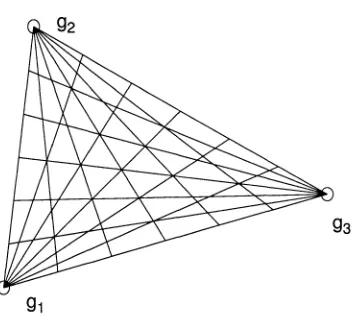
each intermediate node in the path by another shortest path (see Fig.2.1 on Page 20
in Chapter 1, and Fig.3.1a on Page 42 in Chapter 2). The optimal Steiner node is
approximated by a local search upon the grid. Any m genomes are recursively partitioned
into a series of three genome groups. For a median problem, the approximated solution
is very close to the optimal one. However, the computational cost is usually high.
(3) MGR Greedy split algorithm [3] is designed based on a recursive greedy split
strategy. For genomes <71, g2, • • •, gm, it first connects the three closest genomes, say g\,g2
and g3, by shortest paths. Suppose gx, g2, • • •, gm-i have been connected by shortest
paths. It then finds a split edge with the split site for gm among all these paths. Finally,
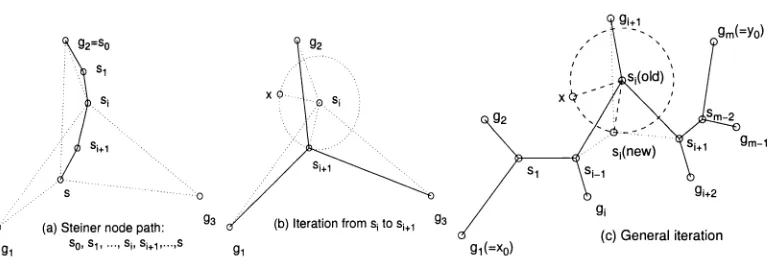
gm is connected to the split site by a shortest path (see Fig.3.1c on Page 42 in Chapter 2).
The optimal Steiner nodes are approximated by the split sites. The algorithm can deal
with both unichromosomal and multichromosomal genomes, but may miss the optimal
tree because no improvement is made after the tree is generated. It may also generate
1.3 Proposed algorithms
The previous algorithms are not efficient enough in both accuracy and computational
cost. The breakpoint analysis has an unclear biological meaning. Both the grid search
and the MGR greedy split algorithm are computationally expensive. The later algorithm
may generate a tree far from the optimal one. Therefore, more efficient algorithms are
needed. We have developed the following approximation algorithms: (1) the nearest path
search algorithm [27] (Chapter 2), (2) the branch-and-bound algorithm [28] (Chapter
3), (3) the neighbor-perturbing algorithm [28] (Chapter 3), (4) perturbing-improving
algorithm [29] (Chapter 4), and (5) partitioning algorithm [30] (Chapter 5).
(1) Nearest path search algorithm [27] searches for the optimal Steiner nodes of
a multiple genome rearrangement by signed reversal. For three genomes: gi,g2, Qz, it
at first connects the nearest pair, say g\ and by a shortest signed reversal path Pi.
Then Pi is improved to P2, - • • ,Pk such that each Pj is constructed from N(Pj_i) (i.e.
the neighborhood of Pj-\) and is closer to g3. A grid is constructed by joining g3 to each
node in Pk- Finally, an optimal Steiner node is approximated by a local search upon
the grid (see Fig.2.4 on Page 27 in Chapter 1, Fig.3.lb on Page 42 in Chapter 2, and
Fig.4. lb on Page 62 in Chapter 3). Moreover, the local search can be improved to search
upon a band with fixed length and width (see Fig.2.4 on Page 27 in Chapter 1). Any m
genomes are recursively processed by a series of groups consisitng three genomes.
This nearest path search algorithm improves Sankoff's grid search algorithm [25]
by putting the local search near the optimal Steiner node (ancestral genome) upon a
simpler grid. It increases the chance to find the optimal ancestral genome and decreases
the computational cost (Sankoff's grid search algorithm has a running time at least
0(n6), comparing to 0(n3) for our nearest path search algorithm).
(2) Branch-and-bound algorithm for an median problem [28] is designed to
candidate conditions. S denotes the set of all possible candidates and is initialized. For
each s G S, check all x G N(s) (i.e. the neighborhood of s). If x satisfies the candidate
conditions, x is chosen as a new candidate and is added into S. Repeat the process until
convergence. The optimal Steiner node is the best one over S by minimizing the total
reversal distance (see Fig.3.3 on Page 48 in Chapter 2). This algorithm is very efficient
for small scale similar genomes.
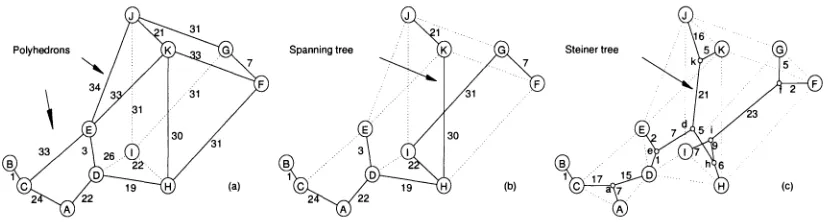
(3) Neighbor-perturbing algorithm [28] searches for optimal Steiner nodes by per
turbing Steiner nodes nearby their neighborhoods and improving them until conver
gence. It has two steps: initialization and iteration. For a median problem, the genomes
G = {<7i, 52,9s}- In the initialization step, g2 is chosen as the initial Steiner node, i.e.
50 = 92- In the iteration step, each Sj is perturbed into a better one Sj+1 E iV(sj) (i.e.
d*(si+1, G) < d*(s{, G), where d*(x, G) = Y$= i d(x, gi), which is the total signed reversal
distance). The Steiner nodes are improved from s0(= 92), to sl5 s2, • • •, s*, • • •. Finally,
51 converges at s (see Fig.3.2a and Fig.3.2b on Page 46 in Chapter 2).
For m genomes G = { g i , g2, • • • , gm} , a weighted graph is defined by G and all signed
reversal distances d{gi,gj). In the initialization step, a minimum spanning tree T is
chosen as the initial Steiner tree. The initial Steiner nodes, denoted by a set S, consists
of all given genomes. In the iteration step, for each Steiner node s G 5", check all
x G N(s). If S U {%} — {s} generates a better minimum spanning tree than S does,
replace s by x in S (see Fig.3.2c on Page 46 in Chapter 2). The Steiner nodes are
improved from the initial ones until convergence.
This algorithm is much better than Bourque and Pevzner's MGR greedy split algo
rithm: Our neighbor-perturbing algorithm is a polynomial 2—approximation algorithm
(i.e. the total length of the tree obtained by the neighbor-perturbing algorithm is always
within twice of the optimal one [28]) and has a lower computational cost 0(m2n4). How
solution far from the optimal one and has an expensive computational cost at least
0(m3n7). Therefore, our neighbor-perturbing algorithm is more efficient than MGR
greedy split algorithm.
(4) Perturbing-improving algorithm for reconstructing ancestral genomes is
designed to search for the optimal ancestral genomes. Its goal is to improve the
neighbor-perturbing algorithm [29] so that it is more efficient than Bourque and Pevzner's MGR
greedy split algorithm and has more chance to find optimal trees.
The neighbor-perturbing algorithm can be improved in three ways. For any existing
Steiner node s, a better Steiner node x is sought in the neighborhood N(s). Searching
over a bigger neighborhood Np(s) for some p > 1 will increase the chance to find such
a better x. Second, if more than one new x is chosen in each search, it should greatly
increase the chance to find the optimal Steiner nodes. Third, any new x is chosen
under the strict condition d*(x,G) < d*(s,G), which may cause the algorithm to miss
t h e o p t i m a l S t e i n e r n o d e . W e s u g g e s t i n s t e a d t h e c o n d i t i o n i s m o d i f i e d t o d * ( x , G ) <
d * ( s , G ) .
Based on these three factors, we design the perturbing-improving algorithm. The
algorithm consists of three steps. Initially, the algorithm connects all given genomes
by a tree with no internal node. Then, for each given genome, an internal node is
created and assigned by an initial ancestral genome. Finally, the ancestral genomes
are recursively improved until convergence or a fixed number of iteration steps. During
recursive iteration, each ancestral genome may be updated to several new ones chosen
from a bigger neighborhood at least as good as the old one.
This is a 2—approximation algorithm. Because each ancestral genome may be re
spectively updated by several new genomes that are at least as good as the old one,
the algorithm has more chances to find the optimal ancestral genomes and improves the
optimal solution. However, the perturbing-improving algorithm can find more than one
optimal solution if exist. It is shown by both simulated and biological data that the
algorithm is more efficient than MGR greedy split algorithm [29].
(5) Partitioning algorithm is designed to process large scale of genomes. Because all
current existing algorithms can only efficiently reconstruct phylogenetic trees for small
scale of genomes. For a large scale of genomes (which may contain a large number of
genomes and each genome may contain a large number of genes), all algorithms are not
efficient enough. If the number of genomes is large, the accuracy of the inferred tree
may be low. On the other hand, if the number of genes is large, the computational cost
will be high.
We design a partitioning algorithm to partition a large collection of genomes into a
series of small groups whose evolutionary histories can be efficiently reconstructed by
current existing algorithms. The evolutionary history of the large collection of genomes
is approximated by joining all evolutionary histories of the small groups by minimizing
the total distance [30].
Our algorithms are shown to be more efficient by theoretical proofs, computer sim
ulations, and biological applications. The algorithms are implemented into programs
(e.g. GenomeNP, GenomeBnB, Mgenome) and are available on the Internet at
"http://xgu.zool.iastate.edu".
1.4 Further work in the future
There is much interesting and challenging further work on multiple genome rear
rangement. The most interesting part is to improve both the approximation algorithms
(1) Improve the algorithms
Our algorithms always search for better Steiner nodes over the whole neighborhood
of old Steiner nodes. The computational cost is expensive. A random search strategy
may reduce the computational cost. Meanwhile, the accuracy of inferred tree can be
assured by reasonable random search strategies.
(2) Improve the model
The model of multiple genome rearrangement can be improved in two ways. At
first, our discussion is based on pure signed reversals. However, evolution involves many
other types of mutation. So we need to extend the model to handle more types of
mutations (i.e. evolutionary events), such as insertion, deletion, substitution, reversal,
translocation, fusion, fission, etc.
In addition, we assume genomes contain only one copy of each gene. In practice,
genomes often contain multiple copies of genes. The further discussion should allow
multiple gene copies.
Therefore, we need to discuss a more general multiple genome rearrangement prob
lem: For a given collection of genomes, each of which may contain multichromosomes
and multiple copies of its genes, reconstruct the evolutionary history under a collection
of mutations (evolutionary events) including insertion, deletion, substitution, reversal
(signed or unsigned), transposition, translocation, fusion, fission, recombination, gene
duplication, gene loss, etc. The problem is NP-hard and efficient approximation algo
rithms are the best ways to solve the problem. Algorithm development becomes more
1.5 Dissertation organization
The rest of this dissertation consists of five chapters, each of which is a paper that
describes algorithms for various cases of multiple genome rearrangement by signed re
versal. In Chapter two, the nearest-path search algorithm is designed. In Chapter three,
the neighbor-perturbing algorithm and branch-and-bound algorithm are developed. In
Chapter four,we generalize the neighbor-perturbing and branch-and-bound algorithms
into the perturbing-improving algorithm. In Chapter five, we present the partitioning
algorithm for large scale genomes. Finally, Chapter six gives a brief summary of all the
algorithms.
References
[1] Bader, D. A., Moret, B. M. E. and Yan, M., (2001). A linear-time algorithm for
computing inversion distances between signed permutations with an experimental
study. Lecture Notes in Computer Science, 2125: 365-376.
[2] Blanchette, M., Bourque, G., and Sankoff, D. (1997). Breakpoint phylogenies. In
Genome Information Workshop (GIW 1997), (eds. Mivano S. and Takagi, T.),
pp.25-34. University Academy Press, Tokyo.
[3] Bourque, G. and Pevzner, P. (2002). Genome-Scale Evolution: Reconstructing Gene
Orders in the Ancestral Species. Genome Research 12: 26-36.
[4] Caprara, A. (1997). Sorting by Reversals is Difficult. Proceedings of the First An
nual International Conference on Computational Molecular Biology (RECOMB'97),
[5] Caprara, A. (1999). Formulations and hardness of multiple sorting by reversals.
Proceedings of the Third Annual International Conference on Computational Molec
ular Biology (RECOMB'99), ACM Press, New York.
[6] Durbin, R., Eddy, S. R., Krogh, A. and Mitchison, G. (1998). Biological sequence
analysis: Probabilistic models of proteins and nucleic acids, Cambridge University
Press, Cambridge, UK.
[7] Felsenstein, J. (1981). Evolutionary trees from DNA sequences: a maximum likeli
hood approach. Journal of Molecular Evolution, 17:368-376.
[8] Fitch, W.M. (1971). Toward defining the course of evolution: minimum change for
a specific tree topology. Systems Zoology, 35:406-416.
[9] Gu, X., (1999). Statistical methods for testing functional divergence after gene du
plication. Molecular Biology and Evolution 16:1664-1674.
[10] Gu, X., (2000). A simple evolutionary model for genome phylogeny inference based
on gene content. Comparative genomics (ed. Sankoff and Nadeau), pp.515-524.
Kluwer Academic Publishers, The Netherlands .
[11] Gu, X., (2001). Maximum likelihood approach for gene family evolution under func
tional divergence. Molecular Biology and Evolution. 18: 453-464.
[12] Gusfield, D. (1997). Algorithms on Strings, Trees, and Sequences: Computer Science
and Computational Biology. Cambridge University Press, Cambridge, UK.
[13] Korkin, D. and Goldfarb, L., (2002). Multiple genome rearrangement: A General
approach via the evolutionary genome graph. Bioinformatics, V18: pp.303-311.
[14] Lake, J. A., (1994). Reconstructing evolutionary trees from DNA and protein se
[15] Moret, B. M. E., Wyman, S., Bader, D. A., War now, T., and Yan, M. (2001). A
new implementation and detailed study of breakpoint analysis, Proceeding of 6th
Pacific Symposium on Biocomputing (PSB 2001), Hawaii, World Scientific Pub.,
583-594.
[16] Ohno, S. (1967). Sex Chromosomes and Sex-Linked Genes. Berlitn SpringerVerlag.
[17] Otu, H. H. and Sayood, K. (2003). A new sequence distance measure for phylogenetic
tree construction. Bioinformatics, 19:2122-2130.
[18] Sankoff, D. and Blanchette, M. (1998). Multiple genome rearrangement and break
point phologeny. Journal of Computational Biology, 5: 555-570.
[19] Sankoff, D., Leduc, G., Antoine, N., Paquin, B., Lang, B. F. and Cedergen,R.
(1992). Gene order comparisons for phylogenetic inference: Evolution of the mito
chondrial genome. Proceeding of National Science, USA, 89:6575-6579.
[20] Snel, B., Bork, P. and Huynen, M. A. (1999). Genome phylogeny based on gene
content. Nature Genetics, 21: 108-110.
[21] Snel, B., Bork, P. and Huynen, M. A. (2000). Genome evolution: gene fusion versus
gene fission. Trends Genetics, 16: 9-11.
[22] Snel, B., Bork, P. and Huynen, M. A. (2002). Genomes in flux: the evolution of
archaeal and proteobacterial gene content. Genome Research, 12:17-25.
[23] Saitou, N. and Nei, M. (1987). The neighbor-joining method: a new method for
reconstructing phylogenetic trees. Molecular Biology Evolution, 4: 406-425.
[24] Sankoff, D. (1999). Genome rearrangement with gene families. Bioinfomatics,
[25] Sankoff, D., Sudaram, G. and Kececioglu, J. (1996). Steiner points in the space
of genome rearrangements. International Journal of the Foundations of Computer
Science, 7:1-9.
[26] Watterson, G. A., Ewens, W. J., Hall, T. E. and Morgan, A., (1982). The chromo
some inversion problem, Journal of Theoretical Biology, 99:1-7.
[27] Wu, S. and Gu, X., (2002). Multiple Genome Rearrangement By Reversals. Pacific
Symposium on Biocomputing 7:259-270.
[28] Wu, S. and Gu, X., (2003). Algorithms for Multiple Genome Rearrangement by
Signed Reversals. Pacific Symposium on Biocomputing 8:363-374.
[29] Wu, S. and Gu, X. (2004). An efficient algorithm for reconstructing ancestral
genomes , to be submitted.
[30] Wu, S. and Gu, X. (2004). A partitioning algorithm for multiple genome rearrange
CHAPTER 2. Multiple Genome Rearrangement by Reversals
A paper published in
Pacific Symposium on Biocomputing 7(2002), pp.259-270.
Shiquan Wu and Xun Gu
Abstract
In this paper, we discuss a multiple genome rearrangement problem: Given a collec
tion of genomes represented by signed permutations, we generate the collection from
some common ancestral genome (e.g. the identity permutation) in the minimum num ber of signed reversals. The problem is NP-hard, so efficient heuristics is an important
way to find its optimal solution. At first, we discuss the problem for several special cases, including generating two genomes and three genomes by polynomial-time algo
rithms. Then we design a nearest path search algorithm to generate two genomes in
2.1 Introduction
Comparative genomics is one of the most important areas in bioinformatics and
computational biology. Sorting by reversal plays a central role in comparative genomics.
The problem was originated in last decade [2, 3, 4]. Its goal is to determine the evolu
tionary distances between organisms by inversions in genomes. Early, transformations
of genomes are widely studied under evolutionary events such as insertion, deletion,
point mutation (substitution), etc [11, 12]. Recently, the discussion is extended to
other mutations, such as breakpoint, reversal, translocation^, 4, 11, 12, 18, 19, 20], and
recombination[21]. So far, most of the discussions on comparative genomics has been
focused on sorting by reversal[2, 4, 5, 7, 8, 13, 14, 19], where a genome is represented by
a signed permutation and an optimal reversal scenario (i.e. optimal reversal process) is
found from any given permutation to the identity permutation.
Sorting by reversal is categorized into two classes: sorting by unsigned and signed
reversals. At first, sorting by unsigned reversals is NP-hard[7, 8]. Therefore, only efficient
approximation algorithms can be expected to find the optimal solution of the problem.
So far, the best approximation algorithm has been a l.^-approximation algorithm[10].
It is proved that there exists no polynomial-time 1.0008-approximation algorithm[6].
However, sorting by signed reversal is polynomial-time solvable[13, 14]. Several
quadratic-time algorithms are widely used for finding the optimal solutions of the prob
lem [5, 15, 16]. Recently, a linear-time algorithm is designed for computing the signed
reversal distance between any two signed permutations[l].
Sorting by reversal can be regarded as a problem that generates a permutation from
some given permutation by the minimum number of reversals. Multiple genome re
arrangement by reversal is a generalization of sorting by reversal. It is to generate a
given collection of permutations (i.e. genomes) from a common ancestral genome (e.g.
un-signed case, the problem is obviously NP-hard (since sorting by unun-signed reversals is
NP-hard[7, 8]). For the signed case, it is proved that the problem is NP-hard even if two
permutations are generated from a common ancestral genome[8]. This implies that the
problem is extremely hard. Therefore, it is interesting, also our purpose in this paper,
to find efficient heuristics, or special cases that are polynomial-time solvable. Heuristics
can be combinatorial or experimental algorithms [1, 9].
A similar genome rearrangement problem was discussed under reversal and trans
position [17]. An approximation algorithm was designed to find the optimal solution
by a local search upon a grid. In this paper, we discuss a multiple genome rearrange
ment problem for generating a collection of permutations from some fixed permutation
(i.e. a common ancestral genome) in the minimum number of signed reversals. At first,
we discuss the problem for several special cases, including generating two genomes and
three genomes by polynomial-time algorithms. Then we design a nearest path search
algorithm to generate two genomes in general. Finally, we obtain an approximation
algorithm to generate multiple genomes. We also show by experimental examples that
the algorithms are efficient.
The rest of the paper includes five parts: (1) Mathematical model, (2) Related
problems, (3) Theorems and algorithms, (4) Experimental applications, (5) Discussion
and future work.
2.2 Mathematical model
First of all, we introduce our main definitions and notations. The mathematical
model of multiple genome rearrangement problem is described.
Definition 1 A genome is represented as a signed permutation p = (P1P2 • • -P|X|)
following operation that transforms a permutation p into another one r(p; i , j ) : P = ( P i P2 • • • P i -1 P i Pi+1 • • • P j P j + i • • • P \ x \ )
r(p; i , j ) = (Pi P2 • • • P i - i - P j P i + i ~ P i P j +1 • • • P \ x \ )
Definition 2 Let P be a collection of permutations. Define N ( P ) — { q \ q — r ( p ; i , j )
for some p G P, 1 < i < j < n}, called the reversal neighborhood of P. Define Ni(P)
= N(P), N2(P) = N(Ni(P)), and Nk(P) = N(Nk-i(P)), the /^-neighborhood of P.
Throughout the paper, genome and signed permutations are equivalent. An ancestral
genome is represented by a Steiner node or internal node. A Steiner tree is equivalent
to a phylogenetic tree. With the above definitions, our genome rearrangement problem
is described as follows.
Multiple Genome Rearrangement By Signed Reversal (i.e. (1, n ) —MGRBSR)
Given a collection of genomes Q = {çi,<72, • • •,qn} on a set X of genes, which are
represented by signed permutations, generate the collection from some common ancestral
genome (e.g. the identity permutation p = 12 • • • |X|) in the minimum number of signed
reversals, i.e. find a collection of signed permutations tr( 1 < r < s) on X such that
(1) any qj is obtained from the common ancestral genome by a series of signed reversals
tri,tr2, • • • ,tTu, where each tTj+1 is obtained from tTj by one signed reversal, and (2) s is
minimized.
We at first discuss (1, 2)—MGRBSR problem. The general (1, n ) —MGRBSR problem
2.3 Related problems
Our (1, n)—MGRBSR problem is similar or closely connected to the following prob
lems:
(1) Multiple alignment [11, 12] Given some sequences, find the alignment with
minimum pairwise score. In our (1, n)—MGRBSR problem, we do not consider the
pairwise score, but the minimum total length of Steiner trees on the given permutations.
(2) Star alignment[11, 12] Given some sequences, find one median sequence such
that the total alignment score between the median sequence and each given sequence is
minimized. Our (1, n)—MGRBSR problem generalizes the problem and may contain a
number of median/internal sequences.
(3) Fixed topology alignment[22] Given some sequences and a topological struc
ture (usually, a tree) T. Each leaf of T is labeled by one given sequence. Assign one
sequence to each internal node of T such that the total alignment score for all edges of
T is minimized. Our (1, n)—MGRBSR problem is not restricted to a fixed topology and
it is a topology-free alignment problem.
(4) Sorting by reversal[2, 4, 13, 14, 19] Given a permutation, transform it into the
identity permutation in the minimum number of signed (or unsigned) reversals, i.e. it
generates the identity permutation from a given permutation in the minimum number of
signed (or unsigned) reversals. Our (1, n)—MGRBSR problem generalizes the problem
to generating a collection of permutations from the identity permutation.
et al [17] discussed a multiple genome rearrangement problem under reversals and trans
positions. For three genomes, the optimal solution was approximated by the local search
upon a grid consisting of a series of paths from the three genomes (see Fig.2.1). A gen
eral problem with m genomes is recursively approximated by a series of groups of three
genomes. We aim to design a grid search algorithm to improve Sankoff's local search on
[image:28.612.224.402.268.430.2]the grid (see Fig.2.4).
Figure 2.1 Sankoff's grid search algorithm.
2.4 Theorems and algorithms
In this part, we find algorithms for the (1, n)—MGRBSR problem. Our discus
sion goes from the special cases of (1,2)—, (1,3)—MGRBSR problem to the general
problem. If a (1,2)—MGRBSR problem contains a pair of close permutations, we
get a polynomial-time algorithm. If a (1,3)—MGRBSR problem consists of two pairs
of close permutations, we get another polynomial-time algorithm. Based on these
polynomial-time algorithms, we design our nearest path search algorithm for the gen
a series of (1,2)—MGRBSR problems and obtain an approximation algorithm for the
general (1, n)—MGRBSR problem.
First of all, we have
Theorem 1 (1,1)—MGRBSR problem is solvable in a running time 0(|X|) [1].
A linear-time algorithm is presented for computing the reversal distance between
two signed permutations [1] (however, finding the optimal reversal scenario still has a
running time 0(|X|2)). We denote it BMY algorithm and will use it in our algorithms.
We can easily have the following approximation algorithm. At first, we construct
a weighted graph with all given permutations as its vertices. All pairs of the given
permutations form its edges. The weight of an edge is defined as the reversal distance
of the pair of permutations representing the edge, which is computed by the BMY
algorithm in a linear-time. Then, we find a minimum weight spanning tree of the graph.
And finally, we generate all permutations from a given permutation (common ancestral
genome) along the edges of the spanning tree.
Algorithm A
Input Sequences: p , q \ , q2, • • • , qn •
Output Reversal process (i.e. scenario).
Step 1 Apply the BMY algorithm to construct a graph
G = ( V , E , W ) w i t h V = { p , q i , q2, • • • , qn} , E =
{[u, v] \ u,v eV,u^ v}, and W([u, y]) = d(u, v),
which is the reversal distance between u and v.
Step 2 Find a minimum weight spanning tree T of G .
Step 3 Generate all permutations from p along the edges of T.
Theorem 2 Algorithm A finds an approximated solution for any (1, n)—MGRBSR
Proof Step 1 has a running time 0(n2\X\) since it takes 0(|X|) time to find each
W([u, v]) and G has 0{n2) edges. Step 2 has a running time 0(n log n) to find T. Step
3 has a running time 0(n\X\2) since it takes a running time 0(\X\2) to find the optimal
reversal process (i.e. scenario) for each edge [u, v] and there are n — 1 edges in T. It
then follows the total running time.
Algorithm A is a trivial approximation. The number of reversals can be decreased
by introducing some median permutations. Suppose we want to generate qi and q2
from p. We at first generate a median permutation q0 from p, then generate q\ and
q2 from q0, respectively. When q0 is properly chosen, the number of reversals can be
improved. The median permutation % is called a Steiner permutation. If we want to
generate a collection of permutations, multiple Steiner permutations will be chosen so as
to minimize the total reversal distance. These Steiner permutations are called optimal
if they minimize the total reversal distance. For a (1, n)—MGRBSR problem, there may
be n — 1 optimal Steiner permutations.
In order to find an optimal Steiner permutation q0 for a (1, 2)—MGRBSR problem,
we can check each permutation on X and finally get an optimal one. However, there are
|X|! permutations, so the running time is at least 0(|X|!). Here, we find some special
cases that are polynomial-time solvable.
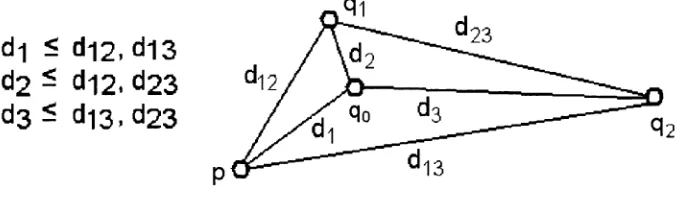
Theorem 3 (1) Let V = {p,q i , q2} - Assume q0 is an optimal Steiner permutation.
Then d(x, q0) < d(x, y) for any x,y £V (x ^ y), i.e. for any x G V, the optimal Steiner
permutation is the nearest one from x (see Fig.2.2).
(2) If V = {p,q i , q2} contains a nearest pair with a reversal distance at most k ,
then an optimal Steiner permutation q0 can be found in a running time 0(|X|2fc+1) (see
Fig.2.3).
(3) If V = {p, <?i, q2, Ç3} consists of two nearest pairs with reversal distances at most
(see Fig.2.3).
Proof (1) By contradiction. Suppose that d ( q2, <Zo) > d ( q2, Q i ) . Then since d ( p , q0) +
d( q0, qi) > d(p,qi), it follows that d(p, q0) + d(q0, qi) + d(q0, q2) > d(p,q1)+d(q1,q2), which
is a contradiction because pqx and q\q2 form a tree better than the optimal Steiner tree
formed by %%(% = 1,2,3).
[image:31.612.148.491.397.497.2](2) By (1), the optimal Steiner permutation q0 G N k ( x ) for some x Ç. V . Since
|jV(z)| < \X\2 and |A^(a:)| < \X\2\Nk_i(x)\ < \X\2k. We need a running time 0(|X|) to
find d ( y, x) ( y G Nk( x ) ) . Therefore, the total running time is 0 ( \ X \2 k + 1) .
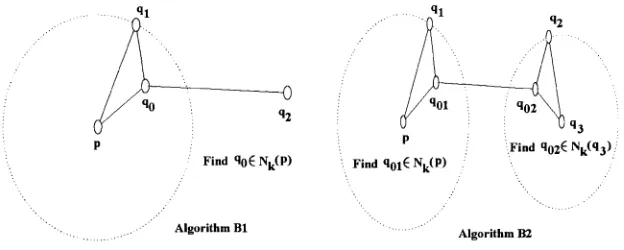
(3) Suppose that d ( p , q i ) < k and d(q2, Ç3) < k. By (2), for each pair q01 G Nk(p)
and q02 G Nk(q3), compute the total reversal distance d(q0i,p) + d(q01, q\) + d(g0i,9o2) +
d(qo2, Ç2) + d(qo2, ç3). We then take the best pair ç0i and q02 as the optimal Steiner
permutations. By (2), the total running time is 0 ( \ X \A k + 1) .
Figure 2.2 The optimal Steiner node qo is the nearest one from or to other nodes.
Based on Theorem 3, we can see from (1) that an optimal Steiner permutation
is closer to the pair of permutations with the minimum distance than to the other
permutations. Therefore, in (2), we find an optimal Steiner permutation in the
k-neighborhood of a permutation in the nearest pair for a (1,2)—MGRBSR problem. In
(3), for a (1,3)— MGRBSR problem, we can also respectively find two optimal Steiner
permutations in the ^-neighborhoods of two permutations, each of which is in a nearest
pair. We have the following algorithms (see Fig.2.3). d-| < di2, di3
d2 5 d-|2, d23
d3 ^ d-|3, d23
Algorithm B1 (1,2)—MGRBSR
Input Sequences: p, qi, q2
(a nearest pair with reversal distance at most k).
Output Optimal reversal process.
Step 1 Find the pair, say p and çl7 with the minimum reversal
distance (at most k).
Step 2 Loop over all u G 7V&(p) and update the reversal distance
d = d(u,p) + d(u, qi) + d(u, q2) and q0 = u if a better
one is found.
Step 3 Generate q0 from p, qi and q2 from q0 by BMY algorithm.
Algorithm B2 (1,3)—MGRBSR
Input Sequences: p, Çi, q2,93
(two nearest pairs with reversal distances < k)
Output Optimal reversal process.
Step 1 Find the pairs, say p, qi and q2, q3, with two minimum
reversal distances (at most k).
Step 2 Loop over u G Nk(p), v G Nk(q3). Update the total reversal
distance d = d(u, v) + d(u,p) + d(u, çi) + d(v, q2) + d(v, 93)
if a better one is found. Also update q o i = u and qo2 = v.
Step 3 Generate goi from p, qx from %i, 902 from q01, qi and q2
U q3
Find %2t Nk(q3) :
P P
Find %6Nk(P) Find Nk(P)
Algorithm B1
[image:33.612.157.469.103.228.2]Algorithm B2
Figure 2.3 Algorithm B1/B2: optimal Steiner permutation is located in some Nk(x)
In Algorithm B1 and B2, each optimal Steiner permutation corresponds to one near
est pair of genomes. Because Theorem 3 shows that for any three genomes, the Steiner
permutation is closer to the nearest pair of genomes. Based on this idea, we connect
the two nearest genomes by a shortest reversal path and then begin to search for the
optimal Steiner permutation from the neighborhood of the path. We have the following
Algorithm D Nearest path search
Input Sequences: p, qx, q2.
Output Steiner permutation and reversal process.
Step 1 Choose a minimum reversal distance pair, say p, qx.
Step 2 Find the optimal reversal path Px from p to qx.
Step 3 For i > 1, construct Pi+x from the neighborhood of Pi
as follows such that Pi+X is closer to q2:
(3.1) Find M, G Pi minimizing
d(Mi,p,qi,q2) = d(Mhp) + d(Mi,q1) + d(Mi,q2).
(3.2) Denote P i ( M i , w ) a segment of P i centered at with
length w. Find M G Nk(Pi(Mi,w)) (k > 1) minimizing
d(M,p,q1,q2) = d(M,p) + d{M,qx) + d(M,q2).
(3.3) Pi+1 is the optimal reversal path from p to M, then to qx.
Step 4 For each u in (the last path in Step 3), find an optimal
reversal path W from u to q2. We get W\, W2, • • •, Wt.
Furthermore, from Wx, W2, • • •, Wt, construct a band with
length I and width w centered at Md. See Fig.2.4.
Step 5 For each x in all W{ (or the l x w band), do a local optimal
search to find % G Nh(x) minimizing d(q0,p, qi,q2).
Step 6 Choose the best % in Step 5 as the optimal solution.
w
Figure 2.4 Algorithm D: (1) Find Pi joining p and q\. (2) Find M\ in Pi nearest to qi. (3) Find M from the neighborhood of a segment of Pi nearby . (4) Find P2 joining p, M, and then q\. (5) From P2, recursively find P3, • • •, Pci- (6) By q2 and a segment of Pa nearby M4, find Wt and construct a l x w band. (7) Do a local optimal search upon all W{ (or the l x w band).
In fact, in Algorithm D, we find a series of paths from p to q i such that they get
closer and closer to q2. Then construct a grid by using g2 and the closest path to q2
-Finally, do local optimal searches on the grid or the l x w band. This nearest path search
algorithm improves Sankoff's local search on grid [17] (also see Fig.2.1).
Theorem 4 For any p , q i , q2, the approximated Steiner permutation q0 and reversal
process can be found in a polynomial running time by Algorithm D.
Proof P i can be found in a running time 0 ( \ X \2) and it has at most 0(|A|) nodes.
Since any reversal distance can be computed in a running time 0(|X|), Mi G Pi can be
found in a running time 0(|X|2). For each node x of Pi, Nk(x) has 0(\X\2k) nodes. It
follows that Nk(Pi(Mi,w)) has at most 0(\X\2k) nodes. It then takes a running time
and other paths. Finally, Pd can be found in d iterations ( d is at most |X|). Therefore,
t h e t o t a l r u n n i n g t i m e i s 0 ( \ X \2 k + 2) .
Based on Algorithm D, i.e. the nearest path search algorithm, we design an approx
imation algorithm to find the optimal Steiner permutations for the (1,n)— MGRBSR
problem. The main idea is to split the (1, n)—MGRBSR problem into a collection of
(1,2)—MGRBSR problems, or to connect the permutations one after another into a tree.
For any permutations: {p, 91, q2, • • •, qn}, we at first find a closest pair, say p and qx (i.e.
they have the minimum signed reversal distance). Next, find a third permutation, say
92, closest to {p, qi). Then apply Algorithm D to find a Steiner permutation si for
(P) 9i> 92} (see Fig.2.5(a)). Suppose {p, qx, q2, • • •, have been connected by a tree
with the Steiner nodes {si, s2, • • •, Sj-i}. Then we find an un-connected permutation,
say qi+i, closest to {p, 91,92, • • •, %}. Re-label the permutations such that % is closest
t o qi +1 - F i n d a n e d g e o f t h e t r e e s u c h t h a t sk i s c l o s e s t t o qi + x. R e - l a b e l { s i , s2, • • • ,
s;_i} such that sk = Sj_i. Apply Algorithm D to find an optimal Steiner permuta
tion Si for {si-i,qi,qi+i} (see Fig.2.5(b)). Repeat the process until all permutations
{p, 92, • • •, 9n} are connected by a tree.
Algorithm E Recursive connecting
Input Permutations P = {p, 91, q2, • • • , qn} .
Step 1 Initial tree: Connect the first three permutations.
(1.1) Find a closest pair, say p and qi (with the minimum
signed reversal distance).
(1.2) Find a third permutation, say closest to {p, qx}, i.e.
q2 and p (or q i ) have the minimum signed reversal distance.
(1.3) Apply Algorithm D to find an optimal Steiner permutation
si for {p, quq2}.
Step 2 Growing tree: Connect a new permutation to the tree.
(2.0) Suppose {p, qi, q2, • • •, %} have been connected by a tree
with the Steiner nodes {si, s2, • • •, Sj_i}.
(2.1) Find a closest pair, say % and qi+1 (where % has been
connected to the tree, but %+% has not been connected).
(2.2) Find an edge, say such that is closest to qi+1.
(2.3) Apply Algorithm D to find an optimal Steiner permutation
for , Çj,
Now, {p, qi, q2, • • •, %, qi+1} have been connected by
a tree with the Steiner nodes {si, s2, • • •, s^-i, s^}.
Step 3 Repeat Step 2 until all permutations {p, çi, q2, • • • , qn}
are connected by a tree.
Figure 2.5 Algorithm E: (a) Step 1: Apply Algorithm D to find the optimal Steiner permutation si for {p,Where d(p,qi) < d(x,y) for all permuta tions x and y. d(qi,q2) < d(qi,y) for all permutations y(^ p). (b) Step 2: Apply Algorithm D to find the optimal Si for for {si-i,qi,qi+\}. Where d(qi,qi+i) < d(qu,qv) for all u < i and v>i + 1. d(si_i,ç<+i) < d(su,qi+1)
for all u < i — 1.
Theorem 5 Algorithm E finds the approximated optimal Steiner permutations and
the reversal process in a polynomial running time.
2.5 Experimental applications
Based on our algorithms, we design a computer program. Applying the program to
some specific permutations, we obtain the optimal Steiner permutations for the permu
tations with different lengths. These examples show that our approximation algorithms
are efficient, i.e. they find approximate solutions that are very close to the optimal ones.
The three permutations, p,qi,q2, are chosen from the genomes of human, sea urchin,
and fruit fly, respectively.
p = 26 13 17 12 - 24 15 18 - 2 - 16 - 3 4 - 28 7 5 1 10 19 25 22 11 29 14 20 - 21 - 8 6 30 - 23 9 27.
q i = 26 4 25 22 5 1 - 28 19 11 29 20 - 21 6 9 27 8 30 23 - 24 16
1 4 - 2 3 1 5 - 7 1 0 1 3 1 7 1 2 1 8 .
q2 = -26 - 27 12 - 24 15 18 - 3 4 13 5 7 1 10 19 2 25 16 29 8 9
By our program, we obtain an optimal Steiner permutation.
q0 = 26 - 2 - 14 - 29 - 11 - 22 - 25 - 19 - 10 - 1 - 5 13 17
12 - 24 15 18 - 7 28 - 4 3 16 20 - 21 - 8 6 30 - 23 9 27.
If we choose the first k genes of p, q\,q2 and apply the program for k = 5, 10, 15,
20, 25, then we obtain the optimal Steiner permutations qo(k) from p(k),qi(k),q2(k),
respectively.
p ( 5 ) = —2 — 3 4 5 1.
9i(5) = 4 5 1 - 2 3.
ç2 (5) = -3 4 5 1 2.
ço(5) = —2 — 1 — 5 —4 3.
p(10) = -2 - 34751 10 - 86 9.
çi(10) = 451698 - 23 - 7 10.
g2 (10) = -3 4 5 7 1 10 2 8 9 6.
9o (10) = —10 — 1 — 5 — 7 — 432 — 86 9.
p(15) = 13 12 15 - 2 - 3 4 7 5 1 10 11 14 - 8 6 9.
çi(15) = 4 5 1 11 6 9 8 14 - 2 3 15 - 7 10 13 12.
92(15) = 12 15 - 3 4 13 5 7 1 10 2 8 9 - 11 6 - 14.
%(15) = 13 12 15 - 2- 10 -1-5-7-43 11 - 9- 68 - 14.
p(20) = 13 17 12 15 18 - 2 - 16 - 3 4 7 5 1 10 19 11 14 20 - 8 6 9.
çi(20) = 4 5 1 19 11 20 6 9 8 16 14 - 2 3 15 - 7 10 13 17 12 18.
ç2 (20) = 12 15 18 - 3 4 13 5 7 1 10 19 2 16 8 9 - 20 - 11 6 17 - 14.
Qo(20) = —20 — 14 — 11 — 19 — 10 — 1 — 5 — 7 — 43 16 8 13 17
p {25) = 13 17 12 - 24 15 18 - 2 - 16 - 3 4 7 5 1 10 19 25 22 11
14 20 - 21 - 8 6 - 23 9.
9i (25) = 4 25 22 5 1 19 11 20 - 21 6 9 8 23 - 24 16 14 - 2 3 15
-7 10 13 17 12 18.
g2 (25) = 12 - 24 15 18 - 3 4 13 5 7 1 10 19 2 25 16 8 9 - 20 - 11
-22 23 21 6 17 - 14.
9o (25) = 2 - 18 - 15 24 - 12 - 17 - 13 25 22 11 20 - 21 5 1 10
19 - 14 - 16 - 3 4 7 - 8 6 - 23 9.
The following table shows the reversal distances of the optimal Steiner trees in the
cases of various permutation lengths we consider:
Permutation length n d { p, 9i) d ( p , 92) d(9i,92) Optimal d ( p , {91,92})
5 3 2 3 4
10 8 8 9 15
15 12 9 14 19
20 15 13 19 26
25 19 18 24 33
30 21 22 29 40
The optimal reversal distances are computed by our program. They are almost the
same as the lengths of the Steiner trees in a metric space. For example, for n = 10,
we have (dx, d2, d3) = (8,8,9). In the Euclidean metric space, we compute the optimal
Steiner tree and find that its length is 14.5. The optimal d(q0:p)+d(q0, qi)+d(q0, q2) = 15.
Both are close each other.
Our approximation algorithms can find the optimal solutions for most collections of
2.6 Discussion and future work
In this paper, we discuss a (1, n)—MGRBSR problem. We design polynomial-time
algorithms for several special cases. The nearest path search algorithm is designed
for the case of three genomes. An efficient approximation algorithm for the general
(1, n)—MGRBSR problem is then designed based on the nearest path search algorithm.
The (1, n)—MGRBSR problem is one of the most important problems in comparative
genomics. We are interested in designing more efficient approximation algorithms for
finding optimal solutions for the general (1, n)—MGRBSR problem. The problem is very
similar to Steiner tree problems in a metric space. With the application of Steiner tree
theory, the problem can be solved efficiently. On the other hand, stochastic can also be
applied to the discussion of the (1, n)—MGRBSR problem. This will be the subject of
our future work.
Acknowledgment This work is supported by the NIH grant ROI GM62118 (to X.G.)
and Wu is supported in part by NSF of China (19771025).
References
[1] Bader, D. A., Moret, B. M. E. and Yan, M. (2001). A linear-time algorithm for
computing inversion distances between signed permutations with an experimental
study. Proceeding of 7th Workshop on Algorithms and Data Structures (WADS
01).
[2] Bafna, V. and Pevzner, P. (1994). Genome rearrangements and sorting by reversals.
In Proceeding of 34th IEEE Symp. of the Foundations of Computer Science,
[3] Bafna, V. and Pevzner, P. (1995). Sorting permutations by transpositions. Proceed
ings of the 6th Annual Symposium on Discrete Algorithms, pages 614-623. ACM
Press, New York.
[4] Bafna, V. and Pevzner, P. (1996). Genome rearrangements and sorting by reversals.
SIAM Journal on Computing, 25(2):272-289.
[5] Berman, P. and Hannenhalli, S. (1996). Fast sorting by reversal. Proceeding of
Combinatorial Pattern Matching (CPM), 168-175. Also Lecture Notes in Computer
Science. 1075.
[6] Berman, P., and Karpinski, M. (1998). On some tighter inapproximability results.
Technical Report TR98-065, ECCC.
[7] Caprara, A. (1997). Sorting by Reversals is Difficult. Proceedings of the First An
nual International Conference on Computational Molecular Biology (RECOMB'97),
ACM Press, New York.
[8] Caprara, A. (1999). Formulations and hardness of multiple sorting by reversals.
Proceedings of the Third Annual International Conference on Computational Molec
ular Biology (RECOMB'99), ACM Press, New York.
[9] Caprara, A. and Lancia, G. (2000). Experimental and Statistical Analysis of Sort
ing by Reversals, in D. Sankoff and J.H. Nadeau (eds.) Comparative Genomics:
Empirical and Analytical Approaches to Gene Order Dynamics, Kluwer Academic
Publishers, The Netherlands .
[10] Christie, D. A. (1998). A 3/2-approximation algorithm for Sorting by reversals.
Proceeding of 9th Ann. SIAM Symposium on Discrete Algorithms,
[11] Durbin, R., Eddy, S. R., Krogh, A. and Mitchison, G. (1998). Biological sequence
analysis: Probabilistic models of proteins and nucleic acids. Cambridge University
Press, Cambridge, UK.
[12] Gusfield, D. (1997). Algorithms on Strings, Trees, and Sequences: Computer Science
and Computational Biology. Cambridge University Press, Cambridge, UK.
[13] Hannenhalli, S. and Pevzner, P. (1995). Transforming men into mice
(polynomial-time algorithm for genomic distance problems. Proceeding of IEEE Symposium of
the Foundations of Computer Science.
[14] Hannenhalli, S. and Pevzner, P. (1995). Transforming cabbage into turnip (polyno
mial algorithm for sorting signed permutations by reversals). Proceedings of the
Twenty-Seventh Annual ACM Symposium on Theory of Computing, 178-189.
[15] Kaplan, H., Shamir, R. and Tarjan, R. E. (1997). Faster and simpler algorithm for
sorting signed permutations by reversals. Proceeding of eighth annual ACM-SIAM
Symp. on Discrete Algorithms (SODA 97). ACM Press, New York.
[16] Kaplan, H., Shamir, R. and Tarjan, R. E. (2000). Faster and simpler algorithm for
sorting signed permutations by reversals. SIAM Journal on Computing,
29(3):880-892.
[17] Sankoff, D., Sudaram, G. and Kececioglu, J. (1996). Steiner points in the space
of genome rearrangements. International Journal of the Foundations of Computer
Science, 7:1-9.
[18] Sankoff, D. and Planchette, M. (1998). Multiple genome rearrangement and break
[19] Sankoff, D. and Nadeau, J. H. (2000). Comparative Genomics: Empirical and, An
alytical Approaches to Gene Order Dynamics. Kluwer Academic Publishers, The
Netherlands .
[20] Watterson, G. A. and Ewens, W. J. and Hall, T. E. and Morgan, A. (1982). The
chromosome inversion problem. Journal of Theoretical Biology, 99, 1-7.
[21] Wu, S. and Gu. X. (2001). A greedy algorithm for optimal recombination. Lecture
Notes on Computer Science, 2108:86-90.
[22] Wang, L., Ma, B. and Li, M. (2000). Fixed topology alignment with recombination.
CHAPTER 3. Algorithms for Multiple Genome
Rearrangement by Signed Reversals
A paper published in
Pacific Symposium on Biocomputing 8(2003), pp.363-374.
Shiquan Wu and Xun Gu
Abstract
We discuss a multiple genome rearrangement problem by signed reversals: Given a
collection of genomes, we generate them in the minimum number of signed reversals.
It is NP-hard and equivalent to finding an optimal Steiner tree to connect the genomes
by reversal paths. We design two algorithms to find the optimal Steiner nodes of the
problem: Neighbor-perturbing algorithm and branch-and-bound algorithm. The first
one is a polynomial running time approximation algorithm. It searches for the optimal
Steiner nodes by perturbing initial Steiner nodes nearby their neighborhoods and
improving them until convergence. The second one is an exact exponential running
time algorithm for a median problem. It finds the optimal Steiner node by checking
all candidates that satisfy the necessary conditions for optimal Steiner nodes. We
implement the algorithms into two programs respectively and show by experimental
examples that they are more efficient than other similar ones, such as GRAPPA,