Published By:
Blue Eyes Intelligence Engineering Retrieval Number: I8913078919/2019©BEIESP
A Link Distribution Algorithm with Efficient Relay
Node Optimization for Congestion Control in
Urban Vanets
Mantasha Haseeb, Ashok. A.
Abstract: This research work develops a new algorithm i.e. Link distribution algorithm and efficient link distribution algorithm. A Link distribution algorithm is the distribution of the link to the nodes so that communication between the nodes takes place in case of any link failure whereas efficient link distribution algorithm is distribution of the packets to the nodes which has high transmission power. The technique used in Link distribution algorithm (LDA) is link establishment whenever there is any link failure happen we apply this concept which is LDA whereas the technique used in efficient link distribution algorithm (ELDA) is relay node selection the relay node is selected based upon the received signal strength ratio (RSSI) value and which node is having high RSSI value that node we allocate the link. The above algorithms can be applied wherever there is high congestion on the road due to the high congestion link failure will happen and due to the link failure emergency event occurs. Results of model achieved in a realistic state of affairs validate our theoretical deliberation and confirm the efficiency and the efficacy of our protocol by screening significant expansion in terms of busy ratio, collision rate, deviation, local density and transmission power compared to previous scheme ETSI DCC. The work has been successfully done with the help open source network simulator NS3.
Keywords: Adhoc Networks, Vanets, Congestion Control, Link Distribution Algorithm, Efficient Link Distribution Algorithm.
I. INTRODUCTION
A Vehicular Adhoc network (VANET) is one of the envoy applications of the ad hoc networks [1].Over the preceding back years, (VANETs) have materialized as an innovative set of competent broadcasting technology, amid commune of users chiefly as their spacious array of uses in different domain as in Intelligent Transport Systems (ITS), security relevance, online amusement throughout the mobility of the vehicles etc [2]. Amid the deal with VANETs, vibrant topology fetch solidity to routing procedure devise, seeing terminal mobility grounds recurrent connection breakages. When connection of a passageway is wrecked, the lane desires to refurbishes during routing safeguarding course or reinstate with fresh established path. Opting for unswerving way is decisive for setting up trustworthy way connecting two linking medium as rerouting is pricey [3]. This research work introduces a Link distribution algorithm to offer efficient and trustworthy data broadcast in VANETs. This algorithm relies on distribution of links between nodes as how many links are available and what about the capacity of the vehicles because in VANET topology it is using and categorising the nodes as well as (25, 50, 75, 100).
Revised Manuscript Received on August 03, 2019.
Mantasha Haseeb, M. tech Scholar, ECE Department Shuats, Prayagraj, India.
A. Ashok, Assistant Professor, ECE Department, SHUATS, Prayagraj, India.
According to nodes the establishment of the links take place then the distribution of that particular link so that it can make a communication. Then the further work is been carried out of Link distribution with efficient relay node optimisation which is improving the previous technique i.e. transmission rate and transmission power. Implementation of link distribution with efficient relay node optimisation in VANET topology with (25, 50, 75, 100) nodes to transmit the messages from sender vehicle to receiver vehicle. Fig. 1. Depicting the VANET scenario.
Fig.1. Overview of VANET
II. RELATED WORKS
Late 1980s the clustering algorithms are proposed. A bulky sum of cluster-oriented researches commenced to MANETs and VANETs in common [4, 5].The precise end-to-end delay calculation, TBD [6] put forward a connection delay representation to calculate approximately the package forwarding stoppage on road sector. Speculative testing and wide-ranging simulation revealed that connection delay representation supply the precise connection delay evaluation aim outperforms the alive design in DDD (data delivery delay) and PDR (packet delivery ratio). CBDRP [7] proposes a cluster-based directional routing protocol for main road set-up in which the description of a cluster chooses another description according to the moving way of vehicle to forward packages. Simulation results has been done that CBDRP can resolve the predicament of link stability in VANET, realizing steadfast and rapid data broadcast.
III. OVERVIEW OF THE PROBLEM A.Assumptions
The objective of this research work is to put a stop to crash by superior control of their link distribution parameters. Spotlighting more on urban set-up, extra prone to passage collisions. It is also presume that all vehicle is equipped through navigation system which allows spotting and time management with IEEE
transceiver means CCH/SCH outlet switching is permit able in every vehicle. The main objective of this research work is the implementation of link distribution algorithm to transmit the messages from source to the destination and lastly implementation of link distribution with efficient relay node optimisation has been done and outputs are shown through graphs.
B. Theoretical Collision rate, busy ratio and deviation Calculation
In this concise analytical learning, we confer the theoretical capacity of the channel. By varying density of nodes from 1 to 100 nodes, we experiential five system metrics, i.e., busy ratio, collision rate, deviation, local density and the transmission power. The above mentioned network metrics was obtained from the following formula:
Collision rate=No of collisions/No of transmissions. (1) The busy ratio is obtained as follows:
Busy ratio=∑Transmission times/Total CCHI time. (2)
The deviation is obtained as follows:
Deviation=100−100 × (∑observed local density /∑real local density)
( 3)
IV. IMPLEMENTATION OF LINK DISTRIBUTION ALGORITHM
Implementation of Link distribution algorithm in VANET topology with (25, 50, 75, 100) nodes to transmit the message from sender vehicle to receiver vehicle. Link consistency is specified by likelihood that perseveres definite time period to illustrate the upcoming location of a link. Prior work [9] spotlightning on link reliability typically classed into two category; link lifetime assessment algorithms which uses link lifetime allotment of all link to course link lifetime assessment via routing metric; the former forecast based connection reliability assessment that survey a probabilistic connection reliability representation for direction-finding discovery course. Mutually these two processes depend on mobility representation that classifies movement set-up of the arrangement. However, for VANETs no connection reliability representation explicitly developed so far. Our proposed work which is a link distribution algorithm for urban VANETs as how many links are available and what about the capacity of the vehicles because in VANET topology it is using and categorising the nodes as well as (25, 50, 75, 100). According to nodes we have to establish the links then how we can distribute that particular link so that we can make a communication that’s why we are using this algorithm. Fig.2. demonstration of the cycle of execution carrying the parameters (transmission power, density, local density, collision rate, and busy ratio). First the algorithm starts then it comes under the vanet topology after entering into the topology it predicts the algorithm here prediction means predicting the density of nodes. Now if the link quality is greater than the received signal strength indicator (RSSI) value which is the measurement of power present inside a received radio signal it will assume the power level and optimised the relay node and the algorithm automatically stops. If the link quality is less than the the RSSI value it will not assume the level of power on the other it will analyse the link again and again.
Fig.2. Core components of Algorithm and their implementation cycle
A. Performance Analysis of Link Distribution Algorithm In this section, the demonstration of the competence of the mechanism forming Link distribution algorithm and Link distribution with efficient relay node optimisation. To do so, we compared our protocol with ETSI DCC. The metrics we selected to assess the efficiency of our procedure are the collision rate, the busy ratio, deviation, local density and transmission power. A crash is retrieved from simulation surroundings if more nodes within range, broadcast their signal at same timestamp. The act evaluation is carried out in five steps : Busy Ratio vs Density, Collision Rate vs Density, Deviation vs Density, Local density vs Distance, Transmission Power vs Density and outputs are shown using graphs. Section B represents the algorithm for link distribution.
B.Algorithm 1: Link distribution algorithm
Input N= 0-100
Input: N number of vehicles.
Output: Packet transmission from source node S to destination vehicle D.
Select source node S, destination node D and routing table from S to D.
Set Each node path i=1,path[i]; Set Neighbor selection
j=1,Neighbor=0; WHILE (Src!=D) do{
Calculate RSSI
link_ quality (i,j)= link from node i to j;l if (link_quality (i,j)==∞) { nodes link not connected
}else if link _quality (i,j)> RSSI-val {
Nodes link connected }
Route request_bc ast(S, D, pkts) If (comm._range <= Threshold) {
receives routing packet and send to next neighbor; }
End While
The above algorithm which is LDA we took number of nodes from 0 to 100.
C. Implementation of Link Distribution Algorithm with Efficient Relay Node Optimisation
Published By:
Blue Eyes Intelligence Engineering Retrieval Number: I8913078919/2019©BEIESP
connections to transmit the message from Sender vehicle to Receiver vehicle. Relay node means sometimes the source is generating the packets destination means who is going to receive the packets relay is just passing the packets who is transmitting it just helping to forward packets those nodes are relay nodes. How we can show the efficient relay node and how we can choose that particular relay node as the best by using link distribution with efficient relay node optimisation. Section D represents the Link distribution algorithm with efficient relay node optimization.
D. Algorithm 2: Link distribution algorithm with efficient relay node optimization
Input N=0-100
Input: N number of vehicles.
Output: Packet transmission from source node S to destination vehicle D.
Select source node S, destination node D and routing table from S to D.
Set Each node path i=1,path[i]; Set Neighbor selection
j=1,Neighbor=0; WHILE (Src!=D) do{
Calculate RSSI
link_ quality (i,j)= link from node i to j;l if (link_quality (i,j)==∞) { nodes link not connected
}else if link _quality (i,j)> RSSI-val {
Nodes link connected }
Route request_bc ast(S, D, pkts) If (comm._range <= Threshold) { Set
BER_threshold;
Select Relay node and calculate average BER; If relay_node_ber < BER_threshold { Relay node transmitting the data Packet }
End While
V. SIMULATION SETTING
We look a extraordinary care to carry out our research study in a practical simulation surroundings. For a practical node mobility representation, we used SUMO, a phase that duo the traffic simulator SUMO with the network simulator NS-3, and permit them to swap information about node movements at runtime. We refer to [10, 11] for detailed description of the SUMO stage operation method. We assorted the density of nodes in the model from low densities to high densities. The traffic was engendered using a SUMO tool.
VI. RESULT ANALYSIS
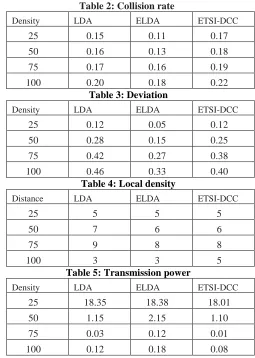
Comparison of ETSI-DCC (Decentralized Congestion Control with Link distribution algorithm and Link distribution with efficient relay node optimization using the measured parameters : Busy Ratio vs Density, Collision Rate vs Density, Deviation vs Density, Local density vs Distance, Transmission Power vs Density and
outputs are shown using graphs. ELDA provides better overall result in terms of busy ratio, collision rate, deviation, local density, and transmission power.
A.Busy ratio
The busy ratio is deliberated as fraction of period the outlet is busy from a single node perspective, within a specified period of time. As the density increases the ELDA busy ratio is least in comparision to link distribution algorithm and ETSI DCC.
Fig.3. Busy ratio vs Density
B.Collision rate
Fig.4. Collision rate vs Density
C.Deviation
[image:4.596.299.554.51.409.2]A deviation of 0% is excellent case set-up and the higher the deviation the worse the outcome.
Fig.5. Deviation vs Density
D.Local density
For clearness, the no of nodes one step neighbors will be referred to as “the local density.” The region that wraps these neighbors is referred to as the subject nodes “radio visibility field” or simply “field of view.
Fig.6. Local density vs Distance
E.Transmission power
[image:4.596.62.376.100.503.2]If a node wants to convey a message from source to end it needs some energy, transmission power and reception power to convey the message from the source which is generating the message and destination who is going to receive the message. So the conclusion is for transmitting the message the transmission power should be very high.
Fig.7. Transmission power vs Density
Table 1: Busy ratio
Density LDA ELDA ETSI-DCC
25 0.08 0.07 0.10
50 0.11 0.11 0.13
75 0.25 0.25 0.29
100 0.29 0.27 0.31
Table 2: Collision rate
Density LDA ELDA ETSI-DCC
25 0.15 0.11 0.17
50 0.16 0.13 0.18
75 0.17 0.16 0.19
100 0.20 0.18 0.22
Table 3: Deviation
Density LDA ELDA ETSI-DCC
25 0.12 0.05 0.12
50 0.28 0.15 0.25
75 0.42 0.27 0.38
100 0.46 0.33 0.40
Table 4: Local density
Distance LDA ELDA ETSI-DCC
25 5 5 5
50 7 6 6
75 9 8 8
100 3 3 5
Table 5: Transmission power
Density LDA ELDA ETSI-DCC
25 18.35 18.38 18.01
50 1.15 2.15 1.10
75 0.03 0.12 0.01
100 0.12 0.18 0.08
The above table gives the clearness to the outputs.
VII. CONCLUSIONS
In our proposed research work, we presented link distribution algorithm and link distribution with efficient relay node optimisation, an innovative way out for
communication between vehicles to organize the links and make certain level of awareness among nodes. This algorithm is acted upon a link scheme that gives more up-to-date information about the system status. The results are verified and give the effectiveness of our scheme which is efficient link distribution algorithm that enabled a significant enhancement in terms of outlet busy ratio and successful packet delivery than in ETSI DCC.
REFERENCES
1. S. Al-Sultan, M. Moath, Al-Doori, H. Al-Bayatti Ali, H. Zedan, A comprehensive survey on vehicular ad hoc network, J. Netw. Comput. Appl. (2014), in press.
2. R. S. Bali, N. Kumar, and J. J. P. C. Rodrigues, “Clustering in vehicular ad hoc networks: taxonomy, challenges and solutions,” Vehicular Communications, vol. 1, no. 3, pp. 134–152, 2014.
3. Z. Niu, W. Yao, Q. Ni, and Y. Song,“ Link reliability model for vehicle ad hoc networks,” in Proceedings of the London Communication Symposium, pp. 1–4, London, UK, 2006.
4. C. Cooper, D. Franklin, M. Ros, F. Safaei, and M. Abolhasan, “A comparative survey of VANET
[image:4.596.46.298.675.787.2]Published By:
Blue Eyes Intelligence Engineering Retrieval Number: I8913078919/2019©BEIESP
and L. Chen,” Efficient and Reliable Cluster-Based Data Transmission for Vehicular Ad Hoc Networks,” Hindawi, Mobile Information Systems ,2018.
6. J. Jeong, S. Guo, Y. Gu, T. He, and D. H. C. Du, “Trajectory based data forwarding for light-traffic vehicular ad hoc networks,” IEEE Transactions on Parallel & Distributed Systems, vol. 22, no. 5, pp. 743–757, 2011. 7. T. Song, W. Xia, T. Song, and L. Shen, “A cluster-based directional routing protocol in VANET,” in Proceedings of the IEEE International Conference on Communication Technology, pp. 1172–1175, Jinan, China, September 2011.
8. IEEE Standard for Information Technology—Local and Metropolitan Area Networks—Specific Requirements—Part 11: Wireless LAN Medium Access Control (MAC) and Physical Layer (PHY) Specifications Amendment 6: Wireless Access in Vehicular Environments, IEEE Standard 802.11p-2010, 2010.
9. R. Dube, C. D. Rais, K. Wang and S. K. Tripathi, “Signal Stability Based Adaptive Routing for Ad-Hoc mobile networks”, IEEE Personal Communications, Feb 1997.
10. The Network Simulator: NS2, 2015, http://www.isi.edu/ nsnam/ns/. 11. SUMO: Simulation of Urban Mobility, 2015, http://sumo. sourceforge.net.
Mantasha Haseeb received the B-Tech degree in Electronics & Communication Engineering, from the university of Sam Higginbottom University of Agriculture & Technology Allahabad,(Prayagraj). Pursuing M-Tech in Communication system Engineering , from the University of Sam Higgin Bottom University of Agriculture & Technology from Allahabad,(Prayagraj).Her current research interests include Congestion in vehicular ad hoc networks, and Internet of Things.