Investigation of Clock Synchronization Techniques and its Performance
Impact in MANET
Prof. Mithlesh Kumar Sigaroli 1 Department of CSE TITE, Bhopal M.P., (India) [email protected]
Manish Nagar 2
M. Tech. Scholar Department of DCE B.U.I.T., Barkatullah University
Bhopal M.P. (India) [email protected]
Mahendra Kumar Jhariya 3 Department of CSE B.U.I.T., Barkatullah University
Bhopal M.P. (India) [email protected]
Abstract— Mobile ad hoc Network (MANET) is an assortment of
mobile nodes that area unit needed to transmit packets on behalf
of every alternative. The mobile nodes maintain the topology
data during a dynamic network among a selected vary. All nodes
should remember of its neighbors that area unit directly
approachable. The every node in network maintained next hop
data of close neighbor nodes. The routing protocols area unit
routed knowledge packets in between sender and receiver during
a specific time instant. The time synchronization is maintained
the communication clock cycle between the nodes. Time
synchronization is an important element of a MANET. Time
synchronization during a network aims at providing a typical
duration for local clocks of nodes within the network. Since all
hardware clocks area unit imperfect, local clocks of nodes could
alienate from one another in time, thus determined time or
durations of your time intervals could differ for every node
within the network. However, for several applications or
networking protocols, it's needed that a typical read of your time
exists and is obtainable to everybody or variety of the nodes
within the network at any specific instant. This work presents a
survey of existing analysis on time synchronization within the
field of Mobile unintended Network. This survey is provides the
initiative data during a field of synchronization by that the
innovative approach is feasible to planned in MANET.
Index Terms—Time Synchronization, MANET, survey,
Routing.
I.INTRODUCTION
Mobile Ad hoc Network (MANET) Ad hoc networks [1] are networks of mobile wireless computing devices. Due to the limited communication range of wireless technology, nodes of the network form spontaneous connections when they are brought within the communication range of each other, providing typically a symmetrical communication link where message exchange is possible in both directions. The limited communication range and the mobility of the nodes lead to frequent reconfiguration of the network topology. Each node participates in an ad hoc routing protocol that allows it to discover ‘multi-hop’ paths through the network to any other
ensuring all devices are operating using the same standards (especially if they are all under the control of different entities). Similarly, MANET are typically more dynamic, being formed to fulfill a particular goal and terminated when that goal has been achieved. In addition, most ad-hoc networks allow nodes to join and leave the network at will, so that the topology is constantly changing.
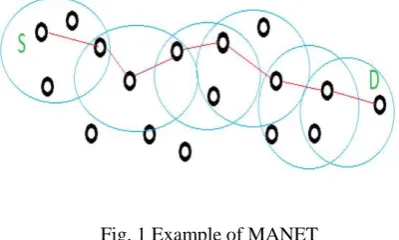
In this diagram the thick black circles represent nodes, the red lines represent the route of the packet and the blue circles represent the transmission range of the present node. It should be noted that despite the use of circles to represent transmission ranges of nodes participating communication process.
Fig. 1 Example of MANET
II.TIME SYNCHRONIZATION OVERVIEW
The synchronization of geographically separated clocks has intrigued researchers for a long time. The first accurate clocks started to appear in the 17th century after the scientific work pioneered by Galileo and expanded by Christian Huygens [2]. These scientists helped develop a better clock based on their theories of the motion of pendulums. More recent advances in the area of clocks include the development of the atomic clocks that are used in numerous applications including the Global Positioning System (GPS) and in the digital telephone communication network in order to provide timing reference [3]. In the area of clock synchronization we will present a summary of some important related works later on this section, but first some background on the basic theory of clocks.
A.General requirements on time synchronization protocols
are:
Provision of a small and/or bounded clock offset, i.e.
an accurate time basis
Fast and/or bounded convergence, i.e. a short and
ideally predictable delay until (re-) synchronization is achieved
Low and/or bounded complexity concerning, e.g.,
computation, communication, storage, energy, and structure
High robustness against topology changes such as
node movements and node failures
More specific requirements on time synchronization protocols depend on concrete application requirements and network topology. For instance, data fusion applications require a small average clock offset for time stamping of sensor values. On the other hand, a small and bounded clock offset is needed for duty cycling or network-wide medium slotting.
B.Challenges in Time Synchronization
When a node in the network generates a timestamp to send to another node for synchronization, the packet carrying the timestamp will face a variable amount of delay until it reaches and is decoded at its intended receiver. We can basically decompose the sources of error in network time synchronization methods into four basic components:
Send Time: This is the time spent to construct a message at the sender. It includes the overhead of operating system (such as context switches), and the time to transfer the message to the network interface for transmission.
Access Time: Each packet faces some delay at the MAC (Medium Access Control) layer before actual transmission. The sources of this delay depend on the MAC scheme used, but some typical reasons for delay are waiting for the channel to be idle or waiting for the TDMA slot for transmission.
Receive Time: This is the time needed for the network interface of the receiver to receive the message and transfer it to the host.
III.MANETCHARACTERISTICS
Ad hoc network has its own characteristics that are different from those of fixed networks [4]:
(1) Dynamic topologies: Node mobility in an ad hoc network causes frequent changes of network topology. Adjusting transmission and reception parameters such as power can also affect the topology. Thus, the management station needs to collect connectivity information from nodes periodically. An implication of this is an increased message overhead in collecting topology information.
(2) Bandwidth-constrained, variable capacity, possibly asymmetric links: wireless links will continue to have significantly lower capacity than their hardwired counterparts. One effect of these relatively low to moderate link capacities is that congestion happens more often than wired networks.
(3) Energy-constrained operation: Most of the ad hoc nodes run on batteries. That is, we need to ensure that network overhead is kept to minimum so that energy is conserved. Moreover, in order to conserve energy, nodes may power themselves off. This requirement is contradictory to the need for topology update messages.
(4) Wireless vulnerabilities and limited physical security: Mobile wireless networks are generally more prone to information and physical security threats than fixed, hardwired networks. Nodes roaming in a hostile environment such as a battlefield have non negligible probability of being compromised. That is, a malicious attack may be launched from within the network by compromised nodes.
A.Time Synchronization in MANET
In this paper we are interested in synchronizing clocks located in geographically separated nodes of a Mobile Ad Hoc network. Network synchronization is a difficult task particularly due to the real characteristics of the oscillators in the clocks as described previously, and also due to the delay
and delay variation in the links used to transfer the timing information among the nodes comprising the network.
There are two commonly known approaches for clock synchronization [5], centralized, and decentralized. The centralized synchronization approach is also known as master-slave synchronization and it is the most common method encountered in practice in civilian applications, there is one or more accurate clocks (the master(s)) to which all the rest of the clocks listen and adjust their frequency and phases accordingly.
The decentralized synchronization approach is also known as mutual synchronization, in this approach there is no master clock, but instead all clocks cooperate to achieve synchronization in a distributed manner. In mutual synchronization the clock of a node tries to achieve synchronization by reducing its phase or timing error with respect to a weighted average of the other clock's phases.
In practice it is necessary to exchange timing information messages among the different nodes comprising the network. There are several approaches for doing this and some of the most important are:
Burst position measurement
Continuous correlation of timing signals and, Clock-sampling
In the burst position method each node schedules the periodic transmission of a burst or pulse. At each receiving node the positions of the incoming bursts are compared with the position of the local burst and the difference is used to correct the local clock period according to a many-to-one mapping. This mapping usually takes the form of a weighted average of the errors. The transmission of pulses has the disadvantage of requiring a large bandwidth and possibly a dedicated channel if a wireless medium is used.
this sequence can be transmitted to other nodes. As in previous cases a many-to-one mapping is needed to extract the correction term used to adjust the local clock.
In the clock-sampling method each node reads the time of its clock and transmits it to other neighbor nodes. At each receiving node the timing errors are computed as the difference between the local and neighbor nodes' clocks. The errors are used in a many-to-one mapping rule to determine the correction applied to the local clock. The main advantage of the clock-sampling technique is its relative simplicity of implementation. The TSF in the IEEE 802.11 standard is a clock-sampling method. In all these methods the timing information exchanged can be corrupted during the time it travels from transmitter to receiver. Some of the most detrimental factors include link delay, signal fading, signal delay spread, and collision of timing messages due to the broadcasting nature of the wireless medium.
IV.PROBLEM IN TIME SYNCHRONIZATION
Due to unpredictability and imperfect measurability of message delays, physical clock synchronization is always imperfect. Therefore one has to take care to avoid false statements when reasoning about temporal ordering and real– time issues based on synchronized computer clocks.
Timing synchronization can be viewed as the following problem: A person, e.g., John Doe, is a normal commuter. John hates being late for work and wishes to always catch the train his wants. To achieve this, John obtains the reference time that is available at the train station and adjusts his watch to show the same time. Due to the imperfections in John's watch, it does not measure time intervals accurately and therefore tends to drift away from the reference time at the train station. To maintain synchronization with the time at the train station, John must periodically synchronize his watch with the reference time. Using this example, we see that time synchronization is more accurate the more often a local clock (i.e., John's watch) is synchronized, i.e., synchronization is an ongoing process.
Since there is a sole resource for measuring time (the train station clock), John and any other person can achieve synchronization implicitly. But if that resource is unavailable, synchronization can only be achieved by communication between two or more entities, e.g." if John and Jane only have access to personal times and are able to communicate by some means. In such a scenario, synchronization can be achieve if John were to send Jane the reading on his watch, and Jane then adjusts her own watch based on either the time or the time offset between their clocks. Here too, periodic synchronization would be needed, since both John's and Jane's watches may drift at different rates, to ensure a specific synchronization: error level.
V.ROUTING IN MANET
Routing is an essential function in MANETs. The routing procedure is exchange data/ routing packets between mobile nodes. Therefore, a routing protocol is required to achieve this objective either proactively or reactively. A routing protocol is said to be proactive when mobile nodes broadcast their routing information periodically to keep consistency in their routing table entries. It is reactive when routes between mobile nodes are built on an on-demand basis. MANET routing protocols must be simple and robust, and minimizes control message exchanges. It needs to be simple because it is performed by generic mobile hosts that may have only limited resources and power. Routing algorithms that consume excessive bandwidth for routing control message exchanges is not appropriate for such wireless networks. The topology of an ad hoc network is inherently volatile and routing algorithms must be robust against frequent topology changes caused by host movements [6].
consistency of these tables, MANET nodes update their routing information periodically and whenever there is a change in the network topology. Network topology changes occur due to node mobility and/or link and node failure. When a change in the network topology is detected, mobile nodes exchange messages throughout the network to maintain correct routing tables. Proactive routing protocols differ in the way update messages are exchanged between all nodes and the number of their routing tables. Proactive routing protocols are also called table-driven routing protocols. As can be seen, routes exist between all pair of nodes in the network although a given pair of nodes might not be communicating with each other. Also, message exchange floods the network and introduces significant overhead. In contrary to proactive routing protocols, mobile nodes do not maintain routing information to all nodes in the network.
When using reactive routing protocols, such as the ad hoc on-demand distance vector (AODV) protocol [8]. Routes are created only when needed. This is the reason why these protocol are also called on-demand routing protocols. To find a route to a destination, a mobile node needs to run a route discovery procedure. A route between a source node and a destination is said to be valid only when the destination is reachable and is needed by the source node. As can be seen, routes between MANET nodes are not always available and have to be established on an on-demand basis. While this kind of routing protocol significantly reduces routing overhead, it may introduce additional delay in data transmission.
Hybrid routing protocols are takes advantage of both schemes have attracted a lot of attention. This is combination of best features of above two protocols. Node within certain distance from the node concerned, or within a particular geographical region, are said to be in routing zone. By exploiting the strength and avoiding the weakness of each type, hybrid topological routing protocols are proposed, for example, Zone Routing Protocol (ZRP) [6].
VI.PREVIOUS WORK ACCOMPLISHED
In this paper [9] proposed a new time synchronization algorithm. Nodes do not depend on a specific node, and they use all the received beacon signals and perform the time synchronization on their own. We validated the method with simulation results, which show that time synchronization is performed effectively with short process time. The proposed Time Synchronization Procedure toward Average (TSPTA) which does not give priority to a particular node. Each node gathers time information through the received beacon signal, and using this information self correcting is accomplished. Through the decentralized processing method, we obtain short convergence time and high accuracy.
In this paper [10] Kay Romer identified the problem of physical time synchronization in sparse ad hoc networks giving two reasons why classical clock synchronization algorithms fail in this environment. We then presented a synchronization algorithm suitable for a certain class of applications of sparse ad hoc networks, which transforms time stamps exchanged between nodes inside messages to the local time of the receiver instead of adjusting the clocks. The algorithm has a low resource and message overhead and therefore is well suited for resource restricted distributed sensor networks.
In this work [11], extend BBS by an algorithm for time synchronization called Black Burst Clock Synchronization (BBCS). The idea is to use global ticks as reference points in time, and to propagate the time values of these global ticks in special time frames. For this purpose, we introduce two different frame encodings with black bursts called cooperative and arbitrating encoding. Both encodings are resistant against collisions, and guarantee upper bounds for convergence delay. Being based on BBS, BBCS preserves the properties regarding offset, complexity, and robustness. Neither BBS nor BBCS rely on static network topology.
than a slower one. Secondly, after collecting enough timing information, a slower host can synchronize to the faster one by self-correcting its timer periodically (which makes it becoming a faster host).
This paper [13] proposed a GMAC (Gossip based MAC Protocol) with energy awareness is a primary goal. GMAC is designed to run on higher constrained sensor nodes and it therefore has very low processing requirement and a small footprint. This serve to reduce energy consumption, but GMAC’s chief mechanism for energy conservation is duty
cycle.
This paper [14] considers clock synchronization in multihop Ad hoc networks from a new angle, relating the energy constraint on the clock synchronization algorithm with the optimal skew it may obtain. Given individual energy remaining is indicated how much time a node spend for each message transmission. Synchronization we, give exact of the optimal skew that can be achieved as a function of the uncertainty in message delay. As they show the optimal skew is the minimal depth of a particular spanning Forest whose trees are rooted at the time sources of the topology graph induced by respecting the energy budget.
In this paper [15] concentrates on the clock synchronization and routing overhead protocol for MANET. It is very much clear that any network which does not have any clock synchronization, would get crash and is of no issue. The main concept of the GCSMBHCD method is it’s concept of global
clock synchronization. in this proposed work all the nodes of the adhoc network gets synchronized based on the global highest divergence value of clock of all clocks available in the all nodes of network.
VII.EXPECTED PROPOSAL
In this proposal is the selection of a global clock for all nodes in the presence of multiple clocks advertising themselves as being stable. We term this problem time information routing to form an analogy with network routing, which addresses a similar issue - that of selecting the next hop
to forward a packet toward its final destination based on wireless link estimations. In time information routing, the “next hop” for a slave node is the master clock it synchronizes
to and the final destination is always the root clock in the system. To achieve more accurate global time synchronization, we proposed for a selection of minimum mobility node and average the time of all nodes in a particular zone. Today’s time synchronization protocols liberally
integrate timing information offered by neighboring nodes into their own estimates. The following steps are done to synchronize the clock of mobile nodes in network:-
1. The sender has sends the Route Establishment packets to neighbor nodes that are in radio range forward the request to for establishment of connection.
2. The time synchronization procedure is initiated if the routing procedure is started.
3. The clock synchronization condition is based on the average of current clock time of mobile nodes and minimum mobility of mobile device.
Z1 = (S1 (CLK) +I1 (CLK) +I2 (CLK) + I3 (CLK)
+...D1 (CLK))/5 // here total is 5
Z1 = Average of CLK is the synchronized
clock
'Election Node (EN)' = select minimum mobility (S1, I1, I2, I3 ...D1)
4. In a particular zone only the 'election node' time is considered for synchronization because it follows the step 3 conditions.
5. In a particular zone according to 'election node' clock of mobile devices are synchronized.
6. In case of zone communication i.e. intra zone communication same procedure of step 3 is applied on all zones of network i.e.
Global Synchronized CLK (GSC) = Average of ((Z1
(EN (CLK)) + Z2 (EN (CLK))/2) U (Minimum mobility
7. Now the clock of all mobile nodes is synchronized through this GSC value.
8. Data delivery in network is started to established path.
VIII.CONCLUSION
In this paper study about the various clock synchronization under MANET and identifies the problem and its resolution with different techniques. In the above section our proposed work are given that is based on global clock synchronization for reliable inter communication under MANET. In future we create simulation experiments and takes expected output in the form of network parameter.
REFERENCES
[1] Broch J, Maltz D, Johnson D, Hu Y-C, Jetcheva J. ,“A
Performance Comparison Of Multi-Hop Wireless Ad Hoc
Network Routing Protocols”, The fourth Annual ACM/IEEE
International Conference on Mobile Computing and
Networking, Dallas, TX, U.S.A., 85–97, 1998.
[2] Douglas M. Considine, Editor, .Van No strands scientific
encyclopedia, Eight ed. 1995.
[3] Kartaschoff, P, .Synchronization in digital communications
networks, Proceedings of the IEEE, Volume: 79, Issue: 7, July
1991.
[4] Congzhe Zhang, MengChu Zhou, Ming Yu, "Ad hoc network
routing and security: A review", International Journal of
Communication Systems, pp.909–925, Published online 22
September 2006 in Wiley Inter Science.
[5] W.C Lindsey, F. Ghazvinian, W. Hagmann, and K. Dessouky,
.Network synchronization”, Proceedings of the IEEE, vol. 73,
No. 10, October 1985
[6] E. M Royer, C.K Toh, “A Review of Current Routing Protocols for Ad Hoc Mobile Wireless Networks”, IEEE Personal
Communications, 6(2):46–55, 1999.
[7] 4. Perkins C, Bhagwat P. Highly dynamic destination-sequenced
distance vector (DSDV) routing for mobile computers.
Proceedings of the ACM SIGCOMM Conference on
Communications, Architectures, Protocols and Applications
(SIGCOMM 1994), London, U.K., August 1994.
[8] 5. Perkins C, Belding-Royer EM, Das SR. Ad hoc on-demand
distance vector (AODV) routing. RFC 3561, July 2003.
[9] Yun-Jae Shin, Jung-Ryun Lee "Time Synchronization Protocol in
Ad hoc network" ICOIN 2013.
[10]Kay Romer, "Time Synchronization in Ad Hoc Networks",
Proceeding MobiHoc '01 Proceedings of the 2nd ACM
international symposium on Mobile ad hoc networking &
computing Pages 173-182, 2001.
[11]Dennis Christmann, Reinhard Gotzhein, Thomas Kuhn,
"Multi-hop Clock Synchronization in Wireless Ad-Hoc Networks",
Electronic Communications of the EASST Volume 17, pp.2-13,
2009
[12]Jang-Ping Sheu, Chih-Min Chao, Ching -wen Sun, "A clock
synchronization algorithm for multi-hop wireless ad hoc
networks", IEEE 24th International Conference on Distributed
Computing Systems, 574 - 581, 2004.
[13]Matthew Dobson, Spyros Voulgaris, Maarten van Steen,
"Network level Synchronization in Decentralized Social
Ad-Hoc Networks", IEEE 5th International Conference on Pervasive
Computing, and Applications (ICPCA), , pp. 206 - 212, 1-3 Dec.
2010.
[14]Hagit Attiya, DavidHay and Jennifer L. Welch, “ Optimal Clock Synchronization under energy Constraints in Wireless Ad hoc
Network”, LNCS 3974, pp. 221–234, Springer Verlag Berlin
Heidelberg 2006.
[15] Md. Naim Ansari#, Hemant Kumar Soni, “Global Clock Synchronization Method based on Highest Clock Divergence in
MANET”, International Journal of Application or Innovation in
Engineering & Management (IJAIEM), pp273-278, Volume 3,