A D V A N C E D R E V I E W
Assessing the value of seasonal climate forecasts
for decision-making
Marta Bruno Soares | Meaghan Daly | Suraje Dessai
University of Leeds, School of Earth and Environment, Leeds, UK
Correspondence
Marta Bruno Soares, University of Leeds, School of Earth and Environment, Maths/Earth and Environment Building, Leeds LS2 9JT, UK. Email: [email protected]
Funding information
UK Economic and Social Research Council, Grant/Award Number: ES/K006576/1; European Union's Seventh Framework Programme for Research, Grant/Award Number: 308291
Edited by Maria Carmen Lemos, Domain Editor, and Mike Hulme, Editor-in-Chief
Seasonal climate forecasts (SCF) can support decision-making and thus help society cope with and prepare for climate variability and change. The demand for under-standing the value and benefits of using SCF in decision-making processes can be associated with different logics. Two of these would be the need to justify public and private investment in the provision of SCF and demonstrating the gains and ben-efits of using SCF in specific decision-making contexts. This paper reviews the main factors influencing how SCF is (or can be) valued in supporting decision-making and the main methods and metrics currently used to perform such valuations. Our review results in four key findings: (a) there is a current emphasis on economic ex ante studies and the quantification of SCF value; (b) there are fundamental differ-ences in how the value of SCF is defined and estimated across methods and approaches; (c) most valuation methods are unable to capture the differential benefits and risks of using SCF across spatiotemporal scales and groups; and (d) there is lim-ited involvement of the decision-makers in the valuation process. The paper con-cludes by providing some guiding principles towards more effective valuations of SCF, notably the need for a wider diversity and integration of methodological approaches. These should particularly embrace ex-post, qualitative, and participatory approaches which allow co-evaluation with decision-makers so that more compre-hensive and equitable SCF valuations can be developed in future.
This article is categorized under:
Vulnerability and Adaptation to Climate Change > Institutions for Adaptation
K E Y W O R D S
assessing value of climate information, climate services, seasonal climate forecasts, valuation methods, value of climate information for decision-making
1 | I N T R O D U C T I O N
Debates around the science–policy–society interface have highlighted the importance of understanding how scientific knowl-edge is applied and used in policy and decision-making contexts (Lemos, 2015; Lemos & Morehouse, 2005). It is also argued that the production of scientific knowledge is not sufficient to ensure its use in practice as the lack of salience, credibility and legitimacy of the information produced often leads to its failure in supporting actions (Cash & Buizer, 2005; Meinke, Nelson, Kokic, Stone, & Selvaraju, 2006). As such, the value and benefits that climate information can provide, both in developed and least developed countries, is a significant topic of research (Zillman, 2005). In this context, valuation1studies can be helpful in understanding the value and benefits of using weather and climate information (such as SCF) to support decision-making processes. Other areas such as, climate services (Adams, Eitland, Vaughan, & Wilby, 2015; Anderson et al., 2015; Clements, DOI: 10.1002/wcc.523
This is an open access article under the terms of the Creative Commons Attribution License, which permits use, distribution and reproduction in any medium, provided the original work is properly cited.
© 2018 The Authors.WIREs Climate Changepublished by Wiley Periodicals, Inc.
WIREs Clim Change.2018;9:e523. wires.wiley.com/climatechange 1 of 19
Ray, & Anderson, 2013; Ferguson, Finucane, Keener, & Owen, 2016; Perrels, Frei, Espejo, & Jamin, 2013), meteorological services (Frei & von, 2014; Hallegatte, 2012; Perrels et al., 2013; Pilli-Sihvola, Namgyal, & Dorji, 2014), humanitarian response (Drechsler & Soer, 2016; Rodrigues et al., 2016; Stephens, Perez, Kruczkiewics, Boyd, & Suarez, 2015; World Food Programme, 2016) and disaster risk reduction and management (Hallegatte, 2012; Practical Action, 2008) have all highlighted the need for such valuations and the pursuit for this type of studies can be underpinned by a number of reasons, including (adapted from Anderson et al., 2015; Clements et al., 2013; Freebairn & Zillman, 2002):
• Justify publicly expenditure in the provision of climate information and services. This is particularly relevant in the context of public services, such as those provided by the National Meteorological and Hydrological Services (NMHS), where it is frequently argued the importance of ascertaining the benefits and services provided by NMHS and demonstrate how it supported better decision-making and policy development in order to justify and secure sustained public investment. In this context, valuation studies can also help to justify the implementation and provision of new climate information, ser-vices and/or programs by demonstrating the potential return on such investment.
• Improve existing provision of SCF in order to maximize (use and) value to its users. Understanding how SCF are used and of value to the users is also critical to help providers (from both the public and private sectors) to continuously enhance and tailor the forecasts provided.
• Justify pricing for charging bespoke SCF provided by private and/or public sector where users' expectations are intrinsi-cally linked to the value and benefits expected from using those forecasts by demonstrating the potential return on such investment;
• Inform investment decisions towards adaptation to climate variability and change. In this context, valuation studies can help understand the potential value and benefits of using SCF against other pathways that may exist to address vulnerabil-ity and improve adaptation to climate variabilvulnerabil-ity and change.
• Conducting research on the valuation of SCF. Valuation studies are often pursued in academic settings where researchers perform valuations of SCF to advance existing knowledge in the area (which, in some cases, can also end up informing policy-making).
• Raise awarenes as well as demonstrate and promote the value of using SCF to (new) users. The outcomes of a valuation can be used to illustrate the potential value that can be yielded by using the forecasts (e.g., evidence of avoided costs, increased revenues).
Seasonal climate forecasts2(SCF) sit between short-term weather forecasts and longer timescales such as interannual pre-dictions and climate change projections (Kirtman, Power, Adedoyin, Boer, & Bojariu, 2013). SCF provide a probabilistic indi-cation of how average conditions (such as temperature and rainfall) may develop in the future and can go from 1-month prediction lead time up to a year (Rickards, Howden, & Crimp, n.d.; Goddard, Hurrell, & Kirtman, 2012).
However, distinctions should be made between SCF, El Niño Southern Oscillation (ENSO) forecasts, and climate services. SCF (also referred to as climate outlooks3) not only incorporate considerations of sea surface temperature, including ENSO, but also factor in a broader range of both atmospheric and oceanographic drivers of seasonal variability. In contrast, ENSO forecasts refer only to the prediction of the likelihood of a change in ENSO phase state (i.e., El Niño, La Niña, and neutral conditions).4
Climate services on the other hand, refer to the development and provision of climate information and knowledge to sup-port decision-making (European Commission, 2015; Vaughan & Dessai, 2014). As such, SCF can be regarded as a climate service depending on how the process of SCF provision is pursued and implemented, but are not in all cases sufficient to be considered a service on their own without additional input from the users/decision-makers. In addition, from a climate services perspective, the value of SCF can be assessed from a chain viewpoint and therefore can focus on different stages (or all) within the process of production and use of seasonal forecasts. These stages include, for example, the period at which models, data and expertise are combined to produce the forecast; the stage when SCF are tailored and disseminated through a number of channels; and the moment when the forecast is finally used and applied within a specific decision-making context by a user in order to yield some benefit (cf. Perrels et al., 2013). In the context of this paper, however, the main focus is on the last stage of this chain of events which aims to understand the value and benefits following the use of SCF to support a specific decision-making process.
The aim of this paper is therefore to provide a timely review of the critical factors, common methods, and outstanding challenges that limit current assessment of SCF value in decision-making.
Section 2 describes common conceptualizations of value and how these relate to evaluating SCF in the literature. Section 3 introduces the key factors that can help frame the value of SCF in the processes of evaluation. Section 4 presents the main methods and metrics commonly used to examine the SCF value in decision-making. Section 5 describes other aspects that can also influence how the value of SCF is captured and assessed. Section 6 provides a discussion regarding the advan-tages and limitations of the methods to perform valuations as well as the main outstanding considerations towards more effec-tive evaluations of SCF value in decision-making. Section 7 provides concluding remarks.
2 | T H E V A L U E O F S E A S O N A L C L I M A T E F O R E C A S T S
The word“value”carries a variety of meanings across an array of disciplines such as sociology (Rokeach, 1973), philosophy (Rescher, 1969), psychology (Schwartz, 1992), economics (Freeman III, Herriges, & Kling, 2014), and ethics (Sayer, 2011). Despite the extensive lexicon associated with the word, recurrent meanings tend to relate to value as (a) something that is monetary worth or a fair return in money, services, or goods, (b) something useful, estimable, or important, and (c) a set of beliefs and concepts in individuals (McKeown & Summers, 2006).
Conceptualizations of the value of SCF in the climate literature tend to converge to the idea of comparing the expected or observed outcome resulting from a decision made based on a SCF (either in a theoretical or empirical context) from the expected outcome of the same decision madewithoutthe SCF (or with climatology5) (Hill & Mjelde, 2002; Letson, Podestá, Messina, & Ferreyra, 2005). For example, for Stern and Easterling (1999) the value of a SCF is conceived as the difference between the outcomes of a decision made with and without a forecast or, alternatively, by comparing the outcomes among users without access to forecasts with the potential outcomes if they had access to the forecast. In their conceptualization, the value of SCF is a function of various factors that influence its use and outcomes, such as the users' activities, how sensitive they are to weather and climate conditions, the time horizon of the decision(s), and their strategies and capacity to cope. Mur-phy also emphasizes that SCF do not have intrinsic value per se as this is acquired“through their ability to influence the deci-sions made by users of the forecasts [and] to guide their choices among alternative courses of action”(1993, p. 286). In this context, the value of SCF can be related to the (potential) benefits that can be yielded through using SCF, thereby allowing us to consider alternative metrics (e.g., non-economic value) when assessing the value of SCF (Clements et al., 2013).
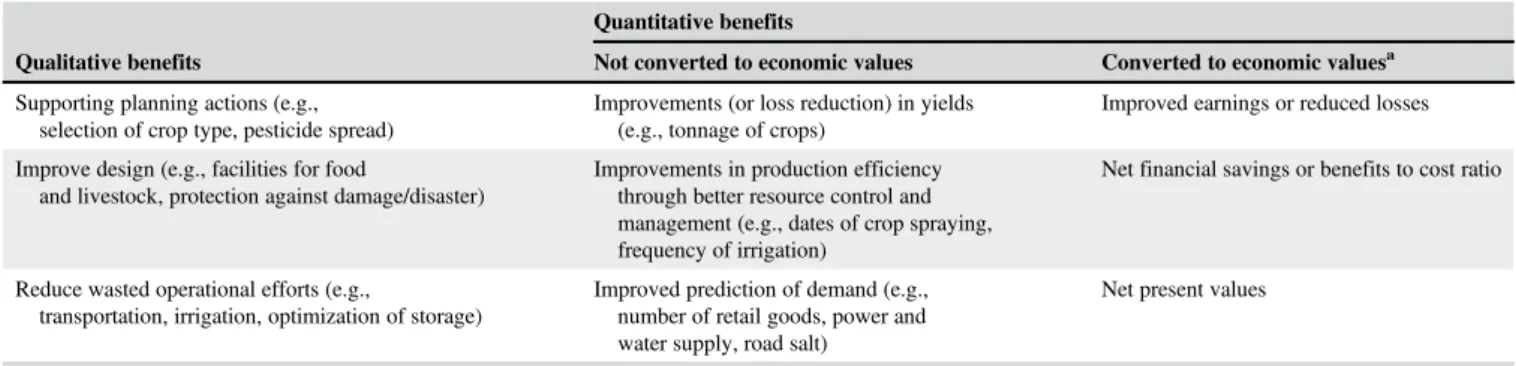
Nicholls (1996) identifies the range of benefits and value that can be garnered from using climate information in decision-making. These measures include qualitative improvements in the decision, environment, and outcomes as well as quantitative changes in outcomes in terms of economic and/or non-economic value. In this context, the conceptualization of the value of SCF can be considered something that carries either monetary worth (economic value; quantitative benefit) and/or something useful (non-economic value; qualitative benefit). Table 1 lists examples of qualitative and quantitative benefits that can be yielded from using climatic information in decision-making processes.
In some valuation studies, the onus is to understand the (potential or real) qualitative benefits that using SCF can propor-tionate to the user in their decision-making rather than quantifying the economic value that SCF can yield when used to sup-port decision-making (cf. Table 1; Clements et al., 2013). It is also clear from Table 1 that there is a wider range of (potential) qualitative benefits when using climate information and SCF when compared to quantitative benefits that can be calculated in terms of economic gains.
However, the majority of studies focus on the economic value of using the information in decision-making (Clements et al., 2013; Nicholls, 1996). Fewer studies seem to apply qualitative approaches6to assess the value of SCF and most of these
TABLE 1 Examples of potential qualitative and quantitative benefits of using climatic information to inform decision-making Qualitative benefits
Quantitative benefits
Not converted to economic values Converted to economic valuesa
Supporting planning actions (e.g., selection of crop type, pesticide spread)
Improvements (or loss reduction) in yields (e.g., tonnage of crops)
Improved earnings or reduced losses
Improve design (e.g., facilities for food
and livestock, protection against damage/disaster)
Improvements in production efficiency through better resource control and management (e.g., dates of crop spraying, frequency of irrigation)
Net financial savings or benefits to cost ratio
Reduce wasted operational efforts (e.g.,
transportation, irrigation, optimization of storage)
Improved prediction of demand (e.g., number of retail goods, power and water supply, road salt)
Net present values
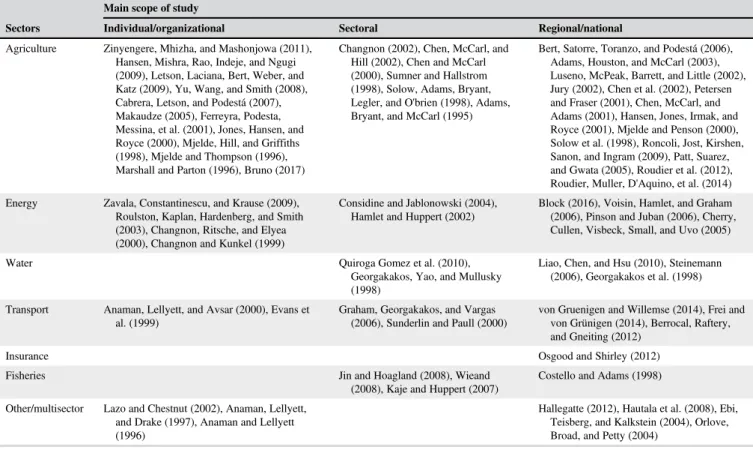
tend to focus on smallholdings in developing countries (Meza, Hansen, & Osgood, 2008). The main scope of existing studies tends to focus on the value of SCF when considered at (a) the individual or organizational level, (b) sectoral, and (c) regional or national (Clements et al., 2013). Table 2 lists examples of studies that assessed the value and/or benefits of SCF according to specific sectors and the main unit of analysis of the study. As showed in Table 2, there is a predominance of studies in agri-culture particularly those performed at the individual/farm level.
The following section describes the main factors influencing the value of SCF in decision-making processes.
3 | F A C T O R S I N F L U E N C I N G T H E V A L U E O F S E A S O N A L C L I M A T E F O R E C A S T S I N D E C I S I O N - M A K I N G
As discussed in Section 2, the value of the forecast is generally considered to be derived from its ability to influence decisions and actions in comparison to existing sources of information or knowledge. In this sense, while the usability of a SCF is not equal to value, it is generally considered aprerequisiteof value. However, even if a SCF is effectively used to inform a deci-sion, this does not guarantee benefit or value.
There is a growing consensus that there must be a range of factors in place to enable the use of SCF in practice such as the characteristics of the forecasts, institutional environment, and wider contextual factors (Bruno Soares & Dessai, 2016; Dil-ling & Lemos, 2011; Lemos, Kirchhoff, & Ramprasad, 2012). The value of a SCF is dependent upon the ability to be able to effectively act upon information, as well as enabling physical, social, political, and policy environments at a variety of scales in order for forecasts to generate value. Here, we review the main factors that can influence the value of SCF in decision-mak-ing: (a) the forecast, (b) the decision-maker, (c) the decision-making context, and (d) the science–society interface.
3.1 | The forecast
Attributes of SCF clearly play a role in determining the use and value of SCF. Forecast accuracy7is often considered one of the most important determinants of the value of SCF (Clements et al., 2013) particularly among climate science communities. However, a direct link between forecast accuracy and value has not been established (Kirtman & Pirani, 2009) and the expected relationship is neither automatic nor linear (Harrison, Troccoli, Anderson, & Mason, 2005; Letson et al., 2005; Mur-phy, 1993).
TABLE 2 Examples of studies looking at the value of seasonal climate forecasts according to economic sector and main scope of the study (based on Clements et al., 2013; Hill & Mjelde, 2002)
Sectors
Main scope of study
Individual/organizational Sectoral Regional/national
Agriculture Zinyengere, Mhizha, and Mashonjowa (2011), Hansen, Mishra, Rao, Indeje, and Ngugi (2009), Letson, Laciana, Bert, Weber, and Katz (2009), Yu, Wang, and Smith (2008), Cabrera, Letson, and Podestá (2007), Makaudze (2005), Ferreyra, Podesta, Messina, et al. (2001), Jones, Hansen, and Royce (2000), Mjelde, Hill, and Griffiths (1998), Mjelde and Thompson (1996), Marshall and Parton (1996), Bruno (2017)
Changnon (2002), Chen, McCarl, and Hill (2002), Chen and McCarl (2000), Sumner and Hallstrom (1998), Solow, Adams, Bryant, Legler, and O'brien (1998), Adams, Bryant, and McCarl (1995)
Bert, Satorre, Toranzo, and Podestá (2006), Adams, Houston, and McCarl (2003), Luseno, McPeak, Barrett, and Little (2002), Jury (2002), Chen et al. (2002), Petersen and Fraser (2001), Chen, McCarl, and Adams (2001), Hansen, Jones, Irmak, and Royce (2001), Mjelde and Penson (2000), Solow et al. (1998), Roncoli, Jost, Kirshen, Sanon, and Ingram (2009), Patt, Suarez, and Gwata (2005), Roudier et al. (2012), Roudier, Muller, D'Aquino, et al. (2014) Energy Zavala, Constantinescu, and Krause (2009),
Roulston, Kaplan, Hardenberg, and Smith (2003), Changnon, Ritsche, and Elyea (2000), Changnon and Kunkel (1999)
Considine and Jablonowski (2004), Hamlet and Huppert (2002)
Block (2016), Voisin, Hamlet, and Graham (2006), Pinson and Juban (2006), Cherry, Cullen, Visbeck, Small, and Uvo (2005)
Water Quiroga Gomez et al. (2010),
Georgakakos, Yao, and Mullusky (1998)
Liao, Chen, and Hsu (2010), Steinemann (2006), Georgakakos et al. (1998)
Transport Anaman, Lellyett, and Avsar (2000), Evans et al. (1999)
Graham, Georgakakos, and Vargas (2006), Sunderlin and Paull (2000)
von Gruenigen and Willemse (2014), Frei and von Grünigen (2014), Berrocal, Raftery, and Gneiting (2012)
Insurance Osgood and Shirley (2012)
Fisheries Jin and Hoagland (2008), Wieand
(2008), Kaje and Huppert (2007)
Costello and Adams (1998)
Other/multisector Lazo and Chestnut (2002), Anaman, Lellyett, and Drake (1997), Anaman and Lellyett (1996)
There are a range of other forecast characteristics that can influence value, though such attributes are rarely included within SCF valuation studies (Hill & Mjelde, 2002). This can include elements such as the timeliness, spatial, and temporal resolution as well as type of forecast (Clements et al., 2013; Dilling & Lemos, 2011; Hill & Mjelde, 2002). For example, the lead time at which forecasts are received can determine whether or not the delivery of forecast information may align with important decision-making points (Hill & Mjelde, 2002).
The type of climate parameters included within SCF also plays a role in determining their value. For example, within the agricultural sector the spatial and temporal resolution and the types of weather parameters predicted (e.g., distribution of rain-fall throughout the season, rainrain-fall onset, and cessation) are key to determining the value of the forecasts for decision-making. There is, thus, a need to evaluate the importance of alternative forecast characteristics to better understand how each of these affects potential decisions and how this, in turn, influences forecast value (Hansen, 2002).
There are also intrinsic aspects of forecasts, which may not be as easily adjusted or calibrated to specific user needs. Uncertainty within the forecasts as well as the treatment of uncertainty in forecast products are determinants of forecast value (Patt et al., 2005; Pulwarty & Redmond, 1997). Decision-makers may be skeptical about the credibility of forecasts if the accuracy of the forecasts is not well communicated (Hill & Mjelde, 2002).
SCF are presented in probabilistic terms, since this is seen as helping to improve the technical quality of a forecast (Murphy, 1993) and can also help to better convey and manage the uncertainty surrounding the probability of a given event (Doblas-Reyes & García-Serrano, 2013). However, the way in which probabilistic forecasts are formatted, packaged, and communicated matters a great deal, and it has been shown that the probabilistic nature of SCF can pose a barrier to the inter-pretation and use of forecasts (Patt & Gwata, 2002). Theoretical models have indicated that perceived value can be increased by providing forecasts of categories that are tailored to specific decisions (Millner & Washington, 2011). In addition, the skill of SCF varies both temporally and spatially. Seasonal forecasts generally have greater skill in the tropics than in midlatitudes (McIntosh, Pook, Risbey, & Lisson, 2007), and the skill of forecasts also varies within regions (Hartmann, Pagano, Sor-ooshian, & Bales, 2002).
The skill of SCF can also vary by season, which may limit the ability of forecasts to beneficially inform the most important decisions. Both of these inherent attributes of seasonal forecasts may limit the overall value and also imply that the value of forecasts cannot be broadly generalized across time or space.
3.2 | The decision-maker
The value of SCF is user-specific, complex, and nonlinear. In addition, there are markedly different perspectives on the value of seasonal forecasts among producers and users (Murphy, 1993). For example, while scientists may focus primarily on the technical skill8of a forecast, farmers may see more value in forecasts that have lower but well-characterized skill, when com-pared to high-skill forecasts in which the skill is not made adequately clear (cf. Hansen, 2002). This has prompted suggestions for valuations that include “users”or“decision-makers”perspectives and not only that of scientists (Hartmann et al., 2002; Venkatasubramanian, Tall, Hansen, & Aggarwal, 2014).
In addition, the value of a forecast can vary among users themselves. Murphy (1993) highlights that forecast value is dif-ferent from problem to problem and, also, from user to user within the context of a particular problem. This can be dependent upon issues surrounding individual interpretations of forecasts, as well as cognitive biases and heuristics that can result in dif-ferences in outcomes of forecast application within decisions (Nicholls, 1996; Roncoli, 2006). Disparities in SCF value can also be due to differences in the ability of individuals to access alternative information and resources in the absence of fore-casts. In other words, because the value of the forecast must be considered in relation to pre-existing knowledge and informa-tion bases, forecasts may be more or less valuable depending on the baseline of informainforma-tion that individuals are able to access without the additional input of forecasts.
simulation to calculate the value of forecasts in terms of profit, Hansen et al. (2009) conclude that farmers would prefer to make decisions using the forecast, even though this would result in a high likelihood of lower returns in individual years.
3.3 | The decision-making context
Much of the literature on SCF recognizes the importance of the decision-context in shaping the value of forecasts (Bruno Soares & Dessai, 2016; Lemos et al., 2012). Dilling and Lemos (2011) argue that constraints to, and limitations of, SCF use originate in the lack of understanding of the broader decision-making context in which forecasts are intended to be used. The decision-context is influenced by both microscale and macroscale factors that determine whether and how a forecast might be used as well as whether the use of the forecast will generate benefit or value. However, these do not act in isolation. Macro-scale aspects have important influences on microMacro-scale conditions and vice versa. For example, Vogel and O'Brien (2006) illus-trate how local decisions of farmers were constrained because agricultural banks operating at the national level chose to limit access to credit based on a climate forecast. Furthermore, it has been recognized that understanding the scale at which fore-casts might be used is key to“unlocking”their value (Orlove & Tosteson, 1999).
It has long been realized that economic, political, social, and cultural factors that shape the broader context within which SCF are used are important to determining whether or not they will generate value (see, e.g., Glantz, 1977). Lemos, Finan, Fox, Nelson, and Tucker (2002) argued that it is just as important to consider the political ramifications of climate variability as it is to generate reliable scientific predictions. Decision-contexts represent a “moving target” with rapid changes (e.g., environmental, demography, market, or technological) that cannot necessarily be captured within the models used to evaluate the benefits of climate forecasts (Hansen, 2002). Climate is only one of many aspects that can influence decision-making and the value of forecasts. Other macroscale factors, such as market liberalization policies, changes in production sub-sidies, and other societal challenges (e.g., HIV/AIDS epidemic, which eroded labor pools for agricultural production) can shift both the motivation and ability to be able to respond to seasonal forecasts as well as the overall value that might be derived from their use (Vogel & O'Brien, 2006). Broad and Agrawala (2000) illustrated that even when the forecast is received with enough advanced notice, broader political issues, such as conflict and willingness of funding agencies to support response, can play a key role in translating forecasts into beneficial action. As such, responses to SCF at more localized scales cannot be isolated from the broader context.
There is also a need for conducive institutional and policy environment that can support and encourage use in order to real-ize the benefits of SCF (Hansen, 2002). Responses to forecasts among various organizations (e.g., government agencies, non-governmental organizations, and United Nations organizations) must be coordinated to ensure that forecasts can produce value (Glantz, 1977). Government policies can either enable or limit whether and how climate forecasts are used, and there is also a need for adequate physical infrastructure (e.g., roads, communication) to facilitate such responses (Hill & Mjelde, 2002). For these reasons, there can be important differences between developing and developed countries in their ability to realize the value of SCF. Furthermore, institutional determinants of forecast application can be both formal and informal in nature (Dilling & Lemos, 2011) as personal relationships among individuals in scientific and policy agencies can, for example, play a strong role in determining whether forecasts are used in practice. In general, however, there is still a low level of under-standing in terms of how forecasts and policies interact to maximize the benefit of forecasts. For example, there is conflicting evidence about whether or not insurance schemes implemented alongside forecasts may affect the perceived value of forecasts (Millner & Washington, 2011).
The microscale factors that are often considered include the internal institutional and regulatory context within which deci-sions are made (Hartmann et al., 2002; Orlove & Tosteson, 1999), organizational cultures, routines, and practices (Rayner, Lach, & Ingram, 2005), differences between sectors (Murphy et al., 2001), decision-making rules and models (Hill & Mjelde, 2002), livelihood constraints (Patt & Gwata, 2002; Vogel & O'Brien, 2006), and power differentials between different actors involved (Roncoli et al., 2009). If SCF do not fit within existing organizational, institutional, or sectoral decision-making con-texts, the ability to realize their value may be limited. The value of climate forecast also varies across sectors. For example, the water resources and energy sectors are often considered better able to take advantage of the SCF in their current probabilis-tic form than the agricultural sector (Murphy et al., 2001), since they are more accustomed to incorporating statisprobabilis-tical and probabilistic information within their decision-making processes.
others. Power dynamics, both between producers and users of SCF, as well as between individuals and groups at local scales, are an important determinant of whether benefits can be realized. Such dynamics can have influence across entire industries, as illustrated by Pfaff et al. (1999) in the case of Peruvian fisheries, or at more localized scales, such as gender disparities within households or elite capture within local governance (Carr & Owusu-Daaku, 2016; Roncoli, Orlove, & Kabugo, 2011).
3.4 | The science–society interface
Science–society interfaces encompass a range of aspects including the ways in which science is incorporated within policy-making processes, levels of trust between experts, policy-makers, and the public, and public expectations regarding scientific credibility, transparency, and integrity. Such arrangements also need to be accompanied by a host of “downstream”factors, such as effective dissemination and communication of scientific information that enable the forecast to be used and of value when informing decision-making.
At the most basic level, an impediment to the value of forecast is simply the fact that many decision-makers may be unaware that SCF exist and are available (Hill & Mjelde, 2002). It has also been shown that to inform decision-making, mate information must be supplemented with available social and economic data at the same resolution and scale as the cli-mate forecasts (Ruth, 2010). However, the transmission or communication of seasonal clicli-mate information is not only a technical issue, but must also deal with social and cultural dimensions to determine how best to deliver content, including the ways it is presented and transmitted (Harrison et al., 2005). For example, it is argued that the users of SCF are more likely to trust the information if it comes from sources with which they have existing relationships or already trust (Bruno Soares & Dessai, 2016; Hansen, 2002; Lemos et al., 2012). In addition, developing and sustaining the institutional linkages that are needed to communicate forecasts is a critical issue (Dilley, 2000) as well as the key role that institutional design can play in influencing flows and uptake of SCF (Orlove & Tosteson, 1999).
The literature on SCF now widely agrees on the need to adapt and tailor forecasts through better understanding of the con-texts in which the forecasts are (to be) used (Lemos et al., 2012). Tailoring of the forecasts themselves to the needs of particu-lar users has been cited as a means of increasing the value of SCF (McIntosh et al., 2007). For example, Changnon & Kunkel (1999) illustrate that assessment of user needs is one factor that has contributed to increased uptake of climate information over the last decades. Fitting forecasts to user needs is, however, not always a straightforward task. Closer cooperation between“producers”and“users”of SCF is frequently cited as a key determinant of enhancing the potential to realize value of SCF (Aldrian, Oludhe, Garanganga, & Pahalad, 2010; Buizer, Jacobs, & Cash, 2016; Dilling & Lemos, 2011; Meadow et al., 2015; Stern & Easterling, 1999; Stone & Meinke, 2006; Troccoli, 2010). There is wide agreement that there is a need for an iterative process between producers and users of SCF in order to produce forecasts that are responsive to the needs of users (Dilling & Lemos, 2011; Lemos & Morehouse, 2005; Patt et al., 2005; Roncoli et al., 2009). This is often referred to as a pro-cess of“coproduction,”in which producers and users are jointly involved in producing the forecast. Thus, this involves much more than just getting people in the same room (Lemos et al., 2012), but requires dedicated institutional arrangements and ownership of both the problem and process of coproducing climate forecasts (Dilling & Lemos, 2011). There are also barriers to the successful coproduction of SCF, including inappropriate incentives, institutional arrangements, and lack of attention to relations of powers within participatory approaches designed to facilitate forecast use (Roncoli et al., 2011).
4 | M E T H O D S F O R A S S E S S I N G T H E V A L U E O F S E A S O N A L C L I M A T E F O R E C A S T S
Assessing the value of using SCF to support decision-making can be practically pursued through a range of methods that span from the quantitative approaches to qualitative methods. Differences in epistemological traditions underpinning such methods can be linked to distinct conceptual approaches around the notion of value (e.g., monetary vs. nonmonetary value) and, in a more practical sense, to other aspects such as the timing of the examination (i.e., ex ante9or ex post use of SCF in decision-making), and the involvement of the user/decision-maker in the evaluation process (Rubas, Hill, & Mjelde, 2006). However, it is important to highlight that these methods are not mutually exclusive and valuation studies often involve different compo-nents of these methods. The following sections describe the main methods10currently used to assess the value and/or benefits of using SCF in decision-making.
4.1 | Decision theory-based models
2009). In its simplest form decision theory involves a single actor who has to make a decision to maximize (or minimize) a specific objective based on either a utility function, cost-loss model, production function, or other economic models (Rubas et al., 2006). It is thus assumed that the actor solely decides based on the potential payoff such as“(…) the expected increase in economic benefits arising from the use of the forecast in decision making”(Adams et al., 1995, p. 11). Meza et al. (2008) defines the value of forecast information as the expected utility when using a forecast in ex ante input to the decision-making in comparison with the expected utility of using climatological information. In this view, the value of SCF relates to the differ-ence between the expected outcome of a decision made with the forecast and the expected outcome of the decision made with-out the forecast (Letson et al., 2005).
As institutional factors are considered fixed in decision theory, it is pertinent to use this method when the choice of the decision-maker does not affect the outcome of another agent (Rubas et al., 2006). In addition, this type of study is usually combined with other management or production models12(e.g., crop growth models) to identify optimal decisions under dif-ferent climate scenarios (Hill & Mjelde, 2002).
According to Stewart (1997) the value of forecasts can be estimated throughprescriptivestudies (i.e., how the decision-maker should decide) and descriptive studies (i.e., how the decision-maker actually decides based on the forecast). Both approaches are underpinned by the idea that the value of the forecast is based on its effect on the decision to be made and, thus, the onus lies on the examination of decision-making models. Both approaches require similar information to develop the models, including defining a payoff function and a decision rule, probability distributions, the cost of the information, and the user(s) of the forecast, their decision process and rules and payoff functions (Stewart, 1997). The critical difference is the way in which the users' decision model (i.e., decision rules) are determined and the methods to do it. However, the two approaches are not mutually exclusive and tend to use elements of the other (Stewart, 1997). It is also often assumed that the user has prior knowledge (i.e., climatology) which he/she will use to make decisions but with a forecast, the user can make better decisions instead. As such, the value of the SCF is the difference between the payoff of making a decision with the forecast in compari-son to the payoff of making that same decision with only the user's prior knowledge (Rubas et al., 2006; Stewart, 1997).
Using a reservoir model to estimate the economic value of using extended streamflow forecasts for the energy production in the Columbia River, Hamlet and Huppert (2002) found that use of SCF could lead to an increase energy production of 5.2 million MW/h and an average revenue increase of around 153 million USD per year.
Avoided costs is another method based on decision theory since some level of optimization of the decisions at hand is expected when using SCF (Clements et al., 2013). The difference is that the expected optimization when using this approach is expressed in terms of the costs avoided by using the SCF (as opposed to not using). Although studies using an avoided costs approach to assess the value of SCF were not found in the literature there are several assessments in relation to the use of weather forecasts (Chen et al., 2002; Frei & von, 2014; Liao et al., 2010; Portney, 1994).
4.2 | General equilibrium models
General equilibrium models (GEM) are another economic approach that can be utilized to understand the potential value that climate information can have in specific sectors. It is assumed in GEM that the choices of disparate decision-makers are inter-linked and affect each other (Anderson et al., 2015). For example, the use of SCF by an increasing number of farmers can potentially change the overall production which in turn can influence price (Rubas et al., 2006).
Although this type of models has not been used to assess the value of SCF due to their intrinsic complexity (e.g., the level of abstraction can make it difficult to use in concrete situations) some studies have used some of the principles of GEM to develop partial equilibrium models13or sector models to understand the potential effect of SCF in a particular market or eco-nomic sector (Rubas et al., 2006).
For example, Chen and McCarl (2000) developed a stochastic agriculture sector model to assess the value of considering the strength of the ENSO phase event, a key driver of interannual variability, in the United States and the rest of the world. They found that accounting for ENSO event strength increases the value of the forecast information and, as a result, such information should be included in future studies. In a similar vein, Chen et al. (2002) examined the potential increase of the value of ENSO information in the agriculture sector in the United States and the rest of the world using a five-phase definition (as opposed to the conventional three-phase14 definition). Their findings have shown that providing more refined forecasts can potentially double the value of the forecasts for agricultural production.
4.3 | Contingent valuation
The contingent valuation (CV) method emerged in the late 1940s and has been empirically applied since the 1960s in areas such as environment, transport, meteorology, public policy, and health (Freebairn & Zillman, 2002; Mitchell & Carson, 1989; Portney, 1994; Smith & Sach, 2010; Venkatachalam, 2004). Based on economic theory, the premise of CV was to develop a method capable of assessing the value of public goods (i.e., not traded in private markets) for public policy decision-making (Mitchell & Carson, 1989; Portney, 1994). In the context of basic weather and climate services which are normally freely available and considered as indivisible goods, the CV method is perceived as a useful technique to help understand the eco-nomic value of such services (Anaman & Thampapillai, 1995).
The CV is a survey-based method for“estimating the monetary benefits of non-marketed goods and services”(Hausman, 2012, p. 91). It is used to elicit the maximum amount (in monetary value) that individuals would be willing to pay (WTP) for a nonmarketed service or good, or willing to accept (WTA) compensation for the gain or loss of that service or good (Bateman, Carson, Day, & Hanemann, 2002; Clements et al., 2013; Hausman, 2012). CV15 uses hypothetical markets16 to estimate the benefits of the service or good being considered (Mitchell & Carson, 1989; Rollins & Shaykewich, 2003). Responses to those hypotheses are aggregated to develop a benefit estimate or a measure of society's WTP for that service (Freebairn & Zillman, 2002; Mitchell & Carson, 1989). Critics to the CV emphasize the hypothetical bias of the method, the differences between WTP and WTA, and the lack of reliability and validity of the findings (Carson, Flores, & Meade, 2001; Hausman, 2012). Stewart (1997), p. 159 adds that these studies only provide an idea “of perceived usefulness of forecasts rather than their actual value”as they do not disclose how the forecasts are used.
Several studies have applied CV to examine the WTP for weather services (Anaman & Lellyett, 1996; Freebairn & Zill-man, 2002; Lazo & Chestnut, 2002; Lazo, Morss, & Demuth, 2009; Richardson & Loomis, 2005; Rollins & Shayke-wich, 2003).
Looking specifically at SCF, Makaudze (2005) estimated that the WTP for this type of forecasts from farmers in Zimba-bwe ranged from Z$0.44 to Z$0.55 and that lower WTP was consistently found in wetter districts. Amegnaglo, Anaman, Mensah-Bonsu, Onumah, and Gero (2017) also applied a CV method to understand the requirements for SCF by farmers in the Republic of Benin and to assess their WTP. Their study showed that around 83% of the 354 maize farmers were WTP although differences across municipalities were noted with drier areas registering a higher WTP for SCF (similarly to findings from the Makaudze, 2005 study).
4.4 | Benefit transfer
Benefit transfer emerged in the 1980s, although it was only in the 1990s that it became more prominent in the literature (Johnston & Rosenberger, 2010). The method is based on the transfer of the estimated economic values from an existing study (the“study”site) to a different context of analysis (the“policy”site) (Anderson et al., 2015). Rosenberger and Loomis (2003) describe it as making use of existing information in a context different than the one for which the information was originally collected. In addition, as it requires less financial resources and time, it tends to be more used than other methods (e.g., CV) since it builds upon“(…) existing case studies (…) to‘borrow’the resulting economic values and apply them to a new con-text”(Bateman et al., 2002, p. 16).
However, intrinsic methodological challenges related to issues of transferability and reliability (e.g., inferences made based on existing information) have been noted (Johnston & Rosenberger, 2010). Loomis and Rosenberger (2006) describe the main criteria for performing valid benefit transfers including the commodity that is being valued at the study site should be identical to that being assessed at the policy site, and the communities at the study site and policy site should have similar characteristics.
Hallegatte (2012) estimated the potential benefits of upgrading hydrometeorological information and early warning sys-tems in developing countries based on existing estimates from studies in Europe. His analysis indicated that a total of up to 36 billion USD per year in benefits could be yielded including up to 2 billion USD per year of avoided losses due to natural disasters as well as an average of 23,000 lives saved and up to 30 billion USD could be gained in terms of additional eco-nomic benefits.
Also using existing studies, Frei (2010) extrapolated the values of economic benefits of meteorological services in Switzer-land. The author found that the cost/benefit ratio of the meteorological services in Switzerland was around 1:5 and that the estimated benefits, although varied across sectors, were in the order of millions of USD.
4.5 | Qualitative and participatory studies
decision-maker in the evaluation process as well as a wider interest for the context within which the user is embedded and where the SCF is expected to be used and of value. The approaches adopted in this type of studies can be diverse compared with others regarding the methods adopted and used, the level of engagement and inclusion of the user in the valuation pro-cess, and the outcomes of such valuations which can range widely. Below we provide a number of examples of studies to exemplify this variety.
Changnon (2002) examined the impacts of the failed Midwestern drought forecast in the summer of 2000 in the agriculture and water sectors. Using interviews, focus groups, survey, and studies on market and insurance, he analyzed the effects of the failed drought forecast on agribusiness practices, crop insurance and grain market choices. The author found that almost 50% of the producers (n= 1,017) changed their crop marketing practices, which ultimately led to significant losses in revenue. In the water sector, actions resulting from the forecast such as conserving water incurred little cost, and were thus considered beneficial.
In another study, Luseno et al. (2002) assessed the value of climate forecast information to pastoralists in the Horn of Africa based on an open-ended questionnaire. In doing so, they examined aspects that could affect the potential value of using SCF in the pastoralists' decision-making, including their level of understandability of the forecasts; accessibility to, and useful-ness of, the information; the level of spatiotemporal resolution. The authors conclude that rather than focusing on improving the skill of the forecasts and their dissemination, attention should be paid to “(…) what infrastructural and institutional advances are necessary to facilitate the use of climate forecast information within the [pastoralists'] livelihoods strategies (…)” (Luseno et al., 2002, p. 49).
Furman, Roncoli, Crane, and Hoogenboom (2011) studied the factors influencing the accessibility and usability of climate forecasts among organic farmers in Georgia in the United States. Through interviews and an online survey the authors sought to examine aspects related to the accessibility and usability of climate information by those farmers. Although it does not assess the value of climate forecasts in decision-making, their study emphasized the role of other factors beyond the quality of the forecast (e.g., consideration for the farmers' values and goals) towards developing forecasts that are usable and, ultimately, can potentially bring value and benefits to those farmers (cf. section 3).
Roncoli et al. (2009) assessed the accessibility, use and benefits of SCF to farmers in Burkina Faso through participatory workshops and interviews. Their study showed that although many farmers found the SCF useful to help them prepare, adapt strategies and prevent losses, its use was also largely “(…) modest adjustments that blended into the configuration of tactical decisions made as the season unfolded (…)”(Roncoli et al., 2009, p.453) thus making it difficult to quantify the impact and value of the forecasts in farmers' decisions. However, through farmers' subject evaluations of the reliability and usefulness of the forecasts provided, it was possible to understand additional, although less tangible, benefits such as acquisition of new knowledge and ideas and emotional relief (e.g., felling less anxious) which, although not economically quantifiable it posi-tively impacted the farmers.
5 | O T H E R A S P E C T S I N F L U E N C I N G H O W T H E V A L U E O F S E A S O N A L C L I M A T E F O R E C A S T S I S A S S E S S E D
In addition to the factors influencing the value of SCF in decision-making processes (Section 3) and the methods to pursue such valuation studies (Section 4), there are also other aspects that impact the implementation and outcomes of the valuation.
A first aspect is the difference between ex ante (i.e., based on expected or hypothetical responses to forecasts and associ-ated outcomes) and ex post valuations (i.e., based on observed responses to forecasts and associassoci-ated outcomes). In most stud-ies, the emphasis is on the expected value of SCF—ex ante—rather than on observations of changes that occurred based on the forecast (Meza et al., 2008). In addition, the decision-maker is generally assumed to have perfect knowledge of the climate data (either climatology or SCF), as well as other relevant information, to be able to identify the optimal decision that maxi-mizes their utility function. The final outcome therefore, tends to be the quantification of the value of SCF based on models (developed with or without the decision-maker input) focusing on a narrow set of decisions (cf. Meza et al., 2008). As such, there is a general “(…) lack of distinction between actual and potential value of climate forecasts” (Stern & Easterling, 1999, p. 5).
decision-making. Examples of such factors include the general characteristics of the decision-maker, the broad context within which the decision is taken and the forecast requirements to support the decision(s) (see section 3). Ex post studies are less common in part due to the lack of data including the ways in which the user may change their decision based on seasonal fore-cast information (cf. Hill & Mjelde, 2002). These studies are often conducted based on actual forefore-casts (as opposed to consid-ering a perfect SCF scenario as in many ex ante studies) and the value of the SCF is examined retrospectively normally involving the decision-makers (Changnon, 2002; Steinemann, 2006) in processes adopting some form of co-evaluation.
The ability to understand and capture the complexity, linkages and impacts of using the SCF in decision-making can also facilitate (or limit) the valuation of SCF. In many of the methods described above, the tendency is to simplify reality's com-plexity based on assumptions and models on how the decision-maker responds to the forecast, the spatial delimitations of the study area or simply by not involving the decision-maker in the valuation process. However, in complex and diffuse chains of causality (e.g., understanding how SCF may benefit livelihoods or well-being) such linkages may be harder to identify:“(…) direct value estimates, owing largely to the complexity of real-world decision environments, and thus are of limited use for ascertaining the veracity of economic models”(Millner & Washington, 2011, p. 210). Aligned with this idea is the difficulty of using empirical studies to validate ex ante models of SCF value due to the limitations in capturing the complexities inherent to the real world within those models.
The inability of quantitative methods (such as decision-based theory) to address the value of SCF as a relative and differ-ential concept also constrains the ability to understand the range of (potdiffer-ential) benefits and value across different groups and institutional, administrative, and geographic scales. In this context, the pursuit for quantifying the value of SCF may not be adequate in cases were the impacts of climate change will be undervalued (e.g., value of homes in rural Africa vs. value of homes in urban Europe) and, therefore, the forecast could be considered less valuable in economic terms. This in turn, can lead to a “(…) lack of attention to the distribution of damages and benefits (particularly the impacts on vulnerable activities or groups)”(Stern & Easterling, 1999, p. 5) as well as the exclusion of potential non-economic benefits that are less tangible or amenable to being quantified (cf. Roncoli et al., 2009).
The spatiotemporal scales at which the valuations are conducted are also often not taken into consideration (cf. Clements et al., 2013) with many valuation studies tend to be pursued at the macrolevel (i.e., national scale) or microlevel (e.g., farm level) (see Table 2). This again, can lead to failing to capture variations and nuances regarding the value that SCF can provide at other scales that may also be relevant to the aim and purpose of the overall assessment (see, e.g., Gunasekera, 2010). The selection of the spatial scale at which the valuation is conducted can also lead to different conclusions in terms of the per-ceived value of SCF and the lack of attention to the distribution of benefits and damages which can benefit some groups to the detriment of others (particularly those already vulnerable; Stern & Easterling, 1999). As such, more attention is required for adequately acknowledging the assumptions taken on board during the valuation particularly when generalizing and applying the findings of the study to other geographical areas or decision-making contexts (such as in the benefit transfer method). It is therefore critical to acknowledge that the value of SCF is differential and unequally distributed across spatiotemporal scales and social groups (and thus decision-making, context and society interface), depending on the set of factors influencing the value of SCF (see section 3). Considerations over the temporal dimensions of the valuation should also be acknowledged par-ticularly in cases where the assessment of the value of SCF needs to be an ongoing activity due, for example, the need to jus-tify ongoing investment in new initiatives (see, e.g., Stephens, Coughlan de Perez, Kruczkiewicz, Boyd, & Suarez, 2017).
Data availability and existing resources also influence the way in which valuation studies are conducted. Many valuation studies estimate the value of SCF based on forecasts from historical data and do not take into account climate change implica-tions (e.g., extreme events; Clements et al., 2013). In addition, some methods, such as those pursued in qualitative studies, tend to be more time and resource intensive particularly when the valuation is underpinned by processes of coproduction and co-evaluation with the users of SCF. Nonetheless, some studies have incorporated user perspectives to evaluate SCF in terms of, for example, scientific forecast quality (Hartmann et al., 2002); perceptions about the use of the information (Cabrera et al., 2007; Letson et al., 2001); the use and benefits of SCF (Venkatasubramanian et al., 2014); barriers and enablers to the use of SCF (Bruno Soares & Dessai, 2016; Lemos et al., 2012); and user satisfaction (Daly, West, & Yanda, 2016).
6 | D I S C U S S I O N
6.1 | At the intersection between methods and factors influencing how seasonal climate forecasts are valued and captured
Table 3 illustrates the main differences across the methods normally used to perform valuation of SCF. It shows that all methods tend to exclude from the analysis one or more of the factors that influence how SCF are valued in decision-making. For example, whilst in the case of based theory models, broader factors influencing the value of SCF in decision-making (i.e., science–society interfaces) are not normally accounted for in the analysis, in the benefit transfer method those broader characteristics are the main source of information underpinning the valuation. Another aspect highlighted in Table 3 is the fact that all methods tend to pursue ex ante valuation which limits the ability to understand the actual value (both eco-nomic and non-ecoeco-nomic) of using SCF in decision-making processes. Furthermore, they also tend towards the quantification of value which constraints the ability to understand other (non-quantifiable) benefits (see Section 5).
The exception to these tendencies are qualitative and participatory studies which conversely can struggle to account for all the different factors influencing the value of SCF since addressing them depends on the aims and purposes of the particular valuation at hand.
A key aspect in the table above is that it illustrates that no single approach to evaluating SCF will be able to fully assess their value on its own. This point has been recognized within some previous efforts to evaluate weather forecasts and other meteorological services (Anaman et al., 1997). Given the complexity of SCF application and use and the numerous ways in which they may impart value, we conclude that there is a need for mixed approaches that are sensitive to multiple definitions of, or perspectives on, the potential or observed value of seasonal climate information. Mixed approaches—including qualita-tive and quantitaqualita-tive assessments—at multiple scales that include monetary or economic approaches, as well as examination of benefits that are difficult to quantify, are needed (cf. Meza et al., 2008). Furthermore, independently of the kind of approach adopted—quantitative or qualitative, ex ante or ex post—valuations themselves are likely to more accurately reflect societal value if they are co-evaluated with the users of the SCF. Methodologies that allow a co-evaluation with the users will be better able to capture the various ways in which the value of forecasts could be assessed, as well as providing opportunities for inte-gration and social learning.
6.2 | Towards effective valuation of seasonal climate forecasts
As outlined in the introduction, valuation studies can be underpinned by a variety of reasons ranging from the need to justify public investment in the development and production of seasonal forecasts, charging for climate services (e.g., tailored SCF), or to help raise awareness of the potential value of using SCF (Clements et al., 2013). Naturally, the reason and purpose for conducting the valuation will influence aspects such as the scale at which the valuation needs to be conducted (e.g., focusing at national, local, and individual levels), the availability and accessibility of data and resources, who performs the valuation as well as the process through which the valuation is performed. This in turn, influences the choice of method(s) and, conse-quently, the outcomes of any given valuation study (cf. Clements et al., 2013; Ferguson et al., 2016).
In addition, and as described in the introduction, SCF includes seasonal forecasts as climate outlooks, ENSO forecasts and SCF as climate services (when the forecast provided is subject to a process of tailoring in accordance to specific users' needs). The type of SCF being considered in the valuation will also influence the process through which the value of the forecast is assessed. For example, a valuation aiming to justify public expenditure of a NMHS in the provision of climate outlooks through their website will entail a substantial different process of analysis than one seeking to demonstrate the value that a pri-vate company can offer to its clients by providing them with a tailored climate service. Whilst in the former it may be harder to directly engage with the users of the SCF provided through a website; in the later the process of co-evaluation may be facil-itated given the collaborative interaction between the provider of the climate service and the user(s). As such, the type of SCF in question will also influence the choice of methods through which the valuation is to be conducted and, ultimately, how the value of SCF is captured and understood.
Another critical aspect that deserves consideration is that those involved in the valuation influence the overall process and how it is framed and pursued in practice. In this context, equity issues and power dimensions can be raised in terms of, for example, who is involved (and who is excluded) in the valuation process both in terms of setting the assessment process as well as taking part in the analysis and who decides what are the critical aspects that need to be addressed in the valuation such as the application of a particular method which can capture/exclude information on the factors influencing the value of SCF (cf. Chambwera, Heal, Dubeux, et al., 2014; Few, Brown, & Tompkins, 2007; see Table 3). This is particularly relevant since it has long been recognized that those who are better off are generally better able to take advantage of coproduction (and co-evaluation) processes to their own benefit (Parks et al., 1981).
This paper does not intend to provide a prescriptive framework on how one should seek to conduct valuations. However, there are some guiding principles that those pursuing this type of analyses should contemplate, including:
own way. Whilst some are based on oversimplified assumptions of reality others can become too complex to be effectively assimilated in the analysis and, as such, striking a balance is needed. In this context, pursing a mixed-methods approach can facilitate this process as well as providing a more realistic understanding of the value of SCF in decision-making processes.
• Those involved in the valuation process have the responsibility to ensure transparency and issues of equity and power dimensions (e.g., who is included/excluded from the valuation, who ultimately benefits with the outcomes of the valuation, and so on) are adequately acknowledged and addressed throughout the process.
• Co-evaluation (underpinned and supported by processes of co-production) should be pursued with those using the fore-casts in their decision-making processes to develop more comprehensive and equitable valuations in the future. However, effectively implementing a co-evaluation process beyond common normative approaches (cf. Bremer & Meisch, 2017) may be easier to implement in the context of climate services (i.e., tailored SCF developed for a specific user) where there is a proximity between those providing the SCF and those using it. As such, an awareness of the limitations in pursuing and achieving valid outcomes within a co-evaluation process given the context and purpose of the valuation is key. • The emphasis on the quantification of the value of SCF can easily exclude other potential benefits that are less tangible
but, nonetheless, of value to the users particularly those already vulnerable to climate variability and change.
• Data availability, access to resources, and the spatiotemporal scales at which the valuation is to be pursued (e.g., national vs. local) can limit the use of certain methods (cf. Table 3).
• Ex post valuations can provide a better understanding of the true (economic and non-economic) value of SCF to users. However, these require the existence of data which is not always available and/or accessible. In addition, in some instances, ex ante valuations may be more adequate particularly in cases where SCF have not yet been implemented/used (e.g., to justify public expenditure in a new national program).
7 | C O N C L U S I O N S
This paper provides a review of the factors influencing the value of SCF in decision-making processes, common methods used to conduct such valuations as well as other aspects that also influence the ways in which the value of SCF is captured and assessed.
This review illustrates that most studies currently evaluating SCF have focused on a single method, generally relying on ex ante approaches to determine estimates of economic value. This in turn, may easily exclude important benefits that are not easily captured through economic valuation methods (e.g., reduction in loss of life).
Broader implications and risks of an over-emphasis on economic valuation alone, particularly as a means of justifying sus-tained investment in SCF, have the potential to undermine the provision of seasonal forecasts as a public good if undertaken uncritically. While it is recognized that the private sector can play an important role in transforming public climate information into usable products (Anderson et al., 2015; European Commission, 2015), the provision of SCF as a predominantly public good is critical to ensuring that this type of climate information can benefit the populations most vulnerable to climate vari-ability and change (Webber & Donner, 2017). In this context, Webber and Donner (2017) point out that the increasing push for the commercialization of climate services (such as SCF) can impact how the production and provision of basic services currently operate thus perpetuating the inequality regarding access to climate information and knowledge particularly in the most vulnerable communities (such as in the context of least developed countries; Lemos & Dilling, 2007).
An important lesson that can be derived from comprehensively examining the issue of valuation of SCF from a variety of perspectives is that forecasts alone are not sufficient to enable improved decision-making for societal benefit. Rather, it is whether and how the forecasts are made usable within the decision-making contexts in which they are applied that ultimately determines the value that seasonal forecasts can impart. In addition, the need to acknowledge and consider a wider diversity and integration of methodological approaches, particularly those inclusive of ex-post, qualitative, and participatory approaches is critical when evaluating the benefits of using SCF in decision-making. Finally, the pursuit of co-evaluation processes with the decision-makers—whenever possible—is also key to develop more comprehensive and equitable valuations of SCF in the future.
A C K N O W L E D G M E N T S
C O N F L I C T O F I N T E R E S T
The authors have declared no conflicts of interest for this article.
E N D N O T E S
1
In this paper, the words valuation and evaluation are used interchangeably and broadly relate to the process of understanding, assessing and/or estimating the value (economic and non-economic) of using climate information in decision-making.
2
SCF are produced worldwide including by Global Producing Centres such as the European Centre for Medium Range Fore-casts, the UK Met Office, the National Oceanic and Atmospheric Administration, the South African Weather Services, and the Australian Bureau of Meteorology (Graham, Yun, Kim, Kumar, & Jones, 2011).
3
Climate outlooks are generally synonymous with SCFs, but are often consensus-based, such as predictions produced through Regional Climate Outlook Forums (RCOFs; World Meteorological Organization, 2011).
4
In the context of this paper, the term SCF encompasses both SCF and ENSO forecasts. In addition, SCF also includes fore-cast data (i.e., raw data coming out of the models) as well as forefore-cast information (i.e., the product following postprocessing and/or preparation of data in a format more amenable to less expert audiences).
5
Climatology corresponds to past/historical climate data (World Meteorological Organization, 2011). 6
Such limited numbers may be due to a number of reasons such as lack of data and limited resources to perform qualitative and participatory evaluations which tend to be costly and time consuming.
7
Accuracy is understood as the degree to which forecasts and observations agree. 8
Skill is understood as the relative accuracy of the forecast compared to a reference forecast. 9
Ex ante studies are normally based on the expected or hypothetical responses to forecasts and associated outcomes whilst ex post evaluations are based on observed responses to forecasts and associated outcomes.
10
This paper does not include additional methods that, although not so commonly used, can also be considered when analyz-ing the value of SCF such as game theory (Rubas et al., 2006), hedonic studies (Hamilton, 2007; Rehdanz, 2006), and econo-metric models (Clements et al., 2013).
11
There is also a third branch of decision theory—the normative decision theory—whose focuses is on“how a hypothetical, infinitely intelligent being would make decisions”(Grant & Van, 2009, p. 23).
12
Bio-economic models can also be developed and used by integrating biophysical models with forms of decision based-theory models (see, e.g., Roudier et al., 2012) or even benefit transfer approaches (see below; e.g., Costello & Adams, 1998). 13
Contrary to GEM this type of modeling focus on a single market (Anderson et al., 2015). 14
The three ENSO phases include: warm event (or El Niño), cold event (El Niña), and non-event or neutral (Chen & McCarl, 2000; Solow et al., 1998).
15
Variants to the CV method such as the stated preferences survey where respondents are asked to choose between two or more hypothetical options rather than expressing their WTP for a service or good (Bateman et al., 2002; Mathews, 2008). 16
In this method, respondents are provided with information regarding the good(s) or service being valued as well as the hypo-thetical context in which it would made available to them; questions eliciting the respondents WTP for that good/service; and questions about the respondent's general characteristics (e.g., age, income) as well as their preferences and their use of the good/service being studied (see, e.g., Bateman et al., 2002; Mitchell & Carson, 1989; Portney, 1994).
R E L A T E D W I R E s A R T I C L E S
Climate projections and their impact on policy and practice
Seasonal climate predictability and forecasting: status and prospects
O R C I D
Suraje Dessai http://orcid.org/0000-0002-7879-9364
R E F E R E N C E S
Adams P, Eitland E, Vaughan C, Wilby R. (2015).Toward an ethical framework for climate services.Retrieved from http://www.climate-services.org/wp-content/ uploads/2015/09/CS-Ethics-White-Paper-Oct-2015.pdf