2μm solid-state laser mode-locked by single-layer graphene
A. A. Lagatsky, Z. Sun, T. S. Kulmala, R. S. Sundaram, S. Milana et al.
Citation: Appl. Phys. Lett. 102, 013113 (2013); doi: 10.1063/1.4773990
View online: http://dx.doi.org/10.1063/1.4773990
View Table of Contents: http://apl.aip.org/resource/1/APPLAB/v102/i1
Published by the AIP Publishing LLC.
Additional information on Appl. Phys. Lett.
Journal Homepage: http://apl.aip.org/
Journal Information: http://apl.aip.org/about/about_the_journal
Top downloads: http://apl.aip.org/features/most_downloaded
2
l
m solid-state laser mode-locked by single-layer graphene
A. A. Lagatsky,1Z. Sun,2T. S. Kulmala,2R. S. Sundaram,2S. Milana,2F. Torrisi,2 O. L. Antipov,3Y. Lee,4J. H. Ahn,4C. T. A. Brown,1W. Sibbett,1and A. C. Ferrari2,a)
1
School of Physics and Astronomy, University of St Andrews, St Andrews KY16 9SS, United Kingdom
2
Department of Engineering, University of Cambridge, Cambridge CB3 0FA, United Kingdom
3
Institute of Applied Physics, Russian Academy of Sciences, Nizhny Novgorod, Russia
4
School of Advanced Materials Science and Engineering and Advanced Institute of Nanotechnology, Sungkyunkwan University, Suwon 440-746, Korea
(Received 25 October 2012; accepted 17 December 2012; published online 10 January 2013)
We report a 2lm ultrafast solid-state Tm:Lu2O3 laser, mode-locked by single-layer
graphene, generating transform-limited 410 fs pulses, with a spectral width 11:1 nm at 2067 nm. The maximum average output power is 270 mW, at a pulse repetition frequency of 110 MHz. This is a convenient high-power transform-limited ultrafast laser at 2lm for various applications, such as laser surgery and material processing.VC 2013 American Institute of Physics.
[http://dx.doi.org/10.1063/1.4773990]
Ultrafast lasers operating at2lm are of great interest due to their potential in various applications, e.g., telecoms, medicine, material processing, and environment monitor-ing.1–5 They can be used for light detection and ranging measurements and free-space optical communications, due to the 2–2.5lm atmospheric transparency window.5Because water (main constituent of human tissue) absorbs more at
2lm (100=cm) (Ref.3) than at other conventional laser wavelengths (e.g., 10=cm at 1:5lm, and 1=cm at
1lm),3sources working at2lm are promising for medi-cal diagnostics3and laser surgery.3Currently, the dominant approach to ultrafast pulse generation at 2lm relies on semi-conductor saturable absorber mirrors (SESAMs).6,7 InGaAsSb quantum-well-based SESAMs were used to mode-lock Tm;Ho:NaYðWO4Þ2 (Ref. 8) and Tm:Sc2O3
(Ref.9) lasers, generating 258 fs pulses with 155 mW output power at 2lm8 and 246 fs pulses with 325 mW output at 2.1lm.9However, SESAMs require complex growth techni-ques (e.g., molecular beam epitaxy6), often combined with ion implantation8,9to reduce recovery time.6,7
Nanotubes and graphene have emerged as promising saturable absorbers (SAs), due to their low saturation inten-sity,10–14low-cost,10and easy fabrication.12,14,15With nano-tubes, broadband operation can be achieved by using a distribution of tube diameters.10,16 With graphene, this is intrinsic, due to the gapless linear dispersion of Dirac elec-trons.12,14Ultrafast pulse generation at 0.8,171,181.3,19and 1.5lm (Refs. 10–12, 14, 20–23) was demonstrated with graphene-based SAs (GSAs). Zhang et al.25 reported a 1.94lm Tm-doped fiber laser mode-locked by a polymer composite with graphene produced by liquid phase exfolia-tion of graphite.14,24 Compared to solid-state lasers, fiber lasers have some advantages, such as compact geometry and alignment-free operation. However, their output power is typically very low (mW (Ref.26)) and their output spec-trum generally has side-bands.26 Solid-state lasers have the advantage, compared to fibre lasers, of sustaining ultrafast pulses with higher output power (typically 100 mW)
(Refs. 6 and 7) and better pulse quality (e.g., transform-limited with sideband-free profile in the spectral domain6,7). Therefore, solid-state lasers are of interest for applications requiring high power and good pulse quality, such as indus-trial material processing6and laser surgery.3Liuet al.27used graphene-oxide to mode-lock a 2lm solid-state Tm:YAlO3
laser. However, the output pulse duration was long,10 ps, due to the lack of intracavity dispersion compensation.27 Also, graphene oxide is fundamentally different from gra-phene: it is insulating with a mixture of sp2=sp3 regions29,30
and with many defects and gap states.30 Thus it may not offer the same wideband tunability as graphene. A mixture of 1 or 2 graphene layers grown by chemical vapor deposi-tion (CVD) was used to mode-lock a Tm-doped calcium lith-ium nioblith-ium galllith-ium garnet (Tm:CLNGG) laser at 2lm in Ref.28. However, compared to 2lm solid-state lasers mode-locked by SESAMs,8,9the output power was low (60 mW), limited by damage to the mode-locker.
Here we report a single-layer graphene (SLG) mode-locked solid-state Tm:Lu2O3 laser at 2067 nm, with a
270 mW average output power. Transform-limited 410 fs pulses are generated using a dispersion-compensated cavity. This is a convenient high-power transform-limited laser at 2lm for various applications.
Our GSA is prepared as follows. SLG is grown by CVD.31,32A35lm thick Cu foil is heated to 1000C in a quartz tube, with 10 sccm H2 flow at 5102Torr. The
H2 flow is maintained for 30 min. This not only reduces the
oxidized foil surface, but also extends the graphene grain size. The precursor gas, a H2 :CH4 mixture with flow ratio
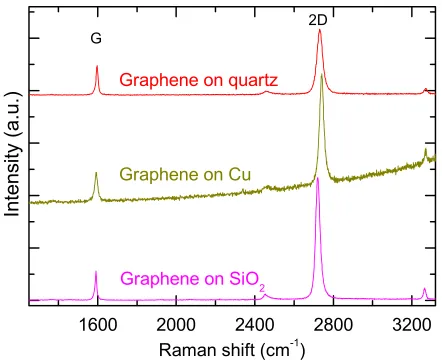
10:15, is injected at a pressure of 4:5101Torr for 30 min. The carbon atoms are then adsorbed onto the Cu surface and nucleate SLG via grain propagation.31,32 The quality and number of layers are investigated by Raman spectros-copy,33,34 Fig. 1. At the more common 514 nm excitation, the Raman spectrum of CVD graphene on Cu does not show a flat background, due to Cu photoluminescence.35This can be suppressed at 457 nm, Fig.1. The spectrum does not show a D peak, indicating negligible defects.33,34,36 The 2D peak is a single sharp Lorentzian, signature of SLG.33
a)
Electronic mail: [email protected].
We then transfer a 1010 mm2 SLG region onto a quartz substrate (3 mm thick) as follows. Poly(methyl meth-acrylate) (PMMA) is spin-coated on the sample. Cu is then dissolved in a 3% H2O2:35% HCl (3:1 ratio) mixture,
fur-ther diluted in equal volume of deionized water. The PMMA/graphene/Cu foil is then left floating until all Cu is dissolved. The remaining PMMA/graphene film is cleaned by moving it to a deionized H2O bath, a 0.5 M HCl bath, and
again to a deionized H2O bath. Finally, the layer is picked up
using the target quartz substrate and left to dry under ambi-ent conditions. After drying, the sample is heated to 180C for 20 min to flatten out any wrinkles.37The PMMA is then dissolved in acetone, leaving SLG on quartz. This is then inspected by optical microscopy, Raman spectroscopy, and absorption microscopy. A representative Raman spectrum of the transferred sample is in Fig. 1. After transfer, the 2D peak is still a single sharp Lorentzian, validating that SLG has indeed been transferred. The absence of a D peak proves that no structural defects are induced during this pro-cess.33,34,36,38In order to estimate the doping, an analysis of more than 15 measurements with 514 nm excitation is car-ried out. This wavelength is used since most previous litera-ture and correlations were derived at 514 nm.39We find that the G peak position, Pos(G), up-shifts 4 cm1 in average after transfer on quartz, whereas the full width at half maxi-mum of the G peak, FWHM(G), decreases from 17 to
10:5 cm1. Also, the 2D to G intensity and area ratios,
I(2D)/I(G); A(2D)/A(G), decrease from 3.2 to 1.6 and 5.8 to 5.3, respectively. This implies an increased p-doping com-pared to graphene on Cu before transfer.39–41 We estimate the doping for the sample on quartz to be1013cm2, corre-sponding to a Fermi level shift300=400 meV. For compar-ison, we also transferred on SiO2=Si. In this case, the
average Pos(G) and FWHM(G) are 1584 cm1and 14 cm1. The average Pos(2D) is 2685 cm1, and I(2D)/I(G); A(2D)/ A(G) are 3.2 and 7.1. This indicates a much lower doping, below 100 meV. Therefore, we conclude that the doping of our graphene transferred on quartz does not arise from the transfer process itself, but it is most likely due to charge transfer from adsorbates on the substrate.42,43The transmit-tance of the transferred SLG on quartz is then measured
(Fig. 2). The band at 270 nm is a signature of the van Hove singularity in the graphene density of states,44 while those at1:4;2:2lm are due to quartz.45The transmittance in the visible range (e.g., at 700 nm) is 97:7% (i.e.,
2:3% absorbance), further confirming that the sample is indeed SLG.46 The absorbance decreases to 1% at 2067 nm, much lower than the 2.3% expected for intrinsic SLG. We assign this to doping.47 The graphene optical conductivity r at a wavelength k is rðk;EF;TÞ ¼pe
2 4h
tanh
hc k þ2EF
4kBT
þtanh
hc k 2EF
4kBT
, as for Ref.47, where
T is the temperature,EFthe Fermi energy. The transmittance
(Tr) is linked toras47Tr14pr
c . By fitting to the
meas-ured Tr, we derive EF 350 meV, consistent with the
Raman estimates.
The laser setup is shown in Fig.3. The cavity consists of four plano-concave high-reflectivity (R>99:2% at 2lm) mirrors (M1–M4) and an output coupler (OC) with 1% trans-mittance at 2lm, and is designed to ensure the best mode-matching between the pump and intra-cavity laser beams. Tm:Lu2O3 ceramic is selected as the gain material because
[image:3.612.64.285.52.232.2]of its high thermal conductivity,48broad emission spectrum (>1:92:1lm (Refs.48and49)), high absorption,48,49and emission cross-sections,48,49 making it suitable for high-power ultrafast pulse generation.48–50 A 5 mm long Tm: Lu2O3ceramic is pumped by a home-made continuous-wave FIG. 1. Raman spectra at 457 nm for graphene on Cu (before transfer) and
after transfer on quartz and SiO2=Si.
[image:3.612.327.544.52.216.2]FIG. 2. Transmittance of quartz and graphene on quartz. For graphene, this is derived from the transmittance of transferred graphene on quartz divided by that of quartz.
FIG. 3. Laser setup. L: lens; M1 with 75 mm curvature; M2–M4 with 100 mm curvature radii; P1, P2: fused silica prisms.
[image:3.612.333.543.602.742.2]Ti:sapphire laser at 796 nm with 2.6 W maximum power. A p-polarized pump beam is focused into the gain medium via an 80 mm focal length lens and a folding mirror (with>99% transmittance at 976 nm) to a spot radius of 26lm (1=e2
in-tensity), as measured in air at the location of the input facet of the ceramic. The GSA is inserted in the cavity between mirrors M1 and M2 at the Brewster’s angle, to reduce Fres-nel’s reflection losses (Fig. 3). The laser beam waist radii inside the gain medium and on the GSA are calculated as 3261lm2 and 110158lm2, respectively, by using the ray matrices method of Ref. 51. A pair of infrared-grade fused silica prisms with 12 cm tip-to-tip separation is used to control the intracavity net group velocity dispersion (GVD). Each prism is placed at a minimum deviation to reduce inser-tion losses. The total round-trip cavity GVD at 2lm is 2980 fs2, due to the insertion of the prisms (glass mate-rial dispersion, 113 fs2=mm), the gain medium itself (15 fs2=mm) and the angular dispersion of the prism pair (1436 fs2). The whole cavity length is1:35 m.
During continuous wave operation (without GSA), the laser produces up to 640 mW output power from 1.8 W of absorbed pump power at2070 nm, the lasing threshold being 89 mW. After inserting the GSA, the lasing threshold increases to 314 mW. Self-starting mode-locking is achieved at 160 mW average output power (with1:16 W absorbed pump power). The maximum average output power is 270 mW, while the absorbed pump power is 1.8 W. The obtained output power is comparable to that of previous 2lm SESAMs mode-locked ultrafast solid-state lasers (e.g., 155 mW from Tm, Ho:NaYðWO4Þ2,
8
325 mW from Tm:Sc2O3 (Ref.9)), but
larger than thus far reported for 2lm nanotube mode-locked
Tm-doped solid-state lasers (e.g., 50 mW from a Tm:Lu2O3 laser52) and graphene mode-locked solid-state
lasers (e.g., 60 mW from a Tm:CLNGG laser28) in sub-ps regime. The repetition rate is110 MHz. The corresponding pulse energy is 2:45 nJ, higher than thus far achieved for 2lm nanotube (e.g., 0:5 nJ (Refs. 53–55)) and graphene (e.g.,0:4 nJ (Ref.25)) mode-locked fiber lasers. Higher out-put power/energy is possible by increasing pump power, as the output power is limited by the maximum available pump power.
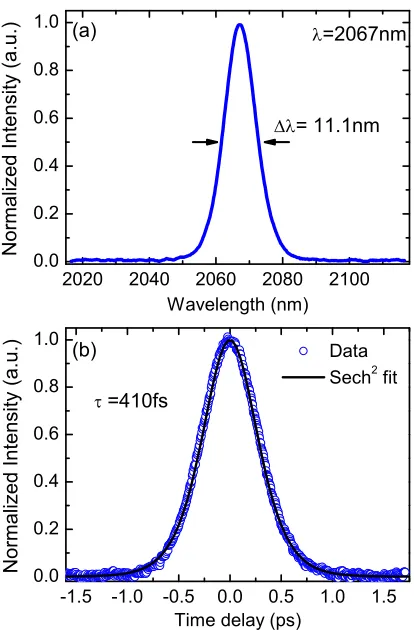
The mode-locked pulse peak wavelength is 2067 nm (Fig.4(a)). The FWHM bandwidth is11:1 nm at the maxi-mum average output power. The spectrum has no soliton sidebands, unlike what typical for 2lm ultrafast fiber lasers53–55due to intracavity periodical perturbations.56 Fig. 4(b)plots the autocorrelation trace of the output pulses at the maximum average output power. The data are well fitted by a sech2 temporal profile, giving a pulse duration 410 fs. This is longer than previously reported for SESAM and nanotube mode-locked 2lm solid-state lasers (e.g.,200 fs (Refs. 8, 9, and 52)), but shorter than previous graphene mode-locked 2lm solid-state lasers (e.g.,10 ps (Ref. 27),
729 fs (Ref. 28)). The pulse duration is much shorter than 2lm nanotube (e.g.,0:75 ps) (Ref.53),1:3 ps (Ref.55)) and graphene (e.g., 3:6 ps (Ref. 25)) mode-locked fiber lasers. The time-bandwidth product is 0.319, close to 0.315 expected for transform-limited sech2pulses.
The mode-locking operation stability is studied meas-uring the radio frequency (RF) spectrum using a fast InGaAs photo-detector (EOT, ET-5010; >7 GHz cut-off) connected to a spectrum analyzer. Fig.5plots the RF spectrum around the fundamental repetition frequency of 110 MHz. A signal-to-noise ratio of 60 dB (i.e. a contrast of 106) is measured, implying no Q-switching instabilities.57
In conclusion, we demonstrated a graphene mode-locked solid-state Tm:Lu2O3 laser at 2lm, having
transform-limited 410 fs pulses with270 mW average out-put power and110 MHz repetition rate. This showcases the potential of graphene for high-power ultrafast solid-state lasers.
We acknowledge funding from the ERC grant NANO-POTS, EU grants RODIN, MEM4WIN, GENIUS, EPSRC grants EP/GO30480/1 and EP/G042357/1, King’s College
[image:4.612.327.546.50.212.2]FIG. 4. (a) Output spectrum, (b) autocorrelation trace.
[image:4.612.71.278.437.752.2]Cambridge, the Royal Academy of Engineering, a Royal So-ciety Wolfson Research Merit Award, and the Cambridge Nokia Research Centre.
1
V. W. S. Chan,IEEE J. Sel. Top. Quantum Electron.6, 959 (2000). 2
B. E. Bouma, L. E. Nelson, G. J. Tearney, D. J. Jones, M. E. Brezinski, and J. G. Fujimoto,J. Biomed. Opt.3, 76 (1998).
3
F. Dausinger, F. Lichtner, and H. Lubatschowski,Femtosecond Technol-ogy for Technical and Medical Applications(Springer, 2004).
4
R. R. Gattass and E. Mazur,Nat. Photonics2, 219 (2008).
5M. Ebrahim-Zadeh and I. T. Sorokina,Mid-infrared Coherent Sources and
Applications(Springer, 2008). 6
U. Keller,Nature424, 831 (2003). 7
W. Sibbett, A. A. Lagatsky, and C. T. A. Brown,Opt. Express20, 6989 (2012).
8A. A. Lagatsky, X. Han, M. D. Serrano, C. Cascales, C. Zaldo, S. Calvez,
M. D. Dawson, J. A. Gupta, C. T. A. Brown, and W. Sibbett,Opt. Lett.35, 3027 (2010).
9A. A. Lagatsky, P. Koopmann, P. Fuhrberg, G. Huber, C. T. A. Brown,
and W. Sibbett,Opt. Lett.37, 437 (2012). 10
T. Hasan, Z. Sun, F. Wang, F. Bonaccorso, P. H. Tan, A. G. Rozhin, and A. C. Ferrari,Adv. Mater.21, 3874 (2009).
11Z. Sun, T. Hasan, and A. C. Ferrari,Physica E44, 1082 (2012). 12F. Bonaccorso, Z. Sun, T. Hasan, and A. C. Ferrari,Nat. Photonics
4, 611 (2010).
13
D. Popa, Z. Sun, T. Hasan, W. B. Cho, F. Wang, F. Torrisi, and A. C. Fer-rari,Appl. Phys. Lett.101, 153107 (2012).
14Z. Sun, T. Hasan, F. Torrisi, D. Popa, F. Bonaccorso, D. M. Basko, and A.
C. Ferrari,ACS Nano4, 803 (2010). 15
F. Torrisi, T. Hasan, W. Wu, S. Jung, F. Bonaccorso, P. J. Paul, D. P. Chu, and A. C. Ferrari,ACS Nano6, 2992 (2012).
16F. Wang, A. G. Rozhin, V. Scardaci, Z. Sun, F. Hennrich, I. H. White, W.
I. Milne, and A. C. Ferrari,Nat. Nanotechnol.3, 738 (2008). 17
I. H. Baek, H. W. Lee, S. Bae, B. H. Hong, Y. H. Ahn, D. I. Yeom, and F. Rotermund,Appl. Phys. Express5, 032701 (2012).
18
W. D. Tan, C. Y. Su, R. J. Knize, G. Q. Xie, L. J. Li, and D. Y. Tang, Appl. Phys. Lett.96, 031106 (2010).
19
W. B. Cho, J. H. Yim, S. Y. Choi, S. Lee, U. Griebner, V. Petrov, and F. Rotermund,Opt. Lett.33, 2449 (2008).
20Z. Sun, D. Popa, T. Hasan, F. Torrisi, F. Wang, E. Kelleher, V. Nicolosi,
and A. Ferrari,Nano Res.3, 653 (2010). 21
Q. Bao, H. Zhang, Y. Wang, Z. Ni, Y. Yan, Z. X. Shen, K. P. Loh, and D. Y. Tang,Adv. Funct. Mater.19, 3077 (2009).
22T. Hasan, F. Torrisi, Z. Sun, D. Popa, V. Nicolosi, and A. C. Ferrari,Phys.
Status Solidi B247, 2953 (2010). 23
D. Popa, Z. Sun, F. Torrisi, T. Hasan, F. Wang, and A. C. Ferrari,Appl. Phys. Lett.97, 203106 (2010).
24Y. Hernandez, V. Nicolosi, M. Lotya, F. M. Blighe, Z. Y. Sun, S. De, I. T.
McGovern, B. Holland, M. Byrne, Y. K. Gunko, J. J. Boland, P. Niraj, G. Duesberg, S. Krishnamurthy, R. Goodhue, J. Hutchison, V. Scardaci, A. C. Ferrari, and J. N. Coleman,Nat. Nanotechnol.3, 563 (2008).
25
M. Zhang, E. J. R. Kelleher, F. Torrisi, Z. Sun, T. Hasan, D. Popa, F. Wang, A. C. Ferrari, S. V. Popov, and J. R. Taylor, Opt. Express 20, 25077 (2012).
26L. E. Nelson, D. J. Jones, K. Tamura, H. A. Haus, and E. P. Ippen,Appl.
Phys. B65, 277 (1997). 27
J. Liu, Y. G. Wang, Z. S. Qu, L. H. Zheng, L. B. Su, and J. Xu,Laser Phys. Lett.9, 15 (2012).
28J. Ma, G. Q. Xie, P. Lv, W. L. Gao, P. Yuan, L. J. Qian, H. H. Yu, H. J.
Zhang, J. Y. Wang, and D. Y. Tang,Opt. Lett.37, 2085 (2012).
29S. Stankovich, D. A. Dikin, G. H. B. Dommett, K. M. Kohlhaas, E. J.
Zim-ney, E. A. Stach, R. D. Piner, S. T. Nguyen, and R. S. Ruoff,Nature442, 282 (2006).
30C. Mattevi, G. Eda, S. Agnoli, S. Miller, K. A. Mkhoyan, O. Celik, D.
Mostrogiovanni, G. Granozzi, E. Garfunkel, and M. Chhowalla, Adv. Funct. Mater.19, 2577 (2009).
31
S. Bae, H. Kim, Y. Lee, X. Xu, J. S. Park, Y. Zheng, J. Balakrishnan, T. Lei, H. R. Kim, Y. I. Song, Y. J. Kim, K. S. Kim, B. Ozyilmaz, J. H. Ahn, B. H. Hong, and S. Iijima,Nat. Nanotechnol.5, 574 (2010).
32
F. Bonaccorso, A. Lombardo, T. Hasan, Z. Sun, L. Colombo, and A. C. Ferrari, Materials Today15, 14 (2012).
33A. C. Ferrari, J. C. Meyer, V. Scardaci, C. Casiraghi, M. Lazzeri, F. Mauri,
S. Piscanec, D. Jiang, K. S. Novoselov, S. Roth, and A. K. Geim,Phys. Rev. Lett.97, 187401 (2006).
34
L. G. Cancado, A. Jorio, E. H. M. Ferreira, F. Stavale, C. A. Achete, R. B. Capaz, M. V. O. Moutinho, A. Lombardo, T. S. Kulmala, and A. C. Fer-rari,Nano Lett.11, 3190 (2011).
35
A. Mooradian,Phys. Rev. Lett.22, 185 (1969). 36
A. C. Ferrari and J. Robertson,Phys. Rev. B61, 14095 (2000).
37A. Pirkle, J. Chan, A. Venugopal, D. Hinojos, C. W. Magnuson, S.
McDonnell, L. Colombo, E. M. Vogel, R. S. Ruoff, and R. M. Wallace, Appl. Phys. Lett.99, 122108 (2011).
38
A. Ferrari,Solid State Commun.143, 47 (2007).
39A. Das, S. Pisana, B. Chakraborty, S. Piscanec, S. K. Saha, U. V.
Wagh-mare, K. S. Novoselov, H. R. Krishnamurthy, A. K. Geim, A. C. Ferrari, and A. K. Sood,Nat. Nanotechnol.3, 210 (2008).
40
C. Casiraghi, S. Pisana, K. S. Novoselov, A. K. Geim, and A. C. Ferrari, Appl. Phys. Lett.91, 233108 (2007).
41S. Pisana, M. Lazzeri, C. Casiraghi, K. S. Novoselov, A. K. Geim, A. C.
Ferrari, and F. Mauri,Nature Mater.6, 198 (2007). 42
Y. Y. Wang, Z. H. Ni, T. Yu, Z. X. Shen, Y. H. Wu, W. Chen, and A. T. Shen Wee,J. Phys. Chem. C112, 10637 (2008).
43L. Kong,J. Phys. Chem. C
114, 21618 (2010). 44
V. G. Kravets, A. N. Grigorenko, R. R. Nair, P. Blake, S. Anissimova, K. S. Novoselov, and A. K. Geim,Phys. Rev. B81, 155413 (2010). 45G. P. Agrawal,Applications of Nonlinear Fiber Optics(Academic,
Lon-don, 2001). 46
R. R. Nair, P. Blake, K. S. Novoselov, T. J. Booth, T. Stauber, N. M. R. Peres, and A. K. Geim,Science320, 1308 (2008).
47K. F. Mak, M. Y. Sfeir, Y. Wu, C. H. Lui, J. A. Misewich, and T. F. Heinz,
Phys. Rev. Lett.101, 196405 (2008). 48
P. Koopmann, R. Peters, K. Petermann, and G. Huber,Appl. Phys. B102, 19 (2011).
49O. L. Antipov, S. Y. Golovkin, O. N. Gorshkov, N. G. Zakharov, M. V.
Kruglova, M. O. Marychev, A. A. Novikov, N. V. Sakharov, and E. V. Chuprunov,Quantum Electron.41, 863 (2011).
50
A. A. Lagatsky, O. L. Antipov, and W. Sibbett,Opt. Express20, 19349 (2012).
51W. Koechner,Solid-State Laser Engineering(Springer, 2006). 52
A. Schmidt, P. Koopmann, G. Huber, P. Fuhrberg, S. Y. Choi, F. Roter-mund, V. Petrov, and U. Griebner,Opt. Express20, 5313 (2012). 53K. Kieu and F. W. Wise,IEEE Photon Technol. Lett.21, 128 (2009). 54
S. Kivisto, T. Hakulinen, A. Kaskela, B. Aitchison, D. P. Brown, A. G. Nasibulin, E. I. Kauppinen, and O. G. Okhotnikov,Opt. Express17, 2358 (2009).
55M. A. Solodyankin, E. D. Obraztsova, A. S. Lobach, A. I. Chernov, V. I.
Konov, and E. M. Dianov,Opt. Lett.33, 1336 (2008). 56
M. L. Dennis and I. N. Duling, IEEE J. Quantum Electron 30, 1469 (1994).
57C. Honninger, R. Paschotta, F. Morier-Genoud, M. Moser, and U. Keller,
J. Opt. Soc. Am. B16, 46 (1999).