This is a repository copy of
Exosome substrate targeting: the long and short of it
.
White Rose Research Online URL for this paper:
http://eprints.whiterose.ac.uk/89311/
Version: Accepted Version
Article:
Mitchell, P. (2014) Exosome substrate targeting: the long and short of it. Biochemical
Society Transactions, 42. 1129 - 1134. ISSN 0300-5127
https://doi.org/10.1042/BST20140088
[email protected] https://eprints.whiterose.ac.uk/ Reuse
Unless indicated otherwise, fulltext items are protected by copyright with all rights reserved. The copyright exception in section 29 of the Copyright, Designs and Patents Act 1988 allows the making of a single copy solely for the purpose of non-commercial research or private study within the limits of fair dealing. The publisher or other rights-holder may allow further reproduction and re-use of this version - refer to the White Rose Research Online record for this item. Where records identify the publisher as the copyright holder, users can verify any specific terms of use on the publisher’s website.
Takedown
If you consider content in White Rose Research Online to be in breach of UK law, please notify us by
Exosome Substrate Targeting: The Long and Short of It
Phil Mitchell*1
*Department of Molecular Biology and Biotechnology, The University of Sheffield, Firth Court, Western Bank, Sheffield S10 2TN
1
email: [email protected]
Keywords: Dis3, exosome, ribonuclease, processing protein 44 (Rrp44),
rRNA-processing protein 6 (Rrp6), Ski, Trf4-Air2-Mtr4 polyadenylation complex (TRAMP complex).
This Accepted Manuscript is not the Version of Record that was published in Biochemical Society Transactions by Portland Press on behalf of the Biochemical Society. The publisherÕs
Version of Record is available at the Biochemical Society Transactions website (http://dx.doi.org/bst/042/bst0420088).
Exosome substrate targeting: the long and short of it
Phil Mitchell*
1*Department of Molecular Biology and Biotechnology, The University of Sheffield, Firth Court,
Western Bank, Sheffield S10 2TN
______________________________________________________________________________
Abstract
The exosome ribonuclease complex functions in both the limited trimming of the 3Õ ends of nuclear substrates during RNA processing events and in the complete destruction of nuclear and cytoplasmic RNAs. The two RNases of the eukaryotic exosome, Rrp44 and Rrp6, are bound at either end of a catalytically inert cylindrical core. RNA substrates are threaded through the internal channel of the core to Rrp44 by RNA helicase components of the nuclear TRAMP or cytoplasmic Ski complexes. Recent studies reveal that Rrp44 can also associate directly with substrates via channel-independent routes. Although the substrates of the exosome are known, it is not clear whether specific substrates are restricted to one or other pathway. Data currently available support the model that processed substrates are targeted directly to the catalytic subunits, whereas at least some substrates that are directed towards discard pathways must be threaded through the exosome core.
______________________________________________________________________________
Functions of the Exosome
The exosome ribonuclease complex acts on all types of RNA at some point during their lifetime, functioning in (i) the 3Õ end maturation of stable RNAs (and some mRNAs); (ii) the complete degradation of fragments such as the 5Õ ETS (5Õ external transcribed spacer) that are released as a result of RNA processing reactions; (iii) quality control of all classes of nuclear and cytoplasmic RNAs; (iv) the constitutive degradation of unstable nuclear transcripts such as CUTs (cryptic instable transcripts), and (v) the ultimate degradation of cytoplasmic mRNAs [1,2].
The exosome complex is conserved throughout eukarya and most archaea, and genetic depletion of any subunit except Rrp6 causes a block in mitotic growth in yeast [3,4]. The importance of exosome function in human biology is reflected by the
observations that active site mutations in Rrp44 correlate with the incidence of multiple myeloma and relapsed acute myeloid leukaemia [5,6], while mutations in the related enzyme Dis3L2 are linked to Perlman Syndrome and WilmÕs tumour predisposition [7]. Genetic complementation analyses underscore the functional conservation of exosome subunits through fungi, plants and metazoa [3,8-10].
Structure of the Exosome
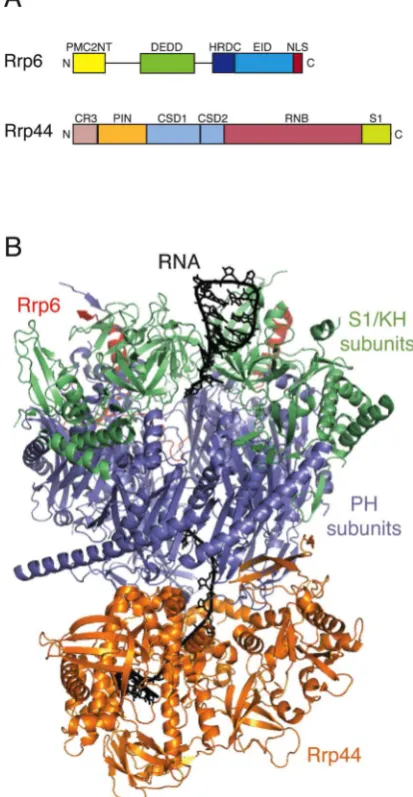
The eukaryotic exosome has a highly stable ÒcoreÓ, consisting of an asymmetric double-layered ring. The lower tier comprises six subunits (Rrp41, Rrp42, Rrp43, Rrp45, Rrp46 and Mtr3) that are structurally related to RNase PH. This is overlaid with an upper tier of three ÒcapÓ subunits (Rrp4, Rrp40 and Csl4) that have S1 or KH RNA binding domains [11,12] (see Figure 1). A structurally homologous complex is found in archaeabacteria
[13]
, which is itself similar in architecture to the bacterial PNPase (polynucleotide phosphorylase) enzyme [14]. Catalytically, however, there are clear differences between these complexes. While the archaeal complex contains multiple copies of a fewer number of subunits, the subunits of the eukaryotic exosome have diverged through evolution. The eukaryotic exosome core has lost catalytic activity but the substrate RNAs traverse the same pathway taken through the central channel of the archaeal complex [12,13]. The eukaryotic complex is directly associated with the eukaryotic-specific ribonucleases Rrp44 (also known as Dis3) and Rrp6
[3,4]
. Rrp44 is bound to the core at the ÒbottomÓ of the channel near the RNA exit site [15,16], while Rrp6 is bound to the ÒtopÓ of the core [12,17] (Figure 1). Rrp44
Keywords: Dis3, exosome, ribonuclease, rRNA-processing protein 44 (Rrp44), rRNA-rRNA-processing protein 6 (Rrp6), Ski, Trf4-Air2-Mtr4 polyadenylation complex (TRAMP complex).
Abbreviations: CSD, cold-shock domain; CUT, cryptic unstable transcript; Dis3L, DIS3-like exonuclease; 5Õ-ETS, 5Õ-external transcribed spacer; HRDC, helicase and RNase D C-terminal; hRRP6, human Rrp6 protein; KH, K homology; PIN, PilT N-terminus; PNPase, polynucleotide phosphorylase; Rrp, rRNA-processing protein; Ski, superkiller; snoRNA, small nucleolar RNA; snoRNP, small nucleolar ribonucleoprotein; TRAMP complex, Trf4-Air2-Mtr4 polyadenylation complex.
1
To whom correspondence should be addressed (email [email protected])
and Rrp6 are hydrolytic ribonucleases [18,19], whereas the archaeal complex and PNPase are phosphorolytic enzymes.
The exosome RNase Rrp44
Rrp44 is related to the RNase II/R family of 3Õ-5Õ exoribonucleases [20]. The catalytic RNB exonuclease domain is flanked at the N-terminal end by two tandem, cold-shock domains (CSD1 and CSD2) and at the C-terminal end by an S1 domain (Figure 1). The cold shock and S1 domains contribute to RNA binding. In addition to its exonuclease activity, Rrp44 also has a distinct endonuclease activity that is associated with its N-terminal PIN (PilT N-terminus) domain [21-23]. Full-length Rrp44 protein nevertheless degrades RNA in a 3Õ-5Õ direction [3,24], indicating that the endo- and exonuclease activities of Rrp44 are functionally coupled. The PIN domain also mediates the interaction between Rrp44 and the exosome core
[23,25]
. Both RNase activities of Rrp44 are largely suppressed upon interaction with the exosome through allosteric effects that diminish its ability to bind RNA [24]. In yeast there is a single gene encoding Rrp44 and the protein functions in the nucleolus, the nucleoplasm and the cytoplasm [3,26]. In contrast, three Rrp44 homologues are found in human cells; Dis3 is nucleoplasmic and excluded from the nucleolus, while Dis3L and Dis3L2 are cytoplasmic [27,28]. Dis3L lacks endonuclease activity but is associated with the exosome core, while Dis3L2 lacks the PIN domain and is not associated with the exosome. Dis3L2 plays a role in cytoplasmic mRNA degradation, in both human cells and in the fission yeast Schizosaccharomyces pombe [28,29]. Thus, at least some eukaryotic Rrp44 homologues function independently of the exosome core complex. Indeed, a recent study reported that Rrp44 in budding yeast functions in mitochondria independently of the exosome core [30]. Whether yeast Rrp44 can fully function when separated from the exosome remains to be determined. Notably, expression of the PIN domain alone is able to support slow growth [31].
The exosome RNase Rrp6
Rrp6 belongs to the RNase D family of 3Õ-5Õ exoribonucleases that contain a DEDD exonuclease domain juxtaposed to one or more HRDC (helicase and RNase D C-terminal) domains [32]. Rrp6 members of this family also contain an N-terminal PMC2NT domain [33] and a C-terminal exosome interacting domain [12] (see Figure 1). Interaction of Rrp6 with the exosome core has little effect on its exonuclease activity but allosterically stimulates the activity of Rrp44 [24]. Yeast Rrp6 is a nuclear protein
[18]
, while the human Rrp6 protein hRRP6 (also known as PM-Scl100) is restricted to the nucleolus
[27]
. Three different Rrp6 proteins are expressed in Arabidopsis thaliana; Rrp6L1 and Rrp6L2 proteins
are found in the nucleus, while Rrp6L3 is localized to the cytoplasm [9]. Thus, distinct forms of both Rrp44 and Rrp6 have evolved in different systems and presumably carry out specialized functions.
!
[image:4.595.315.522.57.456.2]Rrp6 and the small nuclear, RNA binding protein Rrp47 (also known as Lrp1 in yeast, or C1D in human cells) form a heterodimer through an interaction between their N-terminal PMC2NT and Sas10/C1D domains [34,35]. This interaction provides mutual protein stabilization [36,37] and limits expression of the Rrp6/Rrp47 complex to the nucleus [35]. The C-terminal region of Rrp47 mediates interactions with snoRNP components that are critical for the normal 3Õ end maturation of box C/D snoRNAs [38]. Thus, the Rrp6/Rrp47 interaction also allows RNA degradation to be coupled to substrate recognition or binding.
Threading substrates through the exosome
Rrp44 alone shields a stretch of 9-12 nucleotides in RNase protection assays, and 31-33 nucleotides when associated with the exosome core [16]. Substrate binding to Rrp44 requires a single-stranded 3Õ terminus but, once engaged with the RNA, Rrp44 is a highly processive exoribonuclease that efficiently degrades structured RNA [11]. The energy released upon hydrolytic activity of Rrp44 is released in bursts, pulling substrates through the complex by a steric occlusion mechanism [39,40]. The function of the exosome complex in vivo is dependent upon additional factors, notably the structurally closely related RNA helicases Mtr4 (also known as Dob1) and Ski2 [41,42]. Yeast Mtr4, together with the noncanonical poly(A) polymerases Trf4 or Trf5 and the RNA-binding proteins Air1 or Air2, constitute the TRAMP complexes that stimulate exosome-mediated RNA degradation in vitro and in vivo [43-45]. The human protein hMTR4 is found in a homologous TRAMP complex together with hRRP6 in the nucleolus, as well as being a component of the distinct nuclear exosome targeting (NEXT) complex [46]. This suggests that hMTR4, like yeast Mtr4, has a major role in targeting nuclear RNAs to the exosome and that it promotes the degradation of some substrates independently of their oligoadenylation. Ski2 is a component of the cytoplasmic Ski complex, which contains the scaffold protein Ski3 and two copies of the protein Ski8 [47,48], and is critical for exosome-mediated cytoplasmic mRNA degradation [42] and mRNA surveillance pathways [49-51].
RNase protection assays suggest that the Ski complex is positioned on top of the exosome core
[52]
, as has been proposed for Mtr4 [53,54]. The RNA helicases Mtr4 and Ski2 are thought to unfold the 3Õ end of substrates and thread the resultant single-stranded RNA 3Õ end into the exosome core for subsequent degradation by Rrp44. A number of conserved residues are found at the base of the central DExH core within Mtr4 and Ski2 and on the upper surface of the exosome core, suggesting that they might constitute a mutual binding interface. Nevertheless, additional factors are required for a stable interaction between the RNA helicases and
the exosome core. Mtr4 directly interacts with the exosome-associated protein Mpp6 [55], which may promote binding with the exosome core. Furthermore, hRRP6 is required for stable interaction between hMTR4 and the exosome core
[46]
. The interaction between the yeast Ski complex and the exosome is dependent upon another factor, Ski7 [56].
Mutations in Rrp41 (also known as Ski6) and/or Rrp45 that alter conserved residues or obstruct the central channel cause a block in growth in yeast
[24,57]
. This suggests that the passage of at least some RNAs through the exosome core is essential for cell growth.
A conformational switch in Rrp44
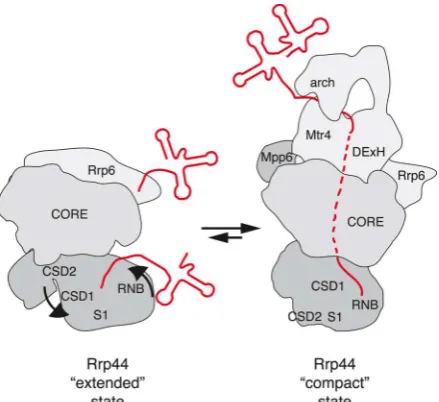
Recent structural analyses resolve two distinct structural conformations of Rrp44 bound to the exosome core complex [58] (see Figure 2). In the presence of short structured RNAs, Rrp44 that is associated with the exosome core has an extended structure and the substrate can directly access either the exonuclease domain or the PIN domain. In this state, the CSD2 domain of Rrp44 is positioned at the RNA exit site at the bottom of the core, blocking the pathway of the substrate through the core. In the presence of longer RNAs, Rrp44 undergoes a substantial conformational change and becomes more compact. The exonuclease domain is rotated ~ 120¡, bringing it close to the RNA exit site and displacing the CSD2 domain. In this conformation, Rrp44 is able to digest RNA that is threaded through the channel. These data suggest that Rrp44 bound to the exosome core can switch between an extended conformation that is accessible to direct substrate binding, and a compact conformation that is aligned for interaction with threaded substrates.
the threaded pathway to Rrp44 might suppress access of substrates to the catalytic domain of Rrp6, thereby ensuring that a single exosome complex can only be engaged with a substrate targeted to the one or other enzyme (see Figure 2).
Long and short pathways for distinct RNAs
Deletion of the exosome interacting domain of Rrp6 does not impair its function in box C/D snoRNA 3Õ maturation or the trimming of the Ò5.8S+30Ó processing intermediate, but does cause a defect in discard pathways that degrade the 5Õ ETS fragment and truncated degradation intermediates of 5S rRNA
[59]
. Furthermore, in vivo cross-linking studies have shown that Rrp44 and Rrp6 bind directly to 7S pre-rRNA and snoRNA processing intermediates but very few contacts were observed with exosome core components [60]. These data suggest that substrates that undergo limited trimming reactions are normally targeted directly to Rrp44 or Rrp6, whereas at least some substrates destined for complete degradation are dependent upon threading through the exosome core. It is unclear whether Rrp6 can efficiently degrade its other substrates, such as pre-mRNAs,
CUTs/SUTs, tRNAs and snRNAs, when uncoupled from the exosome core.
Strikingly, the subset of Rrp6 substrates that accumulate in rrp6 mpp6 double mutants comprise those that are destined for complete degradation (CUTs, pre-mRNAs, 5Õ ETS, truncated stable RNAs, snoRNA transcription read-through products) and exclude those that undergo limited 3Õ end processing reactions (5.8S rRNA, box C/D snoRNAs) [61,62]. Given that Rrp6 substrates targeted to degradation are dependent upon the interaction between Rrp6 and the exosome core, this suggests that the synthetic lethal relationship between loss of function rrp6 and mpp6 alleles [61] might reflect redundant functions of Rrp6 and Mpp6 in facilitating substrate threading into the exosome core. This model is supported by the direct physical interaction reported between hMPP6 and hMTR4 [55] and the observation that the stable interaction between hMTR4 and the exosome core is dependent upon hRRP6 [46].
Although the exosome was initially characterised through its role in the 3Õ processing of 5.8S rRNA [3], the overwhelming majority of exosome substrates are targeted to RNA discard pathways [60,63]. The exosome is able to degrade extensively structured pre-ribosomal RNP particles in a highly processive manner. It is not clear how substrates destined for limited processing could be effectively differentiated from those that are targeted to discard pathways if they were both engaged in a highly processive mode of degradation. One function proposed for the endonuclease activity of Rrp44 is to release substrates that are stalled in the exosome channel, thereby salvaging blocked exosome complexes [64]. The endonuclease activity of Rrp44 is not, however, required for exosome-mediated RNA processing events in wild-type cells. Thus, such a role presumably represents a fail-safe recycling function rather than an obligatory step in RNA processing.
Which RNAs might be degraded by Rrp44 using direct, core-independent pathways, and how would these RNAs be targeted without threading through the exosome core? One major class of such substrates might be incorrectly folded tRNAs, which can be targeted directly to Rrp44 [65,66]. Notably, tRNA represents a significant proportion of the RNA subjected to cellular RNA discard pathways [63]. Other small, structured RNAs targeted to discard pathways may well share this route. Such substrates are likely to require 3Õ tailing by TRAMP
[65]
or another nucleotidyltransferase [66] to facilitate efficient docking with Rrp44. A major current objective is to define the set of RNAs that are threaded through the exosome core and those that are targeted directly to either Rrp44 or Rrp6.
!
[image:6.595.65.285.59.260.2]References
1 Chlebowski A, Lubas M, Jensen TH, Dziembowski A. (2013) RNA decay machines: The exosome. BBA - Gene Regulatory Mechanisms. 1829, 552Ð560.
2 Schneider C, Tollervey D. (2013) Threading the barrel of the RNA exosome. Trends Biochem. Sci. 38, 485Ð493.
3 Mitchell P, Petfalski E, Shevchenko A, Mann M, Tollervey D. (1997) The exosome: a conserved eukaryotic RNA processing complex containing multiple 3'->5' exoribonucleases. Cell. 91, 457Ð466.
4 Allmang C, Petfalski E, Podtelejnikov A, Mann M, Tollervey D, Mitchell P. (1999) The yeast exosome and human PM-Scl are related complexes of 3' -> 5' exonucleases. Genes Dev. 13, 2148Ð2158.
5 Chapman MA, Lawrence MS, Keats JJ, Cibulskis K, Sougnez C, Schinzel AC, et al. (2011) Initial genome sequencing and analysis of multiple myeloma. Nature. 471, 467Ð472. 6 Ding L, Ley TJ, Larson DE, Miller CA, Koboldt DC, Welch JS,
et al. (2012) Clonal evolution in relapsed acute myeloid leukaemia revealed by whole-genome sequencing. Nature. 481, 506Ð509.
7 Astuti D, Morris MR, Cooper WN, Staals RHJ, Wake NC, Fews GA, et al. (2012) Germline mutations in DIS3L2 cause the Perlman syndrome of overgrowth and Wilms tumor susceptibility. Nature Genetics. 44, 277Ð284.
8 Noguchi E, Hayashi N, Azuma Y, Seki T, Nakamura M, Nakashima N, et al. (1996) Dis3, implicated in mitotic control, binds directly to Ran and enhances the GEF activity of RCC1. EMBO J. 15, 5595Ð5605.
9 Lange H, Holec S, Cognat V, Pieuchot L, Le Ret M, Canaday J, et al. (2008) Degradation of a polyadenylated rRNA maturation by-product involves one of the three RRP6-like proteins in Arabidopsis thaliana. Mol. Cell. Biol. 28, 3038Ð 3044.
10 Baker RE, Harris K, Zhang K. (1998) Mutations synthetically lethal with cep1 target S. cerevisiae kinetochore components. Genetics. 149, 73Ð85.
11 Liu Q, Greimann JC, Lima CD. (2006) Reconstitution, activities, and structure of the eukaryotic RNA exosome. Cell. 127, 1223Ð1237.
12 Makino DL, BaumgŠrtner M, Conti E. (2013) Crystal structure of an RNA-bound 11-subunit eukaryotic exosome complex. Nature. 495, 70Ð75.
13 Lorentzen E, Walter P, Fribourg S, Evguenieva-Hackenberg E, Klug G, Conti E. (2005) The archaeal exosome core is a hexameric ring structure with three catalytic subunits. Nat. Struct. Mol. Biol. 12, 575Ð581.
14 Symmons MF, Jones GH, Luisi BF. (2000) A duplicated fold is the structural basis for polynucleotide phosphorylase catalytic activity, processivity, and regulation. Structure. 8, 1215Ð1226.
15 Wang H-W, Wang J, Ding F, Callahan K, Bratkowski MA, Butler JS, et al. (2007) Architecture of the yeast Rrp44 exosome complex suggests routes of RNA recruitment for 3' end processing. Proc Natl Acad Sci U S A. 104, 16844Ð 16849.
16 Bonneau F, Basquin J, Ebert J, Lorentzen E, Conti E. (2009) The Yeast Exosome Functions as a Macromolecular Cage to Channel RNA Substrates for Degradation. Cell 139, 547Ð559. 17 Cristodero M, Bottcher B, Diepholz M, Scheffzek K, Clayton C. (2008) The Leishmania tarentolae exosome: Purification and structural analysis by electron microscopy. Mol. Biochem. Parasitol. 159, 24Ð29.
18 Burkard KT, Butler JS. (2000) A nuclear 3'-5' exonuclease involved in mRNA degradation interacts with Poly(A) polymerase and the hnRNA protein Npl3p. Mol. Cell. Biol. 20, 604Ð616. 19 Dziembowski A, Lorentzen E, Conti E, SŽraphin B. (2006) A single subunit, Dis3, is essentially responsible for yeast exosome core activity. Nat. Struct. Mol. Biol. 14, 15Ð22.
20 Mian IS. (1997) Comparative sequence analysis of ribonucleases HII, III, II PH and D. Nucleic Acids Res. 25, 3187Ð3195.
21 Lebreton A, Tomecki R, Dziembowski A, SŽraphin B. (2008) Endonucleolytic RNA cleavage by a eukaryotic exosome. Nature. 456, 993Ð996.
22 Schaeffer D, Tsanova B, Barbas A, Reis FP, Dastidar EG, Sanchez-Rotunno M, et al. (2009) The exosome contains domains with specific endoribonuclease, exoribonuclease and cytoplasmic mRNA decay activities. Nat. Struct. Mol. Biol. 16, 56Ð62.
23 Schneider C, Leung E, Brown J, Tollervey D. (2008) The N-terminal PIN domain of the exosome subunit Rrp44 harbors endonuclease activity and tethers Rrp44 to the yeast core exosome. Nucleic Acids Res. 37, 1127Ð1140.
24 Wasmuth EV, Lima CD. (2012) Exo- and endoribonucleolytic activities of yeast cytoplasmic and nuclear RNA exosomes are dependent on the noncatalytic core and central channel. Mol. Cell. 48, 133Ð144.
25 Schaeffer D, Reis FP, Johnson SJ, Arraiano CM, van Hoof A. (2012) The CR3 motif of Rrp44p is important for interaction with the core exosome and exosome function. Nucleic Acids Res. 40, 9298-9307.
26 Allmang C, Kufel J, Chanfreau G, Mitchell P, Petfalski E, Tollervey D. (1999) Functions of the exosome in rRNA, snoRNA and snRNA synthesis. EMBO J. 18, 5399Ð5410. 27 Tomecki R, Kristiansen MS, Lykke-Andersen SOR,
Chlebowski A, Larsen KM, Szczesny RJ, et al. (2010) The human core exosome interacts with differentially localized processive RNases: hDIS3 and hDIS3L. EMBO J. 29, 2342Ð 2357.
28 Lubas M, Damgaard CK, Tomecki R, Cysewski D, Jensen TH, Dziembowski A. (2013) Exonuclease hDIS3L2 specifies an exosome-independent 3. EMBO J. 32, 1855Ð1868. 29 Malecki M, Viegas SC, Carneiro T, Golik P, Dressaire CEM,
Ferreira MG, et al. (2013) The exoribonuclease Dis3L2 defines a novel eukaryotic RNA degradation pathway. EMBO J. 32, 1842-1854.
30 Turk EM, Das V, Seibert RD, Andrulis ED. (2013) The Mitochondrial RNA Landscape of Saccharomyces cerevisiae. PLoS ONE. 8, e78105.
31 Schaeffer D, van Hoof A. (2011) Different nuclease requirements for exosome-mediated degradation of normal and nonstop mRNAs. Proc Natl Acad Sci U S A. 108, 2366Ð 2371.
32 Moser MJ, Holley WR, Chatterjee A, Mian IS. (1997) The proofreading domain of Escherichia coli DNA polymerase I and other DNA and/or RNA exonuclease domains. Nucleic Acids Res. 25, 5110Ð5118.
33 Staub E, Fiziev P, Rosenthal A, Hinzmann B. (2004) Insights into the evolution of the nucleolus by an analysis of its protein domain repertoire. Bioessays. 26, 567Ð581.
34 Stead JA, Costello JL, Livingstone MJ, Mitchell P. (2007) The PMC2NT domain of the catalytic exosome subunit Rrp6p provides the interface for binding with its cofactor Rrp47p, a nucleic acid-binding protein. Nucleic Acids Res. 35, 5556Ð 5567.
35 Feigenbutz M, Jones R, Besong TMD, Harding SE, Mitchell P. (2013) Assembly of the yeast exoribonuclease Rrp6 with its associated cofactor Rrp47 occurs in the nucleus and is critical for the controlled expression of Rrp47. J Biol Chem. 288, 15959Ð15970.
36 Feigenbutz M, Garland W, Turner M, Mitchell P. (2013) The Exosome Cofactor Rrp47 Is Critical for the Stability and Normal Expression of Its Associated Exoribonuclease Rrp6 in Saccharomyces cerevisiae. PLoS ONE. 8, e80752.
37 Stuparevic I, Mosrin-Huaman C, Hervouet-Coste N, Remenaric M, Rahmouni AR. (2013) Co-transcriptional recruitment of the RNA exosome cofactors Rrp47p, Mpp6p and two distinct TRAMP complexes assists the exonuclease Rrp6p in the targeting and degradation of an aberrant mRNP in yeast. J Biol Chem. 288, 31816-31829.
core, Rrp44: diverse modes of substrate recruitment in the RNase II nuclease family. Mol Cell. 29, 717Ð728.
40 Lee G, Bratkowski MA, Ding F, Ke A, Ha T. (2012) Elastic Coupling Between RNA Degradation and Unwinding by an Exoribonuclease. Science. 336, 1726Ð1729.
41 la Cruz de J, Kressler D, Tollervey D, Linder P. (1998) Dob1p (Mtr4p) is a putative ATP-dependent RNA helicase required for the 3' end formation of 5.8S rRNA in Saccharomyces cerevisiae. EMBO J. 17, 1128Ð1140.
42 Anderson JS, Parker RP. (1998) The 3' to 5' degradation of yeast mRNAs is a general mechanism for mRNA turnover that requires the SKI2 DEVH box protein and 3Ò to 5Ó exonucleases of the exosome complex. EMBO J. 17, 1497Ð 1506.
43 Wyers F, Rougemaille M, Badis G, Rousselle J-C, Dufour M-E, Boulay J, et al. (2005) Cryptic pol II transcripts are degraded by a nuclear quality control pathway involving a new poly(A) polymerase. Cell. 121, 725Ð737.
44 LaCava J, Houseley J, Saveanu C, Petfalski E, Thompson E, Jacquier A, et al. (2005) RNA degradation by the exosome is promoted by a nuclear polyadenylation complex. Cell. 121, 713Ð724.
45 Vanacova S, Wolf J, Martin G, Blank D, Dettwiler S, Friedlein A, et al. (2005) A new yeast poly(A) polymerase complex involved in RNA quality control. PLoS Biol. 3, e189.
46 Lubas M, Christensen MS, Kristiansen MS, Domanski M, Falkenby LG, Lykke-Andersen S, et al. (2011) Interaction Profiling Identifies the Human Nuclear Exosome Targeting Complex. Mol Cell. 43, 624Ð637.
47 Brown JT, Bai X, Johnson AW. (2000) The yeast antiviral proteins Ski2p, Ski3p, and Ski8p exist as a complex in vivo. RNA. 6, 449Ð457.
48 Synowsky SA, Heck AJR. (2008) The yeast Ski complex is a hetero-tetramer. Protein Sci. 17, 119Ð125.
49 van Hoof A, Frischmeyer PA, Dietz HC, Parker R. (2002) Exosome-mediated recognition and degradation of mRNAs lacking a termination codon. Science. 295, 2262Ð2264. 50 Mitchell P, Tollervey D. (2003) An NMD pathway in yeast
involving accelerated deadenylation and exosome-mediated 3'->5' degradation. Mol Cell. 11, 1405Ð1413.
51 Orban TI, Izaurralde E. (2005) Decay of mRNAs targeted by RISC requires XRN1, the Ski complex, and the exosome. RNA. 11, 459Ð469.
52 Halbach F, Reichelt P, Rode M, Conti E. (2013) The Yeast Ski Complex: Crystal Structure and RNA Channeling to the Exosome Complex. Cell. 154, 814Ð826.
53 Weir JR, Bonneau F, Hentschel J, Conti E. (2010) Structural analysis reveals the characteristic features of Mtr4, a DExH helicase involved in nuclear RNA processing and surveillance. Proc Natl Acad Sci U S A. 107, 12139Ð12144.
54 Jackson RN, Klauer AA, Hintze BJ, Robinson H, van Hoof A, Johnson SJ. (2010) The crystal structure of Mtr4 reveals a novel arch domain required for rRNA processing. The EMBO J. 29, 2205Ð2216.
55 Schilders G, van Dijk E, Pruijn GJM. (2007) C1D and hMtr4p associate with the human exosome subunit PM/Scl-100 and are involved in pre-rRNA processing. Nucleic Acids Res. 35, 2564Ð2572.
56 Araki Y, Takahashi S, Kobayashi T, Kajiho H, Hoshino S, Katada T. (2001) Ski7p G protein interacts with the exosome and the Ski complex for 3'-to-5' mRNA decay in yeast. EMBO J. 20, 4684Ð4693.
57 Drazkowska K, Tomecki R, Stodus K, Kowalska K, Czarnocki-Cieciura M, Dziembowski A. (2013) The RNA exosome complex central channel controls both exonuclease and endonuclease Dis3 activities in vivo and in vitro. Nucleic Acids Res. 41, 3845-3858.
58 Liu J-J, Bratkowski MA, Liu X, Niu C-Y, Ke A, Wang H-W. (2013) Visualization of distinct substrate-recruitment pathways in the yeast exosome by EM. Nat. Struct. Mol. Biol. 21, 95-102.
59 Callahan KP, Butler JS. (2008) Evidence for core exosome independent function of the nuclear exoribonuclease Rrp6p. Nucleic Acids Res. 36, 6645Ð6655.
60 Schneider C, Kudla G, Wlotzka W, Tuck A, Tollervey D. (2012) Transcriptome-wide analysis of exosome targets. Mol. Cell. 48, 422Ð433.
61 Milligan L, Decourty L, Saveanu C, Rappsilber J, Ceulemans H, Jacquier A, et al. (2008) A yeast exosome cofactor, Mpp6, functions in RNA surveillance and in the degradation of noncoding RNA transcripts. Mol. Cell. Biol. 28, 5446Ð5457. 62 Garland W, Feigenbutz M, Turner M, Mitchell P. (2013)
Rrp47 functions in RNA surveillance and stable RNA processing when divorced from the exoribonuclease and exosome-binding domains of Rrp6. RNA. 19, 1659Ð1668. 63 Gudipati RK, Xu Z, Lebreton A, SŽraphin B, Steinmetz LM,
Jacquier A, et al. (2012) Extensive degradation of RNA precursors by the exosome in wild-type cells. Mol. Cell. 48, 409Ð421.
64 Schneider C, Tollervey D. (2014) Looking into the barrel of the RNA exosome. Nat. Struct. Mol. Biol. 21, 17Ð18. 65 Schneider C, Anderson JT, Tollervey D. (2007) The exosome
subunit Rrp44 plays a direct role in RNA substrate recognition. Mol Cell. 27, 324Ð331.
66 Wilusz JE, Whipple JM, Phizicky EM, Sharp PA. (2011) tRNAs marked with CCACCA are targeted for degradation. Science. 334, 817Ð821.