Gommissiot
Joint
Resei
b
o
-{E
o
I
o
=
o
-o,
b
{!
E
C,
C)
ED
e
I
ts
--CL
E
o
C)
O
rYYt
v
oooooo
o o
oo
oo
oo
-o
o
ooooo
o
O
o
o
o
o
o
o
o
oo
o
Due
to technical
reasons
the
publ
Ication
of this Newsletter
has
been delayed.
We
apologlze
and we hope
to anticlpate
the
appearance
of the next edltlon.
Contents
Editorial
note
The system
of
software at the Computing Centre
present status and
possible
development
IBM
Fortran
lV
(H extended)
Caulogued procedure
LISP
Statistics
on computer
utilization,
March
Utilization
by objectives and accounts, March
Table
of
equivalent time, summary per month
and
cumulative
Back-up
of
PSQ-file
Note
to
the
usersVisitors
2
3
6
10
11
12
13
14
21
Note
of the Editor
The present Neurletter will bepublished monthly except for August and December.
Tho Nev\Aletter will include:
.
Derrslopments, changes, uses ofinstallations
o
Announ@ments. ner,\6 and ahtracts on initiatives and accompl ishments. The Editor thanks in advance those who will wEnt to contribute to the News-letter by sending articl€s in English or Frendr to one of the folloring persons of the Editorial Board.Note de la Rddastion
Le pr6sent Bulletin sera publid
mensuelle-ment exoept6 durant les mois d'ao0t et ddcembre.
Le Bulletin traitera des:
o
Ddveloppements. changements et emploi des installationso
Avis, nouvelles et r6sum6s concernantles initiatives et les r6alisations, [.a Rddaction remercie d'avance ceux
qui voudront bien contribuer au Bulletin en envoyant des articles en anglais ou frangais d l'un des rnembres du Comit6 de Rddaction.
Editorial
Board/
ComftC de R6dastionS.R. Gabbai, D.G. lsPra H. de Wolde, C.C. lsPra
C. Pigni, C.C. lsPra
J. Pire, C.C. lsPra
Computing Centre References
hnager
Adjoined
bmputer Room
Adioined
foriplprab
S6tem Group
Adloined lnforntatics Support
o General lnformation o Program lnfornution Service
AdJoined
o Graphics and Support to Users
Adloined
Application Packages
Programming Languages
J.
Pire
1816
732G.
Gaggero
1874
787P.
Tomba
1857
797A.
Binda
1857
797,G.
Nocera
1825
767D.
Koenig
1839
742P.A.
Moinil
1841
7O4G.
Gaggero
1874
787G.
Hudry
1873
787G.
Gaggero
1874
787 S. LeoMenardi
1884
721H.l . de
Wolde
1890
753A.
Pollicini
1882
743A.
lnzaghi
1887
755 C. van denMuyzenberg
1848
781Tel.
Editor :
Sylvia R. C"OUa,Layout :
Paul Oe Ho6The System Software
at
the Comput[ng Centre
Present
Status and
Posible
Development
D. Koenig Preface
This
article
isthe
first
oneof
a seriesof
three articles.lt
will
describe the presentsituation
of
the
systemsoftware,
outline the
possibilitiesfor
itsfuture
dev'elopment and serve as anintroduction
for
thefollowing
articles.The
secondarticle
will
presentthe
highlights
of
the
present operating system-
OS/MVT (1)
Release 21.8-
on a more technical level.The
third
articlewill
give anintroduction to
one componentof
the presentoperating system
-
namelythe Time
SharingOption
(TSO)of
OS/MVT (1)-
andwill
present an overviewof
the facilities which
are availableto
the
userof
TSO. (Furthermore detailedinformation on
howto
use TSOwill
be provided before the systemwill
be introduced).ln
thefollowing
theterm
"systemsoftware"
is used in.a restricted senseto
only
denote
the
operating systemproper (i.e. OS/MVT
and
HASP andcomponents
thereof).
Excluded
from
the following discusion are
thelanguage processors
like
compilers and assemblers,the
data base systemse/en
if
they
providetheir
own
data communication environment and thelarge application packages like
for
instance GENESYS and ICES. This does hourevernot
mean that these components are excluded in the planningfor
the system software development.
The System Software and its Development
For some time there exist (among others)
two partly
interrelated trendsof
development
of
computing. Thefirst
one is.to providefor
the users better rccessto
the
computing facilities.
This
is
usually accomplishedby
thetransition from
a
"batch
operatingsystem"
to
a
timssharing
operatingsystem
offering
accessto
the
computer via on-line terminals. ln aprallelto
the
developmentof
tim+sharing
operating systemsnew
computingfaci-lities urcre developed
which
are especiallysuited
to
be usedfrom
ater-minal
like
for
instancetext
editors1),
incremental compilers2) or
highlevel
language debuggingsystems3).
The
secondtrend is
the
decentra-lization
of
computing services.This
is usually doneby
removing some ofthe existing
servicefunctions
from a
central
machine and implementingposible
advantagesof
this
approach arediscused
in
Ref.4,
5 and6.
lf
executed properly thib transition should have
only minor
inf luences on the users of a computing service.It
is expectedthat
alsothe
developmentof
the JRC computing facilitieswill follow
thesetwo
trends;that
is, in a f irst step the accessto
the centralmachine
will
be improved andin
a second step somefunctions
presentlyincorporated
into
the softwareof
the central machinewill
be implemented on other machines.Better Access
After
a general analysisof
the
computing requirementsfor
the JRCin
thefuture
7)
andafter
a
more detailed analysisof
the
requirementsfor
con-versational computing (contained in
8))
it
became evident that the existingteleprocessing system
could
not
fulfill
these requirements because there wEEno
manpower availableto
further
developit.
Therefore
it
became necessaryto
replacethe
operating systemOS/MFT
(2)
by the
operatingsystem
OS/MVT
(1)
in
order
to
be able
to
introduce
a
teleprocessingmonitor
which is adaptedto
the computing needsof
the Centre.After the introduction of
OS/MVT at
the endof
last year an analys's offour
TP-monitors:CONTEXT
(TEL-TEC System
S.A.)IMSJDS
(lBM
Corp.)ROSCOE
(Applied
Data
Research
lnc.)TSO
(lBM
Corp.)was made. Based on
techrical, financial,
maintenance and support aspectsof
the different
monitors as vrell asthe
computing needsof
the JRC, the decision vwstaken
to
choose TSO. The system isnow
in
a testing phaseand
will
probably
be availablefor
the connectionof
the
f irst terminals in September this year. The serviceof
the internal TP-system (TE LEUR)will
be offered
for
as long as there are major applications usingit.
lt
is howeverrecommended
that
new applications usethe
Tso-system. Existing,inter-nally developed applications like SIMAS or COREA
will
be moved to TSO. Sincethe
editing facilitiesof
TSO are more powerful and more convenientto
usethan
thoe
offered byPSO/FlLEDlit
is expected that the transition from PSOFILEDI usage to TSO usage is made quickly. The user may obtainassistance in the transfer
of
his data f rom PSOto
TSO.MVT
=MFT =
Multiprogramming with
a
variabh numberof
tasks Multit)roqramminq with a tixed number oI tasks (1)l2l
Decentralization
The second step
in
the developmentof
the JRC computing facilities -that
is
the
decentralizationof
servicefunctions
- will not
betaken
in
the nearfuture. ln
orderto
introduce a sensible decentralization in the Centreit
isnecessary
to
be
able
to
interconnect
different
types
of
computersin
auniform
way.
At
present afirst
study
has been performed-
with
activeuser
participation
-
on how
to
solvethe
interconnection problemwithin
the
JRC.The
resultsof
this study
will
be presentedin
a
later isue.
Onlyafter the
interconnection problem is
solvedfurther
decisionson how
to
decentralize
the
actual computing
servicescan be taken
in
cooperationwith
the involved users.References
1. RICE/VAN DAM: On-line Text Editing, A Survey, Computing Surveys 3(1971),
pp. 93114
2.
RISHEL, W,J.: lncremental Compilers, Patamation Jan. 1970, pp. 129-.l363.
EVANS/DARLEY: On-line Debugging Techniques, A Survey, AFIPS Proceedings29 (FJCC 1966), pp.37-49
4.
PATRICK,B.L.:
Decentralizing Hardware and Dispersing Responsibility,Data-mationvol.22, No. 5, May 1976,pp. 79-84
5. WAGNER,
F,V.:
ls
Decentralization lnevitable?
Datamation vol.22,No.
10, Nov. 1976, pp.86976,
FEHRERA/NILLES: Five Years Planningfor
Dara Communiation, Datamationvol.22, No. 10, Oct. 1976, pp.51-57
7.
LANGSFORD: Reporton
Computing Requirementsat
lspra
19761980, HL.76/2306 (Aug. 1976), Computer Service and Systems Division, AERE Harwell8.
GRABE/LANGSFORD: Repon on the Strategyfor
Computing FacilitiesDeve-lopment at JBC lspra, Christian Rovsing Report (Dec. 19761
lBM Fortran
lV
(H Extended)
C. Pigni
lntroduction
Recently
the
FORTRAN
lV
(H
Extended)
compiler.with the
Library Modelll
have been installed. These aretwo
product programs produced by the IBM corporation.The library
repliesto
the
requestsof
thecompiler
for
mathematical and service subprograms.The
FORTRAN
lV
(H
Extended) compiler acceptsany
source programsthat
arevalid
definedin
IBM
System/360 and System/37OFORTRAN tV
language.
\
The compiler has saneral extended features and capabilities. Extended-precision
Data types:
REAL*16
and COMPLEX*32 are implementedwith
function
and
input/output
conversion support.The
magnitude isfrom
16.6s (approximately
1O7E)through
16-63(aF
prox imately 1 C|-7 s ).
The
precisionis
of
28
hexadecimaldigits
(approximately35
decimaldi-gits).
A
REAL*16
CONSTANT consistsof
a
string
of
decimaldigits
with
orwithout
a decimalpoint, followed
by an extended precision exponent. Theexponent consists
of the
letter
Ofollowed by
a signed or unsigned one ortwo digit
integer constant.lf
the string
isnot
followed
by
theexponent
it
is treated as avalid
basic real constant offour
digits.Examples:
. 491 27 1
84U297
1 6536281 50 + 3367.27951009
The
letter
O
is usedin the format
statementto
represent extended REAL data fields.Example:
101 FORMAT
(O18.6,2024.16,2A21.181The
first
field
contains
18
characters.of
which
6
are the
fractional Portion.The second and the
third
are identical fieldsof
24 characters, 16 of whichare the fractional portion.
The fourth and
fifth
are
identical fields and contain
21
characters, of which 18 are the f ractional portion.External
Statement ExtensionThis feature provides a means
of
declaring certain names thatwould
other-wise
be consideredFORTRAN
library
subprogramsto
bethe
names ofuser-supplied f unctions or subroutines.
The added
facility
is obtainedby
writing
an AMPERSAND(&)
precedingthe library function
or
subroutine namein an EXTERNAL
statement.A
user-supplied
function
is regarded asof
the type and length predefined byits
initial
character, unlessits type
is
declaredin an
IMPLICIT
or
EX-PLICIT specification
statement. Compiler checkingof
the type,
numberand
length
of
the
argumentsof
both
functions and
subroutinesis
suspended.
Example:
EXTERNAL
&OSINA=OSIN(E,F,D)
Explanation:
Becauseof
its
appearancewith
an
ampersandin
an
EX-TERNAL
statement,OSIN
is treated as a user-supplied external procedureof
type REAL*4 without
checking on the arguments.Automatic
Function SelectionThe automatic
function
selectionfacility
allowsthe
programmerto
use a single generlc name when requesting a FORT RAN-suppliedfunction
whichhas several names, depending
on
argumenttype.
The
properfunction
is selectedby
the
FORTRAN compiler
based onthe type
and the lengthof
the argument
of
the function.
The function
is requestedby
including theGENERIC statement.
Example:
GENER IC
EXTERNAL
SINREAL*8
A,B,C,D C=SlN(A)D=DStN(B)
CALL. SUB(SIN)
.
Exaplanation.'
Becauseautomatic
function
selection has
been invoked,function DS|N.is
called
to
calculatethe value
of
C, aswell
asD.
Thespecif ic name SIN is passed
to
the subroutine SUB.List-di rected I
nput/Output
The list
directedinput/output
feature permits reading andwriting of
for-matted
datawithout
a
FORMAT
statement. The generalform of
READand WRITE statement becomes the
following:
READ
(a,*,ERR=b,END=c) listWRITE (a,*)
listThe
format
statementnumber is substituted
by
an asterisk.The
BACK-SPACE statement maynot
be usedwith
list-directed data.The
list-directed
input
data consistsof
an alternation
of
constants and separators.An
input
constant may beof
anyvalid FORTRAN
data type,except
that a
literal constant must
be enclosedin
quotation
marks. The separators are blank and comma,to
separate one itemfrom
another; slash(/)
is a special-purpose separator, indicatingthat
no more data isto
be readduring the current execution of a R EAD statement.
Example:
R EAD(S,*,EN D=l 01 .E R R=520) (A( | ), l=1,50),WO R D 1,WOR D2,B,C,D,E data
input
ontwo
cards asfollows:
first
card
50*0.
'EXAM' 'PLE
'second
card
1.5,0.165D-6,,
TRUE.Explanation:
Whenthe
READ
is executed, the value0.
is readinto
eachof
thefirst
50 elementsof
arrayA;
text
is readinto
locationWORDl
andWORD2;
two
values are readinto
location
B and C; location D isskippedbecause
of
thenullspecification
and logical value true is placedin
locationE.
Asynchronous
input
The
asynchronousinput/output
feature providing
high-speeddata tran$
mission
for
unformatted
sequential
data-sets.lt
is
performed
by
theREAD, WRITE and
WAIT
statements.The asynchronous
READ
andWRITE
statementsinitiate
a transmission.The WAIT
statement,
which must be
executedfor
each asynchronousBEAD and WR
lTE,
terminates the transmission cycle.Example:
:
READ (10,1D=l)
(A(l),1=1,200)After
the execution
of
the
WAIT, the
specifiedarray
elementsmay
bereferred to.
General Observation
The FORTRAN
lV
(H extended) compilerwith
the
Library mod.il,
have someother
improvements; pleaseconsult the
publications specif ied in thebibliography. We
rememberhere
the ANSF option
of
the compiler
to
recognize
only
those library and build-in functions
specified
by
the American National Standardslnstitute
(ANS); and we signal the data con-version routines,which
provide greater accuracy in conversions.BIBLIOGBAPHY
1.
FORTRANlV
LANGUAGE-cC2&6515 - IBM Corporation2.
IBM OS FORTRAN lV (H Extended) Compiler - Programmer's Guide- SC28-6852 - IBM Corporation
CaAlogued Procedure LISP
For the
usersof
the
LISP
(LlSt
Procesing)
language,the
procedureto
execute
the
LISPinterpreter
(using300K
bytes storage, card$ clas
3)
isinserted in the library.
!xamples
1.
LISP
program/data on cardsII
EXEC
LISP//GO.SYSIN
DD
*
PROGRAM/DATA
l*
LISP program/data on a disk dataset
MYDATA
on disk USER02ll
EXEC LISP,DSND=MYDATA,VOLD=USER02LISP program/data on a member (P1)
of
a partitioned dataset(DATASET)
followed by
punched cardsl/
EXEC
LISP,DSND=DATASET(P1).VOLD=USER02//GO.SYSIN
DD
*
CARDS
l*
4.
LISP program/data on tapeII
EXEC
LISP//GO.SYSIN
DD
DSN=LISPROG,VOL=,SER=EUg999,DlSP=OLD,ll
UNIT=TP9The parameters
that
rnay be used are:DSNA
the datasetwith
ATOMS, defaulFLlSP(ATOMS)DSNF
the datasetwith
FUNCTIONS, default=LISPD(FUNC)DSND
the datasetwith
input
data,default=Ll SPD( EMPTY), an
empty
datasetVOLD
volumeof
theinput
data (on disk),defauleCOPlCl
For more
information about
LISP see:Analisi di
albri
logici AND/OR mediante tecniche non numeiche il codice $ALP.M. Astolfi, S. Contini, G. Volta
EUR Report No.5641 3.
Statistics
of
computing installation utilization
Report
of
computing installationexploitation
for
the monthof
Number of working days
Work hours from g.0O 1e24.00 for Duration of scheduled maintenance
Duration of unexpected maintenance
Total maintenance time Total exploitation time CPU time in problem rnode Teleprocessing:
CPU time l/O numbsr Equivalent time Elapsed time
Batch processing:
Numbor of jobs Number of cards read
Number of cards punched Number of lines printed
Number of pages printed
YEAR 1977
23d
16.00 h
19.49 h
14.92h 34.51 h
304.82 h
142.24 h
2.20h
?9,8,862 2.31 h
136.00 h
11,107
3,392,000 220,OOO 30,337,000 679,000
YEAR 1976
22d
15.00 h 33.96 h
4.Uh
37.30 h
286.70 h
118.58 h 0.80 h
433,655
3.90 h 87.00 h
10,(r7
2,904,000 191,(x)O 28,563.000 648,(x)0 BATCH PROCESSING DISTRIBUTION BY REOUESTED CORE MEMORY SIZE
100
2OO
300 400 600
800
1000 1400
torslNumber of jobs
280s
3993
2597
1056
187 94
24 10036Elapeed time (hrsl
53
183 193
137 38 26
16 446CPU time (hrsl
3.4 31 40 32 14 10
7 137Equivalent time (hrsl
18 72 87 71 20 11
12 291 Turn around time(hrsl
0.6 1.5 2.1 2.9 4.3 4.4
4.4 1.7 PEBCENTAGE OF JOBS F]NISHED IN LESS THANTIME
15' 30' th 2h
4h gh 1D%vear
1976
36.2 55.5 73.1
86.2
95.6 98.8
99.5
99.6 99.9
l(X) 5D3D 2D
%year 1977
26.A 42.2
59.6
75.1
88.8 97.1
99.6
99.9
loo
tltilization
of
computer center by the objectives andappropriation aooounts
for
the monthof
MarchrBM 370/165
equivalent time in hours
1.2O.2
General Services - Administration-lspra 75.251.2O.3
General Services - Technical-lspra 3.401.50.2
Department B 0.041.90.0
ESSOR 13.911.92.0
Supportto
the Commission 2.432.10.1
Reactor Safety 82.472.10.2
Plutonium Fuel andActinide
Research 1.462.10.3
Nuclear Materials 2.172.20.1
Solar Energy 0.612.2O.2
Hydrogen o.272.20.4
Design Studies on Thermonuclear Fusion 0.652.30.0
Environment and Resources 39.342,4O.O
METRE 4.122.50.1
Data Processing 85.952.50.3
Safeguards 0.33TOTAL
312.101.94.0
Servicesto
external Usersr7.86
TOTAL
329.96EOUIVALENT TIME TABLE FOR ALL J9BS OF THE ADMINISTRATION/MONTHLY AND CUMULATIVE STATISTICS
January February March April May July
August
September
October
November Dedember59
36
46712
748
79473
54538
59284
82
101
77
57u
166
267
344
40161 653
,il
465
Year 1976
accumulation Yaar 1977
accumulation 76 190 42 42 72 114
EOUIVALENT TIME TABLE FOR THE JOBS OF ALL THE OBJECTIVES/MONTHLY AND CUMULATIVE STATISTTCS
January February March April May June July
August
September
October
November DecemberYear 1976
accumulation Year 1977
accumulation
244 2380 223
1903
206
237
270206
443
713241
954
229
1 183
248 1431 249 1680 159 2539 150 1689 233
21 36 312
665
135
218135
353EOUIVALENT TIME TABLE FOR THE JOBS OF THE EXTERNAL USERSA,TONTHLY AND CUMULATTVE STATTSTTCS
January February March April May July
August
September
October
November December 12262
27
31
29190
221
25032
14138
15228
16
2565
81
10619 37 18 18 11 163
Year 1976
accumulation Year 1977
accumulation 18 45 14
2t
13 13EOUIVALENT TIME TABLE FOR ALL JOBS OF ALL USERS/MONTHLY AND CUMULATIVE STATISTICS
January February March April May June July
August
September
October
November December Year 1976accumulation
Year 1977
accumulation
273
287
2062433 2720
1926277 1374
233
271233
504Back-up
of
PSO-File
Ole
Ndrager,
ECDINGeneral Description
During
the
pilot
phaseof
the ECDIN projectit
has been necessaryto
placea
great numberof
files in the
PSO-system containingeither
data whichnee&
checkingand updating
or
computer
programs under development.With
many files
in the
PSO system andwith
the
repeated experience of destructionof
data, whenthe
system was overloaded, the lack of an autGmatic
back-up systemfor
PSOfiles worried us. During 1976
ure made several attempts to construct such a system and in Junewe succeeded in the construction, andthe
ECDIN group has since used an in-stream procedure BCKPto
back-up PSO files as membersof
unloadedpartitioned
data sets(PDS) on magnetic tapes.
ln
_the presentversion
the
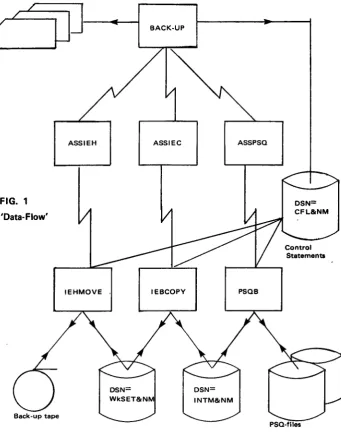
procedure makes useof eight different pro
grams. The main program BACKUP is
written
in the COBOL programming languageand
this
program invokes
through three
assembler routines, ASSPSO, ASSIEC,and
ASSIEH,the'PSO
program', PSOB, and thetwo
IBM
utility
programs IEBCOPY and IEHMOVE. The programlEFBRl4
is usedto
allocate disk space.The procedure is
written
to
perform three operations:-
to
back-up selected PSOfiles
as membersof
a
new unloaded PDS on magnetic tape-
to
generate PSQ files which are copiesof
members of an unloaded PDS, i.e.to
restore PSO filesfrom
the back-up tape-
to
update a back-up tape by replacing members in or adding membersto the PDS.
The necessary
information about
the
PSO files which areto
be backed-upor
restored areinput
to
the main program as a card deck and this program generatesthe control
statementsfor
the
PSOB programand
the utility
programs.
ln
a back-up run PSOB copies a PSOfile
to a member, MMM, of a PDSwith
the
Data Set NameINTM.
IEBCOPY copiesMMM
toa
mem-ber
of
another PDSwith
the DSN WKSET and renames the memberwith
aname indicated on the
input
cards (see the examples). When all the wantedPSO files are copied
to
members of WKSET, IEHMOVE copies this PDSto
a magnetic tape.
To avoid
lackof
spacein
the
PDS INTM, this data set iscompressed each
time
a new PSQfile
has been copiedto
INTM(MMM).
ln'update
of
a back-up tape'-runthe
old
PDS isfirst
loaded to a disk as thePDS WKSET
and
the
operationsthen go
on
asfor
generationof
a
newback-up PDS. Figure 1 gives an overview
of
the
data flow
andfigure
2
isthe
outline of
the logic in the program BACKUP.FIG.
1'Data-Flow'
control Statemontl
Back-up tape
tr
[image:17.416.40.382.99.541.2]FEAD FIRST INPUT CARD
BEAD NEXT CARD AND USE THE DATA ON THIS CARD TO LET IEHMOVE;LOAD THE PDS DISK AS WKSET
contalna a
. comma
LET PSOB CO.
PY THE PSO.
FILE.
PSO-NA. ME TO INTM (MMM)LET IEBCOPY COPY INTM (MMM) TO
WKSET (MEM. BER.NAME)
LET IEBCO.
PY COM.
PR ESS INTM from PSO'
MOVE PSO. NAME TO
MEMBEB-NA. ME
READ NEXT CARD AND USE THE DATA ON THIS CABD TO LET IEHMOVE UNLOAD THE PDS WKSET TO TAPE
ALARM
containS a
comma
LET IEBCOPY COPY WKSET (MEMBER.NA. ME) TO INTM (MMM) REAO
NEXT CABD
LET PSOB
COPY INTM (MMM) TO A
NEW
PSO.FI-LE PSO.NAME
LET IEBCO COMPBESS
INTM MOVE PSO.
NAME TO MEMBER.NA.
ME
FlG.
2-
The Logicof
Back-up FEAONEXT
CARO
Examples
of Control
Statementfor
the BCKP Procedurea)
Generationof
a new back-upfile
This example shous the
control
statements necessilryfor
the creation of aback-up
file with
copies offour
PSO fileswith
the PSO numbers250,251,
255 and 1003 and
the
PSO names PSO1 , PSO2, PSO3 and PSO4. The nryofirst
files
use
the
PSO names as member namesin the
generated PDS, where as PSO3 and PSO4 are given the member MEMBC and MEMBD. Theunloaded
PDS
is
placedas
the
first
dataset
on a
tapewith
the
serialnumber ELJ9998 and given the data set name PSOBCKl.
$FROM
PSO$0250PSO1 $0251 PSO2
$O255PSO3,MEMBC $1OO3PSO4.MEMBD $$
$TO
TAPE$TFTP9=
E U9998,R E NAM E=PSOBCK 1l*
All
cards havethe
first
characterin column
1.The
PSO numbersmust bewritten
with four
digits,
including
leading zeros.The
PSO names, the member-namesand the
DSN
follow the
normal
conventionsfor
thesenames,
i.e.
up
to
8
charactersof
which
the
first
should
be alphabetic. Wheneverboth
a PSO name and a member name is specif ied the member nameshall
follow
immediatelyafter the
PSO nameonly
separatedby
acomma.
The
PSOBwill
asdefault
becontrolled
by the
PSO statement$PN,
but
this
option can be
changedby
entering
a
card
with
$$PYbetween
the
$FROM
PSO andthe $$
card.All
PSOfiles
described afterthe $$PY and before the $$ or a $$PN card
will
be tisted.The Newsletter is available
at:
Mrs.
A.
CambonSupport
to
Computing Blds. 36 -Tel.
753Dx
e)emplaires du Bulletin sont disponibles chez:Mme
A.
CambonSupport
to
ComputingBat. 36 -
Tel.
753b)
Restoring of the PSO filesThis
example showshow
the four files in the
previous exampleare
re-stored in the PSO system
with
the PSO names MEMBA, MEMBB, MEMBC, and MEMBD. Thefile
MEMBC is listed.$FROM
TAPE$F ROM=TPFE U9999,PDS=PSOBC K 1
$TO
PSO$MEMBA,
PSO1$MEMBA,
PSO2$$Pv
$MEMBC $$Pttt
$MEMBD
$$
l*
The remarks relating
to
example2.al
are also valid herefor
the names. NoPSO numbers are specified as these numbers are generated
by the
PSOsystem.
Notice the
PSO namesare
alwayswritten
before
the
member name, when thesetwo
names are different.c)
Updating a back-up data setThis
example showshow
to
updatethe
back-upfile
usedin
the
previousexample
by
replacing MEMBA and MEMBCwith
copiesof two
new PSOfiles
501
PSOSand
502
PSO6and
by
adding a new member503
PSOTwith
member name MEMDE. The updated PDS is unloaded to a tapewith
rrial
number EU998 andthe
unloaded PDS is given the name PSOBCK2.$FROM
TAPE$F R OM=TP9=E U9999, PDS=PSOBC K 1
$FROM
PSO$O5OlPSO5,MEMBA $O5O2PSO6,MEMBC $O5O3PSO7,MEMBE $$
$TO TAPE
$T0=TPg=EU9999, R E NAM E=PSOBC K2
l*
It
has been assumed in all examples,that
the data sets on tape are thefirst
data sets
on the
tape. Following the
format
conventionsfor
the utility
the
PDS PSOBCK1 wasthe
third
data set on rhe tape EU9999the
state-ments in example b) and c) should be:$F ROM=TPS( E U9999,3),PDS=PSOBCK 1
and in example a)
$TO=TPF( E U9999,3), R E N AM E=PSOBC K 1
The JCL Cards
The JCL
cardsin
the
instream procedure are listedbelow
(the name and the locationof
the ECDIN programlibrary
is changed).llScKp
pRUCNr,t=XXXrpLttJ=.SySt.LtB
trpvOL:USER
rl.l. - _
^. _ _
PV!:,
5E8=EtJt< SYl,
rPV2:
t SER=5URSY2t rPV3=. SER=SP30LlrllSlPl
EXEC PGH= IEFBi{ L 4I.I.DUL
DO OSN=IiCFLI!I.Ir[I I SP=(NEW, PASS,DELETEIrUNIT-33]Or
ll
VUL=[PVITSPACE=(uor(
trJor5rI]l
rll
DC8=(RECFi.t:FTLRECL=iJ0rrlLKSllt=B9l
/
I OO'
DDI)S\=L
It\lIHNI.I r U I SP =( NEl{,PAS S IDE LC TTI,
UNI T=3]30I
ll
VdL=tPVl. r SPACE=( l2()O()rl40
t5)2ll
tl/
Dcu=(RECFr,,r:FhTLRECL=d0,nLK5lZt=[20001llGO
EXEC PGM=tlCKPrPARt4=r0,N{tt
/
stEPL'o
8[]
"ili$!5]Bt?l,i(iig|nY'3!=!fi[=e'v0L';uNI
r=3130
ll
00
l)S!=SYSt.L
IdUTItrUl
SP=SHRTUNI I=3330rVOL=SER=USER04 I l,)LDTAP
UD DDNA,tlt=T,lP INI I \EvtT
AP
00
0f)tlArtE= tAP{)tJI//SYSUf
l
00
DISp=..lLDr UN I f =3J30rVUL=LPVII
/
SY\ul
2
l)O
0Sr.J=trKSEIqNM,Ul
S?= (lttr'
rD!LEIEr
0ELErE I rUNIt=3t
30rll
VUL=LPV2TSPACE=(l.2u00r(600r20r101
I
rll
0C0= ( RECFtI=FrJ r LRECL=d0,8LKSI
? E=l20U0l
//PRINf
DD SYS'tU[=Al/SYSIN
t)r)
tJSt'l=6CFL\.4 Ii1r{r{lr0lSP=ltlLDr0ELETEt,VOL=CPVt,UNI
t=3i30
//CAKDS r)D
DS\=rilFL;rrll tr,r'{l,DISp=(r)LDrt)ELEIEI;V,lL-6pVI;UNtT=3330
l./P_$tlll!
DDQS\1!l,vTi.lN!{rOtSt)=(tJLDrl)ELttEl ,V,JL;tPVtrUNIi=3-t30
l.t.FT J
Lr}J
t
DD QSrr= L t NI HN,'t I M;rMI
r D i 5p =( ULD ;DEIE rEI
i
vDU= SpvI;
-ll
Ur,llI=3JJ0
I
I \YStll
!
t)D
UN IT=13 3{) r VI)L =6PVt r S PACE=I
256 t I I0,
I 0I
II
/
PS))IS(
!
DD U"r I I =3J JCrVr)L =Sbri=USE'{J2 ;DSN=SySI.
pS0I
rt)tSp:SHRl/lSlt)lS(2
DDr,l\ll=JJJ,)ry'L)L=SEx=r.rStR0l;DS;'r=SySl.pSa2;DISp=SHR
l/P5oDIS(
I
t)D
r.t,\ II
= JJ30 r vCL =SER=USt Ro4 ;D SN=S yS[ :pSa,
;0I
Sp=SHil./.P-SaQIS(!
Dtl tr\tI=!JJ0rVrlr-:SF*.=USER05,DS\=SySl.pS04i0iSp=Sxrr
//SY5P(I'{T
UI)
SYSJUT=A//?8!NJS(
DU SYSJUIlArDCtl=IRECFP=l-ATLRECL=lJJTBLKSItE=t33t
l.l.PR
I'tl L\aD
DD SY 50UT =A, DCD =(t{s!
i-t{ =FA r LR EC L= IJj,
BLK S I Zta t fi
t//
SYSIJIJJUTDI)
SY5JUI=AI
I
K.lAI
l)D
Dt)NA Yb= SY 5l I'l//SYSU0UT'lP
l)0
SV50UT=A II
IICKPF-ND P EN DThe parameter NM. is
introduced
to
ensure a uniquefile
namefor
thefile
with
the
DSN=\/KSET
by adding extra characters to this name, andthere-by allovrr the
procedureto
be executedby
several users at the same time.The
value
of
the
paremetersshould
be a
combination
of
up
to
threecharacters allowed
in
DSN's. TheJCL
cards requiredfor
an executionof
the procedure are:
ll
EXEC
BCKP,NM=XXX//GO.TAPIN
DD//GO.TAPOUT
DD//GO.SYSIN
DD
*
(XXX
being any allowed character combination)follorarcd
by the contrql
statements discussed above.TAPIN
is a magnetictape containing
an
unloaded
PDSand
TAPOUT
isa
magnetic tapeto
which
the generated/updated PDS is unloaded. TheTAPIN
DD statement isonly
required when a$FROM
TAPE card is presentamongthecontrol
statements,
and
the
TAPOUT DD
statementwhen
a $TO
TAPE card ispresent.
Both DD
cards must,
when
present,
contain the
DSNof
theunloaded PDS, and the DCB parameters:
DCB=( R
ECFM=FB,
LRECL=80,
B LKS| ZE--800)Whenever
a
data set is unloadedto
magnetic tapethe
IEHMOVE
returnsthe
condition
code04; this
doesnot
meanthat
thejob
hasfailed, only
that the PDS is unloaded.
The procedure is
written for
placingthg
back-upon
magnetic tape,but
it
is also possible
to
use the procedure to generate and read PDS on disc. TheDD
cardfor
TAPIN
and TAPOUT shall thencontain
the specificationof
the
disc
usedand the
control
cards usedfor
the
generationof
control statementsfor
IEHMOVE should
insteadof
T0=TP9=and
FROM=TP9=contain
T0=333F
and
FROM=333F.
The
T0
TAPE and FROM TAPEcards remain unchanged.
lf
the
programin a
back-uprun
triesto
opena
non existing PSOfile.
thePSOB program
will print
a warning,but the
main programwill
not detectthe error, and
the
utility
programwill
copy
the
last opened PSOfile (if
any) once more
to
the
unloaded PDSwith
the
nameof
the
non-existing file.The
programprints a
list of
'accepted command cards'. These cards havepased
a
format
check,
but
if
the
program
goesto
ABEND
for
otherreasons than
format error,
the
last card listed as acceptedwill
normally bethe one which has introduced the error.
The
procedureis
now
cataloguedin
the
procedurelibrary
and can
beexecuted
by all
users of the PSO system. The catalogued procedure differsfrom
the shownin$ream
procedureonly in
the location
of
the
loadmo
dule BCKP and in the omission
of
the SYSUDUMP DD card.Due
to
a systemerror
step GO always terminateswith
an error code C03.Also
sincethe
changeof
system
in
November76 an 0C5
(addressingexception)
error
has occurredfrom time to time
in the GO step, caused byan
addresing
error
during
the
execution
of
the
IEHMOVE
moduleIEHMVXSE.
The
C03error
doesnot affect
the execution,
whereas the0C5
error
brings the executionto
abnormaltermination. The
responseto
an 0C5
error
isto
re-eneter the samejob
again.The
ECDIN group does not guarantee any maintenance or developmentof
the
procedureand
the
included
programs. HoweverI
would like
to
hearabout
any
problems encounteredduring the
executionof
the
procedure(building
2, tel.
330) , and these extensionsof
the procedure, which might be developedto
satisfyour own
requirementswill,
whenthey
have been tested by the group, be made partof
the catalogued procedure.The procedure can be executed in a class 2 job.
Note
to the
UsersAs
a
consequenceof
the
changefrom
OS/MFTto
OS/MVT,the
lEC209messagB
which
provideserror
statisticsby
volumefor
tape volumes doesno
more appear
in the
I'JASPSYSTEM
IOG.
This fact could not
beavoided
for
technical reasons.ln
the
meantime a solution wasworked outto
provide userswho
needit
with
the information
containedin this
mev sage. lnterested users are askedto
contirct
D.
Koenig,te|.742,
to
discusstheir
requirements concerning this problem.Visitors
The already established good contacts
of the
lnformatics
Departmentto
ontside research centers were deepened by the visits
of two
guests:o
ProfessorPeter
Kirstein
(Professorof
computer
systemsat
the
Uni-versity
College,
London)
presentedin
a
stimulating
lecture
the
"uK
Experiences
with
the ARPA Computer Networ.k".o
Doctor
Leland
H.
Willianrs (president
of
the
Triangle
University Computing Centre,North
Grolina
andat
present visiting professor at the Edinburgh Regional Computing Centre) gave an interesting lecture on the "Managementof
Computing Servicesfor
Network Delivery".I I I
I
Lespersonnes int6ress6es
et
d6sireuses
de recevoir
r6gulidre-I
ment
"Computing
Centre Nevrrsletter" sont
pri6es
de
remplir
I
le
bulletin
suivant et de l'envoyer
dI I
I
MmeA-
CambonI
Supportto
ComputingI
Bat.36, Tel.
753I I
;
NomI
r
Adresse|
--
---I
I
Tel.
The
persons
interested
in
receiving regularly
the
"Computing
Centre
Neunletter"
are requested
to
fill
out
the
following form
and
to sendit to:
Mrs.
A.
CambonSupport
to
ComputinSBuitding
36,
Tel.
753Nom
.Address