0022-538X/81/100224-17$02.00/0
Simian Virus
40
Early
mRNA's Contain
Multiple
5' Termini
Upstream and Downstream from
a
Hogness-Goldberg
Sequence;
a
Shift in
5' Termini
During the Lytic Cycle Is
Mediated by Large T Antigen
PRABHAT K. GHOSH AND PAUL LEBOWITZ*
Department of InternalMedicine, Yale University School of Medicine, New Haven,Connecticut 06510
Received 16 April 1981/Accepted 15 June 1981
We have usedprimer-directed synthesis, separation, andsequencing ofcDNA's
toidentify andlocalize the 5' termini of simian virus40earlymRNA's. We have examinedpolyadenylated RNAs obtained from whole cytoplasm and polysomes oftwotransformed linesandfrom the cytoplasmofinfected cells early and late inthelytic cycle, andwehave attempted tocorrelate the resultsof our cDNA
analyses withrecentanalyses of early cap structures. We have found that early mRNA's fromtransformedcells havethree principal5'termini, atresidues5,150,
5,154, and 5,155, with terminal transcribed sequences of CU, GC, and GG,
respectively. These termini lie 21 to 26nucleotides downstream from the early Hogness-Goldbergsequence.Transformedcell early mRNA's also containaseries ofless abundant 5' termini that are copied from DNA sequences as faras 80
nucleotides downstreamand a minimum of70 to 75nucleotides upstreamfrom theHogness-Goldbergsequence. Thetemplatesfortheupstream5' termini and thelate simian virus40mRNA'soverlap byaminimum of60to 65nucleotides. Early mRNA's isolated from cells early in infection contain the same three
principal5' termini and downstreamminor5'termini astransformedcell mRNA's,
butthey lack 5' terminiupstreamfrom theHogness-Goldbergsequence.With the
onsetof thelatelyticphase, there isaprogressive decrease intheutilization of
the three principal 5' termini and additional downstream 5' termini and a
progressive increase in theutilization offourmajor terminiatresidues5,190 to
5,194, which are 10 to 15 nucleotides upstream from the Hogness-Goldberg
sequence.Thisshift is evident incellsinfected withatsAmutant atthe permissive
temperature,but is abortedby growthat orshift-upto arestrictivetemperature.
Thus, this shift is mediated by thegeneA product,large T antigen. Wepresent twomodels, whicharemutuallyexclusive,toaccountfor the role ofTantigenin
the early-late shift. One involves transcription late in infectionon anew DNA
template synthesized duringDNAreplication. The second involves inhibition of initiation ofearlytranscriptionatresidues5,150 to 5,155andother downstream sitesand ashift oftranscription initiationprincipallytotheupstreamsitesas a
resultofthe binding ofTantigento twositesonsimian virus 40 DNA downstream
from theHogness-Goldberg sequence.
Whereas
eucaryotic
cellular genes appear togiverise to mRNA's withsingle5' termini (3, 7,
37, 52), certain animal cell viruses produce
mRNA's withheterogeneous5' ends(2,6, 12, 13,
15, 17, 19-21, 23-25, 28, 30, 36, 38, 39). The
papovaviruses, simianvirus40 (SV40) and
pol-yoma virus, are especially remarkable in this
regard. For SV40, late wild-type mRNA's
ter-minate at a minimum of five sites with the
AU(U) sequenceandasmany as 10 to 15
addi-tional sites with other terminal sequences (17,
39). The latemRNA'sof mutants with deletions
in the late leaderregion are evenmore diverse
(18, 36). Theearly mRNA'sofSV40have been
more difficult to study than the late mRNA's
becauseoftheirrelativescarcity,butrecentcap
analyseshavesuggestedsevendifferent terminal
capdinucleotides(21,25), andcDNAsequencing
studies have suggested major 5' ends at two
proximate sites and anumber ofminor
down-stream 5' ends in transformed cells (15, 38).
WhereasSV40andpolyomaviruslategenesdo
not contain Hogness-Goldberg sequences
up-streamfrom the 5' termini of mRNA's (17, 39),
224
on November 10, 2019 by guest
http://jvi.asm.org/
the earlymRNA's are preceded by such a se-quence (38). In addition, a recent study has
shown5'-terminalheterogeneity ofan
adenovi-rus-SV40 hybrid mRNA taking origin froman
adenovirus late promoter in adenovirus-SV40
hybrid (44); in this system, too, a
Hogness-Gold-bergsequence liesupstreamfromtheprincipal
5' terminus. Thus, the presence of a
Hogness-Goldbergsequence does notrestrict 5'
termina-tion to asinglesite,and the 5' terminal
hetero-geneityofthepapovavirus late mRNA'scannot beattributedto anabsence of thesesequences.
Furthermore, nospecific structural features of
the papovavirus or adenovirus genes which
wouldaccountforthe 5'terminal heterogeneity
havebeenrecognized.
Recent studies involving in vitro transcrip-tional systems (32, 42; Lebowitz and Ghosh, submittedforpublication) andincorporation of B8-3P-labeled nucleosidetriphosphates into viral mRNA's made bynuclei isolated from infected
cells (19) and made in permeabilized infected
cells (7a) have suggested that most, ifnot all, earlyand lateSV40 mRNA's ariseby transcrip-tion initiatranscrip-tion. Coupledwiththemultiplicityof 5' termini, this observation suggests that there
aremechanisms in thepapovaviruses that gov-ern initiation and regulation of transcription frommultiple sites.
We have been studying early and late SV40 transcription in vivoand invitro inaneffortto
gaininsightinto the mechanismsbywhich viral
transcription is initiated andregulated. We have beenespecially interestedinearly transcription
since aregulatory mechanism involving binding
of theearly proteinlargeTantigentothree loci
overlapping the template for the 5' termini of
theearlymRNA's (49) andsuppression of
tran-scription by this antigen (26, 41, 47) has been elucidated and since theearlygeneisnecessary
for induction andmaintenance of transformation
(1, 5, 33, 35,46) and information regarding
reg-ulation ofearlygeneexpressionmayberelevant
tocellular transformation.
Inthispaper we present adetailedstudy of5'
termini of the SV40 early mRNA's. As in our
previous studies (15, 38),wehave used primer-directed cDNA synthesis and sequencing for identification andlocalization of5' termini, but
we have incorporated a number of advances
which have permitted a more detailed analysis
thanpreviouslypossible,and wehaveexamined the early lytic mRNA's both early and late in
infection. Wehave also attempted tocorrelate
ourresults with those derived from recent cap
sequence studies(21,25). We havefound
consid-erably more heterogeneity in the 5' termini of
the early mRNA's in transformed cells than
previously reported, and we have found
compa-rable heterogeneity inthe early lytic mRNA's.
Inboth lytic infection and transformed cells,5'
termini are located upstream as well as
down-stream from the Hogness-Goldberg sequence.
Whereas the principal 5' termini early in lytic
infection lie downstream from the
Hogness-Goldberg sequence, as the lytic cycle progresses
into the late phase there is a decrease (always
relative, usually absolute) in the utilization of
these 5' termini, and four new termini lying
about 10 to 15 nucleotides upstream from the
Hogness-Goldberg sequence become the major
5' termini of the earlymRNA's. When infection
is carried out with a tsA mutant, thisearly-late
shift of 5' termini is blocked at the nonpermissive
temperature. Thus, this shift is mediated by
geneA product, largeTantigen.
MATERIALS AND METHODS
TheSV40-transformed human andmousefibroblast lines SV80and SV101 were generously provided by David LivingstonandRobert Pollack. The tempera-ture-sensitive mutanttsA58was agiftfromSherman Weissman. For lytic infections with wild-type SV40, confluentVero African green monkey cells were in-fected with 10to20PFU of strain776virus per cell. For certain preparations of early RNA, cytosine ara-binoside (ara-C)wasaddedtocultures1 h postinfec-tion at afinal concentration of20,tg/ml.Infections withtsA58werecarriedout onconfluent CV1cellsat
amultiplicityof10 to 20PFU per cellateither 33 or
40.5°C,orcellswereinfected for24hat one temper-ature,followed by eithershift-uporshift-down to the othertemperature. Thegrowth conditions for infected and transformed cells were as previously described (38), except that calfserumwassubstituted for fetal calfserum.
Cellswereharvestedatthe times indicated below. Cells were lysed, and cytoplasmic RNAs were ex-tractedaspreviouslydescribed(18).Polysomeswere obtained from whole cytoplasm by adding sodium
deoxycholateto afinal concentration of 15% and
cen-trifuging the preparation in 7.5 to 45% sucrose
gra-dients in0.01 M Tris-hydrochloride (pH 7.5)-0.1 M
NaCl-0.003MMgCl2inanSW27rotor at25,000 rpm
for225 min. Polyadenylated RNAs, whichwere
ob-tainedbypassageofpreparationsthrough
oligodeox-ythymidylic acidcellulosecolumns, wereused in all
experiments.
5'-Terminal sequences ofSV40 early RNAs were obtainedby the primer extension method, involving primer-directed, reverse transcriptase-catalyzed syn-thesis of[nP]DNAscomplementarytothe 5' ends of RNAsfollowed by determination of the3'ends ofthe cDNA's.Theprimer used forallcDNAsyntheseswas therestrictionfragmentextending from residues 5,053 to5,089ontheearlyDNAstrand(Fig. 1). This frag-ment was obtainedbycleavageof the viralDNA at residues5,053 and 5,089withrestriction enzymesHinfl
and HindIII, respectively. For certain experiments,
thisprimerwaslabeledonboth DNA strands. Inmost
on November 10, 2019 by guest
http://jvi.asm.org/
4=
Cu)
.
C.)
.4; .
V0
2
o
L--n
Xe
_o
2
o
o(} B i ¢~~~~
Crs z
c
0 c 0
Z~~~~~~~~~~~~~~~~~~Z
.z
:4.4
-Z; r-i
t4d
on November 10, 2019 by guest
http://jvi.asm.org/
experiments a primer labeled only at the 5' position of the early strand (at residue 5,053) was used. This primer was obtained by first isolating theHinfl frag-mentextending from residues 5,053 to 1,660, labeling the 5' position ofboth strands, cleaving the labeled fragment with HindIII at residue 5,089, separating the tworesulting labeledfragments by gelelectrophoresis, and isolating the small fragment spanning residues 5,053through 5,089.Determinations of the 3' ends of cDNA's were done in thefollowing two ways: (i) by separation of cDNA's on2-mm (standard thickness)
8% polyacrylamide-7 M urea slab gels, followed by
sequencing of
in#iyidual
cDNA's (34), or (ii) by co-electrophoresis ofcDNA's on thin (0.3-mm) DNA sequencing gei of thesame compositionalong with Maxam-Gilbert digests of the DNA fragment extend-ingfrom residues 5,053 to190and also labeled on the early strand only atposition 5,053. This fragment was obtained from the residue 5,053toresidue 1,660 frag-mentlabeled at the 5'ends of both strands by digestion withPvuII and isolation of the fragment extending from residue 5,053toresidue190. The methods used forlabeling primers,hybridizingprimerstoRNA, iso-lating DNA-RNAhybrids, extending primers with re-verse transcriptase, and separating and sequencing cDNA's havebeen describedpreviously (16).Nucleotidesarenumberedaccordingtoa
modifica-tion(M.Piatak,K. N.Subramanian,andS. M.
Weiss-man,J. Mol.Biol.,inpress) of the system ofReddyet al. (40). This modification involves thefollowing: num-bering from 1 through 77 to correspond tooriginal residues18through 94;numbering from78through94 toincludea17-basepair insertion (51) detected after theoriginal description of the SV40 sequence; reten-tion of the original numbering from residues 95 through 5,226; and numbering 5,227 through 5,243 to correspond to original residues 1 through 17. The corresponding numbering in the BBB system (50) is shown inFig.1.
RESULTS
Asnotedabove,wehave introduced
improve-ments into ouranalytical methods in an effort
to definein greater detail than previously
pos-sible (15, 38)the number andgenomiclocations
of the 5' termini of the early SV40 mRNA's. These improvements have included scaling up
of cellgrowthsand RNA preparations, the use
in certain experiments of primers for cDNA
syntheses labeled on only the coding strand, electrophoresis of cDNA's on thin polyacryl-amide-ureagelsthatwereabletoresolvesingle nucleotides, and autoradiographic exposure of cDNAseparationgelsforlongertimes thanused previously.When combined with
co-electropho-resis of a digested DNA fragment having the
same 5' terminus as the fragment used as the
cDNA synthetic primer, electrophoresis of
cDNA's on thingels permitteddirect and
accu-rateone-step determinations of their3'termini.
Early mRNA'sin transformed celis.
Fig-ure 2A showsthin gel electrophoretic patterns
of DNAs complementary to the 5' termini of polyadenylated early viral RNAs extracted from
thecytoplasm of the SV40-transformed cell lines
SV80 (human) and SV101 (mouse). In this
ex-periment cDNA's were synthesized with a primer labeled on both DNA strands. The
cDNApatternsforthe twolineswerecomplex,
B >>
A
-u-.
s
_m3
_a
.c
d.
... ..:
.^ I
d e f
FIG. 2. (A) Patterns on 8%polyacrylamide-7 M
ureathinelectrophoretic gels ofradiolabeled DNAs
complementary to 5' ends of polyadenylated viral
earlyRNAs isolatedfromwholecytoplasm ofSV80
(lanea) andSVIO (lane b)transformedcells,infected
Vero cells treated with ara-C (20
lsg/ml)
and har-vestedat24hpostinfection(lane c), andinfectidVero cells harvested in latelyticphaseat48hpostinfection(ltne d). The resultsofcontrol cDNA syntheses on
polyadenylated cytoplasmic RNA from uninfected Verocells(lane e) and SV40 cRNA (lane e)arealso shown. The DNAs complementary to cRNA were electrophoresedonthegelshown inFig.6and were transposedfor comparison with the cDNA's of in vivo RNAs. Numbers in left and right margins and to rightof lane d identify specific cDNA's discussed in text.(B) Lightly exposedthin 8%polyacrylamide-7M urea electrophoretic gel patterns ofsamples of the indicatedcDNA'sfrom (A), which bringoutthe band-ing patternsofcDNAs 1 and 2. cDNA 1 is adoublet, and cDNA 2appearstobe asinglet.
on November 10, 2019 by guest
http://jvi.asm.org/
[image:4.496.247.440.156.460.2]but theyappeared to beidentical. They
resem-bled the cDNA patterns described previously
(15, 38)for theSV80 cell line withrespect to the
twoprincipal cDNA's (cDNA's 1and 2), minor cDNA's3and 4, andcDNA's6 through 8, which
appearinthepresentexperimentsas atriplet of
distinct cDNA's but appeared previously on
standard thickness gels as asingle broad band.
Because of their relative scarcities, cDNA's 5
and 9 through 20 were not visualized in our
previous studies. As described previously, cDNA's1 and2each accountedfor about40 to
45% of total cDNA's, whereas cDNA's6through
8 together accounted for about 5 to 8% ofthe
total. Theremaining cDNA'swereall minor and together accounted forat most5 to10% of total cDNA's. Identical cDNApatterns wereobtained by using the same primer labeled only on the coding strand (Fig. 3) and by using RNAs iso-lated from SV80 cell polysomes (Fig. 4). Thus, each of the cDNA's shown arises from
tran-scriptsof the viralearly DNA strand, and
tem-plate RNAsprobablyfunctionasmRNA's.
Inourpreviousstudies, cDNA's 1and2were
recovered in amounts adequate for sequencing by cleavages adjacent to guanine and cytosine residues only. Furthermore, on standard
thick-ness gels, there was no evidence that these cDNA'swerecomposed ofmorethanoneband.
Inthisstudywe haveanalyzed lightexposures
of thetransformed cell cDNA'sonthingelsand performed detailedsequenceanalysesof cDNAs
1 and2. Onlightly exposed thin gels (Fig. 2B), cDNA 1 uniformly had the appearance of a
doublet with components thatwereaboutequal in abundance and terminated at adjacent
ge-nomic sites, whereas cDNA 2 most frequently
appearedas asinglet(however, in certain
exper-iments, adoubletwas observed). Since certain cDNA'sreproduciblyremainedsingletsonthin
gels (Fig.2A, cDNA 9, andFig.2B,cDNA2;see
Fig.5and6) and since mRNA's with5' termini
at adjacent sites were detected previously by
methods which didnotinvolve cDNAsyntheses
(12), we believe that the cDNA 1 doublet, as
wellas othermultipletsdescribedbelow,
prob-ably reflect the presence of discrete in vivo mRNA's with 5' termini at adjacent genomic
loci rather thanpremature terminationof
tran-scription in the region justshort ofa true
ter-minus.OursequenceanalysesofcDNA's 1and
2 were performedboth by Maxam andGilbert
(34)degradations adjacenttoall four nucleotides (data not shown) and by co-electrophoresis of
cDNA's on a thin gel with a digested DNA
fragmenthaving the same5' terminus (Fig. 3).
Theformermethoddemonstrated 5'termini of
the two cDNA 1 components between residues
5,152 and 5,155 and the terminus of cDNA 2
between residues 5,148 and 5,150. The results with thelatter method appearedtobedefinitive, showingtermini of the cDNA 1components at
residues 5,154 and 5,155 and the terminus of cDNA2 atresidue5,150.
Recently, Haegeman and Fiers (21) and Ka-hanaetal. (25) have studied the5'-terminalcaps
of theSV40 early mRNA's. Both of thesegroups
have analyzed primarily mRNA's produced in cells infected with tsAmutants; however, Haege-man and Fiers have cited similar results for mRNA's obtained from SV80cells, and Kahana
et al. have reported comparable results for mRNA'sproduced byaline ofpermissive cells transforined by UV-treated SV40 and by
wild-type virus in early lytic infection. In certain
respects the results of these two groups are
similar, whereas in others they differ. Both
groupshave found relatively abundant termini
with the transcribed 5' -* 3'sequences GCand
GG. Haegeman and Fiers have also found abun-danttermini with thesequencesAUU and GA (both of which Kahanaetal. havenotfoundas
abundant components), whereas Kahanaet al. have demonstrated CU as the most abundant terminus and AG and GU as additional rela-tively abundant termini (Haegeman and Fiers have notfound these three sequencesincaps).
Thereasonsfor thedisparateresults of thetwo
groups are notclear, and the disparities hinder
attempts to assign 5' termini to certain ofour
cDNA'sonthebasis of combinedcapand primer
extension analyses. Nevertheless, the 5' -. 3'
sequencein earlySV40 mRNA's from residues
5,157 through 5,147 is UCGGCCUCUGA, and
onthe basis ofourcombinedanalyses itseems
virtually certain that two abundant early
mRNA'sstartat residues5,155 and5,154with
the sequences GG and GC, whereas another
abundantmRNA starts atresidue5,150withthe
sequenceCU (Fig.1). These termini lie21to26
nucleotides downstream from the early Hog-ness-Goldbergsequence.
Of theminorcDNA's shorter than cDNA's 1
and 2, cDNA 3 is adoublet, cDNA's 4 and 5 are
singletsor have single majorcomponents, and
cDNA's6through8 aresinglets. We also
local-ized the 3' termini of these cDNA's both by
Maxam-Gilbert sequencing (data not shown)
andbyco-electrophoresis withadigestedDNA
fragment havingthe same 5'terminus (Fig. 3).
These twoanalysesgave consistentresults
sug-gesting that the 3' terminilie at or within one
nucleotide of residues 5,145 and 5,146(cDNA 3),
5,140(cDNA 4),5,134 and 5,135 (cDNA 5),and
5,125through5,123(cDNAs 6through8,
respec-tively) (Fig. 1).
on November 10, 2019 by guest
http://jvi.asm.org/
5' SV40 EARLY mRNA's 229 With the exception of cDNA 10, which
ap-g,nm pearedtobeadoublet in theelectrophoresisof
a
OCz° SV101 cell cDNA's, it was
difficult
to determines_ro > ufrom Fig.> 2Aand3whether minortransformed
3 D C T G A u cellcDNA's 9 through 20 were singlets or
mul-_*NK&
1W^qtiplets.
Each of these cDNA'swasalsosubjectedto Maxam-Gilbert sequenceanalysis (data not
shown). cDNA's 9 through 16 contained only SV40early strandsequences up totheir 3'
ter-mini. cDNA's 17 through 20 contained only SV40earlysequences up toresidues 15through
20,but sequencescould notbereadaccurately
* beyond this point; thus it isnotknown whether
these cDNA's terminate with viral or host
se-quences,and if theformer, how farupstream on
theviralgenometheir terminilie. Thesequence
studiesfurther revealed terminiatorwithin one ortwonucleotides of residues 5,160, 5,184 and
-16 5,185, 5,193 and 5,194, 5,206, 5,213, 5,222, 5,233
-15
through
5,237,
and 9through
13 for cDNA's 9through 16,respectively(Fig. 1).
-14 We have attempted to determine the
signifi--13 cance of minor cDNA's 3 through 20 in the
following threeways. (i) We triedtodetermine
-12 whether these cDNA's appeared constantly in
-t1 thereversetranscripts ofallin vivoearly RNAs
or specifically intranscripts of RNAs obtained
5182-89 A8--. - from only certain sources. The presence of a
l-10 cDNA which appeared amongthe transcripts of
certain RNAs butnotamongthetranscripts of othersorwhichappeared invarying quantities
amongthe transcripts ofearlyRNAs obtained
5l164,65 C2- -- 9 from various sources wouldhavesuggested
de-5160 C rivation froma discrete in vivo mRNA. On the
5154,55 C2 other hand, the presence of a cDNA which was
-2
uniformly
present in the reversetranscripts
of5150 G- .
al
earlyRNAs would have been consistent with14P;
-- 3 either derivationfromadiscrete mRNApresent*k.
5139,40 G
-_-5135
TK
-...
5134 Cl5130 A
--C2
---:5125T
C2-_
1 2345
FIG. 3. Determinationofthe3'endsofDNAs
com-plementaryto5'endsof earlymRNA's by co-electro-phoresis ofcDNA's witha digestedDNAfragment havingthesame5'endasthecDNA's.cDNA'swere
synthesizedoncytoplasmic polyadenylatedRNAs
ex-tractedfrom Vero cells infected for48h with wild-type(WT) SV40(lane 1)andmutantdl 892(lane 2) andfrom SV80 cells (lane 7); forcontrolpurposes,
cDNA'swerealsosynthesizedonRNApolymeraseII
invitrotranscripts of BglI-cleaved SV40DNA (lane
8). Theprimer forcDNAsynthesesand thedigested DNAfragmentwerebothlabeled with32Ponlyatthe 5' endoftheearlystrand,atposition5,053. The DNA fragmentwassubjectedtonucleotide-specific diges-tionsby the methodofMaxamandGilbert(34) (lanes 3through 6). Electrophoresiswas on athin 8% poly-acrylamide-7 Mureagel. cDNA's arenumberedat
therightin accord with thenumberinginFig. 2A.
The sequenceofthedigestedDNAfragmentshould be readfrombottomtotop, correspondingto a5'
-3' direction ontheearlyDNA strand. The relevant SV40 DNA sequence is shown inFig.1.BglIcleaves the SV40early strand between residues 5,159 and 5,160. Comigration ofacDNA synthesizedon tran-scripts of the BglI-cleaved DNA (arrow) with the
guanine-terminal band corresponding to residue
5,159ofthedigested DNAfragmentindicates initia-tion ofin vitro transcription from the end ofthe
fragmentand allowed directreading ofthe3'
termi-nus of each cDNAfrom the residue number ofthe comigratingbandofthedigestedDNAfragment. VOL. 40, 1981
kim.
w
,":''
ICD-8
"I 0
6 7
8
on November 10, 2019 by guest
http://jvi.asm.org/
[image:6.496.47.222.58.552.2]FIG. 4. Patternson8%opolyacrylamide-7 Murea
electrophoretic gels of radiolabeled DNAs comple-mentarytothe 5' ends ofpolyadenylated RNAs ob-tainedfrom the polysomes (P) and whole cytoplasm (C) Of SV80cells.
in vivo under a wide variety of conditions or
derivation by a constant artifact in our
proce-dure (e.g., premature termination of reverse
transcriptionordegradationof invivo RNAs at
specific sites). (ii) We compared the terminal
sequences of these cDNA's with the earlycap
sequencesmentioned above. (iii) Weperformed
control reverse transcriptions by using SV40
cRNA asatemplateand compared the gel
elec-trophoretic patterns of the cDNA's transcribed
oninvivo early RNAs and cRNA. SV40 cRNA
is transcribed solely from the early strand of
form I DNA with preferred initiation sites
dis-tant from the template for the 5' ends of the
early mRNA's and transcription through this
region (29, 53). Since procedural artifacts were
likely to affect reverse transcription of in
vivo-and invitro-synthesized mRNA's similarly, the
presence on electrophoresis gels of cDNA's
de-rivedfrom in vivo RNAs which had no
counter-partsamong thecDNA'stranscribed on cRNA
wouldhavesuggestedderivationfromintact in
vivomRNA's. On the other hand, cDNA's
tran-scribed on in vivo RNAs which comigrated with
cDNA's synthesized on cRNA had to be
sus-pected of arising artifactually. However, since
initiation oftranscription is not wholly specific
and can occur with low efficiency at a great
number of sites on the viral early strand (P.
Lebowitz, P. K. Ghosh, and S. M. Weissman,
unpublished data), comigration ofcDNA's
de-rived from in vivo RNAs and cRNA could also reflect initiation of transcription from identical
sitesunder in vivo and invitro conditions.
We didnotobserve cDNA'sthatcomigrated
with in vivocDNA's 5, 9, and 11 through20in
any of our cRNA experiments. In addition,
cDNA's 5, 9, and 11 through 16 terminate at
sites with sequencesidentifiedinearlycaps(21,
25) andarealso present inreversetranscriptsof
RNA polymerase II transcripts of SV40 DNA
(Lebowitz and Ghosh, submitted for
publica-tion). Thus, it is likely that these cDNA's are
derived from intactearlymRNA's.Further
sup-portfor the significance ofRNAsgiving riseto
cDNA's5and11 comesfrom thefact that cDNA
11isusuallythemostabundant cDNA inreverse
transcripts ofearly RNAsisolated late inlytic
infection and cDNA 5 isnotpresent inreverse
transcripts of early mRNA's produced by the
origin-defective mutants 6-1, 6-17, and 8-4,
al-though these mRNA's do have termini at up-streamsites (14) (Fig. 1).
Inthree cRNAexperimentswedetectedonly
an extremely weak band that comigratedwith
cDNA 10, whereas intwoanalysesweobserved
weak bands thatcomigratedwith cDNA's8and
10andbarelydetectable bands thatcomigrated
with cDNA's1through4and,possibly,cDNA's
6and7(Fig. 2A). However,whereas the cDNA
patternsof transformed cell RNAs shown inFig. 2A wereobtainedbyhybridizingtranscripts
con-tainingapproximately0.05jgof viral RNA with
primer and exposing the cDNA separation gel
for 2 days, the cDNA pattern of cRNA was
::...
I ..:.4.:..-:..
::7...
-::,:.- .:I..
on November 10, 2019 by guest
http://jvi.asm.org/
obtained by hybridizingreversetranscripts
con-taining 10 ytgof>16S cRNA with primer
con-tainingapproximately thesame amountof total
radiolabel and the same specific activity and
exposing thegel for2 weeks. Given the
approx-imately 1,000-fold excess of template cRNA and
exposuretime used in this andourotherstudies
with cRNA, the presence of weak cDNA's of
cRNA comigrating with certain cDNA's of in
vivo RNAs has minimal significance.
Further-more, the presence of weak cDNA's of cRNA
comigrating with cDNA's 1and 2 copied on in vivo early RNAs, taken together with the
evi-dencethat these cDNA's are derived from intact
early mRNA's (together, they constitute 80 to
90% of the total cDNA, their termini lie the expected distance downstream from the early Hogness-Goldberg sequence, their termini
cor-relatewell with the available sequences ofthe
SV40earlycaps,and directsequenceanalysis of theearly SV40 RNAs has revealedone ormore
termini in the region of the termini of cDNA's1
and2[9]),stronglysuggeststhatearly transcrip-tion with Escherichia coli RNA polymerase
maybe initiated extremely inefficientlyat
cer-tain sitesof in vivo initiation. Thus, webelieve that cDNA's 1 through 4, 6 through8, and 10 arealso all derived from in vivo RNAs andnot
from a systematic methodological artifact.
In-deed, thefollowingobservationsprovidefurther evidence that the 3' termini of these cDNA's mark the 5' termini ofspecific intact mRNA's. (i) Exceptfor cDNA's4and10,all terminate in RNA's withsequencesfound inearlycapsfrom transformed cells (21, 25). However, under
cer-tain conditions cDNA 10 becomes aprominent cDNAlate in lytic infections (see below), and
capscorrespondingtothe termini of cDNA's4
and10mayhaveescaped detection duetotheir uniqueness and scarcity. (ii) With regard to
cDNA3, twoorigin-defective mutants(mutants
6-1and 6-17) utilize residues5,145and5,146(the termini of cDNA3components)asthe 5' termini
of their principal early mRNA's; on the other hand, theearlymRNA's of anothermutant
(mu-tant 8-4) hasno detectable 5' termini atthese sites, although principal termini lie just
up-stream (14) (Fig. 1). (iii)WithrespecttocDNA
4, mutant 6-17 synthesizes an mRNA with a
terminusatresidue 5,140, whereasmutants8-4
and 6-1 withmajorupstream 5' termini do not
(14) (Fig. 1). (iv) The relative quantities of
cDNA's6 through8varyconsiderably
depend-ing upon the source of in vivo RNA; whereas
cDNA's derived from transformed cell RNAs
demonstrate a relative abundance of cDNA 6
comparedwith cDNA's 7 and 8, cDNA's ofearly
RNAsproducedlate in thelytic cycle
reproduc-ibly demonstrateaprominentcDNA 8,but very
weakor nocDNA's6and7(Fig. 2A).Inaddition,
RNAs extracted from cells transformed by cer-tain ofthe origin-defective mutants yield rela-tively prominent cDNA's 7 and 8, but barely detectable cDNA6 (14) (Fig. 1).
In summary,the evidencecited above suggests
amultiplicity of 5' termini of early mRNA'sin
SV40-transformed cells. It now appears that there arethree principal5' termnini (at residues
5,150, 5,154,and5,155),several minor 5' termini
at downstream sites, and a multiplicity of 5' terminiatupstreamsites. Most ofthelatterlie
upstream from the early Hogness-Goldberg
se-quence atresidues 5,176through5,181 (Fig. 1),
within the genomic region coding for the late mRNA leaders. One 5' terminus lies 70 to 75
nucleotides upstream from the
Hogness-Gold-bergsequenceand within10to15nucleotidesof
two 72-base pair tandemly repeated sequences
(Fig. 1), and it is likely that the termini of cDNA's17through20liewithin these repetitive
sequences.
Early mRNA's inlytic infection. Most of
our experiments on the 5' termini of early
mRNA'sproduced
early
in thelytic cycle
wereperformed with RNAs isolated from infected cellsgrownin thepresence ofara-C. The elec-trophoreticpattern of cDNA's copiedonthe 5' termini ofearlyRNAsfrom ara-C-treated cells (Fig. 2A) was similartothatof cDNA's copied
on transformed cell RNAs with respect to the twomajor cDNA's(cDNA's1and2) and minor downstream cDNA's3 through8. Asfor
trans-forned cell cDNA's, in mostexperiments early
lytic cDNA 1 was composed of two adjacent
bands, whereas cDNA 2 appeared as a singlet (Fig. 2B).Althoughbands thatcomigrated with transformed cell cDNA's9through11 were vis-ualized among the cDNA's of the early lytic
RNAs shown in Fig. 2A, the appearance of
cDNA 9 was variable, and cDNA's 10 and 11
were notvisualized whenaprimerlabeled only
on the early strand was used forreverse
tran-scription(Fig.5and6).(Indeed,the band inFig.
2A that comigrated with cDNA 11 is of host
originsince RNA isolatedfrom uninfected Vero
cellsuponreversetranscriptionwithprimer la-beled on both strands yielded a similar band
[Fig. 2A].) Thus,theearlymRNA'ssynthesized
in infectedcellsin thepresence of ara-C appear
to have the same principal and minor
down-stream5' endsastransformedcellmRNA's,but
theylackessentially all minor upstream 5'
ter-*mm.
Theelectrophoreticpatternof DNAs
comple-mentarytothe 5' ends ofearlyRNAsmade late
in thelytic cycle (Fig. 2A) differed greatlyfrom
on November 10, 2019 by guest
http://jvi.asm.org/
... _. ..
~~~~~~~~~!) .. ;
.i
r -
U%
Uw
8
;-r. :
--:
r,
S
i, i,. -,1. 'A'.,
*' *_.
*,,!I
FIG. 5. Patternson8%polyacrylamide-7Murea
thinelectrophoretic gelsof radiolabeled DNAs
com-plementary to the 5' termini of early lytic RNAs isolatedfrom wild-type(W.T.) SV40- andmutantdl 892-infectedVero cellsattheindicatedtimes postin-fection.Inbothwild-typeandmutantinfections,
ara-C(A.C.)wasaddedtoonecell cultureat1h
postin-fection, and the cells were harvested at 30 h. The numbersonthe right refertothe cDNA's shown in Fig.2A. UnnumberedcDNA's between cDNA's 9 and 10wereobserved in certainexperimentslate inlytic
infectionandmayreflectadditionalearly5' termini.
thepatternsof cDNA'scopiedonthe5'endsof
RNAs isolated from either transformedcellsor
[image:9.496.84.242.62.513.2]infected cells treated with ara-C. Essentially
FIG. 6. Patternson8%polyacrylamide-7Murea
thinelectrophoretic gels of radiolabeled DNAs
com-plementarytothe 5'endsof early lyticRNAs isolated from CVI cellsinfected withmutanttsA58. Lanes 1
and3,Infectionsat33°C for48and24h, respectively; lanes 4 and6, infectionsat40.50Cfor48and 24h,
respectively; lane 2,infectionat33°C for24hfollowed by shift-up to 40.5°C for24 h; lane 5, infection at
40.5°C for24 hfollowed by shift-downto33°C for24 h; lane 7, control infectionat33°C for48 h in the
presence of ara-C. cDNA's synthesized on SV40
cRNA wereco-electrophoresedinlane 8. The
num-bersontheleft refertothe cDNA'sshown inFig.2A. Theunnumbered cDNA's betweencDNA's 9 and 10
were observed in certain experiments late in lytic infectionsandmayreflectadditionalearly5' termini.
h h -;
._C
_6P
'a.
-W -41. .%.:
.-4,0"
on:
, -'L,7
I 37b
6- :.
7-
ikmiff-A 4i
it m, *K:
.tzr
aw
on November 10, 2019 by guest
http://jvi.asm.org/
[image:9.496.278.455.67.519.2]identical patterns were obtained with primers
labeled on both DNA strands or on the early strand alone.Comparedwith the pattern for
ara-C-treated cells, the pattern of DNAs
comple-mentary tothe5' endsofearlyRNAs madelate
ininfectionwas mostnoteworthy for its marked reductions in the relative quantitiesof cDNAs
1, 2, 6,and7,its increase in therelativeamount
of cDNA8,and theappearanceofanumberof cDNA's withterminiupstreamfromthe termini of cDNA's1and2.The latter cDNA'sincluded themajorspeciesobservedatthistime,cDNA's
10.5and11,moderatelyabundantcDNA's9and
10, faint cDNA's 12 through 16, and several cDNA's longer than cDNA 16 which did not
appear tocomigratewithanyof the transformed
cell cDNA's.In contrast to cDNA 1from
trans-formed cells and early in infection, late lytic
cDNA 1 was atriplet, whereas cDNA 2 was a
doublet. In addition, cDNA's 10.5 and 11 were
bothdoublets (Fig. 7A). Weperformed
nucleo-tidesequenceanalysesoncDNA's 1through16
and confirmed that all of these cDNA's were
composed of viral early sequences. We also found that the principal cDNA's, cDNA's 10.5
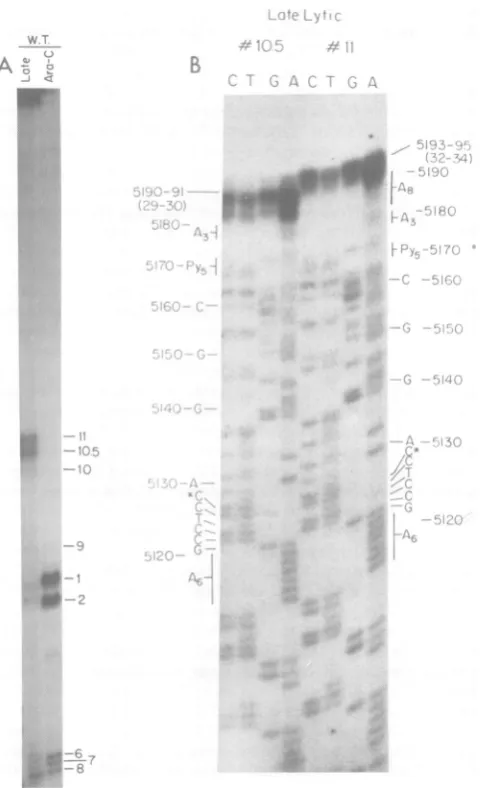
and11,hadterminiat orwithinonenucleotide of residues 5,190 and 5,191 and residues 5,193
and 5,194, respectively (Fig. 7B), whereas the
terminiof the remaining cDNA'swerethesame as the termini for the comigrating cDNAs of transformed cell mRNA's. The specificity of
cDNA 10.5for lateinfection, the prominence of
cDNA11atthistime, the absence of thesetwo
cDNA's in reverse transcripts of cRNA (Fig. 2A), and the prominence of these twocDNA's
in reverse transcripts of RNA polymerase II
transcripts of SV40 DNA (Lebowitz andGhosh,
submitted forpublication) suggestthat the ter-miniof cDNA's10.5and11reflect the 5' termini of specific early mRNA's. Furthermore, caps
with the sequences AU, CU, and AC,
corre-spondingtoterminiatresidues5,190, 5,193, and
5,194,respectively,arethemostabundantearly capslateinlytic infections (Y. Groner,personal communication), arguing that these upstream
termini donotarisefromprematuretermination
of reverse transcription (due to annealing of
earlymRNA's with late mRNA'sterminatingat
residue 5,189) but ratherrepresenttheprincipal
early 5' termini late in the lytic cycle. Thus,
there is striking heterogeneity of the early
mRNA's lateinthe lytic cycle, with four
prin-cipal 5' termini at residues 5,190, 5,191, 5,193,
and5,194 upstream fromtheHogness-Goldberg
sequenceand less abundantterminiconforming
tothe terminiof transformed cell mRNA'sboth
upstream and downstream from the
Hogness-Goldbergsequence (Fig. 1).
The very different cDNA patterns obtained
for mRNA's from ara-C-treatedcells and from cells in the latelytic phase suggested the
exist-enceofatleastapartial switch in the 5' termini used by the early mRNA's early and late in infection. To study this switchfurther,weasked the following three questions. Could the ara-C pattern be duplicated early ininfection in the absence of this agent? Does this switch occur
abruptlyat somespecific pointinthelytic cycle,
or does it occur gradually as the cycle
pro-gressed? And do viable mutants with lesions close tothe origin ofreplication also manifest thisswitch? We answeredthefirsttwoquestions
by examining DNAs complementary to the 5'
ends of RNAs thatwere isolated from infected cells harvestedatdifferent timesduring the lytic cycle (Fig. 5).At 16hpostinfection, the cDNA
patternwasidenticaltothepattern obtained for RNAs isolated fromcellsgrownin thepresence
ofara-C; cDNA's1and2constituted thebulk of the cDNA's, cDNA's 3 through 8 were minor constituents, and cDNA'swith termini at more
upstream locations were completely absent.
Thus, the cDNApattern obtained with RNAs from cells treated withara-Cwas not anartifact, butcharacteristic of theearly phaseof infection.
Atlatertimes cDNA's1through8first increased and thenleveled off in absolutequantity.
How-ever,themostsignificant changelate in infection
was the appearance and gradual increase of
cDNA's 9 through 16 (especially cDNA's 10, 10.5, and 11). In certain experiments the
amounts of cDNA's 1 through 8 actually
de-creasedinabsolutetermsduring lateinfections,
whereas the amounts of cDNA's9 through 11
increased. Indeed, in certain experiments, the ratios of cDNA's9through11 tocDNA's 1and
2reached5:1 to10:1late in infection(Fig.2and 7A). Thus, the late phase is characterized bya
relativeand, undersomeconditions,anabsolute decrease in earlymRNA's with termini atand downstream from residues 5,150through 5,155 and theappearance and thenabsolute increase
inmRNA's whichutilize terminiupstreamfrom residue 5,155(especiallyanincrease in mRNA's
withterminiatresidues5,190through 5,194).
dl 892 isaviablemutantofSV40which lacks
19DNAbasepairs,extendingfromresidue5,196
to residue 5,215 (45). Wechose this mutant to
studytheearly-lateshift in the5' terminiof the
early mRNA's for the following reasons: the
deletionabutsonthetemplatefor the principal
5'terminilateininfection and italsoremoves a
large part of the third (or lowest affinity) T-Thearrowsindicate two cDNA'sof cRNA, the
upper-mostof which appearedtocomigratewith cDNA 10. A darkerprint of the cDNA's of cRNA appears in Fig.2A.
on November 10, 2019 by guest
http://jvi.asm.org/
. 0
FIG. 7. (A) Patterns on 8%1vpolyacrylamide-7 M urea thin electrophoretic gels ofradiolabeled DNAs complementarytothe5'endsof early RNAs isolated fromwild-type(W.T.) SV40-infected Vero cells early and late in thelyticcycle. Cellswereinfectedasdescribed in thelegend to Fig.2.Theprimer for cDNA syntheses waslabeledonlyontheearly strand. The numbersontheright refer to cDNA's shown in Fig.2A. (B) Maxam-Gilbert (34) sequenceanalyses of cDNA's10.5and11complementary to 5'termini of early RNAs isolated from infected Vero cells late ininfection (see Fig. 2A). The residues are numbered as indicated in the legend to Fig.
1.Sequenceswerereadasdescribed inthelegendtoFig. 3.Asterisks markposition 5,127,where acytosine
residue appears in thecDNA.In cDNA's derivedfrom transformed cellRNAs,athymineresidue appearsin thisposition.
antigen binding site (49) (Fig. 1). Figure5shows
that the early mRNA's of dl 892 undergo the
sameshift in their 5' terminilate in infectionas
wild-typeSV40. Thus, deletion of sequences
im-mediately adjacenttothetemplate for the
prin-cipal 5' termini used late in infection does not
block the utilization of these termini at that
time. The normal early-late shift in dl892 also
indicates that the thirdT-antigen binding site is
notinvolved in this shift.
Mechanism of early-late shift of 5'
ter-mini of early lytic mRNA's. Since large T
antigen suppressesearlySV40transcriptionand
istheonly knownregulatorofearlytranscription
(26, 41, 47), it seemed likely that this antigen
might also mediate theearly-lateshift in the 5'
terminiof the early lyticmRNA's. Totestthis
hypothesis, we infected permissivecells with a
-i"
....*:::!:::
.ii.i:.qv,.
I.ff
i.b..IW:
i"v'
on November 10, 2019 by guest
http://jvi.asm.org/
mutantofSV40that synthesizeda
temperature-sensitive geneA orearlygeneproduct (tsA58),
andby using cDNA analyses weexamined the
5'termini of theearly mRNA's thatweremade by the mutant at the permissive temperature
(330C),
at the nonpermissive temperature(40.5°C), andafter shifts fromonetemperature to the other (Fig. 6). Since the Vero line of Africangreenmonkeykidney cells used inmost
ofourstudies didnotgrowwellat40.5°C, these experiments were performed with CV1 cells,
which grewsatisfactorilyatthistemperature.
Upon reverse transcription, RNAs obtained
frommutant-infected cellsgrown at330Cfor24
and 48 hyielded cDNA's with the gel electro-phoreticpattern characteristic of the latephase oflytic infection. Growthat40.5°C followedby ashiftto330Cfor24halsoyieldedRNAs which
gavethetypical latelyticcDNApattern.On the otherhand, RNAs extracted from cellsgrownat or shifted up to 40.50C yielded cDNA's with a
pattern characteristic of the earlyphase of the lytic cycle. Thus, growth of the virus at the nonpermissive temperature freezes the 5' ter-miniof theearly mRNA'satgenomic sites char-acteristicof theearlyphase oflyticinfection and
does notpermitthemtotake onthe additional
5' terminiatupstreamsites characteristic ofthe latephase of thelytic cycle. Therefore,we
con-clude that thegeneAproduct, largeTantigen,
is involved in the shift of the 5' termini of the
earlylyticmRNA's late in the infectiouscycle.
DISCUSSION
We have reached the following four conclu-sions from the present study: there is striking
heterogeneityofthe 5' termini of theSV40early
mRNA's in both transformed and lytically in-fectedcells; 5' termini arelocatedupstream as
well as downstream from the early
Hogness-Goldberg sequence; there is a shift in the 5'
terminiof theearly lyticmRNA'sfromaseries of downstream sitesearlyinthelytic cycleto a
series ofupstreamsites late ininfection;and the
upstreamshift is mediatedbythegene A
prod-uct,largeTantigen.
5'-Terminalheterogeneity: correlation of
cap and cDNA terminal sequences. It has become clear over the past several years that
one of the characteristics ofpapovavirus early andlate transcriptionisheterogeneityof the5'
terminiof therespectivemRNA's (6, 12, 13, 15,
17, 19-21, 25, 28, 30, 38,39). For theSV40early
mRNA's,capstructureanalyseshavesuggested
that asmanyas sevenseparate di-or
trinucleo-tides lieadjacent toterminalcaps (21, 25),and
ourcDNAanalyses suggestedthreetofour
ma-jor termini and amultiplicityof minor termini
for both transformed cell and early lytic mRNA's. 5'-Terminal heterogeneity has also beenreportedrecently foranadenovirustype2
DNAbinding protein mRNA (2),other
adeno-virustype 2early mRNA's(23, 24), and a hybrid
adenovirus-SV40 mRNAoriginating froma
ma-jor adenovirus latepromoter in an
adenovirus-SV40hybrid (44).
Figure 1 summarizes our findings on the
lo-cations(plusorminusone or twonucleotides in certain cases) of the 5' termini of the early mRNA's of wild-type SV40 and a number of
origin-defectivemutants(14). Thesefindingsare
basednotonlyonlocationsof thetermini of the
cDNA'swe havestudied, but alsoonattempts to correlate these locations with the available information onearly caps (21, 25). Indeed, the
locations of the ternini of both majorandminor mRNA'swehave deduced from cDNA analyses
agreewell with the availablecapdataexceptfor
RNAs in transforned and infected cells
repre-sentedby cDNAs4and10.Thepossibility that
these RNAsareuncapped orthatthecaps are
too scarce to detect must be considered. One
discrepancy between our results and those of Kahana et al. (25) on the one hand and the results ofHaegeman and Fiers (21)onthe other
concernsthefrequency ofmRNA's with an AUU
terminus.Despite thepresenceofthis sequence atthe 5' termini ofanumber of early mRNA's, accordingtoouranalyses and those of Kahana
etal. these mRNA's are minor and donot
ac-countformorethanafewpercentoftotalearly
mRNA's. However, by sizing cDNA's reverse
transcribedon RNAsfromcells infected for 12
h with SV40 strain 776, Thompson et al. (47)
identifiedamajorearly 5' endatresidue 5,143,
where the RNA sequence is AUU. We do not
findanyterminusatthissite, and the basisfor
thisdiscrepancyhasnotbeendetermined.
Asnotedabove, theearlymRNA's from
trans-formed cells and from the early phase oflytic infectionappear to have threeprincipal5'
ter-minilocatedatresidues5,150, 5,154,and 5,155,
whereas theearly mRNA's from late lytic
infec-tionappear tohave four main terminilocatedat
residues 5,190, 5,191, 5,193, and 5,194. The
clus-tering of early 5' termini at adjacent sites is
reminiscent of the close clusteringof the 5'
ter-miniof certainlate polyoma virus(12) andSV40
(39) mRNA's.Recently,wehavefound that the
5' ends ofessentially all of the early mRNA's
described here arise by transcription initiation
(Lebowitz and Ghosh, submitted for publica-tion). Thus, clusteringof 5' ends suggests that
initiation of transcription may be directed
to-wardspecific genomic regions but that there is
flexibilityinthe number andselectionofspecific
on November 10, 2019 by guest
http://jvi.asm.org/
initiation sites within such regions.
One of the most interesting findings of our
study and that of Kahana et al. (25) is that
pyrimidines are present in the 5'-penultimate
position of certain SV40 early mRNA's. As noted
above, Kahanaet al. have found that the
prin-cipal earlycapcontains the transcribedsequence
CU, andwehavefound 5'termniniwith
pyrimi-dines in the penultimate position among the
early mRNA's of wild-type virus and certain
origin-defectivemutants(14) andamongthelate
mRNA's of several late leadermutantsofSV40
(Ghosh, Piatak, Barkan, Mertz, Weissman, and Lebowitz, manuscript in preparation).
Further-more,auridine-terminalcaphasbeenidentified
recently in an adenovirus type 2 mRNA (22).
Thus, 5' termini containing pyrimidines may
now be extended fromprocaryotic mRNA'sto
include certain animalvirus mRNA's. Whether
the relative abundance ofpyrimidine termini in
the early SV40 mRNA's and their absence or
virtual absence in the wild-type late mRNA's
have anysignificance withregard tothe
mech-anism by which the respective 5' termini are
formed(i.e., initiationoftranscription by
differ-entmechanisms) is unknown.
Span of the template for 5' termini and
generation of 5' terminii.We havelocated the
5' termini ofwild-type SV40 early mRNA's as
far downstream as residues 5,095to 5,097 (14)
andasfar upstreamasresidues 9to 13(Fig. 1).
In addition, we have identified cDNA's with
viral sequences extending further upstream,
probably into the pair of tandemrepeats
span-ning residues 25 through 96 and residues 97
through 168onthe viralgenome.However,we
cannot be certain how far upstream viral
se-quencesextend and whether they terminate in
virusorcovalently linked hostsequences.Thus,
thetemplatefor the 5' termini of thewild-type
early mRNA's spans at least 160 nucleotides
and,probably, considerablymore.Furthermore,
in certain origin-defective mutants, we have
identified 5' termini asfardownstreamas
resi-dues5,066to5,070 (14) (Fig. 1), indicating that
aregion ofatleast 190nucleotides iscapable of
servingasthetemplatefor the 5'termini of the
early mRNA's. In comparison, the SV40 late
mRNA'sarederived fromatemplate almost300
nucleotideslong (17). With the template for the
viral latemRNA'sextendingonthe late strand
to residue 5,189 or evenbeyond (17), many of
theupstreamearly 5' termini fall within the late
genomic region. Ourdatashowthat there isan
overlap ofat least 65 to 70 nucleotides in the
templates for the early and late mRNAs.
All SV40 early mRNA's with 5' termini
up-stream from the Hogness-Goldberg sequence
contain AUG initiationcodons neartheir5'
ter-mini.Although theyareinphasewithT-antigen
coding sequences, these AUGsare followed by
downstreamtermination signalsand thus cannot give rise to minor T antigens containing
lengthened amino termini. Whether the
up-stream AUG triplets interfere with the use of
the AUG atresidues 5,081 through 5,079
nor-mallyused for initiationof T antigen is presently
unknown. Of interest is the fact that the AUG triplet from residues5,178 through 5,176 is
fol-lowed by23aminoacid-codingtriplets andthen
a UAG terminator. A protein containing 62
amino acids encoded by the SV40 late leader region, designated the agnogene product, has
recently been identified (G. Khoury, personal
communication;J. Mertz,personal communica-tion), and itmaybe questioned whether these
23 triplets code for an anologous small early
protein. Furthermore, since the late protein
bindstonucleic acids(G. Khoury,personal
com-munication), it appearsreasonable tospeculate
that this protein and a possible early analog
functioninregulation of late and early transcrip-tions,respectively.
As Fig. 1 shows, the Hogness-Goldberg
se-quenceforearly transcription is located21 to 26
nucleotidesupstreamfrom the major 5' endsat
residues 5,150, 5,154, and 5,155. Although the Hogness-Goldberg sequence has been
consid-ered important in initiation oftranscription at
downstream sites, recent experiments, both in vivo (4) andinvitro (Lebowitz and Ghosh, sub-mitted for publication), have shown that this
sequence isnot essential for initiation of
tran-scription from these sites. Other sequences,
which arealmostcertainlyupstream, must
con-stitute theearly transcriptionalpromoter. Still, the Hogness-Goldberg sequence and possibly
certain adjacent sequences appear to have the
following twoimportant functions: theyplay a
crucial role infixing initiation oftranscriptiona
specificdistance(i.e.,21to26nucleotides)
down-stream from the Hogness-Goldberg sequence
(14), andtheyappear to beimportantin maxi-mizing theefficiency of transcription from
down-streamsites(8).
The factorsresponsibleforgeneratingthe
up-stream 5' termini of the early mRNA'sare not
known. Primerextension studiesof RNA
polym-eraseII in vitrotranscriptional productsofSV40
DNAhavesuggestedthat theterminiatresidues
5,184, 5,185, and 5,190 through 5,194 and sites
further upstream arisebytranscriptioninitiation
(Lebowitz and Ghosh, submitted for
publica-tion).Thepositionof theHogness-Goldberg
se-quence and thesurroundingsequences with
re-spect to the upstream 5' termini bears some
on November 10, 2019 by guest
http://jvi.asm.org/
resemblancetotheposition of RNApolymerase
III promoters for 4S and 5S RNAs. In these
systems,thepromoters arelocated within
inter-nalportions of the genes downstream from the
5'termini ofthe RNAs (10, 27, 43).Whetherthe
Hogness-Goldberg sequence or adjacent
se-quences or both might act as a promoter or
portion ofapromoterfor theupstream5' termini of the SV40 earlymRNA'sin asimilarfashion is unknown. However, itseems morelikely that initiation from theupstream sites is underthe
control of a more upstream promoter, and it
seems possible that atleast a portion ofearly
transcription in vivo insystemslacking the Hog-ness-Goldberg sequence may be initiated at
these upstream sites. Based upon our findings that theearly5'terminiareheterogeneous, that
the most upstream termini lie within or just
downstream from thepair of72-basepair
tan-dem repeats mentioned above (residues 25
through 96 and 97 through 169 [Fig. 1]), and
thatmost,ifnotall,5'termini ariseby
transcrip-tioninitiation,ahypothesisfor initiation ofearly transcriptionatmultiplesitesmaybeproposed.
Inthis schemeweenvisionanobligatoryinitial interaction of DNA polymerase II with
se-quences at or upstreamfrom residues9through
13(themostupstream 5'termini whichwehave
identified) and thensomeform ofmovementof
the enzyme in a downstream direction, with
initiation of transcription at multiple specific sites thataredeterminedby either local
nucleo-tidesequences, melting of the DNAhelix,or a
combination of these factors. Of interest is the
factthat the two most upstreaminitiation sites
which we identified (at residues 9 through 13
and 5,231 through 5,235) lie at identical sites within a pair of 21-base pair tandem repeats
(from residue 1 toresidue 21and fromresidue
5,223 to residue 5,343), illustrating the
impor-tancethatlocal nucleotidesequencesmayhave
intranscription initiation. Dependingupon
spe-cificlocalfactors,initiationatspecificsitesmay varyfrom weaktoveryefficient.Inthisscheme,
theHogness-Goldbergsequence wouldserve as
suchalocal factorspecifying efficient initiation oftranscription from specific downstream sites.
The early SV40 Hogness-Goldberg sequence isunlikethat ofmost eucaryoticgenes studied
inthat it isflankedonits 5' side by another 11 adenine-thymine base pairs. It is conceivable
that initiation ofearly transcription occurs at
three major downstreamsites rather than at a
single site as a result of interaction of RNA
polymerase II with this elongated Hogness-Goldbergsequence.However,it seemsdoubtful
thattheelongatedsequenceplaysarole in het-erogeneous initiation from other genomic sites.
Early-late shift in5' termini. Perhaps the most significant finding ofour study from the
standpoint of regulation ofSV40 early
transcrip-tion is that there is a shift in the principal 5'
terminiused by the earlymRNA's fromresidues
5,150through5,155,downstreamfrom the
Hog-ness-Goldberg sequence, early in infection to
residues5,190through5,194,upstream from this
sequence,lateinthelytic cycle.Furthermore, in
studies with atsA mutant wehave found that this shift is mediated by large T antigen. In
agreementwith thelatterfinding,wehave also
foundthatthe shift canbeblocked, atleastin
part, byblocking protein synthesis with
cyclo-heximide (unpublished data). Sincemost,ifnot
all, early5'termini ariseby transcription initia-tion, the shiftmustbe mediatedatthislevel. We offer thefollowingtwohypothesestoexplain the role ofT antigen in the early-late shift. First, sinceTantigen is essential for the initiation of
DNAreplication and since the shift is blocked by the suppression ofreplication, it is possible
thata newDNAtemplate which isaproduct of
thereplicatoryeventisrequired for initiation of transcription at the upstream sites. Second,
sinceTantigen binds to two sitesdownstream fromtheHogness-Goldbergsequence(with high affinityto asitebetween residues5,103and5,130
[Fig. 1,site 1] and with moderate affinityto a
site between residues 5,150 and 5,175 [site 2] (49), itseemsplausible that transcription initia-tion from residue 5,150through5,155 andfrom other downstream sites decreasesasincreasing
quantities ofTantigenaccumulate and bindto
the downstreamtemplate sites and,as aresult,
that transcription is shifted to upstream sites,
where there is less interference by T antigen (Fig. 8). If the latter mechanism is operative, there wouldstillbe arequirement for initiation
ofDNAreplication, since theshift is blockedin
ara-C-treated cells. Indeed, transcription on a newtemplate and alterations in available initi-ation sites due to T-antigen binding to DNA
may both be involved in the early-late shift.
Furthernore, the absence ofindependent viral
DNAreplicationmayberesponsible for failure
of efficient utilization of the upstream loci as
initiation sites intransforned cells evenin the
presenceofanabundance ofTantigen.
Since early mRNA's produced by dl 892, which lacks most of the third T-antigen binding site(residues5,197through5,223[Fig.1]),
man-ifest the shift in 5' termini late in infection, it
appearslikelythatsequences within this siteare
not involved in the shift. Studies to elucidate
the mechanism of the shift further are in
prog-ress.
Since the most upstream 5' terminus of the
on November 10, 2019 by guest
http://jvi.asm.org/
238 GHOSH AND LEBOWITZ
TAg#3
Early Lytic Infection
LateLytic Infection
J. VIROL.
TAg #1
i -L
TAg#2
r, A
EmRNAs
~~~~~~~~5'
, E
ITAAATAI IPIP 1 IFiPi E
1 1 IIL
5194 5190 5181 5176 5155 5150 5125 5123
E
mRNAs
(D (951 (D OCL)(E00_0 _D 0 0 0 (D
BNITAAATApL
LmRNA 5155 5150 5125 5123 mRNt
5194 5190,89
E Strand
L Strand
E Strand
-L Strand
FIG. 8. Schematicdiagramproposingonepossible mechanism by which(i)principal sites for initiation of earlytranscriptionareshiftedfromsites downstreamfrom theHogness-Goldbergsequenceearly in infection tosites upstreamfrom this sequence late ininfectionand(ii)latetranscriptionfromresidue 5,189 is initiated asaconsequenceof theshiftinearly initiation sites. Details of this mechanism are presented in the text. The darkarrowsindicate theprincipal sites,andthe light arrows indicatesignificant minor sites of initiation of transcription. P, RNA polymerase II molecules; T, large-T-antigen (TAg) molecules. The residues are numberedasinFig.1.
late mRNA's thus faridentified lies atresidue
5,189 (17) and since the sequence at this site
(AUU)conformstothemostabundant latecap
ofSV40(6,20), itseemslikelythatonelocusfor initiation oflatetranscription liesatthis site. It
isstrikingthattheprincipal early5' terminilate
in infection at residues 5,190 through5,194 lie
adjacenttoresidue 5,189.Thus, it is also
tempt-ingtoproposethat thesame
T-antigen-depend-ent events which shift initiation ofearly
tran-scription to the sitesatresidues 5,190 through
5,194 late in infection are also responsible for
diversion ofpolymerase molecules tothe
adja-cent residue 5,189site, where they initiate late transcription (Fig.8).
We have indicated two positions where we
found altemative nucleotides in earlymRNA's obtained from SV40-infected and transformed cells (Fig. 1). Atposition 5,127, early mRNA's
from lytically infected cells contain a guanine
residue, whereas mRNA's from transformed
cells containanadenine residue (Fig. 5); and at
position 5,096,mRNA's frominfectedcells
con-tain anadenine residue,whereasmRNA's from
cellstransformedwithwild-typeSV40or
origin-defective mutants contain a guanine residue (14).Inthelattercase, the viral DNAs used for
infection and transformation have been shown
to contain a thymine residue on the coding
strand. The basis for theuseofalternative
nu-cleotidesatthesetwopositionsisunknown,but
it iscurrently beinginvestigated.
ACKNOWLEDGMENTS
We thankSherman Weissman for helpful advice and criti-calreading of the manuscript and Charlene Ivory for excellent technical assistance.
This researchwassupportedbyAmericanCancerSociety grant1N-31-T7, Public Health Service grant 16038 from the National Institutes of Health, and grants from the Leonard Eckstein Fund forLeukema Research and theSwebilius Trust ofthe YaleComprehensiveCancerCenter.
LITERATURE CITED
1. Abrahams,P.J.,C.Mulder,A.vandeVoorde,S.0. Warnaar,and A. J. vander Eb. 1975. Transforma-tion ofprimary rat kidney cells by fragments of simian virus 40DNA. J. Virol. 16:818-823.
2. Baker,C.C.,J.Herisse, G. Courtois, F. Galibert, and E.Ziff. 1979.MessengerRNA for the Ad2 DNAbinding protein: DNA sequences encoding the first leader and heterogeneity at the mRNA 5'-end. Cell 18:569-580. 3. Baralle,F. E. 1977. Complete nucleotide sequence of the
5'-noncoding region of human a and ,Bglobin mRNA. Cell 12:1085-1095.
4. Benoist, C., and P. Chambon. 1980. Deletions covering theputative promotor region ofearlymRNAs of simian virus 40 do not abolish T antigen expression. Proc. Natl. Acad. Sci. U.S.A. 77:3865-3869.
5. Brugge, J. S., and J. S. Butel. 1975. Role of simian virus 40gene A function in maintenance oftransformation. J. Virol. 15:619-635.
6.Canaani, D., C. Kahana, A.Mukamel,and Y.Groner. 1979.Sequence heterogeneity at the 5'-termini of late simian virus 40 19S and 16S mRNAs. Proc. Natl. Acad. Sci. U.S.A. 76:3078-3082.
7.Cochet, M., F. Gannon, R. Hen, L. Maroteaux, F. Perrin, and P. Chambon. 1979. Organization and sequence studies of the17-piece chicken conalbumin gene. Nature(London)282:567-574.
7a.Contreras,R., and W. Fiers. 1981. Initiation of tran-scription by RNApolymerase II inpermeable,
on November 10, 2019 by guest
http://jvi.asm.org/
[image:15.496.62.459.51.241.2]infected and noninfected cells; evidence for multiple promotersfor SV40 late transcription. Nucleic Acids Res. 9:215-236.
8. Corden,J., B.Wasylyk, A.Buchwalder,P. Sassone-Corsi, C. Kedinger, andP. Chambon. 1980. Pro-moter sequencesofeukaryotic protein-coding genes. Science209:1406-1414.
9. Dhar, R., K. N. Subramanian, J. Pan, and S. M. Weissman. 1977. Nucleotide sequence ofafragmentof SV40 DNA that contains the origin of DNAreplication and specifies the 5' ends of "early" and "late" viral RNA. J.Biol. Chem. 252:368-376.
10. Engelke, D. R.,S. Ng,B.S.Shastry,andR.G. Roeder. 1980. Specific interaction of a purified transcription factor with aninternal control region of 5S RNA genes. Cell 19:717-728.
11.Fiers, W., R.Contreras,G.Haegeman,R.Rogiers, A. van deVoorde,H. vanHeuverswyn, J.van Her-reweghe,G.Volekaert,and M.YsebartL 1978. Com-plete nucleotide sequenceofSV40DNA.Nature (Lon-don) 273:113-120.
12.Flavell, A. J., A.Cowie,J. R.Arrand,and R. Kamen. 1980. Localization of threemajor capped 5' ends of polyoma viruslate mRNA's withinasingle tetranucleo-tide sequence in the viral genome. J. Virol. 33:902-908. 13.Flavell, A.J., A.Cowie, S.Legon, and R. Kamen. 1979.Multiple 5'-terminal cap structures in late poly-omavirus RNA.Cell 16:357-371.
14. Ghosh, P. K., P.Lebowitz, R. Frisque, and Y. Gluz-man. 1981. Identification ofa promoter component involved inpositioning the 5'-termini of simian virus40
earlymRNAs. Proc. Natl. Acad. Sci. U.S.A. 78:100-104.
15. Ghosh, P. K., M.Piatak,V.B.Reddy,J.Swinscoe, P. Lebowitz,andS. M.Weissman.1980.Transcription ofthe simian virus40genomein virus transformedcells andearly lytic infection. Cold SpringHarborSymp. Quant.Biol. 44:31-39.
16. Ghosh,P.K.,V. B.Reddy,M.Piatak,P.Lebowitz, andS. M. Weissman.1980.Determination of
messen-gerRNA sequencesby primer directed synthesis and sequencing of their cDNA transcripts. Methods En-zymol.65:580-594.
17. Ghosh, P. K., V. B.Reddy,J.Swinscoe,P.Lebowitz, andS. M.Weissman.1978.Theheterogeneityand 5'-terminalstructuresof the late RNAs of simianvirus 40.
J. Mol. Biol. 126:813-846.
18. Ghosh, P. K., P. Roy, A. Barkan, J. Mertz, S. Weiss-man,and P.Lebowitz.1981.Unsplicedfunctional late 19S mRNAs containing intervening sequences are pro-duced by a late leader mutant of SV40. Proc. Natl. Acad. Sci. U.S.A.78:1386-1390.
19. Gidoni, D.,C.Kahana,D.Canaani,and Y. Groner. 1981.Specificinvitro initiation oftranscriptin of simian
virus40early and late genesoccurs atthe various cap nucleotides including cytidine. Proc. Natl. Acad. Sci. U.S.A. 78:2174-2178.
20. Haegeman, G.,and W. Fiers.1978.Characterization of the5-'-terminal cappedstructuresof latesimian virus 40-specificmRNA. J. Virol. 25:824-830.
21.Haegeman,G.,and W.Fiers.1980.Characterization of the5'-terminal capstructuresofearlysimian virus40 mRNA. J.Virol. 35:955-961.
22. Handa, H.,R. J.Kaufman,J.Manley,M.Gefter,and
P.A. Sharp. 1981. Transcription of simian virus 40 DNA in a HeLa wholecellextract. J. Biol. Chem.256:
478-482.
23. Hashimoto, S., and M. Green. 1979. Methylated 5'-terminal caps of adenovirus type2earlymRNA: evi-denceof atleast six5'-termini.Virology94:254-272. 24. Hashimoto,S.,S. H.Pursley,W.S.M.Wold,andM.
Green. 1980. Characterization of distinct 5'-terminal
cap structures of adenovirus type 2 early messenger ribonucleic acid and KBcell messenger ribonucleic acid. Biochemistry 19:294-300.
25. Kahana, C., D. Gidoni, D. Canaani, and Y. Groner. 1981. Simian virus 40 early mRNA's inlytically infected and transformed cells contain six 5'-terminal caps. J. Virol. 37:7-16.
26. Khoury, G., and E. May. 1977. Regulation of early and late simian virus 40 transcription: overproduction of earlyviral RNA in the absence of a functional T antigen. J.Virol. 23:167-176.
27. Kressman, A., H.Hofstetter, E. DiCapua, R. Gros-schedl, and M. L. Birnstiel. 1979.A tRNAgeneof Xenopuslaevis contains at least two sites promoting transcription. Nucleic Acids Res. 7:1749-1763. 28. Lai,C. J., R. Dhar, and G. Khoury. 1978. Mapping the
spliced and unspliced late lytic SV40 RNAs. Cell 14: 971-982.
29. Lebowitz, P., R. Stern, P. K. Ghosh, and S. M. Weiss-man. 1977.Specificityofinitiation of transcription of simian virus 40 DNAby Escherichia coli RNA polym-erase:identification and localization of five specific sites for initiation with[y-yYP]ATP.J.Virol. 22:430-445. 30. Lebowitz, P., and S. M. Weissman. 1979. Organization
andtranscription of the simian virus40genome. Curr. Top.Microbiol. Immunol. 87:43-172.
31. Luse, D.S., and R. G. Roeder.1980.Accurate transcrip-tion initiatranscrip-tion on apurified mousefiglobin DNA frag-ment in a cell-free system.Cell 20:691-699.
32. Manley, J. L., A. Fire, A.Cano, P. A. Sharp, and M. L.Gefter.1980.DNA-dependenttranscription of ade-novirusgenes inasoluble wholecell extract. Proc. Natl. Acad.Sci. U.S.A. 77:3855-3859.
33. Martin, R.G.,and J. Y.Chou.1975. Simianvirus 40
functions required for the establishment and mainte-nanceofmalignant transformation. J. Virol.
15:599-612.
34. Maxam,A.,and W. GilberL 1980.Sequencing end-la-beled DNA with base-specific chemical cleavages. Methods Enzymol. 65:498-560.
35. Osborn, M.,and K.Weber.1975.Simian virus40gene Afunction and maintenance oftransformation. J. Virol. 15:636-644.
36. Piatak, M., P. K.Ghosh,V. B.Reddy,P.Lebowitz, andS. M. Weissman.1979.Complexes,structuresand newsurprisesinSV40 mRNA, p. 199-215. In D. Cum-mings,A.Borst,I.Dawid, S. M. Weissman, and C. F. Fox(ed.), Extrachromosomal DNA. ICN-UCLA Sym-posiumonMolecular and CellularBiology. Academic Press, Inc., New York.
37. Proudfoot,N.J., M. H. M.Shander,J.L.Manley, M. L.Gefter,and T. Maniatis. 1980. Structure and in vitrotranscription of human globin genes. Science 209: 1329-1336.
38. Reddy, V. B., P. K. Ghosh, P. Lebowitz, M. Piatak, and S. M. Weissman. 1979. Simian virus 40 early mRNA's. I. Genomic localization of3' and5' termini
and twomajorsplicesinmRNA from transformed and lyticallyinfectedcells.J.Virol.30:279-296.
39. Reddy,V. B.,P. K.Ghosh,P.Lebowitz, and S. M. Weissman.1978.Gapsandduplicatedsequences in the leaders ofSV40 16S RNA. Nucleic Acids Res. 5:4195-4214.
40. Reddy,V.B.,B.Thimmappaya, R. Dhar,K. N. Sub-ramanan, B.S. Zain, J. Pan, P. K. Ghosh, M. L. Celma, andS.M. Weissman. 1978.Thegenomeof
SV40. Science22:494-502.
41. Reed, S. I., G. R. Stark, and J. C. Alwine. 1976. Autoregulationof simian virus 40geneAbyTantigen. Proc. Natl. Acad. Sci. U.S.A. 73:3083-3087.
42.Rio, D., A.Robbins, R.Myers, andR.ITian. 1980.
Regulation ofsimian virus 40 early transcription in
on November 10, 2019 by guest
http://jvi.asm.org/
vitrobyapurifiedtumorantigen. Proc. Natl. Acad. Sci. U.S.A.77:5706-5710.
43. Sakonju, S., D.F.Bogenhagen, and D. D. Brown.
1980. Acontrol region in thecenterof the 5S RNA
genesdirectsspecific initiation of transcription. I. The 5'-border of the region. Cell 19:13-25.
44. Solnick, D. 1981. Construction ofan adenovirus-SV40
recombinant producing SV40 T antigen froman ade-novirus latepromoter.Cell 24:135-143.
45. Subramanian,K.N.,and T. Shenk. 1978. Definition of
the boundaries of the origin of DNA replication in simian virus40.Nucleic Acids Res. 5:3635-3642.
46.Tegtmeyer, P.1975. Function ofsimian virus40geneA intransforming infection. J. Virol. 15:613-618.
47.Tegtmeyer, P., M. Schwartz, J. K. Collins, and K. Rundell. 1975. Regulation oftumorantigen synthesis by simian virus40geneA. J.Virol. 16:168-178.
48. Thompson, J. A., M. F. Radonovich, and N. Salzman.
1979. Characterization of the 5'-terninalstructureof simian virus40early mRNA's. J. Virol. 31:437-446.
49. Tjian, R. 1978.ThebindingsiteonSV40DNA foraT
antigen related protein. Cell13:165-180.
50. Tooze, J. (ed.) 1980. DNA tumor viruses. Molecular biology oftumorviruses,part2. ColdSpringHarbor
Laboratory, Cold Spring Harbor, N.Y.
51. vanHeuverswyn, H., and W. Fiers.1979.Nucleotide
sequenceof the Hind-C fragment of simian virus40
DNA. Eur. J. Biochem. 100:51-60.
52. Wasylyk, B., C. Kedinger, J. Corden,0.Brison, and
P.Chambon.1980.Specific in vitro initiation of
tran-scriptiononconalbuminand ovalbumingenesand
com-parison with adenovirus-2 early and lategenes.Nature (London) 285:367-373.
53. Zain, B. S., R. Dhar, S. M. Weissman, P. Lebowitz, andA. M.Lewis,Jr. 1973. Preferred sitefor initiation of RNAtranscription by Escherichia coli RNA
polym-erasewithin thesimian virus40DNAsegmentof the nondefectiveadenovirus-simian virus40hybrid viruses Ad2+ND,andAd2+ND3.J.Virol. 11:682-693.
on November 10, 2019 by guest
http://jvi.asm.org/