A Strategy for Conditional Orthogonal Sequential CuAAC Reactions Using a Protected Aromatic Ynamine
Marine Z. C. Hatit, Ciaran P. Seath, Allan J. B. Watson,* and Glenn A. Burley*
Department of Pure and Applied Chemistry, WestCHEM, University of Strathclyde, Glasgow, G1 1XL, UK. Email: [email protected], [email protected].
ABSTRACT
A method for conditional control of orthogonal sequential Cu-catalyzed azide alkyne cycloaddition
(CuAAC) reactions is reported. The inherent reactivity of an aromatic ynamine is controlled by a silyl protecting group that allows the selective CuAAC reaction of less reactive alkynes. Alternatively, the same protected ynamine undergoes selective CuAAC reaction via silyl deprotection in situ to give the ynamine click products. This allows complete orthogonal control of dialkyne systems and provides a unifying strategy for chemoselective CuAAC ligations in multi-alkyne/azide systems.
The Cu-catalyzed azide-alkyne cycloaddition (CuAAC) or ‘click’ reaction has become a method of choice for a variety of broadly different applications throughout both chemistry and biology.1,2 This popularity arises from the reliable synthesis of 1,4-substituted triazoles using readily available terminal alkyne and azides. The predictability of this reaction has led to broad utility within materials chemistry,3 chemical biology,4 and combinatorial chemistry.5 A powerful extension of the CuAAC reaction uses multi-alkyne/azide systems, where several click events are performed sequentially.6 This allows the generation of, for example, two unique triazole products using two alkynes and two azides, or multi-functional products from the union of a diyne with two azide partners. The success of this strategy relies upon chemoselective control of the alkyne and azide coupling partners.
focus in this area, with two main approaches. (1) Alkyne deactivation: Protected alkynes allow orthogonal control (Scheme 1a).8 While this has led to a number of elegant reports of sequential click reactions, the order of reactivity is typically determined at inception with little opportunity for diversification. (2) Alkyne activation: several highly reactive alkynes have been developed to establish a reactivity gradient.9 However, truly orthogonal reactivity has only been demonstrated in strain-promoted alkyne-azide cycloaddition (SPAAC)/CuAAC bifunctional systems where the high azidophilicity of cyclic alkynes allows selectivity over terminal alkynes in the absence of a Cu catalyst (Scheme 1b).10 Transient protection of cyclooctynes offers sequential control;11 however, the formation of regioisomeric products from SPAAC can pose problems for downstream applications due to potential differences in regioisomer pharmacology.12
At present, sequential CuAAC methodologies are uni-directional, i.e., there is a pre-designed deactivation of one alkyne and this reactivity gradient cannot be completely overturned. In addition, few methods are available to perform sequential CuAAC reactions exploiting chemoselective control of both alkyne and azide reagents.13 Here we describe a conditional strategy for complete orthogonal control over CuAAC reactions in multi-alkyne/azide systems using a single aromatic ynamine construct (Scheme 1c).
c) This work: Orthogonal CuAAC reactions using single aromatic ynamine construct
N N
a) Previous work: Chemoselective CuAAC reactions via protecting groups (Carell, Leigh)
TIPS R1 N
3
Cu cat. deprotect
reactive unreactive
R2 N3 Cu cat.
R1
R2 R N3
Cu cat. Cu cat.
N N
N
N N R
R1
N N
N R
R2 TBAF
alkyne selective less reactive ynamine selective
conditionally more reactive PG PG N N N R1 N N N R1 N N N R1 N N N R2
• Protected alkyne is unreactive
• Deprotection allows second CuAAC reaction
N N N R N N N R
b) Previous work: Orthogonal reactivity using CuAAC and SPAAC
R N3
Cu cat. (xs) R N3
SPAAC CuAAC
Scheme 1. (a) Alkyne selectivity using protecting groups. (b) Control using CuAAC vs. SPAAC. (c) Orthogonal alkyne/ynamine selectivity using a conditional strategy.
Aromatic ynamines display enhanced reactivity over a series of more conventional alkynes due to a shift in the rate-determining step (RDS) of this class of reagent.14 The enhanced reactivity of an ynamine, (e.g., 1) vs. a standard terminal alkyne (e.g., 2a) enables chemoselective triazole formation under CuAAC conditions (Scheme 2).15
Scheme 2. Design plan.
The reciprocal reaction, i.e., chemoselective reaction at the less reactive alkyne, is rather more difficult based on this kinetic profile. This is another example of uni-directional CuAAC. However, we reasoned that conditional orthogonal control could be delivered using a simple protecting group strategy. Specifically, TIPS protection of 1 to give 4 would block the natural reactivity of 1 and thereby allow the reaction of a less reactive alkyne (e.g., 2a). This would effectively reverse the reactivity trend. To restore the normal reactivity, a rapid in situ silyl deprotection using a fluoride source would deliver 1 that would then react preferentially (Scheme 2). This approach would deliver a conditional bi-directional strategy for sequential control of two CuAAC reactions.
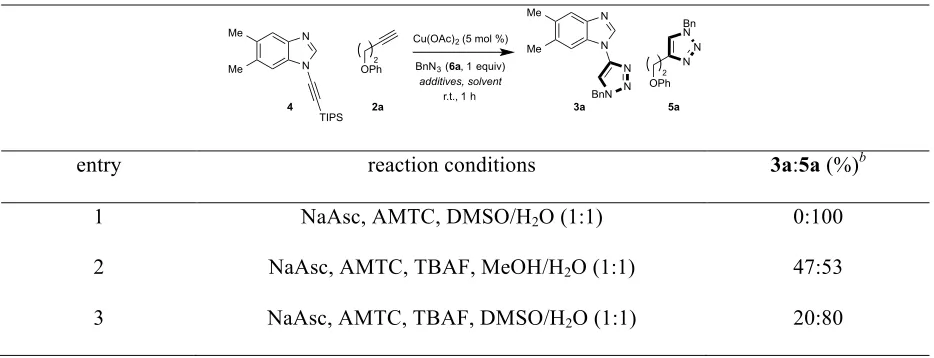
We began our investigation through the reaction of 4, benzyl azide (BnN3, 6a), and a representative terminal alkyne (2a) under a range of standard reaction conditions (Table 1). First, chemoselectivity
was established for alkyne 2a. Standard CuAAC conditions led to complete selectivity for 2a,
N N Me Me 1 N N Me Me N N N 3 OPh2 OPh2 N N N 2a 5 OPh2 2a
R N3
Cu cat. R N N Me Me 4 OPh2 2a
R N3
Cu cat. TIPS N N Me Me 4 TIPS R + + + + alkyne selective (orthogonal reactivity) ynamine selective (restored natural reactivity)
delivering triazole product 5a in quantitative yield without any degradation of 4 (entry 1). We then sought to restore ynamine chemoselectivity though addition of TBAF as a source of F–. Initial experiments using standard Cu(I) ligands (1-(trans-2-hydroxycyclohexyl)-4-(N,N -dimethylaminomethyl)-1,2,3-triazole (AMTC), tris(3-hydroxypropyltriazolylmethyl)amine (THPTA)) and TBAF or polymer-supported fluoride were unsuccessful in any solvent mixture, delivering mixtures of products (entries 2-6). Removal of Cu-ligating additives and variation of the solvent (entries 7-10) led quickly to a system that delivered complete chemoselectivity for 3a (entry 10). Solvent choice was an important factor for chemoselective control. Standard CuAAC solvent mixtures of DMSO/H2O conditions operated well for CuAAC reaction of the alkyl alkyne 2a whereas DMSO and DMSO/H2O mixtures were not effective for selectivity at the ynamine 4. Ynamine selectivity was optimum using MeCN as the reaction medium. This difference in medium may be attributable to the requirement for sodium ascorbate (NaAsc) as an additive to promote reaction of 2a and the improved solubility of NaAsc in H2O. NaAsc was not necessary for reaction of 4. That 4 does not need NaAsc as a promoter may be attributable to reduction of Cu(II) to Cu(I) via Glaser coupling.2 Since complete chemoselectivity for reaction at the ynamine using the in situ deprotection method (entry10), this suggests that the silyl deprotection is sufficiently rapid to have little consequence of the CuAAC process, i.e., the overall rate of silyl deprotection and CuAAC of 4 is less than the CuAAC rate of 2a.
Table 1. Reaction development.a
entry reaction conditions 3a:5a (%)b
1 NaAsc, AMTC, DMSO/H2O (1:1) 0:100
2 NaAsc, AMTC, TBAF, MeOH/H2O (1:1) 47:53
3 NaAsc, AMTC, TBAF, DMSO/H2O (1:1) 20:80
N N Me
Me
TIPS
(6a, 1 equiv)
4
N N Me
Me
BnN N N
3a
OPh2
OPh2 N
N Bn N
2a 5a
Cu(OAc)2 (5 mol %) BnN3
additives, solvent
4 NaAsc, AMTC, PS Fluoride, DMSO/H2O 15:85
5 NaAsc, THPTA, TBAF, DMSO/H2O (1:1) 43:57
6 NaAsc, THPTA, PS Fluoride, DMSO/H2O (1:1) 63:37
7 PS Fluoride, DMSO 35:65
8 TBAF, DMSO 47:53
9 TBAF, MeOH 16:84
10 TBAF, MeCN 100:0
a 2a (1 equiv), 4 (1 equiv), 6a (1 equiv), Cu(OAc)2 (5 mol %), NaAsc/AMTC/THPTA (10 mol %), fluoride source (1.1
equiv), solvent (0.03 M), r.t., 16 h. b Determined by HPLC analysis using an internal standard. PS = polymer supported.
With optimized conditions for orthogonal reactivity in this benchmark system established, we progressed to look at the generality of the process. The scope and orthogonality of the developed conditions A (ynamine-selective) and B (alkyne-selective) was first assessed using a series of azide
Scheme 3. Selective orthogonal CuAAC reactions of 4 and 2a using a variety of azides using conditions A or B.Isolated yields. a Using MeOH/H
2O (1:1) as solvent. b Using MeOH as solvent.
The orthogonality of the approach was further probed using a series of different alkyne components
vs. 4 (Scheme 4).
Scheme 4. Competition reactions of 4 with a range of alkynes 2a-f using conditions A and B.Isolated yields.
n-Oct N3
N N3
Ad N3
HN NH S O H H
Ph N3
S NH O O N Me Me O H N O Ph Me N3 O OH NHBoc N3 4 O HO OH O O N3 O O N3 N O N NO2 N
Me N3
N N Me Me TIPS 6a-j 4 N N Me Me N N N
3a-j OPh2
OPh2 N N N 2a 5a-j Conditions A alkyne-selective Conditions B ynamine-selective R R R N3
Conditions A: Cu(OAc)2 (5 mol %), NaAsc (10 mol %), AMTC (10 mol %), DMSO/H2O (1:1), r.t. Conditions B: Cu(OAc)2 (5 mol %), TBAF (1.1 equiv), MeCN, r.t.
Conditions A: Conditions B:
Conditions A: Conditions B:
Conditions A: Conditions B:
5a: 100% 3a: 100%
5b: 94% 3b:98%
5c: 100% 3c: 99%
5e: 82% 3e:94% 5d:84%
3d:95%
5f: 79% 3f: 99%
5g: 85% 3g: 95%
5h: 87% 3h: 92%
5i: 91%a
3i: 85%b 5j3j: 88%: 87%
H N S H N N3 O N O N O PhO p-Tol n-Pr N N Me Me TIPS 2a-f 4 Conditions B Conditions A R
Conditions A: Cu(OAc)2 (5 mol %), NaAsc (10 mol %), AMTC (10 mol %), DMSO/H2O (1:1), r.t.
Conditions B: Cu(OAc)2 (5 mol %), TBAF (1.1 equiv), MeCN, r.t.
N N Me Me BnN N N 3a R N N Bn N 7a-f or
(3a, 1 equiv) BnN3
Conditions A:
Conditions B: OPh2
2a 2b 2c 2d 2e 2f
3a: 0% 5a: 100%
3a: 0% 7b: 99%
3a: 0% 7c: 100%
3a: 0% 7d: 97%
3a: 0% 7e: 92%
3a: 0% 7f: 85%
3a: 100% 5a: 0%
3a: 79% 7b: 21%
3a: 86% 7c: 14%
3a: 90% 7d: 8%
3a: 90% 7e: 9%
Activated alkynes 2b and 2c display enhanced reactivity in CuAAC reactions over propargyl substrates (e.g., 2d) as well as aromatic (2e) and aliphatic alkynes (2f).9 Under alkyne-selective conditions (Conditions A), full conversion to the expected triazoles 7a-f was observed, with isolated yields >85%. When changing to the ynamine-selective conditions (Conditions B), chemoselectivity remained in favor of the ynamine, although the level of selectivity was lower for more reactive alkynes (2b, 2c) as could be anticipated based on previous studies.14
Orthogonal control was further explored first by use of the diyne 8 (Scheme 5). Preparation of the regioisomeric bis-triazole products 11a and 11b could be achieved either by reacting at the terminal alkyne then the ynamine (Conditions A then B) or by reaction at the ynamine followed by the terminal alkyne (Conditions B then A). This was not conditional on strategic use of a particular azide: The overall yield of 11a and 11b using both approaches was >90%, further demonstrating the orthogonality of the approach as well as establishing a useful method for sequential ligation in a multi-functional system.
N N N H TIPS O 4 N N N H TIPS O 4 N N N H O 4 N N N c-Hex N N N Bn N N N H O 4 N N N Bn N N N c-Hex 63% 98% 71% 8 10a 10b 11b
(6k, 1 equiv) c-HexN3
Conditions A Conditions B
(6a, 1 equiv) BnN3
(6a, 1 equiv) BnN3
Conditions B Conditions A
(6k, 1 equiv) c-HexN3 95% N N N H TIPS O 4 N N N H O 4 N N N Bn N N N c-Hex N N N H O 4 N N N c-Hex N N N Bn 98% 96% 94% 9a 9b 11a
(6a, 1 equiv) BnN3
Conditions A Conditions B
(6k, 1 equiv) c-HexN3 (6k, 1 equiv)
c-HexN3
Conditions B Conditions A
(6a, 1 equiv) BnN3
Scheme 5. Orthogonal CuAAC reactions on a diyne scaffold. 8. Isolated yields.
Lastly, we investigated the ability to simultaneously control both chemoselectivity at the alkyne as well as the azide component through exploitation of chelate-assistance to afford control over the azide (Scheme 6).7 Under alkyne-selective conditions (Conditions A), the multicomponent reaction of 2e, 4, 6a, and 6f delivers product pair 3a and 12 via first CuAAC reaction of 2e with the more reactive azide 6f.7a Addition of TBAF liberates the reactive ynamine allowing the second CuAAC reaction with azide 6a to take place. Alternatively, the orthogonal product pair, 3f and 7e, is generated using the ynamine-selective protocol (Conditions B) to promote the reaction of ynamine with 6f and the alkyne with 6a.
Scheme 6. Reactivity pairing of sequential CuAAC reactions. Isolated yields.
CONCLUSIONS
In summary, we have shown that orthogonal control of alkyne reactivity in CuAAC reactions can be controlled by the strategic use of a silyl protecting group. This allows the development of the first conditional orthogonal strategy for alkynes in CuAAC reactions, and displays excellent chemoselectivity profiles in single competition experiments as well as within multi-component reactions. We envisage the flexibility of this approach will provide new opportunities for chemoselective CuAAC reactions in a number of research areas, from chemical biology to materials science.
EXPERIMENTAL SECTION
N N Me
Me
TIPS
N
N3 N
N Me
Me
N N N
N
p-Tol
NN N
96% 88%
4
6f
3f 7e
p-Tol
2e
6a N3
N N Me
Me
N N N
p-Tol
NN N
N
72% 85%
3a 12
Conditions A
General. All reagents and solvents were obtained from commercial suppliers and were used without further purification unless otherwise stated. Purification was carried out according to standard laboratory methods. Intermediates 4,16 2a,17,18 6b,19 6d,20 6e,21 6g,22 6h,23 6i,24 6j,25 2b,16 2c,26 2d,27 8,15 and AMTC28 were prepared according to literature procedures. Dry solvents for reactions were either obtained from a PureSolv SPS-400-5 solvent purification system, transferred to and stored in a septum-sealed oven-dried flask over previously activated 4 Å molecular sieves and purged with and stored under nitrogen, or either used as obtained from suppliers without further purification. Reactions were carried out using conventional glassware (preparation of intermediates). Purging refers to a vacuum/nitrogen-refilling procedure. Room temperature was generally 18 °C. Reactions were carried out at elevated temperatures using a temperature-regulated hotplate/stirrer.
Purification. Thin layer chromatography was carried out using Merck silica plates coated with fluorescent indicator UV254. These were analyzed under 254 nm UV light or developed using potassium permanganate solution. Normal phase flash chromatography was carried out using ZEOprep 60 HYD 40-63 µm silica gel.
analysis. Note: Due to the high heteroatom count in specific products, 13C NMR analysis was not possible due to issues with relaxation.
General Procedures. General Procedure A for the formation of 3a-j (Scheme 3). To a solution of 5,6-dimethyl-1-((triisopropylsilyl)ethynyl)-1H-benzo[d]imidazole (45 mg, 0.14 mmol, 1 equiv), (but-3-yn-1-yloxy)benzene (20 mg, 0.14 mmol, 1 equiv) and azide 6a-j (0.14 mmol, 1 equiv) at rt in MeCN (1 mL) was added TBAF (49 µL, 0.15 mmol, 1.1 equiv) followed by Cu(OAc)2 (1 mg, 0.007 mmol, 0.05 equiv). The reaction was stirred for 16 h, after which EtOAc (10 mL) was added. The mixture was washed with EDTA (10 mg/mL, 10 mL) and brine (2 x 10 mL), dried over Na2SO4, and concentrated under vacuum. The resulting residue was purified by flash chromatography (silica gel) to provide the desired compound.
General Procedure B for the formation of 5a-j (Scheme 3). To a solution of 5,6-dimethyl-1-((triisopropylsilyl)ethynyl)-1H-benzo[d]imidazole (45 mg, 0.14 mmol, 1 equiv), (but-3-yn-1-yloxy)benzene (20 mg, 0.14 mmol, 1 equiv) and azide 5a-j (0.14 mmol, 1 equiv) at rt in DMSO/H2O (1/1, 1 mL) was added AMTC (3 mg, 0.014 mmol, 0.1 equiv) followed by Cu(OAc)2 (1 mg, 0.007 mmol, 0.05 equiv) and NaAsc (3 mg, 0.014 mmol, 0.1 equiv). The reaction was stirred for 16 h, after which EtOAc (10 mL) was added. The mixture was washed with EDTA (10 mg/mL, 10 mL) and brine (2 x 10 mL), dried over Na2SO4, and concentrated under vacuum. The resulting residue was purified by flash chromatography (silica gel) to provide the desired compound.
1-(1-Benzyl-1H-1,2,3-triazol-4-yl)-5,6-dimethyl-1H-benzo[d]imidazole (3a). Prepared using General Procedure A. White solid (31 mg, 66 %). Purification on silica gel using hexane/EtOAc 3/7. 1H NMR (CDCl3, 400 MHz): δ 8.20 (br. s, 1H), 7.67 (s, 1H), 7.58 (br. s, 1H), 7.39–7.45 (m, 4H), 7.37–7.34 (m, 2H), 5.62 (s, 2H), 2.37 (s, 6H). 13C NMR (CDCl
3, 100 MHz): δ 143.2, 142.4, 140.4, 134.0, 133.6, 132.2, 131.1, 129.5, 129.3, 128.3, 120.7, 113.5, 111.3, 55.2, 20.7, 20.3. IR νmax (neat): 3086, 2922, 2854, 1724, 1584, 1495, 1459, 1407, 1284, 1213, 1053, 867, 718 cm-1. HRMS (ESI-TOF) m/z: [M + H]+ Calcd for C
18H18N5 304.1557; Found 304.1551.
5,6-Dimethyl-1-(1-octyl-1H-1,2,3-triazol-4-yl)-1H-benzo[d]imidazole (3b). Prepared using General Procedure A. White solid (88 mg, 98%). Purification on silica gel using hexane/EtOAc 3/7. 1H NMR (CDCl3, 500 MHz): δ 8.62 (br. s, 1H), 7.77–7-68 (m, 3H), 4.45 (t, J = 7.1 Hz, 2H), 2.40 (s, 3H), 2.38 (s, 3H), 2.00 (app. quint, J = 6.6 Hz, 2H), 1.40–1.26 (m, 10H), 0.87 (t, J = 7.2 Hz, 3H). 13C NMR (CDCl3, 100 MHz): δ 133.9, 132.0, 113.8, 51.5, 31.8, 30.4, 29.8, 29.2, 29.1, 26.6, 22.7, 20.7, 20.4, 14.2. IR νmax (neat): 3135, 2924, 2857, 1740, 1597, 1500, 1470, 1383, 1292, 1206, 1156, 1091, 1053, 1033, 949, 869, 785 cm-1. HRMS (ESI-TOF) m/z: [M + H]+ Calcd for C19H28N5 326.2339; Found 326.2323.
1-(1-((3s,5s,7s)-Adamantan-1-yl)-1H-1,2,3-triazol-4-yl)-5,6-dimethyl-1H-benzo[d]imidazole (3c).
Prepared using General Procedure A. White solid (95 mg, 99%). Purification on silica gel using hexane/EtOAc 3/7. 1H NMR (CDCl
3, 400 MHz): δ 8.22 (br. s, 1H), 7.82 (s, 1H), 7.60 (s, 1H), 7.47 (s, 1H), 2.39 (s, 3H), 2.38 (s, 3H), 2.33 (br. s, 9H), 1.83 (br. s, 6H). 13C NMR (CDCl3, 100 MHz): δ 142.4, 142.1, 140.7, 133.5, 132.1, 131.4, 120.7, 111.4, 110.6, 61.0, 43.1, 35.9, 29.8, 29.6, 20.7, 20.4.IR νmax (neat): 3080, 2917, 2852, 1725, 1586, 1495, 1467, 1448, 1281, 1216, 1149, 1019, 948, 861, 844 cm-1. HRMS (ESI-TOF) m/z: [M + H]+ Calcd for C
21H26N5 348.2183; Found 348.2179.
5.88 (q, J = 7.0 Hz, 1H), 2.37 (s, 6H), 2.09 (d, J = 7.1 Hz, 3H). 13C NMR (CDCl
3, 100 MHz): δ 139.3, 133.6, 132.3, 129.4, 126.7, 120.7, 112.6, 111.5, 61.5, 29.8, 21.3, 20.7, 20.4. 4 signals not observed/coincident. IR νmax (neat): 3110, 2926, 2857, 1724, 1590, 1498, 1459, 1383, 1286, 1212, 1143, 910, 731 cm-1. HRMS (ESI-TOF) m/z: [M + H]+ Calcd for C
19H20N5 318.1713; Found 318.1704.
(S)-2-((tert-Butoxycarbonyl)amino)-6-(4-(5,6-dimethyl-1H-benzo[d]imidazol-1-yl)-1H-1,2,3-triazol-1-yl)hexanoic acid (3e). Prepared using General Procedure A. Yellow solid (56 mg, 94%). Purification on silica gel using DCM/MeOH 9/1 + 0.01% AcOH. 1H NMR (CDCl3, 400 MHz): δ 9.80 (br. s, 1H), 8.79 (s, 1H), 7.91 (s, 1H), 7.71 (s, 1H), 4.60 (br. s, 2H), 4.08 (br. s, 1H), 2.48 (s, 6H), 2.08 (br. s, 2H), 1.89 (br. s, 1H), 1.74 (br. s, 1H), 1.51 (br. s, 2H), 1.41 (s, 9H). 13C NMR (CDCl3, 100 MHz): δ 175.9, 158.1, 141.0, 139.2, 138.9, 119.9, 116.0, 114.8, 80.4, 54.6, 52.4, 32.2, 30.6, 28.7, 23.9, 20.7, 20.5. 2 signals not observed/coincident. IR νmax (neat): 3382, 3127, 2974, 2867, 2485, 2233, 2071, 1686, 1591, 1422, 1392, 1368, 1247, 1165, 1119, 1052, 974 cm-1. HRMS (ESI-TOF) m/z: [M + H]+ Calcd for C22H31N6O4 443.2401; Found 443.2389.
5,6-Dimethyl-1-(1-(pyridin-2-ylmethyl)-1H-1,2,3-triazol-4-yl)-1H-benzo[d]imidazole (3f). Prepared using General Procedure A. Yellow oil (83 mg, 99%). Purification on silica gel using hexane/EtOAc 3/7. 1H NMR (CDCl
3, 500 MHz): δ 8.61 (d, J = 4.5 Hz, 1H), 8.24 (s, 1H), 8.03 (s, 1H), 7.72 (dt, J = 7.7, 1.7 Hz, 1H), 7.57 (s, 1H), 7.45 (s, 1H), 7.33 (d, J = 7.7 Hz, 1H), 7.29 (m, 1H), 5.72 (s, 2H), 2.36 (s, 6H). 13C NMR (CDCl
3, 100 MHz): δ 153.6, 150.1, 143.0, 142.3, 140.4, 137.6, 133.6, 133.5, 133.4, 132.3, 132.2, 132.1, 131.0, 123.8, 122.8, 120.6, 114.3, 111.3. IR νmax (neat): 3105, 2960, 2917, 2852, 1586, 1502, 1465, 1435 cm-1. HRMS (ESI-TOF) m/z: [M + H]+ Calcd for C
17H17N6 305.1509; Found 305.1508.
2.39 (d, J = 4.7 Hz, 6H), 2.03 (s, 3H). 1 signal not observed/coincident. IR νmax (neat): 3599, 3108, 3082, 2917, 2852, 1613, 1597, 1550, 1424, 1288, 1216, 1149, 1087, 1002, 918, 732 cm-1. HRMS (ESI-TOF) m/z: [M + H]+ Calcd for C
20H20N9O3 434.1684; Found 434.1613.
N-(3-(4-(5,6-Dimethyl-1H-benzo[d]imidazol-1-yl)-1H-1,2,3-triazol-1-yl)propyl)-5-(dimethylamino)naphthalene-1-sulfonamide (3h). Prepared using General Procedure A. Yellow solid (43 mg, 92%). Purification on silica gel using DCM/MeOH 9/1. 1H NMR (CDCl
3, 500 MHz): δ 8.52 (d, J = 8.6 Hz, 1H), 8.27 (d, J = 8.6 Hz, 1H), 8.24 (s, 1H), 8.21 (d, J = 8.6 Hz, 1H), 7.80 (s, 1H), 7.61 (s, 1H), 7.55 (t, J = 7.6 Hz, 1H), 7.50–7.46 (m, 2H), 7.16 (d, J = 7.6 Hz, 1H), 5.38 (t, J = 6.5 Hz, 1H), 4.54 (t, J = 5.5 Hz, 2H), 2.94 (q, J = 6.2 Hz, 2H), 2.86 (s, 6H), 2.39 (s, 6H), 2.15 (m, 2H). 13C NMR (CDCl3, 100 MHz): δ 152.4, 142.6, 142.4, 140.5, 134.2, 133.8, 132.4, 131.0, 130.1, 129.9, 129.6, 128.9, 123.4, 120.7, 118.3, 115.5, 114.7, 111.4, 47.7, 45.5, 39.9, 30.2, 20.7, 20.4. IR νmax (neat): 3127, 2924, 2857, 2794, 1750, 1597, 1457, 1396, 1325, 1312, 1234, 1146, 1092, 1042, 951, 789 cm-1. HRMS (ESI-TOF) m/z: [M + H]+ Calcd for C26H30N7O2S 504.2176; Found 504.2153.
1-(3',6'-Dihydroxy-3-oxo-3H-spiro[isobenzofuran-1,9'-xanthen]-5-yl)-3-(3-(4-(5,6-dimethyl-1H-benzo[d]imidazol-1-yl)-1H-1,2,3-triazol-1-yl)propyl)thiourea (3i). Prepared using General Procedure A. Red solid (66 mg, 85%). Purification on silica gel using DCM/MeOH 9/1). 1H NMR (CDCl
3, 400 MHz): δ 9.32 (br. s, 1H), 9.00 (s, 1H), 8.45 (s, 1H), 7.86 (d, J = 8.0 Hz, 1H), 7.82 (s, 1H), 7.65–7.62 (m, 2H), 7.16 (d, J = 8.3 Hz, 1H), 6.72–6.68 (m, 2H), 6.60–6.56 (m, 3H), 4.66 (t, J = 6.9 Hz, 2H), 3.51
(s, 2H), 3.16 (s, 2H), 2.40 (s, 3H), 2.38 (s, 3H).IR νmax (neat): 2924, 2113, 1716, 1593, 1541, 1457, 1381, 1303, 1245, 1210, 854 cm-1. HRMS (ESI-TOF) m/z: [M – H]– Calcd for C
35H28N7O5S 658.1878; Found 642.1632 [M – OH]–. 13C NMR could not be obtained due to relaxation issues.
N-(2-(2-(2-(2-(4-(5,6-Dimethyl-1H-benzo[d]imidazol-1-yl)-1H-1,2,3-triazol-1-
(br. s, 1H), 4.71 (t, J = 5.2 Hz, 2H), 4.45 (dd, J = 7.8, 4.9 Hz, 1H), 4.25 (dd, J = 7.9, 4.5 Hz, 1H), 3.99 (t, J = 4.9 Hz, 2H), 3.69–3.66 (m, 2H), 3.64–3.62 (m, 2H), 3.58–3.55 (m, 2H), 3.49–3.47 (m, 2H), 3.38 (t, J = 5.4 Hz, 2H), 3.24 (t, J = 5.4 Hz, 2H), 3.17–3.12 (m, 1H), 2.88 (dd, J = 12.8, 5.0 Hz, 1H), 2.68 (d, J = 12.7 Hz, 1H), 2.41 (s, 3H), 2.40 (s, 3H), 2.17–2.13 (m, 2H), 1.73–1.50 (m, 4H), 1.42–1.34 (m, 2H). 13C NMR (CDCl
3, 100 MHz): δ 176.0, 166.1, 135.2, 133.9, 120.6, 118.2, 112.9, 71.5, 71.4, 71.1, 70.5, 63.3, 61.6, 57.0, 52.3, 41.0, 40.2, 36.7, 29.7, 29.4, 26.8, 20.7, 20.3. IR νmax (neat): 3375, 3124, 2922, 2867, 2470, 2068, 1690, 1645, 1591, 1454, 1098, 1055 cm-1. HRMS (ESI-TOF) m/z: [M + H]+ Calcd for C28H43N8O5S 615.3072; Found 615.3149.
1-Benzyl-4-(2-phenoxyethyl)-1H-1,2,3-triazole (5a). Prepared using General Procedure B. White solid (81 mg, quant). Purification on silica gel using hexane/EtOAc 3/7. 1H NMR (CDCl3, 400 MHz): δ 7.40–7.34 (m, 4H), 7.29-7.26 (m, 2H), 7.25–7.24 (m, 2H), 6.94 (tt, J = 7.4, 1.1 Hz), 6.89–6.85 (m, 2H), 5.50 (s, 2H), 4.23 (t, J = 6.5 Hz, 2H), 3.19 (t, J = 6.5 Hz, 2H). 13C NMR (CDCl3, 100 MHz): δ 158.8, 135.0, 129.6, 129.2, 128.8, 128.1, 122.0, 121.1, 114.7, 66.8, 54.2, 26.4. IR νmax (neat): 3120, 3071, 3038, 2958, 2935, 1604, 1590, 1496, 1459, 1251, 1219, 1176, 1059, 1042, 890, 828, 789, 752, 720 cm-1. HRMS (ESI-TOF) m/z: [M + Na]+ Calcd for C17H17N3ONa 302.1264; Found 302.1256.
1-Octyl-4-(2-phenoxyethyl)-1H-1,2,3-triazole (5b). Prepared using General Procedure B. White solid
(78 mg, 94%). Purification on silica gel using hexane/EtOAc 3/7. 1H NMR (CDCl3, 400 MHz): δ 7.41 (s, 1H), 7.29–7.25 (m, 2H), 6.96–6.89 (m, 3H), 4.30 (t, J = 7.2 Hz, 2H), 4.24 (t, J = 6.5 Hz, 2H), 3.21
(t, J = 6.5 Hz, 2H), 1.87 (app. quint, J = 7.1 Hz, 2H), 1.30–1.25 (m, 10H), 0.87 (t, J = 6.6 Hz, 3H). 13C NMR (CDCl3, 100 MHz): δ 158.7, 144.6, 129.6, 121.7, 121.0, 114.6, 66.8, 50.3, 31.8, 30.4, 29.1, 29.0, 26.6, 26.3, 22.7, 14.1. IR νmax (neat): 3142, 2956, 2922, 2852, 1604, 1591, 1500, 1487, 1388, 1247, 1217, 1176, 1057, 1035, 886, 817, 756, 694 cm-1. HRMS (ESI-TOF) m/z: [M + Na]+ Calcd for C18H27N3ONa 324.2046; Found 324.2035.
(CDCl3, 400 MHz): δ 7.49 (s, 1H), 7.30–7.28 (m, 2H), 7.00–6.90 (m, 3H), 4.25 (t, J = 6.6 Hz, 2H), 3.22 (t, J = 6.6 Hz, 2H), 2.25–2.23 (m, 9H), 1.82–1.75 (m, 6H). 13C NMR (CDCl
3, 100 MHz): δ 158.9, 143.7, 129.6, 121.0, 118.2, 114.7, 67.1, 59.4, 43.1, 36.1, 29.6, 26.5. IR νmax (neat): 2909, 2857, 1599, 1590, 1556, 1500, 1476, 1457, 1420, 1348, 1292, 1243, 1035, 1016, 780, 759, 694 cm-1. HRMS (ESI-TOF) m/z: [M + Na]+ Calcd for C
20H25N3ONa 346.1890; Found 346.1881.
(S)-4-(2-Phenoxyethyl)-1-(1-phenylethyl)-1H-1,2,3-triazole (5d). Prepared using General Procedure B. White solid (67 mg, 84%). Purification on silica gel using hexane/EtOAc 3/7). 1H NMR (CDCl3, 400 MHz): δ 7.38–7.32 (m, 8H), 6.94 (tt, J = 7.4, 1.1 Hz, 1H), 6.88–6.85 (m, 2H), 5.78 (q, J = 7.2 Hz, 1H), 4.23 (t, J = 6.5 Hz, 2H), 3.19 (t, J = 6.5 Hz, 2H), 1.97 (d, J = 7.1 Hz, 3H). 13C NMR (CDCl3, 100 MHz): δ 158.7, 144.6, 140.2, 129.6, 129.1, 128.5, 126.6, 121.0, 120.8, 114.7, 66.8, 60.2, 25.4, 21.4. IR νmax (neat): 3170, 3066, 3030, 3045, 2941, 2924, 2870, 1604, 1588, 1498, 1463, 1387, 1366, 1305, 1251, 1038, 811, 756, 733, 705, 694 cm-1. HRMS (ESI-TOF) m/z: [M + Na]+ Calcd for C18H19N3ONa 316.1420; Found 316.1410.
(S)-2-((tert-Butoxycarbonyl)amino)-6-(4-(2-phenoxyethyl)-1H-1,2,3-triazol-1-yl)hexanoic acid (5e).
Prepared using General Procedure B. White solid (46 mg, 82%). Purification on silica gel using DCM/MeOH 9/1, 0.1% AcOH. 1H NMR (MeOD, 500 MHz): δ 7.83 (br. s, 1H), 7.24 (t, J = 7.8 Hz, 2H), 6.92–6.89 (m, 3H), 4.37 (t, J = 7.1 Hz, 2H), 4.22 (t, J = 6.5 Hz, 2H), 4.08–4.05 (m, 1H), 3.15 (t, J
= 6.4 Hz, 2H), 1.94–1.89 (m, 2H), 1.87–1.80 (m, 2H), 1.70–1.55 (m, 2H), 1.42 (s, 9H). 13C NMR (MeOD, 100 MHz): δ 176.0, 158.1, 130.5, 121.9, 115.6, 80.5, 67.7, 54.6, 52.2, 51.1, 32.3, 32.2, 29.4, 28.7, 26.9, 23.9.IR νmax (neat): 3398, 2952, 2922, 2868, 2482, 2242, 2071, 1688, 1600, 1368, 1167, 1119, 974 cm-1. HRMS (ESI-TOF) m/z: [M + Na]+ Calcd for C21H30N4O5Na 441.2108; Found 441.2102.
7.7 Hz, 1H), 6.93 (tt, J = 7.3, 1.2 Hz, 1H), 6.88 (m, 1H), 5.63 (s, 2H), 4.25 (t, J = 6.5 Hz, 2H), 3.22 (t,
J = 6.5 Hz, 2H). 13C NMR (CDCl
3, 100 MHz): δ 158.8, 137.5, 129.6, 123.5, 121.1, 114.7, 66.8, 55.7, 26.4. 3 signals not observed/coincident. IR νmax (neat): 3142, 2932, 1601, 1590, 1496, 1474, 1441, 1295, 1241, 1052, 1022, 1035, 998, 752, 692 cm-1. HRMS (ESI-TOF) m/z: [M + Na]+ Calcd for C16H16N4ONa 303.1216; Found 303.1214.
N-Methyl-7-nitro-N-(2-(4-(2-phenoxyethyl)-1H-1,2,3-triazol-1-yl)ethyl)benzo[c][1,2,5]oxadiazol-4-amine (5g). Prepared using General Procedure B. Yellow solid (118 mg, 85%). Purification on silica gel using hexane/EtOAc 1/9. 1H NMR (CDCl3, 500 MHz): δ 8.37 (d, J = 9.0 Hz, 1H), 7.86 (br. s, 1H), 7.24 (t, J = 7.7 Hz, 2H), 6.92 (t, J = 7.3 Hz, 1H), 6.84 (d, J = 8.0 Hz, 2H), 6.20 (d, J = 8.9 Hz, 1H), 4.68 (m, 2H), 4.01 (t, J = 6.0 Hz, 2H), 3.03 (t, J = 6.0 Hz, 2H), 1.34–1.29 (m, 5H). IR νmax (neat): 3142, 1617, 1556, 1483, 1429, 1303, 1281, 1095, 1035, 1000, 801, 756, 682 cm-1. HRMS (ESI-TOF)
m/z: [M + Na]+ Calcd for C19H19N7O4Na 432.1391; Found 432.1376. 13C NMR could not be obtained due to relaxation issues.
5-(Dimethylamino)-N-(3-(4-(2-phenoxyethyl)-1H-1,2,3-triazol-1-yl)propyl)naphthalene-1-sulfonamide
(5h). Prepared using General Procedure B. Yellow solid (38 mg, 87%). Purification on silica gel using DCM/MeOH 9/1. 1H NMR (CDCl
3, 400 MHz): δ 8.53 (dt, J = 8.5, 0.9 Hz, 1H), 8.27 (dt, J = 8.5, 0.9 Hz, 1H), 8.18 (dd, J = 7.3, 1.2 Hz, 1H), 7.55 (dd, J = 8.6, 7.6 Hz, 1H), 7.47 (dd, J = 8.5, 7.2 Hz, 1H), 7.33 (s, 1H), 7.28–7.24 (m, 2H), 7.16 (d, J = 7.6 Hz, 1H), 6.95–6.88 (m, 3H), 5.41 (t, J = 6.5 Hz, 1H),
4.32 (t, J = 6.6 Hz, 2H), 4.20 (t, J = 6.3 Hz, 2H), 3.15 (t, J = 6.3 Hz, 2H), 2.87 (s, 6H), 2.01 (m, 4H).13C NMR (CDCl
1-(3',6'-Dihydroxy-3-oxo-3H-spiro[isobenzofuran-1,9'-xanthen]-5-yl)-3-(3-(4-(2-phenoxyethyl)-1H-1,2,3-triazol-1-yl)propyl)thiourea (5i). Prepared using General Procedure B. Red solid (68 mg, 91%). Purification on silica gel using DCM/MeOH 9/1. 1H NMR (CDCl
3, 500 MHz): δ 8.72 (br. s, 1H), 8.38 (s, 1H), 8.06 (s, 1H), 7.83 (d, J = 7.7 Hz, 1H), 7.27 (t, J = 7.1 Hz, 2H), 7.17 (d, J = 7.1 Hz, 1H), 6.95 (m, 2H), 6.71 (s, 3H), 6.58 (q, J = 8.2 Hz, 3H), 4.45 (t, J = 6.4 Hz, 2H), 4.22 (t, J = 6.6 Hz, 4H), 3.51 (m, 2H), 3.09 (t, J = 6.4 Hz, 2H). IR νmax (neat): 2928, 1638, 1591, 1541, 1457, 1381, 1295, 1238, 1210, 1176, 1120, 852 cm-1. HRMS (ESI-TOF) m/z: [M - H]- Calcd for C
34H28N5O6S 634.1766, found 618.2001 [M - OH]. 13C NMR could not be obtained due to relaxation issues.
5-((3aS,4S,6aR)-2-Oxohexahydro-1H-thieno[3,4-d]imidazol-4-yl)-N-(2-(2-(2-(2-(4-(2-phenoxyethyl)-1H-1,2,3-triazol-1-yl)ethoxy)ethoxy)ethoxy)ethyl)pentanamide (5j). Prepared using General Procedure B. White solid (32 mg, 88%). Purification on silica gel using DCM/MeOH 9/1. 1H NMR (CDCl3, 400 MHz,): δ 7.96 (br. s, 1H), 7.25 (t, J = 7.7 Hz, 2H), 6.92 (d, J = 7.2 Hz, 3H), 4.56 (t, J = 4.6 Hz, 2H), 4.47 (dd, J = 7.6, 5.6 Hz, 1H), 4.28 (dd, J = 7.9, 4.3 Hz, 1H), 4.24 (t, J = 5.1 Hz, 2H), 3.88 (t, J = 4.7 Hz, 2H), 3.63–3.54 (m, 8H), 3.50 (t, J = 5.1 Hz, 2H), 3.37–3.33 (m, 2H), 3.20–3.17 (m, 3H), 2.90 (dd,
J = 12.5, 4.8 Hz, 1H), 2.70 (d, J = 12.7 Hz, 1H), 2.19 (t, J = 7.4 Hz, 2H), 1.75–1.54 (m, 4H), 1.41 (app. quint, J = 7.5 Hz, 2H). 13C NMR (CDCl3, 100 MHz): δ 176.1, 166.1, 160.2, 130.5, 121.9, 115.7, 71.6, 71.5, 71.4, 71.2, 10.6, 70.4, 67.8, 63.4, 61.6, 57.0, 51.5, 41.1, 40.3, 36.7, 29.7, 29.5, 27.0, 26.8. 1
signal not observed/coincident. IR νmax (neat): 3274, 3071, 2917, 2861, 1695, 1679, 1643, 1545, 1474, 1238, 1104, 1035, 756 cm-1. HRMS (ESI-TOF) m/z: [M + H]+ Calcd for C
28H43N6O6S 591.2959, found 591.2811.
3-(1-Benzyl-1H-1,2,3-triazol-4-yl)oxazolidin-2-one (7b).29 Prepared using General Procedure C. White solid (99 mg, 99%). Purification on silica gel using hexane/EtOAc 7/3. 1H NMR (CDCl
3, 400 MHz): δ 7.82 (s, 1H), 7.36–7.33 (m, 3H), 7.28–7.26 (m, 2H), 5.48 (s, 2H), 4.56–4.52 (m, 2H), 4.25–4.21 (m, 2H). 13C NMR (CDCl
(1-Benzyl-1H-1,2,3-triazol-4-yl)(pyrrolidin-1-yl)methanone (7c). Prepared using General Procedure C. White solid (105 mg, quant). Purification on silica gel using hexane/EtOAc 7/3. 1H NMR (CDCl
3, 400 MHz): δ 8.02 (s, 1H), 7.36–7.34 (m, 3H), 7.28–7.26 (m, 2H), 5.52 (s, 2H), 4.09 (t, J = 6.7 Hz, 2H), 3.62 (t, J = 6.9 Hz, 2H), 1.97 (app. quint, J = 7.1 Hz, 2H), 1.88 (app. quint, J = 7.1 Hz, 2H). 13C NMR (CDCl3, 100 MHz): δ 159.5, 145.5, 134.1, 129.3, 129.0, 128.3, 127.6, 54.3, 48.7, 47.0, 26.6, 23.8. IR νmax (neat): 3298, 3099, 2939, 2861, 2190, 1600, 1543, 1498, 1424, 1342, 1279, 1229, 1048 cm-1. HRMS (ESI-TOF) m/z: [M + Na]+ Calcd for C
14H16N4ONa 279.1216; Found 279.1206.
1-Benzyl-4-(phenoxymethyl)-1H-1,2,3-triazole (7d).30 Prepared using General Procedure C. White solid (106 mg, 97%). Purification on silica gel using hexane/EtOAc 9/1. 1H NMR (CDCl3, 400 MHz): δ 7.52 (s, 1H), 7.37–7.35 (m, 3H), 7.29–7.25 (m, 4H), 6.97–6.95 (m, 3H), 5.52 (s, 2H), 5.18 (s, 2H). 13C NMR (CDCl3, 100 MHz): δ 157.7, 144.2, 134.0, 129.0, 128.7, 128.3, 127.6, 122.1, 120.8, 114.3,
61.6, 53.7.
1-Benzyl-4-(p-tolyl)-1H-1,2,3-triazole (7e).31 Prepared using General Procedure C. White solid (94 mg, 92%). Purification on silica gel using hexane/EtOAc 9/1. 1H NMR (CDCl3, 400 MHz): δ 7.70 (s, 1H), 7.68 (s, 1H), 7.62 (s, 1H), 7.39–7.36 (m, 3H), 7.32–7.31 (m, 1H), 7.30–7.29 (m, 1H), 7.21 (s, 1H), 7.19 (s, 1H), 5.56 (s, 2H), 2.36 (s, 3H). 13C NMR (CDCl
3, 100 MHz): δ 148.4, 138.1, 134.9, 129.6, 129.3, 128.9, 128.2, 127.9, 125.7, 119.3, 54.3, 21.4.
1-Benzyl-4-propyl-1H-1,2,3-triazole (7f).32 Prepared using General Procedure C. White solid (70 mg, 85%). Purification on silica gel using hexane. 1H NMR (CDCl
3, 400 MHz): δ 7.36–7.31 (m, 3H), 7.24–7.21 (m, 2H), 7.18 (s, 1H), 5.47 (s, 2H), 2.64 (t, J = 7.4 Hz, 2H), 1.64 (sextet, J = 7.4 Hz, 2H), 0.9 (t, J = 7.4 Hz, 3H). 13C NMR (CDCl
3, 100 MHz): δ 148.8, 135.1, 129.1, 128.6, 128.0, 120.7, 54.0, 27.8, 22.7, 13.8.
]imidazol-6-yl)hept-6-ynamide (50 mg, 0.119 mmol, 1 equiv.) in MeOH/H2O (1/1, 2 mL) was added benzyl azide
(15 µL, 0.119 mmol, 1 equiv.), AMTC (3 mg, 0.012 mmol, 0.1 equiv.), Cu(OAc)2 (1 mg, 0.006 mmol,
0.05 equiv.), and NaAsc (3 mg, 0.012 mmol, 0.1 equiv.). The reaction was stirred at rt for 16 h, after which DCM (10 mL) was added. The mixture was washed with aq. EDTA (10 mg/mL, 10 mL), brine (2 x 10 mL), dried over Na2SO4, and concentrated under reduced pressure. The resulting residue was purified by flash chromatography (silica gel, hexane/ EtOAc 3/7) to provide the desired product as a white solid (62 mg, 98%). 1H NMR (CDCl3, 400 MHz,): δ 8.75 (s, 1H), 8.24 (s, 1H), 8.05 (br. s, 1H), 7.64 (br. s, 1H), 7.35–7.30 (m, 4H), 7.23–7.21 (m, 3H), 5.45 (s, 2H), 2.71 (t, J = 6.9 Hz, 2H), 2.43 (t, J
= 6.9 Hz, 2H), 1.79–1.70 (m, 4H), 1.14 (s, 21H). 13C NMR (CDCl3, 100 MHz): δ 171.8, 136.3, 134.8, 129.2, 128.8, 128.1, 120.6, 117.0, 102.6, 73.5, 54.2, 37.1, 29.8, 28.6, 25.1, 25.0, 18.7, 11.3. 5 signals not observed/coincident. IR νmax (neat): 3251, 2937, 2859, 2184, 1664, 1602, 1548, 1498, 1441, 1216, 909, 883, 730 cm-1. HRMS (ESI-TOF) m/z: [M + Na]+ Calcd for C
32H42N6OSiNa 577.3082; Found 577.3122.
N-(1-(1-Cyclohexyl-1H-1,2,3-triazol-4-yl)-1H-benzo[d]imidazol-6-yl)hept-6-ynamide (9b). To a solution of N-(1-((triisopropylsilyl)ethynyl)-1H-benzo[d]imidazol-6-yl)hept-6-ynamide (50 mg, 0.12 mmol, 1 equiv.) in MeCN (1 mL) was added cyclohexylazide (15 mg, 0.12 mmol, 1 equiv.), TBAF
(43 µL, 0.13 mmol, 1.1 equiv.), and Cu(OAc)2 (1 mg, 0.006 mmol, 0.05 equiv.). The reaction was
stirred at rt for 16 h, after which DCM (10 mL) was added. The mixture was washed with aq. EDTA (10 mg/mL, 10 mL), brine (2 x 10 mL), dried over Na2SO4, and concentrated under reduced pressure. The resulting residue was purified by flash chromatography (silica gel, 7/3 EtOAc/hexane) to provide the desired product as a white solid (45 mg, 96%). 1H NMR (CDCl
3259, 3123, 3080, 2930, 2855, 1673, 1604, 1587, 1550, 1487, 1442, 1299, 1240, 911, 803, 730 cm-1. HRMS (ESI-TOF) m/z: [M + Na]+ Calcd for C
22H26N6ONa 413.2060; Found 413.2049.
5-(1-Cyclohexyl-1H-1,2,3-triazol-4-yl)-N-(1-((triisopropylsilyl)ethynyl)-1H-benzo[d]imidazol-6-yl)pentanamide (10a). To a solution of N-(1-((triisopropylsilyl)ethynyl)-1H-benzo[d ]imidazol-6-yl)hept-6-ynamide (50 mg, 0.119 mmol, 1 equiv.) in MeOH/H2O (1/1, 2 mL) was added cyclohexylazide (15 mg, 0.12 mmol, 1 equiv.), AMTC (3 mg, 0.012 mmol, 0.1 equiv.), Cu(OAc)2 (1 mg, 0.006 mmol, 0.05 equiv.), and NaAsc (3 mg, 0.012 mmol, 0.1 equiv.). The reaction was stirred at rt for 24 h, after which DCM (10 mL) was added. The mixture was washed with aq. EDTA (10 mg/mL, 10 mL), brine (2 x 10 mL), dried over Na2SO4, and concentrated under reduced pressure. The resulting residue was purified by flash chromatography (silica gel, hexane/ EtOAc 3/7) to provide the desired product as a white solid (42 mg, 63%). 1H NMR (CDCl3, 400 MHz,): δ 8.51 (br. s, 1H), 8.20 (d, J = 1.6 Hz, 1H), 8.01 (s, 1H), 7.66 (d, J = 8.7 Hz, 1H), 7.32 (dd, J = 8.6, 1.7 Hz, 1H), 7.29 (s, 1H), 4.38 (tt, J = 11.8, 3.8 Hz, 1H), 2.75 (t, J = 6.9 Hz, 2H), 2.45 (t, J = 6.7 Hz, 2H), 2.18–2.15 (m, 2H), 1.92–1.87 (m, 2H), 1.83–1.65 (m, 6H), 1.48–1.37 (m, 2H), 1.27–1.21 (m, 2H), 1.16–1.14 (m, 21H). 13C NMR (CDCl3, 100 MHz): δ 171.8, 147.2, 143.8, 138.2, 136.2, 135.0, 120.8, 118.7, 117.0, 102.6,
90.1, 73.4, 60.1, 37.2, 33.7, 28.6, 25.3, 25.3, 25.1, 25.0, 18.8, 11.3. 9 signals not observed/coincident. IR νmax (neat): 3296, 3132, 3075, 2935, 2859, 2184, 1686, 1664, 1602, 1547, 1500, 1483, 1441, 1376, 1284, 1216, 1071? 998, 885, 680 cm-1. HRMS (ESI-TOF): m/z: [M + Na]+ Calcd for C31H46N6OSiNa 569.3395; Found 569.3382.
N-(1-(1-Benzyl-1H-1,2,3-triazol-4-yl)-1H-benzo[d]imidazol-6-yl)hept-6-ynamide (10b). To a solution of N-(1-((triisopropylsilyl)ethynyl)-1H-benzo[d]imidazol-6-yl)hept-6-ynamide (50 mg, 0.12 mmol, 1
equiv.) in MeCN (1 mL) was added benzyl azide (15 µL, 0.119 mmol, 1 equiv.), TBAF (43 µL, 0.13
product as a white solid (47 mg, 98%). 1H NMR (CDCl
3, 400 MHz,): δ 8.37 (br. s, 1H), 8.25 (br. s, 1H), 8.01 (br. s, 1H), 7.88 (s, 1H), 7.68 (d, J = 8.7 Hz, 1H), 7.39–7.34 (m, 5H), 7.20 (dd, J = 8.6, 1.7 Hz, 1H), 5.61 (s, 2H), 3.12–3.08 (m, 2H), 2.42 (t, J = 7.3 Hz, 2H), 2.22 (td, J = 7.2, 2.7 Hz, 2H), 1.95 (t, J = 2.5 Hz, 1H), 1.88–1.80 (m 2H). 13C NMR (CDCl
3, 100 MHz): δ 171.3, 135.2, 134.1, 129.4, 129.2, 128.3, 120.6, 116.2, 114.2, 102.5, 84.2, 68.8, 55.2, 37.1, 28.0, 24.7, 19.7, 18.3. 6 signals not observed/coincident. IR νmax (neat): 2954, 2961, 2865, 1599, 1589, 1439, 1396, 1080, 1065, 1041, 866, 775 cm-1. HRMS (ESI-TOF): m/z: [M + Na]+ Calcd for C
23H22N6ONa 421.1747; Found 421.1732.
5-(1-Benzyl-1H-1,2,3-triazol-4-yl)-N-(1-(1-cyclohexyl-1H-1,2,3-triazol-4-yl)-1H-benzo[d]imidazol-6-yl)pentanamide (11a). Method A: To a solution of 5-(1-benzyl-1H-1,2,3-triazol-4-yl)-N -(1-((triisopropylsilyl)ethynyl)-1H-benzo[d]imidazol-6-yl)pentanamide (64 mg, 0.12 mmol, 1 equiv.) in
MeCN (1 mL) was added cyclohexylazide (15 mg, 0.12 mmol, 1 equiv.), TBAF (43 µL, 0.13 mmol,
1.1 equiv.) and Cu(OAc)2 (1 mg, 0.006 mmol, 0.05 equiv.). The reaction was stirred at rt for 16 h, after which DCM (10 mL) was added. The mixture was washed with aq. EDTA (10 mg/mL, 10 mL), brine (2 x 10 mL), dried over Na2SO4 and concentrated under reduced pressure. The resulting residue was purified by flash chromatography (silica gel, 9/1 EtOAc/hexane) to provide the desired product as a white solid (61 mg, 98%). Method B: To a solution of 5-(1-benzyl-1H-1,2,3-triazol-4-yl)-N -(1-((triisopropylsilyl)ethynyl)-1H-benzo[d]imidazol-6-yl)pentanamide (20 mg, 0.051 mmol, 1 equiv.) in
1.79–1.70 (m, 6H), 1.47 (tt, J = 12.9, 3.5 Hz, 2H). 13C NMR (CDCl
3, 100 MHz): δ 172.0, 135.5, 134.9, 129.2, 128.8, 128.1, 121.1, 120.6, 116.3, 112.3, 102.4, 61.3, 54.1, 37.1, 33.4, 28.6, 25.3, 26.2, 25.1, 25.0. 5 signals not observed/coincident. IR νmax (neat): 3257, 3125, 3062, 2922, 2852, 2093, 1671, 1584, 1547, 1496, 1485, 1446, 1299, 1216, 1050, 816, 799, 729 cm-1. HRMS (ESI-TOF) m/z: [M + Na]+ Calcd for C
29H33N9ONa 546.2700; Found 546.2660.
N-(1-(1-Benzyl-1H-1,2,3-triazol-4-yl)-1H-benzo[d]imidazol-6-yl)-5-(1-cyclohexyl-1H-1,2,3-triazol-4-yl)pentanamide (11b). Method A: To a solution of 5-(1-cyclohexyl-1H-1,2,3-triazol-4-yl)-N-(1-((triisopropylsilyl)ethynyl)-1H-benzo[d]imidazol-6-yl)pentanamide (30 mg, 0.06 mmol, 1 equiv.) in
MeCN (1 mL) was added benzyl azide (7 µL, 0.06 mmol, 1 equiv.), TBAF (20 µL, 0.07 mmol, 1.1
equiv.) and Cu(OAc)2 (0.5 mg, 0.003 mmol, 0.05 equiv.). The reaction was stirred at rt for 2 h, after which DCM (10 mL) was added. The mixture was washed with aq. EDTA (10 mg/mL, 10 mL), brine (2 x 10 mL), dried over Na2SO4 and concentrated under reduced pressure. The resulting residue was purified by flash chromatography (silica gel, 9/1 EtOAc/hexane) to provide the desired product as a white solid (30 mg, 95%). Method B: To a solution of N-(1-(1-benzyl-1H-1,2,3-triazol-4-yl)-1H-benzo[d]imidazol-6-yl)hept-6-ynamide (30 mg, 0.08 mmol, 1 equiv.) in MeOH/H2O (1/1, 2 mL) was added cyclohexylazide (10 mg, 0.08 mmol, 1 equiv.), AMTC (1.6 mg, 0.008 mmol, 0.1 equiv.), Cu(OAc)2 (0.8 mg, 0.004 mmol, 0.05 equiv.) and NaAsc (3 mg, 0.008 mmol, 0.1 equiv.). The reaction was stirred at rt for 24 h, after which DCM (10 mL) was added. The mixture was washed with aq. EDTA (10 mg/mL, 10 mL), brine (2 x 10 mL), dried over Na2SO4 and concentrated under reduced pressure. The resulting residue was purified by flash chromatography (silica gel, 9/1 EtOAc/hexane) to provide the desired product as a yellow solid (30 mg, 71%). 1H NMR (CDCl3, 400 MHz,): δ 8.67 (br. s, 1H), 8.10 (br.s, 1H), 7.88 (br. s, 1H), 7.41–7.38 (m, 6H), 7.23 (m, 2H), 5.65 (s, 2H), 3.24 (m, 2H), 2.48 (t, J = 5.8 Hz, 2H), 2.29–2.26 (m, 1H), 2.20–2.18 (m, 2H), 1.90–1.75 (m, 6H), 1.69–1.60 (m 4H), 1.45–1.42 (m, 2H). 13C NMR (CDCl3, 100 MHz): δ 129.4, 129.2, 128.3, 124.6, 31.6, 30.3, 29.8, 29.6, 28.0, 25.3, 24.8, 24.5, 20.0, 13.9. 15 signals not observed/coincident. IR νmax (neat): 3300, 2954, 2928, 2855, 1736, 1677, 1628, 1600, 1587, 1548, 1496, 1441, 1455, 1379, 1364, 1301, 1234, 864, 821, 725 cm-1. HRMS (ESI-TOF): m/z: [M + Na]+ Calcd for C
2-((4-(p-Tolyl)-1H-1,2,3-triazol-1-yl)methyl)pyridine (12).33 To a solution of 5,6-dimethyl-1-((triisopropylsilyl)ethynyl)-1H-benzo[d]imidazole 1 (49 mg, 0.15 mmol, 1 equiv.) and 1-ethynyl-4-methylbenzene (19 µL, 0.15 mmol, 1 equiv.) in MeCN (0.75 mL) was added 2-(azidomethyl)pyridine (20 mg, 0.15 mmol, 1 equiv.), (azidomethyl)benzene (19 µL, 0.15 mmol, 1 equiv.), and Cu(OAc)2 (1.4 mg, 0.0075 mmol, 0.05 equiv.). The reaction was stirred at rt for 5 h before being filtered through celite and concentrated under reduced pressure. The crude mixture was dissolved in MeCN (0.75 mL) before adding Cu(OAc)2 (1.4 mg, 0.0075 mmol, 0.05 equiv.) and TBAF (1 M in THF, 22.5 µL, 0.225 mmol, 1.5 equiv.). The reaction was stirred at rt for a further 16 h, after which EtOAc (10 mL) was added. The mixture was washed with aq. EDTA (10 mg/mL, 10 mL), brine (2 x 10 mL), dried over Na2SO4, and concentrated under reduced pressure. The resulting residue was purified by flash chromatography (silica gel, Et2O/MeOH/NEt3 20/1/1) to provide the desired product as a white solid (32 mg, 85%). 1H NMR (CDCl3, 500 MHz): δ 8.61 (br. s, 1H), 7.89 (s, 1H), 7.72 (s, 1H), 7.71 (s, 1H), 7.68 (td, J = 7.6, 1.4 Hz, 1H), 7.26 (t, J = 5.4 Hz, 1H), 7.22 (t, J = 5.6 Hz, 3H), 5.69 (s, 2H), 2.36 (s, 3H). 13C NMR (CDCl3, 100 MHz): δ 154.7, 149.8, 148.5, 138.1, 137.5, 129.6, 127.8, 125.7, 123.6, 122.6, 120.0, 55.8, 21.4.
ACKNOWLEDGMENTS
M.Z.C.H. thanks the University of Strathclyde for a PhD scholarship. C.P.S. thanks the Carnegie Trust
for the Universities of Scotland for a PhD scholarship. We thank the EPSRC UK National Mass Spectrometry Facility at Swansea University for analyses.
ASSOCIATED CONTENT
Supporting information. Data for optimization, NMR and IR spectra for characterization.
REFERENCES
(1) For seminal reports, see: a) Kolb, H. C.; Finn, M. G.; Sharpless, K. B. Angew. Chem. Int. Ed. 2001,
(2) For reviews see: a) Hein, J. E.; Fokin, V. V. Chem. Soc. Rev. 2010, 39, 1302–1315; b) Meldal, M.; Tornøe, C. W. Chem. Rev. 2008, 108, 2952–3015; c) Moses, J. E.; Moorhouse, A. D. Chem. Soc. Rev. 2007, 36, 1249–1262.
(3) Weixian, X.; Scott, T. F.; Kloxin, C. J.; Bowman, C. N. Adv. Funct. Mater. 2014, 24, 2572–2590. (4) Thirumurugan, P.; Matosiuk, D.; Jozwiak, K. Chem. Rev. 2013, 113, 4905–4979.
(5) Castro, V.; Rodríguez, H.; Albericio, F. ACS Comb. Sci. 2016, 18, 1–14.
(6) a) Wang, Z.; Li, Y.; Dong, X.-H.; Yu, X.; Guo, K.; Su, H.; Yue, K.; Wesdemiotis, C.; Cheng, S. Z. D.; Zhang, W. B. Chem. Sci. 2013, 4, 1345–1352; b) Kele, P.; Mezö, G.; Achatz, D.; Wolfbeis, O. S.
Angew. Chem. Int. Ed. 2009, 48, 344–347; c) DeForest, C. A.; Polizzotti, B. D.; Anseth, K. S. Nature Materials 2009, 8, 659–664.
(7) a) Yuan, Z.; Kuang, G. C.; Clark, R. J.; Zhu, L. Org. Lett. 2012, 14, 2590–2593; b) Kuang, G. C.; Guha, P. M.; Brotherton, W. S.; Simmons, J. T.; Stankee, L. A.; Nguyen, B. T.; Clark, R. J.; Zhu, L. J. Am. Chem. Soc. 2011, 133, 13984–14001. (c) Urankar, D.; Steinbücher, M.; Kosjek, J.; Košmrlj, J.
Tetrahedron 2010, 66, 2602–2613.
(8) a) Gramlich, P. M. E.; Warncke, S.; Geirlich, J.; Carell, T. Angew. Chem. Int. Ed. 2008, 47, 3442– 3444; b) Aucagne, V.; Leigh, D. A. Org. Lett. 2006, 8, 4505–4507.
(9) a) Kislukhin, A. A.; Hong, V. P.; Breitenkamp, K. E.; Finn, M. G. Bioconjugate Chem. 2013, 24, 684−689; b) Zhang, X.; Li, H.; You, L.; Tang, Y.; Hsung, R. P. Adv. Synth. Catal. 2006, 348, 2437−2442; c) Zhang, X.; Hsung, R. P.; You, L. Org. Biomol. Chem. 2006, 4, 2679−2682.
(10) a) Beal, D. M. Albrow, V. E.; Burslem, G.; Hitchen, L.; Fernandes, C.; Lapthorn, C.; Roberts, L.
R.; Selby, M. D.; Jones, L. H. Org. Biomol. Chem. 2012, 10, 548–554; b)Agard, N. J.; Prescher, J. A.; Bertozzi, C. R. J. Am. Chem. Soc. 2004, 126, 15046–15047.
(11) Yoshida, S.; Hatakeyama, Y.; Johmoto, K.; Uekusa, H.; Hosoya, T. J. Am. Chem. Soc. 2014, 136, 13590–13593.
(12) Tummatorn, J.; Batsomboon, P.; Clark, R. J.; Alabugin, I. V.; Dudley, G. B. J. Org. Chem. 2012,
77, 2093−2097.
(14) Seath, C. P.; Burley, G. A.; Watson, A. J. B. Angew. Chem. Int. Ed. 2017, 56, 3314–3318.
(15) Hatit, M. Z. C.; Sadler, J. C.; McLean, L. A.; Whitehurst, B. C.; Seath, C. P.; Humphreys, L. D.; Young, R. J.; Watson, A. J. B.; Burley, G. A. Org. Lett. 2016, 18, 1694–1697.
(16) Burley, G. A.; Davies, D. L.; Griffith, G. A.; Lee, M.; Singh, K. J. Org. Chem. 2010, 75, 980– 983.
(17) Belanger, G.; Dupuis, M.; Larouche-Gauthier, R. J. Org. Chem. 2012, 77, 3215–3221. (18) Capella, L.; Montevecchi, P. C.; Nanni, D. J. Org. Chem. 1994, 59, 3368–3374.
(19) Sahoo, L.; Singhamahapatra, A.; Loganathan, D. Org. Biomol. Chem. 2014, 12, 2615–2625. (20) Khedar, P.; Pericherla, K.; Kumar, A. Synlett 2014, 25, 515–518.
(21) Schmitz, J.; Li, T.; Bartz, U.; Gütschow, M. ACS Med. Chem. Lett. 2016, 7, 211–216. (22) Mamidyala, S. K.; Cooper, M. A. Chem. Commun. 2013, 49, 8407–8409.
(23) Sivakumar, K.; Xie, F.; Cash, B. M.; Long, S.; Barnhill, H. N.; Wang, Q. Org. Lett. 2004, 6, 4603–4606.
(24) Wolfram, S.; Wurfel, H.; Habenicht, S. H.; Lembke, C.; Richter, P.; Birckner, E.; Beckert, R.; Pohnert, G. Beilstein J. Org. Chem. 2014, 10, 2470–2479.
(25) Huang, B.; Kukowska-Latallo, J. F.; Tang, S.; Zong, H.; Johnson, K. B.; Desai, A.; Gordon, C. L.; Leroueil, P. R.; Baker, J. R. Bioorg. Med. Chem. Lett. 2012, 22, 3152–3156.
(26) Oakdale, J. S.; Sit, R. K.; Fokin, V. V. Chem. Eur. J. 2014, 20, 11101–11110.
(27) Chen, Y.-L.; Sharma, P.; Liu, R.-S. Chem. Commun. 2016, 52, 3187–3190.
(28) Szafranski, P. W.; Kasza, P.; Cegła, M. T. Tetrahedron Lett. 2015, 56, 6244–6247.
(29) Zhang, X.; Hsung, R. P.; You, L. Org. Biomol. Chem. 2006, 4, 2679–2682.
(30) Tale, R. H.; Gopula, V. B.; Toradmal, G. K. Tetrahedron Lett. 2015, 56, 5864–5869. (31) Zheng, Z.; Shi, L. Tetrahedron Lett. 2016, 57, 5132–5134.
(32) Taher, A.; Nandi, D.; Islam, R. U. l.; Choudhary, M.; Mallick, K. RSC Adv. 2015, 5, 47275– 47283.
TOC GRAPHIC
R N3
N
N
TIPS
N
N N
N
TIPS
N N N N
N N R
R Cu cat., TBAF
mono-protected diyne alkyne click product
(protecting group-directed) ynamine click product(rate directed)
R N3