Evaluation of Subject
Knowledge Enhancement
Courses
Annual Report – 2011-12
Research Report
June 2013
Sarah Gibson, Dr Gillian O’Toole,
Mary Dennison
& Lizzie Oliver
2
Contents
Table of figures 6
Acknowledgements 9
1. Executive Summary 10
1.1 Methodology 10
1.2 Key findings 11
1.2.1 Effectiveness of preparing trainees sufficiently in subject area 11
1.2.2 Effectiveness in equipping trainees to become subject specialists in schools 12
1.2.3 Comparing SKE and traditional entry teacher trainees 13
1.2.4 Meeting the targets for mathematics and science teaching in schools 14
1.3 Recommendations 16
2. Introduction 18
3. The Policy Context 20
3.1 Machinery of government changes 20
3.2 Policy overview: 2006 - 2012 21
3.2.1 The introduction of SKE courses 22
3.2.2 The quality of teaching 22
3.2.3 The importance of subject knowledge 24
3.3 SKE courses 26
3.3.1 Number of SKE trainees 27
3.3.2 Initial Teacher Training: recruitment allocations and funding 28
3.4 Updates for 2012 32
3.4.1 Teachers’ Standards 33
3.4.2 Additional support for science and mathematics teachers 34
3
3.5 Summary and conclusions 40
4. Methodology 42
4.1 Document review 42
4.2 Student data 42
4.2.1 Beginning of SKE course survey and interviews 43
4.2.2 End of SKE course survey and interviews 43
4.2.3 Postgraduate Certificate in Education (PGCE) survey and interviews 44
4.2.4 Newly Qualified Teacher (NQT) survey and interviews 45
4.2.5 SKE case studies 46
4.3 Tutor and colleague data 47
5. Profile of Participants 48
5.1 Surveys 48
5.1.1 SKE student demographics 49
5.1.2 Course of study 50
5.1.3 Respondent qualifications and experience 51
5.2 Interviews 53
5.3 Case studies 54
6. Effectiveness of Preparing Trainees Sufficiently In the Subject Area 56
6.1 Changes in subject knowledge 56
6.2 Confidence in the subject 58
6.3 Preparation for teacher training 62
6.3.1 Defining levels of subject knowledge and progress on teacher training 63
6.4 Previous qualifications 66
6.5 Course content and delivery 67
6.6 Summary and conclusions 71
4
7.1 Expectations and confidence to teach different key stages 73
7.2 Key stages being taught and required levels of subject knowledge 77
7.3 Are former SKE students ‘subject specialists’? 79
7.4 Satisfaction and impact for those in teaching positions 82
7.5 Summary and conclusions 84
8. SKE vs. Traditional Entry Teacher Trainees 86
8.1 Comparing subject knowledge 87
8.2 Comparing preparedness for the PGCE 89
8.3 Summary and conclusions 91
9. Meeting the Targets for Mathematics and Science Teaching in Schools 93
9.1 Advantages and disadvantages of the SKE course and satisfaction levels 93
9.2 Barriers to enrolment and completion of the SKE course 96
9.3 Motivations for teaching, choosing the specialist subject and SKE course 97
9.4 Career aspirations of students 99
9.5 Enhancing employment prospects and gaining a teaching post 102
9.5.1 Meeting the objectives of the SKE programme 102
9.5.2 The NQT role and performance as a teacher 104
9.6 Awareness and perception of SKE courses 107
9.6.1 Awareness of SKE courses 107
9.6.2 Perception of SKE courses and students 108
9.7 Summary and conclusions 110
10. Conclusions and Recommendations 113
10.1 Effectiveness of preparing trainees sufficiently in subject area 113
10.2 Effectiveness in equipping trainees to become subject specialists in schools 114
10.3 Comparing SKE and traditional entry teacher trainees 115
5
10.5 Concluding comments and recommendations 118
6
Table of figures
Table 1 The Importance of Teaching: DfE action points (2010) 23 Figure 1 Number of SKE registrations by subject – 2009/10 and 2010/11 27
Table 2 Demographic of student registrations – 2009/10 and 2010/11 28
Table 3 Allocation of teacher training places by subject, 2011/12 29
Table 4 Bursary funding for ITT 2011/12 30
Table 5 ITT bursary priorities for 2012/2013 31
Table 6 Science and mathematics ITT registrations against DfE targets - 2011/2012 31
Table 7 Science and mathematics ITT recruitment against DfE targets - 2012/2013 32
Table 8 Support mechanisms/specialist routes available to ITT recruits in science and
mathematics 35
Figure 2 Science and mathematics subjects as a proportion of all GCSEs sat in England
(2011-2012) 37
Figure 3 Science and mathematics subjects as a proportion of all A level examinations
sat in England (2011-2012) 37
Figure 4 Science and mathematics subjects as a proportion of all AS level examinations
sat in England (2011-2012) 38
Table 9 Overview of evaluation participants 2009-2012 48
Table 10 Profile of survey respondents by SKE subject (2011/12) 49
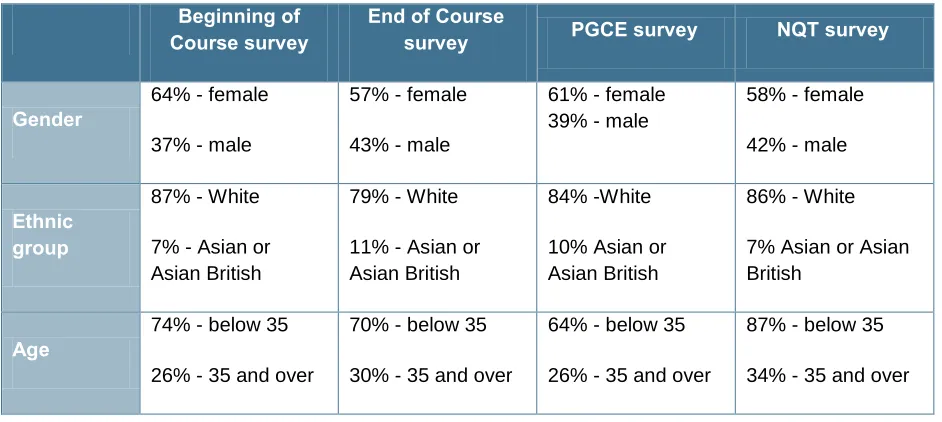
Table 11 Comparison of survey participant demographics 49
Table 12 Comparison of survey responses by main subject 2009-2012 50
Table 13 Length of SKE course across all surveys 2011/12 51
Table 14 Profile of interview respondents according to SKE subject (2011/12) 53
Table 15 Profile of interview respondents - age and gender of prior SKE students
(2011/12) 54
Table 16 Profile of case study participants (2011/12) 55
Figure 6 Change in subject knowledge; beginning vs. end of course results - Beginning
7
Table 17 Proportion (percentage) of SKE students rating their level of subject knowledge by length of SKE course - Beginning and End of Course surveys 2011/12 58
Figure 7 Level of confidence in subject by SKE subject - Beginning of Course Survey
2011/12 59
Figure 8 Level of confidence in subject by SKE subject - End of Course Survey 2011/12 60
Figure 9 Rating of confidence in subject knowledge of principal subject - PGCE Survey
2011/12 61
Figure 10 NQTs' current level of confidence in the principal SKE subject - NQT Survey
2011/12 62
Figure 11 Definition of level of subject knowledge - PGCE Survey 2011/12 64
Figure 12 How the SKE course has impacted on performance on the PGCE course -
PGCE Survey 2011/12 65
Table 18 Subject knowledge needed to teach to key stages 3, 4 and 5 - PGCE Survey
2011/12 74
Figure 12 Expected levels to teach principal subject to once NQT year is completed -
PGCE Survey 2011/12 74
Table 19 Level of confidence to teach to key stages 3, 4 and 5 in the principal subject -
PGCE Survey 2011/12 75
Table 20 NQTs level of confidence in subject knowledge to teach to key stages 3, 4 and
5 - NQT Survey 2011/12 76
Table 21 Subject knowledge needed to teach principal SKE subject to key stages 3, 4
and 5 - NQT Survey 2011/12 77
Figure 13 The extent to which NQTs have found it necessary to develop their subject
knowledge - NQT Survey 2011/12 78
Table 22 Do NQTs class themselves as subject specialists? - NQT Survey 2011/12 79
Figure 14 Impact of SKE courses on NQTs' performance as a teacher - NQT Survey
2011/12 82
Table 23 Top 2 advantages of completing the SKE course - BoC, PGCE, NQT surveys
2011/12 94
8
Figure 16 Career aspirations in the next 5 years by PGCE subject - PGCE survey 100
Figure 17 Career aspirations in the next 10 years by PGCE subject - PGCE survey 101
Figure 18 Time taken to secure a teaching post since completing the PGCE - NQT
Survey 2011/12 104
Table 25 Principal subject that NQTs are teaching - NQT Survey 2011/12 105
Figure 19 School perception of SKE students - PGCE Survey 2011/12 109
9
Acknowledgements
The authors would like to thank James O’Donoghue and Angela Mabee from the
Teaching Agency who acted as project managers and provided guidance and support for the research. Many thanks are extended to the providers of Subject Knowledge
Enhancement courses for their continued support in accessing students past and present and for their valuable feedback. We would also like to thank the many SKE students, PGCE students and NQTs who contributed to the research, especially those who gave considerable time to take part in the longitudinal case studies. All respondents’
10
1. Executive Summary
The Teaching Agency commissioned CooperGibson Research to carry out the final year of an evaluation of the Subject Knowledge Enhancement (SKE) courses programme (initially commissioned by the Training and Development Agency for Schools). The evaluation looked at the effectiveness of the programme in equipping teacher trainees to specialise in teaching a subject in school and the impact it had on teacher trainees who had been through the SKE programme compared to those who had not. The overall aims of the evaluation were set in 2009 as:
Assess the effectiveness of the SKE courses in preparing trainees sufficiently in their subject areas to meet the Qualified Teacher Status (QTS) standards.
Evaluate the effectiveness of the SKE courses in equipping trainees to become subject specialists in schools.
Investigate any differences between traditional entry and SKE candidates during all stages of becoming a teacher (successfully completing training, commencing teaching in schools, becoming high-quality teachers and progressing within the teaching profession).
Gauge the SKE courses’ effectiveness in terms of meeting the 2014 targets for mathematics and science teaching in schools.1
Since the evaluation began in 2009, there have been significant changes in
Government and several announcements in relation to teacher training and targets for teaching and learning (refer to the policy context section for further detail). Changes to the 2014 targets for mathematics and science teaching in schools has had a direct impact on the fourth aim of this evaluation. Whilst the political context within which SKE courses are operating has changed since the evaluation first started, overall, mathematics and science teaching and learning remains a key priority for Government, therefore this evaluation has continued to have this as a key focus of its aims.
These four main evaluation criteria therefore, underpin the structure of this report and its conclusions. This report is the final annual report of the evaluation. It is
accompanied by a technical report which analyses survey findings.
1.1 Methodology
Across the three years of the evaluation, there have been nine surveys (with some run over two rounds of data collection) and a series of telephone interviews taking place. In total, there were 3,268 responses to the surveys and 456 interviews
1
11
completed. The final year was the most comprehensive in terms of the range of stakeholders involved. It included:
A desk review to update the literature review carried out in previous years.
A Beginning and End of course SKE survey and follow-up interviews.
A survey of teacher trainees on the Postgraduate Certificate in Education (PGCE) and follow-up interviews – those who had completed an SKE course and for comparison, those who had not.
A survey of newly qualified teachers (NQTS) who were former SKE students and follow-up interviews, plus interviews with a small number of NQT colleagues.
Interviews with SKE tutors.
Interviews with longitudinal case studies, tracked through the three evaluation years – example case studies can be viewed in Appendix 1.
As the evaluation progressed through each year, targets for each data collection strand changed to allow a wider variety of respondents to be included towards the final year. This design allowed for an incremental approach to data collection where data and knowledge built along with the journey of SKE students through their SKE course, onto PGCE training and into their NQT year.
1.2 Key findings
The range and volume of data collated throughout this evaluation has allowed an in-depth exploration of the four key evaluation objectives. A summary of the findings drawn from this evidence base is provided below.
1.2.1 Effectiveness of preparing trainees sufficiently in subject area
A key objective of the evaluation was to explore how effective SKE courses are in preparing teacher trainees sufficiently in their specialist subject area.
The evidence gathered in year three of the evaluation supports the findings from the previous two years: SKE courses provide trainees with a high level of subject knowledge and confidence in the subject and a firm foundation and preparation for their PGCE training. Although the majority of students commence SKE courses with a perception of having a reasonable level of subject knowledge in their subject of study, it is clear that after completing the SKE course, trainees recognise that they over-estimated their levels of understanding of their subject. Overall, however, by the end of the SKE course,
students thought that their subject knowledge had improved significantly.
12
graduates might have could be less relevant to the school context. This would indicate that SKE courses currently being delivered in some institutions, whilst being effective in providing relevant and useful subject knowledge for trainees, might not be providing sufficiently high levels of subject knowledge that some teacher trainees suggest they might require.
The content of SKE courses was an important consideration for trainees. They viewed the balance between subject knowledge and pedagogy of most SKE courses as being heavily weighted towards subject knowledge, with pedagogy being a much smaller aspect. However, students’ preference would be for a more balanced ratio such as 60/40 or 50/50. The inclusion of subject-related pedagogy was seen by many students as particularly useful. Many former SKE students and SKE tutors highlighted the need to involve subject-related pedagogy in SKE course content, even if it was not explicitly covered. Current and former SKE students certainly valued the practical experience they gained from the courses and having examples and tips on how to teach their subject.
1.2.2 Effectiveness in equipping trainees to become subject specialists
in schools
A second objective of the evaluation explored the effectiveness of SKE courses in equipping teacher trainees to become subject specialists in schools.
Students at both PGCE and NQT stages felt that in order to teach effectively they needed to have a level of subject knowledge at least one level higher than they would be
expected to teach; this would enable them to have increased confidence in their knowledge and make them more effective in their teaching. The majority of PGCE students and NQTs said they felt highly confident to teach to key stage 3 and 4 but less so to key stage 5. Being familiar with the content and teaching experience at key stage 3 and key stage 4 were of significant benefit in terms of building their confidence to teach; however some students who felt they did not have sufficient knowledge on specific topics or sufficient grounding in the subject, noted the lack of a subject degree or A level in the subject and that this did present some gaps in their knowledge.
Most NQTs were teaching to key stage 3 and key stage 4 which fitted with their
13
Many NQTs who had completed an SKE course came to regard themselves as subject specialists in their principal subject but interestingly those with physics SKE background were less likely to do so. The majority of these also thought that their colleagues would class them as such. When discussing the term ‘subject specialist’, current and former SKE students and some tutors tend to relate this to their subject knowledge and ability to teach the subject rather than having subject knowledge per se. They are therefore
referring to having specialist subject knowledge for teaching their subject. Some referred to a subject specialist as having greater depth and breadth of subject knowledge -
recognised as graduate level understanding.
Almost all the NQTs in the sample were pleased that they had completed an SKE course, and didn’t consider it could really be improved upon; most thought it had significantly enhanced their performance as a teacher. Of the small number of improvements suggested these were for: more focus on different levels (i.e. some wanted higher level knowledge, key stage 5, whilst one or two would have liked more on lower levels such as key stage 3); more input on all three sciences; more pedagogy and practical experience in school environment; and more instruction and guidance on concepts, particularly for those with additional needs.
1.2.3 Comparing SKE and traditional entry teacher trainees
This objective focuses on comparing the progress and development of those who have been through an SKE course with those who entered teacher training after graduating with a degree in their specialist subject. Whilst all respondents were asked to compare these two routes into teaching, the PGCE survey and interview responses were
particularly important here since they included former SKE students on PGCE courses and traditional route PGCE students (subject graduates).
Nearly half of SKE students considered their subject knowledge as above or well above average for the PGCE course compared to nearly two-thirds of traditional route trainees. Their level of knowledge differed from traditional route trainees, with the latter more likely to rate their knowledge as graduate or postgraduate compared to SKE students rating it at level 5 (A level).
14
Both the SKE and PGCE students (both former SKE students and subject graduates) thought that those with a specialist degree would have greater depth and breadth of knowledge which would help with answering complex questions, teaching to a higher level and would have a better grasp of complex concepts and underlying principles. Whilst the SKE course did help students in terms of building their confidence in the subject, at the NQT stage traditional route teacher trainees were more likely to rate their confidence at higher levels especially at key stage 5.
In terms of preparing students for the PGCE course, the SKE is considered to be ideal preparation. The majority of PGCE respondents thought former SKE students would be better prepared to do the PGCE course than traditional route students although they did think that the latter would have more confidence in their subject knowledge. The main reasons were that they would be more prepared for the demands of the PGCE course; more familiar with the curriculum, have experience of conducting practicals and
laboratory work; have experience of teaching methods and insight into school practices; have built up a bank of resources; have built a network of support and be familiar with the institution and tutors and style of working; and have a wider grasp of the three science subjects taught in schools.
1.2.4 Meeting the targets for mathematics and science teaching in
schools
The final objective of the evaluation explored whether SKE courses are able to support recruitment of teachers to mathematics and science subjects.
Almost all respondents were positive about the value of the SKE course especially in terms of enabling them to go on to a teaching career in mathematics or the sciences in schools. Many respondents said that without the course that they would not have been able to realise their ambitions to teach. The main factors that the NQTs valued were the relevance and usefulness of the teaching methods, pace and content of the course, level of support, and preparation for completing the PGCE. The majority also considered that it provided them with sufficient knowledge to become a successful teacher.
The majority of PGCE students who had not completed an SKE thought they did not need to complete one but this was not because they thought it had no value but that they already had sufficient knowledge, experience or had recently finished education.
However, a third of those without an SKE background did think that they would have benefited in terms of being able to refresh their subject knowledge, gain familiarity with the curriculum and practical experience in schools, gain more confidence and get into the process of learning again.
15
time. Potential barriers included the introduction of course fees and reduction of bursaries, both of which it was suggested would lead to a reduction in applicants.
Most trainees came into teaching because they wanted to teach rather than for economic reasons; they wanted to ‘make a difference’ and said it was because they ‘enjoyed
working with young people’. These findings replicate findings from the previous
evaluation years. For many SKE students this was their second career and the SKE gave them the opportunity to realise it. This partly explains the two main reasons given for enrolling on an SKE course which were that it was a condition of their PGCE (which is a requirement within the SKE regulations) and they felt that their subject knowledge was not sufficient. For those for whom it was a second career it was often a substantial amount of time since they had been in education. When choosing a specific subject to specialise in, across all surveys, the two main reasons given were ‘enjoyment of the subject’ and ‘to pass on enthusiasm for the subject to young people’. Having better job prospects was also referred to and some were aware of the initiative to recruit and increase the number of teachers in mathematics and the sciences.
Career aspirations whilst on the SKE and PGCE courses were similar and did not change significantly; they related mainly to middle management with nearly half aspiring to
become a head of department. At the end of the course their short-term goals were to focus on teaching their subject with a view to specialise in teaching in one or more
subjects within five years and become a head of department. Longer term goals included more senior roles such as deputy head teacher, head of year.
The aspirations of NQTs were similar although those in mathematics are more likely to aim to specialise in teaching one subject with about a quarter aiming to become a head of department. Much higher proportions of chemistry and physics PGCE students aspire to positions of deputy or head teacher within 10 years. In the shorter term most NQTs were focusing on their teaching responsibilities. Changes in aspirations were in terms of having higher aspirations to progress and reach leadership roles, due to having more confidence, feeling more ambitious and wanting to have wider impact on young people. A small number had changed their mind from wanting to become a head teacher as they preferred to focus on pastoral duties.
Former SKE students have, on the whole, moved quickly into full-time employment, teaching the same subject that they studied their SKE in. Just over two-thirds of NQTs were offered teaching posts before completing their training and the majority were full-time posts. Just over half were teaching mathematics as their principal subject; followed by general sciences and then physics. Only 5% taught chemistry as their principal subject. In general they taught their main subject to key stages 3 and 4. This is
complemented by the apparent satisfaction that NQTs had with their first year in teaching – with a high proportion saying they were satisfied and only a very small minority
16
SKE courses have been very successful, on the whole, in preparing students to move into new careers as science and mathematics teachers with sufficient subject knowledge suited to the school curriculum and the ability to teach with confidence to at least key stages 3 and 4.
Despite the success of the SKE courses to date in preparing successful and well-equipped graduates, it appears that there remain issues in terms of awareness of SKE courses, particularly in schools. Most former SKE teacher trainees and NQTs felt that schools had some awareness of SKE courses but it was limited. A small number of PGCE students thought that schools should be better informed about the SKE courses and their value. There were several students who thought that this had an impact on schools in terms of recruitment. A similar finding emerged when interviewing colleagues of NQTs; it emerged there were several who were not aware of SKE courses, even though one of their colleagues had been through the programme.
However, just under half of the PGCE students did think that schools were on the whole positive about SKE students and just over half of NQTs considered that they were very positively or quite positively regarded by schools. The most common response, by more than a third of NQTs was that they thought schools did not have an opinion either way. This may be indicative of the lack of awareness of the SKE course rather than simply not having an opinion.
Finally, another issue raised by tutors was the notification of their institution’s allocation of places in relation to being able to plan and recruit SKE students. Tutors mentioned that they often didn’t know in good time how many places that they would be allocated by the Teaching Agency which made recruitment of students difficult.
1.3 Recommendations
There is clear evidence in this evaluation of the success of SKE courses in preparing teacher trainees sufficiently with subject knowledge they require, equipping them to specialise in teaching a subject in schools, providing an alternative route into teaching which is on a par with traditional entry teacher training and supporting the supply and quality of teachers into the profession.
There are however, opportunities to further enhance the delivery and quality of SKE courses. Recommendations are presented below.
The Teaching Agency to:
17
2. Review the current format of SKE courses and the value of including subject-related pedagogy to a greater extent in relation to current regulations of the SKE programme.
3. Review and consider how coverage of more than one science could be achieved to some extent within the design of SKE programme.
4. Work with SKE providers to ensure that there is an appropriate and consistent recruitment process for SKE students.
5. Provide guidance to schools to encourage schools to provide newly qualified teachers with further training in terms of Continuing Professional Development (CPD) to further enhance subject knowledge and confidence to enable them teach to required levels.
6. Provide appropriate information to schools to raise awareness of the value and purpose of SKE courses with the aim of supporting recruitment of former SKE trainees into teaching.
7. Review the process and timing of allocation of SKE places to institutions, to assist with providing sufficient time for recruiting of students.
SKE providers to:
8. Consider including more emphasis on key stages 4 and 5 when designing content of SKE courses, to help build trainees’ confidence at these levels.
9. Be encouraged to work collaboratively with other local SKE providers to ensure that students are recruited to the appropriate course for their needs e.g. in terms of length and subject area.
10. Build on support networks developed through their SKE courses and to ensure continued support (including academic support) into PGCE stages.
18
2. Introduction
The Teaching Agency commissioned CooperGibson Research to carry out the final year of an evaluation of the Subject Knowledge Enhancement (SKE) courses programme (initially commissioned by the Training and Development Agency for Schools). The evaluation looked at the effectiveness of the programme in equipping teacher trainees to specialise in teaching a subject in school and the impact it had on teacher trainees who had been through the SKE programme compared to those who had not. The overall aims of the evaluation were set in 2009 as:
Assess the effectiveness of the SKE courses in preparing trainees sufficiently in their subject areas to meet the Qualified Teacher Status (QTS) standards.
Evaluate the effectiveness of the SKE courses in equipping trainees to become subject specialists in schools.
Investigate any differences between traditional entry and SKE candidates during all stages of becoming a teacher (successfully completing training, commencing teaching in schools, becoming high-quality teachers and progressing within the teaching profession).
Gauge the SKE courses’ effectiveness in terms of meeting the 2014 targets for mathematics and science teaching in schools.2
Since the evaluation began in 2009, there have been significant changes in
Government and several announcements in relation to teacher training and targets for teaching and learning (refer to the policy context section for further detail). This includes the abolition of the 2014 targets for mathematics and science teaching in schools which has a direct impact on the fourth original aim of this evaluation. Whilst the political context within which SKE courses are operating has changed since the evaluation first started, overall, mathematics and science teaching and learning remains a key priority for Government, therefore this evaluation has continued to have this as a key focus of its aims.
These four main evaluation criteria therefore, have been used to set the structure of this report and its conclusions.
The report presents the policy background to this evaluation and key drivers, an overview of the methodology used for the evaluation, profiles of respondents and the sample, and then analysis of quantitative and qualitative data in relation to the four evaluation criteria above. It presents an analysis of findings from several strands of data collection activity carried out during 2011 and 2012 with brief comparison to findings from previous years of the evaluation, where this is appropriate. Separate annual reports are held by the Teaching Agency for 2009/10 and 2010/11 (Training and Development Agency for Schools at the time of their submission). This report is accompanied by a technical report for 2011/12 which provides more detailed analysis
2
19
20
3. The Policy Context
This is the final iteration of the SKE literature review first carried out in 2010. It was amended in 2011 to reflect changes in Government and the subsequent amendment of strategies for teaching and learning. This final review takes into account further changes and the most up-to-date data available from the Teaching Agency regarding Subject Knowledge Enhancement (SKE) trainees.
Note on the definition of SKE
Although ‘subject knowledge enhancement’ is the term for the current courses, there have been programmes designed to enhance subject knowledge for trainee teachers or prospective trainee teachers for a number of years. These courses have variously been known as extension, booster and pre-ITT courses, as well as in some cases being the additional part of two year PGCEs – they are now considered as being SKE courses. Their inclusion under the SKE banner serves to highlight the overall identity of SKE courses as representing all courses designed to enhance subject knowledge pre-initial teacher training.
3.1 Machinery of government changes
As part of the current government’s wide-scale review and reform of arm’s length bodies and the Department for Education’s (DfE) resultant programme for change, the former Training and Development Agency for Schools (TDA) was closed and the Teaching Agency assumed some of the functions which the TDA had previously discharged, including responsibility for ensuring teacher supply. In April 2012 the Teaching Agency became operational as an executive agency of the DfE3. The Teaching Agency’s remit is to ensure a supply of high-quality teachers, trainers and supporting staff, special education needs co-ordinators (SENCOs), educational psychologists and examination officers. It is tasked with overseeing three key areas of delivery:
1. Supply and retention of the education workforce. 2. Quality of the education workforce.
3. Regulation of teacher conduct.
Ensuring high-quality training and development of the education workforce remains a key role for the Teaching Agency, particularly in respect of making sure this is
‘responsive to the changing educational landscape’4
. The quality of Initial Teacher Training (ITT) provision in terms of developing (among other aspects) the skills of
3
Three other executive agencies were created: the Standards & Testing Agency (opening in October 2011); the National College and the Education Funding Agency, both of which also came into operation in April 2012.
4
21
trainees in teaching mathematics is also highlighted as a priority in the Teaching Agency framework documentation5.
3.2 Policy overview: 2006 - 2012
When SKE courses were first introduced, the shortage of subject specialist teachers for science and mathematics had been brought to the fore through NFER’s
Mathematics and Science in Secondary Schools: The Deployment of Teachers and Support Staff to Deliver the Curriculum (2006). This report stated that less than one third of those teaching the physics element of double award science GCSEs had a degree in physics or were qualified to teach it through Initial Teacher Training (ITT).
The NFER team also reported that the majority of mathematics (76%) and science (93%) teachers either had a mathematics/science-related degree or had specialised in
mathematics/science at ITT level. Within these figures however, there were still great imbalances in terms of the distribution of science teachers, with 44% having a biology specialism, whilst only 25% had specialised in chemistry and 19% in physics. This in turn meant that over a quarter (26%) of 11-16 secondary schools lacked a physics specialist in 2006.
Moreover, imbalances were evident between schools in terms of the qualifications of staff teaching mathematics and science, and within schools in terms of pupil ability and
teaching expertise. For example, mathematics teachers who were not specialists in the subject were most often found in the lowest attaining schools, whilst pupils who had been assigned to low ability groups were often taught by teachers without a post-16
qualification in the given subject (NFER, 2006).
Concerns about the impact of teaching shortages in chemistry, mathematics and physics remained, even after the introduction of SKE. In 2010, the Confederation of British
Industry (CBI) highlighted the need for more specialist science teachers in order to inspire and encourage young people to study science and therefore meet the economy’s need for science and mathematics graduates. It anticipated a need for mathematics and science skills so great that ‘the number of those studying for degrees in science,
engineering and technology must increase by over 40% on current levels if this demand is to be met’6.
This lack of teachers within subjects such as chemistry, mathematics and physics was thought not only to impact school provision and the learning experiences of young
people, but also trainee teachers and those with Newly Qualified Teacher (NQT) status in these curriculum areas. Faced with a shortage of current subject specialists, for example, new entrants to the workforce are unable to ‘access the subject-specific and pedagogical
5
DfE (2012), Teaching Agency: Framework Document, p.17 6
22
support and guidance they require’ from colleagues within the school setting (SCORE, 2011).
3.2.1 The introduction of SKE courses
SKE courses quickly came to the forefront as an answer to the short supply of mathematics and science graduates entering teaching. In 2006/2007, the former
Department for Education and Skills (DfES) made a specific call for further availability of training in chemistry, mathematics and physics that would cover the continuing demand for teachers in these subject areas. Following this call the former TDA identified that although the numbers of graduates with first degrees in mathematical or physical sciences was relatively small, there was a great number of other graduates with a science or science-related degree who potentially could, with appropriate training, be recruited. The resulting response was to increase the volume of pre-ITT subject
knowledge training in the form of SKE courses by 40% in the areas of mathematics and physical sciences.
Meeting recruitment targets is part of the Teaching Agency’s key performance indicators, and achievement against them relies greatly on sustained improvements to recruitment over several years. Significant resources – and continuing investment – have been given to SKE courses, as teacher recruitment in these subject areas remains challenging.
3.2.2 The quality of teaching
Ofsted, in Success in Science from 2008, suggested that the quality of science teaching is related to teachers’ initial qualifications. The report supported a fundamental
proposition upon which SKE was introduced: that effective teaching (particularly in
scientific subjects) comes from a combination of expertise in approaches to teaching and learning, and strong subject knowledge.
The publication of the Schools White Paper, The Importance of Teaching, in November 2010 saw the first clear statement of intent from the coalition Government that the focus for education policy and teacher training would be to improve the quality of teaching, raise standards and support the autonomy of schools. All of this was based firmly on a ‘vision of the teacher as society’s most valuable asset’7
. It led the Government to set out five action points related directly to teaching and leadership in schools (see Table 1).
7
23
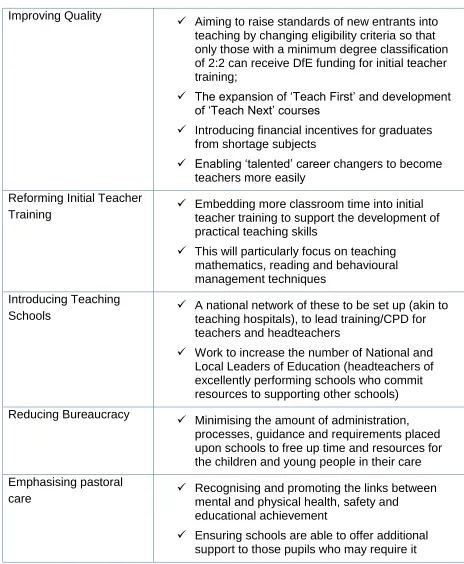
Table 1 The Importance of Teaching: DfE action points (2010)
Improving Quality Aiming to raise standards of new entrants into teaching by changing eligibility criteria so that only those with a minimum degree classification of 2:2 can receive DfE funding for initial teacher training;
The expansion of ‘Teach First’ and development of ‘Teach Next’ courses
Introducing financial incentives for graduates from shortage subjects
Enabling ‘talented’ career changers to become teachers more easily
Reforming Initial Teacher
Training Embedding more classroom time into initial teacher training to support the development of practical teaching skills
This will particularly focus on teaching mathematics, reading and behavioural management techniques
Introducing Teaching
Schools A national network of these to be set up (akin to teaching hospitals), to lead training/CPD for teachers and headteachers
Work to increase the number of National and Local Leaders of Education (headteachers of excellently performing schools who commit resources to supporting other schools) Reducing Bureaucracy Minimising the amount of administration,
processes, guidance and requirements placed upon schools to free up time and resources for the children and young people in their care Emphasising pastoral
care Recognising and promoting the links between mental and physical health, safety and educational achievement
Ensuring schools are able to offer additional support to those pupils who may require it (Source: DfE,2010)
24
From the action points, it was clear that deep subject knowledge had taken precedence in the coalition Government’s vision of teaching, particularly with the introduction of incentives for attracting the ‘best’ graduates, further emphasised with a move towards practical school-based training in priority subjects.
3.2.3 The importance of subject knowledge
The importance of subject knowledge has been an area for much debate within educational circles. The 1944 Education Act, which introduced grammar schools, put subject knowledge at the centre of the skills required to be a teacher. However, with the advent of the National Curriculum, less flexibility was permitted in curriculum content, and so the processes and guidelines involved in teaching came to the forefront during the training of new recruits. However in recent years, and particularly for those across the science community, the importance of fostering the knowledge and skills of the science teaching workforce has become a topic of renewed discussion.
Ofsted, in its report on Success in Science, examined the strengths and weaknesses of science education between 2004 and 2007. The report found that, in most cases, teachers:
‘were working outside their own science specialisms...A teacher’s own lack of understanding in the area of science to be taught can lead them to operate in ‘safe’ mode. This involves telling pupils facts, requiring them to copy notes and avoiding activities that would require discussion and the possible revelation of their own lack of understanding’ (Ofsted, 2008)8.
Ofsted went on to assert that ‘subject knowledge alone is not a measure of effective
teaching’, but that it does – when combined with effective teaching practices – ‘make a major contribution to raising pupils’ achievements’. This brought to the fore a point raised, again by Ofsted, back in 2002 that despite the importance of teachers having a solid grounding in their chosen subject, trainees (primary level science) were not always identifying gaps in knowledge and, where they were, schools could find it difficult to address these gaps whilst also taking responsibility for the development of planning, teaching and assessment skills9. The links between knowledge and pedagogical practice was again confirmed during Ofsted’s survey of post-16 science10, which found ‘effective’ teaching in science to be carried out by those teachers:
Regarded as subject specialists.
Able to confidently engage learners in discussions and debates about science.
Competent in using practical investigations to apply and reinforce theoretical knowledge and learning.
8
Ofsted (2008), Success in Science
9
Ofsted (2002), Science in Primary Initial Teacher Training
10
25
Such ‘effective’ teaching practices required appropriate subject knowledge that meant teachers were not relying on textbooks and other external materials to fill gaps in understanding; nor were they avoiding debate with and among young learners about areas of the curriculum because they themselves did not feel confident in their own grasp of a subject area.
Developments such as SKE pre-ITT courses and CPD for existing teachers address these issues by placing subject knowledge at the centre of effective teaching, and support for such programmes for science teachers is clear. For example, in its response to the Government’s consultation on teacher training reform, SCORE recently proposed that SKE courses specifically should become a required element of teacher training11. In this way, an entrance test for ITT focused on ‘school appropriate knowledge’ would be a more ‘direct measure’ of subject knowledge, even than the degree class achieved by the candidate during their own study of the subject:
‘SCORE recommends that the Department explores the use of subject-specific tests for initial teacher trainees. These tests could lend confidence that trainees/teachers have a sufficient breadth and depth of knowledge and understanding of their discipline. The Department should consider whether such tests could be
introduced either for applicants to initial teacher training courses in the sciences or as part of the conditions satisfying the awarding of qualified teacher status or both. It should be possible for graduates to attend a subject knowledge enhancement (SKE) course before taking (or retaking) an entrance test. Such tests are being
developed and trialled by the Institute of Physics and Royal Society of Chemistry with support from the Gatsby Charitable Foundation and all SCORE member organisations would welcome the opportunity to discuss the potential of such tests with the Department.’ (SCORE, 2011)
This response was supported by the publication of SCORE’s own briefing paper on
Subject Specialist Teaching in Science12, which went into greater detail regarding the need for defined measurements of what constitutes ‘specialism’, and how far this impacts on the experiences and aspirations of young people and their attitudes towards science. In short, SCORE outlined a need to make distinctions between ‘subject specialism’ and ‘teaching expertise’. This was emphasised by the Campaign for Science and Engineering in the UK (CaSE) which also highlighted that schools not only need to ‘teach the
concepts and details of science and maths’, but that they also need to ‘inspire more of
11
SCORE (2011), Training our next generation of outstanding teachers: An improvement strategy for discussion – A SCORE response
12
26
the next generation to realise that these subjects provide the basis for stimulating and highly important further study and careers’13
.
This would then allow, SCORE argued, to create more flexibility in the subjects taught by new recruits – for example, greater recognition that due to the implications of ‘specialist’ subject knowledge, a physics graduate should be able to train to teach physics and
mathematics, rather than just ‘science’14. In this way, development of subject knowledge can potentially enhance the delivery of a wider range of curriculum areas.
3.3 SKE courses
SKE courses:
Are intensive pre-ITT programmes specifically developed for graduates with some previous knowledge of the subject area who need to develop the depth of their understanding.
Are undertaken by individuals prior to proceeding onto a PGCE or for Qualified Teacher Status (QTS).
Enable those whose first degree was not focused on mathematics, physics or chemistry to train as a specialist teacher in one of these areas.
Focus on building and improving knowledge acquired by candidates at A-level, as part of a degree, or through occupational experience, in order to reach sufficient depth and breadth of subject knowledge appropriate for teaching secondary pupils.
Have been designed to allow flexibility for both the course providers and trainees in terms of addressing individual needs in subject knowledge training.
Are not intended to include significant in-school experience, but are designed instead to focus on subject knowledge.
The range of SKE courses currently searchable via the Teaching Agency website focus on the priority subject areas of chemistry, mathematics and physics. Courses are however also still available via some providers in subjects such as Design and Technology, Music, ICT, Modern Foreign Languages and Religious Education.
Duration of long courses varies depending on the discipline and requirement but typically ranges from sixteen to 36 weeks. For people who have already applied for or started their ITT, but need to improve specific aspects of their subject knowledge, there are short SKE courses which can last from two to twelve weeks.
13
CaSE (2011), Letter to Michael Gove, 14.02.2011: http://sciencecampaign.org.uk/?p=2829 14
27
3.3.1 Number of SKE trainees
In academic year 2010/2011, there were 2,913 registrations onto SKE courses and a comparable number (3,088) previously in 2009/201015.
Looking at data currently available, 57 providers are delivering SKE courses to trainees. Whilst some offer courses in one subject only, most have a combination of courses on offer, with the vast majority of registrations in 2010/11 related to training for:
Mathematics (37.1%)
Physics (18.9%), or
Chemistry (17.4%)
[image:27.595.57.405.296.541.2]Figure 1 shows the number of registrations in the last two years by subject16. Figure 12Number of SKE registrations by subject – 2009/10 and 2010/11
508 252 147 1082
247 22
76 551 28 2913
518 271 165 1251
194 27
35 592 35 3088
Chemistry
Design & Technology
ICT
Mathematics
Modern Language
Music
Other Science
Physics
Religious Education
TOTAL
2010/11 2009/10
(Source: Teaching Agency data)
The demographic of individuals registering for SKE courses has remained fairly static across the last two years in terms of disability, ethnicity, gender and age (where known). The figures for each are given in the table below, showing the only notable change is the proportion of mature students down by 3 percentage points in 2010/11.
15
Data supplied by the Teaching Agency 16
28
Table 13Demographic of student registrations – 2009/10 and 2010/11
2010/11 2009/10
Gender Male: 1242 (42.6%)
Female: 1671 (57.4%)
Male: 1304 (42.2%)
Female: 1784 (57.8%)
Disability 183
(6.3%)
193
(6.2%)
Ethnic minority 609
(20.9%)
597
(19.3%)
Mature students 1857
(63.7%)
2044
(66.2%)
(Source: Teaching Agency data)
Data on trainee progression routes (e.g. from SKE onto PGCE courses) is not available, and data for recruitment to ITT for 2012/2013 has not yet been published.
3.3.2 Initial Teacher Training: recruitment allocations and funding
29
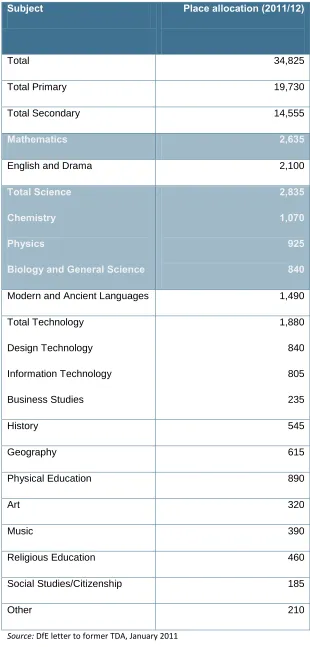
Table 24Allocation of teacher training places by subject, 2011/12
Subject Place allocation (2011/12)
Total 34,825
Total Primary 19,730
Total Secondary 14,555
Mathematics 2,635
English and Drama 2,100
Total Science
Chemistry
Physics
Biology and General Science
2,835
1,070
925
840
Modern and Ancient Languages 1,490
Total Technology
Design Technology
Information Technology
Business Studies
1,880
840
805
235
History 545
Geography 615
Physical Education 890
Art 320
Music 390
Religious Education 460
Social Studies/Citizenship 185
Other 210
Source: DfE letter to former TDA, January 2011
30
[image:30.595.53.361.141.361.2]that investment was being ‘rigorously’ targeted where it was most required – i.e. across STEM subjects, and modern foreign languages, in an attempt to attract high quality graduates into profession. Funding levels were as follows:
Table 35Bursary funding for ITT 2011/12
Subject Bursary amount offered
Physics
Chemistry
Engineering
Mathematics
£9,000
Biology
Combined/general science
Modern foreign languages
£6,000
Source: DfE letter to former TDA, January 2011
However, the structures for funding have now been altered further (see Table 5):
“The priorities for recruitment to ITT courses continue to focus on subjects that are difficult to recruit to. This year those subjects include Mathematics, Physics, Chemistry, and Modern Foreign Languages. Added to this and in line with recent government announcements in the ITT strategy
implementation plan, recruitment activities are focussing on increasing the degree quality of successful applicants to ITT. The bursaries available for trainees starting in September 2012 are again in line with these priorities”
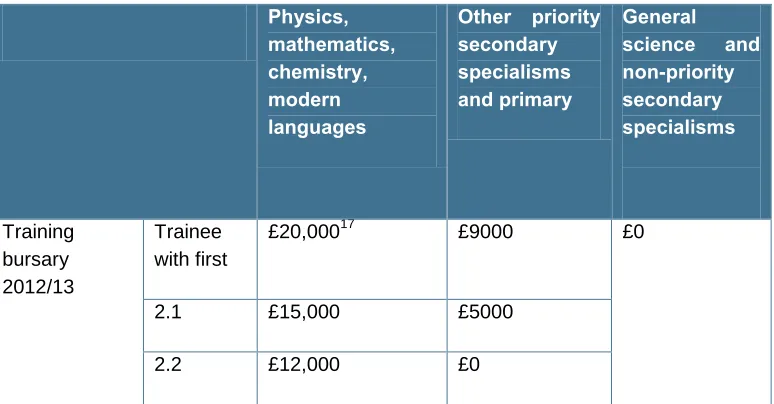
31 Table 46ITT bursary priorities for 2012/2013
Physics, mathematics, chemistry, modern languages
Other priority secondary specialisms and primary
General science and non-priority secondary specialisms
Training bursary 2012/13
Trainee with first
£20,00017 £9000 £0
2.1 £15,000 £5000
2.2 £12,000 £0
Unlike in previous years, there are also now DfE targets set for ITT recruitment in the separate disciplines (except biology), rather than just for “Science” overall.
Encouragingly, indications show that targets in general science are now being surpassed, although the number of registrations onto physics and mathematics ITT remains below target by 9% and 1% respectively in 2011/2012.
Table 57Science and mathematics ITT registrations against DfE targets - 2011/2012
Mainstream & EBITT Registrations 2011/12
Predicted outcomes by July 2012
2011/12 DfE
Target contribution to Predicted DfE target as at 31/07/12 (%)
Science (total) 3159 2687 2100 121%
General science 347 3240 2835 111%
Biology 696 696 n/a n/a
Chemistry 1272 1305 1070 119%
Physics 844 864 925 91%
Mathematics 2615 2687 2635 99%
(Source: TDA data February 2012)
17
Alongside ITT bursaries, teacher training scholarships to the value of £20,000 are also available for Physics teaching (offered by Institute of Physics from 2012/12) and Chemistry (offered by Institute of Chemistry from 2013/14). The number of scholarships available is limited: 100 from Institute of Physics and approximately 130 from Institute of Chemistry. To be eligible, candidates for the scholarships will have to demonstrate excellent subject knowledge (generally a 2:1 or first class degree). For further details, see:
www.iop.org/news/11/nov/page_52700.html, or
[image:31.595.54.509.442.659.2]32
Initial data for 2012/2013 suggests an improvement in physics, which is below target by just 3%. Achievement in chemistry is above target and 5% below target in mathematics (slightly more than was predicted in July 2012).
Table 68Science and mathematics ITT recruitment against DfE targets - 2012/2013
Recruitment numbers
for 2012/2013 2011/12 DfE Target target as at November Achievement to DfE 2012 (%)
Biology and
general science 850 840 101%
Chemistry 1170 1070 109%
Physics 900 925 97%
Mathematics 2500 2635 95%
(Source: TA, Initial teacher training census 2012 summary)
In line with government priorities, the DfE has changed the way it sets targets to focus on the number of postgraduate trainees recruited with a 2:1 or above. These targets were published at the end of September 2012 and come into effect for entry to ITT in academic year 2013/2014. Targets for the recruitment to teacher training of high quality
postgraduates in science and mathematics are as follows18:
Mathematics: 1,480
Chemistry: 535
Physics: 555
Biology: 360
The recruitment figures outlined in the table above are likely to be at least in part attributable to the packages of additional support being offered to trainee teachers in science and mathematics, such as the Premier Plus service and Schools Experience Programme (see section 3.4.2 on ‘additional support’). Since the Physics with
Mathematics scheme (see 3.4.2) recognises the synergies between the two subjects, this may help to boost the lower recruitment figures currently being achieved in these
disciplines.
3.4 Updates for 2012
A large number of policy changes were included in the last literature review, so this final summary provides an update on other research findings which may provide insight for the support and development of SKE/pre-ITT courses beyond this evaluation.
18
33
3.4.1 Teachers’ Standards
The new Teachers’ Standards came into effect from September 2012, replacing the Standards for Qualified Teacher Status (QTS) and the Core Professional Standards for teachers. The new Standards apply to all levels of the teaching workforce and
performance and conduct will be assessed against the Standards through school
appraisals. The Standards come in two parts: Part 1, Standards for Teaching and Part 2, Standards for Personal and Professional Conduct. 19
The Standards for Teaching expect members of the teaching workforce to:
1. Set high expectations to inspire, motivate and challenge 2. Promote good progress and outcomes
3. Demonstrate good subject/curriculum knowledge 4. Plan and teach well-structured lessons
5. Respond to strengths and needs of all pupils 6. Make accurate and productive use of assessment
7. Manage pupil behaviour to create a good and safe learning environment 8. Fulfil wider professional responsibilities
Most pertinently for SKE provision, the third Standard regarding knowledge of subject and curriculum areas includes the specific requirement that:
Teachers must engage in continuing professional development (CPD), and demonstrate ‘strong subject knowledge’ that reflects a ‘critical understanding of the developments in subject and curriculum areas’.
A specific reference to teaching early mathematics sets out that teachers must
demonstrate ’understanding of appropriate teaching strategies’ for these concepts. There are also clauses outlining the expectation that teachers will work towards ‘improve
teaching’ itself, taking advice and feedback from colleagues, and working with other members of the workforce to ensure ‘specialist support’ is drawn upon where required and ‘appropriate professional development’ is undertaken.
Part 2 of the Standards, those for Personal and Professional Conduct, provides a definition of the behaviour and attitudes via a series of short statements that require teachers to uphold trust in the profession and maintain high standards of ethics and behaviour, within and outside schools’20
. This covers being expected to:
Treat pupils with dignity, with relationships based on mutual respect and observing appropriate boundaries.
Have regard for the need to safeguard pupils’ well-being.
19
A short summary of the Standards is provided but the full document can be obtained here:
www.education.gov.uk/publications/eOrderingDownload/teachers%20standards.pdf
20
34
Show tolerance and respect for the rights of others.
Uphold ‘fundamental British values’21 .
Ensure expression of personal beliefs does not exploit pupils’ vulnerability.
In terms of professional conduct, the Standards also outline requirements for teachers to respect and abide by the ‘ethos, policies and practices’ of the school in which they teach, including high levels of attendance and punctuality. They should also always act within the statutory frameworks that set out their ‘professional duties and responsibilities’22
.
This second element to the Standards is significant given that alongside this steps are being taken not just to ensure professional teaching conduct but also to tackle poor behaviour across all school provision, with a call for teachers to be trained in adequate behaviour management techniques coming from the government’s behaviour tsar23
. Currently, student teachers cannot do work-based training, teaching practice, acquire QTS or work as an NQT in alterative provision such as Pupil Referral Units (PRUs). The recent report on Improving Alternative Provision has recommended changes to these rules: emerging actions will need to be monitored in order to ensure any implications for SKE are considered (i.e. teaching priority subjects in alternative settings)24.
3.4.2 Additional support for science and mathematics teachers
In order to attract high quality graduates into teaching across all subjects, there have been recent expansions of School-Centred ITT (SCITT), and Teach First25. In addition, the School Direct Training programme has been expanded to replace the Graduate Teacher programme (GTP), which will close. School Direct enables graduates (including those with three or more years’ career experience) to carry out their teacher training within schools. This scheme also provides more control to schools in terms of deciding the subjects in which they require trainee teachers, recruiting trainees and planning how their training will be carried out (this may be within one school or shared with other institutions). There is a commitment that the schools will employ the recruits as unqualified teachers for the duration of their training26. The Teaching Agency will prioritise requests according to subject. For 2013/2014 highest priority will be given to: physics, mathematics, chemistry and foreign language teacher training27.
21
These include democracy, the rule of law, individual liberty, mutual respect and tolerance for different faiths/beliefs – see Teachers’ Standards, p.5
22
DfE (2012), Teachers’ Standards, p.10 23
See: www.bbc.co.uk/news/education-19048288
24
Taylor, C (2012), Improving Alternative Provision, p.21 25
See, for example: www.bbc.co.uk/news/education-18427512 26
For further information on Schools Direct, see:
http://www.education.gov.uk/schools/careers/traininganddevelopment/initial/b00205704/s chool-direct/schools
27
35
Despite these wider teacher recruitment programmes, science and mathematics remain high priority subjects for attracting recruits into ITT and apart from SKE, there are now three other schemes in place to support prospective mathematics and science trainee teachers:
1. Premier Plus.
2. Schools Experience Programme (SEP). 3. Physics with Mathematics.
[image:35.595.55.499.262.718.2]These three schemes are summarised below.
Table 79Support mechanisms/specialist routes available to ITT recruits in science and mathematics
Premier Plus
•For prospective trainees in priority subjects including mathematics, physics, and chemistry
•For recruits with a degree classification of 2:1 or higher
•Intended to attract high achieving graduates by offering: one-to-one advice and guidance; access to SKE and the SEP; invites to attend exclusive events; regular news / advice / hints and links to resources; access to teaching advocates (experienced teachers able to answer
questions/offer advice); Graduate Teacher Training Registry fee fully reimbursed
Schools Experience Programme (SEP)
•Offers classroom experience in a secondary school for up to 10 days
•Available for those looking to teach priority subjects, including mathematics, physics, or chemistry
•For recruits with a degree classification of 2:1 or higher
•The first day involves the recruit observing teaching and pastoral activites, and being able to speak with teachers about the day-to-day job
•Further days are focused on the
teaching of the recruit's specialist subject, with practical activities (e.g. lesson planning, delivering part of a lesson, shadowing senior members of staff)
Physics with Mathematics
• There is evidence that many science teachers would prefer to teach physics and
mathematics •Furthermore, some
mathematics teachers are supporting physics lessons in schools •Wider rollout therefore
being planned, of the Physics with
Mathemaitcs PGCE programme to encourage potential teaching recruits to apply for training, and work across both disciplines •School training
36
There have been over 3746 potential trainees engaged with Premier Plus and allocated to a Regional Advisor for 2011/12. Of these, 1000 had applied for and 793 had secured an ITT place. 28
For the Schools Experience Programme (2011/12), 518 schools were registered as willing to take part. Furthermore, the Teaching Information Line received 3044 requests from prospective ITT candidates wishing to go on the SEP.29
The Teaching Agency census (November 2012) confirmed that 190 candidates had been recruited to Physics with Mathematics for academic year 2012/13. This was offered by 30 providers.30
Although it is too early to suggest any direct impact on the supply and quality of teachers and improved pupil outcomes, there is evidence to suggest that such schemes could pay dividends, both for the teaching workforce and the pupils they work to inspire and
motivate.
Despite a general increase in scientific interest within and across popular media (e.g. television documentaries from Professor Brian Cox), reports suggest that teacher support schemes have a lot to do with the sudden surge in pupil numbers. The Stimulating
Physics Network (Institute of Physics) and Further Mathematics Support Programme (Mathematics in Education and Industry) are funded by the DfE and enable experienced teachers to pass on their knowledge and skills to other members of the workforce who are notspecialists in physics or further mathematics and could therefore benefit from the ‘booster’ workshops and tutorials provided. Data released by the Institute of Physics for example, shows a 30% increase in the number of students taking up AS Physics over the past twelve months in the schools involved in the Stimulating Physics scheme31.
Nationally, there has been a slight rise in the proportion of GCSEs sat in England covering the separate science disciplines, most markedly in chemistry. The ‘generalist science’ GCSE has seen a clear increase. The proportion of mathematics GCSEs has however seen a fairly significant drop from just over 15% to less than 13%.
28
Teaching Agency 2013, unpublished registration data. 29
Teaching Agency 2013, unpublished registration data. 30
Teaching Agency Census, November 2012. 31
37
Figure 210Science and mathematics subjects as a proportion of all GCSEs sat in England (2011-2012)
5.6%
3.3%
3.2%
12.9%
0.0%
3.1%
10.6% 6.1%
3.0%
2.9%
15.1%
0.2%
2.8%
7.9% Additional Science
Biology
Chemistry
Maths
Additional Maths
Physics
Science
2012
2011
(Source: JCQ data)
The numbers of pupils taking science and mathematics at A-level has nonetheless risen for the last two years, showing an increasing trend for studying these subjects to higher levels.
Figure 311Science and mathematics subjects as a proportion of all A level examinations sat in England (2011-2012)
7.2%
5.7%
10.0%
1.6%
4.0%
7.0%
5.5%
9.6%
1.5%
3.8% Biology
Chemistry
Maths
Further Maths
Physics
2012
2011
[image:37.595.56.492.464.707.2]38
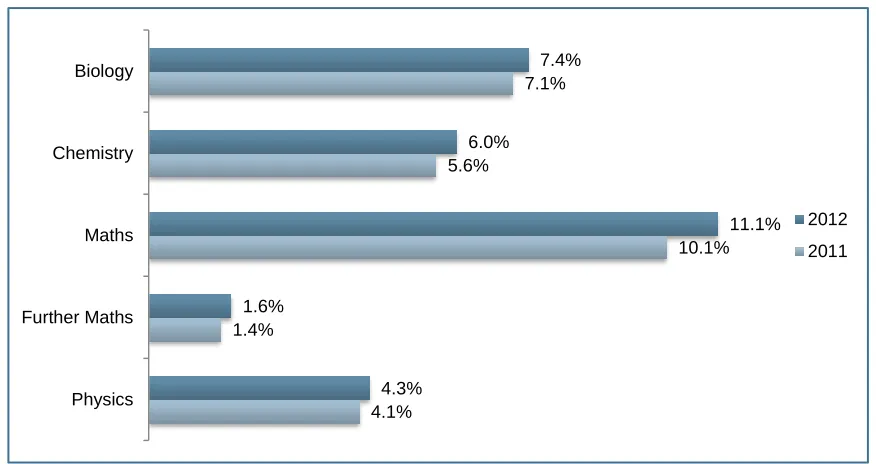
[image:38.595.53.491.171.403.2]The rising interest in mathematics and science is not just for full A levels. Across both A level (Figure 3) and AS level (Figure 4), there has been an increase in every science and mathematics discipline in relation to their proportion of the exams sat in England between 2010/11 and 2011/12.
Figure 412Science and mathematics subjects as a proportion of all AS level examinations sat in England (2011-2012)
(Source: JCQ data)
To help support this increasing interest in science and mathematics subjects, anecdotal evidence suggests that fully qualified teachers also really appreciate the opportunities to share good practice and subject knowledge. For example, over this summer holiday (2012), science teachers networking with each other on the social media site Twitter arranged to meet together at the University of York to share ideas, resources, swap useful links and answer one another’s questions. As one attendee reported: ‘We took away new ideas, felt freshly enthused (just in time for September) and had reinforced professional relationships and friendships’32
.
Although these courses and meetings have been designed for those already practicing in the teaching profession, pre-ITT subject knowledge courses have the potential to develop a similar outlook among those new into the profession.
32
See: www.guardian.co.uk/teacher-network/2012/aug/31/science-teacher-twitter-meeting 7.4%
6.0%
11.1%
1.6%
4.3%
7.1%
5.6%
10.1%
1.4%
4.1% Biology
Chemistry
Maths
Further Maths
Physics
2012
39
3.4.3 Wider research on SKE courses
Additional evaluative research into SKE has been undertaken with regards both mathematics and science and a summary of findings is presented below.
Mathematics Enhancement Course – University of London
Between 2008 and 2011, some small-scale evaluative research has been undertaken on the impact of pre-ITT development courses, specifically focusing on the ‘beliefs’ and ‘belief statements’ of those participating in what is called the Mathematics Enhancement Course (MEC), which is an SKE course delivered by the University of London. It is a six-month (24 week) programme offered to graduates without a mathematics degree but wishing to teach mathematics at secondary school level. The aim of the course is to ‘develop Pedagogical Content Knowledge…through a focus on Subject Matter Knowledge’33
.
Research question: Does participation in a mathematics SKE course prior to
ITT change the beliefs of students in terms of how mathematics should be taught?
Although changes in how SKE participants believe mathematics should be taught are only based on a small number of participants in the study over two years (20), there is indication that changes do take place among trainees over the course of SKE and these are towards a less didactic approach to teaching mathematics. As much as participants in the study suggested that text-book based exams were a necessary component to the subject, they also saw the potential for introducing more activities such as group work, collaborative projects and interactive discussions/teaching practices, so that concepts taught are applied in a more practical context34.
Research question: How is ‘understanding mathematics in depth’ understood and interpreted by SKE students?
The intention of the MEC course was that students understand mathematics ‘in-depth’ by the end of training and prior to teacher training. Eighteen interviews were conducted with trainees to investigate how they interpreted the concept of ‘in-depth’ mathematical
knowledge. Results showed that ‘in-depth’ was generally interpreted to mean that not only would trainees know a ‘fact’ such as a mathematical formula, they would also know why and in what situations/contexts that formula could be usefully and practically a