ADDITIONAL SUPPORT FOR LEARNING
NICKI GEORGHIOU AND CAMILLA KIDNER
This briefing gives an overview of the development of policy from special educational needs to additional support for learning. It briefly describes the new legal framework introduced in 2005 and considers some of the issues that have arisen from it. The legislation is due to be amended and this will be covered in more detail in future briefings.
SPICe
subject
profile
15 September 2008
08/46
Scottish Parliament Information Centre (SPICe) Briefings are compiled for the benefit of the Members of the Parliament and their personal staff. Authors are available to discuss the contents of these papers with MSPs and their staff who should contact Nicki Georghiou on extension 85190 or email [email protected]. Members of the public or external organisations may comment on this briefing by emailing us at [email protected]. However, researchers are unable to enter into personal discussion in relation to SPICe Briefing Papers. If you have any general questions about the work of the Parliament you can email the Parliament’s Public Information Service at [email protected].
Every effort is made to ensure that the information contained in SPICe briefings is correct at the time of publication. Readers should be aware however that briefings are not necessarily updated or otherwise amended to reflect subsequent changes.
www.scottish.parliament.uk
providing research and information services to the Scottish Parliament
2
CONTENTS
KEY POINTS ...3
SECTION ONE: OVERVIEW OF ADDITIONAL SUPPORT NEEDS FRAMEWORK...4
A BRIEF HISTORY OF SPECIAL EDUCATIONAL NEEDS ...4
STATISTICS ...5
LEGISLATIVE FRAMEWORK ...9
EDUCATION (ADDITIONAL SUPPORT FOR LEARNING)(SCOTLAND)ACT 2004 ...9
Assessing and providing additional support...9
Co-ordinated Support Plans...9
Rights for Parents and Young People...10
Partnership Working...10
Placing Requests ...11
THE EDUCATION (DISABILITY STRATEGIES AND PUPILS’EDUCATIONAL RECORDS)(SCOTLAND)ACT 2002(THE 2002 ACT) ...11
STANDARDS IN SCOTLAND’S SCHOOLS ETC ACT 2000(THE 2000ACT) ...11
THE CHILDREN (SCOTLAND)ACT 1995(THE 1995ACT) ...12
THE DISABILITY DISCRIMINATION ACT 1995 ...12
FUNDING AND EXPENDITURE ...13
SCOTTISH GOVERNMENT POLICY ...14
GENERAL FRAMEWORK...14
INITIAL TEACHER EDUCATION...14
2004 ACT IMPLEMENTATION...15
SECTION TWO: DISCUSSION OF CURRENT ISSUES ...16
REVIEWS AND COURT OPINIONS...16
PROPOSED LEGISLATION...17
DEFINITION OF ADDITIONAL SUPPORT...17
CRITERIA FOR A CSP...18
PLACING REQUESTS...18
Out of area placing requests ...19
Placing requests to independent special schools ...19
‘Host’ authority claiming costs from home authority ...19
Responsibility for reviewing a CSP ...20
RESOLVING DISPUTES...20
Jurisdiction of ASNT...21
Liability to pay for mediation ...21
Other ASNT Proposals...21
Education Appeal Committees...22
LOCAL VARIATION...22
TRANSITIONS...22
INFORMATION PROVISION...23
INTEGRATED WORKING...23
PRESUMPTION OF MAINSTREAMING ...24
GLOSSARY...25
ORGANISATIONS...27
SEN HISTORY...28
providing research and information services to the Scottish Parliament
3
KEY POINTS
• The concept of special educational needs was first introduced by Baroness Warnock in 1978. Since November 2005 a new legal framework of ‘additional support needs’ has been introduced by the Education (Additional Support for Learning) (Scotland) Act 2004.
• The definition of additional support needs is very wide, including any child who, for whatever reason needs additional support in order that they benefit from education.
• There is no definitive list of factors that give rise to additional support needs. The more commonly recorded reasons are learning disability and social, emotional and behavioural difficulties. Other reasons can include being a young carer, having suffered bereavement or being especially gifted.
• The new system requires local authorities to assess the support required. This may be provided either through a non-statutory Individualised Education Programme or, if co-ordination with other services is needed, through a statutory Co-ordinated Support Plan. This replaces the previous system of ‘Record of Needs’.
• 36,150 pupils in Scotland have been identified as having additional support needs (as at September 2007). That is, they have an Individualised Education Programme, a Co-ordinated Support Plan or a Record of Needs. There is also an unknown number of pupils who have additional support needs but do not have one of these plans.
• In 2007, 30% of children recorded as having additional support needs had either a Record of Needs or a Co-ordinated Support Plan.
• Since 2003 there has been a statutory presumption that children will be educated in mainstream schools and most pupils with additional support needs spend their time in mainstream classes.
• Generally more boys than girls have additional support needs – particularly with regard to dyslexia, autism, social, emotional and behavioural difficulties and learning disabilities. • In November 2007, HMIE reported on how Education Authorities were implementing the
Act. While the report pointed to a number of areas of good practice it also found variation in local authority practice, low numbers of CSPs (particularly for those children and young people who are looked after), as well as difficulties in interpreting the criteria for a CSP. In addition, there have been a number of Court of Session opinions that run contrary to the original policy intention of the Act and these need to be addressed by amending primary legislation
providing research and information services to the Scottish Parliament
4
INTRODUCTION
The framework for meeting the needs of pupils in Scotland who require additional support for learning has changed considerably in recent years. Perhaps the most pronounced policy shift has been moving from an understanding of ‘Special Educational Needs’ (SEN) to ‘Additional Support Needs’ (ASN). The former has had the effect of isolating a minority of pupils with the most severe needs and carried with it a degree of stigma; the latter seeks to be more inclusive and acknowledges the certainty that a substantial number of pupils will require additional support at some point in order to benefit from education and realise their potential.
As the terminology has changed from SEN to ASN the terms may be used interchangeably in this paper depending on the timing of reports, ie before or after the enforcement of the Education (Additional Support for Learning) (Scotland) Act 2004, (the 2004 Act).
SECTION ONE: OVERVIEW OF ADDITIONAL SUPPORT NEEDS
FRAMEWORK
A BRIEF HISTORY OF SPECIAL EDUCATIONAL NEEDS
Over the past 30 years there has been a considerable shift in the delivery of education to pupils who may require specific support. In 1978, the Warnock Report introduced the idea of ‘special educational needs’ and an ‘integrative’ approach, now referred to as ‘inclusive’ education. It identified that 20% of children were likely to need special education provision of some kind during their school careers with 2% requiring multi-disciplinary support. This latter group needed to have their needs recorded formally, along with a legally binding statement from a local authority on how those needs would be met. In Scotland this became the Record of Needs (Education (Scotland) Act 1980 as amended 1981). Circular 4/96 was the key guidance for education authorities outlining their statutory duties (Scottish Office Education Department 1996).
By the 1990’s a number of problems had been identified with the Record of Needs system including that it was time consuming and bureaucratic, that it was driven by the availability of resources and suitable provision, and that it involved conflicting interests for local authorities as assessors and providers. The system was considered by the Riddell report on education for children with severe low incidence disabilities (Riddell, 1999), a national advisory forum (2000) and the Scottish Parliament’s Education, Culture and Sport Committee (2001). The Scottish Executive held a consultation in 2001 (Scottish Executive, 2001a) and issued proposals for change in 2002 (Scottish Executive, 2002). The resulting Education (Additional Support for Learning) (Scotland) Act 2004 substantially changed the system for providing extra support in education. This came into force in 2005 with a transition period that ended in November 2007. The change in terminology from SEN to ASN, and the vision outlined for special education provision, marked a commitment to a cultural change in the delivery of special education.
providing research and information services to the Scottish Parliament
5
STATISTICS
Around 5% of pupils in Scotland are recorded as having ASN. In 2007 there were 36,510 pupils recorded with ASN, most of whom (82%) were in mainstream schools. 25,318 pupils (69%) with ASN spent all their time in mainstream classes (Scottish Government, 2008a).
Reasons for support
The most common difficulties recorded were learning disabilities (1.1% of all pupils), specific learning difficulties in language or maths (such as dyslexia) (1.1%) and social, emotional and behavioural difficulties (1.0%). 0.7% of pupils were on the autistic spectrum. Around twice as many boys than girls had additional support needs. 2.4% of girls compared with 5.6% of boys needed additional support in education. Some conditions such as autism, dyslexia and social, emotional and behavioural difficulties had even larger gender differences. (For example 0.4% of girls compared with 1.6% of boys had social, emotional and behavioural difficulties). There were also around twice as many boys as girls recorded as being ‘more able’. (36 girls compared with 77 boys, though based on incomplete data). The chart below shows the gender difference in the range of difficulties recorded.
Chart 1: ASN by type and gender, 2007.
0 1000 2000 3000 4000 5000 6000 Dual Sensory Impairment
Complex or Multiple Impairments -Moderate Learning Difficulties and Hearing Impairment Visual Impairment Physical or Motor Impairment Language or Speech Disorder Moderate Learning Difficulty Other Autistic Spectrum Disorder Learning Disability Specific Learning Difficulties in Language and/or Mathematics Social Emotional and Behavioural
Difficulty
Male Female
providing research and information services to the Scottish Parliament
6
Support provided
In 2007 there were over 4,700 teachers whose main subject related to ASN. There were also 6,806 non-teaching staff related to ASN either employed as support staff in schools or centrally employed by the local authority (Scottish Government, 2008b).
Table 1: Additional Support Needs Related Staff, 2007.
primary secondary special centrally
employed total Teachers
learning support teachers 605 885 27 174 1,691
ASN teachers general 164 178 275 32 649
behavioural support teachers 25 110 68 29 232
learning difficulties teachers 98 149 242 15 504
physical disabilities teachers 1 23 8 n/a 32
english as additional language
teachers n/a 29 n/a 214 243
hearing impairment teachers 2 27 20 33 82
visual impairment teachers 1 8 10 23 42
other teaching (special schools) n/a n/a 938 327 1,265
Total teachers 896 1,409 1,588 847 4,740
Non-teaching staff
education psychologists n/a n/a n/a 416 416
additional support needs auxiliary
or care assistant 3,370 1,670 983 n/a 6,023
behaviour support 71 126 23 n/a 220
home-school link worker 33 110 4 n/a 147
Total (non-teaching) 3,474 1,906 1,010 416 6,806
Total (all staff) 4,370 3,315 2,598 1,263 11,546
NB: Data on support staff is provisional. It is known to be inaccurate from some schools. The data should therefore be treated with caution.
Sources: Scottish Government, 2008b. Tables 2.8 (primary) , 3.9 (secondary), 4.8 (special) 5.2 and 5.3 (centrally employed), 2.16 (support staff, primary), 3.19 (support staff, secondary), 4.15 (special schools support staff)
providing research and information services to the Scottish Parliament
7 Chart 2: ASN pupils by type of plan, 2007
70% 23%
7% IEP only
RoN
CSP
Source: Scottish Government 2008a
Pupils can be provided with support within education, from other local authority departments such as social work or from outside agencies such as health. Overall, in 2007 11% of pupils with ASN had support from social work, 21% from health and 1% from the voluntary sector. The chart below shows the number of pupils who had support from different sources. The co-ordination of this outside support is the main purpose of CSPs introduced under the 2004 Act. However, chart 3 shows that pupils without CSPs still got support from other agencies.
Chart 3: Number of pupils with support from education and outside agencies, 2007
0 2,000 4,000 6,000 8,000 10,000 12,000 14,000
Education: Additional Specialist teaching
support
Education: Additional Specialist
non-teaching
support
Social Work services
Health services
Voluntary Other
With IEP only With CSP(1)
With RoN(1)
Source: Scottish Government, 2008a. Data only available for 27,334 pupils
Attainment
providing research and information services to the Scottish Parliament
8
emotional and behavioural difficulties (SEBD) achieved at a lower level than pupils with learning difficulties or disabilities. For example, 56% of those with moderate learning difficulties achieved five qualifications at SCQF level 3 compared to only 36% of those with SEBD.
Chart 4: Educational attainment of pupils with ASN on leaving school, 2007
% of pupils in each group gaining five or more qualifications at SCQF level 3 or better
0 20 40 60 80 10
No Additional Support need
Specific learning difficulty Hearing impairment
Autistic spectrum disorder Visual impairment
Physical or motor impairment Language or speech
disorder Other Any Additional Support
need
Moderate learning difficulty Complex or multiple
impairments Learning disability Social emotional and behavioural difficulty
0
providing research and information services to the Scottish Parliament
9
LEGISLATIVE FRAMEWORK
The key legislation is the Education (Additional Support for Learning) (Scotland) Act 2004, (the 2004 Act) although disability legislation and the Standards in Scotland’s Schools etc Act 2000 also contain important provisions for ASN.
EDUCATION (ADDITIONAL SUPPORT FOR LEARNING) (SCOTLAND) ACT 2004
The 2004 Act created a broad definition of ASN which includes all children, who, for whatever reason, require additional support for their education. The Act provides a framework for local authorities and other relevant agencies to support children. A statutory Code of Practice
provides further guidance (Scottish Executive, 2005).
Assessing and providing additional support
The local authority must assess those children for whose education it is responsible and make adequate and efficient provision for the additional support required.1 Support must be provided if it is within the local authority’s power to do so and does not result in unreasonable cost. The Act does not prescribe any particular form of assessment but the Code of Practice expands on the approach local authorities are expected to take. For example, it is described as a dynamic process that will usually include discussion with parents and professionals involved with the child, build on other information already available, and may involve observation or individual work with the child.
There is a wide range of factors that may lead some children and young people to have a need for additional support. There is no definitive list of factors, but issues will fall broadly into the following four overlapping themes:
• Learning environment
• Family circumstances
• Disability or health need, and • Social and emotional factors.
Co-ordinated Support Plans
A CSP is a statutory document for children who meet the criteria below. Education authorities must identify those children with additional support needs who might require a CSP. The CSP is subject to regular review and monitoring. A CSP must be drawn up where:
• the local authority is responsible for the child’s education, and
• the child has ASN which have a significant adverse effect on their education. (These needs can arise from one or more complex factors or from multiple factors which taken together have a significant adverse effect), and
• those needs are likely to continue for more than a year, and
• those needs require significant additional support to be provided beyond education2
such as from social work or health.
1
s.4 2004 Act 2
providing research and information services to the Scottish Parliament
10
Additional Support Needs Tribunal
Matters relating to CSPs can be appealed to the Additional Support Needs Tribunal (ASNT). This is called a reference. The following decisions of the local authority responsible for the child’s education can be referred to the ASNT:
• that a child requires or does not require a CSP
• any of the information in the plan (this includes the named school)
• failure to prepare the CSP in time, or review it, or review it in the time required • refusal of request for a review
• refusal of placing request if, at the time the placing request is refused
o the child has a CSP
o the education authority has decided to prepare a CSP
o the education authority has decided a plan is not required, and that decision is referred to the ASNT (so the ASNT considers both the refusal for a CSP and the placing request).
Rights for Parents and Young People
Parents have the right to request the education authority to establish whether their child has ASN or requires a CSP.3 Parents have a right to an assessment4 and to request a particular type of assessment.5 They also have the right to a review of the CSP (reviews are required anyway at least every 12 months).6 In order to resolve any disputes, the Act enables the establishment of three dispute resolutions mechanisms: independent mediation7, independent adjudication8 and for matters involving a CSP, the ASNT. Parents have a right to have a supporter present at these or to have an advocate to put their views across to the local authority.9 There are also rights established to receive information from the local authority and for information provided by the parents to be taken into account in an assessment.10 Young people also have the above rights on their own behalf.
Partnership Working
The 2004 Act requires other agencies, such as a health board or another local authority to assist a local authority when asked11. More specifically it requires local authorities to seek and take advice from other relevant agencies in a number of circumstances including when ASN are being established, when a CSP is being reviewed and when a young person is moving on from school.12 When a young person is preparing to leave school the local authority must, with the young person’s consent, also provide information about the young person to relevant agencies (for example, those who will be providing for the young person’s needs in the future).13
3
s. 6 2004 Act 4
s. 6 and s.8 2004 Act 5
s.8 2004 Act 6
s.10 2004 Act 7
s.15 2004 Act 8
Additional support for learning dispute Resolution (Scotland) Regulations 2005/501 made under s. 16 2004 Act. 9
s.14 2004 Act 10
s.12 2004 Act 11
s.23 2004 Act 12
s.12, s.13 2004 Act 13
providing research and information services to the Scottish Parliament
11
Placing Requests
Parents who wish their child to attend a school other than the one offered by the local authority can request this by using a ‘placing request’. Placing requests are generally made under the Education (Scotland) Act 1980.14 However, this does not apply to children with ASN who if they wish to make a request must do so under Schedule 2 of the 2004 Act. The two sets of provisions are very similar, but have important differences. In the 2004 Act, a placing request can be made to an independent special school. One reason this can be refused is that the child has been offered a suitable place in a local authority school and the independent special school is too expensive. Following a Court of Session opinion15 there is currently doubt whether parents can make placing requests to a local authority where they do not live. This is being addressed by amending the legislation. (See p.16 below).
The process of making an appeal is also different. Generally, parents would appeal to an Education Appeals Committee. However, if a CSP is involved, then the placing request is referred to the ASNT. The ASNT takes references from the local authority responsible for the child’s education.
THE EDUCATION (DISABILITY STRATEGIES AND PUPILS’ EDUCATIONAL RECORDS) (SCOTLAND) ACT 2002 (THE 2002 ACT)
The 2002 Act requires education authorities to ensure that strategies are in place to improve access to the curriculum and to the physical environment, and to improve communication with disabled pupils. In 2007, schools provided physical adaptation to 0.3% of pupils, curriculum adaptations to 0.9% of pupils, and communication adaptations to 0.4% (Scottish Government, 2008a). The strategies should be available for parents to see and are monitored by Her Majesty’s Inspectorate of Education (HMIE) in their routine inspections of schools and education authorities.
STANDARDS IN SCOTLAND’S SCHOOLS ETC ACT 2000 (THE 2000 ACT)
The 2000 Act requires education authorities to:
secure that the education is directed to the development of the personality, talents and mental and physical abilities of the child or young person to their fullest potential. (Section 2(1))
Section 15 of the 2000 Act (which came into force in August 2003) introduced the ‘presumption of mainstreaming’ for children and young people with SEN, so that where possible they should be educated in mainstream schools rather than special schools, except where it:
• would not be suited to the ability or aptitude of the child
• would be incompatible with the provision of efficient education for the children with whom the child would be educated
• would result in unreasonable public expenditure being incurred which would not ordinarily be incurred
and it shall be presumed the above circumstances arise only occasionally.
14
s. 28A, 28C, 28E, 28F and 28G 15
providing research and information services to the Scottish Parliament
12
Section 40 of the 2000 Act made provision for children too ill to attend school, ensuring that education authorities make special arrangements for the pupil to receive education elsewhere than at the educational establishment.
Studies carried out by Audit Scotland (2003) and Scottish Council for Research in Education (SCRE) (Brna et al 2003) on the impact of mainstreaming are discussed in the issues section below.
THE CHILDREN (SCOTLAND) ACT 1995 (THE 1995 ACT)
Among other things, the 1995 Act sets out how local authorities should promote children’s welfare, including provision for children to be ‘looked after’ by them and duties towards children considered ‘in need’. The broader definition of ASN in the 2004 Act creates a larger group of children subject to the provisions of both Acts.
Disabled Children
A local authority has a duty to provide services to minimise the effect of disability on a child and ‘to give those children the opportunity to lead lives which are as normal as possible.’16 There is also a more general duty to promote the welfare of ‘children in need’ which is wider than those with disabilities.
Children in Need
Local authorities are also required to promote the welfare of children in their area who are in need, and to provide an appropriate level of services for them, including day care.17
Looked After Children
Care plans should be drawn up for looked after children.18 If the fact of being ‘looked after’ itself gives rise to additional support needs then ‘looked after’ children may have both a Care Plan under s.31 of the 1995 Act and a CSP under the 2004 Act. The Code of Practice on the 2004 Act highlights the need to prevent the proliferation of plans and to co-ordinate plans made under different legislation. It suggests that the care plan refers to the CSP rather than completing the education section of the care plan. (Scottish Executive, 2005 para 79- 81).
THE DISABILITY DISCRIMINATION ACT 1995
The Disability Discrimination Act 1995 (as amended) protects disabled pupils in Scotland from discrimination in education (Part IV of the Act). Since September 2002, education authorities and schools have been subject to two key duties:
• not to treat disabled pupils less favourably; and
• to take reasonable steps (or make ‘reasonable adjustments’) to avoid putting disabled pupils at a substantial disadvantage
However, it does not require the provision of auxiliary aids or services, or the removal or alteration of physical features19.
16
s.23, Children (Scotland) Act 1995 17
s.22, s.27 Children (Scotland) Act 1995 18
s.31, Children (Scotland) Act 1995 19
providing research and information services to the Scottish Parliament
13
Disability Equality Duty
The Disability Discrimination Act 1995 (as amended in 2005), places a general duty on all public authorities. This includes that, when carrying out their functions, they have due regard to the need to promote equality of opportunity, eliminate discrimination and promote positive attitudes towards disabled people.
In addition, certain public authorities, including all 32 education authorities, are subject to specific duties under the Act which includes the requirement to publish a Disability Equality Scheme demonstrating how it intends to fulfil its general and specific duties.
FUNDING AND EXPENDITURE
Revenue expenditure on special schools is £463m (Scottish Government, 2008d). Other costs include provision within mainstream schools, provision of centrally provided services such as educational psychologists and support provided from outwith education services. However, this expenditure is not separately identified in local authority finance statistics.
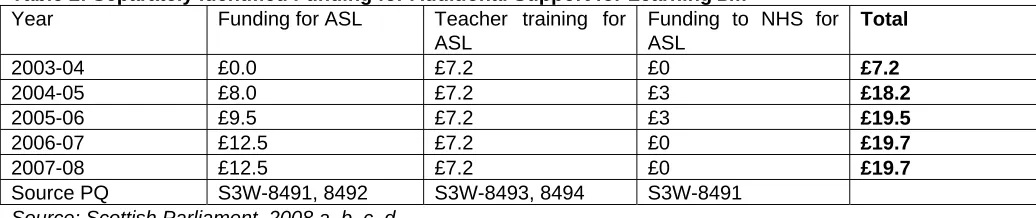
[image:13.595.37.555.352.461.2]Funding for Additional Support for Learning is almost entirely provided through the block grant to local authorities. In previous years, there was some separately identified additional funding of local authorities as set out in table 2 below:
Table 2: Separately Identified Funding for Additional Support for Learning £m Year Funding for ASL Teacher training for
ASL
Funding to NHS for ASL
Total
2003-04 £0.0 £7.2 £0 £7.2
2004-05 £8.0 £7.2 £3 £18.2
2005-06 £9.5 £7.2 £3 £19.5
2006-07 £12.5 £7.2 £0 £19.7
2007-08 £12.5 £7.2 £0 £19.7
Source PQ S3W-8491, 8492 S3W-8493, 8494 S3W-8491
Source: Scottish Parliament, 2008,a, b, c, d.
There was also £17m allocated in GAE for ‘accessibility strategies’ following the implementation of the Education (Disability Strategies and Pupils' Educational Records) (Scotland) Act 2002 (Scottish Government, personal communication, December 2007).
providing research and information services to the Scottish Parliament
14
SCOTTISH GOVERNMENT POLICY
GENERAL FRAMEWORK
All Scottish Government policy relates to the national outcomes and the Concordat with COSLA. National outcomes of particular relevance to additional support needs are:
• our young people are successful learners, confident individuals, effective contributors and responsible citizens
• our children have the best start in life and are ready to succeed • we have tackled the significant inequalities in Scottish life
• our public services are high quality, continually improving, efficient and responsive to local need (Scottish Government, 2007a).
The Concordat with COSLA specified delivering a curriculum for excellence and reducing class sizes in P1 – P3 (Scottish Government and COSLA, 2007).
Two broad policies have particular relevance to ASN. These are the Curriculum for Excellence and Getting it Right for Every Child (GIRFEC). A Curriculum for Excellence is the programme for curriculum reform from 3 to 18 years which is expected to be implemented in schools in 2009. Current developments are set out in Building the Curriculum 3 (Scottish Government 2008f). Of particular relevance to ASN is the intention to create a more inclusive, coherent and child centred curriculum which values and enables achievement beyond traditional academic and examined subjects.
GIRFEC is an approach which expects any agency working with a child to look out for the child’s needs as a whole and work to improve all outcomes for children (Scottish Government, online). The previous Executive established pathfinder projects and the current Government has confirmed that GIRFEC is a key priority as it contributes to its strategic objectives. In its focus on ensuring that every child gets the help they need when they need it, it complements the inclusive, integrated and child centred approach of additional support for learning.
In addition, an early years strategy is expected later in 2008 although a policy statement was published in March. While the policy statement does not specifically address ASN, the general themes of early intervention, support through transitions and personalisation of services are all very relevant to the development of additional support for learning (Scottish Government and COSLA, 2008).
INITIAL TEACHER EDUCATION
It has been agreed with Scottish Ministers that a ‘Framework for Inclusion’ is to be developed by the Deans of the Faculties on Teacher Education. The framework will set out the skills, abilities and values required for student teachers and teachers to support pupils with ASN. It will include:
• guidance on specific issues such as dyslexia • teaching materials to support teacher training • review of postgraduate opportunities
providing research and information services to the Scottish Parliament
15
The framework was announced at a summit on Dyslexia (Scottish Government, 2008g) but its coverage will include other additional support needs and inclusive education generally. Children in Scotland has been commissioned by the Scottish Government to consider the potential for joint activity with partner organisations in social services, education and health and to consider how to embed awareness and understanding of the 2004 Act in undergraduate/professional training (Scottish Government, personal communication, July 2008).
2004 ACT IMPLEMENTATION
In response to issues raised about the way the legislation is working the Scottish Government has:
• held a six week pilot media campaign to raise awareness of the 2004 Act among parents • commissioned Children in Scotland to:
o carry out a a mapping project investigating the understanding of the criteria for a CSP. This will inform a decision about whether new guidance is needed about eligibility for co-ordinated support plans
o deliver training on the criteria for a CSP
o run workshops on the process of independent adjudication • announced work on initial teacher education (as outlined above)
providing research and information services to the Scottish Parliament
16
SECTION TWO: DISCUSSION OF CURRENT ISSUES
Key issues about the way additional support for learning is working include: • Confusion about the criteria for a CSP
• Placing requests, in particular
o Whether out of area placing requests are possible
o Responsibilities for home/host authorities with regard to reviewing the CSP and provision of services
o When a reference should go to an Education Appeal Committee and when to the ASNT
• Variation in practice between local authorities
• Difficulties in the provision of on-going support after compulsory education
• Parents and children not being well informed about the concept of ASN or their right to be
involved in decisions
• Lack of awareness of health and social work staff about the legislation.
REVIEWS AND COURT OPINIONS
Her Majesty’s Inspectorate of Education (HMIe) reported on the implementation of the 2004 Act in November 2007 and the President of the Additional Support Needs Tribunal (ASNT) raised a number of isues in her annual report in early 2008. In addition, a number of Court of Session opinions have been issued that cast doubt on the original policy intention of the Act (see below).
Key findings from HMIe included inconsistent approaches by different local authorities and the need to provide better information to children and parents. More positively, HMIe found many examples of good practice in which authorities use multi-agency approaches to identify and meet the needs of children and families. They made recommendations for improved practice which cover: the need for guidance, training, better transition pathways, the local authority duty as corporate parent, better communication with children and parents and the need to plan services around the individual.
The annual report of the President of the ASNT 2006/07 (ASNT, 2007) made proposals for change which covered practice, procedure and legislation.
In addition, there have been a number of Court of Session cases which have focused on statutory interpretation:
• Gordon v Argyll and Bute Council (2007 CSOH 45) considered the transfer of references
between an education appeal committee and an Additional Support Needs Tribunal (ASNT).
• JT v Stirling Council (2007 CSIH 52) considered the definition of ‘significant’ in the criteria for a CSP.
• WD v Glasgow City Council (2007 CSIH 72) found that children with a CSP were not
entitled to make out of area placing requests.
• SC v. Edinburgh City Council (2008 CSOH 60 ) considered the definition of ‘additional
support’.
providing research and information services to the Scottish Parliament
17 PROPOSED LEGISLATION
The Scottish Government has published a consultation on a draft Bill to amend the 2004 Act. The consultation ran until June 19th 2008 (Scottish Government, 2008h). There is no intention to change the main policy underpinning the Act. In brief the proposed changes in the draft Bill are:
1. To allow out of area placing requests20
2. To give host authorities responsibility for paying mediation costs and reviewing the CSP 3. To allow a placing request appeal to move to the ASNT once a CSP is being considered 4. To allow ASNT to review its decisions
5. To allow a reference to ASNT if the local authority does not acknowledge a request for a CSP or has not taken a decision about a CSP
6. To allow a ‘documents only’ procedure in the ASNT where the issue is about the local authority failing to meet statutory timescales
7. To allow enforcement of orders to pay expenses and of restricted reporting orders21.
The Scottish Government is currently considering the responses made to the consultation exercise and plans to introduce the Amendment Bill to Parliament in October 2008. The Code of Practice and related secondary legislation will be reviewed, and proposals will be issued for consultation. SPICe will produce a briefing on the Bill when it is introduced which will consider the issues and responses to them in more detail.
The following considers the issues raised in the above cases, reviews and reports in more detail. A number of the issues are addressed in the draft Education (Additional Support for Learning) (Scotland) Act 2004 – Amendment Bill 2008. Others will be addressed in guidance in a revised Code of Practice.
DEFINITION OF ADDITIONAL SUPPORT
A central part of the 2004 Act is the wide definition of ASN. The type of support that can be provided is therefore wide and can involve factors relating to education, health and social work agencies. In SC v. Edinburgh City Council CSOH 60 a child with autism and severe learning difficulties attended a day special school but the parents wanted their child to go to a special school. Edinburgh City Council argued that the child’s additional support needs were being met at the day school, whereas the parents argued that the child’s needs outside the school day should be taken into account. Lord Wheatley’s decision found that the focus should be on support in a teaching environment, not broader social welfare considerations. There has been some media comment expressing surprise at this conclusion. The Herald reported on 19th May
that:
“Iain Nisbet, from the education law unit of the Govan Law Centre, who helped represent the parent, said the decision "will have come as a surprise to everyone working in the education sector. Having adopted the principle that additional support needs might arise for a range of reasons, to be told that additional support needs relate only to those in a teaching environment and not to social or environmental needs is just astonishing"
(Herald, 2008).
20
Where a parent makes a placing request for the child to attend a school in a local authority where they do not live.
21
providing research and information services to the Scottish Parliament
18
However the ASNT considering the request has accepted that additional support needs were not confined to what can be provided within the school or the school day.
CRITERIA FOR A CSP
A key issue arising has been uncertainty about the interpretation of the statutory criteria for granting a CSP. As mentioned above, these are that a child’s needs:
• result from a complex factor or multiple factors, • last more than a year,
• have a significant adverse effect on the child’s education and
• require significant adidtional support to be provided from outwith education services.
The ASNT annual report 2006/07 found that local authorities had been slower than expected in converting records of need to the new system. HMIe has found that almost all authorities wanted more guidance on how much support was ‘significant’ and whether ‘multiple’ and ‘complex’ meant the same thing. The interpretation of ‘significant’ has been appealed to the Court of Session. In JT v Stirling 2007 CSIH 52 a child who has learning difficulties, dyscalculia and is registered blind required short term support from the health service. It was found that ‘significant’ was to be judged by the frequency, nature, intensity and duration of the support and the need for co-ordination. The Code of Practice, Supporting Children's Learning, expands on how to establish significance and provides a ‘decision tree’ to assist in establishing whether a CSP is required. This states that indications that significant support is required are that:
"There is a continuing requirement for a high level of adaptation or elaboration of the curriculum and learning environment. The child [...] requires substantial, direct and continuing intervention from another agency/agencies in order to benefit from school education" (Scottish Executive, 2005).
HMIe has recommended that the Scottish Government “develop additional guidance which defines more clearly the meaning of the term ‘significant’ in relation to additional support needs.” Additional confusion is created by some local authorities creating their own plans, in addition to IEPs and CSPs, and the use in some authorities of an alternative planning mechanism to establish whether a child requires a CSP (HMIe, 2007).
As mentioned above, the Scottish Government has funded Children in Scotland to undertake a number of projects including mapping current understandings of the term ‘significant’. The results of these projects will inform its decision whether to develop new guidance (Scottish Government, personal communication June 2008).
PLACING REQUESTS
A large proportion of disputes about ASN relate to various issues about placing requests. Issues arising are:
• ability to make ‘out of area’ placing requests to a host authority • how to calculate the cost of an independent school place
providing research and information services to the Scottish Parliament
19
Out of area placing requests
In general, parents can make a placing request directly to another local authority for their child to go to a school there. They do not have to go through their own local authority. However, in WD v. Glasgow City Council [2007 CSIH 72] it was found that children with CSPs could not make these ‘out of area’ placing requests. The family lived in West Dunbartonshire and made a placing request to Glasgow Council which was refused. The parents made a reference to the ASNT which said it had no jurisdiction to hear it. This was because the reference was against Glasgow (because Glasgow had turned down the placing request). The ASNT can only hear references against the authority responsible for the child’s education, i.e West Dunbartonshire. The case was unsuccessfully appealed to the Court of Session.
It was found that the parents in the case had no right to appeal the decision of the ‘host’ authority. Parents cannot therefore go directly to another local authority, but can only get a place with the approval of the authority where they live. It was considered that reading the 2004 Act as a whole and considering the duties of home authorities throughout the Act does not suggest a scheme which would allow out of area placing requests. While the case was about a situation where a child had a CSP and so the ruling strictly only applies to parents whose children have CSPs, there is a strong inference that no parents of children with additional support needs can make an out of area placing request. This is a key issue which the draft amendment Bill seeks to resolve. The clear policy intention is that:
• parents of children with additional support needs should be able to make out of area placing requests to any local authority and
• refusal of out of area placing requests should be able to be referred to ASNTs (Scottish Government, 2008d)
Placing requests to independent special schools
The 2004 Act introduced the ability to make placing requests to an independent special school for which the local authority would pay the fees. One reason this could be refused is that the child had been offered other suitable provision and the cost of the independent special school was too high. Key issues are therefore establishing what is a suitable placement and identifying the correct method to compare costs. In SM. v. Edinburgh (2006 CSOH 201) a parent put in a placing request to the Royal Blind School but was refused as the local authority said it could make suitable provision at its own school. It was found that the correct way to compare costs was to look at the additional costs that the local authority would incur by sending the child to the independent special school. It could be argued that using the correct method is likely to find greater costs for independent special schools.
‘Host’ authority claiming costs from home authority
providing research and information services to the Scottish Parliament
20
Responsibility for reviewing a CSP
The home authority must keep a CSP under review. Where there is an out of area placing request, the host authority provides the child’s education but it is still the home authority which must review the CSP. The draft amendment Bill seeks to remedy this by giving the host authority responsibility for the child’s education which would include the duty to keep the CSP under review. The transfer of responsibility would happen when the child starts school in the host authority.
RESOLVING DISPUTES
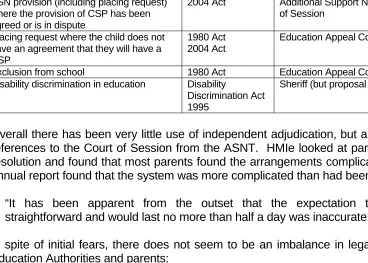
[image:20.595.52.420.346.609.2]One of the intentions of the 2004 reforms was to create a user-friendly system based on early intervention. Mediation and a formal review by an independent adjudicator is available to all and the ASNT to those involved with CSPs. Education Appeal Committees continue their role with regard to placing requests and exclusions. The routes for resolving disputes are summarised below.
Table 3: Dispute resolution mechanisms
Issue Legislation Dispute Resolution
Any provision for ASN made under the 2004 Act except the refusal of a placing request.
2004 Act Independent mediation, independent adjudicator
ASN provision (including placing request) where the provision of CSP has been agreed or is in dispute
2004 Act Additional Support Needs Tribunal, appeal to Court of Session
Placing request where the child does not have an agreement that they will have a CSP
1980 Act 2004 Act
Education Appeal Committee, appeal to sheriff
Exclusion from school 1980 Act Education Appeal Committee, appeal to sheriff Disability discrimination in education Disability
Discrimination Act 1995
Sheriff (but proposal to change to ASNT)
Overall there has been very little use of independent adjudication, but a relatively high number of references to the Court of Session from the ASNT. HMIe looked at parents’ views about dispute resolution and found that most parents found the arrangements complicated. The ASNT 2006/07 annual report found that the system was more complicated than had been hoped:
“It has been apparent from the outset that the expectation that hearings would be straightforward and would last no more than half a day was inaccurate.” (ASNT, 2007).
In spite of initial fears, there does not seem to be an imbalance in legal representation between Education Authorities and parents:
providing research and information services to the Scottish Parliament
21
Jurisdiction of ASNT
An appeal about a placing request will generally be heard by an Education Appeal Committee unless, ‘at the time’ the request is refused, it has been agreed that the child needs a CSP, in which case it will be heard by the ASNT. In Gordon v. Argyll and Bute Council [2007] CSOH 45 while the mother was in the process of appealing a refusal of a placing request to an Education Appeal Committee, the council granted the child a CSP. As a result, the appeal was moved to the ASNT. However, it was found that she should have been allowed to continue with her appeal to the Education Appeal Committee because on the date of the refusal of the placing request there had not been a decision about the CSP from the local authority. The 2004 Act does not therefore allow references to the ASNT where the education authority has issued a proposal to establish whether a CSP is required but has not yet made a decision. The draft amendment Bill seeks to allow references to the ASNT in this situation and also where the local authority has failed to acknowledge a request to establish whether a CSP is required.
A separate issue on jurisdiction is the proposal through the review of GB discrimination law to allow ASNTs to hear cases of disability discrimination in education rather than the sheriff. The consultation, Framework for Fairness asked for views on: “whether the Additional Support Needs Tribunals in Scotland should have the power to hear disability discrimination school education cases, mirroring the situation in England and Wales;” (Discrimination Law Review, 2007). The UK government has yet to respond to the consultation, but is committed to introducing a single equality bill in this Westminster parliamentary session (Government Equalities Office, online).
Liability to pay for mediation
The 2004 Act requires that the home authority pays for mediation and dispute resolution. In the case of an out of area placing request, disputes will more likely arise in reference to the provision by the host authority and yet it is the home authority which pays. The draft amendment Bill seeks to remedy this by requiring the host authority to provide mediation services and not allow recovery of these costs from the home authority.
Other ASNT Proposals
Other issues with the 2004 Act with regard to ASNTs are that: • they cannot review their decisions
• they cannot enforce reporting bans
• they cannot enforce awards for expenses
• there is no ‘speeded up’ procedure for cases about failure to meet statutory timescales.
The draft Amendment Bill proposes that:
• ASNTs be allowed to review their decisions if they have made an error, if either party was not present or represented, if new evidence becomes available or in the interests of justice. The detail is to be provided for in regulations
• breach of a reporting order be punishable with a fine
• an award for expenses can be enforced in the same way as a Sheriff court warrant
• a documents only procedure be introduced for cases regarding failure to meet statutory timescales.
providing research and information services to the Scottish Parliament
22
Education Appeal Committees
The previous Scottish Executive published proposals for reforming Education Appeal Committees. This noted that: “A report in 2000 by the Scottish Council of the Committee of Tribunals, who oversee all tribunals in Scotland, found that the current processes around EACs were often "seriously unsatisfactory". The Committee's key recommendation was that all those involved with EACs should be properly trained. The main proposals for improving the current system were:
• issuing guidance for local authorities • producing national training materials
• producing an information leaflet for parents and young people. (Scottish Executive, 2006)
The Scottish Government has not published a response to this consultation.
LOCAL VARIATION
HMIe has found that local authorities vary in their effectiveness in implementing the key requirements of the new legislation. This includes variation in:
• disseminating information
• meeting the needs of ‘looked after’ children • interpreting the criteria for a CSP
• the quality of CSPs
• the rate of granting CSPs (The rate of granting Records of Needs had also varied between different local authorities).
• different interpretations of the legislation leading to inconsistencies in implementing the
Code of Practice. (HMIe, 2007)
The rate of granting co-ordinated support plans varied between 1% of pupils to 34% of pupils. Adam Ingram, Minister for Children and Early Years has said that the disparity between the number of co-ordinated support plans that had been set up was “unacceptable” (TES, 2007).
TRANSITIONS
HMIe found that a fully effective system for transition had yet to be put in place. While many local authorities felt that their best practice was with regard to pre-school/school transition, just under half of authorities were concerned that adult services in health and social services did not focus on the needs of young people who had just finished school.
“In most authorities new systems had yet to be implemented for identifying and meeting the needs of young people who had ongoing support needs beyond school age. In particular, through care and after care arrangements for children and young people with learning disabilities and looked after and accommodated children were unclear. Capacity issues existed in terms of the availability of adult services to support successful transitions. Although the task team found some evidence that support for looked after children was beginning to improve, most authorities required to co-ordinate services more effectively for these vulnerable children and young people.”
providing research and information services to the Scottish Parliament
23
• establish clear transition pathways from children’s to adult services for all individuals at risk of missing out on the opportunities available for education and training and ensure effective through care and after care arrangements
• give particular regard to the legal duty that local authorities have as corporate parents to looked after and accommodated children and consider provision of independent advocacy services for them.
(HMIe, 2007)
INFORMATION PROVISION
The 2004 Act encourages the inclusion of parents, children and young people in decision making processes and gives them the opportunity to make their views known. HMIe found wide variation in the level of information provided to parents and young people. It found that three quarters of parents were critical of authorities in relation to raising awareness of their rights within the new legislation. It recommended that local authorities:
“Improve the quality and extent of local authorities’ communication with young people and their parents, and engage young people and parents more fully in decisions which affect any future support, including communicating about services for resolving disagreements.” (HMIe, 2007)
The ASNT annual reports in both 2006/07 and 2007/08 raised concerns about the information provided by local authorities. For example, some local authorities misdirected the parent about how to appeal and the report noted that there was often a ‘sense of drift’ where the parent is not advised of timescales for the assessment period or the decision making process being set. A recurring theme was that local authorities were interpreting the legislation as though there is no applicable timescale until it has been decided to open a CSP. The report found very different practices within local authorities and suggested that ‘expertise is spread very thinly’, perhaps because of the relatively low number of CSPs (ASNT, 2008).
INTEGRATED WORKING
The wider definition of additional support needs results in a greater emphasis on co-ordination with health and social work. Children may have additional support needs because they are looked after or have health problems. While some authorities were looking at ASN in connection with looked after status, young carers or mental health issues, “this process was at an early stage of development” (HMIe, 2007). HMIe found low awareness of the 2004 Act amongst health and social work staff.
“In almost all authorities there was scope for further development of integrated approaches to assessment and intervention by care and education staff, particularly in supporting the needs of looked after children and young people.”
[…]
“In less than a third of authorities, staff thought that practice in meeting the needs of looked after and accommodated children was improving”
providing research and information services to the Scottish Parliament
24
recorded as having additional support needs (Scottish Government, 2008a). This represents just 4.5% of looked after children (Scottish Government 2007b).
PRESUMPTION OF MAINSTREAMING
Since 2003 there has been a statutory presumption that children will be educated in the mainstream.22 The impact of this on teaching staff and other pupils as well as the resources required have been commented on regularly since then.
In 2003 Audit Scotland carried out a study on the provision for children and young people with special educational needs in the context of the incoming policy of a ‘presumption for mainstreaming’. It considered how well the needs of children with SEN would be met in mainstream education, what changes were likely to occur as a result of the new policy, the impact of the changes on costs and services, and whether councils and the NHS were prepared to meet the requirements of the legislation. Recommendations covered issues such as integrated working, teacher training, monitoring the quality of provision and the need for Parliament to adequately scrutinise the cost of legislative provisions which are made as amendments to Bills.
Also in 2003, the Scottish Council for Research in Education was commissioned by the Scottish Executive to evaluate the impact of section 15 of the Standards in Scotland's Schools etc Act 2000 (Brna et al 2006). The main aims of the research were to examine the response of education authorities to section 15 and to assess its impact on pupils, parents and teachers, as well as other professionals and agents who support pupils with special educational needs. It looked specifically at the number of children with SEN placed in mainstream schools and in special schools outside their home authority in 2001 and in 2003. Recommendations covered issues such as the need for improved collaborative working – including a coherent and transparent approach to workforce planning across local authority boundaries, the need to monitor and evaluate changes in placement patterns and the need to make use of the expertise of special schools.
In 2005 Baroness Warnock, whose report in 1978 led to the SEN legislation (which is still current in England and Wales) argued that inclusion is not always the best approach and that “refusal to address genuine differences can wholly undermine our attempts to meet children's needs” (Guardian, 2005).
A consistent message has been concerns about funding mainstreaming. For example, in February 2008 the EIS said:
"The policy of mainstreaming pupils with additional support needs cannot be achieved on the cheap, so this must be a key priority area for additional resources in the future" (BBC, 2008).
The lack of teacher training has also been raised:
“(mainstreaming) would be manageable if appropriate resources were in place, but all too often, staff find themselves lacking training in a specific additional support need, struggling to meet the needs of all the pupils, striving to challenge those high achievers whilst attempting to control those with behaviour difficulties.” (Susan Quinn, EIS and ASL co-ordinator in a Glasgow school in Holyrood, 2008).
The debate around school discipline also often brings up the subject of mainstreaming. In focus groups, school support staff linked indiscipline with the ‘inclusion agenda’.
22
providing research and information services to the Scottish Parliament
25
“staff felt they were having to deal with increasing numbers of pupils in mainstream schools with more serious behavioural problems” (Wilkin et. al, 2006).
However, to put this in context, the classes which teachers find the most difficult to deal with do not necessarily have a high proportion of children with ASN. In fact, research in 2006 found that only 17% of the most difficult classes had more than a quarter of pupils with ASN. (Wilkin et. al 2006). On the other hand, it is notable that exclusion rates are high for pupils with ASN in mainstream secondary classes. There are 376 exclusions per 1,000 pupils with ASN who spend all the time in mainstream secondary compared to 215 for those who spend all the time in special class (Scottish Government, 2008i).
GLOSSARY
ASN Additional Support Needs. The definition of additional support needs is very wide, including any child who, for whatever reason needs additional support in order that they benefit from education.
ASNT Additional Support Needs Tribunal. Established by the 2004 Act to deal with complaints relating to CSPs.
CSP Co-ordinated Support Plan. A statutory plan introduced by the 2004 Act. There are certain criteria which must be met for a child to get a CSP.
Home Authority In a placing request, the authority where the child lives is the ‘home authority’ and the authority where they attend school is the ‘host authority’.
Host Authority Where, as a result of a placing request, a child attends school in a local authority where they do not live, the local authority where that school is, is known as the ‘host authority’.
IEP Individualised Education Programme. These are not statutory, but are recommended in the 2005 Code of Practice.
Independent Adjudication Independent adjudication was introduced by the 2004 Act and is a formal review by someone independent of the education authority.
Looked After Children who are ‘Looked after’ under the Children (Scotland) Act 1995 are either accommodated by the local authority (e.g. through foster care or in a children’s home) or are living with their parents, but are subject to a court order or supervision order from a Children’s Hearing.
Mediation Mediation is a non-judicial way to resolve disagreements. An independent, trained mediator will be present and parents can have a supporter with them.
providing research and information services to the Scottish Parliament
26
Placing Request Parents who wish their child to attend a school other than the one offered by the local authority can request this by using a ‘placing request’. Placing requests for children with ASN are made under Schedule 2 of the 2004 Act.
RoN Record of Needs. A statement of the support required by children with special educational needs. The system has been replaced by the 2004 Act.
providing research and information services to the Scottish Parliament
27
ORGANISATIONS
The following highlights some of the key organisations involved with additional support for learning. It does not however include organisations working on specific conditions or areas of ASL.
Additional Support Needs Tribunal
http://www.asntscotland.gov.uk/asnts/asnts_Display.jsp;jsessionid=13F6F295ACD0FC3194835 7142F9C52F3?p_applic=CCC&p_service=Content.show&pContentID=41&
Website includes a searchable database on decisions reached by the Tribunal
Barnardos http://www.barnardos.org.uk/scotland.htm
Capability Scotland http://www.capability-scotland.org.uk/
Centre for Studies in Inclusive Education - an independent centre working in the UK and overseas to promote inclusion and end segregation
http://inclusion.uwe.ac.uk/csie/csiehome.htm
Contact a Family provides help and advice to families caring for children with any disability or special needs. http://www.cafamily.org.uk/scotland/groups.html
Govan Law Centre’s Education Law Unit http://www.edlaw.org.uk/. It includes a guide to Additional Support for Learning http://www.additionalsupportneeds.org.uk/
Enquire – The Scottish advice service for Additional Support for Learning. Managed by Children in Scotland, and funded by the Scottish Government.
http://www.enquire.org.uk/
Equity in Education - working to develop sustainable inclusive education structures for all children in Scotland with additional support needs
http://www.equityineducation.org/
ISEA (Scotland) - http://www.isea.org.uk established by parents in 1998 to provide free, independent advice, information and support to parents who have a child/young person with special educational needs.
Learning and Teaching Scotland: Inclusive Education
http://www.ltscotland.org.uk/inclusiveeducation/
Resolve: ASL – an independent mediation service set up by Children in Scotland to assist education authorities in meeting their mediation requirements under the Act.
http://www.childreninscotland.org.uk/html/serv_res.htm
Scottish Child Law Centre - http://www.sclc.org.uk/index.htm
providing research and information services to the Scottish Parliament
28
SEN HISTORY
Year Action Details
1978 Warnock Report Reviewed educational provision for ‘handicapped’ children in England, Scotland and Wales. Dismissed concept of handicap and extended the definition of special education to take include all children who may have individual educational needs. Identified that 20% of children were likely to require special educational provision at some point during their school careers.
1980 Education (Scotland) Act 1980
This was the main legislation governing the education of children with SEN. It defined SEN and made provision for pupils with ‘pronounced, specific or complex special educational needs’ likely to require continuing review to have a Record of Needs.
1996 Scottish Office Circular
September 1999
Riddell Report on ‘Educational
Provision for children with severe low incidence disabilities’
Called for a review of SEN provision.
Recommended a national advisory forum be set up for the purpose of discussing SEN at a strategic level between education, health, social work and the voluntary sector to ensure Scottish Ministers and the Parliament have direct access to such views on regular basis.
http://www.scotland.gov.uk/library2/doc04/ridm-00.htm September
1999
Enquire The Scottish independent advice and information service for special educational needs was set up. It is managed by Children in Scotland and funded by the Scottish Executive.
http://www.enquire.org.uk/ September 1999 ‘Implementing inclusiveness, realising potential’ (Beattie Report)
The Beattie Committee was set up to review the range of needs among young people who require additional support to make the transition to post school education and training or employment.
‘The Committee's core principle and main recommendation is Inclusiveness which means that post school learning should be designed and delivered to meet the needs, abilities and aspirations of young people.’
http://www.scotland.gov.uk/about/ELLD/TTW/00016581/page350604987.as px
March 2000 Special Educational Needs Advisory Forum
The SEN advisory forum met several times a year. Its remit was to advise Ministers on the development and implementation to improve standards of SEN provision in Scotland.
Its remit came to an end in March 2003. May 2000 Scottish Executive
‘Improving our schools: Special Educational Needs: The programme of action’
Scottish Executive outline action to date, and further measures to be taken forward on SEN provision in Scotland.
http://www.scotland.gov.uk/library2/doc15/sen-00.asp
June 2000 Standards In Scotland’s Schools etc Act
Legislation passed which included a presumption of mainstream education for pupils with special educational needs.
February 2001 Education Culture and Sport Committee: SEN Inquiry
The Education, Culture and Sport Committee’s Inquiry into SEN provision concluded that provision should be inclusive and that the Record of Needs system could be revised or replaced.
http://www.scottish.parliament.uk/business/committees/historic/education/re ports-01/edr01-03-01.htm
May 2001 ‘Assessing our children's
educational needs: The Way Forward?’
Scottish Executive consultation on SEN provision.
http://www.scotland.gov.uk/library3/education/aocen-00.asp
providing research and information services to the Scottish Parliament
29 2002 children's
educational needs: The Way Forward? Responses to the consultation’
outlining its proposal for change.
http://www.scotland.gov.uk/consultations/education/acen-00.asp
January 2003
‘Moving forward, additional support for learning.’
And Draft Additional Support for Learning Bill
Scottish Executive publish policy framework document, alongside a draft of the Education (Additional Support for Learning) Scotland Bill.
http://www.scotland.gov.uk/library5/education/mfas-00.asp
May 2003 ‘Moving to mainstream: the inclusion of pupils with special educational needs into mainstream education’
Audit Scotland report on the likely impact of mainstreaming and cost on local authorities and health bodies.
http://www.audit-scotland.gov.uk/publications/pdf/2003/03pf09as.pdf
May 2004 Education (Additional Support for Learning) Act
Bill passed.
August 2005
Supporting
Children’s Learning: Code of Practice
Statutory Code of Practice.
http://www.scotland.gov.uk/Publications/2005/08/15105817/58187
November 2005
Education (Additional Support for Learning) Act
Act in force.
September 2006
HMIE Interim Report on the Implementation of the Education (Additional Support for Learning) (Scotland) Act 2004
http://www.hmie.gov.uk/documents/publication/Interim%20Report%20ASL %20Act%202005.pdf
November 2007
HMIE Report on the Implementation of the Education (Additional Support for Learning) (Scotland) Act 2004
http://www.hmie.gov.uk/documents/publication/aslr.pdf