Towards a Systemic Ethic
In search of an Ethical Basis for Sustainability and Precaution
Hugo Fjelsted Alrøe and Erik Steen Kristensen*
ABSTRACT: Environmental issues and questions of sustainability and pcaution have come into focus in agriculture, and in society in general, in re-cent decades. There are, however, many different meanings of sustainability and precaution, and there is no evident connection between these new nor-mative concepts and the traditional moral theories. This paper seeks an ethi-cal basis for sustainability and precaution – a common framework that can serve as a means of resolving the conceptual ambiguities of the new norma-tive concepts and as a means of resolving conflicts between new and tradi-tional moral concepts and theories. The method employed is to analyse the past and possible future extension of ethics and establish an inclusive framework of ethical extension. The extension of ethics is driven by the in-creased awareness of several, not unrelated aspects, such as the similarities between man and other living beings and their common ecological relations, the increasing human influence on natural systems and processes, and the limits of human knowledge and control. In accordance, the analysis is char-acterised by a systemic approach, and the established framework forms the basis for what we call a systemic ethic.
I. THE MEANING OF SUSTAINABILITY AND PRECAUTION
There is an increasing focus on environmental and global issues in society and this is reflected in the widespread use of concepts such as sustainability and the precautionary principle. These concepts, on the other hand, pose a challenge to ethical theory. Ethical conduct is an ancient theme in human thought, but sustainability and precaution are quite new normative concepts connected with the rapid scientific and technological de-velopment and the growing environmental concern in the recent decades. In fact, the field of environmental ethics is only a few decades old. As late as in 1979, Goodpaster & Sayre noted that:
Few philosophers have systematically addressed the difficult problems associated with applying ethical theory to social and environmental issues. … at a time in history when [human] behavior is increasingly consequential for human life and for life in general.1
restricted to agriculture. Agriculture can, in many ways, be taken as a fertile example for understanding the moral aspects of environmental problems. Agriculture is an an-cient and very intimate relationship between man and nature that involves both ecologi-cal and social systems, and agricultural production depends on natural processes that can only to some degree be controlled by man. Investigating environmental problems in agriculture involves the dual challenge of understanding complex ecological and bio-physical processes, and handling the involvement of human actors, their practices and preferences – a situation that can be seen to be common to environmental issues in gen-eral. This paper is therefore also relevant to the wider context of environmental ethics.
There is, however, no single, well-defined meaning of either sustainability or precau-tion.
The diversity of meanings of sustainability can be analysed in relation to different per-ceptions of nature. It is common to distinguish between different "myths of nature", where nature is seen as robust or vulnerable in terms of ecological resilience.2 This is related to the distinction between weak and strong sustainability in environmental eco-nomics.3 Strong sustainability builds on two assumptions: that nature is (more or less) vulnerable and that society is dependent on nature in terms of basic life support ser-vices. This means that manmade and natural capital cannot be infinitely substituted. Weak sustainability assumes that they can, and it is therefore essentially an economic concept that has no separate normative content. Strong sustainability has a normative content that is directed towards the value of the environment for present and future gen-erations.
Despite their differences, the above perceptions of nature and concepts of sustainability share a view of man as distinct from nature. They do not, however, explicate the rela-tionship between man and nature. This is where agriculture brings in a new perspective on sustainability. Gordon Douglass has described three different meanings of agricul-tural sustainability that are used by different groups with different views and values.4
Food sufficiency speaks of sustainability in terms of sufficient food production in rela-tion to future needs. The target is to be met through technological development and use of resources. Agriculture is an instrument for feeding the world, based on economic cost-benefit analyses. This usage is mainly found in conventional agriculture. Steward-ship is concerned with the ecological balance and the biophysical limits to agricultural production. Sustainability in this sense constrains the production and determines desir-able population levels. Community shares the concern for ecological balance, but with a focus on the permanence and self-reliance of the agricultural system and the effects of different agricultural systems on the social organisation and cultural values of rural life. This usage is mainly found in alternative forms of agriculture, including organic farm-ing.
three different views of nature. Within the distinctive conception of nature there are two opposite perspectives on nature and the value of nature. In the Culturist View of Nature the controlled, well-ordered and cultivated nature is the good nature, while the Natural-ist View of Nature values the wild, authentic and uncontrolled nature – nature un-touched by man. The systemic perspective on nature can be characterised as an Ecolo-gist View of Nature, which values the intimate and mutually benign relations between human and nature. (These generic terms do, off course, not preclude that an agriculturist may have an Ecologist View of Nature, an ecologist may have a Naturalist View of Na-ture, etc.)
[image:3.595.102.493.368.614.2]This threefold distinction can be used as a more comprehensive organising principle for evaluative (e.g. nature quality) and normative concepts that refer to nature and the envi-ronment. For example in relation to the three meanings of sustainability identified by Douglass: food sufficiency takes a Culturist View of Nature, stewardship takes a Natu-ralist View, and community takes an Ecologist View of Nature. Another example is the distinction between two schools within the philosophy of nature conservation, composi-tionalism and funccomposi-tionalism,5 where compositionalism corresponds to the Naturalist View, while functionalism corresponds to the Ecologist View of Nature.
Figure 1: Two different conceptions of the relationship between man and nature, dis-tinctive and systemic, that imply three different views of nature.
Distinctive:
Controlled, orderedcultivated nature Wild, authentic, uncontrolled natureEcologist View of Nature Culturist
View of Nature
Social system
Natural system
Naturalist View of Nature
Systemic:
Man separate from nature
Paul Thompson suggests that two philosophical approaches to sustainability have emerged: Resource sufficiency (which corresponds to Douglass’s food sufficiency) and
functional integrity (which encompasses Douglass’s stewardship and community mean-ings of sustainability).6 Resource sufficiency is an 'accounting' approach that presumes the ability to measure and calculate the proper balance between present resource use and future needs. This leads to debates over the potential for substitution of resources, such as the discussion of strong and weak sustainability referred to above. The notion of functional integrity presupposes an account of a system having crucial elements, such as soil, crops and livestock, ecosystems, cultural values and social institutions, which are reproduced over time in away that depends upon previous system states. The integrity may be nurtured or disrupted by human actions.
Functional integrity does not in itself distinguish between the Ecologist View of Nature, where humans are within the system considered, and the Naturalist View of Nature, which considers ecological systems from outside. But Thompson's dual distinction re-veals another aspect of sustainability. He points out that ignorance is handled differently in the two approaches. Resource sufficiency is concerned with anticipation, making predictions and calculating the foreseeable supplies and needs based on available knowledge. Functional integrity emphasises resilience, development of capacities for coping and compensating, and avoidance of irreversible effects, based on recognition of the limits of human knowledge. The distinction made by Thompson therefore reveals a close connection between different conceptions of sustainability and different views of the scope and limits of human knowledge. The latter differences are central to precau-tion as a normative concept.
through comprehensive research, and the development and promotion of cleaner technologies.9
The present paper seeks an ethical basis for sustainability and precaution.10 A common framework that can serve as a means of resolving the conceptual ambiguities in the practical use of the new normative concepts and as a means of resolving conflicts be-tween new and traditional moral concepts and theories. The method that is employed here is to analyse the past and possible future extension of ethics and establish an inclu-sive framework of ethical extension. The extension of ethics has been driven by the in-creased awareness of several, not unrelated aspects, such as the similarities and relations between man and other living beings, and the increasing human influence on natural systems and processes. In accordance, the analysis is characterised by a systemic ap-proach, and the established framework forms the basis for what we call a systemic ethic.
There is a traditional distinction between non-consequentialist ethics, which focus on the intention or motivation behind the act (such as character, virtues, duties), and conse-quentialist ethics, which focus on the consequences of the act (such as utility). The dis-tinction can be illustrated by a simple model of moral acting:
(moral agent) intentions Æ acts Æ consequences (moral object)
We need to go beyond this distinction to understand sustainability and precaution, be-cause both these traditions are insufficient in front of the rapid technological develop-ment and the limited knowledge of the consequences of new technology. In particular, there is a need to go beyond the individualism and rationalism of classical humanist and utilitarian ethics,11 towards a systemic ethic of responsible acting. That is, an ethic that incorporates the present understanding of social and ecological systems, and which puts emphasis on acts rather than intentions and consequences.
The systemic approach maintains a traditional Aristotelian conception of ethics as criti-cal reflection upon our ideas of the good life and right acting. This understanding of ethics presumes moral agents with self-awareness. That is, a self-reflexive cognitive ability to see oneself as another by way of taking another's point of view on oneself and one's actions. And, hence, an ability to see others as oneself – an ability that can support feelings of sympathy as a motivation for moral acting. Self-awareness is also the basis for responsible acting – the awareness of a choice of action implies moral responsibility.
II. THE EXTENSION OF MORAL CONSIDERABILITY
re-cently, future people and sentient beings. And in the latest decades, the possible further extension of ethics to include living beings and ecosystems has been thoroughly dis-cussed.
In order to analyse the past and possible future extension of ethics, we need to go into the different aspects of ethical acting in some detail and discriminate between different dimensions of the extension. First, we shall look at the step beyond a symmetrical ethics that is based on a mutual obligation between equals. Going beyond a symmetrical ethics involves the distinction between moral responsibility, concerning the moral agent, and
moral considerability, concerning the object of moral consideration.
In the history of western culture, ethics was mostly anthropocentric and symmetrical. Those who were taken into ethical consideration were themselves capable of moral ac-tion. This symmetry is expressed in the so-called golden rule of ethics, here from the gospel of Matthew: "In everything, do to others what you would have them do to you". In the very influential ethics of Immanuel Kant there is also a symmetrical foundation, expressed in his well-known single categorical imperative of morality: "Act only on that maxim which you can at the same time will, that it should become a universal law."12 A universal symmetrical ethics such as Kant's, entailing that all those capable of moral action, and only those, are worthy of moral consideration, can provide a rationale for an extension of ethics beyond one's fellows, but it also precludes the extension of moral considerability beyond persons. Granting a distinction between moral responsibility and moral considerability, on the other hand, leaves open the possible extension of moral considerability. The distinction also allows for a separate inquiry into the space of moral responsibility (see further in section V).
Environmental ethics has been concerned with a further extension of moral consid-erability.16 Many different kinds of ethics, in terms of the sphere of considerability, may
entail an environmental ethic in the sense of 'a concern for the human environment'. William K. Frankena lists eight different 'ethics about the environment' with different spheres of considerability, arguing that each can entail an environmental ethic.17 The first five are characterised by still wider spheres, the limits being: 1. oneself, 2. humans or persons, 3. sentient beings, 4. living beings, 5. everything. Type 6 includes only God as a moral object, type 7 includes God and one of the first five types, and type 8 in-cludes only Nature. These environmental ethics will, as Frankena readily admits, be different, and he casts his vote on an ethics where only sentient beings are morally con-siderable, leaving the rest of the environment to be considered as values in relation to humans and sentient beings. Frankena's point is that we may very well decide to protect the environment because it is of value to us, while not acknowledging any moral con-sideration for non-sentient beings. (The relation between value and moral value is dis-cussed further in section VII)
Type 8 in Frankena's list of ethics is ambiguous as to whether nature is to be left alone (the Naturalist View of Nature) or to be cooperated with, followed and imitated (the Ecologist View of Nature). It is therefore not very helpful as a moral guideline. The other seven ethics focus on individuals, and the moral considerability of ecological sys-tems comes in only as an appendix to the considerability of 'everything' (type 5). Since the considerability of 'everything' is next to a reductio ad absurdum of the idea of an extension of moral considerability, Frankena's structuring of environmental ethics is not favourable to the idea that communities and ecosystems might deserve moral considera-tion. Views of moral considerability that are based solely on an individualistic approach cannot form a sufficient basis for a systemic normative concept like the functional in-tegrity conception of sustainability.
III. INDIVIDUALISTIC AND SYSTEMIC APPROACHES TO MORAL CONSIDERABILITY
Two perspectives on the extension of ethics are of particular interest in relation to sus-tainability, because they involve a systemic approach to ethics. They are the ecological perspective, represented here by Aldo Leopold, and the technological perspective repre-sented by Hans Jonas. Leopold, the founder of the 'holistic' form of environmental eth-ics, took ethics to be a body of self-imposed limitations on freedom of action, based on the recognition that the individual is a member of a community of interdependent parts (corresponding to an Ecologist View of Nature). In "The Land Ethic" he described the historical extension of ethics from tribal members to men from other tribes and other races, and to slaves and women, and argued for a further extension toward incorporating the biotic community: "The land ethic simply enlarges the boundaries of the community to include soils, waters, plants and animals, or collectively: the land. … The extension of ethics to this … element in human environments is, if I read the evidence correctly, an evolutionary possibility and an ecological necessity." 20
While Leopold is regarded as the most important source of modern biocentric or holistic ethics,21 there were important precursors to his evolutionary account of ethics, such as William E.H. Lecky and Charles Darwin.22 Darwin wrote on the social nature of ethics in "The Descent of Man":
Finally the social instincts, which no doubt were acquired by man as by the lower animals for the good of the community, will from the first have given to him some wish to aid his fellows, some feeling of sympathy, and have compelled him to regard their approbation and disapprobation. Such impulses will have served him at a very early period as a rude rule of right and wrong. But as man gradually advanced in intellectual power, and was en-abled to trace the more remote consequences of his actions … [and as] his sympathies be-came more tender and widely diffused, extending to men of all races, to the imbecile, maimed, and other useless members of society, and finally to the lower animals, – so would the standard of his morality rise higher and higher.23
But still, Leopold's 'biotic community' was a radical, novel conception in ethics, because it took a distinctly systemic perspective on man as part of nature, spurred by ecological science. As J. Baird Callicott succinctly stated it: "… ecology changes our values by changing our concepts of the world and of ourselves in relation to the world".24
of human technological action and the magnitude of risks associated with the techno-logical development.
Modern technology has introduced actions of such novel scale, objects, and consequences that the framework of former ethics can no longer contain them. … No previous ethics had to consider the global condition of human life and the far-off future, even existence, of the race. These now being an issue demands, in brief, a new conception of duties and rights, for which previous ethics and metaphysics provide not even the principles, let alone a ready doctrine.26
According to Hans Jonas, the expansion of human power through the collective practice of technology has created an ethical vacuum. And "novel powers to act require novel ethical rules and perhaps even a new ethics".27 Jonas summarises the new duties corre-sponding to our new powers in his theory of responsibility.28 The expansion of the range and impact of our collective actions and our increased awareness of possible far and future consequences moves the principle of responsibility into the very centre of ethics. We postpone the treatment of these systemic aspects of human action to section V, and investigate the systemic approach to moral considerability in more detail here below.
J. Baird Callicott distinguished between the animal liberation movement and an envi-ronmental ethics in the tradition of Aldo Leopold's Land Ethic.29 The extension of ethics to sentient animals in the animal rights movement is individualistic in the same way as traditional humanism. Contrary to this, the Leopoldian environmental ethics is holistic, locating ultimate value in 'the biotic community': "A thing is right when it tends to pre-serve the integrity, stability, and beauty of the biotic community. It is wrong when it tends to do otherwise." 30 And Leopold's extension of ethics is much more sweeping than the animal rights movement's inclusion of sentient animals, since it enlarges the boundaries of the moral community to include soils, waters, and plants as well as ani-mals.
In line with Goodpaster and Callicott we distinguish between two different paths of ex-tension of moral considerability: an individualistic extension in kind and a systemic
community extension. The individualistic considerability can be extended in the famil-iar way from the individual moral agent to others of – more or less – the same kind: fellows, persons, human beings, sentient beings, living beings, and things. The possible systemic extension moves along a different path: from individual to family (perhaps including family animals, such as hunting dogs, horses, livestock, or pets), and further to the local community, the larger ecological community (the land and the humans, animals, plants, and other beings living on the land), and the universe.
self-interest' and 'disinterested benevolence'. The two ways of overcoming egoism are ways of 'extending the self': an (individualistic) extension by way of identification with other individual 'selves' and a (systemic) extension by way of expanding the boundary of ones own 'self'.
IV. TWO WAYS OF 'EXTENDING THE SELF'
In "The social theory of the self" George Mead has described the 'I' and the 'me' as dif-ferent aspects of the self (that is, the self seen from difdif-ferent perspectives) in the process of self-consciousness.32 The 'I' is the actor as well as, but not at the same time as, the observer of the 'me'. Or in other terms, the 'me' is the self as an object – that which is presented to the 'I' as self. This view is based on a social conception of self, where the self which consciously stands over against other selves thereby becomes an object, an other to himself.33 Mead's theory of the social self lends itself directly to the individual-istic path of extension of moral considerability, since self-awareness entails the ability to see oneself as another by way of taking another's point of view on oneself and one's actions and, hence (by inference from this knowledge of oneself as object and subject to the subjects of similar objects), an ability to see others as oneself – as autonomous sub-jects with interests more or less like oneself. In other words, the individualistic moral considerability is based on identifying with the other as an 'I' in certain respects.34
The rational acknowledgement that another is a subject with interests like oneself, forms a basis for identifying with the other and thus for feelings of sympathy, empathy, or love – this is the way of 'disinterested benevolence'. Hans Jonas says that "it is indeed of the essence of our moral nature that the appeal, as insight transmits it, finds an answer in our feeling. It is the feeling of responsibility." And he continues:
ethics has an objective side and a subjective side, the one having to do with reason, the other with emotion. … the two sides are mutually complementary and both are integral to ethics itself. Without our being, at least by disposition, responsive to the call of duty in terms of feeling, the most cogent demonstration of this right, even when compelling theo-retical assent, would be powerless to make it a motivating force.35
The systemic expansion of the self rests on the perception of 'the other' as being, in a certain respect, part of oneself – included in an expanded ecological or relationary per-ception of self. In an ecological understanding of humans as part of nature, the self is a centre of organisation, with Paul Shepard's term, constantly drawing on and influencing the surroundings, and there is no sharp boundary between self and not self. In the words of Alan Watts, inspired by oriental philosophy: "The world is your body".36 Callicott quotes Holmes Rolston's meditations on a lake shore:
And Callicott continues:
As one moves, in imagination, outwardly from the core of one's organism, it is impossible to find a clear demarcation between oneself and one's environment. … Ecology, thus, gives a new meaning as well as new substance to the phrase 'enlightened self-interest'.38
In Mead's terms, this can be seen as based on an expansion of 'me' – of the moral agent's representation of 'myself' as an object. We can thus consider the local community and the wider ecological system as part of an expanded 'me'. The rational acknowledgement that 'the other' is part of an expanded 'me' forms a basis for identifying (in a different sense from above) with the larger system and thus for feelings of self-love – and this is the way of 'enlightened self-interest'.
The two ways of extending the self forms a foundation for extending moral consid-erability along two different paths, an individualistic and a systemic. The two perspec-tives may also be combined so that the moral consideration of an individual includes the systemic consideration based on that subject's perspective.
V. TOWARDS AN INCLUSIVE FRAMEWORK FOR ETHICAL EXTENSION
Above, we have distinguished between moral responsibility and moral considerability, and discussed the extension of moral considerability and the distinction between indi-vidualistic and systemic aspects of considerability. This is, however, not a sufficient framework for discussing the normative aspects of sustainability and precaution.
In Hans Jonas's theory of moral responsibility the extension of ethics is linked to the expansion of the range of our collective actions and of our knowledge of far and future consequences – uncertain as it is.39 Taking responsible acting as the basis for the analy-sis of the extension of ethics (instead of moral considerability) allows for a broader ethi-cal framework. A framework that can encompass issues such as the problems concern-ing technological development, the limits of knowledge, and the responsibility of social systems. In this light it is evident that we need to distinguish further dimensions of moral extension, apart from responsibility and considerability, in order to establish an inclusive systemic framework for ethics. But it is not clear exactly what constitutes those dimensions.
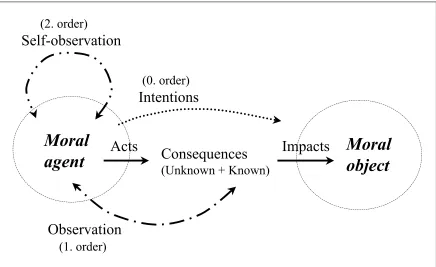
In order to determine the relevant dimensions in which an extension of ethics may take place, we need to elaborate on the simple model of moral acting presented in section I. The new model of moral acting is a second order model that includes self-observation. That is, it is based on a theory of second order cybernetics and a theory of self-referential systems.40
agent's acts, the consequences brought about by these acts and the impacts on the moral object. These elements correspond to a third dimension of ethics, namely the action ability of the agent, which Jonas took as his starting point.
The remaining elements in the model correspond to a fourth dimension of ethics, which concerns the type of grounds for moral action. The model shows three types of proc-esses with respect to the grounds of action: 0) A non-cybernetic process where the
intentions form the only grounds of action without 'feedback' (such a system could be the result of natural or cultural evolution as suggested by Darwin). 1) A first order cybernetic process that includes feedback from the agent's observation of the consequences of the acts and the impacts on the moral object. Here the agent's acts are grounded on the known consequences (besides the intentions). 2) A second order cybernetic process that includes self-observation – the observation of oneself as oneself – and thus forms the basis for critical reflection. In particular, second order observation (the observation of observation) can expose the limitations of particular observations and the ensuing limits of knowledge concerning consequences and impacts. It can thereby reveal the moral import of ignorance and uncertainty by way of including unknown consequences as grounds of action.
Moral
agent
Acts
Consequences
(Unknown + Known)Observation
Intentions
Self-observation
Moral
object
Impacts
(2. order)
(1. order)
[image:12.595.85.521.354.621.2](0. order)
Based on the model of moral acting we can identify four dimensions of ethical exten-sion, which are shown in Figure 3. The dimension of moral considerability, referring to the moral object, has already been discussed in some detail above.
The dimension of moral responsibility refers to the moral agent. It is therefore con-strained to self-aware beings and cannot be extended in the way of considerability (to sentient beings, for instance). Accordingly, moral responsibility has traditionally been understood as individual or personal responsibility. But the growing complexity of hu-man society and the dramatic development of collective technological action abilities give reasons for considering human societies, organisations, and corporations as moral agents.41 This means that we can speak of the collective social responsibility of such social systems – and of the demand for developing social systems that can take on a
global responsibility.42 In this vein, Sytse Strijbos asks: "What societal agents are
re-sponsible for particular developments? How are the different responsibilities of the agents related to each other and how are they coordinated?" and suggests that "what can be of help here is a systems view of technology that clarifies the interweavement be-tween human actions at the various systems levels and the responsibilities that belong to a variety of agents at these levels." 43
Considerability
(moral object)Moral
grounds
of action
Action
ability
known
consequences
unknown consequences intentions
things
sentient beings humans
fellows global ecological
community
cumulative individual
technological
social global
personal
Responsibility
(moral agent)living beings
oneself family
persons local ecological
community
individualistic: systemic:
[image:13.595.88.500.362.641.2]universe
From this it appears that the extension of responsibility is closely related to the third dimension, action ability, which refers to the types of acts and consequences that the agent can initiate. Action ability may be individual, cumulative – involving more of the same kind of individual actions, such as in an increase of the human population size – or
technological – that is, involving new kinds of human action.44 For instance, the so-called 'tragedy of the commons' is a moral aspect of the cumulative consequences of individually harmless actions. On the other hand, the technological development in ag-riculture, for instance, in terms of machines, chemical engineering, biotechnology, and genetic engineering introduces entirely new kinds of human action into the world. Technological actions are essentially collective actions of social systems. In the words of Strijbos: "Technology is no longer simply a matter of objects in the hands of indi-viduals; it has become a very complex system in which our everyday lives are embed-ded. The systemic character of modern technology confronts us with relatively new questions and dimensions of human responsibility." 45 As a remark in passing, the ('pas-sive') responsibility for constraining unwanted consequences is but one aspect of in-creased action abilities – another aspect is the ('active') responsibility to utilise the new action abilities to help and protect those in need. With respect to this, the limits of knowledge and control cautions against active interference where the consequences cannot be foreseen. This forms a link to the last dimension of our framework for ethical extension.
non-linguistic communication and empathy to supplement scientific observations – and on the knowledge of our ignorance as a moral ground of action.
The inclusive systemic framework of ethics, which we have described above, provides a tool for structuring and analysing normative concepts and in this way it can contribute to the resolution of moral conflicts. The precautionary principle can be seen as a moral principle that is based on the extension of human action ability and moral grounds of action (with the systemic relations between man and nature as a necessary background). A related principle from environmental policy, the polluter pays principle, can be seen as a moral principle that is based on the extension of human action ability and moral responsibility. Sustainability as functional integrity can be seen as a moral principle that is based on the extension of systemic moral considerability and the acknowledgement of ignorance as a moral ground of action.
We use the term 'systemic ethic' to designate an ethical stance that includes all the sys-temic aspects of ethical extension in the framework – syssys-temic considerability, social responsibility, technological action ability, and ignorance as a moral ground of action. Some of the implications and pertinent questions of a systemic ethic will be discussed briefly in the last sections, including a discussion of the relation to some more familiar concepts within environmental ethics, such as non-anthropocentrism and the intrinsic value of nature.
VI. DISCUSSION OF NON-ANTHROPOCENTRISM, EQUITY AND MORAL SIGNIFICANCE
Wherever the limit of moral considerability is drawn, the very extension of considerability beyond persons calls for a further distinction such as Goodpaster's distinction between moral considerability and moral significance.47 Even though all
living beings, for instance, are considered morally considerable, living, sentient and self-aware beings need not be considered of equal moral significance – they should not necessarily be treated alike in moral judgements.
Goodpaster's distinction allows us to distinguish between the extension of moral consid-erability and the ensuing questions of equity within the sphere of moral considconsid-erability. The common non-anthropocentric terms tend to conflate the issues of extension and equity, because the suffix 'centric' implies not only an extension of considerability but also a shift of moral significance, assigning equal moral significance to, for instance, a pig and a person.48 Such a shift is rightfully criticised for justifying acts that are
inhu-mane in the sense of being unjust to persons.49 Equity does not necessarily imply equal treatment. Speaking in terms of an extension of moral considerability does not imply such a shift, because we can discuss the question of moral significance separately – but the extension of considerability obviously determines the range within which we can discuss moral significance. In other words, moral considerability deals with the univer-sality aspect of equity (what kinds of moral objects enter into our considerations of eq-uity?) while moral significance deals with the justice aspect (what does equity between these objects mean?).
The question of moral significance thus involves the question of what equity and just treatment means. Justice in the Aristotelian sense means proportional treatment, where like instances are treated alike.50 The crucial question is which similarities and differ-ences are considered relevant. According to Peter Singer, species membership is not a relevant reason for treating non-humans different from humans.51 His concept of 'animal liberation' points out the analogy between the unjust, unequal consideration of slaves, of women, and of animals on farms and labs. On the other hand, an 'egalitarian pathocen-tric view' (extending moral considerability to sentient beings and taking all sentient be-ings to be of equal significance), where only the sense of pain and pleasure is consid-ered relevant, must be judged unjust if self-awareness is included as being of moral relevance, because equity then means treating persons differently from sentient beings without self-awareness.52
different processes of social and ecological dynamics (often discussed in terms of sus-tainability). The relevance of a difference in systemic significance depends on whether it is related to the functional integrity of the system – that is, the structure of connec-tions and processes that sustains the system.55
The functional integrity of the system is established by the web of relations between the physical, genetic, physiological, and social 'memory-structures' in the system, which secure the reproduction of system elements and processes. No single individual being or lineage is 'sustainable' in itself. Some kinds of living beings and physical processes, which we consider of little or no individual moral significance, are of great systemic moral significance with reference to the functional integrity of the ecological commu-nity. But any single individual, or group of individuals, has very limited systemic sig-nificance – unless they are the bearers of a functional role in the system and therefore play a key role in sustaining the system or a subsystem, in which case a systemic sig-nificance is added to their individual sigsig-nificance. In this way the sigsig-nificance of, for instance, the remaining individuals of a threatened species can increase.
VII. DISCUSSION OF THE INTRINSIC VALUE OF NATURE
It is a widely held idea that a 'proper' environmental ethics must be based on there being intrinsic values in nature (as opposed to nature being only of instrumental value to man), because this would be a necessary and sufficient ground for human obligations to non-human nature.56 A common line of argument is to establish this necessary connec-tion by way of defending the existence of objective intrinsic values in nature.57 This argument, however, presupposes that intrinsic values have moral import – and this ques-tion is impeded by the many senses of 'intrinsic value'. In other words, a key problem with the language of values and intrinsic values is that it tends to confuse questions of value and ethics. In this paper we have treated the moral considerability of nature with-out reference to intrinsic value. From this basis the question of the moral import of in-trinsic value in its different senses can be addressed and the implications for value the-ory drawn out.
The systemic ethic takes a relational view of values in line with the systemic or rela-tional view of nature. According to H. Richard Niebuhr a relarela-tional value theory "is objective in the sense that value relations are understood to be independent of the feel-ings of an observer but not in the sense that value is itself an objective kind of reality".58 Niebuhr shows how relational value-thinking can be found implicit in both objectivist and subjectivist positions, and how the dichotomy thus masks a common relationary ground. Relational value theory is relativistic (in the sense known from physics), or con-textual, and therefore incompatible with the idea of an ideal observer, but not with the idea of objective methods of research with due attendance to the viewpoint of the ob-server and to the interplay of facts and values.59 On this basis, a certain structure can be
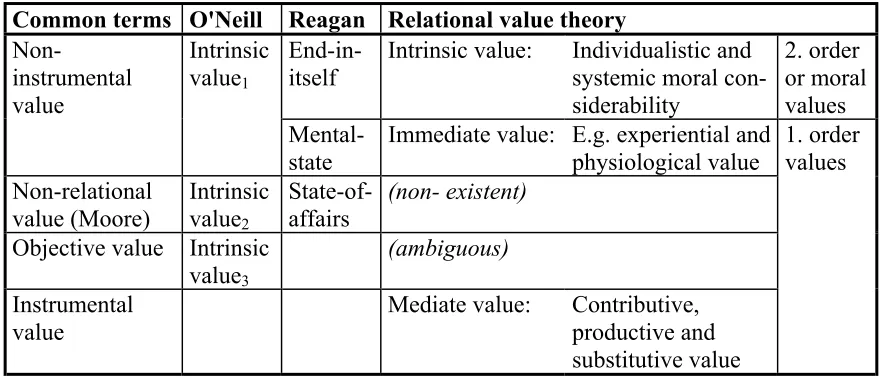
John O'Neill distinguishes between three different basic senses of intrinsic value: Intrin-sic value1 meaning non-instrumental value, intrinsic value2 meaning the value of an
ob-ject in virtue of its non-relational properties (as employed by G.E. Moore), and intrinsic value3 meaning 'objective value', which an object possesses independently of the
valua-tions of valuers.60 Tom Regan gives a different threefold distinction where intrinsic value is understood as either a mental-state, a state-of-affairs, or an end-in-itself.61 O'Neill's intrinsic value1 conflates Regan's end-in-itself and mental-state – there are two
kinds of opposites to instrumental value: intrinsic value (Reagan's end-in-itself) and immediate value. Immediate value includes Regan's mental-state (experiential value) as well as for example physiological value, and it is in opposition to mediate or instrumen-tal values, such as contributive (part), productive (tool) and substitutive (exchange, market) values. Regan's state-of-affairs corresponds to O'Neill's intrinsic value2, but
value in this non-relational sense has no place in a relational view of values. O'Neill's intrinsic value3, objective values, must either pertain to a value relation, in which case
the term intrinsic value seems inappropriate (because the 'objectivity' of a value relation does not in itself imply moral import), or to a non-relational value, in which case it must be discarded here together with intrinsic value2.
[image:18.595.79.521.366.555.2]
Table 1: Different senses of 'intrinsic value' compared with a relational theory of values.
Common terms O'Neill Reagan Relational value theory
End-in-itself
Intrinsic value: Individualistic and systemic moral con-siderability 2. order or moral values Non-instrumental value Intrinsic value1
Mental-state Immediate value: E.g. experiential and physiological value Non-relational value (Moore) Intrinsic value2 State-of-affairs (non- existent)
Objective value Intrinsic value3
(ambiguous)
Instrumental value
Mediate value: Contributive, productive and substitutive value
1. order values
limited knowledge of the values of some moral object, the (second order) moral value implies a cautious and conservative attitude towards encroaching on the object.
Analogously to the individualistic intrinsic values of individual beings, we can speak of a systemic intrinsic value, corresponding to systemic moral considerability, which des-ignates the moral value of the larger system that the moral agent is a part of. Moreover, this systemic aspect transfers to the consideration for other individuals, whether they themselves are moral agents or not, so that every individualistic intrinsic value is con-nected with a systemic intrinsic value.63 The moral value of the other entails the moral value of the larger system that the other is a part of. And the systemic values connected to the perspectives of different individuals in the same ecological community are – to some degree – different aspects of a common systemic intrinsic value. We may there-fore speak more loosely of the intrinsic value (meaning: moral considerability) of nature or natural processes, when there is little need or possibility for distinguishing between the individual and systemic aspects of intrinsic value – as long as we do not conflate this with other senses of 'intrinsic value of nature', which are based on a Naturalist View of Nature.
VIII. PRELIMINARY REMARKS ON THE FURTHER IMPLICATIONS OF A SYSTEMIC ETHIC
As stated in the introduction, the purpose of the present paper is to investigate the ethi-cal basis for sustainability and precaution. An outline of a systemic ethic has been pre-sented and discussed, and although space does not allow us to draw all the relevant im-plications of this framework here, some preliminary remarks can be given.
The systemic ethic enables us to understand and analyse sustainability and precaution as moral concepts on equal terms with the traditional moral concepts of humanist, indi-vidualistic ethics. It provides a tool for structuring and criticising the different meanings of new normative concepts of environmental concern. In particular, the systemic ethic points to reflexive precaution and functional integrity as the proper, more general un-derstandings of precaution and sustainability.64 And it provides those new norms that are
in agreement with the systemic ethic, with a stronger moral basis that can give them more credence and influence.
The systemic ethic gives reason to take the reflexive understanding of precaution as a more general sense of precaution. The development of new technologies with unfore-seeable consequences gives rise to a critique of the adequacy of rational decision-making based on scientific knowledge, such as in the case of pesticides, antibiotic growth promoters, and genetically modified organisms in agriculture. Reflexive precau-tion includes raprecau-tional precauprecau-tion, such as risk assessments, as a means of dealing with known consequences, while emphasising more general moral principles of acting, such as those entailed in the precautionary principle, in front of unknown consequences.
Systemic moral considerability presents the relationship between man and nature as something of moral value and not merely an instrumental relation. Therefore, the sys-temic ethic gives reason to see functional integrity as a more general understanding of sustainability, which employs the thinking of resource sufficiency as a way of dealing with known consequences where a distinctive view of nature is appropriate, while em-phasising the active responsibility for sustaining the ecological community.
NOTES
* Danish Research Centre for Organic Farming (DARCOF), P.O. Box 50, 8830 Tjele, Denmark; further information at <http://alroe.dk/hugo>. H.F. Alrøe is a Postdoc-toral Scientist at DARCOF who works with philosophy of research, research meth-odology and value inquiry. His research interests include systems research, transdis-ciplinary research, the role of values in science, sustainable agriculture, organic farming, and agricultural and environmental ethics. E.S. Kristensen is Chief Scientist and manager of DARCOF. In Denmark, DARCOF has the responsibility for initiat-ing and coordinatinitiat-ing research that contributes to the development of organic farminitiat-ing and the general promotion of sustainable agriculture. The centre also conduces to the synthesis and communication of knowledge, education of researchers, development of research methodology, and value inquiry. The authors wish to thank Niels Hal-berg, Helena Röcklinsberg and the anonymous reviewers for helpful comments. 1. K. E. Goodpaster and K. M. Sayre, "Introduction," in Ethics and Problems of the
21st Century, eds. K. E. Goodpaster and K. M. Sayre (Notre Dame, Indiana: Univer-sity of Notre Dame Press, 1979), pp. vii, xi.
2. See, e.g., C. S. Holling, "The resilience of terrestial ecosystems: local surprise and global change," in Sustainable Development of the Biosphere. (Cambridge: Cam-bridge University Press, 1986), pp. 293-320. P. Timmerman, "Mythology and sur-prise in the sustainable development of the biosphere," in Sustainable Development of the Biosphere, pp. 435-454. M. Schwarz and M. Thompson, Divided we stand. Redefining politics, technology and social choice (New York: Harvester Wheatsheaf, 1990), p. 5.
3. E.g., Robert Goodland, "The Concept of Environmental Sustainability,"
Annu.Rev.Ecol.Syst. 26 (1995): 1-24, and the recent paper in this journal by Ayres, Robert U., van den Berg, Jeroen C.J.M. and Gowdy, John M., "Strong versus Weak Sustainability: Economics, Natural Sciences, and 'Consilience'," Environmental Eth-ics 23(2) (2001): 155-168. See also Wilfred Beckerman, "'Sustainable Development': Is It a Useful Concept?," Environmental Values 3 (1994): 191-209, the responses from Herman E. Daly and Michael Jacobs in Environmental Values 4(1) (1995): 49-55 and 57-68, and the reply from Beckermann in Environmental Values 4(2)
(1995):169-179.
4. Gordon K. Douglass, "The meanings of agricultural sustainability," in Agricultural Sustainability in a Changing World Order (Boulder, Colorado: Westview Press, 1984), 3-29. See also E. S. Kristensen and N. Halberg, "A systems approach for as-sessing sustainability in livestock farms," in Livestock Farming Systems. More Than Food Production. Proc. of the 4th Int. Symp. on Livestock Farming Systems. EAAP Publication No. 89 (Waageningen, The Netherlands: Waageningen Pers, 1997), 5-15. 5. J. Baird Callicott, Larry B. Crowder, and Karen Mumford, "Current Normative
6. Paul B. Thompson, "Sustainability As a Norm," Society for Philosophy & Technol-ogy 2(2) (1996): 75-93. Paul. B. Thompson, "The varieties of sustainability in live-stock farming," in Livestock Farming Systems, 16-30. The concept of functional in-tegrity can be used in relation to any system with an internal, self-sustained purpose or an external, imposed purpose.
7. See, e.g., Silvio O. Funtowitcz and Jerome R. Ravetz, "Science for the Post-Normal Age," Futures 25(7) (1993): 739-755. Michael Smithson, "Ignorance and Science: Dilemmas, Perspectives and Prospects," Knowledge: Creation, Diffusion, Utilization
15 (1993): 133-156.
8. See, e.g., T. O'Riordan and J. Cameron, eds., Interpreting the precautionary princi-ple (London: Earthscan, 1994). Carolyn Raffensperger and Joel Tickner, eds., Pro-tecting public health and the environment. Implementing the precautionary principle
(Washington, D.C.: Island Press, 2000).
9. This interpretation of the precautionary principle is based on S.
Boehmer-Christiansen, "The precautionary principle in Germany – enabling government," in
Interpreting the precautionary principle, p. 37. See also the discussion of different versions of the principle in Bart Gremmen and Henk van den Belt, "The Precaution-ary Principle and Pesticides," Journal of Agricultural and Environmental Ethics 12 (2000): 197-205.
10. See also the discussion of sustainability as a system-describing and a
goal-prescribing (normative) concept in Paul. B. Thompson , "The Varieties of Sustain-ability," Agriculture and Human Values 9 (1992): 11-19, revised version in Thomp-son, The spirit of the soil. Agriculture and environmental ethics (New York:
Routledge, 1995), chapter 7.
11. Kenneth E. Goodpaster, "From egoism to environmentalism," in Ethics and Prob-lems of the 21st Century, 21-35. J. Burkhardt, "The Morality Behind Sustainability,"
Journal of Agricultural Ethics 2 (1989): 113-128.
12. Immanuel Kant, Fundamental principles of the metaphysics of morals (1785), sec-ond section. 'Maxim' here means the principle on which the subject acts, in distinc-tion from the principle on which it ought to act, that is, an imperative or a practical law. The imperative is 'categorical' in the sense that it is a logical condition for mu-tual obligations between rational beings, and this means that the rationale behind Kant's categorical imperative presumes a symmetrical ethics. Without symmetry, the imperative would not be categorical.
13. Lawrence E. Johnson, A morally deep world. An essay on moral significance and environmental ethics (Cambridge: Cambridge University Press, 1991), p. 16. 14. Roderick Frazier Nash, The rights of nature. A history of environmental ethics
(Madison, Wisconsin: The University of Wisconsin Press, 1989), p. 137.
16. E.g., Kenneth E. Goodpaster, "On Being Morally Considerable," The Journal of Philosophy 75 (1978): 308-325. Paul Taylor, Respect for nature. A theory of envi-ronmental ethics (Princeton: Princeton University Press, 1986).
17. W. K. Frankena, "Ethics and the environment," in Ethics and Problems of the 21st Century.
18. Goodpaster, "From egoism to environmentalism," pp. 22ff. 19. Ibid., pp. 29-30.
20. Aldo Leopold, A Sand County almanac (Oxford: Oxford University Press, 1949), pp. 203-04.
21. E.g., Frederick Ferré, "Persons in Nature: Towards an Applicable and Unified Envi-ronmental Ethics," Ethics and the Environment 1(1) (1996): 15-25. J. Baird Callicott, "Elements of an Environmental Ethic. Moral Considerability and the Biotic Commu-nity," Environmental Ethics 1 (1979): 71-81.
22. Nash, The rights of nature, p. 68.
23. Charles Darwin, The Descent of Man, and Selection in Relation to Sex (1871), chap-ter 4.
24. J. Baird Callicott, "Hume's Is/Ought Dichotomy and the Relation of Ecology to Leopold's Land Ethic," Environmental Ethics 4 (1982): 163-174, p.174.
25. Hans Jonas, The imperative of responsibility. In search of an ethics for the techno-logical age (Chicago: University of Chicago Press, 1984), pp. 5-6.
26. Ibid., pp. 6, 8.
27. Ibid., pp. 22-23. As we wrote in the first section, the awareness of a choice of action implies moral responsibility. But note that a genuine choice of action involves that the ability to act responsibly is within reach.
on the known at the expense of the unknown that we reject above. In the context of precautionary acting, the reversed burden of proof can therefore better be discussed in terms of the distinction between taking a risk and being exposed to danger. See, e.g., Niklas Luhmann, Ecological Communication (Cambridge, UK: Polity Press, 1989), p. 71 and note 21, p. 166. That is, in terms of who bears the burden of uncer-tainty in relation to who stands to gain from the risks that they deliberately take. See also Jonas, The imperative of responsibility, p. 34ff.
29. J. Baird Callicott, "Animal Liberation. A Triangular Affair," Environmental Ethics 2 (1980): 311-338.
30. Leopold, A Sand County almanac, pp. 224-25. 31. Goodpaster, "From egoism to environmentalism".
32. George H. Mead, "The Social Self," Journal of Philosophy, Psychology and Scien-tific Methods 10 (1913): 374-380, pp. 374-75. See also Kant's Critique of Pure Rea-son, Transcendental Dialectics, book II, chapter 1, where Kant distinguishes the I as a subject from the I as an object.
33. Mead, "The Social Self," p. 377.
34. See also Arne Næss, Økologi, samfunn og livsstil. Utkast til en økosofi (Oslo, Norge: Universitetsforlaget, 1974), pp. 175ff on the process of identification and the extension of the self. (English edition, Ecology, Community and Lifestyle : Outline of an Ecosophy, Cambridge University Press, 1990)
35. Jonas, The imperative of responsibility, p. 85. See also David Hume's Inquiry con-cerning the principles of morals, Appendix I, on moral sense.
36. Cited from J. Baird Callicott, "The Metaphysical Implications of Ecology," Envi-ronmental Ethics 8 (1985): 301-316.
37. Holmes Rolston III, "Lake Solitude: The Individual in Wildness," Main Currents in Modern Thought 31 (1975): 122.
38. Callicott, "The Metaphysical Implications of Ecology," pp. 314, 316. 39. Jonas, The imperative of responsibility.
40. Second order cybernetics is concerned with accounting for the observer in the ob-servation of cybernetic systems, see H. von Foerster, Observing systems (California, USA: Intersystems Publications, 1984), p. 258. An account of the development of systems theory from the distinction between 'wholes and parts' to 'system and envi-ronment' and to a theory of self-referential systems is given by Niklas Luhmann in
also an act that is directed and intentional in terms of being rooted in the sense appa-ratus and the instruments of observation. See e.g. von Foerster, Observing systems, pp. 288-90, G. Bateson, Steps to an ecology of mind (New York: Ballentine Books, 1972), p. 292. Second order observation can provide knowledge of the nature and limits of the observation observed, but no observation can reveal the nature of itself. Observation always has a 'blind spot', located in the distinctions necessary for ob-serving, and observing this blind spot involves a new observation with, necessarily, a new blind spot. See Niklas Luhmann, "Erkendelse som konstruktion," in Fra Lærin-gens Horisont (Århus: Forlaget Klim, 1998), 163-184 (German edition: Erkenntnis als Konstruktion. (Benteli Verlag, Bern, 1988).
41. Hans Lenk, "Distributability Problems and Challenges to the Future Resolutions of Responsibility Conflicts," Society for Philosophy & Technology 3(4) (1998): 69-93. Sytse Strijbos, "Ethics and the Systemic Character of Modern Technology," Society for Philosophy & Technology 3(4) (1998): 19-34.
42. Holmes Rolston, Environmental Ethics (Philadelphia, U.S.A.: Temple University Press, 1988), pp. 247ff. Hans Lenk, "Progress, Values and Responsibility," Society for Philosophy & Technology 2(3-4) (1997): 102-119, p. 107.
43. Strijbos, "Ethics and the Systemic Character," p. 28, in a discussion of Jonas' ethics of technology.
44. Jonas, The imperative of responsibility. Lenk, "Progress, Values and Responsibil-ity," p. 108: "In proportion to its powers, technologically multiplied to an extreme, humankind's responsibilities have grown if not exploded."
45. Strijbos, "Ethics and the Systemic Character," p. 19.
46. See also Peter A. French, Collective and corporate responsibility (New York: Co-lumbia University Press, 1984), p. 132ff, where he proposes an extended principle of accountability, according to which somebody is morally responsible not only for in-tentional acts, but also for some of the unintended effects of actions, which these per-sons should have known.
47. Goodpaster, "On Being Morally Considerable," pp. 311-12.
48. Or, in the case of ecocentrism, stating the primacy of the ecological systems or of 'Nature'. Note the connection between such views and the Naturalist View of Nature in section I.
49. E.g., Ferré, "Persons in Nature," and K. Shrader-Frechette, "Individualism, Holism and Environmental Ethics," Ethics and the Environment 1(1) (1996): 55-69, p. 63. 50. Aristotle, Nichomachean Ethics (Translated by W.D. Ross, 350), book V, section 3. 51. Singer, "Not for humans only," pp. 194-95.
53. See, e.g., Rolston, Environmental Ethics, pp. 223-224.
54. See Johnson, A morally deep world, for an elaboration of such a view, and critiques by e.g. Robin Attfield, Value, obligation and meta-ethics (Amsterdam: Edition Ro-dopi, 1995), pp. 24ff, and Shrader-Frechette, "Individualism, Holism," pp. 59ff. 55. Note, however, that the systemic extension involves going beyond the 'instrumental'
view of the system. This means that the limits of knowledge need to be taken into consideration when evaluating the moral significance of something on the basis of available knowledge. The instrumental view of the system can, by the way, be found in both anthropocentric and non-anthropocentric individualistic ethics. See, e.g., Bryan G. Norton, "Epistemology and Environmental Values," The Monist 75(2) (1992): 208-226, and Taylor, Respect for nature. See also Norton's convergence hy-pothesis (p. 209), which states the equivalence of non-anthropocentric and anthropo-centric positions.
56. E.g., Jim Cheney, "Intrinsic Value in Environmental Ethics: Beyond Subjectivism and Objectivism," The Monist 75(2) (1992): 227-236, and John O'Neill, "The Varieties of Intrinsic Value," The Monist 75(2) (1992): 119-137. Note the connection between this formulation of the intrinsic value of nature and the Naturalist View of Nature in Figure 1.
57. E.g., Attfield, Value, obligation, pp. 29ff.
58. H. Richard Niebuhr, "The center of value," in Radical Monotheism and Western Culture (New York: Harper & Row, 1960), 100-113, p. 102.
59. See H. F. Alrøe and E. S. Kristensen, "Towards a Systemic Research Methodology in Agriculture: Rethinking the Role of Values in Science," forthcoming in Agricul-ture and Human Values, for a detailed discussion of objectivity, contextuality, and values in science.
60. O'Neill, "The Varieties," pp. 119-20.
61. Tom Regan, "Does Environmental Ethics Rest on a Mistake?," The Monist 75(2) (1992): 161-182. Regan uses the term end-in-itself in a Kantian sense. Kant restricted intrinsic value to persons, he contrasted the inner worth (innern Werth) or dignity (Würde) of human individuals with relative values such as market value and senti-mental value, see Fundamental principles of the metaphysics of morals (1785), sec-ond section. But Regan describes (pp. 171ff) how intrinsic value in Kant's sense can be extended to 'subjects of a life' that have an experiental welfare or, with reference to Paul Taylor, to 'individual living beings' that are 'teleological centers of life'. Regan uses the term 'inherent value', while Paul Taylor uses 'inherent worth'.
63. See also Judith N. Scoville, "Value Theory and Ecology in Environmental Ethics: A Comparison of Rolston and Niebuhr," Environmental Ethics 17(2) (1995): 115-133, pp. 122ff., for a discussion, based on a relationary view of values, of Holmes Rol-ston's use of systemic value.
64. And these conceptual differences have very practical consequences, see e.g. Thomp-son, "Sustainability as a norm," p. 92. The view of sustainability and precaution sup-ported by the systemic ethic seems to be largely in agreement with the way these concepts are used in the organic movement.