L E T T E R T O T H E E D I T O R
Open Access
The missing link in parasite manipulation of
host behaviour
Ryan Herbison
*, Clement Lagrue and Robert Poulin
Abstract
The observation that certain species of parasite may adaptively manipulate its host behaviour is a fascinating phenomenon. As a result, the recently established field of‘host manipulation’has seen rapid expansion over the past few decades with public and scientific interest steadily increasing. However, progress appears to falter when researchers ask how parasites manipulate behaviour, rather than why. A vast majority of the published literature investigating the mechanistic basis underlying behavioural manipulation fails to connect the establishment of the parasite with the reported physiological changes in its host. This has left researchers unable to empirically distinguish/ identify adaptive physiological changes enforced by the parasites from pathological side effects of infection, resulting in scientists relying on narratives to explain results, rather than empirical evidence. By contrasting correlative mechanistic evidence for host manipulation against rare cases of causative evidence and drawing from the advanced understanding of physiological systems from other disciplines it is clear we are often skipping over a crucial step in host-manipulation: the production, potential storage, and release of molecules (manipulation factors) that must create the observed physiological changes in hosts if they are adaptive. Identifying these manipulation factors,viaassociating gene expression shifts in the parasite with behavioural changes in the host and following their effects will provide researchers with a bottom-up approach to unraveling the mechanisms of behavioural manipulation and by extension behaviour itself.
Keywords:Parasite, Behaviour, Manipulation, Mechanism, Manipulation factor
Letter to the Editor
Behaviour, as a physical concept, presents an incredibly complex challenge to researchers looking to understand its inner workings. Parasites capable of behavioural manipulation provide a direct window into the molecu-lar basis of behaviour by altering physiological systems in their hosts to generate behaviours that align with their life-cycle [1, 2]. The potential of manipulative parasites to increase our fundamental understanding of behaviour is now beginning to dawn on the wider scientific com-munity [1, 3, 4] as is the fact that some of the world’s deadliest diseases (such as malaria) rely on behavioural manipulation to complete their life-cycle [5]. Conse-quently, studies investigating the molecular mechanisms behind parasite manipulation are slowly increasing in frequency [6, 7]. However, the molecular evidence for adaptive behavioural manipulation (behavioural change
in the host that directly benefits the parasite) in a major-ity of host-parasite associations is missing crucial pieces of evidence. If we define establishment of a parasite in its host (or physical contact with the host by the para-site) as Event A and the resulting physiological change in the host as Event B, we can now consider the evidence that connectsEvent Ato Event Bin the three cases of host manipulation that follow:
Case 1: A rat contractsToxoplasma gondii via contact with cat faeces (Event A). Following this, testicular testosterone production increases in the rat leading to hypomethylation of the amygdala (Event B). This is suggested to cause the loss of aversion to cat urine in the infected rats [8,9].
Case 2: A mouse contractsLeishmania amazonensis
viaa sand fly bite (Event A). Two to four months post-establishment, several key cytokines levels are altered in the mouse’s pre-frontal cortex (Event B),
* Correspondence:[email protected]
Department of Zoology, University of Otago, P.O. Box 56, Dunedin 9054, New Zealand
potentially resulting in a set of observed anxiety behaviours in infected mice [10].
Case 3: The parasitoid waspCotesia congregatainjects an egg into the caterpillarManduca sexta(Event A). During egression of the larvae from the caterpillar, removal of octopamine from the hemolymph of the caterpillar is significantly reduced (Event B). This is thought to suppress the caterpillar’s feeding, thus enabling the larvae to egress unimpeded [11].
As with a majority of host manipulation research, the three cases presented above cannot categorically connect parasite establishment (Event A) with the physiological/ molecular changes seen in infected hosts (Event B). Instead, one must correlate parasite presence with the observed physiological changes that coincide temporally with one or another stage of infection. Consequently, this makes it extremely difficult to distinguish adaptive physiological changes induced by the parasites from other outcomes of infection. The reported physiological changes in the hosts from the cases given above could have multiple alternative explanations involving, but not restricted to, immunological or homeostatic mechanisms (see Fig. 1 for illustration). Empirical research needs to generate evidence that allows us to rule out these alternative explanations in order to confirm adaptive
behavioural manipulation by the parasite. Failing this, convincing narratives pushing for adaptive manipula-tion will continue to play an overly important role in this research area. For example, in a review of
Toxo-plasma’s host manipulation mechanisms by Vyas [9] we see the multiple potential pathways framed as ‘nar-ratives’by the author.
In what follows, we attempt to further clarify the thought process needed to generate definitive evidence for adaptive behavioural manipulation. By using an ana-logy from a different discipline and the jewel wasp-cockroach host-parasitoid system, and comparing them to the cases described above, we hope to clearly point out the gaps in our present knowledge. Furthermore, we suggest a step-by-step process that parasites should logically follow to adaptively manipulate behaviour and propose a potential avenue for researchers to begin gen-erating evidence for the currently overlooked steps. Note that we are in no way dismissing earlier empirical stud-ies or undermining their importance. Indeed, correlative evidence is a crucial stepping-stone toward uncovering the underlying causal mechanisms, and earlier results may point towards the true mechanisms of host manipu-lation. However, there is a dire need to push the field of host manipulation study to the next step and the search for the actual causative mechanisms.
[image:2.595.59.539.422.644.2]Tobacco and Jewel wasps
In order to demonstrate the correlative nature of many earlier host manipulation studies, allow for an analogy: consider the addiction induced by smoking tobacco as a form of behavioural manipulation, and compare this against the cases presented above. Smoking tobacco (Event A) causes the nicotine stored in the plant leaves to be released and inhaled into the lungs where it rapidly travels to the brain. Once there, it saturates receptors normally reserved for binding acetylcholine, culminating in the excessive release of dopamine in the brain (Event B). Dopamine signals pleasure and is crucial in reinforcing behaviours. Constant, large releases of this neurochemical quickly result in addiction to nicotine and thus smoking [12]. Albeit simplified, this system of behavioural modifica-tion has clear causative evidence, specifically the release of nicotine, connectingEvent AandB. Consider a correlative explanation for tobacco addiction, similar to the three host manipulation cases presented above, in which we would only know that smoking tobacco results in higher dopa-mine levels in the brain, but have no idea of nicotine’s exist-ence. Nicotine is the causative factor (i.e. the substance released by smoking tobacco) directly triggering the cas-cade of processes leading to addiction. Identification of nicotine and its role marked the transition from correlation to causation in research on tobacco addiction.
Although equating the mechanisms of tobacco addic-tion and those of host manipulaaddic-tion may appear obtuse, it is a clear way to demonstrate the gaps in the host manipulation research. Research on tobacco addiction may serve as a benchmark for the rigour needed in the search of mechanisms behind behavioural manipulation. Indeed, what is the causativefactorthat enables parasites to manipulate behaviour?
The jewel wasp-cockroach parasitoid-host system is one of the best understood examples of host behavioural manipulation. The wasp injects its venom directly into the cockroach’s brain (Event A). A component of the venom interferes with octopaminergic neurons (Event B), result-ing in the loss of self-directed locomotion in the cock-roach. This allows the wasp to lead the cockroach to its burrow [3,13]. In both tobacco addiction and jewel wasp-cockroach system, nicotine and venom, respectively, unarguably connectsEvent AandB. Identification of the specific factors (nicotine and wasp’s venom) allows us to reliably conclude that the molecular changes observed in the smoker/host are a direct result of the cigarette/parasit-oid and not just some other coincidental side effect of smoking/infection.
Connecting parasite establishment and molecular changes
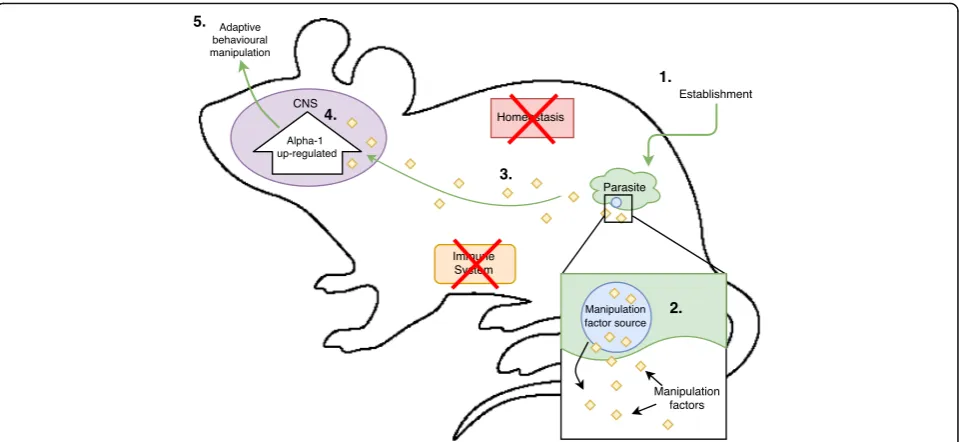
Drawing from the tobacco analogy and the jewel wasp, we can conceptualize a framework for how cases of
adaptive behavioural manipulation should logically pro-gress (Fig. 2). In order for parasites to directly manipu-late their host’s behaviour, they should be releasing “manipulation factors”(see Fig. 2 for definition), similar in their functional role to nicotine or jewel wasp venom, which interact with the host’s physiological system(s). These “manipulation factors” should then result in the observed molecular/behavioural changes [7]. The source and production of manipulative factors (step 2) is also a key step that should not be overlooked either. Consider that in the jewel wasp and tobacco plant, the source of their manipulative factors, i.e. venom gland or roots respectively, is a key part of their manipulative process.
The three cases of host manipulation presented earl-ier are still missing evidence for manipulation factors and their source (step 2 and 3) compared to the to-bacco addiction pathway and jewel wasp-cockroach parasite-host system (Table1). The search for manipu-lation factors and their source in parasites suspected of adaptive behavioural manipulation should be a major goal of research in the area, as it directly con-nects parasite establishment with physiological change in the host. This bottom-up approach should be invaluable for finding the true molecular mechanisms involved in behavioural manipulation, as the impacts of the identified manipulative factor on host physi-ology can be logically tracked step-by-step. Compara-tively, the alternative top-down approach of trying to elucidate the molecular changes in the host, before investigating step 2 and 3, makes it very difficult to validate the adaptive value of the observed molecular changes in the infected host. Again, in these top-down cases, it is entirely possible that the reported molecu-lar changes are simply the host’s reaction (coping mechanism) to infection, rather than being enforced directly by the parasite (Fig.1).
Finding manipulation factors and their source
process in the parasite is a defined event initiated at a specific time, whereas achieving behavioural ma-nipulation could instead result from a gradual process that starts early in the parasite’s life-cycle. Consider-ing behavioural manipulation can range from a subtle change in pre-existing traits to the creation of
[image:4.595.59.539.87.308.2]entirely new behaviours, both punctual and gradual manipulation are distinct possibilities. Essentially, the aim here should be to pair gene expression changes in the parasite with behavioural changes in the host, and investigate these relationships for potential ma-nipulative factors.
Table 1Steps toward adaptive host manipulation compared against the known steps inToxoplasma-rat,Leishmania-mouse,
wasp-caterpillar and wasp-cockroach parasite-host systems. Additionally, tobacco addiction pathway included for comparison
Steps to adaptive host manipulation
Case 1 Case 2 Case 3 Jewel-wasp and cockroach
Tobacco addiction
Step 1/Event A:
Parasite/tobacco establishment
Toxoplasma gondii
infects a rat (Rattus norvegicus)
Leishmania amazonensis
infects a mouse
WaspCotesia congregata
injects its larvae into the catepilliarManduca sexta
WaspAmpulex compressa
stings cockroach
Periplaneta americana
Inhalation of tobacco smoke
Step 2:Manipulation
factors released from source
? ? ? Venom stored in the glands released into CNS
Nicotine released into lungs/brain from tobacco root
Step 3:Manipulation
factors impacts physiological functioning
? ? ? Neurotoxin in venom impacts octopaminergic neurons
Nicotine saturates acetylcholine receptors
Step 4/Event B:
Molecular change in host
Testosterone release causes hypomethylation of the medial amygdala
Cytokine levels altered in pre-frontal cortex
Octopamine removal from hemolymph severely reduced
Sharp decrease in firing rate of affected neurons
Large dopamine release in the brain
Step 5:Behavioural
change
Loss of innate aversion to cat odor
Set of anxiety behaviours
Suppression of feeding Loss of self-directed movement
Addiction to tobacco
[image:4.595.59.540.548.733.2]Finding the potential source of manipulation factors is equally important. Genomic analysis may allow re-searchers to identify simple manipulation factor sources such as enzymes. However, if the source is a complex structure (i.e. tissue, membrane, organelle) the number of genes involved in its development may make it difficult to identify it from genomic analysis alone, especially if that development is drawn out over the parasite’s life-cycle. Detailed histological analysis (or in-situ hybridization) of manipulative parasites, coinciding with adaptive behav-ioural changes in their host could serve to localise com-plex sources. The internal anatomy of parasites changes as they progress through their life-cycle (e.g. [15–18]). Therefore, it is not unlikely that a manipulation factor source may be absent early in a parasite’s life but present later on when manipulation occurs.
Host-parasite size disparity may also give insight into when the source becomes active. If host-parasite size disparity is great, we may expect a source that the para-site can store, as higher amounts of manipulation factor may be needed to impact host physiology. Alternatively, in host-parasite systems with little size disparity, such as hairworm-insect systems where the parasite induces its terrestrial host to seek and jump in water, the rate of production of manipulative factors may be high enough not to require storage. However, regardless of size dis-parity, sudden or rapid behavioural changes in the host may necessitate storage of manipulation factors by the parasite, whereas gradual behavioural changes in hosts may only require sustained production. Determining the probability that a parasite’s source of manipulation factor requires storage is important for two reasons: it informs histological searches for the source, and suggests when in the parasite’s life-cycle the source might appear.
Finally, it is also important to consider that parasites may repurpose or expand functionality of existing organelles/tissue for generating and secreting manipu-lation factors. Therefore, histological analysis should focus on existing structures/organelles as well as iden-tification of new structures. Particular interest should be paid to existing organelles already capable of stor-age in high-disparity, rapid behavioural change host-parasite systems.
Conclusion
Earlier studies often use the term ‘proximate mechan-ism’ when reporting physiological changes in infected hosts. Proximate is an incorrect epithet for these mecha-nisms. If adaptive behavioural manipulation is occurring in these cases, the physiological changes in the host are actually several steps downstream from the true cause; the manipulation factors themselves and their source are thus likely the true proximate mechanisms. Adopting
this alternative perspective provides a bottom-up ap-proach that has the potential to empirically differentiate an adaptive physiological manipulation from other pos-sible consequences of infection. When implemented, this approach will likely accelerate progress in the field of behavioural manipulation.
Acknowledgements Not applicable.
Funding Not applicable.
Availability of data and materials Not applicable.
Authors’contributions
RH: Initial conceptualization of articles premise, wrote manuscript. CL: Discussion of article premise and revision of manuscript. RB: Discussion of article premise and revision of manuscript. All authors read and approved the final version of the manuscript.
Ethics approval and consent to participate Not applicable.
Consent for publication Not applicable.
Competing interests
The authors declare that they have no competing interests.
Publisher’s Note
Springer Nature remains neutral with regard to jurisdictional claims in published maps and institutional affiliations.
Received: 18 January 2018 Accepted: 19 March 2018
References
1. Adamo SA. Parasites: evolution’s neurobiologists. J Exp Biol. 2013; 216(1):3–10.
2. Houte S, Ros VI, Oers MM. Walking with insects: molecular mechanisms behind parasitic manipulation of host behaviour. Mol Ecol. 2013;22(13): 3458–75.
3. Libersat F, Gal R. What can parasitoid wasps teach us about decision-making in insects? J Exp Biol. 2013;216(1):47–55.
4. Webster JP, Kaushik M, Bristow GC, McConkey GA.Toxoplasma gondii infection, from predation to schizophrenia: can animal behaviour help us understand human behaviour? J Exp Biol. 2013;216(1):99–112.
5. Emami SN, Lindberg BG, Hua S, Hill SR, Mozuraitis R, Lehmann P, et al. A key malaria metabolite modulates vector blood seeking, feeding, and susceptibility to infection. Science. 2017;355(6329):1076–80. 6. Poulin R, Maure F. Host manipulation by parasites: a look back before
moving forward. Trends Parasitol. 2015;31(11):563–70.
7. Herbison RE. Lessons in mind control: trends in research on the molecular mechanisms behind parasite-host behavioral manipulation. Front Eco Evo. 2017;5:102.
8. Hari Dass SA, Vyas A.Toxoplasma gondiiinfection reduces predator aversion in rats through epigenetic modulation in the host medial amygdala. Mol Ecol. 2014;23(24):6114–22.
9. Vyas A. Mechanisms of host behavioral change inToxoplasma gondiirodent association. PLoS Pathog. 2015;11(7):e1004935.
10. Portes A, Giestal-de-Araujo E, Fagundes A, Pandolfo P, de Sá GA, Lira MLF, et al.Leishmania amazonensisinfection induces behavioral alterations and modulates cytokine and neurotrophin production in the murine cerebral cortex. J Neuroimmunol. 2016;301:65–73.
12. Benowitz NL. Nicotine addiction. N Engl J Med. 2010;362(24):2295–303. 13. Rosenberg LA, Pflüger HJ, Wegener G, Libersat F. Wasp venom injected into
the prey’s brain modulates thoracic identified monoaminergic neurons. Dev Neurobio. 2006;66(2):155–68.
14. Hébert FO, Grambauer S, Barber I, Landry CR, Aubin-Horth N. Major host transitions are modulated through transcriptome-wide reprogramming events inSchistocephalus solidus, a threespine stickleback parasite. Mol Ecol. 2017;26:1118–30.
15. Bird AF. Changes associated with parasitism in nematodes. III. Ultrastructure of the egg shell, larval cuticle, and contents of the subventral esophageal glands inMeloidogyne javanica, with some observations on hatching. J Parasitol. 1968;54:475–89.
16. Aikawa M. Variations in structure and function during the life cycle of malarial parasites. Bull World Health Organ. 1977;55(2–3):137. 17. Vickerman K. Developmental cycles and biology of pathogenic
trypanosomes. Br Med Bull. 1985;41(2):105–14.
18. Hall N, Karras M, Raine JD, Carlton JM, Kooij TW, Berriman M, et al. A comprehensive survey of thePlasmodiumlife cycle by genomic, transcriptomic, and proteomic analyses. Science. 2005;307(5706):82–6.
• We accept pre-submission inquiries
• Our selector tool helps you to find the most relevant journal • We provide round the clock customer support
• Convenient online submission • Thorough peer review
• Inclusion in PubMed and all major indexing services • Maximum visibility for your research
Submit your manuscript at www.biomedcentral.com/submit