WESTERN JOINT COMPUTER CONFERENCE
March
3-5. 1959
San Francisco. Calif.
Sponsors:
THE INSTITUTE OF RADIO ENGINEERS
Professional Group on Electronic Computers
THE AMERICAN INSTITUTE OF ELECTRICAL ENGINEERS
Committee on Computing Devices
THE ASSOCIATION FOR COMPUTING MACHINERY;
PROCEEDINGS OF THE
WESTERN JOINT COMPUTER CONFERENCE
PAPERS PRESENTED AT
THE JOINT IRE-AIEE-ACM COMPUTER CONFERENCE
SAN FRANCISCO. CALIF .• MARCH 3-5. 1959
Sponsors
THE INSTITUTE OF RADIO ENGINEERS
Professional Group on Electronic Computers
THE AMERICAN INSTITUTE OF ELECTRICAL ENGINEERS
Committee on Computing Devices
THE ASSOCIATION FOR COMPUTING MACHINERY
Published
by
The Institute of Radio Engineers
I
East 79th Street. New York
21.
N. Y.
for the
Additional copies may be purchased from the following spon-soring societies at $6.00 per copy. Checks should be made pay-able to anyone of the following societies:
INSTITUTE OF RADIO ENGINEERS 1 East 79th Street, New York 21, N. Y.
AMERICAN INSTITUTE OF ELECTRICAL ENGINEERS 33 West 39th Street, New York 18, N. Y.
ASSOCIATION FOR COMPUTING MACHINERY 2 East 63rd Street, New York 21, N. Y.
Copyright © 1959
LIST OF EXHmITORS
AERONUTRONIC SYSTEMS, INC... Santa Ana, Calif. AMPEX CORP ... ,. Redwood City, Calif. AMP INC ... , . . . .. Harrisburg, Pa. BECKMAN/BERKELEY DIVISION OF BECKMAN
IN-STRUMENTS, INC... Richmond, Calif. BENDIX COMPUTER DIVISION OF BENDIX AVIATION
CO RP. . . .. Los Angeles, Calif. E. L. BERMAN CO.. . . . .. San Francisco, Calif. BRYANT COMPUTER PRODUCTS DIVISION ... " Springfield, Vt. C. P. CLARE & CO.. . . . .. Los Angeles, Calif. COLLINS RADIO CO... Burbank, Calif. COMPUTER CONTROL CO., INC.. . . . .. Los Angeles, Calif. DATA INSTRUMENTS DIVISION OF TELECOMPUTING
CORP.. . . .. North Hollywood, Calif. DIGITAL EQUIPMENT CORP... . . . .. Maynard, Mass.
ELECTRODATA DIVISION OF BURROUGHS CORP... Pasadena, Calif. ELECTRONIC ASSOCIATES, INC.. ... Long Branch, N. J. ELECTRONIC ENGINEERING CO. OF CALIFORNIA.... Santa Ana, Calif. FERRENTI ELECTRIC, INC... Hempstead, N. Y. FRIDEN, INC... . . . .. San Leandro, Calif. GENERAL ELECTRIC CO., LIGHT MILITARY
ELEC-TRONICS DEPT.. . . .. Johnson City, N. Y. HUGHES AIRCRAFT CO... . . . .. Culver City, Calif. INTERNATIONAL BUSINESS MACHINES CORP... .. New York, N. Y. LABORATORY FOR ELECTRONICS, INC... . . . .. Boston, Mass. LIBRASCOPE, INC... Glendale, Calif. F. L. MOSELEY CO... . . . .. . .. . . .. Pasadena, Calif. G. E. MOXON SALES.... . . .. Beverley Hills, Calif. PACIFIC TELEPHONE & TELEGRAPH CO.. . . . . ... San Francisco, Calif. PHILCO CORP... Philadelphia, Pa. RADIO CORP. OF AMERICA. . . .. Camden, N. J. REMINGTON RAND DIVISION OF SPERRY RAND CORP. New York, N. Y. RESEARCH & ENGINEERING, THE MAGAZINE OF
Chairman H. H. Goode
Bendix Systems Division Ann Arbor, Mich.
IRE Representatives R. D. Elbourn
National Bureau of Standards Department of Commerce Washington 25, D. C.
H. H. Goode
Bendix Systems Division Ann Arbor, Mich.
W. Buchholz
IBM Product Dev. Lab. P.O. Box 390
Poughkeepsie, N. Y.
L. Nofrey
General Electric Computer Dept. Phoenix, Ariz.
P. Armer
RAND Corporation Santa Monica, Calif.
F. M. Verzuh
Vice-Chairman P. Armer
RAND Corporation Santa Monica, Calif.
Secretary-Treasurer Miss M. R. Fox
National Bureau of Standards Department of Commerce Washington 25, D.C.
AIEE Representatives R.A.Imm
IBM Corporation Rochester, Minn.
G. Glinski
Dept. of Electrical Engineering University of Ottawa
Ottawa, Ont., Can.
C. A. R. Kagan
Engineering Research Center Western Electric Company, Inc. Princeton, N. J.
S. Rogers
c/o Convair, Mail Zone 6-156 San Diego 12, Calif.
ACM Representatives
J.
D. MaddenSystem Development Corp. Santa Monica, Calif.
Massachusetts Institute of Technology Cambridge, Mass.
H. R. J. Grosch IBM Corporation New York, N. Y.
R. W. Hamming (ACM) Bell Telephone Laboratories Murray Hill, N.
J.
J.
MoshmanEx-Officio Representatives
M. Rubinoff (AlEE) Philco Corporation
W. H. Ware (IRE) RAND Corporation Santa Monica, Calif.
Government and Industrial Division Philadelphia, Pa.
The Headquarters Representatives L. G. Cumming Council for Economic and Industry Research, Inc.
Arlington, Va.
The Institute of Radio Engineers New York, N. Y.
R. S. Gardner
American Institute of Electrical Engineers 33 West 39th Street
WESTERN JOINT COMPUTER CONFERENCE COMMITTEE
General Chairman. . . .. R. R. Johnson, General Electric Co., Palo Alto, Calif.
Vice-Chairman. . . .. R. W. Melville, Stanford Research Inst., Menlo Park, Calif.
Secretary-Treasurer. . . .. H. G. Asmus, General Electric Co., Palo Alto, Calif.
Technical Program. . . .. R. W. Melville, Chairman
J. Paivinen, General Electric Co., Palo Alto, Calif. A. S. Zukin, Lockheed Aircraft Corp., Palo Alto, Calif. D. Teichroew, Stanford University, Stanford, Calif.
Publications. . . . ... . . .. . . ... B. J. Bennett, Chairman, IBM Corp., San Jose, Calif. E. Lowe, IBM Corp., San Jose, Calif.
D. Willard, IBM Corp., San Jose, Calif.
A. Bagley, Hewlett-Packard Co., Palo Alto, Calif.
Publicity. . . . .. ... G. A. Barnard, III, Chairman, AMPEX, Redwood City, Calif. C. Elkind, Vice-Chairman, Stanford Research Inst., Menlo Park, Calif. W. C. Estler, Consultant, Palo Alto, Calif.
Exhibits. . . .. ... H. K. Farrar, Chairman, Pacific Telephone & Telegraph Co., San Francisco, Calif. G. H. Warfel, Bank of America, San Francisco, Calif.
Field Trips .. '. . . .. K. F. Tiede, Chairman, Livermore Radiation Lab., Livermore, Calif.
Registration ... , ... R. M. Bennett, Jr., Chairman, IBM Corp., San Jose, Calif. F. Chiang, IBM Corp., San Jose, Calif.
Printing. . . .. L. D. Krider, Chairman, Livermore Radiation Lab., Livermore, Calif. R. Abbott, Livermore Radiation Lab., Livermore, Calif.
Women's Activities. . . . .. Mrs. J. Teasdale, Chairman, General Electric Co., San Jose, Calif. Mrs. R. Waters, General Electric Co., San Jose, Calif.
Mrs. E. Majors, General Electric Co., San Jose, Calif.
Local Arrangements. . . .. R. C. Douthitt, Chairman, Remington-Rand, El Cerrito, Calif. W. Gerkin, Remington Rand, San Francisco, Calif.
TABLE OF CONTENTS
Foreword... ... ... 7 New Horizons in Systems ... Darwin E. Ellett 8 A Multiload Transfluxor Memory ... D. G. Hammel, W. L. Morgan, and R. D. Sidnam 14 Design and Analysis of MAD Transfer Circuitry ... . D. R. Bennion and H. D. Crane 21
A Twistor Matrix Memory for Semipermanent Information ... Duncan H. Looney 36
A Card Changeable Nondestructive Readout Twistor Store ... . J. J. DeBuske, J. Janik, Jr., and B. H. Simons 41 Square-Loop Magnetic Logic Circuits ... : ... Edward P. Stabler 47
Relative Merits of General and Special Purpose Computers for Information Retrieval ... . A. Opler and N. Baird 54
A Specialized Library Index Search Computer ... . B. Kessel and A. DeLucia 57
Programmed Interpretation of Text as a Basis for Information-Retrieval Systems ... " ., ... . L. Doyle 60
A Theory of Information Retrieval. ... Clinton M. Walker 63
The Role of USAF Research and Development in Information Retrieval and Machine Translation ... Robert F. Samson 66
Computing Educated Guesses ... " ... " ... '" ... , ... " ... . E. S. Spiegelthal 70
A Memory of 314 Million Bits Capacity with Fast and Direct Access-Its Systems and Economic Considerations ...•. · ... N. Bishop and A. I. Dumey 74 Information Retrieval on a High-Speed Computer ... . A. R. Barton, V. L. Schatz, and L. N. Caplan 77
The Next Twenty Years in Information Retrieval: Some Goals and Predictions ... Calvin N. Mooers 81 Simulation of an Information Channel on the IBM 704 Computer ... E. G. Newman and L. O. Nippe 87
A Compiler with an Analog-Oriented Input Language ... M. L. Stein, J. Rose, and D. B. Parker 92
Automatic Design of Logical Networks ... T. C. Bartee 103
The Role of Digital Computers in the Dynamic Optimization of Chemical Reactions ... R. E. Kalman and R. W. Koepcke 107
Simulation of Human Problem-Solving ... W. G. Bouricius and J. M. Keller 116
The Role of the University in Computers, Data Processing, and Related Fields ... " ... Louis Fein 119
The RCA 501 Assembly System ... . H. Bromberg, T. M. Hurewitz, and K. Kozarsky 127
A Program to Draw Multilevel Flow Charts ... Lois M. Haibt 131
A Compiler Capable of Learning ... Richard F. Arnold 137
Special-Purpose, Electronic Data Systems-The Solution to Industrial and Commercial Automation ... William V. Crowley 143
The Residue Number System ... Harvey L. Garner 146
System Evaluation and Instrumentation for Military Special-Purpose Digital Computer Systems ... . · ... " ... , ... . A. J. Strassman and L. H. Kurkjian 153 Automatic Failure Recovery in a Digital Data-Processing System ... . R. H. Doyle, R. A. Meyer, and R. P. Pedowitz 159
A High-Speed Data Translator for Computer Simulation of Speech and Television Devices ... . · ... E. E. David, Jr., M. V. Mathews, ani/, H. S. McDonald 169 Some Experiments in Machine Learning ... Howard Campaigne 173
Some Communication Aspects of Character-Sensing Systems ... Clyde C. Heasly, Jr. 176
An Approach to Computers That Perceive, Learn, and Reason ... Peter H. Greene 181
Automatic Data Processing in the Tactical Field Army ... . A. B. Crawford 187
Data Transmission Equipment Concepts for FIELDATA ... '" ... " ... W. F. Luebbert 189
A High-Accuracy, Real-Time Digital Computer for Use in Continuous Control Systems ... W. J. Milan-Kamski 197
The Man-Computer Team in a Space Ecology ... J. Stroud and J. McLeod 202
The RCA 501 High-Speed Printers-The Story of a Product Design ... C. Eckel and D. Flechtner 204
A Digital Computer for Industrial Process Analysis and Control ... Edward L. Braun 207
The Burroughs 220 High-Speed Printer System ... F. W. Bauer and P. D. King 212
The ACRE Computer-A Digital Computer for a Missile Checkout System ... , ... Richard I. Tanaka 217
IBM 7070 Data-Processing System ... J. Svigals 222
An Organizational Approach to the Development of an Integrated Data-Processing Plan ... , .. , . George J. Fleming 231
Developing a Long-Range Plan for Corporate Methods and the Dependence on Electronic Data Processing ... Norman J. Ream 234
A General Approach to Planning for Management Use of EDPM Equipment ... Gomer H. Redmond 240
Dynamic Production Scheduling of Job-Shop Operations on the IBM 704 Data-Processing Equipment ... . · ... L. N. Caplan and V. L. Schatz 244 Numerical Methods for High-Speed Computers-A Survey ... George E. Forsythe 249
More Accurate Linear Least Squares ... Richard E. von Holdt 255
The CORDIC Computing Technique ... Jack Volder 257
Monte Carlo Calculations in Statistical Mechanics ... " ... W. W. Wood and J. D. Jacobson 261
Real-Time Digital Analysis and Error-Compensating Techniques ... WaUy Ito 269
Automatic Digital Matric Structural Analysis ... M. Chirico, B. Klein, and A. Owens 272
A New Approach to High-Speed Logic ... " ... " ... " ... W. D. Rowe 277
Information Retrieval Study ... Robert Cochran 283
Communication Across Language Barriers ... " ... W. F. Whitmore 286
Symbolic Language Translation ... Eugene C. Gluesing 288
A Generalized Scanner for Pattern- and Character-Recognition Studies ... W. H. Highleyman and L. A. Kamentsky 291
File Searching Using Variable Length Keys ... Rene De La Briandais 295
Program Design to Achieve Maximum Utilization in a Real-Time Computing System ... . A. Frederick Rosene 299
Pattern and Character Recognition Systems-Picture Processing by Nets of Neuron-Like Elements ... . L. A. Kamentsky 304
The Social Responsibility of Engineers and Scientists ... F. B. Wood 310
Emergency Simulation of the Duties of the President of the United States ... Louis L. Sutro 314
Can Computers Help Solve Society's Problems? ... Jerome Rothstein 323
The Measurement of Social Change ... " ... " ... Richard L. Meier 327
Simulation of Sampled-Data Systems Using Analog-to-Digital Converters ... '" ... Michael S. Shumate 331
FOXY 2: A Transistorized Analog Memory for Functions of Two Variables ... . L. J. Kamm, P. C. Sherertz, and L. E. Steffen 338 A Time-Sharing Analog Computer. ... John V. Reihing, Jr. 341
Computers-The Answer to Real-Time Flight Analysis ... Guenther Hintze 350
1959 PROCEEDINGS OF THE WESTERN JOINT COMPUTER CONFERENCE
Foreword
The Western Joint Computer Conference returned to San Francisco, Calif., for the second time in 1959. The dynamic growth in our industry and the computer industry growth in the San Francisco area is evidenced by the doubling of attendance since 1956.
The 1959 Western Joint Computer Conference presented a view of "New Horizons with Computer Technology." These new horizons are appearing with the new circuits and devices that are arising from the maturing research efforts of our growing businesses. Similarly, new vistas are opening as a result of the knowledge gained through the application and utilization of computers throughout our entire economy.
These annual conferences are intended to provide an opportunity for the professional people in the computer industry to discuss their technical and business interests and accom-plishments. The papers herein present the record of these discussions.
R. R.
JOHNSON Conference ChairmanNew Horizons in Systems
DARWIN E. ELLETTt
I
T HAS been our experience in the Air Materiel Com-mand, and I imagine this is true of everyone en-gaged in data systems modernization and automa-tion, that the further we advance, the greater potential we find for achievement. A prime characteristic of our objectives would appear to be mobility, for as we move closer to each established milestone, we inevitably find a new horizon beyond. So, in keeping with my subject, I propose to review some suggested issues and oppor-tunities for future exploration and development.The field of data systems design and automation is at once broad and complex, with its many interlocking facets of concept, principle, methodology, equipping, and technique, and its deep penetration into every phase of management and operational activities. Further, it is a very dynamic field. There are interacting advancements afoot in all of these facets and all of these phases, and there is, therefore, a wide range of new hor-izons available for examination.
In the light of this situation, my comments neces-sarily follow from a process of selection and limitation. I have chosen those areas which appear to us to be of the broadest application and the most basic concern.
As a first order of limitation, I shall confine my re-marks to management systems from the viewpoint of the Air Materiel Command. I shall further limit the subject to a discussion of four steps in the management process:
1) The expression of the mission of the Command. 2) The establishment of the work processes for the
accomplishment of this mission.
3) The establishment and organization of the man-agement rules associated with these work proc-esses.
4) The translation of these rules, where appropriate, into the procedural detail required for machine application.
Although I am basing my remarks on our experiences in the Air Materiel Command, I think it is safe to say that the fundamental management decisions are sub-stantially the same in all enterprises. Therefore, the issues upon which I shall build my case are offered as be-ing of possible general application. In this connection, since I am basically describing a possible course for our own future efforts, my intent is simply to add whatever stimulus I may to your thinking, rather than to pro-pound ready-made answers.
The immediate reaction to my selection of specific topics may be that I am outside the lawful hunting
t
Colonel, USAF; Chief, Data Systems Plans Div., Air Materiel Command, Wright-Patterson AFB, Ohio.ground of the data systems designer. Traditionally, this is true. I think most of us work under written or im-plicitly accepted legislation which decrees that the estab-lishment and ordering of work processes is a separate task, and that management retains the prerogative of deciding and specifying how it shall manage.
Let it be understood at once that I am not about to make a case for major adjustment in the organizational chart, with the data systems planner to come into a new ascendancy. Rather, I am making the proposition that we cannot do all that we should, if in our data systems work we go no deeper than a reappraisal and updating of accounting and computational methodology, for this level is to a large degree no more than a reflection of the basic work flow itself.
In developing a case for positive action, I should like to begin with a brief review of our own data systems modernization program. Since early 1954, we have been vigorously pursuing a command-wide program for mod-ernizing data systems through the use of electronic data processing and modern communications. Our primary aim has been data systems integration. I shall not at-tempt to define integration to the satisfaction of every-one, but I should like to devote a moment or two to pointing up what such an objective has meant to our program. Simply stated, it has meant that our program could be no less in scope than the command itself. While we do pursue a policy of extensive decentralization, all of our activities and operating facilities are themselves completely interdependent; they are as indivisible as airpower itself.
Let me further enlarge on this point by a brief de-scription of our specific management responsibilities and relationshi ps.
The Air Materiel Command is the agency responsible for materiel support of all Air Force organizations and activities in accordance with established Air Force plans and programs. This involves:
1) Managing the production and delivery into active service of the air weapons themselves.
2) Determination of requirements and control of world-wide distribution of the million and a half line items of spare assemblies, parts, and support-ing equipment and "supplies in today's inventories. 3) Operation of a formidable array of industrial
fa-cilities which must physically accomplish the pro-curement, storage, transportation, and repair of these items.
Ellett : New Horizons in Systems 9
products, and can therefore engage in separate forecast-ing, workload plannforecast-ing, budgetforecast-ing, production, and dis-tribution. To the contrary, it is in the nature of the Air Force mission, and the highly dynamic state of research and development, that air weapons will constantly enter and leave the active inventory, and during their life cycles, will enjoy different relative precedences at dif-ferent points in time. All command resources, in funds, materiel of common usage, and facilities, must be ap-plied in the manner most effective for appropriate sup-port of all weapons, in accordance with the current combat force structure, and the precedences of units and weapons within this structure.
This condition brings to bear two severe criteria for the data systems planner:
1) In the light of the very dynamic operational and technological environment, there must be a very high capability for rapid and coordinated reaction and ad-justment down through all of the levels of materiel sup-port programming and program execution, from weapon production, through scheduling of spares acquisition and allocation, to workloading of the industrial facil-ities.
2) The managers of all components of the command, however organized and wherever located within our fourteen major management centers across the country, are jointly engaged in managing a common enterprise in support of a common workload. This means that there is complete interdependency of management deci-sion and action, and therefore interdependency for management information. Thus, we have, in fact, a single man age men t process and the need for a single, all-inclusive data system.
With an awareness of this need, our data systems de-velopment program has moved out on this general basis:
1) We have defined and published this objective of systems integration, and the essential detail of planning criteria it engenders.
2) We have initiated and are well along on a systems design and application program which provides for the identification and separate modernization of data sub-systems.
There are about 30 of these subsystems within our total data system. Examples range from the computa-tion of requirements for aircraft spare parts, to inven-tory control of ground vehicles, to cost accounting and labor distribution in the maintenance shops. The objec-tive of command-wide integration implies the need for command-wide procedural standardization, and our velopment program is geared to this end. A formal de-velopment project has been established for each sub-system. Each such project is guided by a Headquarters steering group made up of representatives of all offices of management or systems interest and monitored by a representative of the Data Systems Plans Division. Since our materiel operation is decentralized, most of the projects cover depot-level applications. Therefore,
much of the procedures design work, and the machine programming, test, and initial computer application are assigned to a "pilot" Air Force Depot in each case. When this work is completed, all other Air Force Depots concerned implement the standard product as de-veloped. (Air Materiel Areas and Air Force Depots are equivalents for our purposes here. Each of these ac-tivities holds world-wide materiel management responsi-bility for an assigned segment of the total inventory. In addition, each is the site of a part of the industrial fa-cility complex, and as such engages in materiel process-ing, that being primarily m'ajor repair and wholesale storage, for the various materiel management elements.) As one can see, under this approach we are taking the data system apart, updating its components, and put-ting it back together again i,n a new composite. We are doing this through central control against an end of integration, and through decentralized but standard modernization of components.
We can report that this approach works, and it works rather well if the objective is to make rapid improve-ments in data handling. However, it will not quickly achieve integrated systems, as will become evident in this discussion. We have been attacking the subsystems on a "pay-off-as-we-go" basis, in an order of priority which affords the greatest rate of improvement in our combat support capability and in resources manage-ment. Many of our priority efforts have reached the op-erational stage, with acceptable results; others are nearly there.
About a dozen large-scale and 30-odd small- and medium-scale computers are in active use at Head-quarters and at our Air Materiel Areas and Air Force Depots. We have in being a world-wide punch-card transceiver net which links these centers and most of the major Air Force Bases, and we are well along toward significant further improvement in our communication systems.
Beyond these immediate data systems improvements, there has been increasing awareness of the need and op-portunity for greater management integration. In recent months, the command has undergone considerable ad-justment in management organization, moving into an aggregation of responsibilities which parallels closely the present array of decision points and resulting data flow.
While our data system work has been by no means the sole (and quite possibly not even the primary) cause of this reorganization, it is safe to say that it has con-tributed an important and positive influence. At the same time, and notwithstanding these significant achievements, if we are to attain and retain the ultimate in an integrated system, there is much yet to be done, and this brings us back to the further efforts I defined at the beginning of this discussion.
and should not be regarded as a chronicle of what the Air Force now officially proposes to do. I am simply pro-posing to share with you, as fellow workers in the sys-tems field, some of the ideas that have evolved in at-tempting to project my thinking beyond today's state-of-the-art and potential achievement in the near term. Let us begin with my first step, "The expression of the mission of the Command." As presently stated, the Air Materiel Command does have an abstract single ultimate objective. In a very simplified version, it is: To produce and deliver air weapons and thereafter to support them through their life cycles, in accordance with Air Force plans and programs and priorities, and as indicated earlier, we have a single integrated enter-prise to accomplish this mission. Although it has a multiplicity of functions, and a complex far-flung or-ganization, it is nevertheless of single purpose and uni-fied by nature. Now, in the modernization of data sys-tems over the past few years, it has become increasingly evident that if the many decision points in this total system are to be equated, then the mission itself, to which they should all relate, must be stated quantita-tively. There have, of course, been many advancements over the years toward a more precise definition of the end product of the work of the Command. For example, we have used and continue to use a desired in commis-sion rate for each of the various types of aircraft and missiles in the inventory. And to some extent, we have used a desired percentage of positive supply action as an objective of the enterprise. We use and have used an array of other objectives, such as a desired percentage of the aircraft and missiles in commission that are equipped to perform their wartime mission, or the sortie capabil-ity desired at a given point in time by various units, with an expression of the quantitative materiel require-ments at a particular site to achieve this. None of these objectives or definitions of the products of the Com-mand are entirely satisfactory when viewed from the standpoint of the data system designer, who is attempt-ing to relate appropriately all decision points to each other and to the mission of the organization. This is so because the objective has never been defined as a single all-inclusive quantified expression. I realize that to achieve this is a tremendous undertaking, but without it, no final evaluation of all of the work processes as to their essentiality and quality can be achieved nor can the best supporting automated data system be attained. Our systems people are not now actively working in this particular area, but we realize that to do so will become increasingly more important with the passage of time. Next, the establishment and description of the physi-cal work processes necessary to the accomplishment of this mission. By referring again to our single ultimate purpose, and the unity of our enterprise, we come to this conclusion: The entire operation can be considered in total as a world-wide production line, composed of an unbroken series of work steps, from original input of Air Force programs to final delivery of the last item of
ma-teriel to the using forces. These are the action steps which march through all phases of planning, program-ming, and budgeting, and the direction, execution, and evaluation of results of these programs. And although there is a positive interrelationship between the work steps and the rules associated with them, I believe the general pattern of work must be planned before setting down the rules by which it will be directed and reported. I do not know how many such steps would be involved in the typical situation, nor do I know how many there are in our own system, but obviously there are a consid-erable number, possibly several thousand. In whatever event, a description of these steps, in their logical se-quence and without regard to current organization or division of responsibility, is a delineation of the live sys-tem itself, and is therefore the foundation for the most effective data system. Since the advent of the electronic computer, and of course even before that, we have all given much attention to the data needs of management, and have been much concerned with meeting these re-quirements. I am now suggesting that there is a more basic task at hand, if we are to explore the full potential of today's equipment and techniques. We must equip ourselves with a systematic view of the total work proc-ess in which the data system is grounded, which is at once the source of all its inputs and the destination of all outputs. For the relatively small and simple enter-prise, operating at one location, this may be no great problem; all of the elements may literally be already in sight. However, for the large-scale activity, which has expanded with the industrial revolution and has tended to grow up in segments, through the necessary multipli-cation of management, this is no small task.
I can perhaps elaborate a bit on the true extent of such an effort, and further establish oUrr need for this systematic view, by expanding the discussion of a work step. We find that in the operating system, the work re-quired is a mixture of data processing and materiel proc-essing, interwoven and interlocked. In the early stages of the cycle, particularly those involved in planning, programming, and budgeting, only data processing is involved. However, beyond the first point at which ma-teriel is committed to manufacture, there is an interde-pendent blend of materiel processing and data process-ing in terms of work flow. From this observation, we have drawn the conclusion that data processing is so closely related to the physical work process that it is inseparable of design if the ultimate in integration is to be achieved. This alone is sufficient reason for a view which includes all work steps of whatever specific na-ture.
Ellett: New Horizons in Systems 11
is not an end in itself, paper can never be the final prod-uct. This means that data processing serves only to pro-vide a control and a report; a control to direct a physi-cal action with reference to the materiel itself, and a re-port of action accomplished which in turn leads to direc-tion of the next succeeding materiel work step, another action, another report, and so on throughout the entire system. Of course, there is a very definite layering effect in data processing. The execution of one data step may lead only to another, down through any number, but the whole series must eventually emerge into direction of a materiel processing action in our business or it has no purpose.
If all of this is so, then it must surely follow that much of the complexity and volume of data processing must be charged to the number of separate control directions to be given and reports to be rendered, and the extent of their repetition.
Therefore, can we not postulate from this that the road to data systems simplification must finally lead through simplification of the materiel work process? The simpler and better organized the ultimate job, the simpler the control and reporting system.
Beyond this, lies factory automation, which I think most of us have historically regarded as a not-too-fa-miliar cousin. As the physical work itself is automated in longer and longer runs, there must be a corresponding decrease in the number of points at which individual energizing instructions must be entered from the central manage men t data system. I t should be possible in the foreseeable future to introduce original instructions at point of entry of materiel into the automated production run at hand, and thereupon, to pass control to the local automatic governing mechanism, with no need for re-port or new instruction until the materiel is delivered at the other end of the line. The longer and, therefore, the fewer number of separate production runs, the lesser de-mands upon the central management data system. Here again a case for reviewing the steps involved in both data processing and materiel processing as a single entity, with improvement in one basic to per-formance in the other.
Our case can be extended through examination of one final issue in this cycle of events. By automation of the materiel production process in long sequences, we do, as I have indicated, reduce the need for step-by-step con-trol from the central management data system. But the fact remains that this control must go on. We have simply transferred it to the local automatic control de-vice for the production run in question. Now, two facts become self-evident. First, this local control device is itself by nature a data processor, moving through a series of orders and counts, which are quantitative of expression, and second, it is energized by the input of production schedules which -can only come from the central management data system. Again, the ordering and processing of the work itself is basic to a correct design of the data system, and automation of materiel
production is by definition to a large degree automa-tion of management data processing.
In summary on this point, we come to the inevitable conclusion that we must eventually cease to view the data system as something apart; we must step up to a plane from which we can attack the entire operating system as an inseparable entity.
I should like to turn now to my third point: the es-tablishment and organization of management rules associated with the work processes. This subject reflects to a considerable degree the same issues as those we found in reviewing the subject of work steps, for a man-agement rule as I am using the term is basically an ex-tension of the statement of a work step to include the conditions, actions, and exceptions which will apply under each set of possible circumstances. For each work step there must be governing management rules, and in composite these steps and their rules are a procedural extension of management objectives, plans, and policies. The incidence of management rules will, of course, de-pend entirely upon the incidence of variable conditions. In some situations, a standard and unvarying condition will exist and the only management rule needed is an im-plied, "Do this work step." Such work steps are most fre-quently found in straight production-line situations where there is no choice and therefore no local decision. On the other hand, there are of course many situa-tions where multiple alternatives present themselves. Since each decision will have impact on all of the steps that follow, and, therefore, on the functioning of the en-tire system, it is absolutely essential that all possible selections must be carefully established and described within a frame of reference which can be no less than the ,total operation.
I think I can develop this point and perhaps point up an interesting area for exploration by categorizing these management rules in two groups.
The first group would include all rules which are made necessary by the nature of the enterprise itself. It would hardly be realistic to assume that any large-scale ac-tivity could be straight-lined from original plan and policy to final accomplishment, with absolutely no need for intermediate decision and selection of alternatives along the way. There are too many variables and un-predictables in the surrounding environment alone to permit such a condition. I believe I can demonstrate this rather obvious fact by a simple example, in terms of our own Air Force materiel support, and in terms of work steps and management rules which are a part of data processing.
We now come therefore to work steps and management rules which are of basic importance to the data system designer. One such work step might be, "Compare quan-tity requested with inventory balance." Here the man-agement rules set in. For example, if the balance is ade-quate, take one action. If there is stock, but this order brings the balance below minimum levels for retention, take another. If there is no stock, there is a third type of action involved. No matter how precisely future sys-tems may permit the planning of requirements, unpre-dictable events in manufacture, delivery, or usage may operate to cause this condition. Therefore, if automation is to occur, management must make rules in advance to cover all situations that may arise due to the relation-ships of the enterprise to its surrounding environment, and management must assume responsibility for failure in this area.
The second group would include what we might call deficit rules; those made necessary by faults in design of the system itself.
In a rather obvious example, one element of the data system might prescribe a work flow which termi-nates in the rendition of reports from a number of sim-ilar activities. Another element of the system must re-ceive and act upon these reports. If these reports are in standard format and content from all reporting agen-cies, and as needed by the receiving activity, then it is possible to proceed immediately to the next work step of operational value. But, if reports are not consistent, there is a need to provide management rules and further work steps which cover actions to be taken to discover and eliminate the various discrepancies. This might in-volve returning incorrect or incomplete reports to the sender, and suspending the remainder. It might involve making assumptions which would permit the process to continue. In any event, it causes the establishment and building into the system of a set of management rules which serve no more than a deficiency purpose, and for which responsibility must rest with the systems designer himself.
If we design and create the system in segments, there is every reason to believe that with due care we shall eliminate the internal need for such deficit rules within each segment. However, with anything less than per-fect coordination of detail and rate of progress among those designing the various segments, such deficiencies will inevitably occur. The direct result: inefficiencies in the segments, cumulative inefficiencies in the entire sys-tem, and finally inefficiency and loss of effectiveness and economy in meeting the basic mission. I believe that at this point we can add this review of management rules to our earlier observations on work steps, and draw a rather obvious conclusion: to secure the most effective results, we must design and bring into being a system which extends from original input programs to final product delivery in an unbroken series of work steps and governing management rules, with physical materiel processing and data processing steps and rules, and
their automation, regarded as inseparable and com-pletely interdependent. The composition of such a system must be limited entirely to rules and steps which actually advance the work at hand; and as a first order of business, the system deficiencies must be sought out and eliminated. This latter statement raises a further issue: the efficient organization of these work steps and rules. We have just observed that steps and rules entered by the systems designer as a deficiency ac-tion must be eliminated. This leaves the province of work step establishment and type one rule formulation entirely to management, and this is as it should be. However, once this has been accomplished, the system designer must step forward and assume responsibility for their most effective organization. This division of effort has always been true of manual methods; it is even more pertinent as we move deeper into process automation. This organization comes to final fruition in our detailed procedural flow and our computer routines, and the outer limits of effective automation will depend upon our ability to absorb and consolidate these rou-tines in larger and larger composites.
Thus, we find ourselves in a situation where we must pursue an objective of attaining and maintaining com-plete systems integration, accompanied by maximum ef-fective automation. We must ask all of the many ele-ments of management to establish work steps and formu-late rules in the light of all others, and we must ask our systems designers to organize all of these steps for the most effective execution.
Given this statement of need, we must now cast about for a con trol vehicle through which we can approach this task, and here we come upon a familiar subject. I refer to the various directive and procedural manuals and similar publications which are an integral part of any management system, in which all of these work steps and rules are traditionally expressed, and which must continue to serve in one form or another as our docu-ments of reference.
At this point, ~e are confronted with very real con-siderations which are at once friend and foe: the Eng-lish language, and the human mind.
You are all well aware of the limitations of the Eng-lish language as a device for definitive and precise com-munication in procedural publications. If this is true in a limited area, consider the problems involved in at-tempting to formulate, correlate, and record with pre-cision, all work steps and management rules for the whole of a large-scale system. And consider further the very limited ability of the human mind to comprehend, analyze, correlate, and evaluate all of these management rules under such conditions.
Ellett: New Horizons in Systems 13
field of data system design, probably including at least some of you here today.
One of our consulting firms has just completed con-siderable initial research in this area, utilizing some of our existing publications for analysis. The results indi-cate that while this is certainly no simple task, it is en-tirely possible, and we are now preparing to extend our efforts into further research and probably later into a major attack on some of our more critical areas. Spe-cifically those which are identified with our priority data subsystem development projects.
This attack is guided by four basic principles: Principle No. I-Work steps and management rules can be removed from the usual narrative form and ex-pressed as independent entities, often in tabular form, and without consideration of data systems problem or-ganization or the type of processing equipment to be employed. This principle in itself will work to bring greater precision to the formulation and application of management rules. Further, and most important, such an expression will serve to close partially the language gap between management and data systems designers. There is some relief from the need for joint logical flow-charting; management, as the creator of steps and rules, need not concern itself directly with the most efficient organization of rules for machine processing.
Principle No. 2-Techniques are required which will permit the efficient processing, correlation, and control of the total body of p,ublication knowledge, as a basis for coordinated formulation of all work steps and man-agement rules. This can be accomplished through the numerical coding of each English language information element, set, and system as they are used in procedural publications to describe these steps and rules. This per-mits the correlation of English words and phrases which are dissimilar of expression but have common meaning, and their reduction to specific and standard terms, which are in turn susceptible to consolidated filing and processing.
Principle No.3-There can be established a central information repository containing all steps and manage-ment rules, expressed in terms of standard elemanage-ments and sets of information, and indexed to all applicable com-ponents of the system, and to related publications. This library would serve as a control filter between manage-ment policy and the data system, by providing evalua-tion of the total impact of a proposed change to any rule or information element, a must in the interests of sus-tained integration.
Principle No.4-Such a file is itself a very likely can-didate for automation. This assumes a rather extensive file, and the need for frequent reference, and it has been our experience that our own system would certainly meet these criteria.
In summary to this point, we have proposed a quan-titative expression of the objective, the restating of all contributing work steps, and management rules, in the most logical and effective sequence across the entire
system, their conversion to more precise and standard terms, and a central file and process which will permit management and systems designers to review a change to any sequential step or rule in relation to alI others, an impossible feat in today's large enterprise, but possi-bly not so in the future.
Finally, we come to our last new horizon for today's consideration: automatic machine programming. This subject may seem a bit apart from those I have been discussing, but I believe I can establish a close liaison. As you all know, programming is a very difficult task re-quiring a very scarce skill, and it is one of the major limiting factors of our rate of progress in computer ap-plication. In the light of this situation, we, like other computer users, have moved actively into the field of automatic, or general, programming. We define this as a technique whereby the computer is instructed in basic English verbs, and in turn the machine codes instruc-tions for itself when fed appropriately designed data to be processed. The criticality of this area has been such that we are applying some of our best talent in a major effort at improvement. While we are still far from final achievement, we have made considerable progress, and are quite optimistic about future potential. In addi-tion to practical relief from the programming task, achievement here has been considered essential to insur-ing the necessary degree of data systems standardization and integration among our computer centers.
Beyond these direct systems benefits, let me now point up the close relationship between this field and those I discussed earlier. The specific situation is this: if we can achieve a high degree of direct correlation be-tween the input to automatic programming and the standard expression of work steps and management rules, we will have forged the final link in the chain, and will have a highly controlled and responsive means for progressing from original management policy and deci-sion to procedural implementation. We can then close the circuit by providing test decks and other analytical means for insuring that the information system has in fact produced the results desired by management in original decision and directive.
This, then, is our view of where we must go in the future if we are to reap the full benefits inherent in the use of advanced equipments and techniques, and are to finally achieve the best in management control through systems integration and automation.
In summary and analysis of the issues I have been discussing, it occurs to me that the basic substance has been this: The future of our systems work holds almost unlimited potential for gains in industrial efficiency, and that resulting benefits will continue to justify the ex-penditure of the required resources to achieve them.
im-prove the welfare of human beings. If there is a real rea-son for promoting this efficiency, it can be none other than the betterment of human living, whether through better defense of the nation, improvement of the standard of living, relief from manual drudgery, or whatever the specific and valid aim.
In pursuing our goals of greater integration and automation by attempting to predict all eventualities and to prearrange solutions, we as systems workers,
must never lose sight of this purpose, lest in our enthu-siasm we do harm to our real intent. We must assume major responsibility for insuring that every step for-ward meets the criterion of even greater human contri-bution all up and down the line, and therefore even greater human dignity. Progress in systems design and automation must always be measured within this larger perspective, and must forever be conditioned, and per-haps even limited, by this governing need.
A
Multiload Transfluxor Memory
D. G. HAMMELt,
w.
L. MORGANt,
ANDR. D. SIDNAMt
INTRODUCTION
I
N the field of computing machinery there is an ever-increasing demand for the develop men t of random-access digital memory-storage units that operate at higher speeds and provide greater storage capacities. In 1951 a digital memory-storage unit that had a capacity of 1000 words and performed the basic memory cycle in about 200 p,sec was quite sufficient to satisfy the needs of a large-scale data-processing system. Today memory units of large-scale data-processing systems are being designed to provide as much as 90,000 words of storage capacity and to perform the basic memory cycle in about 4 p,sec. The trend is obvious, but the means of achieving desired results are often cumbrous.The development of a superior memory-storage de-vice is presently a major consideration of many prom-inent research activities. An important feature of the most promising schemes is the ability of the storage de-vice to perform a nondestructive readout. This means that the state of the storage device is not destroyed whenever a readout is performed. This is not the case with present-day magnetic core memories which destroy the stored information when the core is read, and conse-quently require that the information be written back into the memory if retention is desired. This in effect gives the nondestructive storage medium a 2: 1 speed advantage over the destructive storage device. "
The read/write speeds of the memories being devel-oped with present-day techniques are approaching their maximum, and any further increases can be achieved only with decreased reliability and increased costs. These memories are capable of executing only one access at a time and therefore restrict the digital
com-t RCA, Defense Electronic Products Div., Moorestown, N.
J.
t RCA, Astro-Electronic Products Div., Princeton, N.
J.
puters to functioning sequentially. The ability of a memory to perform more than one access simultane-ously would be a major advancement in the computer field; this would be equivalent to increasing the read/ write speed of the memory cycle. But a much more sig-nificant aspect to this mode of operation is that it would make possible the practical realization of truly parallel computers, computers capable of simultane-ously and independently sharing the same memory or memories and hence able to communicate at the com-puter speed. A storage system which holds promise of fulfilling all these desirable features is a multiload trans-fluxor memory.
The multiload transfluxor is a multiapertured mag-netic memory element employing the same type of high-remanent ferrite used in the ordinary memory cores. Thus the transfluxor is built upon a strong foundation of practical and theoretical ferrite core knowledge. The wealth of experience that has been accumulated during the development and use of coincident current magnetic core memories is applicable. In addition the transfluxor offers many properties heretofore unobtainable.
THE Two-HOLE TRANSFLUXOR MEMORY
The original Rajchman and Lo transfluxor is a two-hole ferrite core.1 The following is a brief explanation
of the device. (See Fig. 1.)
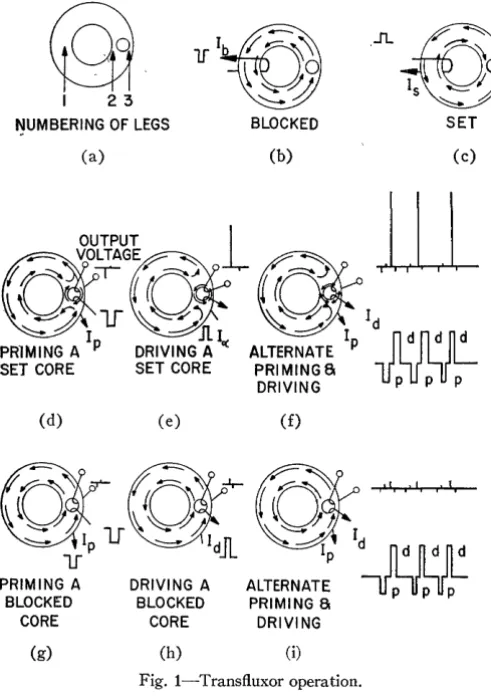
The large hole is used for the writing operation and the small hole for reading. There are two parts to the writing cycle: a block pulse and a set pulse. The block pulse is a large pulse, either positive or negative, which saturates the entire core in one direction. When the core is blocked, the flux direction on both sides of the small
.1 A complete explanation of the device may be found in
J.
A.Hammel, Morgan, and Sidnam: A Multiload Transfluxor Memory
15
hole is the same [Fig. 1 (b) ]. The set pulse is a restricted smaller pulse of opposite polarity which reverses a portion of the flux in leg one and all the flux in leg 2. This is the set condition of the core [Fig. l(c)]. The transfluxor is read by applying sine waves or pulses of alternating polarity to the small hole to sense the presence or absence of a set condition. If the core is set, the following occurs. First, a prime pulse, which produces a clockwise path around the small hole [see Fig. 1 (d) ], is applied to leg 3. A drive pulse is then ap-plied to leg 3 to produce a counterclockwise flux path. The reversal of the direction of the flux path around the small hole by the prime and drive pulses generates an emf which is sensed by a winding on leg 3 [see Fig. l(e) and l(h)]. The set condition of the core and subsequent readout of a sense voltage is the equivalent of writing and reading a "1."
@
I 23
NUMBERING OF LEGS
(a)
(d) (e)
PRIMING A DRIVING A
BLOCKED BLOCKED
CORE CORE
(g) (h)
BLOCKED
(b) (c)
ill
(£)
"~I, , I J
,
I
~
p p P(i)
Fig. l-Transfluxor operation.
In order to write a "0" in the core, the write opera-tion must be modified so that the core remains blocked. This is accomplished by an inhibit winding through the large hole. At the same time the set pulse is applied, a half-current pulse of opposite polarity is applied to the inhibit winding. This half-pulse thus nullifies the set pulse and the core remains blocked. With the trans-fluxor blocked, the prime-drive pulses will not reverse any flux in the vicinity of the small hole and conse-quently will not generate any sense voltage [see Fig.
1 (g)-1(i) ]. Thus the generation or nongeneration of a sense voltage is the equivalent of reading a "1" or a "0" from the core.
The applicable addressing techniques for transfluxor memories are similar to those used for magnetic core memories. Each of the two transfluxor holes may have its own set of selection wires as shown in Fig. 2. Be-cause there are separate addressing systems for both reading and writing, and because there is negligible in-teraction between aperture signals, it is possible to write in one location of the array while simultaneously reading in another location.
HALF PRIME a HALF BLOCK a
DRIVE SET
I~+-~--o HALF BLOCK
a
SET--l-~~-\--''(<.&.~----,(~....---t--'(~bH'l'r--H-~ HALF P RIM E
a
DRIVEFig. 2-Coincident current transfluxor array.
An important feature of the transfluxor is its ability to perform a nondestructive readout. This ability of the transfluxor memory system offers significant advan-tages to the digital computer. Because of the nondestruc-tive nature of the transfluxor, there is no need to restore the transfluxor to its original state after interrogation. This results in the elimination of a major portion of the read/write cycle normally associated with memory systems, and the timing requirements are appreciably simplified. In effect the speed of the memory cycle is increased by approximately 2: 1.
[image:16.615.66.312.267.615.2]THE MULTILOAD TRANSFLUXOR
One of the attributes of the transfluxor is signal isola-tion between the windings of the small hole and the large hole. Through the proper physical placement of additional small holes in the ferrite body and a separate set of addressing wires and sense windings in each small hole, it is possible to obtain more than one independent output from the transfluxor without seriously affecting the signal isolation between holes. Thus it is possible to consider three, four, five, or more holes in the trans-fluxor, offering the designer an extremely versatile mem-ory storage component. This new component is called the multiload transfluxor.
For the purpose of discussion, consider a multiload transfluxor with a large hole and two small holes. If only one of the small holes is used for readout, the perform-ance of the multiload transfluxor is identical to the two-holed transfluxor. A possible configuration of a dual-load transfluxor and its flux patterns with only one of the small Woles being pulsed for readout is shown in Fig. 3(a)-3(d).
The cores shown in Fig. 3 are pulsed by the coinci-dent-current address method. This means that two pulses, one on the X wire and one on the Y wire, are needed to supply the total current required to generate the proper flux condition in the core. These flux patterns are nearly the same as those for the more conventional transfluxor. If the prime-drive cycle is simultaneously initiated in both small holes, the resulting flux distribu-tions are shown in Fig. 4(a) and 4(b). Notice that there is minimum interaction between the holes. This permits the timing of the priming and driving pulses for each hole to be independent of the other.
The multiload transfluxor as used in a memory sys-tem has a separate set of addressing wires and sense windings in each small hole. Each set of wires is tied to independent address registers and loads. All address registers are capable of addressing randomly any core in the array and any core may be addressed by all the registers. Therefore the information stored in one core may be read out simultaneously to any or all loads, and any number of cores may be read independently into different loads.
With only one large aperture in each multiload trans-fluxor, there can be only one write/addressing source for each word. This limitation is imposed on the large aper-ture because each inhibit winding is common to every bit in its memory plane; so it can only represent one ad-dressing source. Of course, multiple writing could be made possible by eliminating the inhibit winding, but this scheme involves many more control circuits. A simple and quite satisfactory method of accomplishing multiple writes is to use a split-memory system. The split-memory system is discussed later in this paper. There are two techniques for selecting cores or core registers mentioned in this discussion: coincident-cur-rent selection and external word-selection (end firing).
x
"
X
NIs 2
(b)
t--""*-+t-I-I-+ Z .~~§. (INHIBIT) c;
SET~ING (WRITE)
( :1)
Fig. 3-Flux patterns of a dual-load transfluxor with only one small aperture being pulsed; single-load readout.
PRIMING BOTH HOLES DRIVI NG BOTH HOLES
N~ N1cJ
"2 y X2
(a) (b)
Fig. 4-Flux patterns of a dual-load transfluxor with both small apertures being pulsed; double-load readout.
The coincident-current technique is illustrated in Fig. 5. It is used here to address three cores simultaneously from three independent sources.
The wire leads in the array are designated ~y a code which describes the addressing source, the addressing axis, and the row or column number of that axis. For instance, LY3 indicates that the origin of the lead is the third column in the Y axis of the L addressing source.
Hammel, Morgan, and Sidnam: A Multiload Transfluxor Memory 17
UY'l-L ly, UY2l-(lY2 UY3~ lY3 UY4l-(lY4 UY5l-( lY5
( \ / I \ \ 1 \\ ( \ (
F
\ ) \ \
/ L
l 'J} \ } \...
-
II 1'-'--: 12 ~~ 13 ' --- 14 I'-V 15 • IvL... ~~ v'--..
---
---(
,
,
\...
#; "~ ( I \ \...
( I ' \..
(,
~'
}-+-\ l}-+-\, ~ }
...
~ ?! '\ " I / \ \ '" ! .. \ "-... ~ 21 ~~ 22 ...--
23 '-I---- 24 ----~ 25---
---
---
,...-'-.... ...--c...( \ ( 1 \
\
1 \ ('-f/ \ ()-\ ! \
'
/ I \ j \ ) \1'--1---- 31 t--[...- 32
t--+--~ 33 r----I-- 34 !'---V 35
v_
v'-....
~ 1-'--.. v'-....( \ ( r l \ ~ k, 1\\ j \ (
F
\ J \ ' '" ! \\ .. ~
\ J \
I'--v 41 1'-1--- 42 ~~ 43 t'--I---- 44 ----I---' 45
Fig. 5-The effects of simultaneously pulsing three cores; not shown: inhibit wires, sense wires to loads 1 and 2. This is only one plane of the memory.
In contrast to the coincident-current technique of selecting a word by summing the half currents of the X
and Yaxis leads, the external word-selection technique involves one wire that carries the full current to the se-lected word. A multiload transfluxor memory using the external word selection is shown in Fig. 6. Memory planes, composed of printed multiload transfluxor plates similar to those of a ferrite-plate memory, are stacked with the selection wires threaded in the word dimension. There are three apertures per bit, with one selection wire through each aperture, thus requiring only 3 physical wires per bit. All other windings can be printed on the ferrite plate, since they are all in the X- Y plane. These printed windings consist of one con-tinuous inhibit winding per plate through each large aperture and two continuous sense windings per plate, one through each upper small aperture and the other through each lower small aperture. The X and Yad-dressing signals are supplied to an external circuit using either magnetic or transistor switches which provides the gating to select a specific word.
The advantages of this technique are as follows: 1) There is only one selection wire required per hole
of a t~ansfluxor. This eases the congestion and red uces the task of threading wires;
2) The noise problem due to the half-current selec-tion pulses is eliminated; and
3) The specifications on the current amplitudes of block and drive pulses are less critical than in the normal array.
The multiload transfluxor for most memory design purposes imposes no additional restrictions than are re-quired for toroidal cores. In fact, other selection meth-ods may prove more advantageous than the ones de-scribed.
'liiii'1J:J..---oSENSE (L)
Fig. 6-Switch-driven memory-employing transfluxors.
LEG I S : s J
INPUT
---,f----hf-}----1r--U J U: U
~
BD :Bp BD LEG 3 J I2 VOLTS/IIO"
TURN/DIVJ-b<I't~itti:j
0.1 JL SEC/DIV
RL = 10,OOO./\.. INPUT P I P : P
I BASIC PULSE
J PATTERN
ocrf~uf--~r---7-~'----~--/
,
r
SET+2 A.T.'. LEG I INPUT -i- 111"-+BLOCi<Vi ift DRIVE -10 A.t: J +7.5 A.T.
LEG 3 INPUT I J I
tRI ~E -p.75, AT. J J I OUTPUT
J : +6 V/T LEG 3 OUTPUT : I
J J , J " I I
o 1.0 2.0 3.0 JL SEC TIMING SEQUENCE
(RL = 10,000A)
SIGNAL OUTPUT DETAIL
2 V O L T S / . TURN/DIV
O.lJL SEC/DIV RL= 90./\..,
Fig. 7-A test program for a transfluxor of the large size.
LABORATORY TEST DATA
A considerable amount of experience has been gained by RCA in studies on the transfluxor itself and in de-velopment of a transfluxor memory for an airborne digital computer. The characteristics of transfluxors which make it ideally suited for high-speed digital mem-ories were laboratory tested. The results are described here briefly; some data and waveforms are shown in Fig. 7.
The test setup used a large core (364-mil O.D.) which requires rather large currents. In practical memories smaller cores will be used with more reasonable cur-rents. A memory is now being constructed using trans-fluxors with an outside diameter of 200 mils.