RIT Scholar Works
Theses
Thesis/Dissertation Collections
1985
Using natural language for database queries
Mikel J. Brown
Follow this and additional works at:
http://scholarworks.rit.edu/theses
This Thesis is brought to you for free and open access by the Thesis/Dissertation Collections at RIT Scholar Works. It has been accepted for inclusion in Theses by an authorized administrator of RIT Scholar Works. For more information, please [email protected].
Recommended Citation
Database Queries
by
Mikel
J.
Brown
This thesis is
su bmitte d in partial fulfillment of
the requirement s
for the Master
of Science
degree in
Co
mp uter
Science
at Ro
chester
Institute of Technol ogy.
Permission is
hereby
granted
to reproduc e any pa
rt
or all of this
th
esis provide d that th
e
copie s are
not
made or distributed
for direct
commercial use or profit.
T
o
cop y otherwise
requires specific
permiss ion from
the autho r.
Appr oved
by:
Th
esis
Advisor:
Profe
ssor
J
ohn
A.
Biles
Graduate Director:
Pr
ofessor
Peter
G.
Anderson
Conunittee Me
mbe r: Professor
Lawrence A.
Co
on
Dedicated toour little Princess
Natural Language
Processing
isdescribed,
together with a small natural language front-endprocessor called NBASE. The requirements and goals of a natural language system along
with existing alternatives, are discussed. The necessity of preprocessing a knowledge base
and the implementationof
JPREP,
a preprocessing interface toNBASE,
is presented. Lexical analysis, natural language parsing, and semantic processing of natural language
inputs,
along with heuristics for transformation at each stage are offered. The interface to a formal
query database
(Mistress)
is given. Difficulties of natural language implementations areexposed. A very general overview of PROLOGand its strength as a logic oriented language
for natural language processing is covered, along with some ideas for further research in
I would liketo thank mythesis committeefor their involvement inthis project, particu
larly
Mr. John A. Biles(Al)
forhis encouragement and time spentlistening
toideas,
returning suggestions, andeditingthe manuscript.Much appreciation is givento my parents, who encouraged this undertakingand were a
constant support emotionallyand
financially
when the"chips were down."I could never thank mywife,
Julie,
enough! Always supportive, and often the receiving block of my frustrations experiencedduring
this project. Always ready tohelp
with themanuscript, thanks for your love! I know that I have found a "virtuous woman"
(Proverbs
31:10-31)!
Most of all, I am eternally grateful to the LORD Jesus
Christ,
for His all sufficientgrace,who in this thesis has assured me thatmanis
"fearfully
and wonderfullyThis thesis examines the basic elements of a natural language processing system, while
describing
the implementation of a simple front end processor called NBASE. The majordesign issues will be addressed
by
referring in detail to existing alternatives implemented inseveral current systems
(LUNAR,
REL,
INTELLECT and theLDC-1). Theapproach takenis to isolate the design issues
by
examining the strategies of these systems, commenting ontheir applicabilityto the growth of natural language processing and
functionally
relating themto the NBASE project. The method of
describing
the project is to describe system components which requires presenting theoretical concerns of the targeted systems, alternating
with the functionalspecifications ofNBASE. This approach is taken to enhance later efforts
to upgrade this project or
help
instruction of particular components ofnatural language processing.
Finally,
an alternative database approach is presented,describing
a database systemwhose underlyingstructure and schema are defined
by
naturallanguage constructs, aswell asthe access support to the database. The discussion in chapter 7 is not meant to be exhaus
tive, and the reader interested in further material on complete natural language Database
Preface iii
Contents v
1.0 Introduction 1
1.1
Why
Natural Language 21.2 Goals ofNatural Language 4
1.3 Theoretical Requirements ofNatural Language 6
2.0 SystemOverview 9
2. 1 Design Alternatives 9
2.2 NBASE Functional Structure 14
3.0
Preprocessing
andthe Knowledge Base 183.1 The Knowledge Base 18
3.2
Preprocessing
203.3 Implementationof a Preprocessor~ JPREP
23
4.0 LEXBOX 27
5.0 Syntax Analysis 32
5.1
Ambiguity
335.2
Parsing
Strategies 365.3 The NBASE Parser 39
6.0 Semantics/Formal
Query
Generation 446.1 Vaguenessand Semantic
Ambiguity
456.2 Implementationof aSemantic Analyzer 48
7.0 The PROLOG Approach 54
7. 1 PROLOGOverview 54
Appendix A 64
Appendix B 65
Appendix C 68
Appendix D 69
Appendix E 70
Appendix F 72
AppendixG 73
Appendix H 75
Intelligenceis a concept that many have attempted to
define,
understand, measure, and,recently, emulate via machine (artificial intelligence or Al). It is debatable whether success
has been achieved in any ofthese attempts to interpret
intelligence,
but some insights haveemerged, particularly in thefield ofnaturallanguage processing.
Natural language analysis examines a machines'
ability to "intelligently" respond to
discourse1,
using a natural language such asEnglish,
German,
French,
etc. Turing's test formachine intelligence is a computers'
ability to disguise itselfas human while communicating
with a human counterpart
(Wilcox,
1983).Early
successes in passing theTuring
test includeELIZA
(Weizenbaum,
1965),
LUNAR(Woods,
1970),
and SHRDLU(Winograd,
1972).While these projects established a foundation for natural language processing, their practical
applications were severely limited.
The emergence ofthe"information explosion"
has helped tomake natural language pro
cessing and expert systems the two most promising and desired applications of Al research
(Guida,
1983). The demand for a system that can process requests for information fromusers who have had little or no experience with the formalities of a computer system, has
become a
leading
motivation for natural language processing.By
exploiting a user'sknowledge ofhis own natural
language,
a system can be produced thatintelligently
respondstojust about any user's request. This was shown
during
the 1970's when several experimentalnatural language systems were
developed,
most ofwhich directedat database queries(Bal-1 Discourse
Harris
(1984),
have beenexpanded and marketedwithvaryingdegrees ofsuccess,1.1.
Why
Natural Language?Accessing
information in a database via query languages can be divided into fourcategories
(Li,
1984):1. Menu driven
2. Formal query language
3. Embedded languagewithin aprogramming language (e.g.
COBOL)
4. Natural languagequeries
Fixed script
dialogues,
ormenus, representthe easiest query for an end user to operate.No experience is necessary, outside of
knowing
which tool, such as keys on akeyboard or amouse, is the selector tooland which tool registers the users choice.Successive menu displays lead auser through the system until the desired information is located. The primary limita
tionof menu driven queries is thatonly queries specificallyaccommodated
by
the menus canbe generated. This either limits the scope of information that can be accessed, or for very
large information
bases,
potentially leads the user down many dead end paths irrelevant tohissearch
(Leigh,
1983).Formal and embedded languages increase the accessibility of the information base
by
isolating
the table or other structure in which the desired data arelikely
to be found. However, several requirements force the user to become familiar with both the implemented
query language and thestructure ofthe knowledge base
being
queried.One
limiting
requirement is that the syntax offormal languages is strict, requiring thatthe user express himselfwithin often unnatural syntactic restrictions. The definitions ofthe
language must be
learned,
and the organization of the language components examined inorder toguarantee syntacticallycorrectquery formulations.
Furthermore,
expressingqueries in aformal query languagerequires specific knowledgenames, and the structure ofattributevalues.
Ideally,
knowledge ofthese details should notberequired ofthe enduser.
Another consideration is that an experienced user's conceptualization and the actual
structure of the database are different. This concept, to service the needs of all users, is a
foundation ofdatabase theory, but it compounds the difficulties ofinexperienced operators,
particularlythose who have littleor no motivationfor
learning
the querysystem(Date,
1983).Like the other three methods, natural language query systems have their disadvantages.
The major problems,
however,
aredesigning
andimplementing
the query system, rather thanin training the user. These disadvantages include the complexity ofthe semantic and syntac
tic structures and inherent ambiguities common to natural language.
Furthermore,
a generallack of linguistic theory to present an adequate, formalized theoretical base upon which to
implement a system, requires that several heuristics be examined to provide an efficient
knowledge retrieval system
(Rhamstorf,
1979).Providing
simple access through natural language reduces a system's time efficiency forretrieving the desired data. The amount ofprocessing required toanalyze and derive mean
ing
from a sentence requires increased processing time when compared to a formal system.For those users who are constrained to use a natural language processor, the longer response
timeis not perceived.
The chief advantage of a natural language query systemis that there is little or no spe
cial training required to use it. There is no need to learn an artificial
(formal) language,
andknowledge of database schema is not required. A natural language system eliminates the
necessity for the user to translate his natural language idea into a formal language statement,
resulting in fewer mistakes and less timewasted. A natural language systemis convenient; it facilitatesefficiency ofexpression, yieldingaversatile system. A naturallanguage system also
powerful queries than menus while yieldingsimpler user interfaces than formal language sys
tems.
Indeed,
many systems provide heuristics for contextdependency
so that incompletequeries are resolvedusing inferencesdeveloped fromprevious queries
(Waltz,
1978).Natural language queries may yield increased productivity from information retrieval
(IR)
systems. Performance of an IR systemis dependent upon the correct use ofkey
words,a function generally performed
by
an IR specialist rather than the user himself(Shoval,
1981). One can speculate that a natural language system could affect both the indexer and
the searcher
by
providing a standardization of whichkey
words are stored and later generated. The need for a specialist to form queries is removed, and information is made more
accessible to the user.
Simply
stated, the use of natural language increases efficiencyby
removinguser intimidations,
thus encouraging the inexperienced user to take advantage of a machine's power toretrievedata.
1.2. Goals of aNatural Language Processor
It is important to note that
developing
a grammar that parses any sentence in a naturallanguage would require a machine of infinite resources, while the grammar would possess
infinite complexity (Aho &
Ullman,
1982). The first goal, then, is to design a grammar thatprocesses an adequate subset of a natural language so that the user is relatively unconfined.
Biermann
(1982)
defines a"fortual language" as:1. A subset of naturallanguage
2. User learnable from asmallamount ofinstruction
A fortual language is not as powerful as its natural language superset, but it is easiertoimple
ment while maintaining a high level of power. In this thesis, when we refer to a system as
cessor into the database system
(Harris,
1977a). Ifan error is passed to the database system,recovery becomes more difficult and often results in the return of inaccurate data. This
raises the question of whether an "inaccuracy" should include questions outside ofthe infor
mation base's
domain,
somethingoften undefined priorto the formalsearch.Other
inaccuracies
should be tolerated.Spelling
mistakes should be overlooked orproperly corrected where possible. Inferences should be made where ambiguous or vague
questions are proposed, and searches should be implemented only after the dialogue with the
user has resolved any ambiguities, eliminating any incorrect assumptions. Biermann
(1982)
believes that narrowing the scope of a
database,
thereby restrictingitsdomain,
will yield lessambiguity and vagueness, while allowing a more refined system to be developed
during
preprocessing.
The natural language system should provide explicit answers rather than a set of
answers. A more developed system would provide natural language responses; a less
developedone would provide atable or a list.
Convenience is necessary. The system should be
interactive,
carrying on a dialoguewith the user and the database administrator where necessary.
Keeping
the system on-linemakes the system readily available,and the system should be as quick as possible.
Upgrading
the system should be made simple
by
making it easy to extend, both within it's own worldandto new domains and databases
(Waltz,
1978).Fundamentally,
the natural language processor should hide the underlying databasestructure. Itis notadequate tointroduce formal languageconstructs to the user, norshould it
be required that the user have specific knowledge of the information domain. It is most
important that all users get appropriate answers to their queries with a minimum degree of
Ballard
(1979)
lists several requirements necessary to produce a natural language system. These include linguistic
knowledge,
domain knowledge and programming knowledge.Linguistics is the study of language which includes grammar, elementary word struc
tures, component structures, semantics, etc. Its role in the design of a natural language pro
cessor is to
identify
the "everyday" limits of the language. If a natural language must bescoped
down,
to restrict the constructs available, it is important toidentify
the constructscommonlyused
by
the users forwhom the systemisbeing
targeted.Linguistic knowledge directs the designer to an efficient natural language translation of
an input query, yielding a
highly
meaningful internal representation of the user's request.Dictionary
entries in a natural language system are extremely important and are influencedby
the linguistic knowledge ofthedesigner. Aproper perspective in linguisticswill generallyyield a more useful system.
Domain knowledge is also important. While it has been universally accepted that the
more domain specific a system, the less portable it
becomes,
the domain does influencedesign strategies of various components of the system (e.g. parser, semantic analyzer). As
understanding of natural language processinghas
increased,
sohas the ability to produce systems with increased domain content and increased portability. This has been accomplished
mostly
by
taking advantage of the database administrator(DBA)
and a system preprocessor(refer to Chapter 3).
Nevertheless,
in all applications, domain knowledge is a fundamentalcomponent ofeverysystem.
Programming
knowledge is necessary to make control structures available, both to theend user within his natural
language,
and to a"super-user" within a meta-language. A metalanguageis a language thatis hidden toan end user, and is atahigher levelthan thelanguage
used for normal operation ofthe system. Itis alanguage that isused to controlthe operation
of the system and is commonly used to increase the scope ofthe grammar constructs which
operate overmany different domains with a minimum amount ofrestructuring and no
repro-gramming.
Ofthe two most common approaches to
building
a natural language query system, thenatural-language-front-end processor has been morepopularthan a completenatural language
database system (chapter
7),
due to its easier implementation.Receiving
natural languageinput thatrepresents aquery, a front end processor attempts to translate the*
input into a for
mal database query. The resultingformal queryis used to access the
database,
retrievingtheinformationrequested
by
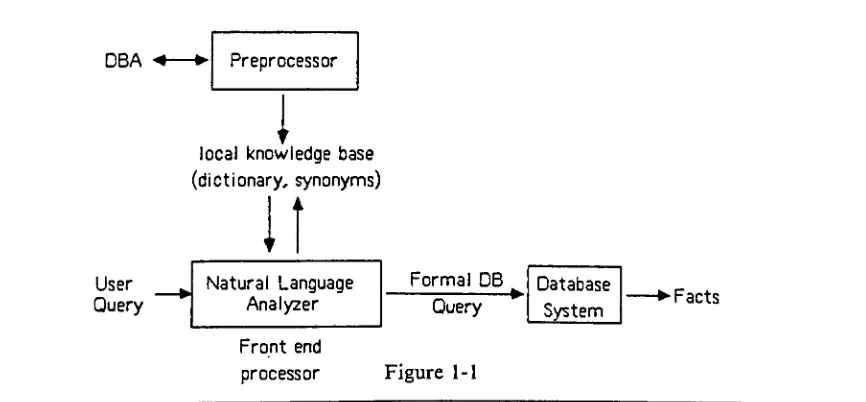
theuser (figure 1-1).The scope ofthis thesis is to examine the basic elements of a natural language process
ing
system, whiledescribing
the implementation of a simple front end processor calledNBASE. The major design issues will be addressed
by
referring in detail to existing alternativesimplemented in several current systems
(LUNAR,
REL,
INTELLECT and the LDC-1).Finally,
an alternative database approach is presented,describing
a database system whoseunderlying structure and schema are defined
by
natural language constructs, as well as theaccess support to thedatabase.
nnA * Preprocessor
Formal DB
UUrt ^
le
(di
1
cal knowledge ba
ctionary, synonyr
It
se
ns]
User Natural Language Database
System
Query
AnalyzerQuery
-v?Facts [image:15.534.52.485.456.657.2]Front end
The conclusions
hopefully
will generate interest for future enhancements of theDesigning
a natural languageprocessor demands considerable forethoughtand planning.As with any software system,goals mustbe specified and propertiesisolated to yielda defini
tion for the processor. Once the scope has been
determined,
the designer chooses a softwarearchitecture, and then a hardware architecture that best supports his software expectations.
As we shall see, the properties ofthe natural language processor require that datastructures
be developed early. These considerations must be made before a functional "black-box"
description can be designed.
2.1. Design Alternatives
Initial design decisions address the issue of goals. What is the application to which the
system isto be directed? How portable/flexible should the systembe?
Early
systems, such as LUNAR(Woods,
1970),
were designed accordingto a restrictiveset of specifications. LUNAR's goal was to service the needs of scientists whose information
requests were limitedto thenarrow domain oflunar geological studies. The primary goal was
to provide interested lunar researchers with the capability to extract information from an
extensive database without requiring training in a formal database query language. While
LUNAR was a successful early prototype and pioneered several implementation strategies,
its application dependence and non-portability motivated further research toward a more
flexible system.
REL1
(Thompson, 1975)
represents an early implementation that addressed portability1
needs. The goals ofREL included:
1)
The support ofmany language packages, each with itsown syntax, semantics and data structure
facilities; 2) factoring
the system to separate thedriver modules from the applicationmodules; and
3)
an extension allowing the user to definenew language constructs (via a metalanguage). REL served as an initial bench-mark for por tability. Its designers found they could
develop
a base system in a given natural language(English, Polish,
etc.) and support avarietyofuser interestsby
providing anadditional "UserLanguage Package."
The net result led to a natural language processor with increased flexi
bility.
Just how portable were these early efforts?
Portability
is not only a measure of systemflexibility,
but includes the effort to adapt a system from one domain to another. The REL "User Language Packages"were hardwired packages, requiring recoding for each new appli
cation. Gross modifications necessitated the services of a system technician,
leading
to increased expenditures intimeand money.Harris
(1984)
believed in the need to strive for a more complete application indepen dence.Asserting
that application independence cannot be achieved for the total package,Harris suggested and built a system, called the ROBOT processor, in which all
customiza-tions were within the realm of "ordinary" technicians. That
is,
given a minimal amount ofinstruction,
a company employee could assume the responsibility of modifying the naturallanguage processor to address the domain ofany on site application. Harris points out that
the ROBOTproject was directed at
delivering
the ultimate inuser capabilitywithin the context ofthe existing marketplace and did not necessarily provide the ultimate in Al capabili
ties. ROBOT has found widespread commercial success and is now marketed under the
name INTELLECT. Even the ROBOT system,
however,
was somewhat limited in its ability to provide full portability because preprocessing that required some intelligent manipulationby
theuser was needed.The LDC-1 (Ballard et.al.,
1984),
though somewhat limited in its scope, represents theeliminate the need for the system technician when a domain increases or an application
changes.
Ideally,
the installationof an LDC-1 system requires no on sight technicianwith thebulk of the responsibility
being
placed on the DBA. The LDC-1 takes advantage of the DBA's knowledge ofdatabase schemaby
providing an interactive preprocessor.Prompting
the DBA for information as it analyzes the
database,
the preprocessor isolates relationships,producing aknowledgebase that is builtaround the immediateapplication. Ifparticular syn
tacticor semantic informationis required
during
analysis, the local knowledge base serves asthe source.
In contrast to most natural language front end processors, the LDC-1 allows for more
general retrieval over domains that are not necessarily represented via "restrictive" database
structures (see chapter 8). Its capabilities extend to files that are produced
by
using a fileeditor, giving more
flexibility
to the group of people using the natural language systemby
allowing experienced users to
directly
modify their stored data. The LDC-1 typifies theresearch efforts that have been directed at providing flexible and portable natural language
systems.
Flexibility
and portability represent important research issues in natural language processing.
Flexibility
is important for each component in the processor to provide transportability
and ease of operation, even for the most inexperienced user.Flexibility
should be aprimarygoal ofany natural language systemto provide robustness for theindividualend user
andgeneralityfor the targeteduser group.
Design considerations may include hooks for enhancements or features not originally
required in the processor. Ballard and Lusth
(1982)
suggest several implementation properties that enhance a system's design. The valuesrepresenting persons (Chapter
4)
are difficultto resolve, but
by
using aseries offlags,
Ballard suggests alternative strategies toincrease the provisions of the processor. Optional properties are most easily defined early in the designphase, removing the necessity for major revisions that occur ifthese properties are defined
An important design feature to establish prior to any functional specification is the
structure oftheoperating architecture. Thisis presented intermsofsoftware, but itcould be
developed in hardware. The primary consideration is whether or not syntactic analysis and
semanticanalysis canbe separated. Regardless of one'spersuasion, it is widely accepted that
syntax, semanticsand pragmatics of natural language understanding must be well understood
before a structural decisioncan be made2
(Davis,
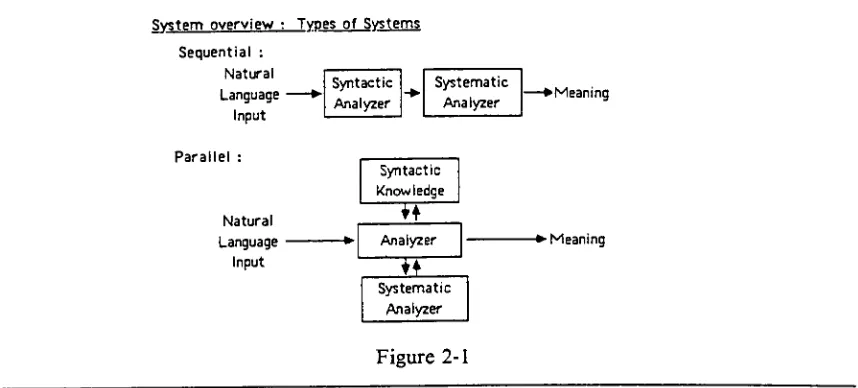
1983).Alternatives in operating structures include a pipelined (or sequential) system and a
parallel system. As displayed in figure
2-1,
a sequential system emphasizes theseparation ofsyntactic analysisfrom semantic analysis. The primary advantage ofthis method ismodulari
zation. The syntactic component(or semantic component) canbe modified orcompletely res
tructured, while
being
constrained onlyby
the interface between modules. Future revisionsofa systemmay be incorporated
by
isolating
and correctingsystem components, requiringlittle or no revision to modular interfaces. While they allow easy revisions, there is a serious
question on the degree of efficiency that can be provided
by
a sequential system. KaplanSystemoverview: Typesof Systems
[image:20.534.57.486.417.611.2]Sequential : Natural Language -Input Syntactic Analyzer Systematic Analyzer ? Meaning Parallel : Natural Language Input Syntactic knowledge
~W
AnalyzerIE
Systematic Analyzer Figure 2-1 Meaning2The topic of syntax, semantics and pragmatics is very broad, and exhaustive consideration is beyond the scope ofthispaper. Alternatives arepresented throughout thepaperaddressing particularissues, but itwas neither
intended nordesired topresent a comprehensive surveyonthis topic. Theinterested reader couldbeststart with a
confirms that a complete separation of syntactic and semantic analysis may yield inefficient
analysis paths. Kaplan believes it is best to incorporate some semantic analysis within the
syntax analyzer
(Davis, 1983),
or parallel to syntax analysis (figure 2-1). Semantic grammars(Wilcox, 1983)
also couldbe defined as a parallel organization.Arguments againstparallel design center aroundthe need to
develop
a new grammarforeach desired domain. The modularityofthesystemis therebyreduced, supposedly makingit
less portable.
However,
if the semantics are resolved in the lexicon (knowledgebase)
produced
during
preprocessing, the desiredflexibility
could be achievedwith added efficiency.As
flexibility/portability
issues are resolved, the emphasis will be on greater operating efficiency,most
likely
resultingina more parallel approach.Mapping
a natural language input to ahighly
related database value makes data structure design the most important aspect of
building
a natural language system. The data structure not onlyprovides the means for thestorage and manipulation of
data,
but it also defineshow the system willwork, sets limitson the system's functional capacity, and can be used for
code modification to enable the processor to "learn." The strong inter-relatedness between
the data structure and the system specification often requires major system revisions if the
datastructure is modified.
One mightsimply argue that the datastructure is a prime consideration in all aspects of
computer science. Thompson
(1975)
concludes that the short input sentences, the complexinterpretive routines and the high relatedness of a database (all characteristic of natural
language processing), makes the data structure design central to anatural languageprocessor.
When contrasted to the longer input sentences (e.g. entire programs), the short interpretive
routines and collections ofthe otherwise independent data items offormal language process
ing,
Thompson indicates that the natural language processor needs to be considerably moresensitive to data structure complexities and considerably less sensitive to the optimization of
The research for this thesis confirms Thompson's assertions. Choice ofthe data struc
ture was central to the design of the entire system.
Furthermore,
it was found that understanding the process ofsemantic analysis was the primary influence in data structure design
(refer to chapter 6). One cannot overemphasize the relatedness between the data structure
and the functional design in natural language processing. Functional design is dependent
upon the choice of data representation and the representation is partially defined
by
thescope ofthe ofthe desired system.
2.2. NBASE Functional Structure
Like INTELLECTand the
LDC-1,
NBASEis designedtoprovide applicationindependence. The DBA has the primary responsibility for
building
the knowledge base for eachapplication. A small base knowledge package, providing words such as interrogatives and
auxiliaryverbs that are commonto most naturallanguagerequests, is provided for all applica
tions. No othertechnical personnel are required to readythesystemfor use
by
the enduser.The NBASEsystem provides basicinterpretive services for English. There are no addi
tional properties, special flags or representations employed to enhance the system. Although
this reduces the system's ability to precisely
identify
some grammatical errors, it does allowfor a more general attempt to resolve any user input. Some general 'hooks' have been pro
vided in the datastructure for future additions and hardwiredfor no particular utility.
The architecture is sequential, allowing for easier implementation and a more elegant
approach to revisions. Ifthedata structures are left unchanged, component revisions may be
coded readily to provideadditionalfeatures and/orincreased efficiency.
The general data structure is a list which appears to be the most widely accepted data
structure for natural language processing
(Winston,
1981). The system was built using PROLOG,
alogic oriented programminglanguage (chapter7)
that has facilities for convenient listprocessing. The contents of the list data structure are redefined through each successive
stage of the processor, and allow several levels
(currently four)
of nested structures. Themodules are discussed.
The
dictionary
(knowledgebase)
is the foundation ofthe system System versatility isbounded
by
the level ofdictionary
completeness, which in turn is establishedduring
preprocessing.
Dictionary
entries includesynonyms, word definitions and schema definitions ofthetargeted database. Withthe exception ofthesmallbase knowledge core, all
dictionary
entrieswillvary from application to application giving the system its portability.
Learning
capabilities areprovided to expandtherange ofthe
dictionary
'on thefly'(see chapter 4).Thefunctions oftheNBASE system canbe separated intothreecategories(figure 2-2):
1. Preprocessor (chapter 3).
2. Englishprocessor (chapters 4-6). 3. Retrieval Module.
The preprocessor,
JPREP,
obtains theknowledge peculiarto a givendomain. The success ofa preprocessing session using JPREP is
highly
dependent upon the experience of the useroperating the preprocessor.
Generally,
theuser is theDBA,
an individual who is thoroughlyfamiliar with the database schema and the intended relationships among attributes of various
relations. JPREP assumes the existence of a relational
database,
and it yields text files ofdomain specific
'knowledge.'
The text files produced are modifiable, but are generated
IMPLEMENTATION: Synonyms Generator =1*1! Input Query Lexical Analysis Formal Query ^ Syntax Analysis !:!| Semantic
^7
Analysis :FQ.English f Processor Dictionary
(lexicon)
Grammer
Retriever
ft
SemanticRulesDBA- Preprocessor jprep
[image:23.534.51.485.447.653.2]Answer
according to NBASE specifications, and therefore should be protected from all but a system
technician.
The function of the English processor is to process the English input provided
by
theend user,yieldingan appropriate formaldatabase query. Userinput is restricted tokeyboard
entries ofEnglishnatural language. The Englishprocessor consistsofthreesubprocesses
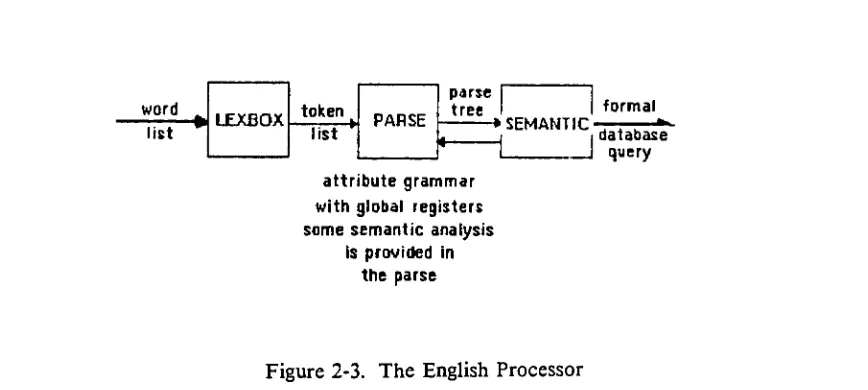
(fig
ure
2-3),
the lexical analyzer, the parser, and the semantic translator. As the query is processed, it passes from one module to the next as a series of lists. Each module outputs a
derivativeofthe inputlist performingtranslations to ultimatelyproduce aformal query.
The lexical analyzer provides traditional lexical processing (Aho &
Ullman, 1978),
yielding a list oftokens (words and punctuation) to be processed
by
the parser. The parseruses an attribute grammar with the addition of global registers (chapter
5)
to parsethe incoming
token list. Some semantic analysis is provided in the parse. This improves the efficiencyofthe analysis
by
providing a degree of parallelism as described above (See chapter 5). Thegoal of the NBASE system is to process as much user input as possible, not to "spit up"
errors. With this in mind, the parser is
fairly forgiving
with respect to grammatical errors. Asuccessful parse results in a parse tree, which is input to the semantic translator. Several
word
LEXBOX token PARSE parse
tree
SEMANTIC formal
list list * database
1 nuerv/
attribute grammar
with global registers
some semantic analysis
is provided in the parse
[image:24.534.56.490.460.655.2]heuristics are employed there to attempt to produce enough meaning to
develop
a formaldatabase command (chapter 6). The formal command generated is database dependent,
currently serving MISTRESS (Rhodnius
Corp.,
1983)
on the UNIX operating system(AT&T).
The retriever is atrivialimplementation of a PROLOGsystem call. The call invokes a
UNIX shell, which inturn invokes MISTRESS using theMISTRESS user shellinterface. No
attempt is made to produce a return result in the form of a natural language assertion. The
result is supplied according to the specifications of the MISTRESS design. No attempt is
made to respond to an invalid query served to the database. It is hoped that most incon
sistencies will have beenresolved
by
theEnglish processor before aformal queryis issued toMISTRESS,
limiting
invalid queries. Users should be informed that formal queries requiringthe searchfor specific database values will only succeed ifanexact match is
found,
a severePREPROCESSING
AND THE KNOWLEDGEBASEUntilrecently, natural language systems that contained enough information to be useful
were generally not very portable
(Waltz,
1982). Design conflicts oftenarose, portability
opposingsystemspecialization,with portability usuallyassigned thelowerpriority.
As natural language packages have become commercially available,
however,
portability
hasbecome thedominant design issue. Naturallanguageprocessing installationsnow demand
a comprehensive package, allowing for the retrieval ofdata from numerous domains. Natural
language systems rely upon a knowledge base to associate meaningwith a query. The ability
to restructurethatknowledge base toaffectportabilityis thefunctionofthepreprocessor.
3.1. The Knowledge Base
Domain Knowledge is the most important component of the entire processing system.
Structurally,
it delimits the processes of syntactic and semantic analysisby
providing worddefinitions and the underlying database structure to the system. The word definitions ofthe
knowledge base determine what is available and accessible for the current system. Relation
ships specific to the targeted database are an inherent part ofthe knowledge base and pro
vide a rich source of semantic information for thefront-end processor. Most
important,
ifthesemantic relationships can be wholly represented
by
the knowledge base using arestructur-able
lexicon,
the natural language processor's versatilitycan be virtually unlimited, and couldbetransferred to any application(figure 3-1). The chief concern would be encoding the new
v- .
MINIMAL
OPERATING
MAXIMAL FLEXIBILITY
vs?
COSTS
Figure 3-1.
Portability
InfluencesThe efficiency of lexicon production is improved
by defining
an organization over theset of word entries to be encoded in the dictionary. This structure is established
by
partitioning the set of entries into three subsets, general entries, structural entries and volatile
entries
(Kaplan,
1984).General knowledge entries are those entries universal to all domains.
They
are encodeddirectly
into the system, and form the lexical foundation on which the entire system is built.General knowledge is the domain independent data that can be used with any application.
These entries make up the base knowledge package of most systems,
including
NBASE.Examples ofgeneral knowledge entries include conjunctives,
interrogatives,
meta definitionsand auxiliaryverbs.
Structural knowledge entries reference the attributefields peculiarto a database. Should
the entries be used to define a systemcomponent such as a grammar, then the system would
be non-portable. The structural entries are those requiringcomplete regenerationfrom appli
cation to application and should be created
by
theDBA. These entries provide the semanticsforthe system
by
establishing relationships among classes of objects anddefining
the level oflinkverbs to nouns and prepositions to nouns, establish synonym
lists,
isolate attributes, andmaintain pathnames, all ofwhich are local to one particular database. Structural entries pro
videthe "possibilities"
for query resolution.
Volatileentries are references to specific values in the database. These values are com
monly useful only
during
a particular session and include the special treatmentofnumbers ornumeric data
fields,
particular characterfields,
names,locations,
etc.They
are values thatare recognized
by
some general heuristic and are neither hardwired into the system lexiconnor in violation of database normalization theory. Volatile values are temporarily "learned"
knowledge maintained only for thelength ofthe sessioninwhich theyare defined in orderto
increase timeefficiencies.
Considering
the time required toproduce a tailored domainthat will yield portable formal queries
(Leigh,
1983),
implementation of a partitioned word set reduces search timescosts
by
concentrating on the generation of structural entries. The design of a preprocessormust balance
flexibility
and operating complexity/costs to provide optimal lexicalgenerationover any domain/database.
Partitioning
helps tominimize the costby
minimizing the amountofrestructuringrequired tobuild anew lexicon.
3.2.
Preprocessing
By
understanding the structure and generation ofthelexicon,
we can see that portability
andflexibility
constraints are setby
the preprocessor. Design considerations must focuson both the interpretation ofthe targeted database and the representation ofdeveloped rela
tionships. Interpretation needs to be exhaustive, while representation needs to be well
some ordering over theset of relationships exists that will resolve ambiguous and vague state
ments shouldthey arise.
Theimportanceofcomplete representationis illustrated inthe
following
example :USER: What is theGRADEin tableSCORES whose STUNAME is 'Julie Richardson'
and COURNUMofICSP241?
The structure imposed on this input is typical of that required
by
a formal database queryandisnot sufficientas a naturallanguage query. It does have a natural language'flavor'
to
it,
but requiring the user to understand the underlying database structure is a failure to any
natural language system. The above query exemplifies the disadvantage of a restricted lexi
con and doesnot promoteaccess forthe unexperienceduser.
Givenalimitedamountof semantic
information,
aless restrictive querywould be :USER: Whatis thegrade for thestudent whose nameis Julie Richardsoninthe course whose numberis ICSP241?
Lexical entries must exist associatingthe noun 'grade' withthe fieldspecifier
GRADE;
associating the specifier GRADE with the relation
'SCORES',
etc. This is an allowable naturallanguage query.
However,
ifthe user is required to explicatelyidentify
structural values (e.g."... whose name is ..."), the extent ofrelation representation is not ideal for natural language
processing.
The challenge of producing a formal query from a less
formal,
comparatively vaguenatural language request, can only be met with the definition of appropriate relationships in
thelexicon.
USER: Whatgrade did Julie Richardson getin ICSP241?
This query is typical of a natural language
input,
requiring no value-structure associationsfromthe user. All associations areresolved usingsemantic inferencessupplied inthelexicon.
Assuming
a well developed grammar, queries ofthis sort promote user accessby
freeing
theThe implementationofLUNAR was
hardwired,
and therefore non-portable and requiring
no preprocessing. REL was somewhat portable, its portability definedby
a grammar constructing
feature,
allowing the generation of new domain-specific grammar rules(Thompson,
1975). It required no preprocessing, but its portability was more limited
by
memory constraints.
INTELLECT,
having
no preprocessor as such, does employ a level of preprocessing.Eachuser writes his own lexiconwhich inturn establishesthe boundaries ofINTELLECT'S
domain. Harris claims that writing lexicons is simple enough even for non-linguists
(Davis,
1983).
However,
INTELLECT'S abilityto resolve database relationships is restrictedby
theuser's concept ofthe database.
Perhaps the most versatile of preprocessors, is PREP. PREP is the primary
learning
component ofthe LDC-1 (Ballard &
Lusth, 1982),
and builds both thesyntactic and semanticrelationships for later inferences. PREPisolates thename of each relation inthe domain and
finds the nature ofthe relationships among relations. PREP determines the English words to
be used (e.g. nouns, verbs, modifiers)in user queries,and attemptsto
identify
the morphological and semanticpropertiesofeach word
(Ballard,
Lusth &Tinkham,
1984).Specifically,
PREP prompts the DBA for associatednouns, adjectives and modifiers fora given entity. These word entries willbe used later to
help
disambiguatemeaningstructuresin addition to representing leaf nodes of the parse tree. Associated with each entity is a
synonym list allowing the surface structure to refer tothe same entity using several terms. A
typeis associated, suggesting what theentity mightbe areferenceto, a person, a
date,
atime,or
'something
else.'
The DBA can define a unique type via the
'something
else'choice
by
supplyinga pattern or context inwhich the entity mightbe found
(Ballard,
1982).Verb associations are the most influential of all associations, producing both syntactic
and semantic information.
Representing
asubset ofthe leafnodes ofthe parse tree insyntactic analysis, verb structures are also used to indicate the relationship of a given entity to the
subject references. The generalities of these relationships are more clearly described in the
implementationofJPREP.
3.3. Implementationof aPreprocessor JPREP
JPREP is a natural languagefront-end preprocessor, designed to provide portabilityfor
the NBASE system. Code specificdetailswill notbe provided
here,
although a datastructuregraph is given in Appendix B.
Conceptually,
JPREPis a large symbol tableprocessor associating word entries with various attributes. It is completely
interactive,
requiring no understandingofthe physical structures itgenerates.
JPREP's operation requires an interaction with the DBA. The success of JPREP is
stronglyrelated to the DBA's understanding ofthe database and his expertise in
defining
therelationships between attributes. All relationships among classes of attributes are defined
during
JPREP's analysis ofthe database schema and are limited to the internal schema support supplied
by
the databasepackage.JPREP offers the capability ofreinitializingacomplete systemor modifying an existing
system Allsysteminitializationsare localto JPREPexecution.
Comparisons can be made relating JPREP features to those found in both CO-OP
(Kaplan,
1984)
and PREP(Ballard,
1982). Additionalfeatures,
weakly link JPREP toINTELLECT
(Harris,
1978). Three classes of output are producedby
JPREP,
environmental structures, attribute synonyms, and word definitions. These structures are assumed tobe
unique to a specific system. Environmental structures are produced through direct interac
tion with MISTRESS. This is done
by
executing a UNIX shell script with a MISTRESScommandto
dump
the database structures. Afterfinding
thedatabase structure, JPREPusesthe resulting information to analyze the relations of the database and prompt the DBA to
establish relationships amongattributes.
Environmental structures include the location of the targeted database and its related
used both
directly by
NBASE (for analysis and retrieval) and to guide JPREP through alldatabase relations.
Attribute synonyms are special synonym structures containing semantic information.
The entries associate synonyms toactual database fieldattributes. Theiruse reduces the time
required to isolate a targetedfield referencein a query. The structure provides for both sin
gle word and phrase synonyms.
Using
the relational model in AppendixC,
thefollowing
example demonstrates the use of an attribute synonym.
Synonyms for f# :
family, family
number,family
# ==>syn_attr([family],f#).
syn_attr([family,number],f#).
syn_attr([family,#],f#).
Using
thegenerated structures, alater queryofthe formUSER: What
family
livesat 24 East Ave inBrockport,
NY?could quickly be analyzed to yieldthe targetfieldof
'f#\
generatingthe initialcomponent ofaformal query,
Select f# from...
A more general synonym function is supported
by
the lexical analyzer for user convenience.Thiswillbe discussed in chapter 4.
Word definitions are the primary
dictionary
entries. The entries are generatedduring
apreprocessing session via prompting for words associated with each attribute. The system
currently supports four restructurable classes of words: nouns, adjectives, verbs and preposi
tions. Otherclasses are installed as general knowledge entries atthe time ofsystem initializa
tion. The representation ofaword is defined to containfour fields ofinformation: the value
of the word, the word classification (e.g. noun), a features list and an empty field for late
enhancements.
The features list is the semantic information associated with each word,
linking
a wordto the domainstructure. Feature valuesvary fromword to word, andthe list structure varies
same. This list is an encoding ofthe relation-attribute pair(s) with which the word could be
associated. The number ofassociations has no upper
bound,
butthe lower bound isone, otherwise the word would not be in the dictionary. Noun and adjective entries are built
by
prompting the DBA fornouns and adjectives associated withthegiven attribute. As theDBA
responds, the words are loaded into a symbol table where relation and attribute identifiers
are attached to the word (Appendix B). If a word already exists in the table, it is simply
updated toavoidknowledge base duplication.
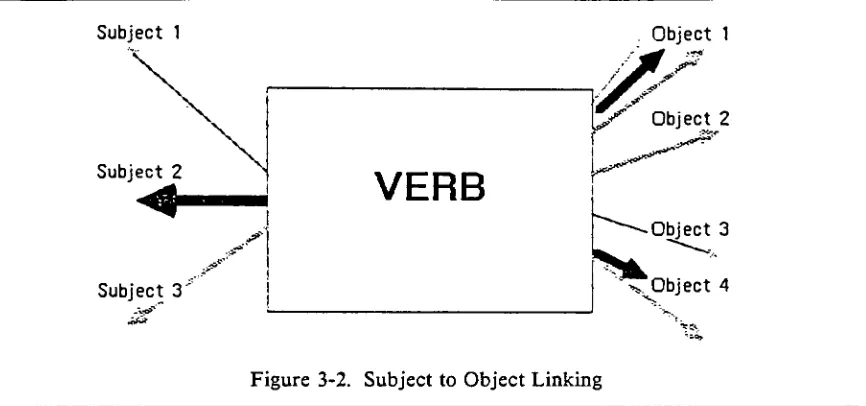
The structure of verb and preposition features is much more complex, allowing up to
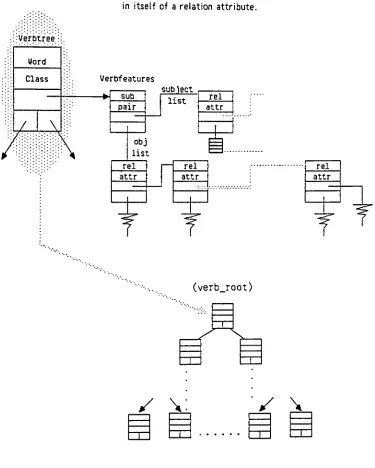
three levels ofnesting offeatures. The primary function of each verb or preposition entry is
to link each possible subject to each possible object (figure
3-2;
the semantic worth of thisrepresentation is discussed in chapter 6). This is executed
by
the preprocessorby
firstprompting for the verb or preposition and
loading
the result into the symbol table. The subject values are assumed to be the current relation and attribute
identifiers,
which areautomatically assigned a subject association with the current word. The DBA is then
prompted for objects upon which the subject may perform the action indicated
by
thecurrent verb or preposition1,
linking
all objects returned to the subject reference. Thenumber of subject-object references has no upper
bound,
and also requires at least one perdictionary
entry. Duplicationof a verb or preposition entry isnot allowed.In contrast to the representation of structural knowledge values, all general knowledge
values and thetemporary occurrenceof volatileknowledge values existwith nullfeaturelists.
Two additional constructs associated with word definitions are the 'who' and 'where'
components. Similar to both INTELLECT and the LDC-1 processors, person and place asso
ciations are maintained in the system. This is performed
by
giving the DBA the opportunityto
flag
a field as representing a person, place or thing.Every
person/place field is enteredinto a who/where list. These lists are used
by
the semantic analyzer to infer subject-objectrelationships when a'who' or 'where' query isprocessed.
Subject 1
Subject 2
Subject 3
VERB
Object 1
Z*'
xZA Object 2
U****
i
Object 3
'Object
4Figure 3-2. Subjectto Object
Linking
USER: Who livesat24 East Ave in
Brockport,
NY?USER: Where does Julie Richardson live?
To summarize,JPREPis animplementationof arather simplepreprocessor that realizes
its full potential for
dictionary
processing under the current design. Further enhancementsmay suggest a complete redesign in order to broaden the scope of JPREP.
Testing
of theNBASE system has shown JPREP to be an adequate preprocessor for achieving application
[image:34.534.53.486.83.286.2]4. LEXBOX
Lexical analysis is the first stage ofcompilation, representing the interface between the
source program and the compiler. In natural language processing the source program is the
natural language query. The role of a lexical analyzer seems to be much less complex in a
naturallanguage implementationthanin itsformal language counterpart.
The basic functionof alexicalanalyzer is toscan an input string,
breaking
the stringupinto logical entities called tokens. A token has the general structure of a 'type'-'value' pair,
where type identifies the lexical class of the input
(e.g
constant,identifier, key
word) andvaluerepresents theactual inputreceived. For example,giventhe
following
Pascalstatement:HORSE:=
5;
a possible tokenoutput ofthe form
(type,
value) mightbe(identifier, HORSE)
(operator, ':=')
(constant,
'5')
Token organization differs among implementationswith most organizations
being
more complexthan the above example.
Depending
on the lexical-syntactic analysisinterface,
tokens are either output one at atime,or organizedinto aliststructure andoutput as atokenlist.
Assuming
thelatter,
the lexical analyzer's general function is to convert an input string ofsome source language into a
tokenlist(figure 4-1). The lexicaloutput thenserves as input for syntactic analysis.
source
language
I
input
LEXICAL
ANALYSIS
[image:36.534.63.478.109.287.2]token
string
outputFigure 4-1
individual source program atoms with general, logical tokens. Lexical analysis reduces the
logical length ofasource program(or string)
by
removingextraneous datasuch as blanksandcomments.
By dividing
the overall analysisinto two stages, lexical and syntactic, the overalldesignis simplified, providing adegree ofmodularityto thesystem
The LEXBOX ofthe NBASE system does the typical lexicalanalysis described above.
The source program is a natural language
input,
and the lexical function is to convert theinput into a token list. LEXBOX
indirectly
provides other features somewhat unique tonatural
language,
as described below. Note that symbol table searching, a common function associatedwithlexical analysis,is performedby
searching the associateddictionary.Initial processing begins in LEXBOX at the input procedure. The primary function of
theinput component is to capture user inputand convert itto alistof atoms called words. A
word is any non-null substring of characters, delimited
by
blanks or thefollowing
set ofpunctuation characters
{comma,
period, question mark, exclamationpoint, semicolon, colon).Withthe exception ofthecomma and semicolon, these characters signal the end of asentence
All substrings
beginning
with a capitalletterinvoke a special search overthe dictionary,attemptingto matchthe
incoming
word with an upper caseor lowercase entry inthe dictionary. Ifthe corresponding entry is notfound in the
dictionary,
the substring is assumed to bea volatile knowledge value. Volatile knowledge values often can be identified
by
propernouns. Other volatile entries are caught through interaction with the user if an
incoming
word cannot be located in the dictionary. As such, it is temporarily asserted into the
knowledge base as anoun, and given a special volatilefeature list. Regardless ofthe success
ofthe
dictionary
search, the isolated atomis inserted intoan inputlist.The primary lexicalanalysis stage receivesthe resultinglist of words as input. The first
processing ofthe list is to
identify
the logicalentity to which eachword is associated. Thereare three token types generated
by
LEXBOX,
punctuation, integer and word. If asubstringis identified as aninteger or punctuation, the corresponding token type is generated, and the
substring value is linked to the token identification. As tokens are constructed they are
appended to the token list representing the current user input. The token list is the data
structure tobe output from lexicalanalysis (Appendix E).
Identification of token type 'word' is a more complex and time consuming process. A
word token association is made only if punctuation and integer analyses are not successful.
Word analysis requires a
dictionary
search for each word. Ifthe word is upper case, bothupper and lower case searches are attempted. If the search is successful, a word token is
constructed, and several values are associated with the token. A design choice was made to
associate information tobe used in latersyntactic and semanticanalyses withtheword token,
to reduce the amount of processing time required for additional
dictionary
searches. Thetradeoffis higher memory requirements, aresource considered to be far less expensive than
response time throughout NBASE design. The values associated with a word token are its
value,its class
(noun,
verb, etc.) andthe associatedfeatures list.An unsuccessful
dictionary
search is indicative oftwo possible failures. Either the userbut left for afuture enhancement, is a spelling checker. It is at this pointin the analysis pro
cess, that a spelling checker would be invoked and an attempt made to resolve the word
reference. It would be important to design a spelling checker that would allow the user to
interactively
approve allprocessing assumptions.Ifa word is still not resolved, a
learning
component has been provided tointeractively
workwiththe user toproduce a
dictionary
entryforthe newword. Theuser is first asked ifthe word under analysis is a database value. Ifso, a
dictionary
entry is built andthe substringis temporarily asserted into the
dictionary
as a volatile value.If, however,
the substring isnota database value, the user is prompted for a list of synonyms related to the substring. The
synonymlistmustbe anon-empty response.
Receiving
a list of synonyms asinput,
the synonym generator searches thedictionary
for all occurrences given in the list. Ifno match occurs, the user is prompted again for a list
ofnew synonyms, this cycle continuing until at least one match is found. When a match is
found,
the characteristics ofthe matcheddictionary
value are attached to the new word. Adictionary
entry is created and permanentlyloaded into the knowledgebase,
creating an illusion oflearning. The
dictionary
update extends over all future processing sessions, not justtherelatedactive session.
When either a spelling checker orthe synonym generator is successful, the finalprocess
generates aword token with the connected properties defined above. The tokenis appended
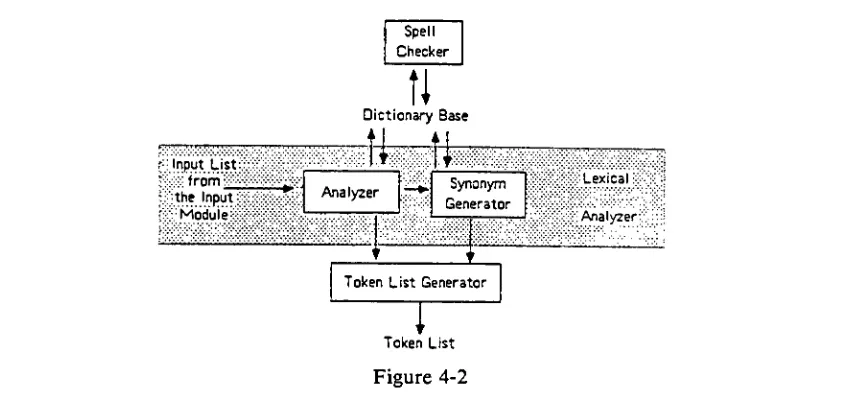
to the tokenlist for lateranalysis (figure 4-2).
The implementation of LEXBOX is recursive, and can be invoked if a declaration is
used in response to a prompt from LEXBOX. LEXBOX will prompt the user ifit cannot
resolve areference and is not sure what to do with it.
Allowing
natural languageinput,
theresponse also must be analyzed, requiring LEXBOX to be recursive in order to properly
interpretthe response. An exampleis thefailure ofLEXBOX to
identify
an input word. Theword may represent a volatile knowledge value, but is nota proper noun, and, therefore, not
Input List;: from::
-theInput Module
Spell
Checker
tl
DictionaryBasei!
fcffe
Analy2er Synonym Generator
PS
Token List Generator [image:39.534.55.482.84.285.2]Token List
Figure 4-2
Lexical
Analyzer
ofthe word's database value. LEXBOX must be able to analyze any natural language input
that requires recursively calling itself. (Note: The hooks for this feature are provided.
Currently,
LEXBOX prompts the user for a response within the format expectedby
LEXBOX. The recursion is in place,
however,
itis the grammar that is not complete.)Currently,
the nestinglimitis not software defined. A valuable enhancement would supply an escape if
some meaningful threshold were
identified, indicating
over-commitmentto therecursive process.
Ofthesystems examined inthe
literature,
onlyLDC-1 displayeda separate lexicalcomponent, althoughthelexical function was integrated into various modules inall other systems.
The use of a separate lexical tool may not be considered a necessary component in natural
language processing, its operation
being
somewhat less complex than that offormal languageanalysis. NBASE research,
however,
proved the lexical analysis phase to be worth implementing as an individual component, providing a theoretical base on which tobuild the sub
components featured
by
it. It also delivered a meaningful approach to theoretically describe5. SYNTAX ANALYSIS
Syntax analysis is the process that defines how language expressions can be generated.
It is the method
by
which valid sentences are recognized/built.Accepting
a list of tokensgenerated
during
lexical analysis, the parser examines the token types to determine whetheror not the string satisfies the structural rules explicit in the syntactic definition of the
language (Aho &
Ullman,
1972). As the token string is processed, theparser imposes a treestructure (notalways explicitly) on thetokens, whichis used in succeeding stages of compila
tion.
Using
aPascal substringas an exampleA + *B
lexicalanalysismaygenerate a tokenstring tomakethe Pascalinput appear as
identifier + * identifier.
The parser should detect the error oftwo adjacent
binary
operators, an illegalstring according
to thesyntacticdefinition ofthelanguage.The second phase of syntax analysis imposes some hierarchical structure on the pro
cessed token stream, grouping related tokens together. The generation of such a structure
(the parse tree) often leads to an ambiguous production ofmultiple structures, requiring the
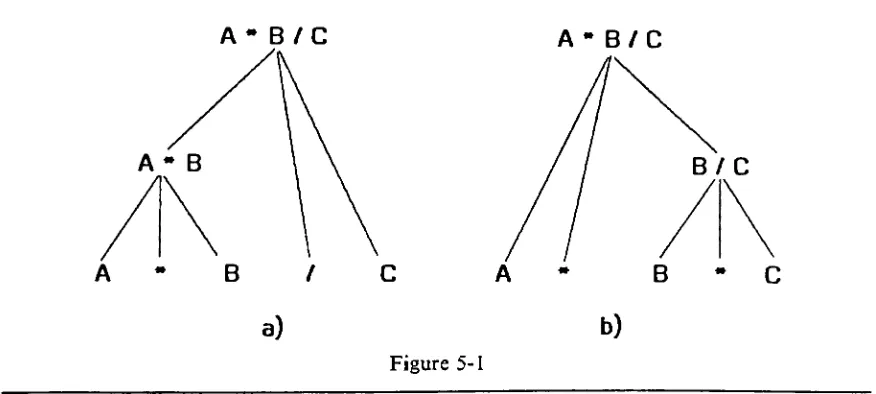
language specificationtodisambiguate theresult. For example, theexpression
A*B/C
hastwo possible interpretations.
The two interpretations are represented
by
two different parse trees (figure 5-1). The challenge of
developing
an unambiguous language specification is a primary concern in the construction ofany parsingsystem1.
Parsing
naturallanguage iseven more challenging. The abilityof a computer toaccept asentence in anatural
language,
such asEnglish,
and recognize its grammaticalform has beentested for nearly three decades with varying degrees of success. Several solutions have been
proposed, some directed at efficient performance, others presented as answers to linguistic
and psychological questions
(Wilcox,
1983).Before examining some of the parsing strategies developed particularly for natural
language analysis, we must examine one of the most influential concerns, the problem of
ambiguityinnaturallanguage.
5.1.
Ambiguity
Ambiguity
is more dominant in natural language than in a formal language. As notedearlier, ambiguous representations in a formal language can be controlled
by
restricting the
A-B/C
[image:41.534.49.487.442.639.2]A-B/C
Figure 5-1
1978.
language specification. This "convenience"
isnot usually availableto the designerof anatural
language parser.
Recalling
the goal of a natural language processor, to exploit the user'sknowledge of his natural
language,
restricting user input to avoid the ambiguities of thenatural language is not acceptable. Some English ambiguities can be disambiguated
by
considering the context within which the related input is found.
Often,
the selection of aninterpretation ismade
by
the user, choosing from amongseveral alternatives givenby
the system.
Syntactic ambiguity in natural language parsing emerges from the fact that
"modifying
clauses"
are oftenseparatedfromthestructures theymodify
(Kaplan,
1984).Themandrove down the streetina car.
Is the street in the car (a valid parse) or is the car on the street? Kaplan has suggested the
following
heuristics for resolving ambiguities, but stresses that syntacticinformation, itself,
isgenerallynot enough.
Kaplan's first suggestion is to define a measure ofdistance over the components ofthe
surface string. Distance is a physical calculation ofthe position of all potential noun phrases
inthe sentence. Potential noun phrases are ranked according to their order in the
input,
thefirst positionreceiving the higherrating.
Using
the previousexample,"the man"would be the
leading
nounphrase in the sentence because it is the first noun phrase encountered and untilotherwise determined is assumed the subject of the sentence. Now we can generate the
correctway to producethis parse. Itis
The man who drove downthe street
-and
The man who drove ina car.
While the decisions affecting the proper parse for the above example required no
semantic
information,
we could modify the surface structure ofthe string to produce a construct that would yield unacceptable results when applying Kaplan's heuristic. A supplemen
tary proposal istoadd an additional featureto thelexicalentries ofall verbs and prepositions
association links the verb to its subject-object reference(s). When an ambiguous parse is
detected,
a combination ofdistance measure and acomparison againstthefeatures list wouldhelp
to isolate the correctstructure. Again using the above example, the verb"drive"